TS Inter 2nd Year Maths 2A Solutions Chapter 1 Complex Numbers Ex 1(b)

Students must practice this TS Intermediate Maths 2A Solutions Chapter 1 Complex Numbers Ex 1(b) to find a better approach to solving the problems.

TS Inter 2nd Year Maths 2A Solutions Chapter 1 Complex Numbers Exercise 1(b)

I.
Question 1.
Write the following complex numbers in the form A + iB.
i) (2 – 3i) (2 + 3i)
ii) (1 + 2i)3
iii) \(\frac{a-i b}{a+i b}\)
iv) \(\frac{4+3 i}{(2+3 i)(4-3 i)}\)
v) (- √3 + √-2) (2√3 – i)
vi) (- 5i) \(\frac{i}{8}\)
vii) (- i) (2i)
viii) i9
ix) i-19
x) 3 (7 + 7i) + i (7 + 7i)
xi) \(\frac{2+5 i}{3-2 i}+\frac{2-5 i}{3+2 i}\)
Solution:
i) z = (2 – 3i) (3 + 4i)
z = 6 + 8i – 9i + 12
z = 18 – i
= 18 + (- 1)i

ii) z = (1 + 2i)3
= 13 + (2i)3 + 3 . 2i(1 + 2i)
= 1 – 8i + 6i (1 + 2i)
= (1 – 12) – 2i
= – 11 – 2i
= (- 11, – 2)

iii) z = \(\frac{a-i b}{a+i b}\)
z = \(\frac{(a-i b)(a-i b)}{(a+i b)(a-i b)}\)
= \(\frac{a^2-b^2-2 a b i}{a^2+b^2}\)
= \(\left(\frac{a^2-b^2}{a^2+b^2}, \frac{-2 a b}{a^2+b^2}\right)\)

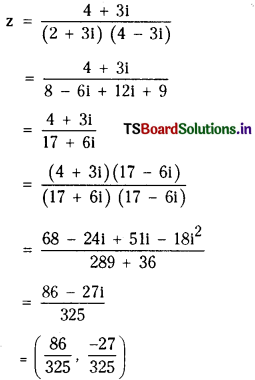
iv) \(\frac{4+3 i}{(2+3 i)(4-3 i)}\)

TS Inter 2nd Year Maths 2A Solutions Chapter 1 Complex Numbers Exercise 1(b) 1

v) (- √3 + √-2) (2√3 – i)
z = (- √3 + √2i) (2√3 – i)
= – 2 . 3 + √3i + 2√6i + √2
= (√2 – 6) + i (√3 + 2√6).

TS Board Inter 2nd Year Maths 2A Solutions Chapter 1 Complex Numbers Ex 1(b)

vi) z = (- 5i) (\(\frac{i}{8}\))
z = \(\) i2
z = \(\frac{5}{8}\) + 0i

vii) (- i) (2i)
z = (- i) (2i)
= 2 + 0i

viii) z = i9
z = (i2)4 . i
z = i = 0 + i . 1

ix) z = i-19
z = \(\frac{1}{\left(\mathrm{i}^2\right)^9} \cdot \frac{1}{\mathrm{i}}\)
= \(\frac{-1}{i}=\frac{-1}{1^2}\)
z = i = 0 + 1 . i

x) z = 3 (7 + 7i) + i (7 + 7i)
= 21 + 21i + 7i + 7i2
= 21 – 7 + 28i
z = 14 + 28i

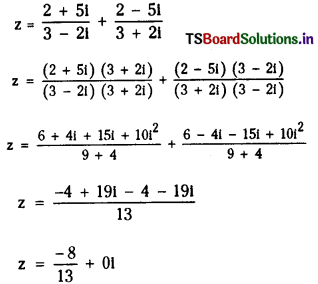
xi) \(\frac{2+5 i}{3-2 i}+\frac{2-5 i}{3+2 i}\)

TS Inter 2nd Year Maths 2A Solutions Chapter 1 Complex Numbers Exercise 1(b) 2

TS Board Inter 2nd Year Maths 2A Solutions Chapter 1 Complex Numbers Ex 1(b)

Question 2.
Write the conjugate of the following complex numbers.
i) (3 + 4i)
ii) (15 + 3i) – (4 – 20i)
iii) (2 + 5i) (- 4 + 6i)
iv) \(\frac{5 \mathbf{i}}{7+1}\)
Solution:
i) z = 3 + 4i
\(\overline{\mathbf{z}}\) = 3 – 4i

ii) z = (15 + 31) – (4 – 201)
z = 11 + 23i
z = 11 – 23i

iii) z = (2 + 5i) (- 4 + 6i)
z = – 8 + 12i – 20i + 30i2
z = – 38 – 8i
z = – 38 + 8i

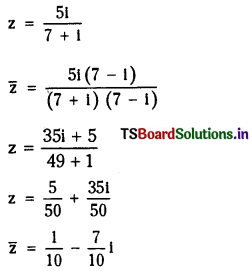
iv) \(\frac{5 \mathbf{i}}{7+1}\)

TS Inter 2nd Year Maths 2A Solutions Chapter 1 Complex Numbers Exercise 1(b) 3

TS Board Inter 2nd Year Maths 2A Solutions Chapter 1 Complex Numbers Ex 1(b)

Question 3.
Simplify
i) i2 + i4 + i6 + ………… + (2n + 1) terms
ii) i18 – 3 . i7 + i2 (1 + i4) (- i)26
Solution:
i) i2 + i4 + i6 + …………… (2n + 1) terms
= i2 + i4 + i6 + ……………. +
= -1 + 1+(-1) + 2n terms + i2
= 0 – 1 = – 1

ii) i18 – 3i7 + i2 (1 + i4) (- i)26
(i2)9 – 3i6i + i2 (1 + i4) (i)26 = – 1 + 3i + (- 1) (1 + 1) (- 1)13
= 3i – 1 + 2 = 3i + 1.

TS Board Inter 2nd Year Maths 2A Solutions Chapter 1 Complex Numbers Ex 1(b)

Question 4.
Find a square root for the following complex numbers.
i) 7 + 24i
ii) – 8 – 6i
iii) 3 + 4i
iv) – 47 + i 8√3
Solution:
i) z = 7 + 24i
Let square root of z be a + ib
a + ib = \(|\sqrt{7+24i}|\)
(a + ib)2 = 7 + 24i
a2 – b2 + 2abi = 7 + 24i
a2 – b2 = 7, 2ab = 24 ……………..(1)
| a + ib | = \(|\sqrt{7+24i}|\)
Squaring on both sides,
| a + ib |2 = | 7 + 24i|
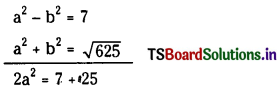
a2 + b2 = \(\sqrt{49+576}\)
a2 + b2 = \(\sqrt{625}\)

TS Inter 2nd Year Maths 2A Solutions Chapter 1 Complex Numbers Exercise 1(b) 4

a2 = 16
a = ± 4
2b2 = 25 – 7
b2 = 9
b = ± 3
a + ib = ± (4 + 3i)

ii) z = – 8 – 6i
Let square root of z be a + ib
a + ib = \(\sqrt{-8-6 \mathrm{i}}\)
Squaring on both sides,
(a + ib)2 = – 8 – 61
a2 – b2 + 2abi = – 8 – 6i
a2 – b2 = – 8, 2ab = – 6 …………..(i)
| a + ib | = \(|\sqrt{-8-6 \mathbf{i}}|\)
Squaring on both sides,
| a + ib |2 = \(|\sqrt{-8-6 \mathrm{i}}|^2\)
a2 + b2 = \(\sqrt{64+36}\)
a2 + b2 = 10 ………….(ii)
(i) + (ii)
2a2 = 2
a2 = 1 or a = ± 1
(ii) – (i)
2b2 = 18
b2 = 9
⇒ b = ± 3
a + ib = ± (1 – 3i).

TS Board Inter 2nd Year Maths 2A Solutions Chapter 1 Complex Numbers Ex 1(b)

iii) z = 3 + 4i
Let square root of z be a + ib
a + ib = \(\sqrt{3+4i}\)
Squaring on both sides,
(a + ib)2 = 3 + 4i
a2 – b2 + 2abi = 3 + 4i
a2 – b2 = 3; 2ab = 4 …………..(i)
| a + ib | = \(|\sqrt{3+4 \mathrm{i}}|\)
Squaring on both sides,
| a + ib |2 = | 3 + 4i |
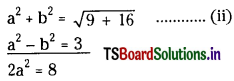
a2 + b2 = \(\sqrt{9+16}\) …………..(ii)
a2 – b2 = 3

TS Inter 2nd Year Maths 2A Solutions Chapter 1 Complex Numbers Exercise 1(b) 5

2a2 = 8
a2 = 4
⇒ a = ± 2
2b2 = 2
⇒ b = ± 1
a + ib = ± (2 + i).

iv) z = – 47 + i 8√3
Let the square root of z be a + ib
(a + ib)2 = – 47 + i 8√3
a2 – b2 = – 47, 2ab = 8√3
| a + ib | = \(|\sqrt{-47+i 8 \sqrt{3}}|\)
Squaring on bothsides,
a2 + b2 = \(\sqrt{(-47)^2+(8 \sqrt{3})^2}\)
= \(\sqrt{2209+192}=\sqrt{2401}\)

TS Inter 2nd Year Maths 2A Solutions Chapter 1 Complex Numbers Exercise 1(b) 6

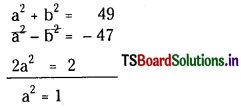
a2 + b2 = 49
a2 – b2 = – 47
2a2 = 2
a2 = 1
a = ± 1
2b2 = 96
b2 = 48
b = ± 4√3
a + ib = ± (1 + 4√3i).

TS Board Inter 2nd Year Maths 2A Solutions Chapter 1 Complex Numbers Ex 1(b)

Question 5.
Find the multiplicative inverse of the following complex numbers.
i) √5 + 3i
ii) – i
iii) i-35
Solution:
i) z = √5 + 3i
Let a + ib be multiplicative inverse then (a + ib) . z = 1
z = \(\frac{1}{a+i b}\)
or a + ib = \(\frac{1}{\mathrm{z}}\)
a + ib = \(\frac{\overline{\mathbf{z}}}{(\mathrm{z} \overline{\mathrm{z}})}\)
a + ib = \(\frac{\bar{z}}{|z|^2}=\frac{\sqrt{5}-3 i}{5+9}\)
= \(\frac{1}{14}\) (√5 – 3i).

ii) z = – i
Let a + ib be multiplicative inverse then (a + ib) z = 1
a + ib = \(\frac{1}{\mathrm{z}}\)
= \(\frac{1}{-i}\)
= \(\frac{i}{-i \cdot i}\)
a + ib = i.

iii) z = i-35
Let a + ib be multiplicative inverse then (a + ib) z = 1
a + ib = \(\frac{1}{\mathrm{z}}\)
= \(\frac{1}{i^{-35}}\) = i35
(a + ib) = i35
= (i2)17 i = – i.

TS Board Inter 2nd Year Maths 2A Solutions Chapter 1 Complex Numbers Ex 1(b)

II.
Question 1.
i) If (a + ib)2 = x + iy, find x2 + y2.
ii) lf x + iy = \(\frac{3}{2+\cos \theta+i \sin \theta}\) then, show that x2 + y2 = 4x – 3.
iii) If x + iy = \(\frac{1}{1+\cos \theta+i \sin \theta}\) then, show that 4x2 – 1 = 0.
iv)If u + iv = \(\frac{2+i}{z+3}\) and z = x + iy find u, v.
Solution:
i) (a + ib) = x + iy
a2 – b2 + 2abi = x + iy ,
a2 – b2 = x
2ab = y
Now x2 = (a2 – b2)2
y2 = 4a2b2
x2 + y2 = (a2 – b2)2 . 4a2b2 = (a2 + b2)2

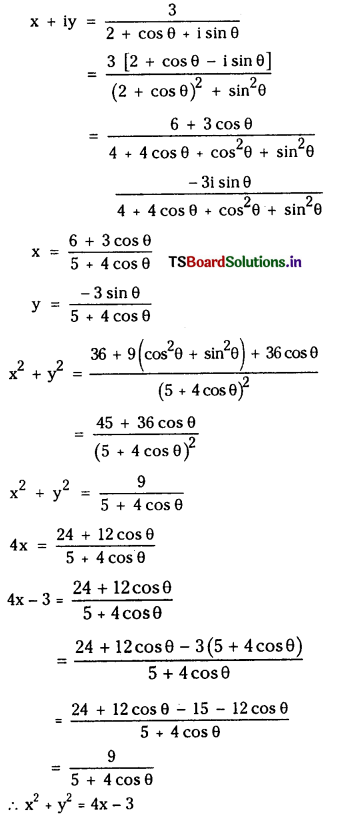
ii) x + iy = \(\frac{3}{2+\cos \theta+i \sin \theta}\)

TS Inter 2nd Year Maths 2A Solutions Chapter 1 Complex Numbers Exercise 1(b) 7

TS Board Inter 2nd Year Maths 2A Solutions Chapter 1 Complex Numbers Ex 1(b)

iii) x + iy = \(\frac{1}{1+\cos \theta+i \sin \theta}\)
x + iy = \(\frac{1+\cos \theta-i \sin \theta}{(1+\cos \theta)^2+\sin ^2 \theta}\)
x = \(\frac{1+\cos \theta}{2+2 \cos \theta}=\frac{(1+\cos \theta)}{2(1+\cos \theta)}\)
x = \(\frac{1}{2}\)
2x = 1
4x2 = 1
4x2 – 1 = 0.

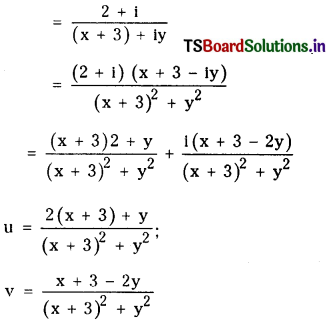
iv) u + iv = \(\frac{2+i}{z+3}\)

TS Inter 2nd Year Maths 2A Solutions Chapter 1 Complex Numbers Exercise 1(b) 8

TS Board Inter 2nd Year Maths 2A Solutions Chapter 1 Complex Numbers Ex 1(b)

Question 2.
i) If z = 3 + 5i then show that z3 – 10z2 + 58z – 136 = 0
ii) If z = 2 – i√7 then show that 3z3 – 4z2 + z + 88 = 0
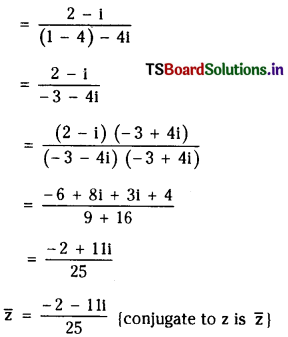
iii) Show that \(\frac{2-i}{(1-2 i)^2}\) and \(\frac{-2-11 i}{25}\) are conjugate to each other.
Solution:
i) z = 3 + 5i
(z – 3)2 = (5i)2
z2 – 6z + 9 = 25i2
z2 – 6z + 9 = – 25
z2 – 6z + 34 = 0
z3 – 6z2 + 34z = 0
(z3 – 10z2 + 58z – 136) + 4z2 – 24z + 136 = 0
(z3 – 10z2 + 58z – 136) + 4 (z2 – 6z + 34) = 0
(z3 – 10z2 + 58z – 136) = 0

il) z = 2 – i√7
(z – 2)2 = (- i – √7)2
z2 – 4z + 4 = – 7
z2 – 4z + 11 = 0
z3 – 4z2 + 11z = 0
3z3 – 12z2 + 33z = 0
(3z3 – 4z2 + z + 88) + (- 8z2 + 32z – 88) = 0
(3z3 – 4z2 + z + 88) – 8 (z2 – 4z + 11) = 0
3z3 – 4z2 + z + 88 = 0.

iii) z = \(\frac{2-i}{(1-2 i)^2}\) (If z = a + ib, \(\overline{\mathbf{Z}}\) = a – ib)

TS Inter 2nd Year Maths 2A Solutions Chapter 1 Complex Numbers Exercise 1(b) 9

TS Board Inter 2nd Year Maths 2A Solutions Chapter 1 Complex Numbers Ex 1(b)

Question 3.
i) If (x – iy)1/3 = a – ib then show that \(\frac{x}{a}+\frac{y}{b}\) = 4(a2 – b2)
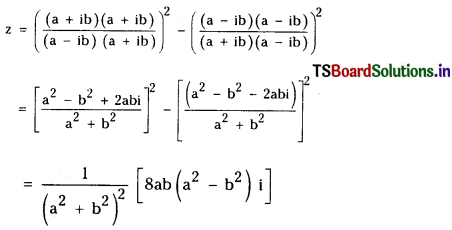
ii) Write \(\left(\frac{a+i b}{a-i b}\right)^2-\left(\frac{a-i b}{a+i b}\right)^2\) in the form x + iy.
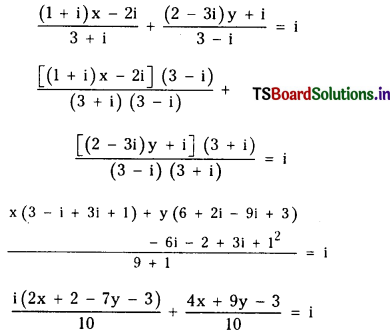
iii) If x and y are real numbers such that \(\frac{(1+i) x-2 i}{3+i}+\frac{(2-3 i) y+i}{3-i}\) determine the values of x and y.
Solution:
(x – iy)1/3 = (a – ib)
x – iy = (a – ib)3
x – iy = a3 + ib3
x = a3 – 3ab2
– iy = ib3 – 3a2bi
\(\frac{x}{a}\) = a2 – 3b2
y = b3 – 3a2b
\(\frac{x}{a}\) = a2 – 3b2
\(\frac{y}{b}\) = b2 – 3a2
\(\frac{x}{a}-\frac{y}{b}\) = 4(a2 – b2).

ii) \(\left(\frac{a+i b}{a-i b}\right)^2-\left(\frac{a-i b}{a+i b}\right)^2\)

TS Inter 2nd Year Maths 2A Solutions Chapter 1 Complex Numbers Exercise 1(b) 10

iii) \(\frac{(1+i) x-2 i}{3+i}+\frac{(2-3 i) y+i}{3-i}\)

TS Inter 2nd Year Maths 2A Solutions Chapter 1 Complex Numbers Exercise 1(b) 12

4x + 9y – 3 = 0
2x – 7y – 3 = 10
Solving, we get
x = 3, y = – 1.

TS Board Inter 2nd Year Maths 2A Solutions Chapter 1 Complex Numbers Ex 1(b)

Question 4.
i) Find the least positive integer n, satisfying \(\left(\frac{1+1}{1-1}\right)^n\) = 1.
ii) If \(\left(\frac{1+i}{1-i}\right)^3-\left(\frac{1-i}{1+i}\right)^3\) = x + iy find x and y.
iii) Find the real values of θ in order that \(\frac{3+2 i \sin \theta}{1-2 i \sin \theta}\) is a
a) real number
b) purely imaginary number
iv) Find the real values of x and y if \(\frac{x-1}{3+i}+\frac{y-1}{3-i}\) = i.
Solution:
i) \(\left(\frac{1+i}{1-i}\right)^n\) = 1
\(\left(\frac{(1+i)(1+i)}{(1-i)(1+i)}\right)^n\) = 1
\(\left(\frac{2 \mathrm{i}}{2}\right)^{\mathrm{n}}\) = 1
in = 1
(∵ in = 1 = – 1 × – 1 = i2 × i2 = i4)
n = 4
i4 = 1
Least value of n = 4.

ii) \(\left(\frac{1+i}{1-i}\right)^3-\left(\frac{i-i}{1+i}\right)^3\) = x + iy
\(\left(\frac{(1+i)(1+i)}{(1+i)(1-i)}\right)^3-\left(\frac{(1-i)(1-i)}{(1+i)(1-i)}\right)^3\) = x + iy
\(\left(\frac{2 \mathrm{i}}{2}\right)^3-\left(\frac{-2 \mathrm{i}}{2}\right)^3\)
– i – i = x + iy
x = 0
y = – 2.

iii) z = \(\frac{3+2 i \sin \theta}{1-2 i \sin \theta}\)
z = \(\frac{(3+2 i \sin \theta)(1+2 i \sin \theta)}{(1-2 i \sin \theta)(1+2 i \sin \theta)}\)
z = \(\frac{3-4 \sin ^2 \theta+8 i \sin \theta}{1+4 \sin ^2 \theta}\)
z is purely real ⇒ imaginary part = 0
\(\frac{8 \sin \theta}{1+4 \sin ^2 \theta}\) = 0
sin θ = 0
θ = nπ, n ∈ 1
z is purely imaginary ⇒ Real part zero
\(\frac{3-4 \sin ^2 \theta}{1+4 \sin ^2 \theta}\) = 0
sin θ = \(\frac{3}{4}\)
sin θ = \(\pm \frac{\sqrt{3}}{2}\)
sin θ = 2nπ ± \(\frac{\pi}{3}\), n ∈ 1.

TS Board Inter 2nd Year Maths 2A Solutions Chapter 1 Complex Numbers Ex 1(b)

iv) \(\frac{x-1}{3+i}+\frac{y-1}{3-1}\) = 1
\(\frac{(x-1)(3-i)}{9+1}+\frac{(y-1)(3+i)}{9+1}\) = 1
\(\frac{3(x-1)+3(y-1)}{10}+\frac{i(1-x+y-1)}{10}\) = 1
3x + 3y – 6 = 0
y – x = 10
Solving we get
x = – 4, y = 6.

TS Inter 2nd Year Maths 2A Solutions Chapter 5 Permutations and Combinations Ex 5(e)

Students must practice this TS Intermediate Maths 2A Solutions Chapter 5 Permutations and Combinations Ex 5(e) to find a better approach to solving the problems.

TS Inter 2nd Year Maths 2A Solutions Chapter 5 Permutations and Combinations Ex 5(e)

I.
Question 1.
If \({ }^{\mathrm{n}} \mathrm{C}_4\) = 210, find n.
Solution:
Given \({ }^{\mathrm{n}} \mathrm{C}_4\) = 210
⇒ \(\frac{n(n-1)(n-2)(n-3)}{4 !}\) = 210
⇒ n (n – 1) (n – 2) (n – 3) = 41 × 210
= 24 × 210
= 7 × 8 × 9 × 10
On comparing largest integers, we get n = 10.

Question 2.
If \({ }^{12} \mathrm{C}_{\mathrm{r}}\) = 495, find the possible values of ‘r’.
Solution:
Given \({ }^{12} \mathrm{C}_{\mathrm{r}}\) = 495
= 11 × 9 × 5
= \(\frac{12 \times 11 \times 9 \times 10}{4 \times 3 \times 2 \times 1}\)
⇒ \({ }^{12} \mathrm{C}_{\mathrm{r}}={ }^{12} \mathrm{C}_4 \text { or }{ }^{12} \mathrm{C}_8\)
⇒ r = 4 or 8.

Question 3.
If 10 . \({ }^n \mathrm{C}_2\) = 3 . \({ }^{n+1} C_3\), find n.
Solution:
Given 10 . \({ }^n C_2\) = 3 . \({ }^{n+1} C_3\)
\(10 \times \frac{n(n-1)}{2}=3 \cdot \frac{(n+1) n(n-1)}{3 \times 2 \times 1}\)
⇒ 10 = n + 1
⇒ n = 9.

TS Board Inter 2nd Year Maths 2A Solutions Chapter 5 Permutations and Combinations Ex 5(e)

Question 4.
If \({ }^n P_r\) = 5040 and \({ }^n C_r\) = 210, find n and r.
Solution:
Given \({ }^n P_r\) = 5040 and \({ }^n C_r\) = 210, \({ }^n P_r=r !^n C_r\)
5040 = r! × 210
⇒ r! = 24
⇒ r! = 4!
∴ r = 4
∴ \({ }^n \mathrm{P}_4\) = 5040
⇒ n (n – 1) (n – 2) (n – 3) = 10 × 9 × 8 × 7
On comparing largest integers, we get n = 10
∴ n = 10 and r = 4.

Question 5.
If \({ }^n C_4={ }^n C_6\), find n.
Solution:
Given \({ }^n C_4={ }^n C_6\)
If \({ }^n C_r={ }^n C_s\), then either r = s or r + s = n.
Clearly, we have n = 4 + 6
⇒ n = 10.

Question 6.
If \({ }^{15} \mathrm{C}_{2 \mathrm{r}-1}={ }^{15} \mathrm{C}_{2 \mathrm{r}+4}\), find r.
Solution:
Given \({ }^{15} \mathrm{C}_{2 \mathrm{r}-1}={ }^{15} \mathrm{C}_{2 \mathrm{r}+4}\)
If \({ }^n C_r={ }^n C_s\) then either r = s or r + s = n.
∴ 2r – 1 = 2r + 4
Which is impossible.
or
2r – 1 + 2r + 4 = 15
⇒ 4r + 3 = 15
⇒ r = 3
∴ r = 3.

TS Board Inter 2nd Year Maths 2A Solutions Chapter 5 Permutations and Combinations Ex 5(e)

Question 7.
If \({ }^{17} C_{2 t+1}={ }^{17} C_{3 t-5}\), find t.
Solution:
Given \({ }^{17} C_{2 t+1}={ }^{17} C_{3 t-5}\)
If \({ }^n C_r={ }^n C_s\), then either r = s or n = r + s.
i.e., either
2t + 1 = 3t – 5
⇒ t = 6 = 17
2t + 1 + 3t – 5 = 17
⇒ 5t = 21
⇒ t = \(\frac{21}{5}\)
Since t’ is an integer, we have t = 6.

Question 8.
If \({ }^{12} C_{r+1}={ }^{12} C_{3 r-5}\), find r.
Solution:
Given \({ }^{12} C_{r+1}={ }^{12} C_{3 r-5}\).
If \({ }^n C_r={ }^n C_s\), then either r = s or n = r + s.
i.e., r + 1 = 3r – 5
or 12 = r + 1 + 3r – 5
⇒ r = 3 or r = 4.

Question 9.
If \({ }^9 C_3+{ }^9 C_5={ }^{10} C_r\), then find r.
Solution:
Given \({ }^9 C_3+{ }^9 C_5={ }^{10} C_r\)
⇒ \({ }^9 \mathrm{C}_3+{ }^9 \mathrm{C}_4={ }^{10} \mathrm{C}_r\) (∵ \({ }^n C_r={ }^n C_s\))
⇒ \({ }^{10} \mathrm{C}_4={ }^{10} \mathrm{C}_{\mathrm{r}}\) (or) \({ }^{10} \mathrm{C}_6={ }^{10} \mathrm{C}_{\mathrm{r}}\)
⇒ r = 4 or r = 6.

TS Board Inter 2nd Year Maths 2A Solutions Chapter 5 Permutations and Combinations Ex 5(e)

Question 10.
Find the number of ways of forming a com-mittee of 5 members from 6 men and 3 ladies.
Solution:
Selecting 5 members to form a commitee from 6 men and 3 ladies (i.e., 9 members) can be done in \({ }^9 \mathrm{C}_5\) = 126 ways.

Question 11.
In question 10, how many committees contain atleast two ladies.
Solution:
In selecting 5 members from 6 men and 3 ladies to form a committee containing atleast two ladies, two cases arises.

Case – (1):
(When committee contains exactly two ladies) :
Number of ways of selecting 2 ladies from 3 ladies is \({ }^3 \mathrm{C}_2\).
Now the remaining 3 members are selected from 6 men and this can be done in C3 ways
∴ Number of ways to form a committee with 2 ladies = \({ }^3 \mathrm{C}_2 \times{ }^6 \mathrm{C}_3\) = 60.

Case – (2)
(When committee contains 3 ladies) :
Selecting 3 ladies from 3 ladies can be done in \({ }^3 \mathrm{C}_3\) ways.
Selecting remaining 2 members from 6 men can be done in \({ }^6 \mathrm{C}_2\) ways.
∴ Number of ways to form a committee with 3 ladies = \({ }^3 \mathrm{C}_3 \times{ }^6 \mathrm{C}_2\) = 15
∴ Total number of ways = 60 + 15 = 75.

Question 12.
If \({ }^n C_5={ }^n C_6\), then \({ }^{13} \mathrm{C}_{\mathrm{n}}\).
Solution:
Given, \({ }^n C_5={ }^n C_6\)
⇒ n = 5 + 6
(If \({ }^n C_r={ }^n C_s\) then either n = r + s or r = s)
⇒ n = 11
Now, \({ }^{13} C_n={ }^{13} C_{11}={ }^{13} C_2\) = 78.

TS Board Inter 2nd Year Maths 2A Solutions Chapter 5 Permutations and Combinations Ex 5(e)

II.
Question 1.
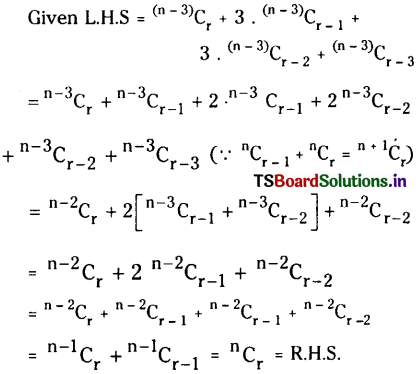
Prove that 3 ≤ r ≤ n, \({ }^{(n-3)} C_r+3 \cdot{ }^{(n-3)} C_{(r-1)}+3 \cdot{ }^{(n-3)} C_{(r-2)}+{ }^{(n-3)} C_{(r-3)}={ }^n C_r\).
Solution:
Given 3 ≤ r ≤ n

TS Inter 2nd Year Maths 2A Solutions Chapter 5 Permutations and Combinations Ex 5(e) 1

Question 2.
Find the value of \({ }^{10} C_5+2 \cdot{ }^{10} C_4+{ }^{10} C_3\).
Solution:
\({ }^{10} C_5+2 \cdot{ }^{10} C_4+{ }^{10} C_3\)
= \({ }^{10} C_5+{ }^{10} C_4+{ }^{10} C_4+{ }^{10} C_3\)
= \({ }^{11} C_5+{ }^{11} C_4\) (∵ \({ }^n C_{r-1}+{ }^n C_r={ }^{n+1} C_r\))
= \({ }^{12} \mathrm{C}_5\) = 792.

Question 3.
Simplify \({ }^{34} C_5+\sum_{r=0}^4(38-r) C_4\).
Solution:

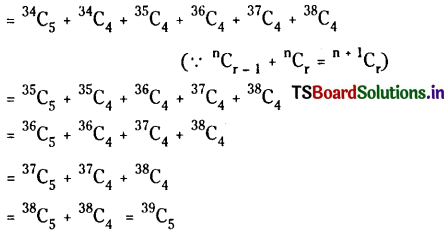
TS Inter 2nd Year Maths 2A Solutions Chapter 5 Permutations and Combinations Ex 5(e) 2

TS Board Inter 2nd Year Maths 2A Solutions Chapter 5 Permutations and Combinations Ex 5(e)

Question 4.
In a class there are 30 students. If each student plays a chess gaine with each of the other student, then find the total number of chess games played by them.
Solution:
Number of students in a class = 30.
Given each students plays a chess game with each of the other student.
∴ The total number of chess games played is equal to number of ways of selecting 2 students to play a game from 30 students.
This can be done in \({ }^{30} \mathrm{C}_2\) ways.
∴ The number of chess games played = \({ }^{30} \mathrm{C}_2\) = 435.

Question 5.
Find the number of ways of selectIng 3 girls and 3 boys out of 7 girls and 6 boys.
Solution:
Number of ways of selecting 3 girls out of 7 girls = \({ }^7 \mathrm{C}_3\)
Number of ways of selecting 3 boys ouf of 6 boys = \({ }^6 \mathrm{C}_3\)
∴ The total number of ways = \({ }^7 \mathrm{c}_3 \cdot{ }^6 \mathrm{c}_3\)
= 35 . 20 = 700.

Question 6.
Find the number of ways of selecting a committee of 6 members out of 10 mem bers always Including a specified member.
Solution:
A committee of 6 members is to be formed out of 10 members in which a specified member is always included.
So, remaining 5 members are to be selected from rest of 9 members.
This can be done in \({ }^9 \mathrm{C}_5\) ways.
∴ Required number of ways \({ }^9 \mathrm{C}_5\) = 126.

TS Board Inter 2nd Year Maths 2A Solutions Chapter 5 Permutations and Combinations Ex 5(e)

Question 7.
Find the number of ways of selecting 5 books from 9 different mathematics books such that a particular book ¡s not included.
Solution:
Given out of 9 different mathematics books a particular book is not included.
∴Number of book left are ‘8′.
∴ Number of ways of selecting 5 books out of 8 different books are \({ }^8 C_5\) = 56.

Question 8.
Find the number of ways of selecting 3 vowels and 2 consonants from the letters of the word EQUATION.
Solution:
The word EQUATION contains 5 vowels and 3 consonants.
Number of ways of selecting 3 vowels out of 5 = \({ }^5 \mathrm{C}_3\) = 10
Number of ways of selecting 2 consonants out of 3 = \({ }^3 \mathrm{C}_2\) = 3
∴ Total number of ways = 10 x 3 = 30.

Question 9.
Find the number of diagonals of a polygon with 12 sides.
Solution:
Number of sides of a polygon = 12
Number of diagonals of a n – sided polygon = \({ }^n C_2\) – n
∴ Number of diagonals of 12 sided polygon = \({ }^{12} C_2\) – 12 = 54.

TS Board Inter 2nd Year Maths 2A Solutions Chapter 5 Permutations and Combinations Ex 5(e)

Question 10.
If n persons are sitting in a row, find the number of ways of selecting two persons, who are sitting adjacent to each other.
Solution:
Number of ways of selecting 2 persons out of n persons sitting in a row, who are sitting adjacent to each other = n – 1.

Question 11.
Find the number of ways of giving away 4 similar coins to 5 boys if each boy can be given any number (less than or equal to 4) of coins.
Solution:
In distribution of 4 similar coins to 5 boys, the following cases arises.

Case – (i) :
Giving all 4 coins to one boys. This is done in \({ }^5 \mathrm{C}_1\) ways.

Case – (ii) :
Giving 4 coins to two boys so that one of them gets 1 and the other 3 coins.
This is done in 2 x \({ }^5 \mathrm{C}_2\) ways.

Case – (iii) :
Giving 4 coins to two boys so that each get 2 coins. This can be done in \({ }^5 \mathrm{C}_2\) ways.

Case – (iv) :
Giving 4 coins to three boys so that, two of them gets 1 coin and the other gets 2. This is done in \({ }^5 \mathrm{C}_3 \times \frac{3 !}{2 !}\) ways.

Case – (v):
Giving 4 coins to four boys so that each gets 1.
This is done in \({ }^5 \mathrm{C}_4\) ways.
∴ Total number of ways = \({ }^5 \mathrm{C}_1+2 \times{ }^5 \mathrm{C}_2+{ }^5 \mathrm{C}_2+\frac{3 !}{2 !}{ }^5 \mathrm{C}_3+{ }^5 \mathrm{C}_4\) = 70.

TS Board Inter 2nd Year Maths 2A Solutions Chapter 5 Permutations and Combinations Ex 5(e)

III .
Question 1.
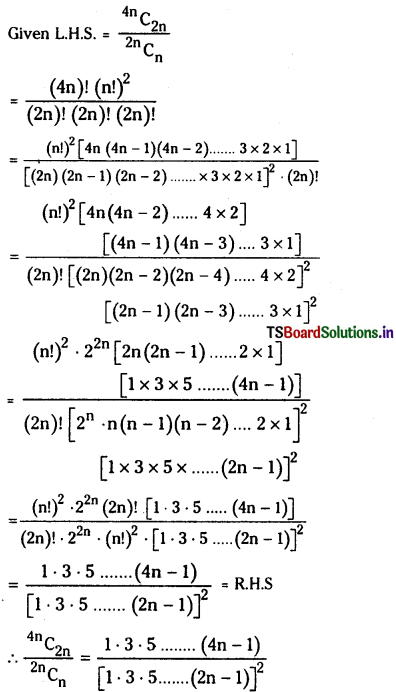
Prove that \(\frac{{ }^{4 n} C_{2 n}}{{ }^{2 n} C_n}=\frac{1 \cdot 3 \cdot 5 \ldots \ldots(4 n-1)}{\{1 \cdot 3 \cdot 5 \ldots \ldots(2 n-1)\}^2}\).
Solution:

TS Inter 2nd Year Maths 2A Solutions Chapter 5 Permutations and Combinations Ex 5(e) 3

TS Board Inter 2nd Year Maths 2A Solutions Chapter 5 Permutations and Combinations Ex 5(e)

Question 2.
If a set A has 12 elements, find the number of subsets of A having
i) 4 elements
ii) Atleast 3 elements
iii) Atmost 3 elements.
Solution:
Given number of elements in set A are 12.

i) Subsets of A having 4 elements :
Number of subsets of A having 4 elements is equal to number of ways of selecting 4 elements from 12 elements in set ‘A’.
This can be done in \({ }^{12} C_4\) ways.
∴ Number of subsets of A having 4 elements = \({ }^{12} C_4\) = 495.

ii) Subset of A contains atleast 3 elements:
Number of subsets of A, having ‘r’ elements is equal to number of ways of selecting ‘r’ elements from 12 elements in set A’, i.e., \({ }^{12} \mathrm{C}_{\mathrm{r}}\) ways.
∴ Number of ways of selecting at least 3 elements from 12 elements in set A is \({ }^{12} \mathrm{C}_3+{ }^{12} \mathrm{C}_4+\ldots \ldots+{ }^{12} \mathrm{C}_{12}\)
Number of subsets of A having atleast 3 elements = \({ }^{12} \mathrm{C}_3+{ }^{12} \mathrm{C}_4+\ldots \ldots+{ }^{12} \mathrm{C}_{12}\)
= \(\left({ }^{12} \mathrm{C}_0+{ }^{12} \mathrm{C}_1+\ldots \ldots+{ }^{12} \mathrm{C}_{12}\right)-{ }^{12} \mathrm{C}_0-{ }^{12} \mathrm{C}_1-{ }^{12} \mathrm{C}_2\)
= 212 – \({ }^{12} \mathrm{C}_0+{ }^{12} \mathrm{C}_1+{ }^{12} \mathrm{C}_2\) = 4017.

iii) Number of subsets of ‘A’ having atmost 3 elements :
Number of subsets of A having ‘r’ elements is equal to number of ways of selecting r’ elements from 12 elements in set ‘A’ i.e., \({ }^{12} C_r\) ways.
∴ Number of ways of selecting atmost 3 elements from 12 elements in set A is \({ }^{12} \mathrm{C}_0+{ }^{12} \mathrm{C}_1+{ }^{12} \mathrm{C}_2+{ }^{12} \mathrm{C}_3\).
∴ Number of subsets of ‘A’ having atmost 3 elements = \({ }^{12} \mathrm{C}_0+{ }^{12} \mathrm{C}_1+{ }^{12} \mathrm{C}_2+{ }^{12} \mathrm{C}_3\) = 299.

TS Board Inter 2nd Year Maths 2A Solutions Chapter 5 Permutations and Combinations Ex 5(e)

Question 3.
Find the numbers of ways of selecting a cricket team of 11 players from 7 batsmen and 6 bowlers such that there will be atleast 5 bowlers in the team.
Solution:
Number of batsmen = 7
Number of bowlers = 6
In selecting 11 players in a team out of given 13 players so that the team contains atleast 5 bowlers, two cases arises.

Case (i) : (Selecting 5 bowlers) :
Number of ways of selecting 5 bowlers from 6 = \({ }^6 \mathrm{C}_5\)
The remaining 6 players are selected from 7 batsmen can be done in \({ }^7 \mathrm{C}_6\) ways.
Number of ways of selecting = \({ }^7 \mathrm{C}_6 \times{ }^6 \mathrm{C}_5\).

Case – (ii) (Selecting 6 bowlers) :
Number of ways of selecting 6 bowlers from 6 = \({ }^6 \mathrm{C}_6\)
The remaining 5 players to be selected from 7 batsmen can be done in \({ }^7 \mathrm{C}_5\) ways.
∴ Number of ways of selecting = \(\mathrm{C}_6 \times{ }^7 \mathrm{C}_5\)
Total number of ways of selecting = \({ }^7 \mathrm{C}_6 \times{ }^7 \mathrm{C}_5+{ }^7 \mathrm{C}_5 \times{ }^6 \mathrm{C}_6\) = 63.

Question 4.
In 5 vowels and 6 consonants are given, then how many 6 letter words can be formed with 3 vowels and 3 consonants.
Solution:
Given 5 vowels and 6 consonants.
6 letter word is formed with 3 vowels and 3 consonants.
Number of ways of selecting 3 vowels from 5 vowels is \({ }^5 \mathrm{C}_3\).
Number of ways of selecting 3 consonants from 6 consonants is \({ }^6 \mathrm{C}_3\).
∴ Total number of ways of selecting = \({ }^5 \mathrm{C}_3 \times{ }^6 \mathrm{C}_3\)
These letters can be arranged themselves in 6! ways.
∴ Number of 6 letter words formed = \({ }^5 \mathrm{C}_3 \times{ }^6 \mathrm{C}_3\) × 6!.

TS Board Inter 2nd Year Maths 2A Solutions Chapter 5 Permutations and Combinations Ex 5(e)

Question 5.
There are 8 railway stations along a rail-way line. In how many ways can a train be stopped at 3 of these stations such that no two of them are consecutive ?
Solution:
Let S1, S2, S3 ……. S8 be 8 railway stations along a railway line.
Train is to be stopped at 3 stations.
Number of ways of selecting 3 stations out of 8 stations is 8Cr
Number of ways of selecting 3 consecutive stations is 6.
(i.e., (S1, S2, S3), (S2, S3, S4), ………. (S6, S7, S8)}
Number of ways of selecting only 2 consecu¬tive stations = 2 × 5 + 5 × 4 = 30
As no two stops are consecutive, number of ways of selecting = \({ }^8 \mathrm{C}_3\) – 6 – 30 = 20.

Question 6.
Find the number of ways of forming a com¬mittee of 5 members out of 6 Indians and 5 Americans so that always the Indians will be in majority in the committee.
Solution:
A committee of 5 members is to be formed out of 6 Indians and 5 Americans.
As committee contains the majority of Indians, 3 cases arises.

i) Selecting 3 Indians and 2 Americans :
Number of ways of selecting 3 Indians out of 6 Indians = \({ }^6 \mathrm{C}_3\)
Number of ways of selecting 2 Americans out of 3 Indians = \({ }^5 \mathrm{C}_2\)
Number of ways of selecting 3 Indians and 2 Americans = \({ }^6 \mathrm{C}_3 \times{ }^5 \mathrm{C}_2\).

ii) Selecting 4 Indians and 1 American :
Number of ways of selecting 4 Indians out of 6 Indians = \({ }^6 \mathrm{C}_4\)
Number of ways of selecting 1 American out of 5 Americans = \({ }^5 \mathrm{C}_1\)
Number of ways of selecting 4 Indians and 1 American = \({ }^6 \mathrm{C}_4 \times{ }^5 \mathrm{C}_1\).

iii) Selecting 5 Indians :
Number of ways of selecting all 5 members
Indians out of 6 Indians = \({ }^6 \mathrm{C}_5\).
∴ Total numbers of ways of forming a committee = \({ }^6 \mathrm{C}_3 \times{ }^5 \mathrm{C}_2+{ }^6 \mathrm{C}_4 \times{ }^5 \mathrm{C}_1+{ }^6 \mathrm{C}_5\) = 281.

TS Board Inter 2nd Year Maths 2A Solutions Chapter 5 Permutations and Combinations Ex 5(e)

Question 7.
A question paper is divided into 3 sections A, B, C containing 3, 4, 5 questions respectively, Find the number of ways of attempting 6 questions choosing atleast one from each section.
Solution:
A question paper contains 3 sections A, B, C containing 3, 4, 5 questions respectively.
Number of ways of selectng 6 questions out of these 12 questions = \({ }^{12} \mathrm{C}_6\)
Number of ways of selecting 6 questions from sections B and C (i.e., from 9 questions) = \({ }^{9} \mathrm{C}_6\)
Number of ways of selecting 6 questions from sections A and C (i.e., from 8 questions) = \({ }^{8} \mathrm{C}_6\)
Number of ways of selecting 6 questions from sections A and B (i.e., 7 questions) = \({ }^{7} \mathrm{C}_6\)
∴ Number of ways of selecting 6 questions choosing atleast one from each section = \({ }^{12} \mathrm{C}_6-{ }^7 \mathrm{C}_6-{ }^8 \mathrm{C}_6-{ }^9 \mathrm{C}_6\) = 805.

Question 8.
Find the number of ways in which 12 things be
(i) divided into 4 equal groups
(ii) distributed to 4 persons equally.
Solution:
i) Dividing 12 things in 4 equal groups :
Number of ways of dividing 12 things into 4 equal groups = \(\frac{12 !}{(3 !)^4 \cdot 4 !}\).

ii) Distributing 12 things to 4 persons equally
Number of ways of distributing 12 things to 4 persons equally = \(\frac{12 !}{(3 !)^4 \cdot 4 !}\).

TS Board Inter 2nd Year Maths 2A Solutions Chapter 5 Permutations and Combinations Ex 5(e)

Question 9.
A class contains 4 boys and g girls. Every Sunday, five students with atleast 3 boys go for a picnic. A different group is being sent every week. During the picnic, the class teacher gives each girl in the group a doll. If the total number of dolls distributed is 85, find g.
Solution:
A class contains 4 boys and ‘g’ girls,
In selecting 5 students with atleast 3 boys for picnic two cases arises.

i) Selecting 3 boys and 2 girls :
Number of ways of selecting 3 boys and 2 girls = \({ }^4 C_3 \times{ }^g C_2=4\left({ }^g C_2\right)\)
As each group contains 2 girls, number of dolls required = 8 \(8\left({ }^8 \mathrm{C}_2\right)\).

ii) Selecting 4 boys and 1 girl :
Number of ways of selecting 4 boys and 1 girl = \({ }^4 \mathrm{C}_4 \times{ }^{\mathrm{g}} \mathrm{C}_1\) = g
∴ As each group contains only 1 girl, number of dolls required = g
∴ Total number of dolls = 8 (\(\left({ }^g \mathrm{C}_2\right)\)) + g
i.e., 85 = \(\frac{g(g-1)}{2}\) + g
⇒ 85 = 4g2 – 3g
⇒ 4g2 – 3g – 85 = 0
⇒ (4g + 17) (g – 5) = 0
⇒ g = 5 (∵ ‘g’ is non-negative integer).

TS Inter 2nd Year Economics Study Material Chapter 9 పర్యావరణ అర్థశాస్త్రం

TS Inter 2nd Year Economics Study Material 9th Lesson పర్యావరణ అర్థశాస్త్రం

వ్యాసరూప సమాధాన ప్రశ్నలు:

ప్రశ్న 1.
వివిధ రకాల కాలుష్యాలను వివరించి, వాటి ప్రభావాలను పరిశీలించండి.
జవాబు.
కాలుష్యం (Pollution) :
గాలి, నీటితో కలసిన కాలుష్యకాలు కాలుష్యాన్ని సృష్టిస్తాయి. ఇవి వాతావరణాన్ని కలుషితం చేసి పరిసరాలకు నష్టాన్ని కలిగిస్తాయి. కాలుష్యం అన్ని జీవరాశులకు ప్రమాదాన్ని కలిగిస్తుంది. భౌతిక పర్యావరణ విచ్ఛేదనకు కూడా కాలుష్యం కారణమవుతుంది. కాలుష్యం ప్రధానంగా వాయు కాలుష్యం, జల కాలుష్యం, ధ్వని కాలుష్యం అనే మూడు రూపాలలో ఉంటుంది.

1. వాయు కాలుష్యం :
వాయు కాలుష్యానికి కారణాలు లేదా ఆధారాలు :

  1. వ్యవసాయ కార్యకలాపాలు
  2. పదార్థాల దహనం
  3. యంత్రాల సహాయంతో జరిగే ఉత్పత్తి ప్రక్రియలు
  4. ద్రావకం ఉపయోగిత
  5. న్యూక్లియర్ శక్తి కార్యక్రమాల నిర్వహణ, మానవులు, జంతువులు, పక్షులు మొదలైన జీవరాశి శ్వాస వ్యవస్థపై వాయు కాలుష్యం తీవ్ర ప్రభావాన్ని చూపుతుంది.

ఆహార వస్తువులు, కూరగాయలు, పండ్లపై వాయు కాలుష్య ప్రభావం ఉంటుంది. మొక్కలు, పంటలు, పచ్చిక భూములపై దుమ్ము పొరలు ఏర్పడటంవల్ల భూమి ఉత్పాదక శక్తి తగ్గుతుంది. హరిత గృహంపై దీని ప్రభావంవల్ల భూమి మీది ఉష్ణోగ్రతలు ఎక్కువగా పెరిగి ధ్రువ ప్రాంతాలలోని మంచుగడ్డలు, హిమానీనదాలు కరిగిపోయే ప్రమాదం ఉంది. ఆమ్ల వర్షాలు, వాయు కాలుష్యం ద్వారా ఏర్పడి భూమి మీద భవనాలను, చెట్లను, మొక్కలను, అటవీ ప్రాంతాలను నష్టపరుస్తాయి.

2. జల కాలుష్యం (Water Pollution) :
నీటి స్వభావాన్ని మార్చి ఉపయోగానికి పనికి రాకుండా ప్రమాదకరమైన రీతిలో జల కాలుష్యం నీటిని పాడుచేస్తుంది. ప్రాణి కోటికి ప్రమాదకరమైన అదనపు పదార్థాలు నీటిలో కలవడమే జల కాలుష్యంగా నిర్వచించవచ్చు. కాలుష్యం వల్ల వీటి మధ్య సమతుల్యత దెబ్బతింటుంది.

  1. మురుగు వ్యర్థ పదార్థాలు
  2. అంటు వ్యాధుల ఏజెంట్లు
  3. విదేశీ సేంద్రియ రసాయనాలు
  4. రసాయనిక ఖనిజ పదార్థాలు, సమ్మేళనాలు మొదలైన వాటిని నీటి కాలుష్య కారకాలుగా చెప్పవచ్చు.

నీటి కాలుష్యం అనేక సమస్యలను సృష్టిస్తుంది. వాస్తవానికి ఎన్నో వ్యాధులకు ఇతర పర్యావరణ ప్రమాదాలకంటే నీటి కాలుష్యమే ప్రధానమైంది. కలరా, టైఫాయిడ్ అతి విరోచనాలవంటి వ్యాధులు నీటి కాలుష్యం ద్వారా వ్యాప్తి చెందుతాయి.

కొన్ని పరిశ్రమలు తమకు కావలసిన స్థాయిలో నీటిని శుభ్రపరచడంకోసం అధిక మొత్తాలలో వెచ్చించాల్సి రావడంవల్ల ఉత్పత్తి వ్యయాలు పెరుగుతున్నాయి. నీటి కాలుష్యం చేపలను చంపి జల ఆహార నిల్వలను నశింపచేస్తుంది.

3. ధ్వని కాలుష్యం (Noise Pollution) :
ధ్వని కాలుష్యం శరీర సంబంధమైన లేదా మానసిక సంబంధమైన హానిని కలగజేస్తుంది. రైల్వేలు, పరిశ్రమలు, నిర్మాణ రంగ కార్యకలాపాలు, ప్రజా సమూహాల కలయికల, లౌడ్ స్పీకర్లను ఉపయోగించడం `వంటి క్రియలు ధ్వనిని వ్యాప్తి చేస్తాయి.

చెవికి ఇబ్బంది కలిగించే ధ్వని కాలుష్యం తాత్కాలికంగా కాని, శాశ్వతంగా కాని వినికిడి సామర్థ్యాన్ని తగ్గిస్తుంది. కొంతకాలంపాటు ధ్వని కాలుష్యానికి లోనైతే చెవిటితనం వచ్చే ప్రమాదముంది. ధ్వని కాలుష్యంవల్ల మెదడు, నరాల వ్యవస్థ దెబ్బతిని, చికాకు స్వభావం పెరుగుతుంది. నిరంతర ధ్వని కాలుష్య ప్రభావంవల్ల శ్రామిక సామర్థ్యం, వారి వృత్తిపరమైన పనితీరు క్షీణిస్తుంది.

TS Board Inter Second Year Economics Study Material Chapter 9 పర్యావరణ అర్థశాస్త్రం

ప్రశ్న 2.
పర్యావరణ క్షీణత ఆర్థిక వ్యవస్థను ఏ విధంగా ప్రభావితం చేస్తుంది ? ఈ సమస్యను అధిగమించడానికి నివారణ చర్యలను సూచించండి.
జవాబు.
I. పర్యావరణ విచ్ఛేదన భావన :
పర్యావరణ విచ్ఛేదనం అంటే భూమిపై జరిగిన ఛిద్రత లేదా పర్యావరణంలోని సహజ వనరుల రూపంలో ఉన్న ఆస్తుల క్షీణత అనవచ్చు. ప్రకృతి ఉపరితలంలో రాకూడని మార్పులు లేదా తీవ్రతను పర్యావరణ విచ్ఛేదనంగా చెప్పవచ్చు. భూమిపైగల సహజ వనరులు క్రమంగా క్షీణించి కొన్ని జీవరాశులు అంతరించి పోవడం పర్యావరణ విచ్ఛేదనను కలుగజేస్తుంది. వాయు కాలుష్యం, జల కాలుష్యం, భూమిపై పొరలలో ఉన్న సహజ శక్తుల క్షీణతవంటి సమస్యలు ఈ విచ్ఛేదనంవల్ల సృష్టించబడతాయి.

II. పర్యావరణ విచ్ఛేదనకు కారణాలు :

1. భూసార క్షీణత :
పనికిరాని పిచ్చి మొక్కలు ప్రకృతిని, పరిసరాలను ఆవరించే సహజంగా ఉన్న హరిత ప్రదేశాలను క్రమంగా క్షీణింపచేస్తాయి. ఈ విధమైన వృక్ష సంబంధమైన జీవరాశులు భూమి, భూమిలోని పర్యావరణపరమైన ఆస్తులను నాశనం చేస్తాయి. అటవీ ప్రాంతాలలో, మైదాన ప్రాంతాలలో, పంట భూములలో పశువుల మేతకోసం తొక్కిడి అధికంగా ఉన్నప్పుడు సారవంతమైన భూమి ఉపరితలంలోని పొరలు దెబ్బతిని భూమి గట్టితనాన్ని సంతరించుకుంటుంది.

2. కాలుష్యం :
వాయు, జల, ధ్వని పరమైన కాలుష్యాలు పర్యావరణానికి ప్రమాదకరమైనవి. ఈ కాలుష్యాలు గాలి, నీరు, భూమి నాణ్యతలను క్షీణింప చేస్తాయి. ధ్వని కాలుష్యం చెవులకు కలిగించే నష్టంతోపాటు పక్షులకు, జంతువులకు భయాందోళనలను కలిగిస్తుంది. అమితమైన జనాభా పెరుగుదల సహజ వనరులపై ఒత్తిడిని పెంచి పర్యావరణ విచ్ఛేదనకు దారితీస్తుంది.

3. చెత్తా చెదారాల సమూహం (Landfills) :
చెత్తా చెదారాల కుప్పలు వాయు కాలుష్యాన్ని సృష్టిస్తాయి. ఇవి చెడు వాసనలు సృష్టించడంతోపాటు అధికస్థాయిలో పర్యావరణ విచ్ఛేదనకు కారణమవుతాయి. వ్యర్థ పదార్థాలు, అపరిశుభ్రమైన మురుగు నీటితో ఇవి నిండి ఉంటాయి.

4. వన నిర్మూలన:
గృహ నిర్మాణ కార్యకలాపాల దృష్ట్యా, పరిశ్రమల స్థాపన దృష్ట్యా అడవులను నరికివేయడాన్ని వన నిర్మూలన అంటారు. వ్యవసాయ భూమి విస్తరణకోసం, వంట చెరకు అవసరాలకోసం అడవులలోని వృక్షాలను నరికి వేస్తున్నారు. పెద్ద తరహా నీటిపారుదల ప్రాజెక్టులకోసం కొన్ని ప్రాంతాలలో వన నిర్మూలన జరుగుతుంది. ఇందువల్ల పర్యావరణంలోకి చేరే కార్బన్ పరిమాణం పెరిగి ప్రపంచవ్యాప్తంగా భూతాపం పెరుగుతూ ఉంది. వర్షాభావం కూడా ఏర్పడే ప్రమాదం ఉంది.

5. సహజ కారణాలు :
భూకంపాలు, సముద్ర కెరటాలు, ఉప్పెనలు, సునామీలు, వన దహనాలు, జంతువులను, వృక్ష సముదాయాలను నాశనం చేస్తాయి. వీటివల్ల వర్తమానంలోనూ మరియు దీర్ఘకాలంలోనూ పర్యావరణంపై ప్రభావాలు ఉంటాయి.

6. పారిశ్రామికీకరణ, అధికోత్పత్తి:
శాస్త్ర, సాంకేతిక రంగాల అభివృద్ధితో ప్రపంచదేశాలలో ఉత్పాదక సామర్థ్యాలు విస్తరించాయి. ఉత్పత్తిని విస్తరించడానికి సహజ వనరులు, ముడి పదార్థాలు విరివిగా వినియోగించబడుతున్నాయి. పరిశ్రమల పొగ, ధ్వని, వ్యర్థ పదార్థాల విసర్జకాల ద్వారా పర్యావరణ విచ్ఛేదనానికి కారణాలు అవుతున్నాయి.

III. పర్యావరణ విచ్ఛేదన ప్రభావాలు :

  1. మానవాళి ఆరోగ్యంపై పర్యావరణ విచ్ఛేదన ప్రభావం తీవ్రంగా ఉంది. ఆస్తమా, క్షయ, న్యూమోనియా, అతి విరోచనాలు వంటి వ్యాధులు కాలుష్యంవల్ల పెరుగుతున్నాయి. వాయు, జల, ధ్వని కాలుష్యంవల్ల సంబంధిత సమస్యలు క్రమంగా పెరుగుతున్నాయి.
  2. జీవావరణ వ్యవస్థ సమతుల్యంగా ఉండటానికి జీవ వైవిధ్యం అవసరం. పర్యావరణ క్షీణత జీవ వైవిధ్యాన్ని క్షీణింపచేస్తుంది. పర్యావరణ విచ్ఛేదన ఓజోన్ పొరను క్షీణింపచేస్తుంది. ఇందువల్ల హానికరమైన కాంతి కిరణాలు భూమిపైకి వస్తాయి.
  3. పర్యాటకులు ఒకే దేశంలోని లేదా ప్రాంతంలోని ప్రకృతిని, జంతు జాలాన్ని పక్షులను పచ్చదనంతో కూడిన భూభాగాన్ని దర్శించి ఆనందించాలని భావిస్తారు. కానీ, పర్యావరణ విచ్ఛేదన పర్యాటక బృందాలను నిరుత్సాహపరుస్తుంది.
  4. పర్యావరణ విచ్ఛేదన ప్రభుత్వాలపై అధిక ఆర్థిక భారాన్ని మోపుతుంది. అధిక మొత్తాలను పర్యావరణం పరిరక్షణపై వ్యయం చేయడం ప్రభుత్వాలకు తప్పనిసరి భారం అవుతుంది.
    పర్యావరణం విచ్ఛేదనను తగ్గించి పుడమి తల్లిని రక్షించుకోవలసిన బాధ్యత అందరిపైనా ఉంది. ఇందుకు ప్రజలను పర్యావరణపరమైన విద్య ద్వారా చైతన్య పరచవలసిన అవసరం ఎంతో ఉంది.

TS Board Inter Second Year Economics Study Material Chapter 9 పర్యావరణ అర్థశాస్త్రం

ప్రశ్న 3.
వివిధ రకాల కాలుష్యాలకు గల కారణాలను, వాటివల్ల ఏర్పడే ప్రభావాలను తెలియజేయండి.
జవాబు.
వ్యాసరూప సమాధాన ప్రశ్న – 1 చూడుము.

ప్రశ్న 4.
పర్యావరణ సుస్థిరత లక్ష్యాలు ఏవి ? సుస్థిర అభివృద్ధి ప్రాధాన్యతను వివరించండి.
జవాబు.
సుస్థిర అభివృద్ధి లక్ష్యాలు :

1.వృద్ధి లేదా ఆదాయాలలో పెరుగుదల :
సుస్థిర అభివృద్ధి అన్ని వర్గాల జీవన ప్రమాణాలను పెంపొందించే ఉద్దేశంలో ఉంటుంది. విద్య, ఆరోగ్య, ప్రజా జీవనంలో భాగస్వామ్యం, స్వచ్ఛమైన పర్యావరణం, సమ న్యాయం పెంపొందించడం భావి తరాల జీవన ప్రమాణాలను పెంపొందించడానికి, సుస్థిర అభివృద్ధిలో సమ్మేళనం చేయబడ్డాయి.

2. అభివృద్ధి కొనసాగింపు :
సుస్థిర అభివృద్ధిలో భౌతిక, మానవపరమైన, సహజ మూలధనాలు పరిరక్షించబడి నియమబద్ధంగా ఉపయోగించబడతాయి.

3. క్షీణత నియంత్రణ :
ఆర్థికాభివృద్ధి పర్యావరణ క్షీణతకు దారితీస్తూ, నాణ్యమైన జీవన విధానానికి హాని కలిగించే రీతిలో ఉండకూడదు. భూమి, నీరు, గాలి, భూసార నాణ్యతలను సుస్థిర అభివృద్ధికోసం కొనసాగించాలి. ఆర్థికాభివృద్ధికి సంబంధించిన ప్రస్తుత నిర్ణయాలు, భావితరాల జీవన ప్రమాణాలను దెబ్బతీయకూడదు.

4. జీవ వైవిధ్య రక్షణ :
సుస్థిర అభివృద్ధిలో జీవ వైవిధ్య రక్షణకు ప్రాధాన్యతను ఇస్తుంది. ఈ విధానంలో అన్ని ఉత్పాదక కార్యక్రమాలు జీవ వైవిధ్యంతో, జన్యు వైవిధ్యంతో జీవరాశుల వైవిధ్యంతో ఆవరణాత్మక వైవిధ్యంతో సంబంధాన్ని కలిగి ఉంటాయి. కాబట్టి ఈ వైవిధ్యాలను సుస్థిర అభివృద్ధి కోసం కొనసాగించవలసి ఉంటుంది.

TS Board Inter Second Year Economics Study Material Chapter 9 పర్యావరణ అర్థశాస్త్రం

సుస్థిర అభివృద్ధి ప్రాధాన్యత :
ప్రపంచ స్థాయిలో సుస్థిర అభివృద్ధి ప్రాధాన్యతను దృష్టిలో ఉంచుకొని ఐక్యరాజ్యసమితి 2005-15 దశాబ్దాన్ని సుస్థిర అభివృద్ధి కోసం విద్య’గా ప్రకటించింది. సుస్థిర అభివృద్ధి ప్రాధాన్యతలను కింది విధంగా సంక్షిప్తంగా వివరించడమైంది.

1. దృక్పథాలలో మార్పులు :
సుస్థిర అభివృద్ధి భావన ప్రజల దృక్పథాలను మారుస్తుంది. అత్యాశకు కాకుండా మన ‘అవసరాలకు మాత్రమే వనరులు ఉపయోగించినట్లయితే వినియోగాన్ని నియంత్రించే దృక్పథాన్ని పెంపొందిస్తుంది.

2. స్నేహపూర్వక నవకల్పనలు :
ఆర్థికాభివృద్ధికి పర్యావరణంతో స్నేహపూర్వకంగా ఉండే పద్ధతులను, నవ కల్పనలను ప్రోత్సాహిస్తుంది.

3. ఆర్థిక కార్యకలాపాలకు పరిమితి :
పర్యావరణానికిగల పోషక సామర్థ్యాన్ని దృష్టిలో ఉంచుకొని ఆర్థిక కార్యకలాపాలకు పరిమితులను విధిస్తుంది.

4. భవిష్యత్ అభివృద్ధి :
పర్యావరణాన్ని పరిరక్షిస్తూ భావితరాల ఆర్థిక బాగోగుల అభివృద్ధి తోడ్పడుతుంది.

5. ప్రభుత్వ చర్యల విస్తరణ :
సుస్థిర అభివృద్ధి పరిపాలనాపరమైన ప్రభుత్వ పాత్రను విస్తరింపచేస్తుంది. ఈ అభివృద్ధి దృష్ట్యా .ప్రభుత్వ కార్యకలపాల కింద

  • సామాజిక భాగస్వామ్యం
  • వికేంద్రీకరణ
  • ధనాత్మక ప్రోత్సాహకాలు
  • (నూతన విధానం, పాలనా యంత్రాంగాల సృష్టి
  • పర్యావరణ కార్యక్రమాలకు స్వచ్ఛంధ సంస్థలకు NGO ప్రోత్సాహం’ వంటివి ఉంటాయి.

6. వృద్ధికి కొత్త నిర్వచనం :
నాణ్యమైన జీవన రూపంలో సుస్థిర అభివృద్ధి ఆర్థికాభివృద్ధికి ఒక కొత్త నిర్వచనాన్ని ఇస్తుంది.

7. వనరుల సంరక్షణ :
అభివృద్ధి. నిరంతరం సాగుతూ సమానత్వ స్వభావంతో ఉండటానికి వనరుల సంరక్షణ అవసరాన్ని పదే పదే గుర్తు చేస్తుంది. ఈ విధమైన వృద్ధి వనరుల పునఃసృష్టిని ప్రోత్సాహిస్తుంది.

8. జీవ వైవిధ్య పరిరక్షణ :
సుస్థిర అభివృద్ధి జీవ వైవిధ్య ప్రాధాన్యతను గుర్తిస్తుంది. జీవ వైవిధ్య పరిరక్షణ నిర్వాహణలకై మానవుడి మనుగడ ఆధారపడి ఉంది.

  • పర్యావరణం
  • కాలుష్యం
  • సహజ వనరులను అతిగా వినియోగించడం
  • వృక్ష, జంతు కోటి క్షీణత
  • ప్రపంచ పర్యావరణ వ్యత్యాసాలు మొదలైన సమస్యల నియంత్రణకు అవసరమైన విధానాలను ప్రోత్సాహిస్తాయి.

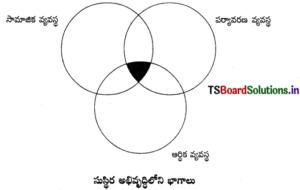
9. అభివృద్ధిలో ఆర్థిక, సామాజిక, పర్యావరణ కోణాల సమతుల్యత :
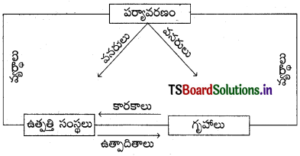
దీనికి సంబంధించిన కింద పేర్కొన్న మూడు విభాగాలు పరస్పరం ఆధారపడి ఉంటాయి. దీనిని కింద పటంలో చూపడమైంది.
TS Inter 2nd Year Economics Study Material 9th Lesson పర్యావరణ అర్థశాస్త్రం 1

10. ప్రకృతికిగల ప్రాధాన్యతను గుర్తించడం:
సుస్థిర అభివృద్ధి ప్రకృతి ప్రాధాన్యతను అభివృద్ధితో సంబంధం కలిగిన భాగస్వాముల గుర్తించేటట్లు చేస్తుంది. మనందరం సమిష్టిగా భూమాతను సుస్థిరంగా ఆరోగ్యప్రదంగా పంచడానికి కృషి చేయవలసిన అవసరాన్ని సుస్థిర అభివృద్ధి గుర్తుచేస్తుంది. పర్యావరణాన్ని, అందులోని వనరులను పదిలపరచవలసిన, పరిరక్షించవలసిన అవసరాన్ని కూడా దృఢంగా తెలియజేస్తుంది.

TS Board Inter Second Year Economics Study Material Chapter 9 పర్యావరణ అర్థశాస్త్రం

స్వల్ప సమాధాన ప్రశ్నలు:

ప్రశ్న 1.
సహజ వనరులు అంటే ఏమిటి ?
జవాబు.
ఒక నిర్ణీత ప్రదేశంలో, సమయంలో మానవ అవసరాలను తీర్చగలిగే సాధనాలే వనరులు. వివిధ రూపాలలో ఉన్న వనరుల సంపదనే ప్రకృతి కల్గి ఉంటుంది. సహజ వనరులు ఆర్థిక వ్యవస్థకు అతీతంగా కర్బనజనిత, మూలక లేదా అకర్బన పదార్థాల ద్వారా సమకూరుతాయి.

సహజ వనరుల లక్షణాలు :

  1. సహజ వనరులు ప్రకృతి ఉచితంగా ప్రసాదించిన కానుకలు, మానవులు వాటిని అన్వేషించి ఉపయుక్తంగా మారుస్తారు.
  2. ఒక నిర్ణీత కాలంలో సహజ వనరుల సంపద స్థిరంగా ఉంటుంది.
  3. సహజ వనరులు ప్రకృతిలో నిక్షిప్తమై ఉంటాయి. మానవుడు సాంకేతిక విజ్ఞానం సహాయంతో పరిశోధనచేసి వీటిని కనుగొంటాడు.
  4. సహజ వనరులు, సహజ, సజీవ భాగంలో మార్పులద్వారా కొంతకాలం పరిమితిలో సహజ వనరుల పరిమాణంలో మార్పులు సంభవిస్తాయి.
  5. శాస్త్రీయ, సాంకేతిక విజ్ఞానాలు అభివృద్ధిచెందడంతో నూతన వనరులు ప్రకృతినుంచి కాలానుగుణంగా ఆవిర్భవిస్తాయి. తౌడు నుంచి నూనెను వెలికి తీయడం ఒక ఉదాహరణగా చెప్పవచ్చు.

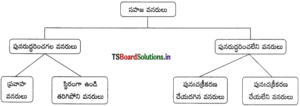
సహజ వనరుల వర్గీకరణ :
మన్నిక, పునరుద్ధరణ వ్యూహం ప్రాతిపదికలపై సహజ వనరులను వర్గీకరిస్తారు. సహజ వనరుల వర్గీకరణ ఈ కింది విభాగాలలో ఉంటుంది.
TS Inter 2nd Year Economics Study Material 9th Lesson పర్యావరణ అర్థశాస్త్రం 2

ప్రశ్న 2.
సుస్థిర అభివృద్ధి అంటే ఏమిటి ?
జవాబు.
సుస్థిర అభివృద్ధి భావన :
పర్యావరణ విధ్వంసం లేకుండా జరిగే ఆర్థికాభివృద్ధిని సుస్థిర అభివృద్ధి అంటారు. ఈ విధమైన అభివృద్ధి ప్రక్రియలో పర్యావరణం విలీనం చేయబడుతుంది. వర్తమానంలో అవసరాలను తీర్చుకొంటూ భావి తరాల అవసరాలు తీర్చుకోవడంలో రాజీలేని అభివృద్ధిని సుస్థిర అభివృద్ధి అంటారు.

అంటే భావితరాల అవసరాలను సుస్థిర అభివృద్ధిలో దృష్టిలో ఉంచుకొంటుంది. వనరుల వినియోగం, పునఃకల్పనం మధ్య సమతుల్యతను ఏర్పరిచి అభివృద్ధి ప్రక్రియను కొనసాగిస్తే సుస్థిర వృద్ధి సాధ్యపడుతుంది. కాబట్టి ప్రస్తుతకాలంలో అభివృద్ధి వ్యూహాలు సహజం, ఆర్థిక వ్యవస్థ, పర్యావరణాలు సామూహిక అభివృద్ధికి ప్రాధాన్యత ఇస్తున్నాయి. సుస్థిర రూపంలో ఉన్న అభివృద్ధికి ప్రాధాన్యత ఇస్తున్నాయి. ‘సుస్థిర రూపంలో ఉన్న అభివృద్ధి నిరాటంకంగా కొనసాగుతుంది.

ప్రకృతి, సహజ వనరుల రక్షణకు సంబంధించిన అంతర్జాతీయ సంఘం (International Union for the Con- servation of Nature and Natural Resources) ప్రపంచ వ్యాప్తంగా సంరక్షణ వ్యూహంలో మొట్ట మొదట 1980లో సుస్థిర అభివృద్ధి భావనను తెలియజేసింది. ఈ పదం సాధారణ ఉపయోగంలోకి Brundtland నివేదిక ద్వారా క్రమంగా వచ్చింది. డాలీ 1990లో సుస్థిర అభివృద్ధికి మూడు నియమాలు తెలియచేశారు.

  1. పునరుద్ధరించగల వనరులను పునఃకల్పన రేటులకు (regeneration rate) మించి ఉపయోగించరాదు.
  2. పునరుద్ధరించడానికి వీలులేని వనరులు ప్రత్యామ్నాయ వనరులు లభించే రేటుకన్నా ఎక్కువ రేటులో ఉపయోగించకూడదు.
  3. పర్యావరణం విలీనం చేసుకోగల్గిన సామర్థ్యంకంటే ఎక్కువ పరిమాణంలో కాలుష్య పదార్థాలు పర్యావరణంలోకి విసర్జించరాదు.

TS Board Inter Second Year Economics Study Material Chapter 9 పర్యావరణ అర్థశాస్త్రం

ప్రశ్న 3.
పర్యావరణాన్ని ఎందుకు సంరక్షించాలి ?
జవాబు.

  1. భారతదేశంవంటి ఎన్నో అభివృద్ధి చెందుతున్న దేశాలు వ్యవసాయంపై ఆధారపడ్డాయి. మంచి వర్షపాతం, అనుకూల వాతావరణం, భూసారం నాణ్యమైన విత్తనాలు పర్యావరణం ద్వారా అందజేయబడతాయి. అయితే రసాయనిక ఎరువులు, క్రిమి సంహారక మందులు అధికంగా వినియోగించడంవల్ల పర్యావరణపు సమతుల్యత విచ్ఛిత్తి చెంది దీర్ఘకాలంలో భూమి యొక్క సహజ భూసారం క్షీణిస్తుంది.
  2. అడవులు, వృక్ష సంపద సకాలంలో వర్షాలకు తోడ్పడి వాతావరణ సమతుల్యతను కాపాడతాయి. అందువల్ల క్షీణిస్తున్న అటవీ సంపదను అధికంగా మొక్కలు నాటడం ద్వారా పెంపొందించాలి.
  3. ఖనిజాలు వెలికితీయడం, పాడి పరిశ్రమ, చేపల పెంపకం, పారిశ్రామిక కార్యకలాపాలవంటి ఆర్థిక కార్యకలాపాలకు పర్యావరణ పరిరక్షణ సహాయపడుతుంది.
  4. పర్యావరణ పరిరక్షణ ఒకదేశ ప్రజల సంపదను, ఆరోగ్య జీవనాన్ని పెంపొందించడం ద్వారా సామాజిక అభివృద్ధికి దోహదపడుతుంది.
  5. పర్యావరణ పరిరక్షణ మానవుల సుఖ సంతోషాలను పెంపొందిస్తుంది. పర్యావరణ అసమతుల్యత, వరదలు, భూకంపాలు, కరువులు, తుఫానులువంటి సమస్యలు సమాజాన్ని, ఆర్థిక వ్యవస్థను ఛిన్నాభిన్నం చేస్తాయి.
  6. సహజ వనరులను ప్రస్తుతం ఎక్కువగా దుర్వినియోగంచేస్తే, భావితరాల సంక్షేమం దెబ్బతింటుంది. కాబట్టి సుస్థిర అభివృద్ధి ద్వారా పర్యావరణ పరిరక్షణ భావితరాల సంక్షేమానికి సహాయపడుతుంది.
  7. పర్యావరణ పరిరక్షణ కాలుష్య రహిత జీవితాన్ని అందజేస్తుంది. కాలుష్యరహిత పరిస్థితులలో మానవాళి ఆరోగ్యకరమైన సుఖ సంతోషాలు మెరుగుపడతాయి.
  8. జీవ వైవిధ్యాన్ని, ఆవరణ సంతులతను పెంపొందించడానికి పర్యావరణ పరిరక్షణ సహాయపడుతుంది. ఓజోన్ పొర, హిమానీ నదాలు ఇతర ప్రకృతిపరమైన అంశాలు సరైన క్రమంలో నిర్వహించడానికి పర్యావరణ పరిరక్షణ సహాయపడుతుంది.

ప్రశ్న 4.
కాలుష్యం రకాలను చర్చించండి..
జవాబు.

వివిధ రకాల కాలుష్యాలను వివరించి, వాటి ప్రభావాలను పరిశీలించండి.
జవాబు.
కాలుష్యం (Pollution) :
గాలి, నీటితో కలసిన కాలుష్యకాలు కాలుష్యాన్ని సృష్టిస్తాయి. ఇవి వాతావరణాన్ని కలుషితం చేసి పరిసరాలకు నష్టాన్ని కలిగిస్తాయి. కాలుష్యం అన్ని జీవరాశులకు ప్రమాదాన్ని కలిగిస్తుంది. భౌతిక పర్యావరణ విచ్ఛేదనకు కూడా కాలుష్యం కారణమవుతుంది. కాలుష్యం ప్రధానంగా వాయు కాలుష్యం, జల కాలుష్యం, ధ్వని కాలుష్యం అనే మూడు రూపాలలో ఉంటుంది.

1. వాయు కాలుష్యం :
వాయు కాలుష్యానికి కారణాలు లేదా ఆధారాలు :

  1. వ్యవసాయ కార్యకలాపాలు
  2. పదార్థాల దహనం
  3. యంత్రాల సహాయంతో జరిగే ఉత్పత్తి ప్రక్రియలు
  4. ద్రావకం ఉపయోగిత
  5. న్యూక్లియర్ శక్తి కార్యక్రమాల నిర్వహణ, మానవులు, జంతువులు, పక్షులు మొదలైన జీవరాశి శ్వాస వ్యవస్థపై వాయు కాలుష్యం తీవ్ర ప్రభావాన్ని చూపుతుంది.

ఆహార వస్తువులు, కూరగాయలు, పండ్లపై వాయు కాలుష్య ప్రభావం ఉంటుంది. మొక్కలు, పంటలు, పచ్చిక భూములపై దుమ్ము పొరలు ఏర్పడటంవల్ల భూమి ఉత్పాదక శక్తి తగ్గుతుంది. హరిత గృహంపై దీని ప్రభావంవల్ల భూమి మీది ఉష్ణోగ్రతలు ఎక్కువగా పెరిగి ధ్రువ ప్రాంతాలలోని మంచుగడ్డలు, హిమానీనదాలు కరిగిపోయే ప్రమాదం ఉంది. ఆమ్ల వర్షాలు, వాయు కాలుష్యం ద్వారా ఏర్పడి భూమి మీద భవనాలను, చెట్లను, మొక్కలను, అటవీ ప్రాంతాలను నష్టపరుస్తాయి.

2. జల కాలుష్యం (Water Pollution) :
నీటి స్వభావాన్ని మార్చి ఉపయోగానికి పనికి రాకుండా ప్రమాదకరమైన రీతిలో జల కాలుష్యం నీటిని పాడుచేస్తుంది. ప్రాణి కోటికి ప్రమాదకరమైన అదనపు పదార్థాలు నీటిలో కలవడమే జల కాలుష్యంగా నిర్వచించవచ్చు. కాలుష్యం వల్ల వీటి మధ్య సమతుల్యత దెబ్బతింటుంది.

  1. మురుగు వ్యర్థ పదార్థాలు
  2. అంటు వ్యాధుల ఏజెంట్లు
  3. విదేశీ సేంద్రియ రసాయనాలు
  4. రసాయనిక ఖనిజ పదార్థాలు, సమ్మేళనాలు మొదలైన వాటిని నీటి కాలుష్య కారకాలుగా చెప్పవచ్చు.

నీటి కాలుష్యం అనేక సమస్యలను సృష్టిస్తుంది. వాస్తవానికి ఎన్నో వ్యాధులకు ఇతర పర్యావరణ ప్రమాదాలకంటే నీటి కాలుష్యమే ప్రధానమైంది. కలరా, టైఫాయిడ్ అతి విరోచనాలవంటి వ్యాధులు నీటి కాలుష్యం ద్వారా వ్యాప్తి చెందుతాయి.

కొన్ని పరిశ్రమలు తమకు కావలసిన స్థాయిలో నీటిని శుభ్రపరచడంకోసం అధిక మొత్తాలలో వెచ్చించాల్సి రావడంవల్ల ఉత్పత్తి వ్యయాలు పెరుగుతున్నాయి. నీటి కాలుష్యం చేపలను చంపి జల ఆహార నిల్వలను నశింపచేస్తుంది.

3. ధ్వని కాలుష్యం (Noise Pollution) :
ధ్వని కాలుష్యం శరీర సంబంధమైన లేదా మానసిక సంబంధమైన హానిని కలగజేస్తుంది. రైల్వేలు, పరిశ్రమలు, నిర్మాణ రంగ కార్యకలాపాలు, ప్రజా సమూహాల కలయికల, లౌడ్ స్పీకర్లను ఉపయోగించడం `వంటి క్రియలు ధ్వనిని వ్యాప్తి చేస్తాయి.

చెవికి ఇబ్బంది కలిగించే ధ్వని కాలుష్యం తాత్కాలికంగా కాని, శాశ్వతంగా కాని వినికిడి సామర్థ్యాన్ని తగ్గిస్తుంది. కొంతకాలంపాటు ధ్వని కాలుష్యానికి లోనైతే చెవిటితనం వచ్చే ప్రమాదముంది. ధ్వని కాలుష్యంవల్ల మెదడు, నరాల వ్యవస్థ దెబ్బతిని, చికాకు స్వభావం పెరుగుతుంది. నిరంతర ధ్వని కాలుష్య ప్రభావంవల్ల శ్రామిక సామర్థ్యం, వారి వృత్తిపరమైన పనితీరు క్షీణిస్తుంది.

TS Board Inter Second Year Economics Study Material Chapter 9 పర్యావరణ అర్థశాస్త్రం

ప్రశ్న 5.
పర్యావరణానికి, ఆర్థికాభివృద్ధికి మధ్యగల సంబంధాన్ని వివరించండి.
జవాబు.
అభివృద్ధిచెందుతున్న భారతదేశంలాంటి దేశాలలో పర్యావరణం వనరులపై ఒత్తిడి, స్వయం సమృద్ధి, ఆదాయ పంపిణీ, భవిష్యత్తులో ఆర్థికవృద్ధిపై తీవ్ర ప్రభావాలను సృష్టిస్తుంది. ఈ ప్రభావాలను జనాభాలో ఉన్న 22-30% పేద ప్రజలు ఎక్కువ భరించవలసి రావడం దురదృష్టకరం.

ఆర్థిక వృద్ధి ప్రక్రియలో పర్యావరణానికి సంబంధించిన అవగాహన చారిత్రాత్మకంగా లేకపోవడం దీనికి కారణం. భవిష్యత్లో ఆర్థిక కార్యకలాపాలు క్షీణించిన పర్యావరణంలోనే జరగవలసి ఉంటుంది.

బీహార్, ఒడిస్సా, మధ్యప్రదేశ్, గోవా వంటి రాష్ట్రాలు కొన్ని ప్రాజెక్టులను చేపట్టాయి. ఇవి సమాజంలో ప్రాబల్యం ఉన్న శక్తివంతమైన వర్గాల ప్రయోజనాలను కాపాడటానికి ఉద్దేశించబడ్డాయి. వీటివల్ల బలహీన వర్గాలు, ఆదిమ జాతులు, పేద వర్గాలు సమస్యలను ఎదుర్కోవలసి వస్తోంది. పర్యావరణ విచ్ఛేదన ప్రభావాలు ఆ ప్రాంతంలో నివసించే అధిక శాతం ప్రజలపై పడతాయి. సామాజిక, ఆర్థిక, సాంస్కృతిక, జనాభాపరమైన నష్టాలను ఎక్కువ శాతం అక్కడి ప్రజలు భరించాల్సి ఉంటుంది.

ఆర్థిక కార్యకలాపాలకు ముడి పదార్థాలను అందజేయడంతోపాటు అనువైన వాతావరణ పరిస్థితులను పర్యావరణం కల్పిస్తుంది. అంతేగాక, ఉత్పాదక సంస్థలు విడుదలచేసే వ్యర్థాలు పర్యావరణం ఇముడ్చుకొంటుంది. ఇందుమూలంగా పర్యావరణ సమతుల్యత దెబ్బతిని పర్యావరణ క్షీణతకు కారణభూతమవుతుంది.

కెన్నత్. ఇ. బౌల్డింగ్ వంటి ఆర్థికవేత్తలు ఈ దృష్టితో పర్యావరణ వనరులపై ఒత్తిడి ద్వారా ఏర్పడే ఫలితాల గురించి ప్రపంచానికి హెచ్చరికలు చేశారు. వర్తమాన, భవిష్యత్ తరాల శ్రేయస్సుకు ప్రపంచ దేశాలు పర్యావరణ వనరులను పరిమితంగా ఉపయోగించాలి.

ఇంకో విధంగా చెప్పాలంటే, వస్తువుల ఉత్పత్తికి ఉపయోగించే ఉత్పాదకాలు, వ్యర్థ పదార్థాల విడుదల మధ్య సమతుల్యత ఏర్పడాలి. వ్యర్థ పదార్థాల పరిమాణం, విసర్జకాల పరిమాణం తక్కువగా ఉన్నప్పుడు పర్యావరణం తేలికగా విలీనం చేసుకోగలుగుతుంది.

వాస్తవానికి ఆర్థికాభివృద్ధికి అవసరమైన వనరులన్నీ పర్యావరణంలో లభిస్తాయి. పునరుద్ధరించగలిగిన, పునరుద్ధరించలేని సహజ వనరులు పర్యావరణం నుంచి సేకరించబడతాయి. సరైన పర్యావరణం లేకుండా ఏ దేశం కూడా ఆర్థికాభివృద్ధి సాధించలేదు.

పర్యావరణానికి సంబంధించిన ఆర్థిక విధులను శ్రద్ధగా గమనించవలసిన అవసరం ఉంది. ఆర్థికాభివృద్ధి ప్రక్రియకు పర్యావరణానికి మధ్యగల అంతర్గత సంబంధాలను గుర్తించవలసిన అవసరం కూడా ఉంది.
TS Inter 2nd Year Economics Study Material 9th Lesson పర్యావరణ అర్థశాస్త్రం 3

ఆర్థికాభివృద్ధికి, పర్యావరణానికి మధ్య గల సంబంధం :
ప్రకృతి నుంచి ఆర్థికాభివృద్ధికి అవసరమైన అన్ని వనరులు లభిస్తాయి. ఈ భూగోళం మీద జీవకోటి పర్యావరణంలోనే మనుగడ సాగిస్తుంది. ఆర్థికాభివృద్ధిని కొనసాగిస్తూనే వనరుల సంరక్షణ ప్రత్యేక శ్రద్ధతో జరగాలి. ఆర్థిక లక్ష్యాలను రూపొందించేటప్పుడు వనరుల సంరక్షణ కార్యక్రమాలకు సంబంధించిన ప్రణాళికలను సిద్ధం చేసుకోవాలి.

ఆర్థికాభివృద్ధి సుస్థిరతను దృష్టిలో ఉంచుకోవాలి. సుస్థిర వృద్ధి భావితరాలను, పర్యావరణ మూలధనాన్ని రక్షించే లక్ష్యంతో పనిచేస్తుంది. ఒకదేశం వాయు, జల, ధ్వని కాలుష్యాలను అధిక ఉత్పత్తులను సృష్టిస్తాయి.

వ్యవసాయం, గ్రామీణాభివృద్ధికి సంబంధించిన ఆర్థిక విధానాలు పర్యావరణానికి స్నేహపూర్వకంగా ఉండాలి. సేద్య పద్ధతులు, జీవ వైవిధ్యం, రసాయనిక ఎరువులు పరిమితంగా ఉపయోగించడం, వర్షపు నీటిని సంరక్షించుకోవడం, మొక్కల పెంపకాన్ని అభివృద్ధి చేయడం మొదలైన అంశాలకు పర్యావరణ సంరక్షణ, సుస్థిర వృద్ధి లక్ష్యాల దృష్ట్యా ప్రాధాన్యతను ఇవ్వాలి.

పెరుగుతున్న పట్టణీకరణ పర్యావరణానికి సమస్యలను సృష్టిస్తుంది. అందువల్ల జల, వాయు, దృశ్య కాలుష్యాలు ఏర్పడే ప్రమాదం ఉంది. వేగవంతమైన పారిశ్రామికీకరణ పెరుగుతున్న ఆర్థిక కార్యకలాపాలు పట్టణ ప్రాంతాలలో పర్యావరణానికి నష్టాన్ని కలిగిస్తున్నాయి.

అభివృద్ధి ప్రక్రియలో భాగంగా వినియోగత్వం పెరుగుతూ ఉంటుంది. హరిత గృహ ప్రభావం, ఓజోన్ పొరను హరింపచేసే కాలుష్యం, భూతాప, అకాల వర్షాలు, వరదలు మొదలైనవి వనరులను అతిగా ఉపయోగించడం, అధిక ఉత్పత్తుల తయారీవల్ల ఏర్పడిన సమస్యలు.

ఆర్థికాభివృద్ధికి అవసరమైన అన్ని వనరులను పర్యావరణం అందచేస్తుంది. అదే సమయంలో ఆర్థికాభివృద్ధి కార్యకలాపాల వల్ల పర్యావరణ విచ్ఛేదన సమస్య ఏర్పడుతుంది. ఆర్థికాభివృద్ధి, పర్యావరణ విచ్ఛేదనాల మధ్య సమతుల్యత ఉండేలా ప్రపంప దేశాలన్నీ కృషి చేయాలి.

TS Board Inter Second Year Economics Study Material Chapter 9 పర్యావరణ అర్థశాస్త్రం

ప్రశ్న 6.
పర్యావరణ క్షీణత ఆర్థిక వ్యవస్థను ఏ విధంగా ప్రభావితం చేస్తుంది ? ఈ సమస్యను అధిగమించడానికి నివారణ చర్యలను సూచించండి.
జవాబు.
I. పర్యావరణ విచ్ఛేదన భావన :
పర్యావరణ విచ్ఛేదనం అంటే భూమిపై జరిగిన ఛిద్రత లేదా పర్యావరణంలోని సహజ వనరుల రూపంలో ఉన్న ఆస్తుల క్షీణత అనవచ్చు. ప్రకృతి ఉపరితలంలో రాకూడని మార్పులు లేదా తీవ్రతను పర్యావరణ విచ్ఛేదనంగా చెప్పవచ్చు. భూమిపైగల సహజ వనరులు క్రమంగా క్షీణించి కొన్ని జీవరాశులు అంతరించి పోవడం పర్యావరణ విచ్ఛేదనను కలుగజేస్తుంది. వాయు కాలుష్యం, జల కాలుష్యం, భూమిపై పొరలలో ఉన్న సహజ శక్తుల క్షీణతవంటి సమస్యలు ఈ విచ్ఛేదనంవల్ల సృష్టించబడతాయి.

II. పర్యావరణ విచ్ఛేదనకు కారణాలు :

1. భూసార క్షీణత :
పనికిరాని పిచ్చి మొక్కలు ప్రకృతిని, పరిసరాలను ఆవరించే సహజంగా ఉన్న హరిత ప్రదేశాలను క్రమంగా క్షీణింపచేస్తాయి. ఈ విధమైన వృక్ష సంబంధమైన జీవరాశులు భూమి, భూమిలోని పర్యావరణపరమైన ఆస్తులను నాశనం చేస్తాయి. ` అటవీ ప్రాంతాలలో, మైదాన ప్రాంతాలలో, పంట భూములలో పశువుల మేతకోసం తొక్కిడి అధికంగా ఉన్నప్పుడు సారవంతమైన భూమి ఉపరితలంలోని పొరలు దెబ్బతిని భూమి గట్టితనాన్ని సంతరించుకుంటుంది.

2. కాలుష్యం :
వాయు, జల, ధ్వని పరమైన కాలుష్యాలు పర్యావరణానికి ప్రమాదకరమైనవి. ఈ కాలుష్యాలు గాలి, నీరు, – భూమి నాణ్యతలను క్షీణింప చేస్తాయి. ధ్వని కాలుష్యం చెవులకు కలిగించే నష్టంతోపాటు పక్షులకు, జంతువులకు భయాందోళనలను కలిగిస్తుంది. అమితమైన జనాభా పెరుగుదల సహజ వనరులపై ఒత్తిడిని పెంచి పర్యావరణ విచ్ఛేదనకు దారితీస్తుంది.

3. చెత్తా చెదారాల సమూహం (Landfills) :
చెత్తా చెదారాల కుప్పలు వాయు కాలుష్యాన్ని సృష్టిస్తాయి. ఇవి చెడు వాసనలు సృష్టించడంతోపాటు అధికస్థాయిలో పర్యావరణ విచ్ఛేదనకు కారణమవుతాయి. వ్యర్థ పదార్థాలు, అపరిశుభ్రమైన మురుగు నీటితో నిండి ఉంటాయి.

4. వన నిర్మూలన :
గృహ నిర్మాణ కార్యకలాపాల దృష్ట్యా, పరిశ్రమల స్థాపన దృష్ట్యా అడవులను నరికివేయడాన్ని వన నిర్మూలన అంటారు. వ్యవసాయ భూమి విస్తరణకోసం, వంట చెరకు అవసరాలకోసం అడవులలోని వృక్షాలను నరికి వేస్తున్నారు. పెద్ద తరహా నీటిపారుదల ప్రాజెక్టులకోసం కొన్ని ప్రాంతాలలో వన నిర్మూలన జరుగుతుంది. ఇందువల్ల పర్యావరణంలోకి చేరే కార్భన్ పరిమాణం పెరిగి ప్రపంచవ్యాప్తంగా భూతాపం పెరుగుతూ ఉంది. వర్షాభావం కూడా ఏర్పడే ప్రమాదం ఉంది.

5. సహజ కారణాలు :
భూకంపాలు, సముద్ర కెరటాలు, ఉప్పెనలు, సునామీలు, వన దహనాలు, జంతువులను, వృక్ష సముదాయాలను నాశనం చేస్తాయి. వీటివల్ల వర్తమానంలోనూ మరియు దీర్ఘకాలంలోనూ పర్యావరణంపై ప్రభావాలు ఉంటాయి.

6. పారిశ్రామికీకరణ, అధికోత్పత్తి:
శాస్త్ర, సాంకేతిక రంగాల అభివృద్ధితో ప్రపంచదేశాలలో ఉత్పాదక సామర్థ్యాలు విస్తరించాయి. ఉత్పత్తిని విస్తరించడానికి సహజ వనరులు, ముడి పదార్థాలు విరివిగా వినియోగించబడుతున్నాయి. పరిశ్రమల పొగ, ధ్వని, వ్యర్థ పదార్థాల విసర్జకాల ద్వారా పర్యావరణ విచ్ఛేదనానికి కారణాలు అవుతున్నాయి.

TS Board Inter Second Year Economics Study Material Chapter 9 పర్యావరణ అర్థశాస్త్రం

అతిస్వల్ప సమాధాన ప్రశ్నలు:

ప్రశ్న 1.
పర్యావరణ రకాలు.
జవాబు.
మనచుట్టూ ఆవరించి ఉన్న అన్ని అంశాలను పర్యావరణంగా చెప్పవచ్చు. ఈ పర్యావరణంలో సజీవ, నిర్జీవ నిర్మాణాలు పరస్పరం ఆధారపడి ఒకదానిని మరొకటి ప్రభావితం చేసుకొంటాయి. ఇవి ప్రధానంగా నాలుగు రకాలు.

  • భౌతిక పర్యావరణం
  • జీవ పర్యావరణం
  • సామాజిక లేదా సాంస్కృతిపరమైన పర్యావరణం.

ప్రశ్న 2.
ఆవరణ వ్యవస్థ (Eco-System)
జవాబు.
మన చుట్టూ పర్యావరణం ఉంది. పర్యావరణంలో ఆవరణ వ్యవస్థలు (Eco-System) ఉంటాయి. ఆవరణ వ్యవస్థను వివిధ రూపాలలో నిర్వచించారు. ఈ నిర్వచనాలకు మూడు సాధారణ లక్షణాలు ఉన్నాయి. అవి :

  1. జీవ అంశాలు (biotic)
  2. నిర్జీవ అంశాలు (abiotic components)
  3. ఈ రెండింటి పరస్పర ప్రభావాలు (their inetractions) పరస్పర ప్రభావాల ద్వారా వీటి మధ్య శక్తి (energy), పదార్థం (matter), సమాచారాలు (information)
    వాప్తి చెందుతుంటాయి.

ప్రశ్న 3.
వాయు కాలుష్యం.
జవాబు.
భూమి చుట్టూ ఉన్న వాతావరణంలోని అనేక వాయువులను అన్నింటిని ఉమ్మడిగా కలిపి వాయువు (గాలి) అని సామాన్య అర్థంగా చెబుతారు. గాలిలో ఇతర కాలుష్యకారక పదార్థాల గాఢత ఎక్కువైపోయి మానవుని శ్రేయస్సును, జీవకోటికి మరియు వివిధ రూపాలలోఉన్న ఆస్తులపై ప్రతికూల ప్రభావాన్ని చూపడాన్ని వాయు లేదా గాలి కాలుష్యం అంటారు.

TS Board Inter Second Year Economics Study Material Chapter 9 పర్యావరణ అర్థశాస్త్రం

ప్రశ్న 4.
జల కాలుష్యం.
జవాబు.
భూమి మీద ఉండే నీటిలో 97 శాతం వరకు సముద్రాల్లో ఉంటుంది. మిగతా 3 శాతం మాత్రమే స్వచ్ఛమైన నీరు. కొన్ని పదార్థాలుగాని, కారకాలు గాని నీటిలో ఎక్కువగా చేరిపోయి నీటి యొక్క స్వచ్ఛతను తగ్గించి వేసి, దానిని ఆరోగ్యానికి హానికరంగాను వాడుకోవడానికి పనికి రాకుండా మార్చివేస్తాయి. దానినే జలకాలుష్యం అంటారు.

ప్రశ్న 5.
భౌతిక కాలుష్యం.
జవాబు.
భౌతిక, రసాయన మరియు జీవ అంశాలు అయిన భూమి, వాతావరణం, వృక్షసంపద, వన్యమృగాలు, చుట్టుప్రక్కల ఉన్న భూమి మరియు దాని స్వభావం, అవస్థాపనా సౌకర్యాలు, గాలి మరియు శబ్ద కాలుష్య స్థాయి మొదలైన వాటిని కలిగి ఉంటుంది. వీటి నాణ్యత తగ్గడాన్ని భౌతిక కాలుష్యం అంటారు.

ప్రశ్న 6.
పర్యావరణ విచ్ఛేదన.
జవాబు.
పర్యావరణ విచ్ఛేదనం అంటే భూమిపై జరిగిన ఛిద్రత లేదా పర్యావరణంలోని సహజ వనరుల రూపంలో ఉన్న ఆస్తుల క్షీణత అనవచ్చు. ప్రకృతి ఉపరితలంలో రాకూడని మార్పులు లేదా తీవ్రతను పర్యావరణ విచ్ఛేదనంగా చెప్పవచ్చు.

భూమిపైగల సహజ వనరులు క్రమంగా క్షీణించి కొన్ని జీవరాశులు అంతరించి పోవడం పర్యావరణ విచ్ఛేదనను కలుగజేస్తుంది. వాయు కాలుష్యం, జల కాలుష్యం, భూమిపై పొరలలో ఉన్న సహజ శక్తుల క్షీణతవంటి సమస్యలు ఈ విచ్ఛేదనంవల్ల సృష్టించబడతాయి.

TS Board Inter Second Year Economics Study Material Chapter 9 పర్యావరణ అర్థశాస్త్రం

ప్రశ్న 7.
సుస్థిరమైన అభివృద్ధి.
జవాబు.
పర్యావరణ విధ్వంసం లేకుండా జరిగే ఆర్థికాభివృద్ధిని సుస్థిర అభివృద్ధి అంటారు. ఈ విధమైన అభివృద్ధి ప్రక్రియలో పర్యావరణం విలీనం చేయబడుతుంది. వర్తమానంలో అవసరాలను తీర్చుకొంటూ భావి తరాల అవసరాలు తీర్చుకోవడంలో రాజీలేని అభివృద్ధిని సుస్థిర అభివృద్ధి అంటారు.

ప్రశ్న 8.
పునరుద్ధరించగల, పునరుద్ధరించలేని సహజ వనరులు.
జవాబు.
తిరిగి సమకూర్చుకోగలిగిన లేదా సృష్టించుకోగలిగిన వనరులను పునరుద్ధరించగల సహజ వనరులు అని అంటారు. వీటినే ప్రవాహ వనరులు అని కూడా అంటారు.
ఉదా : నీరు, అడవులు, మత్స్య సంపద, సౌరశక్తి, తరంగ శక్తి.

పునరుద్ధరించలేని సహజ వనరులను అంతరించిపోయే స్వభావం గల వనరులు అని అంటారు. ఒక నిర్ణీత సమయంలో వీటి పరిమాణం స్థిరంగా ఉంటుంది.
ఉదా : బొగ్గు, ఖనిజాలు, పెట్రోలియం, గ్యాస్ నిల్వలు.

TS Inter 2nd Year Economics Study Material

TS Inter 2nd Year Maths 2A Solutions Chapter 2 De Moivre’s Theorem Exercise 2(a)

Students must practice this TS Intermediate Maths 2A Solutions Chapter 2 De Moivre’s Theorem Ex 2(a) to find a better approach to solving the problems.

TS Inter 2nd Year Maths 2A Solutions Chapter 2 De Moivre’s Theorem Exercise 2(a)

I.
Question 1.
If n is an integer then show that (1 + i)2n + (1 – i)2n = 2n + 1 cos \(\frac{n \pi}{2}\)
Solution:
L.H.S = (1 + i)2n + (1 – i)2n

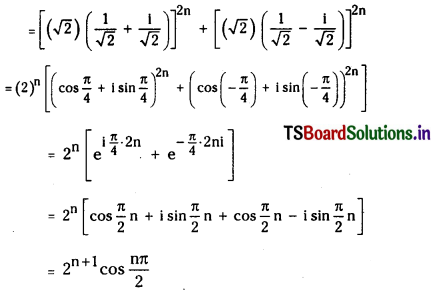
TS Inter 2nd Year Maths 2A Solutions Chapter 2 De Moivre’s Theorem Exercise 2(a) 1

TS Board Inter 2nd Year Maths 2A Solutions Chapter 2 De Moivre’s Theorem Ex 2(a)

Question 2.
Find the values of the following:
i) (1 + √3)3
ii) (1 – i)8
iii) (1 + i)16
iv) \(\left(\frac{\sqrt{3}}{2}+\frac{i}{2}\right)^5-\left(\frac{\sqrt{3}}{2}-\frac{i}{2}\right)^5\)
Solution:
i) z = (1 + i√3)3
= (\(\left(\frac{1}{2}+\mathrm{i} \frac{\sqrt{3}}{2}\right)^3\))3 . 23
= [cos \(\frac{\pi}{3}\) + i sin \(\frac{\pi}{3}\)]3 . 23
=[cos \(\frac{\pi}{3}\) . 3 + i sin \(\frac{\pi}{3}\) . 3] . 23
= 8 [cos π + i sin π]
∴ z = – 8.

ii) z = (1 – i)8
z = \(\left[(\sqrt{2})\left[\frac{1}{\sqrt{2}}-\frac{\mathrm{i}}{\sqrt{2}}\right]\right]^8\)
z = (2)4 [cos \(\frac{\pi}{2}\) – i sin \(\frac{\pi}{2}\)]8
z = 16 [cos 2π – i sin 2π]
z = 16.

iii) z = (1 + i)16
z = \(\left[(\sqrt{2})\left(\frac{1}{\sqrt{2}}+\frac{i}{\sqrt{2}}\right)\right]^{16}\)
z = 28 [(cos \(\frac{\pi}{4}\) + i sin \(\frac{\pi}{4}\))16]
z = 28 [cos 4π + i sin 4π]
z = 256.

iv) \(\left(\frac{\sqrt{3}}{2}+\frac{i}{2}\right)^5-\left(\frac{\sqrt{3}}{2}-\frac{i}{2}\right)^5\)

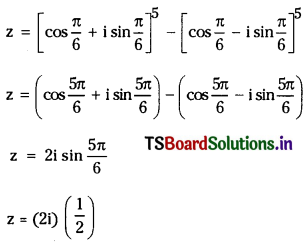
TS Inter 2nd Year Maths 2A Solutions Chapter 2 De Moivre’s Theorem Exercise 2(a) 2

TS Board Inter 2nd Year Maths 2A Solutions Chapter 2 De Moivre’s Theorem Ex 2(a)

II.
Question 1.
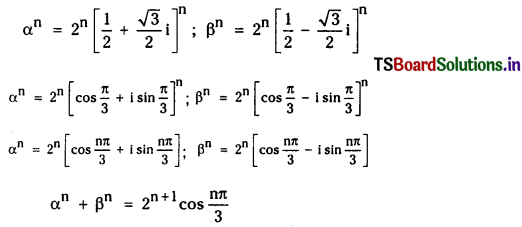
If α, β are roots of the equation x2 – 2x + 4 = 0 then for any n ∈ N show that αn + βn = 2n+1 cos \(\frac{n \pi}{3}\).
Solution:
x2 – 2x + 4 = 0
x = \(\frac{2 \pm \sqrt{4-16}}{2}\)
x = \(\frac{2 \pm 2 \sqrt{3} i}{2}\)
x = 1 ± √3i
α = 1 + √3i ; β = 1 – √3i

TS Inter 2nd Year Maths 2A Solutions Chapter 2 De Moivre’s Theorem Exercise 2(a) 3

Question 2.
If cos α + cos β + cos γ = 0 = sin α + sin β + sin γ then show that
i) cos 3α + cos 3β + cos 3γ = 3cos (α + β + γ)
ii) sin 3α + sin 3β + sin 3γ = 3sin(α + β + γ)
iii) cos (α + β) + cos (β + γ) + cos (γ + α) = 0
Solution:
1) cos α + cos β + cos γ = 0
sin α + sin β + sin γ = 0
(cos α + i sin α) + (cos β + i sin β) + (cos γ + i sin γ) = 0
A + B + C = 0
A3 + B3 + C3 = 3ABC
A = e, B = e, C = e
A3 + B3 + C3 = e3αi + e3βi + e3γi ……………(1)
= cos 3α + i sin 3α + cos 3β + i sin 3β + cos 3γ + isin 3γ …………..(1)
3ABC = 3ei(α + β + γ)
= 3[cos (α + β + γ) + isin (α + β + γ)] …………..(2)
(1) = (2)
Comparing real and Imaginary parts
cos 3α + cos 3β . cos 3γ = 3 cos (α + β + γ)
sin3α. sin 3β + Sin 3γ = 3 sin (α + β + γ).

TS Board Inter 2nd Year Maths 2A Solutions Chapter 2 De Moivre’s Theorem Ex 2(a)

ii) cos (α + β) cos (β + γ) cos (γ + α) = 0
A + B + C = 0
\(\frac{1}{A}+\frac{1}{B}+\frac{1}{C}\) = 0
AB + BC + CA = 0
ei(α + β) + ei(β + γ) + ei(α + γ) = o
cos (α + β) + i sin (α + β) + cos(β + γ) + isin(β + γ) + cos (α + γ) + isin (α + γ) = 0 + 0i
cos (α + β) cos (β + γ)) + cos (α + γ) = 0
sin (α + β) sin (β + γ)) + sin (α + γ) = 0.

Question 3.
If n is an integer and z = cis θ, (θ ≠ (2n + 1)\(\frac{\pi}{2}\)], then show that \(\frac{z^{2 n}-1}{z^{2 n}+1}\) = i tan nθ
Solution:
z = e
z2n = (e)2n
z2n = e2nθi
z2n = cos 2nθ + isin2nθ – 1
z – 1 = cos 2nθ + isin 2nθ – 1
= – 2 sin2nθ + 2i sin nθ . cos nθ
= i 2 sin nθ [cos nθ + i sin nθ]
= 2i sin nθ [cos nθ + i sin nθ] …………..(1)
z2n + 1 = cos 2nθ + i sin 2nθ + 1
= 2 cos2 nθ + 2 i sin nθ cos nθ
= 2 cos nθ [cos nθ + i sin bθ] ……………..(2)
\(\frac{z^{2 n}-1}{z^{2 n}+1}=\frac{2 i \sin n \theta}{2 \cos n \theta}\) = i tan nθ.

TS Board Inter 2nd Year Maths 2A Solutions Chapter 2 De Moivre’s Theorem Ex 2(a)

Question 4.
If (1 + x)n = a0 + a1x + a2x2 + ………….. + anxn, then show that
i) a0 – a2 + a4 – a6 + ………….. = 2n/2 cos \(\frac{n \pi}{4}\)
ii) a1 – a3 + a5 ……………. = 2n/2 sin \(\frac{n \pi}{4}\)
Solution:
(1 + x)n = a0 + a1x + a2x2 + ………….. + anxn
(1 + i) = a0 + a1i + a2i2 + ………………… + anin
(√2)n \(\left(\frac{1}{\sqrt{2}}+\frac{i}{\sqrt{2}}\right)\)n = (a0 – a2 + a4 – ………….) + i(a1 – a3 …………………)
Equating Real parts both sides
(√2)n cos \(\frac{n \pi}{4}\) = a0 – a2 + a4 ……………
Equating Imaginary parts
(√2)n sin \(\frac{n \pi}{4}\) = a1 – a3 + a5 ………………

TS Inter 2nd Year Maths 2A Solutions Chapter 3 Quadratic Expressions Ex 3(c)

Students must practice this TS Intermediate Maths 2A Solutions Chapter 3 Quadratic Expressions Ex 3(c) to find a better approach to solving the problems.

TS Inter 2nd Year Maths 2A Solutions Chapter 3 Quadratic Expressions Exercise 3(c)

I.
Question 1.
Solve the following inequatlons by algebraic method.
i) 15x2 – 4x – 4 ≤ 0
ii) x2 – 2x + 1 < 0
iii) 2 – 3x – 2x2 ≥ 0
iv) x2 – 4x – 21 ≥ 0
Solution:
i) 15x2 – 4x – 4 ≤ 0
15x2 + 10x – 6x – 4 ≤ 0
5x (3x + 2) – 2 (3x + 2) ≤ 0
(3x + 2) (5x – 2) ≤ 0
\(\frac{-2}{3}\) ≤ x ≤ \(\frac{2}{5}\).

ii) x2 – 2x + 1 < 0
(x- 1)2 < 0
Not possible
∵ (x – 1)2 ≥ 0
No solution.

TS Board Inter 2nd Year Maths 2A Solutions Chapter 3 Quadratic Expressions Ex 3(c)

iii) 2 – 3x – 2x2 ≥ 0
2x2 + 3x – 2 ≤ 0
2x2 + 4x – x – 2 ≤ 0
2x (x + 2) – 1 (x + 2) ≤ 0
(2x – 1)(x + 2) ≤ 0
– 2 ≤ x ≤ \(\frac{1}{2}\)

iv) x2 – 4x – 21 ≥ 0
x2 – 7x + 3x – 21 ≥ 0
x (x – 7) + 3 (x – 7) ≥ 0
(x + 3) (x – 7) ≥ 0
x ≥ 7 or x ≤ – 3
(- ∞ < x ≤ – 3) ∪ (7 ≤ x < ∞).

TS Board Inter 2nd Year Maths 2A Solutions Chapter 3 Quadratic Expressions Ex 3(c)

II.
Question 1.
Solve the following inequations by graphical method.
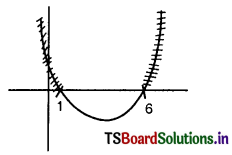
i) x2 – 7x + 6 > 0
ii) 4 – x2 > o
iii) 15x2 + 4x – 4 ≤ 0
iv) x2 – 4x – 21 ≥ 0
Solution:
i) (x – 6) (x – 1) > 0

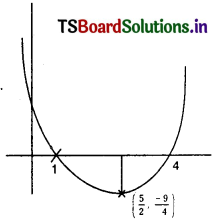
TS Inter 2nd Year Maths 2A Solutions Chapter 3 De Moivre’s Theorem Ex 3(c) 1

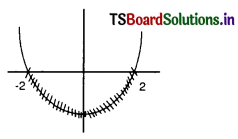
ii) 4 – x2 > 0
x2 – 4 > 0
(x – 2) (x + 2) > 0
– 2 < x < 2

TS Inter 2nd Year Maths 2A Solutions Chapter 3 De Moivre’s Theorem Ex 3(c) 2

TS Board Inter 2nd Year Maths 2A Solutions Chapter 3 Quadratic Expressions Ex 3(c)

iii) 15x2 + 4x – 4 ≤ 0
15x2 + 10x – 6x – 4 ≤ 0
5x (3x + 2) – 2 (3x + 2) ≤ 0
\(\frac{-2}{3} \leq x \leq \frac{2}{5}\)

TS Inter 2nd Year Maths 2A Solutions Chapter 3 De Moivre’s Theorem Ex 3(c) 3

iv) x2 – 4x – 21 ≥ 0
(x – 7) (x + 3) ≥ 0
x ≥ 7 or x ≤ – 3

TS Inter 2nd Year Maths 2A Solutions Chapter 3 De Moivre’s Theorem Ex 3(c) 4

TS Board Inter 2nd Year Maths 2A Solutions Chapter 3 Quadratic Expressions Ex 3(c)

Question 2.
Solve the following Inequations.
i) \(\sqrt{3 x-8}\) < – 2
ii) \(\sqrt{-x^2+6 x-5}\) > 8 – 2x
Solution:
\(\sqrt{3 x-8}\) < – 2 Possible when 3x – 8 > 0
x > \(\frac{8}{3}\)
also \(\sqrt{3 x-8}\) ≥ 0
∴ Solution does not exist.

ii) \(\sqrt{-x^2+6 x-5}\) > 8 – 2x
Possible
– x2 + 6x – 5 ≥ 0
x2 – 6x + 5 ≤ 0
(x – 5) (x – 1) ≤ 0
1 ≤ x ≤ 5 …………….(1)
Squaring on both sides we get
– x2 + 6x – 5 > 64 + 4x2 – 32x
0 > 5x2 – 38x + 64 + 5
or 5x2 – 38x + 69 < 0
5x2 – 23x – 15x + 69 < 0
5x (x – 3) – 23(x – 3)< 0
(x – 3) (5x – 23) < 0

TS Inter 2nd Year Maths 2A Solutions Chapter 1 Complex Numbers Ex 1(d)

Students must practice this TS Intermediate Maths 2A Solutions Chapter 1 Functions Ex 1(d) to find a better approach to solving the problems.

TS Inter 2nd Year Maths 2A Solutions Chapter 1 Complex Numbers Exercise 1(d)

I.
Question 1.
i) Find the equation of the perpendicular bisector of the line segment joining the points 7 + 7i, 7 – 7i.
ii) Find the equation of the straight line joining the points – 9 + 6i, 11 – 4i in the Argand plane.
Solution:
i) z1 = 7 + 7i
z2 = 7 – 71
A (7, 7) B (7, – 7)

TS Inter 2nd Year Maths 2A Solutions Chapter 1 Complex Numbers Exercise 1(d) 1

M(7, 0)

Slope of AB = \(\frac{7+7}{7-7}\) → ∞
Line ⊥ to AB slope is zero,
y = 0 is line.

ii) A (- 9, 6) B (11, – 4)
Slope of AB = \(\frac{6+4}{-9-11}\)
= \(\frac{10}{-20}=\frac{-1}{2}\)
Equation of line AB,
y – 6 = \(\frac{- 1}{2}\) (x + 9)
2y – 12 = – x – 9
x + 2y = 3.

TS Board Inter 2nd Year Maths 2A Solutions Chapter 1 Complex Numbers Ex 1(d)

Question 2.
If z = x + ily and if the point Pin the Argand plane represents z, then describe geometrically the locus of z satisfying the equations
i) |z – 2 – 3i| = 5
ii) 2|z – 2| = |z – 1|
iii) im z2 = 4
iv) Arg \(\left(\frac{z-1}{z+1}\right)=\frac{\pi}{4}\)
Solution:
i) |z – 2 – 3i| = 5
|(x – 2) + (y – 3)i| = 5
(x – 2)2 + (y – 3)2 = 25
x2 + y2 – 4x – 6y + 4 + 9 – 25 = 0
x2 + y2 – 4x – 6y – 12 = 0

ii) 2|z – 2| = |z – 1|
4(z – 2) (- 2) = (z – 1) (\(\overline{\mathbf{z}}\) – 1)
4z\(\overline{\mathbf{z}}\) – 8z – 8\(\overline{\mathbf{z}}\) + 16 = z\(\overline{\mathbf{z}}\) – z – \(\overline{\mathbf{z}}\) + 1
3z\(\overline{\mathbf{z}}\) – 7z – 7\(\overline{\mathbf{z}}\) + 15 = 0
3(x2 + y2) – 7(2x) + 15 = 0.

iii) Im (z2) = 4
Im (z2) = 4
z = x + iy
z2 = (x + iy)2
z2 = x2 – y2 + 2xyi
Im(z2) = 2xy
2xy = 4
xy = 2 rectangualr hyperbola

iv) Arg \(\left(\frac{z-1}{z+1}\right)=\frac{\pi}{4}\)

TS Inter 2nd Year Maths 2A Solutions Chapter 1 Complex Numbers Exercise 1(d) 2

TS Board Inter 2nd Year Maths 2A Solutions Chapter 1 Complex Numbers Ex 1(d)

Question 3.
Show that the points in the Argand diagram represented by the complex numbers 2 + 2i, – 2 – 2i, – 2√3 + 2√3i are the vertices of an equilateral triangle..
Solution:
A(2, 2), B(- 2, – 2), C (- 2√3 + 2√3)
AB = \(\sqrt{(2+2)^2+(2+2)^2}\) = 4√2
BC = \(\sqrt{(-2+2 \sqrt{3})^2+(-2-2 \sqrt{3})^2}\)
BC = \(\sqrt{4+12-8 \sqrt{3}+4+12+8 \sqrt{3}}\)= 4√2
AC = \(\sqrt{\left(2+2 \sqrt{3}^2\right)+(2-2 \sqrt{3})^2}\) = 4√2
AB = AC = BC
∆ ABC is equilateral.

Question 4.
Find the eccentricity of the ellipse whose equtaion is | z – 4 | + |z – \(\frac{12}{5}\)| = 10
Solution:
SP + S’P = 2a
S (4, 0) S’(\(\frac{12}{5}\), 0)
2a = 10
a = 5
SS’ = 2ae
4 – \(\frac{12}{5}\) = 2 × 5e
\(\frac{8}{5}\) = 10e
e = \(\frac{4}{25}\).

TS Board Inter 2nd Year Maths 2A Solutions Chapter 1 Complex Numbers Ex 1(d)

II.
Question 1.
If \(\frac{z_3-z_1}{z_2-z_1}\) is a real number, show that the points represented by the complex numbers z1, z2, z3 are collinear.
Solution:

TS Inter 2nd Year Maths 2A Solutions Chapter 1 Complex Numbers Exercise 1(d) 3

Arg \(\left(\frac{z_1-z_3}{z_1-z_2}\right)\) = 0 then \(\frac{z_1-z_3}{z_1-z_2}\) is real θ = 0.
∴ z1, z2, z3 are collinear.

Question 2.
Show that the four points in the Argand plane represented by the complex numbers 2 + i, 4 + 3i, 2 + 5i, 3i are vertices of a square.
Solution:
A (2, 1), B (4, 3), C (2, 5), D (0, 3)
AB = \(\sqrt{(4-2)^2+(3-1)^2}\) = 2√2
BC = \(\sqrt{(4-2)^2+(3-5)^2}\) = 2√2
CD = \(\sqrt{(2-0)^2+(5-3)^2}\) = 2√2
AD = \(\sqrt{(2-0)^2+(1-3)^2}\) = 2√2
Slope of AB = \(\frac{5-3}{2-4}\)= 1
Slope of BC = \(\frac{3-1}{4-2}\) = 1
AB ⊥ BC
BC ⊥ CD
⇒ ABCD is a square.

Question 3.
Show that die points in the Argand plane represented by the complex numbers – 2 + 7i, – \(\frac{-3}{2}\) + \(\frac{1}{2}\)i, 4 – 3i, \(\frac{7}{2}\) (1 + i) are the vertices of a rhombus.
Solution:

TS Inter 2nd Year Maths 2A Solutions Chapter 1 Complex Numbers Exercise 1(d) 4

AC ⊥ BD
∴ ABCD is rhombus.

TS Board Inter 2nd Year Maths 2A Solutions Chapter 1 Complex Numbers Ex 1(d)

Question 4.
Show that the points in the Argand diagram represented by the complex numbers z1, z2, z3 are collhitear if and only if there exists three real numbers p, q, r not all zero satisfying p + qz2 + rz3 = 0 and p + q + r = 0.
Solution:
pz1 + qz2 + rz3 = 0
pz1 + qz2 = – rz3
\(\left(\frac{p z_1+q z_2}{p+q}\right)\) (p + q) = – rz3
Now p + q = – r
\(\left(\frac{p z_1+q z_2}{p+q}\right)\) = z3
⇒ z3 divides z1 and z2 is q : p ratio.
∴ z1, z2, z3 are collinear.

Question 5.
The points P, Q denote the complex numbers z1, z2 in the Argand diagram. O is
origin. If z1\(\overline{\mathbf{z}}_2\) + \(\overline{\mathbf{z}}_1\)z2 = 0 tlien show that ∠POQ = 90°.
Solution:
z1\(\overline{\mathbf{z}}_2\) + \(\overline{\mathbf{z}}_1\)z2 = 0
\(\frac{\mathbf{z}_1 \overline{\mathbf{z}}_2+\overline{\mathbf{z}}_1 \mathbf{z}_2}{\mathbf{z}_2 \overline{\mathrm{z}}_2}\) = 0
⇒ Real of \(\frac{\mathrm{z}_1}{\mathrm{z}_2}\) = 0
\(\left(\frac{\mathrm{z}_1}{\mathrm{z}_2}+\frac{\overline{\mathrm{z}}_1}{\mathrm{z}_2}\right)\)
Imaginary part of (\(\frac{\mathrm{z}_1}{\mathrm{z}_2}\)) is k.
\(\left(\frac{\mathrm{z}_1}{\mathrm{z}_2}\right)+\left(\frac{\overline{\mathrm{z}}_1}{\mathrm{z}_2}\right)\) = 0 or
\(\frac{\mathrm{z}_1}{\mathrm{z}_2}\) is purely imaginary.
\(\frac{\mathrm{z}_1}{\mathrm{z}_2}\) = ki
⇒ Arg\(\frac{\mathrm{z}_1}{\mathrm{z}_2}\) = \(\frac{\pi}{2}\).

TS Board Inter 2nd Year Maths 2A Solutions Chapter 1 Complex Numbers Ex 1(d)

Question 6.
The complex number z has argument θ 0 < θ < \(\frac{\pi}{2}\) and satisfy the equation |z – 3i| = 3. Then prove that (cot θ – \(\frac{6}{z}\)) = 1.
Solution:
(x2) + (y – 3)2 = 9
x + y = 0
x + y = 6y

TS Inter 2nd Year Maths 2A Solutions Chapter 1 Complex Numbers Exercise 1(d) 5

TS Inter 2nd Year Maths 2A Solutions Chapter 4 Theory of Equations Ex 4(d)

Students must practice this TS Intermediate Maths 2A Solutions Chapter 4 Theory of Equations Ex 4(d) to find a better approach to solving the problems.

TS Inter 2nd Year Maths 2A Solutions Chapter 4 Theory of Equations Ex 4(d)

I.
Question 1.
Find the algebraic equation whose roots are 3 times the roots of x3 + 2x2 – 4x + 1 = 0.
Solution:
Given equation is x3 – 2x2 – 4x + 1 = 0 ……………(1)
Let f(x) = x3 + 2x2 – 4x + 1
The equation whose roots are 3 times the roots of f(x) = 0 is given by f(\(\frac{x}{3}\)) = 0.
i.e., \(\left(\frac{x}{3}\right)^3+2\left(\frac{x}{3}\right)^2-4\left(\frac{x}{3}\right)\) + 1 = 0
⇒ \(\frac{x^3}{27}+\frac{2 x^2}{9}-\frac{4 x}{3}\) + 1 = 0
⇒ x3 + 6x2 – 36x + 27 = 0.

Question 2.
Find the algebraic equation whose roots are 2 times the roots of x5 – 2×4 + 3×3 – 2×2 + 4x + 3 = 0.
Solution:
Given equation is x5 – 2x4 + 3x3 – 2x2 + 4x + 3 = 0 ……..(1)
Let f(x) = x5 – 2x4 + 3x3 – 2x2 + 4x + 3
The equation whose roots are 2 times the roots of f(x) = 0 is given by f(\(\frac{x}{2}\)) = 0
i.e., \(\left(\frac{x}{2}\right)^5-2\left(\frac{x}{2}\right)^4+3\left(\frac{x}{2}\right)^3-2\left(\frac{x}{2}\right)^2+4\left(\frac{x}{2}\right)+3\) = 0
⇒ x5 – 4x4 + 12x3 – 16x2 + 64x + 96 = 0.

TS Board Inter 2nd Year Maths 2A Solutions Chapter 4 Theory of Equations Ex 4(d)

Question 3.
Find the transformed equation whose roots are the negatives of the roots of x4 + 5×3 + lix + = 0.
Solution:
Given equation is x4 + 5x3 + 11x + 3 = 0
Let f(x) = x4 + 5x3 + 11x + 3
The transformed equation whose roots are the negatives of the roots of f(x) = 0 is
f(- x) = 0.
i.e., (- x)4 + 5(- x)3 + 11 (- x) + 3 = 0
⇒ x4 – 5x3 – 11x + 3 = 0.

Question 4.
Find the transformed equation whose roots are the negatives of the root of x7 + 3x5 + x3 – x2 + 7x + 2 = 0.
Solution:
Given equation is
x7 + 3x5 + x3 – x2 + 7x + 2 = 0
Let f(x) = x7 + 3x5 + x3 – x2 + 7x + 2
The transformed equation whose roots are the negatives of the roots of f(x) = 0 is
f(- x) = 0.
i.e., (- x)2 + 3(- x)5 + (- x)3 – (- x)2 + 7(- x) + 2 = 0
x7 + 3x5 + x3 + x2 + 7x – 2 = 0.

Question 5.
Find the polynomial equation whose roots are the reciprocals of the roots of x4 – 3x3 + 7x2 + 5x – 2 = 0.
Solution:
Given equation is x4 – 3x3 + 7x2 + 5x – 2 = 0 ………….(1)
Let f(x) = x4 – 3x3 + 7x2 + 5x – 2
The polynomial equation whose roots are the reciprocals of the roots of (1) is given by
f(\(\frac{1}{x}\)) = 0
i.e., \(\left(\frac{1}{x}\right)^4-3\left(\frac{1}{x}\right)^3+7\left(\frac{1}{x}\right)^2+5\left(\frac{1}{x}\right)\) – 2 = 0
⇒ 1 – 3x + 7x2 + 5x3 – 2x4 = 0
⇒ 2x4 – 5x3 – 7x2 + 3x – 1 = 0.

TS Board Inter 2nd Year Maths 2A Solutions Chapter 4 Theory of Equations Ex 4(d)

Question 6.
Find the polynomial equation whose roots are the reciprocals of the roots of x5 + 11x4 + x3 + 4x2 – 13x + 6 = 0.
Solution:
Given equation is x5 + 11x4 + x3 + 4x2 – 13x + 6 = 0 …………(1)
Let f(x) = x5 + 11x4 + x3 + 4x2 – 13x + 6
The polynomial equation whose roots are the reciprocals of the roots of f(x) = 0 is
f(\(\frac{1}{x}\)) = 0
i.e., \(\left(\frac{1}{x}\right)^5+11\left(\frac{1}{x}\right)^4+\left(\frac{1}{x}\right)^3\) + 6 = 0
⇒ 6x5 – 13x4 + 4x3 + x2 + 11x + 1 = 0.

II.
Question 1.
Find the polynomial equation whose roots are the squares of the roots of x4 + x3 + 2x2 + x + 1 = 0.
Solution:
Given equation is x4 + x3 + 2x2 + x + 1 = 0
Let f(x) = x4 + x3 + 2x2 + x + 1
The polynomial equation whose roots are squares of the roots of f(x) = 0 is f (√x) = 0.
i.e.. (4√x)4 + (√x)3 + 2(√x)2 + √x + 1 = 0
⇒ x2 + 2x + 1 = √x (x + 1)
⇒ (x + 1)2 = √x (x + 1)
⇒ (x + 1)4 = x (x + 1)2
⇒ x4 + 4x3 + 6x2 + 4x + 1 = x(x2 +2x + 1)
⇒ x4 + 3x3 + 4x2 + 3x + 1 = 0 is the required equation.

TS Board Inter 2nd Year Maths 2A Solutions Chapter 4 Theory of Equations Ex 4(d)

Question 2.
Form the polynomial equation whose roots are the squares of the roots of x3 + 3x2 – 7x + 6 = 0.
Solution:
Given equation is x3 + 3x2 – 7x + 6 = 0 …… (1)
Let f(x) = x3 + 3x2 – 7x + 6
The polynomial equation whose roots are the squares of the roots of f(x) = 0 is f(√x) = 0.
i.e., (√x)3 + 3(√x)2 – 7(√x) + 6 = 0
⇒ x√x – 7√x = – 3x – 6
⇒ √x (x – 7) = – (3x + 6)
⇒ x (x2 + 49 – 14x) = 9x2 + 36 + 36x
⇒ x3 – 23x2 + 13x – 36 = 0 is the required equation.

Question 3.
Form the polynomial equation whose roots are the cubes of the roots of x3 + 3x2 + 2 = 0.
Solution:
Given equation is x3 + 3x2 + 2 = 0 …………. (1)
Let f(x) = x3 + 3x2 + 2
The polynomial equation whose roots are the cubes of the roots of f(x) = 0 is f(\(\sqrt[3]{x}\)) = 0.
i.e., \((\sqrt[3]{x})^3\) + 3 (\((\sqrt[3]{x})^2\)) + 2 = 0
⇒ x + 2 = – 3x2/3
⇒ (x + 2)3 = – 27 (x2)
⇒ x3 + 6x2 + 12x + 8 = – 27x2
⇒ x3 + 33x2 + 12x + 8 = 0 is the required equation.

TS Board Inter 2nd Year Maths 2A Solutions Chapter 4 Theory of Equations Ex 4(d)

III.
Question 1.
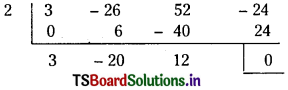
Find the polynomial equation whose roots are the translates of those of the equation – 5x3 + 7x2 – 17x + 11 = 0 by – 2.
Solution:
Given equation is
x4 – 5x3 + 7x2 – 17x + 11 = 0 ………(1)
Let f(x) = x4 – 5x3 + 7x2 – 17x + 11
The polynomial equation, whose roots are
the translates of those of the f(x) = 0 by – 2 is f(x + 2) = 0.
Suppose that
f(x + 2) = A0x4 + A1x3 + A2x2+ A3x + A4
By synthetic division, the coefficients A0, A1, A2, A3 and A4 are obtained as follows.

TS Inter 2nd Year Maths 2A Solutions Chapter 4 Theory of Equations Ex 4(d) 1

∴ The roots ol the equation x4 – 3x3 + x2 – 17x + 19 = 0 are the translates of the roots of the given equation by – 2.

Question 2.
Find the polynomial equation whose roots are the translates of those of the equation x5 – 4x4 + 3x2 – 4x + 6 = 0 by – 3.
Solution:
Given equation is x5 – 4x4 + 3x2 – 4x 4 6 = 0 ………….(1)
Let f(x) = x5 – 4x4 + 3x2 – 4x + 6
The polynomial equation, whose roots are the translates of those of the f(x) = 0 by – 3 is f(x + 3) = 0.
Suppose that f(x + 3) = A0x5 + A1x4 + A2x3 + A3x2 + A4x + A5
By synthetic division, the coefficients A0, A1, A2, A3, A4 and A5 are obtained as follows.

TS Inter 2nd Year Maths 2A Solutions Chapter 4 Theory of Equations Ex 4(d) 2

∴ The roots of the equation x5 + 11x4 + 42x3 + 57x2 – 13x – 60 = 0 are the translates of the roots of the given equation by – 3.

TS Board Inter 2nd Year Maths 2A Solutions Chapter 4 Theory of Equations Ex 4(d)

Question 3.
Find the polynomial equation whose roots are the translates of the roots of the equation x4 – x3 – 10x2 + 4x + 24 = 0 by 2.
Solution:
Given equation is x4 – x3 – 10x2 + 4x + 24 = 0
Let f(x) = x4 – x3 – 10x2 + 4x + 24
The polynomial equation whose roots are trans-lates of those of the f(x) = 0 by 2 is f(x – 2) = 0.
Suppose that f(x – 2) = A0x4 + A1x3 + A2x2 + A3x + A4
By synthetic division, the coefficients A0, A1, A2, A3, A4 are obtained as follows – 2.

TS Inter 2nd Year Maths 2A Solutions Chapter 4 Theory of Equations Ex 4(d) 3

∴ The roots of the equation x4 – 9x3 + 20x2 = 0 are the translates of the roots of the given equati on by 2.

Question 4.
Find the polynomial equation whose roots are the translates of the roots of the equation 3x5 – 5x3 + 7 = 0 by 4.
Solution:
Given equation is 3x5 – 5x3 + 7 = 0
Let f(x) = 3x5 – 5x3 + 7
The polynomial equation whose roots are the translates of those of the f(x) = 0 by 4 is f(x – 4) = 0.
Suppose that
f(x – 4) = A0x5 + A1x4 + A2x3 + A3x2 + A4x + A5
By synthetic division, the coefficients A0, A1, A2, A3, A4, A5 are obtained as follows.

TS Inter 2nd Year Maths 2A Solutions Chapter 4 Theory of Equations Ex 4(d) 4

∴ The roots of the equation 3x5 – 60x4 + 475x2 – 1860x3 + 3600x – 2745 = 0 are the translates of the roots of the given equation by 4.

TS Board Inter 2nd Year Maths 2A Solutions Chapter 4 Theory of Equations Ex 4(d)

Question 5.
Transform e jach of the following equations into ones i n which the coefficients of the second hig >hest power of x is zero and also find their transformed equations.
i) x3 – 6x2 + 10x – 3 = 0
ii) x4 + 4x3 + 2x2 – 4x – 2 = 0
iii) x3 – 6x2 + 4x – 7 = 0
iv) x3 + 6x2+ 4x + 4 = 0
Solution:
i) Given equation is x3 – 6x + 10x – 3 = 0
Let f(x) = x3 – 6x2 + 10x – 3
We have to find ’h’ so that the coefficient of the Second highest power of x in f(x + h) is zero.
i.e., Coefficient of x2 in f(x + h) is zero,
f (x + h) = (x + h)3 – 6 (x + h)2 + 10 (x + h) – 3 Coefficients of x2 in f(x + h) is 3h – 6.
We choose ‘h‘ such that 3h – 6 = 0 i.e., h = 2
∴ f (x + 2) = (x + 2)3 – 6 (x + 2)2 + 10 (x + 2) – 3
= x3 + 6x2 + 12x + 8 – 6 (x2 + x + 4) + 10x + 20 – 3
= x3 – 2x + 1
∴ x3 – 2x + 1 = 0 is the required equation.

ii) Given equation is
x4 + 4x3 + 2x2 – 4x – 2 = 0
Let f(x) = x4 + 4x3 + 2x2 – 4x – 2
We have to find ‘h’ so that the coefficient of the second highest power of x in f(x + h) is zero.
i.e., coefficient of x2 in f(x + h) is zero,
f (x + h) = (x + h)4 + 4 (x + h)3 + 2 (x + h)2 , – 4 (x + h) – 2
Coefficient of x2 in f(x + h) is 4h + 4.
We choose ‘h‘ such that 4h + 4 = 0 i.e., h = – 1
∴ f(x – 1) = (x – 1)4 + 4 (x – 1)3 + 2 (x – 1)2 – 4 (x – 1) – 2
= (x4 – 4x3 + 6x2 – 4x + 1) + 4 (x3 – 3x2 + 3x – 1) + 2 (x2 – 2x + 1) – 4 (x – 1) – 2
= x4 – 4x2 + 1
∴ x4 – 4x2 + 1 = 0 is the required equation.

iii) Given equation is x3 – 6x2 + 4x – 7 = 0
Let f(x) = x3 – 6x2 + 4x – 7
We have to find ‘h’ so that the coefficient of the second highest power of x in f(x + h) is zero.
i.e., coefficient of x2 in f(x + h) is zero.
f(x + h) = (x + h)3 – 6 (x + h)2 + 4 (x + h) – 7
Coefficient of x2 in f(x + h) is 3h – 6
We choose ‘h’ such that 3h – 6 = 0 i.e., h = 2
∴ f(x + 2) = (x + 2)3 – 6 (x + 2)2 + 4 (x + 2) – 7
= (x3 + 6x2 + 12x + 8) – 6 (x2 + 4x + 4) + 4 (x + 2) – 7
= x3 – 8x – 15
∴ x3 – 8x – 15 = 0 is the required equation.

iv) Given equation is x3 + 6x2 + 4x + 4 = 0
Let f(x) = x3 + 6x2 + 4x + 4
We have to find ’h’ so that the coefficient of the second highest power of x in f(x + h) is zero, i.e., coefficient of x2 in f(x + h) is zero.
f(x + h) = (x + h)3 + 6(x + h)2 + 4(x + h) + 4
Coefficient of x2 in 1(x + h) is 3h + 6.
We have to choose ‘h’ such that 3h + 6 = 0 i.e., h = – 2
∴ f(x – 2)= (x – 2)3 + 6(x – 2)2 + 4(x – 2) + 4
= (x3 – 6x2 + 12x – 8) + 6 (x2 – 4x + 4) + 4 (x – 2) + 4
= x3 – 8x + 12
∴ x3 – 8x + 12 = is the required equation.

TS Board Inter 2nd Year Maths 2A Solutions Chapter 4 Theory of Equations Ex 4(d)

Question 6.
Transform each of the following equations into ones in which the coefficients of the third highest power of x is zero.
i) x4 + 2x<sup3 – 12x2 + 2x – 1 = 0
ii) x3 + 2x2 + x + 1 = 0
Solution:
i) Given equation is
x4 + 2x3 – 12x2 + 2x – 1 = 0
Let f(x) = x4 + 2x3 – 12x2 + 2x – 1
We have to find h’ so that the coefficient of the third highest power of ‘x’ in f(x + h) is zero.
i.e., Coefficient of x2 in [(x + h) is zero.
f(x + h) = (x + h)4 + 2 (x + h)3 – 12 (x + h)2 + 2 (x + h) – 1
Coefficient of x3 in 1(x + h) is 6h2 + 6h – 12
We have to choose ‘h’ such that
6h2 + 6h – 12 = 0
⇒ (h + 2) (h – 1) = 0
⇒ h = – 2 or 1.

Case – (I):
When h = – 2
f(x – 2) = (x – 2)4 + 2 (x – 2)3 – 12(x – 2)2 + 2 (x – 2) – 1
= x4 – 8x3 + 24x2 – 32x + 16 + 2(x3 – 6x2 + 12x – 8) – 12(x2 – 4x + 4) + 2(x – 2) – 1
= x4 – 6x3 + 42x – 53
∴ Tranformed equation is x4 – 6x3 + 42x – 53 = 0.

Case-(ii):
When h = 1
f(x + 1) = (x + 1)4 + 2(x + 1)3 – 12(x + 1)2 + 2 (x + 1) – 1
= (x4 + 4x3 + 6x2 + 4x + 1) + 2(x3 + 3x2 + 3x + 1) – 12 (x2 + 2x + 1) + 2(x + 1) – 1
= x4 + 6x3 – 12x – 8
∴ Tranformed equation is x4 + 6x3 – 12x – 8 = 0
∴ Required equation is x4 – 6x3 + 4x – 53 = 0
or x4 + 6x3 – 12x – 8 = 0.

ii) Given equation is x3 + 2x2 + x + 1 = 0
Let f(x) = x3 + 2x2 + x + 1
We have o find ‘h’ so that the coefficient of the third highest power of ‘x’ in f(x + h) is zero.
i.e., Coefficient of x in f(x + h) is zero.
f(x + h) = (x + h)3 + 2(x + h)2 + (x + h) + 1
Coefficient of ‘x3’ in f(x + h) is 3h2 + 4h + 1
We have to Choose ‘h’ such that 3h2 + 4h + 1 = 0
i.e., h = – 1 or h = – \(\frac{1}{3}\).

Case – (I):
When h = – 1
f(x – 1) = (x – 1)3 + 2(x – 1)2 +(x – 1) + 1
= (x3 – 3x2 + 3x – 1)2 + 2 (x2 – 2x + 1) + x – 1 + 1
= x3 – x2 + 1
∴ Transformed euluation is x3 – x2 + 1 = 0.

Case – (ii):
When h = – \(\frac{1}{3}\)
\(f\left(x-\frac{1}{3}\right)=\left(x-\frac{1}{3}\right)^3+2\left(x-\frac{1}{3}\right)^2+\left(x-\frac{1}{3}\right)\)
= \(\left(x^3-x^2+\frac{x}{3}-\frac{1}{27}\right)+2\left(x^2-\frac{2}{3} x+\frac{1}{9}\right)\) + x – \(\frac{1}{3}\) + 1
= x3 + x2 + \(\frac{23}{27}\)
∴ Transformed equation is x3 + x2 + \(\frac{23}{27}\)
⇒ 27x3 + 27x2 + 23 = 0
∴ Required equation is x3 – x2 + 1 = 0 or 27x3 + 27x2 + 23 = 0.

TS Board Inter 2nd Year Maths 2A Solutions Chapter 4 Theory of Equations Ex 4(d)

Question 7.
Solve the following equations.
i) x4 – 10x3 + 26x2 – 10x + 1 = 0.
ii) 2x5 + x4 – 12x3 – 12x2 + x + 2 = 0
Solution:
i) Given equatIon is
x4 – 10x3 + 26x2 – 10x + 1 = 0 (1)
This is even degree reciprocal equation of class one.
On dividing (1) by x2,
x2 – 10x + 26 – \(\frac{10}{x}+\frac{1}{x^2}\) = 0
⇒ \(\left(x^2+\frac{1}{x^2}\right)-10\left(x+\frac{1}{x}\right)\) + 26 = 0
⇒ \(\left(x^2+\frac{1}{x^2}\right)-10\left(x+\frac{1}{x}\right)\) + 24 = 0
[Put x + \(\frac{1}{x}\) = y)
⇒ y2 – 10y + 24 = 0
⇒ (y – 4) (y – 6) = 0
⇒ y = 4 or y = 6.

Case – (i):
When y = 4
⇒ x + \(\frac{1}{x}\) = 4
⇒ x2 – 4x + 1 = 0
⇒ x = 2 ± √3.

Case – (ii):
When y = 6
⇒ x + \(\frac{1}{x}\) = 4
⇒ x2 – 6x + 1 = 0
⇒ x = 3 ± 2√2
∴ The roots are 2 ± √3, 3 ± 2√2.

TS Board Inter 2nd Year Maths 2A Solutions Chapter 4 Theory of Equations Ex 4(d)

ii) Given equation is
2x5 + x4 – 12x3 – 12x2 + x + 2 = 0 ………………. (1)
Let f(x) = 2x5 + x4 – 12x3 – 12x2 + x + 2
(1) is an odd degree reciprocal equation of class one.
∴ x = – 1 is a root of (1)
x + 1 is a factor of f(x).
We divide f(x) with x + 1.
By synthetic division,

TS Inter 2nd Year Maths 2A Solutions Chapter 4 Theory of Equations Ex 4(d) 5

∴ f(x) = (x + 1) (2x4 – x3 – 11x2 – x + 2)
Let g(x) = 2x4 – x3 – 11x2 – x + 2
g(x) = 0 is an even degree reciprocal equation 0f class one.
Dividing g(x) = 0 by x2
We get 2x2 – x – 11 – \(\frac{1}{x}+\frac{2}{x^2}\) = 0
⇒ \(2\left(x^2+\frac{1}{x^2}\right)-\left(x+\frac{1}{x}\right)\) – 11 = 0
⇒ \(2\left(x+\frac{1}{x}\right)^2-\left(x+\frac{1}{x}\right)\) – 15 = 0
(Put x + \(\frac{1}{x}\) = y)
⇒ 2y2 – y – 15 = 0
⇒ (2y + 5) (y – 3) = 0
∴ y = 3 or y = – 1.

Case – (i) :
When y = 3
x + \(\frac{1}{x}\) = 3
⇒ x2 – 3x + 1 = 0
⇒ x = \(\frac{3 \pm \sqrt{5}}{2}\)

Case – (ii):
When y = \(\frac{-5}{2}\)
x + \(\frac{1}{x}\) = \(\frac{-5}{2}\)
⇒ 2x2 + 2 = – 5x
⇒ 2x2 + 5x + 2 = 0
⇒ (2x + 1) (x + 2) = 0
∴ x = – \(\frac{-1}{2}\) or x = – 2
∴ The roots are – 1, 2, \(\frac{3 \pm \sqrt{5}}{2}\).

TS Inter 2nd Year Maths 2A Solutions Chapter 4 Theory of Equations Ex 4(b)

Students must practice this TS Intermediate Maths 2A Solutions Chapter 4 Theory of Equations Ex 4(b) to find a better approach to solving the problems.

TS Inter 2nd Year Maths 2A Solutions Chapter 4 Theory of Equations Ex 4(b)

I.
Question 1.
Solve x3 – 3x2 – 16x + 48 = 0, given that the sum of two roots is zero.
Solution:
Let α, β, γ be the roots of
x3 – 3x2 – 16x + 48 = 0 ………….(1)
Given that the sum of two roots is zero.
Let α + β = 0 …………(2)
But from (1) we have α + β + γ = 3
⇒ γ = 3
Hence αβγ = – 48
⇒ αβ = – 16
We know that,
(α + β)2 – (α – β)2 = 4αβ
⇒ (α – β)2 = 64
⇒ α – β = ± 8.

i) When α – β = 8
⇒ 2α = 8 (∵ from (2))
⇒ α = 4
∴ β = – 4.

ii) When α – β = – 8
⇒ 2α = – 8 (∵ from (2))
⇒ α = – 4
∴ β = 4.
The roots of given equation are 4, – 4 and 3.

TS Board Inter 2nd Year Maths 2A Solutions Chapter 4 Theory of Equations Ex 4(b)

Question 2.
Find the condition that x3 – px2 + qx – r = 0 may have the sum of two of its roots zero.
Solution:
Given equation is x3 – px2 + qx – r = 0
Let α, β, γ be the roots.
∴ α + β + γ = p …………..(1)
Given sum of two of its roots is zero.
∴ (1) ⇒ α + 0 = p
i. e„ α = p
Substituting in given equation, we get p3 – p3 + pq – r = 0
⇒ pq – r = 0
⇒ Pq = r.

Question 3.
Given that the roots of x3 + 3px2 + 3qx + r = 0 are in
i) A.P., show that 2p3 – 3qp + r = 0
ii) G.P., show that p3r = q3
iii) H.P., show that 2q3 = r (3pq – r).
Solution:
Given cubic equation is
x3 + 3px2 + 3qx + r = 0 ……………..(1)
Let α, β, γ be its roots.

i) When the roots are in A.P. :
i.e., 2β = α + γ
from (1) α + β + γ = – 3p
⇒ (α + γ) + P = – 3p
⇒ 2β + β = – 3p
⇒ 3β = – 3p
⇒ β = – P
Substituting in given equation, we get
– p3 + 3p3 – 3pq + r = 0
⇒ 2p3 – 3pq + r = 0.

ii) When the roots are in G.P. :
∴ β2 = αγ
from (1) αβγ = – r
⇒ β3 = – r
⇒ β = – r1/3
Substituting in (1), we get
(- r1/3)3 + 3pr2/3 – 3qr1/3 + r = 0
⇒ 3pr2/3 = 3qr1/3
⇒ P3r = q3.

iii) When the roots are in H.P. :
β = \(\frac{2 \alpha \gamma}{\alpha+\gamma}\)
⇒ β2 = \(\frac{2 \alpha \beta \gamma}{(\alpha+\beta+\gamma)-\beta}\)
⇒ β2 = \(\frac{-2 r}{-3 p-\beta}\)
⇒ β2 + 3pβ2 = 2r (∵ β is a root of (1))
⇒ – 3qβ – r = 2r
β = – \(\frac{r}{q}\)
Substituting in (1) we get
\(\frac{-r^3}{q^3}+\frac{3 p r^2}{q^2}-\frac{3 q r}{q}\) + r = 0
⇒ 2q3 = r(3pq – r).

TS Board Inter 2nd Year Maths 2A Solutions Chapter 4 Theory of Equations Ex 4(b)

Question 4.
Find the condition that x3 – px2 + qx – r = 0 may have the roots in G.P.
Solution:
Let α, β, γ be the roots of
x3 – px2 + qx – r = 0
If α, β, γ are in G.P., then
β2 = αγ
(1) ⇒ αβγ = r
⇒ β3 = r
β = r1/3
Substituting in (1), we get
(r1/3)3 – p(r1/3)2 + q(r1/3) – r = 0
⇒ pr2/3 = qr1/3
⇒ p3r2 = q3r
⇒ q3 = p3r.

II.
Question 1.
Solve 9x3 – 15x2 7x – 1 = 0, given that two of its roots are equal.
Solution:
Given cubic equation is
9x3 – 15x2 – 7x – 1 = 0 ……………. (1)
Suppose α, β, γ are the roots of (1)
∴ α + β + γ = \(\frac{15}{9}=\frac{5}{3}\)
αβ + βγ + γα = \(\frac{7}{9}\)
αβγ = \(\frac{1}{9}\)
According to the problem, α = β (∵ two of its roots are equal)
∴ 2α + γ = \(\frac{5}{3}\)
⇒ γ = \(\frac{5}{3}\) – 2α
Also, α2 + 2αγ = \(\frac{7}{9}\)
⇒ α2 + 2α (\(\frac{5}{3}\) – 2α) = \(\frac{7}{9}\)
⇒ 27α2 – 30α + 7 = 0
⇒ (3α – 1) (9α – 7) = 0
∴ α = \(\frac{1}{3}\) or α = \(\frac{7}{9}\)

Case (i) :
when α = \(\frac{1}{3}\)
γ = \(\frac{5}{3}\) – 2α
= \(\frac{5}{3}\) – \(\frac{2}{3}\) = 1
∴ The roots are \(\frac{1}{3}\), \(\frac{1}{3}\), 1.

Case – (ii):
When α = \(\frac{7}{9}\)
γ = \(\frac{5}{3}\) – 2α
= \(\frac{5}{3}-\frac{14}{9}\) = \(\frac{1}{9}\)
Which is impossible as
αβγ = \(\frac{7}{9} \cdot \frac{7}{9} \cdot \frac{1}{9}\) ≠ \(\frac{1}{9}\)
∴ The roots are \(\frac{1}{3}\), \(\frac{1}{3}\), 1.

TS Board Inter 2nd Year Maths 2A Solutions Chapter 4 Theory of Equations Ex 4(b)

Question 2.
Given that one root of 2x3 + 3x2 – 8x + 3 = 0 is double the other root, find the roots of equation.
Solution:
Given cubic equation is
2x3 + 3x2 – 8x + 3= 0 ……………..(1)
Suppose α, β, γ are the roots of (1).
∴ α + β + γ = \(\frac{-3}{2}\)
αβ + βγ + γα = \(\frac{-8}{2}\) = – 4 …………….(2)
αβγ = \(\frac{-3}{2}\)
Given one root is double the other.
3α + γ = \(\frac{-3}{2}\)
⇒ γ = \(\frac{-3}{2}\) – 3α
Also from (2):
2 – 3α (\(\frac{3}{2}\) + 3α) = – 4
14α2 + 9α – 8 = 0
(2α – 1) (7α + 8) = 0
α = \(\frac{1}{2}\) or α = \(\frac{-8}{7}\).

Case (i):
When α = \(\frac{1}{2}\)
β = 2α = 2 (\(\frac{1}{2}\)) = 1
γ = \(\frac{-3}{2}\) – 3α
= \(\frac{-3}{2} \frac{-3}{2}\) = – 3.
∴ α = \(\frac{1}{2}\), β = 1 and γ = – 3
satisfies αβγ = \(\frac{-3}{2}\)
∴ The roots are \(\frac{1}{2}\), 1, – 3.

Case (ii):
When α = \(\frac{-8}{7}\)
β = 2α = \(\frac{-16}{7}\)
γ = \(\frac{-3}{2}\) – 3α
= \(\frac{-3}{2}+\frac{48}{7}=\frac{75}{14}\)
But α = \(\frac{-8}{7}\), β = \(\frac{-16}{7}\) and γ = \(\frac{75}{14}\) do not satisfy αβγ = \(\frac{-3}{2}\).
Hence the roots of given equation are \(\frac{1}{2}\), 1, – 3.

TS Board Inter 2nd Year Maths 2A Solutions Chapter 4 Theory of Equations Ex 4(b)

Question 3.
Solve x3 – 9x2 + 14x + 24 = 0, given that two of the roots are in the ratio 3 : 2.
Solution:
Given cubic equation is
x3 – 9x2 + 14x + 24 = 0 ……….(1)
Let α, β, γ be the roots of (1)
∴ α + β + γ = 9, αβ + βγ + γα = 14, αβγ = – 24 ……………..(2)
Given two roots are in the ratio 3 : 2,
let α : β = 3 : 2
⇒ β = \(\frac{2 \alpha}{3}\)
Now from (2) \(\frac{5 \alpha}{3}\) + γ = 9
⇒ γ = 9 – \(\frac{5 \alpha}{3}\)
Also, \(\frac{2}{3}\) α2 + (9 – \(\frac{5 \alpha}{3}\)) \(\frac{5 \alpha}{3}\) = 14
⇒ 2α2 + \(\frac{5 \alpha(27-5 \alpha)}{3}\) = 42
⇒ 19α2 – 135α + 126 = 0
⇒ (19α – 21) (α – 6) = 0
⇒ α = \(\frac{21}{19}\) or α = 6.

Case (i):
When α = \(\frac{21}{19}\)
β = \(\frac{2}{3}(\alpha)=\frac{2}{3}\left(\frac{21}{19}\right)=\frac{14}{19}\)
γ = \(9-\frac{5 \alpha}{3}=9-\frac{5}{3}\left(\frac{21}{19}\right)=\frac{136}{19}\)
These values do not satisfy αβγ = – 24.

Case – (ii) :
When α = 6
β = \(\frac{2}{3}(\alpha)=\frac{2}{3}(6)\) = 4
γ = \(9-\frac{5 \alpha}{3}=9-\frac{5}{3}(6)\) = – 1
These values satisfy αβγ = – 24.
∴ The roots of given equation are 6, 4, – 1.

TS Board Inter 2nd Year Maths 2A Solutions Chapter 4 Theory of Equations Ex 4(b)

Question 4.
Solve the following equations, given that the roots of each are in A.P.
i) 8x3 – 36x2 – 18x + 81 = 0
ii) x3 – 3x2 – 6x + 8 = 0
Solution:
i) Given cubic equation is
8x3 – 36x2 – 18x + 81 = 0 …………….(1)
Given the roots are in A.P.
∴ α – d, α, α + d be the roots.
∴ Sum of the roots 3α = \(\frac{36}{8}\)
⇒ α = \(\frac{3}{2}\)
∴ x – \(\frac{3}{2}\) is a factor of 8x3 – 36x2 – 18x + 81
By synthetic division,

TS Inter 2nd Year Maths 2A Solutions Chapter 4 Theory of Equations Ex 4(b) 1

8x3 – 36x2 – 18x + 81 = (x – \(\frac{3}{2}\)) (8x2 – 24x – 54)
∴ Equation (1)
⇒ (x – \(\frac{3}{2}\)) (8x2 – 24x – 54) = 0
⇒ (x – \(\frac{3}{2}\)) (2x + 3) (2x – 9) = 0
⇒ x = – \(\frac{3}{2}\) or x = \(\frac{3}{2}\) or x = \(\frac{9}{2}\)
∴ The roots are \(\frac{-3}{2}\), \(\frac{3}{2}\), \(\frac{3}{2}\).

ii) Given roots of cubic equation
x3 – 3x2 – 6x + 8 = 0 ……………(1) are in G.P.
Let α – d, α, α + d be the roots.
∴ Sum of the roots 3α = 3
⇒ α = 1
∴ (x – 1) is a factor of x3 – 3x2 – 6x + 8.
By synthetic division,

TS Inter 2nd Year Maths 2A Solutions Chapter 4 Theory of Equations Ex 4(b) 2

x3 – 3x2 – 6x + 8 = (x – 1) (x2 – 2x – 8)
∴ Equation (1)
⇒ (x – 1) (x2 – 2x – 8) = 0
⇒ (x – 1) (x – 4) (x + 2) = 0
∴ x = 1 or x = 4 or x = – 2.
∴ The roots are – 2, 1, 4.

TS Board Inter 2nd Year Maths 2A Solutions Chapter 4 Theory of Equations Ex 4(b)

Question 5.
Solve the following equations, given that the roots of each are in GP.
i) 3x3 – 26x2 + 52x – 24= 0
ii) 54x3 – 39x2 – 26x + 16 = 0
Solution:
i) Given roots of cubic equation
3x3 – 26x2 + 52x – 24 = 0 ……………. (1) are in G.P.
Let \(\frac{\alpha}{r}\), α, αr be the roots.
∴ Product of the roots α3 = \(\frac{24}{3}\) = 8
⇒ α = 2
∴ (x – 2) is a factor of 3x3 – 26x3 + 52x – 24
By synthetic division,

TS Inter 2nd Year Maths 2A Solutions Chapter 4 Theory of Equations Ex 4(b) 3

3x3 – 26x2 + 52x – 24 = (x – 2) (3x2 – 20x + 12)
∴ Equation (1) ⇒ (x – 2) (3x2 – 20x + 12) = 0
⇒ (x – 2) (3x – 2) (x – 6) = 0
∴ x = 2 or x = \(\frac{2}{3}\) or x = 6
∴ The roots are \(\frac{2}{3}\), 2, 6.

ii) Given roots of cubic equation.
54x3 – 39x2 – 26x + 16 = 0 (1) are in GP.
Let \(\frac{\alpha}{r}\), α, αr be the roots.
∴ Product of the roots α3 = \(\frac{-16}{54}\)
⇒ α3 = \(\frac{-2}{3}\)
∴ (x + \(\frac{2}{3}\)) is a factor 54x3 – 39x2 – 26x + 16
By synthetic division,

TS Inter 2nd Year Maths 2A Solutions Chapter 4 Theory of Equations Ex 4(b) 4

54x3 – 39x2 – 26x + 16 = (x + \(\frac{2}{3}\)) (54x2 – 75x + 24)
∴ Equation (1),
(x + \(\frac{2}{3}\)) (54x2 – 75x + 24) = 0
(x + \(\frac{2}{3}\)) (18x2 – 25x + 8) = 0
(x + \(\frac{2}{3}\)) (9x – 8)(2x – 1) = 0
∴ x = – \(\frac{2}{3}\) or x = \(\frac{8}{9}\) or x = \(\frac{1}{2}\)
∴ The roots are \(\frac{8}{9}\), \(\frac{-2}{3}\), \(\frac{1}{2}\).

TS Board Inter 2nd Year Maths 2A Solutions Chapter 4 Theory of Equations Ex 4(b)

Question 6.
Solve the following equations, given that the roots of each are In H.P.
i) 6x3 – 11x2 + 6x – 1 = 0
ii) 15x3 – 23x2 – 9x – 1 = 0
Solution:
i) Given cubic equation is
6x3 – 11x2 + 6x – 1 = 0 …………..(1)
Put y = \(\frac{1}{x}\)
∴ (1) ⇒ \(\frac{6}{y^3}-\frac{11}{y^2}+\frac{6}{y}\) – 1 = 0
⇒ y3 – 6y2 + 11y – 6 = 0 ………… (2)
Given roots of (1) are in H.P.
⇒ Roots of (2) are in AP.
Let a – d, a, a + d be the roots of (2),
∴ Sum of the roots, 3a = 6
⇒ α = 2
∴ (x – 2) is a factor of y3 – 6y2 + 11y – 6
By synthetic division

TS Inter 2nd Year Maths 2A Solutions Chapter 4 Theory of Equations Ex 4(b) 5

∴ y3 – 6y2 + 11y – 6 = (y – 2) (y2 – 4y 3)
∴ Equation (2) = (y – 2) (y2 – 4y + 3) = 0
⇒ (y – 2) (y – 3) (y – 1) = 0
∴ y = 1 or y = 2 ory = – 3
The roots of (2) are 1, 2, 3.
Hence the roots of (1) are 1, \(\frac{1}{2}\), \(\frac{1}{3}\).

ii) Given cubic equation is
15x3 – 23x2 + 9x – 1 = 0 …………….(1)
put y = \(\frac{1}{x}\)
∴ (1) ⇒ y3 – 9y + 23y2 – 15 = 0 ………..(2)
Given roots of (1) are in 1-LP.
⇒ Roots of (2) are in A.P.
Let a – d, a, a + d be the roots of (2),
∴ Sum of the roots, 3α = 9
⇒ α = 3
∴ (y – 3) is a factor of y3 – 9y + 23y2 – 15.
By synthetic division,

TS Inter 2nd Year Maths 2A Solutions Chapter 4 Theory of Equations Ex 4(b) 6

∴ y3 – 9y + 23y2 – 15 = (y – 3) (y2 – 6y + 5)
∴ Equation (2) = (y – 3) (y2 – 6y + 5) = 0
⇒ (y – 3) (y – 1) (y – 5) = 0
∴ y = 1 or y = 3 or y = 5
∴ The roots of (2) are 1, 3, 5.
Hence the roots of (2) are 1, \(\frac{1}{3}\), \(\frac{1}{5}\).

TS Board Inter 2nd Year Maths 2A Solutions Chapter 4 Theory of Equations Ex 4(b)

Question 7.
Solve the following equations, given that they have multiple roots.
i) x4 – 6x3 + 13x2 – 24x + 36 = 0
ii) 3x4 + 16x3 + 24x2 – 16 = 0
Solution:
i) Given equation,
x4 – 6x3 + 13x2 – 24x + 36 = 0 …………..(1)
Let f(x) = x4 – 6x3 + 13x2 – 24x + 36
f’(x) = 4x3 – 18x2 + 26x – 24
= 2 (2x3 – 9x2 + 13x – 12)
f’(3) = 2(54 – 81 + 39 – 12)
⇒ f'(3) = o
Now
f(3) = 81 – 162 + 117 – 72 + 36
= f(3) = 0
∴ (x – 3) is a factor of f(x) and f’(x).
∴ 3 is the repeated root of f(x) = 0.
Now we divide f(x) by (x – 3) by using synthetic division.

TS Inter 2nd Year Maths 2A Solutions Chapter 4 Theory of Equations Ex 4(b) 7

∴ f(x) = (x – 3) (x – 3) (x2 + 4)
∴ Equation (1)
⇒ f(x) = 0
⇒ (x – 3) (x – 3) (x2 + 4) = 0
∴ x = 3 or x2 + 4 = 0
⇒ x = ±2i
∴ The roots of given equation are 3, 3, ± 2i.

ii) Given equation is
3x4 + 16x3 + 24x2 – 16 = 0 …………..(1)
Let f(x) = 3x4 + 16x3+ 24x2 – 16
⇒ f'(x) = 12x3 + 48x2 + 48x
= 12 (x3 + 4x2 + 4x)
= 12x (x + 2)2
⇒ f’ (- 2) = 0
Also f(- 2) = 3(16) + 16(- 8) + 24(4) – 16 = 0
∴ (x + 2) is a factor of f(x) and f'(x).
∴ – 2 is a repeated root of f(x) = 0.
Now we divide f(x) by (x + 2) using synthetic division.

TS Inter 2nd Year Maths 2A Solutions Chapter 4 Theory of Equations Ex 4(b) 8

∴ f(x) = (x + 2) (x + 2) (3x2 + 4x – 4)
Equation (1)
⇒ f(x) = 0
⇒ (x + 2) (x + 2) (3x2 + 4x – 4) = 0
⇒ (x + 2) (x + 2) (3x – 2) (x + 2) = 0
⇒ x = – 2 or x = \(\frac{2}{3}\)
∴ The roots of given equation are – 2, – 2, – 2, \(\frac{2}{3}\).

TS Board Inter 2nd Year Maths 2A Solutions Chapter 4 Theory of Equations Ex 4(b)

III.
Question 1.
Solve x4 + x3 – 16x2 – 4x + 48 = 0, given that the product of two of the roots is 6.
Solution:
Given equation is
x4 + x3 – 16x2 – 4x + 48 = 0 ………….(1)
Let α, β, γ, δ be the roots
∴ x4 + x3 – 16x2 – 4x + 48 = (x + α) (x – β) (x – γ) (x – δ) ……….(2)
∴ Sum of the roots α + β + γ + δ = – 1
and product of roots ⇒ αβγδ = 48 …………..(3)
Given product of two roots = 6
Let αβ = 6
∴ γδ = \(\frac{48}{\alpha \beta}\)
γδ = 8
Let α + β = a and γ + δ = b
Now (2)
⇒ x4 + x3 – 16x2 – 4x + 48 = (x2 – (α + β) x + αβ) (x2 – (γ + δ) x + γδ)
⇒ x4 + x3 – 16x2 – 4x + 48 = (x2 – ax + 6) (x2 – bx + 8)
Comparing like terms.
we get, a + b = – 1 and
8a – 6b = 5 ……………..(4)
⇒ 4a + 3b = 2 (5)
(5) ⇒ 4a + 3 (- 1 – a) = 2 (∵ from (4))
⇒ a = 5
∴ b = – 6
∴ x4 + x3 – 16x2 – 4x + 48 = (x2 – 5x + 6) (x2 + 6x + 8)
= (x – 2) (x – 3) (x + 2) (x + 4)
∴ Equation (1),
⇒ (x – 2) (x – 3) (x + 2) (x + 4) = 0
∴ x = – 4; x = – 2 or x = 2 or x = 3
∴ The roots of the given equation are 2, 3, – 4, – 2.

TS Board Inter 2nd Year Maths 2A Solutions Chapter 4 Theory of Equations Ex 4(b)

Question 2.
Solve 8x4 – 2x3 – 27x2 + 6x + 9 = 0 given that two roots have the same absolute value, but are opposite in sign.
Solution:
Given equation is
8x4 – 2x3 – 27x2 + 6x + 9 = 0
⇒ x4 – \(\frac{1}{4} x^3-\frac{27}{8} x^2+\frac{3}{4} x+\frac{9}{8}\) = 0 ……………(1)
Let α, β, γ, δ be the roots of (1)
∴ Sum of the roots α + β + γ + δ = \(\frac{1}{4}\)
and product of roots αβγδ = \(\frac{9}{8}\)
But given two roots have same absolute value but are opposite sign.
Let α = – β
⇒ α + β = 0
∴ γ + δ = \(\frac{-1}{4}\)
Let αβ = a and γδ = b
Now(x – α) (x – β) = x2 – (α + β)x + αβ
⇒ (x – α) (x – β) = x2 + a …………(2)
Also (x – γ) (x – δ) = x2 – (γ + δ)x + γδ
= (x – γ) (x – δ) = x2 – \(\frac{1}{4}\) x + b ………….(3)
From (1), (2) and (3)
x4 – \(\frac{1}{4} x^3-\frac{27}{8} x^2+\frac{3}{4} x+\frac{9}{8}\) = (x2 + a) (x2 – \(\frac{1}{4}\) x + b)
Comparing like terms,
\(\frac{3}{4}=\frac{-a}{4}\) and ab = \(\frac{9}{8}\)
a = – 3
∴ b = \(\frac{9}{8(-3)}\)
b = \(\frac{-3}{8}\)
∴ (2) ⇒ (x – α) (x – β) = x2 – 3
& (3) ⇒ (x – γ) (x – δ) = (x2 – \(\frac{1}{4}\) x + \(\frac{3}{8}\))
⇒ \(\frac{1}{8}\) (8x2 – 2x – 3)
⇒ (x – γ) (x – δ) = \(\frac{1}{8}\) (2x + 1) (4x – 3)
(x – γ) (x – δ) = (x + \(\frac{1}{2}\)) (x – \(\frac{3}{4}\))
∴ Equation (1)
(x2 – 3) (x + \(\frac{1}{2}\)) (x – \(\frac{3}{4}\)) = 0
⇒ x = ± √3 or x = – \(\frac{1}{2}\) or x = \(\frac{3}{4}\)
∴ The roots of given equation are – √3, √3, – \(\frac{1}{2}\), \(\frac{3}{4}\).

TS Board Inter 2nd Year Maths 2A Solutions Chapter 4 Theory of Equations Ex 4(b)

Question 3.
Solve 18x3 + 81x2 + 121x + 60 = 0 given that one root is equal to half the sum of the remaining roots.
Solution:
Given equation is
18x3 + 81x2 + 121x + 60 = 0 ……………(1)
Let α, β, γ, δ be the roots
∴ Sum of roots, α + β + γ = \(\frac{-81}{18}=\frac{-9}{2}\)
αβ + βγ + γδ = \(\frac{121}{18}\)
and product of roots αβγ = \(\)
given one root is equal to halt of the sum of the remaining roots.
∴ Let α = \(\frac{\beta+\gamma}{2}\)
∴ α + 2α = \(\frac{-9}{2}\)
⇒ 3α = \(\frac{-9}{2}\)
⇒ α = \(\frac{-9}{2}\)
∴ x + \(\frac{3}{2}\) is a factor of 18x3 + 81x2 + 121x + 60.
By synthetic division,

TS Inter 2nd Year Maths 2A Solutions Chapter 4 Theory of Equations Ex 4(b) 9

∴ 18x3 + 81x2 + 121x + 60 = (x + \(\frac{3}{2}\)) (18x2 + 54x + 40)
= (x + \(\frac{3}{2}\)) (9x2 + 27x + 60)
∴ 18x3 + 81x2 + 121x + 60 = 2 (x + \(\frac{3}{2}\)) (3x + 4) (3x + 5)
∴ Equation (1),
⇒ 2 (x + \(\frac{3}{2}\)) (3x + 4) (3x + 5) = 0
∴ x = \(\frac{-3}{2}\) or x = \(\frac{-4}{3}\) or x = \(\frac{-5}{3}\).
∴ The roots of given equation are \(\frac{-3}{2}\), \(\frac{-4}{3}\), \(\frac{-5}{3}\).

TS Board Inter 2nd Year Maths 2A Solutions Chapter 4 Theory of Equations Ex 4(b)

Question 4.
Find the condition In order that the equation ax4 + 4bx3 + 6cx2 + 4dx + e = 0 may have two pairs of equal roots.
Solution:
Given equation is
ax4 + 4bx3 + 6cx2 + 4dx + e = 0 ………………..(1)
Given (1) has two pairs of equal roots.
∴ Let α, α, β, β be the root of (1).
(1) ⇒ x4 + \(\frac{4 b}{a} x^3+\frac{6 c}{a} x^2+\frac{4 d}{a} x+\frac{e}{a}\) = 0

TS Inter 2nd Year Maths 2A Solutions Chapter 4 Theory of Equations Ex 4(b) 10

3abc = 2b3 + a2d and ad2 = eb2.
∴ The required conditions are 2b3 + a2d = 3abc and ad2 = eb2.

TS Board Inter 2nd Year Maths 2A Solutions Chapter 4 Theory of Equations Ex 4(b)

Question 5.
i) Show that x5 – 5x3 + 5x2 – 1 = 0 has three equal roots and and this root.
ii) Find the repeated roots of x5 – 3x4 – 5x3 + 27x2 – 32x + 12 = 0.
Solution:
i) Given equation is x5 – 5x3 + 5x2 – 1 = 0
Let f(x) = x5 – 5x3 + 5x2 – 1
f’(x) = 5x4 – 15x2 + 10x
f”(x) = 20x3 – 30x + 10
f”(1) = 20 – 30 + 10 = 0
Similarly, f’(1) = 0 and f(1) = 0
∴ (x – 1) is a factor of f”(x), f’(x) & f(x).
Thus f(x) = 0 has three equal roots and it is ‘1’.

ii) Given equation is
x5 – 3x4 – 5x3 + 27x2 – 32x + 12 = 0 …………(1)
Let f(x) = x5 – 3x4 – 5x3 + 27x2 – 32x + 12
f’(x) = 5x4 – 12x3 – 15x2 + 54x – 32
f’(1) = 5 – 12 – 15 + 54 – 32 = 0
Similarly f'(1) = 0 and f(1) = 0
∴ (x – 1) is a factor of f”(x), f'(x) & f(x).
Thus f(x) = 0 has three equal roots and it is ‘1’.
By synthetic division,

TS Inter 2nd Year Maths 2A Solutions Chapter 4 Theory of Equations Ex 4(b) 11

∴ f(x) = (x – 1)2 (x3 – x2 – 8x + 12)
Let g(x) = x3 – x2 – 8x + 12
g’(x) = 3x2 – 2x – 8
g’(2) = 3(4) – 2(2) – 8 = 0
and g(2) = 23 – 22 – 8(2) + 12 = 0.
∴ (x – 2) is a factor of g(x) and g’(x).
∴ 2 is a multiple root of g(x) = 0.
By synthetic division,

TS Inter 2nd Year Maths 2A Solutions Chapter 4 Theory of Equations Ex 4(b) 12

∴ g(x) = (x – 2)2 (x + 3)
∴ f(x) = (x – 1)2 (x – 2)2 (x + 3)
The roots of given equation are 1, 1, 2, 2, 3.
Hence repeated roots are 1 and 2.

TS Board Inter 2nd Year Maths 2A Solutions Chapter 4 Theory of Equations Ex 4(b)

Question 6.
Solve the equation 8x3 – 20x2 + 6x + 9 = 0 given that the equation has multiple roots.
Solution:
Given equation is 8x3 – 20x2 + 6x + 9 = 0 …………..(1)
Let f(x) = 8x3 – 20x2 + 6x + 9
f’(x) = 24x2 – 40x + 6
= 2 (12x2 – 20x + 3)
= 2 (2x – 3) (6x – 1)
\(f\left(\frac{3}{2}\right)=8\left(\frac{27}{8}\right)-20\left(\frac{9}{4}\right)+6\left(\frac{3}{2}\right)+9\)
= 27 – 45 + 9 + 9 = 0
∴ f(\(\frac{3}{2}\)) = 0
∴ f(x) and f'(x) has a common factor ‘2x – 3’.
∴ \(\frac{3}{2}\) is a multiple root of f(x) = 0.
By synthetic division,

TS Inter 2nd Year Maths 2A Solutions Chapter 4 Theory of Equations Ex 4(b) 13

∴ 8x3 – 20x2 + 6x + 9 = 0
(x – \(\frac{3}{2}\))2 (8x + 4) = 0
⇒ x = \(\frac{3}{2}\) or x = \(\frac{-1}{2}\)
∴ The roots of given equation are \(\frac{-1}{2}\), \(\frac{3}{2}\), \(\frac{3}{2}\).

TS Inter 2nd Year Maths 2A Solutions Chapter 3 Quadratic Expressions Ex 3(b)

Students must practice this TS Intermediate Maths 2A Solutions Chapter 3 Quadratic Expressions Ex 3(b) to find a better approach to solving the problems.

TS Inter 2nd Year Maths 2A Solutions Chapter 3 Quadratic Expressions Exercise 3(b)

I.
Question 1.
If the quadratic equations ax2 + 2bx + c = 0 and ax2 + 2cx + b = 0, (b ≠ c) have a common root then show that a + 4b + 4c = 0.
Solution:
ax2 + 2bx + c = 0
ax2 + 2cx + c = 0
Let a be common root.
2 + 2bα + c = 0
2 + 2cα + b = 0
2α (b – c) + c – b = 0
(2α – 1) (b – c) = 0
α = \(\frac{1}{2}\)
\(\frac{a}{4}+\frac{2 b}{2}\) + c = 0
a + 4b + 4c = 0.

Question 2.
If x2 – 6x + 5 = 0 and x2 – 12x + p = 0 have a common root, then find p.
Solution:
x2 – 6x + 5 = 0
(x – 5) (x – 1) = 0
x = 1, 5
Now x2 – 12x + p = 0, can have 1 or 5 as root then 1 – 12 + p = 0
p = 11 (or)
25 – 60 + p = 0
p = 35.

TS Board Inter 2nd Year Maths 2A Solutions Chapter 3 Quadratic Expressions Ex 3(b)

Question 3.
If x2 – 6x + 5 = 0 and x2 – 3ax + 35 = 0 have a common root, then find a.
Solution:
(x2 – 6x + 5) = 0
(x – 5) (x – 1) = 0
x = 5, 1
Now, 5, 1 satisfy
x2 – 3ax + 35 = 0
25 – 15a + 35 = 0
60 = 15a
a = 4
1 – 3a + 35 = 0
3a = 36
a = 12.

Question 4.
If the equations x2 + ax + b = 0 and x2 + cx + d = 0 have a common root and the first equation have equal roots, then prove that 2 (b + d) = ac.
Solution:
x2 + ax + b = 0
x2 + cx + d = 0
x2 + ax + b = 0 have equal roots.
⇒ a2 – 4b = 0
a2 = 4b
x2 + ax + b = 0
x2 + cx + d = 0
α (a – c) + b – d = 0
as 2α = – a
α = \({-a}{2}\)
\(\frac{a^2}{4}+c\left(\frac{-a}{2}\right)\) + d = 0
a2 – 2ac + 4d = 0
4b + 4d = 2ac
or (b + d) = ac.

TS Board Inter 2nd Year Maths 2A Solutions Chapter 3 Quadratic Expressions Ex 3(b)

Question 5.
Discuss the signs of the following quadratic expressions when x is real.
i) x2 – 5x + 4
ii) x2 – x + 3
Solution:
i) f(x) = x2 – 5x + 4
f(x) = (x – 4) (x – 1)
y = \(\left(x-\frac{5}{2}\right)^2+4-\frac{25}{4}\)
y = \(\left(x-\frac{5}{2}\right)^2-\frac{9}{4}\)
y + \(\frac{9}{4}\) = \(\left(x-\frac{5}{2}\right)^2\)

TS Inter 2nd Year Maths 2A Solutions Chapter 3 De Moivre’s Theorem Ex 3(b) 1

f(x) < 0
1 < x < 4 f(x) > 0
x > 4 and x < 1
(- ∞ < x < 1) ∪ (4 < x < ∞).

ii) x2 – x + 3
f(x) = x2 – x + 3
= \(\left(x-\frac{1}{2}\right)^2+3-\frac{1}{4}\)
y = \(\left(x-\frac{1}{2}\right)^2+\frac{11}{4}\)
y – \(\frac{11}{4}\) = \(\left(x-\frac{1}{2}\right)^2\)
Now discriminant = 1 – 12 < 0

TS Inter 2nd Year Maths 2A Solutions Chapter 3 De Moivre’s Theorem Ex 3(b) 2

f(x) > 0 ∀ x ∈ Real numbers.

TS Board Inter 2nd Year Maths 2A Solutions Chapter 3 Quadratic Expressions Ex 3(b)

Question 6.
For what values of x the following expressions are positive?
i) x2 – 5x + 6
ii) 3x2 + 4x + 4
iii) 4x – 5x2 + 2
iv) x2 – 5x + 14
Solution:
i) f(x) = x2 – 5x + 6
f(x) > 0
x2 – 5x + 6 > 0
(x – 3) (x – 1)> 0
x > 3 or x < 1
(- ∞ < x < 1) ∪ (3 < x < ∞)

ii) 3x2 + 4x + 4
f(x) = 3x2 + 4x + 4
f(x) > 0
3x2 + 4x + 4> 0
x2 + \(\frac{4}{3}\)x + \(\frac{4}{3}\) > 0
\(\left(x+\frac{2}{3}\right)^2+\frac{4}{3}-\frac{4}{9}\) > 0
\(\left(x+\frac{2}{3}\right)^2+\frac{8}{9}\) > 0 ∀ x ∈ Real numbers.

iii) f(x) = 4x – 5x2 + 2
= [5x2 – 4x – 2]

TS Inter 2nd Year Maths 2A Solutions Chapter 3 De Moivre’s Theorem Ex 3(b) 3

iv) f(x) = x2 – 5x + 14
f(x) > 0
\(\left(x-\frac{5}{2}\right)^2+14-\frac{25}{4}\) > 0
\(\left(x-\frac{5}{2}\right)^2+\frac{31}{4}\) > 0.

TS Board Inter 2nd Year Maths 2A Solutions Chapter 3 Quadratic Expressions Ex 3(b)

Question 7.
For what values of x, the following expres¬sions are negative ?
i) x2 – 7x + 10
ii) 15 + 4x – 3x2
iii) 2x2 + 5x – 3
iv) x2 – 5x – 6
Solution:
i) f(x) = x2 – 7x + 10
f(x) < 0
(x – 5) (x – 2) < 0
2 < x < 5.

ii) f(x) = 15 + 4x – 3x2
f(x) < 0
15 + 4x – 3x2 < 0
3x2 – 9x + 5x – 15 > 0
3x (x – 3) + 5 (x – 3) > 0
(x – 3) (3x + 5) > 0
x > 3, x < \(\frac{-5}{3}\)
(- ∞ < x < \(\frac{-5}{3}\)) ∪ (3 < x < ∞).

iii) if(x) = 2x2 + 5x – 3
f(x) < 0
2x2 + 5x – 3 < 0
2x2 + 6x – x – 3 < 0
2x (x + 3) – 1 (x + 3) < 0
(2x – 1) (x + 3) < 0
– 3 < x < \(\frac{1}{2}\).

iv) f(x) = x2 – 5x – 6
f(x) < 0
x2 – 5x – 6 < 0
(x – 6) (x + 1) < 0
– 1 < x < 6.

TS Board Inter 2nd Year Maths 2A Solutions Chapter 3 Quadratic Expressions Ex 3(b)

Question 8.
Find the changes in the sign of the following expressions and find their extreme values.
i) x2 – 5x + 6
ii) 15 + 4x – 3x2
Solution:
i) f(x) = x2 – 5x + 6
= (x – 3) (x – 2)
f(x) < 0
2 < x < 3 and f(x) > 0
(- ∞ < x < 2) (3 < x < ∞)
y = \(\left(x-\frac{5}{2}\right)^2+\frac{6-25}{4}\)
ymin. = \(\frac{-1}{4}\)

ii) f(x) = 15 + 4x – 3x2
f(x) <0
15 + 4x – 3x2 < 0
3x2 – 4x – 15 < 0
3x2 – 9x + 5x – 15 < 0
3x (x – 3) 5 (x – 3) < 0
(x – 3) (3x + 5) < 0
\(\frac{-3}{5}\) < x < 3 f(x) > 0
(- ∞ < x < \(\frac{-3}{5}\)) ∪ (3 < x < ∞)
y = 15 + 4x – 3x2

TS Inter 2nd Year Maths 2A Solutions Chapter 3 De Moivre’s Theorem Ex 3(b) 4

TS Board Inter 2nd Year Maths 2A Solutions Chapter 3 Quadratic Expressions Ex 3(b)

Question 9.
Find the maximum or minimum of the following expressions as x varies over R.
i) x2 – x + 7
ii) 12x – x2 – 32
iii) 2x+ 5 – 3x2
iv) ax2 + bx + a (a, b ∈ R and a ≠ 0)
Solution:
i) y = x2 – x + 7
y = (x – \(\frac{1}{2}\))2 – \(\frac{1}{4}\) + 7
y = (x – \(\frac{1}{2}\))2 + \(\frac{27}{4}\)
ymin = \(\frac{27}{4}\)

ii) y = 12x – x2 – 32
y = – [x2 – 12x + 32]
= – [(x – 6)2 – 36 +32]
y = – [x – 6]2 + 4
ymax = 4

iii) f(x) = 2x + 5 – 3x2
y = – 3 [x2 – \(\frac{2}{3}\) x – \(\frac{5}{3}\)]
= – 3 \(\left[\left(x-\frac{1}{3}\right)^2-\frac{1}{9}-\frac{15}{9}\right]\)
= – 3 \(\left(x-\frac{1}{3}\right)^2+\frac{16}{3}\)
ymax = \(\frac{16}{3}\)

iv) f(x) = ax2 + bx + a

TS Inter 2nd Year Maths 2A Solutions Chapter 3 De Moivre’s Theorem Ex 3(b) 5

TS Board Inter 2nd Year Maths 2A Solutions Chapter 3 Quadratic Expressions Ex 3(b)

II.
Determine the range of the following expressions.
Question 1.
i) \(\frac{x^2+x+1}{x^2-x+1}\)
ii) \(\frac{x+2}{2 x^2+3 x+6}\)
iii) \(\frac{(x-1)(x+2)}{x+3}\)
iv) \(\frac{2 x^2-6 x+5}{x^2-3 x+2}\)
Solution:
\(\frac{x^2+x+1}{x^2-x+1}\)
yx2 – yx + y = x2 + x + 1
x2 (y2 – 1) + x (- y – 1) + y – 1 = 0
Discriminant ≥ 0
(- y- 1)2 – 4(y – 1) (y – 1) ≥ 0
(y2 + 2y + 1) – 4 (y2 – 2y + 1) ≥ 0
– 3y2 +10y – 3 ≤ 0
3y2 – 10y + 3 ≤ 0
3y2 – 9y – y + 3 ≤ 0
3y (y – 3) – 1 (y – 3) ≤ 0
(3y – 1) (y – 3)≤ 0
\(\frac{1}{3}\) ≤ y ≤ 3.

ii) y = \([\frac{x+2}{2 x^2+3 x+6}/latex]
2x2y + 3xy + 6y – x – 2 = 0
x2 (2y) + x (3y – 1) + 6y – 2 = 0
Discriminant ≥ 0
(3y – 1)2 – 4 (2y) (6y – 2) ≥ 0
9y2 – 6y + 1 – 48y2 + 16y ≥ 0
– 39y2 + 10y + 1 ≥ 0
39y2 – 10y – 1 ≥ 0
39y2 – 13y + 3y – 1 ≤ 0
13y (3y – 1) + (3y – 1) ≤ 0
(13y – 1) (3y – 1) ≤ 0
[latex]-\frac{1}{13}\) ≤ y ≤ \(\frac{1}{3}\).

TS Board Inter 2nd Year Maths 2A Solutions Chapter 3 Quadratic Expressions Ex 3(b)

iii) y = \(\frac{(x-1)(x+2)}{x+3}\)
y = \(\frac{x^2+x-2}{x+3}\)
yx + 3y = x2 + x – 2
x2 + x(1 – y) – 2 – 3y = 0
Discriminant ≥ 0
(1 – y)2 + 4(2 + 3y) ≥ 0
y2 – 2y + 1 + 8 + 12y ≥ 0
y2 + 10y + 9 ≥ 0
(y + 1) (y + 9) ≥ 0
y ≥ – 1 or y ≤ – 9
(- ∞ < y ≤ – 9) ∪ (- 1 ≤ y < ∞)

iv) y = \(\frac{2 x^2-6 x+5}{x^2-3 x+2}\)
y (x2 – 3x . 2) = 2x2 – 6x + 5
x2 (y – 2) + x(- 3y + 6) + 2y – 5 = 0
Discriminant ≥ 0
(6 – 3y)2 – 4(y – 2) (2y – 5)≥0
9y2 – 36y + 36 – 8y2 + 36y – 40 ≥ 0
y2 -4 ≥ 0
(y – 2) (y + 2) ≥ 0
y ≥ 2 or y ≤ – 2
(- ∞ < y ≤ – 2) ∪ (2 ≤ y < ∞)

Question 2.
Prove that \(\frac{1}{3 x+1}+\frac{1}{x+1}-\frac{1}{(3 x+1)(x+1)}\) does not lie between 1 and 4 if x ∈ Real number.
Solution:
y = \(\frac{1}{3 x+1}+\frac{1}{x+1}-\frac{1}{(3 x+1)(x+1)}\)
y = \(\frac{4 x+1}{3 x^2+4 x+1}\)
3yx2 + x(4y – 4) + y – 1 = 0
Discriminant ≤ 0
[4 (y – 1)]2 – 4 . 3y (y- 1) ≤ 0
16 (y- 1)2 – 12y(y- 1) ≤ 0
4(y – 1) [4(y – 1) – 3y)]≤ 0
4(3 – 1) [y – 4] ≤ 0
(y – 1) (y – 4) ≤ 0
⇒ y ≤ 4 or y ≥ 1.

TS Board Inter 2nd Year Maths 2A Solutions Chapter 3 Quadratic Expressions Ex 3(b)

Question 3.
If x is real, prove that \(\frac{x}{x^2-5 x+9}\) lies between \(\frac{-1}{11}\) and 1.
Solution:
y = \(\frac{x}{x^2-5 x+9}\)
y (x2 – 5x + 9) = x
x2y + x(- 5y – 1) + 9y = 0
Discriminant ≤ 0
(- 5y – 1)2 – 4 . 9y2 ≥ 0
25y2 + 10y + 1 – 36y2 ≥ 0
– 11y2 + 10y + 1 ≥ 0
11y2 – 10y – 1 ≤ 0
11y2 – 11y + y – 1 ≤ 0
11y (y- 1) + (y- 1) ≤ 0
(y – 1) (11y + 1) ≤ 0
\(\frac{-1}{11}\) ≤ y ≤1.

Question 4.
If the expression \(\frac{x-p}{x^2-3 x+2}\) takes all values of x ∈ R, then find the bounds for p.
Solution:
y = \(\frac{x-p}{x^2-3 x+2}\)
y(x2 – 3x + 2) = x – p
x2y + x(- 3y – 1) + p = 0
Discriminant ≥ 0
(- 3y- 1)2 – 4y(2y + p) ≥ 0
9y2 + 6y + 1 – 8y2 – 4p ≥ 0
y2 + y(6 – 4p)+ 1 ≥ 0
Discriminant< 0
(6 – 4p)2 – 4 < 0
16p2 – 48p + 36 – 4< 0
16p2 – 48p + 32 < 0
p2 – 48p + 32 < 0
p2 – 3p + 2 < 0
(p – 2) (p – 10)
1 < p < 2.

TS Board Inter 2nd Year Maths 2A Solutions Chapter 3 Quadratic Expressions Ex 3(b)

Question 5.
If c2 ≠ ab and the roots of (c2 – ab) x2 – 2 (a2 – bc) x + (b2 – ac) = 0 are equal, then show that a3 + b3 + c3 = 3abc or a = 0.
Solution:
Roots are equal = Discriminant = 0
4 (a2 – bc)2 – 4 (c2 – ab) (b2 – ac) = 0
a4 + b2c2 – 2a2bc – b2c2 + c3a + b3a – a2bc = 0
a4 – 2a2bc + c3a. b3a – a2bc = 0
a (a3 + b3 + c3 – 3abc = 0
a3 + b3 + c3 – 3abc = 0 or a = 0

TS Inter 2nd Year Maths 2A Solutions Chapter 5 Permutations and Combinations Ex 5(d)

Students must practice this TS Intermediate Maths 2A Solutions Chapter 5 Permutations and Combinations Ex 5(d) to find a better approach to solving the problems.

TS Inter 2nd Year Maths 2A Solutions Chapter 5 Permutations and Combinations Ex 5(d)

I.
Question 1.
Find the number of ways of arranging the letters of the words.
i) INDEPENDENCE
ii) MATHEMATICS
iii) SINGING
iv) PERMUTATION
v) COMBINATION vQ INTERMEDIATE
Solution:
i) Given word is INDEPENDENCE
The given 12 letters word INDEPENDENCE contains 3N’s, 2D’s and 4I’s.
Hence they can be arranged in \(\frac{12 !}{2 ! \times 3 ! \times 4 !}\) ways.

ii) Given word is MATHEMATICS
The given 11 letters word MATHEMATICS contains 2 M’s, 2 A’s and 2 T’s.
Hence they can be arranged in \(\frac{11 !}{2 ! \cdot 2 ! \cdot 2 !}\) ways.

iii) Given word is SINGING.
The given 7 letters word SINGING contains 2 I’s, 2 N’s and 2 G’s.
Hence they can be arranged in \(\frac{7 !}{2 ! \cdot 2 ! \cdot 2 !}\) ways.

iv) Given Word is PERMUTATION
The given 11 letters word PERMUTATION contains 2T’s.
Hence they can be arranged in \(\frac{11 !}{2 !}\) ways.

v) Given word is COMBINATION.
Given 12 letters word COMBINATION contains 2 O’s, 2 I’s, 3 N’s.
Hence they can be arranged in \(\frac{11 !}{2 ! \cdot 2 ! \cdot 2 !}\) ways.

vi) Given word is INTERMEDIATE.
Given 12 letters word INTERMEDIATE’ contains 2 I s, 2 T’s, 3 E’s.
Hence they can be arranged in \(\frac{12 !}{3 ! \times 2 ! \times 2 !}\) ways.

TS Board Inter 2nd Year Maths 2A Solutions Chapter 5 Permutations and Combinations Ex 5(d)

Question 2.
Find the number of 7- digit numbers that can be formed using 2, 2, 2, 3, 3, 4, 4.
Solution:
The 7 digit numbers that can be formed using three 2’s, two 3’s and two 4’s are \(\frac{7 !}{3 ! \cdot 2 ! \cdot 2 !}\).

II.
Question 1.
Find the number of 4 – letter words that can be formed using the letters of the word RAMANA.
Solution:
Given word is RAMANA.
The given word RAMANA has 6 letters which contains 3 A’s and rest are different.
In forming 4 letter words, these cases arises.

Case – (i) :
When all are different i.e., R, M, N, A.
∴ Number of 4 letter words formed = 4! = 24.

Case – (ii) :
When two are alike (i.e., A, A) and two are different, i.e., selected from R, M, N.
Two different letters are selected in \({ }^3 \mathrm{C}_2\) ways.
∴ Number of 4 letter words formed are \({ }^3 C_2 \times \frac{4 !}{2 !}\) = 36.

Case (iii):
When three are alike (i.e., A, A, A) and one different letter, selected out of R, M, N.
Now one different letters is selected in \({ }^3 \mathrm{C}_1\) ways.
∴ Number of 4 letter words formed = \({ }^3 \mathrm{C}_1 \times \frac{4 !}{3 !}\) = 12
∴ Total number of 4 letter words formed are 24 + 36 + 12 = 72.

TS Board Inter 2nd Year Maths 2A Solutions Chapter 5 Permutations and Combinations Ex 5(d)

Question 2.
How many numbers can be formed using all digits 1, 2, 3, 4, 3, 2, 1 such that even digits always occupy even places?
Solution:
Given digits 1, 2, 3, 4, 3, 2, 1 contains 3 even digits i.e., 2, 4, 2 and 3 even places.
Number of ways of arranging 3 even digits 2, 4, 2 in three even places is \(\frac{3 !}{2 !}\) 3.
The remaining 4 digits 1, 3, 3, 1 in remaining 4 places can be arranged in \(\frac{4 !}{2 ! \cdot 2 !}\) ways.
∴ Number of numbers formed using all the digits 1, 2, 3, 4, 3, 2, 1 such that even digits always occupy even places = 3 × \(\frac{4 !}{2 ! \cdot 2 !}\) = 18.

Question 3.
In a library, there are 6 copies of one book, 4 copies each of two different books, 5 copies each of three different books and 3 copies each of two different books. Find the number of ways of arranging all these books in a shelf in a single row.
Solution:
There are 6 copies of one book, 4 copies each of two different books, 5 copies each of three different books and 3 copies of two different books.
∴ Total number of books = 6 + 4(2) + 5(3) + 3(2) = 35
∴ Number of ways of arranging these 35 books = \(\frac{35 !}{6 ! \times 4 ! \times 4 ! \times 5 ! \times 5 ! \times 5 ! \times 3 ! \times 3 !}\)
= \(\frac{35 !}{6 ! \cdot(4 !)^2 \cdot(5 !)^3 \cdot(3 !)^2}\).

TS Board Inter 2nd Year Maths 2A Solutions Chapter 5 Permutations and Combinations Ex 5(d)

Question 4.
A book store has ‘m’ copies each of ‘n’ different books. Find the number of ways of arranging these books in a shelf in a single row.
Solution:
Book store has m’ copies each of n’ different books.
∴ Total number of books = mn
∴ Number of ways of arranging these mn books = \(\frac{(m n) !}{m ! \times m ! \times \underbrace{\ldots \ldots m !}_{n \text { times }}}=\frac{(m n) !}{(m !)^n}\)

Question 5.
Find the number of 5-digit numbers that can be formed using the digits 0, 1, 1, 2, 3.
Solution:
Given digits are 0, 1, 1, 2, 3.
The ten thousand’s place of a ‘5’ digit number can be filled by any of non-zero digit in 4 ways.
The remaining 4 places can be filled with remaining 4 digits in 4! ways.
∴ Number of ways = 4 × 4!
Since there are two 1’s in every arrangement, the number of 5 digited numbers formed are \(\frac{4 \times 4 !}{2 !}\) = 48.

Question 6.
In how many ways can the letters of the word CHEESE be arranged so that no two E’s come together ?
Solution:
Given word is ‘CHEESE’.
As no two E’s come together, first arrange letters C, H, S.
Number of ways of arranging C, H, S is 3!.
∴ Number of gaps formed are 4.
Number of ways of arranging 3 E’s in 4 gaps = \(\frac{{ }^4 P_3}{3 !}\)
∴ Required number of ways = 3! × \(\frac{{ }^4 P_3}{3 !}\) = 24.

TS Board Inter 2nd Year Maths 2A Solutions Chapter 5 Permutations and Combinations Ex 5(d)

III.
Question 1.
Find the number of ways of arranging the letters of the word ASSOCIATIONS. In how many of them
i) all the three S’s together
ii) the two A’s do not come together.
Solution:
Given word is ‘ASSOCIATIONS’.
The given 12 letters word ‘ASSOCIATIONS’ contains 2 A’s, 3 S’s, 2 O’s and 2 I s.
∴ Number of ways of arranging them = \(\frac{12 !}{2 ! \cdot 2 ! \cdot 2 ! \cdot 3 !}\).

i) All the three S’s come together :
Treat 3 S’s as one unit. This unit with remain¬ing 9 letters becomes 10 entities which contain 2 A’s, 2 O’s and 2 I’s.
Number of ways of arranging so that all the three S’s come together = \(\frac{10 !}{2 ! \cdot 2 ! \cdot 2 !}\).

ii) The two A’s do not come together :
As 2 A’s do not come together, arrange remaining 10 letters.
Remaining 10 letters contains 3 S’s, 2 O’s and 2 I’s.
∴ Number of ways of arranging = \(\frac{10 !}{3 ! \cdot 2 ! \cdot 2 !}\)
∴ Number of gaps formed are ’11’.
2 A’s in these 11 gaps can be arranged in up \(\frac{{ }^{11} \mathrm{P}_2}{2 !}\) ways.
∴ Required number of ways of arranging = \(\frac{10 !}{3 ! \times 2 ! \times 2 !} \times \frac{{ }^{11} P_2}{2 !}\).

Question 2.
Find the number of ways of arranging the letters of the word MISSING so that the two S’s are together and the two l’s are together.
Solution:
Given word is MISSING.
Treat 2 S’s as 1 unit and 2 l’s as another unit.
These 2 unit with remaining 3 letters be comes 5 entities.
Number of ways of arranging them = 5!
2 S’s and 21’s can arrange themselves in only 1 way.
∴ Required nunther of ways of arranging = 5! = 120.

TS Board Inter 2nd Year Maths 2A Solutions Chapter 5 Permutations and Combinations Ex 5(d)

Question 3.
If the letters of the word AJANTA are per muted in all possible ways and the words thus formed are arranged In dictionary order, find the ranks of the words
(i) AJANTA
(ii) JANATA.
Solution:
Given word MANTA in Alphabetic order is AAAJNT.

i) Rank of ‘AJANTA’:
In the dictionary order first comes that words which begin with letter A. Also the second place is to be filled by A.
The remaining 4 places can be filled in 4! ways.
On proceeding like this, we get
The number of word begin with AA is 4! = 24
The number of word begin with AJAA is 2! = 2
The number of word begin with AJANA = 1
Next word is AJANTA
∴ Rank of word AJANTA = 24 + 2 + 1 + 1 = 28.

ii) Rank of JANATA :
In the dictionary order first comes that words which begin with the letter A.
The remaining 5 places to be filled in \(\frac{5 !}{2 !}\) ways.
On proceeding like this
The number of words begin with A = \(\frac{5 !}{2 !}\) = 60.
The number of words begin with JAA = 3! = 6
The number of words begin with JANAA = 1! = 1
Next word is JANATA
∴ Rank of word JANATA = 60 + 6 + 1 + 1 = 68.

TS Inter 2nd Year Telugu Study Material Poem 1 శ్రీకృష్ణ రాయబారం
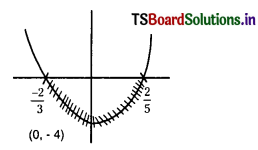
Telangana TSBIE TS Inter 2nd Year Telugu Study Material 1st Poem శ్రీకృష్ణ రాయబారం Textbook Questions and Answers.
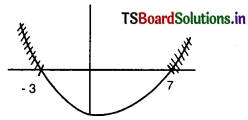
TS Inter 2nd Year Telugu Study Material 1st Poem శ్రీకృష్ణ రాయబారం
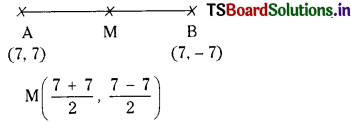
అభ్యాసం

I. వ్యాసరూప ప్రశ్నలు

ప్రశ్న 1.
శ్రీకృష్ణుని రాయబారాన్ని వివరించండి. (V.Imp)
జవాబు:
“ఓ జననాథ అని శ్రీకృష్ణుడు తన మాటలను ధృతరాష్ట్రుని ఎదుట మొదలు పెట్టాడు. సమాజ సౌఖ్యాన్ని దృష్టిలో పెట్టుకొని నిర్ణయం తీసుకోవాలని సూచించాడు. నీకు తెలియని విషయాలు ఏమున్నాయి ? ఐనప్పటికీ, భరతవంశం సంతోషించేటట్లు మీ ఇరు కుటుంబాల వారికి న్యాయమూ, పరమహితమూ చెప్పటం ఉచితమని నేనిక్కడికి వచ్చాను. మీ ఇద్దరు తనకు సమానమని తెలిపాడు. పాండవులు కౌరవులు పాలూ, నీరూ లాగ కలసి మెలసి జీవించటం మంచిదని వారు కలిసిమెలసి ఉండేటట్లు నడిపించవలసిన బాధ్యత ధృతరాష్ట్రునిదని తెలియపరిచాడు. పాండవులు వేరు, కౌరవులు వేరు అనే భేదభావన చూపకూడదన్నాడు.

భరతవంశం ధర్మం, న్యాయం, సత్యం, ఐకమత్యం, గౌరవం, కారుణ్యం మొదలైన సద్గుణాలు గలిగి కీర్తి పొందిందని తెలిపి దానిని కాపాడాలన్నాడు. కురు వంశములో పెద్దవాడివి కావున నీ కుటుంబంలోని వారి నడవడికల బాధ్యత నీదే అన్నాడు.

యుద్ధం వస్తే అక్కడున్న భీమార్జునులను యుద్ధరంగంలో మించేవారు ఇక్కడెందరున్నారు ? ఇక్కడున్న ద్రోణ, భీష్ముల పరాక్రమాన్ని ఎదుర్కొనగలవారు అక్కడ కూడా లేరు. ఇట్లా ఉభయ పక్షాలలోని వీరులు యుద్ధంలో చావటం కన్న నీ బలగాలన్నీ కలసి మెలసి వర్తించటం మంచిదని హితవు పలికాడు. రాజా ! నీవు కురుపాండవుల విషయంలో శ్రద్ధ వహించకుంటే ఈ ఉభయ వర్గాలకే కాదు, పుడమిలోని జనులందరికీ హాని చేసినట్లే అవుతుందని, ఆ కీడు నీకే కలుగుతుందని హెచ్చరించాడు.

రాజా ! కురు పాండవులలో ఎవరికి మరణం సంప్రాప్తించినా, బాధలు కలిగినా, నీకు దుఃఖం కలుగుతుంది. కౌరవ పాండవుల కోమలమైన శరీరాల నుండి మొనలుదేలిన బాణాలు ఆవలికి దూసుకొని వెళ్ళేటట్లు గ్రుచ్చుకోగా నేలమీద కూలటం చూచి సహించటం సరైనది కాదు కావున కురుపాండవులు సంగ్రామంలో నశించకుండా సంరక్షించుకోవాలని చెప్పాడు. పాండురాజు చనిపోయిన తరువాత వారిని చక్కగా పెంచిన నీవు ఇప్పుడు వారికి అన్యాయం చేయడం సరికాదన్నాడు. పాండవుల శక్తియుక్తులను గుర్తు చేస్తూ వారి ఔదార్యాన్ని వివరించాడు. ఉత్తమమైన ధర్మం, నిర్మలమైన సత్యం పాపం చేతను, అబద్ధం చేత లక్ష్యాన్ని చేరలేని స్థితిలో భగవంతుడు ధర్మమును ఉద్ధరించటానికి, సత్యానికి శుభం కలిగించటానికి ముందుకు వస్తాడని తెలిపాడు.

నీ పుత్రుడైన దుర్యోధనుడి అకృత్యాలకు పరోక్షంగా మద్దతు తెలిపినందుకు మీకందరికి తగిన శిక్ష పడుతుందన్నాడు. దుర్యోధనుని మనసులో ఉన్న పరమ దురాశను తొలగించి, పాండవులకు రావలసిన అర్థ రాజ్యాన్ని వారికి అప్పగించేలా చూడాలని చెప్పాడు. పాండవులను నీ చెంతకు పిలిపించుకోమన్నాడు.

పాండవులు ఎంతటి శాంత స్వభావులో అంతటి వీరాగ్రేసరులు. వారికి మీతో కలసి మెలసి ఉండటం ఇష్టం కాకపోతే ఈపాటికి యుద్ధానికి బయలుదేరి వచ్చేవారు. సంధి, సంగ్రామం ఈ రెండింటిలో మీకేది హితమని తోస్తుందో దానిని నిర్ణయించి వెల్లడించమని పలికాడు. ఈ విధంగా శ్రీకృష్ణుడు కౌరవ వంశ ప్రతిష్టను, దుర్యోధనాదుల దుష్టబుద్ధిని, పాండవుల పరాక్రమాన్ని, ఔదార్యాన్ని తెలిపి సంధి చేసుకోకుంటే వచ్చే అనర్థాలను తన రాయబారం ద్వారా వివరించాడు.

ప్రశ్న 2.
యుద్ధం వల్ల జరిగే నష్టాల్ని శ్రీకృష్ణుడు ఏ విధంగా వివరించాడు ?
జవాబు:
యుద్ధం జరిగితే అక్కడున్న భీమార్జునులను యుద్ధరంగంలో ఎదిరించేవారు ఇక్కడెందరున్నారు ? ఇక్కడున్న ద్రోణ, భీష్ముల పరాక్రమాన్ని ఎదుర్కొనగలవారు అక్కడ ఎందరున్నారు ? ఇట్లా ఉభయ పక్షాలలోని వీరులు యుద్ధంలో చావటం కన్న నీ బలగాలై కలసి మెలసి వర్తించటం మంచిది అని హితము పలికాడు. కురు పాండవులలో ఎవరికి మరణం సంప్రాప్తించినా, ఎవరికీ బాధలు కలిగినా ధృతరాష్ట్రునికే దుఃఖం కలుగుతుందని

తెలిపాడు. కౌరవులూ, పాండవులూ మంచి చదువరులు, పరాక్రమవంతులు, భుజదర్పం గలవారు గనుక ఎవ్వరూ వీరి నడ్డగించలేరు. ఇట్లాంటివారు తమలో తమకేర్పడిన యుద్ధంలో మరణించటానికి సిద్ధపడుతుండగా అడ్డుపడక చూస్తూ ఊరకుండటం నీ వంటి వారికి తగిన పని కాదు. ఎంతో కోమలమైన వారి శరీరాల నుండి మొనలుదేలిన బాణాలు దూసుకొని వెళ్ళేటట్లు గ్రుచ్చుకోగా నేలమీద కూలటం చూచి సహించటం సరైనది కాదు. రాజా ! నీ గొప్పతనమును రాజనీతినీ, శాంతిని సమస్త ప్రజలు మెచ్చుకొనేటట్లు కురుపాండవులు సంగ్రామంలో నశించకుండా సంరక్షించుకొనుము అని శ్రీకృష్ణుడు చెప్పడంలో భవిష్యత్ కాలంలో జరిగే అనర్థాలు స్ఫురిస్తాయి. యుద్ధమైతే అందరికీ మహాపద కలుగుతుంది. దాన్ని లెక్కలోనికి తీసుకోవాలన్నాడు.

కౌరవ, పాండవ యుద్ధంలో యాదవ కుటుంబ సభ్యులు కొందరైనాపోవటం శ్రీకృష్ణుడికేర్పడే ఆపద. కొడుకులందరూ మరణించి తర్పణాలు ఇవ్వటానికి కూడా ఎవ్వరూ మిగలని మహాపద ధృతరాష్ట్రుడిది. కౌరవులందరూ నశించటం వంశజుల కేర్పడే మహాపద. యుద్ధంలో సహాయపడే రాజులు కోల్పోతారు. దానివలన భూమి వీరులను కోల్పోతుంది. రక్తంతో తడుస్తుంది. జననాశం ఏర్పడుతుంది. వితంతువుల విషాదం పెల్లుబికుతుంది. ఇవన్నీ లోకానికేర్పడే ఆపదలు, వీటిని పరిగణించి తప్పక సంధి చేయుమని హితవు చెప్పి హెచ్చరించాడు శ్రీకృష్ణుడు.

TS Inter 2nd Year Telugu Study Material Poem 1 శ్రీకృష్ణ రాయబారం width=
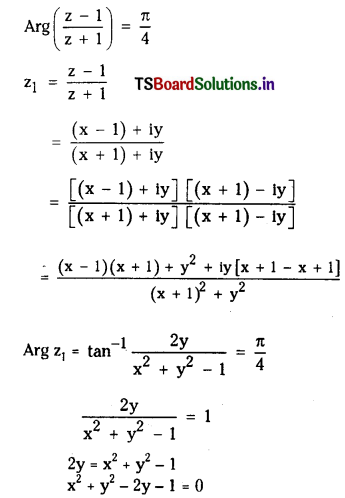
II సంగ్రహరూప ప్రశ్నలు

ప్రశ్న 1.
సభలో శ్రీకృష్ణుడు ఎలా ఉన్నాడు ?
జవాబు:
ధృతరాష్ట్రుని సభలో శ్రీకృష్ణుని కంఠస్వరం మేఘ గర్జన లాగా గంభీరంగా, హృదయంగమంగా ఉంది. ఆయన దంతాల కాంతులు మెరుపులవలె ప్రకాశిస్తున్నాయి. వర్షాకాల ప్రకృతి రమణీయతతో శ్రీకృష్ణుణ్ణి తిక్కన పోల్చి ఉపమాలంకారంతో చెప్పాడు. గంభీరమైన సన్నివేశాన్ని గంభీరంగా తిక్కన చిత్రించాడు.

ప్రశ్న 2.
శ్రీకృష్ణుడు ఎందుకు వచ్చానన్నాడు ?
జవాబు:
ధృతరాష్ట్రుని సభలో ఉన్న వారందరూ శ్రద్ధగా వింటుండగా పాండవులు పంపిన సంధి సమాచారాన్ని ధృతరాష్ట్ర మహారాజుతో చెప్పాడు. “ఓ జననాథ ! నీకు తెలియని విషయాలు ఏమున్నాయి ? ఐనప్పటికీ, భరతవంశం సంతోషించేటట్లు నా ఇరు కుటుంబాల వారికి న్యాయమూ, పరమహితమూ చెప్పటం ఉచితమని నేనిక్కడికి వచ్చాను అని శ్రీకృష్ణుడు అన్నాడు. ఇందులో జననాథ అనడం ద్వారా కేవలం నీ కొడుకుల గురించి మాత్రమే కాకుండా సమస్త ప్రజల గురించి ఆలోచించాలి అనే విషయాన్ని గుర్తు చేశాడు.

నీకు తెలియని విషయాలు ఏమున్నాయి అనడం ద్వారా తన విషయాన్ని ప్రదర్శించాడు. ఇరు కుటుంబాల వారికి అనడం ద్వారా కౌరవ పాండవులు ఇరువురు తనకు కావలసిన వారే అని చెప్పాడు. న్యాయము, పరమ హితము చెప్పడానికి వచ్చాననడం లోకకళ్యాణాన్ని సూచిస్తుంది. కావున శ్రీకృష్ణుడు లోకకళ్యాణం కోసం యుద్ధాన్ని మాన్పించడానికి వచ్చానని చెప్పాడు.

ప్రశ్న 3.
భరతవంశం గొప్పతనం తెలుపండి.
జవాబు:
భరతవంశం ధర్మం, న్యాయం, సత్యం, ఐకమత్యం, గౌరవం, కారుణ్యం అనే ఆరు గుణాలకు ప్రసిద్ధి. ఆ భరత వంశంలో పుట్టిన వారందరూ పై సద్గుణాలు గలిగి కీర్తి పొందారు. అట్టి వంశంలో నీవూ, నీ ప్రియ సహోదరుడు పాండురాజూ సద్గుణాలయందు శ్రేష్టులు అనడంలో పాండురాజు ఔన్నత్యం తెలపడంతోపాటు ధృతరాష్ట్రుని ముందు కాళ్ళకి బంధం వేయడం కనిపిస్తుంది. నీ కుమారులు కూడా కీర్తి భారం వహించ జాలినవారు అవడం వల్ల యుద్ధం చేసి చెడ్డపేరు పొందకూడదు అనే సూచనా కనిపిస్తుంది.

TS Inter 2nd Year Telugu Study Material Poem 1 శ్రీకృష్ణ రాయబారం width=
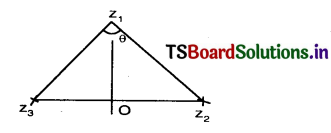
ప్రశ్న 4.
సారపు ధర్మం ఎలాంటిది ?
జవాబు:
ధర్మం ఎప్పుడూ సారవంతమైనది. శక్తివంతమైనదే, సత్యం ఎల్లప్పుడూ కల్మషం లేనిదే, నిర్మలమైనదే, స్వచ్ఛమైనదే. అవి రెండు స్వయం సమర్థములైనవే. అయితే వాటిని వ్యతిరేకించేవీ, కలతపెట్టేవీ, నశింపజేయ యత్నించేవి పాపం, అసత్యం. సత్యధర్మాలు ఫలవంతమయ్యే తరుణంలో పాపం, అబద్ధాలు అడ్డుపడి చెడగొట్టే యత్నాలు చేస్తాయి. కాని, అవి చెడిపోవు. ధర్మాన్ని రక్షించేవారు దానికొరకు తమ శక్తిని ధారపోయాలి. సత్యాన్ని రక్షించేవారు సత్యాచరణంలో త్రికరణశుద్ధిని ప్రదర్శించాలి.

అప్పుడు ధర్మసత్యాలు తమ సార నిర్మలత్వాలను రక్షించుకో గలుగుతాయి. దీనిని తెలిసిన విజ్ఞులు తమ బాధ్యతను తెలుసుకొని వాటిని రక్షించి తమను తాము రక్షించుకోవాలి. ఆ విషయంలో ఉపేక్ష చేస్తే వారి చరిత్రలకు ధర్మసత్య కవచాలు తొలగిపోయి బలహీనులై పాపాలకూ, అసత్యాలకూ బలి అయిపోతారు. దక్షులై కూడా తమ ధర్మాన్ని నిజాయితీతో నిర్వహించని వారికి చేటు రాకతప్పదని ఈ సందేశం.

III ఏకపద / వాక్య సమాధాన ప్రశ్నలు

ప్రశ్న 1.
కౌరవ సభకు రాయబారిగా ఎవరు వచ్చారు ?
జవాబు:
శ్రీకృష్ణుడు

ప్రశ్న 2.
కౌరవపాండవులు వేటిలాగా కలిసి ఉండాలని కృష్ణుడు చెప్పాడు ?
జవాబు:
పాలు నీళ్ళు లాగ

ప్రశ్న 3.
యుద్ధం సంభవిస్తే ఏం జరుగుతుంది ?
జవాబు:
యుద్ధం సంభవిస్తే చాలా త్వరగా కురువంశానికి, రాజులకు మహాపద కలుగుతుంది.

ప్రశ్న 4.
సంధికార్యం ఎవరి చేతిలో ఉంది ?
జవాబు:
ధృతరాష్ట్రుని

ప్రశ్న 5.
తిక్కన ఎవరి ఆస్థాన కవి ?
జవాబు:
తిక్కన నెల్లూరు మండలాన్ని పరిపాలించిన మనుమసిద్ధి యొక్క ఆస్థానకవి.

ప్రశ్న 6.
శాంతశూరులు ఎవరు ?
జవాబు:
పాండవులు

TS Inter 2nd Year Telugu Study Material Poem 1 శ్రీకృష్ణ రాయబారం width=
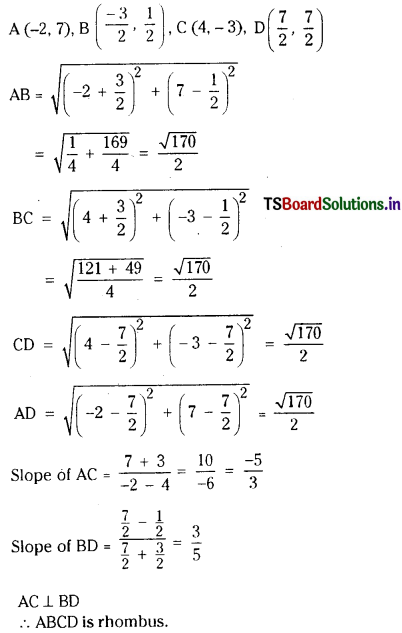
ప్రశ్న 7.
తిక్కన రచనలు తెలుపండి.
జవాబు:
తిక్కన, ఆంధ్ర మహాభారతంలో విరాటపర్వము నుండి స్వర్గారోహణ పర్వం వరకూ ఆంధ్రీకరించాడు. ఇదికాక

  1. నిర్వచనోత్తర రామాయణం
  2. కృష్ణశతకం
  3. విజయసేనం
  4. కవివాగ్బంధం-మొదలైన రచనలు చేశాడు.

ప్రశ్న 8.
తీక్కన సోమయాజ మహాభారతం ఎవరికి వినిపించాడు ? (V.Imp) (M.P.)
జవాబు:
హరి హర నాథునికి

IV సందర్భసహిత వ్యాఖ్యలు

1. సుచరితక్రమమిప్పుడు తప్పనేటికిన్ (V.Imp) (M.P.)

కవి పరిచయం : ఈ వాక్యం తిక్కన రాసిన మహాభారతం ఉద్యోగ పర్వం తృతీయాశ్వాసం నుండి తీసుకున్న శ్రీకృష్ణ రాయబారం అనే పాఠ్యాంశంలోనిది. తిక్కనకు ఉభయకవి మిత్రుడు అనే బిరుదు ఉంది. పదమూడవ శతాబ్దికి చెందిన నెల్లూరు పాలకుడు మనుమసిద్ధి ఆస్థానంలో ఉండేవాడు.

సందర్భం : శ్రీకృష్ణుడు ధృతరాష్ట్రునికి భరతవంశ ప్రాశస్త్యాన్ని వివరిస్తున్న సందర్భంలోనిది.

అర్థం : మంచి వంశ క్రమాన్ని ఇప్పుడు ఎందుకు తప్పుతారు ?

వివరణ : మహారాజా ! మీ భరతవంశం ధర్మం, న్యాయం, సత్యం, ఐకమత్యం, గౌరవం, కారుణ్యం మొదలైన సద్గుణాలు గలిగి కీర్తి పొందింది. అట్టి వంశంలో నీవూ, నీ ప్రియ సహోదరుడు పాండురాజూ, సద్గుణాలయందు శ్రేష్టులు, మరి నీ కుమారులూ కీర్తి భారం వహించ జాలినవారు. కళ్యాణ స్వభావులు. ఇంత మంచి నడవడిగల వంశ సంప్రదాయం ఇప్పుడు కూడా తప్పించడం ఎందుకు ? అని శ్రీకృష్ణుడు ధృతరాష్ట్రునితో అన్నాడు.

2. ప్రజల యెడ విరోధంబు వాటించుటెంతమేలు (V.Imp)

కవి పరిచయం : ఈ వాక్యం తిక్కన రాసిన మహాభారతం ఉద్యోగపర్వం తృతీయాశ్వాసం నుండి తీసుకున్న శ్రీకృష్ణ రాయబారం అనే పాఠ్యాంశంలోనిది. తిక్కనకు ఉభయకవి మిత్రుడు అనే బిరుదు ఉంది. పదమూడవ శతాబ్దికి చెందిన నెల్లూరు పాలకుడు మనుమసిద్ధి ఆస్థానంలో ఉండేవాడు.

సందర్భం : శ్రీకృష్ణుడు ధృతరాష్ట్రునికి యుద్ధం వల్ల కలిగే నష్టాన్ని వివరిస్తున్న సందర్భంలోనిది.

అర్థం : మీ పిల్లల పట్ల నిర్లక్ష్యం వహించడం సరైనదేనా ?

వివరణ : లోకంలోని రాజులందరూ నీ పాదపీఠాన్ని ప్రీతితో సేవిస్తుండగా సముద్రపు చెలియలికట్టచేత చుట్టబడిన పుడమినంతటిని నీవే ఏకచ్ఛత్రంగా పరిపాలించటం తగును, తల్లి తన బిడ్డలపట్ల శత్రుత్వం వహించటం ఎంత సమంజసమో నీవే ఆలోచించు అని శ్రీకృష్ణుడు ధృతరాష్ట్రునితో అన్నాడు.

3. దురితంబొనరించిట్ల తుదిఁ గీడు సుమీ (V.Imp)

కవి పరిచయం : ఈ వాక్యం తిక్కన రాసిన మహాభారతం ఉద్యోగ పర్వం తృతీయాశ్వాసం నుండి తీసుకున్న శ్రీకృష్ణ రాయబారం అనే పాఠ్యాంశంలోనిది. తిక్కనకు ఉభయకవి మిత్రుడు అనే బిరుదు ఉంది. పదమూడవ శతాబ్దికి చెందిన నెల్లూరు పాలకుడు మనుమసిద్ధి ఆస్థానంలో ఉండేవాడు.

సందర్భం : శ్రీకృష్ణుడు ధృతరాష్ట్రునికి తన బాధ్యతను గుర్తుచేస్తున్న సందర్భంలోనిది.

అర్థం : జనులందరికీ పాపం చేసినట్లే ఔతుంది. చివరకు మీకే కీడు కలుగుతుంది.

వివరణ : రాజా ! నీవు కురుపాండవుల విషయంలో శ్రద్ధ వహించకుంటే ఈ ఉభయ వర్గాలకే కాదు, పుడమిలోని జనులందరికీ పాపం చేసినట్లే ఔతుంది. చివరకు నీకే హాని కలుగుతుంది అని శ్రీకృష్ణుడు ధృతరాష్ట్రునితో అన్నాడు.

4. సత్యశుభదాయకమయ్యును దైవముండెడున్ (V.Imp)

కవి పరిచయం : ఈ వాక్యం తిక్కన రాసిన మహాభారతం ఉద్యోగ పర్వం తృతీయాశ్వాసం నుండి తీసుకున్న శ్రీకృష్ణ రాయబారం అనే పాఠ్యాంశంలోనిది. తిక్కనకు ఉభయకవి మిత్రుడు అనే బిరుదు ఉంది. పదమూడవ శతాబ్దికి చెందిన నెల్లూరు పాలకుడు మనుమసిద్ధి ఆస్థానంలో ఉండేవాడు.

సందర్భం : శ్రీకృష్ణుడు ధృతరాష్ట్రునికి సంధి చేసుకోకుంటే దైవం తన పని తాను చేస్తాడని హెచ్చరిస్తున్న సందర్భంలోనిది.

అర్థం : సత్యమునకు శుభం కలిగించటానికి భగవంతుడు ముందుకు వస్తాడు.

వివరణ : ఉత్తమమైన ధర్మం, నిర్మలమైన సత్యం పాపం చేతను, అబద్దం చేత దరి చేరలేక చెడటానికి సంసిద్ధంగా ఉన్న స్థితిలో వాటిని రక్షించే శక్తి ఉన్నా ఎవరు అడ్డుపడక అశ్రద్ధ వహిస్తారో అది వారలకే హానికరమవుతుంది. ఆ స్థితిలో భగవంతుడు ధర్మమును ఉద్ధరించటానికి, సత్యమునకు శుభం కలిగించటానికి ముందుకు వస్తాడు అని శ్రీకృష్ణుడు ధృతరాష్ట్రునితో అన్నాడు.

పద్యములు – ప్రతిపదార్థ – తాత్పర్యములు

1వ పద్యం :

కం॥ జలదస్వన గంభీరత
నెలుఁగొప్పఁగ దంత దీప్తు లెసగ ముకుందుం
డలరుచు సభ నఖిల జనం
బులు విన ధృతరాష్ట్ర భూవిభున కిట్లనియెన్

ప్రతిపదార్థం:

ముకుందుఁడు = శ్రీకృష్ణుడు
జలదస్వన గంభీరతన్ = మేఘ ధ్వని యొక్క గాంభీర్యంతో
ఎలుగు + ఒప్పన్ = తన కంఠ ధ్వని సొంపారగా
దంత దీప్తులు + ఎసగన్ = దంతాల యొక్క కాంతులు అతిశయించగా
సభన్ = సభలో
అలరుచున్ = ప్రకాశిస్తూ
అఖిలజనంబులు = ధృతరాష్ట్రుడి కొలువులో ఉన్న సమస్త ప్రజలు
వినన్ = వింటుండగా
ధృతరాష్ట్ర భూవిభునకు = ధృతరాష్ట్ర మహారాజుకు
ఇట్లు + అనియెన్ = ఈ విధంగా అన్నాడు.

తాత్పర్యం : శ్రీకృష్ణుడు మేఘధ్వనివలె గంభీరమైన తన కంఠధ్వనితో, దంత కాంతులు ప్రసరిస్తూ ఉండగా, సభలో వెలుగొందుతూ, సదస్యులందరూ చెవులు నిక్కరించుకొని ఆలకిస్తుండగా ధృతరాష్ట్ర మహారాజుతో ఇలా అన్నాడు.

విశేషం :

  1. కృష్ణుని కంఠస్వర గాంభీర్యం, సభ్యులను పరవశింప చేస్తున్నదని, కవి తిక్కన ఇందులో సూచిస్తున్నాడు.
  2. జలదస్వనానికి అనగా ఉరుముకు తోడుగా, దంతదీప్తులు మేఘము నుండి వచ్చే మెఱపులుగా భాసిస్తున్నాయని, కవి ఇక్కడ సూచించాడు.

TS Inter 2nd Year Telugu Study Material Poem 1 శ్రీకృష్ణ రాయబారం width=
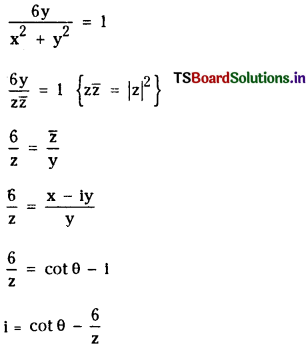
2వ పద్యం :

కం॥ జననాథ ! నీ యెఱుంగని
పనులు గలవె ? యైనఁ దగవుఁ బరహితంబుం
దనవారికిఁ జెప్పగ తగు
నని వచ్చితి భారతాన్వయము ప్రియమొందన్

ప్రతిపదార్థం :

జననాథ = ఓ మహారాజా (ధృతరాష్ట్ర చక్రవర్తీ !)
నీ యెఱుంగని పనులు
(నీ + ఎఱుంగని, పనులు) = నీకు తెలియని పనులు
కలవె (కలవు + ఎ) = ఉన్నాయా ? (లేవని భావము)
ఐనన్ = అయినప్పటికీ
తన వారికిన్ = తన బంధువులకు
తగవున్ = న్యాయమునూ, ధర్మమునూ
పరమ హితంబున్ = ఉత్తమమయిన మంచి (మంచి మాట) నూ
చెప్పన (చెప్పన్ + అ) = చెప్పడమే
తగునని (తగును + అని) = ధర్మమని
భారతాన్వయము (భారత + అన్వయము) = భరత వంశము
ప్రియమొందన్
(ప్రియము + ఒందన్) = సంతోషపడేటట్లు
వచ్చితిన్ = (నేను) ఇక్కడికి వచ్చాను

తాత్పర్యం : ధృతరాష్ట్ర మహారాజా ! నీకు తెలియని విషయాలు ఏమున్నాయి ? అయినా, తన చుట్టాలకు న్యాయాన్నీ, ఉపయోగపడే మంచిమాటనూ చెప్పడమే ధర్మము అనే భావంతో, భారత వంశీయులు అందరూ, సంతోషపడతారని, నేను ఇక్కడికి వచ్చాను.

3వ పద్యం :

కం॥ క్షీరోదక గతిఁ బాండవ
కౌరవు లొడఁగూడి మనికి కార్యం ఐది నీ
వారసి నడపుము వా రన
నీ రనఁ గురుముఖ్య ! నీకు వేఱుంగలదే ?

ప్రతిపదార్థం :

కురుముఖ్య ! = కురువంశంలో ప్రధానమైనవాడా !
క్షీర + ఉదక గతిన్ = పాలూ, నీరు లాగ
పాండవ కౌరవులు = పాండవులు, కౌరవులు
ఒడన్ + కూడి = కలిసి మెలిసి
మనికి = జీవించటం
కార్య౦బు = చేయదగ్గ పని
అది = దానిని
నీవు = నీవు
ఆరసి = పరిశీలించి
నడపుము = సాగించుము
నీకున్ = నీకు
వారు + అనన్ = పాండవులనగా
వీరు + అనన్ = కౌరవులు అనగా
వేఱుం + కలదే = భేదమున్నదా? (లేదని అర్థం)

తాత్పర్యం : కురునాథా ! పాండవ కౌరవులు పాలూ నీరూ వలె కలసిమెలసి జీవించటం మంచిపని. వారు అట్లా ఒద్దికతో ఉండేటట్లు నీవు వారిని నడపించవలసి ఉంది. పాండవులు వేరు, కౌరవులు వేరు అనే భేదభావన నీకు లేదు కదా !

4వ పద్యం :

శా ||
ఈ వంశంబున కెల్ల నీవ కుదు; రిం దెవ్వారి చందంబు లె
ట్లై వర్తిల్లినఁ గీడు మేలుఁ దుది నీయం దొందెడు గాన స
ద్భావం బారసి లోనిపొత్తు వెలివృత్తంబున్ జనస్తుత్యముల్
గావింపం దగు నీక యెవ్విధమునం గౌరవ్యవంశాగ్రణీ!

ప్రతిపదార్థం :

కౌరవ్యవంశ + అగ్రణి = కురువంశంలో శ్రేష్టుడా!
ఈ వంశంబునకున్ + ఎల్లన్ = ఈ కురుకులాని కంతటికి
నీవు + అ (నీవ) = నీవే
కుదురు = ఆశ్రయం (మూలం)
ఇందున్ = ఈ కురువంశస్థులలో
ఎవ్వారి చందంబులు = ఎవ్వరి నడవడులు
ఎట్లు + ఐ వర్తిల్లినన్ = ఏ విధంగా ఉండునో వాటిననసరించి
కీడు = హాని
మేలూ = వృద్ధి
తుదిన్ = కడపటి
నీ అందున్ + ఒందెడున్ = నీకే చెందగలవు
కానన్ = కనుక
సద్భావంబు + అరిసి = మంచి తలంపునకు వచ్చి
లోనిపొత్తు = అంతరంగంలో ఒద్దిక
వెలి వృత్తంబున్ = బహిరంగ ప్రవర్తన
జనస్తుత్యముల్ = ప్రజలచేత మెచ్చదగినవిగా
కావింపన్ = చేయటానికి
నీకున్ + అ(నీక) = నీకే
ఏ విధమునన్ = ఏ విధంగానైనా
తగున్ = యోగ్య౦

తాత్పర్యం : ధృతరాష్ట్ర మహారాజా ! నీవు కురు వంశంలో ఆగ్రేసరుడివి. ఈ వంశానికంతటికీ నీవే ఆధారం. నీ కుటుంబంలో ఎవ్వరెవ్వరి నడవడికలు ఎట్లుగా ఉంటాయో, వాటిని బట్టి కలిగే మేలు కీడు నీకే చెందుతాయి. కాబట్టి నీవు ఇరుకుటుంబాల వారి శ్రేయస్సు నూహించి అంతరంగంలో స్నేహం, బహిరంగ ప్రవర్తన జనులు మెచ్చేటట్లుగా ఏవిధంగానైనా వారిని చక్కదిద్దవలసి ఉంటుంది.

5వ పద్యం :

చ|| వినుము ! సుయోధనాదులగు వీరు సధర్ములు గాక కార్యము
ల్గొనక మహార్థసిద్ధి యెడలుం దమ కిట్లన కన్వయంబు వ
ర్తనమిది గాదు నాక బెడిదంపుఁదనంబున బంధుకోటికి
న్మనసులు నొవ్వఁగా నవగుణంబులకుం బుయిలోడ రేమియున్

ప్రతిపదార్థం :

వినుము = (మహారాజా) నామాటలాలకించండి
సుయోధన + ఆదులు + అగువీరు = దుర్యోధనుడు మొదలైన నీ కుమారులు
సధర్ములు కాక = ధర్మము ననుసరించే వారు కాక
కార్యముల్ + కొనక = చేయదగిన మంచి పనులు చేయక
ఇట్లు = ఈ రీతిగ మెలగితే
తమకున్ = తమకు
మహా + అర్థసిద్ధి = గొప్ప ప్రయోజనాలు చేకూరుట
ఎడలున్ + అనక = తొలగిపోవునని తలంచక
అన్వయంబు వర్తనము = వంశపు నడవడి
ఇది కాదు = ఇటువంటిది కాదు
నాక = అనక
బెడిదంపు దనంబునన్ = దారుణ స్వభావంతో
బంధుకోటికిన్ = బంధువర్గానికి
మనసులు నొవ్వగాన్ = హృదయాలు వ్యధ చెందేటట్లు
అవగుణంబులకున్ = దుర్గుణాలకు
ఏమియున్ = ఇంచుకయు
బుయి లోడర = వెనుదీయరు

తాత్పర్యం: రాజా ! వినుము. దుర్యోధనాదులైన వీరు ధర్మపరులుగాక, సత్కార్యాలాచరించక ఇట్లా ఉంటే మహార్థసిద్ధికి దూరమవుతామని తలంచక, వంశ నడవడి ఇట్టిది కాదనక ఈ దారుణ బుద్ధితో బంధువుల మనస్సులు బాధ చెందేటట్లుగా దుష్టచేష్టలు చేయటానికి ఏమాత్రం వెనుదీయకున్నారు.

TS Inter 2nd Year Telugu Study Material Poem 1 శ్రీకృష్ణ రాయబారం width=
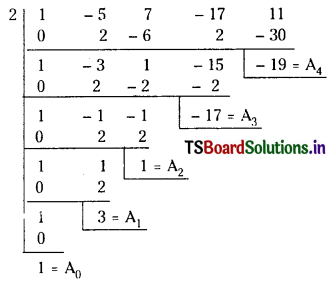
6వ పద్యం :

ఉ ||
కౌరవ పాండవుల్ తెఱఁగు గైకొని శాంతతఁ బొందియున్కి మే
లారయ నాకు నీకుఁ గులమంతకు నీ నృపకోటి కుర్వికిం
బోరితమైన నింతకును బుట్టు మహాపద గావునన్ ధరి
త్రీ రమణాగ్రగణ్య ! గణుతించి యవశ్యముఁ బొం దొనర్పవే !

ప్రతిపదార్థం :

ధరిత్రీ రమణ + అగ్రగణ్య = రాజులలో ఉత్తముడా !
కౌరవపాండవుల్ = కౌరవులూ, పాండవులూ
తెఱగు + కైకొని = సంధి నిర్ణయానికి వచ్చి
శాంతతన్ + పొంది = ప్రసన్నత్వం వహించి
ఉన్కి = ఉండటం
ఆరయున్ = పరికించగా
నాకున్ = నాకును
నీకున్ = నీకును
కులము అంతకున్ = కురువంశానికంతటికి
ఈ నృప కోటికిన్ = ఈ రాజ సమూహానికి
ఉర్వికిన్ = ఈ జగత్తునకూ
మేలు = శ్రేయం (మంచి)
పోరితము + ఐనన్ = యుద్ధం జరిగితే
ఇంతకును = ఈ సమస్తమునకునూ
మహా + ఆపద + పుట్టున్ = గొప్ప విపత్తు సంభవిస్తుంది
కావునన్ = కనుక
గణుతించి = నా మాటలు లెక్కించి
అవశ్యమున్ = తప్పక
పొందు + ఒనర్పవే = సంధి చేసుకోండి

తాత్పర్యం : కౌరవులు పాండవులు ఒక మంచి నిర్ణయానికి వచ్చి, శాంతం వహించి, జీవించటం మంచిది. ఇట్లు వారు ప్రసన్నచిత్తులై ఉండటం నాకూ, నీకూ, కురువంశానికి, ఈ రాజ సమూహానికీ, ఈ భూమండలానికి మంచిది. అట్లాకాక యుద్ధమే సంభవిస్తే మనందరికీ మహా విపత్తు కలుగుతుంది. కనుక రాజోత్తమా! నా మాటలపై విశ్వాసముంచి తప్పక సంధి చేసుకోండి.

7వ పద్యం :
ఉ || అందు వృకోదరార్జునుల నాహవ రంగమునందు మీఱువా
రెందఱో యెన్నుమా యిచట; నీ గురుభీష్ములఁ గ్రేణిసేయువా
రెందఱో; వారు వీరు నని నీల్గుటకంటె భవర్బలంబులై
యందఱుఁగూడు టొప్పదె జనాధిప ! శాంతి యొనర్పు మెమ్మెయిన్

ప్రతిపదార్థం :

అందున్ = అక్కడ ఉన్న
వృకోదర + అర్జునులన్ = భీమార్జునులను
ఆవహరంగమునందున్ = యుద్ధరంగంలో
మీఱువారు = మించగలవారు
ఎందఱో + ఎన్నుమా = ఇక్కడ ఎందరున్నారో నీవే లెక్కించు
ఇచటన్ = ఇక్కడ ఉన్న
ఈ గురు భీష్ములన్ = ఈ ద్రోణుడిని; భీష్ముడిని
క్రేణి + చేయువారు = పరిహరింపగలవారు
ఎందఱో ? = అక్కడెందరున్నారు ?
వారున్, వీరున్ = అక్కడివారూ, ఇక్కడివారూ
అనిన్ = యుద్ధంలో
ఈల్గుట కంటెన్ = చావటం కంటే
భవత్ + బలంబులు + ఐ = నీ బలగాలై
అందరున్ = వీరందరూ
కూడుట + ఒప్పదే = కలసిమెలసి ఉండటం తగదా ?
ఏ + మెయిన్ = ఏ విధంగానైనా
శాంతి + ఒనర్పుము = సంధి చేయుము

తాత్పర్యం : అక్కడున్న భీమార్జులను యుద్ధరంగంలో మించేవారు ఇక్కడెందరున్నారో చెప్పుము ? ఇక్కడున్న ద్రోణభీష్ముల పరాక్రమాన్ని లక్ష్యపెట్టక పరిహసించగలవారు అక్కడ కూడా లేరు. ఇట్లా ఉభయ పక్షాలలోని వీరులు యుద్ధంలో చావటం కన్న నీ బలగాలై కలసి మెలసి వర్తించటం మంచిది. ఏ విధంగానైనా వీరిని శాంతింప జేయుము.

8వ పద్యం :

తే ||
జగతిఁగల జనపతులు నీ చరణపీఠ
మర్థిఁ గొలువ సముద్ర వేలావృతోర్వి
యెల్ల నేలుట యొప్పదే ? తల్లి ప్రజల
యెడ విరోధంబు వాటించు టెంత మేలు ?

ప్రతిపదార్థం :

జగతిన్ + కల = లోకంలో ఉన్న
జనపతులు = రాజులు
నీ చరణ పీఠము = నీ పాదపీఠమును
అర్థిన్ = కోరికలు
కొలువన్ = సేవిస్తుండగా
సముద్ర వేలా + అవృత = సాగరం యొక్క చెలియలి కట్టచేత చుట్టబడిన
ఉర్వి + ఎల్లన్ = పుడమి నంతయు
ఏలుట = నీవు పాలించటం
ఒప్పదే ? = తగదా ?
తల్లి = జనని
ప్రజల + ఎడన్ = తన బిడ్డల విషయంలో
విరోధంబు పాటించుట = వైరం వహించటం
ఎంత మేలు = ఏపాటి మంచిది ?

తాత్పర్యం : లోకంలోని రాజులందరూ నీ పాదపీఠాన్ని ప్రీతితో సేవిస్తుండగా సముద్రపు చెలియలికట్టచేత చుట్టబడిన పుడమినంతటినీ నీవే ఏకచ్ఛత్రంగా పరిపాలించటం తగును. తల్లి తన బిడ్డలపట్ల శత్రుత్వం వహించటం ఎంత సమంజసమో నీవే ఆలోచించు.

9వ పద్యం :

క||
నరనాథ ! నీవుపేక్షా
పరుఁడ వయినఁ గౌరవులక పాండవులక కా
దరయఁగ భూ ప్రజకెల్లను
దురితం బొనరించి నట్ల తుదిఁ గీడు సుమీ !

ప్రతిపదార్థం:

నరనాథ ! = రాజా
నీవు + ఉపేక్షాపరుఁడవు + అయినన్ = ఈ విషయంలో అశ్రద్ధ వహిస్తే
కౌరవులకున్ + ఆ, పాండవులకున్ + ఆ కాదు = కురుపాండవులకే కాదు
అరయగన్ = ఆలోచిస్తే
భూప్రజకున్ + ఎల్లన్ = పుడమిలోని అందరికి
దురితంబు + ఒనరించిన + అట్లు + అ = పాపం చేసినట్లే ఔతుంది
తుదిన్ = చివరకు
కీడు + చుమీ ! = నీకే హాని సుమా !

తాత్పర్యం : రాజా ! నీవు కురుపాండవుల విషయంలో శ్రద్ధ వహించకుంటే ఈ ఉభయ వర్గాలకే కాదు, పుడమిలోని జనులందరికీ పాపం చేసినట్లే ఔతుంది. చివరకు నీకే హాని కలుగుతుంది.

10వ పద్యం :

క||
కౌరవ పాండవులం దె
వ్వారలకుం జావు నొవ్వు వచ్చిన మే లు
ర్వీరమణ ! చిత్తమున నె
ట్లారయునూ నీకు దుఃఖమగు నెట్లయినన్

ప్రతిపదార్థం :

ఉర్వీమణ = భూనాథా !
కౌరవ పాండవులందున్ = కౌరవులలో పాండవులలో
ఏ + వారలకున్ = ఎవరికైనా
చావు = మరణం
నొవ్వు = బాధ
వచ్చినన్ = కలిగినా
చిత్తమునన్ = మనస్సులో
ఎట్లు మేలు = ఏ విధంగా మేలవుతుందో
ఆరయుమా = పరిశీలించుము
ఎట్లు + అయినన్ = వారికి ఏలాగైనా
నీకున్ = నీకు
దుఃఖము + అగున్ = విషాదం కలుగుతుంది
చావు = మరణం

తాత్పర్యం : కురు పాండవులలో ఎవరికి మరణం సంప్రాప్తించినా, బాధలు కలిగినా నీకు ఎట్లా మేలవుతుందో మనస్సులో ఆలోచించుము. వారిలో ఎవరికి చావు లేదా బాధ వచ్చినా నీకు ఏవిధంగానైనా దుఃఖం కలుగుతుంది.

TS Inter 2nd Year Telugu Study Material Poem 1 శ్రీకృష్ణ రాయబారం width=
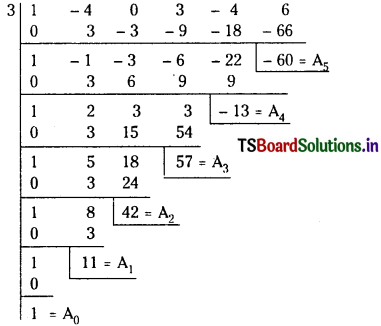
11వ పద్యం :

ఆ||
ఇట్లు గాక యుండ నీ రెండు దెఱఁగుల
వారి గాచికొనుము వసుమతీశ !
నీదు ప్రాభవంబు నీతియు శాంతియు
నఖిల జనులుఁ బొగడునట్లుఁగాగ

ప్రతిపదార్థం :

వసుమతీ + ఈశ = భూవల్లభా (ధృతరాష్ట్రా!)
నీదు ప్రాభవంబు = నీయొక్క గొప్పతనం
నీతియున్ = రాజనీతి
శాంతియున్ = కామక్రోధాది రాహిత్యము
అఖిల జనులు = సమస్త ప్రజలు
పొగడునట్లు కాగన్ = ప్రశంసించునట్టి తీరులో
ఇట్లు + కాక + ఉండన్ = ఇట్లా చావు నొవ్వుల పాలుగాకుండా
ఈ రెండు తెఱగులవారిన్ = ఈ ఉభయ పక్షాల వారిని
కాచి కొనుము = రక్షించుకొనుము

తాత్పర్యం : నీ గొప్పతనమును, రాజనీతిని, శాంతిని సమస్త ప్రజలు మెచ్చుకొనేటట్లు కురుపాండవులు సంగ్రామంలో నశించకుండా సంరక్షించుకొనుము.

12వ పద్యం :

తే||
పాండవులు తండ్రి సచ్చిన ప్రజలు వారి
నరసి ప్రోచితి శైశవ మాదిగాఁగ
నడుమ నిష్కారణము దిగవిడువఁ దగునె ?
పారమొందంగ రక్షింపు గారవమున

ప్రతిపదార్థం :

పాండవులు = ధర్మజాదులు
తండ్రి చచ్చిన ప్రజలు = తండ్రిలేని బిడ్డలు
వారిన్ = వారలను
శైశవము + ఆగాగన్ = చిన్నప్పటి నుంచి
అరసి ప్రోచితి(వి) = చక్కగ కాపాడావు
నడుమన్ = మధ్యలో
నిష్కారణము + అ = కారణం లేకుండా
దిగన్ + విడువన్ + తగునే = వదలి వేయవచ్చునా ?
పారము + ఒందగన్ = ఆవలిగట్టు చేరువరకూ (చివరి వరకు)
గారవమునన్ = ఆదరంతో రక్షింపు(ము), కాపాడుము

తాత్పర్యం : పాండవులు తండ్రిలేని పిల్లలు. వారిని పసితనం నుంచి చల్లగా కాపాడావు. ఇప్పుడు వారిని కారణం లేకుండా మధ్యలోనే విడిచిపెట్టటం న్యాయం కాదు. చివరివరకు నీవు ప్రేమతో వారిని కాపాడవలసి ఉంది.

13 వచనం :

పాండుకుమారులు నీకుం బరమభక్తిం బ్రణమిల్లి యందరు నొక్కమాటగా నీతోఁ జెప్పుమని నాకుం జెప్పిన విధంబు వినుము: తన పంపునం బండ్రెండు వత్సరంబులు వనంబున వసియించితిమి పదమూఁడగునేడు జనపదంబున నజ్ఞాతవాసంబునుం జలిపితిమి; మా తండ్రి సమయంబు పరిపాలించియే మర్ధరాజ్యం బెట్లునుం బడయుడు మని కృతనిశ్చయులమై పడితిమి ? తల్లియుఁ దండ్రియు నెల్ల చుట్టంబులు నేడుగడయునను మాకుఁ దాన: మావలన నేరమి గల్గినం గినిసి యిట్లుగా దట్లని చక్కం బెట్టునది. తనగల పది వేలేండ్లకుం దన్నకాని మఱియెఱుంగ మెట్టివారమైనను మమ్మును దుర్యోధనాదులనుం దలంపరు తనయందుఁ దెఱంగు గలిగిన నెవ్వరు గొఱగాకున్నను గులంబుపాడి సెడక చెల్లునని’ రని పలికి మఱియు నిట్లనియె.

ప్రతిపదార్థం :

పాండు కుమారులు = పాండవులు
నీకున్ = నీకు
పరమ భక్తిన్ = మిక్కిలి భక్తితో
ప్రణమిల్లి = నమస్కరించి
అందఱున్ = అందరూ కలిసి
ఒక్కమాటగా = ఏకవాక్యంగా
నీతోన్ = నీతో
చెప్పుము + అని = చెప్పండి అని
నాకున్ చెప్పిన విధంబు వినుము = నాకు చెప్పిన మాటలు
తన పంపునన్ = తన ఆజ్ఞచేత వినుము
పండ్రెండు వత్సరంబులూ = పన్నెండేళ్ళు
వనంబునన్ = అడవిలో
వసియించితిమి = నివసించాము
పదమూఁడగు + ఏడు = పదమూడవ సంవత్సరం
జనపదంబునన్ = జనులుండే స్థలంలో
అజ్ఞాతవాసంబునన్ + చలిపితిమి = ఇతరులు మమ్మెరుగకుంకుండునట్లుగా జీవించాము
మా తండ్రి సమయంబు పరిపాలించి = మా తండ్రి ఏర్పరచిన ఒడంబడికను నెరవేర్చి
ఏము = మేము
అర్థరాజ్యంబు = సగం రాజ్యాన్ని
ఎట్టును = ఏ విధంగానైనా
పడయుదుము = పొందగలం
అని, కృతనిశ్చయులము + ఐ = తీర్మానించు కొన్నవారమై
పడితిమి = కష్టాలు అనుభవించాం
తల్లియున్ తండ్రియున్ = తల్లిదండ్రులు
ఎల్లచుట్టంబులున్ = అందరు చుట్టాలు
ఏడుగడును = సర్వ విధాలు రక్షించేవాడు.
మాకున్ = మాకు (పాండవులకు)
తాన్ + అ = అతడే
మా వలనన్ = పాండవుల వల్ల
నేరమి + కల్గినన్ = దోషముంటే
కనిసి = కోపించి
ఇట్లు కాదు = ఇలాకాదు
అట్లు + అని = అలా అని
చక్కన్ + పెట్టునది = సరిదిద్దవలెను
తన కల పదివేల + ఏండ్లకున్ = తాను జీవించిన పదివేల సంవత్సరాలకైనా
తన్నున్ + ఆకాని = తననే తప్పు
మఱి + ఎఱుంగుము = ఇతరుల నాశ్రయించం
ఎట్టివారము = ఐనను
మేము = ఎటువంటి వాళ్ళమైనా
మమ్మును = మమ్మల్ని
దుర్యోధన + ఆదులను = దుర్యోధనుడు మొదలైన కౌరవులను
తలంపరు = లోకులు భావింపరు
తనయందున్ + తెఱంగు + కల్గినన్ = తనకు కార్యం సరిదిద్దవలెనన్న తలంపు ఉంటే
ఎవ్వరు కొఱ + కాకున్నను = ఎవరు పనికిమాలిన వారైనా
కులంబుపాడి = వంశధర్మం
చెడకు = చెడకుండా
చెల్లును = సాగును
అనిరి = (పాండవులు) అన్నారు
అని పలికి = అని చెప్పి
మణియున్ ఇట్లు + ఆనియున్ = మరల ఇలా (కృష్ణుడు) అన్నాడు.

తాత్పర్యం : ధృతరాష్ట్ర మహారాజా ! పాండునందనులు నీకు పరమభక్తితో నమస్కరించి ఒకే గొంతుతో చెప్పుమని నాతో చెప్పి పంపిన మాటలు చెపుతాను వినుము, “తండ్రీ ! నీ ఇష్టప్రకారం పన్నెండు సంవత్సరాలు అరణ్యాలలో నివసించాము. పదమూడవ సంవత్సరం విరటుడి పట్టణంలో అజ్ఞాతవాసం కావించాము. ఈ విధంగా ఒడంబడికను నెరవేర్చి మేము రాజ్యంలో సగపాలు పొందగలమని దృఢనిశ్చయంతో ఉన్నాము. మాకు తల్లి, తండ్రి, చుట్టములు వెయ్యేల సర్వవిధ రక్షకులు మీరే. మా వలన ఏమైనా అపరాధముంటే కోపించి ఇలా కాదు అలా నడుచుకోవాలని చెప్పి చక్కబెట్టండి. నీవు పదివేలేండ్లు జీవించినప్పటికిని నిన్ను తప్ప మరెవ్వరినీ ఎరుగము, ఎట్టివాళ్ళమైననూ, మమ్మూ, దుర్యోధనాదులనూ లోకులు అనుకోరు. నీకు సదభిప్రాయముంటే మాలో ఎవరు కొరగాకపోయినా వంశ ధర్మం చెడక నిలుస్తుంది అని నీతో చెప్పుకున్నారు ? అంటూ శ్రీకృష్ణుడు ఆయనతో ఇంకా ఇట్లా అన్నాడు.

14 వచనం :

అని యీ సభ్యులకుం జెప్పుమనిరి; నీవును సభాసదులైన రాజులు నేమనియెద రనుం; డేను ధర్మంబును
నీయుఁ జుట్టఱికంబును మున్నిడుకొని మనోవాక్పప్రకారంబు లేక రూపంబైన సత్యంబకాఁజెప్పితి, నిత్తెఱంగు
మీకు మేలు క్రోధమాన మత్సరంబులు విడిచి యిట్లు సేయుండు

ప్రతిపదార్థం :

అని = చెప్పి
ఈ సభ్యులకున్ = సభలోని పెద్దలకు
చెప్పుము + అనిరి = చెప్పవలసినదిగా పాండవులు నన్ను కోరారు
నీవును = నీవు
సభాసదులు+ఐనరాజులు = సభలో ఉన్న దొరలు
ఏమి + అనియెదరు + అనుండు = ఏమిచెపుతారో చెప్పండి
ఏను = నేను
ధర్మంబును = న్యాయమును
నీతియును = రాజనీతిని
చుట్టరికంబును = బాంధవ్యమును
మున్ను + ఇడుకొని = ముందుంచుకొని
మనఃవాక్ + ప్రకారంబులు = మనసు యొక్క వాక్కు యొక్క వైఖరులు
ఏకరూపంబున = ఒకే విధముగ ఉండునట్లు
సత్యంబకాన్ = సత్యమునే
చెప్పితిన్ = చెప్పాను
ఈ తెఱంగుల = ఈ పద్ధతి
మీకున్ = మీకు
మేలు = మంచిని కలిగిస్తుంది.
క్రోధమానమత్సరంబులు = కోపం, గర్వం, ద్వేషం
విడిచి = వదిలి
ఇట్లు + చేయుండు = నేను చెప్పిన రీతిని ఆచరించండి

తాత్పర్యం : పాండవులు సభలోని పెద్దలకు నన్ను చెప్పుమని కోరిన మాటలు చెప్పాను. మహారాజా ! నీవూ, సభలోని రాజులూ ఇందుకు బదులేమి చెపుతారో చెప్పండి. నేను నీతి, ధర్మాలనూ, బాంధవ్యాన్ని ముందుంచుకొని మనో వాక్కులు ఏకరూపంగా (త్రికణ శుద్ధిగా) ఉన్న సత్యమునే చెప్పాను. నేను చెప్పిన పద్ధతి మీకు మేలు గలిగిస్తుంది. కోపం, గర్వం, ద్వేషం వదలి నేను చెప్పినట్లు చేయండి.

TS Inter 2nd Year Telugu Study Material Poem 1 శ్రీకృష్ణ రాయబారం width=
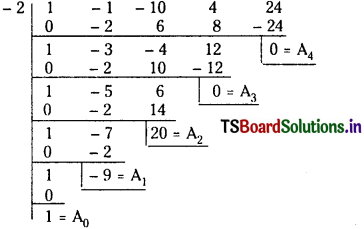
15వ పద్యం :

కం ||
అని పలికి మహారాజా
వినుమని ధృతరాష్ట్రు తోడ వెండియుఁ దా ని
ట్లనిచెప్పె వాసుదేవుఁడు,
తనమది నఱలేక కార్యదశ దెలియంగన్

ప్రతిపదార్థం:

అని పలికి = అని చెప్పి
మహారాజా! = భూ వల్లభా (ధృతరాష్ట్రా)
వినుము + అని = వినుమని
ధృతరాష్ట్రతోడన్ = ధృతరాష్ట్రునితో
వెండియున్ = మరల
కార్యదశ తెలియంగన్ = కార్యపద్ధతి విశదమయ్యేటట్లు
వాసుదేవుఁడు = శ్రీకృష్ణుడు
తన మదిన్ = తన హృదయంలో
అఱ లేక = మర్మం లేకుండా
తాన్+ఇట్లు+అని చెప్పన్ = తాను ఈ విధంగా పలికాడు

తాత్పర్యం : ఇట్లా వచించి శ్రీకృష్ణుడు ధృతరాష్ట్రుడితో రాజా! నా మాటలు వినుమంటూ మనుసులో మర్మం ఉంచుకోక కార్యపద్ధతి తేటతెల్లమయ్యేటట్లు మళ్ళీ ఈ విధంగా పలికాడు.

16వ పద్యం :

ఆ ||
వారి తండ్రిపాలు వారికి నిచ్చి నీ
పాలు నీవుఁ బుత్ర పౌత్ర చేయము
ననుభవించి సఖులరై యుండుఁ డిది బంధు
మిత్ర సుజనకోటి మెచ్చు తెఱఁగు

ప్రతిపదార్థం :

వారి తండ్రిపాలు = పాండవుల తండ్రి భాగం
వారికిన్ + ఇచ్చి = పాండవులకు ఇచ్చి
నీ పాలు = నీ రాజ్య భాగం
నీవున్ = నీవూ
పుత్రపౌత్ర చయమున్ = నీ కొడుకుల, మనుమల సమూహం
అనుభవించిన = అనుభవించి
సుఖులురు+ఐ+ఉండుఁడు = హాయిగా జీవించండి
ఇది = ఇట్లా ఉండటం,
బంధుమిత్ర సుజనకోటి = చుట్టముల, స్నేహితుల, సత్పురుషుల యొక్క సముదాయం
మెచ్చుతెఱగు = కొనియాడు విధమై ఉన్నది

తాత్పర్యం : రాజా! పాండవుల తండ్రి భాగం పాండవుల కిచ్చి, నీ రాజ్యభాగం, నీ కుమారులు, నీ మనుమళ్ళూ హాయిగా అనుభవిస్తూ ఉంటే చుట్టాలూ, స్నేహితులూ, సత్పురుషులు అందరు మిమ్ములను కొనియాడుతారు.

17వ పద్యం :

కం||
ఎఱుఁగవె యజాతశత్రుని
నెఱియును ధర్మంబు సత్యనిష్ఠయు మిము నె
త్తెఱగున ననువర్తించెనొ
యెఱుఁగవె ? తగు చేవ గలుగు టెఱుఁగవె ? యధిపా !

ప్రతిపదార్థం :

అధిపా ! = రాజా!
అజాతశత్రుని = ధర్మరాజు యొక్క
నెఱియును = న్యాయమును
ధర్మంబున్ = ధర్మమును
సత్యనిష్ఠయు = సత్యమునందలి నమ్మకము
ఎఱగవె ? = తెలియదా ?
మిమున్ = మిమ్ము
ఏ + తెఱఁగునన్ = ఏ విధంగా
అనువర్తించెనొ = అనుసరించిమెలగెనో
ఎఱుగవె ? = తెలియదా ?
తగుచేవ = తగినశక్తి
కలుగుట = అతడు కల్గియుండటం
ఎఱుంగవె ? = తెలియదా ?

తాత్పర్యం : మహారాజా! ధర్మజుడి న్యాయమూ, ధర్మమూ, సత్యప్రవృత్తి నీకు తెలుసు. అతడు మిమ్మాశ్రయించుకొని ఎట్లా ఉన్నాడో నీకు తెలుసు. అతని సామర్థ్యం కూడా నీకు తెలుసు.

18వ పద్యం :
చ||
మద మడగించి భూపతిసమాజము నెల్లను నిన్నుఁ గొల్వఁజే
యుదునని పూని దిగ్విజయ మున్నతిఁజేసి మహావిభూతితో
మదిమదినుండ నీ సుతుఁడు మంత్రులు సౌబలు జూదమార్చి సం
పద కొని యంతఁ బోవక సభన్ ద్రుపదాత్మజ భంగపెట్టరే

ప్రతిపదార్థం :

మదము + అడఁగించి = గర్వాన్ని తొలగించి
భూపతి సమాజమున్ + ఎల్లన్ = రాజలోకమంతటినీ
నిన్నున్ = నిన్ను
కొల్వన్+చేయుదున్+అని = సేవించేటట్లు చేయుదునుగాక
అని పూని = పూనుకొని
దిగ్విజయము = విజయ యాత్రను
ఉన్నతిన్ చేసి = గొప్పగా కావించి
మహా విభూతితోన్ = గొప్ప ఐశ్వర్యంతో
మది మదిన్ + ఉండక = నెమ్మదిగా ఉండగా
నీ సుతుడు = నీ కుమారుడైన (దుర్యోధనుడు)
మంత్రులు = అతడికి ఆలోచన చెప్పే (కర్ణ దుశ్శాసనులు)
సౌబలున్ = సుబలును పుత్రుడు (శకుని)
జూదము + ఆర్చి = జూదము ఆడించి
సంపదన్ + కొని = సిరిని హరించి
అంతన్ + పోవక = అంతటితో విడువక
ద్రుపద + ఆత్మజన్ = ద్రౌపదిని
సభన్ = కొలువులో
భంగపెట్టరే = అవమానించిన వారు గదా !

తాత్పర్యం : రాజుల దర్పమడచి వారందరు నిన్ను కొలిచేటట్లు చేయడానికై ధర్మనందనుడు గొప్పగా దిగ్విజయం చేసి మిక్కుటమైన సిరిసంపదతలో తులతూగుతూ నిమ్మళంగా ఉన్నాడు. అప్పుడు నీ తనయుడూ, అతని మంత్రులూ చేరి శకునిచే జూదమాడించి ధర్మజుడి సంపదనెల్ల హరించారు. అంతటితో తృప్తిపడక నిండుసభలో ద్రౌపదిని పరాభవించారు.

19వ పద్యం :

ఉ ||
దానికి నీ వొడంబడితి; ధర్మజుఁ డంతయుఁ జూచి సత్యముం
బూని వృకోదరార్జునులు భుగ్నులుగాఁ బెదచేతఁ గన్ను నీ
రూనఁగ నొత్తుకొంచుఁ జని యుగ్ర వనంబున దుఃఖమగ్నుఁడై
దీనత నుండి పూన్కి దగఁ దీర్చియుఁ గూడి మనంగఁ గోరెడిన్

ప్రతిపదార్థం :

దానికిన్ = దుర్యోధనుడి దుష్టచేష్టకు
నీవు + ఒడంబడితి(వి) = నీవు సమ్మతించావు
ధర్మజుఁడు = ధర్మరాజు
అంతయున్ + చూచి = పరిస్థితి నాకళించుకొని
సత్యమున్ + పూని = సత్యం అవలంభించి
వృకోదర + అర్జునులు = భీమార్జునులు
భుగ్నులుగాన్ = క్రుంగినవారుకాగా
కన్ను = కళ్ళలో
నీరు + ఊనఁగన్ = కన్నీరు నిండగా
పెడచేతన్ = వెనక చెయ్యితో
ఒత్తుకొంచున్ = తుడుచుకొంటూ
చని = వెళ్ళి
ఉగ్ర వనంబునన్ = ఘోరారణ్యంలో
దుఃఖమగ్నుడు + ఐ = శోకమునందు మునిగినవాడై
దీనతన్ + ఉండి = దైన్యంతో పడియుండి
పూన్కిన్ = ప్రతిజ్ఞను
తగన్ + తీర్చియున్ = సక్రమంగా నిర్వహించికూడా
కూడి = మీతో కలసి మెలసి
మనంగన్
కోరె = జీవించాలని
కోరెడిన్ = కోరుకొంటున్నాడు.

తాత్పర్యం: దుర్యోధనుడి దుష్కృత్యాలకు నీవు సమ్మతించావు. ధర్మరాజు తనకేర్పడిన సంకటాన్ని గమనించి సత్యం తప్పక, తన ఆజ్ఞచేత భీమార్జునులు బలముడిగి క్రుంగిపోగా, కంటినుండి కారుతున్న కన్నీటిని ఎడమచేతితో తుడుచుకుంటూ ఘోరారణ్యాలకు వెళ్ళాడు. అక్కడ దుఃఖాలలో మునిగి దైన్యం అనుభవిస్తూ ప్రతిజ్ఞను సక్రమంగా నెరవేర్చికూడా నేడు మీతో ఒద్దికగా జీవించవలెనని కోరుకుంటున్నాడు.

TS Inter 2nd Year Telugu Study Material Poem 1 శ్రీకృష్ణ రాయబారం width=
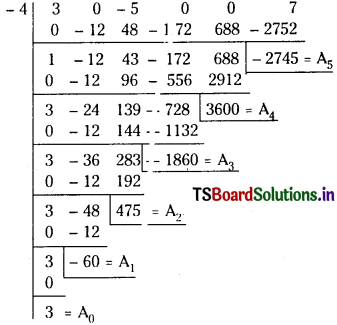
20వ పద్యం :

కం||
తనుఁ దాన పోలుగా కే
మనవచ్చు ? నజాతశత్రు నతిశాంతతయున్
వినయుము సత్యము మున్నే
జనపతులకుఁ గలవు సెపుమ ? సౌజన్యనిధీ !

ప్రతిపదార్థం :
సౌజన్యనిధీ ‘ = మంచితనానికి స్థానమైనవాఁడా!
తనున్+తాను+అ+పోలున్+కాక = అతడికి అతడే సాటి అగును
ఏమి + అనన్ వచ్చున్ ? = అతడిని ఎంతని కొనియాడగలము ?

అజాతశత్రు = ధర్మజుడి యొక్క
అతి = ఎక్కువైనా
శాంతతయున్ = శాంతస్వభావమూ,
వినయమున్ = అణకువా
సత్యమున్ = సత్యమూ
మున్ను = పూర్వ౦
ఏ జనపతులకున్+కలవు = ఏ రాజులకున్నాయో
చెపుము + అ = చెప్పుము

తాత్పర్యం : ధర్మపుత్రుడికి సాటి ధర్మపుత్రుడే. అతడిని ఎంతని కొనయాడగలం ? ఆయన శాంతస్వభావం, అణకువ, సత్యనిష్ఠ ఇంతకు మునుపు ఏరాజులకున్నవో చెప్పు.

21వ పద్యం :

కం॥ ఏ నిం తాడితి నీ సం
తానం బిరుదెఱఁగునకు హితము గోరి భవ
త్సూనుని మతి యతిలోభము
మానిచి పాండవులఁ దెమ్ము మనుజాధీశా !

ప్రతిపదార్థం :

మనుజ + అది + ఈశ = నరనాథా !
నీ సంతానంబు = నీ బిడ్డలైన
ఇరు తెఱుగునకున్ = రెండు పక్షాల వారికి,
హితమున్ + కోరి = మేలు దలచి
ఏను = నేను
ఇంత + ఆడితిన్ = ఇన్ని మాటలు చెప్పాను
భవత్ + సూనుని = నీ కొడుకైన దుర్యోధనుడి యొక్క
మతి + అతి లోభమున్ = మనస్సునందలి మిక్కిలి దురాశను
మానిచి = తొలగించి,
పాండవులన్ + తెమ్ము = పాండవులను నీ దగ్గరకి రప్పించుకొనుము

తాత్పర్యం : మంచితనంగల ధృతరాష్ట్ర మహారాజా ! నీ బిడ్డలైన కురుపాండవుల మేలు గోరి నేనిన్ని మాటలు చెప్పవలసి వచ్చింది. నీ పుత్రుడైన దుర్యోధనుడి మనసులో ఉన్న పరమ దురాశను తొలగించి, పాండవులను నీ చెంతకు పిలిపించుకొనుము.

22వ పద్యం :

చం||
అనవుడు రోమహర్షణము లంగములం బొడమన్ సదస్యు లె
ల్లను బ్రియమంది నెమ్మనములం బురుషోత్తముఁ డింత యొప్పఁ బ
ల్కునె ? మఱుమాటలాడ నయకోవిదుఁ దెవ్వఁడు ? ధీరుఁడెవ్వఁ? డిం
దనువరి యెవ్వఁ డంచు నచలాకృతులై నెఱి నూరకుండఁగన్

ప్రతిపదార్థం :

అనవుడున్ = (శ్రీకృష్ణుడు) అట్లా పలుకగా;
అంగములన్ = శరీరములందు
రోమహర్షణములు = గగుర్పాటు
పొడమన్ = కలుగగా
సదస్యులు + ఎల్లను = కొలువులోని వారంతా
ప్రియము + అంది = హర్షించి,
నెమ్మనములన్ = తమ నిండుమనసులలో
పురుషోత్తముఁడు = శ్రీకృష్ణుడు
ఇంత + ఒప్పన్ + పల్కునే = ఇంత బాగా మాట్లాడుతాడా ? (ఎంత బాగా మాట్లాడాడు ? అని భావం)
మఱుమాటలు + ఆడన్ = ఆ మాటలకు బదులు పలకటానికి
ఇందున్ = ఈ సభలో
నయకోవిదుడు+ఎవ్వఁడు ? = నీతి శాస్త్ర నిపుణుడు ఎవడున్నాడు ?
ధీరుఁడు + ఎవ్వడు ? = ధైర్యశాలి ఎవడున్నాడు ?
అనువరి + ఎవ్వడు ? = ఉపాయలి ఎవడున్నాడు ?
అంచున్ = అని పలుకుతూ
ఆచల :- ఆకృతులు + ఐ = చలించని ఆకారాలు గలవారె
నెతిన్ = ఒప్పుగా
ఊరక + ఉండఁగన్ = మిన్నకుండగా

తాత్పర్యం : శ్రీకృష్ణుడి మాటలు వినగానే సభ్యులందరి శరీరాలు గగుర్పాటు వహించాయి. వారు మనస్సులలో ఎంతో సంతోషించి, నారాయణు డెంత ఒప్పిదంగా మాట్లాడాడు ! శౌరి మాటలకు ప్రతివచనాలు పల్కగల నీతి నిపుణుడు, ధీరుడు, ఉపాయశాలి ఈ కొలువులో ఎవరున్నారు అని కదలక మెదలక నోరు విప్పక అట్లాగే ఉండిపోయారు.

కంఠస్థం చేయవలసిన పద్యాలు, ప్రతిపదార్థ, తాత్పర్యములు

కవి పరిచయం : ఈ పద్యం తిక్కన రాసిన మహాభారతం, ఉద్యోగ పర్వం, తృతీయాశ్వాసం నుండి తీసుకున్న శ్రీకృష్ణ రాయబారం అనే పాఠ్యాంశం లోనిది. తిక్కనకు కవి బ్రహ్మ, ఉభయ కవి మిత్రుడు అనే బిరుదులున్నాయి. పదమూడవ శతాబ్దికి చెందిన నెల్లూరు పాలకుడు మనుమసిద్ధి ఆస్థానంలో ఉండేవాడు.

1వ పద్యం :
(ప్రతిపదార్థ తాత్పర్యాలు రాసే ముందు కవి పరిచయం రాయాలి.)

చ ||
భరతకులంబు ధర్మమును బాడియు సత్యముఁ బొత్తుఁ బెంపునుం
గరుణయుఁ గల్గి యుందు ననఁగా నుతిఁ గన్నది : యందు సద్గుణో
త్తరులరు నీవు నీ యనుఁగుఁ దమ్ముఁడు; నీ తనయుల్ యశోధురం
ధర శుభ శీలు; రీ సుచరిత క్రమ మిప్పుడుఁ దప్పనేటికిన్!

ప్రతిపదార్థం :

భరతకులంబు = భరతుడు జన్మించిన =
ధర్మమును = ధర్మమును
పాడియున్ = న్యాయమును
సత్యమున్ = సత్యమును
పొత్తున్ = ఐకమత్యమును
పెంపునున్ = గొప్పతనమును
కరుణయున్ = దయయును
కల్గి+ఉండున్+అనఁగాన్ = కల్గియుంటుందని
నుతిన్ + కన్నది = ప్రఖ్యాతి వహించినది
అందున్ = అట్టి వంశంలోని
నివున్ = నీవూ
నీ + అనుగుఁ దమ్ముడున్ = నీ ప్రియమైన తమ్ముడు (పాండురాజు)
సద్గుణ + ఉత్తరులు = మంచి గుణాలచేత శ్రేష్టులు
నీ తనయుల్ = నీ కొడుకులునూ, నీ తమ్ముడి కొడుకులున్నూ
యశోధురంధర శుభశీలురు = కీర్తి భారాన్ని వహిస్తున్న మంచి స్వభావం కలవారు
ఈ సుచరిత క్రమము = పరంపరగా వస్తున్న ఈ మంచి ప్రవర్తనా తీరును
ఇప్పుడున్ = ఇప్పుడు కూడా
తప్పన్ + ఏటికిన్ ? = తప్పడం ఎందుకు ?

తాత్పర్యం : మహారాజా ! మీ భరతవంశం ధర్మం, న్యాయం, సత్యం, ఐకమత్యం, గౌరవం, కారుణ్యం మొదలైన సద్గుణాలు గలిగి కీర్తి పొందింది. అట్టి వంశంలో నీవూ, నీ ప్రియ సహోదరుడు పాండురాజు, సద్గుణాలయందు శ్రేష్టులు, మరి నీ కుమారులు కీర్తి భారం వహించ జాలినవారు. కళ్యాణ స్వభావులు. ఇంత మంచి నడవడిగల వంశ సంప్రదాయం ఇప్పుడు కూడా తప్పడం ఎందుకు ?

2వ పద్యం :
ఉ ||
వీరును వారుఁ బండితులు, విక్రమవంతులు, బాహుగర్వదు
ర్వారులు; పూని రిత్త బవరంబున నాఱడిఁ జావఁబోవ నె
ట్లూరక యుండవచ్చుఁ ? గడు నొప్పెడు మేనులు వాఁడి కైదువుల్
గూరఁగ నాటినం బుడమిఁ గూలుట కక్కట ! యోర్వవచ్చునే ?

ప్రతిపదార్థం :

వీరును = ఈ కౌరవులు
వారున్ = ఆ పాండవులు
పండితులు = చదువు, సాములు నేర్చినవారు
విక్రమవంతులు = పరాక్రమం కలవారు
బాహు గర్వ దుర్వారులు = భుజబలంచేత అడ్డగించ రానివారు
పూని = ఉద్యమించి
రిత్త బవరంబునన్ = తమలో తమకు ఏర్పడిన వ్యర్థమైన కలహం వల్ల
ఆఱ డిన్ = యుద్ధంలో
కావడ్ + పోవన్ = మరణించటానికి సిద్ధపడగా
ఎట్లు + ఊరక + ఉండన్* + వచ్చున్ = నివారించక మౌనంగా ఎట్లుండదగును ?
వాడి కైదువుల్ = పదునైన ఆయుధాలు (బాణాలు)
కూరఁగన్ = దూసుకొని పోయేటట్లు
నాటినన్ = గ్రుచ్చుకొనగా
కడున్ = మిక్కిలి
ఒప్పెడు మేనులు = సుందర (సుకుమారమైన) శరీరాలు
పుడమిన్ + కూలుటకున్ = నేలపై కూలటం
అక్కట = అయ్యో
ఓర్వన్ వచ్చునే = సహింపశక్యము ?

తాత్పర్యం : కౌరవులూ పాండవులూ మంచి చదువరులు, పరాక్రమవంతులు, భుజదర్పం గలవారు గనుక ఎవ్వరూ వీరిని అడ్డగించలేరు. ఇట్లాంటివారు తమలో తమ కేర్పడిన కొరమాలిన యుద్ధంలో ఊరక మరణించటానికి సిద్ధపడుతుండగా అడ్డుపడక చూస్తూ ఊరకుండటం మంచిది కాదు. ఇంత కోమలమైన శరీరాలు వాడి బాణాలు ఆవలికి దూసుకొని వెళ్ళేటట్లు గ్రుచ్చుకోగా నేలమీద కూలటం చూచి సహించటం సరైనది కాదు.

TS Inter 2nd Year Telugu Study Material Poem 1 శ్రీకృష్ణ రాయబారం width=

3వ పద్యం:
ఉ||
‘సారపు ధర్మమున్ విమల సత్యముఁ బాపముచేత బొంకుచేఁ
బారముఁ బొందలేక చెడఁ బాఱినదైన యవస్థ దక్షు లె
వ్వారలుపేక్ష సేసి రది వారల చేటగుఁగాని ధర్మని
స్తారక మయ్యు సత్యశుభదాయక మయ్యును దైవ ముండెడున్’.

ప్రతిపదార్థం :

సారపు ధర్మమున్ = శ్రేష్టమైన ధర్మమును;
విమల సత్యమున్ = నిర్మలమైన సత్యమును,
పాపముచేతన్ = దురిత చేత
బొంకు చేన్ = అబద్ధం చేత
పారమున్+పొందన్+లేక = గట్టుకు చేరలేక
చెడన్ పారినది + ఐన + అవస్థన్ = చెడటానికి సిద్ధంగా ఉన్న దుర్దశలో
దక్షులు = చక్కదిద్దటానికి సమర్థులు
ఏ + వారు = ఎవరు
ఉపేక్ష + చేసిరి = అశ్రద్ధ వహిస్తారో
అది = అట్లా ఊరుకోవడం
వారల చేటు + అగున్ = వారికే హాని కలిగిస్తుంది
కాని = కానీ
ధర్మ నిస్తారికము + అయ్యున్ = ధర్మమును ధరించేదిగాను
సత్య శుభదాయకము + ఆయ్యును = సత్యానికి మేలు కల్గించేదిగా
దైవము ఉండెడున్ = దైవం ఆధారంగా ఉంటుంది

తాత్పర్యం : ఉత్తమమైన ధర్మం, నిర్మలమైన సత్యం పాపం చేతను, అబద్ధం చేత దరి (లక్ష్యాన్ని) చేరలేక చెడటానికి సంసిద్ధంగా ఉన్న స్థితిలో వాటిని రక్షించే శక్తి ఉన్నా ఎవరు అశ్రద్ధ వహిస్తారో అది వారలకే హానికరమవుతుంది. ఆ స్థితిలో భగవంతుడు ధర్మమును ఉద్ధరించటానికి, సత్యమునకు శుభం కలిగించటానికి ముందుకు వస్తాడు.

4వ పద్యం :

ఉ ||
వారలు శాంతశూరులు; భవచ్చరణంబులు గొల్వఁబూని యు
న్నారటుఁగాక మీ కది మనంబున కప్రియమేని నింతకుం
బోరికి వచ్చుచుండుదురు; భూవర ! రెండు దెఱంగులందు ని
కారయఁ బథ్యమేది యగు నవ్విధ మేర్పడ నిశ్చయింపుమా !

ప్రతిపదార్థం :

వారలు = కౌంతేయులు
శాంత శూరులు = శాంతస్వభావులు, పరాక్రమవంతులు
భవత్ + చరణంబులు = నీ పాదాలు
కొల్వన్ = సేవించటానికి
పూని + ఉన్నారు = సంసిద్ధంగా ఉన్నారు
అటున్ + కాక = అట్లాకాక
మీకున్ = మీకు
అది = పాండవుల పొత్తు
మనంబునకున్ = మీ మనస్సులకు
అప్రియము + ఏనిన్ = ఇష్టం కానిచో
ఇంతకున్ = ఈపాటికి
పోరికిన్ = యుద్ధానికి
వచ్చుచున్ + ఉండుదురు = వస్తూ ఉంటారు
భూవర = రాజా
రెండు తెలుగులందున్ = సంధి సంగ్రామాలలో
నీకున్ = నీకు
అరయన్ = ఆలోచించగా
ఏది పథ్యము + అగున్ = ఏది హితమౌతుందో
ఆ + విధము = ఆ తెఱగు
ఏర్పడన్ + నిశ్చయింపుమా ! = తేటపడేటట్లు తీర్మానించుము

తాత్పర్యం : మహారాజా ! పాండవులు ఎంతటి శాంత స్వభావులో అంతటి వీరాగ్రేసరులు. వారు నీ పాదసేవ చేయటానికి సంసిద్ధంగా ఉన్నారు. వారట్లా మీతో కలసి మెలసి వర్తించటం మీకు ఇష్టం కాకపోతే కదనం కావించటానికి బయలుదేరి వస్తారు. సంధి, సంగ్రామం ఈ రెండింటిలో మీ కేది హితమని తోస్తుందో దానిని నిర్ణయించి వెల్లడించండి.

శ్రీకృష్ణ రాయబారం Summary in Telugu

(ఆంధ్ర మహాభారతం: హశ్వాసము నుండి)

TS Inter 2nd Year Telugu Study Material Poem 1 శ్రీకృష్ణ రాయబారం 1
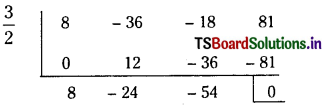
కవి పరిచయం

పాఠ్యాంశం పేరు : శ్రీకృష్ణ రాయబారం
కవి పేరు : తిక్కన సోమయాజి
గ్రంథం : మహాభారతం – ఉద్యోగపర్వం – తృతీయాశ్వాసంలోనిది
బిరుదులు : కవి బ్రహ్మ, ఉభయకవి మిత్రుడు
కాలం : 13వ శతాబ్ది (క్రీ.శ. 1205 నుండి 1288)
‘ఆస్థానం : నెల్లూరును పరిపాలించిన మనుమసిద్ధి ఆస్థానం.
ఇంటి పేరు : కొట్టరువు
రచనలు : వ్యాసభారతంలోని విరాటపర్వం నుండి స్వర్గారోహణ పర్వం వరకు – 15 పర్వాలు అనువదించాడు. నిర్వచనోత్తర రామాయణం, కృష్ణశతకం, విజయసేనం, కవివాగ్బంధం (కవిసార్వభౌమఛందం).
తిక్కన శైలి : తిక్కనది నాటకీయ శైలి, రాసాభ్యుచిత బంధం.
తిక్కనను ఆదరించిన రాజు : తిక్కన క్రీ.శ. 1205 నుండి 1288 వరకు నెల్లూరు మండలాన్ని పాలించిన, మనుమసిద్ధి యొక్క ఆస్థాన కవి.
మనుమసిద్ధికి తిరిగి
రాజ్యాన్ని ఇప్పించడం : తిక్కన తన జీవితకాలంలో దాయాదుల చేతిలో ఓటమిపాలైన మనుమసిద్ధికి అతని రాజ్యాన్ని తిరిగి ఇప్పించేందుకు, నాటి కాకతీయ ప్రభువైన గణపతిదేవుడి దగ్గరకు వెళ్ళి రాయబార కార్యాన్ని సఫలం చేశాడు.
హరిహరాద్వైత మతస్థాపన: సమాజం శాంతిగా ఉండేందుకు హరిహరాద్వైత సిద్ధాంతాన్ని పునఃప్రతిపాదించాడు. తమ సమకాలీన కవులందరిచేత సమున్నత గౌరవం పొందాడు. ఎందరో శిష్య ప్రశిష్యులను తన మార్గంలో నడిపించాడు.

తిక్కన గారి శిష్యుడు
కేతన చెప్పిన వివరాలు : కవిత్రయంలో ద్వితీయుడైనా కవితారచనలో అద్వితీయుడు తిక్కన సోమయాజి. తిక్కన శిష్యుడు కేతన దశకుమార చరిత్రలో తిక్కనను మయూర సన్నిభకవి, ఆర్యభోజ, భారవికల్పుడు, ఉభయ భాషాకర్త, త్రివిధకావ్య పారీణుడు అని పేర్కొన్నాడు.

పాఠ్యభాగ సందర్భం

పంచమ వేదంగా ప్రసిద్ధి పొందిన ఇతిహాసం మహాభారతం. శంతన మహారాజుకు. సత్యవతికి పుట్టిన సంతానం చనిపోయిన తరువాత వేదవ్యాసుని ద్వారా ధృతరాష్ట్ర, పాండురాజులు జన్మిస్తారు. పుట్టుకతో అంధుడైన ధృతరాష్ట్రునికి రాజయ్యే అవకాశం లేనందున పాండురాజుకు పట్టాభిషేకం చేస్తారు. పాండు రాజుమరణానంతరం ధృతరాష్ట్రున్ని తాత్కాలిక రాజునూ చేస్తారు. దుర్యోధనునికి రాజ్యంపై కోరిక పెరగడంతో వారిని చంపాలని ప్రయత్నిస్తాడు. దుర్యోధనుడు అసూయతో పాండవులను అనేకసార్లు కష్టనష్టాలకు గురిచేశాడు. లక్కయిల్లు దహనం, ద్రౌపదీ వస్త్రాపహరణం, మాయాజూదంతో పాండవులతో అరణ్యవాసం చేయించడం వంటి అనేక దుష్కృత్యాలకు దుర్యోధనుడు పాల్పడ్డాడు. అవన్నీ పూర్తయిన తరువాత తన అర్థరాజ్యం తనకిమ్మని రాయబారం పంపిస్తాడు. రాజు స్థానంలో ఉన్న ధృతరాష్ట్రుడు మౌనంగా కూర్చున్నాడు. సంజయుడు, ద్రుపద పురోహితుల రాయబారం ఇరుపక్షాల వద్ద జరిగినా ఫలితం లేకపోయింది. చివరకు శ్రీకృష్ణుడే రంగంలోకి దిగి ధృతరాష్ట్రునికి యుద్ధనష్టాలు, శాంతి గొప్పదనం, పాండవుల పరాక్రమం చెప్పేందుకు వెళ్ళిన సందర్భమే ‘శ్రీకృష్ణ రాయబారం’ అనే ప్రస్తుత మన పాఠ్యాంశం.

TS Inter 2nd Year Telugu Study Material Poem 1 శ్రీకృష్ణ రాయబారం width=
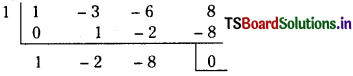
పాఠ్యభాగ సారాంశం

శ్రీకృష్ణుడు మేఘధ్వని వంటి గంభీరమైన తన కంఠధ్వనితో, దంతాల కాంతులు ప్రసరిస్తూ ఉండగా, ధృతరాష్ట్రుని సభలో ఉన్న వారందరూ శ్రద్ధగా వింటుండగా పాండవులు పంపిన సంధి సమాచారాన్ని ధృతరాష్ట్ర మహారాజుతో చెప్పాడు. “ఓ మహారాజా ! నీకు తెలియని విషయాలు ఏమున్నాయి ? అయినప్పటికీ, భరతవంశం సంతోషించేటట్లు నా ఇరు కుటుంబాల వారికి న్యాయమూ, పరమహితమూ చెప్పటం ఉచితమని నేనిక్కడికి వచ్చాను.

శ్రీకృష్ణుడు కురువంశ కీర్తిని గుర్తు చేయుట : కురునాథా ! పాండవ కౌరవులు పాలూ, నీరు లాగా కలిసిమెలిసి జీవించటం మంచిది. వారు కలిసిమెలిసి ఉండేటట్లు నడిపించవలసిన బాధ్యత తమరిది. పాండవులు వేరు, కౌరవులు వేరు అనే భేదభావన నీకు లేదు. మహారాజా ! మీ భరతవంశం ధర్మం, న్యాయం, సత్యం, ఐకమత్యం, గౌరవం, కారుణ్యం మొదలైన సద్గుణాలు గలిగి కీర్తి పొందింది. అట్టి వంశంలో నీవూ, నీ ప్రియ సహోదరుడు పాండురాజు సద్గుణాలతో గొప్ప పేరు పొందారు. నీ కుమారులు కూడా కీర్తి భారం వహింప జాలినవారు. కళ్యాణ స్వభావులు. ఇంత మంచి నడవడిగల వంశ సంప్రదాయం ఇపుడు తప్పడం ఎందుకు ?

యుద్ధం సంభవిస్తే జరిగే కీడుకు ధృతరాష్ట్రున్ని బాధ్యుణ్ణి చేయుట : ధృతరాష్ట్ర మహారాజా ! నీవు కురువంశంలో పెద్దవాడివి. ఈ వంశానికంతటికీ నీవే ఆధారం. నీ కుటుంబంలో ఎవ్వరెవ్వరి నడవడికలు, వాటిని బట్టి కలిగే మేలు, కీడు అంతా నీకే చెందుతాయి. కాబట్టి నీవు ఇరుకుటుంబాల వారి శ్రేయస్సును దృష్టిలో పెట్టుకొని జనులు మెచ్చేటట్లుగా వారిని చక్కదిద్దవలసిన బాధ్యత నీపై ఉంది. రాజా ! దుర్యోధనాదులైన వీరు ధర్మపరులుగాక, సత్కార్యాలు చేయక ఇట్లా ఉంటే మహార్థసిద్ధికి దూరమవుతామని తలచటం లేదు. మీ వంశ నడవడి ఇట్టిది కాదు అని తెలిసి కూడా దారుణ బుద్ధితో బంధువుల మనస్సులు బాధ చెందేటట్లుగా ప్రవర్తిస్తున్నారు. కౌరవులు, పాండవులు ఒక మంచి నిర్ణయానికి వచ్చి, శాంతం వహించి, జీవించటం మంచిది. ఇట్లు వారు ప్రసన్న చిత్తులై ఉండటం నాకూ, నీకూ, కురువంశానికి, ఈ రాజ సమూహానికి, ఈ భూమండలానికి అంతటికి మంచిది. అట్లాకాక యుద్ధమే సంభవిస్తే మనందరికీ మహావిపత్తు కలుగుతుంది. కనుక రాజోత్తమా ! నా మాటలపై విశ్వాసముంచి తప్పక సంధి చేసుకోండి.

ఇరువైపులా గల బలాలను వారిని కలిపి ఉంచే ప్రయత్నం చేయుట : అక్కడున్న భీమార్జునులను యుద్ధరంగంలో వివరించి నిలువరించగలవారు ఇక్కడెందరున్నారు ? ఇక్కడున్న ద్రోణ, భీష్ముల పరాక్రమాన్ని ఎదుర్కొనగలవారు అక్కడ ఎందరున్నారు ? ఇట్లా ఉభయ పక్షాలలోని వీరులు యుద్ధంలో చావటం కన్న నీ బలగాలై కలిసి మెలిసి జీవించటం మంచిది. మహారాజా! ఏ విధంగానైనా వీరిని శాంతింపజేయుము. లోకంలోని రాజులందరూ నీ పాదపీఠాన్ని ప్రీతితో సేవిస్తుండగా సముద్రముచే చుట్టబడిన పుడమినంతటినీ నీవే ఏకచ్ఛత్రంగా పరిపాలించటం మంచిది. తల్లి తన బిడ్డల పట్ల శత్రుత్వం వహించటం ఎంత సమంజసమో నీవే ఆలోచించు. నీవు కురుపాండవుల విషయంలో శ్రద్ధ వహించకుంటే ఈ ఉభయవర్గాలకే కాదు, పుడమిలోని జనులందరికీ పాపం చేసినట్లే అవుతుంది. చివరకు దానివల్ల నీకే హాని కలుగుతుంది.

రాజా ! కురు పాండవులలో ఎవరికి మరణం సంప్రాప్తించినా, బాధలు కలిగినా నీకు దుఃఖం కలుగుతుంది. కౌరవులూ, పాండవులూ మంచి చదువరులు, పరాక్రమవంతులు, భుజదర్పం గలవారు గనుక ఎవ్వరూ వీరి నడ్డగించలేరు. ఇట్లాంటివారు తమలో తమకేర్పడిన కొరమాలిన యుద్ధంలో మరణించటానికి సిద్ధపడుతుండగా అడ్డుపడక చూస్తూ ఊరకుండటం నీ వంటి వారికి తగిన పని కాదు. ఇంత కోమలమైన శరీరాల నుండి మొనలుదేలిన బాణాలు ఆవలికి దూసుకొని వెళ్ళేటట్లు గ్రుచ్చుకోగా నేలమీద కూలటం చూచి సహించటం సరైనది కాదు. రాజా ! నీ గొప్పతనమును, రాజనీతిని, శాంతిని సమస్త ప్రజలు మెచ్చుకొనేటట్లు కురుపాండవులు సంగ్రామంలో నశించకుండా సంరక్షించుకొనుము,

పాండవుల సందేశాన్ని అందించుట : ధృతరాష్ట్ర మహారాజా ! పాండవులు తండ్రిలేని పిల్లలు. వారిని పసితనం నుంచి చక్కగా కాపాడావు. ఇప్పుడు వారిని కారణం లేకుండా మధ్యలోనే విడిచిపెట్టడం న్యాయం కాదు. పాండునందనులు నీకు పరమభక్తితో నమస్కరించి ఒకే గొంతుకతో నీకు చెప్పమని నాతో చెప్పి పంపిన మాటలు చెపుతాను వినుము. “తండ్రీ ! నీ ఇష్టప్రకారం పన్నెండు సంవత్సరాలు అరణ్యాలలో నివసించాము. పదమూడవ సంవత్సరం విరాట మహారాజు దగ్గర అజ్ఞాతవాసం చేశాము. ఈ విధంగా ఒప్పందాన్ని నెరవేర్చాము. మేము రాజ్యంలో సగపాలు పొందగలమని దృఢనిశ్చయంతో ఉన్నాము. మాకు తల్లి, తండ్రి, చుట్టములు వెయ్యేల సర్వవిధ రక్షకులు మీరే. మావల్ల ఏమైనా అపరాధముంటే కోపించి చక్కబెట్టండి”.

యుద్ధాన్ని తప్పించకుంటే దైవం చూసుకుంటుందని హెచ్చరిక : ఉత్తమమైన ధర్మం, నిర్మలమైన సత్యం పాపం చేతను, అబద్ధం చేత లక్ష్యాన్ని చేరలేని స్థితిలో వాటిని రక్షించే శక్తి ఉన్నా, ఎవరు అడ్డుపడక అశ్రద్ధ వహిస్తారో అది వారలకే హానికరమవుతుంది. ఆ స్థితిలో భగవంతుడు ధర్మమును ఉద్ధరించటానికి, సత్యానికి శుభం కలిగించటానికి ముందుకు వస్తాడు.

పాండవులు సభలోని పెద్దలకు నన్ను చెప్పమని కోరినమాటలు చెప్పాను. మహారాజా ! నీవూ, సభలోని రాజులూ ఇందుకు బదులేమి చెపుతారో చెప్పండి. నేటి నీతి ధర్మాలనూ, బాంధవ్యాన్ని ముందుంచుకొని మనోవాక్కులు ఏకరూపంగా ఉన్న సత్యమునే చెప్పాను. నే చెప్పిన పద్ధతి మీకు మేలు గలిగిస్తుంది. కోపం, గర్వం, ద్వేషం వదలి నేను చెప్పినట్లు చేయండి.

పాండవుల ఔన్నత్యాన్ని వివరించుట : రాజా ! పాండవుల తండ్రి భాగం పాండవులకిచ్చి, నీ రాజ్యభాగం నీ కుమారులు, నీ మనుమళ్ళూ హాయిగా అనుభవిస్తూ ఉంటే చుట్టాలూ, స్నేహితులూ, సత్పురుషులు అందరు మిమ్ములను కొనియాడుతారు. మహారాజా ! ధర్మజుడి న్యాయమూ, ధర్మమూ, సత్యప్రవృత్తి నీకు తెలుసు. అయినప్పటికీ స్పష్టంగా చెపుతాను విను. అతడు ఇంద్రప్రస్థపురంలో ఉంటూ నీకు గౌరవ ఖ్యాతులు కలిగించడానికి రాజులను ఓడించి వారందరు నిన్ను కొలిచేటట్లు చేయటానికి గొప్పగా దిగ్విజయ యాత్ర చేశాడు. సిరిసంపదలతో తులతూగుతూ నిమ్మళంగా ఉన్నప్పుడు

నీ తనయుడూ, అతని మంత్రులూ చేరి శకునిచే జూదమాడించి ధర్మజుడి సంపదనెల్ల హరింపచేశాడు. అంతటితో తృప్తిపడక నిండుసభలో ద్రౌపదిని పరాభవించారు. దుర్యోధనుడి దుష్కృత్యాలకు నీవు సమ్మతించావు. ధర్మరాజు తనకేర్పడిన సంకటాన్ని గమనించి సత్యం తప్పక తన ఆజ్ఞచేత భీమార్జునులు బలముడిగి క్రుంగిపోగా కంటి నుండి కారుతున్న కన్నీటిని ఎడమచేతితో తుడుచుకొంటూ ఘోరారణ్యాలకు వెళ్ళాడు. అక్కడ దుఃఖాలలో మునిగి దైన్యం అనుభవిస్తూ ప్రతిజ్ఞను సక్రమంగా నెరవేర్చాడు. అయినా మీతో కలిసి జీవించవలెనని కోరుకుంటున్నాడు.

ధర్మరాజుకు సాటియైన వాడు ధర్మరాజే. ఆయన శాంతస్వభావం, అణకువ, సత్యనిష్ట ఇంతకుమునుపు ఏ రాజులలో కూడా కానరాదు. మంచితనం గల ధృతరాష్ట్ర మహారాజా ! నీ బిడ్డలైన కురుపాండవుల మేలు గోరి నేను ఇన్ని మాటలు చెప్పవలసి వచ్చింది, నీ పుత్రుడైన దుర్యోధనుడి మనసులో ఉన్న పరమదురాశను తొలగించి, పాండవులను నీ చెంతకు పిలిపించుకొనుము. మహారాజా ! పాండవులు ఎంతటి శాంత స్వభావులో అంతటి వీరాగ్రేసరులు. వారు నీ పాదసేవ చేయటానికి సంసిద్ధంగా ఉన్నారు. వారికి మీతో కలిసి మెలిసి ఉండటం ఇష్టంలేకపోతే ఈపాటికి యుద్ధానికి బయలుదేరి వచ్చేవారు. సంధి, సంగ్రామం ఈ రెండింటిలో మీకేది హితమని తోస్తుందో దానిని నిర్ణయించి చెప్పండి.

శ్రీకృష్ణుడి మాటలు వినగానే సభ్యులందరి శరీరాలు గగుర్పాటు వహించాయి. వారు మనస్సులలో ఎంతో సంతోషించి, నారాయణుడెంత చక్కగా మాట్లాడాడు ! శౌరి మాటలకు బదులు చెప్పగల నీతి నిపుణుడు, ధీరుడు, ఉపాయశాలి ఈ కొలువులో ఎవరున్నారు ? అని కదలక మెదలక నోరు విప్పక అట్లాగే ఉండిపోయారు.