TS 6th Class Science 5th Lesson Questions and Answers Telangana – Materials and Things

TS Board Telangana SCERT Class 6 Science Solutions 5th Lesson Materials and Things Textbook Questions and Answers.

Materials and Things – TS 6th Class Science 5th Lesson Questions and Answers Telangana

Improve Your Learning

Question 1.
Name any five objects which are made up of only one material. (Conceptual Understanding) 2M
Answer:
Five objects which are made up of plastic.

  1. Chairs,
  2. Boxes,
  3. Table,
  4. Bottles,
  5. Dolls.

Question 2.
Name any five objects which are made up of more than two materials. (Conceptual Understanding) 2 M
Answer:
Five objects which are made up of more than two materials.

  1. Bicycle,
  2. Bullock cart,
  3. Doors,
  4. Wall clock,
  5. Shuttle bat.

TS 6th Class Science 5th Lesson Questions and Answers Telangana - Materials and Things

Question 3.
List five things which we can make using each of the following materials: a) Glass b) Metal c) Plastic d) Wood. (Conceptual Understanding) 4 M
Answer:
Five things which we can make using each of the following material.
(A) Glass Mirror, car window, TV screen, photo frame, dining bowls, plates etc.
(B) Metal Wheels, chairs, cup board, vessels, machines etc.
(C) Plastic Jars, covers (carry bags), chairs, bottles, plates etc.
(D) Wood Tables, chairs, doors, windows, cots, frames etc.

Question 4.
Mary saw a ship travelling on a sea. She knows that iron nail sinks in water. She has many doubts, what are her doubts ? Write them. (Asking Questions and Making Hypothesis) 4 M
Answer:
Mary raises the following questions (doubts) for floating of ship in the sea.

  1. Flow does a ship float on the surface of sea ?
  2. What principle helps the ship to sail on the sea easily ?
  3. Do all material have a chance of floating on the sea water ?
  4. Are there any properties which help the ship floating ?
  5. Can I travel on the surface of sea as ship sails ?

Question 5.
Mary, while examining whether a boiled egg sinks or floats, found that it floats but Vakula made it sink, how is it possible? Guess and write it. (Asking questions and Making hypothesis) 4 M
Answer:

  1. At first Mary used salt water for testing the sinking or floating character of the boiled egg Naturally boiled egg floats on the surface of salt water. Therefore the egg floats on salt water.
  2. But Vakula made the egg sink in by using normal water. She observed that the boiled egg simply sinks In the normal water.

Question 6.
Drop an egg in a beaker of water. Now drop the same egg in another beaker of water in which excessive salt is added. Write your observation. (Experimentation and Field Investigation) 4 M
Answer:
Procedure of the experiment : The egg is dropped in a beaker of water. After sometime, the same egg is dropped in another beaker of water in which excessive salt is added.

Observation : When the egg is placed in the beaker full of water, the egg sinks normally. On the other hand if the same egg is placed in another beaker of salt water, it floats.

Inference : The salt water and normal water exhibit their character to sinking or floating of an egg.

TS 6th Class Science 5th Lesson Questions and Answers Telangana - Materials and Things

Question 7.
Do the following activities. Write down your observations. What do you conclude ? (Experimentation and Field Investigation) 8 M
a) Mix chalk powder in water.
b) Place a piece of candle in water.
c) Add some oil drops to a beaker of water.
Answer:
Aim : To observe the nature of substances like chalk powder, candle piece and oil drops in water.

Requirements: Three glass beakers full of water, chalk powder, candle piece and oil drops.

Procedure: Three glass beakers are kept on the table. They are filled with water. Certain amount of chalk powder, candle piece and a few drops of oil are taken into the three beakers 1, 2, 3 respectively.

Observation : It is observed that the chalk powder is dissolved in the first beaker, candle piece is not dissolved in the second beaker. It is observed that the oil drops float on the surface of water.

Conclusion : Water has the capacity of dissolving certain substances like chalk powder. Substances like candle in solid state are insoluble in the water. Oil floats on the water surface.

Question 8.
Make a list of items from your kitchen like utensils, food ingredients etc. Classify them as follows.

ItemSink/float in waterSoluble / insoluble in water

Answer:
Utensils : Glass, saucer, small water vessel, spoon.
Ingredients : Sugar, salt, dal, jeera. Based on the sinking or floating of utensils and solubility of ingredients in water the items are classified as follows.
UTENSILS:

ItemSink/float in water
GlassSlowly sinking
SaucerFloats on water
Water vesselFloats on water
SpoonSinking

INGREDIENTS:

ItemSoluble / insoluble in water
SugarSoluble
SaltSoluble
DalInsoluble
JeeraInsoluble

TS 6th Class Science 5th Lesson Questions and Answers Telangana - Materials and Things

Question 9.
Collect different plastic items from your surroundings. Classify them as transparent, opaque and translucent.
Answer:

Item nameTransparent / Opaque / Translucent
Polythene coverTransparent item
Carry bagTranslucent item
BoxOpaque item

Question 10.
Draw different objects made up of wood which we use in our daily life. (Communication through Drawing and Model Making) 8M
Answer:
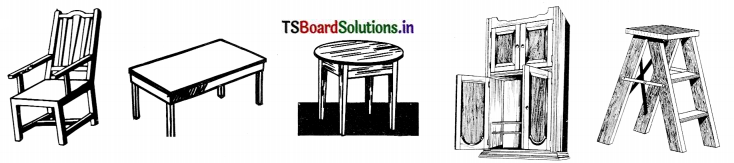
TS 6th Class Science 5th Lesson Questions and Answers Telangana - Materials and Things 3

Question 11.
Make a few models you like using clay. (Communication through Drawing and Model Making) 8M
Answer:
Models made of clay.
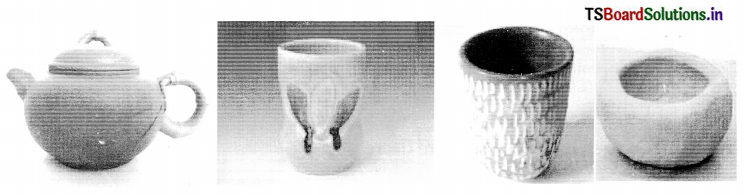
TS 6th Class Science 5th Lesson Questions and Answers Telangana - Materials and Things 2

Question 12.
We know that a ship, even though it is made up of tonnes of iron, floats on water. How do you feel about the scientists, who found the scientific principles and efforts in making a ship ? (Aesthetic Sence, Values and Application to Daily Life and Concern to Bio-diversity) 4M
Answer:

  1. Invention of ship is a great milestone in the human development.
  2. Iron is a heavy metal which sinks in water. But making a ship made with wood and tonnes of iron floats on water is really an appreciable thing.
  3. We have to appreciate the scientists and their efforts in applying scientific principles for the benefit of mankind.

TS 6th Class Science 5th Lesson Questions and Answers Telangana - Materials and Things

Question 13.
We use so many wooden items in our daily life. Is it good to use wood? What happens by excessive use of it? What is the reason? Is there any
alternative for this ? (Aesthetic Sence, Values and Application to Daily Life and Concern to Bio-diversity) 4M
Answer:
Uses of wood :

  1. Indeed the things made of wood are en vironmentally eco – friendly products.
  2. Wooden items do not cause harm to the environment.
  3. To make the items with wood, we should depend on forests and domestic plants.

Demerits of cutting trees :

  1. Cutting trees for wooden items severely affects the decrease in forests and all the plantations is called deforestation.
  2. Deforestation leads to imbalance in nature and there will be a decrease in rainfall.
  3. Oxygen in the atmosphere decreases.
  4. Deforestation causes top most soil erosion. Thus in turn it results in losing of soil fertility. Due to soil erosion we lose food grain harvestation.

Alternative steps to avoid cutting trees for wooden items :

  1. One way is to grow the wood giving plants in the waste land areas with the help of our society.
  2. The wooden furniture, once we purchase them from the shop, should be used them without damage.
  3. We should not cut down non-wood giving trees along with wood giving plants unnecessarily.
  4. We have to find a solution to convert any waste and already used material into wooden like furniture.

TS 6th Class Science 5th Lesson Notes – Materials and Things

  • In our daily life we use several objects for different acHuif les. These objects are made of different materials.
  • Some objects are made of more than one material.
  • Objects around us are made of large variety of materials :
  • Based on their properties, we use different materials for dfferenf purposes.
  • Material has three important states called solids, liquids and gases.
  • Some materials can sink in water and some materials can float on water.
  • Materials are grouped together on the basis of similarities and differences in their properties.
  • Certain materials change their state from solid to liquid, liquid togas on being heated and from gas to liquid, liquid to solid on being cooled.
  • Material : Materials are the things that you need for a particular activity.
  • Object : An object is anything that has a fixed shape that you can touch or see and that is not alive.
  • Metal : It is a hard substance. Eg : Iron, steel, copper etc.
  • Transparent : We can easily see through some materials. Such materials are said to be transparent. Eg: glass, air, water etc.
  • Opaque : We cannot see through some materials. Such materials are said to be opaque. Eg: wood, steel, card board etc.
  • Traslucent : We can see the objects, but not very clearly are said to be translucent. Eg : oily paper etc.
  • Solid : A solid is a substance that stays in the same shape, whether it is in a container or not. Eg: wood, rock etc.
  • Liquid : A liquid is a substance which flows and can be poured and it. takes the shape of the container. Eg: water, kerosene.
  • Gas : A gas is a substance that is neither liquid nor solid. Eg: air, smoke etc.
  • Soluble : The materials which dissolve in a liquid are said to be soluble in water. Eg : Sugar in water.
  • Insoluble : The materials which do not dissolve in a liquid are said to be insoluble in water. Eg: Kerosene in water.
  • Sink : The material which possess more weight can sink in water. Eg: iron nail, stone etc.
  • Float : The material which possess less weight can float on the water; Eg: dry leaf, sponge etc.
TS 6th Class Science 4th Lesson Questions and Answers Telangana – What Do Animals Eat?

TS Board Telangana SCERT Class 6 Science Solutions 4th Lesson What Do Animals Eat? Textbook Questions and Answers.

What Do Animals Eat? – TS 6th Class Science 4th Lesson Questions and Answers Telangana

Improve Your Learning

Question 1.
Name some animals in your house which have the same kind of food habit. (Conceptual Understanding) 2 M
Answer:
Goat, sheep, buffalo and cow consume same kind of food, that is grass. Cat and dog depend on meat, milk, curd etc.

Question 2.
Observe your surroundings or go to a nearby field and write about the following : (Information Skills and Projects/C. U.) 4M
a) How does the cow eat grass ?
b) What tools are used while doing so ?
c) In what way can you justify it is a herbivore ?
Answer:
Aim of the project: To observe the way of eating or consuming of grass by cow while grazing.
(a) Eating of grass (Grazing): The cow naturally grazes in the grass land. Before grazing, sometimes it smells the food (grass). It grazes only green leafy plants (grass) only. It ruminates

(b) The tools used while grazing : Cow doesn’t possess upper teeth. Instead, the upper jaw has muscular, strong gums. It plucks the grass by holding with upper muscular gums and lower teeth. The tongue also helps in churning the food.

(c) Since the cow consumes and only depends on green grass, it is called herbivore. It ruminates while in resting stage.

TS 6th Class Science 4th Lesson Questions and Answers Telangana - What Do Animals Eat?

Question 3.
Compare the legs and nails of a dog and hen and say why they are different. (Conceptual Understanding) 4 M
(Or)
Differentiate the claws between dog and hen.
Answer:

DogHen
1) It has sharp, curved nails on the small digits.1) It possesses sharp, slightly elongated nails than dog.
2) The legs are muscular and strongly jointed.2) The legs are thin and shorter than dog’s legs.
3) It uses its legs to separate the flesh from bones.3) It uses legs to scratch the ground and eat worms.
4) The nails are also used for tearing the flesh.4) Nails are useful for scratching the soil to pick up worms.

Question 4.
Go to a near by pond where cranes are usually seen. Observe how they catch fish ? Write about the process of catching fish. (Take care of yourself when you are near water places.) (Information Skills and Project) 8 M
Answer:
Aim of the project : To find out the way of food collection and consumption by crane in the water places.

Selection of the place :The selected site is a pond with less depth of water. This enables the cranes to pick up the food (fish) easily.

Procedure that is followed : I went to the pond awaiting the cranes. A couple of cranes came to the pond. Naturally, the crane has long beak to catch the fish. First it flew down to the pond. It started walking and searching for fish with the help of its long beak. When crane found the fish, it held the fish very quickly with its beak. Then it engulfed the fish.

Question 5.
Name some animals which use tongue as a tool for taking in food. (Asking Questions and Making Hypothesis) / Conceptual Understanding) 2 M
Answer:
Wall lizard, garden lizard, chameleon, goat, sheep, cow, dog, frog etc.

TS 6th Class Science 4th Lesson Questions and Answers Telangana - What Do Animals Eat?

Question 6.
The butterfly uses to suck honey from flowers. (Conceptual Understanding) 2M
Answer:
The butterfly uses its long hollow tongue to suck honey from flowers.

Question 7.
Do the following and record your observations. Collect one or two earth worms and put them in a bottle containing wet soil. Close it with a lid which has holes. Observe how earthworms get their food. (Experimentation and Field Investigation)
Answer:
Aim : To observ the eating activity of earth worms in the wet soil.

Necessary material: Wet soil, two earthworms, glass bottle (or) thick transparent plastic box.

Procedure for observation : A couple of earthworms are collected and placed in the glass bottle containing wet soil. It is observed that the earthworms felt comfortable to stay in. Then they started swallowing soil in little quantities. While they are swallowing food their food pipe started expanding slightly.

Inference: With all the observations it is concluded that earthworms feed on moist soil that contains minerals and nutrients.

Question 8.
Which animals in the forest depend on only plants or on only animals for food? (Conceptual Understanding) 4 M

Animals that depend on plants for foodAnimals that depend on animals for food
Buffalo, cow, goat, sheep deer, ox, etc.Lion, tiger, fox, wolf, hyna, vulture, eagle, hawk etc.

Question 9.
Fill up the following table. (Information Skills and Projects) 4M
Answer:

Body part used to collect foodExamples
Beakhen, parrot
Tonguelizard, frog
Teethcat, dog
Suckerbutterfly, earth worm
Strong legs with clawstiger, dog, lion

TS 6th Class Science 4th Lesson Questions and Answers Telangana - What Do Animals Eat?

Question 10.
Why do most carnivores live in forests ? Give reasons. (Conceptual Understanding) 2M
Answer:

  1. Most of the carnivores live in forests. Because the prey of carnivores is extensively available only in forests than in domestic areas.
  2. The forest is more suitable for capturing the prey.
  3. The animals which eat herbivorous organisms are carnivores.
  4. If carnivores live outside the forest, human beings kill them as they are afraid of carnivores which may kill their animals or even kill them. Eg: Tiger, lion etc.

Question 11.
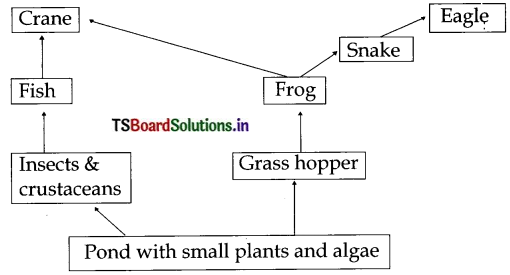
Make your own food chain and display it in your class room. (Communication through Drawing and Model Making) 4M
Answer:
TS 6th Class Science 4th Lesson Questions and Answers Telangana - What Do Animals Eat 1

Question 12.
Prepare a scrap book of animals and separate them into carnivores, omnivores and herbivores. (Information Skills and Project) 2M
Answer:
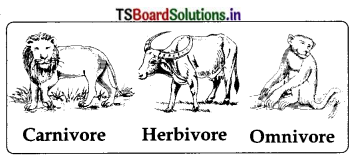
The photos of the following animals are very easy to collect from the available resources. I collected the photos of the following and classified them as follows.

Herbivores : Goat, sheep, buffalo, cow,
Carnivores : Lion, tiger, wolf, cat etc.
Omnivores : Wild bear, man, monkey.
TS 6th Class Science 4th Lesson Questions and Answers Telangana - What Do Animals Eat 2

Question 13.
Identify which of the following statements are wrong and give reasons. (Asking Questions and Making Hypothesis) 4 M
(a) That which lives in water cannot eat animals.
(b) Elephants and deer are the herbivores living in the forest.
(c) Birds’ beaks are designed to suit their food habits.
(d) Sharp claws are useful for hunting.
(e) Most of the food chains end with herbivorous animals.
Answer:
(I) Statements b and c are true to their nature.
(b) The natural living area for elephants and deer are forests.
(c) Different birds feed on different food materials. So, birds’ beaks are designed to suit their food habits.

II) Statements a, d and e are wrong. Reasons :
(a) Certain water animals feed on smaller animals.
Eg: Frog feeds on crustaceAnswer: A blue whale in the sea eats tiny animals called krill.

(d) Sharp claws of some animals meant for tearing the flesh of prey after hunting.
Eg: Lion
In some animals claws help in holding the grip for running while hunting the prey.

(e) Food chains naturally end with decomposers or degraders (microbes).

TS 6th Class Science 4th Lesson Questions and Answers Telangana - What Do Animals Eat?

Question 14.
If you want to understand more about food chain what questions would you like to ask ? (Asking Questions and Making Hypothesis) 4M
Answer:
I would like to clarify my doubts by asking the following questions about food chain.

  1. How do we compare animal food chain with human food chain ?
  2. What can we understand from food chain ?
  3. How do we analyse pond food chain ?
  4. What is a food chain ?

Question 15.
Write a play with dialogues between a parrot and a lion about their food habits and organs to get food. Act it with your friends. Send it to school/district children’s magazine. (Aesthetic Sence, Values and Application to Daily Life and Concern to Bio-diversity) 8M
Answer:
Role – play (Dialogues between a parrot and a lion)

Parrot : Good morning, respected king of forest!

Lion : Good morning, how are you ?

Parrot : Fine, thank you king.

Lion : Where are you going beautiful green bird ?

Parrot : I am going to collect food somewhere.

Lion : Oh! You are going to search for food. What food do you like most ?

Parrot : I like fruits such as guava, mango etc. But you people feed on animal’s flesh.

Lion : Yes, we are the carnivores, we like to feed on other animals like deer, goat, sheep etc.

Parrot : Oh! It is your habit to eat other herbivorous animals.

Lion : Yes. I am also going to hunt for food.

Parrot : I will go by my way, you can move by your way. Bye, all the best.

Lion : Bye, all the best. Have a nice day.

Question 16.
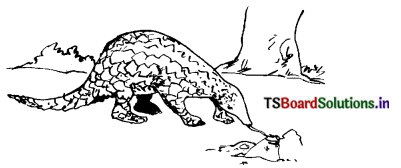
Identify the given animal. (Communication through Drawing and Model Making) 4 M
1. What does it eat ?
2. Which part of the body helps it in eating ?
TS 6th Class Science 4th Lesson Questions and Answers Telangana - What Do Animals Eat 3
Answer:

  1. The given animal is called pangolin.
  2. It feeds on ants. Thus it is called spiny ant eater. Pangolin’s tongue is long and has stretching capacity. When it finds ants it expands tongue to capture the prey.

TS 6th Class Science 4th Lesson Notes – What Do Animals Eat?

  • There are a wide variety of animals in the living world and they take a wide variety of food items.
  • Different types of animals that live in our surroundings have their own food habits (way of taking food and type of food taken)
  • Sucking, licking, pecking, chewing, peeling, swallowing are all the ways by which animals take their food in.
  • Beaks of birds differ from one another depending upon the type of food they eat.
  • Most of the wild animals that eat other animals have sharp teeth.
  • Animals are divided into 3 types on the basis of their food. They are carnivores, herbivores and omnivores.
  • Food chain is in connected between animals on the basis of their food habits.
  • Food chain explains the interdependence of diverse organisms in nature.
  • Some animals rely more on one sense than the other and it can be highly developed.
  • Food Habit : Way of taking food and type of food taken is called food habit. Different types of animals that live in our surroundings have their own food habits
  • Food Chain : Food chain is the connection between animals on the basis of their food habits.
  • Sucking : Sucking is a way of taking food by animal.
  • Picking : Picking is another type of way of food habit.
  • Chewing : Churning food is called chewing. :
  • Habitat : The surroundings which meet the needs of a particular organism in the best manner is called habitat.
  • Carnivore : The organism which depends on herbivore for food.
  • Herbivore : The organisms which feeds on plants.
  • Omnivore : The animal which feeds both on carnivores and herbivores.
  • Nocturnal : The organism which is active during night.
  • Rumination : Bringing back food from stomach to mouth for chewing is called rumination.

TS 6th Class Science 2nd Lesson Questions and Answers Telangana – Playing with Magnets

TS Board Telangana SCERT Class 6 Science Solutions 2nd Lesson Playing with Magnets Textbook Questions and Answers.

Playing with Magnets – TS 6th Class Science 2nd Lesson Questions and Answers Telangana

Improve Your Learning

Question 1.
Predict which of the following material are magnetic and non-magnetic material. Test with a bar magnet and check your predictions. What do you say after testing all material ?
Plastic, Iron, Stainless Steel, Wood, Aluminium, Gold, Silver, Copper, (Experimentation and Field Investigation) 8 M
Answer:
Aim : To classify the given material as magnetic and non – magnetic substances by testing with bar magnet.
Apparatus: Bar magnet

Given material for Testing : Plastic, iron, stainless steel, wood, aluminium, gold, silver, copper, paper, cloth.

Procedure : A bar magnet is taken and started keeping each substance of the given material close to the bar magnet. The same method is followed for all the material.

Observation : Some substances are attracted by magnet and some are not attracted.

Result: The material attracted by magnet – Iron.
The following materials are not attracted by bar magnet a) Stainless steel b) Wood, c) Plastic, d) Aluminium, e) Gold, f) Silver, g) Copper, h) Paper,i) Cloth.

Inference : The substances which are attracted by magnet are called magnetic substances.

Eg: Iron.
The substances which are not attracted by magnets are non-magnetic substances.

Eg: Paper, Aluminium etc.

TS 6th Class Science 2nd Lesson Questions and Answers Telangana - Playing with Magnets

Question 2.
List out the magnetic and non – magnetic materials in your classroom. (Conceptual Understanding) 2 M
Answer:

  1. Magnetic materials : Iron rods of the window, pins, bolt of the door, binding wire, nails etc.
  2. Non – magnetic materials: Paper, note book, plastic pen, rubber band, eraser etc.

Question 3.
For which purposes do people use magnets in their daily life ? Ask your family members and other elders and collect the information and prepare a list of uses of magnets. (Information Skills and Projects) 2 M
Answer:
Aim : Aim of the project is to collect the information of uses of magnets in our daily life.
Uses :

  1. Pure stainless steel is not attracted by magnet. The quality of stainless steel can be checked with a magnet while buying.
  2. It would be easy to handle the pins easily if a magnet is placed in the lid of a pin box.
  3. Magnets are used as door stoppers. One magnet is placed on the door and the other on wall. The door is attracted to wall and doors will not move for the wind.
  4. Magnets are used in refrigerator doors, toys, magnetic stickers, fans, loud speakers, microphones, automobile dynamos, audio and video tapes and computer hard disks.

Question 4.
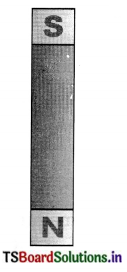
Draw a bar magnet and locate the poles. (Communication through Drawing and Model Making) 2 M
Answer:
TS 6th Class Science 2nd Lesson Questions and Answers Telangana - Playing with Magnets 1

Question 5.
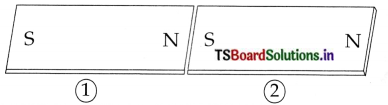
Observe and locate North and South poles for the second bar magnet shown in the figure given below. (Communication through Drawing and Model Making) 2 M
Answer:
TS 6th Class Science 2nd Lesson Questions and Answers Telangana - Playing with Magnets 2

Question 6.
Think and say, in which direction your house is facing ? Use the compass and find out the exact direction of your house and compare it with your prediction. Similarly predict and find out in which direction you keep your head while sleeping at night, the directions you face while you are reading, eating etc. (Asking Questions and Making Hypothesis) 4 M
Answer:

  1. Naturally any architecture professional designs the house blue print in East – West direction. This is because of one reason by allowing morning sun-rays into the house and better ventilation.
  2. Compass is used to find out the specific direction of its construction. I clearly found that it is in East – West direction.
  3. Head is kept either in East – West (or) West – East direction while sleeping. This is to avoid North – South direction of the magnetic influence.
  4. Our elders advise us to sit for study in East-West direction, we avoid sitting North – South direction. We do the same thing while taking meals. For the above reasons we avoid North – South direction of the magnetic influence.

TS 6th Class Science 2nd Lesson Questions and Answers Telangana - Playing with Magnets

Question 7.
Prepare a toy using magnets and write the procedure of preparation briefly. (Experimentation and Field Investigation) 8 M
Answer:
Aim : To prepare a toy using magnets.
Apparatus : Two bar magnets, a toy (car or doll)

Procedure:

  1. A toy car is brought from the shop which is in good condition.
  2. A couple of bar – magnets are taken. One is inserted into the front portion of the toy facing north pole towards front and south pole – towards back. The preparation is kept on the floor.
  3. Another bar magnet is taken into hands keeping its south pole towards front part of the car. It tries to change the direction of the magnet towards the toy car.

Observation : While keeping the south pole of hand’s bar magnet towards the car, the car comes to the hand. While keeping north pole of the hand’s bar – magnet towards the car, the car moves away from hand.

Inference : Like poles of bar magnet repel each other, unlike poles of bar – magnet attract each other. This principle helps us making toy cars and dolls.

Question 8.
Think and say where the poles will be located in a ring magnet ? Try to find out its poles using a bar magnet and check your prediction.
(Experimentation and Field Investigation) 4 M
Answer:

Aim : To find out the North – South poles of the ring magnet by using bar magnet.

Apparatus : Ring magnet, bar magnet

Procedure : A ring magnet is kept on the table. A bar magnet is brought very close to the ring magnet. Amazingly the bar magnet’s north pole is attracted on upper portion of the ring magnet.

Observation: The direction of the bar magnet is changed towards upper portion. But both the magnets repelled. That means the south.

Result: To a ring magnet the poles are located at upper and lower sides.

Question 9.
Magnetise a needle using a bar magnet. Make a compass with that needle by following the process explained in activity 10. (Experimentation and Field Investigation) 4 M
Answer:
Aim : To make a compass with my own magnetised needle.

Apparatus : Needle, glass, round light weight cork, water etc.

Procedure:
A) Preparation of magnetised needle :

  1. A needle is taken and kept on the table. A bar magnet is placed, one of its poles near one edge of the needle.
  2. Without lifting the bar magnet, it is moved along the length of the needle.
  3. Then the magnet is brought to the first end of the needle and is moved along the length. This is repeated 20-30 times.
  4. Now the bar magnet is removed and some iron filings are brought to the magnetised needle.

Observation :

  1. Iron filings are attracted by the needle.
  2. Therefore I succeeded in making my own magnet by magnetising needle.

B) i) The magnetised needle is kept on the cork and is placed on the water surface in the glass.
ii) In order to make free floating of the cork a little detergent is added.

Observation : We observed the magnetised needle pointing north and south directions.

Result: We can prepare a compass with a magnetised needle.

Precaution : We should not drag the bar magnet back and forth on the needle, it should be moved in only one direction.

TS 6th Class Science 2nd Lesson Questions and Answers Telangana - Playing with Magnets

Question 10.
Sometimes people use magnets to keep the doors open and sometimes to close the doors firmly. Think and say how it is possible and how we should arrange the magnets in each case, (or) Magnets are used in closing and opening of doors and windows. How is it possible ? Think and write. (Asking Questions and Making Hypothesis) 4 M
Answer:

  1. It is possible to close and open the doors firmly.
  2. The facility of this is based on the magnetic property of two magnets.
  3. The magnetic property says unlike poles of magnets attract, like poles of magnets repel.
  4. We can do this by changing the direction of table magnet. The suspended one also changes its direction.

Application of Magnetic property to the doors :
(a) When doors are opened firmly, it is because of placing two magnets facing each other with like poles in two doors. This results in firm opening of doors.

(b) When doors are closed firmly, it is because of placing of two magnets facing each other with unlike poles in two doors. This results in firm closing of the doors.

Question 11.
Does the Earth behave as a magnet? How do you prove it? (Experimentation and Field Investigation) 4M
Answer:
Aim : To prove the magnetic behaviour of the Earth.

Apparatus : Two bar magnets, thread, table etc.
Procedure:

  1. A bar magnet is placed on the table. Another bar magnet is suspended very close to the first one kept on the table.
  2. It is observed that the north pole of the suspended bar magnet points towards the south pole of the magnet placed on the table.
  3. The south pole of the suspended bar magnet points towards the north pole of the bar magnet kept on the table.
  4. Later the first bar magnet is removed from the table. But the suspended magnet is still hanging on the table.

Observation:

  1. The suspended magnet comes to rest in the North-South direction.
  2. It is said that there is some magnet below the suspended one, which makes it to come to rest in that particular direction.

Result: It is evident that the earth possesses magnetic property which acts upon the suspended bar magnet.

Inference : The earth exhibits greater magnetic property with north and south poles.

Question 12.
If you have two similar bars, one a magnet and another a piece of iron, can you find out which one of these is a magnet ? Explain the process.
(Experimentation and Field Investigation) 2 M
Answer:

  1. The substance which exhibits magnetic property attracts the other magnetic material. This occurs in case of magnet.
  2. Because it attracts the other bar, which is iron.
  3. When both the bars are kept closely, the true magnet bar attracts the iron bar.
  4. On the other hand iron bar doesn’t show attractive property on true magnet.
  5. By the following way we can recognise true magnet and magnetic substance.

Question 13.
Teacher said that earth is a magnet. But Sree Vidya has some doubts and she asked her teacher some questions. What may be the questions? (Asking Questions and Making Hypothesis) 2M
Answer:

  1. If Earth possesses magnetic property why don’t all the iron material attract towards any one of the poles of the Earth ?
  2. How can we prove the magnetic property of the Earth ?
  3. What is the advantage of magnetic property of Earth for living kind ?
  4. Where are south and north poles of Earth’s magnet ?

TS 6th Class Science 2nd Lesson Questions and Answers Telangana - Playing with Magnets

Question 14.
Surya was wonderstruck to know that Earth is a big magnet and appreci¬ated efforts of scientists to discover this. Do you notice any such things in magnets to appreciate? Explain. (Aesthetic Sence, Values and Application to Daily Life and Concern to Bio-diversity) 4M
Answer:

  1. Isaac Newton discovered that the Earth possesses magnetic property. He proved it by observing fall of apple from the plant.
  2. Indeed we should appreciate the great power of magnetism.
  3. Because of the magnetic property, the Earth revolves round the sun in the name of gravitational force.
  4. The moon revolves round the Earth with specific magnetic property influenced by Earth.
  5. In favour of living kind the earth sustains all the organisms.
  6. Due to above reasons we can appreciate the magnets and the concept of magnetism which exist in the nature.

Question 15.
Kiran wants to prepare a toy using some magnets to make people understand the slogan “Reject bad food and accept only good food.” Can you help him to prepare the toy? If yes, how? (Communication through Drawing and Model Making) 4M
Answer:

  1. Applying the magnetic property for making a toy magnet to conduct the programme is interesting.
  2. The junk food box is placed on one side of the table. Good food box is kept on the other side.
  3. Each item of the junk food with bar magnet facing its specific pole is arranged. Likewise to the good food items having magnet facing its specific pole.
  4. Moving the toy magnet in front of junk food, keeps away from them. Because of the facing pole of the toy magnet is as same as pole of the junk food items.
  5. Moving the toy magnet in front of the good food items, attract them, because of unlike poles of the food items magnet and toy  magnet. We should emphasise the magnetic property of the two bar magnets in our day to day life. To conduct an awareness programme on food items, toy magnet game will be very interesting.

TS 6th Class Science 2nd Lesson Notes – Playing with Magnets

  • The cap of the pin holder contains a material known as magnet which attracts sub¬stances like iron pins, iron nails etc.
  • The stone which Magnus pulled out is called lode stone.
  • Lode stone is a natural magnet
  • Magnets are of different shapes i.e., bar magnets, horse shoe magnets, ring type magnets etc.
  • Each magnet has two magnetic poles : North and South A freely suspended magnet always aligns in the North – South direction.
  •  Magnet : The material which attracts substances like iron pins, iron nails etc. is known as a magnet.
  • Magnetic materials : The materials that are attracted by magnets are called magnetic materials. Eg: iron pins, nails etc.
  • Non-magnetic materials : The materials that are not attracted by the magnets are called non-magnetic materials. Eg: paper, wood, plastic etc.
  • North Pole, South Pole : A bar magnet always have two ends whose attracting capacity is more than other parts of it, these are called poles. Each magnet has two poies – north pole and south pole.
  • Magnetic Compass : A magnetic compass is used to find directions. It is mostly used in ships and aeroplanes, by mountaineers and army people. It works on the “directional property of magnets”.
  • Like poles : North pole – North pole or South pole – South pole of two magnets are called like poles. These are repelled by each other.
  • Unlike poles : North pole – South pole or South pole – North pole of two magnets are called ‘unlike poles’. These are attracted by each other.
  • Attraction : Unlike poles (N-S, S-N) attract each other.
  • Repulsion : Like poles (N-N, S-S) repel with each other.
  • Magnetic induction : Magnetic property possessed by a magnetic substance due to the presence of a magnet near to it is called magnetic induction.

TS 6th Class Science 1st Lesson Questions and Answers Telangana – Our Food

TS Board Telangana SCERT Class 6 Science Solutions 1st Lesson Our Food Textbook Questions and Answers.

Our Food – TS 6th Class Science 1st Lesson Questions and Answers Telangana

Improve Your Learning

Question 1.
What are the common food items usually eaten by you ? (Conceptual Understanding) 2 M
Answer:
Rice, dosa, idly, chapathi, biryani, payasam, leafy vegetable dishes, chicken, mutton, soup, dal, curries of various vegetables etc.

Question 2.
Find out the ingredients of the given food items. (Conceptual Understanding) 4 M
1) Pachipulusu, 2) Coconut chutney, 3) Jilebi, 4) Onion pakodi
Answer:

  1. Pachipulusu: Tamarind, onion, dry chilli, jeera, salt, pepper powder, necessary volume of water and jaggery.
  2. Coconut chutney : Coconut pieces, dry chilli or green chilli, oil, salt, onion, mustard seeds, little amount of black gram, red gram etc.
  3. Jilebi: Maida flour, jaggery syrup, oil etc.
  4. Onion pakodi : Onions, salt, dry chilli, oil, besan flour (senagapindi), rice powder.

TS 6th Class Science 1st Lesson Questions and Answers Telangana - Our Food

Question 3.
Write down the process of making upma or any other snack of your choice.
(Or)
List out the essential ingredients of your desired food items and explain the preparation.
(Or)
Describe the preparation of snacks of your interest.
(Or)
Write the process of preparing any food item you take in the morning.
(Experimentation andfield investigation) 8 M
Answer:
Aim : The process of making upma by my choice at home.
Required ingredients: 1) Sufficient amount of upma ravva, edible oil, water, green or dry chilli, talimpu dinusulu (red gram, black gram, mustard seeds), tomatoes, curry leaves, onions, salt etc.

Procedure:

  1. First, required edible oil is heated in a dish.
  2. Now add, talimpu dinusulu, green or dry chillies, curry leaves and tomato pieces along with onion pieces.
  3. Fry all the ingredients for sometime.
  4. Immediately certain amount of water is added to the fried ingredients. The liquid mixture is boiled for sometime. Needed amount of salt is added to the mixture.
  5. Finally required amount of upma ravva is added to the boiled liquid mixture and stirred well. Sometime is taken for complete boiling of all the ingredients.

Observation : I observed the delicious flavour of the dish while it is boiling on the stove.

Result: I got tasty upma.

Precautions : I used a kitchen spoon for stirring the liquid mixture after adding of upma rawa to prevent unwanted pellets.

Question 4.
Collect any wrapper of packaged food. Read the information details and answer the following questions.
a) When was it manufactured and how long can we use it ?
b) What ingredients does it contain, name them ? (Information skills and Projects) 4 M
Answer:

  1. I collected the wrapper of Kissan mixed fruit jam.
  2. It was manufactured in the month of January – 2018.
  3. It can long last upto the month of September – 2018.
  4. The ingredients present in the jam are sugar, mixed fruit pulp 46%, acidity regulator – 330, vitamin By preservatives, pineapple and strawberry flavouring substances, synthetic food colour, added flavours and artificial raspberry etc.

Question 5.
Shahina’s mother always cooks plain rice! If the same rice is used to make kichidi, payasam or biryani how would you feel eating those ? (Appreciation and Aesthetic sense and values) 4 M
Answer:

  1. It’s a new experience to have a new taste or aroma of the kichidi or payasam or biryani.
  2. Because Shahina’s mother’s idea is to satisfy her family members with new delicious dish with regularly used rice.
  3. She applied innovative method of preparing different tasty food items with routinely used rice.
  4. But each food item (payasam / kichidi/ biryani) has its own taste or aroma.
  5. Payasam gives sweet taste, kichidi and biryani give us spicy taste.

TS 6th Class Science 1st Lesson Questions and Answers Telangana - Our Food

Question 6.
List out the names of some plants that grow in your village. Which parts of it are used as food ? (Information skills and projects) 4 M
(or)
Write the information you collected about the plants that grow in your locality. Also write the parts of the plants which are used as food.

S.No. Name of the plantPart that we eat
1. Amaranthleaves

Answer:
List of the names of some plants that grow in our village.

Name of the plantPart that we eat
Amaranth (Thotakura)leaves, stem
Sugarcanestem
Carrotroot
Onionbulb, leaves
Cabbageleaves
Murraya (curry)leaves

Question 7.
Some food materials are given below. What are the different possible ways of cooking them ? Find out and write them.
Meat – Groundnuts – Potatoes – Spinach. (Conceptual Understanding) 4 M
Answer:
The following different possible ways of cooking for the following food material.

  1. Meat: Steaming, frying.
  2. Groundnuts : Steaming, frying, boiling.
  3. Potatoes : Steaming, frying, boiling, roasting.
  4. Spinach : Steaming, shallow frying, cutting and mixing.

Question 8.
With the help of your teacher, form groups of 5 or 6 students of your class. Make a fruit chat or vegetable salad and eat it.
How do you feel ? Write a few lines about your experience. (Information skills and Projects) 8 M
(Or)
How did you do the project work in groups instructed by your science teacher on making fruit or vegetable salad?
Answer:
Project work:

  1. Introduction : With the help of our teacher all of our classmates were divided into 5 groups.
  2. Aim of the Project: Our teacher advised us to make a fruit salad.
  3. Collection of the fruits : We collected fruits like papaya, grapes, pineapple, ripened mangoes and an apple.
  4. Procedure : We chopped all the fruits and mixed them in a big bowl. The salad is ready.
  5. Taste of the salad : Our teacher asked us to taste the salad. We started eating it. We felt very tasty of the mixture of different fruit pieces. The taste of the salad is sweet, sour and juicy.

Question 9.
Ask your friend to think the name of any food item. Now you have to guess its name. For this you can ask some questions. Your friend can only answer it in Yes or No. What / How many questions did you ask before you could guess the name ? (Asking Questions and making Hypothesis) 8 M
Answer:
[This is based on the idea or plan of the individual at a specific time. Therefore every one can apply own method of questioning about different varieties of food items. India is famous for “Nala Bheema Pakam” throughout the entire food world. [One item is discussed and given below.]

Person ‘A’ thinks about one tasty food item. He asks person ‘B’ to guess the food item that he thinks about. Then person ‘B’ starts asking the following questions. Person A gives yes or no answers.

Thinks aboutPerson B guessing questionsPerson A answers
a delicious1) Is it sweet in taste ?No
food-‘Biryani’2) Is it sour in taste ?No
3) Is it coloured food ?Yes
4) Is it only one coloured food ?No
5) Is it different coloured food ?Yes
6) Is it with different spices ?Yes
7) Does it possess only few ingredients ?No
8) Or else it possesses many ingredients ?Yes
9) Is it famous in India ?Yes
10) Should we add vegetables to the dish ?Yes
11) Should we mix with kurma or curd chutney ?Yes
12) Is it a nice tasty biryani ?Yes, You are correct

(Likewise we can do the activity for so many food items in the class. Put as many questions as possible to get the answer)

TS 6th Class Science 1st Lesson Questions and Answers Telangana - Our Food

Question 10.
List out the ingredients needed to make vada. Are they same for dosa?
Answer:

Ingredients for VadaIngredients for Dosa
1) Red gram flour is used.1) Black gram and rice flour are used.
2) Jeer a, ginger, green onions etc., are also used2) For onion dosa, onions are necessary.
3) Ingredients paste is fried in the oil soon after making it.3) The ingredients mixture (dough) is to be fermented before one day for making
4) More oil is required in the fry dish.4) Less oil is applied on fry pan.
5) Salt is added.5) Salt is added

Question 11.
Latha’s mother has prepared the following statements for you. Find out the wrong ones among these. But don’t forget to give your reasons.
a) We can get food from plants and animals only.
b) Spices, oils, salt and meat are the ingredients of a chicken curry.
Answer:
a) We can get food from plants and animals only.
b) ‘b’ is wrong. Spices, oils, salt, chicken flesh and bones are the ingredients of a chicken curry.
c) Third sentence is not accurate.
Answer:
(a) We can get from plantshoney and animals only. honey from
(b) ‘b’ is wrong. Spices, oils, salt, chicken flesh and bones are the ingredients of a chicken curry.
(c) Third sentence is not accurate. We get honey from bee – hive. Honey bees extract honey from the flowers in the for  nectar. The nectar sucked by the bees is converted into honey in the bee So both plants and honey bees
are source of honey.

Question 12.
Find out from your parents the various methods of preserving food and write a note on them. (Information Skills and Projects) 2 M
Answer:
I asked my parents and collected the information of various methods of preserving different food items. Methods of food preservation are

  1. Smoking
  2. Salting
  3. Canning
  4. Drying
  5. Freezing
  6. Mechanical drying etc.

Question 13.
Collect information about the main food habits of different states of India. Refer to the Atlas, library books and discuss with your teacher, (or)
(Information Skills and Projects) 8 M
Write the details of information you collected on food habits of the people in different regions of India. Write the procedure that how you collected the data, (or)
On what basis development of food habits takes place. Give suitable examples.
Answer:
Food habits develop based on the availability of food material, culture and climatic conditions.
Result: The following food habits have been listed in the form of table

Region/stateFood habits
Andhra PradeshRice & curry, idli, dosa etc.
Punjab & HaryanaChapathi, roti etc.
Uttar Pradesh & UttarakhandChapathi with curry
MaharashtraRoti, kurma, panipuri
OdishaRice and curry
KeralaCoconut oil flavoured items
Tamil NaduSambar, idly, rice etc.
KarnatakaRice, curry etc.

Question 14.
Suppose if fish / raw mangoes / lemons are given to you, how would you preserve them ? (Experimentation and field investigation) 8 M
Answer:
If I choose raw mangoes to preserve, I can use the following method.
Aim : To preserve the raw mangoes in the form of pickle.

Required ingredients: Pieces of raw mango, salt, edible oil, red chilli powder, dry chillies, fenugreek powder, mustard seeds, garlic, red gram (dal) turmeric powder etc.

Procedure:

  1. Mangoes are cut into pieces. Certain amount of salt is added to the pieces.
  2. Sufficient amount of mustard and fenugreek powders are added to the pieces and mixed thoroughly.
  3. Then fresh chilli powder is added followed by mixing of oil to the entire mixture.
  4. All the mixture is preserved for 2 or 3 days. On fourth day mango pieces mixture is tasted for finding out uniformity of added ingredients.
  5. Then sufficient amount of oil is boiled with Talimpu dinusulu (dry chillies, red gram, mustard seeds etc.) poured into the mango pieces jar.
  6. Now the pickle is ready. We can preserve this pickle for a few months.

TS 6th Class Science 1st Lesson Questions and Answers Telangana - Our Food

Question 15.
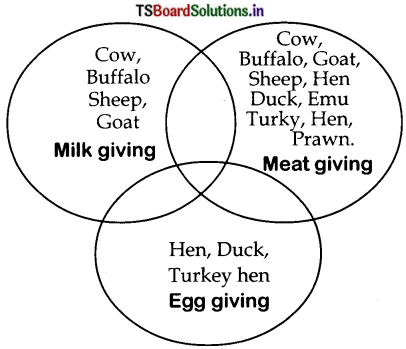
Make a list of animals and insects from which we get food. (Conceptual Understanding) 8 M
(a) Write the names of these animals on slips of paper. On the otherside of the slip write the names of food we get from the animals – milk, eggs or meat.
(b) Sort the slips into groups. Write the names of the animals in the correct portions of the circles shown below.
(c) Are there any portions where none of the animals fit ? Explain why.
Answer:

Region/stateThe products of the birds, animals and Insects
Andhra PradeshChicken, egg
Punjab & HaryanaMeat, egg
Uttar Pradesh & UttarakhandEgg, meat
MaharashtraMeat (mutton)
OdishaMeat
KeralaHoney
Tamil NaduMeat
KarnatakaEggs, chicken

(b)
TS 6th Class Science 1st Lesson Questions and Answers Telangana - Our Food 1

(c) There is a no specific portion for the special insect called Honey bee. Honey bee is neither milk giving nor meat giving and egg laying individual. We can extract only honey from the honey bee. Hence it is unfit.

TS 6th Class Science 1st Lesson Notes – Our Food

  • We get food from plants and animals.
  • For cooking food, we need different types of ingredients.
  • We use different parts of plants like stems, roots, leaves, fruits and flowers as food.
  • The taste of food is based on its ingredients, method of preparation and cultural practices of the region.
  • Boiling, steaming, fermentation are some methods of preparing food.
  • We use preservatives to preserve food for sometime.
  • Sugar syrup or honey is a good preservative. Fruits are often preserved in sugar syrup or honey. Jams and fruit juices are good examples of preservation with sugar.
  • When you purchase any food item in the market, we should not forget to read about its ingredients and manufacturing date.
  • Outdated food material may damage our health.
  • Ingredients : The agents which are added in the food.
  • Preservatives : The substances which help in storing food.
  • Fragrants : The agents which impart smell to the food.
  • Dry fruits : We can preserve the fruits by drying.

TS 6th Class Science Bits 4th Lesson What Do Animals Eat?

Regular practice with TS 6th Class Science Bits with Answers 4th Lesson What Do Animals Eat? improves students’ confidence and readiness for assessments and examinations.

TS 6th Class Science Bits 4th Lesson What Do Animals Eat?

Question 1.
The animals which eat the flesh of other animals
A) Herbivores
B) Carnivores
C) Omnivores
D) None
Answer:
B) Carnivores

TS 6th Class Science Bits 4th Lesson What Do Animals Eat?

Question 2.
Example for Omnivores
A) cow
B) lion
C) man
D) deer
Answer:
C) man

Question 3.
Read the names of the following animals
1. Cow
2. Dog
3. Man
4. Tiger
Which are omnivores from the above?
A) 1, 2
B) 1, 3, 4
C) 3, 4
D) 2, 3
Answer:
D) 2, 3

Question 4.
The animals which eat only plants are …
A) Herbivores
B) Carnivores
C) Omnivores
D) All
Answer:
A) Herbivores

Question 5.
According to their food habits animals are divided into … types.
A) 1
B) 3
C) 4
D) 2
Answer:
B) 3

TS 6th Class Science Bits 4th Lesson What Do Animals Eat?

Question 6.
The insect which feeds on other insects is
A) Cockroach
B) Pond skater
C) Butterfly
D) Bug
Answer:
B) Pond skater

Question 7.
Match the following basing on food capturing organs.
List-I — List-Il
I Hen — a) Tongue
2. Camel — b) Beak
3. Frog — c) Mouth
A) 1-a, 2-b, 3-c
B) 1-b, 2-c, 3-a
C) 1-a, 2-c, 3-h
D) 1-c, 2-b, 3-a
Answer:
B) 1-b, 2-c, 3-a

Question 8.
Which part of the body in frog is mainly useful for food capturing/ingestion?
A) Legs
B) Mouth
C) Cloaca
D) Tongue
Answer:
D) Tongue

Question 9.
Which of the following animals uses its tongue to capture food?
A) Frog
B) Lizard
C) Garden Lizard
D) All the above
Answer:
D) All the above

TS 6th Class Science Bits 4th Lesson What Do Animals Eat?

Question 10.
a) Mostanimals are motile
b) Sponges are sedentary
A) ‘a’ and ‘b’ are true
B) ‘a’ is true ‘b’ is false
C) ‘a’ is fake ‘b’ is true
D) a and h are false
Answer:
A) ‘a’ and ‘b’ are true

Question 11.
Vultures are good example for ……………
A) predators
B) herbivores
C) natural scavamer
D) omnivores
Answer:
C) natural scavamer

Question 12.
The feeding habit of a cow is called ……….
A) crushing
B) churning
C) sucking
D) rumination
Answer:
D) rumination

Question 13.
Most of the animals that eat other animals have teeth.
A) long
B) short
C) sharp
D) small
Answer:
C) sharp

Question 14.
Which animal is not a ruminant?
A) Cow
B) Tiger
C) Buffalo
D) Camel
Answer:
B) Tiger

TS 6th Class Science Bits 4th Lesson What Do Animals Eat?

Question 15.
Which part of the body is helpful for crane to pick up the food?
A) Long beak
B) Claws
C) Legs
D) Wings
Answer:
A) Long beak

Question 16.
Identify the ruminate animal.
A) Camel
B) Pig
C) Monkey
D) Dog
Answer:
A) Camel

Question 17.
Ducks use the teeth for the food.
A) churning
B) masticating
C) filtering
D) All
Answer:
C) filtering

Question 18.
Leeches get their food by the process of
A) sucking
B) absorbing
C) eating
D) masticating
Answer:
A) sucking

Question 19.
The animals which search for their food during nights are called
A) diurnals
B) tetrahedrals
C) miurnals
D) nocturnals
Answer:
D) nocturnals

TS 6th Class Science Bits 4th Lesson What Do Animals Eat?

Question 20.
In butterfly is used to suck honey from flowers.
A) tube like mouth
B) needle like tongue
C) teeth of mouth
D) legs of body
Answer:
A) tube like mouth

Question 21.
Example of nocturnals
A) man
B) parrot
C) bats
D) sparrow
Answer:
C) bats

Question 22.
Natural scavengers
A) Crane
B) Honey bird
C) Wood pecker
D) Crow
Answer:
D) Crow

Question 23.
Suckers are present in
A) snail
B) earthworm
C) housefly
D) leech
Answer:
D) leech

Question 24.
The leopard is a member of family.
A) crane
B) cat
C) lizard
D) rat
Answer:
B) cat

Question 25.
The nocturnal animal you see in your locality
A) Crow
B) Cow
C) Owl
D) Sheep
Answer:
C) Owl

TS 6th Class Science Bits 4th Lesson What Do Animals Eat?

Question 26.
Match the following.
1. Camel — a) Nocturnal
2. Lion — b) Herbivore
3. Bat — c) Carnivore
A) 1-c, 2-b, 3-a
B) 1-a, 2-b, 3-c
C) 1-b, 2-c, 3-a
D) 1-c, 2-a, 3-b
Answer:
C) 1-b, 2-c, 3-a

Question 27.
Frog uses these parts to collect the food materials
A) Legs
B) Hands
C) Tongue
D) Nose
Answer:
C) Tongue

Question 28.
What are the specific organs present in leech to suck the blood?
A) Suckers
B) Tongue
C) Glands
D) Teeth
Answer:
A) Suckers

Question 29.
Which animal search for food at night?
A) Snake
B) Tiger
C) Crane
D) Owl
Answer:
D) Owl

Question 30.
Identify the wrong sentence.
A) Mode of food taking in leech is sucking
B) Deer is a carnivore
C) Man belongs to omnivore
D) Omnivores eat both plants and animals
Answer:
B) Deer is a carnivore

TS 6th Class Science Bits 4th Lesson What Do Animals Eat?

Question 31.
Food chain is the connection between animals on the basis of
A) living place
B) water facility
C) food habits
D) air availability
Answer:
C) food habits

Question 32.
The relation between animals in the food chain is based on
A) Living place
B) Water facility
C) Food habits
D) Availability of air
Answer:
C) Food habits

Question 33.
Complete the following food chain.
TS 6th Class Science Bits 4th Lesson What Do Animals Eat 1
A) man
B) deer
C) hen
D) snake
Answer:
B) deer

Question 34.
Read the following sentences.
1. Eggs and larvae are eaten by fish and frog.
2. Camel is a ruminant animal.
A) Both 1 & 2 sentences are correct
B) 1 is wrong 2 is correct
C) 1 is correct 2 is wrong
D) Both 1 & 2 sentences are wrong
Answer:
A) Both 1 & 2 sentences are correct

TS 6th Class Science Bits 4th Lesson What Do Animals Eat?

Question 35.

Body part used for collecting foodExample
Sucker
Strong legs with claws
Leech
?

A) Goat
B) Crow
C) Vulture
D) Cow
Answer:
C) Vulture

Question 36.
Birds are
A) mammals
B) annelids
C) arthropods
D) vertebrates
Answer:
D) vertebrates

Question 37.
An example for carnivorous animal
A) Cow
B) Elephant
C) Buffalo
D) Fox
Answer:
D) Fox

Question 38.
Sense organs used by bats in finding food:
A) Eyes
B) Ears
C) Nose
D) Skin
Answer:
B) Ears

Question 39.
Identify the animal which search their food during night
A) Tiger
B) Dog
C) Cockroach
D) Cow
Answer:
C) Cockroach

Question 40.
The main man made mistake that show Impacts on food chains
A) Using fertilizers sufficiently
B) Using inseticides and pesticides in large quantities
C) Using bio-fertilizers in large quantities.
D) B or C
Answer:
B) Using inseticides and pesticides in large quantities

TS 6th Class Science Bits 4th Lesson What Do Animals Eat?

Question 41.
Several food chains connecting to each other in the form of
A) Food web
B) Habitat
C) Food net
D) Environment
Answer:
A) Food web

Question 42.
Why do we say that ants are good farmers?
A) They bring manure to the crop field.
B) Ants manufacture compost
C) They help in growing a type of fungus which they eat
D) All the ants die to make the soil fertile
Answer:
C) They help in growing a type of fungus which they eat

Question 43.
Which one of the following collects food by virtue of vision
A) Eagle
B) Dog
C) Cat
D) Bat
Answer:
A) Eagle

Question 44.
Goat: herbivore : Lion :
A) omnivore
B) carnivore
C) herbivore
D) suctivore
Answer:
B) carnivore

Question 45.
Find out the odd one
A) sheep
B) cow
C) bullock
D) dog
Answer:
D) dog

Question 46.
lf sharp teeth are absent in dog
A) it can’t take grass
B) it can’t eat juicy food
C) it can’t eat meat
D) all the above
Answer:
C) it can’t eat meat

TS 6th Class Science Bits 4th Lesson What Do Animals Eat?

Question 47.
Find the correct pair regarding food collection
A) Frog – Teeth
B) Leech-Suckers
C) Earthworm – Tongue
D) Snake – Tail
Answer:
B) Leech-Suckers

Question 48.
Grass → Insects (crickets) → Frog → Snake
What will happen to the food chain if all frogs die? :
A) Insects population increase
B) Snakes suffer from lack of food
C) Grass plants grow more
D) A & B
Answer:
D) A & B

Question 49.
There is a great balance in nature among plants and animals regarding food habits.
What will happen if all animals ate plants?
A) Animals suffer from lack of breathing air
B) Plants will disappear from earth. Then animals will struggle for food
C) Earth will become hot
D) All the above
Answer:
D) All the above

Question 50.
Giraffe: Herbivore:: Crane: … …….
A) Carnivore
B) Plant eating
C) Omnivore
D) Herbivore
Answer:
A) Carnivore

Question 51.
The parts of hen used for picking up food
A) claws
B) beak
C) mouth
D) A and B
Answer:
B) beak

TS 6th Class Science Bits 4th Lesson What Do Animals Eat?

Question 52.
Example of omnivore that we see daily in our surroundings
A) Hen
B) Crow
C) Sheep
D) A and B
Answer:
D) A and B

Question 53.
What is the major difference between dog and rat in case of eating the food material?
A) Dog uses canine to tear the food and rat uses front teeth (incisors) to eat the food.
B) Dog depends on incisors to eat the food and rat uses incisors to eat
C) Both dog and rat do not use teeth
D) Dog uses big teeth. Rat uses canine teeth.
Answer:
A) Dog uses canine to tear the food and rat uses front teeth (incisors) to eat the food.

Question 54.
Which is a carnivore among butterfly, garden lizard, grass hopper in your school garden that you observed.
A) Garden lizard
B) Butterfly
C) Grasshopper
D) Lion
Answer:
A) Garden lizard

Question 55.
Arrange the following animals based on their food habits.
A) Cow, Goat – Omnivore
Fox, Eagle, Tiger – Herbivore.
Fish, Man – Carnivore

B) Eagle, Tiger – Herbivore
Cow Goat – Carnivore
Fox, Eagle, Tiger – Herbivore.

C) Fish, Man – Omnivore
Cow, Goat – Herbivore.
Fox, Eagle, Tiger – Carnivore

D) Fish, Man – Omnivore
Cow, Goat – Carnivore
Fox, Eagle, Tiger – Herbivore.
Answer:
C) Fish, Man – Omnivore
Cow, Goat – Herbivore.
Fox, Eagle, Tiger – Carnivore

TS 6th Class Science Bits 4th Lesson What Do Animals Eat?

Question 56.
Read the following table and give suitable answer for below question.

AnimalOrgan which helps in food collection
1. Hen / cockBeak
2. ManHands

Hen collects its food through
A) Tongue
B) Wings
C) Beak
D) Eyes
Answer:
C) Beak

Question 57.
Read the following paragraph and answer the question.
Vultures use sharp claws along with strong hooked beak to tear the flesh. While humming bird that sucks nectar need a long thin beak. What are the parts of vulture help in capturing food ?
A) claws
B) hooked beak
C) wings
D) A and B
Answer:
D) A and B

Question 58.
Read the para and answer the given question.
Ducks and fish have teeth. They act as filters to get food from water. Teeth these animals are not useful for grinding. The use of teeth in duck and fish.
A) for filtering
B) for grinding
C) for sucking
D) for swallowing
Answer:
A) for filtering

TS 6th Class Science Bits 4th Lesson What Do Animals Eat?

Question 59.

Food groupExample
Only plants Only animals BothCow, Goat Fox, Tiger Man, Duck

What we call the animals if they eat only animals ?
A) Carnivores
B) Omnivores
C) Herbivores
D) Detrivores
Answer:
A) Carnivores

Question 60.

Body part used to collect foodExamples
BeakHen
TongueFrog
TeethDog

Name some other animal that uses tongue to eat food
A) Tiger
B) Lion
C) Duck
D) A & B
Answer:
C) Duck

Question 61.
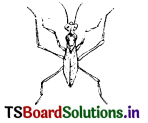
Find out the following diagram.
TS 6th Class Science Bits 4th Lesson What Do Animals Eat 2
A) Mosquito
B) Dragonfly
C) Pond skater
D) Grass hopper
Answer:
C) Pond skater

Question 62.
In the given diagram, body part used in taking food….
TS 6th Class Science Bits 4th Lesson What Do Animals Eat 3
A) Teeth
B) Beak
C) Tongue
D) Mouth
Answer:
D) Mouth

TS 6th Class Science Bits 4th Lesson What Do Animals Eat?

Question 63.
The given flow chart shows
Grass → Rabbit → Wolf
A) Food web
B) Food chain
C) Pyramid
D) Pyramid number
Answer:
B) Food chain

Question 64.
Find out the missing one in the given flow chart
Grass → Deer → ?
A) Rat
B) Rabbit
C) Cockroach
D) Lion
Answer:
D) Lion

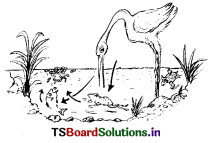
Question 65.
Choose possible food chain based on the given figure.
TS 6th Class Science Bits 4th Lesson What Do Animals Eat 4
A) Smaller plants → Frog → Fish → Crane
B) Smaller grass → Fish → Frog →Crane
C) Frog → Fish → Crane → Smaller grass
D) Smaller seeds → Frog → Fish → Crane
Answer:
B) Smaller grass → Fish → Frog →Crane

Question 66.
Carrot plant → Rabbit → Tiger
Producer in the above food chain
A) Carrot plant
B) Rabbit
C) Tiger
D) Carrot plant and Rabbit
Answer:
A) Carrot plant

Question 67.
The following flow chart indicates
Grass → Insects → Frog → Snake
A) Food web
B) Pyramid
C) Food chain
D) Above all
Answer:
C) Food chain

Question 68.
Grains → Rat →  Cat → ……….. Lion
A) Deer
B) Fox
C) Rabbit
D) Man
Answer:
B) Fox

Question 69.
Complete the following food chain
Grass → …………… → Tiger
A) Man
B) Deer
C) Hen
D) Snake
Answer:
B) Deer

TS 6th Class Science Bits 4th Lesson What Do Animals Eat?

Question 70.
After knowing about food chain, student can
A) kill snakes
B) cut plants
C) grow plants
D) rear frogs
Answer:
C) grow plants

Question 71.
What we learn from ants?
A) An ideal social life
B) Enmity among ants
C) They are dangerous animals
D) None of these
Answer:
A) An ideal social life

Question 72.
What can we find a valuable theme (idea) from food chains?
A) Animals struggle to live
B) An animal depends on itself for food
C) Interdependence of diverse organisms
D) Animals eat their own races
Answer:
C) Interdependence of diverse organisms

Question 73.
Just we keep cows for milk, ants keep a type of insect called aphids for
A) leaf juice
B) honey dew
C) honey bees
D) stem water
Answer:
B) honey dew

TS 6th Class Science Bits 4th Lesson What Do Animals Eat?

Question 74.
We should allow crows and vultures to live on the earth. Because they help us as
A) Predators
B) Natural omnivores
C) Natural destroyers
D) Natural scavengers
Answer:
D) Natural scavengers

TS Board 6th Class Science Important Questions 11th Lesson Water in Our Life 

These TS 6th Class Science Important Questions 11th Lesson Changes Around Us are crafted to align with the curriculum, ensuring students are well-prepared for assessments.

TS 6th Class Science Important Questions 11th Lesson Changes Around Us

Question 1.
How is water level in the reservoirs measured?
Answer:
In feet.

Question 2.
How is the water released from dams and projects during floods, measured?
Answer:
In cusecs (cubic centimeters/sec)

TS Board 6th Class Science Important Questions 11th Lesson Water in Our Life

Question 3.
How is sea water?
Answer:
Salty

Question 4.
What are the drought-prone areas In our state?
Answer:
Anantapuram and Mahaboobnagar.

Question 5.
Mention a natural hazard.
Answer:
Floods
(Some other natural hazards are – droughts, volcanoes, forest fires, earth-quakes, etc.)

Question 6.
Can we drink the water available ¡n the sea?
Answer:
No. It is not fresh water. Sea water is salty. So we cannot drink it.

Question 7.
Do plants and animals also require water like us?
Answer:
For their survival and growth, plants and animals require water.

Question 8.
What are the main water sources of villages and cities ?
Answer:
Wells, canals, tanks, ponds, rivers, bore-wells are the main water sources in villages and cities.

TS Board 6th Class Science Important Questions 11th Lesson Water in Our Life

Question 9.
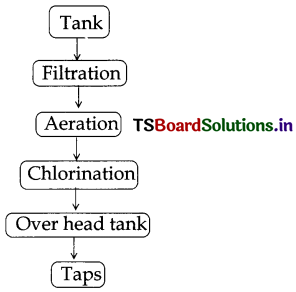
Explain the stages involved in safe drinking water supply. (or)
Prepare a flow chart showing the different stages of protected drinking water schemes.
Answer:
Stages of safe drinking water supply.

TS-6th-Class-Science-Important-Questions-11th-Lesson-Water-in-Our-Life-2

  • Water is collected into tank: Untreated water is collected from rivers or lakes into tanks.
  • Filtration: The water is filtered through sand particles and grills and then sent to another aerated tank. Nearly 99% of solid wastes are filtered through this process.
  • Aeration: Filtered water is exposed to sunlight. As a result some bacteria present in the water bodies will die due to the Sun’s heat.
  • Chlorination: Chlorine compounds are used to destroy all the disinfectants present in the water. Now the water is available to be used for drinking.
  • Overhead tank: Chlorinated water is pumped into overhead tank before supplying.
  • Supply of water: Pure water is supplied to the people through taps.

Question 10.
What is the percentage of fresh water on the earth?
Answer:
One percent

Question 11.
Write the occupancy ratio of the water on the earth.
Answer:
3/4th of the earth is occupied by water.

TS Board 6th Class Science Important Questions 11th Lesson Water in Our Life

Question 12.
Are the sources from where you get water for your daily needs and crop same or not? Give your reasons.
Ans.
For our daily needs, we get fresh water, supplied by the town authoritie under Protected Drinking Water Scheme.’ For the crops, we depend on rains, canals, rivers, bore – wells etc. It is n fresh water.

Question 13.
We know that nearly 314th of the surface of the earth is occupied by water. Is this water useful for us?
Answer:
Although 3/4th of our earth is covered with water, about 97% of the water available in the seas and oceans is salt water. About 2% of water is in the fon of ice at the poles. This means, only 1% of water on the earth is useful for us. Therefore we should not waste water.

Question 14.
What happens if there is less rain fall or too much rain fall?
Answer:

  • If there is less rain fall, there will be scarcity of water.
  • If there is no rain for 4 or 5 years continuously, it causes droughts.
  • Too much rain fall may cause floods.

Question 15.
What would happen if there was no rainfall of five years?
Answer:

  • Severe drought and famine will occur in the area.
  • People will face drastic problems such as food and water scarcity.
  • Cattle will die due to unavailability of grass or non grazing fields.
  • Plants will die and those remaining will enter the jaws of death.
  • As a result people will migrate to places with food and water resources.
  • Nutritional problems will arise in the children of poor families.

Question 16.
Drought occurred in Ramanna’s village. Guess the problems faced by
Ramanna due to drought.
Answer:
Ramanna faced many problems due to drought.

  • For the last five years, there were no rains.
  • Their fields dried and cracks developed on them.
  • His father invested money on bore – wells with no results.
  • Some water they could get from a bore – well lying kilometers away from their village.
  • Several people sold their cattle and migrated to distant cities like Hyderabad and Bangalore.

TS Board 6th Class Science Important Questions 11th Lesson Water in Our Life

Question 17.
What problems can arise due to water scarcity in a particular place?
Answer:
Loss of harvestation, drinking problems, domestic water problems etc., will arise.

Question 18.
If several bore wells are dug and underground water is tapped constantly what will happen to the source of ground water?
Answer:

  • Ground water levels will decrease.
  • Soil will lose moist conditions.
  • Grass lands will not grow.
  • Plants will die due to dryness in soil.
  • Soil organisms such as earthworms, useful insects will die due to lack of moisture in the soil.
  • People who depend on ground water for drinking and other purposes will face serious problems.

Question 19.
What are the possible and relevant questions you will ask on droughts – water supply?
Answer:

  • What will happen if rainfall this year is less than that of last year?
  • What would happen if there was no rainfall for five years?
  • What could be the possible reasons for water scarcity?
  • What problems can arise due to water scarcity?

Question 20.
A student named Virat had a curiosity to know how the water is being supplied to the villages with a govt. scheme i.e. ‘Safe drinking water’. The river water is filtered by separating all the unwanted materials and aerating the water with the process of sprinkling & chlorination. The purified water is then sent to the area tanks, then the purified water is supplied through the pipe lines to the individual houses of that particular areas.
1. What is the process used to separate unwanted materials and microorganisms?
2. What is the main source of water for village people?
3. Show the pumping/supplying of purified water in the form of flowchart.
4. What is meant by safe drinking water?
Answer:

  1. Sprinkling and chlorination.
  2. The river water
  3. Tank → Filtration → Aeration → Chlorination → Overhead tank → Taps
  4. The purified water purely free from impurities and microbes useful for drinking is called safe drinking water.

Question 21.
How do polythene bags, and disposable plates cause floods?
Answer:

  • The polythene bags and disposable plates do not decompose in the soil.
  • They obstruct water flow in canals and drainages during heavy rains and cause floods.
  • People become shelterless.

TS Board 6th Class Science Important Questions 11th Lesson Water in Our Life

Question 22.
Collect information about ‘cyclones’. In which season do they occur?
Write about effects of cyclones that occur in the coastal area of our state. (or)
Write about the information that you collected on cyclones. In which season they occur? Write about the effects of cyclones in coastal A.P.
Answer:
Cyclones frequently occur in the months of October and November.
Often we see cyclones in the month of May due to high pressure in the atmosphere.
The consequences seen after cyclones:

  • Roof tops and houses collapse due to heavy winds.
  • Hoarding boards and street light poles collapse.
  • Heavy loss of population and death of animals occurs.
  • Falling of trees is one of the effects of heavy flood.
  • People suffer from heavy damage of property.

TS Board 6th Class Science Important Questions 9th Lesson Plants: Parts and Functions 

These TS 6th Class Science Important Questions 9th Lesson Plants: Parts and Functions are crafted to align with the curriculum, ensuring students are well-prepared for assessments.

TS 6th Class Science Important Questions 9th Lesson Plants: Parts and Functions

Question 1.
What is venation ? What is its use?
Answer:
The arrangement of veins in the lamina of leaf is called venation. Venation acts as a skeleton of the leaf and gives it a shape and support.

Question 2.
What is transpiration?
Answer:
Plants release excess water in their body through stomata and some other parts as well. This water is released in the forms of vapour and this process is called transpiration.

Question 3.
What are the functions of root?
Answer:
Roots absorb water and minerals from the soil and also help in anchoring the plant body to the soil.

TS Board 6th Class Science Important Questions 9th Lesson Plants: Parts and Functions

Question 4.
Name the types of venations we see in the plants.
Answer:
There are two types of venations in different plants.

  • Reticulate venation
  • Parallel venation

Question 5.
How many types of roots are present in plants and name them.
Answer:
There are two types of root systems.

  • Tap root system
  • Fibrous root system

TS Board 6th Class Science Important Questions 9th Lesson Plants: Parts and Functions

Question 6.
What happens when stomata are not present in leaf?
Answer:
If stomata are absent in leaf plants cannot take carbon dioxide which is useful for preparation of food.
Excess of water taken by plants cannot he expelled out. Exchange of gases will be stopped. As a result plant cannot perform its functions.

Question 7.
What would happen if there are no veins in the leaf?
Answer:
If veins are absent the leaves would lose their specific shape and support from the stem. The food that is prepared in the leaf cannot be supplied to the other parts of the plant. The water and minerals coming from the roots (via) stem cannot reach the leaves due to absence of veins.

Question 8.
Prove the experiment. “The excess water is evaporated from plants by the process by transpiration”. With the help of the procedure write the result.
(Or)
Write the procedure you followed for conducting an experiment on transpiration. Write the required material for experiment. What did you observe at last?
Answer:
Material required for transpiration experiment: Well watered potted plant, 2 polythene bags, twine thread.

Procedure: A well watered potted plant is picked up from the school garden. One of the leafy branches of the plant is enclosed in a polythene bag and tied up at its mouth. Another polythene bag is tied up at its mouth without keeping plant. The preparations are kept in the sun for few hours.

Observation : It is observed that tiny droplets of water appear on the inner side of leafy branch enclosed in polythene bag, whereas the other bag has no such droplets.

Question 9.
Collect any 5 plants and observe their paris. Write your observations in the table as it is given below.
Answer:

S.No.Name of the plantRoot
Yes/No
Stem
Yes/No
Leaves
Yes/No
Flowers
Yes/No

1. We have to observe the following.

  • Presence or absence of flowers, roots, leaf, skin.
  • Common parts in the collected plants.

I collected the following plants and tabulated as the following:
Answer:

Name of the plantRootStemLeavesFlowerCommon parts in collected plants
1.       TridaxYes/NoYes/NoYes/NoYe^NoAll the parts
2.       Small neemYesYesYesYesRoot, stem, leaves
3.       DaturaYesYesYesNoAll the parts.
4.        MangoYesYesYesYesAll the parts
5.       JasmineYesYesYesYesAll  parts

Question 10.
Collect the following plants, observe the roots. Classify the type of root system in them. (Tap root system and fibrous root system)
Tabulate the information as given below. Name of the plants :
(a) Grass
(b) Tulasi
(c) Ummetta
(d) Maize (Jonnalu)
(e) Beans.

S.No.Plant nameRoot system
Tap root system / fibrous

Answer:
I collected the given plants from the surroundings. I observed the root systems of the plants. They are tabulated as given below.

S.No.Plant nameRoot system
Tap root system/fibrous root system
1.GrassFibrous root system
2.TulasiTap root system
3.Datura (Ummetta)Tap root system
4.Maize (Jonnalu)Fibrous root system
5.BeansTap root system

Question 11.
Teacher asked you to collect any 5 branches of 5 different plants. Observe the leaf modifications (Leaf base, Petiole, Lamina, shape and Edges of the leaves). Tabulate the information as shown. I was asked to find out the similarities among those collected leaves.

S.No.Plant
name
Leaf base Yes/NoPetiole
Yes/No
Lamina
Yes/No
Shape of leaf Yes/NoEdge of leaf Yes/No

Answer:
Aim : To find out similarities among the collected plant leaves.
Procedure : I visited my surroundings. I collected the branches of 5 different plants. I observed their leaf modifications. All the information is tabulated as given below.

Name ofLeaf basePetioleLaminaShape ofEdge of
the PlantYes/NoYes/NoYes/Nothe leafthe leaf
Tridax plantYesYesYesOvate andCoarsely
BanyanYesYesYessimpleedge
MangoYesYesYesSimpleSmooth
NeemYesYesYesSimpleSmooth
RoseYesYesYesCompoundSerrated

Question 12.
VI class boys brought stems of 5 differents plants. They are
1. Beans
2. Guava
3. Brinjal
4. Neem
5. Cucumber.
They were asked to find out their position of growth. They tabulated the information. How can you get the information with the following table ?

SNo.Plant nameStem grows Vertically / HorizontallyBranches are Present/ Absent

Answer:

S.No.Plant nameStem grows
Vertically / Horizontally
Branches are Present/Absent
1.BeansVertically or horizontallyCreepers are seen
2.GuavaVerticallyBranches present
3.BrinjalVerticallyBranches present
4.NeemVerticallyBranches present
5.CucumberHorizontallyCreepers are seen

Question 13.
Read the following information and answer the given questions.
The leaf lamina usually consists of a midrib/ veins and veinlets arranged in the form of a network. The long vein present in the middle of the lamina is called midrib. The branches arising from the midrib are called veins and the even finer divisions are veinlets. The arrangement of veins in the lamina is called venation. Venation acts as a skeleton of the leaf and give it a shape and support.

1. Which structures form a network in the leaf ?
Answer:
Midrib, veins and veinlets.

2. What is the use of venation to the leaf ?
Answer:
Venation acts as a skeleton of the leaf.

3. What are the veins ?
Answer:
The branches arising from the midrib of leaf are called veins.

4. Which is the long vein in lamina ?
Answer:
Midrib.

TS Board 6th Class Science Important Questions 9th Lesson Plants: Parts and Functions

Question 14.
Draw the diagrams of tap root system and fibrous root system of plants.
Answer:
TS-6th-Class-Science-Important-Questions-9th-Lesson-Plants-Parts-and-Functions-1
Question 15.
Draw any three storage roots (tubers). Write the definition of tubers.
Answer:
TS-6th-Class-Science-Important-Questions-9th-Lesson-Plants-Parts-and-Functions-2
Definition of tubers : The roots which store the food material in storage tissue are called tubers.

Question 16.
Draw a neat labelled diagram of stomata in leaf. How is it useful to plant?
TS-6th-Class-Science-Important-Questions-9th-Lesson-Plants-Parts-and-Functions-3
Use of stomata in plants : Stomata are useful in the exchange of gases between the plant and atmosphere.

Question 17.
Mention the indicated parts of the following and write any function of the leaf.
TS-6th-Class-Science-Important-Questions-9th-Lesson-Plants-Parts-and-Functions-4

Answer:

  • Mid rib of the leaf
  • Leaf lamina

Function of leaf: Leaf prepares food by the process of photosynthesis.

Question 18.
(a) Draw the following plant and identify the parts A, B, C.
Answer:
A – Roots B – Stem C – Leaf

(b) How do roots help the plant?
Answer:
Roots help in the absorption of water and minerals from the soil.
TS-6th-Class-Science-Important-Questions-9th-Lesson-Plants-Parts-and-Functions-5

TS Board 6th Class Science Important Questions 8th Lesson Fibre to Fabric

These TS 6th Class Science Important Questions 8th Lesson Fibre to Fabric serves as a valuable tool for students to prioritize their studying and revision efforts.

TS 6th Class Science Important Questions 8th Lesson Fibre to Fabric

Question 1.
Name two fibres obtained from plants.
Answer:
Cotton, jute, hemp, flax etc.

Question 2.
Name two fabrics obtained from animals.
Answer:
Silk and wool

Question 3.
Name two fabrics obtained from chemical substances.
Answer:
Terylene, nylon

Question 4.
What is the process of spinning of jute fibres as threads and ropes called?
Answer:
Retting.

TS Board 6th Class Science Important Questions 8th Lesson Fibre to Fabric

Question 5.
When silk is burnt, what is the smell given out?
Answer:
Smell of burning feathers.

Question 6.
How is coconut fibre obtained?
Answer:
From outer layer of coconut fruit

Question 7.
How is wool obtained?
Answer:
From the fur of the sheep.

Question 8.
Which type of fabric is used in book binding?
Answer:
Calico. (Calico is a rough and heavy cotton cloth)

Question 9.
What are fibres?
Answer:
The thinner strands of a thread.

Question 10.
What is the source of cotton?
Answer:
Cotton boils.

Question 11.
How is weaving done?
Answer:
On looms

Question 12.
There is a difference in the prices of fabrics. Why?
Answer:
The price of a fabric depends on various factors, like:

  • The nature of fabric – Whether synthetic or natural
  • Texture
  • durability
  • smoothness
  • Thickness
  • colour
  • shrinking property
  • availability of the fabric
  • demand in the market, etc.

TS Board 6th Class Science Important Questions 8th Lesson Fibre to Fabric

Question 13.
What types of clothes we wear in these seasons?
(i) Summer?
Answer:
Cotton clothes

(ii) Winter?
Answer:
Woollen clothes

(iii) Rainy?
Answer:
Synthetic clothes

Question 14.
On which factors does the selection of a fabric by a person, depend?
Answer:
Personal choice, personality of the owner and his/her ability to pay are all the factors in the selection of a right fabric.

Question 15.
How are the gunny bags made up of ? What are their uses?
Answer:

  • Gunny bags are made up of coarse (rough) jute fabric.
  • They are used to pack commercial crops like paddy, chilli grams, tamarind, etc.
  • Fine quality of jute is also used in making jute fabrics.

Question 16.
Do you know how jute yarn is made ? Is this process same as that for cotton or is there any difference?
Answer:
1. The making of jute yarn differs from that of the cotton yarn.
2. Making of jute yarn:

  • The jute plant is normally harvested when it is at flowering stage.
  • The stems of the harvested plants are cut and immersed in water for some days.
  • When the stem is soaked in water it become rotten and easy to peel.
  • Then the fibres are separated from the stems to make jute yarn.

TS Board 6th Class Science Important Questions 8th Lesson Fibre to Fabric

Question 17.
How a jute fabric differs from a cotton fabric?
Answer:
Jute fabric is harder, stronger and more rough than the cotton fabric.

Question 18.
Name a few plants, from which fibre is obtained from their stems.
Answer:

  • Hemp : Used to make ropes and cloth.
  • Flax: Used to prepare ropes and papers of good quality.

Question 19.
Name a few places in our state, famous for handloom industry.
Answer:
In our state, Gadwal, Venkatagiri, Siricilla, Narayanpet, Dharmavaram, Pochampalli, Mangalagiri, Kothakota are famous for handloom industry.

Question 20.
Write the differences between natural fibres and artificial fibres?
Answer:

Natural fibreArtificial fibre
1. The fibres that are derived from plants/animals are from plants/animals are called natural fibres1. Fibres made of chemicals are called artificial (or) synthetic fibres.
Eg: Polyester, terylene, nylon, acrylic etc.
Eg: Cotton, jute are obtained from plants, silk and wool are obtained from animalsEg: Polyester, terylene, nylon, acrylic etc.
2. When we burn natural fibres it gives ash.2. When we burn artificial fibres it gives a pungent smell.

Question 21.
Read the following fibres and classify them as it is given in tabular form
Wool, Nylon, Terylene, Cotton, Silk, Acrylic, Polyester, Gunny bag.

Natural fibreArtificial fibre

Answer:

Natural fibreArtificial fibre
WoolNylon
Gunny bagTerylene
SilkAcrylic
CottonPolyester

TS Board 6th Class Science Important Questions 8th Lesson Fibre to Fabric

Question 22.
What questions would you ask your teacher about natural fibres?
Answer:

  • Why do we depend on only cotton, sheep and silkworm for natural fibres?
  • Can’t we make fibres completely similar to that of natural fibres?
  • What are the uses of natural fibres?
  • Are natural fibres similar to artificial fibres?

Question 23.
Write the information collected by you about classification of fabrics that are used by your choice. Write names of the things that are made up of each fabric.

Type of fabricThings

(i) Which kind of fabric is being used more in your house ?
(ii) How do you identify the type of fabric ?
Answer:

Type of fabricThings
CottonShirts, Sarees, Towels, Blankets
SilkKurta, Sari, Frocks, Skirts, Lehangas
WoolSweaters, Mufflers, Monkey caps
PolyesterShirts, Skirts, Dress material
LinenShirts, Trousers etc.

(i) Cotton and Polyester fabrics are widely used in the house.
(ii) Fabrics are identified by the following ways

  • By touching
  • By observing duration of dryness after washing
  • Wight of the cloth
  • Sense of heat after wearing the cloth
  • Shining given by the cloth.

TS Board 6th Class Science Important Questions 8th Lesson Fibre to Fabric

Question 24.
How did you identify the type of fabric?
Answer:

  • Polyester / wrinkled / fabrics are generally smooth, soft and light in weight. They get wrinkled after washing.
  • Cotton fabrics are some what thicker than polyester fabrics. But they get wrinkled after washing. Coarse cotton clothes are heavier than smooth cotton fabrics.
  • Silk fabrics are slippery and shiny in nature.
  • Woollen fabrics are rough to touch and are somewhat heavier than silk fabrics.

Question 25.
You are provided with pieces of cotton, wool, silk and nylon.
Answer:

S.No.CharacterNatural fabricArtificial fabric
1.Water absorbing natureyesno
2.Time taken to drylongshort
3.Smell while burningnoyes (pungent)
4.Result after burningashmelts
5.Stretching capacity of yarnlesshigh
6.Smoothnessroughsmooth

Answer the following questions.

(i) Give examples for natural fibres and artificial fibres.
Answer:
Natural fibres : cotton (plant origin)
TS 6th Class Science Important Questions 8th Lesson Fibre to Fabric 2
Aritificial fibres: Nylon

(ii) Which types of fabrics are smooth in nature?
Answer:
Silk is slippery to touch. Nylon is smooth and soft to touch. Cotton and wool are rough to touch.

(iii) Which type of fabrics dry in a short time?
Answer:
Artificial fabrics

(iv) Do you find any relation between smoothness and time to dry?
Answer:
The two factors are inversely related. With the increase in smoothness, the time taken for it to dry, decreases.

TS Board 6th Class Science Important Questions 8th Lesson Fibre to Fabric

(v) Which fabrics give ash when they are burn?
Answer:
The natural fabrics leave ash when burn.

Question 26.
Draw the diagram showing making mat. Write the process.
Answer:
Coconut leaves are collected. They are cut and the middle veins of the leaves are removed. So that two halves of leaves are separated. These strips are put parallel to each other. Remaining strips are inserted horizontally and alternately between the vertical strips. Finally you will get a sheet like structure. This is the way a mat is prepared.
TS Board 6th Class Science Important Questions 8th Lesson Fibre to Fabric 1

TS Board 6th Class Science Important Questions 7th Lesson Separation of Substances

These TS 6th Class Science Important Questions 7th Lesson Separation of Substances serves as a valuable tool for students to prioritize their studying and revision efforts.

TS 6th Class Science Important Questions 7th Lesson Separation of Substances

Question 1.
What type of mixture is our soil?
Answer:
A natural mixture

Question 2.
Can water be used to separate the components of any mixture?
Answer:
No.

TS Board 6th Class Science Important Questions 7th Lesson Separation of Substances

Question 3.
How can you separate rotten fruits from fresh fruits?
Answer:
Hand picking process.

Question 4.
Which property helps in separating the husk from grain?
Answer:
Difference in weights of the husk and grains.

Question 5.
Why sedimentation takes place?
Answer:
Due to gravity.

Question 6.
How does precipitation differ from sedimentation?
Answer:
Precipitation is rapid, whereas sedimentation is a very slow process

TS Board 6th Class Science Important Questions 7th Lesson Separation of Substances

Question 7.
Can you have filter papers with different pore sizes?
Answer:
Yes.

Question 8.
Which of the following does sublime, when heated?
(a) camphor
(b) common salt
(c) Iodine
(d) Ammonium chloride
Answer:
Items a, c and d sublime

Question 9.
Which process can be used to remove impurities from water?
Answer:
Distillation

Question 10.
How is butter taken out from milk or curd?
Answer:
By Churning

Question 11.
Which method is better for separating tea leaves from prepared tea, decantation or filtration?
Answer:
Filtration.

TS Board 6th Class Science Important Questions 7th Lesson Separation of Substances

Question 12.
What is the reverse of evaporation?
Answer:
Condensation.
(Note : The process of conversion of vapour into its liquid form is called condensation.)
TS Board 6th Class Science Important Questions 7th Lesson Separation of Substances 6

Question 13.
List out the different substances that are used to make the items given in the following table.
(Or)
Define mixtures. Name some of the mixtures, that you have seen, tested in your daily life. List out the different substances that are used to make above said mixtures.
Answer:
Definition: The component having more than one substance is called mixture.

ItemSubstances
1. TeaMilk, tea leaves, sugar and water.
2. ItemBengal gram flour; vegetable oil or ghee; cashew nuts, cardamom and sugar (or Jaggery)
3. Lemon JuiceLemons, sugar and water
4. ConcreteCement, sand, small stones and water.
5. SoilWeathered rock, organic material (humus),water and air.

Question 14.
The materials ghee, wax, sand, sugar, salt, haldi, dal, plastic, wood and iron nails are supplied. Answer the following.

(i) Which materials float on water?
Answer:
Wax, plastic and wood float on water.

(ii) Which materials sink in water?
Answer:
Sand, dal and iron nails sink in water.

(iii) Which materials are soluble in water?
Answer:
Sugar and salt are soluble in water.

TS Board 6th Class Science Important Questions 7th Lesson Separation of Substances

(iv) Which materials are insoluble in water?
Answer:
Ghee and haldi are insoluble in water.

Question 15.A.
You might have come across some situations where you have to separate some components from a mixture. Write down two examples of such situations.
Answer:
Case 1. Stones are separated from pulses.
Case 2. Husk is separated from wheat flour.

Question 15. B.

(i) Did you able to separate each component from the mixture?
Answer:
Yes.

(ii) Are the methods used to separate the components same in all these instances?
Answer:
No.

(iii) What are the properties of the components that are used in separating them?
Answer:
In case 1, hand picking. The colour difference between the pulses and the stones made it possible to separate them by hand picking. In case 2, sieving, difference in size between the flour particles (very fine) and the husk particles (large).

Question 16.
Can you separate salt from sand by hand picking?
Answer:
No.

TS Board 6th Class Science Important Questions 7th Lesson Separation of Substances

Question 17.
What differences in the properties of rice, pulses and stones help us in separating them by the method of hand picking?
Answer:
There are two reasons.

  • The size of the stone is different from rice or pulses.
  • The colour of stone, rice and pulses are different.

Question 18.
Give some examples of day-to-day life, where the hand-picking method is used.
Answer:

  • Separating tomato, green chillis and radish.
  • Rotten eggs are removed from fresh eggs.
  • Separating pencils and erasers.

Question 19.
A little of the soil is shaken with water in a glass tumbler. It ¡s kept undisturbed for some time. Then mud particles settle at the bottom of the tumbler. Why is it so?
Answer:

  • Mud is not soluble in water.
  • Mud is heavier than water.
    So mud particles settle at the bottom of the tumbler

Question 20.
(a) Can you separate mud from muddy water using a sieve?
Answer:
No.

(b) How small should be the pores of the sieve to do this?
Answer:
The size of the pores of the sieve should be smaller than the size of the fine mud particles.

(c) Now, you use a cloth as a sieve. Is the water clear after sieving?
Answer:
No, the water is not clear.

TS Board 6th Class Science Important Questions 7th Lesson Separation of Substances

Question 21.
How is salt extracted from sea water?
Answer:
Sea water is captured in wide pans and is exposed to air and sunlight. Then water evaporates and the salt is left behind in the pAnswer: The process is called ‘crystallisation.’

Question 22.
What is ‘distilled water’?
Answer:
When water is boiled, some water vapourises. These vapours are collected in a flask and cooled. Then these vapours turn into water. This water is free from impurities. It is called ‘distilled water’.

Question 23.
What are the uses of ‘distilled water’?
Answer:

  • The injection powder is first mixed with distilled water. Then this liquid is injected to patients, by doctors.
  • In chemical laboratories, distilled water is used during chemical analysis.

Question 24.
In order to separate the components of a mixture, we make use of their difference in colour, shape, size, weight, solubility.
(a) Can we use these features for separating mixtures of powdered salt and camphor?
Answer:
No. However, property of solubility may be used in common salt dissolves in water, while camphor is insoluble in water. Now the salt is recovered from the salt water, by evaporation process.

(b) What other properties can be use?
Answer:
Sublimation. Camphor sublimes. Salt does not sublime.

Question 25.
What is chromatography?
(Or)
Which method is used to separate colours from a mixture of colours?
Answer:
Chromatography is a technique used for separating mixtures of gases, liquids or dissolved substances.

TS Board 6th Class Science Important Questions 7th Lesson Separation of Substances

Question 26.
Give an example of chromatography.
Answer:
Ink appears to be made of a simple colour but it is actually a mixture of many colours. The qualitative separation of ink into its component colours can be done using chromatography.

Question 27.
Where do we use chromatography method?
Answer:
Chromatography is used to separate the colours and then identify the components of a mixture. Ex: Ink, green pigment of leaf, dyes, etc.

Question 28.
Describe any four methods which separate the material.
Answer:

  • Winnowing – Eg: Separation of husk from the paddy grains
  • Hand – picking: Eg: Separation of stones from rice and pulses
  • Crystallization – Eg : Separation of soluble substances from the solution.
  • Decantation – Eg: Floating substance is separated by leaving the sediment in the container.
  • Chromatography – Eg: Separation of colours from different mixtures of colours.

Question 29.
How do farmers separate husk from grains?
Answer:
Farmers separate husk from grains by the method called “Winnowing”.

Question 30.
Write the method you follow to separate
(a) Mud from water
(b) Husk and flour
Answer:
(a) Mud from water : Filtration
(b) Husk and flour : Sieving

Question 31.
What is sublimation ? Give an example.
Answer:
The process in which a substance changes directly from solid to gaseous form and vice-versa is called sublimation. Eg: Sublimation of camphor.

TS Board 6th Class Science Important Questions 7th Lesson Separation of Substances

Question 32.
Can you separate salt from salt water, using a filter paper? If not, why?
Answer:
No.
Reason : The particles of salt dissolved in water are so small in size, that they easily pass through the fine pores of the filter paper. So they can’t be separated by filtration.

Question 33.
Rani filtered mud water by using filter paper. You cannot understand how it is possible. Write down some questions which will be asked by you.
Answer:

  • How can we separate mud from water?
  • is it possible to separa te mud from water?
  • What are the tools required to filter mud water?
  • Is mud water filtered easily?
  • Are there any techniques to filter mud water?

Question 34.
Hemanth purchased green chilli, coriander seeds, tomato, red gram, wheat flour and kept them safely in a bag. While returning he fell and all the items in the bag got mixed. How will he separate?
1. Which material will he separate first?
2. How would he separate tomato and chilli?
3. How would he separate wheat flour?
4. How would he separate coriander seeds?
Answer:

  1. First tomato and chilli are separated.
  2. By hand picking.
  3. Wheat flour is separated by sieving.
  4. Coriander seeds can be separated from red gram by winnowing.

TS Board 6th Class Science Important Questions 7th Lesson Separation of Substances

Question 35.
What is distilled water? Write the arrangement of apparatus to make distilled water by distillation with a neat labelled diagram.
(Or)
What process do you follow to obtain distilled water on your own? Explain the procedure. Mention the apparatus.
(Or)
Write the procedure and precautions taken in the extraction of distilled water experiment.
Answer:
The water content that is made free from impurities by the process of vapourisation technique is called distilled water.
Preparation of distilled water:
TS Board 6th Class Science Important Questions 7th Lesson Separation of Substances 2
Required apparatus : Two conical flasks, water, plastic tube, bunsen flame, tripod, 2 single holed rubber corks etc.

Precautions:

  • Inserting tubes into the rubber holders is done gently.
  • Applying heat to the flask should be observed carefully.

Procedure: A conical flask is filled with water and closed with cork having a hole. Take an another conical flask with a cork having a hole and insert another glass tube through it. Connect both tubes with a plastic tube. Water containing flask is heated.

Observation : It is observed that water vapour goes into the empty flask. It turns slowly into water. The water in the second conical flask is called distilled water.

TS Board 6th Class Science Important Questions 7th Lesson Separation of Substances

Question 36.
Describe the experiment of sublimation of camphor with a figure.
(Or)
How do you demonstrate the process of sublimation ? What apparatus did you use ?
Answer:
Aim : To observe the sublimation of camphor.
TS Board 6th Class Science Important Questions 7th Lesson Separation of Substances 4
Apparatus : Cotton, glass funnel, china dish,camphor and powdered salt, stand, burner etc.

Procedure : A mixture of camphor and powdered salt is taken in a china dish and covered with a funnel. The dish is placed on a stand. It is heated with a burner.

Observation : When camphor is heated, it transforms into a gaseous form without changing into liquid.
Similarly, on cooling, the gaseous form of a camphor changes directly into a solid without going to the liquid state.

Question 37.
Write the process of separation of husk from grain.
Answer:
Standing on a high platform, the husk and grain mixture is allowed to drop slowly from the flat pan.
As a result the wind carries the husk forward and the grains fall vertically downward. A separate heap of grain is formed.

Question 38.
Which separation method is used to separate the mixture of Suji (Raya) and sugar?
Answer:
The method sieving is used to separate Suji (Rava)and sugar.
The fine and smaller particles of raya pass through sieve holes. The sugar crystals are left on the sieve plate.

Question 39.
Write the experimentation method and precautionary measures to know about chromatography method.
Answer:
Aim : To show the phenomenon of chromatography.
Required materials : Chalk piece, ink, plate, water etc.

Procedure : A stick of white chalk is taken. An ink (blue or black) mark is put around the curved surface of the chalk. A plate is taken and filled with little amount of water. Ensure that the water does not touch the ink mark. The set up is kept undisturbed for sometime.

Observation : It is observed that the chalk piece absorbed water. Water absorption took place upto its tip. Some colours appeared from the ink border. Yellow, red, blue, green etc are seen from the ink mark to tip of the chalk piece.

TS Board 6th Class Science Important Questions 7th Lesson Separation of Substances

Question 40.
A mixture of sand, sawdust and salt Is given in a beaker, half-filled with water. The mixture is stirred well and allowed to settle for 10 minutes. Answer the following.

(a) Which substance floats on the water?
Answer:
Saw dust

(b) How can you collect it?
Answer:
Using a perforated wooden spoon.

(c) Which substance settles at the bottom of the beaker?
Answer:
Sand.

(d) How can you collect it back?
Answer:
Filtration

(e) Which substance is dissolved in the water?
Answer:
Salt

(f) How can you get it back?
Answer:
Crystallisation.

Question 41.
Your teacher conducted the following experiment in the classroom.
(a) What is the name of the experiment?
Answer:
Chromatography

TS-6th-Class-Science-Important-Questions-7th-Lesson-Separation-of-Substances-5

(b) What do you observe in the colour on the chalk piece in this experiment?
Answer: Different colours formed from the ink mark, expanded on the chalk.

TS Board 6th Class Science Important Questions 6th Lesson Habitat 

These TS 6th Class Science Important Questions 6th Lesson Habitat serves as a valuable tool for students to prioritize their studying and revision efforts.

TS 6th Class Science Important Questions 6th Lesson Habitat

I. Conceptual Understanding :

Question 1.
Write about pond habitat and organisms in that surroundings.
Answer:
There are several organisms in a pond. The different regions in the pond with different communities of some organisms are present. This is due to some conditions like availability of different amounts of food, air, light etc.,

Different organisms at different regions :

(a) Above the pond surface : Dragonfly, mayfly and kingfisher living above the surface of the pond.

(b) Pond surface : Organisms like snail, whirling beetle and pond skater live on the surface. The larva of mayfly and dragonfly also live on the surface of pond.

(c) Mid water : Great water boatman, leech and mosquito larva are found in midwater. Fish and crabs also swim around this region.

(d) Pond margins : Several grasses, frogs, cranes, crabs etc., are seen in this region. Fish usually lay eggs here.

(e) Bottom of the pond : This region has plants like Hydrilla and animals like mussels, flatworms and some maggots larva of some insects like fly.

Question 2.
Write about the nature of the bottom of the pond.
Answer:
The bottom of the pond has plants like Hydrilla and animals like mussels, flatworms and some maggots larva of some insects like fly. Light is minimum here, but food, in the form of dead and decaying matter is in plenty.

TS Board 6th Class Science Important Questions 6th Lesson Habitat

Question 3.
What are aquatic and terrestrial habitats ?
Answer:
The habitat of water is called aquatic habitat. The habitat of land is called terrestrial habitat.

Question 4.
Write a few lines about desert habitat and the organisms that live in the desert habitat.
Answer:
Desert possesses high temperature and the atmosphere is always dry. Yet, in the adverse atmosphere, many plants and animals are living in the desert. Desert plants and animals are suited to drv conditions and vast temperature differences. Eg : Cactus, acacia, aloevera are plants. Camel, dogs are animals.

Question 5.
What is a habitat ? Name some plants and animals which live in aquatic and terrestrial habitats.
Answer:
Habitat is a dwelling place for plants and animals that gives them optimum conditions of life.

Examples of terrestrial plants: Neem, mango, jasmine, guava, apple, orange, lemon tree, grapes etc.

Terrestrial animals : Tiger, lion, sheep, cow, cat, dog, donkey, monkey etc. Aquatic animals : Fish, turtle, snail, crab, prawn, whale, shark, star fish, insects, snakes etc.

Aquatic plants: Hydrilla, lotus, vallisnaria, pistia, water hyacinth, algae etc.

TS Board 6th Class Science Important Questions 6th Lesson Habitat

Question 6.
Tree is a habitat. Explain with examples.
(or)
How do you say that tree is a habitat for many organisms ?
Answer:
Tree gives shelter and food for many animals. So we should consider that tree is a habitat. Birds, monkeys, squirrels, snakes, ants, spiders, caterpillars, moths, bees, wasps, mosquitoes etc are some of the organisms that live on the tree. There are also some smaller plants live on the tree. Eg : Mosses.

Question 7.
What are the animals that share the surface of the pond as habitat ?
Answer:
Dragonfly, mayfly, smaller insects, kingfisher bird etc., share the surface of the pond.

II. Asking Questions and Making Hypothesis :

Question 8.
Your teacher asked you about the surroundings of your home. He confirmed that your home is as a habitat. Can you agree with your teacher ?
Answer:

  1. Yes, I can agree with my teacher that my house is habitat.
  2. In fact we live in our house, that protects us from heat, cold and rain etc. and it is shelter for us.
  3. We keep some animals and birds as pets in our houses.
  4. We also grow some plants which give us fruits and vegetables.

Question 9.
Imagine a deer is shifted from its natural habitat forest to another habitat (desert). What will be the effect on it ?
Answer:

  1. Deer cannot live in the desert habitat.
  2. It will suffer from lack of food, water and hot weather conditions.
  3. Dry conditions will trouble it seriously.
  4. Deer may die due to dryness and water less and food scarcity.

Question 10.
What type of questions do you ask your teacher to know about desert plants ?
Answer:

  1. How can plants grow in desert ?
  2. How can plants withstand desert atmosphere ?
  3. What type of plants grow in deserts ?
  4. Can desert plants give fruits ?

TS Board 6th Class Science Important Questions 6th Lesson Habitat

Question 11.
Why shouldn’t we kill the smaller animals and insects ?
Answer:

  1. Insects and some other animals help us by cleaning the environment.
  2. Some insects eat harmful micro organisms.
  3. Some insects and animals help us in good crops yields.
  4. Hence we should not kill any animal and insects.

Question 12.
Read the following para. Answer the following questions.
Tree is also a habitat. Birds, Monkeys, Squirrels, Snakes, Ants, Spiders, Caterpillars, Moths, Bees, Wasps, Mosquitoes and some of the algae we usually observe on the trees.

(a) The organisms that are found at the base of tree
Answer:
Snakes, ants, algae.

(b) Organisms appear between the branches.
Answer:
Monkeys, ants, mosquitoes, birds, caterpillar, spiders

(c) Organisms live on the trunk
Answer:
Ants, algae, bees, moths

(d) Organisms live under the bark Answer: Wasps, bees etc.

Question 13.
Write some names of the plants and animals which live in water. Are leaves of all plants growing in the pond similar ? Why?
Answer:
Animals live in water: Fish, crab, snail, pond skater, insects, prawn, snakes etc. Plants live in water: Vallisnaria, lotus, water hyacinth, grass etc.

  1. Leaves of plants that live in water are not similar.
  2. For example some plants such as Hydrilla have smaller scaly leaves that can withstand the water currents.
  3. Some plants such as lotus have larger and wax layer coarsed leaves that enable to float on the water surface.

III. Experimentation and field Investigation :

Question 14.
Collect an aquatic plant say a Hydrilla or Vallisneria. Also collect any land plant. Now compare the two and write your observation in a table.
Answer:
With the instructions of our science teacher we visited the garden and a pond. As we were instructed to get a water plant we picked Hydrilla plant from pond. And we have collected Tulasi plant also. The parts of the two plants are observed. Some differences are seen in their parts. They were tabulated as follows.

PartsTerrestrial plant (Tulasi)Aquatic plant (Hydrilla)
StemStrong and dry in colourWeak and green in colour.
LeafMeadium size leaves are presentNarrow leaves and small in size.
RootRoots are fixed in the soil with root hairsRoots are fixed in the bottom of the pond but not much stronger.
OthersLong flower clusters are presentFlowers clearly seen; but small and less.

IV. Information Skills and Projects :

TS Board 6th Class Science Important Questions 6th Lesson Habitat

Question 15.
Read the following.

under the groundon the groundin/on watersome other place
Eg:snakesnakesnake

Snake, cat, lotus, bird, dung beetle, earthworm, prawns. Where is each organism found most often ? Tabulate the information collected from surroundings.
Answer:

Under the groundOn the groundIn/on waterSome other place
SnakeSnakeSnake
Cat
Dung beetleDung beetleLotus
EarthwormEarthworm (in the fields)
BirdBird (in home)
(prawns)Fresh water prawn

Question 16.
We know that tree is a habitat. You go to field and observe a tree. Find out the organisms which are living on different places of the tree. Tabulate the information.

At the base of the treeants, snakes, small plants
On the trunkspiders, caterpillars, wasps
Between the branchesmonkeys, caterpillars, mosquitoes, bees
On or within leavesspiders, moths, bees etc.

TS Board 6th Class Science Important Questions 6th Lesson Habitat

Question 17.
Analyse the information given in the table and answer the following questions.

Under Ground (I)Surface of the Ground (II)In/ on water (III)Other places (IV)
snakesnakesnakesnake
ratcatlotusants
antinsectsmusselbird
earthwormcamelfishlizards

Question 1.
Fill the boxes with organisms in I, II, III, IV columns.
Answer:
Earth worm – insects — ants – lizards

Question 2.
In which habitat bat is included ?
Answer:
Other place

Question 3.
What are the habitats which are said to be other places ?
Answer:
House, caves etc.

TS Board 6th Class Science Important Questions 6th Lesson Habitat

Question 4.
Name the organism which lives in multiple habitat along with snake.
Answer:
Insect, snake, ants.

Question 18.
Observe the given table.

In soilOn soilIn waterOther areas
SnakeSnakeSnakeSnake
EarthwormCatOctopusSparrow
RabbitDogFishMonkey
BandycootTortoiseTortoisePolar bear

Answer the following questions.

Question 1.
What are the habitats of snake ?
Answer:
In the soil, on the soil, in the water and other areas.

Question 2.
Mention/write other two habitats which are not shown in the table.
Answer:
Forest, garden, house, tree etc.

TS Board 6th Class Science Important Questions 6th Lesson Habitat

Question 3.
In the above table, what will be the other habitats/areas, mentioned ?
Answer:
Caves, old houses, polar regions etc.

Question 4.
Like tortoise, mention other two animals which live in two different habitats.
Answer:
Dog, snake.

Details


Pond surfaceMid-waterBottom water of pond
Characteristics


1) Few organisms will live on sur-face of water1) Motile organisms are present, can swim.1) Light is minimum in this zone.
2) Food, availabi-lity of air.2) In this zone the fishes lay eggs.2) Food is in the form of dead and decaying matter.
3) Little protection3) Pond margins have several plants & grasses.
Examples


Snail, whirling beetle, dragonfly, pond skater, lotus, pistia.Leech, mosquito larva, fish, crab, frog, grasses. Hydrilla, Mussels, Flatworm and maggots.

Write the answers based on the information from the above table.

Question 1.
Name the motile organisms in the pond.
Answer:
Leech, mosquito larva, fish, crab, frog, etc.

Question 2.
Which zone contains high amount of food in the pond ?
Answer:
Pond surface.

TS Board 6th Class Science Important Questions 6th Lesson Habitat

Question 3.
List out the plant species which grow in pond ecosystem habitat.
Answer:
Lotus, Pistia, Grass, Hydrilla etc.

Question 4.
Inner / bottom zone of pond consists less species of plants and animals. Why ?
Answer:
Light is minimum in the bottom of pond.

Question 20.
Observe the following table about the living organisms in a pond and answer to the questions given below.

Living

Organisms/Others

Pond surfaceMid-waterBottom of the pondPond margins.
PlantsPistia, EchorniaVallisneriaGrasses
AnimalsMayfly, dragonfly and mosquito larvaeWhirling beetle,

pond skaters,

mosquito larvae

Some kinds of fish, dead bodies and water decomposers.Snails,
Crabs
OthersDecomposers

Questions:

Question 1.
Which plants can be seen on the pond surface ?
Answer:
Pistia, Echornia.:

Question 2.
Which animals can be seen in the mid-water ?
Answer:
Whirling beetle, pond skaters, mosquito larvae.

TS Board 6th Class Science Important Questions 6th Lesson Habitat

Question 3.
Where can the decomposers be seen in the pond ?
Answer:
Bottom of the pond.

Question 4.
Where can snails and crabs be seen in the pond ?
Answer:
Pond margins.

Question 21.
Read the following para and answer the questions.

We have seen that different organisms live in our surroundings. In these some live on land, in land, in water and on water. Some times most of them live in the same place. Living organisms have different needs.They usually stay in the places where most of their needs are met, that is, they get sufficient food, shelter and other conditions necessary for life. All organisms depend on their surroundings for their needs like food, water, air and shelter.The surrounding which meets the needs of a particular organism in the best manner is the habitat of that organism. Answer the following questions.

Question 1.
What is meant by habitat ?
Answer:
A place for organisms to give maximum needs of life.

Question 2.
On which components of their surroundings the organisms depend ?
Answer:
Food, water, air and favourable weather.

TS Board 6th Class Science Important Questions 6th Lesson Habitat

Question 3.
Give an example of an organism which lives on both land and in water.
Answer:
Frog.

Question 4.
Why do all the living organisms live in different places ?
Answer:
Living habits, availability of food and body conditions make organisms live in different places.

V. Communication through Drawing and Model Making :

Question 22.
Draw the diagram of pond habitat and label the different regions of the habitat.
TS Board 6th Class Science Important Questions 6th Lesson Habitat 1

Question 23.
Draw any three plants and three animals of the pond habitat.
Answer:
TS Board 6th Class Science Important Questions 6th Lesson Habitat 2

Question 24.
Draw any three organism belonging to the above the pond surface.
Answer:
TS Board 6th Class Science Important Questions 6th Lesson Habitat 3

Question 25.
Draw a sketch or a pond and the possible animals and plants that would live in the different places of this pond.
Answer:
TS Board 6th Class Science Important Questions 6th Lesson Habitat 4

Answer:
Different organisms at different regions :

(a) Above the pond surface: Dragonfly, mayfly and kingfisher live above the surface of the pond.
(b) Pond surface : Organisms like snail, whirling beetle and pond skater live on the surface. Mayfly and dragonfly also live on the surface of pond.
(c) Mid water : Great water boatman, leech and mosquito larva are found in midwater. Fish and crabs also swim around thh ‘vgion.
(d) Pond margins : Several grasses, frogs, cranes, etc., are seen in this region. Fishes usually lay eggs here.
(e) Bottom of the pond : This region has plants lil rilla and animals like mussels, flatworms and some maggots.

Question 26.
Identify the following plant and write its nam
TS Board 6th Class Science Important Questions 6th Lesson Habitat 5
Answer:
The given plant is Hydrilla. It is a water plant.

Question 27.
All the organisms have right to live in this environment. How do you support this statement ?
Answer:

  1. A good unharmed habitat leads to a better life for us.
  2. If we harm any organism in the same way we will be harmed directly or indirectly as well.
  3. Interdependency of different organisms leads existence of every creature on the earth.
  4. If we allow other organisms to live we will be allowed to live safely.
  5. Therefore every organism has right to live.

TS Board 6th Class Science Important Questions 6th Lesson Habitat

Question 28.
Rani saw a garden and said, “It is a beautiful habitat”. Why did she say so ?
Answer:

  1. We enjoy the sight of a brightly coloured flowers or a passing butterfly and birds in the garden.
  2. This natural phenomenon make us feel an aesthetic sense.
  3. Garden makes us having a true friendship with the nature.
  4. The beauty of nature partly lies in the garden.
  5. Not only a beautiful habitat but also a habitat for several organisms.

Question 29.
“We cannot live without plants.” Support your answer.
Answer:

  1. Plants are the prime useful sources for man. Man obtain oxygen for breath-ing.
  2. We get varieties of fruits, seeds, leaves, roots from plants.
  3. Plants clean the environment by taking carbondioxide that is released by us.
  4. Plants help us to have sufficient rains and give us cool climate.
  5. Therefore we cannot live without plants.

Question 30.
Bhashini doesn’t want to disturb squirrels that eat fruits on the guava tree at her house. Why does she do so ?
Answer:

  1. We should give a chance to every creature to live in its habitat.
  2. We should remember that there is an interdependence of organisms.
  3. If we have a good unharmed habitat of any animal of it will lead a better life for us.
  4. Guava tree is a habitat for squirrels to obtain food material.
  5. Therefore Bhashini doesn’t want to disturb squirrels on guava tree since it is a good habitat for squirrels.

TS 6th Class Hindi Guide 4th Lesson बाज़ार

Telangana SCERT 6th Class Hindi Study Material Telangana Pdf 4th Lesson बाज़ार Textbook Questions and Answers.

TS 6th Class Hindi 4th Lesson Questions and Answers Telangana बाज़ार

सुनो-बोलो :

TS 6th Class Hindi Guide 4th Lesson बाज़ार 1

प्रश्न 1.
बाज़ार में क्या-क्या मिलता है ?
उत्तर :
बाजार में पुस्तकें, खिलौने, मिटाइयाँ, चूड़ियाँ, बर्तन, आइसक्रीम आदि मिलते हैं।

प्रश्न 2.
बाज़ार से क्या लाभ है ?
उत्तर :
बाज़ार में कई चीज़ें मिलती हैं। इसलिए हम सब चीज़ों को यहाँ खरीद सकते हैं। इधर-उधर भटकने की जरूूरत नहीं पड़ती। समय तथा शक्ति की बचत होती है।

TS 6th Class Hindi Guide 4th Lesson बाज़ार

प्रश्न 3.
गीत गाओ। भाव के बारे में बातचीत करो।
उत्तर :
यह बाज़ार देखो। यह बाजार बहुत प्याग है। इस में सब कुछ मिलता है। यह बाज़ार सब लोगों का हैं।

प्रश्न 4.
अगर घर के पास बाज़ार न हो तो क्या होगा ?
उत्तर :
अगर घर के पास बाज़ार न हो तो हमें चीज़ें खरीदने के लिए इधर-उधर भटकना पड़ता है। बाज़ार टूर होने पर आने-जाने में समय नष्ट होता है। बस, ऑटो के लिए भी धन खर्च कग्ना पडता है।

पढ़ो :

अ. चित्र के आधार पर वाक्य पढ़े। ‘ऋ ‘अक्षर पर ‘○’ लगाओ।

TS 6th Class Hindi Guide 4th Lesson बाज़ार 2

TS 6th Class Hindi Guide 4th Lesson बाज़ार 3

उत्तर :
TS 6th Class Hindi Guide 4th Lesson बाज़ार 11

TS 6th Class Hindi Guide 4th Lesson बाज़ार

आ. चित्र देखो। शब्द पढ़ो। इनके वर्ण वर्णमाला चार्ट में पहचानो। ‘○’ लगाओ।
చిత్రం చూడండి. చదవండి. క్రింది చార్టులో వీటిని ‘○’ ద్వారా గుర్తించండి.

TS 6th Class Hindi Guide 4th Lesson बाज़ार 4

उत्तर :
TS 6th Class Hindi Guide 4th Lesson बाज़ार 12

इ. इन्हें पढ़ो।

TS 6th Class Hindi Guide 4th Lesson बाज़ार 5
उत्तर :
TS 6th Class Hindi Guide 4th Lesson बाज़ार 13

ई. ॠ TS 6th Class Hindi Guide 4th Lesson बाज़ार 14 मात्रा जोड़ते हुए पढ़ो।
TS 6th Class Hindi Guide 4th Lesson बाज़ार 15
उत्तर :

TS 6th Class Hindi Guide 4th Lesson बाज़ार 6+

लिखो :

अ. सुंदर अक्षरों में लिखो।
అందమైన అక్షరాలలో రాయండి.

TS 6th Class Hindi Guide 4th Lesson बाज़ार 7
उत्तर :
TS 6th Class Hindi Guide 4th Lesson बाज़ार 18

आ. शब्द पढ़ो। लिखो।

TS 6th Class Hindi Guide 4th Lesson बाज़ार 8

इ. अक्षरों को मिलाकर पढ़ो। लिखो।

TS 6th Class Hindi Guide 4th Lesson बाज़ार 9
उत्तर :
TS 6th Class Hindi Guide 4th Lesson बाज़ार 17

ई. रंग भरो। नाम लिखो।

TS 6th Class Hindi Guide 4th Lesson बाज़ार 10
उत्तर :
फलों की टोकरी

TS 6th Class Hindi Guide 4th Lesson बाज़ार

अभ्यासकार्य :

1. निम्नलिखित कविता का वाचन कीजिए। प्रश्नों के उत्तर दीजिए :
క్రింది కవిత్వాన్ని చదవండి. ప్రశ్నలకు సమాధానాలు వ్రాయండి.

चूँ-चूँ करती चिडिया आई,
छम-छम करता मोर।
शेर दहाडता दौडा आया,
जंगल में मच गया शोर।।
लाठी लेकर भालू आया,
सबने खेला खेल।।

प्रश्न 1.
चिडिया क्या करती आई?
1) धड-धड
2) चूँ-चूँ
3) छम-छम
उत्तर :
2) चूँ-चूँ

प्रश्न 2.
मोर क्या करता है?
1) छम-छम
2) धड-धड
3) चूँ-चूँ
उत्तर :
1) छम-छम

प्रश्न 3.
कौन दहाडता दौडा आया?
1) वाध
2) मोर
3) शेर
उत्तर :
3) शेर

TS 6th Class Hindi Guide 4th Lesson बाज़ार

प्रश्न 4.
जंगल में क्या मच गया?
1) मोल
2) उत्सव
3) शोर
उत्तर :
3) शोर

प्रश्न 5.
भालू क्या लेकर आया?
1) शेर
2) लाठी
3) लकड़ी
उत्तर :
2) लाठी

2. खाली स्थान भरो।

TS 6th Class Hindi Guide 4th Lesson बाज़ार 19
उत्तर :
1. खेत में बैल है।
2. यह फल की टोकरी है।

TS 6th Class Hindi Guide 4th Lesson बाज़ार

3. नीचे दिये गये वर्णों और मात्राओं से नये शब्द लिखो।

TS 6th Class Hindi Guide 4th Lesson बाज़ार 20

  1. ॠणि
  2. बाल
  3. कृषि
  4. टिकट
  5. जीभ
  6. ॠतु
  7. टब
  8. लाना
  9. फटा
  10. नीला
  11. लाभ
  12. कान
  13. भालू
  14. इधर
  15. ईसा
  16. फिर
  17. कब
  18. बल
  19. नभ
  20. अब
  21. जल
  22. ऊन
  23. कान
  24. जीभ
  25. फूल
  26. कृषक
सारांश-సారాంశం :

TS 6th Class Hindi Guide 4th Lesson बाज़ार 21

अर्थ (అర్ధములు) (Meanings) :

TS 6th Class Hindi Guide 4th Lesson बाज़ार 22