TS 10th Class English Guide Unit 3B Once Upon a Time (Poem)

Telangana SCERT TS 10th Class English Guide Pdf Unit 3B Once Upon a Time (Poem) Textbook Questions and Answers.

TS 10th Class English Guide Unit 3B Once Upon a Time (Poem)

This morning she bought green ‘methi’
in the market, choosing the freshest bunch;
picked up a white radish,
imagined the crunch it would make
between her teeth, the sweet sharp taste,
then put it aside, thinking it
an extravagance, counted her coins
out carefully, tied them, a small bundle
into, her sari at the waist;
came home, faced her mother-in-law’s
dark looks, took
the leaves and chopped them,
her hands stained yellow from the juice;
cut an onion, fine and cooked
the whole thing in the pot
over the stove,
shielding her face from the heat.

The usual words came and beat
their wings against her: the money spent,
curses heaped upon her parents,
who had sent her out
to darken other people’s doors.

TS Board 10th Class English Guide Unit 3B Once Upon a Time (Poem)

She crouched, as usual, on the floor
beside the stove,
When the man came home
she did not look into his face
nor raise her head; but bent
her back a little more.
Nothing gave her the right to speak.

She watched the flame hiss up
and beat against the cheap old pot,
a wing of brightness
against its blackened cheek.

This was the house she had been sent to,
the man she had been bound to,
the future she had been born into.

So when the kerosene was thrown
(just a moment of surprise,
A brilliant spark)
It was the only choice
that she had ever known.

Another torch, blazing in the dark.
Another woman.
We shield our faces from the heat.

TS Board 10th Class English Guide Unit 3B Once Upon a Time (Poem)

Comprehension :

I. Answer the following Questions:

Question 1.
The woman thought of buying a white radish but later on decided against it thinking it an extravagance. Do you think it is an extravagance? Support your answer.
Answer:
It is not an extravagance for a normal woman. But it is an extravagance for the woman ¡n the poem. Her counting the coins carefully shows us the poverty of the woman. Not only that, when she reaches home, her mother-in-law curses her for spending money. Hence, I think, buying the radish is an extravagance for her.

Question 2.
What does the phrase ‘mother-in-law’s dark looks’ suggest?
Answer:
‘Mother-in-law’s dark looks’ suggests that she is angry with her daughter-in-law. The
daughter-in-law has to face the harsh behaviour and words of her mother-in-law. The
mother-in-law always curses her and her parents.

Question 3.
“The usual words came and beat ” (line 19). Where did the words come from? Why?
Answer:
The words came from the girl’s mother-in-law. Her mother-in-law used to curse her for spending money in the market. The mother-in-law also cursed her parents for sending her to their house as a bad women to spoil their fortune.

TS Board 10th Class English Guide Unit 3B Once Upon a Time (Poem)

Question 4.
Why did the woman crouch on the floor ? (line 24)
Answer:
The woman listened to the harsh words crouching on the floor beside the stove. She didn’t have any right to raise her voice against the injustice insisted upon her. She bore all her sufferings silently. She didn’t want to resist her mother-in-law. Hence, she crouched on the floor.

Question 5.
Why do you think the woman bent her back a little more when her husband came home ? Was her husband helpful ? Support your answer quoting from the poem.
Answer:
When her husband came home, the woman bent her back a little more as he never paid attention to the sufferings of her. He was not helpful. The lines, “When the man came home she did not look into his face nor raise her head; but bent her back a little more”, suggest us that she didn’t have any faith in him. From her husband also, she would not get any care. Though he knew about his mother’s cursing her, he remained silently..

Question 6.
What does the phrase “as usual” suggest ?
Answer:
he phrase ‘as usual’ suggests that the mother-in-law’s cursing her is a common thing for her. She daily faces those harsh words from her mother-in-law. She bears them all silently. When she is being cursed, she crouches on the floor, beside the stove listening to the harsh words of her mother-in-law.

TS Board 10th Class English Guide Unit 3B Once Upon a Time (Poem)

Question 7.
The last line of the first stanza talks about the woman shielding her face from heat whereas the last line of the poem talks about people shielding their face from the heat. How are they different ?
Answer:
In the first stanza, the woman tries to protect her face in order to protect herself from the heat. The last line of the poem suggest that the people are turning their faces from the harsh realities of our society. Though the people know about the sufferings being faced by the women, no one comes forward to act against it.

Question 8.
“So when the kerosene was thrown….” Who threw the kerosene ? Why ? Support your answer quoting from the poem.
Answer:
The woman herself threw at her and committed the suicide. The lines, “So when the kerosene was thrown” and “It was the only choice that she had ever known,” suggest this. She silently bore all her sufferings without even making a complaint against her mother-in-law and her husband. She didn’t have any right to speak anything in that house. She didn’t have patience to bear her sufferings any more. Hence, she decided to commit suicide.

Question 9.
What does the title suggest ?
Answer:
The title “Another Woman” suggests that domestic violence is not a case which could be applied to a single woman. The woman in the poem is a typical example of the woman who is imposed to the domestic violence. She is a representative of the whole women who are experiencing same condition. There are more women in our society who are struggling like her.

TS Board 10th Class English Guide Unit 3B Once Upon a Time (Poem)

Question 10.
Words do not have wings, but the author used them as if they had wings (………….. the usual words came and beat their wings against ………..) This is a literary device called personification. Find out the other instances of personification in the poem.
Answer:

  1. Curses heaped upon her parents.
  2. She watched the flame hiss up and beat against the cheap old pot.
  3. A wing of brightness against its blackened cheek.

In the above instances

  1. ‘Curses’ are personified by using ‘heaped’.
  2. ‘Flame’ is personified by using ‘hiss up’.
  3. ‘Brightness is personified by using ‘wing’ and ‘pot’ is personified by using ‘blackened check’.

Question 11.
In the story ‘The Journey’, the author used the journey as a symbol of life. You will find such symbols in this poem too. Pick them out and talk about them.
Answer:
The title ‘Another Woman’ is the symbol of the number of women who are ending lives against domestic violence. The mother-in-law’s dark looks’ is the symbol of her angry. ‘Usual’ is the symbol of the woman’s facing the sufferings daily.
‘To darken’ is the symbol of bringing ill-luck.
‘Crouch’ is the symbol of modesty.
‘Another torch’ is the symbol of another woman who is going to end her life.

Question 12.
Write a critical appreciation of the poem, ‘Another woman’ highlighting the social issue it deals with.
Answer:
Basic themes on which the poem revolves around
Wife/Daughter-in-Law = Servant l DOWRY
Importance/Significance of the Male compared to the Female
Could relate to any ‘Indian’ Woman {rural areas of the Indian Sub-continent)
Domestic Violence

TS Board 10th Class English Guide Unit 3B Once Upon a Time (Poem)

Imtiaz Dharker pictures the pathetic condition of a wife in her Poem,”

Another Woman.” The woman here lives for her family, but life is a constant struggle for her. She eats last & the least & so is poverty-stricken.

I liked the way the poetess presented the attitude of one woman to the other of the same family as she proclaims it through the dark looks of mother-in-laws.

The Poetess shows her protest towards the men who view women as silly reproductive commodities.

For her, the living & dying has not much difference. We can compare the attitude of Imtiaz Dharker with that of Kamala Das in’ Ghanashyam’ as the former sees no difference between life & death whereas the latter believes the death as the only salvation.

The Poetess reminds the submissiveness of a woman who takes in charge of a home as she had been repeatedly advised of her future life at husband’s home.

Still, when she burns herself for survival, the world has no problem in dealing with it.

Even though the poem is not rhythmical, the flaming agitation against the molestation of woman sets out a perfect platform for the poem to discuss with.

The title of the poem is very aptly chosen as it is a very prevalent and common thing, at least in the rural areas of the Indian Sub-continent, where these customs are followed. Mrs. Dharker, being a British citizen, has written a very effective and factual poem on the customs prevalent in her land of birth and the nations around it.

The title, in my opinion, is the most effective one because this treatment and this incident can happen to any woman. Any other woman. Maybe not in the western countries but here, the Indian Subcontinent, especially rural areas, any married woman can/could relate to this poem.

This poem is like the song which plays in every married woman’s head but she is scared to sing it out, due to the fear that it might just become a reality for her and in that way her very life would be at stake.

TS Board 10th Class English Guide Unit 3B Once Upon a Time (Poem)

Once Upon a Time (Poem) Summary in English

Imtiaz Dharker’s “Another Woman” is about the domestic violence happening against women all over India. The title suggests that domestic violence is not a case which could be applied to a single woman. This poem tells us the ill-treatment of the women which leads to their ending the lives.

The woman in the poem goes to market to purchase vegetables. She buys green ‘methi’ and then wishes to have a white radish. She imagines about the crunch it makes when she puts it in between her teeth and its sharp taste. Thinking that it is an extravagance, she puts her thought aside.

She counts her coins carefully and ties them in the bundle at her waist. Then she returns home and faces the harsh behaviour of her mother-in-law. She takes methi leaves and cuts off them and the other vegetables with care and prepares curry. At this time she protects herself from the heat.

TS Board 10th Class English Guide Unit 3B Once Upon a Time (Poem)

The mother-in-law curses her for spending money. She also curses her parents for sending her to bring ill-luck to them. The girl listens to all her cursing by crouching as usual on the floor beside the stove. She doesn’t face her husband who comes home. He simply keeps quiet though he listens to his mother’s harsh words. She bends a little more when he comes.

There is no right for her to speak about anything in that home. She sits watching the flame hisses up. This is the house where she has been sent to as a daughter-in-law. This is the man who she has wedded to. This ¡s the future she has been born into. She doesn’t have patience to bear her sufferings anymore. The only option left in front of her is to take her life. She submits herself to the hands of the flames.

Thus, she ends her life. She is the representative of all the women who are the victims of domestic violence. Though we know about it, we pay no attention towards it and turn our faces from the harsh realities of our society. We know that women are getting killed and oppressed in the name of birth (gender discrimination), dowry etc. But there is no one to act against it.

About the author:

Ms. Imtiaz Dharker was born in Lahore in Pakistan ¡n 1954 and brought up in Glasgow, Scotland. She is ranked on par with some of the famous women poets of India such as Kamala Das, Sujatha Bhatt and Tara Patel. She is not only a poet but also a painter and an accomplished documentary film maker. Her collections of poetry include Purciah, Postcards from God, and I Speak for the Devil. The Terrorist at My Table and Leaving Fingerprints.

TS Board 10th Class English Guide Unit 3B Once Upon a Time (Poem)

Glossary :

methi(n) = fenugreek;
white radish (n) = white and round or finger-shaped vegetable;
extravagance (n) = spending more than necessary in an uncontrolled way ;
chop (v) = cut something into pieces ;
shield (v) = protect somebody or something from harm;
crouch (v) = lower the body by bending the knees in fear;
blaze (v) = burn brightly and fiercely;

TS 10th Class English Guide Unit 3A The Journey

Telangana SCERT TS 10th Class English Guide Pdf Unit 3A The Journey Textbook Questions and Answers.

TS 10th Class English Guide Unit 3A The Journey

Look at the picture and read the following excerpt from the diary of a 72-year-old man. Answer the questions that follow.

TS 10th Class English Guide Unit 3A The Journey 1

As I sit here alone and waiting
I gaze at people passing me by.
I try to smile and reach out to them
But no one notices; no one waits.
They look to me like I am nothing –
Are they afraid to be seen saying “Hi”
to an old man like me ?

TS Board 10th Class English Guide Unit 3A The Journey

Question 1.
What is the excerpt about ?
Answer:
The excerpt is taken from an old man’s diary in which he was sorrowful about his pathetic condition. The excerpt is about how he is neglected by others.

Question 2.
How do people respond to the old man’s plight ?
Answer:
The people don’t notice the old man’s smile. No one waits for him. They don’t care for him. He is nothing to them. They don’t feel his presence there.

Question 3.
How should old people be treated so that they do not feel neglected ?
Answer:
We should not ill-treat the old people. We should notice their presence. We should give value to their opinions. They should be treated equally along with all our family members. They should be treated in a dignified way. They should be respected. We should inform them about the family matters. We shouldn’t try to avoid anything from them. Their needs should be met. We should take account of their choices. We shouldn’t abuse them.

TS Board 10th Class English Guide Unit 3A The Journey

Oral Discourse:

Question.
Description – Describe the picture in your own words. (Reflect on the theme, people, events, about the old man etc.)
Answer:
The picture depicts a busy usual village setting with an old man sitting idle, or being observant in the veranda of his house. There are people under the peepal tree in the junction getting busy in a conversation, and the people working hard to get the day’s living. Children are busy playing and finding fun, where as the ladies have got into some petty talks at the pump, while collecting water. The house wife is also busy taking care of her husband. Only the elderly man sits simply, observing the entire world out there.

Comprehension:

I. Answer the following Questions:

Question 1.
After spending a leisurely Sunday at home, the very thought of returning to work on Monday is tiring’. Do you agree ? Have you ever felt so ?
Answer:
Yes, I agree with it. Most of us feel it tiring to work on Monday after spending a leisurely Sunday at home. On a holiday, we spend joyously. When we think of the following day, we experience some unknown disliking. I have felt so when I have tried to go to school on the first day after midterm holidays and summer vacation are over.

Question 2.
The last sentence of the first paragraph and the first sentence of the second paragraph appear to contradict each other. What could be the reason for the change in the decision ?
Answer:
The last sentence of the first paragraph says that the author didn’t want to go but the first sentence of the second paragraph says that the author decided to go finally. Both the sentences contradict each other. At first he didn’t want to go as he had got married. He didn’t want to leave behind his newly-wed wife. But, when he remembered his increased respeonsibilities because of his marriage and his debts, he decided to return to work.

Question 3.
Why did the author get into debt ? Think of some possible reasons.
Answer:
The author told that he had got into debt after his marriage. The author might have got into debt by the following reasons.

  1. i)He might have got into debt with the marriage expenses.
  2. He might have got into debt as he had no salary when he was on leave.
  3. He might have bought jewels for his newly – married wife.
  4. The young couple might have made a honey-moon trip.
  5. He might have bought the furniture for their family.
  6. He might have paid off his father’s debts.

TS Board 10th Class English Guide Unit 3A The Journey

Question 4.
Why was the author reluctant to carry his own luggage ? What would you do if you were in the author’s place ?
Answer:
The author was reluctant to carry his own luggage as he had the feeling that if he carried the luggage, the whole world would laugh at him. He thought that his education had made him shun physical labour. In fact, the author looked for someone’s help. He felt that his guilt, shame, self-consciousness and pride might have stopped him from carrying the luggage. If I were in the author’s place, I would not do like he did. I would myself carry the luggage without looking for others’ help.

Question 5.
The author feared that the whole world would laugh at him if he carried the trunk. Was the fear imaginary or real ? Give reasons for your answer.
Answer:
The author thought that the whole world would laugh at him if he carried the trunk. He also thought that he would be littled. His fear was only imaginary. No one could laugh at him if he carried his own luggage as he was a young man and it was an easy thing for him to carry it. He was not carrying the luggage of others. It was his own. Hence, there was no question of laughing. In fact they would all praise him for his modesty for not making his father carry the luggage.

Question 6.
Choose one sentence from the story that best expresses the author’s false prestige. Support your answer with details from the story.
Answer:
“If I carried the luggage, my father and my people, in fact the whole world would laugh at me and I would be littled.” This sentence expresses the author’s false prestige. The real thing was that his education had made him avoid physical labour. He thought that carrying his luggage was not at all suitable for him as he was a government officer.

As he was a young man, it would not become an issue for him to carry it. At sometime, the author wanted to tell his father that he would like to carry the trunk himself but his guilt and shame did not allow him to do so. His education and his white collar job and his pride made him think that it would be better to let his father carry it. All these details show us his false prestige.

TS Board 10th Class English Guide Unit 3A The Journey

Question 7.
What does the phrase ‘Opposite directions’ in the last sentence suggest ?
Answer:
When the bus started moving, the author saw his father gradually receding into the distance. The author felt that their journeys started in two opposite directions, with him seated in the luxurious seat of a bus and father walking back with tired legs on the pebble-strewn road. The phrase ‘opposite directions’ suggests that both their directions were different.

Actually, the son and the father had to travel in opposite directions to reach their destinations. In the other sense, the writer’s way was a luxurious one as he was an educated one and a government officer. He didn’t need to lead such a hard and laborious life like his father used to lead. When compared with his life, his father’s life was much harder one.

Question 8.
How was the story told! Were the events narrated in the order in which they had happened ? Spot the sentences where the course of narration changed its directons. How effective was it ?
Answer:
The Journey’ is a beautiful narrative by Yeshe Dorjee Thongchi. Most of the events were narrated in the order in which they had happened. Here and there we find that the narration changed its directions.
The sentences where the course of narration changed its directions:
a) “I did not have much to carry by way of luggage – just a trunk. Ours is a hilly terrain ………..”
Here the author tried to give the reason. Then he explained the purpose of his coming to his place. Thus, the course of narration was changed.
b) “Nobody had time to spare for me. In fact, carrying the trunk should not have been such a worry ………….”.
The course of narration was changed after the first sentence when the author tried to tell us about his inner feelings.
c) “We were walking up a narrow hilly road and neither of us uttered a word as if we were strangers who spoke different languages. I did not know what was going on in his mind.”
When we observe the two sentences given above, the first one changed its direction when the author tried to present his thoughts.
d) “Father wanted to say something but the bus started moving.” Later the narrative was changed its course when the author tried to think about his way in comparison with his father’s.

A reader could understand vary well about the author’s inner thoughts by this way of narration. He too would try to think in his own way imagining that if he were in the author’s place. Thus it was effective in provoking the thoughts.

TS Board 10th Class English Guide Unit 3A The Journey

Question 9.
Why did the narrator come to his village ? Why didn’t he want to leave his village?
Answer:
The narrator came to his village to get married. He spent six months joyously with his newly – wed wife. Though it was the time for him to join his duties, lethargy crept in him. He didn’t want to leave behind his newly – wed wife. Hence, he didn’t want to leave his village.

Question 10.
Why don’t they carry luggage usually?
Answer:
Theirs is a hilly terrain, without any motorable roads. The roads are uneven and they are covered with pebbles. So, they don’t carry luggage usually.

Question 11.
Why did the narrator decide to go to his duties finally?
Answer:
He knew very well that his marriage had increased his responsibilities and he had got into debt. So, the narrator decided to go to his duties finally.

Question 12.
What was the narrator ? What was his problem?
Answer:
The narrator was a government officer. The problem was that he couldn’t find anyone who could help him carry his trunk to the bus stop which was a little far away from their village.

TS Board 10th Class English Guide Unit 3A The Journey

Question 13.
How did the narrator feel when his father carried his luggage ? Was his attitude was right? Justify your answer.
Answer:
While his father was carrying his luggage, the author felt that It was improper for him to let his father carry the luggage. At first he wanted to tell him that he would like to carry the trunk himself, but his guilt and shame did not allow him to do so.

He thought that his father would not see him carrying a trunk on his back and would be very hurt if he carried. He concluded that it would be better to let him carry it. His attitude was not right. It was not the correct thing on the part of the narrator to make his father carry the trunk as he was old.

II. Write the number of the paragraph that gives the stated Information in each of the following sentences.
1. The author enjoyed his married life
2. The author tried to convince himself that he had not done anything wrong.
3. The author was ashamed of making his father carry his trunk.
4. The author looks at himself and his father as two travellers taking two different roads.
Answer:
1. Para 1
2. Para 11
3. Para 10
4. Para 16

III. The following statements are false. Correct them.
1. The author offered to carry the trunk for sometime.
2. The author could decide on whether to allow his father to carry the trunk or not.
3. The author took unpaid leave.
4. The father was not happy with the old shoes his son gave him.
Answer:
Corrections
1. The authori didn’t carry the trunk at all throughout the story. His father carried it all the way.
2. The author decided that it would be better to let his father carry the trunk.
3. The author initially through of taking unpaid leave but later he decided against it.
4. The father was happy with the old shoes his son gave him. His face lit up with contentment when he noticed the author taking out his pair of shoes from the trunk.

TS Board 10th Class English Guide Unit 3A The Journey

Vocabulary:

I. Look at these words from the story:

1. Newly-wed wife
2. bus stop
3. forehead

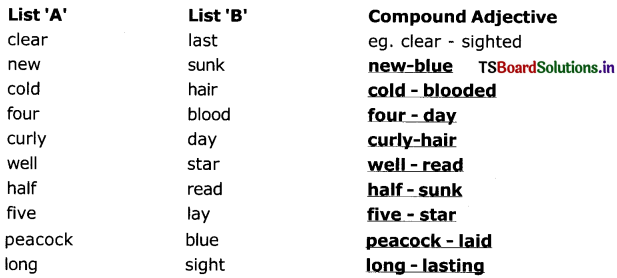
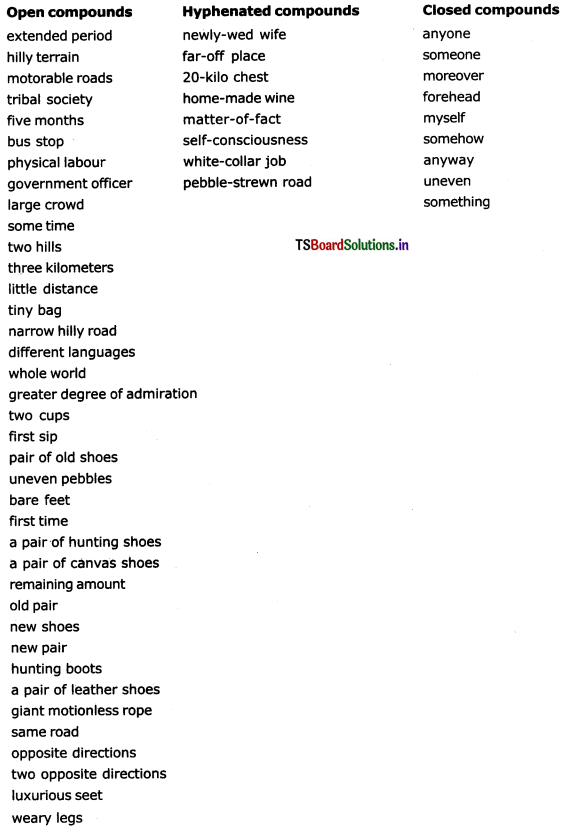
They are all compound words. A compound word is a union of two or more words to convey a unit idea or special meaning that is not as clearly or quickly conveyed by separated words. As shown above, compound words may be hyphenated, written open (as separate words), or written solid (closed). The use of compounding in English is an evolving process.

As expressions become more popular or adopt special meanings, they follow a gradual evolution from two or more separate or hyphenated words to single words.

TS 10th Class English Guide Unit 3A The Journey 2

The words in the first, second and third columns are called ‘open compounds’, ‘hyphenated compounds’ and ‘closed compounds’ respectively. In this unit we focus on hyphenated compounds.

A hyphenated compound is a combination of words joined by a hyphen or hyphens. Here, the hyphen aids understanding and readability and ensures correct pronunciation. Words are hyphenated mainly to express the idea of a unit and to avoid ambiguity.

A. Pick out all the compound words from the story and group them under the headings as explained above.

Compound words given in the story :
Extended period, newly-wed wife, far-off place, hilly terrain, motorable roads, tribal society, five months, bus stop, anyone, someone, physical labour, government officer, 20- kilo chest, large crowd, sometime, moreover, two hills, three kilometers, little distance, home-made wine, matter-of-fact, forehead, tiny bag, narrow hilly road, different languages, myself, self-consciousness, white-collar job, somehow, whole world, greater degree of admiration, anyway, physical labour, childhood, useless, two places, sometime, tea shop, each other, myself, anything, two cups, first sip, pair of old shoes, uneven, uneven pebbles, bare feet, first time, a pair of hunting shoes, a pair of canvas shoes, remaining amount, old pair, new shoes, new pair, hunting boots, a pair of leather shoes, something giant motionless rope, same road, opposite directions, two opposite directions, luxurious seat, weary legs, pebble-strewn road.

TS Board 10th Class English Guide Unit 3A The Journey

Categorisation:

TS 10th Class English Guide Unit 3A The Journey 3

TS Board 10th Class English Guide Unit 3A The Journey

Grammar:

I. In this story the author used the past perfect tense (had + past participle) in many sentences. If you observe the following sentences from the story and the rules given under them, you will understand why and how the past perfect tense is used.

1. It was 10.20 ……………….. My father had already left (para 6)
When an action takes place before a point of time in the past, the action is expressed in the past perfect tense. (Sometimes the point of time can be understood from the earlier sentences and other contextual clues.)

2. Finally we reached Dirang. The bus from Tawang had not yet reached Dirang. (para 11)
When two actions in the past are clearly separated by time, the earlier action is expressed in the past perfect tense.

3. I quickly sat down on a rock. My father laughed at my plight, (para 7)
When two actions in the past happen simultaneously, both of them are expressed in the past tense.

4. a) Sunitha never saw a bear before she was transferred to Maredumilli. (not from the story).
b) Shindh closed the doors because she heard loud noises from outside.
c) I never met him after I left India.
Normally, when the time relation is unambiguous, (by the use of before, after, because, etc.), the simple past (past perfect is optional) is used to refer to both past actions.

Identify the tense and give reasons for the use of the tense used.
1. I had come home this time round for a special purpose: to get married. My parents had arranged my marriage according to the customs of our tribal society.
2. Time flew, and five months into my marriage I realized it.
3. But after some dilly-dallying I finally decided against it because marriage had increased my responsibilities and I had got into debt.
4. On my way home from the bus stop my trunk had been carried by a porter. (para 3)
5. A large crowd gathered at our place the day I was to leave. People had come to wish me luck. (para 6)
6. Father was quiet for some time. He thoughtfully looked at the sun for a moment, and then his eyes fell on the can of home-made wine that I was carrying. (para 9)
7. I gave him the can of wine. He poured himself a mug and handed me the can. He drank all of it at one go. He then arranged the belt that was attached to the trunk carefully on his forehead. (para 10)
8. I had never got used to physical labour having stayed in hostels right from my childhood. (para 11)
9. His feet had developed cracks and somehow resembled those of an elephant, (para 14)
10. I noticed this for the first time. I hadn’t noticed that the road was uneven. (para 14)
11. I checked my wallet and saw I still had around Rs. 40 with me. (para 14)
12. I then took out my pair of leather shoes from the trunk, and noticed my father’s face lighting up with contentment. (para 15)
13. I saw that the road we had come by looked like a giant motionless rope. (para 16)
14. He stopped his business after he became old.
15. I never ate ‘haleem’ before I visited Hyderabad.
Answer:
1. When the narrator was narrating, he went into the past and narrated about them. These two actions had taken place before the narrator’s narration. Hence the two actions.
(i) “I had come home this time ……………. to get married”
(ii) “My parents had arranged my marriage according to the customs of our tribal society” are said in the past perfect tense, (had + v3).

Verbs in the past perfect tense :
(i) had come and
(ii) had arranged
In the two sentences given above, the past perfect tense (had + V3) is used as those two actions had already completed before the anthor’s narration.

TS Board 10th Class English Guide Unit 3A The Journey

2. “Time flew, and five months into my marriage I realized it.”
→ Here the two actions happened simultaneously in the past. Hence they are expressed in the past tense.
Verbs in the past tense :
(i) flew and
(ii) realized

3. “But after some dilly-dallying I finally decided against it because marriage had increased my responsibilities and I had got into debt.”
→ Here the actions,”…………………… marriage had increased my responsibilities and, “I had got into debt” had occurred before the narrator’s action, “I finally decided against it.” Hence the past perfect tense (had + v3) is used to denote the earlier actions and the simple past tense (v2) is used to denote the latter one.
Verbs in the past perfect tense : “had increased” and “had got”.
Verb in the simple past tense : decided

4. “On my way home from the bus stop my trunk had been carried by a porter.” (para 3)
→ The narrator, while narrating the story, went into past and narrated it. So, we understand that the above action had taken place in the past before the writer’s narration. Hence, the past perfect tense is used to denote the action. Verb in the past perfect tense : had been carried.

5. “A large crowd gathered at our place the day I was to leave. People had come to wish me luck” (para 6)
→ The above two actions occurred in the past one after another and they are clearly separated by time. Hence the earlier action, “People had come to wish me luck,” is expressed in the past perfect tense and the latter one, “A large crowd gathered at our place …………….” is expressed in the past tense.
Verb in the past perfect tense → had come
Verb in the simple past tense → gathered

6. “Father was quiet for sometime. He thoughtfully looked at the sun for a moment, and then his eyes fell on the can of home-made wine that I was carrying” (para 9)
→ All the three actions happened simultaneously in the past. Hence the simple past tense is used to express all the three actions.
Verbs in the simple past tense(v2) → was, looked, fell

7. “I gave him the can of wine. He poured himself a mug and handed me the can. He drank all of it at one go. He then arranged the belt that was attached to the trunk carefully on his forehead.” (para 10)
→ All the above actions occurred in the past simultaneously. Hence, the simple past tense(v2) is used to denote all the above actions.

TS Board 10th Class English Guide Unit 3A The Journey

Verbs in the simple past tense(v2) : gave, poured, handed, arranged
8. “I had never got used to physical labour having stayed in hostels right from my childhood.” (para 11)
→ Here the action had taken place before the narrator’s narration. Hence the past perfect tense (had got) is used to denote it.

Verb in the past perfect tense : “had got”
9. “His feet had developed cracks and somehow resembled those of an elephant.” (para 14)
→ Here the earlier action, “His feet had developed cracks ………………..” had taken place before
“……………. somehow resembled those of an elephant.” Hence the earlier action is expressed in the past perfect tence (had + v3) and the latter action is expressed in the simple past tense(v2).
Verb in the past perfect tense : “had developed”
Verb in the simple past tense : “resembled”.

10. “I noticed this for the first time. I hadn’t noticed that the road was uneven”, (para 14)
→ Here the earlier action, “I had not noticed that …………….” had taken place before the latter action, “I noticed this ”
Hence the past perfect tense (had + v3) is used to denote the earlier action and the simple past tense (v2) is used to denote the latter one.
Verb in the past perfect tense : ‘had noticed’
Verb in the simple past tense : ‘noticed’

11. “I checked my wallet and saw I still had around Rs. 40 with me.” (para 14)
→ All the actions in the above sentence occurred in the past simultaneously. Hence, the simple past tense(v2) is used to express the above actions.
Verbs in the past tense (v2) : checked, saw, had

12. “I then took out my pair of leather shoes from the trunk, and noticed my father’s face lighting up with contentment.” (para 15)
→ Here the two actions occurred in the past simultaneously. Hence, the simple past tense(v2) is used to denote the above actions.
Verbs in the simple past tense (v2) : took, noticed

13. “I saw that the road we had come by looked like a giant motionless rope.” (para 16)
“I saw that …………………” and “………………… looked like a giant motionless rope”
→ These two actions are the part of his narration and happened in the past. Hence the simple past tense (v2) is used to denote the expressions.
The expression, “…………….. we had come by ……………..”
had taken place earlier than the other actions in the sentence. Hence the past perfect tense (had + V3) is used to denote it.
Verbs in the past tense : saw, looked
Verb in the past perfect tense : had come

14. “He stopped his business after he became old.”
→ Here, the time relation is unambiguous and ‘after’ is used as the connective. Hence, the tense (v2) is used to refer to both past actions.
Verbs in the past tense : stopped, became

15. “I never ate ‘haleem’ before I visited Hyderabad.”
→ Here, the time relation is unambiguous and ‘before’ is used as the connective. Hence, the simple past tense(v2) is used to refer to both past actions.
Verbs in the past tense : ate, visited.

TS Board 10th Class English Guide Unit 3A The Journey

Writing:

I. In the story ‘The Journey’ the author says …………….” my education had made me shun physical labour”. This is an adverse effect of education. Now write an essay on ‘The Adverse Effects of Education’. Here are some points :
Effect on
doing some work that involves physical labour
dress / fashion
family relationships
giving respect to elders
the treatment of illiterate people
Answer:
The Adverse Effects of Education

There is no doubt; one’s education can give oneself the knowledge, the job, the status and the better way of living. Today, we need education to move up economically and socially. Most of the successful persons are educated ones. With education, one may achieve better benefits in life such as money, assets, the right kind of friends and soon.

One must possess education to know what is happening in the world around oneself. One must need educaton if one doesn’t want to be deceived. These are all some of the advantages of the education. This is only one side of the coin. Along with these advantages, we need to think about the adverse effects of education.

The first thing is that one’s education avoids oneself from doing physical labour. The educated fellows don’t think about the importance of the physical labour. They depend upon others for the things that involve physical labour. They feel that the whole world will laugh at them if they do some kind of work. They feel that it is shameful to do physical labour. In one way, they will face a lot of health problems with their attitude.

TS Board 10th Class English Guide Unit 3A The Journey

The second thing is that their dress sense. They want to wear fashionable dresses which are all a part of western culture. They don’t give any importance to our culture and they lead their lives without values. They want to be different from others and so they develop these kinds of habits. In fact, the dress sense of the modern youth will cause a threat to their existence. The number of incidents of molestation of the women are increasing day by day.

The next thing is that the adverse effect of the education on family relationships. The educated ones don’t show any affection for their family members especially the old ones. Their only aim is to make huge amounts of money. They forget the sacrifices made by their parents. When we see it from a different angle, the educated one doesn’t even find time to spend with one’s wife and children.

They don’t find time to move freely with their family members. In that way they are destroying the family relationships. The family is the main characteristic of our Indian society. The bond among the members of a family are very strong. But now, with their senseless thinking, the educated ones are causing a threat to family relationships.

The educated fellows are not giving respect to elders. Now, they are all westernised in their thoughts. The elders are nothing for them. They don’t give any kind of importance to them. Some of them even think that they are useless. They feel proud of their education.

The last thing is that their treatment of illiterate people. They look down upon the illiterate ones. They think that the illiterate ones are the people of second class. The literate ones are not treating the illiterate ones as human beings. In their view, the lives of the illiterate ones are meant for only physical labour.

These are all the adverse effects of one’s education. There may be many advantages with one’s education. But a learned person should not avoid physical labour. They should give importance to our culture and values. They should maintain proper family relationships. They should give respect to elders. They should treat the illiterate ones amicably. Then only, there is a meaning to their education.

TS Board 10th Class English Guide Unit 3A The Journey

Study Skills:

Scientists believe that we have various kind of intelligence. All intelligences are equally valuable and present in every individual, girl or boy, man or woman, though some intelligence is better developed than others in each one of us. Some of the intelligences have been detailed below.

There is also Naturalistic Intelligence- Love for animals, plants and Spiritual Intelligence – Belief in God, thinking about life and its purpose. Find out which intelligences are better developed in you, and which ones you would like to develop. Write down your findings as shown in the example after the table.

VISUAL INTELLIGENCEVERBAL INTELLIGENCEMATHEMATICAL INTELLIGENCE
You like to:

think in pictures, create mental images to remember things. You enjoy looking at maps, charts, pictures, videos, and movies.


You are good at:

puzzle building, reading, writing, understanding maps, charts and graphs, a sense of direction, sketching, painting, fixing or making objects, understanding pictures.


You can become a:

navigator, sculptor, artist, inventor, architect, interior designer, mechanic, engineer.

You like to:

use words and language. You speak well and think in words rather than pictures.


You are good at:

speaking, writing, story telling, listening, explaining, teaching, using humour, understanding the meaning of words, remembering information, convincing someone of your point of view.


You can become a:

poet, journalist, writer, teacher, lawyer, politician, translator.

You like to:

use reason, logic and numbers. Always curious about the world around, you ask lots of questions and like to do experiments.


You are good at:

problem solving, solving puzzles, experimenting, questioning and wondering about natural events, doing mathematics calculations, working with geometric shapes.


You can become a:

scientist, engineer, computer programmer, researcher, accountant, mathematician.

TS Board 10th Class English Guide Unit 3A The Journey

BODILY INTELLIGENCEMUSICAL INTELLIGENCEINTERPERSONAL INTELLIGENCE
You like to:

understand others. You control your body movements and handle objects skillfully. You have a good sense of balance and can catch or hit a ball well, and like to dance. You like to move around while learning.


You are good at:

dancing, physical coordination, sports, crafts, acting, miming, using your hands to create or build. You express emotions through your body.


You can become a:

dancer, athlete, physical education teacher, actor, firefighter, crafits-person.

You like to:

play and enjoy music. You think about sounds, rhythms and patterns. You immediately respond to music either appreciating or criticising what you hear.


You are good at:

singing, whistling, playing musical instruments, recognising tunes, composing music, remembering melodies, understanding the structure and rhythm of music.


You can become a:

musician, disc jockey, singer, composer.

You like to:

try to see things from other people’s point of view in order to understand how they think or feel. You are a good organiser and manage to get other people to cooperate and work as a team.


You are good at:

seeing things from others’ view, listening, understanding other people’s moods and feelings, solvingproblems, cooperating with groups, noticing people’s moods,communicating,building trust.


You can become a:

counsellor, salesperson, politician, business person, teacher.

TS Board 10th Class English Guide Unit 3A The Journey

Example:
I like to speak a lot and I enjoy music too. I am very good at telling a story. I am also good at remembering information as well as melodies. I understand the meaning of words, but I cannot understand maps and charts. Therefore, I have good verbal intelligence and musical intelligence though my visual intelligence is poor. I can become a writer, teacher, singer or a disc jockey.
Answer:
I like to use good and well furnished words, while speaking to others, that too in a convincing manner. I am good at assessing other people and coming to quick conclusions. I love questioning and appreciate others – in both ways, without hurting their feelings. I can mingle with others quiet easily. I can search my career in Counseling, Business, Teaching or as a trainer.

Listening:

Listen to the story and answer the questions that follow.

Once there was a very rich man. His name was Dhanaraju. He had two sons, Ganiraju and Pothuraju. Ganiraju was hard working and obedient. He always helped his father in the fields. But Pothuraju was lazy. He never went to fields. He was disobedient to his father. He always wanted to lead a free, lavish life, so one day he said to his father, “Father, give me my share of property.”

The father was heart-broken. He divided the property between his two sons. Pothuraju left home with his share. He went to a distant land, made a lot of friends and soon spent all his property lavishly on friends, food and drinks. All his friends left him.

At that time, there was a famine and Pothuraju had no work and food. None of his friends gave him food or money. He took up the job of feeding pigs. Sometimes, he had to eat the food kept for the pigs. He was very sad about his condition. He soon began to think of his father and his brother.

He said to himself, “In my father’s house, even the servants have enough food. They get good shelter too. But here, I am struggling for food and shelter. I will go back to my father. I will beg him to take me as his servant.”

So decided, the dishonest son set out for his father’s house. In the meantime, his father was always thinking of his second son. He would sit near the windows. He would look out at the road, expecting his son to return home.

One day Dhanaraju saw his son coming at a distance. He ran out of the house in great joy and hugged his son. His son knelt down. He said, “Father, I am not fit to be your son. Take me as your servant.”

TS Board 10th Class English Guide Unit 3A The Journey

I. Read the statements given below and mark True or False against each of them.

Question 1.
Pothuraju went to far-off lands to enjoy free life.
Answer:
True

Question 2.
Ganiraju asked his father to give his share of property.
Answer:
False

Question 3.
Pothuraju had a lavish life from the beginning.
Answer:
False

Question 4.
Dhanaraju did not care about Pothuraju.
Answer:
False

II. Which of the following is the most appropriate title for the story you have just listened to.
(a) A Rich Son
(b) Repentance
(c) Two Sons
Answer:
(b) Repentance

TS Board 10th Class English Guide Unit 3A The Journey

The Journey Summary in English

’The Journey1 is written by Yeshe Dorjee Thongchi and is translated by D. P. Nath. Yeshe Dorjee Thongchi is a prominent name in Assamese literature. In this lesson, the narrator tries to bring out some of the adverse effects of education and how the old people are ill-treated. He tries to present how human relations are affected by one’s education.

The narrator was a government officer and he came to his village that time to get married. He got married and spent six months at home. Though it was the time for his joining the duties, he didn’t want to return. He didn’t want to leave behind his newly-wed wife. At first, he wanted to extend his leave but decided against it because marriage had increased his responsibilities and he had got into debt.

The bus stop was a long way from his home and the problem for him was that he couldn’t find anyone who would help him carry his trunk to the bus stop. He thought that his education had made him avoid physical labour. He could have easily carried his luggage but the thought of people seeing him carry it stopped him from doing so. Finally, his father told him that he would carry his luggage upto bus-stop.

Though the narrator protested, his father decided to carry the chest. His father had started before him and a large crowd wished him luck at the time of his leaving. He walked speedily to catch up with his father. By the time he met his father, he was tired. His father laughed at him as he sat down on a rock. His father drank a mug of wine and they resumed their walk.

While they were walking, the narrator thought that it was improper for him to let father carry the luggage. He wanted to tell his father that he would like to carry the trunk himself but his guilt and shame did not allow him to do so. His education and his job made him think that the whole world would laugh at him if he carried the luggage.

According to the narrator, his parents had earned a greater degree of admiration and respect from the villagers because of him only. He thought that his father would not like to see him carrying luggage. Though he was young and strong, he was physically useless. Finally, they reached Dirang but the bus had not yet arrived. They entered a tea shop and ordered tea.

TS Board 10th Class English Guide Unit 3A The Journey

Then the narrator’s father asked him for a pair of old shoes. The narrator noticed that his father’s feet had developed cracks as he had never worn shoes. The narrator wanted to give his father money to buy a new pair of shoes but he protested. He didn’t want his son to spend money on new shoes. Hence, the narrator gave him his hunting boots and made his father happy.

The narrator got into the bus and it started moving. The narrator thought that their (the narrator and his fathre’s) journeys were in two opposite directions; his way was a luxurious one where as his father’s way was laborious and difficult one.

About the author:

Yeshe Dorjee Thongchi (born in May, 1952) is a prominent name in Assamese literature. Though he grew up in poverty, he studied well and entered Arunachal Pradesh Civil Service and was later elevated to the Indian Administrative Service. He writes fiction, drama and essays in Assamese and English. He has received a national recognition with his novel ‘Mouna Ounth Mukhar Hriday’, which won the Sahitya Academy award in 2005. Many of Thongchi’s novels, including Sonam, deal with the cultural life of the Monpa and the Sherdukpen tribes of Arunachal Pradesh.

TS Board 10th Class English Guide Unit 3A The Journey

Glossary:

lethargy (n) = the state of not having any energy or enthusiasm for doing things ;
creeps (v) = develops very slowly ;
dilly – dallying (v) = taking a long time to do something, go somewhere or make a decision ;
shun (v) = to avoid something or somebody ;
dissuade (v) = to convince somebody not to do something ;
plight (n) = a difficult and sad situation ;
guilt (n) = the unhappy feelings caused by knowing that you have done something wrong ;
self-consciousness = feelings of nervousness about what other people think of you ;
contenment (n) = a feeling of happiness or satisfaction;
weary (adj) = very tired ;
terrain (n) = strectch of land, with regard to its natural features ;
extend (v) = to continue for a longer period of time;
chest (n) = large strong box ;
see off (phr. v) = to say good bye ;
protest (v) = express dissapproval about;
catch up (phr.v) = reach ;
utter (v) = make a sound with the mouth ; say or speak ;
belittle (v) = make a person or an action seem unimportant or of little value ;
pebble (n) = small stone made smooth and round by the action of water;
bare foot (n)= without shoes or stocking ;
recede (v) = move back from a previous position or away from an observer
pebble – strewn road (phr.v) = the road covered with pebbles ;
white – collar job (n-phrase) = a job without physical labour.
admiration (n) = respect
wallet (n) = purse
contenment (n) = a feeling of satisfaction
uneven (adj) = rough
amusing (adj) = interesting

TS 10th Class Physical Science Important Questions Chapter 12 Carbon and its Compounds

These TS 10th Class Physical Science Chapter Wise Important Questions Chapter 12 Carbon and its Compounds will help the students to improve their time and approach.

TS 10th Class Physical Science Important Questions Chapter 12 Carbon and its Compounds

1 Mark Questions

Question 1.
What is allotropy’’
Answer:
An element exists in two or more different forms due to the difference in their atomic arrangement is called Allotrophy” and the different forms are called allotropes.

Question 2.
Explain briefly about the structure of ‘Diamond’.
Answer:

  1. In a diamond, each ‘c’ is surrounded by four other ‘c’ atoms.
  2. These are placed at the four corners of a regular tetrahedron.
  3. This results in a 3-dimensional network of carbon atoms.

Question 3.
Explain briefly about the structure of “Graphite”.
Answer:

  1. In graphite, each ‘c’ is surrounded by three other ‘c atoms.
  2. The ‘c’ atoms are arranged in layers.
  3. Each layer consists of a 2-dimensional hexagonal network.

Question 4.
“Diamond is an extremely bad conductor of electricity.” Why?
Answer:

  • In a diamond, each carbon atom is covalently bonded with four other carbon atoms.
  • So, the four outermost electrons of a carbon atom are engaged or trapped in the covalent bonds, having no free electrons makes it a bad conductor of electricity.

Question 5.
What is an alkyl group’
Answer:
If one hydrogen is removed from an alkane, it is called alkyl group.
Eg : CH4 → methane
CH3 → methyl group

Question 6.
What is the bond length in diamond?
Answer:
The C – C bond length In diamond is 1.54 Å.

TS 10th Class Physical Science Important Questions Chapter 12 Carbon and its Compounds

Question 7.
What is polymerization?
Answer:
The reaction In which a large number of identical and simple molecules Join together to form a large molecule is called “Polymerization.
TS 10th Class Physical Science Important Questions Chapter 12 Carbon and its Compounds 1

Question 8.
Name some functional groups.
Answer:
TS 10th Class Physical Science Important Questions Chapter 12 Carbon and its Compounds 2

Question 9.
What is the bond angle in diamond?
Answer:
The bond angle in diamond is 109° 28′.

Question 10.
What is the C-C bond length in graphite?
Answer:
The C-C bond length in graphite is 1.42 A.

Question 11.
What is the bond angle in graphite?
Answer:
The bond angle in graphite is 120°.

Question 12.
What is hydrocarbon?
Answer:
Compounds containing only carbon and hydrogen are called hydrocarbons.
Eg: Alkanes (Saturated hydrocarbons)
Alkenes and Alkynes (unsaturated hydrocarbons)

Question 13.
What are saturated hydrocarbons? (or) What are alkanes?
Answer:
The valency of the carbon is four 4, of all the valencies of carbon are satisfied, the resultant hydrocarbons are refer to as saturated hydrocarbons or Alkanes. They general formula is CnH2n+2.

Question 14.
What are unsaturated hydrocarbons?
Answer:
The hydrocarbons containing one or more double bonds or triple bonds between two carbon atoms are called “Unsaturated hydrocarbons.
Eg: C2H6 and C3H6 etc.

TS 10th Class Physical Science Important Questions Chapter 12 Carbon and its Compounds

Question 15.
What are alkanes? Write the general formula of alkenes. Give an example for alkenes.
Answer:
Alkenes: Hydrocarbons containing at least one double bond between carbon atoms are called Alkenes (>C=C<)
General formula: CnH2n
Examples : Ethene (C2H4, Propene (C3H6)

Question 16.
What are Alkynes?
Answer:
Alkynes are unsaturated hydrocarbons having at least (CC) triple bonds In these structures. Their general formula is CnH2n-2.
Eg: Acetylene (HC ≅ CH)

Question 17.
What is Homologous series?
Answer:
A series of compounds in which the same functional group substitutes for hydrogen in a carbon chain is called a homologous series.

Question 18.
Give the names of the functional group.
Answer:
(i) – CHO- Aldehyde
TS 10th Class Physical Science Important Questions Chapter 12 Carbon and its Compounds 3
(iii) – OH – Alcohol
(iv) – COOH – Acid (carboxylic acid)

Question 19.
What do you mean by a functional group?
Answer:
The characteristic properties of an organic compound depend mainly on an atom or group of atoms In its molecule known as the ‘functional group’, Functional group is responsible for the behavior of the organic compounds.

Question 20.
What is the difference between two successive homologs?
Answer:
Successive compounds in a homologous series possesses a difference of (CH3) unit and are called homologs.

Question 21.
Write the structure of 3 – bromo – 2 – chloro – 5 0x0 hexanoic acid.
Answer:
TS 10th Class Physical Science Important Questions Chapter 12 Carbon and its Compounds 4

Question 22.
Why graphite is a good conductor of electricity?
Answer:
Graphite Is a good conductor of electricity because of the delocalized π electron system.

Question 23.
What are the uses of fullerenes?
Answer:
Fullerenes are under study for potential medicinal use such as specific antibiotics to target resistant bacteria and even target certain cancer cells such as melanoma.

TS 10th Class Physical Science Important Questions Chapter 12 Carbon and its Compounds

Question 24.
What are oxidizing agents?
Answer:
Oxidizing agents or oxidants are substances that oxidize other substances.

Question 25.
Why do we call alkanes as paraffins?
Answer:
Alkanes are saturated hydrocarbons with least reactivity. Therefore they are called paraffins (Parum = little: affine affinity).

Question 26.
Write two uses of Ethanol In day-to-day life.
Answer:
Ethanol is used in

  • Preparation of Alcoholic drinks
  • Preparing tincture iodine
  • Preparing cough syrup and tonics

Question 27.
What is the use of ethanol ¡n motors?
Answer:
If we add 10% ethanol to gasoline it will act as very good motor fuel.

Question 28.
What is a colloidal solution?
Answer:
If the diameter of dispersed phase Is greater than 1 nm but less than 1000 nm in a dispersed medium such a solution Is called colloidal solution.

Question 29.
Other than carbon which elements show catenation?
Answer:
Sulphur, phosphorus, and silicon.

Question 30.
What are the other names given to open-chain hydrocarbons?
Answer:
Open-chain hydrocarbons are also called as aliphatic hydrocarbons or acyclic hydrocarbons.

Question 31.
Expand IUPAC.
Answer:
International Union of Pure and Applied Chemistry.

Question 32.
Name the following compound.
TS 10th Class Physical Science Important Questions Chapter 12 Carbon and its Compounds 5
Answer:
2, 3 – dimethyl – cyclo hexane- 1 – ol

Question 33.
How do you appreciate the role of diamonds In space probes?
Answer:
Since it has the ability to filter out harmful radiation, it is used in making protective windows for space probes.

Question 34.
How do you appreciate the role of diamonds in surgery?
Answer:
A sharp-edged diamond is used as a tool to remove cataracts In eye surgery.

Question 35.
How do you appreciate the role of oxygen in combustion process?
Answer:

  1. When the oxygen supply is insufficient then the fuels burn incompletely Hoducing mainly a yellow flame.
  2. When the oxygen supply is sufficient then the fuels burn completely producing
    a blue flame.

Question 36.
How do you appreciate the role of Ethanol as a fuel?
Answer:

  1. A material which Is burnt to obtain heat is called a fuel. Since ethanol burns with a clear flame giving a lot of heat, it is used as a fuel.
  2. Some countries add ethanol to petrol to be used as a fuel in cars. Thus ethanol is used as an additive in petrol.
  3. Ethanol alone can also be used as a fuel for cars.

Question 37.
How do you appreciate the role of active acid as a preservative?
Answer:

  1. Dilute acetic acid Is used as a food preservative In the preparation o! pickles and sauces.
  2. As vinegar, it is also used as an appetizer for dressing food dishes.

Question 38.
How do you detect leakage in the cylinder?
Answer:

  • To detect any leakage of gas from the cylinder a strong-smelling substance like ethyl mercaptan (C2H5SH) Is added to the gas.
  • Then the leakage can be easily detected by the foul smell of the ethyl mercaptan.

Question 39.
What are nanotubes?
Answer:
Nanotubes are allotropic form of carbon.

TS 10th Class Physical Science Important Questions Chapter 12 Carbon and its Compounds

Question 40.
Write the molecular formula of the fourth member of the homologous series of alcohols.
Answer:
CH3– CH2– CH2 – CH2– OH

Question 41.
What is a catalyst?
Answer:
The substance which does not take part In chemical reaction but changes the rate of reaction is called a catalyst.

Question 42.
Why oils are in liquids at room temperature?
Answer:
Oils are unsaturað compounds so they are In liquid state.

Question 43.
Why fats are solids at room temperature?
Answer:
They are saturated compounds so they are in solid state.

Question 44.
Do you know the police detect whether suspected drivers have consumed alcohol or not? Explain.
Answer:
Orange Cr2O72- changes bluish-green Cr3+ during the process Of the oxidation of alcohol. The Ieiqth of the tube that turned into green is the measure of the quantity of alcohol that had been drunk.

Question 45.
What is pica?
Answer:
The negative value of logarithm of dissociation constant of an acid.

Question 46.
Name the gas evolved when acetic acid is react with sodium hydrogen carbonate.
Answer:
The gas liberated is carbon dioxide.

Question 47.
Name the organic add present In vinegar – write Its chemical formula.
Answer:
The acid present In vinegar is acetic acid. its formula is CH3COOH.

Question 48.
What change will you observe If you test soap with litmus papers?
Answer:
Red litmus turns into blue.

TS 10th Class Physical Science Important Questions Chapter 12 Carbon and its Compounds

Question 49.
Write the valency of carbon In CH3– CH3, CH2 = CH2, and HC ≅ CH?
Answer:
The valency of carbon in CH3– CH3, is 4.
The valency of Carbon in CH2 = CH2 is 3.
The valency of carbon In HC ≅ C – H is 2.

Question 50.
Out of butter and ground nut oil which Is unsaturated In nature?
Answer:
Ground nut oil is unsaturated In nature.

Question 51.
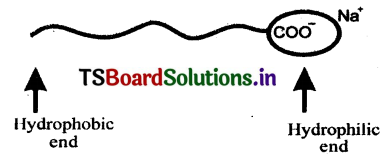
What are hydrophobic and hydrophilic parts in soap?
Answer:
TS 10th Class Physical Science Important Questions Chapter 12 Carbon and its Compounds 6

Question 52.
Name the carboxylic acid used as preservation.
Answer:
Acetic acid used as preservative.

Question 53.
Write two uses of nanotubes.
Answer:

  1. Nanotubes are used to connect the components of integrated circuits instead of copper.
  2. Biomolecules are inserted into nanotubes to inject them into a single cell.

2 Marks Questions

Question 1.
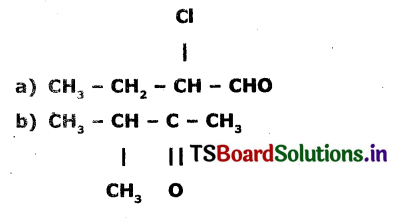
Identify the functional groups In the following compound arid write IUPAC names.
TS 10th Class Physical Science Important Questions Chapter 12 Carbon and its Compounds 7
Answer:
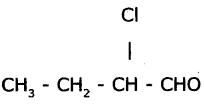
a) The functional group present In TS 10th Class Physical Science Important Questions Chapter 12 Carbon and its Compounds 8 is aldehyde.
The IUPAC name of the compound is 2 – Chloro-Butan- 1 – ol.
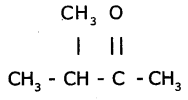
b) The functional group present in TS 10th Class Physical Science Important Questions Chapter 12 Carbon and its Compounds 9 is ketone.
The TUPAC name of the compound is 3- Methyl-2-Butanone.

Question 2.
What are alkenes?
Answer:
Alkenes are unsaturated hydrocarbons having at least one(C=C) double bond in these structures. Alkenes are also called olefins. Their general formula is Cn– H2n Eg: Ethylene (C2H4) and propene (C3-H6) etc.

TS 10th Class Physical Science Important Questions Chapter 12 Carbon and its Compounds

Question 3.
Which of the following compounds are unsaturated? Justify your answer.
(a) CH3-CH2-CH3
(b) CH3 – CH = CH2
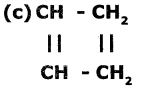
TS 10th Class Physical Science Important Questions Chapter 12 Carbon and its Compounds 10
(d) HC ≅ C – CH = CH2
TS 10th Class Physical Science Important Questions Chapter 12 Carbon and its Compounds 11

Answer:
a and f are saturated hydrocarbons because they have only single bonds. Remaining are unsaturated hydrocarbons as they have double or triple bonds.

Question 4.
What are hydrophilic and hydrophobic parts In soaps? (AS1)
Answer:
The polar end in soap with carboxy TS 10th Class Physical Science Important Questions Chapter 12 Carbon and its Compounds 12 is called hydrophilic end. The non-polar end ¡n soap with hydrocarbon chain is called hydrophobic end.
TS 10th Class Physical Science Important Questions Chapter 12 Carbon and its Compounds 13

Question 5.
What is the order to be followed while naming carbon compounds?
Answer:
The following order is to be followed while naming carbon compounds. Numbers-Numerical Prefixes-Secondary Prefix-Primary Prefix-Word Root-
TS 10th Class Physical Science Important Questions Chapter 12 Carbon and its Compounds 14

Question 6.
Explain addition reactions.
Answer:
Unsaturated organic compounds that contain multiple bonds like alkenes and alkynes became saturated by addition of a reagent are called addition reactions. During the reactions addition of the reagent takes place at the double-bonded or triple-bonded carbon atoms.
TS 10th Class Physical Science Important Questions Chapter 12 Carbon and its Compounds 15

Question 7.
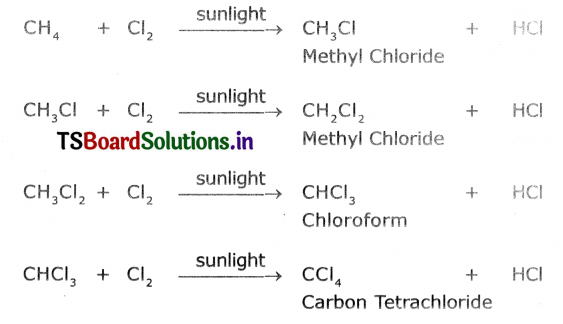
What type of reaction takes place between ethane and chlorine?
Answer:
Substitution reaction takes place between ethane and chlorine In the presence of sunlight.
CH4 + Cl2 → CH3Cl + HCl
CH3Cl+ Cl2 → CH2Cl2 + HCl
CH2Cl2 +Cl2 → CHCl3 + HCl
CHCl3 + Cl2 → CCl4 + HCl

TS 10th Class Physical Science Important Questions Chapter 12 Carbon and its Compounds

Question 8.
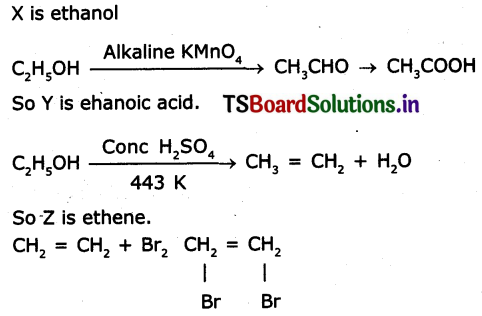
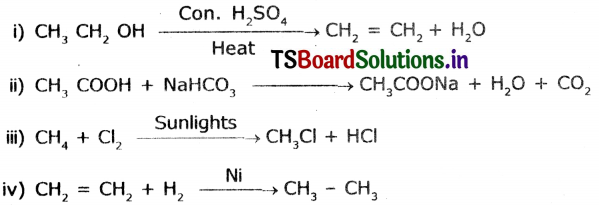
An organic compound X with a molecular formula C2H6O undergoes oxidation with in presence of alkaline KMnO4 to form a compound y. X on heating in presence of con. H2SO4 at 443 k gives Z. Which on reaction with Br2 and decolorizes, It. Identity X, Y, and Z write the reactions involved.
Answer:
TS 10th Class Physical Science Important Questions Chapter 12 Carbon and its Compounds 16

Question 9.
How synthetic detergents are harmful for environment?
Answer:

  1. Some synthetic detergents resist biodegradation, i.e., they are not decomposed by microorganisms such as bacteria.
  2. Hence, they cause water pollution In lakes and rivers.
  3. They tend to persist for a long time, making the water unfit for aquatic life.

Question 10.
Write the reactions of Ethanol with sodium and conc. H2SO4
Answer:

  1. Ethanol reacts with sodium metal to liberate hydrogen and forms sodium ethanoxide.
    2C2H5OH + 2Na → 2C2H5ONa + H2
  2. Ethanol reacts with conc. H2SO4 at about 170°C to give ettiene.
    CH3CH2OH CH2 = CH2 + H2O

Question 11.
Write the reactions of Ettianoic acid with metals, metal hydroxide, metal carbonates, and metal hydrogen carbonates.
Answer:
1. ReactIon of ethanoic acid with metal: Ethanoic add reacts with active metals like Na to liberate hydrogen.
2CH3COOH + 2Na → 2CH3COONa + H2

2. Reaction of ethanoic acid with metal hydroxide: Ettianoic acid reacts with NaOH to form salt and water.
CH3COOH + NaOH → CH3COONa + H2O

3. Reaction of ethanoic acid with metal carbonates and metal hydrogen carbonates: Ethanoic acid reacts with sodium carbonate and sodium hydrogen carbonate and liberates CO2
2CH3COOH + Na2CO3 → 2CH3COONa + H2O + CO2
CH3COOH + NaHCO3 → CH3COONa + H3O + CO2

4 Marks Questions

Question 1.
Draw the structures of Isomers of butane.
Answer:
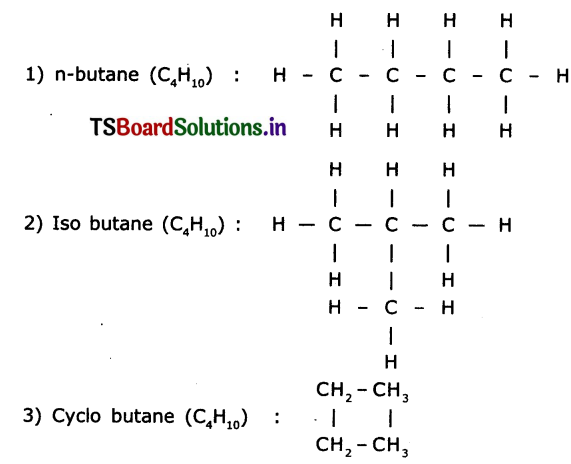
Isomers of butane are n-butane, isobutane and cyclobutane Structures:
TS 10th Class Physical Science Important Questions Chapter 12 Carbon and its Compounds 17

Question 2.
explain the Isomerism and Catenation properties of Carbon.
Answer:
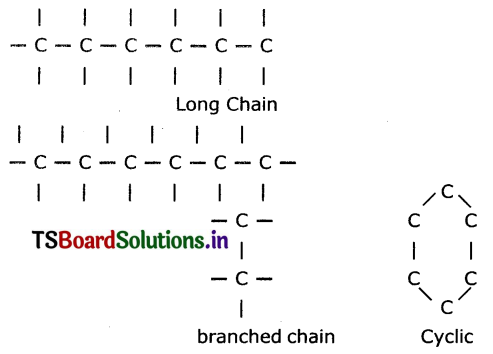
Catenation properties of carbon :
(i) Carbon has ability to form longest chains with its own atoms. This special property of carbon is called catenation.
(ii) Due to catenation property of carbon it can form largest chain containing millions of carbon atoms, branches and acidic compounds.
TS 10th Class Physical Science Important Questions Chapter 12 Carbon and its Compounds 18
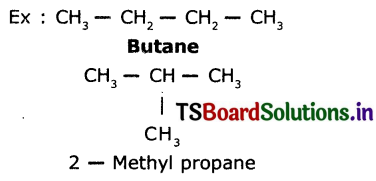
Isomerism of carbon: The phenomenon of possessing some molecular formula but different properties by the compounds is known as isomerism.
TS 10th Class Physical Science Important Questions Chapter 12 Carbon and its Compounds 19
The molecular formula of above two molecules is C4H10 but they have different structures.
These two are isomers
By there two special properties of carbon it can make number of compounds.

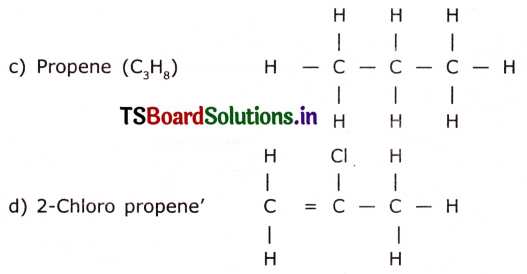
Question 3.
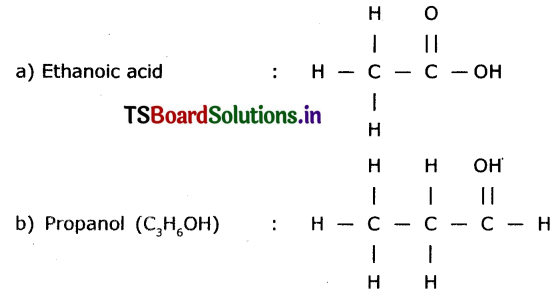
Draw the structures of the following.
a) Ethanoic acid
b) Propanol
c) Propene
d) Chloro propene
Answer:
Structures
TS 10th Class Physical Science Important Questions Chapter 12 Carbon and its Compounds 20
TS 10th Class Physical Science Important Questions Chapter 12 Carbon and its Compounds 21

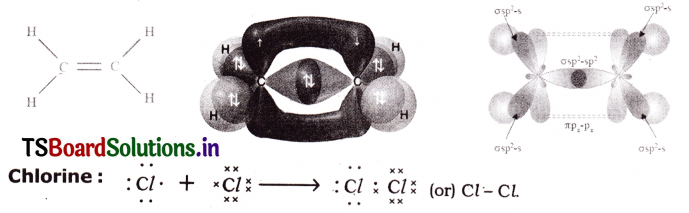
Question 4.
Draw structure of Ethane and electron dot structure of Chlorine.
Answer:
Ethane:
TS 10th Class Physical Science Important Questions Chapter 12 Carbon and its Compounds 22

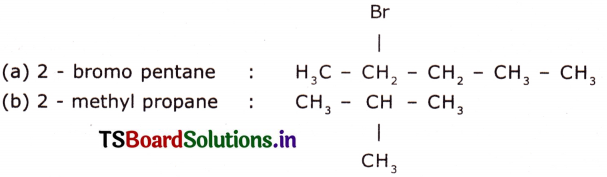
Question 5.
Draw the structures of the following compounds.
(a) 2 – Bromo pentane
(b) 2 – methyl propane
(c) butanol
(d) 1-hexine
Answer:
TS 10th Class Physical Science Important Questions Chapter 12 Carbon and its Compounds 23
(c) butanol : CH3 – CH2 – CH – CHO
(d) 1 – hexine : CH3 – CH2 – CH2 – CH2 – C ≅ C – H

TS 10th Class Physical Science Important Questions Chapter 12 Carbon and its Compounds

Question 6.
Draw the electron dot structures of Ethanoic acid and Ethyne (Acetylene)
Answer:
Ethanoic acid (Acetic acid):
TS 10th Class Physical Science Important Questions Chapter 12 Carbon and its Compounds 24

Question 7.
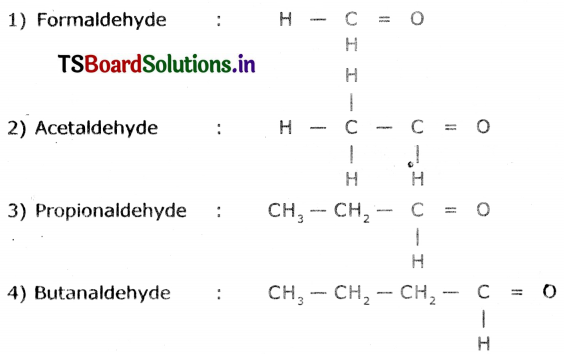
Write the molecular formula of the first tour compounds of the homologous series of aldehydes.
Answer:
Homologous series of aldehydes are Formaldehyde, Acetaldehyde. Propionaldehycie arid Butanaidehyde.
TS 10th Class Physical Science Important Questions Chapter 12 Carbon and its Compounds 26

Question 8.
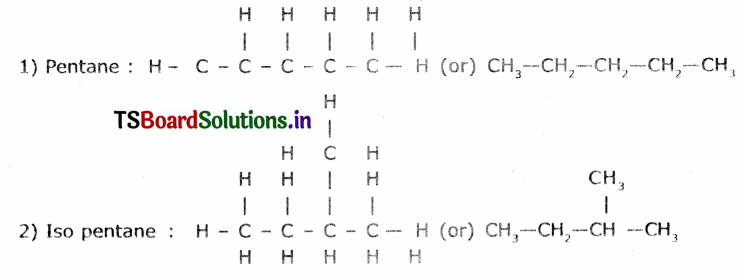
How many Isomers can be drawn for pentane with molecular formula C5H12? What are they? Draw their structures and mention their common names.
Answer:
Isomers of pentane are three. These are

  1. Pentane
  2. Iso pentane
  3. Neo pentane.

Structures:
TS 10th Class Physical Science Important Questions Chapter 12 Carbon and its Compounds 27

Question 9.
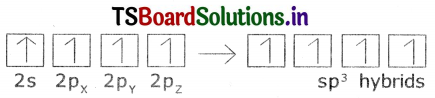
Explain sp3 hybridization In methane.
Answer:
The excited carbon atom allows use S-orbital. (2s) and three p-orbitals (2px,
2py, 2pz) to intermix and reshuffle Into four identical orbitals known sp3 orbitals. Thus carbon atom undergo sp3 hybridization. The four electrons enter into the new four identical orbitals known as sp3 orbitals, one each as per Hund’s rule.
TS 10th Class Physical Science Important Questions Chapter 12 Carbon and its Compounds 29
1. Since carbon has four unpaired electrons, t is capable of forming bonds with four other atoms.
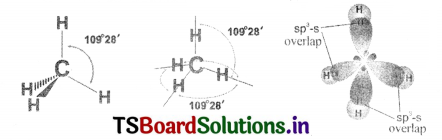
2. When carbon reacts with hydrogen, four hydrogen atoms allow their ‘s’ orbitals containing one electron each to overlap with four sp3 orbitals of carbon-atom which are oriented at an angle of 109°. 28′.
3. Four orbitals of an atom in the outer shell orient along the four comers of a tetrahedron to have minimum repulsion between their electrons. The nucleus of the atom is at the centre of the tetrahedron.
4. This leads to form four sp3 – s – sigma bonds between carbon atom and four hydrogen atoms. All these bonds are of equal energy.
TS 10th Class Physical Science Important Questions Chapter 12 Carbon and its Compounds 30

Question 10.
Explain sp2 Hybridisation with an example.
Answer:
Consider ethene molecule
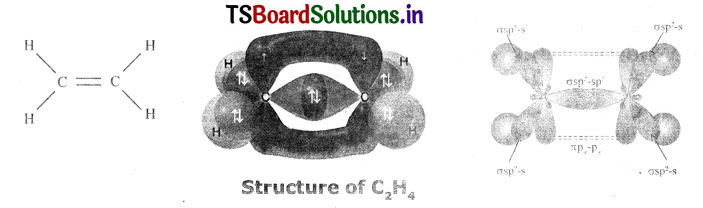
TS 10th Class Physical Science Important Questions Chapter 12 Carbon and its Compounds 31

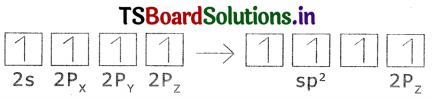
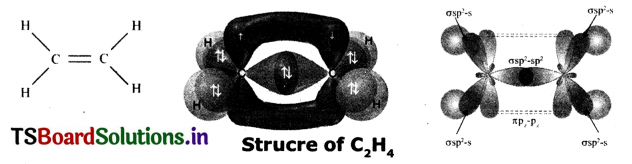
  1. In the formation of CH2 = CH2 each carbon atom in its excited State undergoes sp2 hybridization by Intermixing one s-orbital (2s) and two p-orbitals (say 2px and 2py) and reshuffling to form three sp2 orbitals.
  2. Now each carbon atom Is left with one ‘p’ orbital (say 2Pz) subsidized.
  3. The three sp2 orbitals having one electron each get separated around the nucleus of carbon atoms at an angle of 120°.
  4. When carbon Is ready to form bonds one sp2 orbital of one carbon atom overlaps the sp2 orbital of the other carbon atom to form sp2 – sp1 sigma (s) bond.
  5. The remaining two sp2 orbitals of each carbon atom get overlapped by ‘s’ orbitals of two hydrogen atoms containing unpaired electrons.
  6. The unhybridized pz orbitals on the two carbon atoms overlap laterally as shown in figure to form π bond.
  7. Hence, there exists a sigma (σ) bond and a pi (π) bond between two carbon atoms In ethene molecule. Hence, the structure of molecule ethane (C2H4)

TS 10th Class Physical Science Important Questions Chapter 12 Carbon and its Compounds 32

Question 11.
Explain sp hybridisation.
Answer:

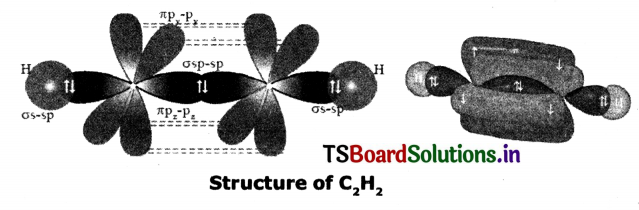
  1. Each carbon is only Joining to two other atoms rather than tour or three.
  2. Here the carbon atoms hybridise their outer orbitals before forming bonds, this time they only hybridise two of the orbitals.
  3. They use the ‘s’ orbital (2s) and one of the sp orbitals, by leave the other 2p orbitals unchanged.
  4. The new hybrid orbitals formed are called sp-hybrid orbitals because they are made by an s-orbital and a p-orbital reorganizing themselves.

Question 12.
Define substitution reaction and give an example
Answer:
A reaction in which one atom or a group of atoms in a given compound is replaced by other atom or group of atoms is called a substitution reaction. Alkanes undergo substitution reactions. Exampler Methane (CH4) reacts with chlorine in the presence of sunlight.
TS 10th Class Physical Science Important Questions Chapter 12 Carbon and its Compounds 33

TS 10th Class Physical Science Important Questions Chapter 12 Carbon and its Compounds

Question 13.
Give next Homologs of the following compounds and also give structure formula and name. (1) HCHO (2) CH3OH
Answer:

HornologFormulaName
CH3CHOC2H4OEthanal
CH3CH2CHOC3H6OPropanal
CH3CH2CH2CHOC4H8OButanal
CH3CH2CH2CH2CHOC5H10OPentanal

Question 14.
Write the IUPAC names of the following compounds. (AS1)
i) CH3 – CH0 – CH2 – CH2 – CH2 – CH2 – CH2 – CH2CH2OH
ii) CH3 – CH2 – CH = CH2 – C ≅ CH
iii) CH3 – CH2– CH2– CH2 – CHO
iv) CH3 – CH2 – CH2 – CH2 – COOH
Answer:
1) nananol
2) 4 – ene 1 hexyne
3) pentanol
4) pentanoic acid

Question 15.
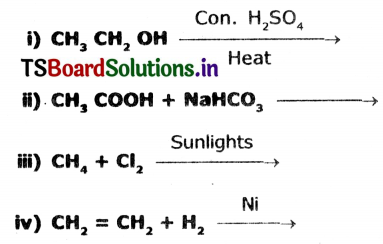
Complete the following reactions.
TS 10th Class Physical Science Important Questions Chapter 12 Carbon and its Compounds 34
Answer:
TS 10th Class Physical Science Important Questions Chapter 12 Carbon and its Compounds 35

Question 16.
Draw the electronic dot structure of ethane molecule.
Answer:
TS 10th Class Physical Science Important Questions Chapter 12 Carbon and its Compounds 36

Question 17.
Draw the structure of the following compounds.
Answer:
TS 10th Class Physical Science Important Questions Chapter 12 Carbon and its Compounds 37

Question 18.
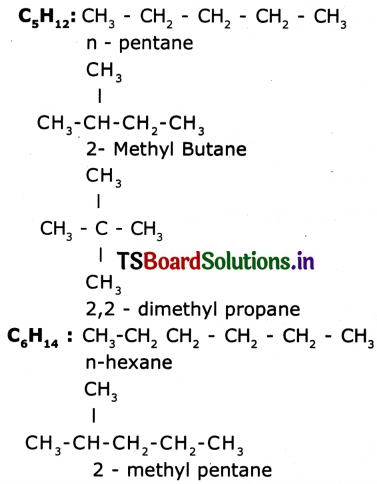
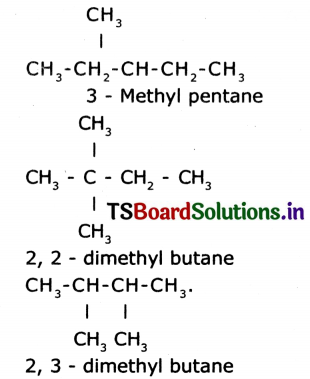
Draw various structures of (a) C5H12 (b) C6H14.
Answer:
TS 10th Class Physical Science Important Questions Chapter 12 Carbon and its Compounds 38
TS 10th Class Physical Science Important Questions Chapter 12 Carbon and its Compounds 39

Question 19.
Draw the structuie of butanoic acid C3H7COOH.
Answer:
Formula of butanoic acid is C4H8O2.
Structure:
TS 10th Class Physical Science Important Questions Chapter 12 Carbon and its Compounds 40

Question 20.
Draw the diagram showing sp2 hybridization In Ethene.
Answer:
TS 10th Class Physical Science Important Questions Chapter 12 Carbon and its Compounds 41

Question 21.
Draw the diagram showing sp hybridisation in Ethyne.
Answer:
TS 10th Class Physical Science Important Questions Chapter 12 Carbon and its Compounds 42

Question 22.
List out the materials required to conduct the experiment to understand the esterification reaction. Explain the procedure of the experiment. How can you identify that an ester is formed In this reaction?
Answer:
Materials required:
Test tube, beaker, water, burner wire gauze, tripod stand, 1ml. of ethanol, 1ml of glacial acetic acid, and few drops of conc. H2SO4
TS 10th Class Physical Science Important Questions Chapter 12 Carbon and its Compounds 43
1) Take 1 ml of ethanol and imI of glacial acetic acid along with a few drops of concentrated sulphuric acid in a test tube.
2) Warm It In a water bath or a beaker containing water for at least 5 minutes as shown in fig.
3) Pour the warm contents into a beaker containing 20-50 ml of water and observe the odour of the resulting mixture.

Observation: The resulting mixture is a sweet odoured substance. This substance Is ester. This reaction is esterification, Ester is a sweet-smelling compound. We can identify an ester by its sweet smelling.

TS 10th Class Physical Science Important Questions Chapter 12 Carbon and its Compounds

Do You Know?

1. Linus Pauling – The world’s one of the greatest scientist and a great humanist. He was acknowledged as the most influential chemist. He is the only person ever to receive two unshared Nobel Prizes – for Chemistry(1954) and for Peace (1962). (Page 255)
TS 10th Class Physical Science Important Questions Chapter 12 Carbon and its Compounds 44

2. The buckminsterfullerene, or usually just fullerene for short, was discovered in 1985 by a team of scientists, Robert F. Curl, Harold W. Kroto, and Richard E. Smalley from Rice University and the University of Sussex, three of whom were awarded the 1996 Nobel Prize in Chemistry. They are named so for the resemblance of their structure to the geodesic structures devised by the scientist and architect Richard Buckminster “Bucky” Fuller. (Page 261)

3. Graphene: The new wonder material: As its name indicates, graphene is extracted from graphite, the material used in pencils. Like graphite, graphene is entirely composed of carbon atoms. For a thickness of 1mm, graphite contains some 3 million layers of graphene. The carbons are perfectly distributed in a hexagonal honeycomb formation only in 0.3 nanometers thickness. Graphene conducts electricity better than copper. It is 200 times stronger than steel but six times lighter. It is almost perfectly transparent to light. (Page 263)
TS 10th Class Physical Science Important Questions Chapter 12 Carbon and its Compounds 45

4. Wohier Friedrich (1800 – 1882): German Chemist who was a student of Berzelius In attempting to prepare ammonium cyanate from silver cyanide and ammonium Chloride. he accidentally synthesized urea in 1828. This was the lust organic synthesis and shattered the vitalism theory.
TS 10th Class Physical Science Important Questions Chapter 12 Carbon and its Compounds 46

Wohier pursued the matter further and discoiered that urea and ammonium cyanate had the same chemical fo.rnula, but very different chemical properties. This was an early discovery of Isomerism since urea has the formula CO(NH2)2 and ammonium cyanate has the formula NH4CNO. (Page 264)

5. We may compare amines to as we have done RON and R – 0 – R’ to H2O. If one Hydrogen Atom is replaced from NH3 by an alkyl group we get primary amines. If two hydrogen atoms of NH3 are replaced by two alkyl groups (same or different) we get secondary amines and if all the three hydrogen atoms are replaced by the same or different alkyl groups we get tertiary amines. (Page 269)

TS 10th Class Physical Science Important Questions Chapter 12 Carbon and its Compounds

6. The police officer asks the suspect to blow air Into a plastic bag through a mouthpiece of the detecting instrument which contains crystals of potassium di-chromate (K2Cr2O7). As K2Cr2O7 is a good oxidizing agent, it oxidizes any ethanol in the driver’s breath to ethanoic acid, Orange Cr2O72- changes to bluish-green Cr3+ during the process of the oxidation of alcohol The length of the tube that turned into green is the measure of the quantity of alcohol that had been drunk. Nowadays police are using even an electronic Instrument containing small fuel cell that measures the electrical signal produced when ethanol is in the breath is oxidized. The police even use the IR Spectra to detect the bonds C – OH and C – H of CH3– CH2OH. (Page 283)

TS 10th Class English Guide Unit 2C The Brave Potter

Telangana SCERT TS 10th Class English Guide Pdf Unit 2C The The Brave Potter Textbook Questions and Answers.

TS 10th Class English Guide Unit 2C The Brave Potter

Comprehension:

I. Answer the following questions briefly.

Question 1.
What did the tiger think the mysterious creature was? Why did he allow himself bound around the neck with a thick rope?
Answer:
The tiger thought that the mysterious creature was the ‘leak’. When the tiger heard the woman in the hut saying that the leak was very terrible and she would rather meet a tiger in the forest than have that leak in her house. He thought that the ‘leak’ must be a very dangerous and strong animal. When the sleeping tiger felt heavy blows fall upon his head and shoulders, the old tiger shivered with fright.

The tiger thought that it must be the leak who had come out of the hut. The tiger also thought that the leak would kill him if he wouldn’t do as it said. So, he allowed himself bound around the neck with a thick rope.

TS Board 10th Class English Guide Unit 2C The Brave Potter

Question 2.
What made the potter angry? What made him more angry?
Answer:
When the storm began, the potter suddenly remembered that he had left his donkey tied under a tree. He rushed out of his hut to take the donkey into the stable. But he found no donkey but its chain there . It made him angry.

Question 3.
Why did the king make the potter the General of the army?
Answer:
A war broke out between the potter’s country and a much stronger neighbour. The king realized that his army was not strong enough to save his country from defeat. He needed a hero to lead his army. One of his ministers remembered the story of the brave potter. He told the king about the bravery of the potter. Immediately the king sent for the potter. The potter went to the palace and the king was pleased to see him and made him the General of the army.

Question 4.
Why did you think the sentry feels that the potter is a giant?
Answer:
The sentry saw the potter galloping towards the camp with a tree in one hand and his reins in the other. The sentry thought that he must be the General who had captured a tiger with his bare hands. It was impossible for any ordinary man to uproot a tree with only one hand. Hence the sentry feels that the potter was a giant.

TS Board 10th Class English Guide Unit 2C The Brave Potter

Question 5.
Do you think the potter is really brave or lucky? Give your reasons.
Answer:
I think the potter is really lucky. It has been proved with the two incidents he faced. When we consider the tiger’s incident, he did not notice the difference between the donkey and a tiger as he was drunk. He rode the tiger home without knowing that he was riding a tiger. The tiger too was frightened when it felt heavy blows. It thought that the creature might be the ‘leak’.

The frightened tiger wanted to do as he said. Thus the tiger allowed him to tie it up with the iron chain. When we consider the horse- riding incident, the potter even didn’t know how to ride a horse. He made himself tie him to the horse and the horse started galloping with impatience. He couldn’t control it though he came to know that it was heading towards the enemy camp. To make the horse stop, the potter grabbed a branch of a young tree but it didn’t stop.

A sentry from the enemy camp saw the potter galloping towards the camp with a tree in one hand and his reins in the other. The sentry thought that he must be the General who captured a tiger with his bare hands. With the warning made by him, the enemy soldiers and their king fled. Thus, in these two incidents the potter’s luck played its role.

Question 6.
What is the most humorous and thrilling incident in the story? Write the incident and say why it is humorous and thrilling.
Answer:
The most humorous and thrilling incident in the story is the potter’s riding the tiger. This incident is humorous as the tiger was frightened thinking that the ‘leak’ in the hut was a very dangerous and stronger creature. In the same way, the drunken potter kicked heavy blows upon the tiger’s head and shoulders thinking that it was his donkey. It is also humorous.

In the normal circumstances, a human being doesn’t try to do this dangerous feat and a tiger too doesn’t allow any human being to beat him. Thus it becomes humorous. The most thrilling incident is that the potter’s riding the tiger. As he was drunk, he kicked and beat the sleeping tiger and jumped on its back. He rode it home and tied it up with the iron chain. Either he or the tiger knows about the real thing, the total situation might be different and unimaginable. Thus, it is the most thrilling incident.

TS Board 10th Class English Guide Unit 2C The Brave Potter

Question 7.
Why did the tiger run through the forest?
Answer:
It was very dark and the black clouds covered the sky. It was about to rain. After a few minutes it started raining heavily. The old tiger ran through the rain looking for shelter.

Question 8.
Where did the tiger find his shelter?
Answer:
It was raining heavily and the tiger was wet and cold. His cave was far away. While hurrying to his shelter, he saw an old hut. With a sigh of relief the tiger crawled under the thatched roof and lay down by the door.

Question 9.
What did the tiger hear from inside the hut? What did he think about the woman’s words?
Answer:
Before the tiger could nod off, he heard something heavy being dragged inside the hut. A woman’s voice said that the leak was very terrible. She also complained that she would rather meet a tiger in the forest than have that leak in her house. The tiger thought that the leak must be a very dangerous and strong creature. He wondered what a leak was.

Question 10.
How did the potter get rid of his tiredness?
Answer:
The potter was very tired after a hard day’s work. He was thirsty too. Then he asked his wife for some palm-wine. The more he drank, the better he felt. When he had drunk all the wine he no longer felt tired.

TS Board 10th Class English Guide Unit 2C The Brave Potter

Project Work:

I. You have read the story ‘The Brave Potter’. It is a humorous story. The writer of the story created humour by creating situations where the tiger took the word ‘leak’ to be ‘a more powerful thing’ than him and people mistook the potter to be a brave man.

Work in groups and collect a humorous story. Analyse how the writer created humour in it.
Answer:
The Servant’s Ruse
A man was expecting a visit from his relative. He gave two ripe mangoes to his servant and asked him to slice them and serve them to the man. The servant sliced them in advance and ate a slice up. It was so sweet that he wanted to eat another slice. Thus he ate all the remaining pieces.

Then he saw the man his master expecting coming towards the house. He thought of a plan. He took a rusty knife and rushed to his master. He showed the knife to him and told him that he coUldn’t cut the mangoes as the knife was blunt. His master said, “I’ll sharpen it” and asked him to welcome the guest. The owner took the knife and began to rub it against the stone. The servant ran towards the guest and said to him, “Beware! Beware! Don’t come into our house. My master has gone mad. He is planning to cut both your ears. “Cut my ears!” exclaimed the man, turning pale, “Why?!”.

TS Board 10th Class English Guide Unit 2C The Brave Potter

“There he is sharpening the knife, “said the servant. The man saw him sharpening his knife. He did not wait to find out why his host wanted his ears. He turned around and started walking as fast as he could. The servant rushed back to his master and told him that the man he had invited was running away with the mangoes.
“What!” said his master. “The greedy fellow! Has he taken both the mangoes?”

“Yes,” said the servant.
The man ran after him shouting.
“Give me me! Give me one at least!”

The other man thougt he was asking for one of his ears and ran for his life!
In this story, the servant’s telling the guest that his master was sharpening his knife to cut his ears, created the humour. The guest believed his words and walked away speedily. The servant’s telling his owner that the guest had taken away both the mangoes also caused the humour.

Self – Assessment:

How well have I understood this unit?
Read and tick (✓) in the appropriate box.

TS 10th Class English Guide Unit 2C The Brave Potter 1

TS Board 10th Class English Guide Unit 2C The Brave Potter

Answer:

TS 10th Class English Guide Unit 2C The Brave Potter 2

The Brave Potter 2 Summary in English Summary

The Brave potter is a folk tale which amuses children very much. Once there lived a potter in a village. One day he worked very hard and reached home in the afternoon. He asked his wife for some palm-wine and drank all the wine. He no longer felt tired. Then the storm began and he suddenly remembered that he had left his donkey tied under a tree. Immediately he rushed out of his hut and reached the spot where he had tied his donkey. But there was no donkey. He felt angry and wanted to give him a good beating when he caught it.

He searched for his donkey everywhere but he could not find it. He walked and walked and often stumbled over roots and fallen branches. It made him more angry. Hours later, he reached the old woman’s hut and saw an animal sleeping in front of the door. He thought it was his donkey.

TS Board 10th Class English Guide Unit 2C The Brave Potter

But the animal sleeping there was an old tiger. The tiger came there to protect himself from the heavy rain. When the tiger came there, he heard a woman saying the ‘leak’ in her house was terrible than a tiger. The tiger thought that the ‘leak might be a very dangerous and strong animal. And then he fell asleep.

The drunken potter did not notice the difference between the donkey and a tiger. He kicked and beat the sleeping tiger. The tiger was frightened. He thought that it might be the ‘leak’ and it came out of the house to kill him. Then the potter jumped on to the frightened animal’s back, rode it home, and then tied it up with the iron chain. Next morning the passers by surprised to see the tiger tied to the tree.

All the villagers praised him for his courage. But the potter couldn’t understand how a tiger was tied there. All the villagers thanked him because the tiger had eaten many of their goats and buffaloes Though the potter tried to tell them that he had only tied his donkey, they didn’t believe his words. They even praised him for being modest. Thus he became famous.

A few years later, a much stronger neighbour declared a war on the potter’s country. The king of the potter’s country wanted a man who could save his country. One of the ministers told the king about the bravery of the potter. Immediately the potter was sent for. When the potter realized that he had been made General of the Army, he became frightened. The next day he met the kina and he ordered the ootter to lead the army into battle the next day. The potter was nervous and worried because he didn’t know how to ride a horse.

TS Board 10th Class English Guide Unit 2C The Brave Potter

He wanted to get up very early the next morning and practise riding. He woke up early and climbed on a horse back with great difficulty. He asked his wife to tie his feet to that stirrups so that he couldn’t fall. His wife bound his feet tightly to the stirrups. Then she tied him to the saddle with a rope. When she tried to tie his hands to the horse’s neck, it suddenly jumped free. The horse started galloping. He held tightly to the horse’s neck and prayed to all the gods to save his life.

The horse began to head for the enemy’s camp. Though he tried harder to stop it, there was no use. When they passed a young tree, the potter grabbed a branch but the horse did not stop. As a result the tree has uprooted and it was in his hand. At that time sentry from the enemy camp saw him galloping towards the camp and warned his soldiers to run and save their lives.

He shouted that the famous Tiger-General was coming at the head of a large army to attack them; he had the strength of a gaint and had uprooted a tree with one hand. The frightened soldiers fled. The king too followed his soldiers after he had written a letter begging for peace and apologizing for attacking the country. When the potter’s black horse reached the camp it stopped and the potter untied his feet and fell to the ground.

He was surprised to see the empty camp. He found the letter and went back to the city. He asked his wife to give the letter to their king and tell him that their enemy had run away. He went bed and his wife ran towards the palace. The king read the letter and praised his new General. Next morning the king rewarded the pot5 jr so well that he did not need to work again.

TS Board 10th Class English Guide Unit 2C The Brave Potter

Abot the author:

Marguerite Siek was a great story teller. He was very much interested in telling folk and mythological stories of Asia. He travelled across many Asian countries and collected interesting short stories from various countries and published them in English. He translated many famous Indian folk stories into English. The present story ‘The Brave Potter’ is a very popular Telugu.

Glossary:

blinding (adj) = very bright;
thatched (adj) = covered with dried straw;
nod off (phr. v) = fall asleep;
palm-wine (n) = toddy/fermented palm juice drunk by village folk (kallu in Telugu);
muttered (v) = spoke something that can not be heard;
your majesty (phr) = way of addressing a king or a queen;
saddle (n) = a leather seat for a rider on a horse;
stirrups (n) = metal rings that hang down on each side of a horse’s;
pawing (v) = touching something repeatedly with a paw;
hooves (n) = the hard parts of the feet of some animals like horses(‘Hooves’ is the plural form of ‘hoof’.);
crashing (v) = falling;
reing (n) = long leather bands held by a horse rider to control it;
sentry (n) = guard / a soldier whose job is to guard something;
uprooted (v) = pulled a tree or a plant out of the ground;
cheering crowds (phr) = a large gathering of people shouting in joy;
leak (n) = hole, crack;
bound (v) = tied or fastened with rope;
scream (v) = give a long piercing cry of fear, pain etc;
head (v) = go to or travel towards a particular place;
stable (n) = a place in which horses are kept;
stumble (v) = strike one’s foot against something and almost fall;
fainted (v) = became unconscious;
modest (adj) = humble;
groaned (v) = made a deep sad sound when in pain, or to express despair;
deserted (adj) = with no one present;

TS 10th Class Physical Science Important Questions Chapter 11 Principles of Metallurgy

These TS 10th Class Physical Science Chapter Wise Important Questions Chapter 11 Principles of Metallurgy will help the students to improve their time and approach.

TS 10th Class Physical Science Important Questions Chapter 11 Principles of Metallurgy

1 Mark Questions

Question 1.
What are minerals?
Answer:
The elements or compounds of the metals which occur in nature in the earths crust are called minerals.

Question 2.
What are ores?
Answer:
The minerals from which the metals are extracted without economical loss are called ores.

Question 3.
Name few highly reactive metals, which are never found in nature in free state.
Answer:
K, Na, Ca, Mg, Al.

Question 4.
Name few moderately reactive metals.
Answer:
Zn, Fe, Pb, Cu.

Question 5.
Name few metals which occur in native state in nature. Why do they occur so?
Answer:
Gold, Platinum and Silver are the metals which occur in native state in nature because of their low chemical reactivity.

TS 10th Class Physical Science Important Questions Chapter 11 Principles of Metallurgy

Question 6.
What is dressing of an ore?
Answer:
The process of removal of impurities from an ore Is called dressing of the ore or concentration of the ore.

Question 7.
What is activity series?
Answer:
Arranging the metals in the decreasing order of their reactivity is known as activity series
K>Na>Ca>Mg>Al>Zn>Fe>Pb>H>Cu>Hg>Ag>Au
Highly reactive Moderately reactive Less reactive

Question 8.
How do you extract highly reactive metals?
Answer:
Highly reactive metals can be extracted by electrolysis of their fused compounds.

Question 9.
How do you extract moderately reactive metals?
Answer:
These metals are generally present as sulphides or carbonates. They are converted to oxides before reducing them to metals.

Question 10.
What Is roasting? Give an example.
Answer:
The process in which the ore s heated in the presence of oxygen or air below its melting point Is called roasting.
Eg: 2ZnS + 3O2 → 2ZnO + 2SO2

Question 11.
What is calcInation ? Give an example.
Answer:
The process in which the ore is heated in the absence of oxygen or air is called calcination.
Eg: MgCO3 → MgO + CO2

TS 10th Class Physical Science Important Questions Chapter 11 Principles of Metallurgy

Question 12.
Mention some properties of metals.
Answer:
Malleability, Ductility, Sonarity, Lusture, Electrical conductivity, etc., are some properties of metals.

Question 13.
Define Metallurgy.
Answer:
Metallurgy is the process of extraction of metals from their ores.

Question 14.
What is the major source of metals?
Answer:
Earth’s crust is the major source of metals.

Question 15.
Why do we call the oxygen-sulphur group chalcogen family?
Answer:
We know that most of the ores of many metals are oxides and sulphides. This is why the oxygen-sulphur (16-group) group is called chalcogen furry. (Chalco-oregenus produce).

Question 16.
Arrange the following metals In descending order of their reactivity. K, Zn, Ag, Fe, Ca, Au, Na, Pb.
Answer:
Highly reactive metals: K, Na, Ca
Moderately reactive metals: Zn, Fe, Pb
Low reactive metals: Ag, Au
The descending order of their reactivity: K, Na, Ca, Zn, Fe, Pb, Ag, Au,

Question 17.
What is concentration or dressing?
Answer:
Concentration or dressing means, simply getting rid of as much of the unwanted rocky material as possible before the ore is converted Into the metal.

Question 18.
How to choose a physical method in enriching of the ore?
Answer:
The physical methods adopted in dressing or enriching of the ore depends upon difference between physical properties of ore and gangue.

Question 19.
Give an example for reduction of metal oxide with carbon.
Answer:
The oxides are reduced by coke In a dosed female which gives the metal and carbon monoxide.
TS 10th Class Physical Science Important Questions Chapter 11 Principles of Metallurgy 1

Question 20.
Give an example for reduction of oxide ore with CO. (ASI)
Answer:
TS 10th Class Physical Science Important Questions Chapter 11 Principles of Metallurgy 2

Question 21.
What is refining?
Answer:
The process of obtaining the pure metal from the impure metal is called refining of the metal.

Question 22.
Mention some important methods of refining.
Answer:
The important methods of refining are.
a) Distillation
b) Poling
c) Liquation
d) Electrolysis.

TS 10th Class Physical Science Important Questions Chapter 11 Principles of Metallurgy

Question 23.
What is flux?
Answer:
Flux Is a substance added to the ore to remove the gangue from it by reacting with ore. It the impurity is acidic substance, basic substance is used as flux and vice-versa.

Question 24.
What is the role of furnace in metallurgy?
Answer:
The furnace is the one which is used to carry out pyrochemical processes In metallurgy.

Question 25.
Why do we add impurities to electrolytes during electrolytic extraction of metals?
Answer:
A large quantity of electricity is required to keep the ore in molten state, during electrolysis. Hence suitable impurities are added to the ore (electrolyte) to decrease its melting point.

Question 26.
How do various metals In the activity series react with chlorine on heating?
Answer:

  • All the metals react with chlorine on heating to form their respective chlorides
  • But the reactivity decreases from top to bottom.

Question 27.
Is Silver is mineral or Ore? Justify your answer.
Answer:
Silver neither mineral nor ore. It Is a metal.

Question 28.
What is Gangue?
Answer:
The impurities obtained during dressing of ore is called gangue.

Question 29.
Where are used the thermite process in daily life?
Answer:

  • Joining railings of railway tracks.
  • Joining cracked machine parts.

Question 30.
Give any two examples of ores with their formulas.
Answer:
Bauxite AlO2. 2H2O
Magnesite MgCO3

Question 31.
What are the preventive methods do you take for rusting iron materials?
Answer:
Iron materials can be prevented from rusting by

  • Painting material
  • Preventing the surface of the iron material to come in contact with atmosphere
  • Coating the materials with non-rusting materials by electroplating method.
  • Applying oil to prevent rusting.

Question 32.
How do you know the reactivity of metals with chlorine, decreases from top to bottom?
Answer:
We know that the reactivity of metals with chlorine decreases from top to bottom from the heat evolved when the metal reacts with one mole of chlorine gas to form chloride.

TS 10th Class Physical Science Important Questions Chapter 11 Principles of Metallurgy

Question 33.
Aluminium occurs in combined state in nature whereas gold Is found In free state. Why?
Answer:
Gold has low reactivity and so occurs In free state. Aluminium is electropositive metal and has high reactivity and occurs as oxide or chloride.

Question 34.
Why is carbon not used for reducing aluminium from aluminium oxide?
Answer:
The oxide of aluminium is very stable and can be reduced by electrolytic process.

Question 35.
An ore gives CO2 on treatment with dilute acid. Identify th. ore and name the process that should be used to concentrate this ore.
Answer:
The ore gives CO2 on treatment with dilute acid, therefore It is a carbonate ore. The ore after concentration is converted Into free metal by

  1. CalcInation
  2. Smelting or Reduction or
  3. Electrolybc process

Question 36.
Name two metals other than aluminium which are obtained by electrolytic reduction.
Answer:
Sodium and Magnesium.

2 Marks Questions

Question 1.
Silicon Is a metalloid. How do you support this?
Answer:
Silicon exhibits following properties, so I conclude that it is a metalloid.

  1. It has metallic lustre by nature.
  2. It exists in several metallic and non-metallic compounds.
  3. It is brittle in nature.
  4. All metalloids are usually occurs in combined states both metals and non-metals.

Question 2.
Mention the most important metals and non-metals from the following products.
a) Annapurna salt
b) Liquid used in thermometer
c) Lead of the pencil
d) Chlorophyll
e) Filament in electric bulb
f) Enamel layer on teeth
Answer:
a) Annapurna salt: Iodine, chlorine: Non-metals
b) Liquid used in thermometer: Mercury: Metal
c) Lead of the pencil: Graphite: Non-metal
d) Chlorophyll : Magnesium: Metal
e) Filament in electric bulb: Tungsten: Metal
f) Enamel layer on teeth: Calcium phosphate: Non-metal

Question 3.
Identify the metal present In the following Ores.
i) Epsom Salt
ii) Horn Silver
iii) Cinnabar
iv) Galena
Answer:
i) Magnesium
ii) Silver
iii) Mercury
iv) Lead

Question 4.
What Is meant by extraction of metals?
Answer:
The separation of metals from ores Is called extraction of metals.

Question 5.
Write the chemical equations of thermite reactions.
Answer:
2Al + Fe2O3 → Al2O3 + 2Fe + Heat
2Al + Cr2O3 → Al2O3 + 2Cr + heat

Question 6.
Give an example of auto reduction of sulphide ores.
Answer:
In the extraction of Cu, from its sulphide ore, the ore is subjected to partial roasting in air to give its oxide.
2Cu2S + 3O2→ 2Cu2O+ 2SO2
When the supply of air Is stopped and the temperature Is raised, the rest of the sulphide reacts with oxide and forms the metal and SO2
2Cu2O + Cu2S → 6Cu + SO2

TS 10th Class Physical Science Important Questions Chapter 11 Principles of Metallurgy

Question 7.
Explain the process of hand-picking.
Answer:
If the ore particles and the impurities are different in one of the properties like colour, size, etc., the ore particles are hand-picked, using that property. Thus, the metal particles are separated from their impurities.

Question 8.
What is the role of washing In enriching the ore?
Answer:

  1. Washing is one of the physical methods la enriching the ore.
  2. Ore particles are crushed and kept on a sloppy surface. They are washed with controlled flow of water.
  3. Less sensitive impurities are carried away by water flow leaving the more dense ore particles behind.

Question 9.
Write the reactions inside a blast furnace.
Answer:
The reactions inside a blast furnace are :
2C (Fuel) +O2 → 2CO
Fe2O3 (Haemette)+ 3C0 → 2Fe + 3CO2
TS 10th Class Physical Science Important Questions Chapter 11 Principles of Metallurgy 3

Question 10.
Do all furnaces have same structure? Explain.
Answer:
Different furnaces have different structures.

  1. In a blast furnace, both firebox and hearth are combined in bg chamber, which accommodates both ore and fuel. It has a cup and cone arrangement at its top to send the ore Into the furnace.
  2. Reverberatory furnace has both firebox and hearth separated, but the flames obtained due to the burning of the fuel touch the ore in the hearth and heat it.
  3. In furnaces like retort furnaces, there is no direct contact between the hearth and firebox and even the flames do not touch the ore.

Question 11.
How do various metals in activity series react with steam?
Answer:

  1. The metals from potassium to iron displace H2 (Hydrogen gas) from steam with decreasing reactivity. That means the reaction of potassium with steam is violent but the reaction of iron Is very slow.
  2. The metals from lead to gold are unable to displace hydrogen from steam.

Question 12.
How do various metals in the activity series react with dilute strong acids?
Answer:
1) The metals from potassium to lead displace hydrogen from dilute strong acids with decreasing reactivity.
a) The reaction of potassium is explosive
b) The reaction of magnesium is vigorous
c) The reaction of Iron is steady
d) The reaction of lead is slow
2) The metals from copper to gold do not displace H, from strong dilute acids.

Question 13.
How do you reduce purified ore to the metal of the top of activity series? Explain.
Answer:
The reduction of ore to particular metal mainly depends on position of metal in the activity senes.
Extraction of metals at the top of activity series

  1. Simple chemical reduction methods like heating with C, CO etc., to reduce the ores of the metals are not possible with metals like K, Na, Ca, Mg and Al.
  2. The temperature required for the reduction is too high and more expensive.
  3. The only method used to extract these metals is by electrolysis of their fused compounds.

Question 14.
What are the preventive techniques used in corrosion of metals?
(OR)
Write two precautions to prevent corrosion of metals in your daily life.
Answer:
Prevention of corrosion of metals

  1. Covering the surface of metal with paint or by some chemicals like bisphenol which prevent the surface of the metallic object to come In contact with atmosphere.
  2. Covering the surface of metal by other metals like tin or zinc that are Inert or react themselves with atmosphere to save the metal.
  3. An electrochemical method in which a sacrificial electrode of another metal like magnesium and zinc etc., corrodes itself to save the metal.

Question 15.
Give some examples for corrosion.
Answer:
Examples for corrosion:

  1. The rusting of iron (Iron oxide)
  2. Tarnishing of silver (Silver sulphide)
  3. Development of green coating on copper (Copper carbonate) and bronze.

Question 16.
What is 22-carat gold? Why It Is preferred for making jewellery?
Answer:

  1. Pure gold, known as 24-carat gold is very soft.
  2. So it is not suitable for making jewellery.
  3. It is alloyed with either silver or copper to make it hard.
  4. So they use 22-carat gold m which pure gold is alloyed with 2 parts of either sliver or copper for making gold jewellery.

Question 17.
Write about the electrolysis of NaCl.
Answer:
1) Fused NaCI is electrolysed with steel cathode and graphite anode.
2) The metal sodium (Na) will be deposited at cathode and chlorine gas liberates at the anode.
At Cathode : 2 Na+ + 2e → 2Na
At Anode: 2Cl → Cl2 + 2e

Question 18.
What is a furnace? Explain various parts of furnace.
Answer:
Furnace: Furnace Is the one which is used to carry out pyrochemical processes in metallurgy.

Furnace has mainly three parts :

  • Hearth: The hearth is the place inside the ore is kept for hearting.
  • Chimney: ChImney is the outlet through which flue (waste) gass o out of the furnace.
  • Firebox: Firebox is the part of the furnace where the fuel is kept for burning.

Question 19.
Why alloying s preferred for metals? Explain with examples.
Answer:

  1. Alloying is a method of improving the properties of a metal. We can get desired properties by this method.
  2. For example, iron is the most widely used metal. But it Is never used In its pure state.
  3. This is because pure Iron Is very soft and stretches easily when hot.
  4. But, if it is mixed with a small amount of carbon, It becomes hard and strong.
  5. When iron is mixed with nickel and chromium we get stainless steel which is not corrosive.

4 Marks Questions

Question 1.
The results of reactions of metals A, B, C, D, and E with different solutions are given In the table below. Observe the table and write answers.
TS 10th Class Physical Science Important Questions Chapter 11 Principles of Metallurgy 4
a) Which Is the highly reactive metal? Why?
b) Which is the least reactive metal? Why?
c) Which metals form brown layer?
d) Arrange the metals A, B, C, D, E In the order of their reactivity?
Answer:
a) Metal ‘E’ is more reactive among all the metals given because it displaces all the elements from the compounds given In the table.
b) Metal ‘C is the least reactive metal because it does not displace any other metal from the compounds given in the table.
c) Metals B and E will form brown layer.
d) The ascending order is as follows C < A < D < B < E.

TS 10th Class Physical Science Important Questions Chapter 11 Principles of Metallurgy

Question 2.
Explain purification or refining of crude metal.
(OR)
Write the short notes on each of the following.
a) Distillation
b) Poling
C) Liquation
d) Electrolysis
(OR)
State the methods used to the purification of crude metals. Explain In which context these methods are used.
Answer:
1) The process of obtaining the pure metal from the impure metal is called refining of the metal.
2) Some of the processes of refining are

  • Distillation
  • Poling
  • Liquation
  • Electrolytic refining.

3) The process that has to be adopted for purification of a given metal depends on the nature of the metal and its Impurities.
i) Distillation: This method is very useful for purification of low boiling ‘metals like zinc (Zn) and mercury (Hg) containing high-boiling metals as impurities: The extracted metal in the molten state ¡s distilled to obtain the pure metal as distillate.

ii) Poling: The molten metal Is stirred with logs of green wood: The impurities are removed either as gases or they get oxidized and form sum (slag) over the surface of the molten metal. Blister copper is purified by this method.

iii) Liquatlon: In this method, a low-melting metal like Tin can be made to flow on a slope surface to separate it from high-melting impurities.

iv) Electrolytic refining:
1. In this method, the impure metal is made to act as anode.
2. A strip of the same metal in pure form is used as cathode.
3. They are put in a suitable electrolytic bath containing soluble salt of the same metal.
4. The required metal gets deposited on the cathode in the pure form.
5. The metal constituting impurity, goes as the anode mud. The reactions are:
At anode: M → Mn++ n.e
At cathode: Mn++ n. e → M
(M = pure metal, n 1, 2, 3,)

Question 3.
Write the physical methods used for the concentration of the ore. Explain the method used for concentration of the sulphide ore.
Answer:
Methods used for the concentration of ore:

  1. Hand-picking
  2. Washing
  3. Froth flotation
  4. Magnetic separation
    Forth flotation process is used for concentration of sulphide ore.

Froth Flotation process
TS 10th Class Physical Science Important Questions Chapter 11 Principles of Metallurgy 5
Froth Floatation process for the concentration of sulphide ores

  1. This method ¡s mainly useful for sulphide ores which have no wetting property where as impurities get wetted.
  2. The ore with impurities is finely powdered and kept In water taken in a floatation cell.
  3. Air under pressure Is blown to produce froth In water.
  4. Froth so produced takes the ore particles to the surface whereas, impurities settle at the bottom.
  5. Froth is separated and washed to get ore parties.

TS 10th Class Physical Science Important Questions Chapter 11 Principles of Metallurgy

Question 4.
What Is corrosion? Explain the chemistry of corrosion. (or) Explain the process involved In corrosion.
Answer:
Corrosion: Corrosion is the deterioration of a metal as a result of chemical reaction between it and the surrounding environment.

Chemistry of corrosion:
1. The chemistry of corrosion in quite complex but it may be considered essentially as an electrochemical phenomenon.
2. During corrosion at a particular spot on the surface of an object made of iron, oxidation takes place and that spot behaves as anode.
Anode : 2Fe → 2 Fe2+ + 4e
3. Electrons released at this anodic spot move through the metal and go to another spot on the metal and reduce oxygen at that spot in presence of H+.
4. This spot behaves as cathode with the reaction.
Cathode : O2 + 4H+ + 4e → 2H2O
5. The overall reaction is: 2Fe + O2 + 4H+ → 2Fe2+ + 2H2O
6. The ferrous ions (Fe2+)are further oxidised by atmospheric oxygen to ferric Ions (Fe3+) which come out as rust In the form of hydrated ferric oxide (Fe2O3. XH2O) and with further production of hydrogen ions.

Question 5.
How do you extract metals In the middle of activity series?
Answer:
Extraction of metals In the middle of the activity series:
The ores of these metals are generally present as sulphides or carbonates. Therefore prior to reduction of ores of these metals, they must be converted into metal oxides.

The metal oxides are then reduced to the corresponding metals by using the following methods:
1. ReductIon of metal oxides with carbon: The oxides are reduced by coke in closed furnace which gives the metal and carbon monoxide (CO).
TS 10th Class Physical Science Important Questions Chapter 11 Principles of Metallurgy 6
2. ReductIon of oxide ores with CO:
TS 10th Class Physical Science Important Questions Chapter 11 Principles of Metallurgy 7

3. Auto (self) reduction of sulphide ores: In the extraction of copper (Cu) from its sulphide ore, the ore is subjected to partial roasting In air to give its oxide.
2Cu2S + 3O2 → 2Cu2O + 2SO2

When the supply of air Is stopped and Increase temperature results in the reaction of rest of sulphide ore with oxide to form metal and SO3.
2Cu2O + Cu2S → 6Cu + SO2

4. Reduction of ores (compounds) by more reactive metals: When highly reactive metals such as sodium, calcium, aluminium etc., are used as reducing agents, they displace metals of low reactivity from the compound.
TS 10th Class Physical Science Important Questions Chapter 11 Principles of Metallurgy 8

Question 6.
How do you extract metals at the bottom of the activity series?
Answer:
1. Metals at bottom of the activity series are often found in free state.
2. The oxides of these metals can be reduced to metals by heat alone and sometimes by displacement from their aqueous solutions.
3. When cinnabar (HgS) is heated In air, It s converted into HgO, then reduced to mercury on further heating.
TS 10th Class Physical Science Important Questions Chapter 11 Principles of Metallurgy 9
4. Displacement from aqueous solution. When Ag2S is dissolved in KCN solution it forms di cardio argentite (1) ions. From these ions by treating with Zn dust powder Ag is precipitated.
Eg : Ag2S + 4CN → 2[Ag(CN)2)] + S2-
2 [Ag(CN)2](aq) + Zn(s) → [Zn(CN)4]2-(aq) + 2Ag(s)

Question 7.
Draw the diagram of blast furnace and label it parts.
Answer:
TS 10th Class Physical Science Important Questions Chapter 11 Principles of Metallurgy 10

Question 8.
What are various types of furnaces? Explain.
Answer:
Various types of furnaces:

  1. Blast furnace: Blast furnace has both firebox and hearth are combined in big chamber which accommodates both ore and fuel.
  2. Reverberatory furnace: It has both firebox and hearth separated. but the vapours(flame) obtained due to burning of the fuel touches the ore in the hearth and heat it.
  3. Retort furnace: In this furnace, there is no direct contact between the hearth or fire box and even the flames do not touch the ore.

Do You Know?

Alloying is a method of improving the properties of a metal. We can get desired properties by this method. For example, iron is the most widely used metal. But it ¡s never used in its pure state. This is because pure iron is very soft and stretches easily when hot. But, if it is mixed with a small amount of carbon, it becomes hard and strong. This alloy is called steel.

TS 10th Class Physical Science Important Questions Chapter 11 Principles of Metallurgy

When iron is mixed with nickel and chromium we get stainless steel which will not rust.
Pure gold, known as 24-carat gold, is very soft. It is, therefore, not suitable for making jewellery. It is alloyed with either silver or copper to make it hard. Generally in India, 22-carat gold is used for making ornaments. It means that 22 parts of pure gold is alloyed with 2 parts of either silver or copper. (Page 248)

TS 10th Class Physical Science Important Questions Chapter 10 Electromagnetism

These TS 10th Class Physics Chapter Wise Important Questions Chapter 10 Electromagnetism will help the students to improve their time and approach.

TS 10th Class Physical Science Important Questions Chapter 10 Electromagnetism

1 Mark Questions

Question 1.
What is electromagnetic induction?
Answer:
Mechanical energy can be converted Into electrical energy by moving a magnet inside a coil.

Question 2.
Mention two uses of solenoid.
Answer:
It is used in electric bells, fans and motors.

Question 3.
Mention applications of electromagnetic Induction.
Answer:
It is used in devices which convert mechanical energy Into electrical energy.

Question 4.
What is Maxwells right-hand screw rule?
Answer:
The direction of current is the direction in which the tip of the screw advances and direction of ration of the screw gives the direction of magnetic lines of force.

Question 5.
Where are the electromagnets used?
Answer:
In electric generators and televisions.

TS 10th Class Physical Science Important Questions Chapter 10 Electromagnetism

Question 6.
What is electromagnet?
Answer:
When current carrying conductor is wind over a magnetic material like soft Iron it gets magnetized.

Question 7.
What are different types of power stations?
Answer:
Electrical energy is produced in different power stations from mechanical energy of water, heat energy, and nuclear energy.

Question 8.
What is the frequency of the AC. supplied in your house?
Answer:
It is approximately 50 Hz.

Question 9.
What type of current Is generated in electric power station?
Answer:
Alternating current.

Question 10.
Which instruments detect small currents?
Answer:
Galvanometer.

Question 11.
What is a transformer?
Answer:
It Is a device which increases or decreases the voltage.

Question 12.
What is the relation between tesla and ampere meter?
Answer:
1 Tesla = 1 NA-1 m-1.

Question 13.
If a copper rod carries a direct current, then where will the magnetic field in the conductor?
Answer:
It will be both inside and outside the rod.

Question 14.
Who proposed that a magnetic field is present in a current-carrying wire?
Answer:
Hans Christian Oersted proved that electricity and magnetism were related phenomena and also proved that a current-carrying wire possesses magnetic field.

TS 10th Class Physical Science Important Questions Chapter 10 Electromagnetism

Question 15.
When a magnetic compass is kept near a current-carrying wire, what happens? Why?
Answer:
When a magnetic compass is kept under a current-carrying wire the needle of compass deflects. This deflection is due to the magnetic field, possessed by current-carrying wire.

Question 16.
How is a magnetic field characterized?
Answer:
The magnetic field exists in the region surrounding a bar magnet and is characterized by Its strength and direction.

Question 17.
What is the direction of magnetic field lines?
Answer:
Magnetic field lines start from North pole of bar magnet and end at South pole. These are Imaginary lines.

Question 18.
What is the use of magnetic field lines?
Answer:
Magnetic field lines help us

  1. To understand the nature of this field.
  2. The tangent drawn to the field line at a point gives the direction of the field.

Question 19.
Why the magnetic field drawn is non-unIform?
Answer:
The magnetic field drawn with the help of magnetic field lines is non-uniform because the strength and direction both change from point to point.

Question 20.
When will be the magnetic field uniform?
Answer:
The magnetic field will be uniform if both strength and direction are constant throughout the field.

Question 21.
Define magnetic flux. Mention its S.I. units.
Answer:
The number of magnetic lines passing through the plane of area ‘A’ perpendicular to the field is called magnetic flux, denoted by 4 the S.J. unit of magnetic flux is weber.

Question 22.
What Is magnetic flux density?
Answer:
The magnetic flux through unit area, which Is perpendicular to the magnetic field is known as magnetic flux density (B) or magnetic field induction.
B = \(\frac{\Phi}{A} \) The unit of (B) is “Weber /m2 or “Tesla.

Question 23.
Write the formula for magnetic flux passing through an area A., with an angle q.
Answer:
The flux through the plane of area A, with an angle θ, is given by Φ = BA cos θ.

Question 24.
What Is the flux through the plane taken parallel to the field?
Answer:
The flux passes parallel to the field. Then θ = 0°
∴ Φ =BA cosθ = BA cos 00⇒ Φ = BA

TS 10th Class Physical Science Important Questions Chapter 10 Electromagnetism

Question 25.
What do you conclude about magnetic field lines after conducting experiment with solenoids?
Answer:
Magnetic field lines are closed loops.

Question 26.
Calculate the force experienced by a charge moving in a magnetic field and perpendicular to the field?
TS 10th Class Physical Science Important Questions Chapter 10 Electromagnetism 1
Answer:
Let the charge q move with a velocity ‘y’ perpendicular to the magnetic field ‘B’. The value of magnetic force on the moving charge can be found experimentally as
F = qvB.

Question 27.
What is the magnetic force on moving charge when there is an angle q between the directions of field ‘B’ and velocity ‘V’?
Answer:
When there is an angle between direction of field and velocity, the magnetic force experienced by charge is given by
F = qvB sin θ

Question 28.
What is the magnetic force on the charge moving parallel to a magnetic field?
Answer:
When charge moves parallel to the magnetic field the value of O becomes 0.
F = qvB sin θ = qvB sin 0° = O
Thus the charge experiences no force.

Question 29.
What is the direction of magnetic force acting on a moving charge?
Answer:
Keep your right-hand fingers along the direction of velocity F of moving charge and next curl your fingers towards the direction of magnetic field, then the thumb gives the H direction of magnetic force.
TS 10th Class Physical Science Important Questions Chapter 10 Electromagnetism 2

Question 30.
What is the direction of force acting on a negative charge moving in a field?
Answer:
First find the direction of force acting on a positive charge moving In a field, using right-hand rule, and then reverse its direction. This new direction is the direction of force acting on the negative charge.

Question 31.
Write the Faraday’s law of electromagnetic induction.
Answer:
Whenever there is a continuous change of magnetic flux linked with a closed coil, a current is generated in the coil.

Question 32.
Write Lenzs law.
Answer:
Lenz’s law states that “the Induced current will appear in such a direction that it opposes the changes in the flux In the coil”.

Question 33.
How did a metal detector work?
Answer:
During security check, people are made to walk through a large upright coil of wire which produces a weak A.C. magnetic field. If we are carrying any significant quantities of Iron, the magnetic flux linked with the large coil changes and the Induced current generated in coil triggers an alarm.

TS 10th Class Physical Science Important Questions Chapter 10 Electromagnetism

Question 34.
What Is the principle of generator? (AS 1)
Answer:
Generator works on the principle of electromagnetic induction. It converts mechanical energy into electrical energy.

Question 35.
What Is the difference between AC generator and DC generator?
Answer:

  1. In an AC generator, the ends of coil are connected to two slip rings.
  2. In a DC generator, the ends of coil are connected to two half-slip rings.

Question 36.
What are the characteristics of AC current?
Answer:

  1. AC current changes the direction of charge flow periodically.
  2. AC possesses certain frequency.

Question 37.
How would you demonstrate the presence of an induced emf in the absence of a Galvanometer?
Answer:
Replace the galvanometer by a small bulb, such as the one we find in a small torch light. The relative motion between the coil and magnet will cause the bulb to glow and thus demonstrate the presence of an induced current.

Question 38.
On what factors the magnetic induction at the center of the coil depends?
Answer:
It depends on current, number of turns, and radius of the coil.

Question 39.
Name the Instrument on which Ampere’s law Is used.
Answer:
Tangent gaivanometer.

Question 40.
Which is more dangerous AC or DC?
Answer:
AC is more dangerous.

Question 41.
In DC motor what type of magnetic field is produced by concave cylindrical magnets?
Answer:
Radial

Question 42.
What Is the use of galvanoscope?
Answer:
It detects the flow of current. It acts as current detector.

Question 43.
State two serious hazards of electricity.
Answer:

  1. If a person touches the live wire he gets severe shock which may prove fatal.
  2. Short-circuIting can cause a spark which may lead to fire In a building.

Question 44.
Why earthing of electrical appliances is recommended?
Answer:
To protect the user from any accidental electrical shock caused due to leakage of current.

Question 45.
Why Is a spark produced at the place of short circuit? Why Is the spark is of white colour?
Answer:
The resistance of circuit decreases and a sudden flow of large current heats up the live wire and vaporizes the metal. This causes spark. The metal of wire becomes white hot and naturally emits white light.

TS 10th Class Physical Science Important Questions Chapter 10 Electromagnetism

Question 46.
Is the magnetic field formed ¡n a solenoid uniform or non-uniform?
Answer:
It is non-uniform.

Question 47.
Is an electromagnetic field a vector or a scalar?
Answer:
It is a vector quantity.

Question 48.
In an electric bell which is attracted towards electromagnet?
Answer:
Armature.

Question 49.
If the strength of the electric current increases, does the magnetic field Increase or decrease?
Answer:
The magnetic field also increases.

Question 50.
If the current ¡n the coil Is in an anti-clockwise direction then what would be the face of the coil?
Answer:
It behaves as north pole.

Question 51.
If the current In the coil is in clockwise direction then what would be the face of the coil?
Answer:
It behaves as south pole.

Question 52.
What Is the shape of magnetic lines due to straight current-carrying conductor?
Answer:
They are concentric circles.

Question 53.
State two ways by which speed or rotation of rotation of electric motor can be Increased.
Answer:

  1. By Increasing strength of the current,
  2. By increasing number of turns in the coil.

Question 54.
What happens If an Iron piece is dropped between two poles of strong magnet?
Answer:
Eddy current Is produced in it. These eddy currents oppose the motion of the piece of Iron. So It falls as it is moving through a viscous iiquid.

Question 55.
In what form the energy ¡n a current-carrying coil is stored?
Answer:
It is stored In the form of magnetic field.

Question 56.
What is Solenoid?
Answer:
A solenoid is a long wire wound In a close-packed helix.

Question 57.
What Is the pattern of field lines Inside a solenoid around when current-carrying solenoid?
Answer:
Parallel to each other.

Question 58.
List any two properties of magnetic field lines.
Answer:

  1. Inside the magnet they start from south pole and end at north pole whereas outside the magnet they start at north pole and end at south pole.
  2. Two magnetic lines of force never intersect each other.

Question 59.
Why does the picture appear distorted when the bar magnet is brought close to the screen of a television?
Answer:
Picture on a television screen is due to motion of the electrons reaching the screen. These electrons are affected by magnetic field of bar magnet.

TS 10th Class Physical Science Important Questions Chapter 10 Electromagnetism

Question 60.
What is meant by electromagnetic induction?
Answer:
Whenever there Is continuous change of magnetic flux linked with a closed coil, current is generated in the coil Is called electromagnetic induction.

Question 61.
What is the use of slip ring In AC motor?
Answer:
Uses of slip rings: Slip rings are used to change the direction of current in the coil continuously.

Question 62.
Correct the diagram according to Lenz law and draw It again.
Answer:
TS 10th Class Physical Science Important Questions Chapter 10 Electromagnetism 3

2 Marks Questions

Question 1.
How can we find the direction of magnetic field due to straight wire carrying Current?
Answer:
The direction of magnetic field due to straight wire carrying current can be determined by right-hand thumb rule.
TS 10th Class Physical Science Important Questions Chapter 10 Electromagnetism 4
If you grab the current-carrying wire with your right hand, In such a way that thumb is In the direction of current, then the curled fingers show the direction of magnetic field.

Question 2.
How can we find the direction of magnetic field due to coil or solenoid, carrying current?
Answer:
The direction of the field due to coil or solenoid carrying B current can be determined by using right-hand rule. When you curl your right-hand fingers in the N direction of current, thumb gives the direction of magnetic field.”
TS 10th Class Physical Science Important Questions Chapter 10 Electromagnetism 5

Question 3.
Explain the working of induction stove.
Answer:

  1. An induction stove works on the principle of electromagnetic Induction.
  2. A metal coil is kept Just beneath the cooking surface. ¡t carries alternating current (AC). So that AC produces an alternating magnetic field.
  3. When you keep a metal pan with water on it, the varying magnetic field beneath it crosses the bottom surface of the pan and an EMF is Induced in it.
  4. Since pan has a finite resistance, the flow of Induced current In It produces heat in it and this heat Is conducted to the water.
  5. That’s why we call this stove as Induction stove.

Question 4.
How does the tape of a tape recorder reproduce voice?
Answer:

  1. The tape recorder which we use to listen songs or record voices works on the principle of electromagnetic induction.
  2. It consists of piece of plastic tape coated with iron oxide and is magnetised more in some parts than in others.
  3. When the tape is moved past as a small coil of wire (head of the tape recorder), the magnetic field produced by the tape changes, which leads to generation of current in the small coil of wire.
  4. This small current will be converted into sound by speaker of varying strengths.
  5. Thus the voice will be reproduced from the tape of a tape recorder.

Question 5.
What is the direction of magnetic force when velocity of charge is perpendicular to the magnetic field?
(Or)
State Right-hand rule with a labelled diagram.
Answer:
If the forefinger points towards the direction of velocity of charge or current, middle finger points to the direction of the field (B), then thumb gives direction of force when three fingers are stretched in sud a way that they are perpendicular to each other.
TS 10th Class Physical Science Important Questions Chapter 10 Electromagnetism 6
This rule is applicable to positive charges.

TS 10th Class Physical Science Important Questions Chapter 10 Electromagnetism

Question 6.
Current is flowing in a wire as shown In figure. Consider a square frame near to It. If suddenly current is stopped in wire then what is the direction of induced current In square frame?
Answer:
According to right-hand thumb rule, the magnetic field is into the plane of the book. Suddenly current is stopped means magnetic field is decreasing. According to Lenz’s law to oppose it in the square frame the induced current generates in clockwise direction ( S-Pole) and magnetic field is Into the paper.
TS 10th Class Physical Science Important Questions Chapter 10 Electromagnetism 7
TS 10th Class Physical Science Important Questions Chapter 10 Electromagnetism 8

Question 7.
Which energy we get from an electric motor? Write two daily life applications of the electric motor?
Answer:
Mechanical energy.
Applications of electric motor:

  1. Grinders
  2. Fans
  3. Pump motors
  4. Refrigerators

Question 8.
Take a long cylindrical copper tube. Hold It so that It Is perpendicular to the horizontal. A stone and a bar magnet are left freely, so that bar magnet passes through the tube and stone outside the tube. Which one reaches the earth first? Guess why It Is so? Give proper reasons.
Answer:

  1. Stone will reach the ground quickly.
  2. Because when magnet moves through the copper cylinder, assume the copper cylinder Is a combination of copper ring
  3. When the magnet moves through the rIngs, current is in the rings. ‘
  4. It opposes the movement of the magnet according to Lenz’s law.

TS 10th Class Physical Science Important Questions Chapter 10 Electromagnetism 9

Question 9.
Why do not two Magnetic lines of force Intersect each other?
Answer:
The tangent at any point on a magnetic field line gives the direction of Magnetic field at that point. 1f two magnetic field lines across each other than at that point of intersection, there will be two tangents. Hence there will be two directions of the magnetic field at the point of intersection. This Is not possible. Hence no two magnetic field lines can intersect each other Let r be the radius of the circular path. We know that centripetal force = mv2/r

4 Marks Questions

Question 1.
A coil is hung as shown in the figure. A bar magnet with north pole facing the coil Is moved perpendicularly.
a) How does the magnetic flux passing through the coil change?
b) State the direction of the flow of the current induced in the coil, keeping the direction of bar magnet In views.
c) Draw the diagrams showing the magnetic field formed due to bar magnet at the surface of the coil and the magnetic field formed due to Induced current.
d) Explain the reason for induced current.
TS 10th Class Physical Science Important Questions Chapter 10 Electromagnetism 10
Answer:
a) A bar magnet with north pole facing the coil is moved perpendicularly, the magnetic flux is increases when passing through the coil.
b) The direction of the flow of the current induced in the coil, keeping the direction of bar magnet is anti-clockwise due to north pole.
TS 10th Class Physical Science Important Questions Chapter 10 Electromagnetism 11
c) Φ = 0
Plane of coil Is parallel to ‘B’
b) Electromagnetic induction is the reason for induced current.

Question 2.
Conductor of length moves perpendicular to its length with the speed V. Length of the conductor is perpendicular to the magnetic field of the conductor. Let us assume that electrons could move freely in the conductor and the charge of an electron is ‘e’.
a) What is the magnetic force acting on electron in the conductor.
b) In which direction does the above force act.
c) What effect does this force have on motion of electrons.
TS 10th Class Physical Science Important Questions Chapter 10 Electromagnetism 12
Answer:
a) Magnetic field acting on the electron inside the conductor is = Fπ = e(V ×B) = BeV
This field acts from P to Q.
b) Consider in the field P and Q are ends of a conductor. Q acts as negative end and ‘P’ acts as positive end then flow passes from P to Q means downwards.
c) The force on electrons shows an effect creates a potential difference at the ends of the roads.
∴ BeV=eE ⇒ E=BV
TS 10th Class Physical Science Important Questions Chapter 10 Electromagnetism 13

Question 3.
How can we apply conservation of energy for electromagnetic induction I?
Answer:

  • We know when a bar magnet is pushed towards a coil with its north pole facing the coil an induced current is set up in the coil.
  • The north of the pole magnet induces north polarity in the coil, as a result there will be a repulsive force between coil and magnet.
  • Hence we need to do work to overcome this force.

TS 10th Class Physical Science Important Questions Chapter 10 Electromagnetism 14

  • This work done on the magnet Is converted into electrical energy in the coil, as a result, an induced current is produced In an anticlockwise direction with respect to north pole of the bar magnet.
  • In this way, conservation energy takes place in electromagnetic induction.

Question 4.
Draw the diagram of magnetic field lines when current passes through the solenoid and label the parts.
Answer:
TS 10th Class Physical Science Important Questions Chapter 10 Electromagnetism 15

Question 5.
Draw the magnetic field lines to form around the bar magnet.
Answer:
TS 10th Class Physical Science Important Questions Chapter 10 Electromagnetism 16

Question 6.
A coil of Insulated copper wire Is connected to a galvanometer. What will happen If a bar magnet is (i) pushed into the coil, (ii) withdrawn from inside the coil, (iii) held stationary Inside the coil?
Answer:
TS 10th Class Physical Science Important Questions Chapter 10 Electromagnetism 17
i) When a bar magnet is pushed into the coil, Induced current flows through the coil due to the phenomenon of electromagnetic induction. This Induced current is indicated by the deflection of the needle of the galvanometer as shown in figure (a).

ii) When a bar magnet is withdrawn from inside the coil, again induced current flows through the coil due to the phenomenon of electromagnetic induction. In this case, the direction of induced current Is opposite to the direction of the current In case (i) as shown In figure (b).

iii) When the bar magnet is held stationary inside the coil, there is no change in magnetic field around the coil. Hence, no Induced current flows through the coil. Therefore, galvanometer shows no deflection as shown in figure (c).

TS 10th Class Physical Science Important Questions Chapter 10 Electromagnetism

Question 7.
Derive Faraday’s law of Induction from law of conservation of energy.
Answer:

  1. Let us arrange an apparatus as shown In figure.
  2. It consists of a pair of parallel bare conductors which are spaced ‘I’ meters apart in uniform magnetic field of R.
  3. We can hold another bare conductor in such a way that it is in contact with the two parallel wires.
  4. A galvanometer is connected to the ends of parallel conductors to complete an electric circuit.
  5. Now if the cross wire placed across parallel conductors is moved to the left, galvanometer needle will deflect in one direction.
  6. If the cross wire is moved to the right, its needle deflects In a drectlon opposite to the previous deflection.
  7. A current will set up ifl the circuit only when there is an EMF in the circuit. Let this EMF be ε.
  8. According to principle of conservation of energy this electric energy must come from the work that we have done in moving the cross wire.
  9. If we ignore friction, the work done by this applied force = Fs (where is the distance moved by cross conductor)
  10. The force applied on the cross wire by the field B is F = BIl → (1)
  11. The work done by us in moving the cross wire converts into electrical energy. So the work done is given by

W = FS
Substitute (1) W = FS= BIls → (2)
ΔΦ = Bls → (3)
From (2) and (3)
W = (ΔΦ)I
Let us divide both sides by Δt
\(\frac{W}{\Delta t}=I \frac{\Delta \Phi}{\Delta t} \) → (4)
ε = \(\frac{\Delta \Phi}{\Delta t}\)
Electric power, P = εI → (5)
Electric power P = I\(\frac{\Delta \Phi}{\Delta t}\)
TS 10th Class Physical Science Important Questions Chapter 10 Electromagnetism 18
Divide (2) by Δt
\(\frac{W}{\Delta t}=\frac{F s}{\Delta t}=\frac{B I l s}{\Delta t}\) ……………… (6)
Here \(\frac{s}{\Delta t} \) gives the speed of the cross wire, let it be v.
Electric power
P= \(\frac{W}{\Delta t}=\mathrm{Fv} \) = BI/v ……………………. (7)
Power is also given as force times velocity. From (5) and (7), εI = BI/v, ε = B/v

Question 8.
Draw a neat diagram of electric motor. Name the parts.
Answer:
TS 10th Class Physical Science Important Questions Chapter 10 Electromagnetism 19

Question 9.
Answer the following questions by observing diagram.
(i) Which device function of working does the figure gives?
Answer:
Electro motor
(ii) What is the angle made by AB and CD with magnetic field?
Answer:
AB and CD are perpendicular to the magnetic field. (90 with the magnetic field)
TS 10th Class Physical Science Important Questions Chapter 10 Electromagnetism 20
(iii) What are the directions of magnetic forces on sids AB and CD?
Answer:

  • The force on AB acts perpendicular to the magnetic lines of force and into the page.
  • The force on CD acts perpendicular to the magnetic lines of force and out of the page.

(iv) What is the net force acting on the rectangular coil?
Answer:
The net force is Zero.

Solved Problems

Question 1.
A charged particle ‘q’ is moving with a speed ‘y’ perpendicular to the magnetic field of Induction B. Find the radius of the path and the time period of the particle.
Solution:
Let us assume that the field is directed into the page as shown in figure. Then the force experienced by the particle is F = qvB, We know that this force is always directed perpendicular to velocity. Hence the particle moves along a circular path and the magnetic force on a charged particle acts like a centripetal force.
TS 10th Class Physical Science Important Questions Chapter 10 Electromagnetism 21
Lets r be the radius of the circular path
We know that centripetal force = mv2/r
qvB =mv2/r
Solving this equation, we get; r = mv / Bq
Time period of the particle; T = 2πr/v
Substituting in above equation, we get T = 2πm/Bq

Question 2.
The magnetic flux inside a coil of 400 turns changes for each single turn with time as shown in figure. Determine the maximum induced emf generated In the coil. Is there any change in induced EMF from t = 0.1 second to 0.3 second?
Solution:
From the given graph, the increase in magnetic flux through one turn of coil ¡n 0.1 second is 0.00 1 Wb. According to Faraday’s law, the maximum induced emf generated in the coil is given by.
ε = NΔΦ/Δt
Substituting the values, we get 400 (0.001/0.1) = 4V
From graph, there ïs no change In magnetic flux through coil from t = 0.1 s to 0.3s.
Hence no emf is generated.
TS 10th Class Physical Science Important Questions Chapter 10 Electromagnetism 22

Question 3.
Find the length of the conductor which is moving with a speed of 10 m/s in the direction perpendicular to the direction of magnetic field of induction 0.8 T, if it induces an emf of 8V between the ends of the conductor.
Solution:
Given that B = 0.8T V = 10 m/s and ε = 8V
Using ε= BIv
8 = 0.8 (l) (10)
l (length of the conductor) = \(\frac{8}{0.8 \times 10}=\frac{8}{8} \) = 1 m

TS 10th Class Physical Science Important Questions Chapter 10 Electromagnetism

Question 4.
A circular coil of radius 10 cm, 500 turns, and resistance 2W is placed with its plane perpendicular to the horizontal component of the earth‘s magnetic field. It is rotated about its vertical diameter through 180° in 0.25 sec. Estimate the magnitudes of the EMF and current induced In the coil. (Horizontal component of the earth‘s magnetic field at the place
is 3.0 x 10⁻⁵ T)
Solution:
Earth’s magnetic field ‘B’ = 3.0 x 10⁻⁵ T
Area of the coil = πr²= π x 10-2m2 (radius = 1o cm = 10-1 m → r2 = 10-2m2)
Initial flux through the coil
Q(initial) = BA cos θ = (3.0 x 10⁻⁵) x (π x 10-2) x cos 180° = 3π x 10-7wb
(since the plane of coil is perpendicular to the magnetic field, the angle is zero)
Final flux after rotation
Q(fial) = BA cos θ = 3.0 x 10⁻⁵ x π x 10-5 x cos 180° = – 3π x 10-7wb
Total flux = (3π x 10-7) – (3π x 10-7) = 6π x 10-7 wb
The value of estimated emf is
ε = N . \(\frac{\Delta \Phi}{\Delta \mathrm{t}}=500 \times \frac{6 \pi \times 10^{-7}}{0.25} \) = 3.8 × 10⁻³ V
The value of estimated current is
I = \(\frac{\varepsilon}{\mathrm{R}}=\frac{3.8 \times 10^{-3}}{2 \Omega} \)
= 1.9 × 10⁻³ V

Question 5.
Calculate the flux passing through an area of 50 cm2 when it is placed in a magnetic field of induction 1.5 T such that normal to the plane of the area makes an angle 60° with magnetic field.
Solution:
Φ = BA Cos
Φ = 1.5 x 50 x 10-4 x cos 60°
Φ = 75 x 10-4 x \(\frac{\sqrt{3}}{2}\)
Φ = 37.5 x 1.732 x 10-4
Φ = 64.95 x 10⁻⁴ wb

Question 6.
A proton is sent into a transverse magnetic field of Induction 2T with a speed of 3.6 x 10⁶ m/s. What is the force experienced by it?
Solution:
Magnetic field induction B = 2T
Speed of proton y = 3.6 x 10⁶ m/s
Charge on proton q = 1.6 x 10⁻¹⁹ c
Force experienced by proton: F = qvB
= 1.6 x 10-19 x 3.6x 106 x 2
∴ F = 115.2 x 10⁻¹³
F = 1.152 x 10⁻¹¹ N.

Question 7.
A magnetic field Is changing at a rate of 3.5 T/s. If the coil’s loo turns has calculate the emf induced in the coil. (Area of cross-section of the coil is 150cm2)
Solution:
Area of the coil : A = 150 cm2 = 150 x 10-4m2
Rate of change of magnetic field = \(\frac{\Delta \mathrm{B}}{\Delta \mathrm{t}} \) = 3.5 T/s
No. of turns in the coil : N = 100
Induced emf: ε =N \(\frac{\Delta \phi}{\Delta \mathrm{t}}\) =N\( \frac{\Delta(\mathrm{BA})}{\Delta \mathrm{t}}\) = NA \(\frac{\Delta \mathrm{B}}{\Delta \mathrm{t}} \)
ε = 100 x 150 x 10-4 x3.5
ε = 1.5 x 3.5 = 5.25
E = 5.25 V

TS 10th Class Physical Science Important Questions Chapter 10 Electromagnetism

Question 8.
A charged particle is moving at a speed of 3 x 10⁴ m/s along a magnetic field of induction 3 x 10⁻⁶T. Calculate the force on the particle If Its charge is 3 mc.
Solution:
Speed of the particle : y = 3 x 10⁴ m/s
Magnetic field induction : B = 3 x 10⁻⁶ T
Charge on the partIcle : q = 3 x 10⁻³ C
Forte on the particle: F = qvB sin θ = 3 x 10-3 x 3 x 104 x 3 x 10-6 x sin θ (θ = O)
F= 0 newtons.

Do You Know?

The relation between direction of induced current, magnetic field and force can also be explained by Fleming’s left-hand rule. Stretch the. left-hand thumb, middle finger and forefinger ¡n such a way that they are mutually perpendicular to each other. The forefinger indicates the direction of magnetic field, the middle finger indicates the direction of current and thumb indicates direction of force. By using the Flemings left-hand rule we can explain the working of electric motor. (Page 224)

Do You Know? (Non-Textual)

1. Hans Christian Oersted (1777 – 1851):
He Is one of the leading Scientists of 19th Century, played a crucial role in understanding electromagnetism. He gave lectures which were quite popular among the public and also learnt a lot during the tours. During one such lecture In April 1820, Oersted carried out an experiment that was never performed before. He placed a compass needle underneath a wire and then turned on electric current. The needle of the compass showed deflection.

Oersted recognized the significance of what he had Just done. Earlier, It was believed that electricity and magnetism were two different unconnected sciences. Oersted had demonstrated that they were Interconnected. Through this observation he showed that electricity and magnetism were related phenomena. Some scientists, influenced by this experiment, continued to work in the modem field of “electromagnetism”.

Their research resulted In several new scientific theories and various vital Inventions like the dynamo and the electric motor. With this a new technology prospered, leading to inventions such as radio, television, and fiber optics. The unit of magnetic field strength is named Oersted in his honour. Oersted was made a foreign member of “Royal Swedish Academy of Sciences in 1822.

2. Michael Faraday:
Michael Faraday was born on 22nd September 1791 in a very poor family in London. He worked as a news paper boy at the age of 13 years. In 1821, he published his work on electromagnetic induction. Encouraged and helped by Sir Humphry Davy, Faraday began his own experiments. He was famous for inventing Dynamo to generate electricity. He introduced new scientific technology like anode, cathode, anion, cation, electrode etc.

3. George Simon Ohm (1787 – 1854):
George Simon Ohm ¡s a German Physicist and a Professor at Munich. Ohm was led to his law by an analogy between the conduction of heat and the electric current. The electric field is analogous to the temperature gradient, and the electric current is analogous to the heat flow.

TS 10th Class Physical Science Important Questions Chapter 10 Electromagnetism

4. You might have seen that, during security check, people are made to walk through a large upright coil of wire which produces a weak AC (alternating) magnetic field. If we are carrying any significant quantities of iron, the magnetic flux linked with the large coil changes and the induced current generated in coil triggers an alarm.

TS 10th Class English Guide Unit 1C I Will Do It

Telangana SCERT TS 10th Class English Guide Pdf Unit 1C I Will Do It Textbook Questions and Answers.

TS 10th Class English Guide Unit 1C I Will Do It
Comprehension:

I. Answer the following questions briefly.

Question 1.
What is the ultimate aim of a bright student in this lesson? Why ?
Answer:
Usually the ultimate aim of a bright student is to join a good and prestigious institute and study there. In this lesson, the aim of the brighter student (Narayana Murthy) is to study in the Indian Institutes of Technology. These institutes maintain good standards and they are all prestigious. Hence a bright student wants to study in the IIT.

Question 2.
‘His heart sank in sorrow’ Whose heart sank in sorrow? Why?
Answer:
Narayana Murthy’s heart sank in sorrow. Because of the poor financial position Murthy’s father refused to send him to IIT. Through had passed with a high rank, there was no chance for him to study at IIT which was his dream. So, he was very sorrowful.

Question 3.
How did Murthy react when his father expressed his helplessness to send him to IIT?
Answer:
Murthy was disappointed. His heart sank in sorrow. He didn’t reply. His heart was bleeding but he did not get angry with anybody.

TS Board 10th Class English Guide Unit 1C I Will Do It

Question 4.
The author calls Murthy an introvert. Which action of Murthy substantiates this claim of the author about Murthy ?
Answer:
‘Introvert’ means someone who is quiet and shy, and does not share his feelings with other people. When Murthy’s father refused to send him to IIT, he felt disappointed and became sorrowful. But he never shared his unhappiness with anybody. He remained silent. That was an example to say that Murthy was an introvert by nature.

Question 5.
What, according to Narayana Murthy, can change the life of a person ?
Answer:
According to Narayana Murthy, a person himself can change his life by hard work. It is not the institution or any other thing that can change the life of a person. One’s life is based on one’s own efforts.

Question 6.
How does the motto, ‘Proved by intellect and driven by values’ describe Murthy’s life?
Answer:
Murthy gained success using his intellect and he was driven by values in reaching the peak level in his life. He worked very hard, and focussed on one thing, never bothering about his personal life or comforts. He shared his wealth with others.

He never used the help of any caste, community or political connections to go up in life. He earned wealth legally and ethically. He built a team of people who were equally good. Today he has become an icon of simplicity, uncompromising quality and fairness, apart from being a philanthropist.

Question 7.
What message does the writer have for educated youth who reach at a high position in the society by virtue of their education? Justify your view point with supporting evidence from the text ‘I Will Do It’.
Answer:
The message the writer has for the youth is that a person can reach high position by working hard focussing on his aim, never bothering about comforts, having intellect and moral values.

TS Board 10th Class English Guide Unit 1C I Will Do It

Question 8.
What was the philosophy followed by Murthy ?
Answer:
Murthy unknowingly followed the philosophy of the Bhagawath Gita : ‘Your best friend is yourself and your worst enemy is also yourself.’ He had confidence on himself and with hardwork, he went on to become a pioneer of India’s software industry and started the Information Technology wave.

Question 9.
Why was Narayana Murthy’s father sad ?
Answer:
Narayana Murthy’s father had to say ‘no’ to his bright son when the son told him that he wanted to join IIT. Theirs was a poor family and so he couldn’t afford his son’s expenses at IIT. Hence, his father was sad that he had to tell the bitter truth to his son.

Question 10.
What did Murthy’s father tell him when he told that he wanted to join IIT ?
Answer:
When Narayana Murthy told his father that he wanted to join IIT, his father told him that he was a bright boy and he knew their financial position. He also told that he had five daughters to be married off and three sons to educate. As he was a salaried person, he couldn’t afford his son’s expenses at IIT. He advised Murthy to stay in Mysore and study as much as he wanted. He said ‘no’ to his bright son.

Question 11.
What kind of a boy was Narayana Murthy ?
Answer:
Murthy was a sharp boy. He was the brightest boy in his class. His seniors used to ask him to solve their difficulties in Science. He could have gone unnoticed in a crowd, but once you asked him a question related to Physics or Maths, there was a spark in his eyes. He could understand theories of Science faster than the speed of light.

TS Board 10th Class English Guide Unit 1C I Will Do It

II. Given below are some sentences from the lesson. What do they tell us about Narayana Murthy’s qualities? Use the adjectives given in the box to describe Murthy’s character, you may also use some more adjectives you like.

TS 10th Class English Guide Unit 1C I Will Do It 1

TS 10th Class English Guide Unit 1C I Will Do It 2

Answer:

Sentences from the lessonAspects of Murthy’s character
1. His seniors used to ask him to solve their difficulties in science.bright
2. He respect the elders opinionobedience
3. While others struggle to solve the problems in the question papers, he would smile shyly and solve them in no time.obedience and brilliant
4. His principle was never to hurt anyone.gentle, kind
5. He did not reply. He never shared his unhappiness or helplessness with anybody.introverted
6. He went to station to say goodbye and good luck to them for their future life.encouraging
7. He never used the help of any caste, community or political connections to go up in life.philosopher and ethical
8. He built a team of people who were equally gooduncompromising

TS Board 10th Class English Guide Unit 1C I Will Do It

I. One-word Substitutes:

Look at the underlined words in the following sentences from the lesson.

1. Today he has become an icon of simplicity, uncompromising quality and fairness, apart from being a philanthropist.
2. He became a pioneer of India’s software industry and started the Information technology wave.

What is the meaning of ‘philanthropist’?
A philanthropist is one who devotes his service or wealth for the love of mankind.

Who is a pioneer?
A pioneer is a person who is the first to study and develop a particular area of knowledge, culture, etc. that other people then continue to develop.

You have observed that the meaning of a group of words is substituted with a word as in sentences (1) and (2). Words which replace a group of words or a full sentence effectively without creating any kind of ambiguity in the meaning of the sentences are called one word substitutes. The main purpose of using one word substitutes is to express the idea precisely and accurately.

Let’s look at some more one word substitutes.

WordMeaning
1. FatalistA person who believes in fate
2. CentenarianA person who is above hundred years
3. OmnipresentOne who is present everywhere
4. MercenaryA person who can do anything for money
5. MisogynistOne who hates women
6. MonogamyA practice of having one wife or husband
7. AutobiographyA life history written by oneself
8. BiographyA life history written by somebody else
9. HonoraryA position for which no salary is paid
10. AmbiguousA sentence whose meaning is unclear

TS Board 10th Class English Guide Unit 1C I Will Do It

Tick (✓) the most appropriate one word substitutes for the following.

Question 1.
A person or thing that cannot be corrected
A) unintelligible
B) indelible
C) illegible
D) incorrigible
Answer:
D) incorrigible

Question 2.
A person of good understanding, knowledge and reasoning power
A) expert
B) intellectual
C) snob
D) literate
Answer:
B) intellectual

Question 3.
A person who knows many languages
A) linguist
B) grammarian
C) polyglot
D) bilingual
Answer:
A) linguist

Question 4.
one who possess many talents
A) versatile
B) prodigy
C) exceptional
D) gifted
Answer:
A) versatile

Question 5.
Words inscribed on a tomb
A) epitome
B) epistle
C) epilogue
D) epitaph
Answer:
D) epitaph

TS Board 10th Class English Guide Unit 1C I Will Do It

Project Work:

You have read about Nick Vujicic, who has accomplished every seemingly impossible thing In life despite having the most difficult form of disability. You have read about Narayana Murthy, who is one of the most remarkable examples to win over the unbeatable difficulties. You may also have heard or read about some remarkable Indian women such as Sudha Murthy, Sudha Chandran, Kiran Bedi and many other women who have crossed all the hurdles to become successful.

Work in pairs and make a list of qualities you like in your partner. Exchange in the list with your partner. Assess whether you want to add more words describing own qualities in it. All qualities are present in all of us, though some are better developed than others. Qualities help us live well and solve problems that we may come across in our lives.
Model Answer:
The qualities I like in my partner are hard working, sincerity, punctuality, honesty, helping nature, wisdom and such others. My partner also want almost all the same.

TS Board 10th Class English Guide Unit 1C I Will Do It

Check your personality:

TS 10th Class English Guide Unit 1C I Will Do It 3

TS 10th Class English Guide Unit 1C I Will Do It 4

If you tick ‘Yes’ to the statements, 1,5,6,8,10,12,14,15 and ‘No’ to the statements, 2, 3, 4, 7, 9, 11, 13, you are a positive personality. Every ‘Yes’ or ‘No’ carries one mark each. For example, a person may say ‘Yes’ to three statements and ‘No’ to 2 of the above, his / her score will be 5/15. That means, he/she is 33% positive.

TS Board 10th Class English Guide Unit 1C I Will Do It

Self Assessment:

How well have I understood this unit?

Read and tick (✓) in the appropriate box.

TS 10th Class English Guide Unit 1C I Will Do It 5

TS 10th Class English Guide Unit 1C I Will Do It 6

TS Board 10th Class English Guide Unit 1C I Will Do It

I Will Do It Summary in English

Nagavara Ramarao Narayana Murthy is the founder of Infosys, a leading IT company in the world. He is an icon of simplicity, uncompromising quality and fairness. He devotes his service and wealth for the welfare of mankind. He became a pioneer of India’s software industry and started the Information Technology wave.

When Murthy was a child, he was very sharp. He was very much interested in Physics and Maths. He could understand theories of science easily. His father was a high-school teacher and an eager reader of English literature. His aim was to study at an IIT. He applied for the entrance test along with his friends.

He acted as the guide for the others. He would easily solve the problems with which his friends struggled. He always dreamt of studying at IIT. He did well in the test and passed with a high rank. He was thrilled and went to his father with delight.

When he told his father that he wanted to join IIT, his father said ‘no’, telling him about their poor financial position. His father advised him to stay in Mysore and study as much as he wanted. He was sad to say this to his bright son.

The teenager was disappointed and his dreams had burnt to ashes. He was sorrowful but didn’t get angry with anybody. He was an introvert. The day on which his classmates were leaving for Madras (Chennai), he went to the station to say good bye and good luck to them. Though all his friends were excited and discussing their new hostels, new courses etc., he stood there silently. He wished all of them standing there even after he could no longer see the train.

He stood there motionless. He decided to change his life by hard work. He followed the philosophy of the Bhagavath Gita ‘Your best friend is yourself and your worst enemy is yourself’. He worked very hard, and focused on one thing, never bothering about his personal life or comforts. He shared his wealth with others. He earned all his wealth legally and ethically.

TS Board 10th Class English Guide Unit 1C I Will Do It

About the author:
Sudha Murthy, the wife of N.R.Narayana Murthy, is an Indian social worker and author. Murthy began her professional career as a computer scientist and engineer. She is the chairperson of the Infosys Foundation. She has founded several orphanages, participated in rural development efforts, supported the movement to provide all Karnataka government schools with computer and library facilities, and established the ‘The Murthy Classical Library of India’ at Harvard University.

Murthy also teaches Computer Science Composed fiction “Dollar Sose”. The present story is an extract from one of the most successful stories ‘How I Taught my Grandmother to Read & Other Stories.’

Glossary:
mandap (n) = a raised platform;
Anna (n) = a word used to address a respecteble elder or older male,
D-Day (n0 = a date on which something important is expected to happen. (From the name given to June 6, 1944, the day on which the U.S., British, and other armies landed on the beaches of northern France in the Second World War.);
Icon (n) = a famous person or thing that people admire and see as a symbol of a particular idea, way of life, etc;
philanthropist (n) = one who devotes his service or wealth for the love of mankind;
avid (adj) = eager;
aspirant (n) = person who is ambitious;
ultimate (adj) = beyond which no other exists or is possible;
afford (v) = be able to buy or do ;
expenses (n) = money spent in doing a specific job, or for a specific purpose;
fondest (adj) = most affectionate; having a great liking for somebody or something;
drizzle (v) = rain in many fine drops;
ethically (adv) = morally,
grasp (v) = understand something,
implied (v) = gave the meaning,
burnt to ashes (idiom) = lost hopes
introvert (n) = a quiet person who is interested in his/her own thoughts and feelings.
chirping (v) = making short high sounds
set in (phr-v) = begin
pioneer (n) = a person who is first to do something.

TS 10th Class Telugu Bits 5th Lesson నగరగీతం

These TS 10th Class Telugu Bits with Answers 5th Lesson నగరగీతం will help students to enhance their time management skills.

TS 10th Class Telugu Bits 5th Lesson నగరగీతం

బహుళైచ్చిక ప్రశ్నలు (\(\frac{1}{2}\) మార్కు)

PAPER – I : PART – B

1. సొంతవాక్యాలు (1 మార్కు)

ప్రశ్న 1.
పద్మవ్యూహం : ……………………….
జవాబు:
మహాభారత యుద్ధంలో అభిమన్యుడు పద్మవ్యూహంలోకి ప్రవేశించాడు.

ప్రశ్న 2.
జీవనఘోష : ………………………
జవాబు:
ప్రజల జీవన ఘోష నాయకులకు పట్టదు.

ప్రశ్న 3.
ఊపిరాడని : ………………………..
జవాబు:
మధ్యతరగతి వారికి ఎన్నో సమస్యలు ఊపిరాడ నివ్వవు.

ప్రశ్న 4.
నగరారణ్యం : …………………………
జవాబు:
నగరారణ్యంలో ప్రజలగోడు నాయకులకు పట్టదు

TS 10th Class Telugu Bits 5th Lesson నగరగీతం

ప్రశ్న 5.
మెర్క్యురి నవ్వు : ………………………
జవాబు:
నగరాలలో ప్రజలు మెర్క్యురి నవ్వుతో జీవిస్తున్నారు.

2. అరాలు

ప్రశ్న 1.
దక్షత కల్గిన నాయకులు నేటి సమాజానికి అవసరం. (గీత గీసిన పదానికి అర్థం గుర్తించండి.)
A) సమర్థత
B) దక్షించుట
C) శిక్షించుట
D) భక్షించుట
జవాబు:
A) సమర్థత

ప్రశ్న 2.
నగరగీతం పఠనీయ గ్రంథం. (గీత గీసిన పదానికి అర్థం గుర్తించండి.)
A) అపఠనీయం
B) చదువదగిన
C) చదువతగని
D) వెలకట్టలేని
జవాబు:
B) చదువదగిన

TS 10th Class Telugu Bits 5th Lesson నగరగీతం

ప్రశ్న 3.
బుధులు సదా వంద్యులు. (గీత గీసిన పదానికి అర్థం గుర్తించండి.)
A) పామరులు
B) వ్యాపారులు
C) పాపాత్ములు
D) పండితులు
జవాబు:
D) పండితులు

ప్రశ్న 4.
కుంభి అంటే అర్థం
A) పావురం
B) వానరం
C) చిలుక
D) ఏనుగు
జవాబు:
D) ఏనుగు

ప్రశ్న 5.
తనలో భావన లేదు. (గీత గీసిన పదానికి అర్థం గుర్తించండి.)
A) వైరం
B) తలంపు
C) శాంతం
D) క్రోధం
జవాబు:
B) తలంపు

TS 10th Class Telugu Bits 5th Lesson నగరగీతం

ప్రశ్న 6.
బ్రహ్మోత్సవాలు ఘనంగా జరిగాయి. (గీత గీసిన పదానికి అర్థం గుర్తించండి.)
A) గొప్పగా
B) మూకుమ్మడిగా
C) అల్పంగా
D) నిరాడంబరంగా
జవాబు:
A) గొప్పగా

ప్రశ్న 7.
మా నగరంలోని ఎన్.టి.ఆర్. కూడలి వద్ద పెద్ద గ్రంథాలయం ఉంది. (గీత గీసిన పదానికి అర్థం గుర్తించండి.)
A) దారులు కలిసే చోటు
B) వీధులు కలిసే చోటు
C) నాలుగుదారులు కలిసే చోటు
D) వాహనాలు ఉండేచోటు
జవాబు:
C) నాలుగుదారులు కలిసే చోటు

ప్రశ్న 8.
వైద్యుడు కావాలని నాకు తీవ్రమైన వాంఛ ఉన్నది. (గీత గీసిన పదానికి అర్థం గుర్తించండి.)
A) లక్ష్యం
B) కోరిక
C) పట్టుదల
D) ప్రయత్నం
జవాబు:
B) కోరిక

TS 10th Class Telugu Bits 5th Lesson నగరగీతం

ప్రశ్న 9.
నరుడు స్వయం కృషితో నారాయణుడిగా మారాలి. (గీత గీసిన పదానికి అర్థం గుర్తించండి.)
A) రవి
B) మానవుడు
C) జంతువు
D) ఋషి
జవాబు:
B) మానవుడు

ప్రశ్న 10.
ధనవంతుని సౌభాగ్యం పేదలకు ఉపయోగపడాలి. (గీత గీసిన పదానికి అర్థం గుర్తించండి. )
A) ధనవైభవం
B) దారిద్య్రం
C) ప్రయత్నం
D) పరిశ్రమ
జవాబు:
A) ధనవైభవం

TS 10th Class Telugu Bits 5th Lesson నగరగీతం

ప్రశ్న 11.
ఏకాకిగా ఉండాలని కొందరి కోరిక. (గీత గీసిన పదానికి అర్థం గుర్తించండి.)
A) కలిసిమెలిసి
B) జతగా
C) ఆప్యాయముగా
D) ఒంటరిగా
జవాబు:
D) ఒంటరిగా

3. పర్యాయపదాలు

ప్రశ్న 1.
అలిశెట్టి రచనలలో రైతు బాధ, కృషీవలుని తపన, వ్యవసాయదారుని జీవనం కళ్ళకు కట్టినట్లుగా కనపడుతుంది. (గీత గీసిన పదాలకు సరిపడు
పర్యాయపదం గుర్తించండి.)
A) రక్షకుడు
B) భక్షకుడు
C) కర్షకుడు
D) మాంత్రికుడు
జవాబు:
C) కర్షకుడు

ప్రశ్న 2.
శృతి జడలో గులాబీ పువ్వు, మందార కుసుమం, మల్లె పుష్పం ఉన్నాయి. (గీత గీసిన పదాలకు సరిపడు పర్యాయపదం గుర్తించండి.)
A) పువ్వు
B) రెమ్మ
C) కొమ్మ
D) చెట్టు
జవాబు:
A) పువ్వు

TS 10th Class Telugu Bits 5th Lesson నగరగీతం

ప్రశ్న 3.
కాంతవంద్యురాలు, స్త్రీ గౌరవనీయురాలు, వనిత కల్పలత, ఇందులోని పర్యాయపదాలు గుర్తించండి.
A) కల్పలత, వనిత, స్త్రీ
B) కాంత, స్త్రీ, వనిత
C) వనిత, వంద్యురాలు, స్త్రీ
D) కాంత, గౌరవం, కల్పలత
జవాబు:
B) కాంత, స్త్రీ, వనిత

ప్రశ్న 4.
భాగీరథీ తీరంలో ఋషులు తపస్సు చేస్తున్నారు. పంచపావని గంగ జాహ్నవిగా కీర్తి పొందింది. (ఇందులోని పర్యాయపదాలు గుర్తించండి.)
A) భాగీరథి, గంగ, జాహ్నవి
B) భాగీరథి, గంగ, పావని
C) తీరం, తమస్సు, గంగ
D) పావని, గంగ, తీరం
జవాబు:
A) భాగీరథి, గంగ, జాహ్నవి

ప్రశ్న 5.
లక్ష్మి ఇంటికి వస్తుంది. (గీత గీసిన పదానికి పర్యాయపదాలు గుర్తించండి.)
A) శ్రీ, ఇందిర, కమల
B) శ్రీ, సాలెపురుగు, వస్త్రము
C) సంపద, అంబరం, వాన
D) స్త్రీ, శ్రీ, వనిత
జవాబు:
A) శ్రీ, ఇందిర, కమల

TS 10th Class Telugu Bits 5th Lesson నగరగీతం

ప్రశ్న 6.
ఇల్లాలు ఇంటికి దైవం. (గీత గీసిన పదానికి పర్యాయపదాలు గుర్తించండి.)
A) భార్య, కుమారి, సతి
B) భార్య, అర్థాంగి, పత్ని
C) పతి, భర్త, భార్య
D) భార్య, సుత, తనయ
జవాబు:
B) భార్య, అర్థాంగి, పత్ని

ప్రశ్న 7.
వాంఛ, కోరికలు – అనే పదాలకు సమానార్థక పదం గుర్తించండి.
A) వాంఛ
B) అభిలాష
C) గుర్రాలు
D) కోరిక
జవాబు:
B) అభిలాష

ప్రశ్న 8.
చెట్లు – అనే పదానికి అదే సమానార్థానిచ్చే పదాలు
A) కుండ, కొండ
B) చెట్లు, మెట్లు
C) ప్లాట్లు, చెట్లు
D) వృక్షాలు, తరువులు
జవాబు:
D) వృక్షాలు, తరువులు

TS 10th Class Telugu Bits 5th Lesson నగరగీతం

ప్రశ్న 9.
పల్లెలే దేశానికి పట్టుకొమ్మలు – (గీత గీసిన పదానికి పర్యాయపదాలు గుర్తించండి.)
A) గ్రామం, జనపదం
B) కలలు, స్వరాజ్యం
C) స్వరాజ్యం, గ్రామం
D) దేశం, జనపదాలు
జవాబు:
A) గ్రామం, జనపదం

ప్రశ్న 10.
సిటి, షహర్ – అనే పర్యాయపదాలు ఈ పదానికి సంబంధించినవి.
A) గ్రామం
B) గీతం
C) నగరం
D) మనిషి
జవాబు:
C) నగరం

4. వ్యుత్పత్త్యర్థాలు

ప్రశ్న 1.
ప్రపంచమునకు భర్త – అనే వ్యుత్పత్త్యర్థం గల పదం
A) శివుడు
B) ముక్కంటి
C) విశ్వనాథుడు
D) అంతర్యామి
జవాబు:
C) విశ్వనాథుడు

TS 10th Class Telugu Bits 5th Lesson నగరగీతం

ప్రశ్న 2.
ఈశ్వరుడు – దీనికి వ్యుత్పత్త్యర్థం గల పదం ఏది ?
A) పశువులకు నాథుడు
B) సృష్టికి నాథుడు
C) విభూతి ధరించినవాడు
D) ఐశ్వర్యం కలవాడు
జవాబు:
D) ఐశ్వర్యం కలవాడు

ప్రశ్న 3.
“లక్ష్మీదేవికి భర్త” – అనే వ్యుత్పత్త్యర్థం గల పదం
A) కాంతాపతి
B) భూనాథుడు
C) శ్రియఃపతి
D) లోకనాథుడు
జవాబు:
C) శ్రియఃపతి

ప్రశ్న 4.
“మృగాదులు తిరుగుటకు యోగ్యమైనది” – దీనికి వ్యుత్పత్తి పదం
A) మృగాలు
B) అరణ్యము
C) నగారా
D) పొదరిల్లు
జవాబు:
B) అరణ్యము

TS 10th Class Telugu Bits 5th Lesson నగరగీతం

ప్రశ్న 5.
“జలధి” కి వ్యుత్పత్తి పదం
A) జలములచే ధరించబడునది
B) ఉదకనిధిచే నిండినది
C) అమ్ముల పొదిలోనిది
D) గుణములకు నిధి
జవాబు:
A) జలములచే ధరించబడునది

ప్రశ్న 6.
“భగీరథునిచే తీసుకొని రాబడినది” దీనికి వ్యుత్పత్తి పదం
A) కృష్ణ
B) తుంగభద్ర
C) పెన్నా
D) గంగ (భాగీరథి)
జవాబు:
D) గంగ (భాగీరథి)

ప్రశ్న 7.
రణన (ధ్వని) లేని ప్రదేశము – అను వ్యుత్పత్తి గల పదము
A) అరణ్యము
B) కాంతారం
C) రణము
D) భాగము
జవాబు:
B) కాంతారం

TS 10th Class Telugu Bits 5th Lesson నగరగీతం

ప్రశ్న 8.
నగ (కొండ) వంటి భవనములు కల ప్రదేశము – అను వ్యుత్పత్తి గల పదము
A) నగరము
B) శీతనగము
C) పట్టణం
D) ఏనుగు
జవాబు:
D) ఏనుగు

5. నానార్థాలు

ప్రశ్న 1.
సంపదలతో శబ్దార్థాలు గల కావ్యాలను కొని, పంచి ప్రయోజనం పొందవచ్చును. (గీత గీసిన పదాలకు సరిపడు నానార్థపదం గుర్తించండి.)
A) తల్లి
B) తండ్రి
C) తాత
D) అర్థం
జవాబు:
D) అర్థం

ప్రశ్న 2.
వాహిని దీనికి నానార్ధములు
A) నది, సేన
B) నది, సముద్రం
C) సముద్రం, సాగరం
D) నది, స్రవంతి
జవాబు:
A) నది, సేన

TS 10th Class Telugu Bits 5th Lesson నగరగీతం

ప్రశ్న 3.
ఆకాశంలో మిత్రుడు ప్రకాశిస్తున్నాడు. (గీత గీసిన పదానికి నానార్థం గుర్తించండి.)
A) వైరి, విరోధి
B) మిత్రుడు, నేస్తం
C) పగతుడు, మిత్రుడు
D) స్నేహితుడు, సూర్యుడు
జవాబు:
D) స్నేహితుడు, సూర్యుడు

ప్రశ్న 4.
కాలుట – పదానికి నానార్థాలు
A) ఉన్నతి, నరుకు
B) తరుగుట, మరుగుట
C) మండుట, పాదము
D) పాతిక, అర్ధ
జవాబు:
C) మండుట, పాదము

ప్రశ్న 5.
వరిమడి, దిగంతము – అనే నానార్థాలనిచ్చే పదం
A) సీమ
B) విదేశము
C) సొడ్డు
D) నారమడి
జవాబు:
A) సీమ

TS 10th Class Telugu Bits 5th Lesson నగరగీతం

ప్రశ్న 6.
అర్థము – పదానికి నానార్థాలు
A) ధనము, డబ్బు
B) సగం, ధనం
C) ధనం, రాశి
D) ధనము, కారణము
జవాబు:
B) సగం, ధనం

ప్రశ్న 7.
ధనము, కారణము – అనే నానార్థాలు గల పదం
A) అర్ధము
B) డబ్బు
C) సగము
D) సంపద
జవాబు:
C) సగము

ప్రశ్న 8.
చాటించు, పెద్ద గోల – అనే నానార్థాలు గల పదం
A) ఘోష
B) గోడు
C) డప్పు
D) ముట్టడి
జవాబు:
A) ఘోష

TS 10th Class Telugu Bits 5th Lesson నగరగీతం

ప్రశ్న 9.
మనుష్యుడు, అర్జునుడు – అనే నానార్థాలు గల పదం
A) నరుడు
B) ఋషి
C) నారాయణుడు
D) నారి
జవాబు:
C) నారాయణుడు

ప్రశ్న 10.
సీమ దాటి ఎవరూ రారు ? (గీత గీసిన పదానికి నానార్థాలు గుర్తించండి.)
A) హద్దు, పొద్దు
B) ప్రదేశము, ఎల్ల
C) దిక్కుల చివర, సీమచింత
D) రాయలసీమ, బంగారం
జవాబు:
A) హద్దు, పొద్దు

6. ప్రకృతి – వికృతులు

ప్రశ్న 1.
అరణ్యంకు వికృతి
A) అరణ్యం
B) ఆరణ్యం
C) అటవి
D) ఆటవి
జవాబు:
C) అటవి

TS 10th Class Telugu Bits 5th Lesson నగరగీతం

ప్రశ్న 2.
పట్టముకు ప్రకృతి
A) పట్టణం
B) పాట్టణము
C) పాణ్ణము
D) ప్రాణము
జవాబు:
A) పట్టణం

ప్రశ్న 3.
సిరి ఇంట చేరింది. (గీత గీసిన పదానికి ప్రకృతి పదం గుర్తించండి.)
A) శీరి
B) శ్రీ
C) శర
D) శ్రీరం
జవాబు:
B) శ్రీ

ప్రశ్న 4.
మానవులు ధర్మం ఆచరించాలి. (గీత గీసిన పదానికి వికృతి పదం గుర్తించండి.)
A) దరుమము
B) దమ్మం
C) దెమ్మం
D) ధమ్మెము
జవాబు:
B) దమ్మం

TS 10th Class Telugu Bits 5th Lesson నగరగీతం

ప్రశ్న 5.
‘మిత్తి’ కి ప్రకృతి పదం గుర్తించండి.
A) మ
B) మృత్యువు
C) మృత్తిక
D) మరణం
జవాబు:
C) మృత్తిక

ప్రశ్న 6.
‘ప్రకృతి’కి వికృతి పదం గుర్తించండి
A) పగిది
B) పకృతి
C) ప్రకతి
D) పగతి
జవాబు:
C) ప్రకతి

ప్రశ్న 7.
‘నగరు’ పదానికి ప్రకృతి పదం ?
A) నగరం
B) నగ
C) నాగ
D) నగవు
జవాబు:
A) నగరం

TS 10th Class Telugu Bits 5th Lesson నగరగీతం

ప్రశ్న 8.
పువ్వు పదానికి ప్రకృతి పదం ?
A) పూజా
B) పువ్వం
C) పుష్పం
D) పుణ్యం
జవాబు:
C) పుష్పం

ప్రశ్న 9.
భాగ్యము పదానికి వికృతి పదం ?
A) భాగం
B) బాగ
C) బాగా
D) బాగ్గెం
జవాబు:
D) బాగ్గెం

ప్రశ్న 10.
స్థిరం పదానికి వికృతి పదం ?
A) సిరం
B) తిరం
C) చిరం
D) సిర
జవాబు:
B) తిరం

TS 10th Class Telugu Bits 5th Lesson నగరగీతం

భాషాంశాలు (వ్యాకరణం) (\(\frac{1}{2}\) మార్కు)

PAPER – II : PART – B

1. సంధులు

ప్రశ్న 1.
“నగరారణ్యం” విడదీయగా
A) నగ + ఆరారణ్యం
B) నగర + అరణ్యం
C) నగారా + ఆరణ్యం
D) నగారా + అరణ్యం
జవాబు:
B) నగర + అరణ్యం

ప్రశ్న 2.
ఏమ్యాదుల క్రియాపదాలలోని ఇత్తునకు సంధి ఎలా జరుగుతుంది ?
A) బహుళంగా
B) వైకల్పికంగా
C) సంధి జరుగదు
D) సంధి తరుచుగా జరుగుతుంది.
జవాబు:
B) వైకల్పికంగా

TS 10th Class Telugu Bits 5th Lesson నగరగీతం

ప్రశ్న 3.
“శోకాగ్ని” ఇది ఏ సంధి ?
A) సవర్ణదీర్ఘ సంధి
B) గుణ సంధి
C) వృద్ధి సంధి
D) విసర్గ సంధి
జవాబు:
A) సవర్ణదీర్ఘ సంధి

ప్రశ్న 4.
పుంప్వాదేశ సంధికి ఉదాహరణ ఏది ?
A) రజనీశ్వరుడు
B) అత్తఱి
C) ముత్యపుచిప్ప
D) మనోహరం
జవాబు:
C) ముత్యపుచిప్ప

ప్రశ్న 5.
సమాంతర రేఖలు – విడదీయండి.
A) సమ + అంతర రేఖలు
B) సమ + ఆంతర రేఖలు
C) సమాంతర + రేఖలు
D) సమాంతర రేఖ + లు
జవాబు:
A) సమ + అంతర రేఖలు

TS 10th Class Telugu Bits 5th Lesson నగరగీతం

ప్రశ్న 6.
చైత్రారంభం – విడదీయండి.
A) చైత్రా + ఆరంభం
B) చైత్ర + ఆరంభం
C) చైత్రత్ + ఆరంభం
D) చైత్రత్ + సంరంభం
జవాబు:
B) చైత్ర + ఆరంభం

ప్రశ్న 7.
ఊపిరాడని – విడదీయండి.
A) ఊపిర + ఆడని
B) ఊపిరిన్ + ఆడనిన్
C) ఊపిరి + ఆడని
D) ఊపిరి + అడనిన్
జవాబు:
C) ఊపిరి + ఆడని

ప్రశ్న 8.
పూరిల్లు – విడదీయండి.
A) పువ్వు + ఇల్లు
B) పూవు + యిల్లు
C) పూరియ + ఇల్లు
D) పూరి + ఇల్లు
జవాబు:
D) పూరి + ఇల్లు

TS 10th Class Telugu Bits 5th Lesson నగరగీతం

ప్రశ్న 9.
ఏమది – విడదీయండి.
A) ఏమి + అది
B) ఏమి + యది
C) ఏమి + యయ్యది
D) ఏమి + మది
జవాబు:
A) ఏమి + అది

2. సమాసాలు

ప్రశ్న 1.
“మహానగరం” ఏ సమాసం?
A) విశేషణ పూర్వపద కర్మధారయ
B) షష్ఠీ తత్పురుష
C) అవ్యయీభావ
D) ద్విగువు
జవాబు:
A) విశేషణ పూర్వపద కర్మధారయ

ప్రశ్న 2.
అవ్యయీభావ సమాసానికి ఉదాహరణ
A) మనచూపులు
B) ప్రతిమనిషి
C) మహావృక్షం
D) పూరిళ్ళు
జవాబు:
B) ప్రతిమనిషి

TS 10th Class Telugu Bits 5th Lesson నగరగీతం

ప్రశ్న 3.
యథాశక్తి – ఇది ఏ సమాసం ?
A) ద్విగువు
B) అవ్యయీభావం
C) బహువ్రీహి
D) షష్ఠీ తత్పురుష
జవాబు:
B) అవ్యయీభావం

ప్రశ్న 4.
ఇనప్పెట్టె – ఏ సమాసం ?
A) షష్ఠీ తత్పురుష
B) తృతీయా తత్పురుష
C) సప్తమీ తత్పురుష
D) ద్వంద్వ
జవాబు:
B) తృతీయా తత్పురుష

ప్రశ్న 5.
పఠనీయ గ్రంథం – ఏ సమాసం?
A) షష్ఠీ
B) ద్వంద్వ
C) ద్విగువు
D) విశేషణ పూర్వపద కర్మధారయం
జవాబు:
D) విశేషణ పూర్వపద కర్మధారయం

TS 10th Class Telugu Bits 5th Lesson నగరగీతం

ప్రశ్న 6.
“విశ్వంలో వింతలు” పఠనీయ గ్రంథంగా చెప్తారు – గీత గీసిన పదానికి సరైన విగ్రహవాక్యం గుర్తించండి
A) పఠనీయములు గ్రంథములు
B) పఠనీయము ఐన గ్రంథము
C) గ్రంథం యొక్క పఠనీయం
D) పఠన గ్రంథము కానిది
జవాబు:
B) పఠనీయము ఐన గ్రంథము

ప్రశ్న 7.
“నాలుగు కాళ్ళు” – సమాసము పేరు
A) ద్వంద్వ సమాసము
B) ద్విగు సమాసము
C) సంభావనా పూర్వపద కర్మధారయము
D) విశేషణ పూర్వపద కర్మధారయ సమాసము
జవాబు:
B) ద్విగు సమాసము

ప్రశ్న 8.
సమాంతరమైన రేఖలు – సమాసము పేరు
A) విశేషణ ఉత్తరపద కర్మధారయము
B) విశేషణ పూర్వపద కర్మధారయము
C) ఉపమాన పూర్వపద కర్మధారయము
D) బహువ్రీహి సమాసము
జవాబు:
B) విశేషణ పూర్వపద కర్మధారయము

TS 10th Class Telugu Bits 5th Lesson నగరగీతం

ప్రశ్న 9.
మన చూపులు ఏ సమాసము ?
A) షష్ఠీ తత్పురుష సమాసము
B) విశేషణ పూర్వపద కర్మధారయ సమాసము
C) ద్విగు సమాసము
D) బహువ్రీహి సమాసము
జవాబు:
A) షష్ఠీ తత్పురుష సమాసము

ప్రశ్న 10.
నగర మహావృక్షం నీడన సామాన్యుడు జీవించడం కష్టం (గీత గీసిన పదం యొక్క సరైన విగ్రహవాక్యం గుర్తించండి.)
A) నగరము యొక్క మహావృక్షం
B) నగరము వంటి మహావృక్షం
C) నగరము అనెడు మహావృక్షం
D) నగరమును, మహావృక్షమును
జవాబు:
A) నగరము యొక్క మహావృక్షం

3. చంధస్సు

ప్రశ్న 1.
“పొదిలి యొండొండ దివియు భువియు దిశలు” – ఇది ఏ వృత్తానికి చెందినది ?
A) ఉత్పలమాల
B) తేటగీతి
C) ఆటవెలది
D) శార్దూలము
జవాబు:
B) తేటగీతి

TS 10th Class Telugu Bits 5th Lesson నగరగీతం

ప్రశ్న 2.
సూర్యగణాలు ఎన్ని ?
A) రెండు
B) మూడు
C) ఆరు
D) నాలుగు
జవాబు:
A) రెండు

ప్రశ్న 3.
మునివర నీవు శిష్యు గణముంగొని చయ్యనరమ్ము విశ్వనా ………………. ఈ వాక్యం ఏ అలంకారం
A) ఉత్పలమాల
B) మత్తేభం
C) శార్దూలం
D) చంపకమాల
జవాబు:
D) చంపకమాల

4. అలంకారాలు

ప్రశ్న 1.
నగారా మోగిందా, నయాగరా దుమికిందా ! ఇది ఏ అలంకారం ?
A) వృత్త్యనుప్రాస
B) ఛేకానుప్రాస
C) ముక్తపదగ్రస్తం
D) అంత్యానుప్రాసాలంకారం
జవాబు:
D) అంత్యానుప్రాసాలంకారం

TS 10th Class Telugu Bits 5th Lesson నగరగీతం

ప్రశ్న 2.
“లేమా ! దనుజుల గెలువగలేమా” ఇది ఏ అలంకారం ?
A) ముక్తపదగ్రస్తం
B) యమకం
C) లాటానుప్రాస
D) వృత్త్యనుప్రాస
జవాబు:
B) యమకం

ప్రశ్న 3.
ఒక పద్యపాదంగాని, వాక్యం గానీ ఏ పదంతో పూర్తవుతుందో అదే పదంతో తర్వాత పాదంగానీ, -వాక్యం గానీ మొదలయితే దాన్ని ఏ అలంకార మంటారు ?
A) లాటానుప్రాస
B) యమకం
C) ముక్తపదగ్రస్తం
D) ఉపమ
జవాబు:
C) ముక్తపదగ్రస్తం

ప్రశ్న 4.
“కమలాక్షు నర్చించు కరములు కరములు” ఈ ఉదాహరణ ఏ అలంకారం ?
A) యమకం
B) ఉపమ
C) రూపకం
D) లాటానుప్రాస
జవాబు:
D) లాటానుప్రాస

TS 10th Class Telugu Bits 5th Lesson నగరగీతం

ప్రశ్న 5.
“భారతమునందు యుక్తి – భాగవతమునందు భక్తి” ఇందులోని అలంకారం ఏది ?
A) అంత్యానుప్రాస
B) వృత్త్యానుప్రాస
C) లాటానుప్రాస
D) యమకం
జవాబు:
A) అంత్యానుప్రాస

ప్రశ్న 6.
“విభిన్న అర్థాలు ఆశ్రయించి ఉండడం” ఇది ఏ అలంకారం ?
A) లాటానుప్రాస
B) శ్లేషాలంకారం
C) యమకం
D) ఉత్ప్రేక్ష
జవాబు:
C) యమకం

5. వాక్య పరిజ్ఞానం

ప్రశ్న 1.
‘దయచేసి ఆ పని పూర్తి చేయండి’ – ఇది ఏ వాక్యం ?
A) విధ్యర్థక వాక్యం
B) ప్రార్థనార్థక వాక్యం
C) సంభావనార్థక వాక్యం
D) ప్రశ్నార్థక వాక్యం
జవాబు:
B) ప్రార్థనార్థక వాక్యం

TS 10th Class Telugu Bits 5th Lesson నగరగీతం

ప్రశ్న 2.
“వర్తమాన కాల అసమాపక క్రియనే” మంటారు ?
A) విధ్యర్థకం
B) శత్రర్థకం
C) చేదర్థకం
D) నిషేధార్థకం
జవాబు:
B) శత్రర్థకం

ప్రశ్న 3.
“పాఠం చదివినప్పటికీ రాలేదు” ఇది ఏ వాక్యం ?
A) క్త్వార్థము
B) చేదర్థకం
C) అప్యర్థకం
D) విధ్యర్థకం
జవాబు:
C) అప్యర్థకం

ప్రశ్న 4.
“పల్లెటూళ్ళు పచ్చదనానికి నిలయాలు” (దీనికి వ్యతిరేక వాక్యం గుర్తించండి.
A) పల్లెటూళ్ళు పచ్చదనానికి నిలయాలు
B) పల్లెటూళ్ళు ఎండిపోయాయి
C) పల్లెటూళ్ళలో మాత్రమే పచ్చదనం ఉండదు
D) పల్లెటూళ్ళు పచ్చదనానికి నిలయాలు కావు
జవాబు:
D) పల్లెటూళ్ళు పచ్చదనానికి నిలయాలు కావు

TS 10th Class Telugu Bits 5th Lesson నగరగీతం

ప్రశ్న 5.
“నీయెడ దోసంగుల్లేమి భావించితిన్” ఇది ఏ వాక్యం ?
A) ప్రత్యక్ష కథనం
B) పరోక్ష కథనం
C) కర్తరి వాక్యం
D) కర్మణి వాక్యం
జవాబు:
A) ప్రత్యక్ష కథనం

ప్రశ్న 6.
“వివేకం లేని రాజును సేవించడం కంటే వనవాసం మంచిది” ఇది ఏ వాక్యం ?
A) గ్రాంథికం
B) పదం
C) గద్యం
D) వ్యవహారికం
జవాబు:
D) వ్యవహారికం

ప్రశ్న 7.
“రాముడు విభీషణుని రక్షించెను” – ఇది ఏ వాక్యం ?
A) కర్తరి వాక్యం
B) కర్మణి వాక్యం
C) ప్రత్యక్షం
D) పరోక్షం
జవాబు:
A) కర్తరి వాక్యం

TS 10th Class Telugu Bits 5th Lesson నగరగీతం

ప్రశ్న 8.
గీత బజారుకు వెళ్ళింది. గీత కూరగాయలు కొన్నది. – సంక్లిష్ట వాక్యం గుర్తించండి.
A) గీత బజారుకు వెళ్ళి, గీత కూరగాయలు కొన్నది
B) గీత వెళ్ళి, కూరగాయలు కొన్నది
C) గీత బజారుకు వెళ్ళి, కూరగాయలు కొన్నది
D) గీత బజారుకు వెళ్ళి, గీత కూరగాయలు
జవాబు:
C) గీత బజారుకు వెళ్ళి, కూరగాయలు కొన్నది

ప్రశ్న 9.
“పరిపాలనా రంగంలో సంస్కరణలు ప్రవేశపెట్టడం ముఖ్యం” అని ముఖ్యమంత్రి ప్రకటించారు – ఏ వాక్యమో గుర్తించండి.
A) పరోక్ష వాక్యం
B) సంక్లిష్ట వాక్యం
C) సామాన్య వాక్యం
D) ప్రత్యక్ష వాక్యం
జవాబు:
D) ప్రత్యక్ష వాక్యం

ప్రశ్న 10.
ఈ కింది వాక్యాలలో ప్రత్యక్ష కథనం గల వాక్యం
A) “అక్కా! ఆ చెరువు చూడు” అన్నాడు తమ్ముడు
B) అక్క ఆ చెరువును చూసింది
C) చెరువు నిండా పూసిన పూలు
D) “తనకు ఆ పూలు కావాలి అంది అక్క
జవాబు:
A) “అక్కా! ఆ చెరువు చూడు” అన్నాడు తమ్ముడు

TS 10th Class Telugu Bits 5th Lesson నగరగీతం

ప్రశ్న 11.
వర్తమానంలో ఉన్న స్త్రీలు కలుసుకోబడాలి – దీనికి కర్తరి వాక్యం గుర్తించండి.
A) వర్తమానంలో ఉన్న స్త్రీలను కలుసుకోవాలి
B) స్త్రీలకు వర్తమాన కాలంలో కలుసుకొని తీరాలి
C) స్త్రీలతో వర్తమాన కాలంలో కలుసుకొనవలెను
D) వర్తమానంలోని స్త్రీలతో కలుసుకొనబడాలి
జవాబు:
A) వర్తమానంలో ఉన్న స్త్రీలను కలుసుకోవాలి

ప్రశ్న 12.
ఉత్సాహంతో ఈ పని మొదలుపెట్టాం – దీనికి కర్మణి వాక్యం గుర్తించండి.
A) మొదలుపెట్టాం ఉత్సాహంతో ఈ పని
B) ఈ పనితో పనిని మొదలుపెట్టాము
C) ఉత్సాహం వల్ల ఈ పని మొదలుపెట్టాము
D) ఉత్సాహంతో ఈ పని మొదలు పెట్టబడింది.
జవాబు:
D) ఉత్సాహంతో ఈ పని మొదలు పెట్టబడింది.

ప్రశ్న 13.
చరిత్రసాగిన క్రమం ప్రతివాళ్ళచేత ప్రశ్నింపబడింది – దీనికి కర్తరి వాక్యం గుర్తించండి.
A) ప్రతివాళ్ళు ప్రశ్నించారు
B) ప్రతివాళ్ళు ప్రశ్నించారు చరిత్ర సాగిన క్రమాన్ని
C) ప్రశ్నించారు అందరు చరిత్రసాగిన విధానమును
D) ప్రశ్నించబడింది ప్రతివాళ్ళు చరిత్ర సాగిన విధానమును
జవాబు:
B) ప్రతివాళ్ళు ప్రశ్నించారు చరిత్ర సాగిన క్రమాన్ని

TS 10th Class Telugu Bits 5th Lesson నగరగీతం

ప్రశ్న 14.
‘నేను నీతో రాను’ అని రమేష్ నీతో అన్నాడు ప్రత్యక్ష కథనాన్ని, పరోక్ష కథనంగా మార్చండి.
A) తాను నీతో రానని, రమేష్ నీతో అన్నాడు
B) నేను నీతో రానని రమేష్ నీతో అన్నాడు
C) నీవు నాతో రావని రమేష్ నీతో అన్నాడు
D) నేనూ రమేష్ నీతో రామని చెప్పాడు
జవాబు:
A) తాను నీతో రానని, రమేష్ నీతో అన్నాడు

ప్రశ్న 15.
“నాకు మహిళలంటే గౌరవం” అని మంత్రి అన్నారు – దీనికి పరోక్ష కథనం గుర్తించండి.
A) తనకు మహిళలంటే గౌరవమని మంత్రి అన్నారు.
B) మహిళలపై గౌరవం అధికమని మంత్రి చెప్పారు.
C) మంత్రి మహిళలపట్ల గౌరవం ప్రకటించారు.
D) అతనికి మహిళలపై గౌరవం మెండని చెప్పాడు.
జవాబు:
A) తనకు మహిళలంటే గౌరవమని మంత్రి అన్నారు.

ప్రశ్న 16.
“మాకు ఎందరో సహకరించారు” అని రచయితలు అన్నారు – దీనికి పరోక్ష కథనం గుర్తించండి.
A) వారికి ఎందరో సహకరించారని రచయితలు చెప్పుకున్నారు.
B) సహకరించినవారు ఎందరో ఉన్నారని రచయితలు చెప్పారు.
C) తమకు సహకరించినవారు కొందరున్నారని రచయితలు చెప్పుకున్నారు.
D) తమకు ఎందరో సహకరించారని రచయితలు అన్నారు.
జవాబు:
D) తమకు ఎందరో సహకరించారని రచయితలు అన్నారు.

TS 10th Class Telugu Bits 10th Lesson గోలకొండ పట్టణము

These TS 10th Class Telugu Bits with Answers 10th Lesson గోలకొండ పట్టణము will help students to enhance their time management skills.

TS 10th Class Telugu Bits 10th Lesson గోలకొండ పట్టణము

బహుళైచ్ఛిక ప్రశ్నలు (\(\frac{1}{2}\) మార్కులు)

PAPER – I: PART – B

1. సొంతవాక్యాలు (1 మార్కు)

1. రూపు రేఖలు : …………
జవాబు:
వంటపనితో మా అక్క రూపురేఖలు మారిపోయాయి.

2. జనసమ్మర్దము : …………
జవాబు:
పండుగల కాలంలో జనసమ్మర్దము విపరీతంగా ఉంటుంది.

3. సత్యహీనుడు : ………….
జవాబు:
లోకంలో సత్యహీనునికి గౌరవ మర్యాదలు దక్కవు.

TS 10th Class Telugu Bits 10th Lesson గోలకొండ పట్టణము

4. మనసు కరుగు : ………..
జవాబు:
పేదలను చూస్తే నా హృదయం, మనసు కరుగుతుంది.

2. అర్ధాలు

ప్రశ్న 1.
గోలకొండ కైవారము చాలా పెద్దది. (గీత గీసిన పదమునకు అర్థం గుర్తించండి.)
A) చుట్టురా
B) దగ్గర
C) లోపల
D) వెలుపల
జవాబు:
A) చుట్టురా

ప్రశ్న 2.
గోలకొండ కోటలోని ఉద్యానవనాలు సొంపు కల్గి ఉంటాయి. (గీత గీసిన పదానికి అర్థం గుర్తించండి.)
A) చుట్టూ
B) అందం
C) మేడ
D) గోడ
జవాబు:
B) అందం

ప్రశ్న 3.
బెంగళూరు నగరములో హర్మ్యములు చూడముచ్చటగా ఉంటాయి. (గీత గీసిన పదానికి అర్థం గుర్తించండి.)
A) అల్పాహారం
B) చిన్నమేడ
C) ఎత్తైన మేడ
D) క్రీడా సరస్సులు
జవాబు:
C) ఎత్తైన మేడ

ప్రశ్న 4.
పాదుషాలు కేళాకూళులు నిర్మించారు. (గీత గీసిన పదానికి అర్థం గుర్తించండి.)
A) నేర్పు
B) కష్టం
C) అప్పు
D) క్రీడా సరస్సులు
జవాబు:
D) క్రీడా సరస్సులు

ప్రశ్న 5.
దర్వాజా తెరిచి ఉంది. (గీత గీసిన పదానికి అర్థం గుర్తించండి.)
A) కోట
B) ద్వారము
C) కిటికి
D) ఇంటి ముందు
జవాబు:
B) ద్వారము

TS 10th Class Telugu Bits 10th Lesson గోలకొండ పట్టణము

ప్రశ్న 6.
“స్కంధం” అంటే అర్థం
A) విభాగం
B) తోట
C) చెట్టు బోదె
D) బురుజు
జవాబు:
C) చెట్టు బోదె

ప్రశ్న 7.
గోల్కొండలో కౌశల్యము గల శిల్పులు గలరు. (గీత గీసిన పదానికి అర్థం గుర్తించండి.) (June ’18)
A) నేర్పు
B) మార్పు
C) కూర్పు
D) చేర్పు
జవాబు:
A) నేర్పు

ప్రశ్న 8.
మిషన్ కాకతీయ పథకంలో తటాకములకు పూర్వవైభవం వచ్చింది. గీతగీసిన పదానికి అర్థం.
A) నది
B) సముద్రం
C) చెరువు
D) వాగు
జవాబు:
C) చెరువు

ప్రశ్న 9.
“మహమ్మారి” అంటే అర్థం
A) గొప్ప మర్రి
B) మరిడమ్మ
C) మశూచి,అమ్మతల్లి
D) తల్లి అమ్మ
జవాబు:
C) మశూచి,అమ్మతల్లి

ప్రశ్న 10.
“రాజసదనము” అంటే అర్థం
A) గుఱ్ఱాలు
B) రాజుగారి గుఱ్ఱము
C) రాజు తోట
D) రాజు మేడ
జవాబు:
D) రాజు మేడ

ప్రశ్న 11.
హిమగిరి సొగసులు మనసుకు ఆనందాన్నిస్తాయి. (గీత గీసిన పదానికి అర్థం గుర్తించండి.)
A) నది
B) మంచు
C) జలం
D) పర్వతం
జవాబు:
D) పర్వతం

ప్రశ్న 12.
భారతదేశంలోని ప్రజలు లేమితో నలిగిపోతున్నారు. (గీత గీసిన పదానికి అర్థం గుర్తించండి.)
A) మోక్షగామి
B) పేదరికం
C) రాచరికము
D) బలిమి
జవాబు:
B) పేదరికం

ప్రశ్న 13.
రాజహర్మ్యము చాలా విశాలంగా ఉన్నది. (గీత గీసిన పదానికి అర్థము గుర్తించండి.)
A) వైపు
B) గుఱ్ఱము
C) రాజభవనం
D) మేడ
జవాబు:
C) రాజభవనం

TS 10th Class Telugu Bits 10th Lesson గోలకొండ పట్టణము

ప్రశ్న 14.
మహిళలు జాతరలో సూడిగములు కొన్నారు. (గీత గీసిన పదానికి అర్థం గుర్తించండి.)
A) గజ్జెలు
B) బొమ్మలు
C) గాజులు
D) బట్టలు
జవాబు:
C) గాజులు

3. పర్యాయపదాలు

ప్రశ్న 1.
ఏనుగు దంతములు విలువైనవి. (గీత గీసిన పదానికి పర్యాయపదాలు గుర్తించండి.)
A) దన్తి, హస్తి
B) లొట్టె, ఉష్ణము
C) నీతి, రీతి
D) కృష్ణ, స్వాద్వి
జవాబు:
A) దన్తి, హస్తి

ప్రశ్న 2.
మేడలు గొప్పగా నిర్మించారు. (గీత గీసిన పదానికి పర్యాయపదాలు గుర్తించండి.)
A) స్వాధ్వీ, కృష్ణ
B) లొట్టె, వాసంతము
C) పురము, సౌధము
D) గజం, ఏనుగు
జవాబు:
C) పురము, సౌధము

ప్రశ్న 3.
ఒంటెలు రాజస్థాన్లో ఎక్కువ ఉంటాయి. (గీత గీసిన పదానికి పర్యాయపదాలు గుర్తించండి.)
A) లొట్టె, ఉష్ట్రము
B) నీతి, తురగము
C) గుంపు
D) నీళ్ళు, ఎఱ్ఱ తామర
జవాబు:
A) లొట్టె, ఉష్ట్రము

ప్రశ్న 4.
“కోట, ఖిల్లా” అనే పదాలకు పర్యాయపదం గుర్తించండి.
A) దుర్గము
B) పడి
C) కోశం
D) బురుజు
జవాబు:
A) దుర్గము

ప్రశ్న 5.
“మాతంగము, సామజము, హస్తి” అనే పదాలకు పర్యాయపదం గుర్తించండి.
A) ఒంటె
B) భల్లూకము
C) ఏనుగు
D) వేదం
జవాబు:
C) ఏనుగు

ప్రశ్న 6.
గోల్కొండలో మేడలు అందముగా నున్నవి. (గీతగీసిన పదానికి పర్యాయపదాలు గుర్తించండి.)
A) గోడ, కుడ్యము
B) గుడిసె, ఇల్లు
C) పురము, నగరు
D) వనము, అవని
జవాబు:
C) పురము, నగరు

ప్రశ్న 7.
“వాజి, ఘోటకము, హయము” పర్యాయపదాలుగా గలిగిన పదం
A) తరంగము
B) అశ్విని
C) అశ్వము
D) రథము
జవాబు:
C) అశ్వము

ప్రశ్న 8.
“హర్మ్యము” అనే పదానికి పర్యాయపదం కానిది.
A) చోటు
B) భవనము
C) ప్రాసాదము
D) సౌధము
జవాబు:
B) భవనము

ప్రశ్న 9.
“తొడవు, భూషణము, ఆభరణము”. అనే పదానికి పర్యాయపదం గల పదం.
A) మార్గము
B) నగ
C) నాగము
D) రాణులు
జవాబు:
B) నగ

ప్రశ్న 10.
“జింక” అనే పదానికి పర్యాయపదాలు కాని జత
A) ఏణము, కురంగము
B) కురంగము, హరిణము
C) ఇట్టి, మృగము
D) పుండరీకము, అశ్వము
జవాబు:
B) కురంగము, హరిణము

TS 10th Class Telugu Bits 10th Lesson గోలకొండ పట్టణము

ప్రశ్న 11.
గజకర్ణము అంటే విసనకర్ర అని అర్థం (దీనికి పర్యాయ పదాలు కానివి.)
A) వీవన, సురటి
B) ఏనుగు తొండం, గజము
C) రాజు, మదపుటేనుగు
D) తాళము, తాళవనం
జవాబు:
B) ఏనుగు తొండం, గజము

ప్రశ్న 12.
ఈ కిందివానిలో “జైలు” అనే పదానికి పర్యాయపదాలు కానివి.
A) చెరసాల, కటకటాలు
B) కారాగారము, కారాగృహము
C) బందీ, చోరులు
D) ఖైదు, బంధిఖానా
జవాబు:
B) కారాగారము, కారాగృహము

ప్రశ్న 13.
నేస్తము మంచి పుస్తకము వంటివాడు. (గీత గీసిన పదానికి పర్యాయపదాలు గుర్తించండి.)
A) మిత్రుడు, చుట్టము
B) నఖుడు, చెలికాడు
C) ఆప్తుడు, బంధువు
D) ఏదీ కాదు
జవాబు:
B) నఖుడు, చెలికాడు

ప్రశ్న 14.
మిత్రుడు లేనివాడు అరణ్యంలోని గుడ్డి జంతువు లాంటివాడు. గీత గీసిన పదానికి సరియైన పర్యాయ పదాలు ఏవి ?
A) నేస్తము, చెలికాడు
B) మిత్రుము, కళత్రము
C) రవి, చంద్రుడు
D) మైత్రి, సుమిత్ర
జవాబు:
A) నేస్తము, చెలికాడు

ప్రశ్న 15.
గుడి, దేవాలయం అనే పర్యాయపదాల్ను మాట (June ’18)
A) వెన్నెల
B) కోవెల
C) సదనం
D) మహీరుహము
జవాబు:
B) కోవెల

ప్రశ్న 16.
……….వారు కొత్త గృహములోనికి ప్రవేశించారు. (గీత గీసిన పదానికి పర్యాయపదాలు గుర్తించండి.)
A) ఇల్లు, మేడ
B) పాక, మందిరం
C) ఇల్లు, మందిరం
D) ఇల్లు, దేవాలయం
జవాబు:
A) ఇల్లు, మేడ

ప్రశ్న 17.
తరువు, మహీరుహం – అనే పర్యాయపదాలు గల మాట. (Mar. ’17)
A) చెట్టు
B) కొండ
C) చెరువు
D) చెలిమి
జవాబు:
A) చెట్టు

4. వ్యుత్పత్త్యర్థాలు

ప్రశ్న 1.
“రాజు నివసించు ప్రధాన పట్టణము”. (దీనికి సరిపడు వ్యుత్పత్త్యర్థ పదం గుర్తించండి.)
A) భవనము
B) అంతఃపురము
C) నందనం
D) రాజధాని
జవాబు:
D) రాజధాని

ప్రశ్న 2.
సంతోష పెట్టునది. (దీనికి సరిపడు వ్యుత్పత్త్యర్థ పదం గుర్తించండి.)
A) నందనం
B) భవనం
C) రాజధాని
D) తానము
జవాబు:
A) నందనం

ప్రశ్న 3.
మనస్సును హరించునది. (దీనికి సరిపడు వ్యుత్పత్త్యర్థ పదం గుర్తించండి.)
A) నందనం
B) భవనం
C) రాజధాని
D) హర్మ్యము
జవాబు:
D) హర్మ్యము

ప్రశ్న 4.
“భాషింపబడునది” దీనికి వ్యుత్పత్తి పదం
A) జలధి
B) సరస్వతి
C) భాష
D) తెలుగు
జవాబు:
C) భాష

ప్రశ్న 5.
“ఆజ్ఞానమనే అంధకారాన్ని తొలగించేవాడు” – దీనికి వ్యుత్పత్తి పదం
A) గురువు
B) బ్రహ్మ
C) శివుడు
D) నారదుడు
జవాబు:
A) గురువు

ప్రశ్న 6.
మనస్సును హరించునది – అను వ్యుత్పత్తి గల పదము
A) కుసుమము
B) హర్మ్యము
C) జట
D) మహిళ
జవాబు:
B) హర్మ్యము

TS 10th Class Telugu Bits 10th Lesson గోలకొండ పట్టణము

ప్రశ్న 7.
ప్రజలను రంజింపచేయువాడు – వ్యుత్పత్తి గల పదము
A) రాజు
B) కళాకారుడు
C) హంతకుడు
D) రంజనం
జవాబు:
A) రాజు

ప్రశ్న 8.
దౌవారికుడు – అనే పదానికి సరియైన వ్యుత్పత్త్యర్థం
A) రెండుసార్లు వారించువాడు
B) సేవలు చేయువాడు
C) ద్వారమును కాపాడువాడు
D) మనుమని మనుమడు
జవాబు:
C) ద్వారమును కాపాడువాడు

ప్రశ్న 9.
వేదములను విభజించినవాడు (వ్యుత్పత్తి పదం)
A) వేదవ్యాసుడు
B) పారాశర్యుడు
C) వేదకర్త
D) వ్యాసుడు
జవాబు:
D) వ్యాసుడు

ప్రశ్న 10.
‘చర్యలను కనిపెట్టి చూచేవాడు’ అనే వ్యుత్పత్యర్థాన్ని కలిగి వున్న పదం ఏది ?
A) ఆచార్యుడు
B) అధ్యక్షుడు
C) కార్యదర్శి
D) క్రియాశీలి
జవాబు:
B) అధ్యక్షుడు

ప్రశ్న 11.
తిధి నియమాలు లేకుండా భోజన సమయానికి వచ్చేవాడు. (వ్యుత్పత్యర్థ పదం)
A) భోజనార్ధి
B) భిక్షార్ధి
C) అతిధి
D) భాగ్యతి
జవాబు:
C) అతిధి

5. నానార్థాలు

ప్రశ్న 1.
గోలకొండ పట్టణం ఎంతో అందమైనది. (గీత గీసిన పదానికి నానార్థాలు గుర్తించండి.)
A) వస్త్రము, రాజధాని
B) గుంపు, రాపిడి
C) నీతి, తురగం
D) దన్తి, హస్తి
జవాబు:
A) వస్త్రము, రాజధాని

ప్రశ్న 2.
హైదరాబాద్ నగరంలో జన సమ్మర్థం ఎక్కువ. (గీత గీసిన పదానికి నానార్థాలు గుర్తించండి.)
A) వగిజుడు, వర్తకుడు
B) రాపిడి, గుంపు
C) నగరు, పాదం
D) లొట్టె, ఉష్ట్రము
జవాబు:
B) రాపిడి, గుంపు

ప్రశ్న 3.
మనిషికి జీవనాధారము జలం. (గీత గీసిన పదానికి నానార్థాలు గుర్తించండి.)
A) గుంపు, రీతి
B) రాజధాని, నగరం
C) నీళ్ళు, ఎఱ్ఱతామర
D) యుద్ధం, రణం
జవాబు:
C) నీళ్ళు, ఎఱ్ఱతామర

ప్రశ్న 4.
శిఖరము (అన్న పదానికి నానార్థాలు గుర్తించండి.)
A) అగ్రము, మండపము
B) వాయువు, స్తంభము
C) హిమము, ఇగము
D) అండ, బంఢ
జవాబు:
A) అగ్రము, మండపము

ప్రశ్న 5.
గాలివానలో ప్రయాణం సాగదు. (గీత గీసిన పదానికి నానార్థాలు గుర్తించండి.)
A) వాయువు, మండపం
B) వాయువు, పిశాచము
C) బద్దె, విద్దె
D) దక్షిణము, దక్కినము
జవాబు:
B) వాయువు, పిశాచము

ప్రశ్న 6.
వజ్రాలహారాన్ని మైసమ్మకు సమర్పించారు. (గీత గీసిన పదానికి నానార్థాలు గుర్తించండి.)
A) రత్నము, ఆకాశము
B) కోరిక, దిక్కు
C) రత్నములలో ఒకటి, పిడుగు
D) కోరిక, రత్నము
జవాబు:
C) రత్నములలో ఒకటి, పిడుగు

ప్రశ్న 7.
అంబరం (అన్న పదానికి నానార్థాలు గుర్తించండి.)
A) వస్త్రము, ఆకాశము
B) కోరిక, కీర్తి
C) అధికం, హారము
D) వాన, దేశం
జవాబు:
A) వస్త్రము, ఆకాశము

ప్రశ్న 8.
వాన, సంవత్సరం (అనే నానార్థాలనిచ్చే పదం)
A) నేల
B) వర్షం
C) శరీరం
D) దిక్కు
జవాబు:
B) వర్షం

TS 10th Class Telugu Bits 10th Lesson గోలకొండ పట్టణము

ప్రశ్న 9.
పుణ్యక్షేత్రం పదానికి నానార్థాలు
A) చోటు, పుణ్యస్థానం
B) కోరిక, నేల
C) ఆకాశము, కీర్తి
D) భూమి, దేశము
జవాబు:
A) చోటు, పుణ్యస్థానం

ప్రశ్న 10.
“ఉదాహరణము” – అనే పదానికి నానార్థాలు
A) దృష్టాంతము, ఉపమానము
B) నాటకభేదము, దొంగతనము
C) ప్రమాణము, ప్రణామము
D) వృథా, మికిలి
జవాబు:
A) దృష్టాంతము, ఉపమానము

ప్రశ్న 11.
‘శుక్రుడు, కావ్య రచయిత’ ఈ నానార్థాలు కలిగిన సరియైన పదం ఏది ?
A) గ్రంథకర్త
B) కావ్యకర్త
C) కవి
D) ఒక గ్రహణ
జవాబు:
A) గ్రంథకర్త

ప్రశ్న 12.
‘ప్రీతి’కి నానార్థాలు ఏవి ?
A) అభిమానం, దయ
B) ప్రతీత, పాత్ర
C) కీర్తి, క్రాంతి
D) ప్రఖ్యాతి, కాంతి
జవాబు:
D) ప్రఖ్యాతి, కాంతి

ప్రశ్న 13.
కవిత, విద్దె, కబ్బం, విద్య, కావ్యం, కైత – ఈ పదాల్లోని ప్రకృతి పదాలు (Mar. ’18)
A) కవిత, కావ్యం, కైత
B) విద్దె, కావ్యం, కవిత
C) కవిత, విద్య, కావ్యం
D) కబ్బం, కైత, విద్య
జవాబు:
C) కవిత, విద్య, కావ్యం

6. ప్రకృతి – వికృతులు

ప్రశ్న 1.
మా ప్రాంతము చాలా రద్దీగా ఉంటుంది. (గీత గీసిన పదానికి వికృతి పదం గుర్తించండి.)
A) పొంత
B) దమ్మము
C) తానము
D) చోటు
జవాబు:
A) పొంత

ప్రశ్న 2.
స్నానముల గదులు చూడముచ్చటగానున్నవి. (గీత గీసిన పదానికి వికృతి పదం గుర్తించండి.)
A) దమ్మము
B) తానము
C) పొంత
D) విద్య
జవాబు:
B) తానము

ప్రశ్న 3.
పూలరేఖలా? (గీత గీసిన పదానికి వికృతి పదం గుర్తించండి.)
A) లేఖ
B) లేక
C) రేక
D) రెమ్మ
జవాబు:
C) రేక

ప్రశ్న 4.
రాజు కొన్నది, రత్నము కాదా ? (గీత గీసిన పదానికి వికృతి పదం గుర్తించండి.)
A) రాయలు
B) రాడు
C) రోజు
D) తరాజు
జవాబు:
A) రాయలు

ప్రశ్న 5.
గీము, ఇంతి పదానికి వికృతి పదాలు గుర్తించండి.)
A) గీచు, స్త్రీ
B) గృహము, స్త్రీ’
C) గృహము, శ్రీ
D) గ్రహము, స్త్రీ
జవాబు:
B) గృహము, స్త్రీ’

ప్రశ్న 6.
మా వీథిలో దేవుని గుడి ఉంది (గీత గీసిన పదానికి వికృతి పదం గుర్తించండి.)
A) వీథులందు
B) వీదిలో
C) బాటలో
D) బజారులో
జవాబు:
B) వీదిలో

TS 10th Class Telugu Bits 10th Lesson గోలకొండ పట్టణము

ప్రశ్న 7.
“ఉష్ట్రము” ప్రకృతి అయితే వికృతి పదం
A) ఊపిరి
B) రాష్ట్రము
C) ఒంటె
D) ఒంటెలు
జవాబు:
C) ఒంటె

ప్రశ్న 8.
“అచ్చెరువు” అనే పదానికి ప్రకృతి పదం గుర్తించండి.
A) ఆశ్చర్యము
B) అబ్బురము
C) అభ్రము
D) అక్కర
జవాబు:
A) ఆశ్చర్యము

ప్రశ్న 9.
“దేవాలయము” అనే పదానికి వికృతి పదం గుర్తించండి.
A) దేవరయిల్లు
B) దేవళము
C) దేశము
D) గుడి
జవాబు:
B) దేవళము

ప్రశ్న 10.
గురువు ఆజ్ఞ పాటిస్తే మేలు గీతగీసిన పదానికి వికృతి పదం గుర్తించండి.
A) ఆన
B) ఆగ్న
C) అనుమతి
D) ఆలోచన
జవాబు:
A) ఆన

ప్రశ్న 11.
ఆమెకు ప్రాణభీతి లేదు. గీత గీసిన పదానికి వికృతి పదం గుర్తించండి.
A) భయం
B) బయం
C) బీతు
D) ప్రీతి
జవాబు:
C) బీతు

ప్రశ్న 12.
మృగమును బంధించుము. గీత గీసిన పదానికి వికృతి పదం గుర్తించండి.
A) మృగము
B) మెకము
C) మృగ
D) మేక
జవాబు:
B) మెకము

ప్రశ్న 13.
తల్లి బిడ్డలను ప్రేమించడం సహజం. గీత గీసిన పదానికి వికృతిని గుర్తించండి.
A) సైతం
B) అసహజం
C) సమాజం
D) సాజం
జవాబు:
D) సాజం

ప్రశ్న 14.
మిషన్ కాకతీయ పథకంలో తటాకములకు పూర్వ వైభవం వచ్చింది. గీతగీసిన పదానికి అర్థం. (June ’18)
A) నది
B) సముద్రం
C) చెరువు
D) వాగు
జవాబు:
B) సముద్రం

భాషాంశాలు (వ్యాకరణం)

PAPER – II : PART – B

1. సంధులు

ప్రశ్న 1.
రమ్యోద్యానములు (సంధి గుర్తించండి.)
A) సవర్ణదీర్ఘ సంధి
B) గుణ సంధి
C) యణాదేశ సంధి
D) త్రిక సంధి
జవాబు:
B) గుణ సంధి

ప్రశ్న 2.
అత్యంత ఏ సంధి ?
A) త్రిక సంధి
B) యణాదేశ సంధి
C) అకార సంధి
D) ఉకార సంధి
జవాబు:
B) యణాదేశ సంధి

TS 10th Class Telugu Bits 10th Lesson గోలకొండ పట్టణము

ప్రశ్న 3.
ఏకైక ఏ సంధి ?
A) అకార సంధి
B) త్రిక సంధి
C) లులనల సంధి
D) వృద్ధి సంధి
జవాబు:
D) వృద్ధి సంధి

ప్రశ్న 4.
“వాజఙ్మయము” విడదీయగా
A) వాక్ + మయము
B) వాగ్ + మయం
C) వాక్ + మయ
D) వాజ్మయ + ము
జవాబు:
A) వాక్ + మయము

ప్రశ్న 5.
‘శస్త్రాదులు’ ఏ సంధి ?
A) త్రిక సంధి
B) ఆమ్రేడిత సంధి
C) సవర్ణదీర్ఘ సంధి
D) అకార సంధి
జవాబు:
C) సవర్ణదీర్ఘ సంధి

ప్రశ్న 6.
క్రమాభివృద్ధి – విడదీయండి.
A) క్రమ + అభివృద్ధి
B) క్రమాః + అభివృద్ధిః
C) క్రమాఅ + భివృద్ధి
D) క్రమాభి + వృద్ధి
జవాబు:
A) క్రమ + అభివృద్ధి

ప్రశ్న 7.
ద్రాక్షాసవము – విడదీయండి.
A) ద్రాక్ష + సవము
B) ద్రాక్ష + ఆసవము
C) ద్రాక్షా + స్తవము
D) ద్రాక్షాస + వము
జవాబు:
B) ద్రాక్ష + ఆసవము

ప్రశ్న 8.
ధనాగారము విడదీయండి.
A) ధనా + ఆగారము
B) ధనుస్సు + ఆగారము
C) ధన + ఆగారము
D) ధనః + ఆగారః
జవాబు:
C) ధన + ఆగారము

ప్రశ్న 9.
రమ్యోధ్యానములు – విడదీయండి.
A) రమ్యః + ధ్యానములు
B) రమ్య + ఉద్యానములు
C) రమ్యః + ఉధ్యానములు
D) రామ్య + ఉదధి + ధానములు
జవాబు:
B) రమ్య + ఉద్యానములు

ప్రశ్న 10.
రాజోద్యోగులు – విడదీయండి.
A) రాజ + సద్యోగులు
B) రాజ్యః + ఉద్యోగులు
C) రాజ + ఉద్యోగులు
D) రాజోద్యో + గులు
జవాబు:
C) రాజ + ఉద్యోగులు

ప్రశ్న 11.
క్రింది వానిలో సవర్ణదీర్ఘ సంధి కాని పదం ఏది ?
A) భిక్షాపాత్ర
B) ధనాపహరణం
C) సర్వాపదలు
D) శోకాగ్ని
జవాబు:
A) భిక్షాపాత్ర

ప్రశ్న 12.
అమ్మకు పిల్లలపై ప్రేమ అత్యంతము. (గీత గీసిన పదాన్ని విడదీయండి.)
A) అ + అంతము
B) అత్య + అంతము
C) అతి + అంతము
D) అత్యంత + అంతము
జవాబు:
C) అతి + అంతము

ప్రశ్న 13.
‘ఎల్లెడల’ పదాన్ని విడదీయండి.
A) ఎల్లె + డల
B) ఎల్లన్ + ఎడల
C) ఎల్ల + ఎడల
D) ఏ + వెడల
జవాబు:
C) ఎల్ల + ఎడల

ప్రశ్న 14.
క్రింది వానిలో ద్వంద్వ సమాసం కానిదేది ?
A) జవసత్త్వాలు
B) సమస్త కార్యాలు
C) పెట్టువోతలు
D) తాతాముత్తాతలు
జవాబు:
B) సమస్త కార్యాలు

2. సమాసాలు

ప్రశ్న 1.
గోలకొండ పట్టణము ఏ సమాసము ?
A) ద్విగువు
B) ద్వంద్వం
C) చతుర్థీ తత్పురుష
D) సంభావనా పూర్వపద కర్మధారయం
జవాబు:
B) ద్వంద్వం

ప్రశ్న 2.
పెంపుసొంపులు – ఏ సమాసము ?
A) ద్వంద్వ
B) విశేషణ పూర్వపద కర్మధారయం
C) ద్విగువు
D) బహువ్రీహి
జవాబు:
A) ద్వంద్వ

ప్రశ్న 3.
ఏడుమైళ్ళు ఏ సమాసము ?
A) బహువ్రీహి
B) ద్విగువు
C) ద్వంద్వం
D) చతుర్థీ తత్పురుష
జవాబు:
B) ద్విగువు

ప్రశ్న 4.
హైదరాబాద్ అను పేరు గల నగరము. (సమాసంగా మార్చండి.)
A) హైదరాబాదు నగరం
B) హైదరాబాద్ యొక్క నగరం
C) హైదర్ నగరం
D) హైదరాబాద్
జవాబు:
A) హైదరాబాదు నగరం

TS 10th Class Telugu Bits 10th Lesson గోలకొండ పట్టణము

ప్రశ్న 5.
‘యుద్ధభీతి’ అను మాటకు విగ్రహవాక్యం (June ’18)
A) యుద్ధము వలన భీతి
B) యుద్ధము అనెడి భీతి
C) యుద్ధమునకు భీతి
D) యుద్ధము వంటి భీతి
జవాబు:
A) యుద్ధము వలన భీతి

ప్రశ్న 6.
“చక్రపాణి” ఏ సమాసం ?
A) ద్వంద్వం
B) బహువ్రీహి
C) తృతీయా తత్పురుష
D) చతుర్థీ తత్పురుష
జవాబు:
B) బహువ్రీహి

ప్రశ్న 7.
అన్యపదార్థ ప్రాధాన్యం కల సమాసం
A) ద్వంద్వం
B) తృతీయా తత్పురుష
C) చతుర్థీ తత్పురుష
D) బహువ్రీహి
జవాబు:
D) బహువ్రీహి

ప్రశ్న 8.
ద్వంద్వ సమాసానికి ఉదాహరణ
A) పెంపుసొంపులు
B) రూపురేఖలు
C) స్నానమందిరములు
D) నలుమూలలు
జవాబు:
C) స్నానమందిరములు

ప్రశ్న 9.
షష్ఠీ తత్పురుష సమాసానికి ఉదాహరణ
A) రాజభవనాలు
B) ప్రజా సముదాయము
C) వెండి పూత
D) పెంపుసొంపులు
జవాబు:
A) రాజభవనాలు

ప్రశ్న 10.
చతుర్థీ తత్పురుష సమాసానికి ఉదాహరణ
A) రెండు బారకాసులు
B) బంజారా దర్వాజ
C) విహార భూమి
D) రెండు లక్షలు
జవాబు:
C) విహార భూమి

ప్రశ్న 11.
ద్విగు సమాసానికి ఉదాహరణ (June ’18)
A) కూరగాయలు
B) నాలుగు రోడ్లు
C) అమ్మఒడి
D) మహావృక్షం
జవాబు:
B) నాలుగు రోడ్లు

ప్రశ్న 12.
“భోగము నందు లాలసత్వం గలవారు.” – విగ్రహ వాక్యానికి సరియైన సమాసము పేరు
A) సప్తమీ తత్పురుష సమాసము
B) బహువ్రీహి సమాసము
C) అవ్యయీభావ సమాసము
D) సంభావనా పూర్వపద కర్మధారయ సమాసము
జవాబు:
B) బహువ్రీహి సమాసము

ప్రశ్న 13.
నిర్మాణము కొఱకు పథకములు వేసిరి గీత గీసిన ప్రత్యయము ఏ విభక్తికి సంబంధించినది ?
A) తృతీయా విభక్తి
B) సప్తమీ విభక్తి
C) చతుర్ధి విభక్తి
D) షష్ఠీ విభక్తి
జవాబు:
C) చతుర్ధి విభక్తి

ప్రశ్న 14.
కింది వానిలో ద్విగు
A) ముజ్జగములు
B) వేయిస్తంభాలు
C) 300 సంవత్సరాలు
D) ముక్కంటి
జవాబు:
B) వేయిస్తంభాలు

TS 10th Class Telugu Bits 10th Lesson గోలకొండ పట్టణము

ప్రశ్న 15.
వివేకహీనుడు ప్రమాదం తెస్తాడు. విగ్రహవాక్యం ఏది ?
A) వివేకము యొక్క హీనుడు
B) వివేకమునందు హీనుడు
C) వివేకము హీనముగా కలవాడు
D) వివేకము చేత హీనుడు
జవాబు:
D) వివేకము చేత హీనుడు

ప్రశ్న 16.
‘యశస్సు అనెడి వసనము’ – సమాసపదంగా మారిస్తే,
A) యశఃవసనము
B) యశావసనము
C) యశోవసనము
D) యశస్వసనము
జవాబు:
C) యశోవసనము

ప్రశ్న 17.
అస్థిరమైన భావంతో పని చేయకూడదు – సమాస పదం ?
A) స్థిరభావం
B) అస్థిర భావం
C) అస్థిరము భావం
D) ఆస్థిర భావం
జవాబు:
B) అస్థిర భావం

ప్రశ్న 18.
పంచమీ తత్పురుష సమాసానికి ఉదాహరణ (Mar. ’18)
A) గురుదక్షిణ
B) సత్యనిష్ట
C) దొంగభయము
D) నెలతాల్పు
జవాబు:
C) దొంగభయము

3. ఛందస్సు

ప్రశ్న 1.
U I U – ఇది ఏ గణము ?
A) రగణం
B) భగణం
C) జగణం
D) తగణం
జవాబు:
A) రగణం

ప్రశ్న 2.
నగణం – దీనికి గణాలు గుర్తించండి.
A) U I I
B) U U U
C) I I I
D) I U U
జవాబు:
C) I I I

ప్రశ్న 3.
వృద్ధుడు – ఇది ఏ గణం ?
A) భగణం
B) నగణం
C) యగణం
D) సగణం
జవాబు:
A) భగణం

ప్రశ్న 4.
ఇంద్రగణాలు ఎన్ని ?
A) 3
B) 6
C) 4
D) 7
జవాబు:
B) 6

ప్రశ్న 5.
భ-ర-న-భ-భ-ర-వ గణాలు ఏ పద్యపాదానికి చెందినవి
A) చంపకమాల
B) ఉత్పలమాల
C) శార్దూలం
D) మత్తేభం
జవాబు:
B) ఉత్పలమాల

ప్రశ్న 6.
సూర్యగణాలు ఎన్ని ?
A) 3
B) 4
C) 5
D) 2
జవాబు:
D) 2

ప్రశ్న 7.
‘సారము’ ఇది ఏ గణము ?
A) ‘స’ గణం
B) ‘భ’ గణం
C) ‘య’ గణం
D) ‘త’ గణం
జవాబు:
B) ‘భ’ గణం

4. అలంకారాలు

ప్రశ్న 1.
మావిడాకులు తెచ్చివ్వండి – అలంకారం గుర్తించండి.
A) శ్లేషాలంకారం
B) ఉపమా
C) రూపకం
D) ఉత్ప్రేక్ష
జవాబు:
A) శ్లేషాలంకారం

TS 10th Class Telugu Bits 10th Lesson గోలకొండ పట్టణము

ప్రశ్న 2.
రాజు కువలయానందకరుడు – అలంకారం గుర్తించండి.
A) ఉపమ
B) ఉత్ప్రేక్ష
C) రూపకం
D) శ్లేషాలంకారం
జవాబు:
D) శ్లేషాలంకారం

ప్రశ్న 3.
హిమాలయ పర్వతాలు ఆకాశాన్ని తాకుతున్నాయి అలంకారం గుర్తించండి.
A) శ్లేషాలంకారం
B) ఉపమాలంకారం
C) ఉత్ప్రేక్ష
D) అతిశయోక్తి
జవాబు:
D) అతిశయోక్తి

ప్రశ్న 4.
జింకలు బిత్తరి చూపులు చూస్తూ చెవులు నిగిడ్చి చెంగు చెంగున దూకుతున్నాయి – ఏ అలంకారం ?
A) స్వభావోక్తి
B) ఉపమా
C) రూపకం
D) ఉత్ప్రేక్ష
జవాబు:
A) స్వభావోక్తి

ప్రశ్న 5.
‘కమలాక్షునర్పించు కరములు కరములు’ ఈ వాక్యంలోని అలంకారాన్ని గుర్తించండి.
A) లాటానుప్రాస
B) ముక్తపదగ్రస్తము
C) యమకము
D) ఉపమాలంకారము
జవాబు:
A) లాటానుప్రాస

ప్రశ్న 6.
ముఖము చంద్రునివలె మనోహరముగా ఉన్నది ఇందులో సమాన ధర్మపదం ఏది ?
A) వలె
B) చంద్రుడు
C) మనోహరము
D) ముఖము
జవాబు:
C) మనోహరము

5. వాక్య పరిజ్ఞానం

ప్రశ్న 1.
వృద్ధుడు ఆశ్రమంబున నుండె దీనికి ఆధునిక వాక్యం గుర్తించండి.
A) వృద్ధుడు ఆశ్రమంలో ఉన్నాడు
B) ఉండెను ఆశ్రమంబున వృద్ధుడు
C) వృద్ధునిచే ఆశ్రమంబున నుండె
D) ఆశ్రమంబుననుండె వృద్ధుడు
జవాబు:
A) వృద్ధుడు ఆశ్రమంలో ఉన్నాడు

ప్రశ్న 2.
విద్యార్థి వృద్ధునికి నమస్కరించె – దీనికి ఆధునిక వాక్యం గుర్తించండి.
A) విద్యార్థి వినయంబున నమస్కరించే వృద్ధునికి
B) విద్యార్థి వృద్ధునికి నమస్కరించాడు
C) నమస్కరించె విద్యార్థి వృద్ధునికి
D) వృద్ధునిచే నమస్కరించబడియె విద్యార్థి
జవాబు:
B) విద్యార్థి వృద్ధునికి నమస్కరించాడు

ప్రశ్న 3.
విద్యార్థులు విద్యను ఆర్జించవలె – దీనికి ఆధునిక వాక్యం గుర్తించండి.
A) విద్యార్థులను విద్యను నార్జించాలి
B) విద్యార్థులు విద్యను ఆర్జించాలి.
C) విద్యార్థులతో విద్య నార్జింపవలె
D) విద్యార్థుల వల్ల విద్య నార్జించాలి.
జవాబు:
B) విద్యార్థులు విద్యను ఆర్జించాలి.

ప్రశ్న 4.
‘నాకు చదువు రావాలి’ అని బాలుడు అన్నాడు. దీనికి ఆధునిక వాక్యం గుర్తించండి.
A) బాలుని వల్ల చదువు రావాలని అన్నాడు.
B) చదువు రావాలని తాను బాలుడు చెప్పుకున్నాడు
C) బాలుడు చదువు రావాలని చెప్పాడు.
D) తనకు చదువు రావాలని బాలుడు అన్నాడు
జవాబు:
D) తనకు చదువు రావాలని బాలుడు అన్నాడు

TS 10th Class Telugu Bits 10th Lesson గోలకొండ పట్టణము

ప్రశ్న 5.
వృద్ధుడు ఆశ్రమమును కట్టించెను. దీనికి ఆధునిక వాక్యాన్ని గుర్తించండి.
A) ఆశ్రమమును వృద్ధునికే నిర్మించాడు.
B) వృద్ధుడు ఆశ్రమాన్ని కట్టించాడు
C) వృద్ధునిచే ఆశ్రమము కట్టించబడెను
D) వృద్ధుడు ఆశ్రమం కట్టించెను
జవాబు:
B) వృద్ధుడు ఆశ్రమాన్ని కట్టించాడు

ప్రశ్న 6.
అడ్డంకి గంగాధర కవిచే తపతీ సంవరణోపాఖ్యానం రచించబడింది. ఈ వాక్యం (June ’18)
A) ప్రత్యక్ష వాక్యం
B) పరోక్ష వాక్యం
C) కర్మణి వాక్యం
D) కర్తరి వాక్యం
జవాబు:
C) కర్మణి వాక్యం

ప్రశ్న 7.
లోభము మోహమును బుట్టించును – ఈ వాక్యానికి ఆధునిక వచనం గుర్తించండి.
A) లోభమునే మోహంబును బుట్టించును
B) లోభాద్మోహముత్పాద్యతి
C) లోభం మోహాన్ని పుట్టిస్తుంది.
D) లోభముతో మోహంబును బుట్టును
జవాబు:
D) లోభముతో మోహంబును బుట్టును

ప్రశ్న 8.
విద్యార్థి భక్తిగ నమస్కరించాడు – దీనికి కర్మణి వాక్యం గుర్తించండి.
A) విద్యార్థికి భక్తిగ నమస్కరించాడు.
B) విద్యార్థితో భక్తిగ నమస్కరింపబడియె
C) విద్యార్థి వల్ల భక్తిగ నమస్కరింపబడెను
D) విద్యార్థి కొరకు భక్తిగ నమస్కరించాడు
జవాబు:
B) విద్యార్థితో భక్తిగ నమస్కరింపబడియె

ప్రశ్న 9.
వృద్ధుని చేత బాలుడు రక్షించబడెను – దీనికి కర్తరి వాక్యం గుర్తించండి.
A) విద్యార్థి బాలుడిని రక్షించాడు
B) విద్యార్థి వల్ల బాలుడిచే రక్షింపబడియె
C) విద్యార్థి వలన బాలునికి రక్షించబడెను
D) విద్యార్థికి బాలుడి యందు రక్షించాడు
జవాబు:
A) విద్యార్థి బాలుడిని రక్షించాడు

ప్రశ్న 10.
విద్యార్థి చక్కగా చదివాడు గుర్తించండి. – దీనికి కర్మణి వాక్యం గుర్తించండి.
A) విద్యార్థి వలన చక్కగా చదివించబడియె
B) విద్యార్థికి చక్కగా చదివింపబడెను
C) విద్యార్థికి చక్కగా చదివించెను
D) విద్యార్థి చేత చక్కగా చదువబడెను
జవాబు:
D) విద్యార్థి చేత చక్కగా చదువబడెను

ప్రశ్న 11.
తల పాదాల మీద ఆనించబడింది – దీనికి కర్తరి వాక్యం గుర్తించండి.
A) తల పాదముల యందు ఆనింతును
B) పాదాల మీద తలను ఆనించాడు.
C) పాదాలకు తలను ఆనించాడు.
D) పాదాల యొక్క ఆనించాడు తలపై
జవాబు:
A) తల పాదముల యందు ఆనింతును

ప్రశ్న 12.
ఆయన ఓర్పు వహించాడు – దీనికి కర్మణి వాక్యం గుర్తించండి.
A) ఓర్పు ఆయనతో వహించును
B) ఓర్పు ఆయనకు వహించబడును
C) ఓర్పు ఆయనచేత వహించబడినది
D) ఓర్పు ఆయన వల్ల వహించాడు.
జవాబు:
C) ఓర్పు ఆయనచేత వహించబడినది

ప్రశ్న 13.
ముగ్గురు రచయిత్రులచే ‘పీఠిక’ వ్రాయబడింది.దీనికి కర్మణి వాక్యం గుర్తించండి. (A.P (SA – I)2016)
A) ముగ్గురు రచయిత్రులూ పీఠిక రాయలేదు.
B) పీఠిక ముగ్గురు రచయిత్రులచే రాయబడింది
C) పీఠికను ముగ్గురు రచయిత్రులు వ్రాశారు
D) పీఠిక ముగ్గురు రచయిత్రులు రాసేశారు
జవాబు:
C) పీఠికను ముగ్గురు రచయిత్రులు వ్రాశారు

ప్రశ్న 14.
‘నాకు గురుభక్తి ఎక్కువ’ అని రవి అన్నాడు – దీనికి పరోక్ష కథనం గుర్తించండి.
A) వానికి గురుభక్తి ఎక్కువగా రవి చెప్పాడు.
B) తనకు గురుభక్తి ఎక్కువని రవి అన్నాడు
C) వానికి గురుభక్తి అధికంబని రవి చెప్పాడు
D) అతని యందు గురుభక్తి ఎక్కువని చెప్పాడు
జవాబు:
B) తనకు గురుభక్తి ఎక్కువని రవి అన్నాడు

TS 10th Class Telugu Bits 10th Lesson గోలకొండ పట్టణము

ప్రశ్న 15.
‘అందరూ చదవాలి’ అని ప్రభుత్వం చెప్పింది – దీనికి పరోక్ష కథనం గుర్తించండి.
A) అందరిచే చదువబడెనని ప్రభుత్వం చెప్పింది
B) అందరిని చదవాలని ప్రభుత్వం చెప్పింది
C) అందరు చదవాలని ప్రభుత్వం చెప్పింది
D) ప్రభుత్వం చెప్పడం వల్ల అందరు చదివారని చెప్పారు
జవాబు:
C) అందరు చదవాలని ప్రభుత్వం చెప్పింది

ప్రశ్న 16.
“నాకు ఆనందం కలిగింది అని బాలుడు అన్నాడు. – దీనికి పరోక్ష కథనం గుర్తించండి.
A) తనకు ఆనందం కలిగిందని బాలుడు అన్నాడు
B) తనకు ఆనందం కలగాలని బాలుడు చెప్పాడు
C) తనకు ఆనందం కలుగవచ్చు బాలుడు అన్నాడు.
D) బాలుడు తనకు ఆనందం కలుగవచ్చునని చెప్పాడు
జవాబు:
A) తనకు ఆనందం కలిగిందని బాలుడు అన్నాడు

ప్రశ్న 17.
“నాకు కన్నీళ్ళు వచ్చాయి” అని విద్యార్థి అన్నాడు – దీనికి పరోక్ష కథనం గుర్తించండి.
A) వానికి కన్నీళ్ళు వచ్చాయని విద్యార్థి అన్నాడు.
B) తనకు కన్నీళ్ళు వచ్చాయని బాలుడు చెప్పుకున్నాడు
C) తనకు కన్నీళ్ళు వచ్చాయని విద్యార్థి అన్నాడు.
D) కన్నీళ్ళు నేను పెట్టుకున్నానని విద్యార్థి అన్నాడు
జవాబు:
C) తనకు కన్నీళ్ళు వచ్చాయని విద్యార్థి అన్నాడు.

ప్రశ్న 18.
నేను నీతో “నేను రాను” అని చెప్పాడు – దీనికి పరోక్ష కథనం గుర్తించండి.
A) అతనితో తాను రానని చెప్పుకున్నాడు.
B) నేను నీతో రానని చెప్పాడు
C) తనతో నేను రానన్నాడు.
D) వానితో నేను రానన్నాడు.
జవాబు:
B) నేను నీతో రానని చెప్పాడు

ప్రశ్న 19.
అడవులను నరకవద్దు – ఇది ఏ రకమైన వాక్యం ?
A) ధాత్వర్థక వాక్యం
B) నిశ్చయార్థక వాక్యం
C) నిషేధార్థక వాక్యం
D) హేత్వర్థక వాక్యం
జవాబు:
C) నిషేధార్థక వాక్యం

ప్రశ్న 20.
బాగా చదివి ఉండడం వల్ల మార్కులు వచ్చాయి. ఇది ఏ రకమైన వాక్యం ?
A) సందేహార్థక వాక్యం
B) హేత్వర్థక వాక్యం
C) అప్యర్థక వాక్యం
D) నిశ్చయార్థక వాక్యం
జవాబు:
B) హేత్వర్థక వాక్యం

ప్రశ్న 21.
నాయనా ! చిరకాలం వర్థిల్లు – ఇది ఏ రకమైన వాక్యం ?
A) హేత్వర్థక వాక్యం
B) అప్యర్థక వాక్యం
C) నిశ్చయార్థక వాక్యం
D) ఆశీర్వచనార్థక వాక్యం
జవాబు:
D) ఆశీర్వచనార్థక వాక్యం

ప్రశ్న 22.
‘ఆయన డాక్టరా ? ప్రొఫెసరా ?’ – ఇది ఏ రకమైన వాక్యమో గుర్తించండి.
A) సంక్లిష్ట వాక్యం
B) సామాన్య వాక్యం
C) సంయుక్త వాక్యం
D) అప్యర్థక వాక్యం
జవాబు:
C) సంయుక్త వాక్యం

ప్రశ్న 23.
‘నీరు లేక పంటలు పండలేదు’ – ఇది ఏరకమైన వాక్యం ?
A) సందేహార్థక వాక్యం
B) హేత్వర్థక వాక్యం
C) విధ్యర్థక వాక్యం
D) నిషేధార్థక వాక్యం
జవాబు:
B) హేత్వర్థక వాక్యం

ప్రశ్న 24.
రాజేష్ అనర్గళంగా ఇంగ్లీషులో మాట్లాడగలడు (ఇది ఏరకమైన వాక్యమో గుర్తించండి.)
A) సంభావనార్థం
B) సామర్ధ్యార్థకం
C) చేదర్థకం
D) భావార్థకం
జవాబు:
B) సామర్ధ్యార్థకం

ప్రశ్న 25.
ఆ ఎత్తు మీద అతను కూర్చున్నాడా ! ఇది ఏరకమైన వాక్యం ?
A) ప్రశ్నార్థక
B) సామర్థ్యార్థకం
C) ఆశ్చర్యార్థకం
D) విధ్యర్థకం
జవాబు:
C) ఆశ్చర్యార్థకం

TS 10th Class Telugu Bits 10th Lesson గోలకొండ పట్టణము

ప్రశ్న 26.
సన్యాసి చెప్పింది విని ఖిన్నుడనైతి. దీనికి ఆధునిక వాక్యం ఏది ?
A) ఖిన్నుడనైతిని చెప్పింది విని సన్యాసి
B) చెప్పింది విని సన్యాసి
C) సన్యాసి చెప్పింది విని ఖిన్నుడిని అయ్యాను
D) సన్యాసి చెప్పగా విన్నాను, ఖిన్నుడనయ్యాను
జవాబు:
C) సన్యాసి చెప్పింది విని ఖిన్నుడిని అయ్యాను

ప్రశ్న 27.
నదులలోని నీరు ప్రవహించును. ఇది ఏ రకమైన వాక్యం ?
A) నిషేధార్థక వాక్యం
B) తద్ధర్మార్థక వాక్యం
C) ప్రశ్నార్థక వాక్యం
D) విధ్యర్థక వాక్యం
జవాబు:
B) తద్ధర్మార్థక వాక్యం

ప్రశ్న 28.
తనకు చాలా ముఖ్యమైన పని యుందని రాము అన్నాడు దీనికి ప్రత్యక్ష కథనం గుర్తించండి.
A) వానికి ముఖ్యమైన పని ఉందని రాము అన్నాడు.
B) ముఖ్యమైన పని నేను చేయాలి అని రాము అన్నాడు.
C) “నాకు చాలా ముఖ్యమైన పని ఉంది” అని రాము అన్నాడు.
D) “నేను ముఖ్యమైన పనిలో ఉన్నాను” అని రాము అన్నాడు.
జవాబు:
B) ముఖ్యమైన పని నేను చేయాలి అని రాము అన్నాడు.

ప్రశ్న 29.
రామం తప్పక వెళ్తాడు – ఇది ఏ రకమైన వాక్యం ?
A) హేత్వర్థక వాక్యం
B) నిశ్చయార్థక వాక్యం
C) తుమున్నర్థక వాక్యం
D) ప్రార్థనార్థక వాక్యం
జవాబు:
B) నిశ్చయార్థక వాక్యం

ప్రశ్న 30.
పిల్లలు పల్లెలకు వెళ్ళవచ్చు. – ఇది ఏ రకమైన వాక్యం ?
A) ప్రార్థనార్థక వాక్యం
B) అనుమత్యర్థక వాక్యం
C) అప్యర్థక వాక్యం
D) ప్రశ్నార్థక వాక్యం
జవాబు:
B) అనుమత్యర్థక వాక్యం

ప్రశ్న 31.
సన్యాసి పండుకున్నాడు. సన్యాసి నిద్రపోలేదు – దీనికి సంయుక్త వాక్యం ఏది ?
A) నిద్ర కోసం సన్యాసి పండుకున్నాడు.
B) సన్యాసి నిద్ర కోసం పండుకున్నాడు.
C) సన్యాసి పండుకున్నాడు గాని నిద్రపోలేదు
D) సన్యాసి పండుకున్నాడు నిద్రించాడు
జవాబు:
C) సన్యాసి పండుకున్నాడు గాని నిద్రపోలేదు

ప్రశ్న 32.
రైతులు పంటలు పండించారు – దీనికి కర్మణి వాక్యం గుర్తించండి.
A) పండించారు
B) రైతులచే పంటలు పండించబడినాయి
C) రైతులతో పంటలు పండించబడును
D) రైతులు పండించారు పంటలు
జవాబు:
B) రైతులచే పంటలు పండించబడినాయి

ప్రశ్న 33.
వారందరికి ఏమైంది ? ఇది ఏ రకమైన వాక్యం ?
A) ప్రశ్నార్థక వాక్యం
B) అప్యర్థక వాక్యం
C) తద్ధర్మార్థక వాక్యం
D) సందేహార్థక వాక్యం
జవాబు:
A) ప్రశ్నార్థక వాక్యం

ప్రశ్న 34.
‘కోటలో ఉత్తర భాగమునందు జింకల వనము ఒకటి యుండెను” ఈ వాక్యాన్ని వ్యవహార భాషలో రాస్తే (June ’18)
A) కోటయందు నుత్తర భాగమునందు జింకల వనము ఒకటి నుండెను.
B) కోటలో ఉత్తర భాగమునందు ఒక జింకల వనము యున్నది.
C) కోటలో ఉత్తర భాగాన జింకల వనం ఒకటి ఉండేది.
D) కోట ఉత్తర భాగంలో ఒక జింకల వనము ఉండె.
జవాబు:
C) కోటలో ఉత్తర భాగాన జింకల వనం ఒకటి ఉండేది.

TS 10th Class English Guide Unit 2B The Dear Departed Part 2

Telangana SCERT TS 10th Class English Guide Pdf Unit 2B The Dear Departed Part 2 Textbook Questions and Answers.

TS 10th Class English Guide Unit 2B The Dear Departed Part 2

Comprehension:

I. Answer the following questions.

Question 1.
Justify the view that the husbands of Mrs. Slater and Mrs. Jordan are men with no individuality.
Answer:
Mr. Henry is the husband of Mrs. Slater and Mrs. Ben is the husband of Mrs. Jordan. Both the men are weak natured persons. We can say that they are men with no individuality. They never try to do anything on their own. They don’t even try to control their wives.

Mr. Henry is afraid of his wife Mrs. Slater and doesn’t dare to displease her. He is a puppet in her wife’s hands. We can say that he is a hen-pecked person. If she speaks a bit hard, he obeys her. He is not able to correct his greedy wife when she tries to pinch her father’s things.

In the same way Mr. Ben too is timid by nature. He can’t control his wife when she starts quarreling with her sister about keeping the old man. Mr. Ben is mean and unscrupulous person. He calls the old man, a ‘drunken old beggar’. Thus both Mr. Henry and Mr. Ben are men with no individuality.

TS Board 10th Class English Guide Unit 2A The Dear Departed Part 2

Question 2.
Discuss the irony in the title ‘The Dear Departed’.
Answer:
Irony is the use of words to express something other than and especially the opposite of the literal meaning. The dramatist satirizes the degradation of moral values in the society. In this drama, the oldman is not dear to anyone but his property is dear to all. The title ‘The Dear Departed’ reveals just the opposite as the grandfather does not seem to be “dear” to his own daughters.

The dear departed is not Mr. Abel but his belongings and property. Both the sisters are more concerned about grabbing their father’s things. They fight with each other for keeping Mr. Abel, when he announces about changing his will. They fight selfishly and greedily even when their father is not dead.

Question 3.
List the arguments the two sisters gave to keep their father in their care.
Answer:
When Abel declares that he is going to change his will leaving all his property to whoever he is living with when he dies, Mrs. Slater and Mrs. Jordan fight with each other to keep their father in their care. Mrs. Jordan tells her father that it is quite time he comes to live with them again and they will make him very comfortable if he comes.

But Mrs. Slater argues that he has not been with them as long as he was with the Jordans. Mrs. Jordan replies that she does not think their father will fancy living on with the Slaters after their stealing his things. They even say sorry for what they have done. Thus, both the sisters argue to keep their father in their care.

TS Board 10th Class English Guide Unit 2B The Dear Departed Part 2

Question 4.
How does the spat between oldman’s daughters lead to father discovering the truth?
Answer:
The spat happens between the two sisters when their father Abel asks Mrs. Slater why his bureau and clock are brought downstairs. Mrs. Jordan understands that her sister tries to steal those things before their arrival. This leads to a quarrel between the two sisters.

Mrs. Jordan tells her father that Mr. and Mrs. Slater have shifted the bureau and the clock from his room to the sitting room because they think he is dead. They have shifted the things so as Mrs. Jordan can’t lay a claim on them. After discovering the truth, Abel becomes angry because he feels that’his daughters don’t even wait till his funeral and have tried to divide things between them.

Question 5.
List the comic elements in the play ‘The Dear Departed’.
Answer:
There are many comic elements in the play ‘The Dear Departed’. All the elements in this play are sarcastic.

Comedy Elements in the Play:
a. Instructions of Mrs. Slater to her daughter, Victoria to change her dress.
b. The way the Slaters stole the things of the grandfather.
c. The attitude of the two sisters over looking after their father.
d. The behaviour of the two husbands without individuality.
e. The Jordans interest in taking tea, but not in seeing the dead body of the grandfather.
f. The idea of preparing a list of assets to distribute them evenly between the two families before the funeral.
g. The spat between the two sisters.
h. The arguments of the two sisters to keep their father in their care.
i. The decision of grandfather to have a remarriage in old age.

TS Board 10th Class English Guide Unit 2B The Dear Departed Part 2

Question 6.
In what way is the play “The Dear Departed” a commentary on the hollowness of human relationships’
Answer:
“The Dear Departed” shows the hollow relations between two daughters and their aged father. The play reveals the breaking of human relationships in the modern world. It reveals the pathetic condition of the elderly and how they are ill own treated and neglected by their own children.

It shows us the degradation of moral values in respect and care within the members of the family itself. Mr. Abel Merryweather, the father of both the sisters becomes a kind of burden for them. Both the sisters are greedy, unscrupulous, selfish and mean.

They have waited for their father’s death. They never love him. The father is not dear to their daughters. They only care for his belongings. The two sisters fight with each other for the old man’s things. Thus the play ¡s a commentary on the hollowness of human relationships.

Question 7.
What are the three things that the father plans to do on Monday next? What effect does it have on his daughters?
Answer:
The three things that the father plans to do on Monday next are:
a) He will go to the lawyer and alter his will.
b) He will go to the insurance office and pay his premium.
c) He will go to St. Philips Church and get married to Mrs. John Shorrocks, the keeper of the ‘Ring-o-Bells’.

His daughters are filled with consternation when they know about their father’s decision of marrying a woman at that age. They are angry to know about his changing the will and feel that he is out of senses. They become speechless.

Question 8.
What do you think about both the sisters Mrs. Slater and Mrs. Jordan?
Answer:
Both the sisters are greedy, mean, unscrupulous and selfish. They don’t have any concern for their father. They always want to get rid of him. They care for only their father’s things. Mrs. Slater grabs his bureau, slippers and clock thinking that he is dead, before her sister’s arrival.

Question 9.
Who does grandfather decide to marry and why?
Answer:
Grandfather decides to marry Mrs. John Shorrocks, the keeper of ‘Ring-o-Bells’. He wants to teach his greedy and selfish daughters a lesson. He no longer trusts them. So, he decides to get married to Mrs. John Shorrocks.

TS Board 10th Class English Guide Unit 2B The Dear Departed Part 2

Question 10.
Why does Mr. Abel decide to make a new will? What effect does it have on his daughters?
Answer:
Mr. Abel decides to make a new will as he realizes that his daughters not at all love him and therefore they don’t deserve his assets too. He doesn’t want to give a penny to either of his daughters. He wants to give his wealth to whoever he is living with when he dies. His daughters feel that he is out of senses. They are shocked and speechless.

II. Arrange the following sentences in sequence so that a continous narrative of the story of ‘The Dear Departed’ could be made.

1) One day Mrs. Slater felt that Abel Merryweather had died.
2) Suddenly Victoria came into the room telling that grandfather was moving.
3) The Slaters and the Jordans wanted to ascertain if Abel Merryweather had paid his insurance premium.
4) Abel Merryweather found fault with the two daughters and wanted to change his will.
5) Before the arrival of the Jordans, the Slaters had pinched Abel’s bureau and clock.
6) Victoria was sent to Abel Merryweather’s room to bring the key bunch of the bureau.
7) Abel Merryweather informed that he was going to marry Mrs. John Shorrocks.
8) The Slaters sent a telegram to the Jordans about the death of Abel Merryweather.

Answer:
The correct sequence.
1) One day Mrs. Slater felt that Abel Merryweather had died.
2) The Slaters sent a telegram to the Jordans about the death of Abel Merryweather.
3) Before the arrival of the Jordans, the Slaters had pinched Abel’s bureau and clock.
4) The Slaters and the Jordans wanted to ascertain if Abel Merryweather had paid his insurance premium.
5) Victoria was sent to Abel Merryweather’s room to bring the key bunch of the bureau.
6) Suddenly Victoria came into the room telling that grandfather was moving.
7) Abel Merryweather found fault with the two daughters and wanted to change his will.
8) Abel Merryweather informed that he was going to marry Mrs. John Shorrocks.

TS Board 10th Class English Guide Unit 2B The Dear Departed Part 2

III. Here is a list of traits of a personality. Tick (✓) the traits that describe Mrs. Slater’s character.
a) Greedy
b) Overpowering
c) Honest
d) Sensitive
e) Dominating
f) Blunt
g) Straight talking
h) Humble
i) Impolite
j) Insensitive
Answer:
Evidence
a) Greedy : Mrs. Slater pinches her father’s bureau and clock before the arrival of her sister Mrs. Jordan.
b) Overpowering : Mrs. Slater rebukes Victoria for her wearing the colourful dress.
c) Dominating : Mrs. Slater’s dominating attitude towards her husband.
d) Blunt : Mrs. Slater says, “Be quiet, Elizabeth” to her sister.
e) Straight talking : When Victoria says that perhaps grandpa hasn’t paid his insurance premium, Mrs. Slater snubs her saying “He went onto”
f) Impolite : Henry(stupefied), I wouldn’t care to. Mrs. Slater. Don’t look so daft. Why not?
g) Insensitive : Victoria: that’s grandpa’s clock. Mrs. Slater: be quiet! It’s ours now.

TS Board 10th Class English Guide Unit 2B The Dear Departed Part 2

IV. The following are the features of a one act play. Which of the following characteristics does the play ‘The Dear Departed’ have? Justify.
a) Minimal characters
b) Single setting or unity of place
c) One act with one or more scenes
d) Focus on one incident
e) Limited time
f) Twist ending
Answer:
The play “The Dear Departed” is characterized by all the above features.
a) Minimal characters :
Total number of characters in this play are six.
They are The grandfather, Mrs. Slater, Mr. Henry, Mrs. Jordan, Mr. Ben and Victoria. Hence, it consists of minimal number of characters.

b) Single setting or unity of place :
The total play occurs in Mrs. Slater’s house. Hence, the play has the feature of ‘Unity of place’.

c) One act with one or more scenes :
This play contains only one act and more than one scene. Hence, it has this feature.

d) Focus on one incident :
The play ‘The Dear Departed’ focuses on how the elderly are illtreated and deserted by their own children.

e) Limited time :
All the incidents in the play occurs within a limited time. Hence, this play has this feature.

f) Twist ending :
The old father announces that he is going to change his will and get married to Mrs. John Shorrocks, the news which shock them. Actually both the sisters don’t expect this. Hence, this play has the feature of “Twist ending”.

TS Board 10th Class English Guide Unit 2B The Dear Departed Part 2

Vocabulary:

I. Compound Adjectives:

Read the following sentence from your text and notice the underlined words.

1. Herny and Mrs. Slater stagger in with a pretty, old-fashioned bureau.
2. Mrs. Slater rose briskly at length in a business-like tone.
3. His bright eyes twinkle under his heavy, reddish-gray eye brows.
4. I’ll not be quiet. Oh, I call it a double – faced behaviour.

The underlined words in the above four sentences are ‘compound adjectives’ in hyphenated form. A compound adjective is an adjective that comprises more than one word. Hyphens are used to link the words together to show that they constitute one adjective.

Make compound adjectives choosing one word from list ‘A’ and another word from list ‘B’ and fill in the blanks with them.
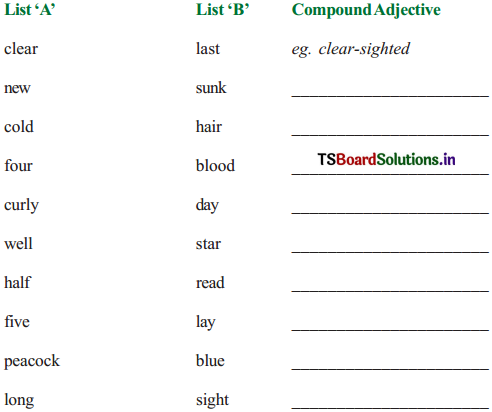
TS 10th Class English Guide Unit 2A The Dear Departed Part 2 4

Answer:

TS 10th Class English Guide Unit 2A The Dear Departed Part 2 3

TS Board 10th Class English Guide Unit 2B The Dear Departed Part 2

Question 1.
Sindhu is very ___________ about her choice.
Answer:
clear – sighted

Question 2.
The headmaster suggested a ___________ trip to Hyderabad.
Answer:
four – day

Question 3.
The ___________ girl who is under the tree is my sister.
Answer:
curly – headed

Question 4.
All the people were shocked at the sight of this ___________murder.
Answer:
cold – blooded

Question 5.
After the terrible tempest, the ___________ sailing boat was unusable.
Answer:
half – sunk

Question 6.
Prasad booked a room in a ___________ hotel for Srikanth.
Answer:
five – star

Question 7.
Every week, ___________ eggs are used by my mother to make some wonderful cakes.
Answer:
peacock-laid

Question 8.
This ___________ coat is too large for me.
Answer:
new – blue

Question 9.
It was a ___________ war between the English and the French.
Answer:
long – lasting

Question 10.
I like to correspond with this ___________ teacher. She speaks about interesting topics.
Answer:
well – read

TS Board 10th Class English Guide Unit 2B The Dear Departed Part 2

II. Words often Confused:

Read the following sentences and notice the underlined words.
1. Mrs. Jordan said, ‘Except his gold watch. He promised that to our Jimmy, (except = excluding or apart from)
2. The Slaters did not accept the proposal of the Jordans, (accept = allow)
In the above sentences the words except and accept look and sound alike. But they have different meanings and spellings.
There are many such words in English that look or sound alike but have very different meanings. It’s easy to get confused with these.

A. Write the words that are likely to be confused with the words given. Find their meanings and use them in sentences of your own to show the difference in meaning.

Question 1.
alter – ________
Answer:
altar

Question 2.
principal – ________
Answer:
principle

Question 3.
gait – ________
Answer:
gate

Question 4.
canvas – ________
Answer:
canvass

Question 5.
check – ________
Answer:
cheque

Question 6.
ceiling – ________
Answer:
sealing

Question 7.
complement – ________
Answer:
compliment

Question 8.
stationary – ________
Answer:
stationery

Question 9.
all ready – ________
Answer:
already

Question 10.
advice – ________
Answer:
advise.

TS Board 10th Class English Guide Unit 2B The Dear Departed Part 2

a) alter (v) : change
E.g: The plane altered its course.
b) altar (n) : table or raised flat – topped platform on which offerings are made to God.
E.g: The priest stood behind the altar

2. a) principal (n) : person with the highest authority in an educational organization.
E.g: Mr. Kishore is the principal of St. Ann’s Junior College.
b) principle (n) : guiding rule for personal behaviour.
E.g: Miss Ramya seems to have no principles at all.

3. a) gait (n) : manner of walking or running.
E.g: The old man is walking with unsteady gait.
b) gate (n) : movable barrier, usually on hinges, which closes an opening in a wall fence or hedge.
E.g: She is running away form the gate.

4. a) canvas (n) : strong coarse cloth.
E.g: He has painted a picture on canvas.
b) canvass (v) : go round an area asking for someone’s support.
E.g: Mr. Reddy has been canvassing for votes for the last two months.

5. a) check (n) : make sure of something by examining or investigating.
E.g: The officer has checked all the records thoroughly.
b) cheque : special printed form on which one writes an order to a bank to pay a sum of money.
E.g: The cheque issued by Prabhu was bounced and also he was imprisoned.

6. a) ceiling (n) : top inner surface of a room.
E.g: The inner ceiling of this room has been designed so well.
b) Sealing (n) : hunting seals.
E.g: A group of fishermen went on a sealing expedition.

7. a) complement (n) : thing that goes well or suitably with something else, or makes it complete.
E.g: Ghee makes an excellent complement to Payasam.
b) compliment(n) : expression of praise, admiration, approval etc.
E.g: She received compliments when she won the title.

8. a) stationary(adj) : not moving
E.g: The car collided with a stationary lorry from behind.
b) stationery (n) : writing materials
E.g: A new stationery shop has been opened recently.

9. a) all ready(phrase) : completely prepared.
E.g: We are all ready for our game against Australia.
b) already (adv) : before now.
E.g: I have already joined them.

10. a) advice (n) : opinion given about what to do or how to behave.
E.g: Let me give you a piece of advice.
b) advise (v) : give advice to somebody.
E.g: He advised me not to go there.

TS Board 10th Class English Guide Unit 2B The Dear Departed Part 2

Some other words that are often misspelt and their meanings:

1. (a) affect (v) = to change or influence something or someone.
(b) effect (n) = the result of a change or influence.

2. (a) allowed (v) = permitted
(b) aloud (adv) = not silently.

3. (a) bear (v) = to stand something.
(b) dare (adj) = naked, without covering.

4. (a) board (n) = a flat piece of wood
(b) bored (adj) = not interested.

5. (a) break (v) = to damage something.
(b) brake (n) = stopping device on a vehicle

6. (a) coarse (adj) = rough
(b) course (n) = a class in which a subject is studied.

7. (a) dear (adj) = beloved
(b) deer (n) = an animal

8. (a) fair (adj) = of light complexion
(b) fare (n) = cost of ticket.

9. (a) flour (n) = powdered grain used for cooking.
(b) floor (n) = beautiful flooming part of a plant.

10. (a) groan (n) = low sound expressing displeasure.
(b) grown (v) = increased in amount, size, number or strength.

11. (a) hair (n) = a mass of fine thread like substance growing on head etc.
hare (n) = a rabbit.

12. (a) Heal (n) = to cure a disease.
(b) heel (n) = the back part of the foot

13. (a) hear (y) = to listen
(b) here (adv) = at this place

14. (a) hole(n) = roundopening
(b) whole (adj) = entire

15. (a) know (y) = to have knowledge
(b) no (adv) = expresses refusal

16. (a) loan (y) to allow someone to borrow
(b) lone (adj) the only one

17. (a) mail (n) = post
(b) male(adj) = man

18. (a) meat (n) = animal flesh
(b) meet (y) = to see someone.

TS Board 10th Class English Guide Unit 2B The Dear Departed Part 2

B. Read the following paragraph. It contains errors in words often confused. Correct them and rewrite the paragraph replacing them with the right words.

It was one of those October daze when it was a pleasure to be alive. The sky was blew and the heir was cold and sharp with a cent of wet earth as the mourning sun warmed the chilled countryside. And then I caught site of a lonely be struggling to find the pollen of a final flour. Wear had he bean, this sad worker, doomed so soon to dye ? I marvelled at his energy as he climbed along so many bear stalks. Finding nothing, he flue on and disappeared from cite. I continued my walk to a country in where, sitting outside, I contentedly sipped my beer, musing all the wile on the mixed fortunes of life.

Answer:
It was one of those October days when it was a pleasure to be alive. The sky was blue and the air was cold and sharp with a scent of wet earth as the morning sun warmed the chilled countryside. And then I caught sight of a lonely bee struggling to find the pollen of a final flower. Where had he been, this sad worker, doomed so soon to die ? I marvelled at his energy as he climbed along so many bare stalks. Finding nothing, he flew on and disappeared from sight. I continued my walk to a country inn where, sitting outside, I contentedly sipped my beer, musing all the while on the mixed fortunes of life.

TS Board 10th Class English Guide Unit 2B The Dear Departed Part 2

III. Idiomatic Expressions:

Here is a list of idioms and idiomatic expressions used in the play, ‘The Dear Departed’. Guess their meanings. Then look them up in a dictionary, note down their meanings and use them in your sentences.
1) get one’s own way
2) for ages
3) set foot
4) drive a hard bargain
5) get rid of
6) give way
7) at length
8) on purpose
9) took by surprise
10) at a loss

1. Get one’s own way : get or do what one wants, often inspite of opposition.
E.g: He always gets his own way in the end. for ages: a long period of time

2. for ages: a long period of time.
E.g: She has not seen her sister for ages, as she lives abroad

3. Set foot: to enter some place.
E.g: The owner ordered his servant never to set foot in his house.

4. driven a hard bargain: be uncompromising in making a deal
E.g: Mr. Raghav drives a hard bargain; be careful with him.

5. get rid of: become free of
E.g: Mrs. Aruna is a tough person; It’s time I got rid of her.

6. give way: Let oneself be overcome by something.
E.g: You shouldn’t give way to despair; it’s all common.

7. At length: after a long time, eventually
E.g: At length, the train arrived, two hours late.

8. on purpose: intentionally, not by accident
E.g: He sent her to their place on purpose.

9. took by surprise: happen unexpectedly, so as to shock somebody slightly.
E.g: His sudden entry took them all by surprise.

10. At a loss: perplexed, puzzled
E.g: Mr. Teja was terribly surprised; he was at a loss.

TS Board 10th Class English Guide Unit 2B The Dear Departed Part 2

Some other ‘Idiomatic expressions’ and their meanings.
(a) at the drop of a hat = without any hesitation.
(b) barking up the wrong tree = looking in the wrong place.
(c) beat around the bush = avoid the main topic
(d) burn the midnight oil = to work late into the night
(e) caught between two stools = found it difficult to choose between two alternatives.
(f) cut comers = when something is done badly to save money.
(g) every cloud has a silver lining = be optimistic
(h) hit the nail on the head = do something exactly right.
(i) last straw = the final problem
(j) once in a blue moon = happens very rarely
(k) put wool over other people’s eyes = deceive
(l) see eye to eye = agree on something
(m) get ducks in a row = getting one’s things well organised
(n) get the axe = lose one’s job
(o) break the ice = some one who does or says something to make people relax in an uncomfortable situation.
(p) jack of all trades = a person who can do many different things but is not good at anyone of them.
(q) keep at arm’s length = don’t allow yourself to become too friendly with them.
(r) odds and ends = things of little value.
(s) pack something in = give up
(t) paper tiger = less powerful than one appears to be.

TS Board 10th Class English Guide Unit 2B The Dear Departed Part 2

Grammar:

I. Read the following sentences from the play and notice the underlined words.

1. She’ll come fast enough after her share of what our father has left.
2. Mrs. Slater doesn’t have enough money to buy the bureau.
In both the sentences ‘enough’ is underlined. ‘Enough’ means ‘sufficient’.
In a sentences ‘enough’ is used after adjectives, adverbs or verbs as an adverb, and before nouns as a determiner.

A. Now decide whether ‘enough’ in the following sentences is used as an ‘adjective’ or an ‘adverb’.

Question 1.
This house is not big enough for me.
Answer:
‘Enough’ is used as an adverb.

Question 2.
We didn’t leave early enough.
Answer:
‘Enough’ is used as an adverb.

Question 3.
I was not trained enough for the game.
Answer:
‘Enough’ is used as an adverb.

Question 4.
Is there enough room for me?
Answer:
‘Enough’ is used as an adjective.

Question 5.
I do not have enough clothes for my journey.
Answer:
‘Enough’ is used as an adjective.

TS Board 10th Class English Guide Unit 2B The Dear Departed Part 2

B. Complete the following sentences using ‘enough’ / ‘not enough’ and one of the words given in the list below.

TS 10th Class English Guide Unit 2B The Dear Departed Part 2 1

Question 1.
Harish wants to be a great wrestler but he is ___________.
Answer:
not strong enough

Question 2.
I want to sit and watch T.V. but I just don’t have ___________.
Answer:
enough time

Question 3.
He tried to win the race but he came third as he was not ___________.
Answer:
fast enough

Question 4.
This bath is freezing. The water is ___________.
Answer:
not warm enough

Question 5.
We had to sleep on the floor as there were ___________.
Answer:
not enough beds

Question 6.
There is ___________ to make a cup of tea! What is wrong with the pipes?
Answer:
not enough water

Question 7.
If Sujatha does not have ___________, I can lend her.
Answer:
enough money

Question 8.
Vasavi is not ___________ to become a member of this club. She must be at least 18 years of age to join.
Answer:
old enough

Question 9.
Is this coffee ___________ for you? Would you like some more sugar?
Answer:
sweet enough

Question 10.
Do you think he has studied ___________ to pass the entrance exam?
Answer:
hard enough.

TS Board 10th Class English Guide Unit 2B The Dear Departed Part 2

II. We generally use articles (a, an and the) before common nouns. But in some cases articles are not used before them. Read the following sentences from the play ‘The Dear Departed’ and notice the underlined common nouns.

1. He went out soon after breakfast to pay his insurance.
2. And when we’d finished dinner I thought I’d take up a bit of something on a tray.
In the above sentences the underlined common nouns ‘breakfast and dinner’ refer to the names of meals and food. In primary and general sense we don’t use articles before the words that refer to the names of meals and food i.e. breakfast, dinner, lunch, supper, pizza, fish fiy and omelette.

The following are the cases where ‘the’ is not used in the primary sense. (In a special or particular sense, ‘the’ is used before them.)

a) Before proper nouns (Rama, Sita, Mohan, Ramya, India, Ongole, Gandhi Nagar etc.)
b) Before abstract nouns and material nouns (honesty, beauty, poetry, iron, gold etc.)
c) Before the words ‘man, woman, society, heaven and hell’.
d) Before the names of diseases, games and sports, seasons, days, months. (fever, cricket, summer, April etc.)
e) Before the words ‘church, jail, prison, school, college, market, hospital, office, university, temple, mosque, bank, home and nursing home.
f) Before plural nouns (books, people, villages, pens etc.)
g) Before the words referring to relations. (mother, father, brother, sister, aunt etc.)
h) Before the names of languages. (Telugu, English, Hindi, Tamil, French etc.)
i) In certain expressions or phrases (catch fire, send word, set sail, set foot, at home, in hand, in debt, by car, at night, on demand, on earth, on foot, etc.)

TS Board 10th Class English Guide Unit 2B The Dear Departed Part 2

Write the following paragraphs, inserting a, an and the where needed.

A. Horse knows when he is going to race. How does he know? His breakfast was scanty. (He is angry about that.) He does not have saddle on his back. He is being led, not ridden, to grandstand. He is led under grandstand into unusual, special stall. Horse is nervous. Sometimes he does not know what to do when starting gate flies open and track is before him. If he does not begin to run instantly, other horses are already ahead of him.

During race, when he sees another horse just ahead of him, he will try to pass him. Sometimes jockey holds him back to save his energy for last stretch. Eventually horse gets to run as fast as he can. Exercise boy, watching owner’s favourite jockey riding horse he has exercised day after day, says nothing. Secretly, he is planning for day when he will be jockey himself, and his horse will be first to cross finish line.

B. I have horse of my own. I call her Pretty Girl. She is intelligent animal, but she is not thoroughbred horse. I could never enter her in race, even if I wanted to. But I do not want to. She is companion, for my own pleasure. I took her swimming day or two ago.
Answers:
(A) A horse knows when he Is going to the race. How does he know? His breakfast was scanty. (He is angry about that.) He does not have a saddle on his back. He is being led, not ridden, to the grandstand. He is led under the grandstand into an unusual, special stall. The horse is nervous. Sometimes he does not know what to do when the starting gate flies open and track is before him. If he does not begin to run instantly, the other horses are already ahead of him.

During the race, when he sees another horse just ahead of him, he will try to pass him. Sometimes the jockey holds him back to save his energy for the last stretch. Eventually the horse gets to run as fast as he can. The exercise boy, watching the owner’s favourite jockey riding the horse he has exercised day after day, says nothing. Secretly, he is planning for the day when he will be a jockey himself, and his horse will be the first to cross the finish line.

(B) I have a horse of my own. I call him the Pretty Girl. She is an intelligent animal, but she is not a thoroughbred horse. I could never enter her in a race, even if I wanted to. But I do not want to. She is a companion, for my own pleasure. I took her swimming a day or two ago.

TS Board 10th Class English Guide Unit 2B The Dear Departed Part 2

Fill in the blanks with the right words given In the brackets against each blanks.

It was winter. _______ (A/The) ponds were all frozen. At the court, Akbar asked Birbal, “Tell me Birbal, will a man ______ (do/does) anything for money?” Birbal replied, “Yes”. The emperor ordered him to prove it.

The next day Birbal ______ (come/came) to the court along with a poor Brahmin, who merely _____ (has/had) a penny left with him
Answer:
It was winter. THE ponds were all frozen. At the court, Akbar asked Birbal, “Tell me Birbal, will a man DO anything for money?” Birbal replied, “Yes”. The emperor ordered him to prove it.
The next day Birbal CAME to the court along with a poor Brahmin, who merely HAD a penny left with him.

III. Compound Prepositional Phrases:
Read the following sentences from the play ‘The Dear Departed’ and notice the underlined words.
1. Victoria dressed according to her mother’s instructions.
2. You both say that because of what I have told you about leaving my money.
3. It was here ìnsteadof in his room.

The underlined phrases are compound prepositional phrases. The following are some more important compound prepositional phrases. Their meanings are given in brackets.

along with (together with)
on account of (because of)
by means of (through the agency of)
apart from (separate from)
ahead of (earlier than somebody/something)
in front of (located before)
in place of (as a substitute for)
in spite of (disregarding the difficulty)
in case of (in the event of)
by way of (via)
due to (on account of)
for the sake of (for the good of)
in addition to (added to)
in accordance with (in agreement with)

TS Board 10th Class English Guide Unit 2B The Dear Departed Part 2

A. Use the above compound prepositional phrases in sentences of your own.
1) along with:
I have drunk a cup of tea along with a cup of milk.

2) on account of:
On account of the bad weather, the departure of the train is delayed.

3) by means of:
They have tried to lift the heavy tree by means of a crane.

4) apart from:
Apart from the apples and the grapes, my mother bought the mangoes.

5) ahead of:
He reached the spot ahead of us.

6) in front of:
There is a temple in front of our school.

7) in place of:-
Dhoni was made the captain of India in the place of Tendulkar.

8) in spite of:-
In spite of heavy rains, they didn’t stop working.

9) in case of:-
In case of fire, ring the alarm bell.

10) by way of:-
They reached France by way of London.

11) due to:-
Their success was due to their hardwork.

12) for the sake of: –
He made this sacrifice for the sake of his friend.

13) in addition to:-
My father teaches Mathematics in addition to English.

14) in accordance with:-
She has started her work in accordance with your proposals.

TS Board 10th Class English Guide Unit 2B The Dear Departed Part 2

B. Fill in each blank with the correct compound prepositional phrase from the options given under each sentence.

Question 1.
I finished my project work several days ________ the deadline.
a) instead of
b) ahead of
c) in spite of
Answer:
b) ahead of

Question 2.
Sravani goes to school ___________ yamuna diualy.
a) according to
b) in spite of
c) along with
Answer:
c) along with

Question 3.
My house stands ________ all the other houses in the street as it is big in size.
a) apart from
b) in accordance with
c) in addition to
Answer:
a) apart from

Question 4.
Madhu got a good job _______ his own abilities and skills.
a) in addition to
b) instead of
c) by means of
Answer:
c) by means of

Question 5.
She was unable to attend the party ________ her marriage engagement.
a) in spite of
b) in addition of
c) due to
Answer:
c) due to

TS Board 10th Class English Guide Unit 2B The Dear Departed Part 2

Question 6.
________ fire, ring the alarm bell.
a) in spite of
b) in case of
c) in addition to
Answer:
b) in case of

Question 7.
Sriram continued his batting carefully ________ his team though he was hungry.
a) for the sake of
b) in addition to
c) in front of
Answer:
a) for the sake of

Question 8.
You should complete your B.Ed ________ your B.Sc to get a teacher job.
a) in addition to
b) according to
c) in spite of
Answer:
a) in addition to

Question 9.
The physical director of our school selected me my friend, Ganesh for tomorrow’s match.
a) in spite of
b) in place of
c) ahead of
Answer:
b) in place of

Question 10.
________ his poverty, he completed his Ph.D. in English.
a) in place of
b) for the sake of
c) in spite of
Answer:
c) in spite ofc

TS Board 10th Class English Guide Unit 2B The Dear Departed Part 2

IV. The Simple Past and the Present Perfect:

Look at the following sentence from the lesson, ‘The Dear Departed’
They have stolen your clock and bureau.
Now compare this sentence with the following sentence.
They sneaked into your room like thieves in the night and stole them after you were dead.

Both the sentences express a past action. The first sentence is in the present perfect tense and the second sentence is in the simple past tense. In the first sentence the time or the place of action is not mentioned or specified. But in the second sentence the time or the place of action is mentioned.

You should use the present perfect tense when the time of action is not important or not specified and it shows the effect of the past action on the present. We should use the simple past tense when details about the time or place that an action occurred are given or specified.

Uses of the simple past tense:
1) The simple past is used to refer to past actions or events.
Examples:
(a) He passed his examination in 2013.
(b) I visited Delhi last month.
(c) Raju met his friend yesterday.

2) The simple past form can also be used to refer to the present time. This is a special use of the simple past form with verbs like want, wonder, hope, think to make an utterance more polite or tactful.
Examples:
(a) I wanted to discuss my proposal with you, madam.
(b) I wondered if I could discuss my proposal with you, sir.
(c) I thought of discussing my proposal with you, sir.
(d) I hoped to discuss my proposal with you, sir.

Other Uses of the Simple Past Form
1) After the conditional if to indicate tentativeness (hypothetical)
e.g. If I were the Prime Minister, I would provide free education at all levels.
2) After it’s time, would rather, wish
e.g. It’s 10 o’clock – it’s time you went to bed.
3) In reported speech
e.g. I asked you what the time was.

TS Board 10th Class English Guide Unit 2B The Dear Departed Part 2

The present perfect:

The present perfect (has/have + Verb in the past participle form) refers to actions in the past which have no definite time reference. The present perfect in English is used in the following three situations:

1. The present perfect tense is often used to talk about past actions and events which are completely finished. However, instead of the simple past, the present perfect is used if the action has current relevance, that is, it is related to the speaker’s experience.

In this case even though the actions took place in the past, they are still with the speaker, as part of his/her experience and knowledge. This use of the present perfect is therefore also called the experiential use of the present perfect.
e.g. I have seen the Taj Mahal.
(Meaning: I know the Taj Mahal. It is still fresh in my memory.)
(Contrast: I saw the Taj Mahal two years ago.)

2. To indicate an action/situation which began in the past and which has continued up to the present moment, i.e. the moment when we are speaking, the present perfect tense is used.
e.g. I have lived in Hyderabad for 10 years.
(Meaning: I started living in Hyderabad 10 years ago and I am still living in Hyderabad.)
If you wish to state that you still continue to live in Hyderabad you should say, ‘ I have been living in Hyderabad for 10 years’.
This use of the present perfect is also known as its linking use as it links the past with the present.

3. The present perfect is also used to refer to past actions/events whose results are seen in the present, i.e. when there is evidence in the present for some action/event that happened in the past. Hence, it is also called the evidential use of the present perfect. This is called resultative past.
e.g. It has rained! (evidence- Look! The ground is wet.).

TS Board 10th Class English Guide Unit 2B The Dear Departed Part 2

The following examples make the difference clear:
1. I saw the film, Gandhi last March. (Here the speaker is calling attention to the action of seeing and to the time when it happened.)
2. I have seen the film, Gandhi. (Here the speaker is not saying when he saw the film. He is calling attention to the fact that he is now a person with personal experience of the film or someone who can tell us about it.)
3. I cut my finger when I was sharpening the pencil. (Nothing is said about any result now.)
4. I have cut my finger (and it is bleeding now.)

The simple past is often used with adverbs of past time (e.g. yesterday, two months ago, in June, in 1965, during the war).
Sometimes it is also used to refer to present time or future time actions,
e.g., 1. Sir, may I come in? I wanted to talk to you.
2. If you left for Delhi tomorrow, when would you return?

The present perfect is never used with adverbs of past time. You should not say, for example, ‘She has gone to Hyderabad yesterday’. Say either ‘She went to Hyderabad yesterday’, if you are interested in the action and in the time when it happened, or ‘She has gone to Hyderabad’, if you wish to convey the idea that she is not in the town now.

The present perfect can be used with adverbs of present time (e.g. today, this morning, this week, this month).
Ex. I have seen Raju this week.

The present perfect is also used with just, recently, yet, already, never, ever, often, so far, etc.
Ex. They have just gone.
Ex. Hasn’t Anirudh left yet?

Read the following sentences .Complete the conversations with the appropriate forms of the verbs. Then say why you chose simple past/present perfect forms.

TS Board 10th Class English Guide Unit 2B The Dear Departed Part 2

Question 1.
“Is your brother in?”
“No, he isn’t. He ________ (go) to Chennai.”
“When ________ he ________ (go) to Chennai?”
“Yesterday.”
Answer:
“Is your brother in?”
“No, he isn’t. He has gone to Chennai.”
“When did he go to Chennai?”
“Yesterday.”

Question 2.
“I ________ (lose) my pencil. ________ you ________ (see) it anywhere?”
“No, I ________. When ________ you last ________ (use) the pencil?”
“I ________ (use) it when I was in the class.”
“Perhaps you ________ (leave) it in the class.”
Answer:
“I have lost my pencil. Have you seen it anywhere?”
“No, I haven’t. When did you last use the pencil?”
“I have used it when I was in the class.”
“Perhaps you have left it in the class.”

Question 3.
A: ________ Madhu ________ (not arrive) yet?
B: No, he ________.
C: But he ________ (arrive) already!
B: ________ you ________ (talk) to him?
C: No, I ________. I merely ________ (see) him.
B: That cannot be Madhu. He may have been somebody else.
Answer:
A: Has Madhu not arrived yet?
B: No, he hasn’t yet.
C: But he has arrived already!
B: Did you talk to him?
C: No, I didn’t. I merely saw him.
B: That cannot be Madhu. He may have been somebody else.

TS Board 10th Class English Guide Unit 2B The Dear Departed Part 2

Question 4.
A: ________ you ________ (call) me, mother?
B: Yes, I ________. ________ you ________ (see) my diary today?
I ________ (put) it on the table last night. I ________ (look) all over the house for it. But I ________ (not, find) it anywhere.
A: I ________ (see) it on the table this morning, if I remember right. Maybe father ________ (take) it with him by mistake.
Answer:
A: Did you call me, mother?
B: Yes, I have called you. Did you see my diary today?
I have put it on the table last night. I have looked all over the house for it. But I have not found it anywhere.
A: I saw it on the table this morning, if I remember right. Maybe father have taken it with him by mistake.

Question 5.
“Do you know Mrs. Geetha ?”
“Yes, I do. I ________ (know) her for nearly four years. It ________ (be) at a high school that I first ________ (see) her in 2009. I ________ (work) with her for several years. Recently we ________ (meet) at
the wedding of a mutual friend of us.”
Answer:
“Do you know Mrs. Geetha?”
“Yes, I do. I have known her for nearly four years. It was at a high school that I first saw her in 2009. I have worked with her for several years. Recently we have met at the wedding of a mutual friend of us.”

TS Board 10th Class English Guide Unit 2B The Dear Departed Part 2

V. EDITING:
The following passage has some errors. Identify and rewrite them with necessary corrections.

Varanasi is locate on the north eastern part of India. Hindu pilgrims go to there to purify their souls. To the Hindus Varanasi is a holiest pilgrimage center to all. Thousands of pilgrims visit this wholly city every year.

As early as four o’clock at the morning the pilgrims are seen make their way to the famous bathing steps knowed as Gatz. From there they board row boats to the holy river ganges to take bath. In doing this the pilgrims believe that their sins would be wash away.
Answer:
Varanasi is located on the north eastern part of India. Hindu pilgrims go to there to purify their souls. To the Hindus, Varanasi is the holiest pilgrimage center to all. Thousands of pilgrims visit this wholly city every year.

As early as four o’clock at the morning the pilgrims are seen making their way to the famous bathing steps known as Gatz. From there they board row boats to the holy river the Ganges to take bath. In doing this the pilgrims believe that their sins would be washed away.

TS Board 10th Class English Guide Unit 2B The Dear Departed Part 2

Writing:

I. Imagine that you are the grandfather in the play. Write a letter to your friend. Mr. Tattersall inviting him to your marriage at ‘Ring-o-Bells with Mrs. John Shorrocks. Don’t forget to say why you are going to get married at this age.
You can include the following
a) Time of wedding
b) Place of wedding
c) Details of the bride
d) Behaviour of the daughters
e) Reason for marrying at this age
f) Cordial invitation.

Flat No. 1125,
Happy Towers,
Road No. 55,
Manchester,
England.

My dear Tattersall,

I am keeping quite well and hope the same with you.

I wonder how you could keep quiet for such a long time without writing to me a letter. How are the things with you? Now, I am very glad to say that I am going to get married to Mrs. John Shorrocks at twelve o’clock on the next Monday (on the 20th August) at St. Philip’s church, Manchester. I shall be very glad to see you at the ceremony.

You can ask me why I have taken this hard decision at this old age. You know that I have been living by turns with my daughters Amelia and Elizabeth since the death of my wife. My daughters don’t have any love and affection for me. They are not concerned for my safety. Now, I have been with the Slater’s family. They are interested only in my assets. Last Saturday, I suffered from a bit of a headache and felt a little dazed. They all thought that I were dead and telegrammed my another daughter Elizabeth about it. Before they came, Amelia got shifted my bureau and my clock. Then Elizabeth and her husband came. My two daughters and their husbands planned to make a list of my things to be divided. They also discussed my paying the insurance premium. Both my daughters think that I am a kind of burden for them. I am not ‘dear’ to them anymore but my belongings are ‘dear’ to them. I have understood that they are greedy, selfish, unscrupulous and mean. Hence, I want to teach them a lesson and take this decision. I think you will realize my feelings.

I once again inivite you to attend my marriage ceremony without fail. I am awaiting you. My regards to your wife.

Your loving friend,
Abel Merryweather.

Address on the envolope
To
S. Tattersall,
H.No. 22-115/A,
Panama Square,
Road No. 26,
Washington,
United states of America.

TS Board 10th Class English Guide Unit 2B The Dear Departed Part 2

II. Convert the play, ‘The Dear Departed’ into a story.

To adapt the story to your culture, you may make changes in the following :
a) The names of the characters
b) Description of costumes
c) Things stolen by the daughter
d) The names of the villages / towns the daughters lived in
Answer:
Mr. Prabhakar, an old man is the father of his two daughters Amala and Vimala. Amala’s husband is Rambabu and Vimala’s husband is Sridhar. Mr. Prabhakar is a widower and since the death of his wife, he has been living by turns with his daughters.

Now, he is with Amala’s family in Guntur. One morning he has suffered from a bit of headache and felt a little dazed. Amala thinks that he is dead and asks her husband to send a telegram to her sister Vimala. She asks her daughter, Sushma to wear black dress before her aunt Vimala and uncle Sridhar come.

Mrs. Amala is greedy and selfish. She wants to grab her father’s things. She asks her husband to wear her father’s new shoes so that those could be theirs. Then she wants to pinch the oldman’s gold chain and his big iron-safe. At first her husband doesn’t agree but finally agrees. Both of them bring the iron-safe down stairs. She wears her father’s gold chain.

Their daughter Sushma asks them if they are pinching the grandpa’s things. Rambabu is really shocked to hear this question from their daughter. Then Mrs. Vimala and Mr. Sridhar come from their village, Bhattiprolu. Mrs. Vimala says that finally the old man is dead. Mrs. Amala asks them if they will go up and look at him but Mrs. Vimala prefers tea. They want to make a list of the grandpa’s bits of things.

Mrs. Vimala says that father has promised his gold ring for Ravi. Mrs. Amala is amazed to hear this. Then they talk about his insurance premium. Mrs. Amala asks Sushma to bring the bunch of keys from grandpa’s room. At first she doesn’t want to go into grandpa’s room as she comes to know he is dead.

TS Board 10th Class English Guide Unit 2A The Dear Departed Part 2

Later she goes out reluctantly and returns after sometime very scared. She tells her mother that grandpa is getting up. They are transfixed with amazement and a few minutes later Mr. Prabhakar comes in. They can’t believe their eyes. He sees Vimala and her husband and asks them how they come there. Mrs. Amala pokes him with her hand to see if he is solid.

Mrs. Vimala asks him if he is well. Prabhakar sees his shoes being worn by Mr. Rambabu and says it is not good. Mrs. Amala snatches them from Rambabu and gives them to her father. He asks why they are in mourning dress. Sushma says that she is glad to see her grandpa alive. Mrs. Amala lies that Sridhar’s brother is dead. Then he invited them all to sit down and be jolly.

Mr. Prabhakar recollects something suddenly and asks them why they have shifted his iron-safe out of his bedroom. Mrs. Amala and her husband are speechless. Then he sees his gold chain worn by Mrs. Amala. Mrs. Vimala blames her sister for pinching their father’s things. The two sisters start quarrelling. Mrs. Vimala has told his father that Mrs. Amala and her husband have pinched his things thinking that he is dead.

Mr. Prabhakar comes to know the reality. He tells them that neither of them has any cause to feel proud about the way they have treated him. He tells them that he shall make a new will leaving all his assets to whoever he is living with when he dies. Both the sisters try to persuade him to keep with them but he says that it is a bit late. Then Prabhakar announces that he is going to do three things on the Monday next.

The first one is that he will go to the lawyer and change his will. The second one is that he will go to the insurance office and pay his premium. The third one is that he will go to Sri Anjaneya Swamy Temple, Kothapet and get married. They are all surprised with the news. He tells them that he will get married to Mrs. Bhanumathi, the owner of the ‘Durga Bhavan’. He invites all of them to attend the ceremony, ill.

TS Board 10th Class English Guide Unit 2B The Dear Departed Part 2

Study skills:

Health is a major concern during old age. Maintaining health is very important for the elderly, particularly in rural areas, who must continue to work for a living even when they become aged. Good health is central to their ability to work, and support themselves and families. However, many poor rural elderly people have severe problems of health.

Here is the data collected in January 2013 by ‘Help Age India’, a research and development journal on common health problems of the rural elderly in Andhra Pradesh. The data is collected from 150 male and 150 female rural elderly people of above 60 years old.

Common Health Problems of the Rural Elderly in Andhra Pradesh
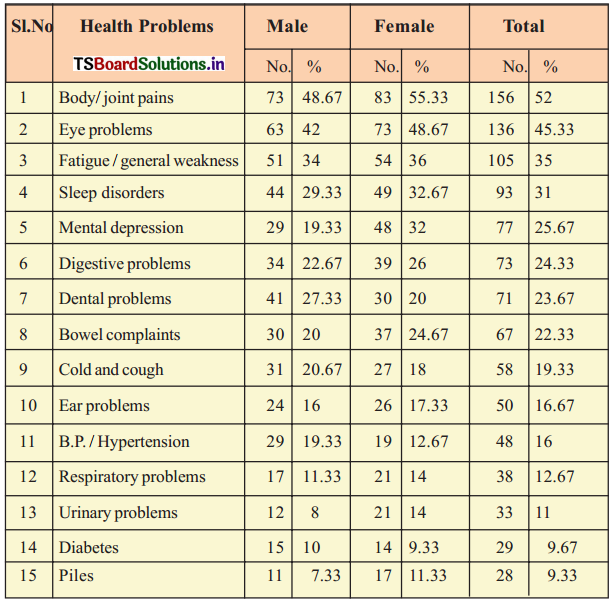
TS 10th Class English Guide Unit 2B The Dear Departed Part 2 2

Read, understand and analyse the data given in the above table and write a report on it to present on the World Grandparents’ Day.
You should include the following points in your report :
Introduction
The type of diseases old people suffer from below 10%, between 10 – 20, 21 – 30, 31 – 40 and 41 – 50.
Which diseases have more or less effect on the health of the old people.
Answer:

REPORT

Dear friends,
At first I want to convey my greetings to all the grandparents on the occasion of the World Grandparent’s Day. Health is a major concern during old age. Maintaining the health is very important for the elderly, particularly in rural areas, who must continue to work fora living even when they become aged. Good health is essential to their ability to work, and support themselves and families. However, many rural elderly people have severe problems of health.

Now, we observe the data collected in January 2013 by ‘Help Age India’, a research and development journal on common health problems of the rural elderly in Andhra Pradesh. The above data is collected from 150 male and 150 female rural elderly people of above 60 years old.

There are as many as fifteen health problems faced by the elderly. Below 10% of the male elderly are suffering from piles and urinary problems. Between 10% and 20% of the males are suffering from diabetes, respiratory problems, hypertension, ear problems, bowel complaints and mental depression.

Between 21% and 30% of the males are suffering from cold and cough, dental problems, digestive problems and sleep disorders. Between 31% and 40% of the males are suffering from fatigue or general weakness. Between 40% and 50% of the males are suffering from eye problems and body/joint pains.

TS Board 10th Class English Guide Unit 2B The Dear Departed Part 2

As far as the female elderly are concerned, below 10% of them are suffering from diabetes. Between 10% and 20% of the females are suffering from piles, urinary problems, respiratory problems, hypertension(B.P), ear problems, cold and cough and dental problems.

Between 21% and 30% of them are suffering from digestive problems and bowel complaints. Between 31% and 40% of the females are suffering from mental depression, sleep disorders and fatigue or general weakness. Between 41% and 50% of the females are suffering from eye problems and body/joint pains.

When we observe the health problems being faced by both the males and the females, below 10% of them are suffering form piles and diabetes. Between 10% and 20% of the elderly are suffering from urinary problems, respiratory problems, hypertension(B.P), ear problems and cold and cough.

Between 21% and 30% of them are suffering from bowel complaints, dental problems, digestive problems and mental depression. Between 31% and 40% of the elderly are suffering from sleep disorders and fatigue or general weakness. Between 41% and 50% of the elderly are suffering from eye problems and body / joint pains.

When we observe the data, the health problems such as body pains or joint pains, eye problems, fatigue/general weakness, sleep disorders, mental depression, digestive problems, dental problems, bowel complaints and cold and cough have more effect on the health of the old people.

The health problems such as ear problems, hypertension, respiratory problems, urinary problems, diabetes and piles have less effect on their health when we compare with the earlier ones. I wish all the rural elderly would lead a healthy life which is free from all the health problems.

TS Board 10th Class English Guide Unit 2B The Dear Departed Part 2

Listening:

Listen to an interesting anecdote and say whether the following statements are true or false.

BUS 65

A woman was visiting Hyderabad for the first time. She wanted to see the Charminar. Unfortunately, she couldn’t find it, so she asked a police officer for directions.
“Excuse me, officer, how do I get to the Charminar?”
The officer replied, “Wait here at the bus stop for the number 65 bus. It’ll take you right there. “She thanked the officer and he drove off.
Three hours later the police officer returned to the same area and, sure enough, the woman was still waiting at the same bus stop. The officer got out of his car and said, “Excuse me, but to get to the Charminar, I said to wait here for the number 65 bus. That was three hours ago. Why are you still waiting?”
The woman replied, “Don’t worry, officer, it won’t be long now. The 56th bus just went by!”

Question 1.
The woman was a stranger to Hyderabad.
Answer:
TRUE

Question 2.
In the beginning of the incident, the woman was at the Charminar.
Answer:
False

Question 3.
The woman in this event might be a villager.
Answer:
True

Question 4.
The woman knows that the buses in city have numbers.
Answer:
False

Question 5.
The woman misunderstood the direction given by the police officer.
Answer:
True

Question 6.
The police officer gave a wrong direction.
Answer:
False

TS Board 10th Class English Guide Unit 2B The Dear Departed Part 2

Oral Activity:

Work in groups . Tell your group any funny incident you may have witnessed / listened read.

What is the funny incident?
Where did it happen?
When did it happen?
What made you laugh?
Answer:
Dear friends,
Now I am going to tell you a funny incident which I have witnessed. We have a pet dog named Dolly. It comes into our house and moves along with us. One day, Dolly happened to see a mirror. He sat infront of the mirror and looked into it. There he found the image of him. But he thought that there was another dog in the mirror.

So, he started barking at it. The dog in the mirror too moved its mouth in the same way as Dolly did. Dolly thought that it was his enemy. He tried to scratch on the mirror with his paw. The dog in the mirror did the same. Dolly wanted to attack his opponent.

So, he went a few steps back and came running towards the mirror. He dashed against the mirror and it was broken. Dolly was very scared to see this and ran away screaming. I think this incident makes you all laugh.

TS Board 10th Class English Guide Unit 2B The Dear Departed Part 2

The Dear Departed 2 Summary in English Summary

Abel Merryweather sees the Jordans and asks them how they come there. Abel thrusts his hand at Ben and he skips back smartly and retreats with Mrs. Jordan to a safe distance below the sofa. Mrs. Slater pokes him with her hand to see if he is solid.

Mrs. Jordan asks him if he is well. Abel sees his slippers being worn by Henry and says it is not good. Mrs. Slater snatches them from Henry and gives them to her father. He asks why they are in mourning dress. Victoria tells her grandpa that she is glad he is not dead.

Abel asks them who is dead as they are all in mourning. Mrs. Slater lies that Ben’s brother is dead. Then Abel says they have only been waiting for him to begin tea. He tells them to sit down and be jolly. Abel suddenly recollects something and asks them why they have shifted his bureau out of his bedroom. Mr. Henry and Mrs. Slater are speechless.

Then he realizes that his clock has also been shifted. Elizabeth blames her sister for stealing. The two sisters start quarrelling. When both his daughters argue, he asks what has been going on. Mrs. Jordan tells him that he is thought to be dead and Mrs. Slater and Henry has pinched his things.

Abel comes to know the reality. He has understood everything. He wonders that they don’t take long to start dividing his things between them. He tells them that neither of them has any cause to feel proud about the way they have treated him. He wants to teach them a lesson. He tells them that he shall make a new will leaving all his things to whoever he is living with when he dies.

TS Board 10th Class English Guide Unit 2B The Dear Departed Part 2

Both the sisters try to persuade him to keep with them but he says that it is a bit late. Ben tells him that he has got to live with one of his daughters. Then Abel announces that he is going to do three things on Monday next. The first one is that he will go to the lawyer and change his will. The second one is that he will go to the insurance office and pay his premium and the third one is that he will go to St. Philip’s Church and get married.

They are all surprised to hear the news of his marriage. He tells them that he will get married to Mrs. John Shorrocks, the keeper of the ‘Ring-o-Bells’. He invites all of them to attend the ceremony. He thanks Mrs. Slater for she has brought his bureau downstairs as it will be handier to carry it across to the ‘Ring-o-Bells’ on Monday.

About the author:

William Stanley Houghton (1881-1913) was a famous English dramatist. He was one of the best of a group of realistic playwrights often called the Manchester School. In every play he sought to present an idea. He had a remarkable gift for dialogue that is evident in ‘The Dear Departed’. The Dear Departed was first produced in Manchester in 1908. Here Houghton satirizes the degradation of moral values in the British middle-class.

TS Board 10th Class English Guide Unit 2B The Dear Departed Part 2

Glossary:

gingerly (adv) = in a careful way;
poke (v) = push;
what the devil (phr.) = old fashioned way of showing annoyance or displeasure; This phrase is always used in questions;
tomfoolerly (n) = too much foolish or silly behaviour;
what the dickens (id.) = (old-fashioned and informal) used in questions instead of ‘devil’ to show that you are annoyed or surprised;
vindictive whisper (n) = talking about someone in a harsh, hasty manner;
double-faced (adj) = hypocritical / deceitful / dishonest;
thumping (v) = hitting hard;
will (n) = legal document that says what is to happen to somebody’s property after his/her death;
fancy (v) = want/feel like;
consternation (n) = a worried, sad feeling;
Ring-o-bells (n) = the name of a restaurant;
handier (adj) = easier;
thrust (v) = to push something somewhere roughly;
skip (v) = move with quick steps and jumps;
retreat (v) = move back;
hearth (n) = the area of floor around a fire place in a house;
snatch (v) = to take something away from someone with a quick, often violent movement;
hold your tongue (phr) = to tell someone to stop talking;
chuckle (v) = to laugh quietly;
resume (v) = to start doing something again after stopping or being interrupted;

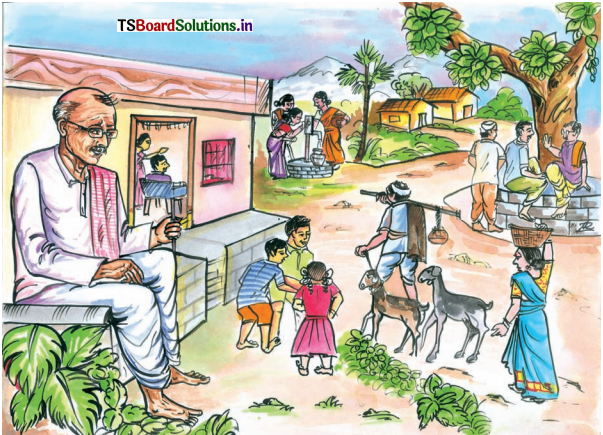
TS 10th Class English Guide Unit 2A The Dear Departed Part 1

Telangana SCERT TS 10th Class English Guide Pdf Unit 2A The Dear Departed Part 1 Textbook Questions and Answers.

TS 10th Class English Guide Unit 2A The Dear Departed Part 1

Look at the picture and answer the questions that follow:

TS 10th Class English Guide Unit 2A The Dear Departed Part 1 1

Question 1.
What do you understand from the picture?
Answer:
We see a cat being frightened by a rat, using a gun.

Question 2.
Can you recall anything comic associated with these animals ?
Answer:
Tom & Jerry.

TS Board 10th Class English Guide Unit 2A The Dear Departed Part 1

Question 3.
Can you imagine, what may be the conversation between the rat and cat ?
Answer:
The rat would be threatening to kill the cat while it is requesting to let him go.

Question 4.
How do people differ in enjoying humour; young and old; rural and urban; literates and illiterates?
Answer:
The young people could enjoy most of the modern humours where as the old could enjoy the old fashioned ones, which may not be to the liking of the new generations.

The rural could be found among the rustic verities of humour rather than the class or standard modals which are found in the urban areas.

The literates will be able to enjoy much standard verities of classical jokes and humour, where as the standard of jokes enjoyed by the illiterates are usually low level, unsophisticated and rude in nature.

Oral Discourse:

Role play – (based on the scene depicted in the picture).

Question 1.
Now let’s read a play in which the characters behave in a humorous way.
Answer:
Students activity – to be done in the class.

TS Board 10th Class English Guide Unit 2A The Dear Departed Part 1

Comprehension:

I. Answer the following questions:

Question 1.
What qualities of Mrs. Slater have you noticed?
Answer:
Mrs. Slater is vigorous, plump, redfaced, vulgar, greedy, selfish, unscrupulous and mean. Mrs. Slater doesn’t waste even a minute to grab the oldman’s bureau, clock and slippers thinking that he is dead. She gives more importance to the mourning dress.
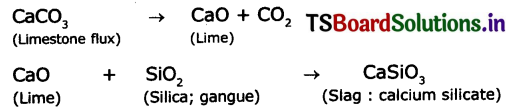
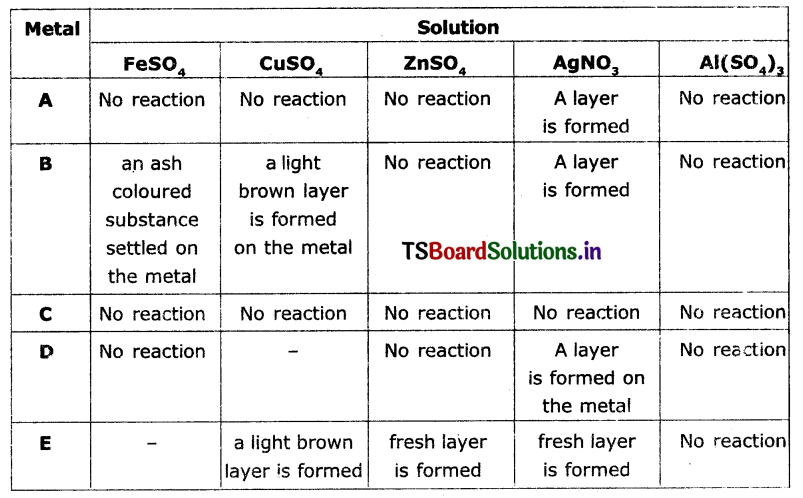
This shows us that Mrs. Slater is showy. She has no compassion for her father. She wants to grab her father’s things even before his death. She plans to outshine the Jordans in wearing mourning dress. She is impolite and insensitive.

Question 2.
Why does Mrs. Slater decide to shift the bureau from her father’s room before the arrival of the Jordans? How does Henry react to the suggestion?
Answer:
Mrs Slater wants to own her father’s bureau as she likes it very much. After her father’s death, she decides to shift the bureau to sitting room before the arrival of the Jordans. She thinks that her sister will lay a claim to it. At first, Henry is shocked at her decision.

He feels that the two sisters should amicably divide their father’s things. Henry suggests her that it is not a good thing pinching her father’s things in an unfair way. Moreover, Henry is worried about the arrival of the Jordans while they are shifting the bureau.

TS Board 10th Class English Guide Unit 2A The Dear Departed Part 1

Question 3.
Why do the Jordans take a long time to get to the house of the Slaters? What does it show about the two sisters’ attitude towards each other?
Answer:
Jordans don’t have mourning dresses for the occasion. Their arrival is delayed as they have to get them. It shows us that they give more importance to showmanship. The sisters are not grief stricken at their father’s death. For them, grief is to be revealed through mourning dress and not by the feelings in one’s heart. They are showy and mean. They don’t have any love and affection for each other.

Question 4.
Ben appreciates his father-in-law saying, ‘It’s a good thing he did’. Later, he calls him a ‘drunken old beggar’. Why does he change his opinion about his father-in¬law?
Answer:
Ben appreciates his father-in-law saying, ‘It’s a good thing he did’, when he comes to know that he has paid his insurance premium. But when he hears that the old man, has not gone to pay the premium he changes his opinion and calls him a ‘drunken old beggar’ since he has gone to the ‘Ring-o-Bells’. He changes his opinion about the old man because of his meanness and selfishness.

Question 5.
What made Mr. Henry feel shocked to hear Victoria say, “Are you planning to pinch it”?
Answer:
Mr. Henry was shocked to know that even Victoria was able to see through the trickery of her parents in shifting the bureau. He was afraid that she might speak the truth in front of the Jordans. So, he tried to convince her that the bureau was given to her mother before the death of the grandfather.

TS Board 10th Class English Guide Unit 2A The Dear Departed Part 1

Question 6.
Why does Mrs. Slater ask Victoria to change her dress?
Answer:
Mrs. Slater rebukes her daughter victoria for wearing the colourful dress. She asks Victoria to change into black as they all have to adapt themselves to the regrettable occasion. Victoria’s grandfather is thought to be dead. Hence she must be in mourning.

Question 7.
Why does Henry doubt the Jordans’ arrival?
Answer:
Mr. Henry doubts the Jordans’ arrival because both the families (the Slaters and the Jordans) have not been in good terms for years. When Mrs. Slater and Mrs. Jordan have quarrelled earlier, Mrs. Jordan has said that she would never set her foot in their house again.

Question 8.
Why is Victoria scared when she returns from Grandpa’s room?
Answer:
Victoria goes into her grandpa’s room reluctantly when her mother asks her to bring the bunch of keys. Her parents have told her that the grandpa is dead. But when she enters the room, she sees grandpa getting out of bed. Hence, she is scared.

TS Board 10th Class English Guide Unit 2A The Dear Departed Part 1

Question 9.
How does the Slaters and the Jordans respond to Mr. Abel’s death?
Answer:
The Slaters and the Jordans are excited over the death of Mr. Abel, the father of two women. Mrs. Slater has pinched her father’s bureau, clock and slippers before her sister’s arrival. They wear mourning dress and pretend to be sad but really they are happy as they want to divide the oldman’s things between them.

Question 10.
What are the things done by the Slaters before the arrival of the Jordans?
Answer:
Mrs. Slater is greedy and selfish. She loves her father’s things more than her father himself. Before the arrival of the Jordans, she has grabbed her father’s bureau and his wall clock. She has made her husband make use of her father’s new slippers.

TS Board 10th Class English Guide Unit 2A The Dear Departed Part 1

The Dear Departed 1 Summary in English

Stanley Houghton’s ‘The Dear Departed’ is a social play which reveals the pathetic condition of the elderly and how they are ill treated, neglected and deserted by their own children. It is a satire that criticizes the degradation of moral values in the modern.

It shows the hollow relations between two daughters and their father. This play reveals the breaking of human relationships in the modern world. The two daughters and their husbands have waited for the Oldman’s (Mr.Abel’s) death. They don’t show any concern for the old man. They only want his belongings, but never love him.

Mr. Abel Merryweather, an old man had two daughters – Amelia and Elizabeth. Amelia is married to Henry Slater and Elizabeth to Ben Jordan. Victoria is the Slater’s only daughter. Abel is a widower and since the death of his wife, he has been living by turns with his daughters.

TS Board 10th Class English Guide Unit 2A The Dear Departed Part 1

At present Abel stays with the Slaters. One morning when Mrs. Slater takes up a bit of something on a tray and goes into the old man’s room, Finding the man in deep sleep, she feels that he is dead. Without checking if the old man is really dead, the Slaters send a telegram to the Jordans revealing the much awaited death.

Mrs. Slater asks her daughter Victoria to change her dress before her aunt Elizabeth and uncle Ben come. She tells her that they are coming to talk over grandpa’s affairs. Henry wonders if they will come at all as Elizabeth has said she would never set her foot in their house again. But Mrs. Slater says that Elizabeth will come fast enough after her share of what their father has left.

Mrs. Slater asks her husband to wear grandfather’s new slippers so that those could be theirs. Then she tells him that she always wanted to have grandfather’s bureau after his death. She says that they could put their shabby chest of drawers upstairs where the bureau is. So she asks her husband to help bring down the bureau. Mrs. Slater fastens the front door and they carry old chest of drawers upstairs.

TS Board 10th Class English Guide Unit 2A The Dear Departed Part 1

In the meantime Victoria comes there after she changes her dress according to her mother’s instructions. Henry is shocked when Victoria asks him if they are planning to pinch the grandpa’s things. Henry and Mrs. Slater put the bureau where the chest of drawers is. Mrs. Slater carries the grandpa’s clock under her arm and puts it on the mantlepiece. Then there is a knock at the door and Victoria ushers in Ben and Mrs. Jordan. Mrs. Jordan says that finally their father has been dead.

Mrs. Slater replies that he is severty-two a fortnight the previous Sunday. She also tells her that her father has been merry that morning and has gone to pay his premium. Then he is found dead on his bed. Then Mrs. Slater asks them if they will go up and look at him. Mrs. Jordan prefers tea. Then they think about the announcement in the papers. They want to look through the oldman’s bits of things and make a list of them.

Mrs. Jordan tells that father has promised his gold watch for Jimmy. Mrs. Slater is amazed to hear this. Ben talks about the insurance money. He asks if they have got receipt for the premium paid by the old man. VRtoria informs that grandpa hasn’t gone to pay his insurance that morning. At this, Ben calls the old man as ‘drunken old begger’. Mrs. Slater says that it is nothing short of swindling after she has kept him for three years.

Mrs. Slater tells Victoria to run upstairs and fetch the bunch of keys that’s on her grandpa’s dressing table. At first Victoria doesn’t want to go into grandpa’s room. She goes out reluctantly. Then both the sisters talked about the bureau. After sometime Victoria returns very scared and tells her mother that grandpa is getting up. They are transfixed with amazement because they all think him to be dead. The door opens revealing the old man Abel Merryweather. They can’t believe their eyes.

TS Board 10th Class English Guide Unit 2A The Dear Departed Part 1

Glossary:

get her own way (id.) = persuade other people to allow you to do what you want;
D’ye = Do you (used in awkward situations);
precocious (adj) = intelligent/ gifted/ talented;
bureau (n) = a writing desk with drawers;
drive a hard bargain = work hard to negotiate agreements in one’s own favour;
daft (adj) = stupid / silly;
pinch (v) = steal;
mantlepiece (n) = a shelf projecting from the wall over the fireplace;
usher(v) = lead/show the way/welcome;
complacent (adj) = self-satisfied/unconcerned;
chirpily (adv) = cheerfully and actively;
snug (adj) = warm and comfortable;
overdue (adj) = not paid by the expected time;
swindling (n) = cheating somebody for property or money;
transfixed (v) = became motionless in fear;
chuckling (v) = laughing quietly out of mild amusement or satisfaction;
clad (adj) = wearing a particular type of clothing;
malicious (adj) = harmful;
vigorous (adj) = strong, active or emergetic;
plump (adj) = having a full rounded shape, fleshy;
vulgar (adj) = rude and offensive;
amazed (adj) = surprised or wondered;
for ages (n) = for a long time;
stooping (adj) = bending forward and down;
drooping (adj) = bending or hanging downwards through tiredness;
worn out (adj) = too old or damaged to be used;
trifle (n) = thing, question or activity that has little value;.
stupefied (adj) = so surprised, bored or tired that one can’t think clearly;
shabby (adj) = in poor condition through much use or being badly cared for;
stagger (v) = walk unsteadily;
mourning (n) = feeling of sadness owing to somebody’s death;
annoy (v) = cause slight anger, irritate;
reluctantly (adv) = unwillingby;
obviously (adv) = clearly;