TS 10th Class English Guide Unit 4A Rendezvous with Ray

Telangana SCERT TS 10th Class English Guide Pdf Unit 4A Rendezvous with Ray Textbook Questions and Answers.

TS 10th Class English Guide Unit 4A Rendezvous with Ray

Look at the picture and answer the questions that follow :

TS 10th Class English Guide Unit 4A Rendezvous with Ray 1

Question 1.
Is this picture (a) a poster, (b) an advertisement, or (c) a painting? Justify your option.
Answer:
It is a wall-poster. It has a title and two persons, the actors. It is not an advertisement as it doesn’t contain any commercial information. Nor is it a painting too. Hence, I think it is a poster.

Question 2.
Who is the director of the film?
Answer:
Singeetam Srinivasa Rao

TS Board 10th Class English Guide Unit 4A Rendezvous with Ray

Question 3.
Who are the people involved in the film making?
Answer:
Making a film requires the talents and abilities of a production team. To understand the roles of a film production team, you can compare the positions of each crew member to the people needed to prepare a fine meal. The following chart lists the common positions found on a typical film production team and explains their responsibilities.

PositionResponsibilityPositionResponsibility
WriterWrites the list of ingredientsBoom operatorGets the microphone in close to hear all the crunches and lip smacking
Executive producerPays for the cost of the dinnerGafferLights the food to look good

(sets the mood with a candlelit dinner)

Line producerFinds where to get the best dealsGripsHelp with the utensils for eating the meal
ProducerPurchases the groceries, helps choose the brandsProduction assistantsAct as waiters and bus boys
Casting directorChooses the food that’s ripe for the pickingMake-up personBrushes on healthy colors to prepare the food to look appetizing
Location scoutLocates the dinner locationWardrobe personDresses the food to look tasty
TransportationTransports the guests to the tableProduction designerEnhances the setting and decorates it for dinner
DirectorTakes all the ingredients and cooks them into a great mealProp masterSupplies the appropriate tableware, including plates and glasses
Assistant directorAssists the chefStunt coordinatorRigs the exploding champagne bottles and smashing of silverware
Script supervisorMakes sure the chef follows the recipeEditorServes the meal in continuity (appetizer first, entree next, dessert at the end)
Director of photography (cinematographer)Makes the food look really goodComposerCreates the right music atmosphere for enjoying the meal
Sound mixerRecords all the crunches and lip smackingPost-production supervisorCleans up the mess

TS Board 10th Class English Guide Unit 4A Rendezvous with Ray

Oral Disclosure:

Talk about your favourite actor/film maker/film. Give reasons, why you like him/her/ it.
Answer:
N. T. Rama Rao (NTR) was born on 28 May 1923 in Nimmakuru, a small village in Gudivada taluk of Krishna District, which was a part of the erstwhile Madras Presidency of British India. He was born to a farming couple.

He was a prolific actor as well as director, who had made the films and acting more popular in Andhra Pradesh. He has become popular with his uniqueness in acting and talent.

In the later half of his career, NTR became a screenwriter. Despite having no formal training in scriptwriting, he authored several screenplays for his own movies as well as for other producers. He also produced many of his films as well as other actor’s films through his film production house National Art Theater Private Limited in T. Nagar, Madras (now Chennai). He actively campaigned for the construction of a large number of cinemas through this production house.

He was influential in designing and implementing a financial system that funded the production and distribution of movies. He was so dedicated to his profession that he would often learn new things in order to portray a particular character on-screen perfectly and realistically. At the age of 40, he learnt dance from the renowned Kuchipudi dancer Vempati Chinna Satyam for his role in the film Nartanasala (1963).

TS Board 10th Class English Guide Unit 4A Rendezvous with Ray

Comprehension:

I. Answer the following questions:

Question 1.
What did Ray’s detractors accuse him of ? Did Roberge agree to their accusation ? If not, Why?
Answer:
Ray’s detractors accused him that he made his reputation selling India’s poverty to the west. Roberge did not agree to their accusation because it was not the material poverty depicted in the films that struck him. To him, the enormous spiritual poverty of some rich peoplewas much more deplorable than material poverty.

Question 2.
“I didn’t come here to convert. In fact, I am the one who got converted”. Who said these words? What different shades of meanings do you find in the words of the speaker ?
Answer:
Roberge was a Christian by belief. Christian missionaries actually work among the people, trying to make them repent and thereby leading them towards Christianity. This process is called ‘conversion’. Gaston Roberge is a French-Canadian priest with a set of beliefs about India and the world. After coming to India, he got converted. This shows us that he has changed his views about India. These are the different shades of meanings of the above mentioned speaker’s words.

Question 3.
Roberge took nine years to meet in person after joining St. Xavier’s college. Why did he take so long time ? What would you do if you were in his place ?
Answer:
Roberge took nine years to meet Ray in person after joining St. Xavier’s College. He wanted to meet right away, he didn’t want just go and see him like a living museum piece. But Ray was far beyond what Roberge expected. Meeting such great personality without enough intellectual exercise would not satisfy an intellectual like Roberge. So, he wanted to prepare himself, get to know his works more for a worthwhile dialogue with Ray when they meet.

TS Board 10th Class English Guide Unit 4A Rendezvous with Ray

Question 4.
How was Ray perceived by the outsiders ? Was this perception true of Ray’s real character ?
Answer:
To the outsiders, Ray was cold, aloof and even intimidating. This was not true perception of Ray’s real character. According to Roberge, he was in reality a very simple and unassuming man with a subtle sense of humour.

Question 5.
What is meant by the line, “Ray took off where Tagore signed out”. What was Ray searching for?
Answer:
Roberge feels that there is a striking comparison between Tagore and Ray. He also feels that philosophically too, Ray took off where Tagore signed out. Tagore believed that we should not lose faith in human beings, despite what was happening at the time of the second world war. The same line of thought was evident in the last three films of Ray.

Question 6.
How did Roberge try to take ‘Chitrabani’ forward? How did ‘Chitrabani’ help film – making in Bengali?
Answer:
Roberge established ‘Chitrabani’, a communication and film institute in 1970. His friendship with Ray helped Roberge to do so. Ray was named as co-founder. He was institute’s adviser in its first governing body. Roberge arranged initial funding from Canadian agencies. For 26 years Roberge was the director of ‘Chitrabani’. Chitrabani produced important documentary features. It also became breeding ground for local talent for film making.

Question 7.
The Theme of Rendezvous with Ray’ is ……………
Answer:
(b) To picturize the illustrious life of Ray.
(c) To explain the experiences of Roberge with Ray.

TS Board 10th Class English Guide Unit 4A Rendezvous with Ray

Vocabulary:

I. Read the following passage and notice the underlined words.
It was a Sunday evening. It was already dark. We wanted to watch the film ‘Gajani’. We had a square meal and came out. There were no lights. There was a power cut. It was pitch dark. It was bitterly cold. We looked here and there………….

The word pairs ‘square meal’, ‘pitch dark’ and ‘bitterly cold’ are found together. That means they co-occur. Such co-occuring words or word combinations are called collocations (co + locate = collocate). These expressions are natural.

Let us look at another example.

TS 10th Class English Guide Unit 4A Rendezvous with Ray 2

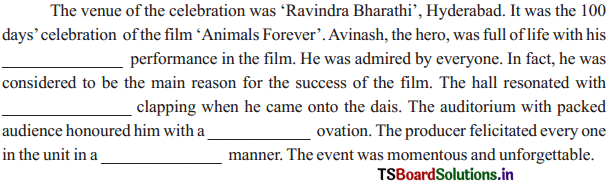
Read the following report and fill in the blanks with the words from the box below that collocates with the underlined words or phrases.

TS 10th Class English Guide Unit 4A Rendezvous with Ray 3

TS 10th Class English Guide Unit 4A Rendezvous with Ray 4

Answer:
The venue of the celebration was ‘Ravindra Bharathi’, Hyderabad. It was the 100 day’s celebration of the film ‘Animals Forever’. Avinash, the hero, was full of life with his outstanding performance in the film. He was admired by everyone. In fact, he was considered to be the main reason for the success of the film. The hall resonated with thunderous clapping when he came onto the dais. The auditorium with packed audience honoured him with a standing ovation. The producer felicitated every one in the unit in a fitting manner. The event was momentous and unforgettable.

TS Board 10th Class English Guide Unit 4A Rendezvous with Ray

II. One-word substitutes:

‘Rendezvous’ is a One – word Substitute for a meeting place.

You can work in groups and pick out similar one-word substitutes from the text equivalent to the meanings given below:
Eg: Rendezvous = a meeting place ;

Question 1.
A short stay between two places in one’s journey
Answer:
stop over ;

Question 2.
A person who brings out new books
Answer:
publisher;

Question 3.
A group of three films that has the same characters or subject
Answer:
trilogy ;

Question 4.
An impressive entrance to a building
Answer:
portal ;

Question 5.
A person who tries to make something less good by criticising it
Answer:
detractor ;

TS Board 10th Class English Guide Unit 4A Rendezvous with Ray

Question 6.
A person who is extremely important or large in size
Answer:
colossus ;

Question 7.
A person who is responsible for a problem or a crime
Answer:

Question 8.
A hand written document
Answer:

Question 9.
A statement that expresses something people believe is true and is to be followed
Answer:
dictum ;

Question 10.
Using more words than needed
Answer:
verbose;

TS Board 10th Class English Guide Unit 4A Rendezvous with Ray

Question 11.
Something designed to teach people some moral
Answer:
didactic ;

Question 12.
A person who is not sure about the existence of God
Answer:
agnostic ;

Question 13.
A branch of philosophy that studies the principles of beauty in art
Answer:
aesthetics ;

Question 14.
A result of a situation or of an action
Answer:
fall out;

Question 15.
A film that gives facts about something
Answer:
documentary ;

TS Board 10th Class English Guide Unit 4A Rendezvous with Ray

Some more one-word substitutes and their meaning.
1. antiseptic = a medicine that prevents decomposing.
2. catalogue = a list of books
3. adolescence = the period between childhood and adulthood
4. altrvist = a person who loves everybody.
5. amphibian = a land animal that breeds in water.
6. antidote = a medicine to counteract the effect of another medicine
7. arbitrator = a person appointed by parties to settle the disputes between them
8. fastidious = a person difficult to please
9. credulous = a person who readily believes whatever is told to him/her
10. impervious = a person who remains unmoved and unaffected by other people’s opinions, suggestions
11. notorious = a person with an evil reputation
12. arsenal = a place where weapons and ammunition are stored
13. extempore = a speech delivered without any previous preparation
14. panacea = a supposed cure for all diseases or problems
15. edible = a thing that is fit to be eaten
16. facsimile = an exact copy
17. centenary = celebration of a hundredth year
18. amnesty = general pardon for political offenders
19. brittle = hard but liable to be easily broken
20. ambivalent = having opposing feelings

TS Board 10th Class English Guide Unit 4A Rendezvous with Ray

21. impregnable = incapable of being seized by attack
22. postmortem = medical examination of a dead body
23. embezzlement = misappropriation of money
24. valetudinarian = pertaining to illhealth
25. mercenary = a soldier who will fight for any country or group that offer payment.
26. vandal = one who damages public property
27. philistine = one who doesn’t care for art, literature, etc
28. infallible = one who doesn’t make mistakes
29. amateur = one who does something not professionally but for pleasure
30. novice = one who is new to a trade or profession
31. insolvent = one who is unable to pay his debts
32. auditor = one who makes an official examination of accounts
33. contemporaries = people living at the same time
34. mobocracy = rule by the mob
35. numismatics = the study of coins or medals
36. cosmology = science of origin of universe
37. namesake = somebody or something with the same name as somebody or somethingelse
38. cannibal = somebody who eats human flesh
39. veteran = somebody who is considerably experienced in something
40. illicit = that prohibited by law

TS Board 10th Class English Guide Unit 4A Rendezvous with Ray

41. invincible = that which can’t be conquered
42. inexplicable = that which can’t be explained
43. imperceptible = that which can’t be noticed
44. maiden speech = the first speech made by a person
45. manuscript = handwritten book or document
46. alienate = to turn friends into enemies.
47. depreciate = to go down in value
48. deteriorate = to go from bad to worse
49. neophyte a person who is a new comer
50. oligarchy = a government by the few
51. misanthropist = haterof mankind
52. misogamist = a person who doesn’t believe in the institution of marriage.
53. misogymist = a person who hates women.
54. ominivorous = an animal or a human being that eats any kind of food.
55. ornithology = a study of birds.
56. pauper = one who has no money.
57. polyandry = practice of having several husbands.
58. polygamy = practice of having several wives.
59. stoic = one who is indifferent to pleasure or pain.
60. turncoat = a person who changes sides.

TS Board 10th Class English Guide Unit 4A Rendezvous with Ray

III. In the lesson ‘Rendezvous with Ray’ we come across certain words/expressions that are not from English, e.g.: en route. This means ‘on the way’. These expressions are taken from languages like Latin, Greek, and Portuguese and so on. There are certain instances where these expressions are used in English perhaps because of their precision in meaning. Some of them along with their meanings are given below.

1. en masse = all together, in large numbers,
2. viva voice = a spoken exam,
3. in toto = totally,
4. alma mater = mother of the soul (school or university),
5. ex officio = included because of the rank or job/by virtue of office;
6. in absentia = in the absence of,
7. detour = a longer route we take to avoid a danger,
8. verbatim = word for word, exactly as spoken or written,
9. status quo = situation as it is now;
10. ad hoc = not planned in advance/ made or arranged for a particular purpose only / special;
11. bona fide = genuine, real or legal,
12. lingua franca = link language,
13. magnum opus = the greatest work,
14. sine die = indefinitely,

TS Board 10th Class English Guide Unit 4A Rendezvous with Ray

Read the following paragraph and fill in the blanks with appropriate expressions given in the list above.

Children for Films

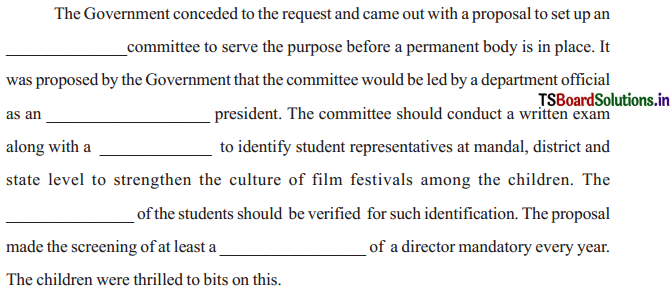
On the 14th November, on the occasion of children’s day, the children across the state requested the officials to conduct children’s film festivals more often. They submitted a memorandum to the Secretary to the Government in Hyderabad in this regard.
TS 10th Class English Guide Unit 4A Rendezvous with Ray 5

Answer:
The Government conceded to the request and came out with a proposal to set up an adhoc committee to serve the purpose before a permanent body is in place. It was proposed by the Government that the committee would be led by a department official as an ex officio president. The committee should conduct a written exam along with a viva voce to identify student representatives at mandal, district and state level to strengthen the culture of film festivals among the children. The bonafides of the students should be verified for such identification. The proposal made the screening of at least a magnum opus of a director mandatory every year. The children were thrilled to bits on this.

TS Board 10th Class English Guide Unit 4A Rendezvous with Ray

Some other Latin expressions in English :

1. ad nauseam = continuing to the point of boredom
2. caveat emptor = let the buyer beware
3. circa = approximately, around
4. compos mentis = in control of the mind
5. de facto = in fact, in reality
6. ergo = therefore
7. erratum = error, mistake
8. et cetera = and so on
9. ex gratia = from kindness or grace
10. exlibris = from the books, from the library
11. habeas corpus = court order instructing that a person under arrest be brought before a judge
12. in loco parentis = in the place of a parent
13. in situ = in its original place
14. in vitro = taking place outside a living organism
15. inter alia = among other things
16. per annum = for each year
17. per capita = for each person
18. quid pro quo = favour or advantage given or expected in return something
19. sine qua non = essential condition
20. terra firma = dryland.

TS Board 10th Class English Guide Unit 4A Rendezvous with Ray

Greek expressions in English :
1. acme = the highest point of a structure
2. acropolis = cities that were built with security purposes
3. agora = open market place
4. anathema = ban; someone or something extremely negative
5. anemia/anaemia = deficiency of the red blood cells
6. ethos = accustomed place
7. dogma = established set of principles by a religion
8. eureka = I have found!
9. genesis = birth/origin
10. phobia = exaggerated fear of something
11. plethora = undesired abundance
12. kudos = flame/glory
13. philos = friend
14. haghios = saint
15. psyche = soul
16. theoria = vision
17. peripeteia = adventure
18. chara = joy
19. aeon = age
20. phantasia = imagination.

TS Board 10th Class English Guide Unit 4A Rendezvous with Ray

Portuguese expressions in English :
1. a longo prazo = on long term
2. a meu ver = as I see it
3. amuito custo = with great difficulty
4. apedido = by request
5. cada vez mais = more and more
6. com o tempo = in the long run
7. de sobra = more than enough
8. de petro = from close by
9. de vista = by sight
10. depressa = faster
11. desde onicio = all along
12. e dai = so what ?
13. em media = on the average
14. em peso = in force
15. formidavel = that’s great
16. por favor = please
17. quanto custa isto = How much does it cost ?
18. nao = no
19. born dia = good morning.

TS Board 10th Class English Guide Unit 4A Rendezvous with Ray

Grammar:

I. Arrange the following sentences in proper order and write a paragraph. You may insert appropriate linkers wherever necessary.

Stream of Comedy

In every Indian language, a comedian is an essential character of films. In Telugu, Relangi and Ramanareddy provided comedy which made the audiences laugh heartily. Their appearance appealed to the film lovers.

Relangi was fat and short.
Their accent amused the film lovers.
Ramana Reddy was lean and tall.
Padmanabham and Allu Ramalingaiah followed their footsteps.
His name found place in the Guinness Book of World Records.
Rao Gopal Rao’s stint as villain-cum-comedian has been admired by all.
Mr. 101 Districts, Nutan Prasad left an indelible mark in the hearts of the audience.
Ali and Sunil are comedians.
He has a world record.
Brahmanandam has had a long career.
People have been laughing.
Rajababu came later.
Sorrows of people are taking a back seat.
He amused the people for long.
They are also considered heroes.

TS Board 10th Class English Guide Unit 4A Rendezvous with Ray

Answer:
In every Indian language, a comedian is an essential character of films. In Telugu, Relangi and Ramana Reddy provided comedy which made the audiences laugh heartily. Their appearance appealed to the film lovers. Relangi was fat and short whereas Ramana Reddy was tall and lean. Their accent amused film lovers very much. Later, Padmanabham and Allu Ramalingaiah followed their footsteps, of whom Raja Babu was the successor.

He amused people for a long time. The villain-cum-comedian, Rao Gopala Rao’s stint has been admired by all. Mr. 101 Districts, Nutan Prasad left an indelible mark in the hearts of the audience. Another comedian , Bramhanandam has had a long, glorious career, who has a world record to his credit. His name found place in the Guinness Book of World Records. Also, we have Ali and Sunil, who are comedians and are also considered heroes. Thanks to the comedians, people have been laughing for decades and sorrows of people are taking a back seat.

II. Prepositions following ‘adjectives’ and ‘verbs’.

In Rendezvous with Ray we come across certain verbs and adjectives followed by prepositions. For example acquainted with, brought out, prevented from, Explained to Read the following sentences and observe the underlined words.

1. I am amazed at you, Victoria.
2. Victoria, a precocious girl of ten, was dressed in colours.
3. He is trying to adapt himself to the regrettable occasion.
4. He was very fond of Jimmy.
5. I am sure. I am sorry for it.
6. You’ve been waiting for me to begin tea.
7. I see the little trifles that belonged to father lying around.
8. This always appealed to me.

TS Board 10th Class English Guide Unit 4A Rendezvous with Ray

In the above sentences, the underlined adjectives and verbs are usually followed by certain prepositions.

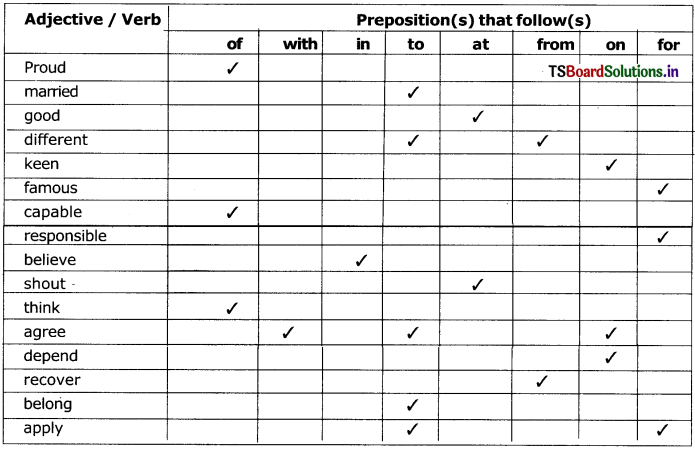
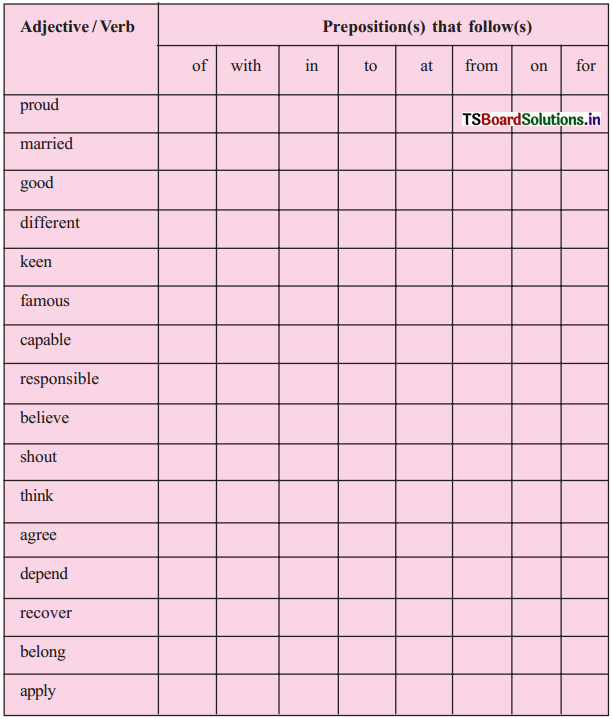
A. Here is a list of adjectives and verbs. Tick (✓) the prepositions that follow the adjectives and the verbs.Later, use them in sentences of your own. You may use a dictionary.
TS 10th Class English Guide Unit 4A Rendezvous with Ray 6

Answer:

TS 10th Class English Guide Unit 4A Rendezvous with Ray 7

TS Board 10th Class English Guide Unit 4A Rendezvous with Ray

Use Prepositions in your own:

1. Proud of : She is proud of her daughter
2. married to : He’s married to a famous writer.
3. good at : My brother is good at Mathematics.
4. different from : Trains in Japan are different from ours.
5. different to : The design of my car is different to that of his car.
6. keen on : Suneel is keen on playing carroms.
7. famous for : New york is famous for its sky scrapers.
8. capable of : Our yoga master is capable of swimming in the river.
9. responsible for : The driver is responsible for the safety of his passengers.
10. believe in : I believe in the existence of almighty God.
11. shout at : My father always shouts at me.
12. think of : I think of a way to raise money to achieve my vision.
13. agree with : Do you agree with me about the need for more schools ?
14. agree to : They agreed to meet me at the railway station.
15. agree on : They don’t agree on the new policy.
16. depend on : You can’t depend on the train arriving on time.
17. recover from : Sonia Gandhi now fully recovered from her illness.
18. belong to : The helicopter belongs to the oil company.
19. apply to : Apply to the publishers for permission to reprint the poem.
20. apply for : I have applied for the post of the computer consultant.

TS Board 10th Class English Guide Unit 4A Rendezvous with Ray

B. Fill in the blanks with suitable prepositions.

Question 1.
All last winter Sharath suffered ________ coughs and colds.
Answer:
from

Question 2.
Anand is unaccustomed ________ the heat.
Answer:
to

Question 3.
Kumar was afraid ________ his enemies.
Answer:
of

Question 4.
Sriram was always arguing ________ his brother.
Answer:
with

Question 5.
Sindhu was dedicated ________ her job.
Answer:
to

Question 6.
Priyanka was shocked ________ the hatred they had shown.
Answer:
at

Question 7.
I said ________ you, “I am thinking ________ going to America. I have actually dreamt ________ it.”
Answer:
to, of, of

Question 8.
I want to talk ________ the group about their exams.
Answer:
to

Question 9.
I was terrified ________ her.
Answer:
of

Question 10.
I’ve always been terribly fond ________ you.
Answer:
of

TS Board 10th Class English Guide Unit 4A Rendezvous with Ray

Question 11.
If you continue to support someone who is in trouble you are loyal ________ them.
Answer:
to

Question 12.
If you don’t understand any of these words, you could refer ________ a dictionary.
Answer:
to

Question 13.
It wasn’t his car, in fact I don’t know who it belongs ________.
Answer:
to

Question 14.
My problems are very similar ________ yours.
Answer:
to

Question 15.
People started to shout ________ the driver.
Answer:
at

Question 16.
She had always been bad ________ languages.
Answer:
at

Question 17.
She listened ________ me and then told me about her problems.
Answer:
to

Question 18.
The accident sadly resulted ________ the death of a man.
Answer:
in

Question 19.
The buses are often late, so you can’t depend ________ them.
Answer:
on

Question 20.
They may feel jealous ________ your success.
Answer:
of

TS Board 10th Class English Guide Unit 4A Rendezvous with Ray

III. Read the following paragraph and notice the use of the past perfect and simple past.

A.

TS 10th Class English Guide Unit 4A Rendezvous with Ray 8

Answer:

As all the actors had taken their positions, the curtain rose. They started acting as the director had asked them to. The audience enjoyed the play very much. The hero kicked the comedian since the comedian had done mischievous things. The musician fell off his chair after the comedian had fallen on him. The power went off after the musician had landed on the cables. There was darkness and silence everywhere. After a while two persons in the audience started a conversation.

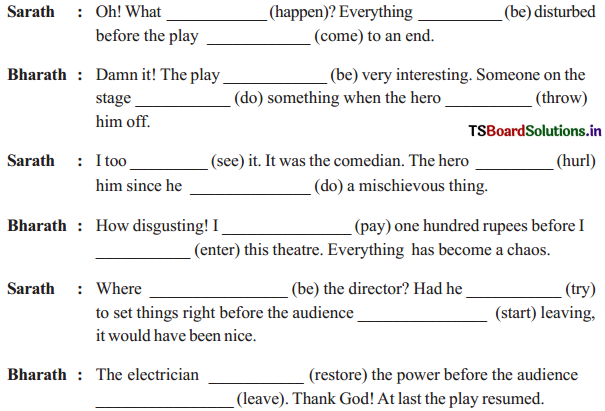
B. Read the following conversation and fill in the blanks with appropriate verb forms ie., past perfect / simple past.
TS 10th Class English Guide Unit 4A Rendezvous with Ray 9

Sarath : Oh! What happened (happen)? Everything had been (be) disturbed before the play came (come) to an end.
Bharath : Damn it! The play was (be) very interesting. Someone on the stage had done (do) something when the hero threw (throw) him off.
Sarath : I too saw (see) it. It was the comedian. The hero hurled (hurl) him since he had done (do) a mischievous thing.
Bharath : How disgusting! I had paid (pay) one hundred rupees before I entered (enter) this theatre. Everything has become a chaos.
Sarath : Where was (be) the director? Had he tried (try) to set things right before the audience started (start) leaving, it would have been nice.
Bharath : The electrician had restored (restore) the power before the audience left (leave). Thank God! At last the play resumed.

TS Board 10th Class English Guide Unit 4A Rendezvous with Ray

IV. Given below is a paragraph with ten errors in the areas of ‘concord, tense, prepositions, punctuation and articles’. Edit the paragraph.
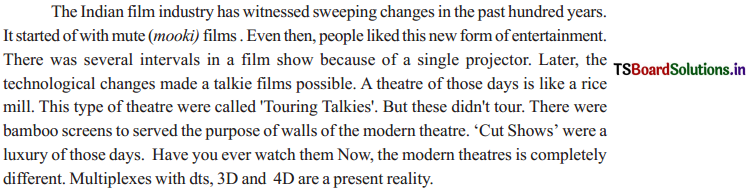
TS 10th Class English Guide Unit 4A Rendezvous with Ray 10

Answer:
The Indian film industry has witnessed sweeping changes in the past hundred years. It started off with mute (mooki) films . Even then, people liked this new form of entertainment. There were several intervals in a film show because of a single projector. Later, the technological changes made talkie films possible. A theatre of those days was like a rice mill. This type of theatres was, called “Touring Talkies’. But this didn’t tour. There were bamboo screens to serve the purpose of walls of the modern theatre. ‘Cut Shows’ were a luxury of those days. Have you ever watched them? Now, the modern theatres are completely different. Multiplexes with dts, 3D and 4D are a present reality.

TS Board 10th Class English Guide Unit 4A Rendezvous with Ray

Study Skills:

Read the following passage and rewrite the underlined idioms without changing the meaning of the passage. Refer to the dictionary.

Tragedy in Comedy
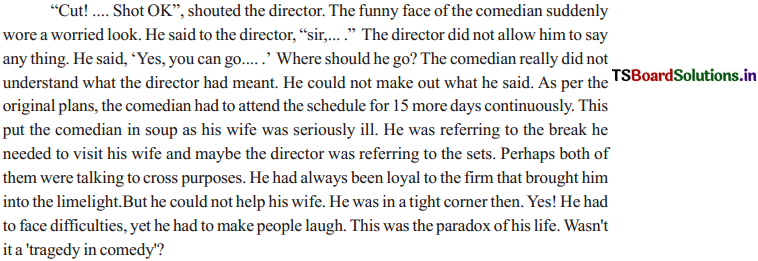
TS 10th Class English Guide Unit 4A Rendezvous with Ray 11

Answer:
“Cut! … Shot OK” , shouted the director. The funny face of the comedian suddenly wore a worried look. He said to the director, “Sir,…” . The director did not allow him to say anything. He said,’ Yes, you can go…’. Where should he go? The comedian did not understand what he said. As per the original plans, the comedian had to attend the schedule for 15 more days continuously. This put the comedian in trouble as his wife was seriously ill. He was referring to the break he needed to visit his wife and maybe the director was referring to the sets. Perhaps both of them understood the other’s words incorrectly. He had always been loyal to the firm that brought him fame. But he could not help his wife. He was in a trouble then. Yes! He had to face difficulties, yet he had to make people laugh. This was the strange situation of his life. Wasn’t it a ‘tragedy in comedy?

TS Board 10th Class English Guide Unit 4A Rendezvous with Ray

Listening:

Listen to the radio programme and tick (3) the right answer to the following questions.

Jewels of India

This is All India Radio, Hyderabad.

Welcome to ‘Jewels of India Programme’ presented by Meenakshi.

In our programme today, we will know about the most famous Indian film maker.

We know that Bengal is a beehive of cultural activities. It has witnessed cultural reforms. It is the birth place of many writers and intellectuals.

To continue this tradition, another great son of India took birth in Calcutta on 2nd May 1921. Who could that be? It is none other than Satyajit Ray, the son of a writer… a grandson of an amateur astronomer. His home provided him with an ambience to think and feel.

Graduating from Presidency College, Calcutta, Ray moved to the open xair university,’Shantiniketan’. A keen observer that he was, Ray imbibed the spirit of Shantiniketan. There he read extensively and developed interest in painting.

Back in Calcutta, Ray started working for a London-based advertising firm. Wasn’t it a right place for a creative man like Ray? He worked there for some time and moved to London to work there.

There he watched films. Film after film. He liked the film ‘Bicycle Thieves’.That kindled interest in Young Ray in film-making. Slowly his interest led him to a world of creativity. That was the birth of a great film maker. And Ray became a film maker.

His films ‘Pather Panchali’, ‘Aparajito’, ‘Agantuk’ were some of his master pieces. His vision for Bengali films was matchless.

Along with the Oscar Award, he received the Bharata Ratna. The legendary film maker passed away in 1992. But the film world cherishes his memories forever.

Next week we will know about another great personality.

Till then, good bye to Meenakshi.

TS Board 10th Class English Guide Unit 4A Rendezvous with Ray

Question 1.
What was the programme about?
(a) Ray
(b) Jewels of India
(c) Film-making
Answer:
(b) Jewels of India

Question 2.
Which film inspired Ray ?
(a) Agantuk
(b) Bicycle Theives
(c) Shantiniketan
Answer:
(b) Bicycle Theives

Question 3.
The highest civilian award Ray received was
(a) Oscar Award
(b) Bharath Ratna
(c) Padma vibhushan
Answer:
(b) Bharath Ratna

TS Board 10th Class English Guide Unit 4A Rendezvous with Ray

Oral Activity:

Make a short speech of 2-3 minutes about the film you have seen recently. You should include the following points in your speech.
– What the film was.
– Why you liked it so much (you can talk about the direction, actors, costumes, music, songs, etc.)
You, can make notes on a sheet of paper and look at it as you speak.
Answer:
Respected teacher and my dear classmates! I am here to give a short speech about the film I have seen recently. Last week, I saw, ‘Lava Kusha an old film’! It was directed by C.Pullaiah. It was produced by A. Sankar Reddy in the year 1963. It was the first colour film in Telugu. Recently it was celebrated Golden Jubilee.

Lava Kusha became a hit not only for the excellent performance of NTR, Anjali, Kantha Rao and Chithuru Nagaiah but also for the performance of the boys who played roles of Lava Kusha. The director, C. Pullaiah also had a major role in the success of the film. Though ‘Relangi’ and Girija appears for a short time in the beginning of the film, they played vital roles for its success.

The music and playback of the film is everlasting. The Music director and famous singer Ghantasala Venkateswara Rao, play back Leela and Suseela got together to present melodious songs to the audience. The scenes of the films give feasting not only to the eyes of the audience but also to their ears. The film is a tribute to the Telugu cinema field. The songs, Vinudu Vinudu Ramayana Gatha and Sri Ramuni Cherithamunu Telipedamamma, Ghana Seelavathi Seetha Kathe Vinudoyamma still reverberates every year on the eve of ‘Sri Rama Navami.

TS Board 10th Class English Guide Unit 4A Rendezvous with Ray

The story itself is woven around the separation of Sita from Rama and sending her to the forest. The women audience see their hardships in the role of Sita. The women folk in those days repeatedly saw the film. Frame after frame we can see the greatness of the director. He reduced the characters of Rama and Sita to ordinary mortals displaying human tendency.

Thank you very much for giving me an opportunity to deliver a speech on the film I have seen recently.

Rendezvous with Ray Summary in English

Satyajit Ray was a famous Bengali Film director of India. According to Father Gaston Roberge,The French-comedian priest, a unique friendship developed between him and the director Ray. It was on the way to India in 1961 at a stopover in New York. Once Roberge saw three Bengali Films in one sitting. Since then, Roberge’s began to love the people of India and Bengali Cinema and culture. In Roberge’s latest book he provides a scholarly original analysis of Ray’s works, his greatness both as a person and as an artist.

Fr.Roberge came to know about West Bengal and it’s people first through triology and then through different sources like Reader’s Digest, Tagore’s poems etc. Roberge disagrees with the accusation of Ray’s critics. In the Ray’s films he could see enormous spiritual poverty of rich people than material poverty of the poor. Roberge met Ray in person nine years after he reached Calcutta.

Their friendship lasted 22 years until Ray’s death in 1992. According to Roberge, Ray was a shy person. He seemed to be cold, aloof and intimidating to outsiders, but he was in reality a very simple man with a subtle sense of humour. The author and Ray used to meet on Sundays at 9 am. The author says that Ray’s human concern was great. For this, he gave an example.

Once a few well-known personalities of the city of Calcutta had visited him earlier to go through one of his manuscripts. After they left, he found the Charulatha screen play missing. Ray knew who had taken that manuscript. Roberge asked him whether he was going to take any action against him. Ray said ‘No’. He explained that he did not want to hurt the reputation of the person.

TS Board 10th Class English Guide Unit 4A Rendezvous with Ray

Like Tagore Ray strode his time like a Colossus. Roberge feels that Ray took off where Tagore signed out. Tagore wrote in his last major prose Shabhyatar Sankat, that it would be a sin to lose faith in man. In Ray’s last three films Tagore’s dictum becomes clear. Ray felt deeply hurt when some critics saw the last three films of him as didactive and verbose.

Chitrabani communication and film institute in West Bengal was founded by Roberge in 1970. Its establishment was the result of his friendship with Ray. As a token of friendship with Roberge lent his name as a co-founder. Ray also agreed also to be the institute’s adviser. Roberge was the director of Chitraban for 26 years. He produced important documentary features. It became breeding ground for local Talent for film-making.

Glossary:

en route (adv) = on the way ;
stopover (n) = a halt in a long journey ;
path – breaking (adj) = totally new ;
portal (n) = an entrance ;
trilogy (n) = a set of three Films with the same artists or characters ;
haunted (v) = obsessed ;
accusation (n) = the act of charging somebody ;
detractors (n) = people who criticise/a person who tries to make sb/sth seem less good by criticizing it;
arrogance (n) = showing pride ;
muster up confidence (idiom) = gain confidence ;
dictum (n) = a statement that is believed to be true and followed ;
analogy (n) = a feature that is similar;
aesthetics (n) = the art of judging beauty ;
fallout (n) = result;
agnostic (n)= a person who does not know whether God exists ;
rendezvous (n) = a meeting place
unique (adj) = usually good and special.

TS Board 10th Class English Guide Unit 4A Rendezvous with Ray

acquainted (v) = deliberately found out about something
fascinating (v) = being attracted
compilation (n) = book, list, record etc. which consists of different pieces of information, songs etc.
insight (n) = a sudden clear understanding of something especially a complicated situation or idea.
reassurance (n) = something that is said or done which makes someone feel calmer and less worried or frightened about a problem.
deplorable (adj) = very bad, unpleasant and shocking
quest (n) = a long search for something that is difficult to find,
right away (idiom) = immediately
worthwhile (adj) = important or useful
discreet (adj) = careful
stature (n) = the degree to which someone is admired or regarded as important
aloof (adj) = unfriendly and deliberately not talking to other people.
intimidating (adj) = making you feel worried and not confident.
unassuming (adj) = showing no desire to be noticed or given special treatment, modest
subtle (adj) = not easy to notice or understand
screening (n) = the showing of a film or television programme
cemented (v) = made a relationship between people, countries or organizations firm and strong
elegance (n) = the state of being beautiful, attractive or graceful
manuscript (n) = a hand written document.
notation (n) = a system of written marks or signs used to represent something such as music, mathematics or scientific ideas

TS Board 10th Class English Guide Unit 4A Rendezvous with Ray

culprit (n) = the person who is guilty of a crime or doing something wrong
reputation (n) = the opinion that people have about someone or something because of what has happened in the past
humane (adj) = treating people or animals in a way that is not cruel and causes them as little suffering as possible
colossus( n) = someone or something that is extremely big or extremely important
sign out (phr.v.) = to write one’s name in a book when one leaves a place such as a hotel, an office or a club
dictum (n) = a statement that is believed to be true and followed
analogy (n) = a feature that is similar
didactic (adj) = intended to teach people a moral lesson
verbose (adj) = using or containing too many words
impulse (n) = a sudden strong desire to do something without thinking about whether it is a sensible thing to do
denying (v) = saying that something is not true,
frail (adj) = weak and thin
TS 10th Class English Guide Unit 4B Maya Bazaar

Telangana SCERT TS 10th Class English Guide Pdf Unit 4B Maya Bazaar Textbook Questions and Answers.

TS 10th Class English Guide Unit 4B Maya Bazaar

Comprehension:

I. Answer the following questions.

Question 1.
You have read the review of the film ‘Maya Bazaar’. List the things that the review focuses on.
Answer:
The things that the review focuses on are

  1. Maya Bazaar was a film made in Telugu and Tamil.
  2. It was released in 1957 to become a landmark more in the Telugu film industry.
  3. Stars like N.T.R, S.V. Ranga Rao, Savitri, A.N.R. and Gummadi acted excellently
  4. K.V.Reddy, The director had full control over every frame of it.
  5. It is a tribute to Telugu culture, language and customs of the land.
  6. The dialogues written by Pingali Nagendra Rao were the same that the people using in their conversations everyday.
  7. Songs in the film still reverberates in marriages
  8. Totally, the film is a feast for the eyes, ears and soul.
  9. It is helpful to an NRI to know about Telugu culture.

TS Board 10th Class English Guide Unit 4B Maya Bazaar

Question 2.
Do you think this review of the film is positive or negative ? Substantiate your view.
Answer:
I think the review of the film is completely positive. In the beginning of the review, it was written that ‘Maya Bazaar’ has been voted as the ‘Greatest Indian film, on the occasion of 100 years of Indian cinema.

The expressions such as ‘unleashing’, ‘landmark movie’, ‘sterling performances’, ‘tribute to Telugu culture, language and customs’, ‘immortalized dialogues’, ‘reverberation of songs’, ‘repertoire added to Telugu dictionary’, ‘audience laughed heartily’, ‘womenfolk recalling their tribulations’, ‘feast for the eyes and soul’, ‘introducing Telugu culture to an NRI’, etc., show us that this review is positive.

Question 3.
What made ‘Maya Bazaar’ a landmark film?
Answer:
The film ‘Maya Bazaar’ is considered one of the enduring classics of Indian cinema and was christened as a landmark achievement in Indian film’s cinematography, art direction and VFX with the available technology during that time.

The great director K.V.Reddy, producers Nagireddy and Chakrapani, sterling performances of the star-ensemble, all time great artists, the dialogues of Pingali Nagendra Rao, the songs and its contribution to Telugu culture, language and customes made ‘Maya Bazaar’ a landmark film. With all these great qualities, ‘Maya Bazaar’ hit the screen in 1957 to become a landmark movie.

Question 4.
Why is ‘Maya Bazaar’ watched repeatedly?
Answer:
The film was watched repeatedly soon after its release because people identified every character of the film with someone they knew in their immediate vicinity.

TS Board 10th Class English Guide Unit 4B Maya Bazaar

Question 5.
What is the central theme of ‘Maya Bazaar’? How have the Telugu speakers settled abroad looked upon ‘Maya Bazaar’?
Answer:
The central theme of the film is the love affair between Sasirekha and Abhimanyu, Krishna and Balarama has different opinions over it and their wives too take sides. It is ineviatable in any family. The director tries to make the audience of their culture, language and customs by showing the striking similarities.

Telugu speakers selected abroad have looked upon ‘Maya Bazaar’ as a masterpiece of their language. They try to introduce ‘Maya Bazar to’ the learners (or the children) to learn Telugu culture, language and customs.

Question 6.
The purpose of the review is …
a) … to give an account of the stars of the film
b) … to establish the element of Telugu culture in the film
c) … to help NRIs understand Telugu culture.
d) … to praise the producer of the film.
e) … to advertise the film.
(Put a tick ( ✓ ) on the options that indicate the purpose of the review.)
Answer:
(a) ………….. to given an account of the stars of the film. (3)
(b) ………….. to establish the element of Telugu culture in the film. (3)
(c) …………… to help NRIs understand Telugu culture. (3).

TS Board 10th Class English Guide Unit 4B Maya Bazaar

Vocabulary:

I. In the review of ‘Maya Bazaar’ the expression, ‘language and custom’, has two words linked with the conjunction ‘and’. We also use expressions like ‘cup and saucer’, ‘near and dear’ etc.

These pairs of words joined by a conjunction ‘and’ are called ‘binomials’. In these expressions, the word order never changes. For example, we say ‘near and dear’ and not ‘dear and near’.

Here are some sentences with ‘binomials’ underlined.

1. Sports is a part and parcel of education.
2. The new theatre is rough and ready.
3. Music is not only Rahman’s bread and butter but also his passion.
4. The film industry is expanding in leaps and bounds.
5. The customer can pick and choose anything he likes. It is for him to decide.
6. ‘Give and take’ policy is always helpful.
7. Ray gave his heart and soul to reading books.
8. He stood by me through thick and thin.
9. The main goods were shifted first. Then the odds and ends were taken.

Answer:
1. Sports is a part and parcel of education.
2. The new theatre is rough and ready.
3. Music is not only Rahman’s bread and butter but also his passion.
4. The film industry is expanding in leaps and bounds.
5. The customer can pick and choose anything he likes. It is for him to decide.
6. ‘Give and take’ policy is always helpful.
7. Ray gave his heart and soul to reading books.
8. He stood by me through thick and thin.
9. The main goods were shifted first. Then the odds and ends were taken.

TS Board 10th Class English Guide Unit 4B Maya Bazaar

Match the following binomials with their meanings and use them in your own sentences.

Column – AColumn – B
1. part and parcela. unimportant things
2. rough and readyb. livelihood
3. leaps and boundsc. in difficult times
4. bread and butterd. dedicated
5. pick and choosee. help one another
6. give and takef. a large choice
7. heart and soulg. big leaps
8. thick and thinh. an integral part
9. odds and endsi. almost finished

Answer:
1 – h
2 – i
3 – g
4 – b
5 – f
6 – e
7 – d
8 – c
9 – a

Own Sentences:
1. Games and sports are part and parcel of eduction.
2. The new school building is rough and ready.
3. My brother’s career is progressing in leaps and bounds.
4. Painting is his bread and butter.
5. The owner can pick and choose any flat in that apartment.
6. We must always follow give and take policy.
7. I gave my heart and soul to my work.
8. His carrer is in big leaps.
9. Her hand bag is full of odds and ends.

TS Board 10th Class English Guide Unit 4B Maya Bazaar

II. Read the following conversation that took place in the classroom of a film institute.

Professor Paul : As a part of our ‘Diploma in film-making’ we have discussed certain aspects of film technology, right? I hope by now all of you are familiar with those concepts. If you have some more queries, we can discuss them. Now the class is open for questions.

Rishi : I think what is included and excluded in an individual shot is called ‘Frame’. Am I right?

PP : Yes, you are. What is brought to the viewer is called a frame.

Prudhvi : Which shot is used to show a happy rcunion,Sir?

PP : It is called ‘Arc’. The camera moves in an arc around the subject (artistes). Any more questions…?

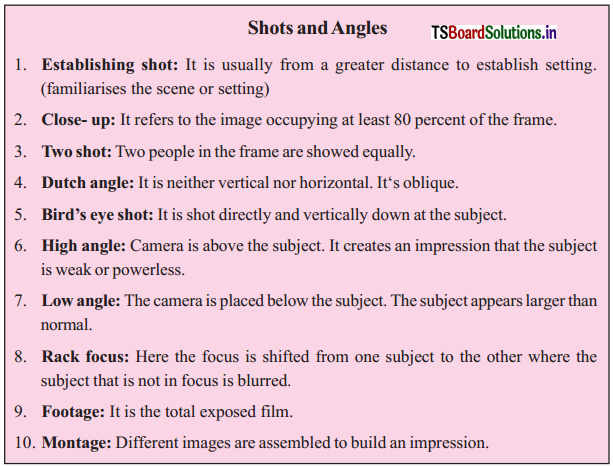
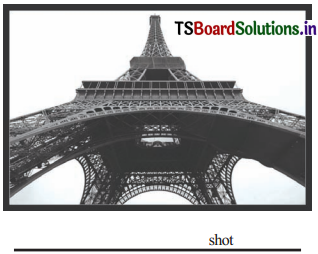
PP : Here is a list of camera shots that helps you to have a clear idea about different shots in film-making.

TS 10th Class English Guide Unit 4B Maya Bazaar 5

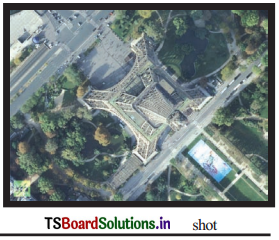
Here are some visuals. Identify their features and label them. You may choose the labels given above.

TS Board 10th Class English Guide Unit 4B Maya Bazaar

Question 1.

TS 10th Class English Guide Unit 4B Maya Bazaar 1

Answer:
Low angle shot

Question 2.

TS 10th Class English Guide Unit 4B Maya Bazaar 2

Answer:
Dutch angle shot

Question 3.

TS 10th Class English Guide Unit 4B Maya Bazaar 3

Answer:
Establishing shot

Question 4.

TS 10th Class English Guide Unit 4B Maya Bazaar 4

Answer:
High angle shot

TS Board 10th Class English Guide Unit 4B Maya Bazaar

Grammar:

Modals:

The following is a conversation between two artists.
Shankar: Shanti, yesterday the ABC Movies called me up seeking my opinion.
Shanti: What is that?
Shankar: They’ve a role for a heroine in their film that is going to sets very soon. They wanted to offer that role to you. Will you accept it?
Shanti: Did they really mean it? I’ve two doubts about it. First, can I do it? The second, should I do it?
Shankar: Yes, you can certainly do it. Regarding your second doubt – I think it’s not that you should do it, you must do it.
Shanti : Why?
Shankar: We may like some roles and others we may not. But we accept them for the sake of our career.
Shanti : Mmm….
Shankar : Certain roles we should accept for the sake of satisfaction. That’s why, I said you must do it.
Shanti : Then I take your word as final to me. I shall do it. Tell the ABC Movies that I have accepted the offer.

The words given in bold letters in the above conversation perform different functions. They are called modal auxiliaries or modals. Their functions are given below.

ModalFunction
Shallobligation, offer, order, suggestion,
Shouldobligation, advice
Canability, possibility, permission
couldrequest, suggestion, permission, possibility, ability
Willcertainty, intention, futurity , purpose
Wouldoffer, preference, past habit, future of the past
Maypermission, possibility, wish
Mightpossibility
mustcompulsion, inference

TS Board 10th Class English Guide Unit 4B Maya Bazaar

Some important points about modals:
1. Modals take any subject before them. There is no Subject-Verb agreement problem.

2. No two modals co-occur in a sentence.
Eg. The film will be released next week.

3. The main verb will always be the form after the modals.
Eg. He cannot move the big stone.

4. Past form of some modals stands for ‘politeness’.
Eg. i) Would you like to have some tea?
ii) Could you lend me your book?

Read the following sentences and identify the functions performed by the modals.

a) He can sing for eight hours at a stretch.
Answer:
ability

b) You could take an umbrella, it’s raining outside.
Answer:
suggestion

c) We should complete the shooting by tomorrow evening.
Answer:
obligation

d) Shall I wait till you come?
Answer:
offer

e) The time was up but the makeup person would not turn up.
Answer:
future of the past

f) The car hasn’t arrived yet. It must’ve got a flat tyre.
Answer:
inference

g) There may be heavy rains tomorrow. So, why couldn’t we go for indoor shooting?
Answer:
suggestion

h) Will you join us for tea?
Answer:
request/invitation

i) The agreement between the two parties shall be in force for two years.
Answer:
obligation

j) It might be an idea to postpone the release of the film.
Answer:
possibility.

TS Board 10th Class English Guide Unit 4B Maya Bazaar

Writing:

I. Now read the review once again. Write a review of a film / a TV Programme / an episode of a TV serial you have seen.
Answer:
A review of a film ‘Maa Gopi’

I have recently seen the Telugu film, “Maa Gopi”. B.S. Iyengar Ranga was a self trained cinematographer, producer, director and studio owner. He founded Vikram producation in 1954. He chose to make his debut film in Telugu. He gave offer to Kovvali Lakshmi Narasimha Rao for writing story ‘Maa Gopi.

Nagaiah, G.Vara Lakshmi, Relangi, Jamuna, V.Narasimha Rao, Prabhavathi were the main actors. It was the story of a boy who lost his parents when he was born. Though Ramadasu (nagaiah) [the eldest brother of Gopi’s father] was a kind hearted person, his wife, Kamala and his brother-in-law Sankaraiah [Relangi] and his wife Durgamma develop hatred towards him.

Time passes and Gopi’s elder brother Balaram marries Suseela [Jamuna], Her entry into the household makes life happy for Gopi. Her affection for him brings great relief to Ramadasu. Balaram gets a transfer to an other town and his wife Suseela also leaves with him. Sankaraiah and Kamala throws Gopi out of the house when Ramadasu is away. It so happens that Gopi averts a train accident and saves many lives. He is hailed by all, including his former formentors, as ‘Maa Gopi’.

The director’s strength lay in choosing the right artistes for the different characters. He also showed talent in shot division and shot taking. Apart from Chittoor V.Nagaiah, G.Varalakshmi and Relangi, the lead pair V. Narasimha Rao and Jamuna too came up with neat portrayals. It was the fourth film for Jamuna and her second successive hit. From this film onwards only, Lamuna earned the tilte ‘Andaala Nati’.

Musical score by Viswanthan and Ramamurthy and lyrics by Anisetty contributed to the success of ‘Maa Gopi’. As per songs, K. Rani’s ‘O muddu papa — Naa muddu Gopi’, T. Satyavathi’s ‘Desadesamula’, and Jikki’s ‘Oogavu Uyyala’ were the popular numbers.

‘Maa Gopi’ was dubbed into Tamil as JayaGopi. Later it was remade into Kannada, titled Bhagya Vantha, introducing RajKumar’s youngest son Master Puneeth in the title role. This two was also big hits.

TS Board 10th Class English Guide Unit 4B Maya Bazaar

II. Read the following letter.

Hanamakonda,
Nov. 27, 2013.

To
The Editor,
The Hindu,
Hyderabad.

Sir/Madam,

I am a regular reader of your esteemed newspaper. I am very much interested in reading the news in ‘Friday Review’ in your newspaper every week. I am writing to bring to your notice certain feelings I had when I watched the colour version of the movie ‘Maya Bazaar’. Recently ‘Maya Bazaar’ was released again but this time it was a different ‘Maya Bazaar’,-Maya Bazaar- in colour! Thanks to the Goldstone Technologies, I was carried away to a different world of colourful visuals. Of course the audio part remained the same. But here and there the effects of digital track sound have made some difference. Such an experiment began in Hindi with ‘Mughal-E-Azam’ and received applause from the audience. I hope many such experiments are welcome to the film lovers.

Thanking you,

Yours faithfully,
Ramu,
Govt. High School,
Hanamakonda,
Warangal (Dist.).

TS Board 10th Class English Guide Unit 4B Maya Bazaar

II. Write a rejoinder to the letter that appeared in the Hindu in response to the review of ‘Maya Bazaar’. In your rejoinder write whether the opinion expressed in this letter is a sufficient appreciation of ‘Maya Bazaar’.
Answer:

Krishnapatnam,
Nalgonda,
20-1-2015.

To
The Editor,
The Hindu,
Nalgonda.

Sir/ Madam,

I am a regular reader to your esteemed newspaper. I regularly read your news paper, particularly the letters column and Friday review.

In this letter, I am writing my opinion in response to the review of ‘Maya Bazar’ that appeared on Nov 27th. Thanks to the person who wrote the letter to your column on the ‘review of Maya Bazar’ that his appreciation of Maya Bazar is superb and sufficient. I totally agree with his view when he wrote to say that experiments are welcome to the film lovers. In this fast developing world, experimentation is necessary in each and every field to get better results. We have to say thanks to the Goldstone Technologies’ which gave colour effects as well as the effects of the digital track sound to the film ‘Maya Bazaar’ and make it wonderful. We have to welcome all the new innovations which give a modern look to the present things. I wish there would be a number of innovations in store for us. I think all the readers will agree with me.

Thanking you,

Yours faithfully,
S.Christiana Joy,
Kennedy High School,
Nalgonda. (Dist)

TS Board 10th Class English Guide Unit 4B Maya Bazaar

III. Let’s read the following skit.
Suhas : Amma, Amma
Mother : What, Suhas?
Suhas : My friends are planning to watch a movie. I too want to join them.
Mother : Movies, movies, movies. No, I can’t let you go to movies too often.
Suhas : My friends are making fun of me. They call me ‘a bird in a cage’. (Goes out disgusted taking his school bag.)

******

Mother : Money, money, money. He always needs money. This is not a kid. It’s an apparition.
Father : (coming) Why are you shouting, Sarala? What did you say?
Mother : Didn’t you hear? An apparition.
Father : Who is the apparition?
Mother : Who else could I mean? It’s your son.
Father : Not your son? He needs money?
Mother : Yes, he needs money. He watches movies. His life is movies. He doesn’t care to study. All the children in the street are doing very well. But this devil (Starts banging her head against the wall. No wounds.No blood)
Father : No, Sarala. No, don’t do it.
(Mother falls down and father brings a glass of water.)
Father : Sarala…, Sarala…., have some water.
(A pause)
Father : Sarala, we have to understand certain things.
Mother : (Having drunk water) As if you have understood You don’t worry about anything. He doesn’t study at all. He is after movies.
Father : Wait! I’ll find out.

*****

TS Board 10th Class English Guide Unit 4B Maya Bazaar

Father : Suhas, you didn’t take your bicycle today. You didn’t take your lunch box. You look tired …….
Suhas : Amma doesn’t understand me. She always makes fuss of me. She always wants me to do one thing; study…. study study. I want to go to a film. That too once a week. All my friends are going. I too want to go. Is it wrong on my part?
Father : Why don’t you try to understand your mother’s concern? She is worried a lot about your future.
Suhas : But I am all right in my studies. I think, watching a film once a week, that too, watching a good film is not a sin.
Father : Which film did you want to watch?
Suhas : “Life of Pi”. It’s an interesting movie with high technical values.
Father : All right, my boy.

*****

Father : Sarala, the boy didn’t want to do anything bad.
Mother : But I have my own fears.
Father : I do understand. Your fears may have reasons. But what Suhas wanted was just 100 rupees. And that too for watching an interesting film.
Mother : Maybe I was wrong. We’ll ask Suhas to go to the film. He is such a nice boy. He never troubles us.
Father : Come on. Let’s have supper. Come, Suhas.
Now let’s ponder over these points:

TS Board 10th Class English Guide Unit 4B Maya Bazaar

Keeping in mind the features of a skit discussed below, prepare a skit on the subject you like most.

A skit has all the characteristics of a play. Usually , it does have a message to convey. It has a plot (a beginning, a crisis and a resolution). However, there are certain differences with respect to time, number of characters, setting etc., The skit is more of an informal nature. The number of characters is less. The setting does not have much importance.
Answer:
Joy : Dad, Dad….
Father : What, Bangaram ?
Joy : Shall I come along with you, dad ?
Father : Not now maa. When I come back, we will go together.
Joy : No, dad, Now only take me [starts crying]
Father : Joy, don’t cry. I am not going anywhere. See, I am sitting.
Joy : Don’t sit dad. Take me with you [crying loudly]
Mother : Joy, why do you cry always? My head is aching..stop crying. Other¬wise I will beat you.
Joy : [crying still more loudly]. I will go with dad.
Mother : See, I am bringing a burning rod. Unless you stop crying I will use it on your back use it on your back. You were born, No rest, no peace of mind to me.
Father : Padma, don’t shout like that. She is just kid. She will gradually understand, be patient.
Mother : You don’t know, how I am struggling with this kid. You just say words and go out. I cann’t bear her noise.
Father : Padma, We have to understand small children. Now, they don’t know anything. They will slowly understand the things. Until that be patient. It is inevitable.
Mother : You always talk like that. You don’t follow me to tackle with her and control her.
Father : Padma, we have to carefully deal with the Kids. Otherwise, they will be afraid. It’s O.K.. You go and see your household work. I will lull her. [mother goes] Joy, come here maa.

*****

TS Board 10th Class English Guide Unit 4B Maya Bazaar

Joy : Dad, I will come with you. Take me with you.
Father : OK, I will take you with me. Before that you have to listen what I should say. Are you Ok?
Joy : Ok, dad. tell me.
Father : Is it good to cry always ?
Joy : No, dad.
Father : Nice, what should you do when dad goes out ?
Joy : I should say good bye and I should not cry.
Father : Padma, see how my daughter behaving now.
Padma : May be I was wrong. Joy is really a nice girl. I will be patient towards her.
Father : That is nice. Joy will you say good bye to me.
Joy : Ok. dad, Good bye dad. I won’t cry dad. Come back soon dad.
Father : Bye maa. I will be back soon.

Maya Bazaar Summary in English

‘Maya Bazaar’ has been voted as the ‘Greatest Indian Film’, when the poll was conducted to find out India’s greatest film till date, on the occasion of 100 years of India cinema. K.V. Reddy was its director. Nagireddy and Chakrapani produced ‘Maya Bazaar’ in Telugu and Tamil. It was released in 1957. In 2007, it celebrated the Golden Jubilee. It became a hit not only for the sterling performances of S.V. Ranga Rao, Savitri, NTR, ANR and Gummadi but also of K.V. Reddy.

‘Maya Bazaar’ is a tribute to Telugu culture, language and customs of the land. The dialogues written by Pingali Nagendra Rao were the same that the Telugu people were using in their conversations every day. Music director was Ghantasala. As for songs, Aha naa Pellianta and Vivaaha Bhojanambu still reverberates in marriages. The story itself is woven around the love of Sasirekha -Abhimanyu. Krishna and Balarama had different opinions over it. Their wives too take sides as is inevitable in any family.

Frame after frame impacts viewers with similarities. The greatness of the director lies here is, he successfully reduces all characters to ordinary mortals displaying all the weakness of human beings except Ghatothkacha and Krishna. K.V.Reddy injects a Telugu atmosphere into the yadava household full with its smile, imagery, adage, sarcasm and wit.

‘Maya Bazaar’, is full of feast for the eyes and soul for the audience. Though, it is a story of Pandavas and Kauravas, one never sees the Pandavas throughout the film. We only hear of them. If anyone wants to know Telugu culture, he should see Maya Bazaar first.

TS Board 10th Class English Guide Unit 4B Maya Bazaar

Glossary:

VFX = Visual effects;
advent (n) = coming or arrival, first appearance;
christened = giving a name to something;
review = a report by somebody in a news paper giving opinion of a film or book;
unleashing = suddenly releasing a powerful force set into action;
sterling = of excellent quality;
star ensemble = a small group actors;
vicinity = the area around a particular place;
reverberates (n) = have a strong effect on people for a long time;
repertoire (n) = all that a performer can do;
inevitable = certain to happen;
indignation (n) = a feeling of anger;
tribulations = great sufferings;
array (n) = an impressive collection of things;
follies = foolish and wrong practices;
adage = a traditional phrase expressing a general truth;
sarcasm (n) = a way of using words that are the opposite of what one means to make fun of somebody;
pitch = to become involved in something;

TS 10th Class Physical Science Bits Chapter 6 Structure of Atom

These TS 10th Class Physical Science Bits with Answers Chapter 6 Structure of Atom will help students to enhance their time management skills.

TS 10th Class Physical Science Bits Chapter 6 Structure of Atom

Question 1.
Total number of orbitals associated with third shell is ( )
(A) 2
(B) 4
(C) 9
(D) 3
Answer:
(D) 3

Question 2.
Which of the following orbitals has least energy? ( )
(A) K
(B) L
(C) M
(D) N
Answer:
(A) K

Question 3.
How many elliptical orbits are possible for a given n=6? ( )
(A) 3
(B) 4
(C) 5
(D) 7
Answer:
(C) 5

Question 4.
Bohr atomic model explains the spectrum of …………………… . ( )
(A) He
(B) Li
(C) H
(D) all
Answer:
(D) all

Question 5.
Which of the following orbital has highest energy? ( )
(A) 3p
(B) 4s
(C) 3d
(D) 4p
Answer:
(D) 4p

TS 10th Class Physical Science Bits Chapter 6 Structure of Atom

Question 6.
The maximum number of unpaired electrons which can exist in an orbital according to Paulis exclusion principle. ( )
(A) 1
(B) 2
(C) 3
(D) many
Answer:
(A) 1

Question 7.
If n=4, the total number of p orbitaIs is : ( )
(A) 3
(B) 6
(C) 9
(D) 12
Answer:
(D) 12

Question 8.
The property possessed by the p orbitals: ( )
(A) no orientation
(B) spherical
(C) five degenerate orbitals
(D) has three orientations
Answer:
(D) has three orientations

Question 9.
The number of ‘s’ electrons in sodium atom Is ( )
(A) 5
(B) 10
(C) 6
(D) 11
Answer:
(A) 5

Question 10.
The maximum number of electrons that can be present In d subshell 🙁 )
(A) 2
(B) 6
(C) 10
(D) 14
Answer:
(C) 10

TS 10th Class Physical Science Bits Chapter 6 Structure of Atom

Question 11.
The sub-shell that is not present in ‘L’ orbit ( )
(A) s
(B) p
(C) d
(D) all of these
Answer:
(C) d

Question 12.
The quantum numbers n,l, m, ms respectively of the electron 3d’ are ( )
(A) 4, 1, 0, -1/2
(B) 4, 0, -1, +1/2
(C) 3, 2, 0, +½
(D) 3, 1, 1, +1/2
Answer:
(C) 3, 2, 0, +½

Question 13.
Bohr’s atomic theory tells about the following : ( )
(A) quantum numbers
(B) energy levels
(C) sub energy levels
(D) shapes of orbitals
Answer:
(B) energy levels

Question 14.
The electronic configuration that contradicts the Aufbau principle among the following …………………. . ( )
TS 10th Class Physical Science Bits Chapter 6 Structure of Atom 1
Answer:
TS 10th Class Physical Science Bits Chapter 6 Structure of Atom 2

Question 15.
The total number of orbitals present In N the orbit.
(A) 2×4
(B) 4
(C) 42
(D) 2×42
Answer:
(C) 42

TS 10th Class Physical Science Bits Chapter 6 Structure of Atom

Question 16.
The distance between the nucleus and the outermost orbital Is called
(A) electron affinity
(B) atomic radius
(C) bond length
(D) mean radius
Answer:
(B) atomic radius

Question 17.
The property that is indicated by principal quantum number
(A) size of main shell
(B) energy of shell
(C) A&B
(D) shape of orbit
Answer:
(C) A&B

Question 18.
The shape of p orbItal is ( )
(A) dumbbell
(B) spherical
(C) elliptical
(D) double dumbbell
Answer:
(A) dumbbell

Question 19.
Bohr’s atomic model can explain the structure of: ( )
(A) H+
(B) He+
(C) Li+
(D) H2
Answer:
(B) He+

Question 20.
The quantum numbers of 2p electron are : ( )
(A) n=2; l=0
(B) n=2;l=3
(C) n=2; l=4
(D) n=2; l=1
Answer:
(D) n=2; l=1

Question 21.
In 1s22s22p4 the number of unpaired electrons in ground state are ( )
(A) 4
(B) 3
(C) 2
(D) 1
Answer:
(C) 2

Question 22.
The orbital which is very close to the nudes. ( )
(A) 6p
(B) 5s
(C) 5d
(D) 4f
Answer:
(D) 4f

TS 10th Class Physical Science Bits Chapter 6 Structure of Atom

Question 23.
The value of Planck’s constant is ( )
(A) 6.626 x 1034 is
(B) 6.626 x 10⁻³⁴ is
(C) 6.02 x 10¹² is
(D) 6.062 x 10⁻²⁷ is
Answer:
(B) 6.626 x 10⁻³⁴ is

Question 24.
The maximum number of electrons, that can occupy ‘f’ sub-shell is ( )
(A) 10
(B) 6
(C) 12
(D) 14
Answer:
(D) 14

Question 25.
“The lowest-energy orbitals are filled up first”. This is called ( )
(A) Aufbau principle
(B) Pauli’s exclusion principle
(C) Hund’s rule
(D) Sommerfeld’s principle
Answer:
(A) Aufbau principle

Question 26.
The space around the nucleus where the probability of finding an electron is maximum is called: ( )
(A) region
(B) orbital
(C) quanta
(D) none of these
Answer:
(B) orbital

Question 27.
Identify n=2; l=0 ( )
(A) 2p
(B) 2d
(C) 2f
(D) 2s
Answer:
(D) 2s

Question 28.
The element whose electronic configuration is 1s22s22p5 is ( )
(A) nitrogen
(B) fluorine
(C) chlorine
(D) oxygen
Answer:
(B) fluorine

TS 10th Class Physical Science Bits Chapter 6 Structure of Atom

Question 29.
If the distance of an orbit from the nucleus increases, then the energy of the orbit. ( )
(A) decreases
(B) remains constant
(C) increases
(D) may increase or decrease
Answer:
(C) increases

Question 30.
The values of spin quantum numbers are (m1) ( )
(A)+1, -1
(B) +1/2, -1
(C) -1, -1/2
(D) +1/2, -½
Answer:
(D) +1/2, -½

Question 31.
After filling up ‘4s’ orbital the electron enters: ( )
(A) 4p
(B) 3d
(C) 5s
(D) 4f
Answer:
(B) 3d

Question 32.
For carbon atom (z=6) the 6th electron goes Into: ( )
(A) 3s
(B) 2d
(C) 2p
(D) 4s
Answer:
(C) 2p

Question 33.
The number of orbitals In 4d subshell is ( )
(A) 3
(B) 7
(C) 5
(D) 2
Answer:
(C) 5

TS 10th Class Physical Science Bits Chapter 6 Structure of Atom

Question 34.
The sub-atomic particles that revolve around the nucleus ( )
(A) protons
(B) electrons
(C) photons
(D) neutrons
Answer:
(B) electrons

Question 35.
The charge on a neutron is
(A) +1
(B) -1
(C) 0
(D) +2
Answer:
(C) 0

Question 36.
The shape of is orbital is ( )
(A) dumbbell
(B) double dumbbell
(C) cylindrical
(D) spherical
Answer:
(D) spherical

Question 37.
The principle which indicates that nitrogen atom has three unpaired electrons ; ( )
(A) Aufbau principle
(B) Somerfeld’s principle
(C) Pauii’s exclusion principle
(D) Hund’s rule
Answer:
(D) Hund’s rule

Question 38.
The number of orbitals present in n=3 is ( )
(A) 1
(B) 3
(C) 5
(D) 7
Answer:
(B) 3

Question 39.
Among the following which orbital has least energy? ( )
(A) 4s
(B) 3p
(C) 3d
(D) 4p
Answer:
(B) 3p

TS 10th Class Physical Science Bits Chapter 6 Structure of Atom

Question 40.
The l value of d subshell is: ( )
(A) 0
(B) 1
(C) 2
(D) 3
Answer:
(C) 2

Question 41.
The clock-wise spin of electron is represented by : ( )
(A) →
(B) ←
(C) ↑
(D) ↓
Answer:
(C) ↑

Question 42.
Shape of ’d’ orbital is:
(A) double-dumbell
(B) pyramidal
(C) spherical
(D) dumb-bell
Answer:
(A) double-dumbell

Question 43.
The number of m, values for I = 3 is
(A) 3
(B) 5
(C) 7
(D) 9
Answer:
(C) 7

Question 44.
[Ar] 4s2 is the electronic configuration of …………………… . ( )
(A) Mg
(B) Be
(C) Ca
(D) Sr
Answer:
(C) Ca

Question 45.
Which of the following shells has highest energy. ( )
(A)K
(B) L
(C) M
(D) N
Answer:
(D) N

TS 10th Class Physical Science Bits Chapter 6 Structure of Atom

Question 46.
Bohr’s theory is valid for: ( )
(A) all atoms
(B) all molecules
(C) any atom or Ion having one electron
(D) all molecules
Answer:
(C) any atom or Ion having one electron

Question 47.
The sub-shells present in L shell are ( )
(A) s and d
(B) s and p
(C) s, p and d
(D) s, p, d and f
Answer:
(B) s and p

Question 48.
‘f’ orbitais are present In …………………… . ( )
(A) K-shell
(B) L-shell
(C) M-shell
(D) N-shell
Answer:
(D) N-shell

Question 49.
The following sub-atomic particles are known as numerous ( )
(A) protons + neutrons
(B) protocis+ positrons
(C) protons + electrons
(D) electrons + neutrons
Answer:
(A) protons + neutrons

Question 50.
The electronic configuration of copper is ( )
(A) [Ar]4s13d8
(B) [Ar]4s13d10
(C) [Ar]4s23d8
(D) [Ar]4s23d10
Answer:
(B) [Ar]4s13d10

Question 51.
Neutral particle present in an atom is ( )
(A) proton
(B) neutron
(C) electron
(D) positron
Answer:
(B) neutron

Question 52.
Orbitals having equal energies are called ( )
(A) valence orbitals
(B) empty orbitals
(C) overlapping shells
(D) degenerate orbitals
Answer:
(D) degenerate orbitals

Question 53.
Magnetic quantum number is related to ( )
(A) size
(B) shape
(C) orientation
(D) spin
Answer:
(C) orientation

Question 54.
The orbital whose l value Is ‘0’ Is designated as ………………… ( )
(A) s orbital
(B) p orbital
(C) d orbital
(D) f orbital
Answer:
(A) s orbital

Question 55.
Bohr’s model could not account for …………………………. . ( )
(A) Raman’s effect
(B) See back’s effect
(C) Condensation effect
(D) Zeeman’s effect
Answer:
(D) Zeeman’s effect

TS 10th Class Physical Science Bits Chapter 6 Structure of Atom

Question 56.
By removing or adding an electron to an atom, It becomes a / an ( )
(A) ion
(B) radical
(C) neutron
(D) gel
Answer:
(A) ion

Question 57.
Number of electrons that can be accommodated in f sub-shell is ( )
(A) 2
(B) 8
(C) 32
(D) 14
Answer:
(D) 14

Question 58.
Orbital without any directional character ( )
(A) s
(B) p
(C) d
(D) f
Answer:
(A) s

Question 59.
The electron after filling 5d sublevel enters ( )
(A) 5f
(B) 6p
(C) 6d
(D) 4g
Answer:
(B) 6p

Question 60.
The number of electrons present in M shell of aluminium atom : ( )
(A) 1
(B) 2
(C) 3
(D) 5
Answer:
(C) 3

Question 61.
The number of electrons present in (Cl) is ( )
(A) 17
(B) 18
(C) 16
(D) 10
Answer:
(B) 18

Question 62.
By losing an electron a neutral sodium atom becomes : ( )
(A) cation
(B) anion
(C) radical
(D) none of these
Answer:
(A) cation

Question 63.
According to Bohr’s theory, the angular momentum of an electron in 4th orbit is : ()
(A) 16 \(\frac{\mathrm{h}}{\pi} \)
(B) 4 \(\frac{\mathrm{h}}{\pi} \)
(C) 2 \(\frac{\mathrm{h}}{\pi} \)
(D) \(\frac{\mathrm{h}}{4 \pi}\)
Answer:
(C) 2 \(\frac{\mathrm{h}}{\pi} \)

TS 10th Class Physical Science Bits Chapter 6 Structure of Atom

Question 64.
Increase in the value of principal quantum number (n) indicates increase of ……………….. . ( )
(A) activity
(B) energy
(C) charge
(D) none
Answer:
(B) energy

Question 65.
The ‘l’ value for ‘f’ subshell Is ( )
(A) 1
(B) 2
(C) 3
(D) 4
Answer:
(D) 4

Question 66.
Number of orbitals for the sub she 3d is ( )
(A) 5
(B) 7
(C) 3
(D) 1
Answer:
(A) 5

Question 67.
The spin quantum number is denoted b ( )
(A) n
(B) ml
(C) l3
(D) m5
Answer:
(D) m5

Question 68.
The shorthand notation of electronic configurations ……………………. . ( )
(A) nlx
(B) xln
(C) xnl
(D) lxn
Answer:
(A) nlx

Question 69.
The maximum number of electrons that an orbital can hold is ( )
(A) 1
(B) 2
(C) 4
(D) many
Answer:
(B) 2

Question 70.
If the frequency of light wave (v) and Its wave length Is (λ), then speed of light c = ( )
(A) v/λ
(B) λ/v
(C) λv2
(D) vλ
Answer:
(D) vλ

TS 10th Class Physical Science Bits Chapter 6 Structure of Atom

Question 71.
electron gains energy by ……………………….. a particular frequency of light. ( )
(A) emitting
(B) absorbing
(C) producing
(D) exchanging
Answer:
(B) absorbing

Question 72.
Splitting of spectral lines In the presence of electronic field is called ( )
(A) Zeeman
(B) stark
(C) dispersion
(D) none of these
Answer:
(B) stark

Question 73.
The value of the electron which spins In clockwise direction is ………………………. ( )
(A) 1
(B) -1
(C) \(\frac{1}{2}\)
(D) \(\frac{-1}{2}\)
Answer:
(C) \(\frac{1}{2}\)

Question 74.
The minimum value of n is ( )
(A) 0
(B) 1
(C) -1
(D) -2
Answer:
(B) 1

Question 75.
M orbital can hold a maximum of …………… electrons. ( )
(A) 4
(B) 6
(C) 2
(D) 8
Answer:
(C) 2

Question 76.
Quantum theory was originated by ……………….. . ( )
(A) Bohr
(B) Helsenberg
(C) Plank
(D) Sommer field
Answer:
(C) Plank

Question 77.
each subshell holds maximum of electrons _______ ( )
(A) 2(2l+1)
(B) 2l+1
(C) l+1
(D) 2(2l+2)
Answer:
(A) 2(2l+1)

Question 78.
Name of the orbital for l= 1 is ( )
(A) s
(B) p
(C) d
(D) f
Answer:
(D) f

Question 79.
Splitting of spectral lines In electric field is known as ( )
(A) Zeemari effect
(B) Stark effect
(C) Photoelectric effect
(D) None
Answer:
(B) Stark effect

Question 80.
Splitting of spectral lines in magnetic field is known as …………………. . ( )
(A) Zeeman effect
(B) Stark effect
(C) Photoelectric effect
(D) None
Answer:
(A) Zeeman effect

Question 81.
If n=3, the main shell is ……………………… . ( )
(A) K
(B) N
(C) O
(D) M
Answer:
(D) M

TS 10th Class Physical Science Bits Chapter 6 Structure of Atom

Question 82.
For a given value of the number of integer values of m are …………………. . ( )
(A) l-1
(B) l+1
(C) 2l+1
(D) 2l-1
Answer:
(C) 2l+1

Question 83.
Which of the following is not a correct set of quantum numbers? ( )
(A) n=1, =0, m=0, m= -½
(B) n=2, 1=1, m=0, m1= +½
(C) n=0, 1=0, m = 0, m = +½
(D) n=3, =1, m=0, m= +½
Answer:
(C) n=0, 1=0, m = 0, m = +½

Question 84.
Which is the correct orbital designation for the electron with the quantum numbers
n=4, l=3, m=2, ms=½? ( )
(A) 5p
(B) 3s
(C) 6s
(D) 4f
Answer:
(D) 4f

Question 85.
Which of the following is correct with respect to d-orbital? ( )
(A) spherical
(B) strong directional characters
(C) fivefold degenerate
(D) no directional character
Answer:
(C) fivefold degenerate

Question 86.
Which of the following is not correct? ( )
(A) 2p6
(B) 3s1
(C) 2d5
(D) 4f12
Answer:
(C) 2d5

Question 87.
Which of the following electronic configuration corresponds to an inert gas? ()
(A) 1s2 2s22p5
(B) 1s2 2s2 2p6
(C) 1s2 2s2 2p63s1
(D) None of these
Answer:
(B) 1s2 2s2 2p6

Question 88.
In which of the following Aufbau principle is violated? ( )
(A) 1s2 2s2 2p6 3s2 3p1
(B) 1s2 2s2 2p6 3s2 3p6 4s1
(C) 1s2 2s2 2p6 3s1 3p6 4s2 3d1
(D) 1s2 2s2 2p6 3s2 3p6 3d2
Answer:
(D) 1s2 2s2 2p6 3s2 3p6 3d2

Question 89.
The magnetic quantum number (m) for the outermost electron in sodium atom is ()
(A) 0
(B) +1
(C) -1
(D) -2
Answer:
(A) 0

Question 90.
When the 4p orbital In any atom are filled completely, the next electron goes to ( )
(A) 5s
(B) 3d
(C) 4d
(D) 4f
Answer:
(A) 5s

Question 91.
The n+ l value of 3d orbital is ( )
(A) 4
(B) 3
(C) 5
(D) 6
Answer:
(C) 5

Question 92.
………………………… waves are produced when an electric charge vibrates. ( )
(A) No
(B) Mechanical
(C) Electromagnetic
(D) None of these
Answer:
(C) Electromagnetic

TS 10th Class Physical Science Bits Chapter 6 Structure of Atom

Question 93.
The orbit of least energy ……………………….. . ( )
(A) K
(B) L
(C) M
(D) N
Answer:
(A) K

Question 94.
The maximum value of l for n = 5 is …………………….. . ( )
(A) 5
(B) 3
(C) -5
(D) 4
Answer:
(D) 4

Question 95.
………………………. colour of visible spectrum has highest wavelength. ( )
(A) red
(B) blue
(C) green
(D) violet
Answer:
(A) red

Question 96.
When an electron jumps from higher energy state to lower energy state it energy. ( )
(A) emits
(B) absorbs
(C) neither emits nor absorbs
(D) none of these
Answer:
(A) emits

Question 97.
A Quantum mechanical model of an atom was developed ( )
(A) Neils Bohr
(B) De Broglie
(C) Heisenberg
(D) Erwin Schrodinger
Answer:
(C) Heisenberg

Question 98.
Orbital quantum gives ………………………….. . ( )
(A) shape or orbital
(B) size and energy of orbital
(C) orientation of orbital
(D) spin of electrons
Answer:
(A) shape or orbital

Question 99.
Noble gases belongs to group …………………. . ( )
(A) VA
(B) VI A
(C) VII A
(D) VIII A
Answer:
(D) VIII A

TS 10th Class Physical Science Bits Chapter 6 Structure of Atom

Question 100.
The clockwise spin of electron is denoted by ………………….. . ( )
(A) →
(B) ←
(C) ↑
(D) ↓
Answer:
(C) ↑

Question 101.
The wavelength range of visible spectrum is …………………. . ( )
(A) 400 nm – 500 nm
(B) 400 nm – 600 nm
(C) 400 nm – 700 nm
(D) 500 nm – 700 nm
Answer:
(C) 400 nm – 700 nm

Question 102.
As ‘n’ increases size of the orbital ………………….. . ( )
(A) increases
(B) decreases
(C) does not change
(D) none of these
Answer:
(A) increases

Question 103.
For ‘l’ the minimum value is …………………………. and the maximum value is ………………….. . ( )
(A) 0, ¥
(B) 1, (n-1)
(C) 0, (n-1)
(D) -l to+l
Answer:
(C) 0, (n-1)

Question 104.
The value of rn1’ for an electron spinning in clock-wise direction is ……………… and for anti-clockwise direction is ………………………. . ( )
(A) -½, +½
(B) ½, ½
(C) 0, ½
(D) +½, -½
Answer:
(D) +½, -½

Question 105.
The order of colours in a rainbow are ……………………… . ( )
(A) ROYGBIV
(B) VIBGYOR
(C) VBGYIOR
(D) VIBYOGR
Answer:
(B) VIBGYOR

Question 106.
The entire range of electromagnetic wave frequencies is known as the ……………………… . ( )
(A) spectrum
(B) colour bands
(C) range of colours
(D) electromagnetic spectrum
Answer:
(D) electromagnetic spectrum

Question 107.
………………………. waves of electromagnetic spectrum are at shorter wavelengths. ()
(A) visible
(B) x – rays
(C) gamma rays
(D) U.V. rays
Answer:
(C) gamma rays

TS 10th Class Physical Science Bits Chapter 6 Structure of Atom

Question 108.
Planck’s equation …………………….. . ( )
(A) E=h
(B) Z=hk
(C) E=hυ
(D) h=Eυ
Answer:
(C) E=hυ

Question 109.
When an electron jumps from lower energy state to higher energy state spectrum emits. ( )
(A) emission
(B) absorption
(C) visible
(D) e.m.s.
Answer:
(B) absorption

Question 110.
Bohr model successfully explains the spectrum of …………………….. atom. ( )
(A) boron
(B) hydrogen
(C) beryllium
(D) All
Answer:
(B) hydrogen

Question 111.
The principal quantum number, which denotes the main shell ‘L.’ is …………………. . ( )
(A) 1
(B) 2
(C) 3
(D) 4
Answer:
(B) 2

Question 112.
The magnetic quantum number extends from …………………. to ………………………… for a given ‘I ‘ value. ( )
(A) -1 to + l
(B) l to (l-1)
(C) (l—1) to (l+1)
(D) l to (l-3)
Answer:
(A) -1 to + l

Question 113.
Maximum number of electrons that can be accommodated In d-subshell ……………….. . ()
(A) 8
(B) 10
(C) 12
(D) 14
Answer:
(B) 10

Question 114.
The anti-parallel spin of electron is represented by ( )
(A) -½
(B) 0
(C) -3
(D) +½
Answer:
(A) -½

Question 115.
The distribution of electrons in shells, sub-shells and orbitals in an atom is known as ………….. .
(A) atomic structure
(B) electronic configuration
(C) chemical formula
(D) accommodation of electrons
Answer:
(B) electronic configuration

TS 10th Class Physical Science Bits Chapter 6 Structure of Atom

Question 116.
The maximum number of electrons that can occupy a main shell (n) is …………….. .( )
(A) 2
(B) 2n2
(C) n2
(D) n
Answer:
(B) 2n2

Question 117.
The electronic configuration of 13Al is ………………………. . ( )
(A) 1s2 2s2 2p6 3s3
(B) 1s22s2 2p6 3s2
(C) 1s22s22p63s23p1 (D) 1s22s22p63s23p6
Answer:
(C) 1s22s22p63s23p1

Question 118.
………………………… is an intrinsic property of an electron. ( )
(A) emission of energy
(B) absorption of energy
(C) spin
(D) emission of radiation
Answer:
(C) spin

Question 119.
Electron in ………………………… orbit does not radiate energy. ( )
(A) s-orbital
(B) p-orbital
(C) stationary
(D) sub-stationary
Answer:
(D) sub-stationary

Question 120.
During formation of Rainbow, the water droplets act as ……………………. . ( )
(A) lense
(B) mirrors
(C) prisms
(D) carriers
Answer:
(C) prisms

Question 121.
Electromagnetic energy is characterized by …………………….. . ( )
(A) wavelength
(B) frequency
(C) A & B
(D) no character
Answer:
(C) A & B

Question 122.
………………… produce line spectrum. ( )
(A) consolidations
(B) liquid atoms
(C) gaseous atoms
(D) any atom
Answer:
(C) gaseous atoms

Question 123.
An atom or molecule having lowest possible energy is said to be in its …………… state. ( )
(A) ground
(B) excited
(C) melting
(D) freezing
Answer:
(A) ground

TS 10th Class Physical Science Bits Chapter 6 Structure of Atom

Question 124.
When an electron jumps from a lower energy state to higher energy state it energy. ( )
(A) loses
(B) emits
(C) absorbs
(D) no change
Answer:
(A) loses

Question 125.
Splitting of spectral lines In magnetic field is called ……………………….. effect. ( )
(A) stark
(B) streeking
(C) screening
(D) Zeeman
Answer:
(D) Zeeman

Question 126.
…………………………… quantum number gives spin of electrons about their own axes. ( )
(A) spin
(B) magnetic
(C) angular momentum
(D) principal
Answer:
(A) spin

Question 127.
If both spin quantum number values are positive then the spins are ………………… . ( )
(A) parallel
(B) perpendicular
(C) clock-wise
(D) antilock-wise
Answer:
(A) parallel

Question 128.
Atomic spectrum of hydrogen is a ……………………. spectrum. ( )
(A) line
(B) band
(C) Continuous
(D) visible
Answer:
(A) line

Question 129.
The shape of s-orbital is ……………………… . ( )
(A) dumbell
(B) double dumbell
(C) spherical
(D) no shape
Answer:
(C) spherical

Question 130.
The shape of p-orbital is ………………………… . ( )
(A) dumbell
(B) double dumbell
(C) spherical
(D) no shape
Answer:
(A) dumbell

TS 10th Class Physical Science Bits Chapter 6 Structure of Atom

Question 131.
The shape of d-orbital is …………………………. . ( )
(A) dumbell
(B) double dumbell
(C) spherical
(D) no shape
Answer:
(B) double dumbell

Question 132.
The electronic structure of the atom that is correctly explained by Bohr’s theory in the following is ………………………. . ( )
(A) Hydrogen atom
(B) Helium atom
(C) Carbon atom
(D) All atoms
Answer:
(A) Hydrogen atom

TS 10th Class Physical Science Bits Chapter 4 Refraction of Light at Curved Surfaces

These TS 10th Class Physical Science Bits with Answers Chapter 4 Refraction of Light at Curved Surfaces will help students to enhance their time management skills.

TS 10th Class Physical Science Bits Chapter 4 Refraction of Light at Curved Surfaces

Question 1.
The value of the focal length of the lens is equal to the value of the image distance when the rays are ( )
(A) passing through the optic centre
(B) parallel to the principal axis
(C) passing through the focus
(D) in all the cases
Answer:
(B) parallel to the principal axis

Question 2.
Which of the following is the lens maker’s formula? ( )
(A) 1/f=(n-1) (1/R1+1/R2)
(B) 1/f=(n+1) (1/R1-1/R2)
(C) 1/f = (n-1) (1/R1-1/R2)
(D) 1/f=(n+1) (1/R1+1/R2)
Answer:
(C) 1/f = (n-1) (1/R1-1/R2)

Question 3.
The height of the image Is hi and the height of the object is ho; then the magnification of the lens, m = ( )
(A) hi/h0
(B) h0/hi
(C) \(\frac{\mathrm{h}_{\mathrm{o}}+\mathrm{h}_{\mathrm{i}}}{\mathrm{h}_{\mathrm{i}}} \)
(D) \(\frac{\mathrm{h}_{\mathrm{o}}+\mathrm{h}_{\mathrm{i}}}{\mathrm{h}_{\mathrm{o}}} \)
Answer:
(A) hi/h0

TS 10th Class Physical Science Bits Chapter 4 Refraction of Light at Curved Surfaces

Question 4.
The distance of the Image formed by a convex lens when the object is kept at a distance of 30 cm. is found to be 10 cm. The focal length of the lens is ( )
(A) 15 cm
(B) 20 cm
(C) 7.5 cm
(D) 12 cm
Answer:
(A) 15 cm

Question 5.
The ability of a lens to converge or diverge light rays depends on Its. ( )
(A) radius of curvature
(B) size
(C) focal length
(D) Intensity of light
Answer:
(C) focal length

Question 6.
A lens having two spherical surfaces bulging outwards is called : ( )
(A) double-concave lens
(B) double convex lens
(C) piano-convex lens
(D) plano-concave lens
Answer:
(B) double convex lens

Question 7.
A lens bounded by two spherical surfaces curved inwards is called: ()
(A) Biconcave lens
(B) Biconvex lens
(C) plano-convex lens
(D) Plano concave lens
Answer:
(A) Biconcave lens

Question 8.
When the object Is at the focal point of a convex lens, the image Is formed at ( )
(A) centre of curvature
(B) at the focal point on the other side of lens
(C) infinity
(D) on the same side of the object
Answer:
(C) infinity

Question 9.
If the object is at 2F of a convex lens, the image Is formed at: ( )
(A) 2F
(B) F
(C) F/2
(D) between F and 2 F
Answer:
(A) 2F

Question 10.
Power of a length is – 2D. Its focal length is ( )
(A) 50cm
(B) 2m
(C) 12cm
(D) 0.5m
Answer:
(D) 0.5m

Question 11.
Point size Image Is formed at focal point of a convex lens when the object is ( )
(A) at 2F1
(B) between FT and 2F1
(C) at infinity
(D) between F2 and optic centre
Answer:
(C) at infinity

Question 12.
A point source of light Is placed at a distance of 2f from a converging lens of focal length “f”. The Intensity of li9ht Is maximum at a distance ……………………….. on the other side : ( )
(A) at f
(B) between f and 2 f
(C) at 2f
(D) beyond 2f
Answer:
(D) beyond 2f

TS 10th Class Physical Science Bits Chapter 4 Refraction of Light at Curved Surfaces

Question 13.
A helicopter flying vertically above a man in water seems to the man to be its actual distance. ( )
(A) nearer than
(B) farther than
(C) at the same height
(D) none
Answer:
(B) farther than

Question 14.
A thin lens is made of a material having refractive index 1.5; both the sides are bulging outwards. It is dipped in water (n=1.33). It behaves like ( )
(A) convergent lens
(B) a divergent lens
(C) correcting lens
(D) prism
Answer:
(A) convergent lens

Question 15.
For all purposes of application at curved surfaces the distances are measured from ( )
(A) focal point
(B) optic centre
(C) position of image
(D) position of object
Answer:
(B) optic centre

Question 16.
An air bubble in water behaves like a ( )
(A) converging lens
(B) diverging lens
(C) rectifying lens
(D) glass slab
Answer:
(B) diverging lens

Question 17.
The radii of the two spherical surfaces of a double concave lens are 30 cm. and 64 cm. respectively. The refractive index of material of lens = 1.5. The focal length of lens is ( )
(A) 120 cm
(B) -60 cm
(C) -120 cm
(D) 80 cm
Answer:
(C) -120 cm

Question 18.
A convex lens behaves like a ………………… lens when It Is kept in a transparent medium with greater refractive index than that of the lens : ( )
(A) converging
(B) diverging
(C) rectifying
(D) none of these
Answer:
(B) diverging

TS 10th Class Physical Science Bits Chapter 4 Refraction of Light at Curved Surfaces

Question 19.
The focal length of a lens depends upon : ( )
(A) atmospheric temperature
(B) humidity
(C) surrounding medium
(D) air pressure
Answer:
(C) surrounding medium

Question 20.
The nature of the image obtained when object is placed between focus and optic centre of a biconvex lens : ( )
(A) virtual
(B) erect
(C) magnified
(D) all of A, B & C
Answer:
(D) all of A, B & C

Question 21.
We get a real, inverted and magnified image of object when It is placed …………………… of a convex lens : ( )
(A) at centre of curvature
(B) beyond C
(C) between centre of curvature and F
(D) beyond centre of curvature
Answer:
(C) between centre of curvature and F

Question 22.
Any ray passing along the principal axis of a lens ……………………….. . ( )
(A) bends downwards
(B) bends upwards
(C) Is normal to principal axis
(D) travels undefeated
Answer:
(D) travels undefeated

Question 23.
According to sign convention the focal length of a ……………………….. lens is negative ( )
(A) biconvex
(B) concave
(C) cylindrical
(D) none of these
Answer:
(B) concave

Question 24.
The magnification of a lens is found to be (-2). Here the negative sign indicates that the image is ( )
(A) virtual
(B) inverted
(C) real
(D) both B&C
Answer:
(D) both B&C

TS 10th Class Physical Science Bits Chapter 4 Refraction of Light at Curved Surfaces

Question 25.
The reciprocal of the focal length of a lens In metres is called ( )
(A) divergence
(B) shift
(C) power
(D) conductance
Answer:
(C) power

Question 26.
We get a real, inverted diminished image of an object when It is placed of a convex lens : ( )
(A) Beyond 2F1
(B) At focus F1
(C) At 2F1
(D) between F1 and 2F1
Answer:
(A) Beyond 2F1

Question 27.
A lens that always gives a virtual, erect and diminished image is ( )
(A) Bi-convex lens
(B) plano-convex lens
(C) concave lens
(D) all of these
Answer:
(C) concave lens

Question 28.
A transparent material bound by two surfaces, of which one or both are spherical is called : ( )
(A) prism
(B) rectangular glass slab
(C) concave mirror
(D) lens
Answer:
(D) lens

Question 29.
The centres of the spheres of which the surfaces of a lens are parts are called: ( )
(A) focal points
(B) null points
(C) centres of curvatures
(D) in centres
Answer:
(C) centres of curvatures

Question 30.
Lenses form mages by the phenomenon of ………………………. of light : ( )
(A) refraction
(B) reflection
(C) diffraction
(D) polarisation
Answer:
(A) refraction

Question 31.
A light ray travelling parallel to the principal axis of a concave lens after refraction ……………………. the principal focus : ( )
(A) converges at
(B) diverges from
(C) passes through
(D) none of these
Answer:
(B) diverges from

TS 10th Class Physical Science Bits Chapter 4 Refraction of Light at Curved Surfaces

Question 32.
If u=-15 cm; v=30 cm; then magnification of the lens, m =? ( )
(A) +2
(B) -2
(C) ½
(D) -½
Answer:
(B) -2

Question 33.
The focal length of a lens suggested to a patient of hypermetropia is 100 cm. Its power is ( )
(A) 1D
(B) 2D
(C) O.5D
(D) -1D
Answer:
(A) 1D

Question 34.
The heights measured vertically down from points on principal axis are taken as ( )
(A) +ve
(B) -ve
(C) both+ve and -ve
(D) none of these
Answer:
(B) -ve

Question 35.
When an object is placed at 2F1 of a biconvex lens, the image is formed ( )
(A) at F2
(B) between F2 and 2F2
(C) at optic centre
(D) at 2F2
Answer:
(D) at 2F2

Question 36.
The size of the image formed by a convex lens when the object Is kept at its 2F1 is: ( )
(A) enlarged
(B) diminished
(C) same size as object
(D) may be enlarged or diminished
Answer:
(C) same size as object

Question 37.
The point at which the refracted ray intersects the principal ax,s of a lens is called …………….. . ( )
(A) optic centre
(B) orthocentre
(C) geocentric
(D) principal focus
Answer:
(D) principal focus

Question 38.
A magnifying glass is a short focus ………………… lens : ( )
(A) concave
(B) convex
(C) Plano concave
(D) cylindrical
Answer:
(A) concave

Question 39.
The nearest point at which an object is seen clearly by the eye is called ………………. of the eye. ( )
(A) farthest point
(B) focal point
(C) nine point
(D) near point
Answer:
(D) near point

Question 40.
The distance between centre of curvature and curved surface of a lens is called …………….. . ( )
(A) principal axis
(B) focal length
(C) radius of curvature
(D) radius of gyration
Answer:
(C) radius of curvature

Question 41.
In case of a plane surface the radius of curvature approaches ( )
(A) 0
(B) +1
(C) -1
(D) infinity
Answer:
(D) infinity

Question 42.
The midpoint of a thin lens is called : ( )
(A) optic centre
(B) pole of lens
(C) principal focus
(D) centre of curvature
Answer:
(A) optic centre

TS 10th Class Physical Science Bits Chapter 4 Refraction of Light at Curved Surfaces

Question 43.
The lens formula is; 1/f = ( )
(A) \(\frac{1}{u}-\frac{1}{v} \)
(B) \(\frac{1}{\mathrm{u}}+\frac{1}{\mathrm{v}} \)
(C) \(\frac{1}{\mathrm{v}}-\frac{1}{\mathrm{u}} \)
(D) \(\frac{u+v}{u v} \)
Answer:
(C) \(\frac{1}{\mathrm{v}}-\frac{1}{\mathrm{u}} \)

Question 44.
If a ……………………. lens is kept In a medium with refractive index less than the refractive index of the lens it behaves as a converging lens. ()
(A) convex
(B) concave
(C) cylindrical
(D) plano concave
Answer:
(A) convex

Question 45.
If you get an image which can’t be collected on a screen, but can be seen by the eye we call it ( )
(A) real image
(B) virtual image
(C) enlarged image
(D) diminished image
Answer:
(B) virtual image

Question 46.
The focal length of a lens can be increased by ( )
(A) keeping In vacuum
(B) keeping in water
(C) keeping in alcohol
(D) none of these
Answer:
(B) keeping in water

Question 47.
The watchmakers use a ……………………. lens to observe the parts of a watch ()
(A) concave
(B) piano-convex
(C) cylindrical
(D) biconvex
Answer:
(D) biconvex

Question 48.
The focal length of a lens depends on which of the following factors ( )
(A) radius of curvature
(B) material of the lens
(C) medium in which the lens is placed
(D) all the above
Answer:
(D) all the above

Question 49.
Two plano-convex lenses of focal lengths 10 cm and 20 cm are placed In contact with each other. The effective focal length of the combination is ()
(A) 10 cm
(B) 20 cm
(C) 200 cm
(D) 6.67 cm
Answer:
(D) 6.67 cm

Question 50.
A person is standing on the bank of a river. A fish inside water will see the persontobe …………… . ( )
(A) taller
(B) shorter
(C) original height
(D) depends on fish
Answer:
(A) taller

Question 51.
Which of the following lens act as converging lens? ( )
(A) Biconvex lens
(B) Plano-convex lens
(C) Concavo-convex
(D) All the above
Answer:
(D) All the above

Question 52.
D is the power of the lens, then focal length of the lens is ………………………. . ( )
(A) 100
(B) 10
(C) \(\frac{1}{100} \)
(D) \(\frac{1}{10} \)
Answer:
(A) 100

Question 53.
One of the uses of a Concave lens is ……………………….. .( )
(A) as eyepiece in microscope
(B) to focus the Sunlight at a point
(C) to correct Hypermetropia
(D) to correct Myopia
Answer:
(D) to correct Myopia

TS 10th Class Physical Science Bits Chapter 4 Refraction of Light at Curved Surfaces

Question 54.
The radius of curvature of a plano-convex lens is doubled without changing the material or medium, Its focal length will be ( )
(A) double
(B) halfed
(C) remains same
(D) insufflcient data
Answer:
(A) double

Question 55.
An object is placed at a distance of 10 cm from a convex lens of focal length 10 cm. The image is formed at. ( )
(A) 10 cm
(B) 20 cm
(C) 100 cm
(D) Infinity
Answer:
(D) Infinity

Question 56.
A biconvex lens of focal length 20 cm is cut along a plane perpendicular to principal axis so as to make two plano-convex lenses. The focal length of each plano-convex lens is ( )
(A)20cm
(B) 10cm
(C) 40cm
(D) 5cm
Answer:
(C) 40cm

Question 57.
An object of height 2 cm is placed in front of a convex lens of focal length 15 cm at a distance of 45 cm. The height of the Image formed by the lens is ( )
(A) 1 cm
(B) 2 cm
(C) 3 cm
(D) 4 cm
Answer:
(A) 1 cm

Question 58.
In the lens displacement method of determining the focal length of a convex lens, the separation between the screen and the object should be ( )
(A) greater than or equlal to 2f
(B) greater than or equal to 4f
(C) greater than or equal to f2
(D) greater than or equal to f
Answer:
(B) greater than or equal to 4f

TS 10th Class Physical Science Bits Chapter 4 Refraction of Light at Curved Surfaces

Question 59.
Dentist uses …………………….. to observe teeth. ( )
(A) concave mirror
(B) concave lens
(C) convex mirror
(D) plane mirror
Answer:
(A) concave mirror

TS 10th Class Physical Science Bits Chapter 3 Acids, Bases, and Salts

These TS 10th Class Physical Science Bits with Answers Chapter 3 Acids, Bases, and Salts will help students to enhance their time management skills.

TS 10th Class Physical Science Bits Chapter 3 Acids, Bases, and Salts

Question 1.
Which of the following is the most accurate way of showing neutralization? ()
(A) acid+base → acid-base solution
(B) acid+base → salt+water
(C) acid +base → sodium chloride+hydrogen
(D) acid+base → neutral solution
Answer:
(B) acid+base → salt+water

Question 2.
The gas liberated when zinc reacts with dilute HCl is ()
(A) oxygen
(B) nitrogen
(C) carbon dioxide
(D) hydrogen
Answer:
(D) hydrogen

Question 3.
A metal that does not react with hydrochloric acid ( )
(A) Au
(B) Zn
(C) Mg
(D) all
Answer:
(A) Au

TS 10th Class Physical Science Bits Chapter 3 Acids, Bases, and Salts

Question 4.
The acid formed when CO2 is dissolved in water : ( )
(A) carboxyüc acid
(B) cifric acid
(C) carbonic acid
(D) all the above
Answer:
(C) carbonic acid

Question 5.
The salt formed when MgO reacts with sulphuric acid is ( )
(A) Mg3S2
(B) MgO3
(C) MgSO4
(D) MgSO2
Answer:
(C) MgSO4

Question 6.
The gas liberated when zinc reacts with sodium hydroxide. ( )
(A) CO2
(B) H2
(C) N2
(D) SO2
Answer:
(B) H2

Question 7.
The acid which gives sour taste to pickles is ( )
(A) nitric acid
(B) sulphuric acid
(C) oxalic acid
(D) acetic acid
Answer:
(D) acetic acid

Question 8.
The acid formed when N2O5 is dissolved in water : ( )
(A) nitrous acid
(B) carbonic acid
(C) oxalic acid
(D) nitric acid
Answer:
(D) nitric acid

Question 9.
When sodium oxide es dissolved In water we get : ( )
(A) NaOH
(B) NaH2
(C) NaCl
(D) Na(OH)2
Answer:
(A) NaOH

Question 10.
A non-metallic oxide among the following is : ( )
(A) Na2O
(B) CaO
(C) N2O3
(D) K2O
Answer:
(C) N2O3

Question 11.
The nature of CaO is ( )
(A) acidic
(B) neutral
(C) amphoteric
(D) basic
Answer:
(D) basic

TS 10th Class Physical Science Bits Chapter 3 Acids, Bases, and Salts

Question 12.
Litmus solution Is a dye extracted from: ( )
(A) eggshells
(B) blood of leaches
(C) lichen
(D) blood of crabs
Answer:
(C) lichen

Question 13.
The salt formed when zinc pieces react with dilute HC1 : ( )
(A) ZnO
(B) ZnCl2
(C) Zn2Cl3
(D) Zn(OH)2
Answer:
(B) ZnCl2

Question 14.
Baking powder contains a mild edible acid called ( )
(A) tartaric acid
(B) oxalic acid
(C) carbonic acid
(D) palmitic acid
Answer:
(A) tartaric acid

Question 15.
The precipitate formed when CO2 is passed through lime water : ( )
(A) CaCO3
(B) CaHCO3
(C) Ca(HCO3)2
(D) CaCl2
Answer:
(A) CaCO3

Question 16.
The balanced equation showing the reaction between copper oxide and Hydrochloric acId. ( )
(A) CuO+2HCl → Cu(OH)2+Cl2
(B) CuO+2HCl → CuHOCI+O2
(C) CuO+2HCl → CuCl2+ H2O
(D) CuO+2HCl → CuHCl+O2
Answer:
(C) CuO+2HCl → CuCl2+ H2O

Question 17.
These oxides are generally acidic in nature: ( )
(A) metallic oxides
(B) non-metallic oxides
(C) neutral oxides
(D) Amphoteric oxides
Answer:
(B) non-metallic oxides

Question 18.
The acid obtained when common salt reacts with dilute sulphuric acid is( )
(A) nitric acid
(B) carbonic acid
(C) citric acid
(D) hydrochloric add
Answer:
(D) hydrochloric add

Question 19.
Buttermilk contains the following acid : ( )
(A) citric acid
(B) tactic acid
(C) butyric acid
(D) carbonic acid
Answer:
(B) tactic acid

Question 20.
The vitamin which is mostly present In citric acid : ( )
(A) vitamin A
(B) vitamin B12
(C) vitamin E
(D) vitamin C
Answer:
(D) vitamin C

TS 10th Class Physical Science Bits Chapter 3 Acids, Bases, and Salts

Question 21.
The substance that does not show acidic property when dissolved In water: ( )
(A) HCl gas
(B) CO2 gas
(C) SO2 gas
(D) glucose
Answer:
(D) glucose

Question 22.
The pH of blood is about ( )
(A) 4.8 to 7.5
(B) 6.4 to 6.9
(C) 7.32 to 7.45
(D) 1 to 2
Answer:
(C) 7.32 to 7.45

Question 23.
The concentration of H ions in a solution whose pH is 8. ( )
(A) log 10-8
(B) 108
(C) 810
(D) 10-8
Answer:
(D) 10-8

Question 24.
If bases are heated we get : ( )
(A) non-metallic oxides
(B) metallic oxides
(C) neutral oxides
(D) amphoteric oxides
Answer:
(D) amphoteric oxides

Question 25.
pH= ( )
(A) -log [H+]
(B) \(\frac{1}{\log \left[\mathrm{H}^{+}\right]} \)
(C) \(-\frac{1}{\log \left[\mathrm{H}^{+}\right]} \)
(D) both A & B
Answer:
(A) -log [H+]
(B) \(\frac{1}{\log \left[\mathrm{H}^{+}\right]} \)

Question 26.
A common substance which behaves as a base in aqueous solution ( )
(A) CO2
(B) ZnO
(C) NH3
(D) P2O5
Answer:
(C) NH3

Question 27.
Common salt Is obtained by the neutralization of sodium hydroxide with ( )
(A) nitric acid
(B) carbonic acid
(C) sulphuric acid
(D) hydrochloric acid
Answer:
(D) hydrochloric acid

Question 28.
The substances which are soapy to touch ( )
(A) acids
(B) alcohols
(C) diamonds
(D) bases
Answer:
(D) bases

TS 10th Class Physical Science Bits Chapter 3 Acids, Bases, and Salts

Question 29.
Which of the following has the highest pH value? ( )
(A) lemon Juice
(B) grape Juice
(C) urine
(D) blood
Answer:
(B) grape Juice

Question 30.
Identify the base among: ( )
(A) SO2
(B) SO3
(C) NH3
(D) P2O5
Answer:
(C) NH3

Question 31.
The anhydride of Carbonic acid ( )
(A) CO2
(B) CO
(C) SO2
(D) N2O3
Answer:
(A) CO2

Question 32.
The pH range of acids is ( )
(A) 7 to 14
(B) 0 to 14
(C) 5 to 12
(D) 0 to 7
Answer:
(D) 0 to 7

Question 33.
The pH range of bases is ( )
(A) 0 to 14
(B) 7 to 14
(C) 5 to 12
(D) 10 to 7
Answer:
(B) 7 to 14

Question 34.
The antacid tablets contain ( )
(A) strong acid
(B) strong base
(C) weak acid
(D) weak base
Answer:
(D) weak base

Question 35.
Aqueous solutions of non-metallic oxides are : ( )
(A) bases
(B) acids
(C) salts
(D) hydrides
Answer:
(B) acids

Question 36.
The pH of gastric Juice ês ( )
(A) O
(B) 7
(C) >7
(D) <7
Answer:
(D) <7

Question 37.
“NaOH is a strong base” – the reason is ( )
(A) It gives large number of Na+ ions
(B) its ionization Is less
(C) gives large number of H+ ions
(D) none of these
Answer:
(A) It gives large number of Na+ ions

TS 10th Class Physical Science Bits Chapter 3 Acids, Bases, and Salts

Question 38.
The negative logarithm of hydrogen ion molar concentration in a solution is called ( )
(A) Avogadro numter
(B) oxidation number
(C) pH
(D) molarity
Answer:
(C) pH

Question 39.
Acids form the following ions In water ( )
(A) H3O
(B) OH
(C) H+
(D) HO2
Answer:
(A) H3O

Question 40.
To prevent tooth decay we have to use toothpastes more of ……………………… nature. ( )
(A) acidic
(B) basic
(C) saltish
(D) neutral
Answer:
(B) basic

Question 41.
The ionic compounds which are produced by the neutralization of acid with base are ( )
(A) alkalies
(B) de-odourants
(C) antacids
(D) salts
Answer:
(D) salts

Question 42.
Aqueous solution of sodium chloride is called : ( )
(A) hypo
(B) brine
(C) phenol
(D) alcohol
Answer:
(B) brine

Question 43.
The chemical formula of Baking soda : ( )
(A) NaHCO3
(B) Na2CO3
(C) Na2SO4
(D) Na2S2O3
Answer:
(A) NaHCO3

Question 44.
The chemical formula of bleaching powder: ( )
(A) Ca(OH)2
(B) CaHCO3
(C) CaOCl2
(D) NaHCO3
Answer:
(C) CaOCl2

Question 45.
The salt used in removing permanent hardness of water ( )
(A) sodium hydrogen carbonate
(B) sodium thiosulphate
(C) sodium chloride
(D) sodium carbonate
Answer:
(D) sodium carbonate

Question 46.
The number of water molecules present in one formula unit of sodium carbonate : ( )
(A) 5
(B) 10
(C) 7
(D) 2
Answer:
(B) 10

Question 47.
The chemical formula of hydrated copper sulphate is : ( )
(A) CuSO4.7H2O
(B) CuSO4.10H2O
(C) CuSO4.2H2O
(D) CuSO4.5H2O
Answer:
(D) CuSO4.5H2O

Question 48.
The common name of calcium sulphate hemihydrate is ( )
(A) Plaster of paris
(B) Blue vitriol
(C) Baking soda
(D) Hypo
Answer:
(A) Plaster of Paris

Question 49.
Baking soda on heating Is converted into: ( )
(A) alum
(B) washing soda
(C) caustic soda
(D) hypo
Answer:
(B) washing soda

Question 50.
The chemical formula of milk of magnesia is ( )
(A) MgCO3
(B) MgCl
(C) Mg(OH)2
(D) MgSO4
Answer:
(C) Mg(OH)2

Question 51.
Which of the following elements forms an acidic oxide? ( )
(A) Mg
(B) Na
(C) P
(D) Al
Answer:
(C) P

TS 10th Class Physical Science Bits Chapter 3 Acids, Bases, and Salts

Question 52.
pH for base is more than ………….. . ( )
(A) 4
(B) 3
(C) 7
(D) 5
Answer:
(C) 7

Question 53.
H2O+ …………………….. → H3O+ ( )
(A) H+
(B) OH
(C) H2O
(D) H3O
Answer:
(A) H+

Question 54.
Which of the following substance has the lowest pH value? ( )
(A) sugar
(B) tomato juice
(C) vineger
(D) washing soda
Answer:
(C) vineger

Question 55.
The acid forms In stomach is …………………………… ( )
(A) HCl
(B) H2SO4
(C) CH3COOH
(D) HNO3
Answer:
(A) HCl

Question 56.
Many salts absorb water from atmosphere this property is called ………………….. .()
(A) Crystallisatlon
(B) Hydration
(C) Deliquenscene
(D) Efflorescene
Answer:
(A) Crystallisatlon

Question 57.
Non-metallIc oxides are …………………….. In nature. ( )
(A) neutral
(B) basic
(C) acidic
(D) non-metallic
Answer:
(C) acidic

Question 58.
The acidity of acids Is formed due to ……………………. produced. ( )
(A) H+ or H3O+ ions
(B) OH ions
(C)Cl
(D) Mg2+
Answer:
(A) H+ or H3O+ ions

Question 59.
The acid is …………………… ( )
(A) dry HCl gas
(B) NaOH solution
(C) Na2SO4
(D) Aqueous solution of HCl
Answer:
(D) Aqueous solution of HCl

Question 60.
Weak acid is ………………… ( )
(A) HCl
(B) NaOH
(C) Mg(OH)2
(D) CH3COOH
Answer:
(D) CH3COOH

Question 61.
ApproxImate pH value of milk is …………….. . ( )
(A) 3.4
(B) 6.6
(C) 7.5
(D) 9
Answer:
(B) 6.6

TS 10th Class Physical Science Bits Chapter 3 Acids, Bases, and Salts

Question 62.
…………………… is produced by the action of chlorine on dry slaked lime. ( )
(A) Bleaching powder
(B) Washing soda
(C) Baking soda
(D) Sodium chloride
Answer:
(A) Bleaching powder

Question 63.
The calcium sulphate hemi hydrate is …………………….. . ( )
(A) Gypsum
(B) Slaked lime
(C) Plaster of Paris
(D) Quick lime
Answer:
(C) Plaster of Paris

Question 64.
On dissolving bases In water produces …………………. ions. ( )
(A) hydrogen
(B) hydroxide
(C) chlorine
(D) magnesium
Answer:
(B) hydroxide

Question 65.
Acid rain occurs when pH value of rain water is less than ……………………….. .
(A) 6.5
(B) 5.6
(C) 7.2
(D) 2.7
Answer:
(B) 5.6

Question 66.
………………………. is a mild non-corrosive base.
(A) Baking soda
(B) Bleaching Powder
(C) Plaster of Paris
(D) Gypsum
Answer:
(A) Baking soda

Question 67.
Litmus solution is a dye extracted from ………………. . ( )
(A) Tree
(B) Aloevera
(C) Uchen
(D) Litmus
Answer:
(C) Uchen

Question 68.
To overcome Indigestion problem ……………………… tablets are used. ( )
(A) antacid
(B) paracetamol
(C) aspirin
(D) acidity
Answer:
(A) antacid

Question 69.
The process of dissolving an acid or a base in water is an ……………… process.
(A) exothermic
(B) endothermic
(C) neutralisation
(D) oxidation
Answer:
(A) exothermic

Question 70.
Acids or bases are mixed with ………………………. to dilute. ( )
(A) water
(B) carbon
(C) each other
(D) oxygen
Answer:
(A) water

Question 71.
As the pH value increases from 7, it represents a ……………….. in H3O+ ion concentration. ( )
(A) increase
(B) decrease
(C) disappearance
(D) addition
Answer:
(B) decrease

Question 72.
If pH of rain water is less than 5.6, it is called …………………… ( )
(A) water
(B) heavy rain
(C) normal rain
(D) acid rain
Answer:
(B) heavy rain

Question 73.
Chemical formula of common salt is …………………….. . ( )
(A) Na2CO3
(B) NaCl
(C) NaHCO3
(D) CaSO4
Answer:
(B) NaCl

TS 10th Class Physical Science Bits Chapter 3 Acids, Bases, and Salts

Question 74.
The reagent used in the preparation of chloroform is …………………….. . ( )
(A) CaOCl2
(B) CaSO4
(C) NaHCO3
(D) Na2CO3
Answer:
(A) CaOCl2

Question 75.
One of the ingredlants in antacids is …………………. . ( )
(A) Na2CO3
(B) CaOCl2
(C) CaSO4
(D) NaHCO3
Answer:
(D) NaHCO3

Question 76.
…………………… are sour to taste ard turn blue litmus to …………………. . ( )
(A) Bases, red
(B) Bases, blue
(C) Acids, red
(D) Acids, blue
Answer:
(C) Acids, red

Question 77.
…………………….. is example of synthetic indicator. ( )
(A) Acid
(B) Red litmus
(C) Blue litmus
(D) Phenolphthalein
Answer:
(D) Phenolphthalein

Question 78.
When base reacts with metal ………………………. gas is evolved. ( )
(A) O
(B) H2
(C) Cl2
(D) CO2
Answer:
(B) H2

Question 79.
Non-metallic oxides are ……………………. in nature. ( )
(A) acidic
(B) basic
(C) neutral
(D) effervescence
Answer:
(A) acidic

Question 80.
Mixing an acid or base with water is a process called …………….. . ( )
(A) dilution
(B) concentration
(C) addition
(D) substitution
Answer:
(A) dilution

TS 10th Class Physical Science Bits Chapter 3 Acids, Bases, and Salts

Question 81.
The pH value In acidic solution is ………………….. . ( )
(A) 7
(B) >7
(C) <7
(D) No value
Answer:
(C) <7

Question 82.
Acids that give less H3O+ ions are said to be ………………… . ( )
(A) strong acid
(B) strong base
(C) weak base
(D) weak acid
Answer:
(D) weak acid

Question 83.
Tooth decay starts when the pH of the mouth is lower than …………………….. . ( )
(A) 6.3
(B) 7.2
(C) 8.5
(D) 5.5
Answer:
(D) 5.5

Question 84.
…………………………… is also known as table salt or common salt. ( )
(A) sodium chloride
(B) sodium carbonate
(C) sodium hydrogen carbonate
(D) magnesium chloride
Answer:
(A) sodium chloride

Question 85.
Bleaching powder is produced by the action of …………………… on dry slaked lime. ( )
(A) sodium
(B) chlorine
(C) magnesium
(D) hydrogen
Answer:
(B) chlorine

Question 86.
(1) Acid (A) Red cabbage solution ( )
(2) Base (B) Na2CO3
(3) Neutral (C) MgO
(4) Indicator (D) CO2
(5) SaIt (E) NaCI
(A) 1-A, 2-B, 3-C, 4-E, 5-D
(B) 1-C, 2-B, 3-A, 4-D, 5-E
(C) 1-D, 2-C, 3-E, 4-A, 5-B
(D) 1-D, 2-C, 3-A, 4-B, 5-E
Answer:
(C) 1-D, 2-C, 3-E, 4-A, 5-B

Question 87.
Which one of the following types of medicines is used for treating indigestion ( )
(A) antibiotic
(B) analgesic
(C) antacid
(D) antiseptic
Answer:
(C) antacid

Question 88.
Many salts absorb water from atmosphere. This property is called ( )
(A) crystallisation
(B) hydration
(C) deliquescence
(D) efflorescence
Answer:
(C) deliquescence

Question 89.
The natural Indicator among the following is ( )
(A) phenolphthalein
(B) Methyl orange
(C) Methyl red
(D) Litmus
Answer:
(D) Litmus

TS 10th Class Physical Science Bits Chapter 3 Acids, Bases, and Salts

Question 90.
An aqueous solution of sodium acetate will turn ( )
(A) Methyl orange yellow
(B) Red litmus blue
(C) Phenolphthaleiri solution pink
(D) all of these
Answer:
(D) all of these

Question 91.
An aqueous solution of which of the following substances will conduct electric current? ( )
(A) ethyl alcohol
(B) acetic acid
(C) acetone
(D) ethen
Answer:
(B) acetic acid

Question 92.
The acid formed In stomach which help in digestion is a dilute solution of ()
(A) HCl
(B) H2SO4
(C) CH3COOH
(D) Citric acid
Answer:
(C) CH3COOH

Question 93.
A few drops of methyl orange are added to a soap solution the colour of the solution becomes ( )
(A) Orange
(B) Yellow
(C) Pink
(D) Remains colourless
Answer:
(B) Yellow

Question 94.
A solution turned pink when a drop of phenolphthalein was added to it. Then the probable pH of that solution is …………………….. .( )
(A) 5
(B) 6
(C) 7
(D) 10
Answer:
(D) 10

TS 10th Class Physical Science Bits Chapter 2 Chemical Equations

These TS 10th Class Physical Science Bits with Answers Chapter 2 Chemical Equations will help students to enhance their time management skills.

TS 10th Class Physical Science Bits Chapter 2 Chemical Equations

Question 1.
What happens when die. Hydrochloric acid is added to iron filings. ( )
(A) hydrogen gas and iron chloride are produced
(B) chlorine gas and iron hydroxide are produced
(C) no reaction takes place
(D) iron salt and water are produced
Answer:
(A) hydrogen gas and iron chloride are produced

Question 2.
In the chemical reaction TS 10th Class Physical Science Bits Chapter 2 Chemical Equations 1 the symbol Δ represents ( )
(A) compressing
(B) heating
(C) cooling
(D) smelting
Answer:
(B) heating

Question 3.
The reaction is which heat is absorbed is called ( )
(A) exothermic reaction
(B) endothermic reation
(C) catalytic reaction
(D) reversible reaction
Answer:
(B) endothermic reaction

TS 10th Class Physical Science Bits Chapter 2 Chemical Equations

Question 4.
Identify the exothermic reaction among the following. ( )
(A) C+O2 → CO2
(B) N2+O2 → 2NO
(C) CaO+H2O → Ca(OH)2
(D) all the above
Answer:
(A) C+O2 → CO2

Question 5.
Atomic mass of oxygen ( )
(A) 8U
(B) 23U
(C) 27U
(D) 16U
Answer:
(D) 16U

Question 6.
Chemical reactions occur with the ……………………. of chemical bonds. ( )
(A) formation
(B) breaking
(C) both A&B
(D) none
Answer:
(B) breaking

Question 7.
The metal formed when zinc reacts with AgNO3 is ( )
(A) Au
(B) Ag
(C) Al
(D) Cu
Answer:
(B) Ag

Question 8.
The substances that are present on right side of a chemical equation are called; ( )
(A) reactants
(B) oxidants
(C) reductants
(D) products
Answer:
(D) products

Question 9.
The formula of hypochlorous acid is ( )
(A) HCl
(B) H2SO4
(C) HOCl
(D) H2Cl3
Answer:
(C) HOCl

TS 10th Class Physical Science Bits Chapter 2 Chemical Equations

Question 10.
Every gas at STP occupies 22.4 liters and it ¡s known as ( )
(A) gram molecular weight
(B) gram equivalent weight
(C) gram molecular mass
(D) gram molecular volume
Answer:
(D) gram molecular volume

Question 11.
Burning of liquid petroleum gas (LPG) is a ………………….. change. ( )
(A) physical
(B) chemical
(C) both A&B
(D) neither physical nor chemical
Answer:
(B) chemical

Question 12.
Identify the balanced equatIon among ( )
(A) H2+O2 → 2H2O
(B) H2+O2 → 2HO2
(C) 2H2+O2 → 2H2O
(D) H2+2O2 → H2O4
Answer:
(C) 2H2+O2 → 2H2O

Question 13.
In exothermic reactions, heat energy is ( )
(A) absorbed
(B) created
(C) released
(D) none of these
Answer:
(C) released

Question 14.
What happens when dli hydrochloric acid is added to iron fillings? Choose the correct answer. ( )
(A) hydrogen gas and iron chloride are produced
(B) chlorine gas and iron hydroxide are produced
(C) no reaction takes place
(D) iron salt and water are produced
Answer:
(C) no reaction takes place

Question 15.
Downward arrow (↓) In a chemical equation indicates ( )
(A) Direction
(B) Gas
(C) Precipitation
(D) No reaction
Answer:
(C) Precipitation

Question 16.
Which of the following is a skeleton reaction? ( )
(A) C3H8+O2 → CO2+H2O
(B) Fe2O3+2Al→ 2Fe+Al2O3
(C) AgNO3+Nacl → AgCl+NaNo3
(D) Ca(OH)2+CO2 → CaCO3+H2O
Answer:
(A) C3H8+O2 → CO2+H2O

Question 17.
A solution of sodium carbonate reacts with Ca(OH)2 to give ( )
(A) CaCO3
(B) NaOH
(C) both A and B
(D) Cao
Answer:
(C) both A and B

Question 18.
C6H2O6+6O2 → …………. + 6H2O+Q ( )
(A) CO2
(B) 6CO2
(C) 3CO2
(D) 4CO2
Answer:
(B) 6CO2

Question 19.
Na2SO4+ ………………. → BaSO4+2NaCl ( )
(A) BaCl2
(B) 2BaCl
(C) Ba2Cl
(D) BaCl
Answer:
(A) BaCl2

Question 20.
TS 10th Class Physical Science Bits Chapter 2 Chemical Equations 2 …………… ( )
(A) 2O2
(B) 2O3
(C) O2
(D) 3O2
Answer:
(D) 3O2

TS 10th Class Physical Science Bits Chapter 2 Chemical Equations

Question 21.
The reaction Zn + H2SO4 →ZnSO4+H2 represents reaction. ( )
(A) Combination
(B) double displacement
(C) displacement
(D) decomposition
Answer:
(C) displacement

Question 22.
A balanced equation contains ( )
(A) Equal number of moles of reactants and products
(B) Equal number of molecules of reactants and products
(C) Equal number of atoms of different elements on reactant side and product side
(D) All the above
Answer:
(D) All the above

Question 23.
The number of molecules present in 1g of Hydrogen is ( )
(A) 6 x 10²³
(B) 3 x 10²³
(C) 1 x 10²³
(D) 2 x 10²³
Answer:
(B) 3 x 10²³

Question 24.
Choose double displacement reaction ( )
(A) X+YZ → XZ+Y
(B) X+Y→XY
(C) XYZ→XY + Z
(D) XV + AB → AX + BY
Answer:
(D) XV + AB → AX + BY

Question 25.
Which information is not conveyed by a balanced equation? ( )
(A) Symbols and formulae of all the substances involved in a particular reaction.
(B) Number of atoms/molecules of the reactants and products involved
(C) Physical states of reactants and products
(D) Whether a particular reaction is actually possible or not.
Answer:
(C) Physical states of reactants and products

Question 26.
Which of the following is not a balanced equation? ( )
(A) Fe + Cl2 →FeCl3
(B) Zn +S → ZnS
(C) Mg + CuSO4 → MgSO4 + Cu
(D) NaOH + HCl → NaCl+ H2O
Answer:
(A) Fe + Cl2 →FeCl3

Question 27.
Which of the following gases indicates the brown fumes liberating in the boiling tube, when lead nitrate is heated? ( )
(A) H2
(B) O2
(C) CO2
(D) NO2
Answer:
(D) NO2

TS 10th Class Physical Science Bits Chapter 2 Chemical Equations

Question 28.
The reaction that takes place when quicklime is added to water is ( )
(A) displacement reaction
(B) gas liberating reaction
(C) heat liberating reaction
(D) combustion reaction
Answer:
(C) heat liberating reaction

TS 10th Class Telugu Bits 8th Lesson లక్ష్యసిద్ధి

These TS 10th Class Telugu Bits with Answers 8th Lesson లక్ష్యసిద్ధి will help students to enhance their time management skills.

TS 10th Class Telugu Bits 8th Lesson లక్ష్యసిద్ధి

బహుళైచ్ఛిక ప్రశ్నలు (\(\frac{1}{2}\) మార్కు)

PAPER – I : PART – B

1. సొంతవాక్యాలు (1 మార్కు)

ప్రశ్న 1.
కల్లోలం : ……………………….
జవాబు:
కోస్తా తీరంలో తుఫాను కల్లోలం రేపింది.

ప్రశ్న 2.
పసందు : ………………..
జవాబు:
సంక్రాంతి పిండి వంటలు పసందుగా ఉన్నాయి.

ప్రశ్న 3.
క్షేత్రం : ………………………..
జవాబు:
తెలంగాణలో యాదగిరిగుట్ట పుణ్యక్షేత్రంగా విరాజిల్లు తోంది.

ప్రశ్న 4.
ఎత్తుల కెదుగు : ………………………
జవాబు:
అసమర్థులు ఊహలతో ఎత్తుకెదుగుటకు ప్రయత్నిస్తారు.

TS 10th Class Telugu Bits 8th Lesson లక్ష్యసిద్ధి

ప్రశ్న 5.
అంగలార్చు : …………………………….
జవాబు:
కొందరు కోపంతో ఇరుతలపై అంగలార్చుదురు.

2. అర్థాలు

ప్రశ్న 1.
డాక్టర్లు రోగులకు ప్రాణం పోస్తూ ఉన్నారు. (గీత గీసిన పదానికి అర్థం గుర్తించండి.)
A) జీవం ఇవ్వడం
B) జీవం తీయటం
C) క్రమ్ము
D) మూగు
జవాబు:
A) జీవం ఇవ్వడం

ప్రశ్న 2.
విద్యార్థులు విద్యను యజ్ఞంగా చేయాలి. (గీత గీసిన పదానికి అర్థం గుర్తించండి.)
A) అసెంబ్లీ
B) దీక్షగా చేయు
C) కోరిక
D) మూగు
జవాబు:
B) దీక్షగా చేయు

TS 10th Class Telugu Bits 8th Lesson లక్ష్యసిద్ధి

ప్రశ్న 3.
రోగులపై చీమలు ముసురుకొన్నాయి. (గీత గీసిన పదానికి అర్థం గుర్తించండి.)
A) రక్తం
B) కన్పించాయి
C) మూగుతున్నాయి
D) జీవం
జవాబు:
C) మూగుతున్నాయి

ప్రశ్న 4.
తల్లడిల్లి – పదానికి అర్థం
A) సొంతరాష్ట్రం
B) విలవిలలాడు
C) భయపడిపోవు
D) అంగీకారం
జవాబు:
B) విలవిలలాడు

ప్రశ్న 5.
తెలంగాణ సంస్కృతి ఎంతో ఉత్కృష్టమైంది – గీత గీసిన పదానికి అర్థం గుర్తించండి.
A) పూజ్యమైనది
B) రమ్యమైనది
C) భవ్యమైనది
D) శ్రేష్టమైనది
జవాబు:
D) శ్రేష్టమైనది

TS 10th Class Telugu Bits 8th Lesson లక్ష్యసిద్ధి

ప్రశ్న 6.
ఆస్తిత్వం – పదానికి అర్థం
A) ఉనికి
B) మునిగి
C) పోలిక
D) మురికి
జవాబు:
A) ఉనికి

ప్రశ్న 7.
సంక్షోభం అంటే అర్థం
A) స్నేహం
B) కలత
C) మడత
D) నడత
జవాబు:
B) కలత

ప్రశ్న 8.
తల్లడిల్లిపోవు అనే పదానికి అర్థం
A) తలక్రిందు కావడం
B) కలత చెందడం
C) వెళ్ళిపోవడం
D) ఆలోచించడం
జవాబు:
B) కలత చెందడం

TS 10th Class Telugu Bits 8th Lesson లక్ష్యసిద్ధి

ప్రశ్న 9.
ఆకాశం నుండి తారలు దిగి వచ్చాయి – గీత గీసిన పదానికి అర్థాన్ని గుర్తించండి.
A) సినిమా స్త్రీలు
B) దేవతా స్త్రీలు
C) గ్రహాలు
D) నక్షత్రాలు
జవాబు:
D) నక్షత్రాలు

ప్రశ్న 10.
ముందుగా రాసుకొన్న ప్రసంగం వల్ల తప్పులు దొర్లవు – గీత గీసిన పదానికి అర్థాన్ని గుర్తించండి.
A) వ్యాసం
B) ఉపన్యాసం
C) సంగతి
D) పాఠం
జవాబు:
B) ఉపన్యాసం

ప్రశ్న 11.
హర్షణీయం – అనే పదానికి అర్థం.
A) విచారించదగినది
B) సంతోషించదగినది
C) ఆలోచించదగినది
D) తొలగించతగినది
జవాబు:
B) సంతోషించదగినది

TS 10th Class Telugu Bits 8th Lesson లక్ష్యసిద్ధి

ప్రశ్న 12.
చాలా ఎక్కువ కాలం – అనే అర్థం వచ్చే పదం.
A) సుదీర్ఘకాలం
B) అచిరకాలం
C) పురాతనము
D) పొడవైనది
జవాబు:
A) సుదీర్ఘకాలం

ప్రశ్న 13.
కృష్ణానదికి వెళ్ళి ఉపస్పర్శము చేయుము. (గీత గీసిన పదానికి అర్థం)
A) అర్ఘ్యము
B) తలస్నానం
C) స్నాన ఆచమనాలు
D) మునగడం
జవాబు:
D) మునగడం

ప్రశ్న 14.
వారి సఖ్యత అమోఘము. (గీత గీసిన పదానికి అర్థం)
A) విరోధం
B) స్నేహం
C) కలయిక
D) కాపురం
జవాబు:
B) స్నేహం

TS 10th Class Telugu Bits 8th Lesson లక్ష్యసిద్ధి

ప్రశ్న 15.
మా తండ్రిగారి మాటలు హర్షణీయంగా ఉన్నది. (గీత గీసిన పదానికి అర్థం)
A) గంభీరం
B) విచారకరం
C) సంతోషదాయకం
D) ఏదీకాదు
జవాబు:
C) సంతోషదాయకం

3. పర్యాయపదాలు

ప్రశ్న 1.
తూర్పున ఇంద్రధనుస్సు వచ్చింది. (గీత గీసిన పదానికి పర్యాయపదాలు గుర్తించండి.)
A) దివాకరుడు, భానుడు
B) ఎద, ఎడద
C) పీడ, బాధ
D) శక్రధనువు, ఐరావతం
జవాబు:
D) శక్రధనువు, ఐరావతం

ప్రశ్న 2.
హృదయమున మంచి ఆలోచనలు రావాలి. (గీత గీసిన పదానికి పర్యాయపదాలు గుర్తించండి.)
A) ఎద, డెందము
B) అచల, ధరణి
C) భానుడు, భాస్కరుడు
D) పీడ, బాధ
జవాబు:
A) ఎద, డెందము

TS 10th Class Telugu Bits 8th Lesson లక్ష్యసిద్ధి

ప్రశ్న 3.
తెలంగాణ భూమి వీరభూమి. (గీత గీసిన పదానికి పర్యాయపదాలు గుర్తించండి.)
A) అచల, ధరణి
B) భానుడు, పీడ
C) కష్టం, అడుము
D) బ్రతుకు, గాలి
జవాబు:
A) అచల, ధరణి

ప్రశ్న 4.
సంస్కరణలు, బాగుచేయడం – అనే పదాలకు సమా నార్థక పదం
A) మంచి ఆలోచన
B) చావు
C) రూపుమాపడం
D) చెడ్డ ఆలోచన
జవాబు:
C) రూపుమాపడం

ప్రశ్న 5.
ప్రశంస ద్వారా విద్యార్థులను సరిదిద్దవచ్చును – గీత గీసిన పదానికి పర్యాయపదాలు గుర్తించండి.
A) పొగడ్త, స్తోత్రం
B) దారి, మార్గం
C) బాధ, దుఃఖం
D) దేవాలయం, గుడి
జవాబు:
A) పొగడ్త, స్తోత్రం

TS 10th Class Telugu Bits 8th Lesson లక్ష్యసిద్ధి

ప్రశ్న 6.
“రాత్రి” అనే పదానికి పర్యాయపదం కానిది
A) నిశీధి
B) నిశ
C) పక్షము
D) రజని
జవాబు:
C) పక్షము

ప్రశ్న 7.
“లోకము, జగత్తు, ఇహము” పర్యాయపదాలుగా గల పదం
A) విశృంఖల
B) ప్రపంచము
C) పరలోకము
D) నేల
జవాబు:
B) ప్రపంచము

ప్రశ్న 8.
ఆనందంతో కూడా కంటివెంట భాష్పాలు రాలు తాయి. గీత గీసిన పదానికి పర్యాయపదాలు గుర్తించండి.
A) అశ్రువులు,కన్నీరు
B) పుష్పాలు, ఆవిరి
C) చుక్కలు, జలము
D) బయర్లుకమ్ము, జిగేలుమను
జవాబు:
D) బయర్లుకమ్ము, జిగేలుమను

TS 10th Class Telugu Bits 8th Lesson లక్ష్యసిద్ధి

ప్రశ్న 9.
ప్రతి ఊరిలో గుడి తప్పక ఉంటుంది గీత గీసిన పదానికి పర్యాయపదాలు గుర్తించండి.
A) పాడి, మడి
B) దేవళము, దేవుళ్ళు
C) కోవెల, కోనేరు
D) దేవళము, కోవెల
జవాబు:
D) దేవళము, కోవెల

ప్రశ్న 10.
“హృదయము” అనే పదానికి పర్యాయపదాలు గుర్తించండి.
A) గుండె, మనస్సు
B) ఎద, దయ
C) డెందము, అందం
D) అంతరంగము, తరంగాలు
జవాబు:
A) గుండె, మనస్సు

ప్రశ్న 11.
“స్వేచ్ఛ, స్వైరము” పర్యాయపదాలుగా గల పదం
A) స్వతంత్రము
B) ఇష్టం వచ్చినట్లు
C) కట్టుబాటు
D) స్వేదం
జవాబు:
A) స్వతంత్రము

TS 10th Class Telugu Bits 8th Lesson లక్ష్యసిద్ధి

ప్రశ్న 12.
స్మరణ ద్వారా అవగాహన పెరుగుతుంది. గుర్తు పెట్టు కొంటే అవసరానికి జ్ఞప్తికి వస్తాయి. పై వాక్యంలో పర్యాయపదాలు ఉన్న పదం.
A) సంస్మరణ
B) అవగాహన
C) జ్ఞాపకం
D) అవసరం
జవాబు:
C) జ్ఞాపకం

ప్రశ్న 13.
ఈ కాలంలో బీజములు వేస్తే మొక్కలు బాగుగా పెరుగుతాయి. (గీత గీసిన పదానికి పర్యాయపదాలు)
A) మొక్క, మొలక
B) విత్తనము, విత్తు
C) అంకురం, మొక్క
D) విత్తనము, పైరు
జవాబు:
B) విత్తనము, విత్తు

ప్రశ్న 14.
పట్టణములోని ఏ అంగన కూడా కరుణించలేదు. (గీత గీసిన పదానికి పర్యాయపదం)
A) స్త్రీ, పురుషుడు
B) మహిళ, పుణ్యవతి
C) తేఱవ, వనిత
D) స్త్రీ, పుణ్యవతి
జవాబు:
C) తేఱవ, వనిత

TS 10th Class Telugu Bits 8th Lesson లక్ష్యసిద్ధి

ప్రశ్న 15.
ఆ ఉద్యానవనమంతా పుష్పములు నిండుగా విర బూసాయి. (గీత గీసిన పదానికి పర్యాయపదాలు)
A) పూవు, సుమము
B) పూవు, జలజం
C) మల్లి, సుమము
D) పూవు, పద్మము
జవాబు:
A) పూవు, సుమము

4. వ్యుత్పత్త్యర్థాలు

ప్రశ్న 1.
సౌధము ఆకాశాన్నంటుతున్నది. (గీత గీసిన పదానికి వ్యుత్పత్త్యర్థ పదం గుర్తించండి.)
A) సుధతో నిర్మింపబడునది
B) భాషించునది
C) సత్పురుషులలో ఉండునది
D) గురువు
జవాబు:
A) సుధతో నిర్మింపబడునది

ప్రశ్న 2.
సత్పురుషులయందు పుట్టునది. (దీనికి సరిపడు వ్యుత్పత్త్యర్థ పదం గుర్తించండి.)
A) సౌధము
B) సంతానం
C) సంప్రదాయం
D) సత్యము
జవాబు:
D) సత్యము

TS 10th Class Telugu Bits 8th Lesson లక్ష్యసిద్ధి

ప్రశ్న 3.
గురుపరంపరచేతను వంశక్రమము చేతను వచ్చిన వాడున్ (దీనికి సరిపోవు వ్యుత్పత్త్యర్థ పదం గుర్తించండి.
A) సంప్రదాయం
B) గురువు
C) సంతానం
D) సౌధము
జవాబు:
A) సంప్రదాయం

ప్రశ్న 4.
“క్షరములు కానివి” – దీనికి వ్యుత్పత్తి పదం
A) క్షారములు
B) ఆమ్లములు
C) అక్షరములు
D) వసంతాలు
జవాబు:
C) అక్షరములు

ప్రశ్న 5.
“నాశనము లేనిది” – అనే వ్యుత్పత్తి గల పదం
A) క్షరము
B) ప్రత్యక్షము
C) అక్షరము
D) దారి
జవాబు:
C) అక్షరము

TS 10th Class Telugu Bits 8th Lesson లక్ష్యసిద్ధి

ప్రశ్న 6.
“సూర్యాదిగ్రహములచే అంతటను ప్రకాశించునది” – అనే వ్యుత్పత్తి గల పదం
A) నక్షత్రాలు
B) ఆకాశం
C) విశ్వం
D) అంతర్యామి
జవాబు:
B) ఆకాశం

ప్రశ్న 7.
“హృదయము” – అను పదానికి సరియైన వ్యుత్పత్తి అర్థం
A) దయతో నిండినది
B) హరించగలది
C) హరింపబడునది
D) రంజింప చేయునది
జవాబు:
C) హరింపబడునది

ప్రశ్న 8.
మన భాష ఇతరులకు అర్థం కావాలి · గీత గీసిన పదానికి వ్యుత్పత్తి అర్థం గుర్తించండి.
A) భషించబడునది
B) భాషింపబడునది
C) భుజింపదగినది
D) బోధ చేయతగినది
జవాబు:
B) భాషింపబడునది

TS 10th Class Telugu Bits 8th Lesson లక్ష్యసిద్ధి

ప్రశ్న 9.
పరాశర మహర్షి కుమారుడు. (వ్యుత్పత్త్యర్థ పదము)
A) కణ్వుడు
B) శుక్రమహర్షి
C) పారాశర్యుడు
D) వశిష్ఠుడు
జవాబు:
C) పారాశర్యుడు

ప్రశ్న 10.
చిగురు వంటి శరీరం కలది. (వ్యుత్పర్యర్థ పదం)
A) పల్లవ పాణి
B) చిగురుబోడి
C) లతా తవ్వి
D) పల్లవదేహ
జవాబు:
D) పల్లవదేహ

5. నానార్థాలు

ప్రశ్న 1.
ఒక దిక్కు, లేఖ అనే నానార్థాలున్న పదం (June ’18)
A) టెలిగ్రామ్
B) ఉత్తరము
C) ఫేస్బుక్
D) వాట్సాప్
జవాబు:
B) ఉత్తరము

TS 10th Class Telugu Bits 8th Lesson లక్ష్యసిద్ధి

ప్రశ్న 2.
భారతదేశ ముఖచిత్రము 29వ రాష్ట్రంగా తెలంగాణ ఆవిర్భవించింది. (గీత గీసిన పదానికి గుర్తించండి.)
A) వర్గం, సంతానం
B) గాలి, రసం
C) ఆశ్చర్యం, చిత్తరువు
D) రాష్ట్రం, దేశం
జవాబు:
C) ఆశ్చర్యం, చిత్తరువు

ప్రశ్న 3.
సాహిత్యము – అన్న పదానికి నానార్థాలు
A) కలయిక, వాజ్మయము
B) భాష, సారస్వతము
C) గేయం, కథ
D) గానామృతం, భాషామృతం
జవాబు:
B) భాష, సారస్వతము

ప్రశ్న 4.
మూడు అనే పదానికి నానార్థాలు (June ’18)
A) ఒక సంఖ్య, కాలం చెల్లు
B) ఒక సంఖ్య, ఒక అంకె
C) ఒక అంకె, ఒక రాశి
D) ఒక పదం ఒక అంకె
జవాబు:
A) ఒక సంఖ్య, కాలం చెల్లు

TS 10th Class Telugu Bits 8th Lesson లక్ష్యసిద్ధి

ప్రశ్న 5.
తురుష్కుల పాలనలో దేశం అశాంతికి నిలయంగా మారింది గీత గీసిన పదానికి నానార్థాలు గుర్తించండి.
A) యోగ్య, భాగ్యం
B) రక్షణ, భక్షణ
C) రక్షణ, ఒక జాతి చేప
D) జెండా, అజెండా
జవాబు:
C) రక్షణ, ఒక జాతి చేప

ప్రశ్న 6.
తారలు దిగి వచ్చిన వేళ శుభం – గీత గీసిన పదానికి నానార్థాలు గుర్తించండి.
A) వాలి భార్య, ముత్యం
B) అరుంధతి, సృష్టి
C) సీత, చూడామణి
D) రాముడు, సోముడు
జవాబు:
A) వాలి భార్య, ముత్యం

ప్రశ్న 7.
“ముహుర్తము, నిముషము, తృటి” – అనే నానార్థాలు వచ్చే పదం
A) క్షణము
B) క్షపణము
C) చిరము
D) పగలు
జవాబు:
B) క్షపణము

TS 10th Class Telugu Bits 8th Lesson లక్ష్యసిద్ధి

ప్రశ్న 8.
ఆమెకు ఎల్లప్పుడూ అనుమానమనే మబ్బు కమ్మి ఉంటుంది. (గీత గీసిన పదానికి నానార్థాలు)
A) జ్ఞానము, అజ్ఞానము
B) ఆందోళన, కంగారు
C) అనుమానం, కోపం
D) చీకటి, మేఘము
జవాబు:
D) చీకటి, మేఘము

ప్రశ్న 9.
తెలుగు భాషా సాహిత్యములు చాలా గొప్పవి. (గీత గీసిన పదానికి నానార్థాలు)
A) కలయిక, వాజ్మయము
B) భాష, గానం
C) భాష, సారస్వతము
D) భాష, గేయం
జవాబు:
C) భాష, సారస్వతము

ప్రశ్న 10.
శ్రీశ్రీ చాలా గొప్పకవి. (గీత గీసిన పదానికి నానార్థాలు)
A) శుక్రుడు, కవిత్వం చెప్పేవాడు
B) కవి, ఋషి
C) పండితుడు, బుధుడు
D) తండ్రి, కవి
జవాబు:
A) శుక్రుడు, కవిత్వం చెప్పేవాడు

TS 10th Class Telugu Bits 8th Lesson లక్ష్యసిద్ధి

ప్రశ్న 11.
ఈ రాజ్యం యొక్క రాజు గారు చాలా దయగలవారు. (గీత గీసిన పదానికి నానార్థాలు)
A) ప్రభువు, చంద్రుడు
B) ప్రభువు, సూర్యుడు
C) ఇంద్రుడు, రాజు
D) రాజు, మంత్రి
జవాబు:
A) ప్రభువు, చంద్రుడు

6. ప్రకృతి – వికృతులు

ప్రశ్న 1.
స్థలముకు వికృతి పదం
A) స్థలము
B) తలము
C) పొలము
D) తాళము
జవాబు:
B) తలము

ప్రశ్న 2.
తియ్యనైన భాష మన తెలుగు భాష – గీత గీసిన పదానికి వికృతి పదం గుర్తించండి.
A) భాష
B) యాస
C) బాస
D) బోను
జవాబు:
C) బాస

TS 10th Class Telugu Bits 8th Lesson లక్ష్యసిద్ధి

ప్రశ్న 3.
యజ్ఞముకు వికృతి పదం
A) జన్నము
B) యన్నాణము
C) యాది
D) జోదు
జవాబు:
A) జన్నము

ప్రశ్న 4.
యుక్తికి వికృతి పదం
A) యూక్తి
B) ఉత్తి
C) ముక్తి
D) రక్తి
జవాబు:
B) ఉత్తి

ప్రశ్న 5.
పౌర్ణమి చంద్రుడు చల్లగా ఉంటాడు. గీత గీసిన పదానికి వికృతి పదం గుర్తించండి.
A) అమావాస్య
B) చెంద్రుడు
C) చందురుడు
D) సోముడు
జవాబు:
C) చందురుడు

TS 10th Class Telugu Bits 8th Lesson లక్ష్యసిద్ధి

ప్రశ్న 6.
“జీవితము” – అనే పదానికి సరియైన వికృతి
A) జీవిత
B) జీతము
C) జీవము
D) జిత్తు
జవాబు:
B) జీతము

ప్రశ్న 7.
“సేమము” – అనే పదానికి సరియైన ప్రకృతి
A) చేమము
B) సేద్యము
C) క్షేమము
D) శ్రేయము
జవాబు:
A) చేమము

ప్రశ్న 8.
“వడ్డి” – అనే పదానికి ప్రకృతి పదము
A) వృద్ధి
B) మిత్తి
C) పొత్తు
D) పరపతి
జవాబు:
A) వృద్ధి

TS 10th Class Telugu Bits 8th Lesson లక్ష్యసిద్ధి

ప్రశ్న 9.
సాగర గర్భము రత్నగర్భము – గీత గీసిన పదానికి వికృతి పదం గుర్తించండి.
A) కరవు
B) రతనము
C) కడుపు
D) గర్వము
జవాబు:
C) కడుపు

ప్రశ్న 10.
ప్రతి అక్కరము ఒక మంత్రము – గీత గీసిన పదానికి ప్రకృతి పదం గుర్తించండి.
A) అక్కర
B) అక్షరము
C) అబ్బురము
D) అధిపతి
జవాబు:
B) అక్షరము

ప్రశ్న 11.
గోలకొండ పట్టణము చాలా విశాలమైనది. (గీత గీసిన పదానికి వికృతి పదం)
A) పట్నము
B) పట్టణము
C) నగరం
D) పత్తనము
జవాబు:
D) పత్తనము

TS 10th Class Telugu Bits 8th Lesson లక్ష్యసిద్ధి

ప్రశ్న 12.
మనదేశంలోని చాలా చట్టము లను మార్చాలి. (గీత గీసిన పదానికి ప్రకృతి పదం)
A) శాస్త్రం
B) చట్రము
C) శాస్త్రము
D) శాసనం
జవాబు:
A) శాస్త్రం

ప్రశ్న 13.
వేటగాడి వలలో చాలా మత్స్యములు పడినాయి. (గీత గీసిన పదానికి వికృతి పదం)
A) మత్తియము
B) మచ్చెము
C) మత్తము
D) మచ్చీ
జవాబు:
B) మచ్చెము

ప్రశ్న 14.
ఆమె తన బడి పొత్తములు చాలా జాగ్రత్తగా దాచుకొనును. (గీత గీసిన పదానికి ప్రకృతి పదం)
A) కావ్యములు
B) పుస్తకములు
C) పొత్తులు
D) గ్రంథము
జవాబు:
B) పుస్తకములు

TS 10th Class Telugu Bits 8th Lesson లక్ష్యసిద్ధి

భాషాంశాలు (వ్యాకరణం) (\(\frac{1}{2}\) మార్పు)

PAPER – II : PART – B

1. సంధులు

ప్రశ్న 1.
అత్యద్భుతం – ఏ సంధి ?
A) యణాదేశసంధి
B) గుణసంధి
C) సవర్ణదీర్ఘసంధి
D) త్రికసంధి
జవాబు:
A) యణాదేశసంధి

ప్రశ్న 2.
సచివాలయంలో మంత్రులు ఉంటారు. (గీత గీసిన పదం ఏ సంధి ?)
A) గుణసంధి
B) సవర్ణదీర్ఘసంధి
C) యణాదేశసంధి
D) అకారసంధి
జవాబు:
B) సవర్ణదీర్ఘసంధి

ప్రశ్న 3.
“ఆనందోత్సాహాలు” తెలంగాణ సాధనతో ప్రజల్లో మిన్నంటినవి. (గీత గీసిన పదం ఏ సంధి ?)
A) అకారసంధి
B) ఇకారసంధి
C) గుణసంధి
D) యణాదేశసంధి
జవాబు:
C) గుణసంధి

TS 10th Class Telugu Bits 8th Lesson లక్ష్యసిద్ధి

ప్రశ్న 4.
అత్యద్భుతము – సంధి విడదీయండి
A) అతి + అద్భుతం
B) అత్య + అద్భుతం
C) అత్యంత + ద్భుతం
D) అత్యద్భు+ భుతము
జవాబు:
A) అతి + అద్భుతం

ప్రశ్న 5.
భావోద్వేగం – సంధి విడదీయండి.
A) భావన + ఉద్వేగః
B) భావ + ఉద్వేగం
C) భావో + ఉద్వేగం
D) భావః + ఉద్వేగః
జవాబు:
B) భావ + ఉద్వేగం

ప్రశ్న 6.
ఆనందోత్సాహాలు – విడదీయండి.
A) ఆనః + ఉత్సాహం
B) ఆనః + ఉత్సాహః
C) ఆనంద + ఉత్సాహాలు
D) ఆనందః + ఉత్సాహం
జవాబు:
C) ఆనంద + ఉత్సాహాలు

TS 10th Class Telugu Bits 8th Lesson లక్ష్యసిద్ధి

ప్రశ్న 7.
సచివాలయం విడదీయండి.
A) సత్ + వాలయం
B) సత్ + చివాలయం
C) సచివ + అలవాలం
D) సచిన + ఆలయం
జవాబు:
D) సచిన + ఆలయం

ప్రశ్న 8.
కార్యాచరణ – విడదీయండి.
A) కార్య + ఆచరణ
B) కార్యా + ఆచరణ
C) కార్యాలు + ఆచారాలు
D) కార్యం + ఆచార్యం
జవాబు:
A) కార్య + ఆచరణ

ప్రశ్న 9.
అకారానికి ఏ, ఐలు పరమైతే, ‘ఐ’ కారము, ఓ ఔలు పరమైతే ‘ఔ’ కారము ఏకాదేశముగా వస్తాయి. ఇది ఏ సంధికి సంబంధించిన విషయం (June ’18)
A) సవర్ణదీర్ఘ సంధి
B) వృద్ధి సంధి
C) గుణ సంధి
D) యణాదేశ సంధి
జవాబు:
B) వృద్ధి సంధి

TS 10th Class Telugu Bits 8th Lesson లక్ష్యసిద్ధి

ప్రశ్న 10.
దశాబ్దము – విడదీయండి.
A) దశ + ఆబ్దము
B) దిశా + అబ్దము
C) దశ + అబ్దము
D) దశః + అబ్దము
జవాబు:
C) దశ + అబ్దము

ప్రశ్న 11.
“ప్రపంచమంతా” – అనే పదాన్ని విడదీసి రాయండి.
A) ప్రపంచము + మంతా
B) ప్రపంచ + మంతా
C) ప్ర + పంచమంతా
D) ప్రపంచము + అంతా
జవాబు:
D) ప్రపంచము + అంతా

ప్రశ్న 12.
‘రామాలయం’ ఇది ఏ సంధి ?
A) గుణ సంధి
B) రుగాగమ సంధి
C) వృద్ధి సంధి
D) సవర్ణదీర్ఘ సంధి
జవాబు:
D) సవర్ణదీర్ఘ సంధి

TS 10th Class Telugu Bits 8th Lesson లక్ష్యసిద్ధి

ప్రశ్న 13.
కోటీశ్వరులు – విడదీస్తే
A) కోటి + ఈశ్వరులు
B) కోట + ఈశ్వరులు
C) కోటు + ఇశ్వరులు
D) కోట్ + ఈశ్వరులు
జవాబు:
A) కోటి + ఈశ్వరులు

ప్రశ్న 14.
మాతృ + ఋణం పదాన్ని కలిపి రాస్తే
A) మాతాఋణం
B) మాతౄణం
C) మాతైఋణం
D) మాతూఋణం
జవాబు:
B) మాతౄణం

ప్రశ్న 15.
వృద్ధి సంధికి ఉదాహరణ
A) కలహాగ్నులు
B) వేంకటేశ్వరా
C) రసైక
D) ఏమని
జవాబు:
C) రసైక

TS 10th Class Telugu Bits 8th Lesson లక్ష్యసిద్ధి

2. సమాసాలు

ప్రశ్న 1.
తెలంగాణ జాతి ప్రత్యేక రాష్ట్ర సాధనతో పులకించింది. (గీత గీసిన పదం ఏ సమాసం ?)
A) సంభావనా పూర్వపద కర్మధారయ సమాసం
B) ద్వంద్వ సమాసం
C) షష్ఠీ తత్పురుష సమాసం
D) ద్విగు సమాసం
జవాబు:
A) సంభావనా పూర్వపద కర్మధారయ సమాసం

ప్రశ్న 2.
హైద్రాబాద్ వీధులు జనసంద్రమయ్యాయి. (గీత గీసిన పదం ఏ సమాసం ?)
A) విశేషణ పూర్వపద కర్మధారయ సమాసం
B) షష్ఠీ తత్పురుష సమాసం
C) తృతీయా తత్పురుష సమాసం
D) చతుర్థీ తత్పురుష సమాసం
జవాబు:
B) షష్ఠీ తత్పురుష సమాసం

ప్రశ్న 3.
మక్కా మహమ్మదీయులకు ‘పవిత్ర స్థలం’ (గీత గీసిన పదం ఏ సమాసం ?)
A) షష్ఠీ తత్పురుష సమాసం
B) బహువ్రీహి సమాసం
C) విశేషణ పూర్వపద కర్మధారయ సమాసం
D) ద్విగు సమాసం
జవాబు:
C) విశేషణ పూర్వపద కర్మధారయ సమాసం

TS 10th Class Telugu Bits 8th Lesson లక్ష్యసిద్ధి

ప్రశ్న 4.
తెలంగాణ ప్రభుత్వం ప్రజల కొరకు ఎన్నో సంక్షేమ పథకాలు ప్రవేశపెట్టింది. (గీత గీసిన పదం ఏ సమాసం ?)
A) చతుర్థీ తత్పురుష సమాసం
B) షష్ఠీ తత్పురుష సమాసం
C) బహువ్రీహి సమాసం
D) తృతీయా తత్పురుష సమాసం
జవాబు:
A) చతుర్థీ తత్పురుష సమాసం

ప్రశ్న 5.
స్వేచ్ఛా స్వాతంత్ర్యాలు – సమాసం పేరు
A) ద్వంద్వ సమాసం
B) ద్విగు సమాసం
C) తృతీయా తత్పురుష
D) చతుర్థీ తత్పురుష
జవాబు:
A) ద్వంద్వ సమాసం

ప్రశ్న 6.
అన్యాయము – సమాసం పేరు
A) ద్వంద్వ సమాసం
B) నఞ తత్పురుషం
C) ద్విగు సమాసం
D) తృతీయా తత్పురుష సమాసం పేరు
జవాబు:
B) నఞ తత్పురుషం

TS 10th Class Telugu Bits 8th Lesson లక్ష్యసిద్ధి

ప్రశ్న 7.
మూడుతరాలు – సమాసం పేరు
A) ద్వంద్వ సమాసం
B) ద్వితీయా తత్పురుష
C) ద్విగు సమాసం
D) చతుర్థీ తత్పురుష
జవాబు:
C) ద్విగు సమాసం

ప్రశ్న 8.
ఉద్యమ చరిత్ర – సమాసం పేరు
A) నఞ తత్పురుష
B) ద్వంద్వ సమాసం
C) ద్విగువు
D) షష్ఠీ తత్పురుష
జవాబు:
D) షష్ఠీ తత్పురుష

ప్రశ్న 9.
ఉద్రిక్త ఘట్టాలు – సమాసం పేరు
A) ద్వంద్వ సమాసం
B) నఞ తత్పురుష
C) విశేషణ పూర్వపద కర్మధారయం
D) షష్ఠీ తత్పురుష
జవాబు:
C) విశేషణ పూర్వపద కర్మధారయం

TS 10th Class Telugu Bits 8th Lesson లక్ష్యసిద్ధి

ప్రశ్న 10.
తెలంగాణ బిడ్డలు – సమాసం పేరు
A) షష్ఠీ తత్పురుష
B) బహువ్రీహి సమాసం
C) ద్వంద్వ సమాసం
D) ద్విగువు
జవాబు:
A) షష్ఠీ తత్పురుష

ప్రశ్న 11.
‘సంక్షేమ పథకాలు’ అనే దానికి సరైన విగ్రహవాక్యం
A) సంక్షేమంతో పథకాలు
B) సంక్షేమం వలన పథకాలు
C) సంక్షేమం కొరకు పథకాలు
D) సంక్షేమం నందు పథకాలు
జవాబు:
C) సంక్షేమం కొరకు పథకాలు

ప్రశ్న 12.
శతాబ్దం – ఏ సమాసం (Mar. ’18)
A) రూపక సమాసం
B) నఞ తత్పురుష సమాసం
C) ద్విగు సమాసం
D) ద్వంద్వ సమాసం
జవాబు:
C) ద్విగు సమాసం

TS 10th Class Telugu Bits 8th Lesson లక్ష్యసిద్ధి

ప్రశ్న 13.
రూపక సమాసమునకు ఉదాహరణ
A) ఆశాపాశం
B) రామకృష్ణులు
C) సప్తపదులు
D) అసాధ్యం
జవాబు:
A) ఆశాపాశం

ప్రశ్న 14.
‘మా తల్లిదండ్రులు అంటే నాకిష్టం’ – వాక్యంలో ‘తల్లిదండ్రులు’ అను సమాసం పేరు (Mar. ’18)
A) ద్వంద్వ సమాసం
B) బహువ్రీహి సమాసం
C) ద్విగు సమాసం
D) రూపక సమాసం
జవాబు:
A) ద్వంద్వ సమాసం

3. ఛందస్సు

ప్రశ్న 1.
1, 3 పాదాలలో 3 సూర్యగణాలు, 2 ఇంద్ర గణాలు (ఏ పద్యపాదానికి చెందినవి ?)
A) ఆటవెలది
B) తేటగీతి
C) సీసం
D) ద్విపద
జవాబు:
A) ఆటవెలది

TS 10th Class Telugu Bits 8th Lesson లక్ష్యసిద్ధి

ప్రశ్న 2.
ప్రతిపాదంలో 3 ఇంద్రగణాలు, 1 సూర్యగణం ఉంటే అది ఏ పద్య పాదానికి చెందినవి ?
A) ఆటవెలది
B) ద్విపద
C) తేటగీతి
D) సీసం
జవాబు:
B) ద్విపద

ప్రశ్న 3.
“న-జ-భ-జ-జ – జ – ర” అనుగణాలు పద్యపాదంలో ఉంటాయి.
A) ఉత్పలమాల
B) చంపకమాల
C) మత్తేభం
D) శార్దూలం
జవాబు:
B) చంపకమాల

ప్రశ్న 4.
ఒక సూర్యగణం, రెండు ఇంద్రగణాలు, రెండు సూర్య గణాలు గల పద్యపాదమేది ?
A) కందము
B) సీసము
C) తేటగీతి
D) ఆటవెలది
జవాబు:
C) తేటగీతి

TS 10th Class Telugu Bits 8th Lesson లక్ష్యసిద్ధి

ప్రశ్న 5.
పదమూడవ అక్షరంతో యతి చెల్లే పద్యపాదమేది ?
A) కందము
B) ద్విపద
C) ఉత్పలమాల
D) శార్దూలం
జవాబు:
D) శార్దూలం

ప్రశ్న 6.
‘కులశైలంబులు పాదు పెల్లగిలి దిక్కూలంబునం గూలినన్’ అనే పద్యపాదం ఏ వృత్తానికి చెందినది
A) ఉత్పలమాల
B) చంపకమాల
C) శార్దూలము
D) మత్తేభము
జవాబు:
D) మత్తేభము

ప్రశ్న 7.
చంపకమాలలో వచ్చే గణాలు వరుసగా
A) భరనభభరవ
B) మసజసతతగ
C) సభరనమయవ
D) నజభజజజర
జవాబు:
A) భరనభభరవ

TS 10th Class Telugu Bits 8th Lesson లక్ష్యసిద్ధి

ప్రశ్న 8.
ఉత్పలమాలలో మొత్తం అక్షరాలు ఎన్ని ?
A) 19
B) 20
C) 21
D) 18
జవాబు:
B) 20

ప్రశ్న 9.
శార్దూలము యొక్క యతి స్థానము
A) 10
B) 11
C) 13
D) 14
జవాబు:
C) 13

4. అలంకారాలు

ప్రశ్న 1.
భాగవతమున భక్తి, భారతమున యుక్తి, రామకథయే రక్తి – అలంకారం గుర్తించండి.
A) ఉపమాలంకారం
B) రూపకాలంకారం
C) ఉత్ప్రేక్ష
D) అంత్యానుప్రాసాలంకారం
జవాబు:
D) అంత్యానుప్రాసాలంకారం

TS 10th Class Telugu Bits 8th Lesson లక్ష్యసిద్ధి

ప్రశ్న 2.
“తలుపు గొళ్ళెం, హారతి పళ్ళెం, గుర్రపు కళ్ళెం” – అలంకారం గుర్తించండి.
A) అంత్యానుప్రాసాలంకారం
B) ఉపమాలంకారం
C) రూపకాలంకారం
D) ఉత్ప్రేక్షాలంకారం
జవాబు:
A) అంత్యానుప్రాసాలంకారం

ప్రశ్న 3.
నీకు వంద వందనాలు – అలంకారం గుర్తించండి.
A) ఉపమాలంకారం
B) ఉత్ప్రేక్షాలంకారం
C) రూపకాలంకారం
D) ఛేకానుప్రాసాలంకారం
జవాబు:
D) ఛేకానుప్రాసాలంకారం

ప్రశ్న 4.
శ్రీకాంత్ అంగి మల్లెపూవులా తెల్లగా ఉంది అలం కారం గుర్తించండి.
A) ఉత్ప్రేక్షాలంకారం
B) శ్లేషాలంకారం
C) ఉపమాలంకారం
D) రూపకాలంకారం
జవాబు:
C) ఉపమాలంకారం

TS 10th Class Telugu Bits 8th Lesson లక్ష్యసిద్ధి

ప్రశ్న 5.
కింది వానిలో శ్లేషాలంకార లక్షణం గుర్తించండి.
A) నానార్థాలను కలిగి ఉండే అలంకారం
B) ఉపమేయానికి, ఉపమానానికి భేదం లేనట్లు చెప్పడం
C) హల్లుల జంట అర్థభేదంతో చెప్పడం
D) ఒక వస్తువును లేదా విషయాన్ని ఉన్నదాని కంటే ఎక్కువ చేసి చెప్పడం
జవాబు:
A) నానార్థాలను కలిగి ఉండే అలంకారం

ప్రశ్న 6.
కింది వానిలోఉపమాలంకార లక్షణం గుర్తించండి.
A) హల్లుల జంట, అర్థభేదంతో వెంట వెంటనే ప్రయోగిస్తే
B) ఉపమాన ఉపమేయాలకు చక్కని పోలిక చెప్పడమే
C) ఉపమాన ఉపమేయములకు అభేదాన్ని చెప్పడమే
D) ఒక వస్తువును గాని, విషయాన్ని ఉన్నదాని కంటే ఎక్కువ చేసి చెప్పటాన్ని
జవాబు:
B) ఉపమాన ఉపమేయాలకు చక్కని పోలిక చెప్పడమే

ప్రశ్న 7.
ఉన్న విషయాన్ని అధికం చేసి చెప్తే వచ్చే అలంకారం
A) రూపకాలంకారం
B) అతిశయోక్తి
C) స్వభావోక్తి
D) ఉపమాలంకారం
జవాబు:
B) అతిశయోక్తి

TS 10th Class Telugu Bits 8th Lesson లక్ష్యసిద్ధి

ప్రశ్న 8.
‘ఆమె ముఖము చంద్రబింబమువలె అందముగా ఉన్నది’ దీనిలోని అలంకారం
A) శ్లేషాలంకారం
B) రూపక అలంకారం
C) ఉపమాలంకారం
D) అంత్యానుప్రాసాలంకారము
జవాబు:
C) ఉపమాలంకారం

ప్రశ్న 9.
వృత్యానుప్రాసాలంకారంలో
A) ఒకే వర్గం అక్షరాలు వస్తాయి
B) అక్షరాల జంట మాటిమాటికి వస్తుంది
C) ఒకే అక్షరం మాటిమాటికి వస్తుంది
D) వాక్యాల చివర్లో ఒకే రకమైన అక్షరం ఉంటుంది
జవాబు:
C) ఒకే అక్షరం మాటిమాటికి వస్తుంది

ప్రశ్న 10.
హల్లుల జంట వెంట వెంటనే అర్థభేదంతో వస్తే
A) చేకానుప్రాసాలంకారము
B) లాటానుప్రాసాలంకారం
C) అంత్యానుప్రాసాలంకారము
D) శ్లేషాలంకారం
జవాబు:
A) చేకానుప్రాసాలంకారము

TS 10th Class Telugu Bits 8th Lesson లక్ష్యసిద్ధి

ప్రశ్న 11.
అతిశయోక్తి అలంకారమంటే (Mar. ’18)
A) ఉన్నది ఉన్నట్లు చెప్పడం
B) ఉన్నదానికన్నా ఎక్కువ చేసి చెప్పడం
C) ఉన్నది లేనట్టు చెప్పడం
D) ఊహించి చెప్పడం
జవాబు:
B) ఉన్నదానికన్నా ఎక్కువ చేసి చెప్పడం

5. వాక్య పరిజ్ఞానం

ప్రశ్న 1.
నేనియ్యడంగల చోద్యంబులు రేపు గగ్గొనియెదన్. అనే గ్రాంథిక భాషలోని వాక్యాన్ని ఆధునిక వచనంలోనికి మార్చితే,
A) నేను ఇక్కడ ఉన్న వింతలను రేపు కనుక్కొంటాను.
B) నేను ఇయ్యెడన్కల చోద్యంబుల్ రేపు కనుకొనెదన్
C) నేన్ ఈయెడన్ కల వింతలు రేపు చూస్తాను.
D) నేనియ్యెడన్ ఉన్న వింతలు రేపు చూచెదన్
జవాబు:
A) నేను ఇక్కడ ఉన్న వింతలను రేపు కనుక్కొంటాను.

ప్రశ్న 2.
‘అన్నము రవి చేత తినబడింది’ – అనే కర్మణి వాక్యాన్ని కర్తరి వాక్యంగా మార్చితే,
A) అన్నము రవిచేత తినెను
B) రవి అన్నము తినెను
C) అన్నముచే రవి తినబడినాడు
D) అన్నమును రవి తినలేదు
జవాబు:
B) రవి అన్నము తినెను

TS 10th Class Telugu Bits 8th Lesson లక్ష్యసిద్ధి

ప్రశ్న 3.
“నా దినం తీరుతుంది బాబూ” అని నాతో చెప్పాడు. అని ప్రత్యక్ష కథనంలో నున్న వాక్యాన్ని పరోక్ష కథనంలోకి మార్చితే,
A) నాదినం తీరదు బాబూ అని తనతో చెప్పాడు.
B) తనదినం తీరదు బాబూ అని నాతో చెప్పాడు.
C) తనదినం తీరదు బాబూ అని తనతో చెప్పలేదు.
D) తన దినం తీరుతుంది బాబూ అని నాతో చెప్పాడు.
జవాబు:
D) తన దినం తీరుతుంది బాబూ అని నాతో చెప్పాడు.

ప్రశ్న 4.
“చంద్రమతి వేషం ప్రథమంగా నేను ధరించవలసి వచ్చింది” అన్నారు స్థానంవారు. అని ప్రత్యక్ష కథనంలోనున్న వాక్యాన్ని పరోక్ష కథనంలోకి మార్చితే,
A) చంద్రమతి వేషం ప్రథమంగా తాను ధరించవలసి వచ్చిందని స్థానం వారు అన్నారు.
B) చంద్రమతి వేషం ద్వితీయంగా తాను ధరించ వలసి వచ్చిందని స్థానం వారు అన్నారు.
C) చంద్రమతి వేషం ప్రథమంగా తాను ధరించవలసి వచ్చిందని స్థానం వారు అనలేదు.
D) చంద్రమతి వేషం ప్రథమంగా నేనే ధరించవలసి వచ్చిందని స్థానం వారు అనలేదు.
జవాబు:
A) చంద్రమతి వేషం ప్రథమంగా తాను ధరించవలసి వచ్చిందని స్థానం వారు అన్నారు.

ప్రశ్న 5.
సమాజంలో భద్రత ఉంది – దీనికి వ్యతిరేకార్థక వాక్యం గుర్తించండి.
A) సమాజంలో భద్రత లేకపోవచ్చు
B) సమాజంలో భద్రత ఉండాలి
C) సమాజంలో భద్రత ఉండి తీరాలి
D) సమాజంలో భద్రత లేదు
జవాబు:
D) సమాజంలో భద్రత లేదు

TS 10th Class Telugu Bits 8th Lesson లక్ష్యసిద్ధి

ప్రశ్న 6.
భావన వచ్చింది. పావని వచ్చింది. సంయుక్త వాక్యాన్ని గుర్తించండి.
A) భావన, పావని వచ్చారు
B) పావని వచ్చి భావన వచ్చింది
C) పావని భావన వచ్చింది
D) భావన రాలేదు పావని వచ్చింది
జవాబు:
A) భావన, పావని వచ్చారు

ప్రశ్న 7.
‘విజయుడవై తిరిగిరా’ ఇది ఏరకమైన వాక్యం ?
A) సందేహార్థకం
B) ప్రశ్నార్థకం
C) ఆశీర్వాదార్థకం
D) భావార్థకం
జవాబు:
C) ఆశీర్వాదార్థకం

ప్రశ్న 8.
బాగా చదివి నిద్రపోయాడు- గీత గీసిన పదం ఏ క్రియాపదం ?
A) అప్యర్థకం
B) హేత్వర్థకం
C) తద్ధర్మార్థకం
D) క్త్వార్థం
జవాబు:
D) క్త్వార్థం

TS 10th Class Telugu Bits 8th Lesson లక్ష్యసిద్ధి

ప్రశ్న 9.
తెలుగులోనే మాట్లాడండని, తెలుగులోనే రాయండని టీవీ లలో మంత్రిగారు చెప్పారు – ఇది ఏ వాక్యం ?
A) ప్రత్యక్ష కథనం
B) పరోక్ష కథనం
C) కర్మణి వాక్యం
D) కర్తరి వాక్యం
జవాబు:
B) పరోక్ష కథనం

ప్రశ్న 10.
“సమాజాన్ని సంక్షేమ పథకాల రూపంలో ఆదుకోవడం తప్పనిసరి” అని మేథావులు నిర్ణయించారు.
A) పరోక్ష వాక్యం
B) కర్మణి వాక్యం
C) కర్తరి వాక్యం
D) ప్రత్యక్ష వాక్యం
జవాబు:
D) ప్రత్యక్ష వాక్యం

ప్రశ్న 11.
“సంఘసంస్కర్తలు దురాచారాలను ఖండించారు. సంఘసంస్కర్తలు ఉద్యమాలు నడిపించారు.” – సంక్లిష్ట వాక్యం గుర్తించండి.
A) సంఘసంస్కర్తలు దురాచారాలను, ఉద్యమాలను ఖండించారు.
B) సంఘసంస్కర్తలు దురాచారాలను, ఉద్యమాలను నడిపించారు.
C) సంఘసంస్కర్తలు దురాచారాలను ఖండించి, ఉద్యమాలను నడిపారు.
D) సంఘసంస్కర్తలు ఉద్యమాలు నడిపారు మరియు దురాచారాలను ఖండించారు.
జవాబు:
C) సంఘసంస్కర్తలు దురాచారాలను ఖండించి, ఉద్యమాలను నడిపారు.

TS 10th Class Telugu Bits 8th Lesson లక్ష్యసిద్ధి

ప్రశ్న 12.
‘వాల్మీకి రామాయణం రచించారు’ ఇది ఏ వాక్యం ?
A) కర్మణి వాక్యం
B) కర్తరి వాక్యం
C) సంక్లిష్ట వాక్యం
D) సంయుక్త వాక్యం
జవాబు:
B) కర్తరి వాక్యం

ప్రశ్న 13.
‘రాము ఇసుకతో ఇల్లు కట్టాడు’ వాక్యాన్ని కర్మణి వాక్యంగా రాస్తే
A) రాముచే ఇసుకతో ఇల్లు కట్టాడు
B) ఇసుకతో ಇಲ್ಲ రాముచే కట్టబడింది
C) రాము ఇల్లు కట్టాడు ఇసుకతో.
D) ఇల్లు ఇసుకతో రాము కట్టాడు.
జవాబు:
B) ఇసుకతో ಇಲ್ಲ రాముచే కట్టబడింది

ప్రశ్న 14.
వేలాది యువకులు ఉద్యమంలో పాల్గొన్నారు. వేలాది యువకులు కారాగారాలకు వెళ్ళారు. సంక్లిష్ట వాక్యంగా రాస్తే
A) వేలాది యువకులు ఉద్యమంలో పాల్గొని వేలాది యువకులు కారాగారాలకు వెళ్ళారు.
B) వేలాది యువకులు ఉద్యమంలో పాల్గొని కారా గారాలకు వెళ్ళారు.
C) వేలాది యువకులు కారాగారాలకు వెళ్ళి ఉద్యమంలో పాల్గొన్నారు.
D) వేలాది యువకులు ఉద్యమంలో పాల్గొన్నారు. వేలాది యువకులు చనిపోయారు.
జవాబు:
B) వేలాది యువకులు ఉద్యమంలో పాల్గొని కారా గారాలకు వెళ్ళారు.

TS 10th Class Telugu Bits 8th Lesson లక్ష్యసిద్ధి

ప్రశ్న 15.
హైదరాబాద్ లోని ఉస్మానియా కాలేజీలో చేరాడు. ఆంగ్లభాషను చదివాడు. సంక్లిష్ట వాక్యంగా మారిస్తే
A) హైదరాబాద్ లోని ఉస్మానియా కాలేజీలో చేరి ఆంగ్లభాషను చదివాడు.
B) హైదరాబాద్ లో ఆంగ్లభాషను ఉస్మానియా కాలేజీలో చదివాడు.
C) ఆంగ్లభాషను చదవడానికి హైదరాబాద్లోని ఉస్మానియా కాలేజీలో చేరాడు.
D) హైదరాబాద్లోని ఉస్మానియా కాలేజీలో చేరి అనేక భాషలు చదివాడు.
జవాబు:
A) హైదరాబాద్ లోని ఉస్మానియా కాలేజీలో చేరి ఆంగ్లభాషను చదివాడు.

TS 10th Class English Guide Unit 1B Every Success Story is Also a Story of Great Failures

Telangana SCERT TS 10th Class English Guide Pdf Unit 1B Every Success Story is Also a Story of Great Failures Textbook Questions and Answers.

TS 10th Class English Guide Unit 1B Every Success Story is Also a Story of Great Failures

Comprehension:

I. Answer the following questions.

Question 1.
‘To Lincoln, defeat was a detour and not a dead end.’ Justify this statement from the life of Lincoln.
Answer:
Though Lincoln failed in many attempts, he didn’t lose hope. He couldn’t quit his trials. He failed in business at the age of 21, was defeated in a legislative race at age 22, failed again in business at age 24, overcame the death of his dear wife at the age of 26 had a nervous breakdown at age 27, lost a congressional race at age 34, lost a senatorial race at age 45, failed in an effort to become vice-president at age 47, lost a senatorial race at age 49 and was elected president of the United States at age 52.

Thus he had faced so many difficulties before he got the success. When he faced difficulties, he didn’t lose his way. He tried hard and got the success. Thus, Lincoln proved that defeat was a detour and not a dead end.

Question 2.
What did Socrates suggest as the secret to success? Do you agree or disagree with him? Give reasons for your answer.
Answer:
Socrates suggested that the burning desire is the only secret to success. Every one should agree with this idea Unless we have a strong passion for something, we cannot achieve it. According to Socrates, the burning desire would be the starting point of all accomplishments. It gives the perfect and adequate motivation to achieve something.

TS Board 10th Class English Guide Unit 1B Every Success Story is Also a Story of Great Failures

Question 3.
Complete the following table about the failures and successes of the great personalities mentioned In the lesson you have just read. The first one is done for you.

TS 10th Class English Guide Unit 1B Every Success Story is Also a Story of Great Failures 1

Answer:

PersonFailures/rejections he facedFinal success
1. Abraham LincolnFailed in business, defeated in legislative elections, had nervous breakdown, lost congressional race and senatorial race.Elected President of United States of America
2. Lee De Forestwas charged by the district attorney for using fradu lent means to mislead the public into buying stocks of his companyInvented the triodes tube
3. Wright BrothersTheir wisdom was questioned by a New York Times editorialThey took their famous flight at Kitty Hawk.
4. Colonel SandersKnocked many doors before he got the first orderBecame a famous business-man and founded the Kentuc ky Fried Chicken Chain restaurants.
5. Walt DisneyFaced many rejections from newspaper editors, who said he had no talent.He created world famous Mickey Mouse. He became animator, film producer, director, screen writer, voice actor, enterpreneur, entertainer, international icon and philanthropist.
6. Thomas EdisonHe was considered as a stupid by his teachers. He was partially deaf. He lost his factory when he was 67.Grew up to be a great scientist
7. Henry FordForgot to put the reverse gear in his first car. He was broke at the age of 40.Established cars Company
8. Lee lacoccaFired by Henry Ford IIEngineered the Ford Mastang and Ford Pinto cars. Famous for leadership, creativity and self control.
9. Ludwig van Beethovenwas told that he had no talent for musicGave some of the best music to the world.

TS Board 10th Class English Guide Unit 1B Every Success Story is Also a Story of Great Failures

Question 4.
How did Walt Disney create Mickey Mouse ?
Answer:
As a young cartoonist, Walt Disney faced many rejections from newspaper editors, who said he had no talent. One day a minister at a church hired him to draw some cartoons. Disney was working out of a small mouse infested shed near the church. After seeing a small mouse, he was inspired and that was the start of Mickey Mouse.

Question 5.
What is failing forward ?
Answer:
All success stories are stories of great failures. The only difference is that everytime they failed, they bounced back. This is called failing forward, rather than backward.

Question 6.
How can we get rid of setbacks ?
Answer:
Setbacks are inevitable in everybody’s life. A setback can act as a driving force and also teach us humility. In grief we will find courage and faith to overcome the setback we need to learn to become victors, not victims. We should not feel fear and doubt.

TS Board 10th Class English Guide Unit 1B Every Success Story is Also a Story of Great Failures

Study skills:

Read the following story.

An elderly carpenter was ready to retire. He told his employer-contractor of his plans to leave the house-building business to live a more leisurely life with his wife and enjoy his extended family. He would miss the paycheck each week, but he wanted to retire. They could get by.

The contractor was sorry to see his good worker go and asked if he could build just one more house as a personal favour. The carpenter agreed. But over time it was easy to see that his heart was not in his work. He resorted to shoddy workmanship and used inferior materials. It was an unfortunate way to end a dedicated career.

When the carpenter finished his work, his employer came to inspect the house. Then he handed the front-door key to the carpenter and said, “This is your house…my gift to you.”

The carpenter was shocked!
What a shame! If he had only known that he was building his own house, he would have done it all so differently.

So it is with us. We build our lives, a day at a time, often putting less than our best into the building. Then, with a shock, we realize we have to live in the house we have built. If we could do it over, we would do it much differently.

But, you cannot go back. You are the carpenter, and every day you hammer a nail, place a board, or erect a wall. Someone once said, “Life is a do-it-yourself project.” Your attitude, and the choices you make today, help build the “house” you will live in tomorrow. Therefore, build wisely!

I. Complete the table given below.

TS 10th Class English Guide Unit 1B Every Success Story is Also a Story of Great Failures 2

Answer:

Point to be observedObservation / Point of view
1. The setting / Location in which the Story took place.(A building) Retirtement of a carpenter.
2. The main charactersA contractor and a carpenter.
3. The main eventsa. The carpenter decided to retire.

b. He told his employer (contractor) about his decision.

c. The contractor requested the carpenter to build one more house as a personal favour.

d. The carpenter agreed and finished his work, but not whole heartedly.

e. The contracter gave the very house to the carpenter as a gift.

4. The turning point in the storyThe contractor inspected the house, handed the front-door key to the carpenter and told him to take the house as a gift.
5. The irony in the storyThe carpenter thought that the hosue was for the contractor. As he had already decided to retire, he didn’t do the work with good workmanship. But he was shocked to know that the house was for him.
6. The message in the story“Build your life with good attitude”.
7. Possible titleBuilding One’s Life/A Surprising Gift.


TS Board 10th Class English Guide Unit 1B Every Success Story is Also a Story of Great Failures

II. Rewrite the above story by giving another ending of your own.
Answer:
An elderly carpenter was ready to retire. He told his employer – contractor of his plans to leave the house – building business to live a more leisurely life with his wife and enjoy his ‘ extended family. He would miss the paycheck each week, but he wanted to retire. They could get by.

The contractor was sorry to see his good worker go and asked if he could build just one more house as a personal favour. The carpenter agreed. He was very faithful and always trustworthy. Hence, he showed good workmanship and used superior materials and finished building the beautiful house.

When the carpenter finished his work, his employer came to inspect the house. He was so attracted that he wanted to live in it. The employer / contractor praised the carpenter and gave him a hundred gold coins as a reward so that he could live happily his remaining life. The ” carpenter went home with the huge gift he received and lived in the house with his family happily.

Listening:

Listen to the story about a farmer.

Attitude is Everything:

There was a farmer in Africa who was happy and contented. He was happy because he was contented. He was contented because he was happy. One day a wise man came to him and told him about the glory of diamonds and the power that goes along with them.

The wise man said, “If you had a diamond of the size of your thumb, you could have your own city. If you had a diamond, the size of your fist, you could probably own your own country.” And then he went away. That night the farmer couldn’t sleep.

He was unhappy and he was discontented. He was unhappy because he was discontented and discontented because he was unhappy. The next morning he made arrangements to sell off his farm, took care of his family and went in search of diamonds.

He looked all over Africa and couldn’t find any. He looked all through Europe and couldn’t find any. When he got to Spain, he was emotionally, physically and financially broke. He got so disheartened that he threw himself into the Barcelona River and committed suicide.

Back home, the person who had bought his farm was watering the camels at a stream that ran through the farm. Across the stream, the rays of the morning sun hit stone and made it sparkle like a rainbow. He thought it would look good on the mantel piece. He picked up the stone and put it in the living room. That afternoon the wise man came and saw the stone sparkling.

He asked, “Is Hafiz back?” The new owner said, “No, why do you ask?” The wise man x said, “Because that is a diamond. I recognize one when I see one.” The man said, no, that’s just a stone I picked up from the stream. Come, I’ll show you. There are many more.” They went and picked some samples and sent them for analysis. Sure enough, the stones were diamonds. They found that the farm was indeed covered with acres and acres of diamonds.

Just now you have listened to a story about a farmer. Here are some sentences that describe the events in the story. However, they are not in the order in which they occur in the story. Listen to the story and arrange them in the order in which they occur. Put 1 after the event that occurs first, 2 against the next and so on.

He threw himself into the Barcelona River and committed suicide.
The wise man said, “Because that is a diamond.”
He picked up the stone and put it in the living room.
He looked all through Europe and couldn’t find any.
They found that the farm was indeed covered with acres and acres of diamonds.
That night the farmer couldn’t sleep.
The person who had bought his farm was watering the camels at a stream.
He made arrangements to sell off his farm and went in search of diamonds.
He was unhappy and he was discontent.
A wise man told him about the glory of diamonds.

Answer:
Correct Order:-
1. A wise man told him about the glory of diamonds.
2. That night the farmer couldn’t sleep.
3. He was unhappy and he was discontented.
4. He made arrangements to sell off his farm and went in search of diamonds.
5. He looked all through Europe and couldn’t find any
6. He threw himself into the Barcelona River and committed suicide.
7. The person who had bought his farm was watering the camels at a stream.
8. He picked up the stone and put it in the living room.
9. The wise man said, “Because that is a diamond.”
10. They found that the farm was indeed covered with acres and acres of diamonds.

TS Board 10th Class English Guide Unit 1B Every Success Story is Also a Story of Great Failures

Oral Activity:

After listening to the story, work in pairs and discuss the advantages and disadvantages of travelling abroad. You may use the hints given in the box for your understanding.

AdvantagesDisadvantages
Earn more moneyCut off from your roots
Social StatusLiving away from parents
More opportunitiesBrain drain / Intellectual loss

Answer:
Travelling Abroad – Advantages and Disadvantages:
Now-a-days, it is easier and easier for people to travel abroad. Because of the globalization, travelling abroad has become necessary in today’s world. The number of foreign tourists is increasing day by day in each and every country. Along with advantages, travelling abroad brings disadvantages too.

Advantages:-
Some people travel abroad to discover the new lands, meet the people there, learn about their culture, gain knowledge, enjoy the architecture and beautiful scenery, pleasant weather etc. Some others travel abroad to work and earn more money. They want to maintain social status by making more money.

The students go abroad to study the specialized courses. They want to get jobs there with the educational qualifications acquired by them there. Thus, they get more opportunities to earn a living. They will get an exciting job and have an active life. The travellers will get a chance to observe how the people in other parts of the world live. Thus they will get a broader worldview.

Disadvantages:-
Today most of the people think that it is a status symbol living in abroad and earning money there. Thus they cut off themselves from their roots. They forget about their culture, customs, rituals etc. They give importance only to money. They abandon their parents and go abroad to earn more and more money. They don’t even think of their parents.

The old ones, when they really need the help from their offspring, can’t get any. Their condition is really miserable. This is all because of man’s thrust for money. In the process of earning money, they are leading mechanical lives. They are using their intellectual power for sake of other countries.

The skilled and clever people emigrate from their countries and use their skill for money. In-that way the countries lose persons with skill and workmanship. These countries are suffering from ‘Intellectual loss’.

Travelling abroad is necessary in this fast-growing world. It helps to promote the development of the tourism industry and the relations among the countries are strengthened. Still, one shouldn’t forget one’s own parents, country, culture etc. for the cause of going abroad.

TS Board 10th Class English Guide Unit 1B Every Success Story is Also a Story of Great Failures

Every Success Story is Also a Story of Great Failures Summary in English

Failures are the stepping stones to success. According to Tom Watson Sr. we have to double our failure rate if we want to get the success. Most of the successful persons had to face failures before reaching their positions. Abraham Lincoln was a good example for this. Before he became President of the United States, Lincoln failed in business at age 21, was defeated in a legislative race at age 22, failed again in business at age 24, overcame the death of his sweetheart at age 26, had a nervous breakdown at age 27, lost a congressional race at age 34, lost a senatorial race at age 45, failed in an effort to become vice-president at age 47, lost a senatorial race at age 49 and finally achieved the success.

Though Lee De Forest was publicly humiliated for transmitting the voices across the Atlantic, he invented the triodes tube and had over 180 patents to his credit. Though their wisdom was questioned, the Wright Brothers didn’t lose their confidence and took their famous flight. Colonel Sanders, the founder of Kentucky Fried Chicken Chain Restaurants had knocked on more than a thousand doors before he got his first order.

Walt Disney, the famous cartoonist had faced many rejections before he got the success. He created Mickey Mouse when he was inspired by a small mouse. Thomas Edison was considered a stupid in his childhood but he grew up to be a great scientist.

He was partially deaf and had only three months of formal schooling. He had made over 1000 experiments before he invented the ‘electric bulb’. He was the man with great attitude. Though Edison lost his factory to fire at age 67, he didn’t lose heart. Three weeks later, he invented the phonograph.

Henry Ford, the founder of the Ford Motor Company, forgot to put the reverse gear in the first car he made. He was broke at the age of 40. Lee lacocca was an American Businessman known for engineering the Ford Mustang and Ford Pinto cars. He was fired (dismissed from service) by Henry Ford II at the age of 54. Ludvig van Beethoven was a German composer and pianist. Though he was told that he had no talent for music, he gave some of the best music to the world.

Everytime the successful men failed, they bounced back which is called failing forward. Setbacks are inevitable in life. They teach us humility. We should get rid of fear and doubt and find courage and faith to overcome the setback. According to Napolean Hill whenever we think about something and believe it, we can achieve it. A burning desire is needed to achieve a purpose.

When a young man asked Socrates the secret to success, he took him to the river and ducked him into the water. He kept the young man there until he started turning blue and then pulled his head onto the water. The boy took a deep breath of air. Then Socrates made the boy realise that the secret to success is that he should want success as badly as he wanted the air.

TS Board 10th Class English Guide Unit 1B Every Success Story is Also a Story of Great Failures

IF YOU THINK:

If you think you are beaten, you are.
If you think you dare not, you don’t!
If you like to win, but think you can’t,
It’s almost a cinch ou won’t.
If you think you’ll lose, you’re lost;
For out in the world we find
Success begins with a fellow’s will;
It’s all in the state of mind.
If you think you are outclassed, you are,
You’ve got to think high to rise,
You’ve got to be sure of yourself before
You can ever win a prize.
Life’s battles don’t always go
To the stronger and faster man,
But sooner or later the man who wins
Is the man who thinks he can.

Our positive thinking makes us successful. If we think we are beaten, it certainly happens. If we think we daren’t we don’t dare to do any. If we don’t think about a win, surely we can’t get it. If we think that we will lose, we are lost. With will we will be successful. If we think we are overcome, we are surely overcame. We need to think high to achieve success. We need to have confidence and faith. The man who thinks properly wins finally. If we are stronger and faster, we can get rid of our difficulties.

TS Board 10th Class English Guide Unit 1B Every Success Story is Also a Story of Great Failures

Glossary:

overcome (v) = to defeat or succeed in controlling or dealing with something ;
detour (n) = a road or route that is used when the usual one is closed ;
triodes tube (n) = a triode is an electronic amplification tube having three active electrodes. Invented in 1906, the triode vacuum tube was the first electronic amplification device. This invention founded the electronic age, making possible amplified radio technology and long-distance telephony. ;
Lee de Forest = an American inventor with over 180 patents to his credit. He invented the Audion, a vacuum tube that takes relatively weak electrical signals and amplifies them. He is one of the fathers of the “electronic age,” as the Audion helped in the widespread use of electronics. He is also credited with one of the principal inventions that brought sound to motion pictures.
fraudulent (adj) = intended to cheat someone, usually in order to make money illegally;
Colonel Sanders = Colonel Harland David Sanders was an American businessman and restaurateur who founded the Kentucky Fried Chicken (KFC) Chain Restaurants ;
Beat-up (adj) = old and damaged;
Walt Disney = an American animator, film producer, director, screenwriter, voice actor, entrepreneur, entertainer, international icon and philanthropist, well known for his influence in the field of entertainment during the 20th century. He created some of the world’s most well-known fictional characters including Mickey Mouse. ;
infest (y) = to exist in large numbers in a particular place, often causing damage or disease (especially of insects or animals such as rats)

TS Board 10th Class English Guide Unit 1B Every Success Story is Also a Story of Great Failures

Henry Ford = An American industrialist, the founder of the Ford Motor Company, and sponsor of the development of the assembly line technique of mass production. He did not invent the automobile but he developed and manufactured the first automobile that many middle class Americans could afford to buy.
Lee lacocca = an American Business man known for engineering the Ford Mustang and Ford Pinto cars. He was the former chairman of the Chrysler Corporation. He was one of the most famous business people in the world. He is the author (or co-author) of several books, including lacocca ;
Ludwig van Beethoven= a German composer and pianist. He was a crucial figure in the transition between the Classical and Romantic eras in Western art music. He remains one of the most famous and influential of all composers. His best known compositions include 9 symphonies, 5 concertos, 2 piano sonatas and 16 string quartets. He also composed other chamber music, choral works (including the celebrated Missa Solemnis and songs). ;
Napoleon Hill = an American author in the area of the new thought movement who was one of the earliest producers of the modern genre of personal-success literature. He is widely considered to be one of the great writers on success.;
conceive = to form an idea, a plan, etc. in your mind; to imagine something ;
Socrates(469 – 399 BC)= A classical Greek Athenian philosopher credited as one of the founders of Western Philosophy. He is an enigmatic figure known chiefly throuqh the accounts of later classical writers, especially the writings of his students Plato and Xenophon and the plays of his contemporary Aristopanes. Many would claim that Plato’s dialogues are the most comprehensive accounts of Socrates to survive from antiquity. Socrates has become renowned for his contribution to the field of ethics. ;
ducked (v) = pushed somebody under water and held them there for a short time;
cinch (n) = a thing that is certain to happen ;
outclassed (v) = overcame;
attorney (n) = a lawyer ;
humiliate (v) = to make someone feel ashamed ;
quit (v) = to leave; to stop doing something ;
recipe (n) = set of instructions for cooking a particular type of food ;
rejection (n) = the act of not accepting ;
disaster (n) = event that causes great harm or damage ;
setback (n) = thing that hinders the progress of something ;
inevitable (adj) = that is sure to happen ;
humility (n) = humble attitude of mind, modesty;
victor (n) = winner of a battle, contest, game etc. ;
stumbling block (n) = thing that causes difficulty or hesitation, obstacle ;
gasp (v) = take one or more quick deep breaths with open mouth ;
accomplishment (n) = successful completion, thing achieved ;
will (n) = mental power by which a person can direct hs thoughts and actions or influence those of others;

TS 10th Class English Guide Unit 5A The Storeyed House – I

Telangana SCERT TS 10th Class English Guide Pdf Unit 5A The Storeyed House – I Textbook Questions and Answers.

TS 10th Class English Guide Unit 5A The Storeyed House – I

Social Issues:

Read the following quotation and answer the questions that follow.

TS 10th Class English Guide Unit 5A The Storeyed House - I 1

Question 1.
What does the above line talk about?
Answer:
In the above lines the poet Tagore thinks that a society, which is not divided by communal, regional, religious and linguistic differences, is like a heaven itself. He even wishes his country to be such a heaven. The narrow feelings among the people such as communalism, regionalism, religious fundamentalism and linguistic fascinations divide the society into pieces.

They divide one section of people from others as narrow domestic walls. Tagore wishes that there should not be any differences, and discrimination among the people. All the people in our country should live in harmony, peace and fraternity. Then our country becomes a heaven of freedom.

Question 2.
What does the expression ‘the narrow domestic walls’ mean?
Answer:
The communal, religious, regional and linguistic differences among the people are called the narrow domestic walls, because they divide the society into pieces. They distinguish one section of people from the other like walls. Communalism, religious fundamentalism, regionalism, and linguistic feelings are the narrow ideas that divide people from one another.

TS Board 10th Class English Guide Unit 5A The Storeyed House - I

Oral Discourse:

Speech – ‘Social evils are the hurdles for the development of the country.’
(Social evils; causes; consequences and your role in making the world heaven of freedom).
Answer:
Social & cultural practices that have adverse or negative impact on all, or some group of people including girls women, and dalit are known as social evils. Social evils exist in almost all societies, communities, religion, regions are civilization since time immemorial.

The only difference is educated & developed societies have released, and given up the practices that are unscientific, inhuman, undemocratic and discriminatory. On the other hand, developing countries with a large percentage of illiterate, ignorant and unexploited masses of people are yet to give up the various aspect of social evils.

However the combined effort of law, act, education and awareness, democratic principles, modern and western influence have been helping to gradually eradicate these time immemorial practices. In practice, the various type of society evil do prevail in the day-to-day the severity of the social evils in much more in rural areas than the urban centers.

Impact of social evils and problems:

  1. Felling of nationalism and petrolism declines.
  2. Deprivation of fundamental rights / human rights.
  3. Deprivation of social culture rights & privileges.
  4. Social communal and political conflict / violence, hatered, grudge.
  5. Increase poverty and deprivation.
  6. Sovernity, democracy and unity became weaker.
  7. Narrow division of society / community.
  8. The effort of planned development cannot achive the object of equity, equaity and quality life.
  9. Lack of equal aspect, support and co-ordinate among the people at different levels.
  10. Psychological / pressure / develop inferiority complex
  11. Pack of mass baed political participation.

TS Board 10th Class English Guide Unit 5A The Storeyed House - I

I. Answer the following Questions:

Question 1.
Who was Bayaji? Where did he work?
Answer:
Bayaji was a sixty year old man with sound health. He was a Mehar by caste. He worked for thirty five years as a porter in the dockyard in Bombay. He retired as a supervisor.

Question 2.
Why did he return home?
Answer:
Bayaji retired from his service as a supervisor in the dockyard. He thought that there was no longer any reason to hang around in Bombay. So he decided to come back to his own village. He wanted to live his remaining life in his own village with his own people. He had a big family but he owned a small house. He wanted to construct a big storeyed house for his family. So he returned home.

Question 3.
“Greetings to you, sir, how are things with you?” Bayaji greeted Bhujaba. Why did Bhujaba become furious?
Answer:
Bhujaba was a known rascal of the village. He belonged to a upper caste. When Bayaji greeted him by merely saying “Greetings sir,’ he became furious. He was expected to greet higher caste people by saying “My humble salutations sir”. Bhujaba thought, after embracing Buddhism, Bayaji himself must have felt an equal to a Brahmin. So he grudged about it and became furious.

TS Board 10th Class English Guide Unit 5A The Storeyed House - I

Question 4.
Which religion did Bayaji embrace?
Answer:
Actually Bayaji belonged to Mehar, a dalit community of Maharashtra. Later he embraced Buddhism to escape the sufferings of untouchability.

Question 5.
Why was Bayaji tempted to knock down Bhujaba with his box?
Answer:
When Bayaji merely said “Greetings”, Bhujaba became furious and asked him if he thought he could become a Brahmin merely by saying “Greetings” and if he could forget his position simply because he had turned Buddhist. Bayaji was nonplussed to face those questions from Bhujaba and for a moment, he was tempted to knock Bhujaba down with his box.

Question 6.
Why do you think Bhujaba insisted on knowing the exact amount received by Bayaji on his retirement?
Answer:
He Bhujaba came to know that Bayaji was retired from his service and came to the village to spend the rest of his life there. Knew that Bayaji would get some amount of money towards retirement benefits. Actually, he was Jealous and greedy about Bayaji’s money.

He wanted to swindle at least four or five hundred rupees from Bayaji’s fund amount. So, I thought Bhujaba insisted on knowing the exact amount received by Bayaji on his retirement. In fact, Bhujaba respected him when he came to know that Bayaji had collected the fund amount some two and a half thousand rupees.

TS Board 10th Class English Guide Unit 5A The Storeyed House - I

Question 7.
What was Bayaji’s dream?
Answer:
Bayaji’s dream was to build a storeyed house in his own village. He had a big family but a small house. Their house was so small that all the members of the family could not eat at once. The existing three-portioned house could not accommodate all the people in his large family. So his dream was to build a big storeyed house.

The Storeyed House – I Summary in English

Bayaji was a sixty year old man with sound health. He worked as a porter for thirty five years in the dockyard in Bombay. He retired from his service as a supervisor. He received two thousand five hundred rupees as fund amount. He thought that there was no longer any reason to hang around in Bombay. So he wanted to go back to his village to live his remaining life with his family.

Bayaji belonged to a Mehar caste, a low caste of Maharashtra. Later he embraced Buddhism. On reaching his village he met Bhujaba, a highercaste rascal. Bayaji greeted him by saying “Greetings Sir!”. Bhujaba thought his greetings had not any salutation and was not humble. So he showed his upper-caste grudge against Bayaji.

He asked him whether he had grown head strong and forgot his lower social position after embracing Buddhism. For a moment it annoyed and frustrated Bayaji. Bhujaba was jealous of Bayaji’s financial position. He enviously asked Bayaji how much money he received as fund amount after his retirement. He insisted Bayaji to tell the exact figure of his receipts.

On reaching the house all his family members received him delightfully. His mother, his beloved wife, all his eight children received him with warm welcome. His daughters, overcame with enthusiasm, like little children searched all his luggage, to see whether he had brought any gifts for them. On finding pots, pans, nails and photographs in his box they were a little disappointed.

They asked him fondly why he had not brought anything for them. Then Bayaji replied smilingly that he wanted to present a gift for them all which could last for ever. He told them that their house was very old and very small. It could not accommodate all his big family. So for their comfort he told them he decided to build a single Storeyed House for them.

TS Board 10th Class English Guide Unit 5A The Storeyed House - I

Glossary:

Winding (adj) = having a curving and twisting shape ;
dispenssary (n) = a place where patients are treated, hospital ;
obstinate (adj) = stubborn ;
destination (n) = a place to which somebody is going to ;
sore (adj) = annoyed; upset and angry ;
goddammit (phr) = an expression used to show that one is angry or annoyed;
initial (adj) = first ;
momentum (n) = impetus gained by movement;
clambered (v) = climbed or moved with difficulty; climbed;
jostle (v) = to push roughly against somebody in a croud; push;
reluctantly (adv) = unwillingly;
truant (n . phr) = a child (a student) who stays away from school without leave or permission;
bang (n) = a sudden loud noise;
lurch (n) = to make a sudden, unsteady movement; forward or sideways(stagger away); a sudden movement;
helter – skelter (adv) = in disorderly haste;
stumble (v) = to hit your foot against something which you are walking or running;
heaved (v) = uttered (a sigh);
grunted (v) = made a short low sound in the threat;
hang around (phr . v) = to stay at a place not doing very much;
sundry (adj) = various; not important enough to be named;
dockyard (n) = place where ships are built and repaired;

TS Board 10th Class English Guide Unit 5A The Storeyed House - I

non plussed (v) = so surprised and confused that you do not know what to do or say; Dumbfounded;
inter (v) = to bury a dead person;
incur (v) = to become liable for;
hostility (n) = enmity;
persist (v) = to continue to do something ;
artfully (adv) = cleverly ;
swindle (v) = to cheat somebody in order to get something ;
scampered (v) = ran quickly ;
scrambled (v) = to move quickly especially with great difficulty;
mock (adj) = not sincere ;
conceal (v) = hide ;
cling (v) = to hold on tightly to somebody ; cling-clung-clung
obey (v) = to do what you are told or expected to do;
fling (v) = to throw ; fling-flung-flung;
temple (n) = each of the flat part at the sides of the head ;
be doing well (pharase) = to be in good health ;
godly (adj) = living a moral life based on religious principles ;
adequqte (adj) = enough in quantity, sufficient ;
auspicious (adj) = showing signs that something is likely to be successful in the future; promising ;
Mahar (n) = a dalit community in Maharastra (Their main occupations are wall mending, sweeping or agricultural labour.);
pleasantries (n) = jocular or humorous remarks;
sturdy (adj) = strong and solid;

TS 10th Class Physical Science Bits Chapter 5 Human Eye and Colourful World

These TS 10th Class Physical Science Bits with Answers Chapter 5 Human Eye and Colourful World will help students to enhance their time management skills.

TS 10th Class Physical Science Bits Chapter 5 Human Eye and Colourful World

Question 1.
The process of re-emission of absorbed light ¡n all directions with different intensities by the atom or molecule is called
(A) scattering of light
(B) dispersion of light
(C) reflection of light
(D) refraction of light
Answer:
(A) scattering of light

Question 2.
The least distance of distinct vision for a healthy adult with normal vision is about ( );
(A) 2.5 cm
(B) 25 m
(C) 25 cm
(D) 25 mm
Answer:
(A) 2.5 cm

Question 3.
The human eye forms the image of an object on its ( )
(A) iris
(B) retina
(C) pupil
(D) cornea
Answer:
(C) pupil

TS 10th Class Physical Science Bits Chapter 5 Human Eye and Colourful World

Question 4.
The focal length of a normal eye lens ‘s about ( )
(A) 2 cm
(B) 25 m
(C) 1 m
(D) 1 mm
Answer:
(B) 25 m

Question 5.
During refraction, the physical factor that changes is ( )
(A) frequency
(B) speed of light
(C) wavelength
(D) All of A, B & C
Answer:
(A) frequency

Question 6.
An Iron ball coated with soot and held under water appears as a ball of ………………….. . ( )
(A) copper
(B) polished silver
(C) shining gold
(D) brass
Answer:
(C) shining gold

Question 7.
A transparent medium separated from the surrounding medium by atleast two Inclined plane surfaces is called. ( )
(A) lens
(B) convex mirror
(C) parabolic mirror
(D) prism
Answer:
(A) lens

Question 8.
The angle between the incident ray and emergent ray In a prism Is called : ()
(A) critical angle
(B) angle of deviation
(C) angle of prism
(D) angle of reflection
Answer:
(D) angle of reflection

Question 9.
An eye specialist advised Prabha to use 2D lens. Its focal length is ………………….. . ( )
(A) 100 cm
(B) 200 cm
(C) 20 cm
(D) 50 cm
Answer:
(D) 50 cm

Question 10.
The part of the eye that regulates the amount of light entering the eye is ( )
(A) pupil
(B) retina
(C) iris
(D) cornea
Answer:
(A) pupil

TS 10th Class Physical Science Bits Chapter 5 Human Eye and Colourful World

Question 11.
The colour of the light that bends the most when white light is dispered is ( )
(A) red
(B) green
(C) yellow
(D) violet
Answer:
(D) violet

Question 12.
The twinkling of stars is the effect of ( )
(A) reflection of light
(B) movement of stars
(C) position of stars
(D) atmospheric refraction
Answer:
(D) atmospheric refraction

Question 13.
The change in focal length of the eye-lens is caused by: ( )
(A) chordiac muscle
(B) ciliary muscles
(C) pupil
(D) retina
Answer:
(B) ciliary muscles

Question 14.
The size of an object as seen by an eye depends upon ( )
(A) aperture of the pupil
(B) size of object
(C) distance of object from the eye
(D) distance of Image from eye lens
Answer:
(C) distance of object from the eye

Question 15.
When we see an object, the image formed on the retina is ( )
(A) virtual
(B) real
(C) inverted
(D) both B&C
Answer:
(D) both B&C

Question 16.
The defect of the eye caused when the Image of distant object is focussed before retina : ( )
(A) Myopia
(B) Hypermetropia
(C) Presbyopia
(D) Astigmatism
Answer:
(A) Myopia

Question 17.
People suffering from both myopia and hypermetropia are advised to use : ( )
(A) biconvex lenses
(B) biconcave lenses
(C) cylindrical lenses
(D) bifocal lenses
Answer:
(D) bifocal lenses

Question 18.
The defect of the eye that Is caused by weakening of the ciliary muscles Is called ……….. .( )
(A) Myopia
(B) Presbyopla
(C) Hyper ametropia
(D) Astigmatism
Answer:
(B) Presbyopla

Question 19.
Hyper metropole Is also known as ( )
(A) short-sightedness
(B) cataract
(C) lar sightedness
(D) presbyopia
Answer:
(C) lar sightedness

TS 10th Class Physical Science Bits Chapter 5 Human Eye and Colourful World

Question 20.
The ability of the eye lens to adjust its focal length is called. ( )
(A) accommodation
(B) adjustment
(C) rectification
(D) none
Answer:
(A) accommodation

Question 21.
Light enters the eye through a thin membrane called : ( )
(A) Iris
(B) Cornea
(C) Retina
(D) Aqueous humour
Answer:
(B) Cornea

Question 22.
The part of the eye that controls the size of the pupil is ( )
(A) Cornea
(B) Retina
(C) Iris
(D) Optic nerve
Answer:
(C) Iris

Question 23.
The farthest point upto which a human eye can see objects clearly is called the …………….. . ()
(A) near point
(B) fixed point
(C) far point
(D) null point
Answer:
(C) far point

Question 24.
Hypermetropia arises because ……………………. . ( )
(A) focal length of eye lens is too long
(B) eyeball has become too small
(C) retina is too small
(D) both A & B
Answer:
(D) both A & B

Question 25.
Splitting of white light into band of colours is called:  ( )
(A) devIation
(B) dispersion
(C) diffraction
(D) polarisation
Answer:
(B) dispersion

Question 26.
Prism angle and refractive index for a prism are 600 and 1.414 then angle of minimum deviation will be ……………………. . ( )
(A) 15°
(B) 30°
(C) 45°
(D) 60°
Answer:
(B) 30°

Question 27.
In the visible spectrum (VIBGYOR) the colour having the shortest wavelength Is ………………. . ( )
(A) green
(B) red
(C) violet
(D) blue
Answer:
(C) violet

TS 10th Class Physical Science Bits Chapter 5 Human Eye and Colourful World

Question 28.
A camera consists of a ……….. lens to form ……………………. mages. ( )
(A) diverging, real
(B) diverging, virtual
(C) converging, real
(D) converging, virtual
Answer:
(C) converging, real

Question 29.
When the eye is focussed on an object very far away, the focal length of the eyelens is …………………. . ( )
(A) maximum
(B) minimum
(C) equal to that of the crystalline lens
(D) half of Its maximum focal length
Answer:
(A) maximum

Question 30.
A lens has a power of +0.5 D. It is …………………… . ( )
(A) a convex lens of focal length 5 m
(B) a convex lens of focal length 5 cm
(C) a convex lens of focal length 2 m
(D) a concave lens of focal length 2 m
Answer:
(C) a convex lens of focal length 2 m

Question 31.
The combination responsible for admitting different amounts of light Into the eye is ………. ( )
(A) ciliary muscles and crystalline lens
(B) ciliary muscles and pupil
(C) iris and pupil
(D) rods and cones
Answer:
(C) iris and pupil

Question 32.
The number of surfaces bounding a prism are ……………………… . ( )
(A) 3
(B) 4
(C) 5
(D) 6
Answer:
(C) 5

Question 33.
A person cannot distinguish between different colours. There is a problem with his ……… . ()
(A) cornea
(B) ciliary muscles
(C) cones
(D) rods
Answer:
(D) rods

Question 34.
The power of accommodation for the normal eye is ( )
(A) 4D
(B) 40 D
(C) 44 D
(D) 400 D
Answer:
(A) 4D

Question 35.
Hypermetropia can be corrected by ………………………. . ( )
(A) concave mirror
(B) concave lens
(C) convex mirror
(D) convex lens
Answer:
(D) convex lens

Question 36.
Most of the refraction of light rays entering the eye occurs at the outer surface of …………. . ( )
(A) cornea
(B) iris
(C) retina
(D) ciliary muscles
Answer:
(A) cornea

Question 37.
The front portion of eyeball is covered by a transparent protective membrane called ………… . ()
(A) cornea
(B) pupil
(C) Iris
(D) retina
Answer:
(A) cornea

TS 10th Class Physical Science Bits Chapter 5 Human Eye and Colourful World

Question 38.
If f is negative, this indicates that it is a ………………………….. lens. ( )
(A) concave
(B) convex
(C) plane
(D) bi-focal
Answer:
(A) concave

Question 39.
If the power of lens is 2D, the focal length of the lens is ……………….. . ( )
(A) 100 cm
(8) 50 cm
(C) 200 cm
(D) 25 cm
Answer:
(A) 100 cm

Question 40.
The angle between the plane surfaces of a prism is called …………………. . ( )
(A) angle of prism
(B) deviation of prism
(C) minimum deviation of prism
(D) angle of incidence
Answer:
(C) minimum deviation of prism

Question 41.
The phenomenon of light scattering in gases and liquids was explained by ( )
(A) Newton
(B) Christian Huygen
(C) C.V. Raman
(D) Faraday
Answer:
(C) C.V. Raman

Question 42.
The distance between the eye lens and retina is about …………………… . ( )
(A) 20 cm
(B) 25 cm
(C) 15 cm
(D) 2.5 cm
Answer:
(D) 2.5 cm

Question 43.
The maximum focal length of the eye lens is about …………………. . ( )
(A) 20 cm
(B) 2.5 cm
(C) 15 cm
(D) 25 cm
Answer:
(B) 2.5 cm

TS 10th Class Physical Science Bits Chapter 5 Human Eye and Colourful World

Question 44.
The power of lens is 1D, then focal length is …………………….. . ( )
(A) 1 cm
(B) 10 cm
(C) 100 cm
(D) 50 cm
Answer:
(C) 100 cm

Question 45.
Hypermetropia can be corrected by using ……………………. lens. ( )
(A) convex
(B) concave
(C) bi-convex
(D) bi-concave
Answer:
(C) bi-convex

Question 46.
During refraction of light, the character of light which does not change is ……………….. .( )
(A) wavelength
(B) frequency
(C) speed
(D) colour
Answer:
(B) frequency

Question 47.
The ……………………… of light changes when it travels from one medium to another medium. ( )
(A) wavelength
(B) frequency
(C) speed
(D) colour
Answer:
(C) speed

Question 48.
Short-sightedness can be removed by using ……………… lenses. ( )
(A) concave
(B) convex
(C) Plano concave
(D) piano-convex
Answer:
(A) concave

Question 49.
The line joining the centres of curvature of the two surfaces of lens Is called its ( )
(A) radius of curvature
(B) focal length
(C) principal axis
(D) pole
Answer:
(C) principal axis

Question 50.
……………………………. reflection does not obey laws of reflection. ( )
(A) irregular
(B) regular
(C) plane
(D) curved
Answer:
(A) irregular

Question 51.
The middle point of the Iris has a hole which Is called …………………… . ( )
(A) pupil
(B) ciliary muscle
(C) iris
(D) diaphragm
Answer:
(A) pupil

TS 10th Class Physical Science Bits Chapter 5 Human Eye and Colourful World

Question 52.
The screen on which the image Is formed by the lens system of the human eye is called ……………………… . ( )
(A) pupil
(B) retina
(C) Iris
(D) lens
Answer:
(B) retina

Question 53.
……………………… responds to the intensity of light. ( )
(A) rods
(B) cones
(C) ciliary muscles
(D) retina
Answer:
(B) cones

Question 54.
…………………. respond to colour by generating electrical nerve pulses. ( )
(A) rods
(B) cones
(C) eyelid
(D) retina
Answer:
(A) rods

Question 55.
The closest distance at which the eye can focus clearly Is called the …………………… . ( )
(A) far point
(B) near point
(C) focus point
(D) clear point
Answer:
(B) near point

Question 56.
The defect of the eye due to which a person Is unable to distinguish between certain colours, known as ………………………….. . ( )
(A) colour blindness
(B) astigmatism
(C) presbyopia
(D) chromatic aberration
Answer:
(B) astigmatism

Question 57.
The band of colours produced on the screen is called ……………………. . ( )
(A) colour band
(B) range of colours
(C) spray of colours
(D) spectrum
Answer:
(D) spectrum

Question 58.
The smallest distance, at which the eye can see objects clearly without strain, is called the ……………………… of the eye. ( )
(A) far point
(B) near point
(C) focal point
(D) endpoint
Answer:
(B) near point

Question 59.
Sunlight comprises …………………….. colours. ( )
(A) 3
(B) 7
(C) 6
(D) 0
Answer:
(B) 7

Question 60.
The wavelength of red colour is ……………………… . ( )
(A) 7 x 10⁻⁷m
(B) 7 x 10⁻⁶m
(C) 7 x 10⁻⁸m
(D) 7 x 10⁻¹⁰m
Answer:
(A) 7 x 10⁻⁷m

Question 61.
In n = \(\frac{\sin \left(\frac{A+D}{2}\right)}{\sin \left(\frac{A}{2}\right)} \) ‘D ‘ is the ……………………… . ( )
(A) angle of prism
(B) angle of Incidence
(C) angle of emergence
(D) angle of minimum deviation
Answer:
(D) angle of minimum deviation

Question 62.
The refractive index of a medium depends on ……………………… of light. ( )
(A) speed
(B) wavelength
(C) frequency
(D) colour
Answer:
(B) wavelength

Question 63.
The relation between angle of incidence (i1) angle of emergence (i2) angle of deviation (d) and angle of prism (A) is ……………………… . ( )
(A) A+i1=d+i2
(B) A-i2=i2-d
(C) A+d=i1-i2
(D) A-i2 = d + i1
Answer:
(B) A-i2=i2-d

Question 64.
Power of lens P = ……………………….. ( )
(A) \(\frac{1}{f} \)
(B) \(\frac{1}{D} \)
(C) \(\frac{f}{100} \)
(D) \(\frac{D}{100}\)
Answer:
(A) \(\frac{1}{f} \)

TS 10th Class Physical Science Bits Chapter 5 Human Eye and Colourful World

Question 65.
To see the whole object, the angle of vision at the eye should be about ……………… ()
(A) 45°
(B) 60°
(C) 42°
(D) 36°
Answer:
(B) 60°

Question 66.
……………………….. are the receptors which identify colour. ( )
(A) cones
(B) ciliary muscles
(C) rods
(D) optic nerves
Answer:
(C) rods

Question 67.
The point of maximum distance at which the eye lens can form an Image on the retina is called ………………………. ( )
(A) near point
(B) far point
(C) focal point
(D) optic centre
Answer:
(B) far point

Question 68.
A person suffering from hyper metropla cannot see the objects at ……………………… .()
(A) near distance
(B) longer distance
(C) any distance
(D) close to eye
Answer:
(A) near distance

Question 69.
The ability of accommodation of the eye usually decreases with ageing. This defect is called ( )
(A) myopia
(B) hyper metropole
(C) colour blindness
(D) presbyopia
Answer:
(D) presbyopia

Question 70.
……………………….. has shortest wavelength in VIBGYOR.
(A) red
(B) green
(C) blue
(D) violet
Answer:
(D) violet

Question 71.
Blue colour of the sky is a result of ……………………. .
(A) scattering
(B) dispersion
(C) reflection
(D) refraction
Answer:
(B) dispersion

Question 72.
‘presbyopia’ can be corrected by using a ………………………… .
(A) convex lens
(B) concave lens
(C) bi-focal lens
(D) plane lens
Answer:
(C) bi-focal lens

Question 73.
Light is an …………………………. wave.
(A) electromagnetic
(B) longitudinal
(C) progressive
(D) stationary
Answer:
(A) electromagnetic

TS 10th Class Physical Science Bits Chapter 5 Human Eye and Colourful World

Question 74.
The colours of light which bends most and least are
(A) Red and Blue
(B) Blue and Red
(C) Violet and Red
(D) Red and Violet
Answer:
(C) Violet and Red

Question 75.
Dispersion of light through a prism is
(A) same as reflection
(B) same as refraction
(C) splitting of white light into its constituent colours
(D) none of the above
Answer:
(C) splitting of white light into its constituent colours

Question 76.
At noon the sun appears white as ( )
(A) light is least scattered
(B) all the colours of the white light are scattered away
(C) blue colour is scattered the most
(D) red colour Is scattered the most
Answer:
(A) light is least scattered

Question 77.
The danger signals installed at the top of the tall buildings are red In colour. These can be easily seen from a distance because among all other colours the red light. ( )
(A) Is scattered the most by smoke or fog
(B) Is scattered the least by smoke or fog
(C) is absorbed the most by smoke or fog
(D) moves fastest in air
Answer:
(B) Is scattered the least by smoke or fog

Question 78.
Which of the following defects can be corrected by cylindrical lens? ( )
(A) Myopia
(B) Hypermetropia
(C) Presbyopla
(D) Astigmatism
Answer:
(D) Astigmatism

Question 79.
The colours that deviate maximum/minimum in visible spectrum are ( )
(A) red/violet
(B) green/yellow
(C) violet/red
(D) yellow/green
Answer:
(C) violet/red

Question 80.
The deviation of which colour light is taken as mean deviation? ( )
(A) red
(B) yellow
(C) orange
(D) blue
Answer:
(B) yellow

Question 81.
A white colour object ( )
(A) absorbs all colours
(B) reflects all the colours
(C) transmits all colours
(D) scatters all colours
Answer:
(B) reflects all the colours

Question 82.
Blue colour of the sky is due to ………….. molecules present in the atmosphere.( )
(A) Water vapour and Krypton
(B) Carbon dioxide and Carbon monoxide
(C) Nitrogen and Oxygen
(D) Krypton and Carbon monoxide
Answer:
(C) Nitrogen and Oxygen

TS 10th Class Physical Science Bits Chapter 5 Human Eye and Colourful World

Question 83.
The reason behind the blue colour of the sky is ……………………. .( )
(A) Reflection of light
(B) Refraction of light
(C) Dispersion of light
(D) Scattering of light
Answer:
(D) Scattering of light

TS 10th Class Physical Science Bits Chapter 1 Reflection of Light at Curved Surfaces

These TS 10th Class Physical Science Bits with Answers Chapter 1 Reflection of Light at Curved Surfaces will help students to enhance their time management skills.

TS 10th Class Physical Science Bits Chapter 1 Reflection of Light at Curved Surfaces

Question 1.
The surface of a polished metal spoon bulged outwards can be approximated to a ………………….. mirror. ( )
(A) convex
(B) plane
(C) concave
(D) cubical
Answer:
(A) convex

Question 2.
If the object Is at Infinity from a concave mirror the size of the image formed is ……………. . ( )
(A) highly enlarged
(B) point sized
(C) same size as object
(D) none of these
Answer:
(B) point sized

Question 3.
The image which cannot be caught on a screen Is called ( )
(A) enlarged image
(B) real image
(C) diminished image
(D) virtual Image
Answer:
(D) virtual Image

TS 10th Class Physical Science Bits Chapter 1 Reflection of Light at Curved Surfaces

Question 4.
The mirror that can be used conveniently as shaving mirror. ( )
(A) plane mirror
(B) convex mirror
(C) concave mirror
(D) parabolic mirror
Answer:
(C) concave mirror

Question 5.
The Image formed by a plane mirror is ( )
(A) real
(B) virtual
(C) enlarged
(D) diminished
Answer:
(B) virtual

Question 6.
The principal focus of a spherical mirror is denoted by the letter. ( )
(A) F
(B) R
(C) C
(D) P
Answer:
(A) F

Question 7.
The centre of the reflecting surface of a spherical mirror Is called ( )
(A) pole
(B) focus
(C) centre of curvature
(D) null point
Answer:
(A) pole

Question 8.
In case of a concave mirror a ray parallel to the principal axis after reflection passes through. ( )
(A) centre of curvature
(B) pole
(C) focus
(D) centre of gravity
Answer:
(C) focus

Question 9.
A highly polished surface Is called ( )
(A) lens
(B) mirror
(C) prism
(D) glass slab
Answer:
(B) mirror

Question 10.
If u=25 cm, and v=37.5 cm, the focal length of the concave mirror is (observe the sign convention) ( )
(A) 31.25 cm
(B) 15 cm
(C) -15 cm
(D) -12.5 cm
Answer:
(C) -15 cm

Question 11.
The distances measured In the direction of incident light are taken ……………. in case of a spherical mirror: ( )
(A) +ve
(B) -ve
(C) either +ve or -ve
(D) none of these
Answer:
(A) +ve

Question 12.
Height of object or height of image is considered as …………. If measured downwards from principal axis : ( )
(A) +ve
(B) -ve
(C) either +ve or -ve
(D) none of these
Answer:
(B) -ve

Question 13.
If u’ is the object distance and ‘v’ is the image distance, the magnification, m = ()
(A) -v/u
(B) -u/v
(C) v/u
(D) v+u/u
Answer:
(A) -v/u

TS 10th Class Physical Science Bits Chapter 1 Reflection of Light at Curved Surfaces

Question 14.
The distance between the principal focus and the pole of a curved mirror is called : ( )
(A) radius of curvature
(B) object distance
(C) image distance
(D) focal length
Answer:
(D) focal length

Question 15.
The centre of the sphere to which the concave mirror is a part is known as ()
(A) centre of curvature
(B) focus
(C) pole of mirror
(D) centre of gravity
Answer:
(A) centre of curvature

Question 16.
If the focal length of a concave mirror ì 50 cm, its radius of curvature is ( )
(A) 100 cm
(B) 25 cm
(C) 50 cm
(D) 75 cm
Answer:
(A) 100 cm

Question 17.
The surface of the head light of a motor vehicle is of ………………………. shape. ( )
(A) concave
(B) plane
(C) convex
(D) helix
Answer:
(C) convex

Question 18.
If the object is beyond ‘c’ of a concave mirror the nature of image is ( )
(A) real
(B) inverted
(C) diminished
(D) all of A,B & C
Answer:
(D) all of A,B & C

Question 19.
The ray which is emergent from the object and reaches the pole of the mirror is
……………………… to the principal axis ( )
(A) parallel
(B) normal
(C) inclined at 60°
(D) coincident
Answer:
(B) normal

Question 20.
To form a shadow the following are needed ( )
(A) source of light
(B) opaque object
(C) screen
(D) All of A, B & C
Answer:
(D) All of A, B & C

Question 21.
The line joining the pole of a curved mirror to its centre of curvature is called ( )
(A) coordinate axis
(B) princpal axis
(C) central axis
(D) none of these
Answer:
(B) princpal axis

Question 22.
When parallel rays are Incident on a concave mirror, on reflection they meet at the
(A) pole
(B) centre of curvature
(C) centre of mass
(D) focus
Answer:
(D) focus

Question 23.
The nature of Image formed when the object is placed between concave mirror and F is ( )
(A) real
(B) virtual
(C) diminished
(D) none of the above
Answer:
(B) virtual

TS 10th Class Physical Science Bits Chapter 1 Reflection of Light at Curved Surfaces

Question 24.
The mirrors used by dentists to examine the teeth of a patient are ( )
(A) concave
(B) convex
(C) plane
(D) cylindrical
Answer:
(A) concave

Question 25.
The light ray emerging from the tip of object and passing through centre of curvature gets reflected ( )
(A) perpendicular to incident ray
(B) at an inclination of 60° to Incident ray
(C) along the same line
(D) along a line parallel to incident ray
Answer:
(C) along the same line

Question 26.
If the object is kept between F and C of a concave mirror the image Is formed
(A) at C
(B) between P and F
(C) at F
(D) beyond C
Answer:
(D) beyond C

Question 27.
A virtual enlarged image ¡s formed by a concave mirror when the object is kept ( )
(A) beyond C
(B) between Fand C
(C) between P and F
(D) at C
Answer:
(C) between P and F

Question 28.
Convention for the parameters connected to mirror equation is: All the distances should be measured from :
(A) centre of curvature
(B) foucs
(C) pole of mirror
(D) none of these
Answer:
(C) pole of mirror

Question 29.
The rearview mirror of a motor car is a ………………………. mirror ()
(A) convex
(B) concave
(C) hyperbolic
(D) cylindrical
Answer:
(A) convex

Question 30.
When torch light is focussed on a wall the beam observed is ()
(A) parallel
(B) focussed at a point
(C) convergent
(D) divergent
Answer:
(D) divergent

Question 31.
Reshma focussed a light ray onto the mirror and the light ray comes back in ( )
(A) broken line
(B) straight line
(C) curved line
(D) circle
Answer:
(B) straight line

TS 10th Class Physical Science Bits Chapter 1 Reflection of Light at Curved Surfaces

Question 32.
Light ( )
(i) requires medium to propagate.
(ii) travels at a velocity of 3x 10⁸m/s in air or vaccum.
(iii) travels in straight lines
Now which of the following statements are correct
(A) i & ii
(B) i, ii, & iii
(C) i only
(D) ii & iii only
Answer:
(D) ii & iii only

Question 33.
Out of the following identify the transparent medium ()
(i) cardboard
(ii) water
(iii) plywood sheet
(iv) air
(A) i & ii
(B) i & iii
(C) ii & iv
(D) i, ii & iii
Answer:
(C) ii & iv

Question 34.
Out of the following which is translucent medium? ()
(i) glass
(ii) stone
(iii) oil paper
(iv) ground glass
(A) iii & iv
(B) i & iii
(C) ii & iii
(D) i & iii
Answer:
(A) iii & iv

Question 35.
If heIght of image is hi and height of object is h0, then magnification, m is ()
(A) h0/hi
(B) hi/h0
(C) \(\frac{\mathrm{h}_{\mathrm{i}}-\mathrm{h}_{\mathrm{o}}}{\mathrm{h}_{\mathrm{o}}}\)
(D) \(\frac{\mathrm{h}_{\mathrm{i}}+\mathrm{h}_{\mathrm{o}}}{\mathrm{h}_{\mathrm{o}}} \)
Answer:
(B) hi/h0

Question 36.
Image distance is (-37.5 cm) and object distance is (-25.0 cm), magnification, m =
(A) -1.5
(B) 10/15
(C) 1.5
(D) 3
Answer:
(C) 1.5

Question 37.
The TV dish antenna resembles the shape of ( )
(A) convex mirror
(B) cylindrical mirror
(C) plane mirror
(D) concave mirror
Answer:
(D) concave mirror

Question 38.
“Light chooses the path which takes the least time to travel” This is known as ( )
(A) Huygens’ wave theory
(B) Newton’s corpuscular theory
(C) Fermat’s principle
(D) Snell’s law
Answer:
(C) Fermat’s principle

Question 39.
The angle between the normal at point of incidence and the incident ray Is called the angle of ( )
(A) reflection
(B) incidence
(C) refraction
(D) minimum deviation
Answer:
(B) incidence

Question 40.
The angle between the normal and reflected ray Is called ( )
(A) angle of incidence
(B) critical angle
(C) angle of deviation
(D) angle of reflection
Answer:
(D) angle of reflection

TS 10th Class Physical Science Bits Chapter 1 Reflection of Light at Curved Surfaces

Question 41.
A collection of large number of light rays is called a …………………….. of light. ( )
(A) pack
(B) cluster
(C) beam
(D) wave
Answer:
(C) beam

Question 42.
When a collection of light rays travel parallel to one another such collection of rays is called ………………… beam of light. ( )
(A) convergent
(B) divergent
(C) parallel
(D) coincident
Answer:
(C) parallel

Question 43.
The path along which light energy travels in a given direction is called ……………… of light. ( )
(A) ray
(B) pack
(C) wave
(D) quantum
Answer:
(A) ray

Question 44.
When the rays of light coming from different directions meet at a point, then the collection or such rays is called ( )
(A) divergent beam
(B) parallel beam
(C) convergent beam
(D) none of these
Answer:
(C) convergent beam

Question 45.
When the rays of light starting from a point travel in different directions such collection of rays is called ( )
(A) divergent beam
(B) convergent beam
(C) parallel beam
(D) dispersed beam
Answer:
(A) divergent beam

Question 46.
A medium through which light can travel freely Is called ………………………. medium. ( )
(A) translucent
(B) opaque
(C) transparent
(D) none of these
Answer:
(A) translucent

Question 47.
Karuna observed her image on a mirror to be magnified. This is due to the beam of light gets : ( )
(A) converged
(B) diverged
(C) both A & B
(D) none
Answer:
(B) diverged

Question 48.
The bodies which emit light and act as sources of light are called ……………………. bodies. ( )
(A) luminous
(B) gloomy
(C) shining
(D) glowing
Answer:
(A) luminous

Question 49.
The ratio of the focal length of spherical mirror to its radius of curvature is ()
(A) 0.5
(B) 1
(C) 2
(D) 3
Answer:
(A) 0.5

Question 50.
The image formed by a concave mirror ( )
(A) is always real
(B) is always virtual
(C) can be both real and virtual
(D) none of these
Answer:
(C) can be both real and virtual

Question 51.
Starting from a long distance, a flame is moved towards a convex mirror. Then the image ( )
(A) decreases In size and moves towards pole
(B) increase in size and moves towards pole
(C) decrease in size and moves away from pole
(D) increase in size and moves away from pole
Answer:
(B) increase in size and moves towards pole

Question 52.
For real and inverted image magnification is ( )
(A) negative
(B) positive
(C) A and B
(D) none
Answer:
(A) negative

TS 10th Class Physical Science Bits Chapter 1 Reflection of Light at Curved Surfaces

Question 53.
For a virtual and erect image magnification is ( )
(A) negative
(B) positive
(C) A and B
(D) none
Answer:
(A) negative

Question 54.
A ray which seems to be travelling through the focus of a convex mirror pass ……………… after reflection. ( )
(A) parallel to the axis
(B) along the same path in opposite direction
(C) through F
(D) through C
Answer:
(D) through C

Question 55.
The image formed by a concave mirror is virtual, erect and magnified. The position of object is ( )
(A) at Focus
(B) between focus and centre of curvature
(C) at pole
(D) between pole and focus
Answer:
(B) between focus and centre of curvature

Question 56.
In order to obtain a magnification of -2 with a concave mirror, the object should be placed. ( )
(A) between pole and focus
(B) between focus and centre of curvature
(C) at the centre of curvature
(D) beyond the centre of curvature
Answer:
(C) at the centre of curvature

Question 57.
The magnification of an object placed at a distance of 6cm in front of a concave mirror is — 3. It mears ( )
(A) The image Is formed at a distance of 2 cm in front of the mirror
(B) The image is formed at a distance of 2 cm in the mirror
(C) The image is formed at a distance of 18 cm in front of the mirror
(D) The image is formed at a distance of 18 cm in the mirror
Answer:
(C) The image is formed at a distance of 18 cm in front of the mirror

TS 10th Class Physical Science Bits Chapter 1 Reflection of Light at Curved Surfaces

Question 58.
Convex mirror is used as ……………………. . ( )
(A) Shaving mirror
(B) Focussing mirror
(C) Rear-view mirror
(D) Vehicle head-lights reflector
Answer:
(C) Rear-view mirror