AP Inter 1st Year Civics Study Material

AP Intermediate 1st Year Civics Textbook Solutions

Civics Inter 1st Year

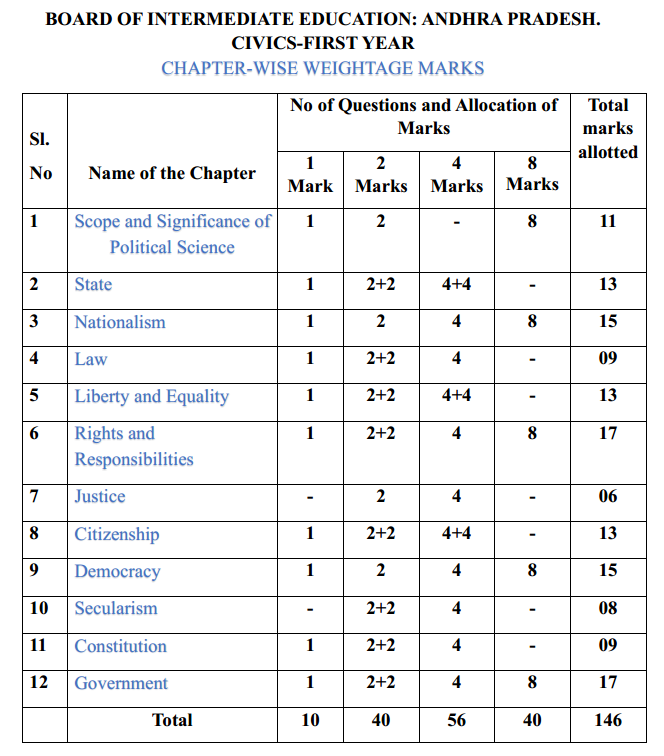
AP Inter 1st Year Civics Weightage BluePrint 2026-2027

AP Inter 1st Year Civics Weightage BluePrint 2026-2027

AP Inter 1st Year Study Material

AP Inter 1st Year Maths Exercise 13b Solutions

Referring to the AP Inter 1st Year Maths Study Material Chapter 13 Statistics Exercise 13b Solutions makes it easier to understand complex problems.

AP Inter 1st Year Maths Statistics Solutions Exercise 13b

I.

Question 1.
Find the mean and variance for each of the following data.
a) 6, 7, 10, 12, 13, 4, 8, 12.
b) First ‘n’ natural numbers,
c) First 10 multiples of 3.
Solution:
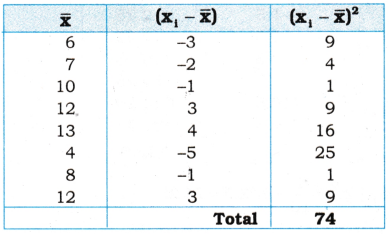
a) Given observations : 6, 7, 10, 12, 13, 4, 8, 12.

Mean, x̄ = \(\frac{\sum_{i=1}^8 x_i}{n}=\frac{6+7+10+12+13+4+8+12}{8}=\frac{72}{8}\) = 9

The following table is obtained for the given data.
AP Inter 1st Year Maths Exercise 13b Solutions 1

Variance (σ2) = \(\frac{1}{n} \sum_{i=1}^n\) (xi – x̄)2
= \(\frac{1}{8}\) × 74
= 9.25

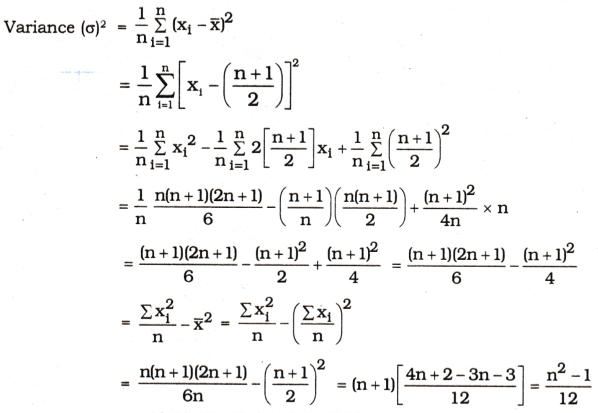
b) The mean of first ‘n’ natural numbers is calculated as follows.
Mean = \(\frac{\text { Sum of all observations }}{\text { No. of observations }}=\frac{n\left(\frac{n+1}{2}\right)}{n}=\frac{n(n+1)}{2 n}=\frac{n+1}{2}\)
AP Inter 1st Year Maths Exercise 13b Solutions 2

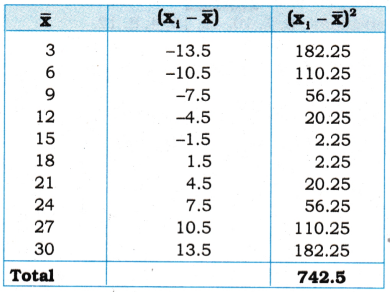
c) The first 10 multiples of ‘3’ are 3, 6, 9, 12, 15, 18, 21, 24, 27, 30.
Here, number of observations, n = 10
Mean, x̄ = \(\frac{\sum_{i=1}^{10} x_i}{10}=\frac{165}{10}\) = 16.5

The following table is obtained for the given data.
AP Inter 1st Year Maths Exercise 13b Solutions 3
Variance (σ2) = \(\frac{1}{\mathrm{n}} \sum_{\mathrm{i}=1}^{10}\)(xi – x̄)2
= \(\frac{1}{10}\) × 742.5
= 74.25

II.

Question 1.
Find the mean and variance for each of the following data.
AP Inter 1st Year Maths Exercise 13b Solutions 4
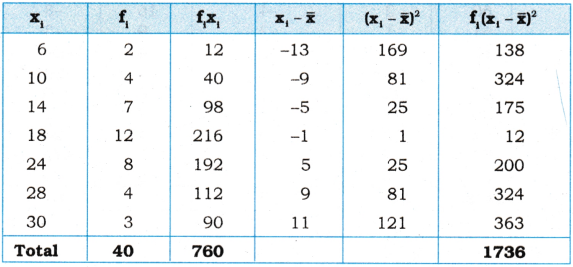
Solution:
AP Inter 1st Year Maths Exercise 13b Solutions 5
Here, N = 40, \(\sum_{i=1}^7\)fixi = 760
x̄ = \(\frac{\sum_{i=1}^7 f_i x_i}{N}=\frac{760}{40}\) = 19
Variance (σ2) = \(\frac{1}{N} \sum_{i=1}^7\) fi(xi – x̄)2 = \(\frac{1}{40}\) × 1736
= 43.4

AP Inter 1st Year Maths Exercise 13b Solutions 6
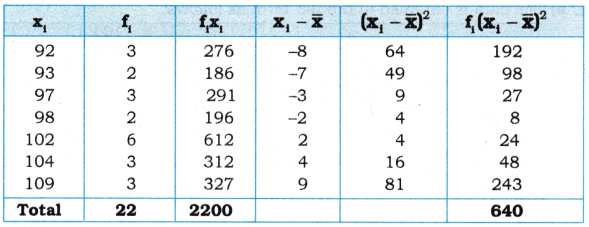
Solution:
The data id obtained in tabular form as follows.
AP Inter 1st Year Maths Exercise 13b Solutions 7
Here, N = 22, \(\frac{1}{2}\)fixi = 2200
∴ x̄ = \(=\frac{1}{N} \sum_{i=1}^7\)fixi

Variance (σ2) = \(\frac{1}{N} \sum_{i=1}^7\) fi(xi – x̄)2 = \(\frac{1}{22}\) × 640 = 29.09

AP Inter 1st Year Maths Exercise 13b Solutions

Question 2.
Find the mean and standard deviation using short-cut method.
AP Inter 1st Year Maths Exercise 13b Solutions 8
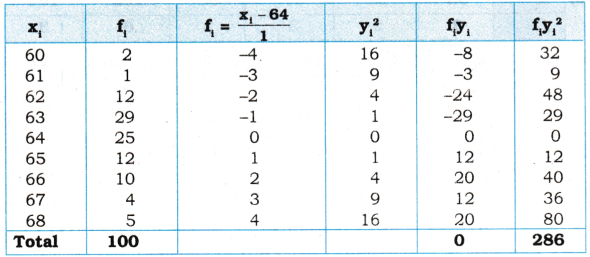
Solution:
The data is obtained in tabular form as follows:
AP Inter 1st Year Maths Exercise 13b Solutions 9
Mean x̄ = A + \(\frac{\sum_{i=1}^9 f_i y_i}{N}\) × h
= 64 + \(\frac{0}{100}\) × 1
= 64 + 0
= 64

Variance (σ2) = \(\frac{h^2}{N^2}\left[N \sum_{i=1}^9 f_i y_i^2-\left(\sum_{i=1}^9 f_i y_i\right)^2\right]\)
= \(\frac{1}{100^2}\)[100 × 286 – 0]
= 2.86

∴ Standard deviation (σ) = \(\sqrt{2.86}\) = 1.69

III.

Question 1.
Find the mean and variance for the following frequency distribution.
AP Inter 1st Year Maths Exercise 13b Solutions 10
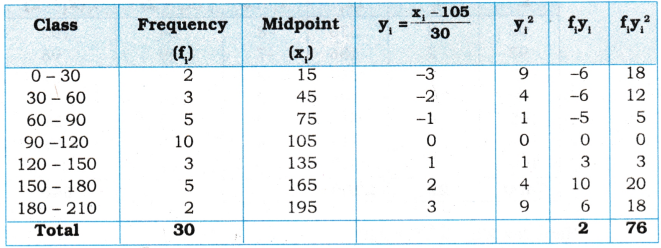
Solution:
The data is obtained in tabular form as follows:
AP Inter 1st Year Maths Exercise 13b Solutions 11
Mean, x̄ = A + \(\frac{\sum_{i=1}^9 f_i y_i}{N}\) × h
= 105 + \(\frac{2}{30}\) × 30
= 105 + 2
= 107

Variance (σ2) = \(\frac{h^2}{N^2}\left[N \sum_{i=1}^9 f_i y_i^2-\left(\sum_{i=1}^9 f_i y_i\right)^2\right]\)
= \(\frac{(30)^2}{(30)^2}\)[30 × 76 – (2)2]
= 2280 – 4
= 2276

AP Inter 1st Year Maths Exercise 13b Solutions 12
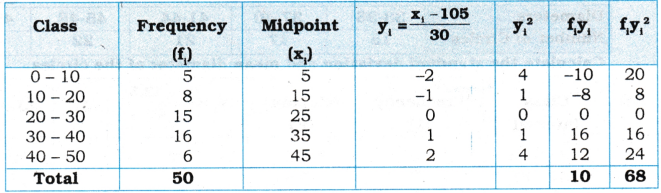
Solution:
The data is obtained in tabular form as follows:
AP Inter 1st Year Maths Exercise 13b Solutions 13
Mean, x̄ = A + \(\frac{\sum_{i=1}^9 f_i y_i}{N}\) × h
= 25 + \(\frac{10}{50}\) × 10
= 25 + 2 = 27

Variance (σ2) = \(\frac{h^2}{N^2}\left[N \sum_{i=1}^9 f_i y_i^2-\left(\sum_{i=1}^9 f_i y_i\right)^2\right]\)
= \(\frac{1}{2}\)[50 × 68 – (10)2]
= \(\frac{1}{25}\)[3400 – 100]
= \(\frac{3300}{25}\) = 132

AP Inter 1st Year Maths Exercise 13b Solutions

Question 2.
Find the mean, variance and standard deviation using short-cut method.
AP Inter 1st Year Maths Exercise 13b Solutions 14
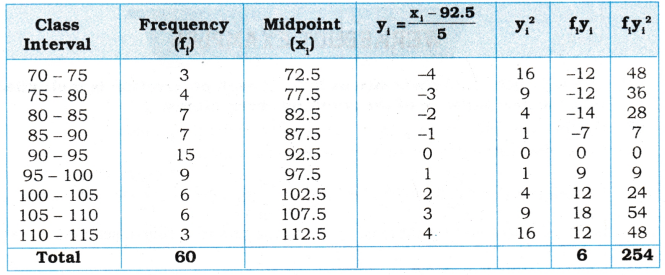
Solution:
The data is obtained in tabular form as follows:
AP Inter 1st Year Maths Exercise 13b Solutions 15
Mean, x̄ = A + \(\frac{\sum_{i=1}^9 f_i y_i}{N}\) × h
= 92.5 + \(\frac{6}{60}\) × 5
= 92.5 + 0.5
= 93

Variance (σ2) = \(\frac{h^2}{N^2}\left[N \sum_{i=1}^9 f_i y_i^2-\left(\sum_{i=1}^9 f_i y_i\right)^2\right]\)
= \(\frac{(5)^2}{(60)^2}\)[60 × 254 – (6)2]
= \(\frac{25}{3600}\)[15240 – 36]
= \(\frac{25}{3600}\)(15204)
= 105.58

∴ Standard deviation (σ) = \(\sqrt{105.58}\) = 10.27

Question 3.
The diameters of circles (in mm) drawn in a design are given below.
AP Inter 1st Year Maths Exercise 13b Solutions 16
Calculate the standard deviation and mean diameter of the circles.
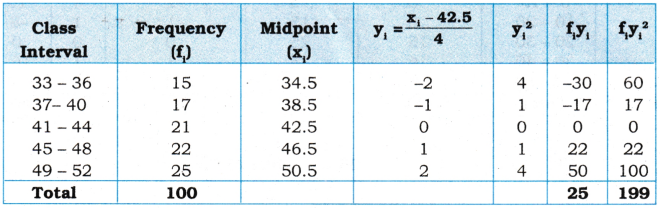
Solution:
AP Inter 1st Year Maths Exercise 13b Solutions 17
Here, N = 100, h = 4. Let the assumed mean A, be 42.5
Mean, x̄ = A + \(\frac{\sum_{i=1}^9 f_i y_i}{N}\) × h
= 42.5 + \(\frac{25}{100}\) × 4
= 43.5

Variance (σ2) = \(\frac{h^2}{N^2}\left[N \sum_{i=1}^9 f_i y_i^2-\left(\sum_{i=1}^9 f_i y_i\right)^2\right]\)
= \(\frac{16}{10000}\) [100 × 199 – (25)2]
= \(\frac{16}{10000}\) [19900 – 625]
= \(\frac{16}{10000}\) × 19275
= 30.84

∴ Standard deviation (σ) = 5.55

AP Inter 1st Year Maths Exercise 13a Solutions

Referring to the AP Inter 1st Year Maths Study Material Chapter 13 Statistics Exercise 13a Solutions makes it easier to understand complex problems.

AP Inter 1st Year Maths Statistics Solutions Exercise 13a

I.

Question 1.
Find the mean deviation about the mean for the following data.
a) 4, 7, 8, 9, 10, 12, 13, 17
b) 38, 70, 48, 40, 42, 55, 63, 46, 54, 44.
Solution:
a) The given data is 4, 7, 8, 9, 10, 12, 13, 17.
Mean of the data, \(\frac{1}{n} \sum_{i=1}^n x_i\) = x̄ = \(\frac{4+7+8+9+10+12+13+17}{8}=\frac{80}{8}\) = 10
The deviations of the respective observations from the mean x̄ i.e., xi – x̄ are -6, -3, -2, -1, 0, 2, 3, 7.
The required mean deviation about the mean is 8
M.D. (x̄) = \(\frac{\sum_{i=1}^8\left|x_i-\bar{x}\right|}{8}=\frac{6+3+2+1+0+2+3+7}{8}=\frac{24}{8}\) = 3

b) The given data is 38, 70, 48, 40, 42, 55, 63, 46, 54, 44.
Mean of the given data, x̄ = \(\frac{38+70+48+40+42+55+63+46+54+44}{10}=\frac{500}{10}\) = 50
The deviations of the respective observations from the mean Xs i.e.,
xi – x̄ are -12, 20, -2, -10, -8, 5, 13, -4, 4, -6.
\(\sum_{i=1}^{10}\)|xi – x̄| = 12 + 20 + 2 + 10 + 8 + 5 + 13 + 4 + 4 + 6 = 84
The required mean deviation about the mean is
M.D. (x̄) = \(\frac{\sum_{j=1}^{10}\left|x_i-\bar{x}\right|}{10}=\frac{84}{10}\) = 8.4

Question 2.
Find the mean deviation about the median for the following data.
a) 13, 17, 16, 14, 11, 13, 10, 16, 11, 18, 12, 17.
b) 36, 72, 46, 42, 60, 45, 53, 46, 51, 49.
Solution:
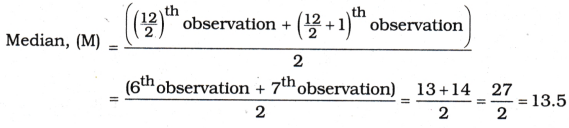
a) Here, the number of observations are 12, which is even.
Arranging the data in ascending order, we have,
10, 11, 11, 12, 13, 13, 14, 16, 16, 17, 17, 18.
AP Inter 1st Year Maths Exercise 13a Solutions 1
\(\sum_{i=1}^{12}\)|xi – M| = 3.5 + 2.5 + 2.5 + 1.5 + 0.5 + 0.5 + 0.5 + 2.5 + 2.5 + 3.5 + 3.5 + 4.5 = 28
∴ The required mean deviation about the median is
M.D. (M) = \(\frac{\sum_{i=1}^{12}\left|x_i-M\right|}{12}=\frac{28}{12}\) = 2.33

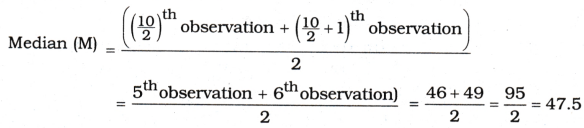
b) The given data is 36, 72, 46, 42, 60, 45, 53, 46, 51, 49.
Here, the number of observations is 10, which is even.
Arranging the data in an ascending order, we have
36, 42, 45, 46, 46, 49, 51, 53, 60, 72
AP Inter 1st Year Maths Exercise 13a Solutions 2
\(\sum_{i=1}^{10}\)|xi – M| = 11.5 + 5.5 + 2.5 + 1.5 + 1.5 + 1.5 + 3.5 + 5.5 + 12.5 + 24.5 = 70
Thus, the required mean deviation about the median is
M.D (M) = \(\frac{\sum_{i=1}^{10}\left|x_i-M\right|}{10}=\frac{70}{10}\) = 7

AP Inter 1st Year Maths Exercise 13a Solutions

II.

Question 1.
Find the mean deviation about the mean for the following data.
AP Inter 1st Year Maths Exercise 13a Solutions 3
Solution:
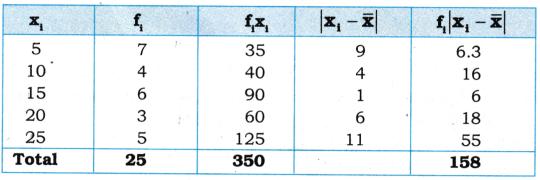
We make following table from the given data.
AP Inter 1st Year Maths Exercise 13a Solutions 4
N = \(\sum_{i=1}^5\) fi = 25 and \(\sum_{i=1}^5\)fixi = 350;
∴ x̄ = \(\frac{1}{N_i} \sum_{i=1}^5\) fixi = \(\frac{1}{25}\) × 350 = 14
∴ M.D.(x̄) = \(\frac{1}{2}\) fi |xi – x̄| = \(\frac{1}{25}\) x 158 = 6.32

AP Inter 1st Year Maths Exercise 13a Solutions 5
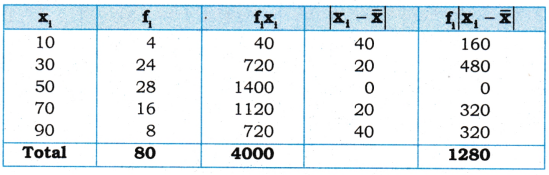
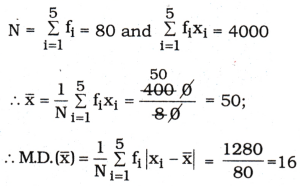
Solution:
We make following table from the given data.
AP Inter 1st Year Maths Exercise 13a Solutions 6
AP Inter 1st Year Maths Exercise 13a Solutions 7

Question 2.
Find the mean deviation about the median for the following data.
AP Inter 1st Year Maths Exercise 13a Solutions 8
Solution:
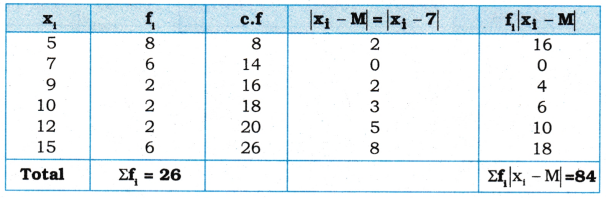
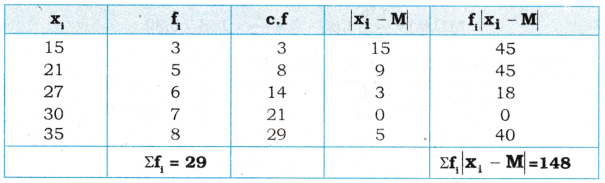
The given observations are already in ascending order. Adding a column corresponding to cumulative frequencies of the given data, we have the following table.
AP Inter 1st Year Maths Exercise 13a Solutions 9
Here, N = 26, which is even. Median is the Mean of 13th and 14th observations. Both of these observations lie in the cumulative frequency 14, for which the corresponding observation is 7.
∴ Median = \(\frac{\left(13^{\text {th }} \text { observation }+14^{\text {th }} \text { observation }\right)}{2}=\frac{7+7}{2}=\frac{14}{2}\)
Median = 7
\(\sum_{i=1}^6\)fi = 26 and \(\sum_{i=1}^6\)fi|xi – M| = 84;
M.D (M) = \(\frac{1}{N_i} \sum_{i=1}^6\)fi|xi – M| = \(\frac{1}{26\) × 84 = 3.23

AP Inter 1st Year Maths Exercise 13a Solutions 10
Solution:
The given observations are already in ascending order. Adding a column corresponding to cumulative frequencies of the given data, we have the following table.
AP Inter 1st Year Maths Exercise 13a Solutions 11
Here, N = 29, which is odd.
Median = \(\left(\frac{29+1}{2}\right)^{\text {th }}\) observation = 15th observation
This observation lies in the cumulative frequency 21, for which the corresponding observation is 30.
M = 30
\(\sum_{i=1}^5\) fi = 29, \(\sum_{i=1}^5\) fi|xi – M| = 148
∴ M.D. (M) = \(\frac{1}{N} \sum_{i=1}^5\)fi|xi – M| = \(\frac{1}{29}\) × 148 = 5.1

III.

Question 1.
Find the mean deviation about the mean for the following data.
AP Inter 1st Year Maths Exercise 13a Solutions 12
Solution:
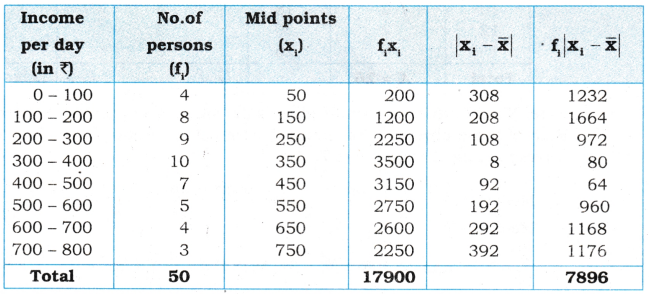
The following table is formed for the given data.
AP Inter 1st Year Maths Exercise 13a Solutions 13
Here, N = \(\frac{1}{2}\) fi = 50 and fixi = 17900
x = \(\frac{1}{2}\)fixi = \(\frac{1}{50}\) × 17900 = 358
and M.D. (x) = \(\frac{1}{N} \sum_{i=1}^8\) fi|xi – x̄| = \(\frac{7896}{50}\) = 157.92

AP Inter 1st Year Maths Exercise 13a Solutions 14
Solution:
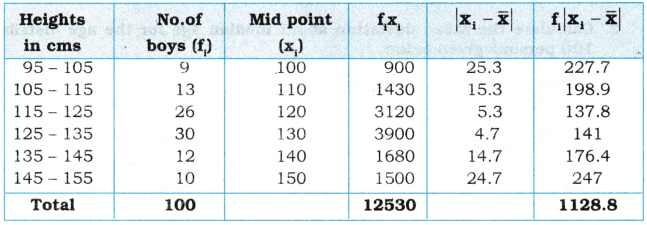
The following table is formed for the given data.
AP Inter 1st Year Maths Exercise 13a Solutions 15
Here, N = \(\sum_{i=1}^6\) fi = 100 and \(\sum_{i=1}^6\) fixi = 12530
x = \(\frac{1}{N_i} \sum_{i=1}^6\)fixi = \(\frac{1}{100}\) × 12530 = 125.3
and M.D (x̄) = \(\frac{1}{N_i} \sum_{i=1}^6\) fi|xi – x̄| = \(\frac{1}{100}\) × 1128.8 = 11.28

AP Inter 1st Year Maths Exercise 13a Solutions

Question 2.
Find the mean deviation about median for the folloeing data:
AP Inter 1st Year Maths Exercise 13a Solutions 16
Solution:
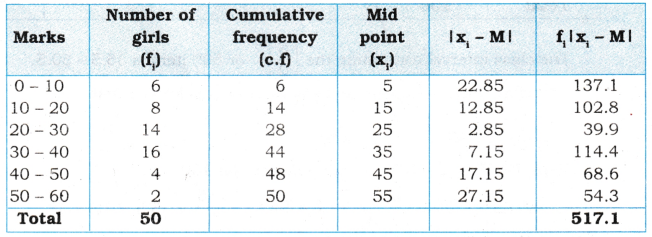
The following table is formed for the given data.
AP Inter 1st Year Maths Exercise 13a Solutions 17
The class interval containing the \(\left[\frac{\mathrm{N}}{2}\right]^{\mathrm{th}}\) or 25th item is 20 – 30.
Therefore, 20 – 30 is the median class. It is known that
Median = l + \(\frac{\frac{\mathrm{N}}{2}-\mathrm{C}}{\mathrm{f}}\) × h
Here, 1= 20, C = 14, f = 14, h = 10 and N = 50
Median = 20 + \(\frac{25-14}{14}\) × 10 = 20 + \(\frac{110}{14}\) = 20 + 7.85 = 27.85
Thus, mean deviation about the median is given by,
M.D. (M) = \(\frac{1}{N_i} \sum_{i=1}^6\)fi|xi – x̄| = \(\frac{1}{50}\) × 517.1 = 10.34

Question 3.
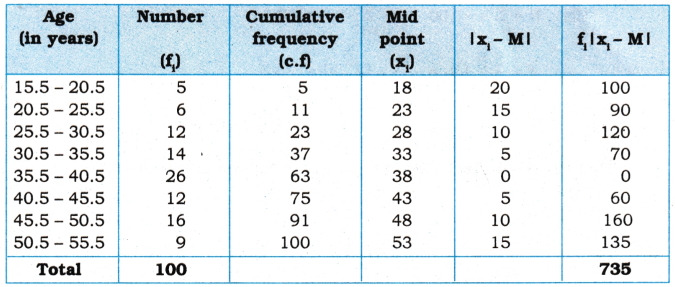
Calculate the mean deviation about median age for the age distribution of 100 persons given below.
AP Inter 1st Year Maths Exercise 13a Solutions 18
Solution:
The given data is not continuous. Therefore, it has to be converted into continuous frequency distribution by subtracting 0.5 from the lower limit and adding 0.5 to the upper limit of each class interval.

The table is formed as follows.
AP Inter 1st Year Maths Exercise 13a Solutions 19
The class interval containing the \(\left[\frac{\mathrm{N}}{2}\right]^{\text {th }}\) or 50th item is 35.5 – 50.5
Therefore, 35.5 – 40.5 is the median class. It is known that
Median (M) = l + \(\frac{\frac{\mathrm{N}}{2}-\mathrm{C}}{\mathrm{f}}\) × h
Here, l = 35.5, C = 37, f = 26, h = 5 and N = 100
∴ Median = 35.5 + \(\frac{50-37}{26}\) × 5 = 35.5 + \(\frac{13 \times 5}{26}\) = 35.5 + 2.5 = 38
Thus, mean deviation about the median is given by,
M.D. (M) = \(\frac{1}{N_i} \sum_{i=1}^8\)fi|xi – x̄| = \(\frac{1}{100}\) × 735 = 7.35

AP Inter 1st Year Maths Exercise 3e Solutions

Referring to the AP Inter 1st Year Maths Study Material Chapter Trigonometric Functions Exercise 3e Solutions makes it easier to understand complex problems.

AP Inter 1st Year Maths Trigonometric Functions Exercise 3e

I. Find the principal and general solutions of the following equations.

Question 1.
tan x = √3
Solution:
We know that tan \(\frac{1}{2}\) = √3 and tan\(\left(\frac{4 \pi}{3}\right)\) = tan\(\left(\pi+\frac{\pi}{3}\right)\)
= tan\(\frac{\pi}{3}\) = √3
The principal solutions are x = \(\frac{\pi}{3}\) and \(\frac{4 \pi}{3}\)
tan x = tan\(\frac{\pi}{3}\) ⇒ x = nπ + \(\frac{\pi}{3}\) where n ∈ Z
The general solution is x = nπ + \(\frac{\pi}{3}\) where n ∈ Z

Question 2.
sec x = 2
Solution:
We know that sec\(\frac{\pi}{3}\) = 2 and sec \(\frac{5 \pi}{3}\)
= sec (2π – \(\frac{\pi}{3}\)) = sec \(\frac{\pi}{3}\) = 2
The principal solutions are x = \(\frac{\pi}{3}\) and \(\frac{5 \pi}{3}\)
sec x = sec \(\frac{\pi}{3}\) ⇒ cos x = cos \(\frac{\pi}{3}\) [∵ sec x = \(\frac{1}{\cos x}\)]
⇒ x – 2nπ ± \(\frac{\pi}{3}\) where n ∈ Z
∴ The general solution is x = 2nπ ± \(\frac{\pi}{3}\); where n ∈ Z

Question 3.
cot x = √3
Solution:
We know that, cot \(\frac{\pi}{3}\) = √3
cot (π – \(\frac{\pi}{6}\)) = -cot\(\frac{\pi}{6}\) = -√3 and cot(2π – \(\frac{\pi}{6}\))
= -cot\(\frac{\pi}{6}\) = -√3
⇒ cot \(\frac{5 \pi}{6}\) = -√3 and cot \(\frac{11 \pi}{6}\) = -√3

The principal solutions are x = \(\frac{5 \pi}{6}\) and \(\frac{11 \pi}{6}\)
cot x = cot \(\frac{5 \pi}{6}\) ⇒ tanx = tan\(\frac{5 \pi}{6}\)
⇒ x = nx + \(\frac{5 \pi}{6}\) , where n ∈ Z
∴ The general solution is x = nx + \(\frac{5 \pi}{6}\), where n ∈ Z

AP Inter 1st Year Maths Exercise 3e Solutions

Question 4.
cosec x = -2
Solution:
We know that, cosec \(\frac{\pi}{6}\) = 2
cosec (π + \(\frac{\pi}{6}\)) = – cosec \(\frac{\pi}{6}\) = -2 and cosec (2π – \(\frac{\pi}{6}\)) = -cosec \(\frac{\pi}{6}\) = -2
⇒ cosec \(\frac{7 \pi}{6}\) = -2 and cosec \(\frac{11 \pi}{6}\) = -2
The principal solutions are x = \(\frac{7 \pi}{6}\) and \(\frac{11 \pi}{6}\)
cosec x = cosec \(\frac{7 \pi}{6}\) ⇒ sinx = sin\(\frac{7 \pi}{6}\)
x = nπ + (-1)n\(\frac{7 \pi}{6}\)
∴ The general solution is x = nπ + (-1)n\(\frac{7 \pi}{6}\) where n ∈ Z

II. Find the general solution for each of the following equations.

Question 1.
cos 4x = cos 2x
Solution:
Given that, cos 4x = cos 2x ⇒ cos 4x – cos 2x = 0
⇒ -2 sin\(\left(\frac{4 x+2 x}{2}\right)\)sin\(\left(\frac{4 x-2 x}{2}\right)\) = 0
⇒ sin 3x sin x = 0
⇒ sin 3x = 0 or sin x = 0
3x = nπ or x = nπ, where n ∈ Z ⇒ x = \(\frac{\mathrm{n} \pi}{3}\) or x = nx, where n ∈ Z

Question 2.
cos 3x + cos x – cos 2x = 0.
Solution:
Given that cos 3x + cos x – cos 2x = 0
⇒ 2cos 2x cos x -cos 2x = 0
⇒ cos 2x (2 cos x – 1) = 0
⇒ cos 2x = 0 or 2cos x – 1 = 0
⇒ cos 2x = 0 or cos x = \(\frac{1}{2}\)
⇒ cos\(\frac{\pi}{3}\) ⇒ x = (2n + 1)\(\frac{\pi}{4}\) or x = 2nx ± \(\frac{\pi}{3}\), where n ∈ Z

Question 3.
sin 2x + cos x = 0
Solution:
Given that sin 2x + cos x = 0
⇒ 2 sin x cos x + cos x = 0
⇒ cos x (2 sin x + 1) = 0
⇒ cos x = 0 or 2 sin x + 1 = 0
cos x = 0 ⇒ x = (2n + 1)\(\frac{\pi}{2}\), where n ∈ Z
2 sin x + 1 = 0
⇒ sin x = \(\frac{-1}{2}\) = -sin\(\frac{\pi}{2}\) = sin(π + \(\frac{\pi}{2}\)) = sin \(\frac{7 \pi}{2}\)
⇒ x = nπ + (-1)n\(\frac{7 \pi}{6}\), where n ∈ Z
∴ The general solution is (2n + 1)\(\frac{\pi}{2}\) or nπ + (-1)n\(\frac{7 \pi}{2}\), n ∈ Z

Question 4.
sec2 2x = 1 – tan 2x.
Solution:
Given that sec2 2x = 1 – tan 2x
⇒ 1 + tan2 2x = 1 – tan 2x
⇒ tan2 2x – tan 2x = 0
⇒ tan 2x (tan 2x – 1) = 0
⇒ tan 2x = 0 or tan 2x – 1 = 0
⇒ tan 2x = 0 or -1
⇒ 2x = nπ, where n ∈ Z
⇒ x = \(\frac{\mathrm{n} \pi}{2}\), where n ∈ Z

tan 2x = -1 = -tan \(\frac{\pi}{4}\) = tan (π – \(\frac{\pi}{4}\)) = tan \(\frac{3 \pi}{2}\)
⇒ 2x = nπ + \(\frac{3 \pi}{4}\), where n ∈ Z
⇒ x = \(\frac{\mathrm{n} \pi}{2}+\frac{3 \pi}{8}\), where n ∈ Z
∴ The general solution is \(\frac{\mathrm{n} \pi}{2}\) or \(\frac{\mathrm{n} \pi}{2}+\frac{3 \pi}{8}\), n ∈ Z

AP Inter 1st Year Maths Exercise 3e Solutions

Question 5.
sin x + sin 3x + sin 5x = 0
Solution:
We know that, sin A + sin B = 2sin\(\left(\frac{\mathrm{A}+\mathrm{B}}{2}\right)\) cos \(\left(\frac{\mathrm{A}-\mathrm{B}}{2}\right)\)
⇒ sin x + sin 5x = 2 sin \(\left(\frac{6 \mathrm{x}}{2}\right)\) cos \(\left(\frac{-4 x}{2}\right)\) = 2 sin 3x cos 2x
⇒ 2sin 3x cos 2x + sin 3x = 0
⇒ sin 3x(2 cos 2x + 1) = 0
⇒ sin 3x = 0 or 2 cos 2x + 1 = 0
⇒ sin 3x = 0
⇒ 3x = nπ
⇒ x = \(\frac{\mathrm{n} \pi}{3}\)

2 cos 2x + 1 = 0
⇒ cos 2x = –\(\frac{1}{2}\)
⇒ 2x = 2nπ ± \(\frac{2 \pi}{3}\)
⇒ x = nπ ± \(\frac{\pi}{3}\)
∴ The general solution is \(\frac{\mathrm{n} \pi}{3}\) or nπ ± \(\frac{\pi}{3}\), where n ∈ Z .

AP Inter 1st Year Maths Exercise 14d Solutions

Referring to the AP Inter 1st Year Maths Study Material Chapter 14 Probability Exercise 14d Solutions makes it easier to understand complex problems.

AP Inter 1st Year Maths Probability Solutions Exercise 14d

In each of the following Exercises 1 to 7, describe the sample space for the indicated experiment.

Question 1.
A coin is tossed four times.
Solution:
Let S’ be a Sample space. Each toss has two outcomes: H(Head), T(Tail).
Total outcomes = 24 = 16.
S = {HHHH, HHHT, HHTH, HHTT, HTHH, HTHT, HTTH, HTTT, THHH, THHT, THTH, THTT, TTHH, TTHT, TTTH, TTTT}.

Question 2.
A coin is tossed and a dice is thrown.
Solution:
Let ‘S’ be a Sample space, Coin → {H, 1, Dice → {1, 2, 3, 4, 5, 6)
S = {(H, 1), (H, 2), (H, 3), (H, 4), (H, 5), (H, 6), (T, 1), (T, 2), (T, 3), (T, 4), (T, 5), (T, 6)}
Total outcomes = 12.

Question 3.
A coin is tossed and then a dice is rolled only in case a head is shown on the coin.
Solution:
Let S’ be a Sample space. If Head : roll dice → {1, 2, 3, 4, 5, 6), If Tail : no dice roll → T
S = {T, (H, 1), (H, 2), (H, 3), (H, 4), (H, 5), (H, 6)}
Total outcomes = 7

Question 4.
2 boys and 2 girls are in Room X, and 1 boy and 3 girls in Room Y. Specify the sample space for the experiment in which a room is selected and then a person.
Solution:
Let ‘S’ be a Sample Space. Room X : B1, B2, G1, G2 Room Y : B3, G4, G3, G4
S = {(X, B1), (X, B2), (X, G1), (X, G2), (Y, B3), (Y, B4), (Y, G3), (Y, G4)}
Total outcomes = 8

AP Inter 1st Year Maths Exercise 14d Solutions

Question 5.
One dice of red colour, one of white colour and one of blue colour are placed in a bag. One dice is selected at random and rolled, its colour and the number on its uppermost face is noted. Describe the sample space.
Solution:
Dice colour → {R, W, B}, Each with outcomes 1 to 6.
S = {(R, 1), (R, 2), …, (R, 6), (W, 1), … , (W, 6), (B, 1) … , (B, 6)}
Total outcomes = 3 × 6 = 18

Question 6.
An experiment consists of recording boy-girl composition of families with 2 children.
i) What is the sample space if we are interested in knowing whether it is a boy or girl in the order of their births?
ii) What is the sample space if we are interested in the number of girls in the family?
Solution:
i) Order matters [first born, second bom) possible combinations
S = {BB, BG, GB, GG} (B = Boy, G = Girl)

ii) Only number of girls matters
S = {0, 1, 2} (0 girls → BB, 1 Girl → BG (or) GB, 2 girls → GG).

Question 7.
A box contains 1 red and 3 identical white balls. Two balls are drawn at random in succession without replacement. Write the sample space for this experiment.
Solution:
Let R = Red, W = White, Balls : {R, W1, W2, W3} {W’s are identical, so indistinct)
Unique Combinations: RW, WR, WW
Hence, S = {RW, WR, WW}
Note : W1, W2, W3 are identical, so (W1, W2) – (W2, W3) = WW.

Question 8.
An experiment consists of tossing a coin and then throwing it second time if a head occurs. If a tail occurs on the first toss, then a dice is rolled once. Find the sample space.
Solution:
Toss a coin. If head, toss again. If tail, roll a dice.
Sample Space, S :
First toss = H → toss again : (H, H), (H, T).
First toss = T → roll dice : (T, 1), (T, 2), … (T, 6).
S = {(H, H), (H, T), (T, 1), (T, 2), (T, 3), (T, 4), (T, 5), (T, 6)}
Total outcomes = 2(From HH, HT) + 6 (From T1 – T6) = 8

Question 9.
Suppose 3 bulbs are selected at random from a lot. Each bulb is tested and classified as defective (D) or non-defective (N). Write the sample space of this experiment.
Solution:
3 bulbs are to be selected at random from the lot. Each bulb in the lot is tested and classified as defective (D) or non-defective (N). The sample space of this experiment is given by
S = {DDD, DDN, DND, NDN, NND, NNN)}.

Question 10.
A coin is tossed. If the outcome is a head, a dice is thrown. If the dice shows up an even number, the dice is thrown again. What is the sample space for the experiment?
Solution:
When a coin is tossed, the possible outcomes are head (H) and tail (T).
When a dice is thrown, the possible outcomes are 1, 2, 3, 4, 5 or 6 S = {T, H1, H3, H5, H21, H22, H23, H24, H25, H26, H41, H42, H43, H44, H45, H46, H61, H62, H63, H64, H65, H66}.

AP Inter 1st Year Maths Exercise 14d Solutions

Question 11.
The numbers 1, 2, 3 and 4 are written separately on four slips of paper. The slips are put in a box and mixed thoroughly. A person draws two slips from the box, one after the other, without replacement. Describe the sample space for the experiment.
Solution:
Let ‘S’ be a Sample space.
Permutations of 2 slips out of 4 :
S = {(1, 2), (1, 3), (1, 4), (2, 1), (2, 3), (2, 4), (3, 1), (3, 2), (3, 4), (4, 1), (4, 2), (4, 3)}
Total outcomes = 4P2 = 12

Question 12.
An experiment consists of rolling a dice and then tossing a coin once if the number on the dice is even. If the number on the dice is odd, the coin is tossed twice. Write the sample space for this experiment.
Solution:
Experiment : Roll a dice, if it shows an even number, toss a coin once. If odd, toss the coin twice.
The possible outcomes when rolling dice are {1, 2, 3, 4, 5, 6}.
Outcomes for even numbers on dice : (2, H), (2, T), (4, H), (4, T), (6, H), (6, T).
Outcomes for odd numbers on dice : (1, HH), (1, TT), (1, TH), (1, HT), (3, HH), (3, TT), (3, TH), (3, HT), (5, HH), (5, TT), (5, TH), (5, HT).
So, S = {(2, H), (2, T), (4, H), (4, T), (6, H), (6, T), (1, HH), (1, TT), (1, TH), (1, HT), (3, HH), (3, TT), {3, TH), (3, HT), (5, HH), (5, TT), (5, TH), (5, HT)}
Total outcomes = 6 (even) + 12 (odd with coin twice) = 18
S = {(6), (x1, 6), (x1, x2, 6), …} where each xi ∈ {1, 2, 3, 4, 5}.
This is an infinite sample space of sequences ending with 6 and prior values being from (1, 2, 3, 4, 5}.

Question 13.
A coin is tossed. If it shows a tail, we draw a ball from a box which contains 2 red and 3 black balls. If it shows head, we throw a dice. Find the sample space for this experiment.
Solution:
Experiment : A coin is tossed if tail, draw a ball from box with 2 red and 3 black balls. If head, throw a dice.
Sample space, S :
If coin is Head → roll dice : H1, H2 … , H6
If coin is tail draw ball : TR1, TR2 (red), TB1, TB2, TB3 (Black).
5 = (H, 1), (H, 2), (H, 3), (H, 4), (H, 5), (H, 6), (T, Red 1), (T, Red 2), (T, Black 1), (T, Black 2), (T, Black 3).
Total outcomes = 6 + 5 = 11

Question 14.
A dice is thrown repeatedly untill a six comes up. What is the sample space for this experiment ?
Solution:
Experiment: A dice is thrown repeatedly untill a six comes up.
Sample space, S :
Stop only when 6 comes possible outcomes :
6
1, 6
1, 1, 6
2, 4, 3, 6
……………..
S = {6, (1, 6) ………….. (1, 1, 6) ………… (2,4, 3, 6) …………}
All sequences ending with 6 and before that only number (or) numbers from 1 to 5.

Trigonometric Functions MCQ AP Inter 1st Year Maths Chapter 3

Practice AP Inter 1st Year Maths Study Material Chapter Trigonometric Functions MCQ to identify your strengths and weak areas.

AP Inter 1st Year Maths Trigonometric Functions MCQ

Question 1.
The value of cos 5π is
1) 0
2) 1
3) – 1
4) None of these
Solution:
3) – 1

Explanation:
Cos 5π = cos (2 × 2π + π)
= cos π = – 1.

Question 2.
The value of cos 1° cos 2° cos 3° ………………………. cos 179° is
1) \(\frac{1}{\sqrt{2}}\)
2) 0
3) 1
4) – 1
Solution:
2) 0

Explanation:
cos 1° cos 2° cos 3° ………………………. cos 179°
= cos 1° . cos 2° ….. cos 3° ………………. cos 90° ………… cos 179°
= cos 1° . cos 2° …………. 0 …………. cos 179° = 0

Question 3.
If sin θ + cosec θ = 2, then sin2 θ + cosec2 θ is equal to
1) 1
2) 4
3) 2
4) None of these
Solution:
3) 2

Explanation:
Given sin θ + cosec θ = 2
⇒ sin θ + \(\frac{1}{\sin \theta}\) = 2
⇒ sin2 θ + 1 = 2 sin θ
⇒ sin2 θ – 2 sin θ + 1 = 0
⇒ sin θ – 1 = 0
⇒ sin θ = 1
Now sin2 θ + cosec2 θ = (1)2 + (1)2
= 1 + 1 = 2

Trigonometric Functions MCQ AP Inter 1st Year Maths Chapter 3

Question 4.
If tan θ = \(\frac{1}{2}\) and tan ϕ = \(\frac{1}{3}\), then the value of θ + ϕ is
1) \(\frac{\pi}{6}\)
2) π
3) 0
4) \(\frac{\pi}{4}\)
Solution:
4) \(\frac{\pi}{4}\)

Explanation:
tan (θ + ϕ) = \(\frac{\tan \theta+\tan \phi}{1-\tan \theta \tan \phi}\)
= \(\frac{\frac{1}{2}+\frac{1}{3}}{1-\frac{1}{2} \cdot \frac{1}{3}}\)
= \(\frac{3+2}{6-1}\)
= 1 [∴ (θ + ϕ) = \(\frac{\pi}{4}\)]

Question 5.

The value of \(\frac{1-\tan ^2 15}{1+\tan ^2 15}\) is
1) 1
2) √3
3) \(\frac{\sqrt{3}}{2}\)
4) 2
Solution:
3) \(\frac{\sqrt{3}}{2}\)

Explanation:
\(\frac{1-\tan ^2 15}{1+\tan ^2 15}\) = cos (2 × 15°)
= cos 30°
= \(\frac{\sqrt{3}}{2}\)

Question 6.
The value of sin (45° + θ) – cos (45° – θ) is
1) 2 cos θ
2) 2 sin θ
3) 1
4) 0
Solution:
4) 0

Explanation:
sin (45° + θ) – cos (45° – θ) = (sin 45° cos θ + cos 45° sin θ) – (cos 45° cos θ + sin 45° sin θ)
= [\(\frac{1}{\sqrt{2}}\) cos θ + \(\frac{1}{\sqrt{2}}\) sin θ] – [\(\frac{1}{\sqrt{2}}\) cos θ + \(\frac{1}{\sqrt{2}}\) sin θ] = 0

Trigonometric Functions MCQ AP Inter 1st Year Maths Chapter 3

Question 7.
The value of cot (\(\frac{\pi}{4}\) + θ) cot (\(\frac{\pi}{4}\) – θ) is
1) – 1
2) 0
3) 1
4) None of these
Solution:
3) 1

Explanation:
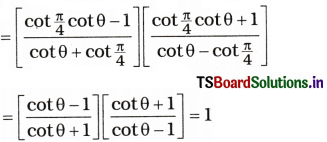
cot (\(\frac{\pi}{4}\) + θ) cot (\(\frac{\pi}{4}\) – θ)

Trigonometric Functions MCQ AP Inter 1st Year Maths Chapter 3 1

Question 8.
cos 2θ cos 2ϕ + sin2 (θ – ϕ) – sin2 (θ + ϕ) is equal to
1) sin 2 (θ + ϕ)
2) cos 2 (θ + ϕ)
3) sin 2 (θ – ϕ)
4) cos 2 (θ – ϕ)
Solution:
2) cos 2 (θ + ϕ)

Explanation:
cos 2θ cos 2ϕ + sin2 (θ – ϕ) – sin2 (θ + ϕ)
= cos 2θ cos 2ϕ + sin [(θ – ϕ) + (θ + ϕ)] sin [(θ – ϕ) – (θ + ϕ)]
= cos 2θ cos 2ϕ + sin 2θ sin (- 2ϕ)
= cos 2θ cos 2ϕ – sin 2θ sin 2ϕ
= cos (2θ + 2ϕ)
= cos 2 (θ + ϕ)

Question 9.
The value of sin 50° – sin 70° + sin 10° is equal to
1) 1
2) 0
3) ½
4) 2
Solution:
2) 0

Explanation:
sin 50° – sin 70° + sin 10° = 2 cos \(\left[\frac{50^{\circ}+70^{\circ}}{2}\right]\) sin \(\left[\frac{50^{\circ}-70^{\circ}}{2}\right]\) + sin 10°
= 2 cos 60° sin (- 10°) + sin 10°
= – sin 10° + sin 10° = 0.

Trigonometric Functions MCQ AP Inter 1st Year Maths Chapter 3

Question 10.
If sin θ + cos θ = 1 then the value of sin 2θ is equal to
1) 1
2) ½
3) 0
4) – 1
Solution:
3) 0

Explanation:
sin θ + cos θ = 1
⇒ (sin θ + cos θ)2 = 1
⇒ sin2 θ + cos2 θ + 2 sin θ cos θ = 1
⇒ 1 + sin 2θ = 1
⇒ sin 2θ = 0.

AP Inter 1st Year Maths Exercise 3d Solutions

Referring to the AP Inter 1st Year Maths Study Material Chapter Trigonometric Functions Exercise 3d Solutions makes it easier to understand complex problems.

AP Inter 1st Year Maths Trigonometric Functions Exercise 3d

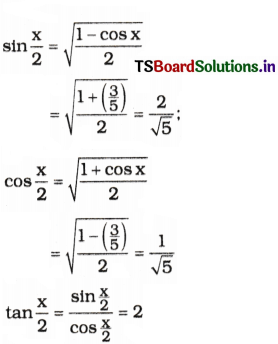
I. Find sin \(\frac{x}{2}\), cos \(\frac{x}{2}\) and tan \(\frac{x}{2}\) in each of the following.

Question 1.
tan = – \(\frac{4}{3}\), x in quadrant II.
Solution:
Given, tan x = – \(\frac{4}{3}\) (x is in second quadrant)
i.e. \(\frac{\pi}{2}\) < x < π
⇒ \(\frac{\pi}{4}<\frac{x}{2}<\frac{\pi}{2}\)
i.e. \(\frac{x}{2}\) lies in the I quadrant,
so that all trigonometric ratios of \(\frac{x}{2}\) are +ve.
Now, sec2 x = 1 + tan2 x
= 1 + \(\frac{16}{9}\)
= \(\frac{9+16}{9}\)
= \(\frac{25}{9}\)
∴ sec x = ± \(\frac{5}{3}\)
But x is in II quadrant
∵ sec x is -ve. i.e., sec x = – \(\frac{5}{3}\)
⇒ cos x = – \(\frac{3}{5}\)

AP Inter 1st Year Maths Exercise 3d Solutions 1

Question 2.
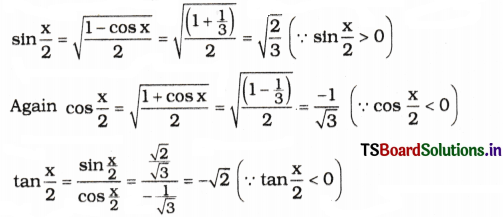
cos x = – \(\frac{1}{3}\), x in quadrant II.
Solution:
Given, cos x = – \(\frac{1}{3}\) [x is in quadrant II]
i.e., π < x < \(\frac{3 \pi}{2}\)
⇒ \(\frac{\pi}{2}<\frac{x}{2}<\frac{3 \pi}{4}\)
⇒ 90° < \(\frac{x}{2}\) < 135°
i.e., \(\frac{x}{2}\) lies in II quadrant, so that sin \(\frac{x}{2}\) > 0, cos \(\frac{x}{2}\) < 0 and tan \(\frac{x}{2}\) < 0

AP Inter 1st Year Maths Exercise 3d Solutions 2

Question 3.
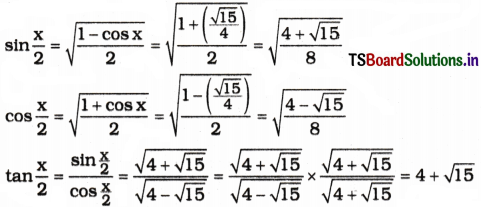
sin x = \(\frac{1}{4}\), x in quadrant II.
Solution:
Given, sin x = \(\frac{1}{4}\), [x is in quadrant II]
i.e. \(\frac{\pi}{2}\) < x < π
⇒ \(\frac{\pi}{4}<\frac{x}{2}<\frac{\pi}{2}\)
i.e., \(\frac{x}{2}\) lies in I quadrant,
so that all trigonometric ratios of \(\frac{x}{2}\) are +ve.
Also, cos2 x = 1 – sin2 x
= 1 – \(\frac{1}{16}\) = \(\frac{15}{16}\)
cos x = ± \(\frac{\sqrt{15}}{4}\)
But x is in II quadrant and cos x < 0.
∴ cos x = \(\frac{-\sqrt{15}}{4}\)

AP Inter 1st Year Maths Exercise 3d Solutions 3

AP Inter 1st Year Maths Exercise 3d Solutions

II. Prove the following.

Question 1.
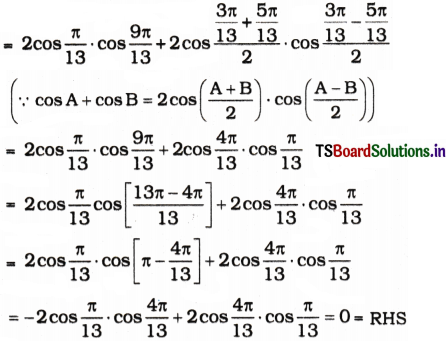
2 cos \(\frac{\pi}{13}\) cos \(\frac{9 \pi}{13}\) + cos \(\frac{3 \pi}{13}\) + cos \(\frac{5 \pi}{13}\) = 0
Solution:
LHS = 2 cos \(\frac{\pi}{13}\) cos \(\frac{9 \pi}{13}\) + cos \(\frac{3 \pi}{13}\) + cos \(\frac{5 \pi}{13}\)

AP Inter 1st Year Maths Exercise 3d Solutions 4

Question 2.
(sin 3x + sin x) sinx + (cos 3x – cos x) cos x = 0.
Solution:
LHS = (sin 3x + sin x) sinx + (cos 3x – cos x) cos x
= sin 3x sin x + sin2 x + cos 3x cos x – cos2 x
= cos 3x cos x + sin 3x sin x – (cos2 x – sin2 x)
= cos (3x – x) – cos 2x
[∵ cos (A – B) = cos A cos B + sin A sin B]
= cos 2x – cos 2x = 0 = RHS

Question 3.
(cos x + cos y)2 + (sin x – sin y)2 = 4 cos2 \(\left(\frac{x+y}{2}\right)\)
Solution:
LHS = (cos x + cosy)2 + (sin x – sin y)2
= cos2 x + cos2 y + 2 cos x . cos y + sin2 x + sin2 y – 2 sin x . sin y
= cos2 x + sin2 x + cos2 y + sin2 y + 2(cos x . cos y – sin x . sin y)
= 1 + 1 + 2 cos (x + y)
= 2 + 2 cos (x + y)
= 2 (1 + cos(x + y))
= 2 . 2 cos2 \(\left[\frac{\mathrm{x}+\mathrm{y}}{2}\right]\)
= 4 cos2 \(\left[\frac{\mathrm{x}+\mathrm{y}}{2}\right]\) = RHS

Question 4.
(cos x – cos y)2 + (sin x – sin y)2 = 4 sin2
Solution:
LHS = (cos x – cos y)2 + (sin x – sin y)2
= cos2 x + cos2 y – 2 cos x cos y + sin2 x + sin2 y – 2sin x sin y
= (cos2 x + sin2 x) + (cos2 y + sin2 y) – 2 [cos x cos y + sin x sin y]
= 1 + 1 – 2 [cos (x – y)]
[∵ cos (A – B) = cos A cos B + sin A sin B]
= 2 [1 – cos (x – y)]
= 2 [2 sin2 \(\left[\frac{\mathrm{x}-\mathrm{y}}{2}\right]\)]
= 4 sin2 \(\left[\frac{\mathrm{x}-\mathrm{y}}{2}\right]\) = RHS

Question 5.
sin 3x + sin 2x – sin x = 4 sin x cos \(\frac{x}{2}\) cos \(\frac{3 x}{2}\)
Solution:
L.H.S. = sin 3x + sin 2x – sin x
= sin 3x – sin x + sin 2x
= 2 cos \(\left(\frac{3 x+x}{2}\right)\) sin \(\left(\frac{3 x-x}{2}\right)\) + 2 sin x cos x
= 2 cos 2x sin x + 2 sin x cos x
= 2 sin x (cos 2x + cos x)
= 4 sinx cos \(\frac{3 x}{2}\) cos \(\frac{x}{2}\)
= 4 sin x cos \(\frac{x}{2}\) cos \(\frac{3 x}{2}\) = RHS

AP Inter 1st Year Maths Exercise 3d Solutions

III. Prove the following.

Question 1.
sin x + sin 3x + sin 5x + sin 7x = 4 cos x cos 2x sin 4x.
Solution:
LHS = sin x + sin 3x + sin 5x + sin 7x
= (sin x + sin 5x) + (sin 3x + sin 7x)
= 2 sin \(\left[\frac{x+5 x}{2}\right]\) cos \(\left[\frac{x-5 x}{2}\right]\) + 2 sin \(\left[\frac{3 x+7 x}{2}\right]\) cos \(\left[\frac{3 x-7 x}{2}\right]\)
= 2 sin 3x cos (- 2x) + 2 sin 5x cos (- 2x)
= 2 sin 3x cos 2x + 2 sin 5x cos 2x
= 2 cos 2x [sin 3x + sin 5x]
= 2 cos 2x [2 sin \(\left[\frac{3 x+5 x}{2}\right]\) . cos \(\left[\frac{3 x-5 x}{2}\right]\)]
= 2 cos 2x [2 sin 4x . cos (- x)]
= 4 cos 2x sin 4x cos x = RHS

Question 2.
\(\frac{(\sin 7 x+\sin 5 x)+(\sin 9 x+\sin 3 x)}{(\cos 7 x+\cos 5 x)+(\cos 9 x+\cos 3 x)}\) = tan 6x
Solution:
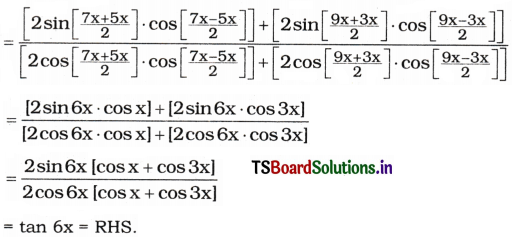
\(\frac{(\sin 7 x+\sin 5 x)+(\sin 9 x+\sin 3 x)}{(\cos 7 x+\cos 5 x)+(\cos 9 x+\cos 3 x)}\)

AP Inter 1st Year Maths Exercise 3d Solutions 5

AP Inter 1st Year Maths Exercise 3c Solutions

Referring to the AP Inter 1st Year Maths Study Material Chapter Trigonometric Functions Exercise 3c Solutions makes it easier to understand complex problems.

AP Inter 1st Year Maths Trigonometric Functions Exercise 3c

I.
Question 1.
Find the value of :

i) sin 75°
Solution:
i) sin 75° = sin (45 + 30)°
= sin 45°°cos 30° + cos°45°sin 30°
[∵ sin (A + B) = sin A cos B + cos A sin B]
= \(\frac{1}{\sqrt{2}} \times \frac{\sqrt{3}}{2}+\frac{1}{2} \times \frac{1}{\sqrt{2}}\)
= \(\frac{\sqrt{3}+1}{2 \sqrt{2}}\)

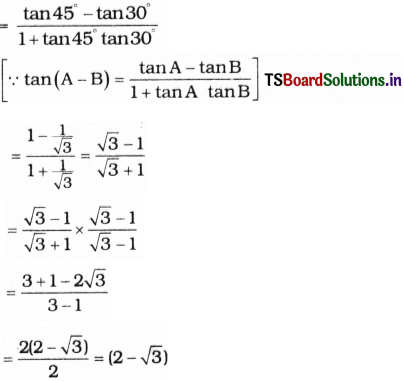
ii) tan 15°
Solution:
tan 15° = tan (45° – 30°)

AP Inter 1st Year Maths Exercise 3c Solutions 1

iii) cot 15°
Solution:
cot 15° = \(\frac{1}{\tan 15^{\circ}}\)
= \(\frac{1}{2-\sqrt{3}}\)
= \(\frac{2+\sqrt{3}}{(2-\sqrt{3})(2+\sqrt{3})}\)
= 2 + √3

iv) cos 75°
Solution:
cos 75° = cos (45° + 30°)
= cos 45° cos 30° – sin 45° sin 30°
= \(\frac{1}{\sqrt{2}} \frac{\sqrt{3}}{2}-\frac{1}{\sqrt{2}} \cdot \frac{1}{2}\)
= \(\frac{\sqrt{3}-1}{2 \sqrt{2}}\)

v) sin 105°
Solution:
sin 105° = sin (60° + 45°)
= sin 60° cos 45° + cos 60° sin 45°
= \(\frac{\sqrt{3}}{2} \cdot \frac{1}{\sqrt{2}}+\frac{1}{2} \cdot \frac{1}{\sqrt{2}}\)
= \(\frac{\sqrt{3}+1}{2 \sqrt{2}}\)

AP Inter 1st Year Maths Exercise 3c Solutions

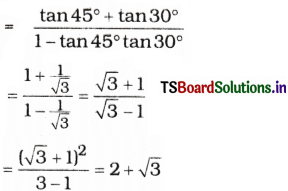
vi) tan 75°
Solution:
tan 75° = tan (45° + 30°)

AP Inter 1st Year Maths Exercise 3c Solutions 2

vii) cot 75°
Solution:
cot 75° = \(\frac{1}{\tan 75^{\circ}}\)
= \(\frac{1}{2+\sqrt{3}}\)
= \(\frac{1}{2+\sqrt{3}} \times \frac{2-\sqrt{3}}{2-\sqrt{3}}\)
= 2 + √3

viii) cos 105°
Solution:
cos 105° = cos (60° + 45°)
= cos 60° cos 45° – sin 60° sin 45°
= \(\frac{1}{2} \cdot \frac{1}{\sqrt{2}}-\frac{\sqrt{3}}{2} \cdot \frac{1}{\sqrt{2}}\)
= \(\frac{1-\sqrt{3}}{2 \sqrt{2}}\)

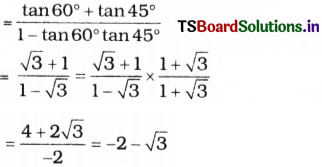
ix) tan 105°
Solution:
tan 105° = tan (60° + 45°)

AP Inter 1st Year Maths Exercise 3c Solutions 3

x) cot 105°
Solution:
cot 105° = \(\frac{1}{\tan 105^{\circ}}\)
= \(\frac{1}{-2-\sqrt{3}}\)
= \(-\frac{1}{2+\sqrt{3}}\)
= – (2 -√3)
= – 2 + √3

xi) cos 15°
Solution:
cos 15° = cos (45° – 30°)
= cos 45° cos 30° + sin 45° sin 30°
= \(\frac{1}{\sqrt{2}} \cdot \frac{\sqrt{3}}{2}+\frac{1}{\sqrt{2}} \cdot \frac{1}{2}\)
= \(\frac{\sqrt{3}+1}{2 \sqrt{2}}\)

xii) sin 15°
Solution:
sin 15° = sin (45° – 30°)
= sin 45° cos 30° – cos 45° sin 30°
= \(\frac{1}{\sqrt{2}} \cdot \frac{\sqrt{3}}{2}-\frac{1}{\sqrt{2}} \cdot \frac{1}{2}\)
= \(\frac{\sqrt{3}-1}{2 \sqrt{2}}\)

AP Inter 1st Year Maths Exercise 3c Solutions

Question 2.
Prove that sin (n + 1) x sin (n + 2) x + cos (n + 1) x cos (n + 2) x = cos x.
Solution:
= sin (n + 1) x sin (n + 2) x + cos (n + 1) x cos (n + 2) x
[∵ cos A cos B + sin A sin B = cos (A – B)]
= cos [(n + 2) x – (n + 1) x]
= cos [n x + 2 x – n x – x]
= cos x

II. Prove that

Question 1.
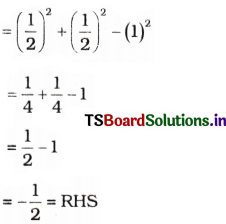
sin2 \(\frac{\pi}{6}\) + cos2 \(\frac{\pi}{3}\) – tan2 \(\frac{\pi}{4}\) = – \(\frac{1}{2}\).
Solution:
L.H.S. = sin2 \(\frac{\pi}{6}\) + cos2 \(\frac{\pi}{3}\) – tan2 \(\frac{\pi}{4}\)

AP Inter 1st Year Maths Exercise 3c Solutions 4

Question 2.
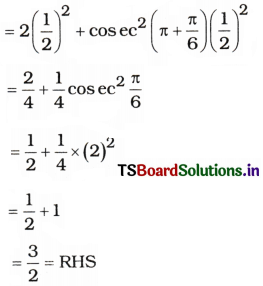
2 sin2 \(\frac{\pi}{6}\) + cosec2 \(\frac{7 \pi}{6}\) cos2 \(\frac{\pi}{3}\) = \(\frac{3}{2}\).
Solution:
L.H.S. = 2 sin2 \(\frac{\pi}{6}\) + cosec2 \(\frac{7 \pi}{6}\) cos2 \(\frac{\pi}{3}\)

AP Inter 1st Year Maths Exercise 3c Solutions 5

Question 3.
cot2 \(\frac{\pi}{6}\) + cosec2 \(\frac{5 \pi}{6}\) + 3 tan2 \(\frac{\pi}{6}\) = 6.
Solution:
LHS = cot2 \(\frac{\pi}{6}\) + cosec2 \(\frac{5 \pi}{6}\) + 3 tan2 \(\frac{\pi}{6}\)
= (√3)2 + cosec (π – \(\frac{\pi}{6}\)) + 3 (\(\frac{1}{\sqrt{3}}\))2
= 3 + cosec \(\frac{\pi}{6}\) + 3 × \(\frac{1}{3}\)
= 3 + 2+ 1
= 6 = RHS

AP Inter 1st Year Maths Exercise 3c Solutions

Question 4.
2 sin2 \(\frac{3 \pi}{4}\) + 2 cos2 \(\frac{\pi}{4}\) + 2 sec2 \(\frac{\pi}{3}\) = 10.
Solution:
LHS = 2 sin2 \(\frac{3 \pi}{4}\) + 2 cos2 \(\frac{\pi}{4}\) + 2 sec2 \(\frac{\pi}{3}\)
= 2 sin2 (π – \(\frac{\pi}{4}\)) + 2 (\(\frac{1}{\sqrt{2}}\))2 + 2 (2)2
= 2 × (\(\frac{1}{\sqrt{2}}\))2 + 1 + 8
= 2 × ½ + 9
= 1 + 9
= 10 = RHS

Prove the following:

Question 5.
cos (\(\frac{\pi}{4}\) – x) cos (\(\frac{\pi}{4}\) – y) – sin (\(\frac{\pi}{4}\) – x) sin (\(\frac{\pi}{4}\)– y) = sin (x + y)
Solution:
LHS = cos (\(\frac{\pi}{4}\) – x) cos (\(\frac{\pi}{4}\) – y) – sin (\(\frac{\pi}{4}\) – x) sin (\(\frac{\pi}{4}\)– y)
= cos (\(\frac{\pi}{4}\) – x) + (latex]\frac{\pi}{4}[/latex] – y)]
[∵ cos A cos B – sin A sin B = cos (A + B)]
= cos [\(\frac{\pi}{2}\) – (x + y)]
= sin (x + y) = RHS

Question 6.
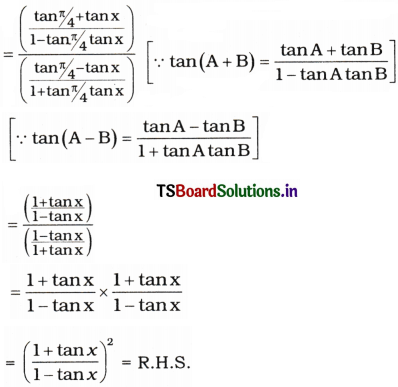
\(\frac{\tan \left(\frac{\pi}{4}+x\right)}{\tan \left(\frac{\pi}{4}-x\right)}=\left(\frac{1+\tan x}{1-\tan x}\right)^2\)
Solution:
\(\frac{\tan \left(\frac{\pi}{4}+x\right)}{\tan \left(\frac{\pi}{4}-x\right)}\)

AP Inter 1st Year Maths Exercise 3c Solutions 6

Question 7.
\(\frac{\cos (\pi+x) \cos (-x)}{\sin (\pi-x) \cos \left(\frac{\pi}{2}+x\right)}\) = cot2 x
Solution:
LHS = \(\frac{\cos (\pi+x) \cos (-x)}{\sin (\pi-x) \cos \left(\frac{\pi}{2}+x\right)}\)
= \(\frac{-\cos x \cos x}{\sin x(-\sin x)}\)
= \(\frac{-\cos ^2 x}{-\sin ^2 x}\)
= cot2 x
= RHS

Question 8.
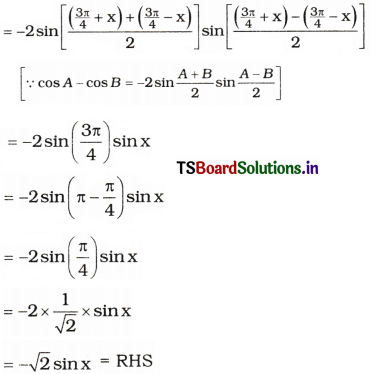
cos (\(\frac{3 \pi}{4}\) + x) – cos (\(\frac{3 \pi}{4}\) – x) = – √2 sin x.
Solution:
LHS = cos (\(\frac{3 \pi}{4}\) + x) – cos (\(\frac{3 \pi}{4}\) – x)

AP Inter 1st Year Maths Exercise 3c Solutions 7

AP Inter 1st Year Maths Exercise 3c Solutions

Question 9.
sin2 6x – sin2 4x = sin 2x sin 10x.
Solution:
LHS = sin2 6x – sin2 4x
= sin (6x + 4x) sin (6x – 4x)
[∵ sin2 A – sin2 B = sin (A + B) . sin (A – B)]
= sin 10x . sin 2x
= sin 2x sin 10x = RHS

Question 10.
cos2 2x – cos2 6x = sin 4x sin 8x
Solution:
LHS = cos2 2x – cos2 6x
= 1 – sin2 2x – (1 – sin2 6x)
= 1 – sin2 2x – 1 + sin2 6x
[∵ sin2 A – sin2 B = sin (A + B) . sin (A – B)]
= sin2 6x – sin2 2x
= sin (6x + 2x) sin (6x – 2x)
= sin 8x . sin 4x = RHS

Question 11.
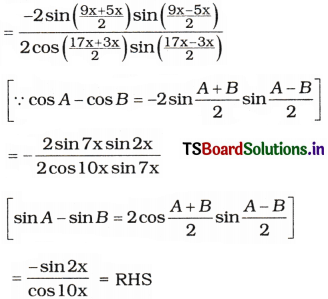
\(\frac{\cos 9 x-\cos 5 x}{\sin 17 x-\sin 3 x}=-\frac{\sin 2 x}{\cos 10 x}\)
Solution:
LHS = \(\frac{\cos 9 x-\cos 5 x}{\sin 17 x-\sin 3 x}\)

AP Inter 1st Year Maths Exercise 3c Solutions 8

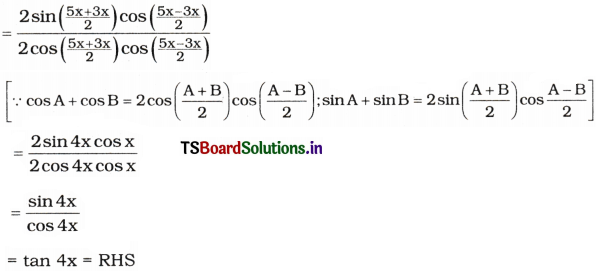
Question 12.
\(\frac{\sin 5 x+\sin 3 x}{\cos 5 x+\cos 3 x}\) = tan 4x
Solution:
LHS = \(\frac{\sin 5 x+\sin 3 x}{\cos 5 x+\cos 3 x}\)

AP Inter 1st Year Maths Exercise 3c Solutions 9

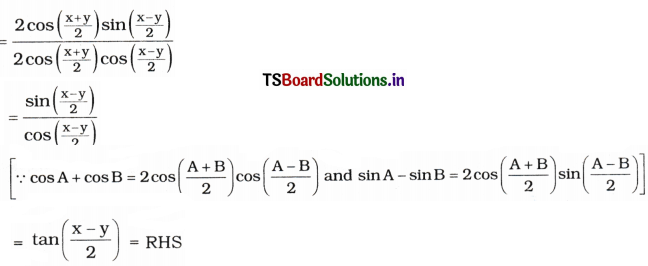
Question 13.
\(\frac{\sin x-\sin y}{\cos x+\cos y}=\tan \frac{x-y}{2}\)
Solution:
LHS = \(\frac{\sin x-\sin y}{\cos x+\cos y}\)

AP Inter 1st Year Maths Exercise 3c Solutions 10

AP Inter 1st Year Maths Exercise 3c Solutions

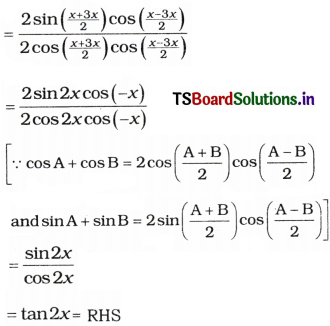
Question 14.
\(\frac{\sin x+\sin 3 x}{\cos x+\cos 3 x}\) = tan 2x
Solution:
LHS = \(\frac{\sin x+\sin 3 x}{\cos x+\cos 3 x}\)

AP Inter 1st Year Maths Exercise 3c Solutions 11

Question 15.
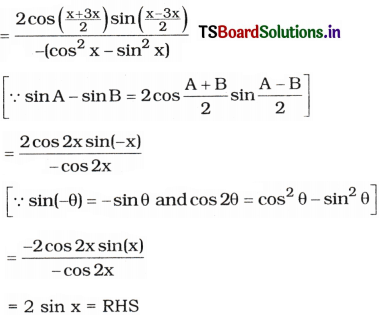
\(\frac{\sin x-\sin 3 x}{\sin ^2 x-\cos ^2 x}\) = 2 sin x
Solution:
LHS = \(\frac{\sin x-\sin 3 x}{\sin ^2 x-\cos ^2 x}\)

AP Inter 1st Year Maths Exercise 3c Solutions 12

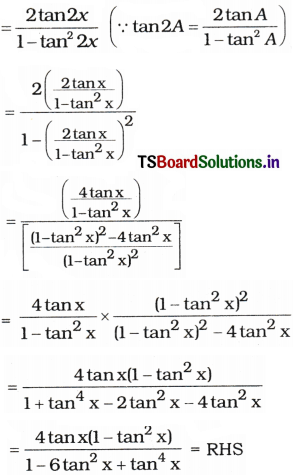
Question 16.
tan 4x = \(\frac{4 \tan x\left(1-\tan ^2 x\right)}{1-6 \tan ^2 x+\tan ^4 x}\).
Solution:
LHS = tan 4x
= tan 2 (2x)

AP Inter 1st Year Maths Exercise 3c Solutions 13

Question 17.
cos 4x = 1 – 8 sin2 x cos2 x
Solution:
LHS = cos 4x
= cos 2 (2x)
(∵ cos 2x = 1 – 2 sin2 x)
= 1 – 2 sin2 x
= 1 – 2 (sin 2x)2
(∵ sin 2x = 2 sin x cos x)
= 1 – 2 ( 2 sin x cos x)2
= 1 – 2 (4 sin2 x cos2 x)
= 1 – 8 sin2 x cos2 x
= RHS

AP Inter 1st Year Maths Exercise 3c Solutions

III. Prove the following:

Question 1.
cos (\(\frac{3 \pi}{2}\) + x) cos (2π + x) [cot (\(\frac{3 \pi}{2}\) – x) + cot (2π + x) = 1.
Solution:
LHS = cos (\(\frac{3 \pi}{2}\) + x) cos (2π + x) [cot (\(\frac{3 \pi}{2}\) – x) + cot (2π + x)
= sin x cos x [tan x + cot x]
[∵ cot (\(\frac{3 \pi}{2}\) – θ) = tan θ,
cos (\(\frac{3 \pi}{2}\) + θ) = sin θ]
= sin x cos x \(\left[\frac{\sin x}{\cos x}+\frac{\cos x}{\sin x}\right]\)
= sin x cos x \(\left[\frac{\sin ^2 x+\cos ^2 x}{\sin x \cos x}\right]\)
= sin2 x + cos2 x
= 1 = RHS

Question 2.
sin 2x + 2 sin 4x + sin 6x = 4 cos2 x sin 4x.
Solution:
LHS = sin 2x + 2 sin 4x + sin 6x
= sin 6x + sin 2x + 2 sin 4x
= [2 sin \(\left(\frac{6 x+2 x}{2}\right)\) cos \(\left(\frac{6 x-2 x}{2}\right)\)] + 2 sin 4x
[∵ sin A + sin B = 2 sin \(\frac{A+B}{2}\) cos \(\frac{A-B}{2}\)]
= 2 sin 4x cos 2x + 2 sin 4x
= 2 sin 4x . (cos 2x + 1)
= 2 sin 4x [(2 cos2 x – 1]
= 4 cos2 x sin 4x = RHS

Question 3.
cot 4x (sin 5x + sin 3x) = cot x (sin 5x – cos 3x)
Solution:
LHS = cot 4x (sin 5x + sin 3x)
= cot 4x [2 sin \(\left(\frac{5 x+3 x}{2}\right)\) cos \(\left(\frac{5 x-3 x}{2}\right)\)
[∵ sin A + sin B = 2 sin \(\frac{A+B}{2}\) cos \(\frac{A-B}{2}\)]
= \(\frac{\cos 4 x}{\sin 4 x}\) [2 sin 4x cos x]
= 2 cos 4x cos x ……………………..(1)
RHS = cot x (sin 5x – cos 3x)
= cot x [2 cos \(\left(\frac{5 x+3 x}{2}\right)\) sin \(\left(\frac{5 x-3 x}{2}\right)\)
[∵ sin A + sin B = 2 cos \(\frac{A+B}{2}\) sin \(\frac{A-B}{2}\)]
= \(\frac{\cos x}{\sin x}\) [2 cos 4x sin x]
= 2 cos 4x cos x …………………………..(2)
From equations (1) and (2),
LHS = RHS.

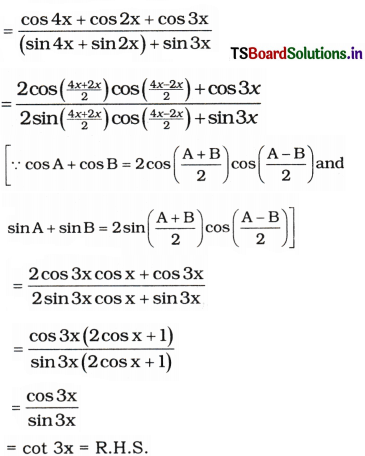
Question 4.
\(\frac{\cos 4 x+\cos 3 x+\cos 2 x}{\sin 4 x+\sin 3 x+\sin 2 x}\) = cot 3x
Solution:
LHS = \(\frac{\cos 4 x+\cos 3 x+\cos 2 x}{\sin 4 x+\sin 3 x+\sin 2 x}\)

AP Inter 1st Year Maths Exercise 3c Solutions 14

Question 5.
cot x cot 2x – cot 2x cot 3x – cot 3x cot x = 1.
Solution:
LHS = cot x cot 2x – cot 2x cot 3x – cot 3x cot x
= cot x cot 2x – cot 3x (cot 2x + cot x)
= cot x cot 2x – cot (2x + x) (cot 2x + cot x).
= cot x cot 2x – \(\left(\frac{\cot 2x \cot x – 1}{\cot x + \cot 2x}\right)\) (cot 2x + cot x)
= cot x cot 2x – (cot 2x cot x – 1)
= cot x cot 2x – cot 2x cot x + 1
= 1 = R.H.S.

AP Inter 1st Year Maths Exercise 3c Solutions

Question 6.
cos 6x = 32 cos6 x – 48 cos4 x + 18 cos2 x
Solution:
cos 6x = cos 3(2x)
= 4 cos3 (2x) – 3 cos 2x
[∵ cos 3x = 4 cos3 x – 3 cos x]
= 4 (2 cos2 x – 1)3 – 3(2 cos2 x – 1)
[∵ cos 2x = 2 cos2 x – 1]
= 4 [(2 cos2 x)3 (- 1)3 – 3 (2 cos2 x)2 + 3 (2 cos2 x)] – 6 cos2 x + 3
= 32 cos6 x – 48 cos4 x + 18 cos2 x – 1
Hence proved.

AP Inter 1st Year Maths Exercise 3b Solutions

Referring to the AP Inter 1st Year Maths Study Material Chapter Trigonometric Functions Exercise 3b Solutions makes it easier to understand complex problems.

AP Inter 1st Year Maths Trigonometric Functions Exercise 3b

I. Find the values of the trigonometric functions.

Question 1.
sin 765°
Solution:
sin 765° = sin (2 × 360° + 45°)
= sin 45°
= \(\frac{1}{\sqrt{2}}\) [∵ x ∈ Q1]

Question 2.
cosec (- 1410°)
Solution:
cosec (- 1410°) = – cosec (1410°) [∵ x ∈ Q4]
= – cosec (4 × 360° – 30°)
= – [- cosec 30°]
= cosec 30° = 2

Question 3.
tan \(\frac{19 \pi}{3}\)
Solution:
tan \(\frac{19 \pi}{3}\) = tan (6π + \(\frac{\pi}{3}\))
= tan \(\frac{\pi}{3}\) [∵ x ∈ Q1] = \(\sqrt{3}\)

Question 4.
sin (- \(\frac{11 \pi}{3}\))
Solution:
sin (- \(\frac{11 \pi}{3}\)) = – sin (\(\frac{11 \pi}{3}\)) [∵ x ∈ Q4]
= – sin (4π – \(\frac{\pi}{3}\))
= – [- sin \(\frac{\pi}{3}\)]
= sin \(\frac{\pi}{3}\) = \(\frac{\sqrt{3}}{2}\)

AP Inter 1st Year Maths Exercise 3b Solutions

Question 5.
cot (- \(\frac{15 \pi}{4}\))
Solution:
cot (- \(\frac{15 \pi}{4}\)) = – cot (\(\frac{15 \pi}{4}\)) [∵ x ∈ Q4]
= – cot (4π – \(\frac{\pi}{4}\))
= – [- cot \(\frac{\pi}{4}\)]
= cot \(\frac{\pi}{4}\) = 1.

II. Find the values of other five trigonometric functions.

Question 1.
cos x = – ½, x lies in third quadrant.
Solution:
sin2 x = 1 – cos2 x
= 1 – (- \(\frac{1}{2}\))2
= 1 – \(\frac{1}{4}\) = \(\frac{3}{4}\)
Therefore, sin x = – \(\frac{\sqrt{3}}{2}\) [∵ x ∈ Q3]
cosec x ⇒ \(\frac{1}{\sin x}=-\frac{2}{\sqrt{3}}\),
sec x ⇒ \(\frac{1}{cos x}\)
= \(-\frac{2}{1}\) = – 2
tan x ⇒ \(\frac{\sin x}{\cos x}=\frac{-\frac{\sqrt{3}}{2}}{-\frac{1}{2}}\) = √3
cot x ⇒ \(\frac{\cos x}{\sin x}=\frac{-\frac{1}{2}}{-\frac{\sqrt{3}}{2}}\)
= \(\frac{1}{\sqrt{3}}\)

Question 2.
sin x = \(\frac{3}{5}\), x lies in second quadrant.
Solution:
cos2 x = 1 – sin2 x
= 1 – (\(\frac{3}{5}\))2
= 1 – \(\frac{9}{25}\) = \(\frac{16}{25}\)
Therefore, cos x = – \(\frac{4}{5}\) [∵ x ∈ Q2]

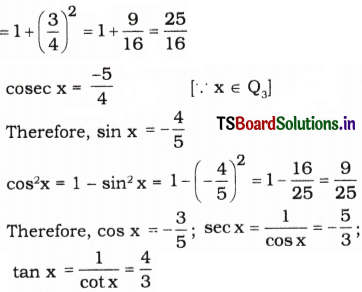
AP Inter 1st Year Maths Exercise 3b Solutions 1

Question 3.
cot x = \(\frac{3}{4}\), x lies in third quadrant.
Solution:
cosec2 x = 1 + cot2 x

AP Inter 1st Year Maths Exercise 3b Solutions 2
​
Question 4.
sec x = \(\frac{13}{5}\), x lies in fourth quadrant.
Solution:
sec x = \(\frac{13}{5}\)
⇒ cos x = \(\frac{5}{13}\)

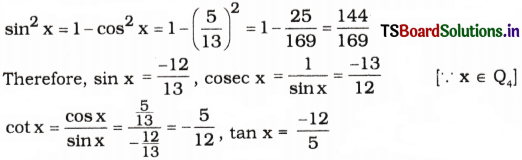
AP Inter 1st Year Maths Exercise 3b Solutions 3

AP Inter 1st Year Maths Exercise 3b Solutions

Question 5.
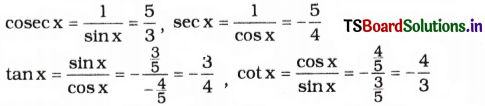
tan x = \(-\frac{5}{12}\), x lies in second quadrant.
Solution:
sec2 x = 1 + tan2 x

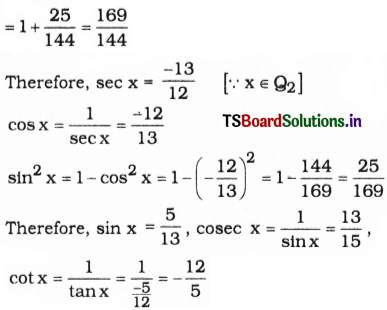
AP Inter 1st Year Maths Exercise 3b Solutions 4

Probability MCQ AP Inter 1st Year Maths Chapter 14

Practice AP Inter 1st Year Maths Study Material Chapter 14 Probability MCQ to identify your strengths and weak areas.

AP Inter 1st Year Maths Probability MCQ

Question 1.
Let A and B be two events such that P(A) = 0.8, P(B) = 0.7. Then P (A ∩ B).
1) ≤ 0.6
2) ≥ 0.5
3) ≥ 0.7
4) ≤ 0.4
Answer:
2) ≥ 0.5

Explanation:
Given : P(A) = 0.8, P(B) = 0.7
We know that P(A ∪ B) = P(A) + P(B) – P(A ∩ B)
So, P(A ∩ B) = P(A) + P(B) – P(A ∪ B)
Maximum P(A ∪ B) = 1 ⇒ P(A ∩ B) = 0.8 + 0.7 – 1 = 0.5

Question 2.
The probability that a leap year selected at random will contain 53 Sundays is
(1) \(\frac{1}{7}\)
(2) \(\frac{2}{7}\)
(3) \(\frac{6}{7}\)
(4) \(\frac{5}{7}\)
Answer:
(2) \(\frac{2}{7}\)

Explanation:
Leap year has 366 days = 52 weeks + 2 days
So, it will have 53 Sundays if :
The two extra days are (Sunday and Monday) or (Saturday and Sunday) out of 7 possible day pairs; 2 pairs contain Sunday ⇒ Probability = \(\frac{2}{7}\).

Question 3.
If two dice are thrown, then the probability of getting the same number on both the faces is
(1) \(\frac{2}{6}\)
(2) \(\frac{3}{6}\)
(3) \(\frac{5}{6}\)
(4) \(\frac{1}{6}\)
Answer:
(4) \(\frac{1}{6}\)

Explanation:
Getting same number on both dice : (1, 1), (2, 2) ……….. (6, 6) outcomes.
Total outcomes = 36.
So, Probability = \(\frac{6}{36}=\frac{1}{6}\)

Probability MCQ AP Inter 1st Year Maths Chapter 14

Question 4.
If two dice are thrown, then the probability of getting a total score of seven is
(1) \(\frac{1}{6}\)
(2) \(\frac{2}{6}\)
(3) \(\frac{3}{6}\)
(4) \(\frac{5}{6}\)
Answer:
(1) \(\frac{1}{6}\)

Explanation:
Total score of 7 means : (1, 6), (2, 5), (3, 4), (4, 3), (5, 2), (6, 1) → 6 outcomes
Total outcomes = 36
So, Probability = \(\frac{6}{36}=\frac{1}{6}\)

Question 5.
If A and B are two events of a sample space with P(AuB) = P(A) + P(B), then they are
1) Mutually exclusive
2) Exhaustive
3) 1 and 2
4) None of these
Answer:
1) Mutually exclusive

Explanation:
P(A ∪ B) = P(A) + P(B) means P(A ∩ B) = 0 ⇒ A and B are mutually exclusive.

Question 6.
An integer is picked from 1 to 20 (both inclusive). Then the probability that it is a prime
(1) \(\frac{3}{20}\)
(2) \(\frac{3}{5}\)
(3) \(\frac{2}{5}\)
(4) \(\frac{1}{5}\)
Answer:
(3) \(\frac{2}{5}\)

Explanation:
Total numbers from 1 to 20 = 20.
Prime numbers ≤ 20 = 2, 3, 5, 7, 11, 13, 17, 19 → 8 primes
Probability = \(\frac{8}{20}=\frac{2}{5}\)

Question 7.
If P(A) = 0.5, P(B) = 0.3. (given that A and B are mutually exclusive) Then P(A’ ∩ B’) =
1) 0.6
2) 0.5
3) 0.7
4) 0.2
Answer:
4) 0.2

Explanation:
A and B are mutually exclusive ⇒ P(A ∩ B) = 0
P(A ∪ B) = P(A) + P(B) = 0.5 + 0.3 = 0.8
Then P(A’ ∩ B ) = 1 – P(A ∪ B) = 1 – 0.8 = 0.2

Question 8.
One card is drawn at random from a well shuffled deck of 52 cards. Then the probability that the card be not a red card.
(1) \(\frac{2}{5}\)
(2) \(\frac{1}{5}\)
(3) \(\frac{1}{2}\)
(4) \(\frac{1}{3}\)
Answer:
(3) \(\frac{1}{2}\)

Explanation:
In a deck of 52 cards, 26 are red (13 hearts + 13 diamonds). so, not red = 26
Probability = \(\frac{26}{52}=\frac{1}{2}\)

Question 9.
Which of the following is false ?
1) P(E) = 0 ⇔ E is an impossible event.
2) 0 ≤ P(E) < 1.
3) P(E) = 1 ⇔ E is a certain event.
4) P(E) + P(Ē) = 1.
Answer:
2) 0 ≤ P(E) < 1.

Explanation:
Option 2 is False, because a probability can be exactly 1; it’s not strictly less than one.

Probability MCQ AP Inter 1st Year Maths Chapter 14

Question 10.
Which of the following statement is not correct ? P is a probability function of the sample space S.
1) P(E) > 0 ∀ E ∈ P(S).
2) P(S) = 1.
3) P(Φ) = 0.
4) P(E1 ∩ E2) = P(E1) + P(E2) where E1, E2 are mutually exclusive.
Answer:
4) P(E1 ∩ E2) = P(E1) + P(E2) where E1, E2 are mutually exclusive.

Explanation:
Option 4 is incorrect. In general, P(E1 ∩ E2) ≠ P(E1) + P(E2)
This equality is invalid unless both probabilities are 0 (which isn’t mentioned)
So, this is the false statement.

AP Inter 1st Year Maths Exercise 14c Solutions

Referring to the AP Inter 1st Year Maths Study Material Chapter 14 Probability Exercise 14c Solutions makes it easier to understand complex problems.

AP Inter 1st Year Maths Probability Solutions Exercise 14c

I.

Question 1.
A box contains 10 red marbles, 20 blue marbles and 30 green marbles. 5 marbles are drawn at random from the box, what is the probability that
i) all will be blue ? ii) atleast one will be green ?
Solution:
Total number of marbles = 10 + 20 + 30 = 60.
Number of ways of drawing 5 marbles from 60 marbles = 60C5.
i) All the drawn marbles will be blue if we draw 5 marbles out of 20 blue marbles. 5 blue marbles can be drawn from 20 blue marbles in 20C5 ways.
Probability that all marbles will be blue = \(\frac{{ }^{20} \mathrm{C}_5}{{ }^{60} \mathrm{C}_5}\)

ii) Number of ways in which the drawn marble is not green = (120 + 10)C5 = 30C5.
Probability that no marble is green = \(\frac{{ }^{30} \mathrm{C}_5}{{ }^{60} \mathrm{C}_5}\)
Probability that atleast one marble is green = 1 – \(\frac{{ }^{30} \mathrm{C}_5}{{ }^{60} \mathrm{C}_5}\)

Question 2.
4 cards are drawn at random from a well-shuffled deck of 52 cards. What is the probability of obtaining 3 diamonds and one spade ?
Solution:
Number of ways of drawing 4 cards from 52 cards = 52C4
In a deck of 52 cards, there are 13 diamonds and 13 spades.
Number of ways of drawing 3 diamonds and one spade = 13C3 x 13C1

Thus, the probability of obtaining 3 diamonds and one spade = \(\frac{{ }^{13} \mathrm{C}_3 \times{ }^{13} \mathrm{C}_1}{{ }^{52} \mathrm{C}_4}\)

Question 3.
A dice has two faces each with number *1’, three faces each with number ‘2’ and one face with number ‘3’. If the dice is rolled once, determine
i) P(2) ii) P(1 or 3) iii) P(not 3).
Solution:
Total number of faces = 6
i) Number of faces with number ‘2’ = 3 ⇒ ∴ P(2) = \(\frac{3}{6}=\frac{1}{2}\)
ii) P(1 OR 3) = P (not 2) = 1 – P (2) = 1 – \(\frac{1}{2}=\frac{1}{2}\)
iii) Number of faces with number ‘3’ = 1 => P(3) = \(\frac{1}{6}\).
Thus, p(not 3) = 1 – P(3) = 1 – \(\frac{1}{6}=\frac{5}{6}\)

AP Inter 1st Year Maths Exercise 14c Solutions

Question 4.
In a certain lottery, 10,000 tickets are sold and ten equal prizes are awarded. What is the probability of not getting a prize if you buy (a) one ticket (b) two tickets (c) 10 tickets ?
Solution:
Total number of tickets sold = 10,000;
Number of prizes awarded =10

i) If we buy one ticket, then P(getting a prize) = \(\frac{10}{10000}=\frac{1}{1000}\)
P(not getting a prize) = 1 – \(\frac{1}{1000}=\frac{999}{1000}\)

ii) If we buy two tickets, then Number of tickets not awarded = 10,000 – 10 = 9990
P(not getting a prize) = \(\frac{{ }^{9990} \mathrm{C}_2}{{ }^{10000} \mathrm{C}_2}\)

iii) If we buy 10 tickets, then P(not getting a prize) = \(\frac{9990 \mathrm{C}_{10}}{10000 \mathrm{C}_{10}}\)

Question 5.
A and B are two events such that P(A) = 0.54, P(B) = 0.69 and P(A ∩ B) = 0.35.
Find (i) P(A ∪ B) (ii) P(A’ ∩ B’) (iii) P(A ∩ B’) (iv) P(B ∩ A’)
Solution:
It is given that P(A) = 0.54, P(B) 0.69, P(A ∩ B) = 0.35
i) We know that P(A ∪ B) = P(A) + P(B) – P(A ∩ B)
P(A ∪ B) = 0.54 + 0.69 – 0.35 = 0.88

ii) A’ ∩ B’ = P(A ∪ B)’ (by De Morgan’s law]
∴ P(A’ ∩ B’) = P(A ∪ B)’ = 1 – P(A ∪ B) = 1 – 0.88 = 0.12

iii)P(A ∩ B’) = P(A) – P(A ∩ B) = 0.54 – 0.35 = 0.19

iv) We know that P(B ∩ A’) = P(B) – P(A ∩ B)
∴ P(B ∩ A’) = P(B) – P(A ∩ B)
P(B ∩ A’) = 0.69 – 0.35 = 0.34

Question 6.
Three letters are dictated to three persons and an envelope Is addressed to each of them, the letters are Inserted Into the envelopes at random so that each envelope contains exactly one letter. Find the probability that atleast one letter is In Its proper envelope.
Solution:
Let L1, L2, L3 be three letters and E1, E2, and E3 be their corresponding envelopes respectively.
There are 6 ways of inserting 3 letters in 3 envelopes. These are as follows:
L1E1. L2E3. L3E3; L2E2. L1E3. L3E1
L3E3. L1E2. L2E1; L1E1. L2E2. L3E3
L1E2. L2E3. L3E1; L1E3. L2E1. L3E2

There are 4 ways in which atleast one letter is inserted in a proper envelope.
Thus, the required probability is \(\frac{4}{6}=\frac{2}{3}\)

II.

Question 1.
Out of 100 students, two sections of 40 and 60 are formed. If you and your friend are among the 100 students, what is the probability that
a) You both enter the same section ?
b) You both enter the different sections ?
Solution:
My friend and I are among the 100 students.
Total number of ways of selecting 2 students out of 100 students = 100C2.
a) The two of us will enter the same section if both of us are among 40 students or among 60 students.
∴ Number of ways in which both of us enter the same section = 40C2 + 60C2.

∴ Probability that both of us enter the same section
= \(\frac{{ }^{40} \mathrm{C}_2+{ }^{60} \mathrm{C}_2}{{ }^{100} \mathrm{C}_2}=\frac{\frac{40!}{2!38!}+\frac{60!}{2!58!}}{\frac{100!}{2!98!}}=\frac{(39 \times 40)+(59 \times 60)}{99 \times 100}=\frac{17}{3}\)

b) P(we enter different sections) = 1 – P(we enter the same section) = 1 – \(\frac{17}{33}=\frac{16}{33}\).

Question 2.
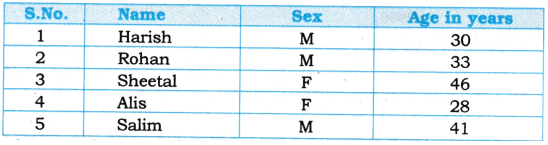
From the employees of a company, 5 persons are selected to represent them in the managing committee of the company. Particulars of five persons are as follows.
AP Inter 1st Year Maths Exercise 14c Solutions 1
A person is selected at random from this group to act as a spokesperson. What is the probability that the spokesperson will be either male or over 35 years ?
Solution:
Let E be the event in which the spokesperson will be a male and F be the event in which the spokesperson will be over 35 years of age.
Accordingly, P(E) = \(\frac{3}{5}\) and P(F) = \(\frac{2}{5}\)
Since there is only one male who is over 35 years of age. ⇒ P(E ∩ F) = \(\frac{1}{5}\)

We know that P(E ∪ F) = P(E) + P(F) – P(E ∩ F)
∴ Required probability = P(E ∪ F) = \(\frac{1}{2}\)
Thus, the probability that the spokesperson will either be a male or over 35 years of 4 age is \(\frac{4}{5}\).

Question 3.
If 4-digit numbers greater than 5,000 are randomly formed from the digits 0, 1, 3, 5 and 7, what is the probability of forming a number divisible by 5 when, (i) the digits are repeated ? (ii) the repetition of digits is not allowed.
Solution:
i) When the digits are repeated
Since four-digit numbers greater than 5000 are formed, the leftmost digit is either 7 or 5.
The remaining 3 places can be filled by any of the digits 0, 1, 3, 5, or 7 as repetition of digits is allowed.
∴ Total number of 4-digit numbers greater than 5000 = 2 × 5 × 5 × 5 = 250 – 1 = 249
A number is divisible by 5 if the digit at its units place is either 0 or 5.
Total number of 4-digit numbers greater than 5000 that are divisible by 5 =2 × 5 × 5 × 2 = 100 – 1 = 99
Thus, the probability of forming a number divisible by 5 when the digits are repeated is \(\frac{99}{249}=\frac{33}{83}\).

ii) When the repetition of digits is not allowed.
The thousands place can be filled with either of the two digits 5 or 7.
The remaining 3 places can be filled with any of the remaining 4 digits.
∴ Total number of 4-digit numbers greater than 5000 = 2 × 4 × 3 × 2 = 48.
When the digit at the thousands place is 5, the units place can be filled only with 0 and the ten’s and hundred’s places can be filled with any two of the remaining 3 digits.
∴ Here, number of 4-digit numbers starting with 5 and divisible by 5 = 3 × 2 = 6
When the digit at the thousands place is 7, the units place can be filled in two ways (0 or 5) and the ten’s and hundred’s places can be filled with any two of the remaining 3 digits.
∴ Here, number of 4-digit numbers starting with 7 and divisible by 5 = 1 × 2 × 3 × 2 =12
∴ Total number of 4-digit numbers greater than 5000 that are divisible by 5 = 6 + 12 = 18
Thus, the probability of forming a number divisible by 5 when the repetition of \(\frac{18}{48}=\frac{3}{8}\).

AP Inter 1st Year Maths Exercise 14c Solutions

Question 4.
The number lock of a suitcase has 4 wheels, each labelled with ten digits i.e., from 0 to 9. The lock opens with a sequence of four digits with no repeats. What is the probability of a person getting the right sequence to open the suitcase ?
Solution:
The number lock has 4 wheels, each labelled with ten digits i.e., from 0 to 9.
Number of ways of selecting 4 different digits out of the 10 digits = 10C4.
Now, each combination of 4 different digits can be arranged in 4! ways.
Number of four digits with no repetitions = 10C4 × 4! = \(\frac{10!}{4!6!}\) × 4!
= 7 × 8 × 9 × 10 = 5040
There is only one number that can open the suitcase. Thus, the required probability \(\frac{1}{5040}\).