AP Inter 1st Year Maths Exercise 14b Solutions

Referring to the AP Inter 1st Year Maths Study Material Chapter 14 Probability Exercise 14b Solutions makes it easier to understand complex problems.

AP Inter 1st Year Maths Probability Solutions Exercise 14b

I.

Question 1.
A coin is tossed twice, what is the probability that atleast one tail occurs?
Solution:
When a coin is tossed twice the sample space is given by S = {HH, HT, TH, TT}
Let A be the event of the occurrence of atleast one tail. So, A = {HT, TH, TT}
P(A) = \(\frac{\text { Number of outcomes favourable to A }}{\text { Total number of possible outcomes }}=\frac{3}{4}\)

Question 2.
If \(\frac{2}{11}\) is the probability of an event A, then what is the probability of the event ‘not A’.
Solution:
Given that P(A) = \(\frac{2}{11}\)
We know that P(A) + P(not A) = 1 ⇒ \(\frac{2}{11}\) + P(not A) = 1 ⇒ P(not A) = 1 – \(\frac{2}{11}=\frac{9}{11}\).
Hence the probability of not ‘A’ is 9/11.

Question 3.
A letter is chosen at random from the word ‘ASSASSINATION’. Find the probability that this letter is (i) a vowel (ii) a consonant.
Solution:
There are 13 letters in the word ASSASSINATION.
∴ Hence, n(S) = 13
i) There are 6 vowels in the given word.
∴ Probability of a vowel = 6/13.
ii) There are 7 consonants in the given word.
∴ Probability of a consonant = 7/13

Question 4.
Given P(A) = \(\frac{3}{5}\) and P(B) = \(\frac{1}{5}\). Find P(A or B), if A and B are mutually exclusive events.
Solution:
Here, P(A) = \(\frac{3}{5}\), P(B) = \(\frac{1}{5}\).
We know that, for mutually exclusive events A and B, P( A or B) = P(A) + P(B).
∴ P(A or B) = \(\frac{3}{5}+\frac{1}{5}=\frac{4}{5}\)

AP Inter 1st Year Maths Exercise 14b Solutions

II.

Question 1.
Which of the following can not be valid assignment of probabilities for outcomes of sample space S = {ω1, ω2, ω3, ω4, ω5, ω6, ω7)
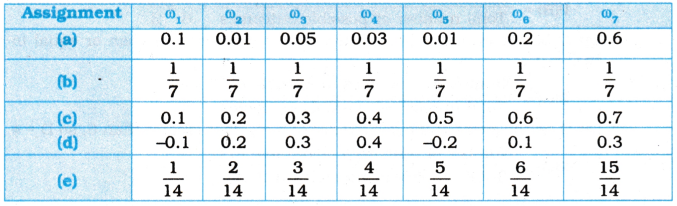
AP Inter 1st Year Maths Exercise 14b Solutions 1
Solution:
a) 0.1, 0.01, 0.05, 0.03, 0.01, 0.2, 0.6
Here, the probabilities of each outcome is positive and less than 1.
Now the sum of probabilities = 0.1 + 0.01 + 0.05 + 0.03 + 0.01 + 0.2 + 0.6 = 1
Hence the assignment is valid.

b) \(\frac{1}{7}\), \(\frac{1}{7}\), \(\frac{1}{7}\), \(\frac{1}{7}\), \(\frac{1}{7}\), \(\frac{1}{7}\), \(\frac{1}{7}\)
Here, the probabilities of each outcome is positive and less than 1.
Now, the sum of probabilities = \(\frac{1}{7}+\frac{1}{7}+\frac{1}{7}+\frac{1}{7}+\frac{1}{7}+\frac{1}{7}+\frac{1}{7}\) = 1.
Hence, the assignment is not valid.

c) 0.1, 0.2, 0.3, 0.4, 0.5, 0.6, 0.7
Here, the probabilities of each outcome is positive and less than 1.
Now, the sum of probabilities = 0.1 + 0.2 + 0.3 + 0.4 + 0.5 + 0.6 + 0.7 = 2.8
Hence, the assignment is not valid.

d) -0.1, 0.2, 0.3, 0.4, -0.2, 0.1, 0.3
Here, the first (-0.1) and the fifth (-0.2) probabilities are negative. We know that the probability of an event can’t be negative.
Hence, the assignment is not valid.

e) \(\frac{1}{14}\), \(\frac{2}{14}\), \(\frac{3}{14}\), \(\frac{4}{14}\), \(\frac{5}{14}\), \(\frac{6}{14}\), \(\frac{5}{14}\)
Hence, the seventh probability (\(\frac{15}{14}\)) is more than 1.
We know that the probability of an event can’t be greater than 1.
Hence, the assignment is not valid.

Question 2.
A dice is thrown, find the probability of following events.
i) A prime number will appear,
ii) A number greater than or equal to 3 will appear,
iii) A number less than or equal to one will appear,
iv) A number more than 6 will appear,
v) A number less than 6 will appear.
Solution:
The sample space of throwing a dice is given by S = {1, 2, 3, 4, 5, 6}
i) Let A be the event of the occurrence of a prime number. So A = {2, 3, 5}.
P(A) = \(\frac{\text { Number of outcomes favourable to } \mathrm{A}}{\text { Total number of possible outcomes }}=\frac{3}{6}=\frac{1}{2}\)

ii) Let B be the event of the occurrence of a number greater than or equal to 3 so, B = {3, 4, 5, 6}.
P(B) = \(\frac{\text { Number of outcomes favourable to } \mathrm{B}}{\text { Total number of possible outcomes }}=\frac{4}{6}=\frac{2}{3}\)

iii) Let C be the event of the occurrence of a number less than or equal to one, so C = {1}.
P(C) = \(\frac{\text { Number of outcomes favourable to } \mathrm{C}}{\text { Total number of possible outcomes }}=\frac{1}{6}\)

iv) Let D be the event of the occurrence of a number greater than 6, so D = Φ.
P(D) = \(\frac{\text { Number of outcomes favourable to } \mathrm{D}}{\text { Total number of possible outcomes }}=\frac{0}{6}\) = 0

v) Let E be the event of the occurrence of a number less than 6, so, E = {1, 2, 3, 4, 5}.
P(E) = \(\frac{\text { Number of outcomes favourable to } \mathrm{E}}{\text { Total number of possible outcomes }}=\frac{0}{6}\) = 0

Question 3.
A card is selected at random from a pack of 52 cards
a) How many points are there in the sample space ?
b) Calculate the probability that the card is an ace of spades.
c) Calculate the probability that the card is (i) an ace, (ii) black card.
Solution:
a) When a card is selected from a pack of 52 cards, the number of possible outcomes is 52. i.e. the sample space contains 52 elements. Therefore, there are 52 points in the sample space.

b) Let A be the event in which the card drawn is an ace of spades. So, n(A) = 1
P(A) = \(\frac{\text { Number of outcomes favourable to } \mathrm{A}}{\text { Total number of possible outcomes }}=\frac{1}{52} .\)

c) i) Let E be the event in which the card drawn is an ace since there are 4 aces in a pack of 52 cards, n(E) = 4.
P(E) = \(\frac{\text { Number of outcomes favourable to } \mathrm{E}}{\text { Total number of possible outcomes }}=\frac{4}{52}=\frac{1}{13} .\)

ii) Let F be the event in which the card drawn is black. Since there are 26 black cards in a pack of 52 cards, n(F) = 26.
P(F) = \(\frac{\text { Number of outcomes favourable to } \mathrm{F}}{\text { Total number of possible outcomes }}=\frac{26}{52}=\frac{1}{2}\)

Question 4.
A fair coin with 1 marked on one face and 6 on the other and a fair dice are both tossed. Find the probability that the sum of numbers that turn up is (i) 3 (ii) 12.
Solution:
Since the fair coin has 1 marked on one face and 6 on the other and the dice has six faces that are numbered 1, 2, 3, 4, 5 and 6. The sample space is given by S = {(1, 1), (1, 2), (1, 3), (1, 4), (1, 5), (1, 6), (6, 1), (6, 2), (6, 3), (6, 4), (6, 5), (6, 6)}. So, n(S) = 12.
i) Let A be the event in which the sum of numbers that turn up is 3. So, A = {(1, 2)}
P(A) = \(\frac{\text { Number of outcomes favourable to } \mathrm{A}}{\text { Total number of possible outcomes }}=\frac{1}{12}\)

ii) Let B be the event in which the sum of numbers that turn up is 12. So, B = {(6, 6)}.
P(B) = \(\frac{\text { Number of outcomes favourable to } \mathrm{B}}{\text { Total number of possible outcomes }}=\frac{1}{12}\)

Question 5.
There are four men and six women on the city council. If one council member is selected for a committee at random, how likely is it that it is a woman?
Solution:
There are four men and six women on the city council. As one council member is to be selected for a committee at random. The sample space contains 10 (4 + 6) elements. Let A be the event in which the selected council member is a woman. So, n(A) = 6.
P(A) = \(\frac{\text { Number of outcomes favourable to A }}{\text { Total number of possible outcomes }}=\frac{6}{10}=\frac{3}{5}\)

AP Inter 1st Year Maths Exercise 14b Solutions

Question 6.
In a lottery, a person chooses six different natural numbers at random from 1 to 20, and if these six numbers match with the six numbers already fixed by the lottery committee, he wins the prize. What is the probability of winning the prize in the game? (Hint : Order of the numbers is not important)
Solution:
Total number of ways in which one can choose six different numbers from 1 to 20
= 20C6 = \(\frac{20!}{6!(20-6)!}=\frac{20!}{6!14!}=\frac{20 \times 19 \times 18 \times 17 \times 16 \times 15 \times 14}{1 \times 2 \times 3 \times 4 \times 5 \times 6 \times 14!}\) =38760
Hence, there are 38760 combinations of 6 numbers.
Out of these combinations only one combination is already fixed by the lottery committee.
Hence, the required probability of winning the prize in the game = \(\frac{1}{38760}\).

Question 7.
Check whether the following probabilities P(A) and P(B) are consistently defined
(i) P(A) = 0.5, P(B) = 0.7, P(A ∩ B) = 0.6
(ii) P(A) = 0.5, P(B) = 0.4, P(A ∪ B) – 0.8
Solution:
i) P(A) = 0.5, P(B) = 0.7, P(A ∩ B) = 0.6
We know that if E and F are two events such that E ⊂ F, then P(E) < P(F). However, here, P(A ∩ B)> P(A). Hence, P(A) and P(B) are not consistently defined,

ii) P(A) = 0.5, P(B) = 0.4, P(A ∪ B) = 0.8
We know that if E and F are two events such that E ⊂ F, then P(E) < P(F) Here, it is seen that P(A ∪ B)> P(A) and P(A ∪ B)> P(B).
Hence, P(A) and P(B) are consistently defined.

Question 8.
Fill in the blanks in the following table.

AP Inter 1st Year Maths Exercise 14b Solutions 2
Solution:
i) Here, P(A) = \(\frac{1}{3}\), P(B) = \(\frac{1}{5}\), P(A ∩ B) = \(\frac{1}{15}\).
We know that P(A ∪ B) = P(A) + P(B) – P(A ∩ B).
⇒ P(A ∪ B) = \(\frac{1}{3}+\frac{1}{5}-\frac{1}{15}\)
⇒ P(A ∪ B) = \(\frac{5+3-1}{15}\)
⇒ P(A ∪ B) = \(\frac{7}{15}\).

ii) Here, P(A) = 0.35, P(A ∩ B) = 0.25, P(A uB) = 0.6
We know that P(A ∪ B) = P(A) + P(B) – P(A ∩ B).
∴ 0.6 = 0.35 + P(B) – 0.25
⇒ P(B) = 0.6 – 0.35 + 0.25
⇒ P(B) = 0.5

iii) Here P(A) = 0.5, P(B) = 0.35, P(A ∪ B) = 0.7
We know that P(A ∪ B) = P(A) + P(B) – P(A ∩ B).
∴ 0.7 = 0.5 + 0.35 – P(A ∩ B)
⇒ P(A ∩ B) = 0.5 + 0.35 – 0.7
⇒ P(A ∩ B) = 0.15

Question 9.
If E and F are events such that P(E) = \(\frac{1}{4}\), P(F) = \(\frac{1}{2}\) and P(E and F) = \(\frac{1}{8}\), find
(i) P(E or F).
(ii) P(not E and not F).
Solution:
Here P(E) = \(\frac{1}{4}\), P(F) = \(\frac{1}{2}\) and P(E and F) = \(\frac{1}{8}\).

i) We Know that P(E or F) = P(E) + P(F) – P(E ∩ F)
∴ P(E ∪ F) = \(\frac{1}{4}+\frac{1}{2}-\frac{1}{8}=\frac{2+4-1}{8}=\frac{5}{8}\)

ii) We Know that P(not E and Not F) = 1 – P(E ∪ F)
∴P(Ē ∩ F̄) = 1 – \(\frac{5}{8}=\frac{3}{8}\)

Question 10.
Events E and F are such that P(not E or not F) = 0.25. State whether E and F are mutually exclusive.
Solution:
Given that P(not E or not F) = 0.25 and we know that P(Ē ∪ F̄) = 1 – P(E ∩ F).
∴ P(Ē ∩ F̄) = 1 – P(not E or not F)
= 1 – 0.25
= 0.75 ≠ 0 ⇒ (A ∩ B) ≠ Φ
Hence, E and F are not mutually exclusive.

Question 11.
A and B are events such that P(A) = 0.42, P(B) = 0.48 and P(A and B) = 0.16. Determine (i) P(not A), (ii) P(not B) and (iii) P(A or B).
Solution:
Given that P(A) = 0.42, P(B) = 0.48, P(A and B) = 0.16
i) P (not A) = 1 – P(A) = 1 – 0.42 = 0.58
ii) P (not B) = 1 – P(B) = 1 – 0.48 = 0.52
iii) We know that P(A uB) = P(A) + P(B) – P(A n B)
⇒ P(AuB) = 0.42 + 0.48-0.16 = 0.74

III.

Question 1.
Three coins are tossed once. Find the probability of getting (i) 3 heads (ii) 2 heads (iii) atleast 2 heads (iv) atmost 2 heads (v) no head (vi) 3 tails (vii) exactly two tails (viii) no tail (ix) atmost two tails.
Solution:
S = {HHH, HHT, HTH, THH, HTT, THT, TTH, TTT). So, n(S) = 8.
It is known that the probability of an event A is given by
P(A) = \(\frac{\text { Number of outcomes favourable to } A}{\text { Total number of possible outcomes }}\)

j) Let B be the event of the occurrence of 3 heads. So, B = {HHH}.
P(B) = \(\frac{\text { Number of outcomes favourable to } B}{\text { Total number of possible outcomes }}=\frac{1}{8}\)

ii) Let ‘C’ be the event of the occurrence of 2 heads. So, C = {HHT, HTH, THH).
P(C) = \(\frac{\text { Number of outcomes favourable to } C}{\text { Total number of possible outcomes }}=\frac{3}{8}\)

iii) Let D be the event of the occurrence of atleast 2 heads. So, D = {HHH, HHT, HTH, THH}
P(D) = \(\frac{\text { Number of outcomes favourable to } \mathrm{D}}{\text { Total number of possible outcomes }}=\frac{4}{8}=\frac{1}{2}\)

iv) Let E be the event of the occurrence of at most 2 heads. So, E {HHT, HTH, THH, HTF, THT, TFH, TTT}.
P(E) = \(\frac{\text { Number of outcomes favourable to } E}{\text { Total number of possible outcomes }}=\frac{7}{8}\)

v) Let F be the event of the occurrence of no head. So, F = (TTT).
P(F) = \(\frac{\text { Number of outcomes favourable to } F}{\text { Total number of possible outcomes }}=\frac{1}{8}\)

vi) Let G be the event of the occurrence of 3 tails, so, G = {TTT}.
P(G) = \(\frac{\text { Number of outcomes favourable to } \mathrm{G}}{\text { Total number of possible outcomes }}=\frac{1}{8}\)

vii) Let H be the event of the occurrence of exactly 2 tails, so H = {HTT, THT, TTH}.
P(H) = \(\frac{\text { Number of outcomes favourable to } \mathrm{H}}{\text { Total number of possible outcomes }}=\frac{3}{8}\)

viii) Let I be the event of the occurrence of no tail. So, I = {HHH}.
P(I) = \(\frac{\text { Number of outcomes favourable to } I}{\text { Total number of possible outcomes }}=\frac{1}{8}\)

ix) Let J be the event of the occurrence of at most 2 tails.
J = {HHH, HHT, HTH, THH, HTT, THT, TTH}.
So, P(J) = \(\frac{\text { Number of outcomes favourable to } \mathrm{J}}{\text { Total number of possible outcomes }}=\frac{7}{8} .\)

Question 2.
In Class XI of a school 40% of the students study Mathematics and 30% study Biology. 10% of the class study both Mathematics and Biology. If a student is selected at random from the class, find the probability that he will be studying Mathematics or Biology.
Solution:
Let A be the event in which the selected student studices Mathematics and B be the event in which the selected student studices Biology.
Now, P(A) = 40% = 0.40, P(B) = 30% = 0.30, P(A ∩ B) = 10% = 0.10
We know that P(A ∪ B) = P(A) + P(B) – P(A ∩ B)
⇒ P(A ∪ B) = 0.40 + 0.30 – 0.10 = 0.60
Thus, the probability that the selected student will be studying Mathematics or Biology is 0.6.

AP Inter 1st Year Maths Exercise 14b Solutions

Question 3.
In an entrance test that is graded on the basis of two examinations, the probability of a randomly chosen student passing the first examination is 0.8 and the probability of passing the second examination is 0.7. The probability of passing atleast one of them is 0.95. What is the probability of passing both?
Solution:
Let A and B be the event of passing through first and second examination respectively. So, P(A) = 0.8, P(B) = 0.7 and P(A ∪ B) = 0.95
We know that P(A ∪ B) = P(A) + P(B) – P(A ∩ B)
∴ 0.95 = 0.8 + 0.7 – P(A ∩ B)
⇒ P(A ∩ B) = 0.8 + 0.7 – 0.95 = 0.55
Thus, the probability of passing both the examinations is 0.55.

Question 4.
The probability that a student will pass the final examination in both English and Hindi is 0.5 and the probability of passing neither is 0.1. If the probability of passing the English examination is 0.75, what is the probability of passing the Hindi examination ?
Solution:
Let A and B be the events of passing English and Hindi examinations respectively. So, P(A ∩ B) = 0.5, P(A’ ∩ B’) = 0.1 and P(A) = 0.75.
We know that P(A’ ∩ B’) = 1 – P(A ∪ B)
P(A ∪ B) = 1 – P (A’ ∩ B’) = 1 – 0.1 = 0.9.
Using the formula : P(A ∪ B) = P(A) + P(B) – P(A ∩ B).
⇒ 0.9 – 0.75 + P(B) – 0.5
⇒ P(B) = 0.9 – 0.75 +0.5
⇒ P(B) = 0.65
Thus, the probability of passing the Hindi examination is 0.65.

Question 5.
In a class of 60 students, 30 opted for NCC, 32 opted for NSS and 24 opted for both NCC and NSS. If one of these students is selected at random, find the probability that
(i) The student opted for NCC or NSS.
(ii) The student has opted neither NCC nor NSS.
(iii) The student has opted NSS but not NCC.
Solution:
Let A be the event in which the selected student has opted for NCC and B be the event in which the selected student has opted for NSS.
Total number of students = 60

Number of students who have opted for NCC = 30 ⇒ P(A) = \(\frac{30}{60}=\frac{1}{2}\)
Number of students who have opted for NSS = 32 ⇒ P(B) = \(\frac{32}{60}=\frac{8}{15}\)
Number of students who have opted both NCC and NSS = 24 ⇒ P(A ∩ B) = \(\frac{24}{60}=\frac{2}{5}\)
i) We know that P(A ∪ B) = P(A) + P(B) – P(A ∩ B)
P(A ∪ B) = \(\frac{1}{2}+\frac{8}{15}-\frac{2}{5}=\frac{15+16-12}{30}=\frac{19}{30}\)
Thus, the probability that the selected student has opted for NCC or NSS is \(\frac{19}{30}\).

ii) Number of students who opted neither NCC or NSS = P(A’ ∩ B’)
= 1 – P(A ∪ B) = 1 – \(\frac{19}{30}=\frac{11}{30}\)
Thus the probability that the selected student has neither opted for NCC nor NSS is \(\frac{11}{30}\)

iii) Number of students who have opted for NSS but not NCC = n(B) – n(A ∩ B) = 32 – 24 = 8
Thus, the probability that the selected student has opted for NSS but not for NCC = \(\frac{8}{60}=\frac{2}{15}\)

Question 6.
A fair coin is tossed four times, and a person win JRs. 1 for each head and lose Rs. 1.50 for each tail that turns up.
From the sample space, calculate how many different amounts of money you can have after four tosses and the probability of having each of these amounts.
Solution:
Since the coin is tossed four times, there can be a maximum of 4 heads or tails.
When 4 heads turn up, ₹ 1 + ₹ 1 + ₹ 1 + ₹ 1 = ₹ 4 is the gain.
When 3 heads and 1 tail turn up ₹ 1 + ₹ 1 + ₹ 1 – ₹ 1.50 = ₹ 3 – ₹ 1.50 = ₹ 1.50 is the gain.
When 2 heads and 2 tails turn up ₹ 1 + ₹ 1 – ₹ 1.50 – ₹ 1.50 * – ₹ 1
i.e. ₹ 1 is the loss. When 1 head and 3 tails turn up ₹ 1 – ₹ 1.50 – ₹ 1.50 – ₹ 1.50 = – ₹ 3.50 i.e., ₹ 3.50 is the loss.
When 4 tails turns up, -₹ 1.50 – ₹ 1.50 – ₹ 1.50 – ₹ 1.50 = – ₹ 6.00 i.e. ₹ 6.00 is the loss. There are 24 = 16 elements in the sample space S ie., n(S) = 16 which is given by S = {HHHH, HHHT, HHTH, HTHH, THHH, HHTT, HTTH, TTHH, HTHT, THTH, THHT, HTTT, THTT, TTHT, TTTH, TTTT}

The person wins ₹ 4.00 when 4 heads turn up, when the event {HHHH} occurs. Probability of winning ₹ 4.00 = \(\frac{1}{16}\)
The person wins ₹ 1.50 when 3 heads and one tail turn up, when the event {HHHT, HHTH, HTHH, THHH} occurs.
Probability of winning ₹ 1.50 = \(\frac{4}{16}=\frac{1}{4}\)
The person loses ₹ 1.00 when 2 heads and 2 tails turn up, when the event {HHTT, HTTH, TTHH, HTHT, THTH, THHT} occurs.
Probability of losing ₹ 1.00 = \(\frac{6}{16}=\frac{3}{8}\)
The person loses ₹ 3.50 when 1 head and 3 tails turn up, when the event {HTTT, THTT, TTHT, TTTH} occurs.
Probability of losing ₹ 3.50 = \(\frac{4}{16}=\frac{1}{4}\)
The person loses ₹ 6.00 when ‘0’ heads when the event {TTTT} occurs. Probability of losing ₹ 6.00 = \(\frac{1}{16}\)
AP Inter 1st Year Maths Exercise 3a Solutions

Referring to the AP Inter 1st Year Maths Study Material Chapter Trigonometric Functions Exercise 3a Solutions makes it easier to understand complex problems.

AP Inter 1st Year Maths Trigonometric Functions Exercise 3a

Question 1.
Find the radian measures corresponding to the following degree measures of their radii.
i) 25°
ii) – 47°30′
iii) 240°
iv) 520°
Solution:
i) We know that 180° = π radians
Therefore, 25° = \(\frac{\pi}{180}\) × 25 radians
= \(\frac{5 \pi}{36}\) radians.
Hence, 25° = \(\frac{5 \pi}{36}\) radians.

ii) We know that 180° = π radians
Therefore, – 47°30′ = – 47 . \(\frac{1}{2}\) degrees
= – \(\frac{95}{2}\) degrees
= \(\frac{\pi}{180} \frac{-95}{2}\) radians
= \(-\frac{19 \pi}{72}\) radians
Hence, – 47°30′ = \(-\frac{19 \pi}{72}\) radians

iii) We know that 180° = π radians
Therefore, 240° \(\frac{\pi}{180}\) × 240 radians
= \(\frac{4 \pi}{3}\) radians
Hence, 240° = \(\frac{4 \pi}{3}\) radians.

iv) We know that 180° = π radians
Therefore, 520° = \(\frac{\pi}{180}\) × 520 radians
= \(\frac{26 \pi}{9}\) radians
Hence, 520° = \(\frac{26 \pi}{9}\) radians

AP Inter 1st Year Maths Exercise 3a Solutions

Question 2.
Find the degree measures corresponding to the following radian measures (Use π = 22/7).
i) \(\frac{11}{16}\)
ii) – 4
iii) \(\frac{5 \pi}{3}\)
iv) \(\frac{7 \pi}{6}\)
Solution:
i) We know that π radians = 180°
Therefore \(\frac{11}{16}\) radians = \(\frac{180}{\pi} \frac{11}{16}\) degrees
= \(\frac{180 7}{22} \frac{11}{16}\) degrees
= \(\frac{315}{8}\) degrees
= 39° \(\frac{3}{8}\) degrees
= 39° + \(\frac{3}{8}\) × 60 minutes (∵ 1° = 60′)
= 39° + \(\frac{45}{2}\) minutes
= 39° + 22 \(\frac{1}{2}\) minutes
= 39° + 22′ + ½ × 60″ (∵ 1′ = 60′)
= 39° + 22′ + 30″
= 39° 22′ 30″
Hence, \(\frac{11}{16}\) radians = 39°22’30”

ii) We know that π radians = 180°
Therefore, – 4 radians = \(\frac{-180}{\pi}\) × 4 degrees
= \(\frac{-180 7}{22}\) × 4 degrees
= – \(\frac{2520}{11}\) degrees
= – 229 \(\frac{1}{11}\) degrees
= – (229° + \(\frac{1}{11}\) × 60 minutes) (∵ 1° = 60′)
= – (229° + \(\frac{60}{11}\) minutes)
= – ( 229° + 5 \(\frac{5}{11}\) minutes)
= – (229 + 5′ + \(\frac{5}{11}\) × 60″) (∵ 1° = 60′)
= – (229° + 5′ + 27″) = – 229 5’27”
Hence -4 radians = -229 5’27”

iii) We know that π radians = 180°
Therefore, \(\frac{5 \pi}{3}\) radians = \(\frac{180}{\pi} \frac{5 \pi}{3}\) degrees
= 300 degrees = 300°
Hence \(\frac{5 \pi}{3}\) radians = 300°

iv) We know that π radians = 180°
Therefore, \(\frac{7 \pi}{6}\) radians = \(\frac{180}{\pi} \frac{7 \pi}{6}\) degrees
= 210 degrees = 210°
Hence \(\frac{7 \pi}{6}\) radians = 210°.

Question 3.
A wheel makes 360 revolutions in one minute. Through how many radians does it turn in one second ?
Solution:
Number of revolutions in one minute = 360
Therefore, number of revolutions in one second = \(\frac{360}{60}\) = 6
We know that the angle formed in one revolution = 360° = 2π radians
Hence, it will turn 12K radians in one second.

Question 4.
Find the degree measure of the angle subtended at the centre of a circle of radius 100 cm by an arc of length 22 cm (Use π = 22/7).
Solution:
Given, radius r = 100 cm,
length of arc l = 22 cm
Hence, using the relation θ = \(\frac{l}{r}\) we have
θ = \(\frac{22}{100}\) radians = \(\frac{11}{50}\) radians
We know that π radians = 180°
Therefore, \(\frac{11}{50}\) radians = \(\frac{180}{\pi} \frac{11}{50}\) degrees
= \(\frac{180 7}{22} \frac{11}{50}\) degrees
= \(\frac{63}{5}\) degrees
= 12 \(\frac{3}{5}\) degrees
= 12° + \(\frac{3}{5}\) × 60
= 12° + 36 = 12°36′
Hence, the angle formed by an arc at the centre is 12°36′.

AP Inter 1st Year Maths Exercise 3a Solutions

Question 5.
In a circle of diameter 40 cm, the length of a chord is 20 cm. Find the length of the minor arc of the chord.
Solution:

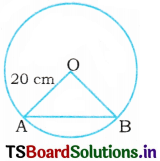
AP Inter 1st Year Maths Exercise 3a Solutions 1

Given diameter =40 cm;
radius r = \(\frac{40}{2}\) = 20 cm
length of the chord AB = 20 cm
In triangle OAB, AB = OA = OB = 20 cm
Therefore, angle AOB = 60 degrees = 60 \(\frac{\pi}{180}\) radians
= \(\frac{\pi}{3}\) radians
Hence, using the relations l = θ × r,
we have l = \(\frac{\pi}{3}\) × 20 cm
= \(\frac{20 \pi}{3}\) cm
Hence, the length of minor arc of the chord is = \(\frac{20 \pi}{3}\) cm.

Question 6.
If in two circles, arcs of the same length subtend angles 60° and 75° at the centre, find the ratio of their radii.
Solution:
Given, the angle formed by the arc of first circle,
θ1 = 60° = 60 × \(\frac{\pi}{180}=\frac{60 \pi}{180}\) radians
Angle formed by the arc of second circle,
θ2 = 75°
= 75 × \(\frac{\pi}{180}=\frac{75 \pi}{180}\) radians
Let, the radius of first circle be r1 and the second circle be r2 hence, using the
relation r = \(\frac{l}{\theta}\) we have
r1 = \(\frac{l}{\theta_1}\)
r2 = \(\frac{l}{\theta_2}\) and
Therefore, \(\frac{\mathrm{r}_1}{\mathrm{r}_2}=\frac{\frac{l}{\theta_1}}{\frac{l}{\theta_2}}=\frac{\theta_2}{\theta_1}\)
= \(\frac{\frac{75 \pi}{180}}{\frac{60 \pi}{180}}\)
= \(\frac{75}{60}=\frac{5}{4}\) = 5 : 4
Hence, the ratio of their radii is 5 : 4.

Question 7.
Find the angle in radian through which a pendulum swings if its length is 75 cm and the tip describes an arc of length,
i) 10 cm
ii) 15 cm
iii) 21 cm
Solution:
i) Given the length of an arc l = 10 cm
length of the pendulum = radius of circle r = 75 cm
Hence, using the relation θ = \(\frac{l}{r}\),
we have θ = \(\frac{10}{75}=\frac{2}{15}\)
Hence, the angle formed by pendulum is \(\frac{2}{15}\) radians

ii) Given the length of an arc l = 15 cm
length of the pendulum = radius of circle = r = 75 cm
Hence, using the relation θ = \(\frac{l}{r}\),
we have θ = \(\frac{15}{75}=\frac{1}{5}\)
Hence, the angle formed by pendulum is 1/5 radians.

ii) Given the length of an arc l = 21 cm
length of the pendulum = radius of circle = r = 75 cm
Hence, using the relation θ = \(\frac{l}{r}\),
we have θ = \(\frac{21}{75}=\frac{7}{25}\)
Hence, the angle formed by pendulum is 7/25 radians.

AP Inter 1st Year Maths Exercise 2f Solutions

Referring to the AP Inter 1st Year Maths Study Material Chapter 2 Relations and Functions Exercise 2f Solutions makes it easier to understand complex problems.

AP Inter 1st Year Maths Relations and Functions Solutions Exercise 2f

Question 1.
Let f : {1, 3, 4} → {1, 2, 5} and g : {1, 2, 5} → {1, 3} be given by f = {(1, 2), (3,5 ), (4, 1)} and g = {(1, 3), (2, 3), (5, 1)}. Write down gof.
Solution:
Given, f = {(1, 2), (3, 5), (4, 1)} and
g = {(1, 3), (2, 3), (5, 1)}
(gof) (1) = g (f (1)) = g (2) = 3;
(gof) (3) = g (f (3)) = g (5) = 1;
(gof) (4) = g (f (4)) = g (1) = 3
∴ gof = {(1, 3), (3, 1), (4, 3)}

Question 2.
Let f,g and h be functions from R to R. Show that (f+g)∘h=f∘h+g∘h; (f⋅g)∘h=(f∘h)⋅(g∘h)
Solution:
[(f + g).h] (x) = (f + g) (h (x)) = f [h (x)] + g [h (x)]
= (f.h) (x) + (g.h) (x)
= {(f.h) + (g.h)} (x)
Hence, (f + g).h = f.h + g.h
[(f⋅g).h] (x) = (f⋅g) (h (x))
= f (h (x))⋅g (h (x))
= (f.h) (x)⋅(g.h) (x)
= {(f.h)⋅(g.h)} (x)
Hence, (f⋅g).h = (f.h) . (g.h)

Question 3.
Find gof and fog, if
i) f (x) = ∣x∣ and g (x) = |5x – 2|
ii) f (x) = 8x3 and g(x) = x1/3
Solution:
i) f (x) = ∣x∣ and
g (x) = |5x – 2|
∴ (gof) (x) = g (f (x))
= g (|x|) = |5x – 2|
(fog) (x) = f (g (x))
= f (|5x − 2|)
= |5x – 2|
= |5x – 2|

ii) f (x) = 8x3
and g (x) = x1/3
∴ (gof) (x) = g [f (x)]
= g (8x3)1/3 = 2x
(fog) (x) = f (g (x))
= f (x1/3)
= 8 (x1/3)3 = 8x

AP Inter 1st Year Maths Exercise 2f Solutions

Question 4.
If f (x) = \(\frac{4 x+3}{6 x-4}\), x ≠ \(\frac{2}{3}\), show that fof (x) = x, for all x ≠ \(\frac{2}{3}\). What is the inverse of f?
Solution:
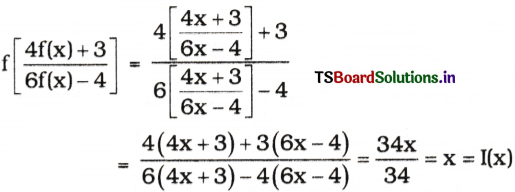
(fof) (x) =
AP Inter 1st Year Maths Exercise 2f Solutions 1

∴ fof = I
⇒ f = f-1.
Thus f-1 (x) = \(\frac{4 x+3}{6 x-4}\).

Question 5.
State with reason whether following functions have inverse
i) f : {1, 2, 3, 4} → {10} with f = {(1, 10), (2, 10), (3, 10), (4, 10)}
ii) g : {5, 6, 7, 8} → {1, 2, 3, 4} with g = {(5, 4), (6, 3), (7, 4), (8, 2)}
iii) h : {2, 3, 4, 5} → {7, 9, 11, 13} with h = {(2, 7), (3, 9), (4, 11), (5, 13)}
Solution:
i) f : {1, 2, 3, 4} → {10} ⇒ f = {(1, 10), (2, 10), (3, 10), (4, 10)}
We know that, given definition of f, f is many one function.
f (1) = f (2) = f (3) = f (4) = 10
∴ f is not one-one, f does not have inverse.

ii) g : {5, 6, 7, 8} → {1, 2, 3, 4}
⇒ g = {(5, 4), (6, 3), (7, 4), (8, 2)}
⇒ g (5) = g (7) = 4
⇒g is not one-one, g does not have inverse.

iii) h : {2, 3, 4, 5} → {7, 9, 11, 13}
⇒ h = {(2, 7), (3, 9), (4, 11), (5, 13)}
It is seen that all distinct elements of the set {2, 3, 4, 5} have distinct images under h.
∴ Function h is one-one.

Also, h is onto as for every element of the set {7, 9, 11, 13} there exists an element x in the set {2, 3, 4, 5} such that h (x) = y.
∴ h is a one-one and onto function.
Hence, h has inverse and
h-1 = {(7, 2), (9, 3), (11, 4), (13, 5)}.

Question 8.
Consider f : R → [4, ∞) given by f (x) = x2 + 4. Show that f is invertible with the inverse f-1 of f given by f-1 (y) = \(\sqrt{y-4}\), where R is the set of all non-negative real numbers.
Solution:
f : R+ → [4, ∞) is given as
f(x) = x2 + 4 for x, y ∈ R+
f (x) = f (y)
⇒ x2 + 4 = y2 + 4
⇒ x2 = y2
⇒ x = y
f is a one-one function.

for y ∈ [4, ∞), let y = x2 + 4
x = \(\sqrt{y-4}\) ∈ R
⇒ y = f (x)
∴ f is onto, thus f is one-one and onto and f-1 exists.
Now f (x) = x2 + 4 = y
⇒ x = \(\sqrt{y-4}\) = f-1 (y).

Question 9.
Consider f : R → [- 5, ∞) given by f (x) = 9x2 + 6x – 5. Show that f is invertible with f-1 (y) = \(\left(\frac{(\sqrt{y+6})-1}{3}\right)\).
Solution:
f : R+ →[- 5, ∞) given that f (x) = 9x2 + 6x – 5
Let a1, a2 ∈ R+.
Now f (a1) = f (a2)
⇒ 9a12 – 9a22 + 6a1 – 6a2 = 0
⇒ 9 (a1 – a2) (a1 + a2) + 6 (a1 – a2) = 0
⇒ (a1 – a2) [9a1 + 9a2 + 6] = 0
(∵ 9a1 + 9a2 + 6 ≠ 0 as a1, a2 ∈ R+)
⇒ a1 – a2 = 0
⇒ a1 = a2, f is one-one.
y ∈ [- 5, ∞). Write y = 9x2 + 6x – 5
Then 9x2 + 6x – 5 – y = 0
⇒ x = \(\frac{-6 \pm \sqrt{36+36(y+5)}}{18}\)
⇒ x = \(\frac{-1 \pm \sqrt{y+6}}{3}\)
as \(\frac{-1+\sqrt{y+6}}{3}\) ∈ R+
as \(\frac{-1-\sqrt{y+6}}{3}\) ∉ R+ is neglected
f-1 (y) = \(\left(\frac{(\sqrt{y+6})-1}{3}\right)\).

AP Inter 1st Year Maths Exercise 2f Solutions

Question 10.
Let f : X → Y be an invertible function. Show that f has unique inverse.
(Hint: Suppose g1 and g2 are two inverses of f. Then for all y ∈ Y fog1 (y) = Iy (y) = fog2 (y). Use one-one ness of f.)
Solution:
Let g1 and g2 be two inverses of that is,
fog1 = Iy,
​fog2 = Iy
So, for all y ∈ Y,
fog1 = Iy,
​fog2 = Iy
So, for all y ∈ Y
f (g1 (y)) = y = f (g2 (y))
Since f is one-one, g1 (y) = g2 (y) for all y ∈ Y.
Hence, g1 = g2, so the inverse is unique.

Question 11.
Consider f : {1, 2, 3} → {a, b, c} given by f (1) = a, f (2) = b and f (3) = c. Find f-1 and show that (f-1)-1 = f.
Solution:
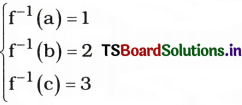
Given : f (1) = a → f-1 (a) = 1,
f (2) = b → f-1 (b) = 2,
f (3) = c → f-1 (c) = 3
So, f-1 :{a, b, c} → {1, 2, 3}, given by,

AP Inter 1st Year Maths Exercise 2f Solutions 2
Consider, (f-1)-1, it must map each element of {1, 2, 3} back to {a, b, c} just like f does.
So, (f-1)-1 (1) = a,
(f-1)-1 (2) = b,
(f-1)-1 (3) = c
Thus (f-1)-1 = f

Question 12.
Let f : X → Y be an invertible function. Show that the inverse of f-1{-1} is f i.e., (f-1)-1 = f.
Solution:
Let f : X → Y be an invertible function.
Then, there exists a function g : Y → X such that
gof = IX and fog = IY
⇒ g = f-1
Also, g-1 : X → Y such that g-1 = f .
∴ (f-1)-1 = g-1 = f
Hence proved.

Question 13.
If f : R → R be given by f(x) = (3 – x3)1/3, then fof (x) is:
1) x1/3
2) x3
3) x
4) (3 – x3)
Solution:
f(x) = (3 – x3)1/3
fof(x) = f [(3 – x3)1/3]
= [3 – ((3 – x3)1/3)3]1/3
= (3 – 3 + x3)1/3
= x
Hence, option 3 is correct.

AP Inter 1st Year Maths Exercise 2f Solutions

Question 14.
Let f : R – {- \(\frac{4}{3}\)} → R be a function defined as f(x) = \(\frac{4 x}{3 x+4}\). The inverse of f is the map g : Range f → R – {- \(\frac{4}{3}\)} given by:
1) g (y) = \(\frac{3y}{3 – 4y}\)
2) g(y) = \(\frac{4y}{4 – 3y}\)
3) g(y) = \(\frac{4y}{3 – 4y}\)
4) g(y) = \(\frac{3y}{4 – 3y}\)
Solution:
Given that f : R – {- \(\frac{4}{3}\)} → R is defined as
f(x) = \(\frac{4 x}{3 x+4}\) = y ∈ Range of f.
⇒ 4x = 3xy + 4y
⇒ 4x – 3xy = 4y
⇒ x (4 – 3y) = 4y
⇒ x = \(\frac{4y}{4 – 3y}\) = g (y).
∴ Option 2 is correct.

AP Inter 1st Year Maths Exercise 14a Solutions

Referring to the AP Inter 1st Year Maths Study Material Chapter 14 Probability Exercise 14a Solutions makes it easier to understand complex problems.

AP Inter 1st Year Maths Probability Solutions Exercise 14a

I.

Question 1.
A dice is rolled. Let E be the event “dice shows 4” and F be the event “dice shows even number”. Are E and F mutually exclusive ?
Solution:
No. When a dice is rolled, the sample space is given by S = {1, 2, 3, 4, 5, 6} Accordingly, E = {4} and F = {2, 4, 6}. It is observed that E ∩ F = {4} ≠ Φ
Therefore, E and F are not mutually exclusive events.

Question 2.
In the experiment of throwing a dice, consider the following events.
A = {1, 3, 5} B = {2, 4, 6} C = {1, 2, 3}
Are these events equally likely ?
Solution:
Yes, chances of occurring the events A, B and C are equal. Hence, clearly A, B, C are equally likely.

Question 3.
In the experiment of throwing a dice, consider the following events.
A = {1, 3, 5} B = {2, 4} C = {6}
Are these events mutually exclusive ?
Solution:
Yes, because of one of the given events A, B and C prevents the happening of other two. Hence A, B, C are mutually exclusive.

Question 4.
In the experiment of throwing a dice, consider the following events.
A = {2, 4, 6} B = {3, 6} C = {1, 5, 6}
Are these events exhaustive ?
Solution:
Yes. Let ‘S’ be the sample space for the random experiment of throwing a dice. Then S = {1, 2, 3, 4, 5, 6}
Given A = {2, 4, 6}, B = {3, 6}, C = {1, 5, 6}
Clearly, events are exhaustive. If their union covers the entire sample space.
∴ A ∪ B ∪ C = S
Hence clearly A, B, C are exhaustive.

II.

Question 1.
An experiment involves rolling a pair of dice and recording the numbers that come up. Describe the following events.
A : the sum is greater than 8,
B : 2 occurs on either dice
C : the sum is at least 7 and a multiple of 3.
Which pairs of these events are mutually exclusive ?
Solution:
When a pair of dice is rolled, the sample space is given by
S = {(x, y) : X, y = 1, 2, 3, 4, 5, 6} = {(1, 1), (1, 2), (1, 3), (1, 4), (1, 5) (1, 6) (2, 1), (2, 2) (2, 3) (2, 4) (2, 5), (2, 6) (3, 1), (3, 2), (3, 3), (3, 4), (3, 5), (3, 6), (4, 1), (4, 2), (4, 3), (4, 4), (4, 5) (4, 6), (5, 1), (5, 2), (5, 3), (5, 4), (5, 5), (5, 6), (6, 1), (6, 2), (6, 3), (6, 4), (6, 5), (6, 6)}
Now, A = {(3, 6), (4, 5), (4, 6), (5, 4), (5, 5), (5, 6), (6, 3), (6, 4), (6, 5), (6, 6)}
B = {(1, 2), (2, 1), (2, 2), (2, 3), (2, 4), (2, 5), (2, 6), (3, 2), (4, 2), (5, 2), (6, 2)}
C = {(3, 6), (4, 5), (5, 4), (6, 3), (6, 6)}
Here, A ∩ B = Φ, B ∩ C = Φ and A ∩ C = {(3, 6), (4, 5), (5, 4), (6, 3), (6, 6) ≠ Φ
Hence, events A and B as well as events B and C are mutually exclusive.

AP Inter 1st Year Maths Exercise 14a Solutions

Question 2.
Three coins are tossed once. Let A denote the event ‘three heads show’, B denote the event “two heads and one tail show”, C denote the event “three tails show” and D denote the event “a head shows on the first coin”. Which events are (i) Mutually exclusive ? (ii) Simple ? (iii) Compound ?
Solution:
S = {HHH, HHT, HTH, HTT, THH, THT, TTH, TTT}
Now, A = {HHH}, B = {HHT, HTH, THH}, C = {TTT}, D = {HHH, HHT, HTH, HTT} We now observe that, A ∩ B = Φ, A ∩ C = Φ, A ∩ D = {HHH} ≠ Φ
B ∩ C = Φ, B ∩ D = {HHT}, ≠ Φ, C ∩ D = Φ
i) Events A and B, events A and C, events B and C, and events C and D are all mutually exclusive.
ii) If an event has only one sample point of a sample space, it is called a sample event. Thus, A and C are simple events.
iii) If an event has more than one sample point of a sample space, it is called a compound event. Hence, B and D are compound events.

Question 3.
Two dice are thrown. The events A, B and C are as follows.
A : getting an even number on the first dice,
B : getting an odd number on the first dice and
C : getting the sum of numbers on the dice < 5.
State true or false : (give reason for your answer)
i) A and B are mutually exclusive.
ii) A and B are mutually exclusive and exhaustive.
iii) A = B’
iv) A and C are mutually exclusive.
v) A and B’ are mutually exclusive.
vi) A’, B’, C are mutually exclusive and exhaustive.
Solution:
When a pair of dice is rolled the sample space is given by
S = {(1, 1), (1, 2), (1, 3), (1, 4), (1, 5), (1, 6), (2, 1), (2, 2), (2, 3), (2, 4), (2, 5), (2, 6), (3, 1), (3, 2), (3, 3), (3, 4), (3, 5), (3, 6), (4, 1), (4, 2), (4, 3), (4, 4), (4, 5), (4, 6), (5, 1), (5, 2), (5, 3), (5, 4), (5, 5), (5, 6), (6, 1), (6, 2), (6, 3), (6, 4), (6, 5), (6, 6)}

Now,
A = {(2, 1), (2, 2), (2, 3), (2, 4), (2, 5), (2, 6), (4, 1), (4, 2), (4, 3), (4, 4), (4, 5), (4, 6), (6, 1), ‘(6, 2), (6, 3), (6,4), (6, 5), (6, 6)}
B = {(1, 1), (1, 2), (1, 3), (1, 4), (1, 5), (1, 6), (3, 1), (3, 2), (3, 3), (3, 4), (3, 5), (3, 6), (5, 1), (5, 2), (5, 3), (5, 4), (5, 5), (5, 6)}
C = {(1, 1), (1, 2), (1, 3), (1, 4), (2, 1), (2, 2), (2, 3), (3, 1), (3, 2), (4, 1)}
i) It is observed that A ∩ B = Φ
A and B are mutually exclusive. Thus, the given statement is true.
ii) It is observed that A ∩ B = Φ and A ∪ B = S
A and B are mutually exclusive and exhaustive. Thus, the given statement is true.
iii) It is observed that
B’ = {(2, 1), (2, 2), (2, 3), (2, 4), (2, 5), (2, 6), (4, 1), (4, 2), (4, 3), (4, 4), (4, 5), (4, 6), (6, 1), (6, 2), (6, 3), (6, 4), (6, 5),.(6, 6)} = A Thus, the given statement is true.
iv) It is observed that A ∩ C = {(2, 1), (2, 2), (2, 3), (4, 1)}
A and C are not mutually exclusive.
Thus, the given statement is false.
v) A ∩ B’ = A ∩ A = A ⇒ A ∩ B’ ≠ Φ
∴ A and B’ are not mutually exclusive. Thus the given statement is false.
vi) It can be observed that : A’ ∪ B’ ∪ C = S However B’ ∩ C = {(2, 1), (2, 2), (2, 3), (4, 1)} ≠ Φ
Therefore, events A’, B’ and C are not mutually exclusive and exhaustive. Thus, the given statement is false,

III.

Question 1.
A dice is thrown. Describe the following events.
(i) A : a number less than 7.
(ii) B : a number greater than 7.
(iii) C : a multiple of 3.
(iv) D : a number less than 4.
(v) E : an even number greater than 4.
(vi) F : a number not less than 3.
Also find A ∪ B, A ∩ B, B ∪ C, E ∩ F, D ∩ E, A – C, D – E, E ∩ F’, F’.
Solution:
When a dice is thrown, the sample space is given by S = {1, 2, 3, 4, 5, 6} Accordingly,
i) A = {1, 2, 3, 4, 5, 6}
ii) B = Φ
iii) C = {3, 6}
iv) D = {1, 2, 3}
v) E = {6}
vi) F = {3, 4, 5, 6}
A ∪ B = {1, 2, 3, 4, 5, 6}, A ∩ B = Φ, B ∪ C = {3, 6}, E ∩ F = {6}, D ∩ E = Φ,
A – C = {1, 2, 4, 5}, D – E = {1, 2,3}, E ∩ F’ = Φ, F’ = S – F = {1, 2}.

Question 2.
Three coins are tossed. Describe
(i) Two events which are mutually exclusive.
(ii) Three events which are mutually exclusive and exhaustive.
(iii) Two events, which are not mutually exclusive.
(iv) Two events which are mutually exclusive but not exhaustive.
(v) Three events which are mutually exclusive but not exhaustive.
Solution:
When three coins are tossed, the sample space is given by
S = {HHH, HHT, HTH, HTT, THH, THT, TTH, TTT}.
i) Two events that are mutually exclusive can be
A : getting no heads and B : getting no tails
Therefore, A = {TTT} and B = {HHH} are disjoint because AnB = f
∴ A, B are mutually exclusive.

ii) Three events that are mutually exclusive and exhaustive can be
A : getting no heads, C : getting at least two heads,
B : getting exactly one head
Therefore, A = {TTT}, B = {HTT, THT, TTH}, C = {HHH, HHT, HTH, THH}
This is because A ∩ B = B ∩ C = C ∩ A = Φ and A ∪ B ∪ C = S.
∴ A, B, C are mutually exclusive and exhaustive.

iii) Two events that are not mutually exclusive can be
A : getting three heads,
B : getting at least 2 heads,
Therefore, A = {HHH}, B : {HHH, HHT, HTH, THH}
This is because A ∩ B = {HHH} ≠ Φ.
∴ A, B are not mutually exclusive.

iv) Two events which are mutually exclusive but not exhaustive can be
A : getting exactly one head
B : getting exactly one tail
Therefore, A = {HTT, THT, TTH}, B = {HHT, HTH, THH}
It is because, A ∩ B = Φ, but A ∪ B ∪ S.
A, B are mutually exclusive but not exhaustive.

v) Three events that are mutually exclusive but not exhaustive can be
A : getting exactly three heads,
B : getting one head and two tails,
C : getting one tail and two heads.
Therefore, A = {HHH}, B = {HTT, THT, TTH}, C = {HHT, HTH, THH}
This is because A ∩ B = B ∩ C = C ∩ A = Φ, but A ∪ B ∪ C ≠ S.
∴ A, B, C are mutually exclusive but not exhaustive.

AP Inter 1st Year Maths Exercise 14a Solutions

Question 3.
Two dice are thrown. The events A, B and C are as follows.
A : getting an even number on the first dice.
B : getting an odd number on the first dice.
C : getting the sum of the numbers on the dice < 5.
Describe the events
(i) A’
(ii) not B
(iii) A or B
(iv) A and B
(v) A but not C
(vi) B or C
(vii) B and C
(viii) A ∩ B’ ∩ C’
Solution:
When a pair of dice is rolled, the sample space is given by
S = {(1, 1), (1, 2), (1, 3), (1, 4), (1, 5), (1, 6), (2, 1), (2, 2), (2, 3), (2, 4), (2, 5), (2, 6), (3, 1), (3, 2), (3, 3), (3, 4), (3, 5), (3, 6), (4, 1), (4, 2), (4, 3), (4, 4), (4, 5), (4, 6), (5, 1), (5, 2), (5, 3), (5, 4), (5, 5), (5, 6), (6, 1), (6, 2), (6, 3), (6, 4), (6, 5), (6, 6)}.

Now,
A = {(2, 1), (2, 2), (2, 3), (2, 4), (2, 5), (2, 6), (4, 1), (4, 2), (4, 3), (4, 4), (4, 5), (4, 6), (6, 1), (6, 2), (6, 3), (6, 4), (6, 5), (6, 6)}
B = {(1, 1), (1, 2), (1, 3), (1, 4), (1, 5), (1, 6), (3, 1), (3, 2), (3, 3), (3, 4), (3, 5), (3, 6), (5, 1), (5, 2), (5, 3), (5, 4), (5, 5), (5, 6)}.
C = {(1, 1), (1, 2), (1, 3), (1, 4), (2, 1), (2, 2), (2, 3), (3, 1), (3, 2), (4, 1)}.
Therefore,
i) A’ = {(1, 1), (1, 2), (1, 3), (1, 4), (1, 5), (1, 6), (3, 1), (3, 2), (3, 3), (3, 4), (3, 5), (3, 6), (5, 1), (5, 2), (5, 3), (5, 4), (5, 5), (5, 6)} = B.

ii) not B = B’ – {(2, 1), (2, 2), (2, 3), (2, 4), (2, 5), (2, 6), (4, 1), (4, 2), (4, 3), (4, 4), (4, 5), (4, 6), (6, 1), (6, 2), (6, 3), (6, 4), (6, 5), (6, 6) = A.

iii) A or B = A ∪ B= {(1, 1), (1, 2), (1, 3), (1, 4) (1, 5), (1, 6), (2, 1), (2, 2), (2, 3), (2, 4), (2, 5), (2, 6), (3, 1), (3, 2), (3, 3), (3, 4), (3, 5), (3, 6), (4, 1), (4, 2), (4, 3), (4, 4), (4, 5), (4, 6), (5, 1), (5, 2), (5, 3), (5, 4), (5, 5), (5, 6), (6, 1), (6, 2), (6, 3), (6, 4), (6, 5), (6, 6)} = S.

iv) A and B = A ∩ B = Φ.

v) A but not C = A – C = {(2, 4), (2, 5), (2, 6), (4, 2), (4, 3), (4, 4), (4, 5), (4, 6), (6, 1), (6, 2), (6, 3), (6, 4), (6, 5), (6, 6)}.

vi) B or C = B ∪ C= {(1, 1), (1, 2), (1, 3), (1, 4), (1, 5), (1, 6), (2, 1), (2, 2), (2, 3), (3, 1), (3, 2), (3, 3), (3, 4), (3, 5), (3, 6), (4, 1), (5, 1), (5, 2), (5, 3), (5, 4), (5, 5), (5, 6)}.

vii) B and C = B ∩ C = {(1, 1), (1, 2), (1, 3), (1, 4), (3, 1), (3, 2)}.

viii) C = {(1, 5), (1, 6), (2, 4), (2, 5), (2, 6), (3, 3), (3, 4), (3, 5), (3, 6), (4, 2), (4, 3), (4, 4), (4, 5), (4, 6), (5, 1), (5, 2), (5, 3), (5, 4), (5, 5), (5, 6), (6, 1), (6, 2), (6, 3), (6, 4), (6, 5), (6, 6)}.

A ∩ B’ ∩ C’ = {(2, 4), (2, 5), (2, 6), (4, 2), (4, 3), (4, 4), (4, 5), (4, 6), (6, 1), (6, 2); (6, 3), (6, 4), (6, 5), (6, 6)}.

AP Inter 1st Year Maths Exercise 2e Solutions

Referring to the AP Inter 1st Year Maths Study Material Chapter 2 Relations and Functions Exercise 2e Solutions makes it easier to understand complex problems.

AP Inter 1st Year Maths Relations and Functions Solutions Exercise 2e

Question 1.
Show that the function f : R✶ → R, defined by f(x) = \(\frac{1}{x}\) is one-one and onto, where R, is the set of all non-zero real numbers. Is the result true, if the domain R, is replaced by N with co-domain being the same as R. ?
Solution:
Part 1 : f : R✶ → R, then, f(x) = \(\frac{1}{x}\)

Injective (one-one) :
To prove injectivity, Assume that f(x1) = f(x2) ⇒ \(\frac{1}{2}\) ⇒ x1 = x2
So, f is injective.

Surjective (onto) :
To prove surjectivity, for any y ∈ R , we need to find on x ∈ R* such that,
f(x) = y ⇒ \(\frac{1}{x}\) = y ⇒ x = \(\frac{1}{y}\).
Since y ≠ 0, \(\frac{1}{y}\) ∈ R✶. So ‘f’ is surjective.

Conclusion : f(x) = \(\frac{1}{x}\) is both one-one and onto from R, R„
Part-2 ; If domain is N and codomain is R,
Let f : N → R✶, f(x) = \(\frac{1}{x}\)

Injective : f(x1) = f(x2) ⇒ \(\frac{1}{2}\) ⇒ x1 = x2 So, it is injective.
Surjective Now the codomain is R✶, but the image of f is only
{\(\frac{1}{1}, \frac{1}{2}, \frac{1}{3}\),…………..} ⊂ R✶, Which is countable and only positive.

AP Inter 1st Year Maths Exercise 2e Solutions

Question 2.
Check the injectivity and surjectivity of the following functions.
(i) f: N → N given by f(x) = x2
(ii) f: Z → Z given by f(x) = x2
(iii) f: R → R given by f(x) = x2
(iv) f: N → N given by f(x) = x3
(v) f: Z → Z given by f(x) = x3
Solution:
i) f:N → N given by f(x) = x2
x, y ∈ N, f(x) = f(y) ⇒ f(y) = x2 = y2 ⇒ x = y.
∴ f is injective.

ii) f: Z → Z given by f(x) = x2; f(-1) = f(1) = 1, but -1 ≠ 1.
∴ f is not injective.
Now, -2 ∈ Z. But x ∈ Z, Such that f(x) = x2 = – Z.
∴ f is not injective.

iii) f: R → R given by f(x) = x2 ⇒ f(- 1) = f(1) = 1, but -1 ≠ 1
∴ f is not injective.
Now, – Z ∈ R. But, X ∈ R; Such that f(x) = x2 = -Z
f is neither injective nor surjective.

iv) f: N → N given by f(x) = x3
x,y ∈ N, f(x) = f(y) ⇒ x3 = y3 ⇒ x = y
∴ f is injective.
Now, 2 ∈ N (codomain); f(x) = x3 = 2.
∴ f is not injective.

v) f : Z → Z given by f(x) = x3
x, y ∈ Z, f(x) = f(y) ⇒ x3 = y3 ⇒ x = y.
∴ f is injective.
Now, 2 ∈ Z. But does not exist only element x in domain Z such that f(x) = x3 = 2.
∴ f is not injective.

Question 3.
Prove that the Greatest Integer Function f : R → R, given by f(x) = {x} is neither one-one nor onto, where [xj denotes the greatest integer less than or equal to x.
Solution:
Given that f(x) = [x] = greatest integer less than or equal to x.
3.4 ≠ 3 but f(3.4) = [3.4] = 3 = [3] = f(3). Thus f is not one-one.
\(\frac{5}{2}\) ∈ R (codomain), but there exists no x ∈ R (domain)
Such taht f(x) = \(\frac{5}{2}\) because, f(x) = [x] is always an integer ∀ x ∈ R. Thus f is not onto.

Question 4.
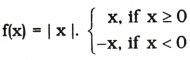
Show that the Modulus Function f : R → R, given by f(x) = |x|, is neither one- one nor onto, where |x| is x, if x is positive or 0 and |x| is – x, if x is negative.
Solution:
f: R → R is given by, f(x) = |x|,
AP Inter 1st Year Maths Exercise 2e Solutions 1
Here f(-1) – | -1 | = 1
∴ f(-1) = f(1), but -1 ≠ 1
f is not one-one.
Consider -1 ∈ R
We know that f(x) = |x| is always non-negative. Thus, there does not exists any element x in domain R such that f(x) = |x | = -1
∴ f is not onto.

Question 5.
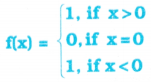
Show that the Signum Function f : R → R, given by
AP Inter 1st Year Maths Exercise 2e Solutions 2
is neither one-one nor onto.
Solution:
Given

AP Inter 1st Year Maths Exercise 2e Solutions 3
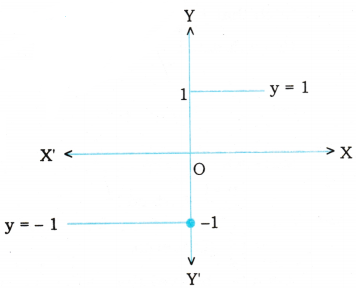
from the graph of the function
f(2) = 1 and f(3)= 1
i.e., f(2) = f(3) = 1, but 2 ≠ 3.
f is not one-one.
∴ for 4 ∈ R (codomain) y = – 1
there exists no x ∈ R (domain) such that f(x) = 4
f is not onto.

Question 6.
Let A = {1, 2, 3}, B = {4, 5, 6, 7} and let f = {(1, 4), (2. 5), (3, 6)} be a function from A to B. Show that f is one-one.
Solution:
It is given that A = {1, 2, 3}, B = {4, 5, 6, 7}
f: A → B is defined as, f = {(1, 4), (2, 5), (3, 6)}
f(1) = 4, f(2) = 5, f(3) = 6
It is seen that the images of distinct elements of A under f are distinct.
Hence, function f is one-one.

Question 7.
In each of the following cases, state whether the function is one-one, onto or bijective. Justify your answer.
i) f : R → R defined by f(x) = 3 – 4x
ii) f : R → R defined by f(x) = 1 + x2.
Solution:
i) f : R → R defined by f(x) = 3 – 4x.
Let x1;x2 ∈ R.
Then f(x1) = f(x2)
⇒ 3 – 4x1 = 3 – 4x2
⇒ -4x1 = -4x2
⇒ x1 = x2 f is one-one
For any real number (y) in R, there exists \(\frac{3-y}{4}\) in R such that
f\(\left(\frac{3-\mathrm{y}}{4}\right)\) = 3 – 4\(\left(\frac{3-\mathrm{y}}{4}\right)\) = y
f is onto. Hence, f is bijective.

ii) f(x) = 1 + x2 for all x e R
we know that f(2) = 1 + 22 = 5 and f(-2) = 1 + (-2)2 = 5
i.e., f(2) = f(-2), but If f(x) = -2
For y = -2 ⇒ x2 = -3 ⇒ x = 3 ∉ R
∴ f is not onto. Then f is not one-one and not onto.
∴ f is not bijection.

AP Inter 1st Year Maths Exercise 2e Solutions

Question 8.
Let A and B be sets. Show that f: A × B → B × A such that f(a, b) = (b, a) is bijective function.
Solution:
f : R → R be defined as f(x) = 2x
Let x, y ∈ R. Then f(x) = f(y) ⇒ 2x = 2y ⇒ x = y
∴ f is one-one
Also, for any real number (y) in co-domain R, there exists \(\frac{y}{2}\).
Such that f\(\left(\frac{\mathrm{y}}{2}\right)\) = 2\(\left(\frac{\mathrm{y}}{2}\right)\) = y .
∴ f is onto.
Hence function f is one-one & onto, then it is bijective function.

Question 9.
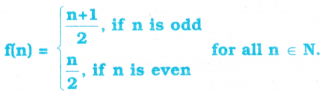
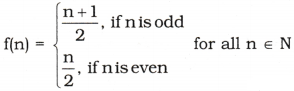
Let f: N → N be defined by f(n)
AP Inter 1st Year Maths Exercise 2e Solutions 4
State whether the function f is bijective. Justify your answer.
Solution:
AP Inter 1st Year Maths Exercise 2e Solutions 5
It can be observed that : f(1) = \(\frac{1+1}{2}\) and f(2) = \(\frac{2}{2}\) = 1
∴ f(1) = f(2) but 1 ≠ 2
∴ f is not one-one.
Consider a natural number ‘n’ in co-domain N.

Case I : n is odd
∴ n = 2r + 1 for some r ∈ N. Then, there exists 4r + 1 ∈ N
Such that f(4r + 1) = \(\frac{4 r+1+1}{2}\) = 2r + 1

Case II: n is even
∴ n = 2r for some r ∈ N. Then, there exists 4r ∈ N such that f(4r) = \(\frac{4r}{2}\) = 2r
∴ f is onto. Hence, f is not a bijective function.

Question 10.
Let A = R – {3} and B = R – {1}. Consider the function f : A → B defined by f(x) = \(\left(\frac{x-2}{x-3}\right)\). Is f one-one and onto? Justify your answer.
Solution:
We have f(x) = \(\frac{1}{2}\) for all x ∈ R – {3}. Let f(x1) = f(x2).
Then \(\frac{1}{2}\)
⇒ x1x2 – 2x2 – 3x1 + 6 = x1x2 – 2x1 – 3x2 + 6
⇒ x1 = x2
Thus f is one-one.

Let y ∈ B. Thus for every y ∈ B thus y ≠ 1.
Now y = \(\frac{x-2}{x-3}\),
Then x – 2 = y(x – 3)
⇒ 3y – 2 = x(y – 1)
⇒ x = \(\frac{3 y-2}{y-1}\)

If \(\frac{2-3 y}{1-y}\) = 3, then 2 – 3y = 3 – 3y
⇒ 2 = 3 which is not true.
∴ \(\frac{2-3 y}{1-y}\) ≠ 3

y ∈ B there exists x = \(\frac{2-3 y}{1-y}\) ∈ A such that f(x) = y.
Thus f is onto and hence f is bijective.

Question 11.
Let f : R → R be defined as f(x) = x4. Choose the correct answer.
A) f is one-one onto
B) f is many-one onto
C) f is one-one but not onto
D) f is neither one-one nor onto,
Solution:
f : R → R be defined as f(x) = x4. Now f(1) = f(-1) = 1.
∴ f is not one-one.
Consider an element-2 in co-domain R. It is clear that there does not exists any x in domain R such that
f(x) = -2, i.e., x4 = -2
∴ f is not onto.
Hence, function f is neither one-one nor onto. The correct option is D.

AP Inter 1st Year Maths Exercise 2e Solutions

Question 12.
Let f: R → R be defined as f(x) = 3x. Choose the correct answer.
A) f is one-one onto
B) f is many-one onto
C) f is one-one but not onto
D) f is neither one-one nor onto,
Solution:
f : R → R be defined as f(x) = 3x
Let x, y ∈ R. Then f(x) = f(y) ⇒ 3x = 3y ⇒ x = y ⇒ f is one-one.
for any 3x = y; x = \(\frac{y}{3}\) ∉ Z domain o
∴ f is not onto.
Hence the function is one-one but not onto. The correct option is C.

Relations and Functions MCQ AP Inter 1st Year Maths Chapter 2

Practice AP Inter 1st Year Maths Study Material Chapter 2 Relations and Functions MCQ to identify your strengths and weak areas.

AP Inter 1st Year Maths Relations and Functions MCQ

Question 1.
If (2x + 1, \(\frac{y}{2}\)) = (3, 3) then the values of x & y are
1) 1, 6
2) 2, 2
3) 3, 3
4) 7, \(\frac{3}{2}\)
Answer:
1) 1, 6

Explanation:
Given (2x + 1, \(\frac{y}{2}\)) = (3, 3)
⇒ 2x + 1 = 3
⇒ 2x = 2
⇒ x = 1;
⇒ \(\frac{y}{2}\) = 3
⇒ y = 6

Question 2.
If A = 11, 2, 3), B = {a, b) then A × B =
1) {(1, a), (2, b), (3, a)}
2) {(a, 1), (b, 2), (a, 3), (b, 3)}
3) {(1, a), (1, b), (2, a), (2, b), (3, a), (3, b)}
4) {(1, a), (1, b), (2, b), (3, b)}
Answer:
3) {(1, a), (1, b), (2, a), (2, b), (3, a), (3, b)}

Explanation:
A = {1, 2, 3}, B = {a, b}
A × B= {1, 2, 3} × {a, b} = {(1, a), (1, b), (2, a), (2, b), (3, a), (3, b)}

Question 3.
A relation can be represented as
1) Roster method
2) Set-builder method
3) An arrow diagram
4) In above three forms
Answer:
4) In above three forms

Explanation:
A relation can be represented as in above three forms

Relations and Functions MCQ AP Inter 1st Year Maths Chapter 2

Question 4.
If A = (1, 2, 3, 4} and a relation R from A to A is defined by R = ((x, y) : y then co-domain of R is (
1) {2, 4}
2) {1, 2, 3, 4}
3) {1, 3}
4) {1, 4}
Answer:
2) {1, 2, 3, 4}

Explanation:
Given A = {1, 2, 3, 4} and a relation R from A to A is defined by, R = {(x, y) : y Co-domain of R is {1, 2, 3, 4}

Question 5.
If f(x) = then f(0) = …………………..
1) 1
2) -1
3) undefined
4) 0
Answer:
3) undefined

Explanation:
f(x) = \(\frac{|\mathrm{x}|}{\mathrm{x}}\), f(0) = undefined

Question 6.
The domain of the function \(\frac{1}{\sqrt{x^2-25}}\) is
1) (-∞, -5) ∪ (5, ∞)
2) (-∞, -5] ∪ [5, ∞)
3) (-∞, -5] ∪ (5, ∞)
4) (-∞, -5) [5, ∞)
Answer:
1) (-∞, -5) ∪ (5, ∞)

Explanation:
The domain of the function \(\frac{1}{\sqrt{x^2-25}}\) is (-∞, -5) ∪ (5, ∞)

Question 7.
Range of the function f(x) = x2, x ∈ R is ( 1 )
1) [0, ∞)
2) (-∞, ∞)
3) (-∞, 0)
4) (0, ∞)
Answer:
1) [0, ∞)

Explanation:
Range of the function f(x) = x2, x ∈ R is [0, oo)

Question 8.
A function f(x) is defined by f(x) = x2 + 2x – 7 then the value of f(3) = ….
1) 2
2) -7
3) 8
4) 9
Answer:
3) 8

Explanation:
Given f(x) = x2 + 2x – 7 ⇒ f(3) = 9 + 6 – 7 = 8

Question 9.
Let f = ((0, 1), (1, 3), (2, 5)) be a linear function from (0, 1, 2) to N then f(x) = ….
1) 2x – 1
2) 2x + 1
3) x2 – 1
4) x22 + 1
Answer:
2) 2x + 1

Explanation:
Given f = {(0, 1), (1, 3), (2, 5)} f(x) = ax + b f(0) = 1, f(1) = 3
⇒ b = 1
⇒ a + b = 3
⇒ a = 2

Relations and Functions MCQ AP Inter 1st Year Maths Chapter 2

Question 10.
The domain of y x – x is
1) R
2) [0, ∞)
3) (-∞, 0]
4) Z
Answer:
1) R

Explanation:
The domain of \(\sqrt{|\mathrm{x}|-\mathrm{x}}\) is R.

AP Inter 1st Year Maths Exercise 2d Solutions

Referring to the AP Inter 1st Year Maths Study Material Chapter 2 Relations and Functions Exercise 2d Solutions makes it easier to understand complex problems.

AP Inter 1st Year Maths Relations and Functions Solutions Exercise 2d

I.

Question 1.
If f(x) = x2, find \(\frac{\mathrm{f}(1.1)-\mathrm{f}(1)}{(1.1-1)}\)
Solution:
Here f(x) = x2
f(1.1) = (1.1)2 = 1.21; f(1) = (1)2 = 1
\(\frac{\mathrm{f}(1.1)-\mathrm{f}(1)}{(1.1-1)}=\frac{1.21-1}{0.1}=\frac{0.21}{0.1}\) = 2.1

Question 2.
Find the domain of the function f(x) = \(\frac{x^2+2 x+1}{x^2-8 x+12}\)
Solution:
Here f(x) = \(\frac{1}{2}\)
f(x) is a rational function of x.
f(x) assumes real values of all x except for those values of x for which.
x2 – 8x + 12 = 0
⇒ (x – 6) (x – 2) = 0
⇒ x = 2, 6
∴ Domain of function = R – {2, 6}.

Question 3.
Find the domain and the range of the real function f is defined by f(x) = \(\sqrt{(x-1)}\).
Solution:
Here f(x) = -1, f(x) assumes real values
If x – 1 ≥ 0 ⇒ x ≥ 1 ⇒ x ∈ (1, ∞)
∴ Domain of f(x) = {1, ∞}
For Z ≥ 1, f(x) ≥ 0
Range of f(x) = all real numbers ≥ 0 = (0, ∞) .

Question 4.
Find the domain and the range of the real function f defined by f(x) = |x – 1|.
Solution:
Here f(x) = |x – 1|
The function f(x) is defined for all values of x
Domain of f(x) = R
when x > 1 ⇒ |x – 1| = 0
when x < 1 ⇒ |x – 1| = -x + 1 > 0
Range of f(x) = all real numbers ≥ 0.

Question 5.
Let f = {(x, \(\frac{x^2}{1+x^2}\)): x ∈ R} be a function from R into R, Determine the range of f.
Solution:
Here f(x) = \(\frac{x^2}{1+x^2}\)
Put y = \(\frac{x^2}{1+x^2}\) ⇒ y + yx2 = x2
⇒ x2(1 – y) = y
⇒ x2 = \(\frac{y}{1-y}\)
⇒ x = \(\sqrt{\frac{y}{1-y}}\)
\(\frac{1}{2}\) ≥ 0 ⇒ \(\frac{1}{2}\) ≤ 0
⇒ 0 ≤ y < 1
⇒ y ∈ [0, 1)
Range of f(x) = [0, 1)

AP Inter 1st Year Maths Exercise 2d Solutions

Question 6.
Let R be a relation from N to N defined by R = |(a, b) : a, b ∈ N and a = b2). Are the following true ?
i) (a, a) ∈ R, for all a ∈ N
ii) (a, b) ∈ R, implies (b, a) ∈ R
iii) (a, b) ∈ R, (b, c) ∈ R implies (a, c) ∈ R.
Justify your answer in each case.
Solution:
i) Given R = {(a, b):a, b ∈ N and a = b2}
(a, a) ∈ R for all a ∈ N 3 ∈ N but 3 * 32 = 9
Hence the statement is not true,

ii) (a, b) ∈ R implies (b, a) ∈ R
Now (4, 2) ∈ N and 4 = 22 = 4
But 3 ≠ 42 = 16 ⇒ (2, 4) ∉ Q
Hence the statement is not true.

iii) (a, b) ∈ R, (b, c) ∈ R ⇒ (a, c) ∈ R
(9, 3) ∈ R, (16, 4) ∈ R because 3, 4, 9, 16 ∈ N
9 ≠ 42 = 16 ⇒ (9, 4) ∈ R
Hence the statement is not true.

Question 7.
Let A = {1, 2, 3, 4). B = (1. 5, 9, 11, 15, 16) and f = {(1, 5), (2, 9), (3, 1), (4, 5), (2, 11)}. Are the following true ?
i) f is a relation from A to B, ii) f is a function from A to B.
Justify your answer in each case.
Solution:
i) Given A = {1, 2, 3, 4}, B = {1, 5, 9, 11, 15, 16}
F = {(1, 5), (2, 9), (3, 1), (4, 5), (2, 11)}
A × B = {(1, 1), (1, 5), (1, 9), (1, 11), (1, 15), (1, 16), (2, 1), (2, 5), (2, 9), (2, 11), (2, 15), (2, 16), (3, 1), (3, 5), (3, 9), (3, 11), (3, 15), (3, 16), (4, 1), (4, 5), (4, 9), (4, 11), (4, 15), (4, 16)} f is a subset of A × B.
Hence f is a relation from A to B.
Statement is true.

ii) f is not a function from A to B because 2 corresponds to two different images that is 9 & 11.

Question 8.
Let f be the subset of Z × z defined by f = {(ab, a + b) : a, b ∈ Z). Is f a function from Z to Z ? Justify your answer.
Solution:
We observe that 1 × 4 = 4 & 2 × 2 = 4 (1 × 4, 1 + 4) ∈ f and (2 × 2, 2 + 2) ∈ f and (4, 4) ∈ f
∴ f is not a function from Z to Z.

Question 9.
Let A = {9, 10, 11, 12, 13} and let f : A → N be defined by f(n) = the highest prime factor of n. Find the range of f.
Solution:
Given A = {9, 10, 11, 12, 13} and f : A → N be defined by f(n) = Highest prime factor of n.
For n = 9, 9 = 1 × 3 × 3; Highest prime factor is 3.
For n = 10, 10 = 1 × 2 × 5; Highest prime factor is 5.
For n = 11, 11 = 1 × 11; Highest prime factor is 11.
For n = 12, 12 = 1 × 2 × 2 × 3; Highest prime factor is 3.
For n = 13, 13 = 1 × 13; Highest prime factor is 13.
∴ f = {(9, 3), (10, 5), (11, 11), (12, 3), (13, 13)}
Hence the range of f = {3, 5, 11, 13}.

II.

Question 1.
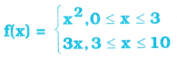
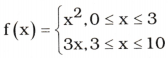
The relation f is defined by
AP Inter 1st Year Maths Exercise 2d Solutions 1
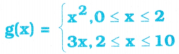
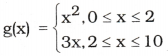
The relation g is defined by
AP Inter 1st Year Maths Exercise 2d Solutions 2
Show that f is a function and g is not a function.
Solution:
Given
AP Inter 1st Year Maths Exercise 2d Solutions 3
It is observed that f(x) = x2, 0 < x < 3 ⇒ f(3) = 32 = 9
f(x) = 3x, 3 < x < 10 ⇒ f(x) = 3(3) = 9
∴ For 0<x<10, the images of fix) are unique. Thus, the given relation f is a function.

Given
AP Inter 1st Year Maths Exercise 2d Solutions 4
It is observed that g(x) = x2, 0 < x < 2 ⇒ g(2) = 22 = 4
g(x) = 3x, 2 < x < 10 ⇒ g(2) = 3(2) = 6
∴ The element 2 at the domain of the relation g corresponds to two different image (4 & 6). Hence, the given relation g is not a function.

Question 2.
Let f, g : R R be defined, respectively by fix) = x + 1, g(x) = 2x – 3. Find
Solution:
Given f(x) = x + 1, g(x) = 2x – 3
(f + g) (x) = f(x) + g(x) = x + 1 + 2x – 3 = 3x – 2
(f – g) (x) = f(x) – g(x) = x + 1 – 2x + 3 = 4 – x
\(\left(\frac{\mathrm{f}}{\mathrm{~g}}\right)\)(x) = \(\frac{f(x)}{g(x)}=\frac{x+1}{2 x-3}\) when x ≠ \(\frac{3}{2}\)

Question 3.
Let f = ((1, 1), (2, 3), (0, -1), (-1, -3) be a function from Z to Z defined by f(x) = ax + b, for some integers a. b. Determine a, b.
Solution:
Given f(x) = ax + b
f(1) = 1 ⇒ a(1) + b = 1 ⇒ a + b = 1;
f(0) = -1 ⇒ a(0) + b = -1 ⇒ b = -1 a + (-1) = 1 ⇒ a = 2
∴ f(x) = 2x – 1

III.

Question 1.
If f = {(4, 5), (5, 6), (6, -4)} and g = {(4, -4), (6, 5), (8, 5)} then find
(i) f + g
(ii) f – g
(iii) 2f + 4g
(iv) f + 4
(v) fg
(vi) \(\frac{f}{g}\)
Solution:
Given f = {(4, 5), (5, 6), (6, -4); g = {(4, -4), (6, 5), (8, 5)}
i) f + g = {(4, 5 -4), (6, -4 + 5)} = {(4, 1), (6, 1)
ii) f – g = {(4, 5 + 4), (6, -4 -5)} = {(4, 9), (6, -9)}
iii) 2f + 4g = {(4, 10), (5, 12), (6, -8)} + {(4, -16), (6, 20), (8, 20)}
= {(4, 10 – 16), (6, -8 + 20)} = {(4, -6), (6, 12)}
iv) f + 4 = {(4, 5 + 4), (5, 6 + 4), (6, -4 + 4)} = {(4, 9), (5, 10), (6, 0)}
v) fg = {(4, (5 x -4), (6, -4 x 5)} = {(4, -20), (6, -20)}
vi) \(\frac{\mathrm{f}}{\mathrm{~g}}=\left\{\left(4, \frac{-5}{4}\right),\left(6, \frac{-4}{5}\right)\right\}\)

AP Inter 1st Year Maths Exercise 2d Solutions

Question 2.
If f and g are real valued functions defined by f(x) = 2x – 1 and g(x) = x2 then find
(i) (3f – 2g)(x)
Solution:
Given f(x) = 2x – 1, g(x) = x2
(3f – 2g)(x) = 3f(x) – 2g(x)
= 3(2x – 1) – 2(x2)
= 6x – 3 – 2x2
= -2x2 + 6x – 3

ii) (fg)(x)
Solution:
(fg)(x)
= f(x) g(x)
= (2x – 1) x2
= 2x3 – x2

iii) \(\left(\frac{\mathrm{f}}{\mathrm{~g}}\right)\) (x)
= \(\frac{f(x)}{g(x)}=\frac{2 x-1}{x^2}\)

iv) (f + g + 2) (x)
Solution:
(f + g + 2) (x)
= f(x) + g(x) + 2
= 2x – 1 + x2 + 2
= x2 + 2x + 1
= (x + 1)2

v) 2f(x)
Solution:
2f(x)
= 2(2x – 1)
= 4x – 2

vi) 2 + f(x)
Solution:
2 + f(x)
= 2 + 2x – 1
= 2x + 1

Question 3.
If f(x) = x2 and g(x) = |x| find the following functions.
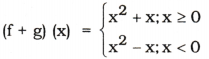
(i) f + g
Solution:
Given f(x) = x2, g(x) = |x|
(f + g)(x) = f(x) + g(x) = x2 + |x|
AP Inter 1st Year Maths Exercise 2d Solutions 5

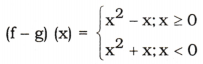
(ii) f – g
Solution:
(f – g)(x) = f(x) – g(x) = x2 – |x|
AP Inter 1st Year Maths Exercise 2d Solutions 6

(iii) f . g
Solution:
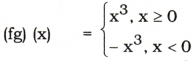
(fg) (x) = f(x) g(x) = x2 |x|
AP Inter 1st Year Maths Exercise 2d Solutions 7

(iv) 2f
Solution:
2f(x) = 2x2

(v) f + 3
Solution:
f + 3 = f(x) + 3 = x2 + 3

(vi) \(\frac{f}{g}\) (for x ≠ 0)
Solution:
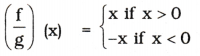
\(\left(\frac{\mathrm{f}}{\mathrm{~g}}\right)\) (x) = \(\frac{f(x)}{g(x)}=\frac{x^2}{|x|}\)
AP Inter 1st Year Maths Exercise 2d Solutions 8

Question 4.
If the function f is defined by
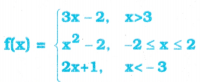
AP Inter 1st Year Maths Exercise 2d Solutions 9
then find the values if exists of f(4), f(2.5), f(-2), f{-4), f(0), f(-7), f(1), f(9).
Solution:
Given
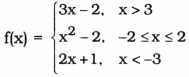
AP Inter 1st Year Maths Exercise 2d Solutions 10
f(4) =3(4) – 2 = 12 – 2 = 10,
f(2.5) = not defined,
f(-2) = 4 – 2 = 2

f(-4) = -8 + 1 = -7,
f(0) = 0 – 2 = -2,
f(-7) = -14 + 1 = -13

f(1) = 1 – 2 = -1,
f(9) = 27 – 2 = 25

AP Inter 1st Year Maths Exercise 2d Solutions

Question 5.
Determine a Quadratic function f is defined by f(x) = ax2 + bx + c, if f(0) = 6,
Solution:
Given f(x) = ax2 + bx + c … (1)
f(0) = 0 + 0 + c = 6 ⇒ c = 6
f(2) = 1 ⇒ 4a + 2b + c = 1
⇒ 4a + 2b + 6 = 1
⇒ 4a + 2b = -5 (∵ c = 6) ………(2)

f(-3) = 6 ⇒ 9a – 3b + c = c = 6
⇒ 9a – 3b = 0 ….(3)

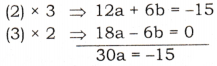
On Solving Eqn (2) & Eqn (3)
(2) × 3 ⇒ 12a + 6b = -15
(3) × 2 ⇒ 18a – 6b = 0
AP Inter 1st Year Maths Exercise 2d Solutions 11
⇒ a = \(\frac{-15}{30}=\frac{-1}{2}\)
⇒ a = \(\frac{-1}{2}\)

Substitute ‘a’ value in Eqn (3), 3b = 9a ⇒ b = 3a = 3\(\left(\frac{-1}{2}\right)=\frac{-3}{2}\)
Substitute a, b, c values in Eqn (1), then f(x) = \(\frac{-1}{2}\) x2 – \(\frac{3}{2}\) x + b

AP Inter 1st Year Maths Exercise 2c Solutions

Referring to the AP Inter 1st Year Maths Study Material Chapter 2 Relations and Functions Exercise 2c Solutions makes it easier to understand complex problems.

AP Inter 1st Year Maths Relations and Functions Solutions Exercise 2c

I.

Question 1.
Find the domain and range of the following real functions.
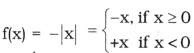
(i) f(x) = -|x|
(ii) f(x) = \(\sqrt{9-x^2}\)
Solution:
i) Given f(x) = -|x|
AP Inter 1st Year Maths Exercise 2c Solutions 1
Domain of f = R, Range of f = [-∞,0]
ii) Given f(x) = \(\sqrt{9-x^2}\)
Here 9 – x2 > 0
⇒ 32 – x2 > 0
⇒ x2 – 32 < 0
⇒ (x + 3)(x – 3) < 0 ⇒ -3 ≤ x ≤ 3 Domain = {x : – 3 ≤ x ≤ 3, ∀ x ∈ R} or [-3, 3] Range = {x : 0 ≤ x ≤ 3} or [0, 3]

Question 2.
A function f is defined by f(x) = 2x – 5. Write down the values of (i) f(0), (ii) f(7), (iii) f(-3).
Solution:
Given f(x) = 2x – 5
i) f(0) = 2(0) – 5 = -5
ii) f(7) = 2(7) -5 = 9
iii) f(-3) = 2(-3) – 5 = -11

Question 3.
Find the range of each of the following functions.
(i) f(x) = 2 – 3x, x ∈ R, x > 0.
(ii) f(x) = x2 + 2, x is a real number,
(iii) f(x) = x, x is a real number.
Solution:
i) Given f(x) = 2 – 3x; x ∈ R, x > 0 Range of f = (-∞, 2)
ii) Given f(x) = x2 + 2, x is a real number; Range of R = (2, ∞)
iii) Given f(x) = x, x is a real number; Range of f = R

AP Inter 1st Year Maths Exercise 2c Solutions

II.

Question 1.
Which of the following relations are functions? Give reasons. If it is a function, determine its domain and range.
(i) {(2, 1), (5, 1), (8, 1), (11, 1), (14, 1), (17, 1)}
(ii) {(2, 1), (4, 2), (6, 3), (8, 4), (10, 5), (12, 6), (14, 7))
(iii) {(1, 3), (1, 5), (2, 5)).
Solution:
i) It is a function because the domain of the relation corresponding to unique image.
Domain = (2, 5, 8, 11, 14, 17}; Range = {1}

ii) It is a function because the domain of the relation corresponding to unique image.
Domain = {2, 4, 6, 8, 10, 12, 14}; Range = {1, 2, 3, 4, 5, 6, 7}

iii) It is not a function because the domain of the given relation corresponding to two different images.

Question 2.
The function ‘t’ which maps temperature in degree Celsius into temperature in degree Fahrenheit is defined by t (C) = \(\frac{9 \mathrm{C}}{5}\) + 32.
Find (i) t(0) (ii) t(28) (iii) t(-10) (iv) The value of C, when t(C) = 212.
Solution:
Given, t(C) = \(\frac{9 \mathrm{C}}{5}\) + 32
i) t(0) = \(\frac{9(0)}{5}\) + 32 = 32
ii) t(28) = \(\frac{9(28)}{5}\) + 32 = \(\frac{252+160}{5}=\frac{412}{5}\)
iii) t(-10) = \(\frac{9(-10)}{5}\) + 32 = 9(-2) + 32 = 14
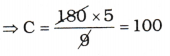
iv) If t(C) = 212 then
212 = \(\frac{9 C}{5}\) + 32
⇒ \(\frac{9 C}{5}\) = 212 – 32
⇒ \(\frac{9 C}{5}\) = 180
AP Inter 1st Year Maths Exercise 2c Solutions 2

AP Inter 1st Year Maths Exercise 2b Solutions

Referring to the AP Inter 1st Year Maths Study Material Chapter 2 Relations and Functions Exercise 2b Solutions makes it easier to understand complex problems.

AP Inter 1st Year Maths Relations and Functions Solutions Exercise 2b

I.

Question 1.
A = {1, 2, 3, 5} and B = {4, 6, 9}. Define a relation R from A to B by R = {(x, y): the difference between x and y is odd; x e A, y ∈ B}. Write R in roster form.
Solution:
Given A = {1, 2, 3, 5}, B= {4, 6, 9}
R = {(x, y): the difference between x & y is odd; x ∈ A, y ∈ B}.
Roster form of R = {(1, 4), (1, 6), (2, 9), (3, 4), (3, 6), (5, 4), (5, 6)}.

Question 2.
Determine the domain and range of the relation R defined by R = {(x, x + 5): x ∈ {0, 1, 2, 3, 4, 5}}.
Solution:
Given R = {(x, x + 5): x ∈ {0, 1, 2, 3, 4, 5}}
The roster form of R = {(0, 5), (1, 6), (2, 7), (3, 8), (4, 9), (5, 10)}
Domain of R = {0, 1, 2, 3, 4, 5}; Range of R = {5, 6, 7, 8, 9, 10}

Question 3.
Write the relation R = {(x, x3) : x is a prime number less than 10} in roster form.
Solution:
Given R = {(x, x3) ; x is a’prime number less than 10}
The prime numbers less than 10 are 2, 3, 5 & 7
∴ The roster form R = {(2, 8), (3, 27), (5, 125), (7, 343)}

Question 4.
Let A = (x, y, z) and B = (1, 2). Find the number of relations from A to B.
Solution:
Given A = {x, y, z} & B = {1, 2}
A × B = {(x, 1), (x, 2), (y, 1), (y, 2), (z, 1), (z, 2)}
n (A × B) = 6, n(B) = 2, the number of subsets of A × B is 26.
The number of relations from A to B is 26.

AP Inter 1st Year Maths Exercise 2b Solutions

Question 5.
Let R be the relation on Z defined by R = ((a,b): a, b ∈ Z, a – b is an integer). Find the domain and range of R.
Solution:
Given R = {(a, b): a, b ∈ Z, a – b is an integer}
∴ Domain of R = Z, Range of R = Z

II.

Question 1.
Let A = {1, 2, 3,…, 14}. Define a relation R from A to A by R = {(x, y) : 3x – y = 0, where x, y ∈ A). Write down its domain, codomain and range,
Solution:
A relation R from A to A is given by R = {(x, y) ; 3x – y = 0, where x, y ∈ A}
The roster form is given by R = {(1, 3), (2, 6), (3, 9), (4, 12)}
The domain of R = {1, 2, 3, 4}
The whole set A is the co-domain of the relation R.
∴ Co-domain of R = {1, 2, 3, 14}
The range of R = {3, 6, 9, 12}.

Question 2.
Define a relation R on the set N of natural numbers by R = {(x, y) : y = x + 5, x is a natural number less than 4; x, y ∈ N}. Depict this relationship using roster form. Write down the domain and the range.
Solution:
Given R = {(x, y): y = x + 5, x < 4;x, y ∈ N)
⇒ x = 1, 2, 3 R = {(1, 6), (2, 7), (3, 8)}
The domain of R = {1, 2, 3},
The range of R = {6, 7, 8}

Question 3.
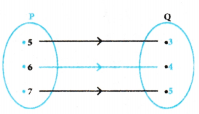
The Fig. shows a relationship between the sets P and Q. Write this relation,
i) in set-builder form ii) roster form. What is its domain and range ?
Solution:
Given P = {5, 6, 7} Q = {3, 4, 5}
i) The set builder form
R = {(x, y): y = x – 2 for x = 5, 6, 7}
AP Inter 1st Year Maths Exercise 2b Solutions 1
ii) The roster form R = {(5, 3), (6, 4), (7, 5)}
Domain of R = {5, 6, 7}
Range of R = {3, 4, 5}

Question 4.
Let A = {1, 2, 3, 4, 6}. Let R be the relation on A is defined by {(a, b): a , b ∈ A, b is exactly divisible by a}.
(i) Write R in roster form
(ii) Find the domain of R
(iii) Find the range of R.
Solution:
Given A = {1, 2, 3, 4, 6} and R = {(a, b) : a, b ∈ A, b is exactly divisible by a}
i) The roster form R = {(1, 1), (1, 2), (1, 3), (1, 4), (1, 6), (2, 2) (2, 4) (2, 6), (3, 3), (3, 6), (4, 4), (6, 6)}
ii) Domain of R = {1, 2, 3, 4, 6}
iii) Range of R = {1, 2, 3, 4, 6}

AP Inter 1st Year Maths Exercise 2a Solutions

Referring to the AP Inter 1st Year Maths Study Material Chapter 2 Relations and Functions Exercise 2a Solutions makes it easier to understand complex problems.

AP Inter 1st Year Maths Relations and Functions Solutions Exercise 2a

I.

Question 1.
If (\(\frac{x}{3}\) + 1, y – \(\frac{2}{3}\)) = \(\left(\frac{5}{3}, \frac{1}{3}\right)\), find the values of x and y.
Solution:
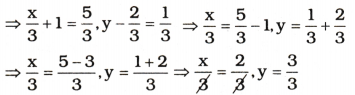
Given (\(\frac{x}{3}\) + 1, y – \(\frac{2}{3}\)) = \(\left(\frac{5}{3}, \frac{1}{3}\right)\)
AP Inter 1st Year Maths Exercise 2a Solutions 1
∴ x = 2, y = 1.

Question 2.
If the set A has 3 elements and the set B = {3, 4, 5}, then find the number of elements in (A × B),
Solution:
Given number of elements in A = 3 ⇒ n(A) = 3 ; Given B = {3, 4, 5} ⇒ n(B) = 3
Number of elements in A × B = (Number of elements in A) × (Number of elements in B)
n(A × B) = n(A) × n(B) = 3 × 3 = 9
Number of elements in (A × B) =9

Question 3.
If G = {7, 8} and H = {5, 4, 2}, find G × H and H × G.
Solution:
Given G = {7, 8}; H = {5, 4, 2}
G × H = {7, 8} × {5, 4, 2} = {(7, 5), (7, 4), (7, 2), (8, 5),(8, 4), (8, 2)}
H × G = {5, 4, 2} × {7,8} = {(5, 7), (5, 8), (4, 7), (4, 8), (2,7), (2, 8)}

Question 4.
State whether each of the following statements are true or false. If the statement is false, rewrite the given statement correctly.
i) If P = (m, n} and 9 = In, ni}, then P × g = j(m, n),(n, m)|.
ii) If A and B are two non-empty sets, then A × B is a non-empty set of ordered pairs (x, y) such that x ∈ A and y ∈ B.
iii) If A = {1, 2}, B = {3, 4}, then A × (B ∩ Φ) = Φ.
Solution:
i) False; P × Q = {m, n} ×{n,m} = {(m, n), (m, m), (n, n), (n, m)}
ii) True; Because A × B is a non-empty set of ordered pairs (x, y) such that x ∈ A and y ∈ B.
iii) True; Because B ∩ Φ = Φ ⇒ A × (B ∩ Φ ) = A × Φ = Φ.

Question 5.
If A = (-1, 1), find A × A × A.
Solution:
Given A = {-1, 1}
A × A = {-1, 1} × {-1, 1} = {(-1, -1), (-1, 1), (1, -1), (1, 1)}
A × A × A = {(-1,-1), (-1, 1), (1, -1), (1, 1)} × {-1,1}
= {(-1, -1, -1), (-1, -1, 1), (-1, 1, -1), (-1, 1, 1), (1, -1, -1), (1,-1,1) (1,1-1), (1, 1, 1)}

Question 6.
If A × B = {(a, x),(a , y), (b, x), (b, y)}. Find A and B.
Solution:
Given A x B = {(a, x), (a, y), (b, x), (b, y)}
A = set of first elements of A × B = {a, b};
B = set of second elements of A × B = {x, y}.

Question 7.
Let A = {1, 2) and B = {3, 4). Write A × B. How many subsets will A × B have? List them.
Solution:
Given A = {(1, 2), B = {3, 4} ; A × B = {(1, 3), (1, 4), (2, 3), (2, 4)} ⇒ n (A × B) = 4
The number of subsets of A × B = 24 = 16
Subsets of A × B = { }, {(1, 3)}, {(1,4)}, {(2, 3)}, {(2, 4)}
{(1,3), (1, 4)}, {(1, 3), (2, 3)}, {(1, 3), (2, 4)}, {(1, 4), (2, 3)}
{(1, 4), (2, 4)}, {(2, 3), (2, 4)}, {(1, 3), (1, 4), (2, 3)}
{(1, 3), (1, 4), (2, 4)}, {(1, 3), (2, 3), (2, 4)}, {(1, 4), (2,3), (2, 4)}, {(1, 3), (1, 4), (2, 3), (2, 4)}.

AP Inter 1st Year Maths Exercise 2a Solutions

Question 8.
Let A and B be two sets such that n(A) = 3 and n(B) = 2. If (x, 1), (y, 2), (z, 1) are in A × B, find A and B, where x, y and z are distinct elements.
Solution:
Given A & B are 2 sets such that n(A) = 3 & n(B) = 2
Given (x, 1), (y, 2), (z, 1) lies in A × B
⇒ A = {x, y, z}, B = {1, 2}

Question 9.
The Cartesian product A × A has 9 elements among which are found (-1, 0) and (0,1). Find the set A and the remaining elements of A × A.
Solution:
Given (-1, 0) and (0, 1) are in the cartesian product of A × A having 9 elements.
∴ n(A × A) = 9 ⇒ n(A) × n(A) = 9 ⇒ n(A) = 3.
∴ A = {-1, 0, 1}
A × A = {-1, 0, 1} × {-1, 0, 1} = {(-1, -1), (-1, 0), (-1, 1), (0, -1), (0, 0), (0, 1), (1, -1), (1, 0), (1, 1)}

II.

Question 1.
Let A = (1, 2), B = (1, 2, 3, 4), C = (5, 6| and D = (5, 6, 7, 8). Verify that
(i) A × (B ∩ C) – (A × B) ∩ (A × C).
(ii) A × C is a subset of B × D.
Solution:
Given A = {1, 2}, B = {1, 2, 3, 4}, C = {5, 6} 8s D = {5, 6, 7, 8}
i) B ∩ C = {1, 2, 3, 4} ∩ {5, 6} = { }
A × (B ∩ C)= A × Φ = Φ
A × B = {(1, 1), (1, 2), (1, 3), (1, 4), (2, 1), (2, 2), (2, 3), (2, 4)}
A × C = {(1, 5), (1, 6), (2, 5) (2, 6)}
(A × B) ∩ (A × C) = Φ
∴ A × (B ∩ C) = Φ
(A × B) ∩ (A ∩ C) = Φ
∴ A × (B ∩ C) = (A × B) ∩ (A × C)

ii) A × C = {1, 2} × {5, 6} = {(1, 5), (1, 6), (2, 5) (2, 6)}
B × D = {1, 2, 3, 4} × {5, 6, 7, 8} = {(1, 5), (1, 6), (1, 7), (1, 8), (2, 5), (2, 6), (2, 7), (2, 8), (3, 5), (3, 6) (3, 7), (3, 8), (4, 5), (4, 6), (4, 7), (4, 8)}
A × C a is subset of B × D

Sets MCQ AP Inter 1st Year Maths Chapter 1

Practice AP Inter 1st Year Maths Study Material Chapter 1 Sets MCQ to identify your strengths and weak areas.

AP Inter 1st Year Maths Sets MCQ

Question 1.
List of elements of the set {x : x is an integer, x3 ≤ 50}
1) {2, 3, 4}
2) {1, 3, 4}
3) {1, 2, 3}
4) {1, 2, 4}
Solution:
We look integer x such that x3 ≤ 50
Cube of integers : 13 = 1, 23 = 8, 33 = 27, 43 = 64 (exceeds 50).
So the integers are : x = 1, 2, 3.

Question 2.
Set-builder form of {1, 2, 3, 4} is
1) {x : x is a positive integer, x2 < 30}.
2) {x : x is a positive integer, x2 + 1 < 20}.
3) {x : x is a positive integer, x2 – 1 < 15}.
4) {x : x is a positive integer, 2x < 20}.
Try each :
1) x2 < 30 : includes more than {1, 2, 3, 4}.
2) x2 + 1 < 20 : x < 4 works, lets check : 1 → 2, 2 → 5, 3 → 10, 4 → 17.
3) x2 – 1 < 15: 1 → 0, 2 3, 3 → 8, 4 → 15 but it includes more value like 5.
4) 2x < 20 : includes more values.

Question 3.
Which of the following statement is true ?
1) {a, b} ⊂ {x : x is a vowel in the English alphabet}
2) {1, 2, 3, 4} ⊂ {1, 2, 3}
3) {5} ∈ {4, 5, 6}
4) {2, 3) ∈ {1, {2, 3}, 4, 5}
Solution:
1) X “b” is not a vowel
2) X false
3) X because {5} ∈ {4, 5, 6} but {5} is not an element
4) ✓ true.

Sets MCQ AP Inter 1st Year Maths Chapter 1

Question 4.
The set builder form of interval [-4, 5) is
1) {x : x is an integer -4 < x < 5}
2) {x : x is an integer -4 < x < 5}
3) {x : x is an integer -4 < x < 5}
4) {x : x is an integer -4 < x < 5}
Solution:
Set builder form of interval [- 4, 5)
We need : integers x such that – 4 < x < 5.

Question 5.
A = (1, 2, 3, 4, 5), B = (4, 5, 6, 7, 8), then (A – B) ∪ (B – A)
1) {1, 2, 3, 4, 5, 6, 7, 8}
2) {1, 2, 3, 6, 7, 8}
3) {1, 2, 4, 5, 6}
4) {2, 4, 6, 8}
Solution:
A – B = {1, 2, 3}; B – A = {6, 7, 8}; (A – B) ∪ (B – A) = {1, 2, 3, 6, 7, 8}.

Question 6.
If A = (1, 2, 3, 4}, B = {2, 3, 4}, C = {3, 4, 5, 6} then A ∩ (B ∪ C)
1) {2, 3, 4}
2) {1, 2, 3, 4}
3) {3, 4, 5, 6}
4) {1, 6}
Solution:
B ∪ C = {2, 3, 4, 5, 6}; A ∩ (B ∪ C) = {2, 3, 4}.

Question 7.
Which of the following is false ?
1) (A’)’ = A
2) A ∪ A’ = Φ
3) (A ∪ B)’ = A’ ∩ B’
4) Φ = U (U is universal set)
Solution:
1) (A’)’ = A – True (law of double complement)
2) A ∪ A’ = Φ – False, should be universal set.
3) (A ∪ B)’ = A’ ∩ B’- True (De Morgan’s law)
4) f = U – True

Question 8.
If U = (1, 2, 3, 4, 5) and A = (2, 3), then Φ’ ∩ A =
1) Φ
2) U
3) A
4) {1, 4, 5}
Solution:
Φ = U, so Φ ‘ ∩ A = U ∩ A = A.

Question 9.
U = {x : x is a natural number 1 < x < 15} and A = 1 < x < 15) then A’ = ____________
1) {2, 3, 5, 7, 11, 13}
2) {4, 6, 8, 9, 10, 12, 14}
3) {2, 3, 4, 5, 7, 11, 13}
4) {2, 4, 6, 8, 10, 12, 14}
Solution:
Given : U = {x : x is a natural number and 1 < x < 15}
U = {2, 3, 4, 5, 6, 7, 8, 9, 10, 11, 12, 13, 14}
A = {x : x is a prime number and 1 < x < 15}
A = {2, 3, 5, 7, 11, 13}
So, A’ = U – A = {4, 6, 8, 9, 10, 12, 14}.

Sets MCQ AP Inter 1st Year Maths Chapter 1

Question 10.
Which of the following is not a subset of (a, b, c, d} ?
1) Φ
2) {a, b}
3) {d, e}
4) {b, d}
Solution:
Let’s analyse :
1) Φ – ✓ Always a subset of any set.
2) {a, b} – ✓ All elements are present in the set.
3) {d, e} – X “e” is not in {a, b, c, d}.
4) {b, d} – ✓ Both elements are present in the set.
∴ {d, e} is not a subset.