
Referring to the AP Inter 1st Year Maths Study Material Chapter 13 Statistics Exercise 13b Solutions makes it easier to understand complex problems.
AP Inter 1st Year Maths Statistics Solutions Exercise 13b
I.
Question 1.
Find the mean and variance for each of the following data.
a) 6, 7, 10, 12, 13, 4, 8, 12.
b) First ‘n’ natural numbers,
c) First 10 multiples of 3.
Solution:
a) Given observations : 6, 7, 10, 12, 13, 4, 8, 12.
Mean, x̄ = \(\frac{\sum_{i=1}^8 x_i}{n}=\frac{6+7+10+12+13+4+8+12}{8}=\frac{72}{8}\) = 9
The following table is obtained for the given data.
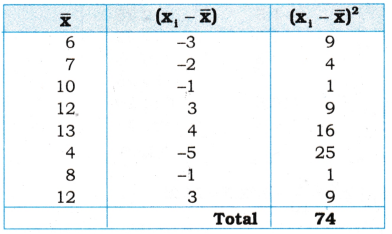
Variance (σ2) = \(\frac{1}{n} \sum_{i=1}^n\) (xi – x̄)2
= \(\frac{1}{8}\) × 74
= 9.25
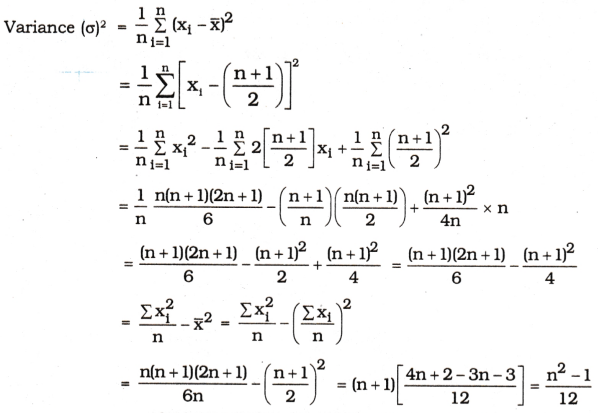
b) The mean of first ‘n’ natural numbers is calculated as follows.
Mean = \(\frac{\text { Sum of all observations }}{\text { No. of observations }}=\frac{n\left(\frac{n+1}{2}\right)}{n}=\frac{n(n+1)}{2 n}=\frac{n+1}{2}\)
c) The first 10 multiples of ‘3’ are 3, 6, 9, 12, 15, 18, 21, 24, 27, 30.
Here, number of observations, n = 10
Mean, x̄ = \(\frac{\sum_{i=1}^{10} x_i}{10}=\frac{165}{10}\) = 16.5
The following table is obtained for the given data.
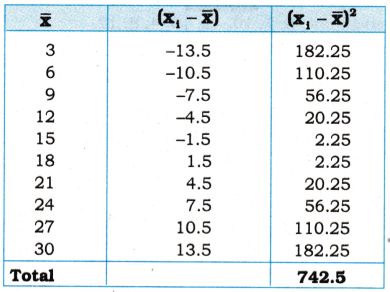
Variance (σ2) = \(\frac{1}{\mathrm{n}} \sum_{\mathrm{i}=1}^{10}\)(xi – x̄)2
= \(\frac{1}{10}\) × 742.5
= 74.25
II.
Question 1.
Find the mean and variance for each of the following data.

Solution:
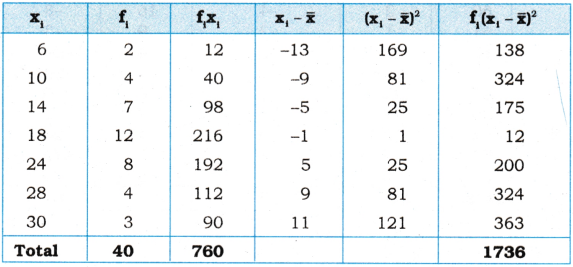
Here, N = 40, \(\sum_{i=1}^7\)fixi = 760
x̄ = \(\frac{\sum_{i=1}^7 f_i x_i}{N}=\frac{760}{40}\) = 19
Variance (σ2) = \(\frac{1}{N} \sum_{i=1}^7\) fi(xi – x̄)2 = \(\frac{1}{40}\) × 1736
= 43.4

Solution:
The data id obtained in tabular form as follows.
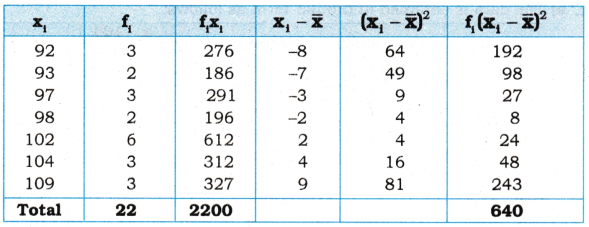
Here, N = 22, \(\frac{1}{2}\)fixi = 2200
∴ x̄ = \(=\frac{1}{N} \sum_{i=1}^7\)fixi
Variance (σ2) = \(\frac{1}{N} \sum_{i=1}^7\) fi(xi – x̄)2 = \(\frac{1}{22}\) × 640 = 29.09

Question 2.
Find the mean and standard deviation using short-cut method.

Solution:
The data is obtained in tabular form as follows:
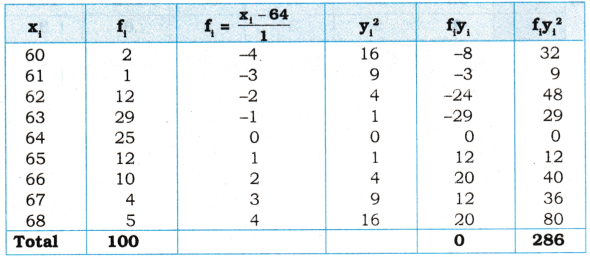
Mean x̄ = A + \(\frac{\sum_{i=1}^9 f_i y_i}{N}\) × h
= 64 + \(\frac{0}{100}\) × 1
= 64 + 0
= 64
Variance (σ2) = \(\frac{h^2}{N^2}\left[N \sum_{i=1}^9 f_i y_i^2-\left(\sum_{i=1}^9 f_i y_i\right)^2\right]\)
= \(\frac{1}{100^2}\)[100 × 286 – 0]
= 2.86
∴ Standard deviation (σ) = \(\sqrt{2.86}\) = 1.69
III.
Question 1.
Find the mean and variance for the following frequency distribution.

Solution:
The data is obtained in tabular form as follows:
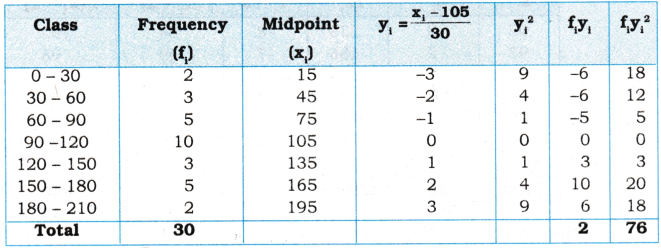
Mean, x̄ = A + \(\frac{\sum_{i=1}^9 f_i y_i}{N}\) × h
= 105 + \(\frac{2}{30}\) × 30
= 105 + 2
= 107
Variance (σ2) = \(\frac{h^2}{N^2}\left[N \sum_{i=1}^9 f_i y_i^2-\left(\sum_{i=1}^9 f_i y_i\right)^2\right]\)
= \(\frac{(30)^2}{(30)^2}\)[30 × 76 – (2)2]
= 2280 – 4
= 2276

Solution:
The data is obtained in tabular form as follows:
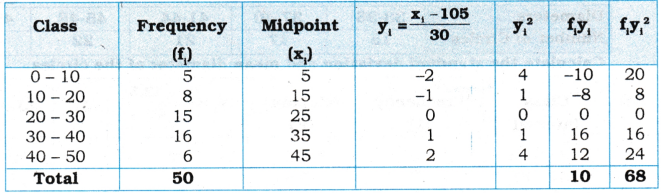
Mean, x̄ = A + \(\frac{\sum_{i=1}^9 f_i y_i}{N}\) × h
= 25 + \(\frac{10}{50}\) × 10
= 25 + 2 = 27
Variance (σ2) = \(\frac{h^2}{N^2}\left[N \sum_{i=1}^9 f_i y_i^2-\left(\sum_{i=1}^9 f_i y_i\right)^2\right]\)
= \(\frac{1}{2}\)[50 × 68 – (10)2]
= \(\frac{1}{25}\)[3400 – 100]
= \(\frac{3300}{25}\) = 132
Question 2.
Find the mean, variance and standard deviation using short-cut method.

Solution:
The data is obtained in tabular form as follows:
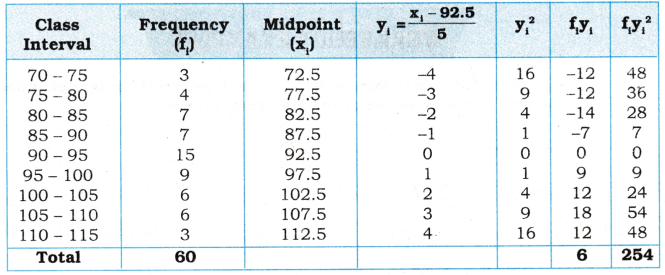
Mean, x̄ = A + \(\frac{\sum_{i=1}^9 f_i y_i}{N}\) × h
= 92.5 + \(\frac{6}{60}\) × 5
= 92.5 + 0.5
= 93
Variance (σ2) = \(\frac{h^2}{N^2}\left[N \sum_{i=1}^9 f_i y_i^2-\left(\sum_{i=1}^9 f_i y_i\right)^2\right]\)
= \(\frac{(5)^2}{(60)^2}\)[60 × 254 – (6)2]
= \(\frac{25}{3600}\)[15240 – 36]
= \(\frac{25}{3600}\)(15204)
= 105.58
∴ Standard deviation (σ) = \(\sqrt{105.58}\) = 10.27
Question 3.
The diameters of circles (in mm) drawn in a design are given below.

Calculate the standard deviation and mean diameter of the circles.
Solution:
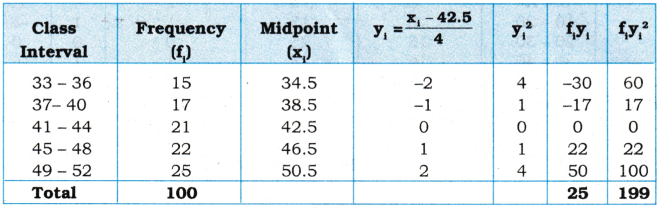
Here, N = 100, h = 4. Let the assumed mean A, be 42.5
Mean, x̄ = A + \(\frac{\sum_{i=1}^9 f_i y_i}{N}\) × h
= 42.5 + \(\frac{25}{100}\) × 4
= 43.5
Variance (σ2) = \(\frac{h^2}{N^2}\left[N \sum_{i=1}^9 f_i y_i^2-\left(\sum_{i=1}^9 f_i y_i\right)^2\right]\)
= \(\frac{16}{10000}\) [100 × 199 – (25)2]
= \(\frac{16}{10000}\) [19900 – 625]
= \(\frac{16}{10000}\) × 19275
= 30.84
∴ Standard deviation (σ) = 5.55