Telangana TSBIE TS Inter 1st Year Chemistry Study Material 3rd Lesson Chemical Bonding and Molecular Structure Textbook Questions and Answers.
TS Inter 1st Year Chemistry Study Material 3rd Lesson Chemical Bonding and Molecular Structure
Very Short Answer Type Questions
Question 1.
What is octet rule?
Answer:
Atoms having octet (8 electrons) in their valence shell e.g.inert gases (except He) are stable. Atoms which do not have octet in their valence, shell will try to get octet either by losing op by gaining or by sharing electrons to acquire stability. This is known as octet rule.
Question 2.
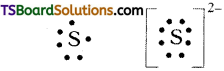
Write Lewis dot structures for S and S2-.
Answer:
Lewis dot structures of S and S2-
Question 3.
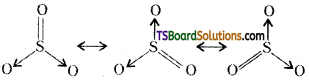
Write the possible resonance structures for SO3.
Answer:
Question 4.
Predict the change, if any, in hybridization of Al atom in the following reaction AlCl3 + Cl– → AlCl–4.
Answer:
1) AlCl3 is mostly covalent.
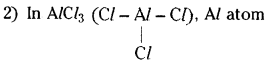
undergoes sp² hybridisation. The molecule is trigonal planar. It has 3 bond pair of electrons and no lone pair of electrons.
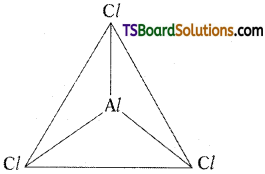
3) In AlCl3, the central atom of Al has vacant p – orbitals. So it can accept a lone pair of electrons from Cl– ion and form the complex AlCl–4 ion.
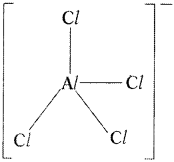
∴ Al(sp²) Cl³ → Al(sp³) Cl–
AlCl–4 has tetrahedral structure. Al atom undergoes sp³ hybridisation. There are 4 bond pair of electrons and no lone pair of electrons in AlCl–4 ion.

Question 5.
Which of the two ions Ca2+ or Zn2+ is more stable and why?
Answer:
Ca2+ ion is more stable than Zn2+ ion.
Reason :
An ion with ‘inert gas configuration’ is more stable than an ion with ‘pseudo inert gas configuration’.
Ca2+ (2,8,8) has inert gas configuration i.e., electronoctet’ in the valence shell.
Zn2+ (2, 8, 18) has 18 electrons in the outermost energy level. It has pseudo inert gas configuration.
Question 6.
Cl– ion is more stable than Cl atom – Why?
Answer:
An atom or ion with inert gas configuration (ns²np6) is comparatively more stable.
Cl(Z) = 17 1s²2s²2p63s²3p5
Cl– 1s² 2s² 2p6 3s²3p6
So Cl– is more stable than Cl.
Question 7.
Why argon does not form Ar2 molecule?
Answer:
Electronic configuration of 18Ar is 1s² 2s² 2p6 3s² 3p6.
Since the atoms of argon contain eight electrons in their valence shell they are stable and do not participate in bonding. So Argon do not form Ar., molecules.
Question 8.
What is the best possible arrangement of four bond pairs in the valence shell of an atom to minimise repulsions?
Answer:
In order to have minimum repulsions between the four bond pairs present in the valence shell of an atom the best possible arrangement is tetrahedron with bond angle 109° 28′.
Question 9.
If A and B are two different atoms, when does AB molecule become covalent?
Answer:
In order to form a covalent bond in between the atoms A & B.
- The electronegativity difference between them should be less than 1.9.
- A & B should share one or more electron pairs mutually.
Question 10.
What is meant by localized orbitals?
Answer:
The orbitals which are concentrated between the two nuclei of bonded atoms are called localised orbitals.
Question 11.
How many Sigma and Pi bonds are present in (a) C2H2 and (b) C2H4? [AP ’15]
Answer:
a) The structure of C2 H2 is
H – C ≡ C – H
C2 H2 contain 3 sigma and 2 pi bonds,
b) The structure of C2H4 is
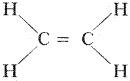
C2H4 contain 5 sigma and one pi bonds.
Question 12.
Is there any change in the hybridization of Boron and Nitrogen atoms as a result of the following reaction?
BF3 + NH3 → F3BNH3
Answer:
Formation of Ammonia – Boron trifluoride:
In NH3 molecule, the central ‘N’ atom contains a lone pair of electrons in one of its sp³ hybrid orbitals. Before reaction with NH3, the central boron atom of BF3 will be in its sp² hybridised state while reacting with NH3, in order to accept the lone pair of electrons from N atom of NH3, the central ‘B’ atom of BF3 changes its hybridisation from sp² to sp³. But, there will be no change in the hybridised state of N atom of NH3.
Short Answer Questions
Question 1.
Explain Kossel – Lewis approach to Chemical bonding.
Answer:
Lewis considered the atom in terms of a positively charged ‘Kernel’. Kernel contains inner electrons and the nucleus. Lewis assumed that the outer shell can accommodate a maximum of eight electrons which occupy the eight corners of a cube surrounding the Kernel. He assumed this type of arrangement in noble gases and hence they are stable. The atoms which do not have this type of arrangement achieve the stable octet by combining with other atoms by sharing of electrons forming a covalent bond.
Kossel proposed that the highly electronegative elements like halogens gain electrons and convert into anions. The highly electropositive alkali metals lose electrons and convert into positive ions. During their conversion into ions they get the noble gas configuration, i.e., octet and thus get stability. Now the positive and negative ions unite together by electrostatic attraction between them.
Thus Lewis proposed the covalent bond formation and Kossel proposed the ionic bond formation.
Question 2.
Write the general properties of Ionic Compounds.
Answer:
Properties of Ionic compounds:
- In general Ionic compounds are solids.
- They possess high melting and boiling points.
- Ionic compounds are soluble in polar solvents like water but insoluble in or-ganic solvents like benzene, chloroform, carbon tetrachloride, etc.
- Ionic compounds in solid state, are bad conductors of electricity, due to absence of free ions.
- In fused state or in their aqueous solu-tions, free ions are present. Then, they are good conductors of electricity.
- Reactions between ionic compounds are very fast.
- They do not exhibit isomerism because, ionic bond is non-directional.
Question 3.
State Fajan’s rules, and give suitable examples. [AP Mar. ’19; AP ’16 ’15]
Answer:
Fajan’s rules are applied to predict the nature of bond in a molecule.
Fajan’s rules:
1) As the size of cation increases, the ionic nature of the bond increases.
Ex: The ionic nature among alkali metal ions follows the order : Ll+ < Na+ < K+ < Rb+ < Cs+
2) Ionic bond is favoured with a small anion.
Ex : Out of CaF2 and Cal2, CaF2 is more ionic, as the size of F– ion is smaller than that of l– ion. size : F– < I–.
3) Smaller charges on cation or anion or both the ions, favours the formation of ionic bond.
Ex: NaCl is more ionic than AlCl3 as the charge on Na (Na+) is less than that on Al (Al+3).
4) Cations with inert gas configuration form ionic bonds, while cations with pseudo inert gas configuration favour covalent bond formation.
Ex : NaCl is ionic, since Na+ (2, 8, 8) has inert gas configuration.
CuCl is more covalent, since Cu+ (2, 8, 8) has pseudo inert gas configuration.
Question 4.
What is Octet rule? Briefly explain its significance and limitations.
Answer:
Octet Rule :
In order to attain stability, “Atoms show tendency to have 8 electrons in their outermost shell”.
Significance of octet rule :
It provides an explanation to the question, ‘why do atoms combine?’. It also explains why some atoms are chemically inert. It is able to explain, the cause of formation of different types of bonds, ionic and covalent. The main points of the octet theory are :
- Atoms with 8 electrons in the outermost shell (2 for He) are chemically stable. So they do not take part in chemical reactions.
- An atom with less than 8 electrons in outermost shell is reactive and so combines with other atoms. Atoms with less than 4 electrons in the outermost shell tend to lose them, while those having more than
- Atoms enter into chemical reactions either by losing, by gaining or by sharing electrons in the outermost shell tend to gain the electrons, so that they get the nearest inert gas configuration.
- In this process of bond formation, every atom tries to acquire 8 electrons in its outermost shell.
- The chemical reactivity of an atom is measured by its tendency to lose, gain or share electrons.
Limitations:
- Octet rule couldn’t explain the shape of molecule.
- Octet rule is not satisfied for molecules having odd number of electrons.
Ex: No. - It could not explain the stability of molecules in which central atom has less or more than 8 electrons.
Ex : In BeCl2, Be has 4 electrons in its valence shell.
Question 5.
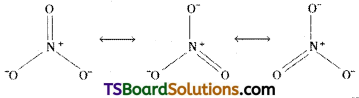
Write the resonance structures for NO2 and NO–3.
Answer:
Resonance structures of NO2.
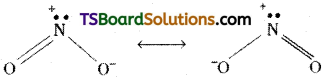
Resonance structures of NO–3.
Question 6.
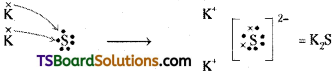
Use Lewis symbols to show electron transfer between the following pairs of atoms to form cations and anions : (a) K and S (b) Ca and O (c) Al and N.
Answer:
a) Electronic configurations of K and S
19K = 1s² 2s² 2p6 3s² 3p6 4s¹
16S = 1s² 2s² 2p6 3s² 3p4
Lewis symbols for K, S and their ions.
b) Electronic configurations of Ca and O
20Ca = 1s² 2s² 2p6 3s² 3p6 4s²
8O = 1s² 2s² 2p4
Lewis symbols of Ca, O and their ions.

c) Electronic configuration of A1 and N
13Al = 1s² 2s² 2p6 3s² 3p¹
7N = 1s² 2s² 2p³
Lewis symbols of Al, N and their ions.

Question 7.
Explain why H2O has dipolemoment while CO2 does not have.
Answer:
Dipolemoment of a polyatomic molecule is a vector quantity.
H2O molecule has angular structure with two
O – H bonds, oriented at an angle of 104.5°.
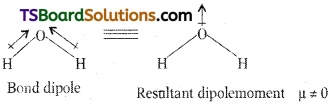
So the dipolemoment of the water molecule is the resultant of the dipolemoments of two O – H bonds.
The dipolemoment in the case of CO2 is zero. This is because the two equal bond dipoles point in opposite directions and cancel the effect on each other.

Question 8.
Define Dipolemoment. Write its application [AP Mar. ’17]
Answer:
Dipolemoment is the product of the magnitude of the charge and the distance between the centres of positive and negative charges. It is designated by µ.
Dipolemoment (µ) = Charge (Q) × distance (r) between the charges.
Units of dipolemoment are Debye units (D)
Applications:
1. Dipolemoment is useful in calculating the percent ionic character of polar covalent bonds.

2. Dipolemoment is useful in predicting the shapes of molecules, e.g.,
- In the case of AX2 type molecule if dipolemoment is zero they have linear structure but if they have some dipolemoment they are angular.
- AX3 type molecules with dipolemoment zero are planar triangular in shape but if they have some dipolemoment they have pyramidal shape.
- AX4 type molecules with dipolemoment zero have symmetric tetrahedral structure but if they have some dipolemoment they have distorted tetrahedral shape.
- In geometrical isomers trans isomers have zero dipolemoment. While cis isomers have some dipole-moment.
3. It is useful to predict the polarity of molecule.
- Molecular with dipolemoment is greater than zero are polar.
- Molecular with dipolemoment is equal to zero are non polar.
Question 9.
Explain why BeF2, molecule has zero dipolemoment although the Be-F bonds are polar.
Answer:
In BeF2 molecule the Be-F bonds have dipolemoment due to the difference in the electronegativities of beryllium and fluorine.

But in polyatomic molecules the dipolemoment of a molecule is the vector sum of the dipolemoments of various bonds.
In the case of BeF2 the dipolemoment becomes zero because the two equal bond dipoles point in opposite direction and cancel the effect each other.

Question 10.
Explain the structure of CH4 molecule.
Answer:
CH4 (Methane):
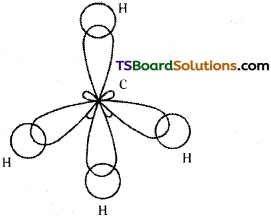
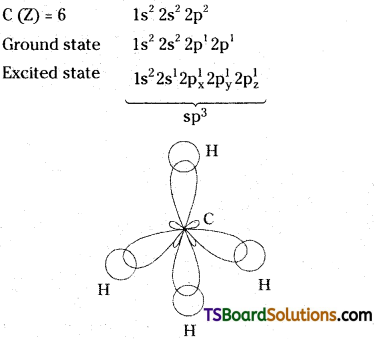
In the formation of methane molecule, the central carbon atom undergoes sp³ hybridisation in its excited state 1s²2s¹ 2p¹x, 2p¹y, 2p¹z. As a result of which four sp³ hybrid orbitals will form on it. All of them contain an electron, each. Now, these four hybrid orbitals overlap Head – Head with Is orbitals of four hydrogen atoms forming CH4 molecule. The structure of the molecule is tetrahedral. The bond angle is 109°28′. Since there are no lone pairs, there is no distortion in the shape of the molecule.
Question 11.
Explain Polar Covalent bond with a suitable example.
Answer:
When a covalent bond is formed between two similar atoms, for example in H2, O2 Cl2, N2 or F2 the shared pair of electrons is equally attracted by the two atoms. So the shared electron pair is situated exactly between the two identical nuclei. The bond so formed is non-polar covalent bond.
If a bond is formed between atoms of different elements to form heteronuclear molecule like HF the shared electron pair between the two atoms gets displaced more towards fluorine since the electronegativity of fluorine is more than that of hydrogen. As a result partial negative charge develops on fluorine atom while an equal amount of partial positive charge develops on hydrogen atom.
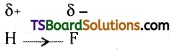
The resultant covalent bond becomes polar covalent bond. The direction of the displacement of electron is represented with an arrow mark on the bond.
Question 12.
Explain the shape and bond angle in BC13 molecule in terms of Valence Bond Theory.
Answer:
In BCl3 the central atom is boron. Its atomic number is 5. Therefore its ground state electron configuration is 1s²2s² 2p¹x 2p°y 2p°z.
From this configuration, it is evident that it exhibits monovalency. The first excited state configuration of B is 1s²2s² 2p¹x 2p¹y 2p°z. Since, there are two half-filled orbitals, the valency of Boron is 3.
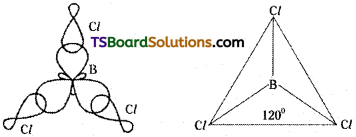
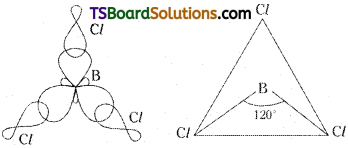
In order to explain the formation of BCl3 molecule sp² hybridisation is to be assumed to boron atom in its excited state I. As a result of which three sp² hybrid orbitals will form on it. Now, the three sp² hybrid orbitals of B’ atom overlap Head – Head with 3pz orbitals of three Cl atoms forming three sigma bonds. The shape of the molecule is plane triangular and the bond angle is 120°.
Question 13.
What are a and π bonds? Specify the differences between them.
Answer:
Sigma Bond :
A covalent bond formed by end-end overlap of orbitals is called sigma covalent bond.
Pi Bond :
A covalent bond formed by lateral overlap of orbitals is called pi covalent bond.
| Sigma bond (σ) | pi bond (π) |
| 1) A σ bond is formed by the axial overlap of two half-filled orbitals belonging to the valence shells of the two combining atoms. | 1) A π bond is formed by the lateral overlap of orbitals. |
| 2) The σ bonding electron cloud is symmetric about the internuclear axis. | 2) The π bonding electron cloud lies above and below the plane of the internuclear axis. |
| 3) It is a strong bond since the extent of overlap is much. | 3) It is weaker than σ bond, since the extent of overlap is less. |
| 4) It allows free rotation of atoms or groups about the bond. | 4) π bond restricts such free rotation. |
| 5) It can exist independently. | 5) It is formed only after a σ bond is formed. |
| 6) It determines the shape of the molecule. | 6) The shape of the molecule is independent of such bond. |
Question 14.
Even though nitrogen in ammonia is in sp³ hybridization, the bond angle deviate from 109°28. Explain.
Answer:
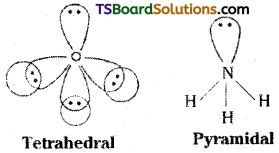
In NH3 molecule, three sp³ hybrid orbitals contain bond pairs and one sp³ hybrid orbital contains a lone pair of electrons. There will be repulsions between the lone pair and bond pair electrons. These are stronger than bp – bp repulsions, (l.p – b.p > b.p – b.p). So the bond pairs are pushed closer together. Hence the bond angle decreases from tetrahedral angle. The molecule as-sumes a pyramidal shape.
Question 15.
Show how a double and triple bond are formed between carbon atoms in
(a) C2 H4 and (b) C2 H2 respectively.
Answer:
a) C2H4 (Ethylene) :
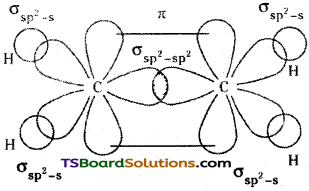
In the formation of ethylene molecule, the two carbon atoms will undergo sp² hybridisation in their excited states. As a result of which sp² hybrid orbitals will form on each of them. All the six hybrid orbitals contain an electron, each. At first, one sp² hybrid orbital of each carbon atom overlap Head-Head forming one sigma bond in between them. Now, the remaining four sp² hybrid orbitals overlap Head-Head with Is’ orbitals of four H’ atoms forming four sigma bonds. Now, the unhybridised pure 2pz orbitals of each carbon atom overlap side-wise forming π bond in between them. Thus a double bond is formed in between the two carbon atoms.
In total there are five sigma bonds and one pi bond in ethylene molecule. The molecule as a whole is planar.
b) 2H2 (Acetylene) :
In the formation of acetylene molecule, the two carbon atoms undergo sp hybridisation in their excited states (1s² 2s¹ 2p¹x, 2p¹y, 2p¹z). As a result of which two sp hybrid orbitals form on each of them. All of them contain an electron, each. One sp hybrid orbital of each carbon atom overlaps Head – Head forming a sigma bond in-between them.
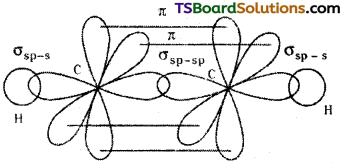
Now, the remaining two ‘sp’ hybrid orbitals overlap Head – Head with ‘Is’ orbitals of two H – atoms forming two sigma bonds. Now’, the unhybridised, pure 2py and 2pz orbitals of each carbon atom overlap side – wise forming tw’o pi bonds in-between them.
Thus, a triple bond is formed between the two carbon atoms. In total there are three sigma bonds and two pi bonds in acetylene molecule. The bond angle is 180°. The molecule is linear.
Question 16.
Explain the hybridization involved in PCl5 molecule. [TS ’16, ’15; Mar. ’11; Mar. ’18 (TS)]
Answer:
In the formation of PCl5 molecule the central phosphorus atom undergoes sp³d hybridisation.
Ex: Formation of PCl5 molecule
Atomic number of (P) = 15
∴ Ground state electron configuration
= 1s²2s²2p63s²3p³
Excited state configuration
= 1s²2s²2p63s¹3p¹x 3p¹y 3p¹z 3d¹
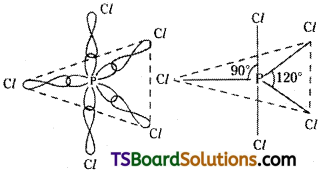
In the formation of PCl5 molecule the central ‘P’ atom undergoes sp³d hybridization in its excited state. As a result of which five sp d hybrid orbitals will form on it. All the five hybrid orbitals contain an electron, each. Now, the five sp³d hybrid orbitals overlap Head-Head with half-filled 3pz orbitals of five chlorine atoms forming five sigma bonds. The shape of the molecule is trigonal bipyramidal with bond angles 120° and 90°.
Question 17.
Explain the hybridization involved in SF6 molecule. [TS, AP Mar. 19; (IPE 14, 10)
Answer:
In the formation of SF6 molecule the central ‘S’ atom undergoes sp³ d² hybridization.
Ex : Formation of SF6 molecule :
Atomic number of Sulphur =16
∴ Ground state configuration of ‘S’
= 1s²2s²2p63s²3p4
Excited state I configuration
= 1s²2s²2p63s² 3p¹x 3p¹x 3p¹x 3d¹
Excited state II configuration
= 1s²2s²2p63s¹3p¹x 3p¹y 3p¹z 3dx²-y² 3dz²
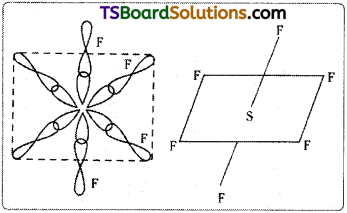
In the formation of SF6 molecule, the central ‘S’ atom undergoes sp³d² hybridization in its excited state II configuration. As a result of which six hybrid orbitals form on it. All of them contain an electron, each. Now all these six hybrid orbits overlap Head-Head with half-filled 2pz orbitals of six ‘F’ atoms forming six o bonds. The shape of the molecule is octahedral with a bond angle of 90° and 180°.
Question 18.
Explain the formation of Coordinate Covalent bond with one example. [AP ’16; Mar. ’13, ’11]
Answer:
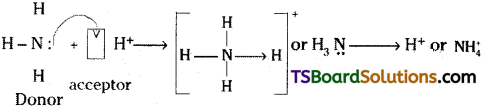
Co-ordinate covalent bond is a special type of covalent bond and in which the shared pair of electrons are contributed by only one of the bonded atoms. This bond is represented by an arrow mark (“→”), pointing towards the acceptor atom. The atom which contributes electron pair for sharing is called donor atom and the atom which accepts the electron pair is called acceptor.
In order to form a co-ordinate bond between two atoms, one of the atoms should possess lone pair of electrons and the other atom should possess empty orbital.
Ex : Formation of Ammonium ion (NH+4): Ammonium ion is formed by the union of NH3 molecule with H+ ion. In NH3 molecule the central ‘N’ atom has one lone pair of electrons and H+ ion has empty orbital. Hence, N- atom of NH3 molecule donates its lone pair to the empty orbital of H+ ion, forming a co-ordinate covalent bond between them.
Question 19.
Which hybrid orbitals are used by Carbon atoms in the following molecules?
(a) CH3 – CH3
(b) CH3 – CH = CH2
(c) CH3 – CH2 – OH
(d) CH3 – CHO
Answer:
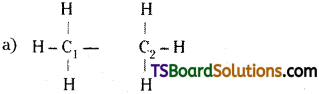
In CH3 – CH3 both C1 and C2 atoms are involved in sp³ hybridisation.
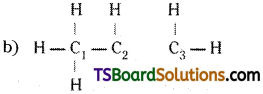
In CH3 – CH = CH2 the C1 atom is involved in sp³ hybridisation. C2 and C3 atoms afe involved in sp² hybridisation.
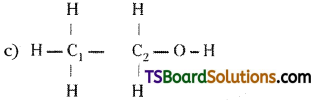
In CH3 – CH2 – OH both C1 and C2 atoms are involved in sp³ hybridisation.
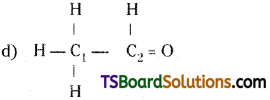
In CH3 – CHO C1 atom is involved in sp³ hybridisation and C2 atom is involved in sp² hybridisation.
Question 20.
What is Hydrogen bond? Explain the different types of Hydrogen bonds with example. [AP ’17, ’16, ’15; TS ’16; Mar. ’18 (AP & TS)]
Answer:
The concept of H – bond is due to Huggins, Latimer and Rodebush.
Def: “The electrostatic force of attraction between a partially charged hydrogen atom of a molecule and a highly electronegative atom of the same molecule or different molecule is known as H – bond.”
Explanation:
1) The molecule having H – bonds should have a highly electronegative atom like F, O or N directly linked to H – atom by a covalent bond.
2) H – bond is stronger than van der Waal’s forces but weaker than ionic and covalent bonds.
van der waal’s forces < H – bond
Energy : 2 – 10 kJ mol-1 2 – 40 kJ mol-1 < Covalent bond < Ionic bond 200 – 400 kJ mol-1
3) The strength of H – bond increases with the EN of the atom attached covalently to H atom.
Types of H – bonds : 2 types. 1) Intramolecular H – bonding and 2) Inter-molecular H – bonding
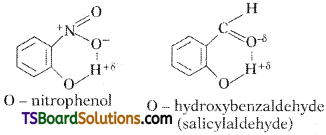
1) Intramolecular H – bonding :
The H – bonding formed between H atom of a molecule and a highly electronegative atom of the same molecule, is called intramolecular hydrogen bond.
Ex:
2) Inter-molecular H – bonding :
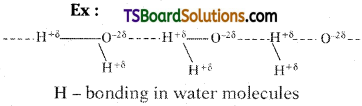
The H – bonding formed in between H – atom of one molecule and a highly electronegative atom of another molecule of same substance or different substances is called intermolecular hydrogen bond.
Consequences of H – bonding:
- Highly viscous nature of H2SO4, HNO3, H3PO4 etc, is due to H – bonding.
- The high b.p. of water is due to H – bonds in it.
- H2O is a liquid but H2S is a gas, since H – bond is present in H2O only.
Question 21.
Explain the formation H2 molecule on the basis of Valence Bond theory.
Answer:
This theory explains the shapes of covalent molecules as well as the directions of the bonds in them.
Important postulates:
- Covalent bond is formed by the overlap of two atomic orbitals.
- The overlapping orbitals contain unpaired electrons with opposite spins.
- Each of the bonded atoms retains its own atomic orbitals. But the electron pair in the overlapping orbitals is shared by both the atoms.
- The greater the extent of overlap of orbitals, the stronger is the covalent bond formed.
- Except ‘s’ orbitals, the remaining all atomic orbitals are directional. So the bonds formed due to their overlap are also directional. This determines the shape of the molecule.
- When the atomic orbitals of the two atoms overlap, then electron density increases on their internuclear axis. This binds the two atoms, firmly. Thus the molecule is stabilised.
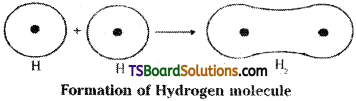
Ex : Formation of Hydrogen molecule (s – s overlap) :
Hydrogen molecule is formed due to overlap of 1 s – orbitals of two hydrogen atoms. The bond formed between the two H – atoms is called σs-s bond and the type of overlapping is s – s overlap.
Question 22.
Using Molecular Orbital Theory explain why the B2 molecule is paramagnetic?
Answer:
Electronic configuration of boron atom is 1s² 2s² 2p¹ There are ten electrons in B2 molecule. In terms of molecular orbital theory the electronic configuration of B2 molecule is
(σ Is)² (σ* Is)² (σ 2s)² (σ* 2s)² (π2p¹ =π2p¹)
The presence of unpaired electrons in the two π bonding molecular orbitals explains its paramagnetic nature.
Question 23.
Write the important conditions necessary for linear combination of atomic orbitals.
Answer:
The necessary conditions for the effective overlap of atomic orbitals to form molecular orbitals are
- The combining atomic orbitals must have the same or almost the same energy.
Ex: 1s – 1s overlap is permitted but not 1s – 2s or 2s – 2p overlap. - The combining atomic orbitals must be able to overlap to the maximum extent to form m.o’s since if the overlapping is more, there will be a greater electron density between the nuclei of the combining atoms and hence the bond formed between them will be stronger.
- The combining atomic orbitals must have the same symmetry about the molecular axis.
It means that, atomic orbitals having the same or nearly the same energy will not overlap, if they do not have the same symmetry. Thus the allowed over laps are : s – s, s – px, px – px, py – py and Pz – Pz.
In the other types of overlaps, s – py s – pz, px – py and px – pz. no m.o is formed since the atomic orbitals do not have the same symmetry. They are nonbonding m.o’s.
Question 24.
What is meant by the term Bond order? Calculate the bond orders in the following. [TS ’15; IPE ’14]
(a) N2 (b) O2 (c) O2 and (d) O2
Answer:
Bond order is the number of bonds between two atoms. It is one half the difference between the number of electrons present in the bonding and the antibonding orbitals.
Bond order = \(\frac{1}{2}\) [Nb – Na]
Where Nb is the number of electrons in bonding molecular orbitals while Na is the number of electrons in antibonding mole- culars orbitals. For calculating bond order electrons present in valence only are considered.
a) MO electronic configuration of N2 molecule is
(σg 1s)² (σg* 1s)² (σg 2s²) (σg * 2s²) (π2p² = π2P²) (σg 2p)²
Bond order = \(\frac{10-4}{2}=\frac{6}{2}\) = 3
b) MO electronic configuration of 02 molecule is
(σ 1s)² (σ * 1s)² (σ 2s)² (σ * 2s)² (σ 2p2)² (π2p²x π2p²y) (π * 2p) (π * 2p¹)
Bond order = \(\frac{1}{2}\)[Nb – Na] = \(\frac{1}{2}\) (10 – 6) = 2
c) MO electronic configuration of O+2 molecule is
(σ 1s)² (σ * 1s)² (σ 2s)² (σ * 2s)² (σ 2p2)² (π2p² π2p²y) (π * 2p¹)
Bond order = \(\frac{1}{2}\)[Nb – Na] = \(\frac{1}{2}\) (10 – 5) = 2.5
d) MO electronic configuration of O–2 molecule is,
(σ 1s)² (σ * 1s)² (a 2s)² (σ * 2s)² (σ 2p2)² (π2p²x π2p²y)(π * 2p2x (π* 2p¹y)
Bond order = \(\frac{1}{2}\)[Nb – Na] = \(\frac{1}{2}\) (10 – 7) = 1.5
Question 25.
Of BF3 and NF3, dipolemoment is observed for NF3 and not for BF3. Why?
Answer:
In polyatomic molecules, the dipolemoment of the molecule is the resultant of vector sum of the dipolemoment of various bonds.
BF3 molecule has symmetric planar triangular structure. The three equal bond dipoles point to the corners of a triangle at an angle of 120° and cancel the effect on each other.
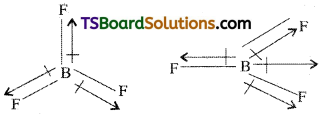
The three bond moments give a net sum of zero as the resultant of any two is equal and opposite to the third.
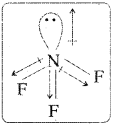
In NF3 the three N – F bonds have dipolemoments. Also the lone pair present on nitrogen atom show dipolemoment in the opposite direction to the resultant N – F bond dipolemoments.
Though the orbital dipolemoment due to lone pair and the resultant dipole moment of three N – F bonds are in opposite direction there remains some resultant dipolemoment since they do not cancel completely.
Question 26.
Even though both NH3 and NF3 are pyramidal, NH3 has a higher dipolemoment compared to NF3 Why? [AP ’16]
Answer:
Both NH3 and NF3 have pyramidal shape with a lone pair of electrons on nitrogen atom. Although fluorine is more electronegative than nitrogen, the resultant dipole moment in NH3 is greater than in NF3.
In the case of NH3 the orbital dipolemoment due to the lone pair electrons and the resultant dipolemoment of the three N – H bonds are acting in the same direction. This enhances the dipolemoment of molecule.
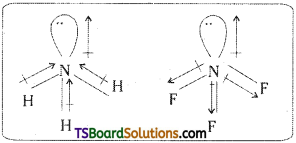
In NF3 the orbital dipolemoment is in the direction opposite to the resultant dipolemoment of the three N – F bonds. The orbital dipolemoment due to lone pair electrons decreases this effect of the resultant N – F bond moments. This results in the decrease of,dipolemoment in NF3 than in NH3.
Question 27.
How do you predict the shapes of the following molecules making use of VSEPR theory? [AP ’15]
(a) XeF4 (b) BrF5 (c) ClF3 and (d) ICl–4
Answer:
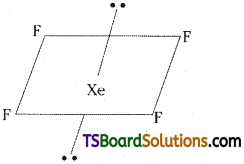
a) In XeF4 the xenon atom has 8 electrons in its outer orbit. Of these 8 electrons 4 electrons are participated in 4 bonds with 4 fluorine atoms the remaining 4 electrons will present as 2 lone pairs. Thus in XeF4 around Xe atom there are 4 bp and 2 lp a total of 6 electron pairs. These six electron pairs are arranged octahedrally around Xe atoms. To minimize the repulsions between electron pairs the two lp occupies the opposite corners of octahedron. So the shape of XeF4 is square planar.
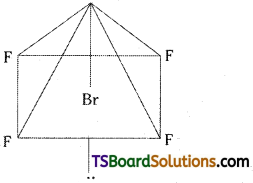
b) In BrFs, Br atom has 5 bond pair and one lone pair. These six electron pairs are arranged octahedrally around the Br atom. The lone pair occupies one corner of octahedron. So the shape of BrF5 is square pyramid.
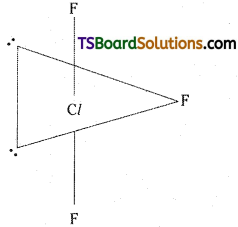
c) In ClF3 around Cl atom there are 3 bond pair and 2 lone pair. These 5 electron pairs are arranged in trigonal bipyramid structure. To minimise the repulsions the lone pair always occupies the equatorial positions in trigonal bipyramid structure. So the shape of ClF3 becomes T – shape.
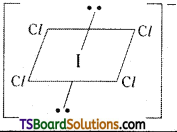
d) In ICl–4 ion there are four bond pair and 2 lone pair a total of six electron pairs. These are arranged octahedrally around I atom. To minimise the repulsions between electron pairs the two lp occupy the opposite corners of the octahedron. So ICl–4 ion have square planar structure.
Long Answer Questions
Question 1.
Explain the formation of Ionic Bond with a suitable example.
Answer:
“The electrostatic force of attraction between oppositely charged ions formed by the transfer of electrons” is called Ionic Bond.
Orbital concept of bonding :
The method of formation of ionic bond in sodium chloride can be shown by the following orbital model:
Electronic configurations are:
Na (Z = 11) 1s²2s²2p63s¹; Cl (Z = 17) 1s²2s²2p63s²3p5

In the formation of sodium chloride, the 3s electron of Na atom is transferred to the half-filled 3p orbital of Cl atom. It gets paired up with it.
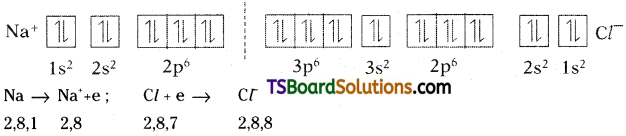
The Na+ and Cl– ions thus formed will have the inert gas configurations of neon and argon and get attracted by coulofnbic electrostatic forces of attraction, forming Na+Cl–, ionic compound.
Question 2.
Explain the factors favourable for the formation of Ionic Compounds.
Answer:
Factors that favour the formation of ionic bond:
a) Factors favourable for the cation formation :
i) Low IP :
Atom with low IP loses electrons readily. So it forms cations readily. K+ (IP 496 KJ mol-1) ion forms readily than Na+ (IP 520 KJ mol-1) ion.
ii) Low charge on the ion :
Formation of an ion with low charge requires lower IP than formation of an ion with high charge. Thus out of Na+, Mg2+ and Al3+, the ease of formation Of these ions is Na+ > Mg+ > Al3+.
iii) Large atomic size :
The force of attraction between the nucleus and the valence electrons is less in case of larger atoms than in case of smaller atoms. So larger atoms can lose electrons more readily than smaller atoms.
Ex : Cs+ is formed more easily than any of the other alkali metal ions.
iv) Formation of cation with inert gas configuration :
Cations with inert gas con-figuration are easily formed.
Ex: Out of Ca2+ and Zn2+, Ca2+ ion (2,8,8) is easily formed than Zn2+ ion (2, 8, 18) with pseudo inert gas configuration.
b) Factors favourable for anion formation:
i) High EN and high EA :
An atom with high EN and high EA has a greater tendency to accept electrons and so it can readily form anion.
Ex : The ease of formation of anions is
F– > O2- >N-3
ii) Small atomic size: Small atoms can hold strongly the electrons gained by it.
Ex : The order of ionic nature in halide ions is F– > Cl– > Br– > I–
F is the smallest and I is the largest atom, among them.
iii) Low charge on the ion :
Stability of ion decreases with increase in its charge. Anion with low – ve charge is formed more readily than anion with high -ve charge.
Ex: F– ion is easily formed than O2- ion.
Question 3.
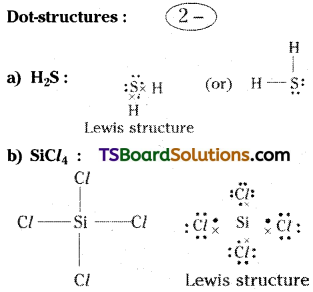
Draw Lewis Structures for the following molecules.
(a) H2S (b) SiCl4
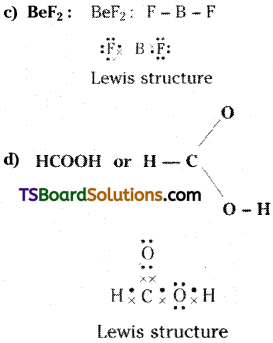
(c) BeF2 and (d) HCOOH
Answer:
In the Lewis structures, only the valence electrons are indicated by dots (•), crosses (x) or circles (O).
Question 4.
Write notes on (a) Bond Angle (b) Bond Enthalpy (c) Bond length and (d) Bond order.
Answer:
a) Bond angle :
The angle between the orbitals containing bonding electron pairs around the central atom in a molecule, complex ion is called bond angle. Bond angle is expressed in degrees.
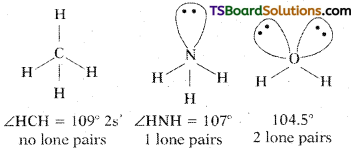
i) Bond angle depends on the presence of lone pair electrons with increase in the number of lone pairs the bond angle decreases, eg. in the molecules which contain four electron pairs the bond angles are follows.
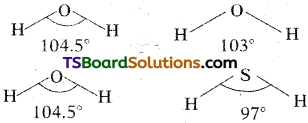
ii) Bond angle decreases with increase in the electronegativity of the bonded atom and increases with increase in the electronegativity of central atom. eg.
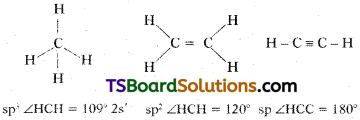
iii) Bond angle depends on the hydridisation.
b) Bond enthalpy :
The amount of energy required to break one mole of bonds of a particular type between two atoms in a gaseous state is called bond enthalpy.
More is the bond enthalpy, stronger the bond and more is the stability of the molecule.
In the case of poly atomic molecules the bond enthalpy is the average of the similar bond enthalpies is taken, eg. in H2O to break the two O – H bonds is not same. The energy required for breaking first bond is 502 kJ mol-1 and for the second bond is 427 kJ mol-1. So the average value 464.5 kJ mol-1 is considered as the bond enthalpy.
c) Bond length :
It is defined as the equilibrium distance between the nuclei of two bonded atoms in a molecule.
Bond length is equal to the sum of the covalent radii of two similar atom in the bond. In hetero atomic molecules, the bond length can be calculated using the formula.
dAB = rA + rB + c (XA – XB). Where XA and XB are the electronegativities of atom A and B. The value of C depends on the nature of atoms participating in the bond.
Bond lengths depend on the number of bonds between atoms, type of hybridisation etc.
d) Bond order :
It is defined as the number of bonds between the two atoms in a molecule.
Eg : Bond orders in H2 is 1, O2 = 2 and N2 = 3.
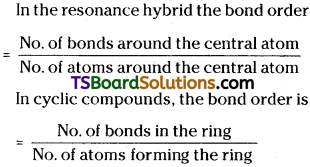
Isoelectronic molecules and ions have identical bond orders, eg. F2 and O2-2 have bond order 1. N2, CO and NO+ have bond order 3.
More the bond order more is the bond enthalpy, lesser the bond length, more the stability.
Question 5.
Give an account of VSEPR Theory, and its applications.
Answer:
VSEPR theory was proposed by Gillespy and Nyholm. It predicts the shapes of molecules Without reference to the hybridisation. The important points in the theory are :
- The shape of a molecule depends upon the number of electron pairs (bond pairs) present on the central atom. If there are only ‘bond pairs’ and no ‘lone pairs’ on the central atom, the molecules assumes a regular geometrical shape.
- If there are ‘lone pairs’ also on the central atom, then the structure gets distorted and the bond angle changes.
- A ‘lone pair of electrons’ occupy more space around the central atom than a bond pair, because the ‘lone pair’ is attracted by only one nucleus, while the ‘bond pair- is attracted by two nuclei.
- The electron pairs orient in space so as to have minimum repulsions among them, which determines the ‘bond angles’.
- The order of repulsion between various electron pairs is
l.p – 1.p > l.p – b.p > b.p – b.p - The magnitude of repulsion between bond pairs of electrons depends on the electronegativity differences between the central atom and the other atoms.
- The order of repulsion between different bonds is :
Triple bond > Double bond > Single bond
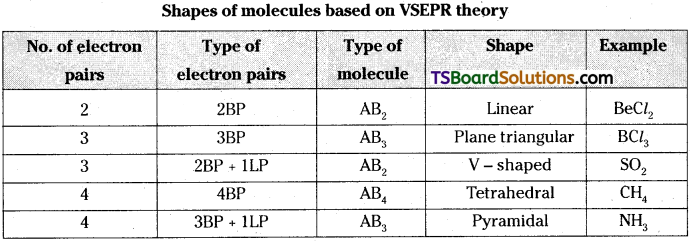
Applications:
1. Structure of NH3 molecule :
In NH3 molecule, the central ‘N’ atom contains 3 bond pairs one lone pair. In total, there are four pair of electrons. Hence, according to VSEPR theory, the expected structure of the molecule in tetrahedral with a bond angle of 109°281. But, because of the presence of lone pair, the shape of the molecule gets distorted. Therefore, the real structure of the molecule is pyramidal with a bond angle of 107°.
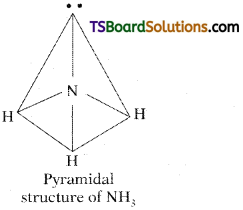
2. Structure of H2O molecule :
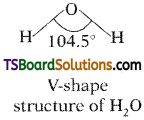
In H2O molecule, the central ‘O’ atom contains two bond pair and two lone pairs. In total there are four pair of electrons. Hence, according to VSEPR theory, the expected structure of the molecule is tetrahedral with a bond angle of 109°28¹. But, because of the presence of lone pair, the shape of the molecule gets distorted. Therefore, the real structure of the molecule is V-shape with a bond angle of 104.5°.
Question 6.
How do you explain the geometry of the molecules on the basis of Valence bond Theory?
Answer:
The valence bond theory explains the shape, the formation and directional properties of bonds in poly atomic molecules like BeCl2, BCl3, CH4, NH3, H2O, etc. in terms of overlap and hybridisation of atomic orbitals.
Eg., in BeCl2, Beds the central atom. Its atomic number is 4. Therefore its ground state electron configuration is 1s² 2s². In order to explain the formation of BeCl2, SP hybridisation is to be assumed for Be in its excited state. The excited state configuration of Be is 1s²2s¹ 2p¹x 2p°y 2p°z. As a result of which two sp hybrid orbitals will form on it. Now the two sp hybrid orbitals overlap Head-Head with 3pz orbitals of two chlorine atoms forming two sigma bonds.
The molecule is linear and the bond angle is 180°.
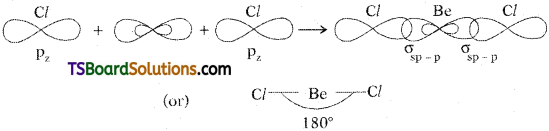
In BCl3 the central atom is boron. Its atomic number is 5; Therefore its ground state electron configuration is 1s² 2s²
2p¹x 2p°y 2p°z. From this configuration it is evident that it exhibits mono-valency. The first excited state configuration of B is 1s²2s¹2p¹x 2p°y 2p°z. Since, there are two half-filled orbitals, the valency of Boron is 3.
In order to explain the formation of BCl3 molecule sp hybridisation is to be assumed to boron atom in its excited state I. As a result of which three sp2 hybrid orbitals will form on it. Now, the three sp² hybrid orbitals of ‘B’ atom overlap Head – Head with 3pz orbitals of three Cl atoms forming three sigma bonds. The shape of the molecule is plane triangular and the bond angle is 120°.
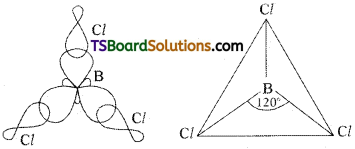
CH4 (Methane) :
In CH4, the central atom is carbon. Its atomic number is 6. Therefore the electron configuration is 1s² 2s² 2p² (2px¹, 2py¹, 2pz° ). In order to explain the formation of four bonds excited stated configu-ration (1s² 2s¹ 2px¹ 2py¹ 2pz¹) is to be taken. From this configuration, we can say that carbon can form four bonds. [Ex. CH4]
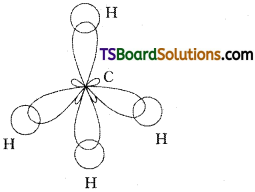
In the formation of methane molecule, the central carbon atom undergoes sp³ hybridisation in its excited state (1s² 2s¹ 2p¹x 2p¹y 2p¹z). As a result of which four sp hybrid orbitals form on it. Each of them contains an unpaired electron. Now, these four hybrid orbitals overlap Head- Head with Is orbitals of four hydrogen atoms forming CH4 molecule. The structure of the molecule is tetrahedral. The bond angle is 109°28′. Since there are no lone pairs, there is no distortion in the structure of the molecule.
NH3 (Ammonia) in NH3 molecule, one sp³ orbital contains a lone pair of electrons. There will be repulsions between the lone pair and bond pair electrons. These are stronger than bp – bp repulsions. (l.p – b.p > b.p – b.p). So the bond pairs are pushed together. Hence the bond angle decreases from tetrahedral angle. The molecule assumes a pyramidal shape.
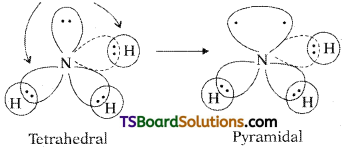
Question 7.
‘What do you understand by Hybridisation? Explain different types of hybridisation involving s and p orbitals. [Mar. ’18 (AP) (TS Mar. 17, 15; Mar. 13]
Answer:
Hybridisation:
“Intermixing of atomic orbitals of almost equal energies of an atom and their redistribution into an equal number of identical orbitals is called, ‘hybridisation’.
Examples :
Let us see the three types of hybridisations – sp³, sp² and sp.
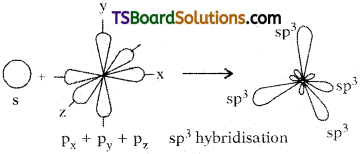
1) sp³ Hybridisation :
The phenomenon of intermixing of one s’ orbital and three p’ orbitals forming four sp³’ hybrid orbitals is called sp³ hybridisation.
Each of the sp³ hybrid orbitals possess \(\frac{1}{4}\) of s – character and \(\frac{3}{4}\) of p character. The bond angle in-between any two sp³ hybrid orbitals is 109°28′. The shape of the molecule in which the central atom undergoes sp³ hybridisation is tetrahedral.
Example :
Formation of Methane (CH4 molecule :
In the formation of methane molecule the central carbon atom undergoes sp³ hybridisation in its excited state. As a result of which four sp³ hybrid orbitals will form on it. All the four sp³ hybrid orbitals possess bond pair of electrons. Now, the four sp³ hybrid orbitals overlap head-head with ‘1s’ orbitals of four H’ atoms forming CH4 molecule. The shape of the molecule is tetrahedral with a bond angle of 109°28′.
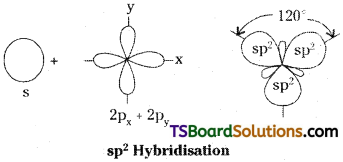
2) sp² Hybridisation:
The phenomenon of intermixing of one s’ orbital and two p’ orbitals forming three sp²’ hybrid orbitals is called sp² hybridisation.
Each of the sp² hybrid orbitals possesses \(\frac{1}{3}\) s – character and \(\frac{2}{3}\) p – character. The bond angle in between any two sp² hybrid orbitals is 120°. The shape of the molecule in which the central atom undergoes sp² hybridisation is plane triangular.
Example:
Formation of Boron trichloride (BCl3) molecule :
In the formation of BCl3 molecule the central boron atom undergoes sp² hybridisation in its excited state (1s² 2s¹ 2px¹, 2py¹, 2pz°). As a result of which three sp² hybrid orbitals will form on it. All the three hybrid orbitals possess an electron each. Now, the three sp2 hybrid orbitals overlap head – head with half-filled ‘3pz‘ orbitals of three chlorine atoms forming BCl3 molecule. The shape of the molecule is plane triangular with a bond angle of 120°.
3) sp Hybridisation:
The phenomenon of intermixing of one s’ orbital and one p’ orbital of an atom forming two ‘sp’ hybrid orbitals is called sp hybridisation.
Each of the sp hybrid orbitals possesses \(\frac{1}{2}\) s – character and \(\frac{1}{2}\) p – character. The bond angle in-between the two hybrid orbitals is 180°. The shape of the molecule in which the central atom undergoes sp hybridisation is linear.
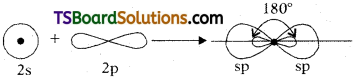
Example : Formation of Beryllium chloride (BeCl2) :
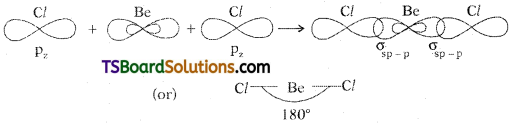
In the formation of BeCl2 molecule the central Be’ atom undergoes sp hybridisation in its excited state (1s² 2s¹ 2px¹, 2py°, 2pz°) As a result of which two sp hybrid orbitals will form on it.
The two hybrid orbitals contain an electron, each. Now, the two sp hybrid orbitals overlap head-head with half-filled ‘3pz’ orbitals of two chlorine atoms forming BeCl2 molecule. The shape of the molecule is linear with a bond angle of 180°.
Question 8.
Write the salient features of Molecular Orbital Theory.
Answer:
M.O.T. was proposed by Hund and Mulliken.
- Formation of MOs : The atomic orbitals of the bonded atoms with similar energies and symmetrical with respect to the inter-nuclear axis lose their identities, merge together and give rise to a set of new orbitals, named, ‘molecular orbitals’.
- Now in the molecule, the electrons will be influenced by the nuclei of all atoms, since the m.o. covers all the nuclei.
- The m.o.’s are formed by LCAO method.
- The number of m.o’s produced is equal to the number of a.o’s that combine. ,
- Half of these m.o’s possess lower energy than the a.o’s from which they form. They are called, bonding m.o’s. The remaining half will have higher energy. They are called, anti bonding m.o’s
- The shape of m.o’s is determined by the shapes of a.o’s from which they form.
- Axial overlap of two a.o’s gives a m.o’s while parallel overlap gives n m.o’s.
- Based on spectroscopic studies, the relative order of energy of the m.o’s of ten m.o’s of Li2,
Be2, B2, C2 and N2 are :
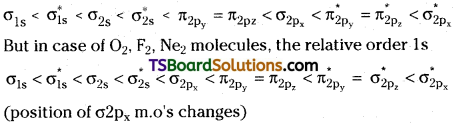
- Electrons occupy the m.o’s which reflects Aufbau principle, Hund’s rule of maximum multiplicity and Pauli’s exclusion principle.
- Electrons present in bonding m.o’s help to stabilise the bond, while those present in anti bonding m.o.’s more than destabilize the bond.
- The inner orbitals which do not take part in bonding are called, ‘non-bonding orbitals’.
Question 9.
Give the Molecular Orbital Energy diagram of (a) N2 and (b) O2 Calculate the respective bond order. Write the magnetic nature of N2 and O2 molecules. [TS Mar. ’19 (IPE ’14)]
Answer:
a) Molecular Orbital Energy diagram of N2:
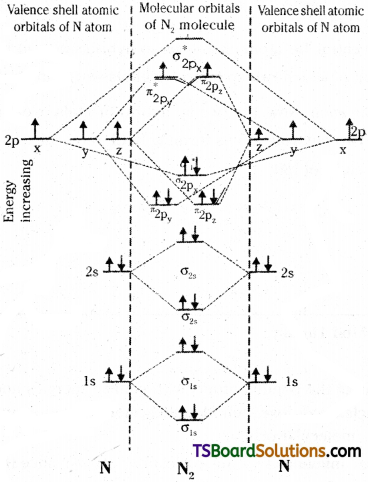
Electronic configuration of molecular or-bital of N2:
σ 1s², σ* 1s², σ 2s², σ* 2s². π2p²y = π2p²z, σ 2p²x
Calculation of bond order of N2 :
Number of bonding electrons (Nb) = 10
Number of anti-bonding electrons (Na) = 41
Bond order = \(\frac{1}{2}\) (Nb – Na)
= \(\frac{1}{2}\)(10 – 4) = 3
Nitrogen is diamagnetic since all the electrons in N2 molecule are paired.
b) Molecular Orbital Energy diagram of O2:
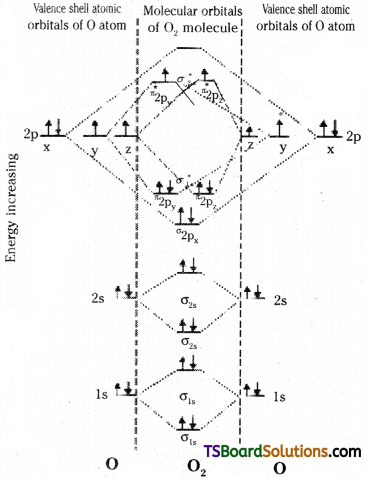
Electronic configuration of molecular orbital of O2 :
σ 1s², σ* 1s², σ 2s², σ* 2s². π2p²x, π2p²y = π2p²z, π* 2p¹y = π* 2p¹z
Calculation of bond order of O2 :
Number of bonding electrons (Nb) = 10
Number of anti-bonding electrons (Na) = 6
Bond order = \(\frac{1}{2}\) (Nb – Na) = \(\frac{1}{2}\)(10 – 6) = 2
Oxygen is paramagnetic as there are two unpaired electrons in two antibonding n π* 2py and π* 2pz molecular orbitals. So oxygen is diamagnetic.