
Reviewing AP Inter 2nd Year Zoology Study Material Chapter 3 Principles of Inheritance and Variation Questions and Answers can help students prepare confidently for exams.
AP Inter 2nd Year Zoology 3rd Lesson Principles of Inheritance and Variation Questions and Answers
IV. Very Short Answer Questions
Question 1.
What is Pleiotropy? Give an example.
Answer:
- Pleiotropy A condition in which a single gene influences more than one phenotypic character.
- Example: Phenylketonuria (PKU) in humans.
Question 2.
What is polygenic inheritance? Give an example.
Answer:
- Polygenic inheritance refers to the combined action of two or more genes on a single trait.
- Example: Human skin colour.
Question 3.
What is aneuploidy?
Answer:
Aneuploidy is a chromosomal condition in which an individual possesses an abnormal chromosome number due to the addition or loss of one or more chromosomes.
Question 4.
What is Klinefelter’s syndrome?
Answer:
- Klinefelter’s syndrome is a genetic disorder caused by trisomy of the 23rd chromosome pair. The karyotype is 47, XXY. Males possess an additional X chromosome and show the presence of a Barr body.
- Common features include underdeveloped gonads, decreased fertility, and enlargement of breasts (gynecomastia).

Question 5.
What is Turner’s syndrome?
Answer:
- Turner’s syndrome is a genetic disorder caused by monosomy of the sex chromosomes; the karyotype is 45, XO, and Barr bodies are absent.
- Characteristic features include short stature, gonadal dysgenesis, webbed neck, broad chest, and widely spaced nipples.
Question 6.
What is Down’s syndrome?
Answer:
- Down’s syndrome is a chromosomal disorder characterized by delayed physical growth and intellectual development.
- It occurs due to the presence of an extra copy of chromosome 21 (Trisomy 21).
Question 7.
Define the terms ‘point mutation’ and ‘frame-shift mutation’.
Answer:
- Point Mutation: A mutation involving a change in a single nucleotide or base pair of DNA, which may alter the structure or function of a protein.
- Frameshift Mutation: A mutation caused by the insertion or deletion of one or more nucleotides, resulting in a shift of the reading frame and alteration of the amino acid sequence. ‘
V. Short Answer Questions
Question 1.
Explain sex determination in human beings.
Answer:
Sex determination in humans:
- Humans exhibit the XX-XY type of sex determination.
- Out of the 23 chromosome pairs, 22 pairs are autosomes and 1 pair is made up of sex chromosomes.
- Females possess the karyotype 44XX, while males possess 44XY.
- Females produce only one type of gamete carrying the X chromosome, whereas males produce two types of sperms carrying X or Y chromosomes.
- Female gametes contain 22A+X; male gametes contain either 22A+X or 22A+Y.
- Fertilization of the ovum by an X-bearing sperm results in a female child (44XX).
- Fertilization by a Y-bearing sperm produces a male child (44XY).
- Therefore, the type of sperm that fertilizes the ovum determines the sex of the child.
- Each pregnancy has an equal 50% chance of producing either a male or female offspring.
Question 2.
Mention any two autosomal Mendelian disorders and write their symptoms.
Answer:
1. Haemophilia:
- Haemophilia is a sex-linked recessive genetic disorder that affects the blood’s ability to clot properly.
- Individuals suffering from this condition experience prolonged and excessive bleeding even from minor cuts or injuries.
- The deficiency of specific clotting factors leads to difficulty in stopping bleeding.
- This disorder is more commonly observed in males, as they have only one X chromosome.
2. Colour Blindness:
- Colour blindness is a sex-linked genetic disorder in which an individual has difficulty distinguishing between certain colours, especially red and green.
- It occurs due to defects in the cone cells of the retina responsible for colour vision.
- This condition does not affect overall vision but impairs the ability to identify colours correctly.
- It is also more frequently found in males than in females.
Question 3.
Describe male heterogamety and female heterogamety method of sex deter¬mination with suitable examples.
Answer:
A. Male Heterogamety: In this system, males produce two types of gametes while females produce only one type. It occurs in two forms:
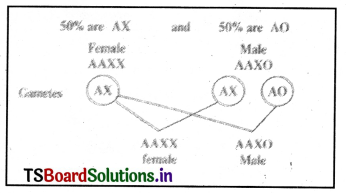
1. XX-XO Type :
- Found in bugs, grasshoppers, and cockroaches.
- Female genotype: AAXX and produces only AX gametes.
- Male genotype: AAXO and produces AX and AO gametes in equal proportions.
- The sperm determines the sex of the offspring.
2. XX-XY type:
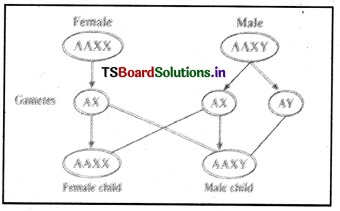
- Found in humans and Drosophila.
- Female genotype: AAXX and produces only AX gametes.
- Male genotype: AAXY and produces AX and AY gametes.
- The sperm carrying X or Y chromosome determines the sex of the offspring.
B. Female Heterogamety: In this type, females produce two kinds of gametes, while males produce only one type. It occurs in two forms:
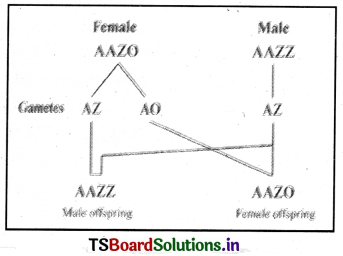
1. ZO-ZZTvpe:
- Seen in moths and some butterflies.
- Males produce only AZ gametes.
- Female produces AZ and AO ova.
- The ovum determines the sex of the offspring.
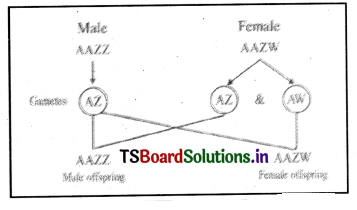
2. ZW-ZZ Type:
- Found in certain fishes, reptiles, and birds.
- Female produces AZ and AW ova.
- Male produces only AZ sperms.
- The ovum carrying Z or W chromosome decides the sex of the progeny.
Question 4.
Explain the haplodiploid System of Sex determination in honey bees.
Answer:
The haplodiploid mechanism of sex determination in honey bees depends on the number of chromosome sets present.
1. Females (Queen and Workers):
- Females develop from fertilized eggs formed by the fusion of sperm and ovum.
- They are diploid (2n = 32 chromosomes).
2. Males (Drones) ;
- Males arise from unfertilized eggs through parthenogenesis.
- They are haploid (n = 16 chromosomes).
3. Sperm Formation: Drones produce sperms through mitotic divisions.
4. Family Relationship:
- Drones have no father because they originate from unfertilized eggs.
- However, they possess a grandfather and can have grandsons.
Thus, in honeybees, sex is determined by chromosome number (haploid or diploid) rather than by sex chromosomes.
Question 5.
What is Thalassemia? Explain the two types of Thalassemia in detail.
Answer:
- Thalassemia is an autosomal recessive blood disorder inherited when both parents carry the defective gene.
- It results from mutation or deletion of genes responsible for globin chain synthesis.
- Reduced globin production leads to abnormal haemoglobin formation and causes anaemia.
Types of Thalassemia :
a) Alpha (α) Thalassemia:
- Characterized by reduced synthesis of α-globin chains.
- Controlled by HBA1 and HBA2 genes located on chromosome 16.
- Since four α-globin genes are present (two from each parent), severity depends on the number of affected genes.
- Greater gene deletions result in a more severe condition.
b) Beta (β) Thalassemia :
- Characterized by reduced synthesis of β – globin chains.
- Controlled by the HBB gene located on chromosome 11.
- The disorder develops when one or both β – globin genes are mutated.
VI. Long Answer Questions
Question 1.
Write an essay on common genetic disorders in humans.
Answer:
Common Genetic Disorders: Many human diseases arise due to abnormalities in genes or chromosomes. These disorders are broadly classified into:
I. Mendelian Disorders II. Chromosomal Disorders.
1. Mendelian Disorders: These disorders follow Mendelian inheritance patterns and are usually caused by mutations in a single gene (monogenic disorders). They may be autosomal or sex-linked. Examples: Haemophilia, Sickle-cell anaemia, Phenylketonuria, Colourblindness, Thalassemia, Cystic fibrosis, Albinism, etc.
1. Haemophilia:
- Haemophilia is commonly known as a bleeding disorder because blood fails to clot normally after injury.
- Haemophilia A results from deficiency of clotting factor VIII.
- Haemophilia B results from deficiency of clotting factor IX.
- Both A and B are X-linked recessive disorders.
- Haemophilia C is an autosomal recessive disorder caused by deficiency of clotting factor XI.
- Haemophilia A and B may skip generations.
- The disorder is rare in females because two recessive genes are required.
- It is more frequently observed in males.
2. Sickle-cell Anaemia:
- Sickle-cell anaemia is an autosomal recessive disorder caused by a defective gene located on chromosome 11.
- It is expressed in the homozygous condition.
- Symptoms include weakness, pain, organ damage due to internal bleeding, and sometimes paralysis.
- The disorder results from the substitution of glutamic acid by valine at the sixth position of the beta-globin chain.
- Red blood cells become sickle-shaped and rigid.
- These cells may block capillaries while passing through them.
- Heterozygous individuals may occasionally show mild symptoms but possess increased resistance to malaria.
3. Phenylketonuria (PKU):
- Phenylketonuria was first described by A. Foiling.
- It is an autosomal recessive metabolic disorder.
- The responsible gene is located on chromosome 12.
- Patients lack the enzyme phenylalanine hydroxylase, which converts phenylalanine into tyrosine.
- As a result, phenylalanine is converted into phenylpyruvic acid.
- Accumulation of phenyl ketones may lead to mental retardation.
4. Colour Blindness:
- Colour blindness is an X-linked recessive disorder.
- Protanopia refers to red colour blindness.
- Deuteranopia refers to green colour blindness.
- Affected individuals cannot distinguish red from green colours.
- The Ishihara colour test is commonly used for diagnosis.
- Tritanopia is associated with blue colour blindness and is autosomal in nature.
5. Thalassemia:
- Thalassemia is an autosomal recessive disorder affecting haemoglobin synthesis.
- α-globin genes are located on chromosome 16.
- β – globin genes are located on chromosome 11.
- Defective globin synthesis damages red blood cells.
- RBC count decreases, leading to anaemia.
6. Cystic Fibrosis:
- Cystic fibrosis is an autosomal recessive disorder.
- The defective gene is present on the long arm of chromosome 7.
- It affects the movement of salt and water across cell membranes.
Symptoms:
- Increased sodium and chloride levels in sweat.
- Mucus becomes thick, sticky, and viscous.
- Mucus accumulates in organs such as lungs, pancreas, and intestinal tract.
- Without treatment, patients may die before reaching five years of age.
Question 2.
Write an essay on sex determination;
Answer:
Chromosomal Theory of Sex Determination: In most animals, sex is determined by a pair of chromosomes known as sex chromosomes or allosomes.
The two major sex chromosomes are the X chromosome and Y chromosome.
There are two major systems of chromosomal sex determination:
I. Male Heterogametic Method
II. Female Heterogametic Method
Male Heterogametic Method: In this system, males produce two kinds of gametes, while females produce only one type.
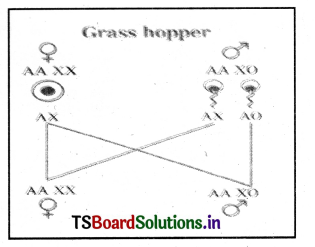
1. XX-XO Type:
- Found in grasshoppers, bugs, and cockroaches.
- Females possess two X chromosomes, whereas males have only one X chromo¬some.’
- The unpaired X chromosome determines maleness.
- Female karyotype is AAXX and male karyotype is AAXO.
- All ova contain the AX complement.
- Sperms are of two types:
- 50% contain AX
- 50% contain AO
- The sex of the offspring depends on the sperm that fertilizes the ovum.
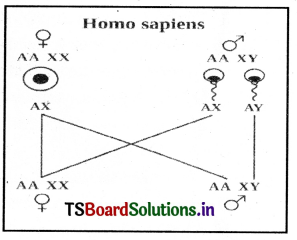
2. XX-XY Type:
- Found in humans and Drosophila.
- Females are homogametic with genotype AAXX and produce only AX ova.
- Males are heterogametic with genotype AAXY. homo sapiens
- Half the sperms carry AX, and the other half carry AY.
- The fertilizing sperm determines the sex of the offspring.
- Fertilization by AX sperm produces a female child (AAXX).
- Fertilization by AY sperm produces a male child (AAXY).
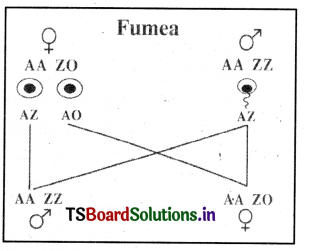
II. Female Heterogametic Method: In this type, females produce two kinds of ova, while males produce only one type of sperm. Two forms are recognized:
1. ZO – ZZ Type:
- Found in moths (Fumea) and certain butterflies.
- Females are heterogametic with one Z chromosome.
- Males are homogametic with ZZ chromosomes
- Female karyotype is AAZO and male karyotype is AAZZ.
- The ovum determines the sex of the of Spring.
- Fertilization of an AO ovum produces a female.
- Fertilization of an AZ ovum produces a male.
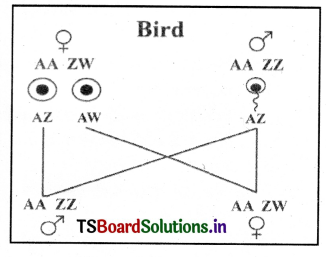
2. ZW-ZZ Type:
- Found in birds, reptiles, and some fishes.
- Females are heterogametic with ZW chromosomes.
- Males are homogametic with ZZ chromosomes.
- Female karyotype is AAZW and male karyotype is AAZZ.
- The ovum that gets fertilized determines the sex of the offspring.
I. Multiple Choice Questions
Question 1.
Given below are two statements.
Statement I: When many alleles of a single gene govern a character, it is called polygenic inheritance.
Statement II: In polygenic inheritance, the effect of each allele is additive. In the light of the above statements, choose the correct answer from the options given below.
1. Both statement I and statement II are true.
2. Statement I is false, but statement II is true.
3. Statement I is true, but statement II is false.
4. Both statement I and statement II are false.
Answer:
2. Statement I is false, but statement II is true.
Question 2.
The phenomenon of pleiotropy refers to
1. Presence of two alleles, each of the two alleles controlling a single trait.
2. More than two genes affecting a single character.
3. Presence of several alleles of a single gene controlling a single trait.
4. A single gene affecting multiple phenotypic expression.
Answer:
4. A single gene affecting multiple phenotypic expressions.
Question 3.
If a colour blind female marries a man whose mother was also colour blind, what are the chances of her progeny having colour blindness?
1. 25%
2. 50%
3. 75%
4. 100%
Answer:
4. 100%
Question 4.
Which one of the following symbols represents mating between relatives in human pedigree analysis?
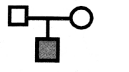
2. 
3.
4.
Answer:
4.
Question 5.
Which of the following is not an autosome linked recessive trait?
1. Thalassemia
2. Phenylketonuria
3. Haemophilia
4. Sickle-cell anaemia.
Answer:
3. Haemophilia
Question 6.
Inheritance of skin colour in humans is an example of
1. Codominance
2. Multiple allelism
3. Polygenic inheritance
4. Chromosomal aberration.
Answer:
3. Polygenic inheritance
Question 7.
Match List I with List II
| List I | List II |
| a) Down’s syndrome | i) Chromosome 1 |
| b) α-thalassemia | ii) Karyotype of 47, XXY |
| c) α-thalassemia | iii) Trisomy of 21 |
| d) Klinefelter’s syndrome | iv) Chromosome 16 |
Choose the correct answer from the options given below
1. a – ii, b – iii, c – i, d – iv
2. a – ii, b – iii, c – iv, d – i
3. a – iii, b – iv, c – i, d – ii
4. a – iii, b – iv, c – ii, d – i
Answer:
3. a – iii, b – iv, c – i, d – ii
Question 8.
Which of the following statements are correct about Klinefelter’s Syndrome?
i) This disorder was first described by Langdon Down (1866).
ii) Such an individual has overall masculine development; however, the feminine development is also expressed.
iii) The affected individual is short-statured.
iv) Physical, psychomotor, and mental development is retarded.
v) Such individuals are sterile.
1. ii and v only
2. i and iv only
3. i and ii only
4. iii and iv only
Answer:
1. ii and v only
Question 9.
Thalassemia and sickle cell anaemia are caused due to a problem in globin molecule synthesis. Select the correct statement.
1. Both are due to a quantitative defect in globin chain synthesis.
2. Thalassemia is due to less synthesis of globin molecules.
3. Sickle cell anaemia is due to quantitative problem of globin molecules.
4. Both are due to a qualitative defect in globin chain synthesis.
Answer:
2. Thalassemia is due to less synthesis of globin molecules.
Question 10.
Haplodiploid system of sex determination is found in
1. Birds
2. Drosophila
3. Honeybee
4. Grasshoppers
Answer:
2. Drosophila
Question 11.
Assertion: The possibility of a female becoming a haemophilic is extremely rare.
Reason: Mother of such a female has to be at least carrier, and the father should be haemophilic (unviable in the later stage of life). ( 1 )
1. If both Assertion and Reason are true and Reason is the correct explanation of Assertion.
2. If both Assertion and Reason are true but Reason is not the correct explanation of Assertion.
3. If Assertion is true but Reason is false.
4. If Assertion is false and Reason is true.
Answer:
2. If both Assertion and Reason are true but Reason is not the correct explanation of Assertion.
Question 12.
Broad palm with single palm crease is visible in a person suffering from
1. Klinefelter’s syndrome
2. Thalassemia
3. Down’s syndrome
4. Turner’s syndrome
Answer:
3. Down’s syndrome
Question 13.
Which of the following is incorrect with reference to the honey bees?
1. Males do not have father and thus cannot have sons, but have a grandfather and can have grandsons.
2. An unfertilised egg develops as a male bee by means of parthenogenesis.
3. A fertilised egg develops as female bee.
4. Gametes are produced by meiosis in drones.
Answer:
4. Gametes are produced by meiosis in drones.
Question 14.
A disorder caused by an autosomal primary non-disjunction is
1. Klinefelter’s syndrome
2. Turner’s syndrome
3. Sickle cell anaemia
4. Down’s syndrome
Answer:
4. Down’s syndrome
Question 15.
A human female with Turner’s syndrome is characterized by ( 3 )
1. Monosomy of 18
2. Presence of an additional copy of X chromosome, i.e., 47 with XXY
3. Absence of one of the X chromosomes, i.e., 45 with XO
4. Trisomy of 18
Answer:
3. Absence of one of the X chromosomes, i.e., 45 with XO
II. Fill in the Blanks
1. A person who is suffering from phenylketonuria lacks an enzyme that converts the amino acid phenylalanine into ……………………… .
Answer:
Tyrosine
2. In addition to recombination, ……………………………… is another phenomenon that leads to variation in DNA.
Answer:
Mutation.
3. Sickle-cell anaemia is caused by the substitution of glutamic acid (Glu) ……………………… at the sixth position of the beta globin chain of the haemoglobin molecule.
Answer:
Valine (VAL)
4. Henking gave a name to a specific nuclear structure that present in 50 per cent of sperms in few insects as the ………………………. .
Answer:
X body.
5. Failure of segregation of chromosomes during cell division cycle results in the gain or loss of a chromosome(s) called ……………………….. .
Answer:
Aneuploidy.
III. One Word Answer Questions
Question 1.
Which type of sex determination is found in Grasshoppers?
Answer:
XO Type
Question 2.
Which Mendelian disorder is controlled by two closely linked genes HBA1 and HBA2 on chromosome 16?
Answer:
α -Thalassemia
Question 3.
Which syndrome is characterized by presence of rudimentary ovaries and lack of other secondary sexual characters?
Answer:
Turner’s syndrome
Question 4.
Accumulation of which substances in brain results in mental retardation in an individual suffering from PKU?
Answer:
Phenylpyruvic acid and other derivatives of phenylalanine.
Question 5.
Name the type of mutations which are caused due to deletions and insertions of base pairs of DNA.
Answer:
Frame-shift mutations
Objective Questions
Question 1.
When genes are arranged on a chromosome, the arrangement is known as:
1. Spiral
2. Ovoid
3. Linear
4. Radial
Answer:
3. Linear
Question 2.
The blood group B possesses:
1. B antigen in plasma
2. B antigens on RBCs
3. B antibodies in plasma
4. A antigen on RBC
Answer:
2. B antigens on RBCs
Question 3.
Another term used for codominance is:
1. Equal dominance
2. Mutual dominance
3. Paternal character
4. Maternal dominance
Answer:
1. Equal dominance
Question 4.
Down syndrome results from:
1. Tetrasomy of 22nd chromosome
2. Trisomy of 21st chromosome
3. Monosomy of 21st chromosome
4. Polysomy of 9th chromosome
Answer:
2. Trisomy of 21st chromosome
Question 5.
Factors responsible for heredity are known as:
1. Tissues
2. Cells
3. Genes
4. Zygotes
Answer:
3. Genes
Question 6.
Satellite DNA is widely used in :
1. Genetic engineering
2. Forensic science
3. Sex determination
4. Organ transplantation
Answer:
2. Forensic science
Question 7.
The branch of biology that studies heredity:
1. Ethology
2. Physiology
3. Genetics
4. Psychology
Answer:
3. Genetics
Question 8.
Which of the following fields does NOT belong to genetics?
1. Study of heredity
2. Study of evolution
3. Study o f variation
4. Study of transmission of characters
Answer:
2. Study of evolution
Question 9.
When a single gene influences multiple traits, the phenomenon is called:
1. Incomplete dominance
2. Pleiotropy
3. Epistasis
4. Codominance
Answer:
3. Epistasis
Question 10.
Identify the genetic disorder among the following:
1. Cholera
2. Sickle cell anaemia
3. Diabetes
4. Typhoid
Answer:
3. Diabetes
Question 11.
The blood group lacking antigens on RBC surface is:
1. B group
2. AB group
3. A group
4. O group
Answer:
4. O group
Question 12.
AB antigens are chemically:
1. Glycoproteins
2. Lipids
3. Proteins
4. Sugar polymers
Answer:
4. Sugar polymers
Question 13.
In O blood group, RBCs possess:
1. A antigen
2. B antigen
3. No antigens
4. A, B antigens
Answer:
3. No antigens
Question 14.
Anti-A and Anti-B antibodies belong to:
1. Ig E type
2. Ig G type
3. Ig M type
4. Ig I type
Answer:
3. Ig M type
Question 15.
The genotype IAIB corresponds to:
1. B group
2. AB group
3. O group
4. A group
Answer:
2. AB group
Question 16.
Genes controlling Rh factor are located on:
1. 12th chromosome
2. 1st chromosome
3. 21st chromosome
4. 9th chromosome
Answer:
2. 1st chromosome
Question 17.
In codominance, the phenotype displays:
1. Maternal character
2. Both paternal and maternal characters equally
3. Neither (1) nor (2)
4. Paternal character
Answer:
2. Both paternal and maternal characters equally
Question 18.
If the genotypic ratio is 1:2:1 under codominance. the phenotypic ratio be conies:
1. 3:1
2. 3
3. 1: 2: 1
4. 1:3
Answer:
3. 1: 2: 1
Question 19.
Human skin colour demonstrates:
1. Multiple allelism
2. Polygenic inheritance
3. Multiple phenotypes
4. Pleiotropy
Answer:
2. Polygenic inheritance
Question 20.
Genes responsible for skin colour but lacking pigment production are termed:
1. Neutral genes
2. Non-pigment genes
3. Submissive genes
4. Pleiotropic genes
Answer:
1. Neutral genes
Question 21.
Chromosomes involved in sex determination are called:
1. Polysomes
2. Allosomes
3. Autosomes
4. Pleasomes
Answer:
2. Allosomes
Question 22.
Human beings exhibit which sex-determination pattern?
1. ZZ – ZO type
2. XX – YY type
3. ZW – ZZ type
4. XX – XO type
Answer:
2. XX – YY type
Question 23.
How many X chromosomes are present in a normal human female?
1. Eight
2. Four
3. Two
4. Six
Answer:
3. Two
Question 24.
The X: A ratio in a normal female Drosophila is :
1. 0.5
2. 1.0
3. 1.5
4. 0.67
Answer:
3. 1.5
Question 25.
Sex-linked genes are found on :
1. Y-chromosome
2. Autosomes
3. X or Y chromosome
4. X-chromosome
Answer:
1. Y-chromosome
Question 26.
Colour blindness, haemophilia and Duchenne muscular dystrophy show:
1. X- linked dominant inheritance
2. X- linked recessive inheritance
3. Y-linked inheritance
4. XY-linked dominant inheritance
Answer:
2. X-linked recessive inheritance
Question 27.
The largest identified human gene is:
1. Melanin gene
2. Dystrophin gene
3. Insulin gene
4. Chromatin gene
Answer:
2. Dystrophin gene
Question 28.
Diseases produced due to mutations in a single gene are known as :
1. Nutritional disorders
2. Chromosomal diseases
3. Mendelian disorders
4. Hormonal diseases
Answer:
3. Mendelian disorders
Question 29.
Haemophilia ‘A’ occurs due to deficiency of:
1. Clotting factor XI
2. Clotting factor IX
3. Clotting factor VIII
4. Clotting factor X
Answer:
3. Clotting factor VIII
Question 30.
PKU results from deficiency of:
1. Phenylalanine carboxylase
2. Phenylalanine hydroxylase
3. Phenylalanine dehydrogenase
4. Phenylalanine hydroxylase
Answer:
2. Phenylalanine hydroxylase
Question 31.
The approximate number of chemical base pairs in human DNA is:
1. 8 billion
2. 3 2 billion
3. 2.2 billion
4. 3.8 billion
Answer:
2. 3 2 billion
Question 32.
In the Human Genome Project, cloning leads to :
1. Fragmentation of DNA
2. Amplification of DNA
3. Segregation of DNA
4. Mutation of DNA
Answer:
2. Amplification of DNA
Question 33.
DNA sequencing technique was developed by:
1. Frederick Sanor
2. Frederick Sanger
3. National Institute of Health
4. Ion wilmot
Answer:
2. Frederick Sanger
Question 34.
The number of genes present on chromosome 1 is :
1. 8296
2. 2968
3. 6928
4. 9268
Answer:
2. 2968
Question 35.
The genotype responsible for intersex Drosophila is :
1. 2A+XXX
2. 2A+XXY
3. 3A+XXY
4. 2A+XY
Answer:
3. 3A+XXY
Question 36.
The chromosome constitution of a male grasshopper is :
1. 2A+YY
2. 2A+XO
3. 2A+XY
4. 2A+XX
Answer:
2. 2A+XO
Question 37.
Sickle-cell anaemia is caused due to :
1. Change of Amino Acid in either α or β chain of Haemoglobin
2. Change of Amino Acid in β-chain of Haemoglobin
3. Change of Amino Acid in α-chain of Haemoglobin
4. Change of Amino Acid in both α and β chain of Haemoglobin
Answer:
2. Change of Amino Acid in β-chain of Haemoglobin
Question 38.
Drosophila melanogaster possesses :
1. 3 pairs of autosomes and 3 pairs of sex chromosomes
2. 3 pairs of autosomes and 1 pair of sex chromosomes
3. 2 pairs of autosomes and 1 pair of sex chromosomes
4. 1 pair of autosomes and 3 pairs of sex chromosomes
Answer:
2. 3 pairs of autosomes and 1 pair of sex chromosomes
Question 39.
Barr body is associated with :
1. Autosome of female
2. Sex chromosome of female
3. Sex chromosome of male
4. Autosome of male
Answer:
2. Sex chromosome of female
Question 40.
Human skin colour inheritance is an example of:
1. Pleiotropy
2. Sex-linked inheritance
3. Polygenic inheritance
4. Multiple allelism
Answer:
3. Polygenic inheritance
Question 41.
The XX-XO type of male heterogamety occurs in :
1. Moths
2. Grasshoppers
3. Drosophila
4. Butterflies
Answer:
2. Grasshoppers
Question 42.
Minisatellites or VNTRs are mainly utilized in :
1. Polymerase Chain Reaction (PCR)
2. Gene mapping
3. DNA fingerprinting
4. Gene therapy
Answer:
3. DNA fingerprinting
Question 43.
In Alpha Thalassemia, the HBA1 gene is located on chromosome :
1. 8
2. 16
3. 9
4. 22
Answer:
2. 16
Question 44.
A woman with blood group O has two brothers, one with blood group A and another with blood group B. The possible genotypes of her parents are :
1. IAIB – I°I°
2. IAI° – IAI°
3. I°I° – IAI°
4. IAI° – IBI°
Answer:
4. IAI° – IBI°
Question 45.
Identify the true statements regarding Klinefelter syndrome.
A) Feminine sexual development is not completely suppressed
B) Karyotype is 44, XXY
C) Male negative for Barr body
D) Secondary sexual characters are well developed
1. A & B
2. B & C
3. C & D
4. B & D
Answer:
1. A & B
Question 46.
In a heterozygous individual, equal expression of both alleles in the phenotype is known as:
1. Rh factor
2. Colour blindness
3. A & B blood types
4. AB blood type
Answer:
4. AB blood type
Question 47.
In colour blindness inheritance, the trait from a colour-blind man is transmitted to :
1. Son
2. Grandson
3. Granddaughter
4. Daughter
Answer:
4. Daughter
Question 48.
A normal woman whose father is colour blind marries a normal man. Their sons will be :
1. All colour blind
2. 50% colour blind
3. 75% colour blind
4. All normal
Answer:
2. 50% colour blind
Question 49.
Inheritance involving many genes in humans is seen in :
1. Sickle cell anaemia
2. Phenylketonuria
3. Skin colour
4. Colour blindness
Answer:
3. Skin colour
Question 50.
Barr body is present in :
1. Ovum
2. Somatic cell of male
3. Somatic cell of female
4. Sperm
Answer:
3. Somatic cell of female
Question 51.
“Cri-du-Chat” syndrome results from a chromosomal structural change
1. Translocation
2. Males produce two types of gametes while females produce one type of gamete
3. Females produce two types of gametes
4. Males as well as females produce two types of gametes
Answer:
3. Females produce two types of gametes
Question 52.
The sex determination mechanism found in poultry birds is:
1. Hormonalmethod
2. XX – XY method
3. ZW – ZZ method
4. XO method
Answer:
3. ZW – ZZ method
Question 53.
In Drosophila, factors essential for male fertility are located on :
1. X chromosome, Autosomes
2. Autosomes
3. X chromosome
4. Y chromosome
Answer:
4. Y chromosome
Question 54.
In the ZW-ZZ pattern of sex determination:
1. Males produce two types of gametes
2. Males produce two types of gametes while females produce one type of gamete
3. Females produce two types of gametes
4. Male as well as female produce two types of gametes
Answer:
3. Females produce two types of gametes
Question 55.
Drumstick body occurs in certain :
1. Fibroblasts of females
2. Fibroblasts of males
3. Neutrophils of females
4. Neutrophils of males
Answer:
3. Neutrophils of females
Question 56.
In honey bees, equal chromosome numbers are found in :
1. Unfertilized egg and queen
2. Drone and ovum
3. Drone and worker
4. Queen and drone
Answer:
2. Drone and ovum
Question 57.
Y-linked genes:
1. Exist in the homozygous state in males
2. Exist in the hemizygous state in females
3. Exist in the hemizygous state in males
4. Exist in the homozygous state in females
Answer:
3. Exist in the hemizygous state in males
Question 58.
A trait that is not associated with Y-linked inheritance :
1. Genes are always hemizygous
2. Webbing of toes is found only in males
3. Genes pass from father to son
4. Genes are dominant or recessive in expression
Answer:
4. Genes are dominant or recessive in expression
Question 59.
If the father is non-bald and the mother is bald, the probability of sons becoming bald is :
1. 0%
2. 50%
3. 25%
4. 100%
Answer:
4. 100%
Question 60.
If a human male somatic cell contains a single Barr body, the genotype is:
1. XO
2. XXY
3. XXXY
4. XYY
Answer:
2. XXY
Question 61.
If mother has blood group B and father has blood group A, the offspring may be:
1. O group
2. A group
3. AB
4. Any of the above
Answer:
4. Any of the above
Question 62.
Polydactyly in humans is due to:
1. Sex-linked recessive gene
2. Autosomal recessive gene
3. Autosomal dominant gene
4. Sex-linked dominant gene
Answer:
3. Autosomal dominant gene
Question 63.
Which symbol and its meaning are correctly matched in human pedigree analysis?
1. O = unaffected male
2. ♦ = male affected
 = meeting between relatives
4. □ = unaffected female
Answer:
= meeting between relatives