Reviewing AP Inter 2nd Year Accounts Study Material Chapter 1 Depreciation Questions and Answers can help students prepare confidently for exams.
AP Inter 2nd Year Accountancy 1st Lesson Depreciation Questions and Answers
I. Fill in the blanks
Question 1.
The main objective of charging depreciation is to ascertain ____ and financial position.
Answer:
True profit
Question 2.
Under the Straight-Line Method, depreciation is ____ every year.
Answer:
Uniform
Question 3.
According to the Income Tax Act, depreciation on most business assets is calculated using the ___ Method.
Answer:
Reducing Balance Method
Question 4.
The formula under the Straight-Line Method is ____ ÷ Useful Life.
Answer:
Cost – Scrap Value
Question 5.
The term “obsolescence” in depreciation refers to loss of value due to ___ changes.
Answer:
Technological
II. Very Short Answer Questions
Question 1.
What is depreciation?
Answer:
Depreciation refers to the gradual and permanent decline in the value of fixed assets such as buildings, machinery, plants, and furniture due to continuous use, the passage of time, obsolescence, or natural wear and tear.
Question 2.
What is obsolescence?
Answer:
Obsolescence occurs when technological progress or improved production techniques make existing assets outdated or less efficient, thereby reducing both their market value and usefulness.
Example : An older computer or machine loses its value when a newer and more advanced model becomes available.
Question 3.
What is depletion?
Answer:
- Depletion is the reduction in the value of natural resource assets such as mines, quarries, and oil wells as their resources are extracted over time.
- The decrease in value depends on the quantity of resources removed.
Example: The value of an oil well decreases every year as oil is extracted from it.

Question 4.
What is the Straight Line Method?
Answer:
- The Straight Line Method is also called the Fixed Installment Method, Equal Installment Method, or Original Cost Method.
- Under this method, depreciation is charged every year at a fixed rate on the original cost of the asset.
Question 5.
What is the Reducing Balance Method?
Answer:
- The Reducing Balance Method is also known as the Diminishing Balance Method or the Written Down Value (WDV) Method.
- In this method, depreciation is calculated each year at a fixed rate on the book value (written down value) of the asset instead of its original cost.
III. Short Answer Questions
Question 1.
Define depreciation. What are the main causes of depreciation?
Answer:
Depreciation is the gradual and permanent decrease in the value of fixed assets such as buildings, plant and machinery, and furniture due to usage, the passage of time, obsolescence, or natural factors.
Main Causes of Depreciation :
- Wear and Tear : Fixed assets lose value gradually because of regular use in business activities. Continuous operation, handling, and friction result in physical deterioration over time. Example: Machinery used in a factory becomes less efficient after prolonged use.|
- Physical Forces: Natural factors such as rain, wind, sunlight, frost, and other climatic conditions can damage assets and reduce their value, even if they are not in active use. Example: The roof and walls of a building may weaken due to continuous exposure to heavy rain.
- Expiry of Legal Rights : Assets like patents, copyrights, trademarks, and leasehold rights lose value as the period of legal protection comes closer to its end. Example A patent with a validity of 20 years gradually decreases in value until it expires.
- Obsolescence : Advancements in technology or improved production methods can make existing assets outdated or less efficient, reducing both their usefulness and market value. Example : Older computers or machines become less valuable when advanced models are introduced.
- Accidents : Unexpected events such as floods, fires, earthquakes, or other natural disasters may permanently damage assets, causing a sudden fall in their value. Example : A machine damaged in a flood loses both its working efficiency and financial worth.
- Depletion : Natural resource assets such as mines, quarries, and oil wells lose value as their resources are extracted. The reduction depends on the quantity of resources removed. Example: The value of an oil well decreases every year as oil is extracted.
Question 2.
Define depreciation. Explain the need of providing depreciation.
Answer:
Depreciation is the gradual and permanent reduction in the value of fixed assets such as buildings, plant and machinery, and furniture due to usage, the passage of time, obsolescence, or natural causes.
Need for Providing Depreciation :
- To determine the correct profit or loss: Depreciation is treated as a business expense and charged to the Profit and Loss Account along with other expenses. This helps in calculating the actual profit of the business.
Example : If a computer costing ₹ 50,000 is depreciated by ₹ 10,000 every year, the reported profit reflects the true business performance.
- To present a true and fair financial position : Deducting depreciation from the cost of an asset shows its actual book value in the Balance Sheet.
Example : Amachine purchased for ₹ 5,00,000 with annual depreciation of ₹ 50,000 will be shown at ₹ 4,50,000 after one year.
1. To create funds for replacing assets : Aportion of the annual profits is set aside through depreciation, which helps in replacing old or obsolete assets without disturbing the business’s financial stability.
2. To ascertain the actual cost of production : Depreciation forms part of production cost and reflects the value of the assets consumed during production.
Example : Depreciation on factory machinery is included while calculating the cost of manufacturing goods.
3. To meet legal requirements: Companies are required by law to provide depreciation before declaring dividends. This ensures compliance with statutory provisions.
Question 3.
Explain a few merits and demerits of the Straight-Line Method.
Answer:
Merits of the Straight-Line Method :
- Simple to Understand: The method is easy to learn and implement.
- Easy to Calculate: Depreciation is computed using a simple and straightforward formula.
- Even Distribution of Cost: The cost of the asset is allocated uniformly over its useful life.
- Suitable When Useful Life is Known: It is appropriate where the useful life of the asset can be estimated accurately.
- Consistent Depreciation: The same amount of depreciation is charged every year, ensuring uniformity
- Complete Depreciation: The asset is depreciated fully up to its residual (scrap) value or nil value.
- Widely Accepted: This method is commonly followed and accepted under various accounting standards.
Demerits of the Straight-Line Method :
- Unrealistic Depreciation Pattern: Depreciation remains fixed every year even though repair expenses usually increase as the asset ages.
- Difficulty in Adjustments Calculating depreciation becomes complicated when assets are purchased or sold during the accounting year.
- Limited Tax Acceptance: This method is generally not accepted under Income Tax regulations.
- Ignores Interest on Investment: It does not consider the interest on the capital invested in acquiring the asset.
- Difficult Life Estimation: Estimating the exact useful life of an asset is often uncertain.
Question 4.
Discuss a few merits and demerits of Reducing Balance Method.
Answer:
Merits of the Written Down Value (Reducing Balance) Method :
Uniform Overall Cost: The combined amount of depreciation and repair expenses remains almost uniform throughout the asset’s life.
- Practical Method: Depreciation reduces each year, which better reflects the asset’s declining usefulness.
- Accepted for Tax Purposes: The method is recognized under the Income Tax Act, 1961.
- Suitable for Technological Assets: It is ideal for assets that become obsolete quickly because of technological developments.
- Appropriate for Long-Life Assets: It is suitable for assets having a long useful life.
Demerits of the Written Down Value Method :
- Difficult Rate Determination Calculating the appropriate depreciation rate is comparatively complicated.
- Book Value Never Becomes Zero: The asset continues to have a residual book value and is never fully written off.
- Interest is Ignored: The method does not take into account interest on the capital invested in the asset.
- No Provision for Replacement: It does not create a separate fund for replacing the asset when it becomes unusable.
Question 5.
What are the differences between the Straight Line Method and the Reducing Balance Method?
Answer:
The Straight-Line Method and the Reducing Balance Method differ in the following ways:
| Basis of Difference | Straight-Line Method | Reducing Balance Method |
| 1. Basis of Calculation | Depreciation is calculated on the original cost of the asset. | Depreciation is calculated on the written down (book) value of the asset after deducting accumulated depreciation. |
| 2. Amount of Depreciation | The depreciation amount remains the same every year. | The depreciation amount decreases every year. |
| 3. Total Charge to Profit & Loss Account (Depreciation + Repairs) | Since repair expenses increase over time while depreciation remains constant, the total charge increases in later years. | As depreciation decreases and repair expenses rise, the total annual charge remains nearly uniform |
| 4. Recognition under Income Tax Law | This method is generally not recognized under the Income Tax Act. | This method is recognized under the Income Tax Act. |
| 5. Suitability | Best suited for assets with low repair costs and minimal risk of becoming obsolete. | Best suited for assets that are affected by technological changes and require higher repair costs as they become older. |
IV. Long Answer Questions
Question 1.
Define depreciation and describe its accounting treatment.
Answer:
Depreciation refers to the gradual and permanent decline in the value of fixed assets such as buildings, machinery, plant, furniture, etc., due to continuous use, passage of time, technological obsolescence, or natural causes.
Accounting Treatment:
Purchase of Asset: When a fixed asset is purchased at the beginning of the accounting year, depreciation is provided for the entire year. If the asset is purchased during the year, depreciation is calculated only from the date of acquisition. For example, if machinery is purchased on 1st October 2024 and the books are closed on 31st March 2025, depreciation is charged only for six months.
Use of Asset: Sometimes an asset is purchased but put into use after a gap. In such situations, depreciation is calculated from the date the asset is first used for business purposes. For example, if a computer is purchased on 1st April 2024 but brought into use on 1st July 2024, and the books are closed on 31st March 2025, depreciation will be charged only for nine months.
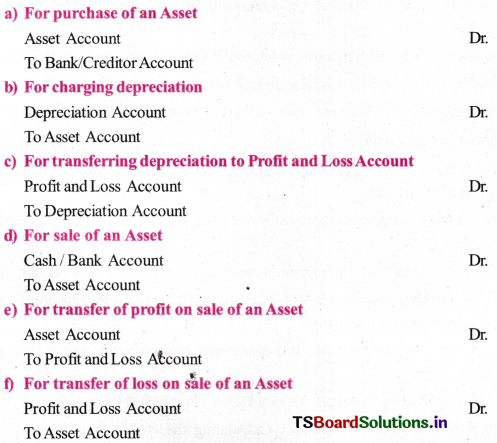
Sale of Asset: If a fixed asset is sold during the accounting year, depreciation is calculated only up to the date of sale. Any profit or loss arising from the sale is transferred to the Profit and Loss Account. For example, if a vehicle is sold on 1st October 2024 and the books close on 31st March 2025, depreciation will be provided for six months up to the date of disposal.
The following journal entries are required :
Question 2.
Explain the merits and demerits of the Straight Line and Reducing Balance Methods.
Answer:
i) Merits of the Straight Line Method :
The important advantages of the Straight Line Method are as follows:
- Simple to Understand : It is easy to leam and implement.
- Easy Calculation : Depreciation is computed using a simple formula.
- Equal Allocation : The cost ofthe asset is distributed evenly over its useful life.
- Suitable for Estimable Life: It is appropriate where the useful life of an asset can be estimated accurately.
- Consistent Depreciation : The same amount of depreciation is charged every year.
- Complete Depreciation The asset is fully depreciated up to its scrap value or nil value.
- Generally Accepted : It is widely accepted under standard accounting practices.
Demerits of the Straight Line Method :
The main limitations of this method are:
- Fixed Depreciation Charge Depreciation remains the same every year even though repair expenses generally increase with age.
- Difficulty in Adj ustments Calculating depreciation becomes complicated when assets are purchased or sold during the year.
- Not Accepted for Tax Purposes: It is generally not recognised under the Income Tax Act.
- Ignores Interest Factor Interest on the amount invested in the asset is not considered.
- Difficult Life Estimation : It is often difficult to estimate the exact useful life of an asset.
ii) Merits of the Reducing Balance (Written Down Value) Method :
The major advantages of this method are:
- Balanced Annual Cost : The combined total of depreciation and repair expenses remains almost uniform each year.
- More Practical : Depreciation gradually reduces as the asset grows older, reflecting its actual value.
- Accepted for Taxation : This method is recognised under the Income Tax Act, 1961.
- Ideal for Obsolescence-Prone Assets : It is suitable for assets that become outdated due to technological developments.
- Suitable for Long-Life Assets : It is appropriate for assets expected to have a long service life.
Demerits of the Reducing Balance (Written Down Value) Method :
- Complicated Rate Determination : Calculating the correct depreciation rate is comparatively difficult.
- Book Value Never Becomes Zero : The value of the asset never completely reduces to nil.
- Interest Ignored : Interest on the capital invested in the asset is not taken into account.
- No Provision for Replacement : This method does not create a fund for replacing the asset in future.
Question 3.
Distinguish between the Straight-Line Method and the Reducing Balance Method.
Answer:
The following are the major differences between the Straight Line Method and the Reducing Balance Method.
| Basis of Difference | Straight-Line Method | Reducing Balance Method |
| 1. Basis of Calculation | Depreciation is calculated on the original cost of the asset. | Depreciation is calculated on the written down (book) value, i.e., original cost less accumulated depreciation. |
| 2. Amount of Depreciation | The depreciation amount remains the same every year. | The amount of depreciation reduces year after year. |
| 3. Total Charge to Profit & Loss Account (Depreciation + Repairs) | Since depreciation remains constant and repair expenses increase over time, the total charge increases in later years. | As depreciation decreases and repair expenses increase, the combined total remains nearly uniform every year. |
| 4. Recognition under Income Tax Law | This method is generally not recognised under the Income Tax Act. | This method is recognised under the Income Tax Act. |
| 5. Suitability | Suitable for assets that require fewer repairs and are less affected by obsolescence. | Suitable for assets that become obsolete due to technological changes and require increasing repair costs over time. |
Exercises
Straight Line Method or Fixed Installment Method
I. Very Short Answer Questions
Question 1.
Rohit Enterprises purchased furniture for ₹ 90,000. The estimated life of the furniture is 8 years, and its residual value is ₹ 6,000. Calculate the annual amount of depreciation according to the Straight Line Method.
Solution:
Straight Line Method Fomula :
Annual Depreciation \(=\frac{\text { Cost }- \text { Residual Value }}{\text { Useful Life }}\)
Substitue the values = \(\frac{90,000-6,000}{8}\) = \(\frac{84,000}{8}\) = 10,500
Annual Depreciation = ₹ 10,500
Question 2.
Kiran Industries purchased a machine for ₹ 50,000. It is estimated that the useful life of the machine is 6 years and the residual value is ₹ 5,000. You are required to find the annual amount of depreciation and the rate of depreciation under the Straight Line Method.
Solution:
Annual Depreciation = \(=\frac{\text { Cost-Residual Value }}{\text { Useful Life }}\) = \(\frac{50,000-5,000}{6}\) = \(\frac{45,000}{6}\) = 7,500
Annual Depreciation = ₹ 7,500
Rate of Depreciation:
Rate \(=\left(\frac{\text { Annual Depreciation }}{\text { Cost }}\right)\) × 100 = \(\left(\frac{7,500}{50,000}\right)\) × 100 = 15%
Question 3.
AgroTech Farmers Pvt. Ltd. purchased a tractor for ₹ 12,00,000. It is estimated that the useful life of the tractor is 8 years and the residual value is ₹ 2,40,000. Calculate the annual amount of depreciation and the rate of depreciation under the Straight Line Method.
Solution:
Annual Depreciation:
Annual Depreciation \(=\frac{\text { Cost }- \text { Residual Value }}{\text { Useful Life }}\)
= \(\frac{12,00,000-2,40,000}{8}\) = \(\frac{9,60,000}{8}\) = 1,20,000
Anual Depreciation = ₹ 1,20,000
Rate of Depreciation :
Rate \(=\left(\frac{\text { Annual Depreciation }}{\text { Cost }}\right)\) × 100 = \(\left(\frac{1,20,000}{12,00,000}\right)\) × 100 = 10%
FinalAnswer:
Annual Depreciation = ₹ 1,20,000
Rate of Depreciation = 10% p.a.
II. Short Answer Questions
Question 4.
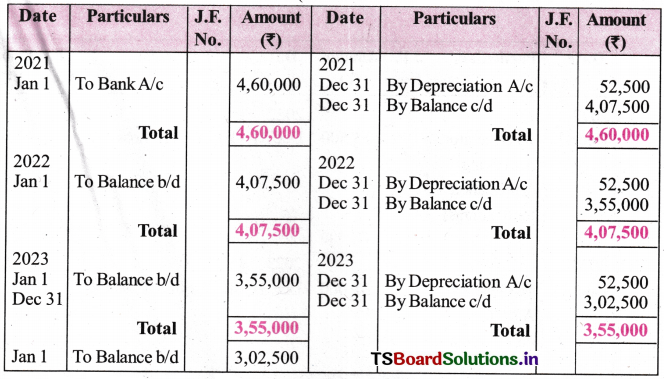
On 1st January 2021, Neha Enterprises purchased a machine for ₹ 4,00,000 and spent ₹ 60,000 on its installation. It is estimated that the working life of the machine is 8 years, and after 8 years its scrap value will be ₹ 40,000. Books are closed on 31st December every year.
Prepare the Machine Account for the first three years in the books of Neha Enterprises according to the Straight Line Method.
Solution:
Calculation of Annual Depreciation:
Total Cost : 4,00,000 + 60,000 = ₹ 4,60,000
Scrap Value : ₹ 40000
Estimated Life: 8 years
Annual Depreciation \(=\frac{460000-40000}{8}\) = \(\frac{420000}{8}\) = 52500
Question 5.
On 1st July 2022, Arjun Electronics purchased a generator for ₹ 3,00,000 and spent ₹ 30,000 on its installation and wiring. It was estimated that the effective useful life of the generator will be 10 years and its scrap value will be ₹ 20,000. The firm closes its books on 31st December every year.
Prepare the Generator Account and Depreciation Account for the first three years according to the Straight Line Method.
Solution:
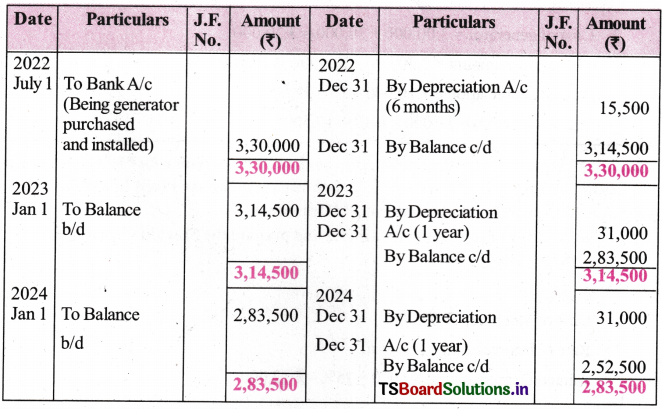
Depreciation Account:
In the books of Arjun Electronics
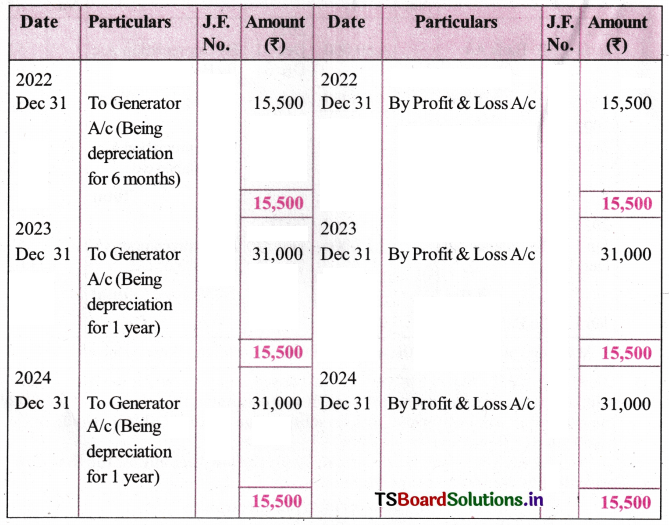
Working Note:
- Cost of generator = 3,00,000 + 30,000 = 3,30,000
- Depreciable amount = 3,30,000-20,000 = 3,10,000
- Annual depreciation = 3,10,000 ÷ 10 = 31,000
- 2022 (6 months) = 31,000 × 6/12 = 15,500
Question 6.
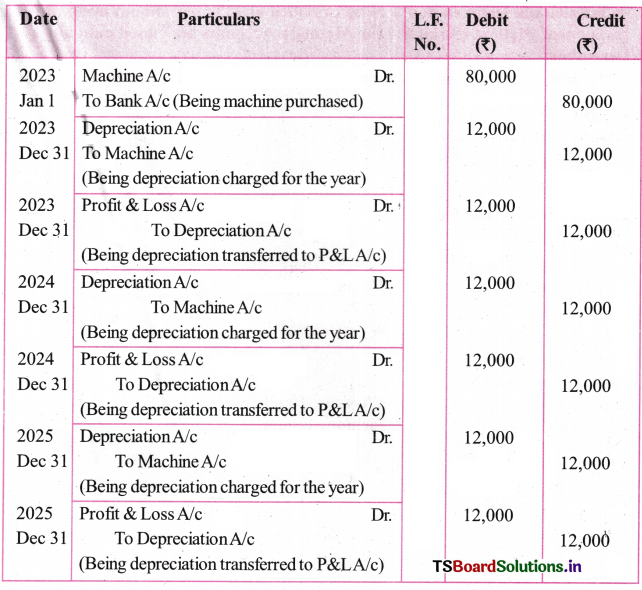
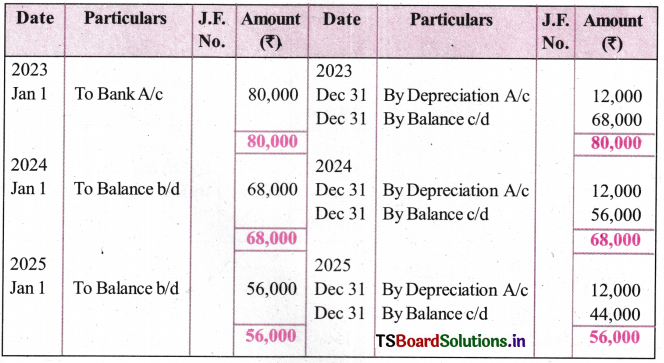
On 1st January 2023, Aarav Enterprises purchased a machine for ₹ 80,000. Depreciation is to be provided at the rate of 15% per annum using the Fixed Installment Method. Accounts are closed annually on 31st December.
Record the required journal entries and prepare the Machine Account covering the first three years.
Solution:
Working Note:
- Cost of Machine = ₹ 80,000
- Rate of Depreciation = 15% p.a.
- Annual Depreciation = 80,000 × 15% = ₹ 12,000
Journal Entries
Machine Account in the books of Aarav Enterprises
Question 7.
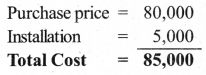
On 1st July 2021, Meera & Go. purchased a machine for ₹ 80,000 and spent ₹ 5,000 on its installation. Depreciation is to be provided at 12% per annum using the Fixed Installment Method (Straight Line Method). Accounts are closed annually on 31st December.
Maintain the Machine Account and indicate the balances for the initial three years.
Solution:
1. Cost of Machine :
2. Depreciation Calculation:
Rate = 12% p.a.
Annual Depreciation = 85,000 × 12% = 10,200 per year
Since the machine was purchased on 1st July 2021, depreciation for 2021 is only for 6 months:
- 2021 : 10,200 × 6/12 = 5,100
- 2022 : 10,200
- 2023 : 10,200
Machine Account (for 3 years)
Machine Account
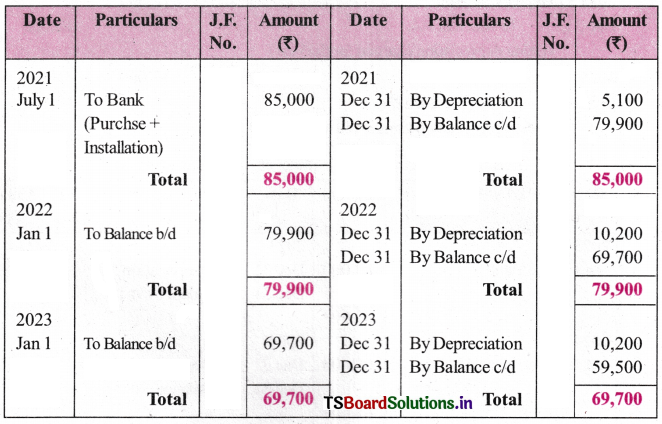
Balances at the end of each year :
- 31 Dec 2021 – ₹ 79,900
- 31 Dec 2022 – ₹ 69,700
- 31 Dec 2023 – ₹ 59,500
Question 8.
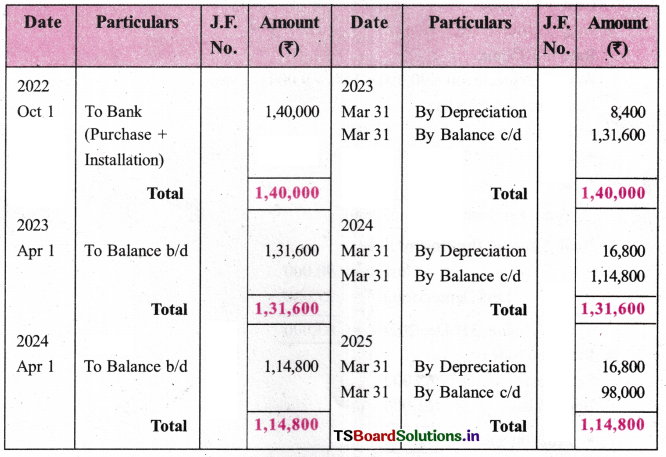
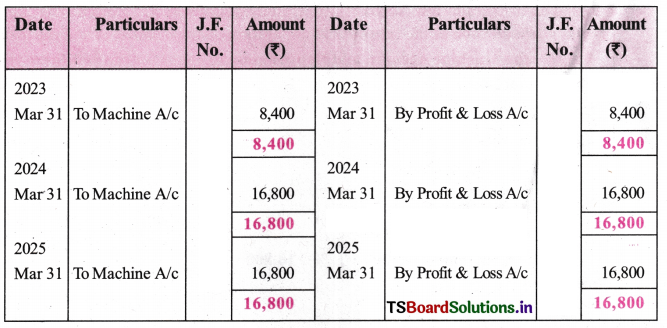
On 1st October 2022, Raghav & Co. purchased a machine for ₹ 1,20,000 and spent ₹ 20,000 on its installation. Accounts are closed annually on 31st March. The company provides depreciation at the rate of 12% per annum on the original cost of the machine. Prepare the Machine Account and Depreciation Account for the first three years.
Solution:
1. Cost of Machine :
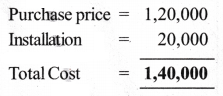
2. Depreciation Calculation:
Rate = 12% p.a. on original cost
Annual Depreciation = 1,40,000 × 12% = 16,800
Time periods:
- Purchased on 1st Oct 2022
- Books closed on 31st March
So:
- 2022-23 (6 months) – 16,800 × 6/12 = 8,400
- 2023-24 (full year) -16,800
- 2024-25 (full year) -16,800
Machine Account
2022-23
Depreciation Account
Question 9.
On 1st January 2022, Bhagat Singh purchased Furniture for ₹ 90,000. Depreciation is to be provided annually at 10% under the Straight Line Method. On 31st December 2024, the furniture was sold for ₹ 65,000.
Prepare the Furniture Account, assuming accounts are finalized annually on 31st December.
Solution:
Let’s solve it step by step using the Straight Line Method (SLM).
1. Cost of Furniture:
Cost = ₹ 90,000
2. Depreciation Calculation:
Rate = 10% p.a.
Annual Depreciation = 90,000 × 10% = 9,000 per year
Depreciation for 3 years :
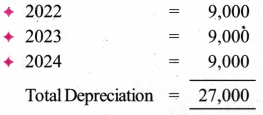
3. Book Value at the time of Sale :
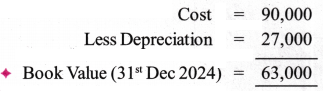
4. Profit on Sale :
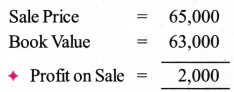
Furniture Account
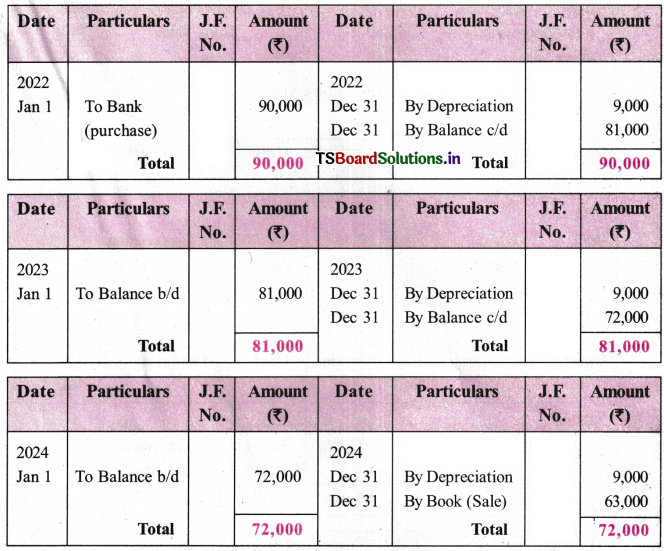
Question 10.
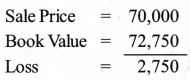
Sukhdev purchased a second-hand machine for ₹ 85,000 and spent ₹ 12,000 on repairs and installation on 1st January 2022. Depreciation is to be provided at 10% per annum using the Straight Line Method. On 30th June 2024, the machine was sold for ₹ 70,000.
Record the Machinery Account for each accounting year, closing the books on 31st December.
Solution:
1. Cost of Machine :
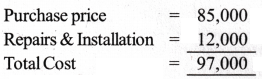
2. Depreciation Calculation:
Rate = 10% p. a.
Annual Depreciation = 97,000 × 10% = 9,700
Depreciation for each year:
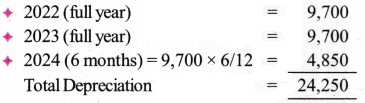
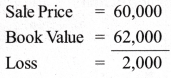
3. Book Value at Sale (30th June 2024):
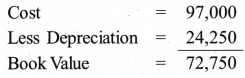
4. Loss on Sale:
Machinery Account
2022
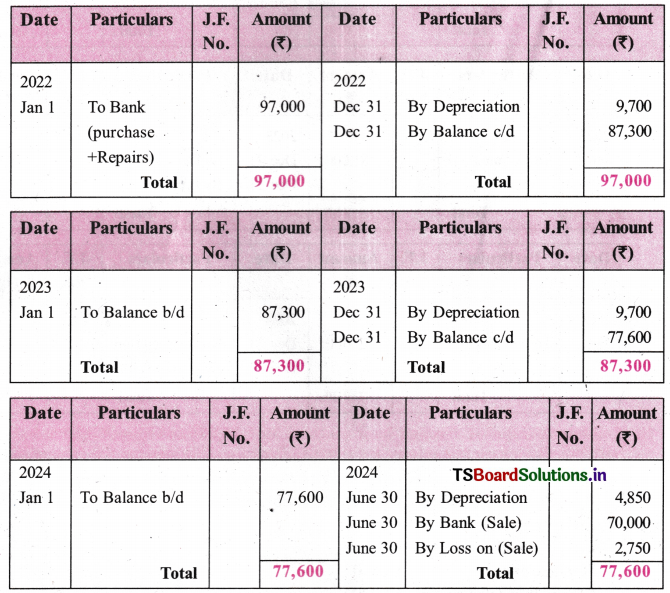
Question 11.
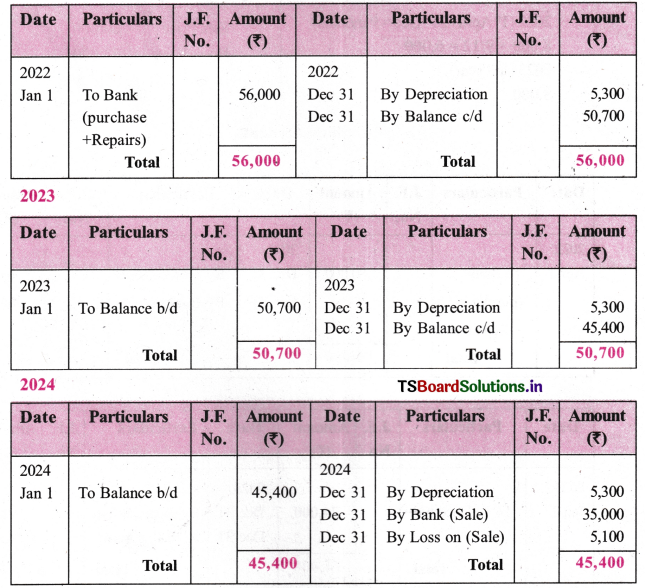
On 1st January 2022, Isha Solutions purchased a second-hand machine for ₹ 50,000 and spent ₹ 6,000 on repairs and installation. It is estimated that the machine has a useful life of 10 years and a scrap value of ₹ 3,000. On 31st December 2024, the machine was sold for ₹ 35,000. Prepare the Machinery Account for each year, considering the books are closed on 31st December, using the Straight Line Method.
Solution:
1. Cost of Machine :
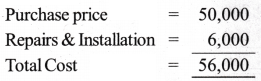
2. Depreciation Calculation:
Formula under SLM with scrap value:
Depreciation = \(\frac{\text { Cost-Scrap Value }}{\text { Life }}\) = \(\frac{56,000-3,000}{10}\) = \(\frac{53,000}{10}\) = 5,300 per year
3. Depreciation for 3 Years:
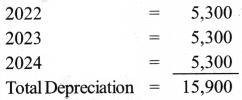
4. Book Value on 31st Dec 2024 :
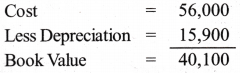
5. Loss on Sale :
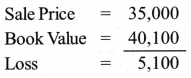
Machinery Account
2022
Question 12.
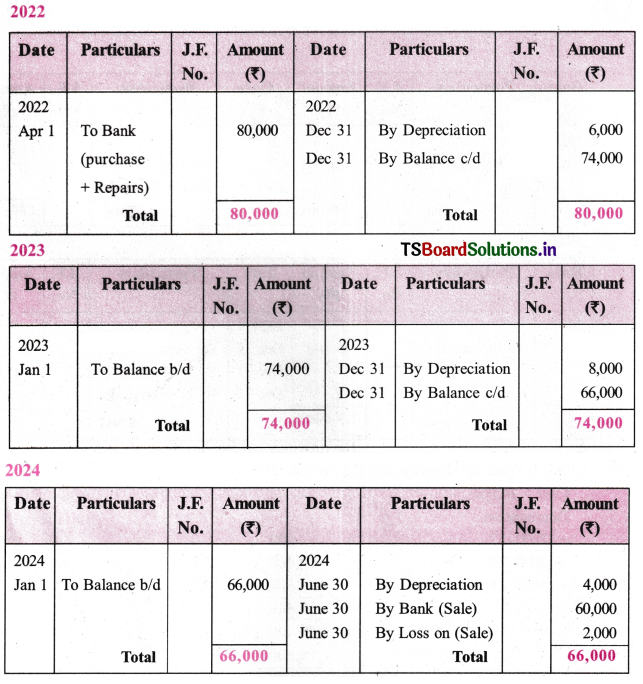
Shiv Dev Enterprises purchased a second-hand vehicle for ₹ 75,000 on 1st April 2022 and spent ₹ 5,000 on repairs and installation to make it roadworthy. Depreciation is to be written off at 10% per annum using the Fixed Installment Method. On 30th June, 2024, the vehicle was sold for ₹ 60,000.
Prepare the Vehicle Account for each financial year ending on 31st December, using the Fixed Installment Method.
Solution:
1. Cost of Vehicle:
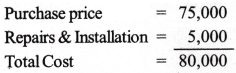
2. Depreciation Calculation:
Rate = 10%p.a.
Annual Depreciation 80,000 × 10%
= 8,000
3. Depreciation for each period:
♦ 2022(1st April – 31stDec=9months)
8,000 × 9/12 = 6,000
♦ 2023(full year)
8,000
♦ 2024 (1 Jan-30th June =6 months)
8,000 × 6/12 = 4,000
Total Depreciation = 18,000
4. Book Value at Sale:
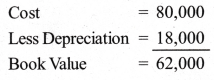
5. Loss on Sale:
Vehicle Account
Long Answer Questions
Question 13.
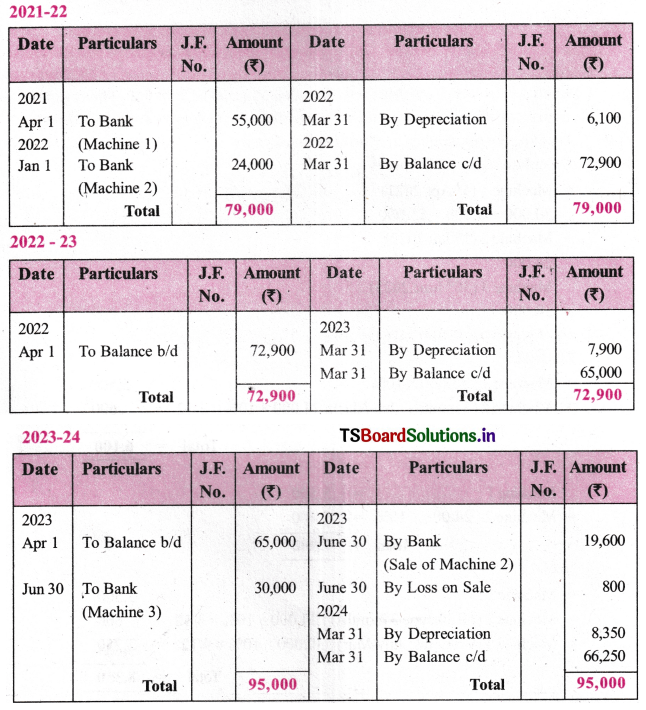
Adiyogi Enterprises purchased a second-hand machine for ₹ 50,000 on 1st April 2021 and spent ₹ 5,000 on repaid On 1st January 2022, a new machine was purchased for ₹ 24,000. On 30th June 2023, the machine purchased on 1st January 2022 was sold for ₹ 19,600, and another machine was installed at a cost of ₹ 30,000. The company writes off depreciation @10% per annum on original cost every year on 31st March.
Prepare the machinery account for three years.
Solution:
1. Calculate Cost of Machines :
- Machine 1 (1st Apr 2021)
50,000 + 5,000 = 55,000 - Machine 2 (1st Jan 2022)
24,000 - Machine 3 (30th June 2023)
30,000
2. Depreciation Calculations (10%):
2021-22

2022-23
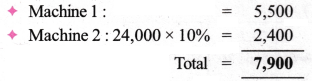
2023-24
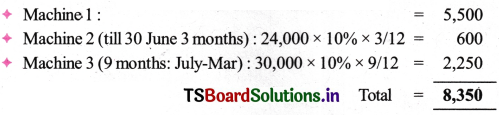
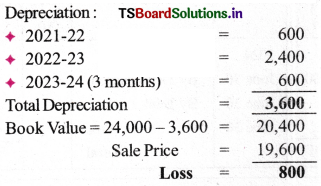
3. Book Value of Machine Sold (Machine 2):
Machinery Account
Question 14.
TechNova Solutions purchased 8 computers at ₹ 75,000 each on 01-01-2022. The company writes off depreciation @ 10% p.a. on original cost. The accounts are closed annually on 31st December. On 30-06-2024, one of the computers was completely damaged due to a power surge. The company received ₹ 40,000 from the insurance company in full settlement. Prepare the Computers Account for the first three years.
Solution:
1. Cost of Computers :
Number of computers = 8; Cost per computer = 75,000
Total Cost = 8 × 75,000 = 6,00,000
2. Depreciation Calculation:
Rate = 10% p.a.
Annual Depreciation (on all 8 computers) = 6,00,000 × 10% = 60,000
Per computer depreciation = 7,500 per year
3. Depreciation for Each Year:
2022
Full year on 8 computers : 60,000
2023
Full year on 8 computers : 60,000
2024
♦ For 6 months (Jan-June) on 8 computers : 60,000 × 6/12 = 30,000
4. Loss of One Computer (30th June 2024) :
Book value of 1 computer:
Cost = 75,000
Depreciation:
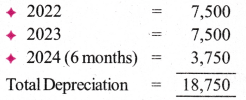
Book Value = 56,250 ; Insurance received = 40,000
Loss = 56,250 – 40,000 = 16,250.
5. Value of Remaining Computers:
After removing one computer:
Remaining cost = 7 × 75,000 = 5,25,000
Computers Account
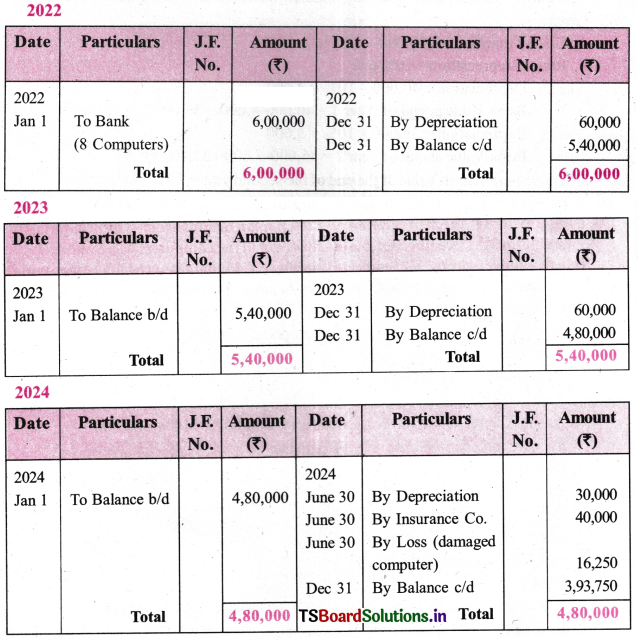
Final Balances
- 31st Dec 2022 – 5,40,000
- 31st Dec 2023 – 4,80,000
- 31st Dec 2024 – 3,93,750
Key Points
- Depreciation is charged till the date of loss.
- Insurance received is credited in the asset account.
- Loss = Book Value – Insurance claim.
Reducing Balance Method
I. Very Short Answer Questions
Question 15.
A machine costing ₹ 40,000 is depreciated at 10% per annum under the Reducing Balance Method. Find the book value of the machine at the end of the second year.
Solution:
Given:
♦ Cost of machine = ₹ 40,000
♦ Rate of depreciation = 10% p.a.
Year 1 : Depreciation = 40,000 × 10% = 4,000
Book Value at end of Year 1 = 40,000 – 4,000 = 36,000
Year 2 : Depreciation = 36,000 × 10% = 3,600
Book Value at end of Year 2 = 36,000 – 3,600 = 32,400
Final Answer: Book Value at the end of the second year = ₹ 32,400
Question 16.
A company purchased equipment for ₹ 1,00,000. Depreciation is to be charged at 20% per annum under the Reducing Balance Method. Calculate the amount of depreciation for the first two years.
Solution:
Given:
♦ Cost of equipment = ₹ 1,00,000
♦ Rate of depreciation = 20% p.a.
Year 1: Depreciation = 1,00,000 × 20% = 20,000
Book Value at end of Year 1 = 1,00,000 – 20,000 = 80,000
Year 2 Depreciation = 80,000 × 20% = 16,000
Final Answer:
- Depreciation for Year 1 = ₹ 20,000
- Depreciation for Year 2 = ₹ 16,000
II. Short Answer Questions
Question 17.
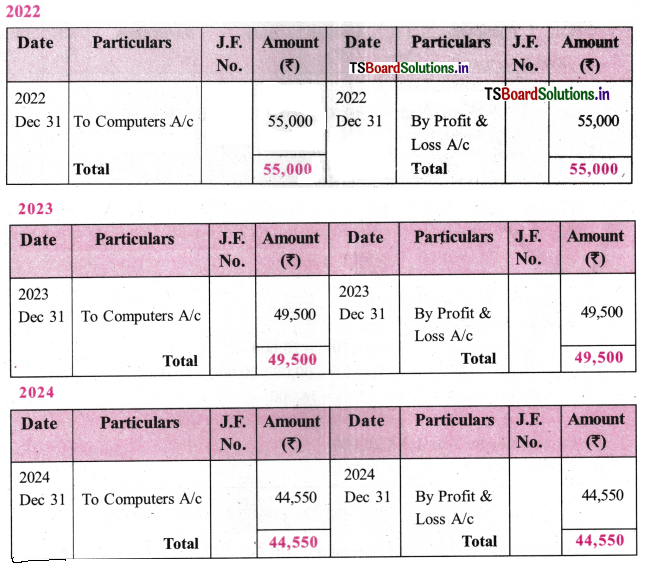
Digitech Solutions purchased computers on 01-01-2022 for ₹ 5,00,000 and spent ₹ 50,000 on their installation. Depreciation is provided @ 10% p.a. on the Reducing Balance Method. The accounts are closed annually on 31st December.
Solution:
1. Cost of Computers :
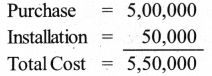
2. Depreciation Calculation (10% p.a.):
2022
Depreciation = 5,50,000 × 10% = 55,000
Closing Value = 4,95,000
2023
Depreciation = 4,95,000 × 10% = 49,500
Closing Value = 4,45,500
2024
Depreciation = 4,45,500 × 10% = 44,550
Depreciation Account
Question 18.
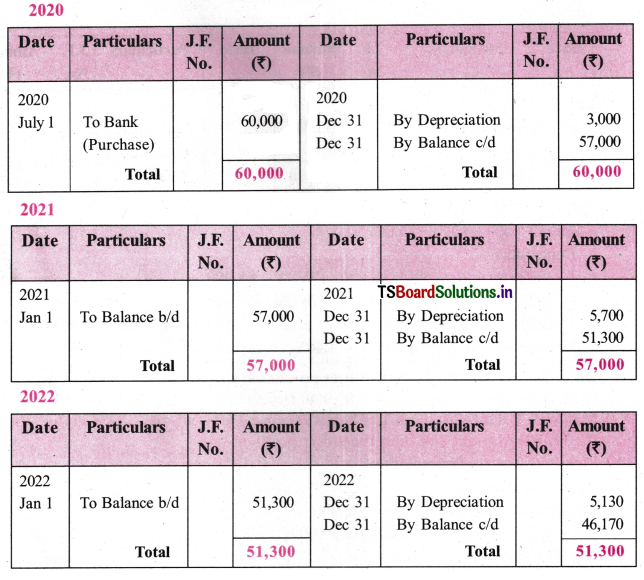
On 1st July 2020, Arjun & Co purchased a machine for ₹ 60,000. Depreciation is written off at the rate of 10% p.a. under the Reducing Balance Method. Show the Machine Account for three years, assuming the books are closed on 31st December each year.
Solution:
1. Given:
- Cost of machine = ₹ 60,000
- Rate of depreciation = 10% p.a.
- Purchased on 1st July 2020
- Books closed on 31st December
2. Depreciation Calculation:
2020 (6 months).
Depreciation = 60,000 × 10% × 6/12 = 3,000
Closing Value = 60,000 – 3,000 = 57,000
2021 (full year)
Depreciation = 57,000 × 10% = 5,700
Closing Value = 57,000 – 5,700 = 51,300
2022 (full year)
Depreciation = 51,300 × 10% = 5,130
Closing Value = 51,300 – 5,130 = 46,170
Machine Account
Question 19.
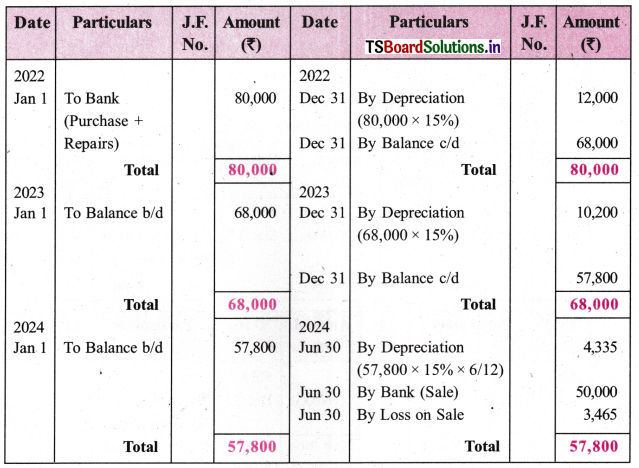
On 1st January 2022, NeoTech Solutions purchased a second-hand machine for ₹ 60,000 and spent ₹ 20,000 on repairs and installation. On 30th June 2024, the machine was sold for ₹ 50,000. Depreciation is provided @15% p.a. using the Reducing Balance Method. The books are closed annually on 31st December. Prepare the Machinery Account.
Solution:
Machinery Account (NeoTech Solutions)
Working Notes:
- Initial Cost = 60,000 + 20,000 = 80,000
- Depreciation:
- 2022 : 80,000 × 15% = 12,000 → WDV = 68,000
- 2023 : 68,000 × 15% = 10,200 → WDV = 57,800
- 2024 (6 months): 57,800 × 15% × 6/12 = 4,335 → Book Value = 53,465
- Loss on Sale = 53,465 – 50,000 = 3,465
Question 20.
On 1st January 2022, Bhumi Ventures purchased a vehicle for ₹ 4,50,000. On 30th June 2024, the vehicle was sold for ₹ 2,80,000. Depreciation is provided @ 20% p.a. on the Reducing Balance Method. The books are closed annually on 31st December. Prepare the Vehicle Account and show the loss or profit on sale.
Solution:
Step 1: Calculate Depreciation
2022 (Full Year)
Depreciation = 4,50,000 × 20% = 90,000
Book Value = 4,50,000 – 90,000 = 3,60,000
2023 (Full Year)
Depreciation = 3,60,000 × 20% = 72,000
Book Value = 3,60,000 – 72,000 = 2,88,000
2024 (6 months till sale)
Depreciation = 2,88,000 × 20% × 6/12 = 28,800
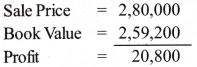
Book Value on 30-06-2024 – 2,88,000 – 28,800 = 2,59,200
Step 2 : Profit / Loss on Sale
Vehicle Account (Exam Format)
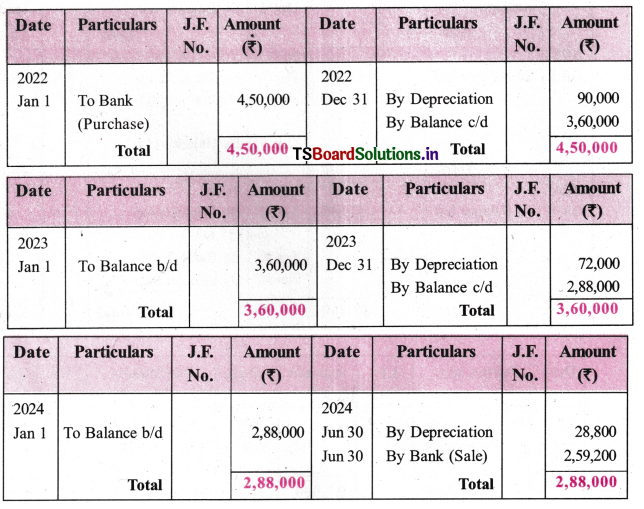
Final Answer :
Profit on Sale of Vehicle = ₹ 20,800
III. Long Answer Questions
Question 21.
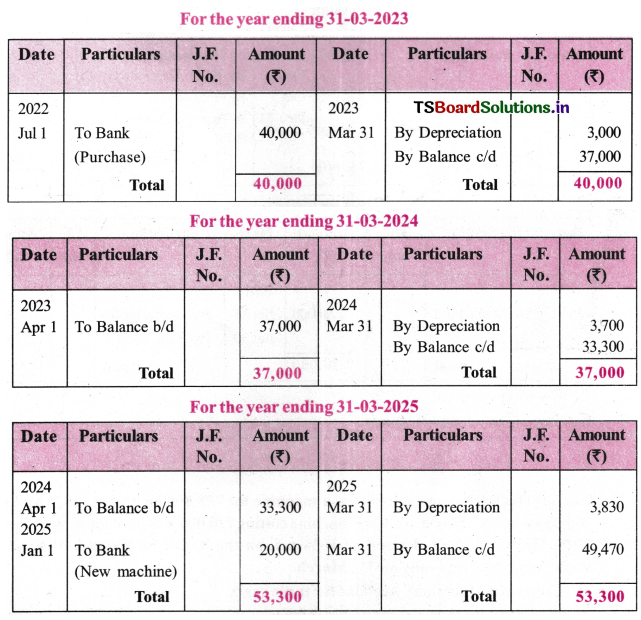
Parvathi Tech Solutions purchased a machine for ₹ 35,000 on 1st July 2022 and spent ₹ 5,000 on its installation. Another machine costing ₹ 20,000 was purchased on 1st January 2025. Depreciation is charged @ 10% p.a. on the Reducing Balance Method. The books are closed annually on 31st March. Maintain a Machinery Account for three years.
Solution:
Step 1: Calculate the Cost of the Machine :
First Machine = 35,000 + 5,000 (installation) = 40,000
Step 2: Depreciation Calculation :
Year 1: 2022-23 (1 July 2022 to 31st March 2023 → 9 months)
Depreciation = 40,000 × 10% × 9/12 = 3,000
Closing Value = 40,000 – 3,000 = 37,000
Year 2 : 2023-24 (Full Year)
Depreciation = 37,000 × 10% = 3,700
Closing Value = 37,000 – 3,700 = 33,300
Year 3: 2024-25
♦ Old Machine Depreciation = 33,300 × 10% = 3,330
♦ New Machine (1st Jan 2025 → 3 months): = 20,000 × 10% × 3/12 = 500
Total Depreciation = 3,330 + 500 = 3,830
Closing Value = (33,300 + 20,000) – 3,830 = 49,470
Machinery Account (Exam Format)
For the year ending 31-03-2023
Final Answer:
Closing Value (31-03-2025) = ₹49,470
Question 22.
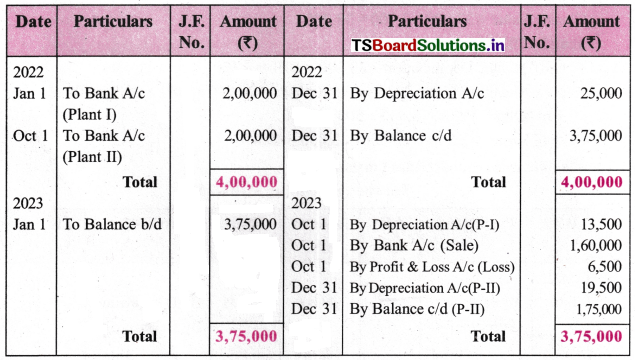
On 1st January 2022, Bhairavi Enterprises purchased a plant for ₹ 2,00,000. Another plant was purchased on 1st October 2022 for ₹ 2,00,000. Depreciation is charged @ 10% p.a. on the Reducing Balance Method. On 1st October 2023, the first plant was sold for ₹ 1,60,000. Show the Plant Account year by year, with accounts closed on 31st December each year.
Solution:
Bhairavi Enterprises- Plant Account