
Referring to the AP Inter 1st Year Maths Study Material Chapter 11 Introduction to 3D Geometry Exercise 11c Solutions makes it easier to understand complex problems.
AP Inter 1st Year Maths Introduction to 3D Geometry Solutions Exercise 11c
I.
Question 1.
Three vertices of a parallelogram ABCD are A(3, -1, 2), B(1, 2, -4) and C(-l, 1, 2). Find the coordinates of the fourth vertex.
Solution:
Let A = (x1, y1, z1) = (3, -1, 2) B = (x2, y2, z2) = (1, 2, -4) C = (x3, y3, z3) = (-1, 1, 2) D = (x4, y4, z4) = (α, β, γ)
The fourth vertex of a parallelogram is
D = [x1 + x3 – x2, y1 + y3 – y2, z1 + z3 – z2]
(α, β, γ) = (3 – 1 -1, -1 + 1 – 2, 2 + 2 + 4)
α = 1, β = -2, γ = 8
D = (1,-2, 8) is the fourth vertex of a parallelogram.

Question 2.
If the origin is the centroid of the triangle PQR with vertices P(2a, 2, 6), Q(-4, 3b, -10) and R(8, 14, 2c), then find the values of a, b and c.
Solution:
Let P = (x1, y1, z1) = (2a, 2, 6)
Q = (x2, y2, z2) = (-4, 3b, -10)
R = (x3, y3, z3) = (8, 14, 2c)
Since origin is centroid then G = (0, 0, 0)
The centroid of the triangle PQR is G = \(\frac{1}{2}\)
(0, 0, 0) = \(\left[\frac{2 a-4+8}{3}, \frac{2+3 b+14}{3}, \frac{6-10+2 c}{3}\right]\)
⇒ (0, 0, 0) = \(\left(\frac{2 a+4}{3}, \frac{3 b+16}{3}, \frac{2 c-4}{3}\right)\)
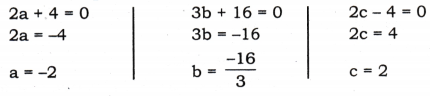
∴ a = -2, b = \(\frac{-16}{3}\), c = 2
Question 3.
If A and B be the points (3, 4, 5) and (-1, 3, -7), respectively, find the equation of the set of points P such that PA2 – PB2 = k2, where k is a constant.
Solution:
Let P(x, y, z) be the locus of a point.
Let A = (3, 4, 5) B = (-1, 3,-7)
Since PA2 – PB2 = k2
⇒ (x – 3)2 + (y – 4)2 + (z – 5)2 – (x + 1)2 – (y – 3)2 – (z + 7)2 = k2

⇒ -8x – 2y – 24z – 9 = k2
⇒ 8x + 2y + 24z + 9 + k2 = 0
⇒ 8x + 2y + 24z + 9 + k2 = 0 which is the required equation.
II.
Question 1.
Find the lengths of the medians of the triangle with vertices A(0, 0, 6), B(0, 4, 0) and C(6, 0, 0).
Solution:
Let A = (0, 0, 6), B = (0, 4, 0), C = (6, 0, 0)
Let D is the midpoint of \(\overline{\mathrm{BC}}\)
D = \(\left[\frac{0+6}{2}, \frac{4+0}{2}, \frac{0+0}{2}\right]\) = [3, 2, 0]
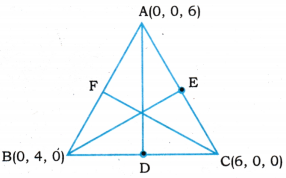
Let E is the midpoint of \(\overline{\mathrm{AC}}\)
E = \(\left[\frac{0+6}{2}, \frac{0+0}{2}, \frac{6+0}{2}\right]\) = [3, 0, 3]
Let F is the midpoint of \(\overline{\mathrm{AB}}\)
F = \(\left[\frac{0+0}{2}, \frac{0+4}{2}, \frac{6+0}{2}\right]\) = [0, 2, 3]
So \(\overline{\mathrm{AD}}, \overline{\mathrm{BE}}, \overline{\mathrm{CF}}\) will be the medians of the triangle.
Since the length of \(\overline{\mathrm{AD}}=\sqrt{\left(\mathrm{x}_2-\mathrm{x}_1\right)^2+\left(\mathrm{y}_2-\mathrm{y}_1\right)^2+\left(\mathrm{z}_2-\mathrm{z}_1\right)^2}\)
\(\overline{\mathrm{AD}}=\sqrt{(3-0)^2+(2-0)^2+(0-6)^2}=\sqrt{9+4+36}=\sqrt{49}\) = 7
The length of \(\overline{\mathrm{BE}}\) is \(\sqrt{\left(\mathrm{x}_2-\mathrm{x}_1\right)^2+\left(\mathrm{y}_2-\mathrm{y}_1\right)^2+\left(\mathrm{z}_2-\mathrm{z}_1\right)^2}\)
\(\overline{\mathrm{BE}}=\sqrt{(3-0)^2+(0-4)^2+(3-0)^2}=\sqrt{9+16+9}=\sqrt{34}\)
The length of \(\overline{\mathrm{CF}}\) is \(\sqrt{\left(\mathrm{x}_2-\mathrm{x}_1\right)^2+\left(\mathrm{y}_2-\mathrm{y}_1\right)^2+\left(\mathrm{z}_2-\mathrm{z}_1\right)^2}\)
\(\overline{\mathrm{CF}}=\sqrt{(6-0)^2+(0-2)^2+(0-3)^2}=\sqrt{36+4+9}=\sqrt{49}\) = 7
Question 2.
A(5, 4, 6) B(1, -1, 3) and C(4, 3, 2) are three points. Find the co-ordinates of the point in which the bisector ∠BAC meets the side BC.
Solution:
Let A = (5, 4, 6), B = (1, -1, 3), C = (4, 3, 2)
AB = \(\sqrt{\left(\mathrm{x}_2-\mathrm{x}_1\right)^2+\left(\mathrm{y}_2-\mathrm{y}_1\right)^2+\left(\mathrm{z}_2-\mathrm{z}_1\right)^2}\)
= \(\sqrt{(1-5)^2+(-1-4)^2+(3-6)^2}=\sqrt{16+25+9}=\sqrt{50}\) = 5√2
AC = \(\sqrt{(4-5)^2+(3-4)^2+(2-6)^2}=\sqrt{(-1)^2+(-1)^2+(-4)^2}\)
= \(\sqrt{1+1+16}=\sqrt{18}\) = 3√2
Since the angular bisector of ∠BAC divides BC in the ratio AB : AC = 5√2 : 3√2 = 5:3
Let ‘D’ divides BC in the ratio 5 : 3
D = \(\left[\frac{5(4)+3(1)}{5+3}, \frac{5(3)+3(-1)}{5+3}, \frac{5(2)+3(3)}{5+3}\right]\)
= \(\left[\frac{20+3}{8}, \frac{12}{8}, \frac{19}{8}\right]=\left[\frac{23}{8}, \frac{3}{2}, \frac{19}{8}\right]\)
Question 3.
Show that the points 0(0, 0, 0), A(2, -3, 3) and B(-2, 3, -3) are collinear. Find the ratio in which each point divides the segment joining the other two points.
Solution:
Given points are O = (0, 0, 0), A = (2, -3, 3), B = (-2, 3, -3)
Now OA = \(\sqrt{4+9+9}=\sqrt{22}\)
AB = \(\sqrt{(2+2)^2+(3+3)^2+(-3-3)^2}=\sqrt{88}=2 \sqrt{22}\)
BO = \(\sqrt{(0+2)^2+(0-3)^2+(0+3)^2}=\sqrt{22}\)
OA + BO = \(\sqrt{22}+\sqrt{22}=2 \sqrt{22}\) = AB
O, A, B are collinear points.
The ratio in which P(x, y, z) divides Q(x1, y1, z1) and R(x2, y2, z2) is \(\frac{x_1-x}{x-x_2}\) (or) \(\frac{y_1-y}{y-y_2}\) (or) \(\frac{z_1-z}{z-z_2}\)
Now
\(\frac{O A}{A B}=\frac{0-2}{2+2}=\frac{-2}{4}=\frac{-1}{2}\),
\(\frac{A B}{B O}=\frac{2+2}{-2-0}=\frac{4}{-2}=\frac{-2}{1}\) and
\(\frac{\mathrm{OB}}{\mathrm{OA}}=\frac{2-0}{0+2}=\frac{2}{2}=\frac{1}{1}\)