
Referring to the AP Inter 1st Year Maths Study Material Chapter 10 Conic Sections Exercise 10c Solutions makes it easier to understand complex problems.
AP Inter 1st Year Maths Conic Sections Solutions Exercise 10c
I.
Question 1.
Find the eccentricity of the ellipse \(\frac{x^2}{a^2}+\frac{y^2}{b^2}\) = 1.
Solution:
Given ellipse is \(\frac{x^2}{a^2}+\frac{y^2}{b^2}\) = 1 (a < b).
Comparing to \(\frac{x^2}{a^2}+\frac{y^2}{b^2}\) = 1
a2 = 9, b2 = 16
Eccentricity (e) = \(\sqrt{\frac{b^2-a^2}{b^2}}=\sqrt{\frac{16-9}{16}}=\frac{\sqrt{7}}{4}\)
Question2.
Find the length of the latus rectum of ellipse x2 + 16y2 = 16
Solution:
Given ellipse is x2 + 16y2 = 16 ⇒ \(\frac{x^2}{16}+\frac{y^2}{1}\) = 1 (a > b)
Comparing to \(\frac{x^2}{a^2}+\frac{y^2}{b^2}\) = 1, a2 = 16, b2 = 1
The length of latus rectum = \(\frac{2 b^2}{a}=\frac{2(1)}{4}=\frac{1}{2}\)
II. In each of the Exercises 1 to 9, find the coordinates of the foci, the vertices, the length of major axis, the minor axis, the eccentricity and the length of the latus rectum of the ellipse.
Question 1.
\(\frac{x^2}{36}+\frac{y^2}{16}\) = 1
Solution:
The given equation is \(\frac{x^2}{36}+\frac{y^2}{16}\) = 1
Here, the denominator of \(\frac{x^2}{36}\) is greater than the denominator of \(\frac{y^2}{16}\).
Therefore, the major axis is along the X-axis, while the minor axis is along the Y-axis.
On comparing the given equation with \(\frac{x^2}{a^2}+\frac{y^2}{b^2}\) = 1. Now, a = 6 and b = 4
∴ c = \(\sqrt{a^2-b^2}=\sqrt{36-16}=\sqrt{20}\) = 2√5
The coordinates of the foci are (2√5,0) and (- 2√5,0)
The coordinates of the vertices are (6, 0) and (- 6, 0)
Length of the major axis = 2a = 12, Length of the minor axis = 2b = 8
Eccentricity, e = \(\frac{c}{a}=\frac{2 \sqrt{5}}{6}=\frac{\sqrt{5}}{3}\). Length of the latus rectum = \(\frac{2 b^2}{a} \Rightarrow \frac{2 \times 16}{6}=\frac{16}{3}\).
Question 2.
\(\frac{x^2}{4}+\frac{y^2}{25}\) = 1
Solution:
The given equation is \(\frac{x^2}{4}+\frac{y^2}{25}\) = 1
⇒ \(\frac{x^2}{2^2}+\frac{y^2}{5^2}\) = 1
Here, the denominator of \(\frac{y^2}{25}\) is greater than the denominator of \(\frac{x^2}{4}\)
Therefore, the major axis along the Y-axis, while the minor axis is along the X-axis.
On comparing the given equation with \(\frac{x^2}{b^2}+\frac{y^2}{a^2}\)j = 1,
b = 2 and a = 5 ⇒ c = \(\sqrt{a^2-b^2}=\sqrt{25-4}=\sqrt{21}\)
Therefore, the coordinates of foci are (0, \(\sqrt{21}\)) and (0, –\(\sqrt{21}\))
The coordinates of the vertices are (0, 5) and (0, -5)
Length of the major axis = 2a = 10, Length of the minor axis = 2b = 4
Eccentricity, e = \(\sqrt{a^2-b^2}=\sqrt{25-4}=\sqrt{21}\), Length of the latus rectum

Question 3.
\(\frac{x^2}{16}+\frac{y^2}{9}\) = 1
Solution:
The given equation is \(\frac{x^2}{16}+\frac{y^2}{9}\) = 1
⇒ \(\frac{x^2}{4^2}+\frac{y^2}{3^2}\) = 1
Here, the denominator of \(\frac{\mathrm{x}^2}{16}\) is greater than the denominator of \(\frac{y^2}{9}\)
Therefore, the major axis along the X-axis, while the minor axis is along the Y-axis.
On comparing the given equation with \(\frac{x^2}{a^2}+\frac{y^2}{b^2}\) = 1,
a = 4 and b = 3 ⇒ c = \(\sqrt{a^2-b^2}=\sqrt{16-9}=\sqrt{7}\)
Therefore, the coordinates of foci are (±√7,0)
The coordinates of the vertices are (± 4, 0)
Length of the major axis = 2a = 8
Length of the minor axis = 2b = 6
e = \(\frac{c}{a}=\frac{\sqrt{7}}{4}\), Length of the latus rectum = \(\frac{2 b^2}{a}=\frac{2 \times 9}{4}=\frac{9}{2}\)
Question 4.
\(\frac{x^2}{25}+\frac{y^2}{100}\) = 1
Solution:
The given equation is \(\frac{x^2}{25}+\frac{y^2}{100}\) = 1
⇒ \(\frac{x^2}{5^2}+\frac{y^2}{10^2}\) = 1
Hence, the denominator of \(\frac{y^2}{100}\) is greater than the denominator of \(\frac{x^2}{25}\)
Therefore, the major axis is along the Y-axis, while the minor axis is along the X-axis.
On comparing the given equation with \(\frac{x^2}{b^2}+\frac{y^2}{a^2}\) = 1. Now b = 5 and a = 10
∴ c = \(\sqrt{a^2-b^2}=\sqrt{100-25}=\sqrt{75}\) = 5√3
The coordinates of foci are (0, ±5√3)
Therefore, the coordinates of the vertices are (0, ±10)
Length of the major axis = 2a = 20,
Length of the minor axis = 2b = 10
e = \(\frac{c}{a}=\frac{5 \sqrt{3}}{10}=\frac{\sqrt{3}}{2}\), Length of the latus rectum = \(\frac{2 b^2}{a}=\frac{2 \times 25}{10}\) = 5
Question 5.
\(\frac{x^2}{49}+\frac{y^2}{36}\) = 1
Solution:
The given equation is \(\frac{x^2}{49}+\frac{y^2}{36}\) = 1
⇒ \(\frac{x^2}{7^2}+\frac{y^2}{6^2}\) = 1
Hence, the denominator of \(\frac{x^2}{49}\) is greater than the denominator of \(\frac{y^2}{36}\)
Therefore, the major axis is along the X-axis, while the minor axis is along the Y-axis.
On comparing the given equation with \(\frac{x^2}{a^2}+\frac{y^2}{b^2}\) = 1,
a = 7 and b = 6
⇒ c = \(\sqrt{a^2-b^2}=\sqrt{49-36}=\sqrt{13}\)
Therefore, the coordinates of foci are (±\(\sqrt{13}\), 0)
The coordinates of the vertices are (±7, 0)
Length of the major axis = 2a = 14,
Length of the minor axis = 2b = 12
e = \(\frac{c}{a}=\frac{\sqrt{13}}{7}\), Length of the latus rectum = \(\frac{2 b^2}{a}=\frac{2 \times 36}{7}=\frac{72}{7}\)
Question 6.
\(\frac{x^2}{100}+\frac{y^2}{400}\) = 1
Solution:
The given equation is \(\frac{x^2}{100}+\frac{y^2}{400}\) = 1
⇒ \(\frac{x^2}{7^2}+\frac{y^2}{6^2}\) = 1
Here, the denominator of \(\frac{x^2}{49}\) is greater than the denominator of \(\frac{y^2}{36}\)
Therefore, the major axis is along the Y-axis while the minor axis is along the X-axis.
On comparing the given equation with \(\frac{1}{2}\) = 1
⇒ b = 10 and a = 20
c = \(\sqrt{a^2-b^2}=\sqrt{400-100}=\sqrt{300}\) = 10√3
Therefore, the coordinates of foci are (0, ±10√3)
The coordinates of vertices are (0, ±20)
Length of the major axis = 2a = 40, Length of the minor axis = 2b = 20
e = \(\frac{c}{a}=\frac{10 \sqrt{3}}{20}=\frac{\sqrt{3}}{2}\), Length of the latus rectum \(\frac{2 b^2}{a}=\frac{2 \times 100}{20}\) = 10
Question 7.
36x2 + 4y2 = 144
Solution:
The given equation is 36x2 + 4y2 = 144 can be written as
\(\frac{x^2}{4}+\frac{y^2}{36}\) = 1 ⇒ \(\frac{x^2}{2^2}+\frac{y^2}{6^2}\) = 1
Here, the denominator of \(\frac{y^2}{6^2}\) is greater than the denominator of \(\frac{x^2}{2^2}\)
Therefore, the major axis is along Y-axis while the minor axis is along the X-axis on.
On comparing equation (1) with \(\frac{x^2}{b^2}+\frac{y^2}{a^2}\) = 1
⇒ b = 2 and a = 61
c = \(\sqrt{a^2-b^2}=\sqrt{36-4}=\sqrt{32}\) = 4√2
Therefore, the coordinates of foci are (0, +4^2 ) The coordinates of the vertices are (0, ± 6) Length of the major axis = 2a = 12
Length of the minor axis = 2b = 4
e = \(\frac{c}{a}=\frac{4 \sqrt{2}}{6}=\frac{2 \sqrt{2}}{3}\),
Length of the latus rectum = \(\frac{2 b^2}{a}=\frac{2 \times 4}{6}=\frac{4}{3}\)
Question 8.
16x2 + y2 = 16
Solution:
The given equation is 16x2 + y2 = 16
It can be written by \(\frac{x^2}{1}+\frac{y^2}{16}\) = 1
⇒ \(\frac{x^2}{1^2}+\frac{y^2}{4^2}\) = 1 …. (1)
Here, the denommator of \(\frac{y^2}{4^2}\) is greater than the denominator of \(\frac{x^2}{1^2}\)
Therefore the major axis is along the Y-axis, while the minor axis is along the X-axis.
On comparing equation (1) with \(\frac{x^2}{b^2}+\frac{y^2}{a^2}\) = 1
⇒ a = 4 and b = 1
c = \(\sqrt{a^2-b^2}=\sqrt{16-1}=\sqrt{15}\) ⇒ c = \(\sqrt{15}\)
Therefore the coordinates of foci are (0, ± \(\sqrt{15}\)), the coordinate of the vertices are (0, ± 4)
Length of major axis = 2a = 8, Length of minor axis = 2b = 2
Eccentricity e = \(\frac{c}{a}=\frac{\sqrt{15}}{4}\), Length of latus rectum = \(\frac{2 b^2}{a}=\frac{2 \times 1}{4}=\frac{2}{4}=\frac{1}{2}\)
Question 9.
4x2 + 9y2 = 36
Solution:
The equation is 4x2 + 9y2 = 36
⇒ \(\frac{4 x^2}{36}+\frac{9 y^2}{36}\) = 1
⇒ \(\frac{x^2}{9}+\frac{y^2}{4}\) = 1
⇒ \(\frac{x^2}{3^2}+\frac{y^2}{2^2}\) = 1 ……………….. (1)
Here, the denominator of \(\frac{x^2}{3^2}\) is greater than the denominator of \(\frac{y^2}{2^2}\)
The major axis is along the X-axis while the minor axis along the Y-axis.
On comparing the given equation with \(\frac{x^2}{a^2}+\frac{y^2}{b^2}\) = 1, we have a = 3 and b = 2
⇒ c = \(\sqrt{a^2-b^2}=\sqrt{9-4}=\sqrt{5}\)
The coordinates of the foci are (±√5, O)
The coordinates of the vertices are (± 3, 0)
Length of major axis = 2a = 6, Length of minor axis = 2b = 4
Eccentricity e = \(\frac{c}{a}=\frac{\sqrt{5}}{3}\), Length of the latus rectum = \(\frac{2 b^2}{a}=\frac{2 \times 4}{3}=\frac{8}{3}\)
Question 10.
Find the equation of the ellipse with focus at (1, -1), e = 2/3 and directrix as x + y + 2 = 0.
Solution:
Given focus S = (1, -1), Eccentricity e = \(\frac{2}{3}\)
Equation of directrix is x + y + 2 = 0.
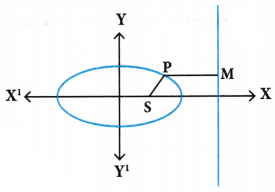
Let P(x, y) be the point on the ellipse, then \(\frac{\mathrm{SP}}{\mathrm{PM}}\) = e, SP = ePM.
⇒ SP2 = e2PM2
⇒ (x – 1)2 + (y + 1)22 = \(\frac{4}{9} \frac{|x+y+2|^2}{2}\)
⇒ 9[(x – 1)2 + (y + 1)2] = 2(x + y + 2)2
⇒ 9[x2 + 1 – 2x + y2 + 1 + 2y] = 2(x2 + y2 + 4 + 2xy + 4y +4x)
⇒ 9x2 + 9y2 – 18x + 18y + 18 = 2x2 + 2y2 + 4xy + 8x + 8y + 8
⇒ 7x2 – 4xy + 7y2 – 26x + 10y + 10 = 0
∴ The equation of the ellipse is 7x2 + 7y2 – 4xy – 26x + 10y + 10 = 0
Question 11.
Find the equation of the ellipse in the standard form whose distance between foci is 2 and the length of latus rectum is 15/2.
Solution:
Let \(\frac{1}{2}\) = 1 ………. (1) be the equation of ellipse.
Given the distance between foci = 2
2ae = 2 ⇒ ac = 1 ⇒ Length of the latus rectum = \(\frac{15}{2}\)
\(\frac{2 b^2}{a}=\frac{15}{2}\)
⇒ b = \(\frac{15 a}{4} \Rightarrow \frac{15 a}{4}\) = a2 – 1
[∵ b2 = a2(1 – e2) = b2 = a2 – a2e2]
⇒ 15a = 4a2 – 4
⇒ 4a2 – 15a – 4 = 0
⇒ 4a2 – 16a + a – 4 = 0
⇒ 4a (a – 4) + 1 (a – 4) = 0
⇒ (a – 4) (4a + 1) = 0
⇒ a – 4 = 0
⇒ a = 4; 4a + 10 ⇒ 4a = -1
⇒ a = –\(\frac{1}{4}\)
[∵ a = 4(+Ve)]
b2 = \(\frac{15(4)}{4}\) = 15
⇒ The equation of the ellipse is \(\frac{x^2}{16}+\frac{y^2}{15}\) = 1
Question 12.
Find the equation of the ellipse In the standard form such that distance between foci is 8 and distance between directrices is 32.
Solution:
Let the equation of the ellipse is \(\frac{x^2}{a^2}+\frac{y^2}{b^2}\) = 1 (a> b)
Given that the distance between foci = 8
∴ 2ae = 8 ⇒ ae = 4………. (1)
The distance between directrices = 32
\(\frac{2a}{e}\) = 32 ⇒ \(\frac{a}{e}\) = 16 ………. (2)
From (1) × (2)
⇒ ae × \(\frac{a}{e}\) = 4 × 16
⇒ a2 = 64
⇒ a = 8
We Know that b2 = a2(1 – e2)
b2 = a2 – a2e2
= (8)2 – (4)2
= 64 – 16
= 48
∴ b2 = 48
⇒ The equation of ellipse is \(\frac{x^2}{64}+\frac{y^2}{48}\) = 1
In each of the following BZerciaea 13 to 23, find the equation for the ellipse that satisfies the given conditions.
Question 13.
Vertices (± 5, 0), foci (± 4, 0)
Solution:
Vertices (± 5, 0), foci (± 4, 0).
Here the vertices are on the X-axis.
The equation at the ellipse will be of the form
\(\frac{1}{2}\) = 1, where ‘a is the semi-major axis
Accordingly a = 5 and c = 4. It is known that a2 = b2 + c2
52 = b2 + 42
25 = b2 + 16 ⇒ b2 = 9 ⇒ b = 3
Thus the equation of the ellipse is \(\frac{x^2}{5^2}+\frac{y^2}{3^2}\) = 1 (or) \(\frac{x^2}{25}+\frac{y^2}{9}\) = 1
Question 14.
Vertices (0, ± 13), foci (0, ± 5)
Solution:
Vertices (0, + 13), foci (0, ± 5)
Here the vertices are on the Y-axis.
So, the equation of the ellipse will be of the form \(\frac{1}{2}\) = 1, where ‘a’ is the semi¬major axis.
Accordingly a = 13 and c = 5, it is known that a2 = b2 + c2
⇒ 132 = b2 + 52
⇒ 169 = b2 + 25
⇒ b2 = 144
⇒ b = 12
Thus the equation of the ellipse is \(\frac{x^2}{12^2}+\frac{y^2}{13^2}\) = 1 (or) \(\frac{x^2}{144}+\frac{y^2}{169}\) = 1
Question 15.
Vertices (±6, 0), foci (±4, 0)
Solution:
Vertices (± 6, 0), foci (+ 4, 0), here the vertices are on the X-axis.
∴ The equation of the ellipse will be of the form “r + ^ = 1 where ‘a’ is the semi¬major axis.
Accordingly a = 6, c = 4, it is known that
a2 = b2 + c2
⇒ 62 = b2 + 42
⇒ 36 = b2 + 16
⇒ b2 = 20
⇒ b = \(\sqrt{20}\)
The equation of the ellipse is \(\frac{x^2}{3^2}+\frac{y^2}{2^2}\) = 1 ⇒ \(\frac{x^2}{9}+\frac{y^2}{4}\) = 1
Question 16.
End, of major axIs (±3, 0), ends of minor axIs (0, ± 2)
Solution:
Ends of major axis (±3, 0), ends of minor axis (0, ± 2)
The major axis is along with X-axis
∴ The equation of the ellipse will be of the form \(\frac{x^2}{a^2}+\frac{y^2}{b^2}\) = 1 where ‘a’ is the semi- major axis.
Accordingly a = 3 and b = 2
Thus the equation of the ellipse is \(\frac{x^2}{3^2}+\frac{y^2}{2^2}\) = 1
⇒ \(\frac{x^2}{9}+\frac{y^2}{4}\) = 1
Question 17.
Ends of major axis (0, ± √5), ends of minor axis (± 1, 0)
Solution:
Ends of major axis (0, ±√5), ends of minor axis (± 1, 0)
Here, the major axis is along the Y-axis
∴ The equation of the ellipse will be of the form \(\frac{1}{2}\) = 1 where ‘a’ is semi-major
axis.
Accordingly a = √5 and b = 1
The equationof the ellipse is \(\frac{x^2}{1^2}+\frac{y^2}{(\sqrt{5})^2}\) = 1
⇒ \(\frac{x^2}{1}+\frac{y^2}{5}\) = 1.
Question 18.
Length of major axis 26. foci (± 5, 0).
Solution:
Length of major axis = 26, foci = (± 5, 0)
Since the foci are on X-axis, the major axis is along the X-axis
∴ The equation of the ellipse will be of the form + 1 where ‘a’ is the semi-major axis.
Accordingly 2a = 26 ⇒ a = 13 and c = 5
It is known that a2 = b2 + c2
⇒ (13)2 = b2 + 52
⇒ 169 = b2 + 25
⇒ b2 = 144
⇒ b = 12
The equation of the ellipse is \(\frac{x^2}{13^2}+\frac{y^2}{12^2}\) = 1 ⇒ \(\frac{x^2}{169}+\frac{y^2}{144}\) = 1
Question 19.
Length of minor axis 16, foci (0, ± 6).
Solution:
Length of minor axis = 16, foci (0, ± 6)
Since the foci are on the Y-axis, the major axis is along the Y-axis.
∴ The equation of the ellipse will be of the form \(\frac{x^2}{b^2}+\frac{y^2}{a^2}\) = 1 where ‘a’ is the semi-major axis.
Accordingly 2b = 16 ⇒ b = 8 and c = 6.
∴ a2 = b2 + c2
⇒ a2 = 82 + 62
⇒ a2 = 64 + 36
⇒ a2 = 100
⇒ a = 10
The equation of the ellipe is \(\frac{x^2}{8^2}+\frac{y^2}{10^2}\) = 1 ⇒ \(\frac{x^2}{64}+\frac{y^2}{100}\) = 1.
Question 20.
Foci(±3, 0), a = 4
Solution:
Foci (±3, 0), a = 4.
Since the foci are on the X-axis the major axis is along the X-axis.
∴ The equation of ellipse will be of the form \(\frac{1}{2}\) = 1 where ‘a’ is the semi-major axis. Accordingly a = 4 and c = 3
⇒ a2 = b2 + c2
⇒ 42 = b2 + 32
⇒ b2 = 16 – 9
⇒ b = 27
∴ Equation of the ellipse is \(\frac{x^2}{16}+\frac{y^2}{7}\) = 1
Question 21.
b = 3, c = 4, centre at the origin foci on the X-axis.
Solution:
It is given that b = 3 and c = 4 centre at the origin, foci on the X-axis.
Since the foci are on the X-axis, the major axis is along the X-axis.
∴ The equation of the ellipse will be of the form \(\frac{x^2}{a^2}+\frac{y^2}{b^2}\) = 1 where ‘a’is the semi – major axis.
Accordingly b = 3, c = 4, it is known that
a2 = b2 + c2
⇒ a2 = 9 + 16
⇒ a2 = 25
⇒ a = 5
Equation of the ellipse is \(\frac{x^2}{5^2}+\frac{y^2}{3^2}\) = 1
\(\frac{x^2}{25}+\frac{y^2}{9}\) = 1
Question 22.
Centre at (0. 0), major axis on the Y-axis and passes through the points (3, 2) and (1, 6).
Solution:
As the centre at (0, 0) and the major axis on the Y-axis.
The equation of the ellipse will be of the form \(\frac{x^2}{b^2}+\frac{y^2}{a^2}\) = 1 …………(1)
a is the semi-major axis.
The ellipse passes through the points (3, 2) and (1, 6)
∴ \(\frac{9}{b^2}+\frac{4}{a^2}\) = 1 ………..(2)
\(\frac{1}{b^2}+\frac{36}{a^2}\) = 1 ………(3)
Solving (2) and (3) b2 = 10, a2 = 40
The equation of the ellipse is \(\frac{x^2}{10}+\frac{y^2}{40}\) = 1 ⇒ 4x2 + y2 = 40
Question 23.
Major axis on the X-axis and passes through the points (4, 3) and (6, 2).
Solution:
Since the major axis is on the X-axis the equation of the ellipse will be of the form
\(\frac{1}{2}\) = 1 ………..(1)
where a is the semi-major axis.
The ellipse passes through the points (4, 3) and (6, 2)
∴ \(\frac{16}{a^2}+\frac{9}{b^2}\) = 1 …….(2)
\(\frac{36}{a^2}+\frac{4}{b^2}\) = 1 …….(3)
Solving (2) and (3) ⇒ a2 = 52 and b2 = 13
Thus, the equation of the ellipse is \(\frac{x^2}{52}+\frac{y^2}{13}\) = 1 ⇒ x2 + 4y2 = 52