
Referring to the AP Inter 1st Year Maths Study Material Chapter 10 Conic Sections Exercise 10a Solutions makes it easier to understand complex problems.
AP Inter 1st Year Maths Conic Sections Solutions Exercise 10a
I. In each of the following exercises 1 to 5, find the equation of the circle with
Question 1.
Centre (0, 2) and radius 2.
Solution:
The equation of a circle with centre (h, k) and radius r is given as (x – h)2 + (y – k)2 = r2. It is given that centre (h, k) = (0, 2) and radius (r) = 2 Therefore, the equation of the circle is
(x – 0)2 + (y – 2)2 = 22
⇒ x2 + y2 + 4 – 4y = 4
⇒ x2 + y2 – 4y = 0
Question 2.
Centre (-2, 3) and radius 4.
Solution:
The equation of the circle with centre (h, k) and radius Y is given as (x – h)2 + (y – k)2 = r2 .
It is given that centre (h, k) = (- 2, 3) and radius (r) = 4 Therefore, the equation of the circle is
(x + 2)2 + (y – 3)2 = (4)2
⇒ x2 + 4x + 4 + y2 – 6y + 9 = 16
⇒ x2 + y2 + 4x – 6y – 3 = 0.
Question 3.
Centre \(\left(\frac{1}{2}, \frac{1}{4}\right)\) and radius \(\frac{1}{12}\).
Solution:
The equation of the circle with centre (h, k) and radius r is given as (x – h)2 + (y – k)2 = r2
It is given that centre (h, k) = \(\left(\frac{1}{2}, \frac{1}{4}\right)\) and radius (r) = \(\frac{1}{12}\)
Therefore, the equation of the circle is (x – \(\frac{1}{2}\))2 + (y – \(\frac{1}{4}\))2 = \(\left(\frac{1}{12}\right)^2\)
⇒ x2 – x + \(\frac{1}{4}\) + y2 – \(\frac{y}{2}+\frac{1}{16}=\frac{1}{144}\)
⇒ 144x2 – 144x + 36 + 144y2 – 72y + 9 – 1 = 0 .
⇒ 144x2 – 144x + 144y2 – 72y + 44 = 0
⇒ 36x2 – 36x + 36y2 – 8y + 11 = 0
⇒ 36x2 + 36y2 – 36x – 18y + 11 = 0.
Question 4.
Centre (1, 1) and radius √2.
Solution:
The equation of the circle with centre (h, k) and radius r is given as (x – h)2 + (y – k)2 = r2
It is given that centre (h, k) = (1, 1) and radius (r) = 72
Therefore, the equation of the circle is (x – 1)2 + (y – 1)2 = (72)2
⇒ x2 – 2x + 1 + y2 – 2y + 1 = 2
⇒ x2 + y2 – 2x – 2y = 0.
Question 5.
Centre (-a, -b) and radius \(\sqrt{a^2-b^2}\).
Solution:
The equation of the circle with centre (h, k) and radius r is given as (x – h)2 + (y – k)2 = r2
It is given that centre (h, k) = (-a, -b) and radius (r) = \(\sqrt{a^2-b^2}\)
Therefore, the equation of the circle is (x + a)2 + (y + b)2 = \(\left(\sqrt{a^2-b^2}\right)^2\)
⇒ x2 + 2ax + a2 + y2 + 2by + b2 = a2 – b2
x2 + y2 + 2ax + 2by + 2b2 = 0

In each of the following Exercises 6 to 10, find the centre and radius of the circles.
Question 6.
(x + 5)2 + (y – 3)2 = 36.
Solution:
The equation of the given circle is (x + 5)2 + (y – 3)2 = 36
⇒ [x – (-5)]2 + (y – 3)2 = 62
which is in the form of (x – h)2 + (y – k)2 = r2, where h = – 5, k = 3 and r = 6
Thus, the centre of the given circle is (-5, 3), while its radius is 6.
Question 7.
x2 + y2 – 4x – 8y – 45 = 0
Solution:
The equation of the given circle is x2 + y2 – 4x – 8y – 45 = 0
⇒ (x2 – 4x) + (y2 – 8y) = 45
⇒ [x2 – 2(x)(2) + 22] + [y2 – 2(y) (4) + 42] – 4 – 16 = 45
⇒ (x – 2)2 + (y – 4)2 = 65
⇒ (x – 2)2 + (y – 4)2 = \((\sqrt{65})^2\)
Which is in the form of (x – h)2 + (y – k)2 = r2, where h = 2, k = 4 and r = \(\sqrt{65}\)
Thus, the centre of the given circle is (2, 4), while its radius is \(\sqrt{65}\)
(OR)
Let S = x2 + y2 – 4x – 8y – 45 = 0
Comparing to x2 + y2 + 2gx + 2fy + c = 0
2g = -4
⇒ g = -2; 2f = -8
⇒ f = -4 ; c = – 45
i) Centre C = (-g, -f) = (2, 4)
ii) Radius r = \(\sqrt{g^2+f^2-c}=\sqrt{4+16+45}=\sqrt{65}\)
Question 8.
x2 + y2 – 8x + 10y – 12 = 0
Solution:
The equation of the given circle is x2 + y2 – 8x + 10y – 12 = 0
⇒ (x2 – 8x) + (y2 + 10y) = 12
⇒ [x2 – 2(x) (4) + 42] + [y2 + 2(y) (5) + (52)] – 16 – 25 = 12
⇒ (x – 4)2 + (y + 5)2 = 53
⇒ (x – 4)2 + [y – (-5)]2 = \((\sqrt{53})^2\)
Which is in the form of (x – h)2 + (y – k)2 = r2 where h = 4, k = -5 and r = \(\sqrt{53}\)
Thus, the centre of the given circle is (4, -5) and its radius is \(\sqrt{53}\)
Question 9.
2x2 + 2y2 – x = 0
Solution:
The equation of the given circle is 2x2 + 2y2 – x = 0
⇒ (2x2 – x) + 2y2 = 0
⇒ 2[(x2 – \(\frac{1}{4}\)) + y2] = 0
⇒ [x2 – 2x(\(\frac{1}{4}\)) + \(\left(\frac{1}{4}\right)^2\)] = 0
⇒ (x – \(\frac{1}{4}\))2 + (y – 0)2 = \(\left(\frac{1}{4}\right)^2\)
which is in the form of (x – h)2 + (y – k)2 = r2, where h = \(\frac{1}{4}\), k = 0 and r = \(\frac{1}{4}\)
Thus, the centre of the circle is (\(\frac{1}{4}\), 0), while its radius is \(\frac{1}{4}\).
Question 10.
\(\sqrt{1+\mathrm{m}^2}\)(x2 + y2) – 2cx – 2mcy = 0.
Solution:
\(\sqrt{1+\mathrm{m}^2}\)(x2 + y2) – 2cx – 2mcy = 0
⇒ x2 + y2 – \(\frac{2 \mathrm{c}}{\sqrt{1+\mathrm{m}^2}}\)x – \(\frac{2 \mathrm{mc}}{\sqrt{1+\mathrm{m}^2}}\)y = 0
2g = \(\frac{-2 \mathrm{c}}{\sqrt{1+\mathrm{m}^2}}\), 2f = \(\frac{-2 \mathrm{mc}}{\sqrt{1+\mathrm{m}^2}}\), c = 0
⇒ C = (-g, -f) = \(\left(\frac{c}{\sqrt{1+m^2}}, \frac{m c}{\sqrt{1+m^2}}\right)\)
Radius = \(\sqrt{g^2+f^2-c}=\sqrt{\frac{c^2}{1+m^2}+\frac{m^2 c^2}{1+m^2}}\) = c units
Question 11.
Find the equation of the circle passing through the origin and having the centre at (- 4, – 3).
Solution:
Circle passes through the origin and having the centre (-4, -3). i.e., (h, k) = (-4, -3); (x, y) = (0, 0)
Equation of the circle is (x – h)2 + (y – k)2 = r2
⇒ (0 + 4)2 + (0 + 3)2 = r2
⇒ 16 + 9 = r2
⇒ r2 = 25
The required equation of the circle, (x + 4)2 + (y + 3)2 = 25
⇒ x2 + y2 + 8x + 6y = 0.
Question 12.
Find the equation of the circle passing through (2, -1) having the centre at (2, 3).
Solution:
C = (2, 3), P = (2, -1),
adius CP = \(\sqrt{(2-2)^2+(3+1)^2}\) = 4
Equation of the circle is (x – h)2 + (y – k)2 = r2
⇒ (x – 2)2 + (y – 3)2 = 42
x2 + y2 – 4x – 6y – 3 = 0
Question 13.
Find the equation of the circle passing through (-2, 3), having the centre at (0, 0).
Solution:
C = (0, 0), P = (-2, 3), Radius = \(\sqrt{(0+2)^2+(0-3)^2}=\sqrt{13}\)
∴ Equation of the circle is (x – 0)2 + (y – 0)2 = \((\sqrt{13})^2\)
⇒ x2 + y2 = 13.
Question 14.
Find the equation of the circle passing through (3, 4) and having the centre at (-3, 4).
Solution:
(h, k) = (-3, 4); (x, y) = (3, 4)
Equation of the circle is (x – h)2 + (y – k)2 = r2
(x + 3)2 + (y – 4)2 = r2
⇒ (3 + 3)2 + (4 – 4)2 = r2
⇒ r2 = 36
The required equation of the circle is (x + 3)2 + (y – 4)2 = 36
= x2 + 6x + 9 + y2 – 8y + 16 – 36 = o
x2 + y2 + 6x – 8y – 11 = 0
Question 15.
Find the value of ‘a’ If 2x2 + ay2 – 3x + 2y – 1 = 0 represents a circle and also find its radius.
Solution:
The general equation of second degree equation ax2 + 2hxy + by2 + 2gx + 2fy + c = 0, represents a circle if a = b, h = 0, g2 + f2 – c ≥ 0.
2x2 + ay2 – 3x + 2y – 1 = 0 represents a circle, then a = 2.
= x2 + y2 – x + y = 0
2g = \(\frac{3}{2}\), 2f = 1, c = –\(\frac{1}{2}\)
= C = (-g, -f) = \(\left(\frac{3}{4},-\frac{1}{2}\right)\)
Radius = \(\sqrt{\mathrm{g}^2+\mathrm{f}^2-\mathrm{c}}=\sqrt{\frac{9}{16}+\frac{1}{4}+\frac{1}{2}}=\frac{\sqrt{21}}{4}\) units
Question 16.
Find the values of a&b if ax2 + bxy + 3y2 – 51 + 2y – 3 = 0 repyesentgacfrcle.
Also find the radius and centre of the circle.
Solution:
The general equation of second degree ax2 + 2hxy + by2 + 2gx + 2fy + c = 0 represents a circie, then a = b, h = 0.
∴ ax2 + bxy + 3y2 – 5x + 2y – 3 = 0 represents a circle.
b = 0, a = 3
3x2 + 3y2 – 5x + 2y – 3 = 0
⇒ x2 + y2 – \(\frac{5}{3}\)x + \(\frac{2}{3}\)y – 1 = 0
⇒ g = \(\frac{-5}{6}\), f = \(\frac{2}{6}=\frac{1}{3}\), c = -1
⇒ C = (-g, -f) = \(\left(\frac{5}{6},-\frac{1}{3}\right)\)
Radius = \(\sqrt{\mathrm{g}^2+\mathrm{f}^2-\mathrm{c}}=\sqrt{\frac{9}{16}+\frac{1}{4}+\frac{1}{2}}=\frac{\sqrt{21}}{4}\) units.
Question 17.
If x2 + y2 + 2gx + 2fy – 12 = 0 represents a circle with centre (2, 3) find g, f and its radius.
Solution:
Given circle is x2 + y2 + 2gx + 2fy – 12 = 0,
g = -2, f = -3, c = -12, Radius = \(\sqrt{g^2+f^2-c}=\sqrt{4+9+12}\) = 5 units.
Question 18.
If x2 + y2 + 2gx + 2fy = 0 represents a circle with centre (-4, -3) then find g, f and the radius of the circle.
Solution:
Given circle is x2 + y2 + 2gx + 2fy = 0, C = (-g, -f) = (-4, -3)
g = 4, f = 3
Radius = \(\sqrt{g^2+f^2-c}=\sqrt{16+9}\) = 5 units.
Question 19.
If x2 + y2 – 4x + 6y + c = 0 represents a circle with radius 6 then find the value of c.
Solution:
Given circle is x2 + y2 – 4x + 6y + c = 0, g = – 2, f = 3.
Radius = \(\sqrt{g^2+f^2-c}\) = 6
\(\sqrt{4+9-c}\) = 6
⇒ 13 – c = 36
⇒ c = -23
Question 20.
Find the equation of a circle which Is concentric with x2 + y2 – 6x – 4y – 12 = 0 and passing through (-2, 14).
Solution:
Given circle S = x2 + y2 – 6x – 4y – 12 = 0, Let P = (-2, 14)
The concentric circle S = x2 + y2 – 6x – 4y + k = 0 ………. (1)
Which passing through (-2, 14)
⇒ (-2)2 + (14)2 – 6(2) – 4(14) + k = 0
⇒ 4 + 196 + 12 – 56 + k = 0
⇒ 156 + k = 0
⇒ k = -156
∴ The concentric circle S’ = x2 + y2 – 6x – 4y – 156 = –
Question 21.
Solution:
The centre of the circle is given as (h, k) = (2, 2)
Since the circle .passes through the point (4, 5) and radius (r) of the circle is the distance between the points (2, 2) and (4, 5)
r = \(\sqrt{(2-4)^2+(2-5)^2}=\sqrt{(-2)^2+(-3)^2}=\sqrt{4+9}=\sqrt{13}\)
The equation of the circle is (x – h)2 + (y – k)2 = r2
⇒ (x – 2)2 + (y – 2)2 = \((\sqrt{13})^2\)
⇒ x2 – 4x + 4 + y2 – 4y + 4 = 13
⇒ x2 + y2 – 4x – 4y – 5 = 0.
Question 22.
Does the point (-2.5, 3.5) lie inside, outside or on the circle x2 + y2 = 25 ?
Solution:
The equation of the given circle is x2 + y2 = 25
⇒ (x – 0)2 + (y – 0)2 = 52, which is in the form of (x – h)2 + (y – k)2 = r2
Here, h = 0, k = 0, r = 5
∴ centre = (0, 0) and radius = 5
Distance between the point (-2.5, 3.5) and centre (0, 0)
= \(\sqrt{(-2.5-0)^2+(3.5-0)^2}=\sqrt{6.25+12.25}=\sqrt{18.5}\) = 4.3 < 5
Hence the point (-2.5, 3.5) lies inside the circle.
II.
Question 1.
If the abscissae of points A, B are the roots of the equation x2 + 2ax – b2 = 0 and ordinates of A, B are roots of y2 + 2py – q2 = 0 then find the equation of a circle for which AB is a diameter.
Solution:
If A (x1, y1) and B (x2, y2) are the extremities of diameter AB, then the equation of circle is (x – x1) (x – x2) + (y – y1) (y – y2) = 0
⇒ x2 – x(x1 + x2) + x1x2 + y2 – y (y1 + y2) + y1y2 = 0
x1 x2 are the roots of x2 + 2ax – b2 = 0; y1, y2 are the roots of y2 + 2py – q2 = 0
⇒ x1 + x2 = – 2a;
⇒ x1x2 = – b2;
⇒ y1 + y2 = -2p
⇒ y1y2 = -q2
Equation of the circle is x2 – x(-2a) – b2 + y2 – y(- 2p) – q2 = 0
x2 + y2 + 2ax + 2py – b2 – q2 = 0
Question 2.
Show that A(3, -1) lies on the circle x2 + y2 – 2x + 4y = 0. Also find the other end of the diameter through A.
Solution:
Equation of the circle is x2 + y2 – 2x + 4y = 0 ………. (1)
A (3, -1) and Let B(x1, y1),
Substitute A in equation (1), we get
(3)2 + (-1)2 – 2(3) + 4(-1) = 0
⇒ ∴ A lies on the circle, C(-g, -f) = (1, -2)
C is the centre of the circle and also C is the midpoint of AB.
\(\frac{x_1+3}{2}\) = 1 ⇒ x1 = -1; \(\frac{y_1-1}{2}\) = -2
⇒ y1 = -3
∴ B(x1, y1) = (-1, 3)
Question 3.
Show that A(-3, 0) lies on x2 + y2 + 8x + 12y + 15 = 0 and find the other end of the diameter through A.
Solution:
Equation of the circle is x2 + y2 + 8x + 12y + 15 = 0 …… (1)
Substitute A (-3, 0) in equation (1), we get (-3)2 + (0)2 + (-3) + 12(0) + 15 = 0
A(-3, 0) is one end of the diameter, Centre is C(-4, -6).
Let B(x1, y1) be the other end. And also ‘C’ is the mid point of AB. then,
\(\frac{x_1+(-3)}{2}\) = -4
⇒ x1 = -5; \(\frac{y_1-0}{2}\) = -6
⇒ y1 = -12
∴ Other end of the diameter is (-5, -12).
Question 4.
Find the equation of the circle whose centre lies on X-axis and passing through (-2, 3) and (4, 5).
Solution:
Let the equation of circle is x2 + y2 + 2gx + 2fy + c = 0 ………….. (1)
(-2, 3) and (4, 5) passing through (1)
4 + 9 – 4g + 6f + c = 0 ……………… (2)
16 + 25 + 8g+ 10f+ c = 0 …………. (3)
Equation (3) – (2), we get, 28 + 12g + 4f = 0 ⇒ f + 3g = -7
Centre lies on X – axis , f = 0 ⇒ g = \(\frac{-7}{3}\), f = 0, c = \(\frac{-67}{3}\)
Substitute g, f and c values in equation (1).
The required equation of the circle be
x2 + y2 + 2(\(\left(-\frac{7}{3}\right)\))x + 2(0)y – \(\frac{67}{3}\) =0
⇒ 3 (x2 + y2) – 14x – 67 = 0.
III.
Question 1.
Find the equation of the circle passing through the points (4, 1) and (6, 5) and whose centre is on the line 4x + y = 16.
Solution:
The equation of the required circle be (x – h)2 + (y – k)2 = r2 since the circle passes through the points (4, 1) and (6, 5)
⇒ (4 – h)2 + (1 – k)2 = r2 …………. (1)
and (6 – h)2 + (5 – k)2 = r2 ………… (2)
since the centre (h, k) of the circle lies on the line 4x + y = 16,
4h + k = 16 ………….. (3)
from equations (1) and (2)
(4 – h)2 + (1 – k)2 = (6 – h)2 + (5 – k)2
⇒ 16 – 8h + h2 + 1 – 2k + k2 = 36 – 12h + h2 + 25 – 10k + k2
⇒ 16 – 8h + 1 – 2k = 36 – 12h + 25 – 10k
⇒ 4h + 8k = 44
⇒ h + 2k = 11 ……………. (4)
On solving equations (3) and (4) we have h = 3 and k = 4
Substituting the values of h and k in equation (1) is
⇒ (4 – 3)2 + (1 – 4)2 = r2
⇒ (1)2 + (- 3)2 = r2
⇒ 1 + 9 = r2
⇒ r2 = 10
⇒ r = Jio
Thus the equation of the required circle is
(x – 3)2 + (y – 4)2 = \(\sqrt{10}\)
⇒ x2 – 6x + 9 + y2 – 8y + 16 = 10
⇒ x2 + y2 – 6x – 8y + 15 = 0
Question 2.
Find the equation of the circle passing through the points (2, 3) and (-1. 1) and whose centre is on the line x – 3y – 11 = 0.
Solution:
The equation of the required circle be (x – h)2 + (y – k)2 = r2
Since the circle passes through the points (2, 3) and (-1, 1),
(2 – h)2 + (3 – k)2 = r2 ………. (1)
and (-1 – h)2 + (1 – k)2 = r2 ………….. (2)
Since the centre (h, k) of the circle lies on the line x – 3y – 11 = 0,
∴ h – 3k = 11 ………… (3)
from equations (1) and (2) (2 – h)2 + (3 – k)2 = (-1 – h)2 + (1 – k)2
⇒ 4 – 4h + h2 + 9 – 6k + k2 = 1 + 2h + h2 + 1 – 2k + k2
⇒ 4 – 4h + 9 – 6k = 1 + 2h + 1 – 2k
⇒ 6h + 4k = 11 ………… (4)
By solving equations (3) and (4) we have, h = \(\frac{7}{2}\) and k = \(\frac{-5}{2}\)
Substituting h, k values in (1) ⇒ (2 – \(\frac{7}{2}\))2 + (3 + \(\frac{5}{2}\))2 = r2
⇒ \(\left(\frac{4-7}{2}\right)^2+\left(\frac{6+5}{2}\right)^2\) = r2
⇒ \(\left(\frac{-3}{2}\right)^2+\left(\frac{11}{2}\right)^2\) = r2
⇒ \(\frac{9}{4}+\frac{121}{4}\) = r2
⇒ \(\frac{130}{4}\) = r2
Thus the equation of the required circle is (x – \(\frac{7}{2}\))2 + (y + \(\frac{5}{2}\))2 = \(\frac{130}{2}\)
⇒ \(\frac{1}{2}\)
⇒ 4x2 + 4y2 – 28x + 20y – 56 = 0
⇒ x2 + y2 – 7x + 5y – 14 = 0
Question 3.
Find the equation of a circle which passes through the points (2, -3) and (-4, 5) and having the centre on 4x + 3y + 1 = 0.
Solution:
Given points are A(2, – 3), B(- 4, 5). Given line is 4x + 3y + 1 = 0
Equation of the circle is x2 + y2 + 2gx + 2fy + c = 0 ………….. (1)
A(2, -3) ⇒ 4 + 9 + 4g – 6f + c = 0 ⇒ 4g – 6f + c + 13 = 0 …………. (2)
C(-g, – f) lies on the given line, – 4g – 3f + 1 = 0 ………… (4)
(2) and (3)
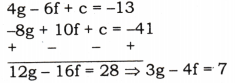
3g – 4f = 7 ………. (5)
Now solving (4) & (5)
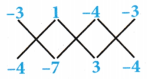
\(\frac{g}{21+4}=\frac{f}{3-28}=\frac{1}{16+9}\)
⇒ \(\frac{g}{25}=\frac{f}{-25}=\frac{1}{25}\)
g = 1; f = -1 ⇒ (g, f) = (1, -1)
(2) ⇒ 4(1) + (- 6) (-1) + c = -13
⇒ 4 + 6 + c = -13
⇒ c = – 23
Substituting g, f, c values in (1) ⇒ x2 + y2 + 2(1)x + 2(-1)y – 23 = 0
x2 + y2 + 2x – 2y – 23 = 0
Question 4.
Find the equation of a circle which passes through (4, 1), (6, 5) and having the centre on 4x + 3y – 24 = 0.
Solution:
Equation of the circle be x2 + y2 + 2gx + 2fy + c = 0 passes through (4, 1) and (6, 5) then
42 + 12 + 2g(4) + 2f(1) + c = 0 ………… (1)
62 + 52 + 2g(6) + 2f(5) + c = 0 ………… (2)
Centre lies on 4x + 3y – 24 = 0
⇒ 4 (-g) + 3(-f) – 24 = 0 ………….. (3)
(2) – (1), we get 44 + 4g + 8f = 0 …………. (4)
Solving (3) and (4) we get f = -4, g = -3, c = 15
∴ Required equation of the circle is x2 + y2 – 6x – 8y + 15 = 0.
Question 5.
Find the equation of the circle with radius 5 whose centre lies on the x-axis and passes through the point (2, 3).
Solution:
The equation of the required circle be (x – h)2 + (y – k)2 = r2
Since the radius of the circle is 5, and its centre lies on the X-axis, k = 0 and r = 5. Now, the equation of the circle becomes (x – h)2 + y2 = 25
It is given that the circle passes through the point (2, 3).
Therefore, (2 – h)2 + 32 = 25
⇒ (2 – h)2 = 16
⇒ 2 – h = ±4
If 2 – h = 4 then h = – 2 and
If 2 – h = – 4 then h = 6
when h = – 2, the equation of the circle becomes (x + 2)2 + y2 = 25
⇒ x2 + 4x + 4 + y2 = 25
⇒ x2 + y2 + 4x – 21 = 0.
when h = 6, the equation of the circle becomes (x – 6)2 + y2 = 25
⇒ x2 – 12x + 36 + y2 = 25
⇒ x2 + y2 – 12x + 11 = 0.
Question 6.
Find the equation of the circle passing through (0, 0) and making intercepts a and b on the coordinate axes.
Solution:
Let the equation of the required circle is (x – h)2 + (y – k)2 = r2
Since the centre of the circle passes through (0, 0)
Therefore (0 – h)2 + (0 – k)2 = r2
⇒ h2 + k2 = r2
The equation of the circle becomes (x – h)2 + (y – k)2 = h2 + k2
It is given that the circle makes intercepts a and b on the coordinate axes. This
means that the circle passes through the points (a, 0) and (0, b).
(a – h)2 + (0 – k)2 = h2 + k2 ………. (1),
(0 – h)2 + (b – k)2 = h2 + k2 ………. (2)
From equation (1) we have a2 – 2ah + h2 + k2 = h2 + k2
⇒ a2 – 2ah = 0
⇒ a(a – 2h) = 0 a = 0 (or) (a – 2h) = 0
However, a ≠ 0, hence, (a – 2h) = 0
h2 + b2 – 2bk + k2 = h2 + k2
⇒ b2 – 2bk = 0
⇒ b(b – 2k) = 0
⇒ b = 0 (or) (b – 2k) = 0
However, b ≠ 0; hence (b – 2k) = 0
A (0, 0) lies on S = 0 ⇒ c = 0
iii) (2, 1), (5, 5), (-6, 7).
Solution:
(2, 1), (5, 5), (-6, 7)
Squation of the circle is x2 + y2 + 2gx + 2fy + c = 0
(2, 1), (5, 5), (-6, 7) satisfy the above equation, 4 + 1 + 4g + 2f + c = 0 ……….. (1)
25 + 25 + 10g + 10f + c = 0 …………….(2)
36 + 49 – 12g + 14f + c = 0 ………. (3)
Subtract (2) – (1), we get, 45 + 6g + 8f = 0 ……….. (4)
Subtract (3) – (2), we get, 35 – 22g + 4f = 0 ………… (5)
Solve (4) and (5), we get, g = ½, f = -6, c = 5
The required equation of circle x2 + y2 + x – 12y + 5 = 0