
Referring to the AP Inter 1st Year Maths Study Material Chapter 7 Binomial Theorem Exercise 7b Solutions makes it easier to understand complex problems.
AP Inter 1st Year Maths Binomial Theorem Solutions Exercise 7b
I.
Question 1.
If a and b are distinct integers, prove that a – b is a factor of an – bn, whenever n is a positive integer. [Hint : Write an = (a – b + b)n and expand]
Solution:
Here, an = (a – b + b)n = [(a – b) + b)n
By using Binomial theorem, the expression [(a – b) + b]n can be expanded as
nC0(a- b)n b0 + nC1(a- b)n-1 b1 + nC2(a- b)n-2 b2 + …. + nCn-1(a – b)bn-1 + nCn(a- b)0bn
= (a – b)n + nC1(a – b)n-1 b + nC2(a – b)n-2 bn + ………….. + nCn-1(a – b)bn-1] + bn
⇒ an = (a – b)[(a – b)n-1 + nC1(a – b)n-2 b + nC2(a – b)n-3 b2 + nCn-1bn-1] + bn
⇒ an – bn = (a – b)[(a – b)n-1 + nC1(a – b)n-2 b + nC2(a – b)n-3 b2 + ……. + nCn-1bn-1]
now, a – b is a factor of R.H.S, so, a – b is also a factor of L.H.S hence, a – b is a factor of an – bn, whenever n is a positive integer.
Question 2.
Evaluate (√3 + √2)6 – (√3 – √2)6
Solution:
(√3 + √2)6 – (√3 – √2)6
= 6C0(√3)6 + 6C1(√3)5(√2) + 6C2(√3)4(√2)2 + 6C3(√3)3(√2)3 + 6C4(√3)2(√2)4
+ 6C5(√3)1(√2)5 + 6C6(√2)6 – [6C0(√3)6 – 6C1(√3 )5(√2) + 6C2(√3)4(√2)2 – 6C3(√3)3(√2)3 + 6C4(√3)2(√2)4 – 6C5(√3)1(√2 )5 + 6C6(√2)6]
= 2[6C1(√3)5(√2) + 6C3(√3)3(√2)3 + 6C2(√3)1(√2)5]
= 2[6 × 9√6 + 20 × 6√6 + 6 × 4√5]
= 2[54 + 120 + 24]√6
= 396√6
Question 3.
Find the value of (a2 + \(\sqrt{a^2-1}\))4 + (a2 – \(\sqrt{a^2-1}\))4
Solution:
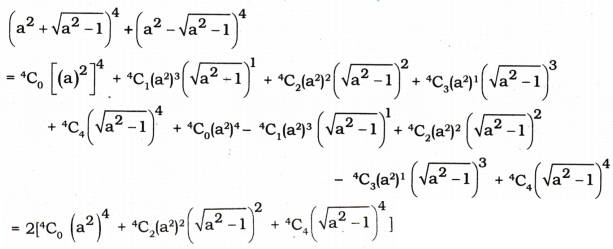
= 2(a8 + 6a4(a2 – 1) + (a2 – 1)2]
= 2[a8 + 6a6 – 6a4 + a4 + 1 – 2a2]
= 2[a8 + 6a6 – 5a4 – 2a2 + 1]
= 2a8 + 12a6 – 10a4 – 4a2 + 2
II.
Question 1.
Find an approximation of (0.99)5 using the first three terms of its expansion.
Solution:
0.99 can be written as the sum or difference of two numbers whose powers are easier to calculate and then Binomial theorem can be applied. It can be written that, 0.99 = 1 – 0.01
Therefore, (0.99)5 = (1 – 0.01)5
= 5C0(-0.01)° + 5C1(-0.01)1 + 5C2 (-0.01)2 + ………………..
= 1 – 5(0.01) + 10(0.0001) + …………
= 1 – 0.05 + 0.001
= 0.951
Question 2.
Expand (1 + \(\frac{x}{2}-\frac{2}{x}\))4 using Binomial theorem,
Solution:
Here (1 + \(\frac{x}{2}-\frac{2}{x}\))4 = [(1 + \(\frac{x}{2}\)) – \(\frac{2}{x}\)]4
Using Binomial theorem, the expression (1 + \(\frac{x}{2}-\frac{2}{x}\))4 can be expressed as
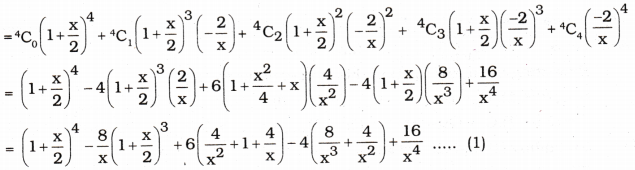
Again applying Binomial theorem, we have
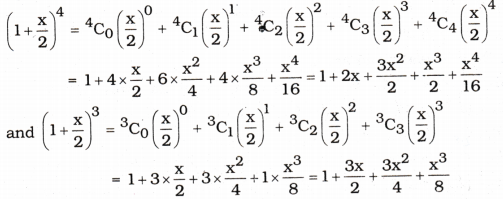
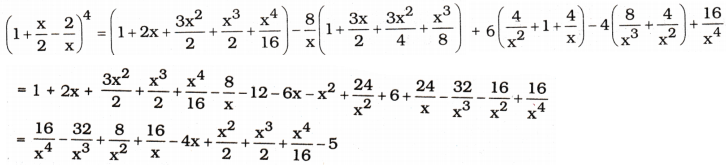
Now putting the value of (1 + \(\frac{x}{2}\))4 and (1 + \(\frac{x}{3}\))3 in (1) we have

Question 3.
Find the expansion of (3x2 – 2ax + 3a2)3 using binomial theorem.
Solution:
Here, (3x2 – 2ax + 3a2)3 = ((3x2 – 2ax) + 3a2)3
Using Binomial theorem, the expression [(3x2 – 2ax) + 3a2)3 can be expressed as
3C0(3x2 – 2ax)3 + 3Cj(3x2 – 2ax)2 (3a2) + 3C2(3x2 – 2ax)1 (3a2)2 + 3C3(3a2)3 = (3x2 – 2ax)3 + 3(9x4 + 4a2x2 – 12ax3)(3a2) + 3(3x2 – 2ax) (9a4) + (27a6)
= (3x2 – 2ax)3 + 81a2x4 + 36a4x2 – 108a3x3 + 81a4x2 – 54a5x + 27a6
Again applying Binomial theorem, we have
(3x2 – 2ax)3 = 3C0(3x2)3 + 3C1(3x2)2 (-2ax)1 + 3C2(3x2) (-2ax)2 + 3C3(-2ax)3
= 27x6 – 3 × 18ax5 + 3 × 12a2x4 – 8a3x3
= 27x6 – 54ax5 + 36a2x4 – 8a3x3
Now putting the value of (3x2 – 2ax)3, we have
= 27x6 – 54ax5 + 36a2x4 – 8a3x3 + 81a2x4 + 36a4x2 – 108a3x3 + 81a4x2 – 54a5x + 27a6
= 27x6 – 54ax5 + 117a2x4 – 116a3x3 + 117a4x2 – 54a5x + 27a6
Question 4.
Prove that C0 + 3.C1 + 5.C2 + … + (2n + 1). Cn = (2n + 2). 2n-1
Solution:
Let S = C0 + 3.C1 + 5.C2 + … + (2n + 1).Cn ……….. (1)
By writing the terms in (1) in the reverse order we get
S = (2n + 1). Cn + (2n – 1) . Cn-1 + (2n – 3).Cn-2 + …….. + 3.C1 + 1.C0
= (2n + 1).C0 + (2n – 1).C1 + (2n – 3).C2 + ……… + 3.Cn-1 + 1.Cn …………. (2)
On adding (1) and (2), we get
2S = (2n + 2).C0 + (2n + 2).C1 + … + (2n + 2).Cn-1 + (2n + 2) . Cn
= (2n + 2) (C0 + C1 + C2 + … + Cn) = (2n + 2).2n Therefore, S = (2n + 2) 2n-1
Question 5.
Prove that, for any real numbers a, d,
a.C0 + (a + d) . C2 + (a + 2d) . C2 + … + (a + nd) . Cn = (2a + nd) . 2n-1
Solution:
Let S = a.C0 + (a + d) . C2 + (a + 2d) . C2 + … + (a + nd) . Cn ….. (1)
∴ S = (a + nd) . Cn + [a + (n – 1) d] . Cn-1 + … aC0
⇒ S = (a + nd) . C0 + [a + (n – 1)d]. + [a + (n – 2)d].C2 + … + a . Cn ……….. (2)
(1) + (2) => 2S = (2a + nd) C0 + (2a + nd) C1 + (2a + nd) C2 + … + (2a + nd) Cn
= (2a + nd) (C0 + C1 + C2 + … + Cn)
= (2a + nd) 2n ⇒ S = (2a + nd) 2n – 1.
Question 6.
If n is a positive integer, then prove that
C0 + \(\frac{C_1}{2}+\frac{C_2}{3}\) + …… + \(\frac{C_n}{n+1}=\frac{2^{n+1}-1}{n+1}\)
Solution:
Let S = C0 + \(\frac{C_1}{2}+\frac{C_2}{3}\) + …… + \(\frac{C_n}{n+1}=\frac{2^{n+1}-1}{n+1}\)
Now multiplying on both sides with (n + 1), we get
(n + 1) S = (n + 1)nC0 + \(\frac{1}{2}\) (n + 1)nC1 + —(n + 1)nC2 + … + nCn
= (n +1) + \(\frac{(\mathrm{n}+1) \mathrm{n}}{1 \cdot 2}+\frac{(\mathrm{n}+1) \mathrm{n}(\mathrm{n}-1)}{1 \cdot 2 \cdot 3}\) + … + 1
= (n+1)C1 + (n+1)C2 + (n+1)C3 + ……… + (n+1)Cn+1
= (n+1)C1 + (n+1)C1 + (n+1)C2 + (n+2)C3 ……… + (n+1)Cn+1 – (n+1)C0
= 2n+1 -1
⇒ S = \(\frac{2^{n+1}-1}{n+1}\)
C0 + \(\frac{C_1}{2}+\frac{C_2}{3}\) + …… + \(\frac{C_n}{n+1}=\frac{2^{n+1}-1}{n+1}\)
Question 7.
If n is a positive integer and x is any non-zero real number, then prove that
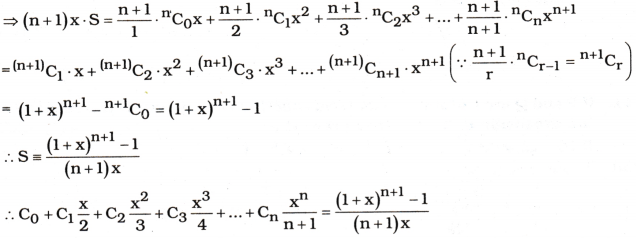
C0 + C1.\(\frac{x}{2}\) + C2.\(\frac{x^2}{3}\) + C3.\(\frac{x^3}{4}\) + ……….. + Cn.\(\frac{x^n}{n+1}=\frac{(1+x)^{n+1}-1}{(n+1) x}\)
Solution:
Let S ≡ C0 + C1.\(\frac{x}{2}\) + C2.\(\frac{x^2}{3}\) + C3.\(\frac{x^3}{4}\) + ……….. + Cn.\(\frac{x^n}{n+1}\)
Multiplying both sides with be ‘x’
Question 8.
Prove that 2.C0 + 5.C1 + 8.C2 + ……….. + (3n + 2) Cn = (3n + 4)2n-1
Solution:
Let S = 2.C0 + 5.C1 + 8.C2 + ……….. + (3n – 1) Cn-1 + (3n + 2) Cn ……(1)
S = (3n + 2) C0 + (3n – 1)C1 + (3n – 4) C2 + + 5Cn-1 + 2.Cn … (2)
(∵ Cn = C0.Cn-1 = Ci…)
Adding (1) 86 (2) we get 2S = (3n + 4)C0 + (3n + 4)Cj + (3n + 4)C2 + … + (3n + 4) Cn = (3n + 4) (C0 + Cj + C2 + … + Cn) = (3n + 4)2n
S = (3n + 4) . 2n-1
Question 9.
Prove tnat C0 +2C1 + 4.C2 + 8.C3 + ……….. + 2n.Cn = 3n
Solution:
We know that,
(1 + x)n = C0 + C1x + C2x2 + C3x2 + ………… + Cnxn
Put x = 2 in equation (1) we get,
(1 + 2)n = C0 + C1(2) + C2(2)2 + C3(2)3 + ………. + Cn(2)n
∴ C0 +2C1 + 4.C2 + 8.C3 + ……….. + 2n.Cn = 3n
Question 10.
If (1 + x + x2)n = a0 + a1x + a2x2 + ………… + a2nx2n, then prove that
i) a0 + a1 + a2 + ………… + a2n = 3n
Solution:
(1 + x + x2)n = a0 + a1x + a2x2 + ………… + a2nx2n
Put x = 1 ⇒ a0 + a1 + a2 + ………… + a2n = (1 + 1 + 1)n = 3n …….(1)
Put x = -1 ⇒ a0 – a1 + a2 + ………. + a2n = (1 – 1 + 1)n = 1 ………. (2)
a0 + a1 + a2 + ………… + a2n = 3n
ii) a0 + a2 + a4 + ………… + a2n = \(\frac{3^n+1}{2}\)
Solution:
(1) + (2) ⇒ 2(a0 + a2 + a4 + ………… + a2n) = 3n + 1
⇒ ∴ a0 + a2 + a4 + ………… + a2n = \(\frac{3^n+1}{2}\)
iii) a1 + a3 + a5 + ….. + a2n-1 = \(\frac{3^n-1}{2}\)
Solution:
(1) – (2) ⇒ 2(a1 + a3 + a5 + ….. + a2n-1) = 3n – 1
⇒ ∴ a1 + a3 + a5 + ….. + a2n-1 = \(\frac{3^n-1}{2}\)
iv) a0 + a3 + a6 + a9 + ………… + a2n = 3n-1
Solution:
Put x = 1
⇒ a0 + a3 + a6 + a9 + ………… + a2n = 3n …(a)
Put x = ω
a0 + a1ω + a2ω2 + a3ω3 + ………… + a2nω2n = 0
Hint: 1 + ω + ω2 = 0; ω3 = 1 ……………. (b)
Put x = ω2
⇒ a0 + a1ω2 + a2ω4 + a3ω6 + ………… + a2nω4n = 0 …..(c)
Adding (a), (b), (c)
∴ 30 + a1(1 + ω + ω2) + a2(1 + ω3 + ω6) + ……… + a2n(1 + ω2n + ω4n) = 3n
⇒ 3a0 + a1(0) + a2(0) + 3a3 + ……. = 3n
∴ a0 + a3 + a6 + ……… = \(\frac{3^{\mathrm{n}}}{3}\) = 3n-1
Question 11.
If P and Q Me the sum of odd terms and the sum of even terms respectively in the expansion of (x + a)n then prove that
i) P2 – Q2 = (x2 – a2)n
ii) 4PQ = (x + a)2n – (x – a)2n
Solution:
We know that (x + a)n = nC0xn + nC1xn-1a + nC2 xn-2a2 + ………………
(x + a)n = T1 + T2 + T3 + T4 + T5 + T6 + …………….
Given that P = (T1 + T3 + T5 + T7 + …) and Q = (T2 + T4 + T6 + ………….)
⇒ (x + a)n = P + Q …………(1) and (x – a)n = P – Q ………….(2)
i) P2 – Q2 = (P + Q) (P – Q) = (x + a)n (x – a)n = [(x + a) (x – a)]n = (x2 – a2)n
ii) 4PQ = (P + Q)2 – (P – Q)2
= [(x + a)n]2 – [(x – a)n]2
= (x + a)2n – (x – a)2n
Question 12.
If (1 + 3x – 2x2)10 = a0 + a1x + a2x2 + … + a20x20, then prove that
i) a0 + a1 + a2 + … + a20 = 210
ii) a0 – a1 + a2 – a3 + … + a20 = 410
Solution:
(1 + 3x – 2x2)10 = a0 + a1x + a2x2 + … + a20x20 ………….. (1)
i) Put x = 1 in eq. (1)
(1 + 3 – 2)10 = a0 + a1 + a2 + … + a20
∴ a0 + a1 + a2 + … + a20 = 210
ii) Put x = -1 in eq (1)
(1 – 3 – 2)10 = a0 – a1 + a2 – a3 + … + a20
∴ a0 – a1 + a2 – a3 + … + a20 = (-4)10 = 410
Question 13.
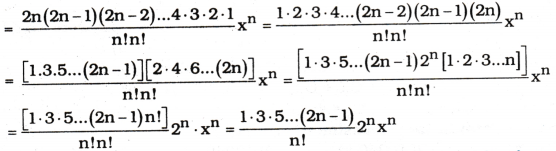
Show that the middle term in the expansion of (1 + x)2n is \(\frac{1 \cdot 3 \cdot 5 \ldots(2 n-1)}{n!}\) 2n . xn, where n is a positive integer.
Solution:
As 2n is even, the middle term of the expansion (1 + x)2n is i.e., (n + 1)th term
Now Tn+1 = 2nCn (1)2n-n (x)n = 2nCn xn = \(\frac{(2 \mathrm{n})!}{\mathrm{n}!\mathrm{n}!}\)xn
Question 14.
The second, third and fourth terms in the binomial expansion (x + a)n are 240, 720, 1080 respectively. Find the value of x, a and n.
Solution:
Given expression is (a + x)n. General term Tr+1 = nCr an-r xr
T2 = T1+1 = nC1 an-1 x1 = 240 … (1)
T3 = T2+1 = nC2 an-2 x2 = 720 … (2)
T4 = T3+1 = nC3 an-3 x3 = 1080 … (3)
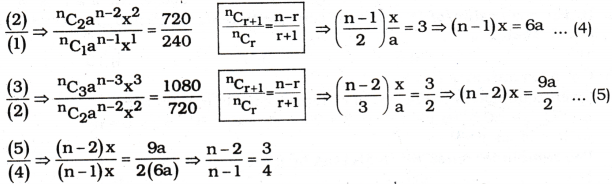
⇒ 4n – 8 = 3n – 3
⇒ 4n – 3n = -3 + 8
∴ n = 5
Substitute n = 5 in (4) ⇒ 4x = 6a ⇒ x = 3a/2
Substitute x, n values in (1)
⇒ 5 a4\(\left(\frac{3 \mathrm{a}}{2}\right)\) = 240
⇒ a5 = \(\frac{240 \times 2}{15}\) = 32
⇒ a5 = 25
⇒ a = 2
Substitute the values of n = 5 and a = 2 in (6)
⇒ x = \(\frac{3(2)}{2}\) = 3
∴ a = 2, x = 3, n = 5