
Referring to the AP Inter 1st Year Maths Study Material Chapter 12 Introduction to 3D Geometry Exercise 12a Solutions makes it easier to understand complex problems.
AP Inter 1st Year Maths Introduction to 3D Geometry Solutions Exercise 12a
I. Evaluate the following limits in Exercises 1 to 20.
Question 1.
\(\lim _{x \rightarrow 3}\) x + 3
Solution:
\(\lim _{x \rightarrow 3}\) x + 3
= 3 + 3
= 6
Question 2.
\(\lim _{x \rightarrow \pi}\left(x-\frac{22}{7}\right)\)
Solution:
\(\lim _{x \rightarrow \pi}\left[x-\frac{22}{7}\right]\) = [π – \(\frac{22}{7}\)]
Question 3.
\(\lim _{x \rightarrow 1}\)πr²
Solution:
\(\lim _{x \rightarrow 1}\)πr² = π(1)2 = π
Question 4.
\(\lim _{x \rightarrow 4} \frac{4 x+3}{x-2}\)
Solution:
\(\lim _{x \rightarrow 4} \frac{4 x+3}{x-2}\)
= \(\frac{4(4)+3}{4-2}=\frac{16+3}{2}=\frac{19}{2}\)
Question 5.
\(\lim _{x \rightarrow-1} \frac{x^{10}+x^5+1}{x-1}\)
Solution:


Question 6.
\(\lim _{x \rightarrow 0} \frac{(x+1)^5-1}{x}\)
Solution:
\(\lim _{x \rightarrow 0} \frac{(x+1)^5-1}{x}\)
Put x + 1 = y so that y → 1 as x → 0
Accordingly, \(\lim _{x \rightarrow 0} \frac{(x+1)^5-1}{x}=\lim _{y \rightarrow 1} \frac{y^5-1}{y-1}\)
= \(\frac{1}{2}\)
= 5.15-1
= 5 [∵ \(\lim _{x \rightarrow a} \frac{x^n-a^n}{x-a}\) = nan-1]
Question 7.
\(\lim _{x \rightarrow 2} \frac{3 x^2-x-10}{x^2-4}\)
Solution:
At x = 2 the value of the given rational takes the form \(\frac{0}{0}\)

= \(\lim _{x \rightarrow 2} \frac{3 x+5}{x+2}=\frac{3(2)+5}{2+2}=\frac{11}{4}\)
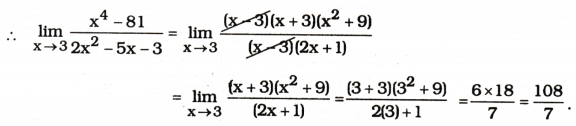
Question 8.
\(\frac{1}{2}\)
Solution:
At x = 2 the value of the given rational takes the form \(\frac{0}{0}\)
Question 9.
\(\lim _{x \rightarrow 0} \frac{a x+b}{c x+1}\)
Solution:
\(\lim _{x \rightarrow 0} \frac{a x+b}{c x+1}\)
= \(\frac{a(0)+b}{c(0)+1}\)
= b
Question 10.
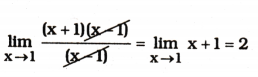
\(\lim _{z \rightarrow 1} \frac{z^{1 / 3}-1}{z^{1 / 6}-1}\)
Solution:
\(\lim _{z \rightarrow 1} \frac{z^{1 / 3}-1}{z^{1 / 6}-1}\)
At z = 1 the value of the given function takes the form \(\frac{0}{0}\)
Accordingly, \(\lim _{z \rightarrow 1} \frac{z^{1 / 3}-1}{z^{1 / 6}-1}=\lim _{x \rightarrow 1} \frac{x^2-1}{x-1}\)
Question 11.
\(\lim _{x \rightarrow 1} \frac{a x^2+b x+c}{c x^2+b x+a}\), a + b + c ≠ 0
Solution:
\(\lim _{x \rightarrow 1} \frac{a x^2+b x+c}{c x^2+b x+a}=\frac{a(1)^2+b(1)+c}{c(1)^2+b(1)+a}\)
= \(\frac{a+b+c}{a+b+c}\)
= 1
Question 12.
\(\lim _{x \rightarrow-2} \frac{\frac{1}{x}+\frac{1}{2}}{x+2}\)
Solution:
\(\lim _{x \rightarrow-2} \frac{\frac{1}{x}+\frac{1}{2}}{x+2}\)
At x = -2 value of the given function takes the form \(\frac{0}{0}\).
Now, \(\lim _{x \rightarrow-2} \frac{\frac{1}{x}+\frac{1}{2}}{x+2}\)
= \(\lim _{x \rightarrow-2} \frac{\left(\frac{2+x}{2 x}\right)}{x+2}\)
= \(\lim _{x \rightarrow-2} \frac{1}{2 x}=\frac{1}{2(-2)}=\frac{-1}{4}\)
Question 13.
\(\lim _{x \rightarrow 0} \frac{\sin a x}{b x}\)
Solution:
\(\lim _{x \rightarrow 0} \frac{\sin a x}{b x}\),
At x = 0, the value of the given function takes the form \(\frac{0}{0}\).
Now, \(\lim _{x \rightarrow 0} \frac{\sin a x}{b x}=\lim _{x \rightarrow 0} \frac{\sin a x}{a x} \cdot \frac{a x}{b x}\) ⇒ \(\lim _{x \rightarrow 0}\left(\frac{\sin a x}{a x}\right) \times \frac{a}{b}\)
= \(\frac{a}{b} \lim _{a x \rightarrow 0}\left(\frac{\sin a x}{a x}\right)\)
= \(\frac{a}{b}\) × 1 = \(\frac{a}{b}\) [∵ \(\lim _{y \rightarrow 0} \frac{\sin y}{y}\) = 1] [x → 0 ax → 0]
Question 14.
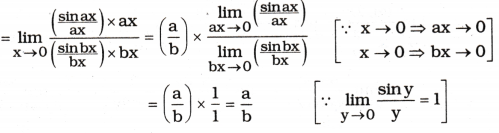
\(\lim _{x \rightarrow 0} \frac{\sin a x}{\sin b x}\), a, b = 0
Solution:
At x = 0 the value of the given function takes the form \(\frac{0}{0}\)
Now, \(\lim _{x \rightarrow 0} \frac{\sin a x}{\sin b x}\)
Question 15.
\(\lim _{x \rightarrow \pi} \frac{\sin (\pi-x)}{\pi(\pi-x)}\)
Solution:
It is seen that x → π
(π – x) → 0 = \(\frac{1}{2}\)
= \(\frac{1}{\pi}\) x 1 = \(\frac{1}{\pi}\) [∵ \(\lim _{y \rightarrow 0} \frac{\sin y}{y}\) = 1]
Question 16.
\(\lim _{x \rightarrow 0} \frac{\cos x}{\pi-x}\)
Solution:
\(\lim _{x \rightarrow 0} \frac{\cos x}{\pi-x}=\frac{\cos 0}{\pi-0}=\frac{1}{\pi}\)
Question 17.
\(\lim _{x \rightarrow 0} \frac{a x+x \cos x}{b \sin x}\)
Solution:
\(\lim _{x \rightarrow 0} \frac{a x+x \cos x}{b \sin x}\), At x = 0, the value of the given function takes the form \(\frac{0}{0}\)

Question 18.
\(\lim _{x \rightarrow 0}\) x sec x
Solution:
\(\lim _{x \rightarrow 0}\) x sec x
= \(\lim _{x \rightarrow 0} \frac{x}{\cos x}=\frac{0}{\cos 0}=\frac{0}{1}\) = 0
Question 19.
\(\lim _{x \rightarrow 0} \frac{\sin a x+b x}{a x+\sin b x}\); a, b, a + b ≠ 0
Solution:
At x = 0, the value of the given function takes the form \(\frac{0}{0}\)
Now, \(\lim _{x \rightarrow 0} \frac{\left(\frac{\sin a x}{a x}\right) a x+b x}{a x+\left(\frac{\sin b x}{b x}\right) b x}=\frac{a \lim _{a x \rightarrow 0}\left(\frac{\sin a x}{a x}\right)+b}{a+b \lim _{a x \rightarrow 0} \frac{\sin b x}{b x}}\)
= \(\\frac{a(1)+b}{a+b(1)}=\frac{a+b}{a+b}=\)
= 1
Question 20.
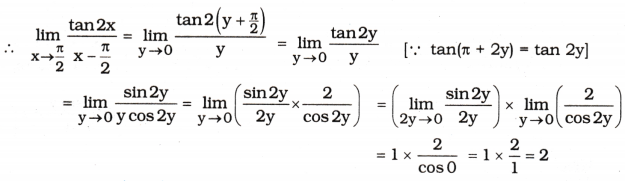
\(\lim _{x \rightarrow \frac{\pi}{2}} \frac{\tan 2 x}{x-\frac{\pi}{2}}\)
Solution:
\(\lim _{x \rightarrow \frac{\pi}{2}} \frac{\tan 2 x}{x-\frac{\pi}{2}}\), At x = \(\frac{\pi}{2}\), the value of the given function takes the form \(\frac{0}{0}\)
Now, put x – \(\frac{\pi}{2}\) = y so that x → \(\frac{\pi}{2}\), y → 0
Question 21.
Show that \(\lim _{x \rightarrow 2^{-}} \frac{|x-2|}{x-2}=\lim _{x \rightarrow 2^{-}} \frac{-(x-2)}{x-2}=\lim _{x \rightarrow 2^{-}}\) = – 1
Solution:
\(\lim _{x \rightarrow 2^{-}} \frac{|x-2|}{x-2}=\lim _{x \rightarrow 2^{-}} \frac{-(x-2)}{x-2}=\lim _{x \rightarrow 2^{-}}\)(-1) = -1
Question 22.
Compute \(\lim _{x \rightarrow 2^{+}}\)([x] + x) and \(\lim _{x \rightarrow 2^{-}}\)([x] _ x) where [ . ] (denotes) integral part.
Solution:
As x → 2+, x > 2 ⇒ [x] = 2,
\(\lim _{x \rightarrow 2^{+}}\) {[x] + x} = \(\lim _{x \rightarrow 2}\) (2 + x)
= 2 + 2
= 4
As x → 2–, x < 2 ⇒ [x] = 1, \(\lim _{x \rightarrow 2^{+}}\) {[x] + x} = \(\lim _{x \rightarrow 2}\) (1 + x) = 1 + 2 = 3 Question 23. Compute \(\lim _{x \rightarrow 0} \frac{a^x-1}{b^x-1}\) (a > 0, b > 0, b ≠ 1).
Solution:
\(\lim _{x \rightarrow 0} \frac{a^x-1}{b^x-1}=\lim _{x \rightarrow 0}\left\{\frac{\frac{a^x-1}{x}}{\frac{b^x-1}{x}}\right\}\)
= \(\frac{\lim _{x \rightarrow 0} \frac{a^x-1}{x}}{\lim _{x \rightarrow 0} \frac{b^x-1}{x}}=\frac{\log _e^a}{\log _e^b}\)
= logba.
Question 24.
Compute \(\lim _{x \rightarrow 0} \frac{e^x-\sin x-1}{x}\)
Solution:
\(\lim _{x \rightarrow 0} \frac{e^x-\sin x-1}{x}=\lim _{x \rightarrow 0}\left(\frac{e^x-1}{x}\right)-\lim _{x \rightarrow 0}\left(\frac{\sin x}{x}\right)\)
= 1 – 1
= 0
Question 25.
Compute \(\lim _{x \rightarrow 0} \frac{e^{3 \cdot x}-e^3}{x}\).
Solution:
\(\lim _{x \rightarrow 0} \frac{e^{3+x}-e^3}{x}=\lim _{x \rightarrow 0} \frac{e^3 \cdot e^x-e^3}{x}\)
\(\lim _{x \rightarrow 0} \frac{e^3\left(e^x-1\right)}{x}=e^3 \lim _{x \rightarrow 0} \frac{e^x-1}{x}\)
= e3
Question 26.
Compute \(\lim _{x \rightarrow 0} \frac{e^{4 x}-1}{x}\)
Solution:
\(\lim _{x \rightarrow 0} \frac{e^{4 x}-1}{x}=\lim _{x \rightarrow 0} \frac{e^{4 x}-1}{4 x}\) × 4
= 1 × 4
= 4
Question 27.
Compute \(\lim _{x \rightarrow 0} \frac{e^{2+x}-e^2}{x}\)
Solution:
\(\lim _{x \rightarrow 0} \frac{e^2 \cdot e^x-e^2}{x}=\lim _{x \rightarrow 0} \frac{e^2\left(e^x-1\right)}{x}\)
= e2\(\lim _{x \rightarrow 0} \frac{e^x-1}{x}\)
= e2 × 1
= e2
Question 28.
Compute \(\lim _{x \rightarrow 5} \frac{e^x-e^5}{x-5}\)
Solution:
\(\lim _{x \rightarrow 5} \frac{e^5\left[\frac{e^x}{e^5}-1\right]}{x-5}\)
= e5\(\lim _{x \rightarrow 5} \frac{e^{(x-5)}-1}{x-5}\)
= e5(1)
= e5.
Question 29.
Compute \(\lim _{x \rightarrow 0} \frac{e^{sin x}-1}{x}\)
Solution:
\(\lim _{x \rightarrow 0} \frac{e^{\sin x}-1}{x}=\lim _{x \rightarrow 0}\left(\frac{e^{\sin x}-1}{\sin x} \times \frac{\sin x}{x}\right)\)
= \(\lim _{x \rightarrow 0} \frac{e^{\sin x}-1}{\sin x} \times \lim _{x \rightarrow 0} \frac{\sin x}{x}\)
= 1 × 1
= 1
Question 30.
Compute \(\lim _{x \rightarrow 3} \frac{e^x-e^3}{x-3}\)
Solution:
\(\lim _{x \rightarrow 3} \frac{e^3\left(\frac{e^x}{e^3}-1\right)}{x-3}=\lim _{x \rightarrow 3} \frac{e^3\left(e^{x-3}-1\right)}{x-3}\)
= e3 \(\lim _{x \rightarrow 3} \frac{e^{(x-3)}-1}{x-3}\)
= e3 × 1
= e3
Question 31.
Compute \(\lim _{x \rightarrow 0} \frac{x\left(e^x-1\right)}{1-\cos x}\)
Solution:
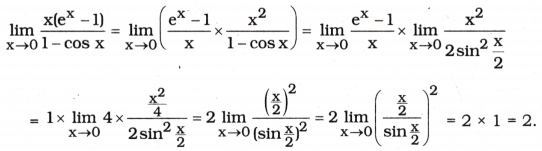
Question 32.
Compute \(\lim _{x \rightarrow 0} \frac{\log (1+2 x)}{x}\)
Solution:
\(\lim _{x \rightarrow 0} \frac{\log _e(1+2 x)}{x}=\lim _{x \rightarrow 0} \frac{\log _e(1+2 x)}{2 x}\) x 2
= 2 \(\lim _{x \rightarrow 0} \frac{\log _e(1+2 x)}{2 x}\)
= 2 × 1
= 2
Question 33.
Compute \(\lim _{x \rightarrow 0} \frac{\log \left(1+x^3\right)}{\sin ^3 x}\)
Solution:
\(\lim _{x \rightarrow 0}\left\{\frac{\log \left(1+x^3\right)}{x^3} \times \frac{x^3}{\sin ^3 x}\right\}\)
= \(\lim _{x \rightarrow 0} \frac{\log \left(1+x^3\right)}{x^3} \times \lim _{x \rightarrow 0}\left\{\frac{x}{\sin x}\right\}^3\)
= 1 × 1
= 1.
II.
Question 1.
Evaluate \(\lim _{x \rightarrow 0} \frac{\cos 2 x-1}{\cos x-1}\)
Solution:
\(\lim _{x \rightarrow 0} \frac{\cos 2 x-1}{\cos x-1}\), At x = 0 the value of the given function takes the form \(\frac{0}{0}\)
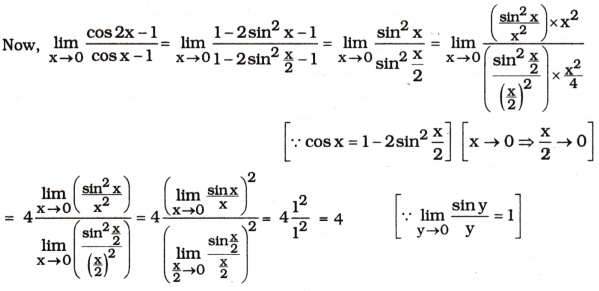
Question 2.
Evaluate \(\lim _{x \rightarrow 0}\)(cosec x – cot x)
Solution:
At x = 0, the value of the given function takes the form ∞ – ∞
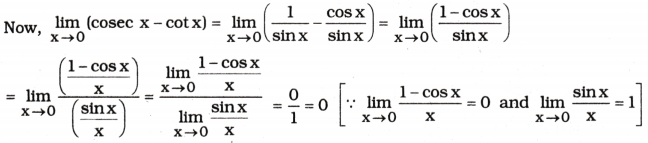
Question 3.
Find \(\lim _{x \rightarrow 0}\) f(x) and \(\lim _{x \rightarrow 1}\)f(x), where f(x) = \(\begin{cases}2 x+3, & x \leq 0 \\ 3(x+1), & x>0\end{cases}\)
Solution:
The given function is f(x) = \(\begin{cases}2 x+3, & x \leq 0 \\ 3(x+1), & x>0\end{cases}\)
R.H.L = \(\lim _{x \rightarrow 0^{-}}\)f(x) = \(\lim _{x \rightarrow 0}\)(2x + 3)
= 2(0) + 3
= 3
L.H.L = \(\lim _{x \rightarrow 0^{+}}\)f(x) = \(\lim _{x \rightarrow 0}\)3(x + 1)
= 3(0 + 1)
= 3
∴ \(\lim _{x \rightarrow 0^{-}}\) f(x) = \(\lim _{x \rightarrow 0^{+}}\) f(x) = 3
R.H.L = \(\lim _{x \rightarrow 1^{-}}\) f(x) = \(\lim _{x \rightarrow 1}\) 3(x + 1)
= 3(1 + 1)
= 6
L.H.L = \(\lim _{x \rightarrow 1^{+}}\) f(x) = \(\lim _{x \rightarrow 1}\) 3(x + 1)
= 3(1 + 1)
= 6
∴ \(\lim _{x \rightarrow 1^{-}}\) f(x) = \(\lim _{x \rightarrow 1^{+}}\) f(x) = \(\lim _{x \rightarrow 1}\) f(x) = 6
Question 4.
Find \(\lim _{x \rightarrow 1}\)f(x), where f(x) = \(\left\{\begin{array}{cc}
x^2-1, & x \leq 1 \\
-x^2-1, & x>1
\end{array}\right.\)
Solution:
The gievn function is f(x) = \(\left\{\begin{array}{cc}
x^2-1, & x \leq 1 \\
-x^2-1, & x>1
\end{array}\right.\)
LHL = \(\lim _{x \rightarrow 1^{-}}\) f(x) = \(\lim _{x \rightarrow 1}\)[x2 – 1] = 12 – 1 = 0
RHL = \(\lim _{x \rightarrow 1^{+}}\) f(x) = \(\lim _{x \rightarrow 1}\)[-x2 – 1] = -12 – 1 = -2
It is observed that \(\lim _{x \rightarrow 1^{-}}\) f(x) ≠ \(\lim _{x \rightarrow 1^{+}}\) f(x), Hence, \(\lim _{x \rightarrow 1}\) f(x) does not exist
Question 5.
Evaluate \(\lim _{x \rightarrow 0}\)f(x), where f(x) = \(\begin{cases}\frac{|x|}{x}, & x \neq 0 \\ 0, & x=0\end{cases}\)
Solution:
The gievn function is f(x) = \(\begin{cases}\frac{|x|}{x}, & x \neq 0 \\ 0, & x=0\end{cases}\)
LHL = \(\lim _{x \rightarrow 0^{-}}\) f(x) = \(\lim _{x \rightarrow 0^{-}}\left[\frac{|x|}{x}\right]\)
= \(\lim _{x \rightarrow 0^{-}}\left(-\frac{x}{x}\right)=\lim _{x \rightarrow 0}\)(-1) = -1 [When x is negative, |x| = -x]
RHL = \(\lim _{x \rightarrow 0^{+}}\left(\frac{x}{x}\right)=\lim _{x \rightarrow 0^{+}}\)(1) = 1 [When ‘x’ is positive |x| = x]
It is observed that \(\lim _{x \rightarrow 0^{-}}\) f(x) \(\lim _{x \rightarrow 0^{+}}\) f(x) .hence \(\lim _{x \rightarrow 0}\) does not exist
Question 6.
Find \(\lim _{x \rightarrow 0}\) f(x), where f(x) = \(\left\{\begin{array}{cc}
\frac{x}{|x|}, & x \neq 0 \\
0, & x=0
\end{array}\right.\)
Solution:
The gievn function is f(x) = \(\left\{\begin{array}{cc}
\frac{x}{|x|}, & x \neq 0 \\
0, & x=0
\end{array}\right.\)
\(\lim _{x \rightarrow 0^{-}}\) f(x) = \(\lim _{x \rightarrow 0^{-}}\left[\frac{x}{|x|}\right]=\lim _{x \rightarrow 0}\left[\frac{x}{-x}\right]=\lim _{x \rightarrow 0}\)(-1) = -1 [When x < 0 |x| = -x]
\(\lim _{x \rightarrow 0^{+}}\) f(x) = \(\lim _{x \rightarrow 0}\left[\frac{x}{|x|}\right]=\lim _{x \rightarrow 0}\left[\frac{x}{x}\right]=\lim _{x \rightarrow 0}\) (1) = 1
It is observed that \(\lim _{x \rightarrow 0^{-}}\) f(x) ≠ \(\lim _{x \rightarrow 0^{+}}\) f(x). Hence \(\lim _{x \rightarrow 0}\) f(x) does not exist.
Question 7.
Find \(\lim _{x \rightarrow 5}\)f(x), where f(x) = |x| – 5
Solution:
The gievn function is f(x) = |x| – 5
\(\lim _{x \rightarrow 5^{-}}\) f(x) = \(\lim _{x \rightarrow 5}\)[|x| – 5] = \(\lim _{x \rightarrow 5}\)[x – 5]
= 5 – 5
= 0
\(\lim _{x \rightarrow 5^{+}}\) f(x) = \(\lim _{x \rightarrow 5^{+}}\)[|x| – 5] = \(\lim _{x \rightarrow 5}\)[x – 5]
= 0
∴ \(\lim _{x \rightarrow 5^{-}}\) f(x) = \(\lim _{x \rightarrow 5^{+}}\) f(x) = 0
Hence \(\lim _{x \rightarrow 5}\)f(x) = 0
Question 8.
Let a1, a2, ………… an be fixed real numbers and define a function
f(x) = (x – a1)(x – a2) ……..(x – an)
What is \(\lim _{x \rightarrow a_1}\) f(x)? For some a ≠ a1, a2, ………… an compute \(\lim _{x \rightarrow a}\)f(x).
Solution:
The gievn function is f(x) = (x – a1)(x – a2) ……..(x – an)
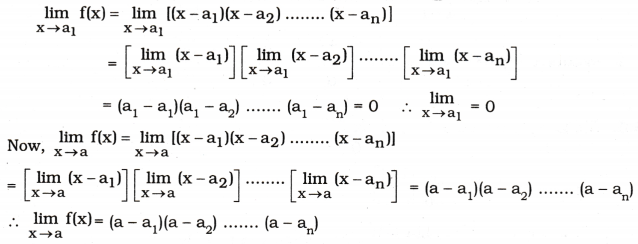
Question 9.
Evaluate \(\lim _{x \rightarrow 3} \frac{x^4-81}{2 x^2-5 x-3}\)
Solution:
\(\lim _{x \rightarrow 3} \frac{x^4-81}{2 x^2-5 x-3}=\lim _{x \rightarrow 3} \frac{(x-3)\left(x^3+3 x^2+9 x+27\right)}{(x-3)(2 x+1)}\)
= \(\lim _{x \rightarrow 3} \frac{x^3+3 x^2+9 x+27}{2 x+1}=\frac{27+27+27+27}{6+1}=\frac{108}{7}\)
Question 10.
If f(x) = \(-\sqrt{{2 5}-{x}^2}\) then find \(\lim _{x \rightarrow 1} \frac{f(x)-f(1)}{x-1}\).
Solution:
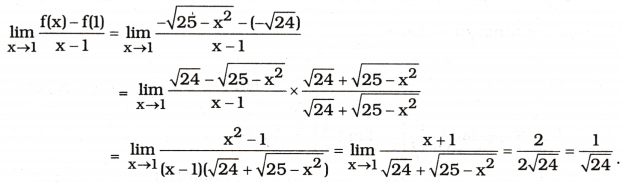
Question 11.
Compute \(\lim _{x \rightarrow a} \frac{x \sin a-a \sin x}{x-a}\).
Solution:
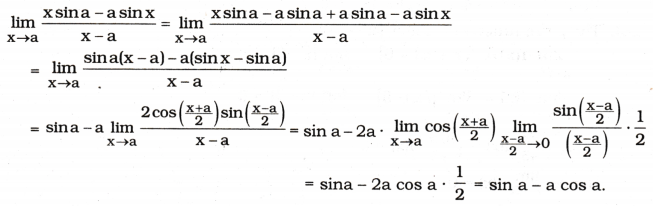
Question 12.
Compute \(\lim _{x \rightarrow 0} \frac{\sin \left(\pi \cos ^2 x\right)}{x^2}\)
Solution:

Question 13.
Compute \(\lim _{x \rightarrow 0} \frac{\sqrt[3]{1+x}-\sqrt[3]{1-x}}{x}\)
Solution:
Put 1 + x = y, 1 – x = z
As x → 0, y → 1, z → 1
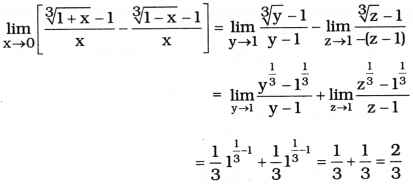
III.
Question 1.
Suppose f(x) = \(\left\{\begin{array}{cc}
a+b x, & x<1 \\ 4, & x=0 \\ b-a x, & x>1
\end{array}\right.\) and if \(\frac{1}{2}\)f(x) = f(1)
What are possible values of a and b?
Solution:
The given function is suppose f(x) = \(\left\{\begin{array}{cc}
a+b x, & x<1 \\ 4, & x=0 \\ b-a x, & x>1
\end{array}\right.\)
\(\lim _{x \rightarrow 1^{-}}\) f(x) = \(\lim _{x \rightarrow 1}\) (a + bx) = a + b
\(\lim _{x \rightarrow 1^{+}}\) f(x) = \(\lim _{x \rightarrow 1}\) (b – ax) = b – a f(1) = 4
It is given that \(\lim _{x \rightarrow 1}\)f(x) = f(1)
∴ \(\lim _{x \rightarrow 1^{-}}\) f(x) = \(\lim _{x \rightarrow 1^{+}}\) f(x) = \(\lim _{x \rightarrow 1}\) f(x)
⇒ a + b = 4 and b – a = 4
On solving these two equations, we obtain a = 0 and b 4
Thus, the respective possible values of a and b are 0 and 4.
Question 2.
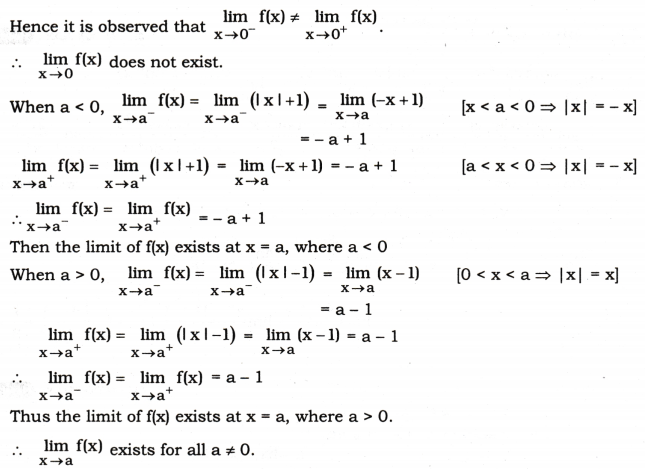
If f(x) = \(\left\{\begin{array}{cc}
|x|+1, & x<0 \\ 0, & x=0 \\ |x|-1, & x>0
\end{array}\right.\) for what value(s) of a does \(\lim _{x \rightarrow a}\) f(x) exists?
Solution:
The given function is f(x) = \(\left\{\begin{array}{cc}
|x|+1, & x<0 \\ 0, & x=0 \\ |x|-1, & x>0
\end{array}\right.\)
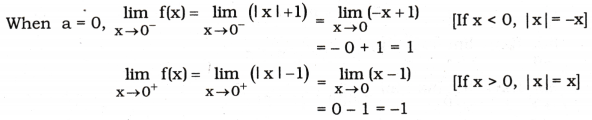
Question 3.
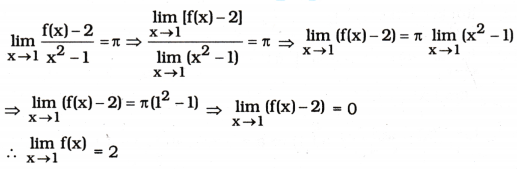
If the function f(x) satisifies \(\lim _{x \rightarrow 1} \frac{f(x)-2}{x^2-1}\) = π, evaluate \(\lim _{x \rightarrow 1}\)
Solution:
Question 4.
If f(x) = \(\left\{\begin{array}{cc}
\mathrm{mx}^2+\mathrm{n}, & \mathrm{x}<0 \\ \mathrm{nx}^3+\mathrm{m}, & 0 \leq \mathrm{x} \leq 1 \\ \mathrm{nx}^3+\mathrm{m}, & \mathrm{x}>1
\end{array}\right.\) For what integers m and n does both \(\lim _{x \rightarrow 0}\) f(x) and \(\lim _{x \rightarrow 1}\)f(x) exist?
Solution:
The given function is f(x) = \(\left\{\begin{array}{cc}
\mathrm{mx}^2+\mathrm{n}, & \mathrm{x}<0 \\ \mathrm{nx}^3+\mathrm{m}, & 0 \leq \mathrm{x} \leq 1 \\ \mathrm{nx}^3+\mathrm{m}, & \mathrm{x}>1
\end{array}\right.\)
\(\lim _{x \rightarrow 0^{-}}\) f(x) = \(\lim _{x \rightarrow 0}\)(mx2 + n) = m(0)2 + n = n
\(\lim _{x \rightarrow 0^{+}}\) f(x) = \(\lim _{x \rightarrow 0}\)(nx + n) = n(0) + m = m
Thus, \(\lim _{x \rightarrow 0}\) f(x) exists if m = n
\(\lim _{x \rightarrow 1^{-}}\) f(x) = \(\lim _{x \rightarrow 1}\)(nx + m)
= n(1) + m
= m + n
\(\lim _{x \rightarrow 1^{+}}\) f(x) = \(\lim _{x \rightarrow 1}\)(nx3 + m)
= n(1)3 + m
= m + n
\(\lim _{x \rightarrow 1^{-}}\) f(x) = \(\lim _{x \rightarrow 1^{+}}\) f(x) = \(\lim _{x \rightarrow 1}\)f(x)
= m + n
Thus, \(\lim _{x \rightarrow 1}\) f(x) exist for any integral value of m and n.