Referring to the AP Inter 1st Year Maths Study Material Chapter 2 Relations and Functions Exercise 2c Solutions makes it easier to understand complex problems.
AP Inter 1st Year Maths Relations and Functions Solutions Exercise 2c
I.
Question 1.
Find the domain and range of the following real functions.
(i) f(x) = -|x|
(ii) f(x) = \(\sqrt{9-x^2}\)
Solution:
i) Given f(x) = -|x|
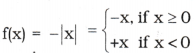
Domain of f = R, Range of f = [-∞,0]
ii) Given f(x) = \(\sqrt{9-x^2}\)
Here 9 – x2 > 0
⇒ 32 – x2 > 0
⇒ x2 – 32 < 0
⇒ (x + 3)(x – 3) < 0 ⇒ -3 ≤ x ≤ 3 Domain = {x : – 3 ≤ x ≤ 3, ∀ x ∈ R} or [-3, 3] Range = {x : 0 ≤ x ≤ 3} or [0, 3]
Question 2.
A function f is defined by f(x) = 2x – 5. Write down the values of (i) f(0), (ii) f(7), (iii) f(-3).
Solution:
Given f(x) = 2x – 5
i) f(0) = 2(0) – 5 = -5
ii) f(7) = 2(7) -5 = 9
iii) f(-3) = 2(-3) – 5 = -11
Question 3.
Find the range of each of the following functions.
(i) f(x) = 2 – 3x, x ∈ R, x > 0.
(ii) f(x) = x2 + 2, x is a real number,
(iii) f(x) = x, x is a real number.
Solution:
i) Given f(x) = 2 – 3x; x ∈ R, x > 0 Range of f = (-∞, 2)
ii) Given f(x) = x2 + 2, x is a real number; Range of R = (2, ∞)
iii) Given f(x) = x, x is a real number; Range of f = R

II.
Question 1.
Which of the following relations are functions? Give reasons. If it is a function, determine its domain and range.
(i) {(2, 1), (5, 1), (8, 1), (11, 1), (14, 1), (17, 1)}
(ii) {(2, 1), (4, 2), (6, 3), (8, 4), (10, 5), (12, 6), (14, 7))
(iii) {(1, 3), (1, 5), (2, 5)).
Solution:
i) It is a function because the domain of the relation corresponding to unique image.
Domain = (2, 5, 8, 11, 14, 17}; Range = {1}
ii) It is a function because the domain of the relation corresponding to unique image.
Domain = {2, 4, 6, 8, 10, 12, 14}; Range = {1, 2, 3, 4, 5, 6, 7}
iii) It is not a function because the domain of the given relation corresponding to two different images.
Question 2.
The function ‘t’ which maps temperature in degree Celsius into temperature in degree Fahrenheit is defined by t (C) = \(\frac{9 \mathrm{C}}{5}\) + 32.
Find (i) t(0) (ii) t(28) (iii) t(-10) (iv) The value of C, when t(C) = 212.
Solution:
Given, t(C) = \(\frac{9 \mathrm{C}}{5}\) + 32
i) t(0) = \(\frac{9(0)}{5}\) + 32 = 32
ii) t(28) = \(\frac{9(28)}{5}\) + 32 = \(\frac{252+160}{5}=\frac{412}{5}\)
iii) t(-10) = \(\frac{9(-10)}{5}\) + 32 = 9(-2) + 32 = 14
iv) If t(C) = 212 then
212 = \(\frac{9 C}{5}\) + 32
⇒ \(\frac{9 C}{5}\) = 212 – 32
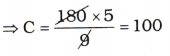
⇒ \(\frac{9 C}{5}\) = 180