
Regular practice with AP Inter 2nd Year Chemistry Study Material Chapter 8 Aldehydes, Ketones and Carboxylic Acids Questions and Answers helps students stay prepared for examinations.
AP Inter 2nd Year Chemistry 8th Lesson Aldehydes, Ketones and Carboxylic Acids Questions and Answers
I. Mutliple Choice Questions
Question 1.
With which of the following reagents both ethanal and propanone react?
1) Tottens’
2) Setoff’s
3) Fehling
4) Grignard
Answer:
4) Grignard
Tollens ’, Fehling, Schiff ’ —»react mainly with aldehydes
Grignard reacts with both aldehydes & ketones (adds to C=0) Grignard reagent
Question 2.
Cannizzaro reaction is not given by
1) CH3CHO
2) PhCHO
3) HCHO
4) (CH3)3C-CHO
Answer:
1) CH3CHO
annizzaro reaction occurs only with aldehydes without a-hydrogen.
CH3CHO has α-H does not give Cannizzaro
Question 3.
A new C—C bond is formed ¡n
1) Cannizzaro reaction
2) Rosenmund reduction
3) Clemmensen reduction
4) AIdol condensation
Answer:
4) AIdol condensation
New C-C bond formation happens when molecules combine.
Aldol condensation forms C-C bond between two aldehydes/ketones.
Question 4.
Fehling reagent oxidised an aliphatic aldehyde to carboxylic acid. The compound responsible for reddish brown precipitate is
1) CuO
2) Cu2O
3) CU(OH)2
4) (R-COO)2Cu
Answer:
2) Cu2O
Fehling’s solution contains Cu2+ ions. On reduction ⟶ CU2O (reddish-brown ppt).
Question 5.
Clemmensen and Wolff-Kishner reductions are used to convert
1) R-Cl → R-H
2) R-CHO → R-CH2OH
3) >C=O → >CH2
4) R-COOH → R-CH2OH
Answer:
3) >C=O → >CH2
Clemmensen & Wolff-Kishner reduce carbonyl group
>C=O → – CH2

Question 6.
Which of the following is a dicarboxvlic acid?
1) oxalic acid
2) benzoic acid
3) salicylic acid
4) picric acid
Answer:
1) oxalic acid
Dicarboxylic acid = 2 COOH groups.Oxalic acid = HOOC-COOH
Question 7.
CH3CHO and C6H5CH2-CHO can be distinguished chemically by
1) Benedict test
2) Iodoform test
3) Tollens’reagent
4) Fehling’s reagent
Answer:
2) Iodoform test
Iodoform test detects -COCH3 group. CH3CHO gives iodoform, C5H5CH2CHO does not.
Question 8.
Conversion of CH3COOH to CH3COCI cannot be achieved by
1) SOCl2
2) PCl5
3) PCl3
4) Cl2/ red P
Answer:
4) Cl2/ red P
Carboxylic acid → acid chloride requires chlorinating agent.
Cl2 /red P forms PCl3 in situ → converts COOH → COCl
Question 9.
Common reagent used to detect aldehydes and ketones is
1) Lucas reagent
2) 2, 4-DNP
3) Baeyer’s reagent
4) Tollens’ reagent
Answer:
2) 2, 4-DNP
2,4-DNP reacts with carbonyl group (C=O).Gives yellow/orange ppt → common test.
Question 10.
Benzaldehyde can be prepared from toluene by reacting with
1) CrO2Cl2 / CS2
2) KMnO4 / KOH
3) Pd / BaSO4
4) CO+HCl/AlCl3
Answer:
1) CrO2Cl2 / CS2
Controlled oxidation of toluene gives benzaldehyde.
Chromyl chloride (CrO2Cl2) → Etard reaction.
Question 11.
Choose the weakest acid among the following
1) FCH2COOH
2) Cl2CCOOH
3) CH2COOH
4) CH3CH2COOH
Answer:
4) CH3CH2COOH
Electron-donating groups decrease acidity. Alkyl group (+I effect) → weakest acid.
Propionic acid weakest here. CH3CH2COOH
Question 12.
Which one of the following is not correctly matched?
1) Formic acid – methanoic acid
2) acetic acid – ethanoic acid
3) malonic acid – propanedioic acid
4) adipic acid – ethanedioic acid
Answer:
4) adipic acid – ethanedioic acid
Adipic acid formula = hexanedioic acid, not ethanedioic. So mismatch.
adipic acid – ethanedioic acid
Question 13.
NaHSO3 forms an adduct with all compounds except
1) CH3CHO
2) H3CCOCH3
3) PhCHO
4) glucose
Answer:
4) glucose
NaHSO3 forms addition compounds with aldehydes/ketones.
Glucose is not typical carbonyl (exists mainly cyclic).
Question 14.
Which one of the following is more reactive towards nucleophilic addition?
1) CH3CHO
2) CH3CH2CHO
3) CH3COCH3
4) H3CCH2COCH3
Answer:
1) CH3CHO
Reactivity in nucleophilic addition depends on: +I effect (alkyl groups) →decreases reactivity
Steric hindrance → decreases reactivity. Order: Aldehyde > Ketone, and smaller
alkyl groups → more reactive. CH3CHO has: only one alkyl group, less steric hindrance
Question 15.
The correct trend of boiling point is
1) CH3COOH > CH3COCH3 > CH3CH2OH > CH3CH2Cl
2) CH3CH2OH > CH3COOH > CH3COCH3 > CH3CH2Cl
3) CH3CH2OH > CH3COOH > H3CCH2Cl > CH3COCH3
4) CH3COOH > CH3CH2OH > H3CCOCH3 > CH3CH2Cl
Answer:
4) CH3COOH > CH3CH2OH > H3CCOCH3 > CH3CH2Cl
Boiling point depends on intermolecular forces:Carboxylic acid → strongest (H-bonded dimers)
Alcohol → H-bonding. Ketone → dipole-dipole.
Alkyl halide → weak van der Waals
So order: Carboxylic acid > Alcohol > Ketone > Alkyl halide
Acid > Alcohol > Ketone > Alkyl chloride
II. Fill in the Blanks
Question 1.
IUPAC name of formaldehyde is _________
Answer:
methanal (HCHO)
Question 2.
Chromium trioxide (CrO3) in acidic (H2SO4) media is called _______ reagent
Answer:
Jones
Question 3.
Tollens’ reagent is ________
Answer:
freshly prepared ammonical silver nitrate solution
Question 4.
Carboxylic acids having an α-hydrogen are halogenated at the α-position on treatment with chlorine or bromine in presence of small amount of phosphorus to give α- halocarboxylic acids. This reaction is known as _________
Answer:
Hell-Volhard-Zellnskv reaction (HVZ reaction)
Question 5.
IUPAC name of Mesityl oxide is ___________
Answer:
4-methvlnent-3-en-2-one
III. One Word Answer Questions
Question 1.
What is name of the product formed when benzene is reacted with CO and HCl in the presence of anhydrous AlCl3? .
Answer:
Benzaldehyde is obtained when benzene is reacted with CO and HCl.
Question 2.
What is Rochelle salt?
Answer:
Rochelle salt: Sodium potassium tartarate (KNaC4H4O6.4H2O) .
( A double salt of Tartaric acid)
Question 3.
Which acid is used as solvent in food industry as vinegar?
Answer:
Vinegar: Ethanoic acid (CH3COOH or acetic acid>
Question 4.
Aldehydes and ketones undergo what type of addition reactions?
Answer:
Aldehydes and ketones undergo Nucleophilic addition reactions.
Question 5.
Phthalic acid on reaction with ammonia followed bv strong heating gives a compound ‘X’ along with elimination of NH3. What is the name of that compound ‘X’?
Answer:
phthalimide
IV. Very Short Answer Questions
Question 1.
Arrange the following compounds in increasing order of their property indicated.
i) acetaldehyde, acetone and t-butylmethyl ketone reactivity towards HCN
ii) fluoroacetic acid, monochloroacetic acid, acetic acid and dichloroacetic acid (acid strength)
Answer:
i) Reactivity towards HCN: t-butylmethyl ketone < acetone < acetaldehyde.
ii) Acid strength: dichloroacetic acid > fluoroaceticacid > monochloroacetic acid > acetic acid.
Question 2.
Write the reaction showing a-halogenation of carboxylic acid and give its name.
Answer:
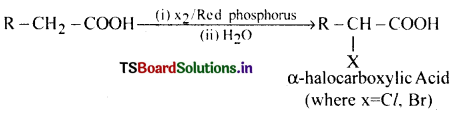
HVZ Reaction: Carboxylic acids having an a-hydrogen are halogenated at the a-position on treatment with chlorine (or) bromine in the presence of small amount of red phosphorus to give a-halo carboxylic acids. The reaction is known as Hell-Volhard-Zelinsky reaction.
Reaction of a-halogenation of carboxylic acid (HVZ reaction):
Question 3.
Although the phenoxide ion has a greater number of resonating structures than carboxylate ion, carboxylic acid is a stronger acid than phenol. Why?
Answer:
A carboxylic acid is a stronger acid than phenol due to the following reasons:
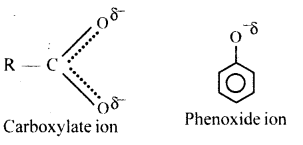
a) The conjugate base of carboxylic acid is carboxylate ion (RCOO–), which is stabilised by two equivalent resonance structures in which the negative charge is at the more electronegative oxygen atom. But, the conjugate base of phenol, is phenoxide ion, has nonequivalent resonance structures in which the negative charge is at the less electro negative carbon atom. Hence, resonance in phenoxide ion is not as important as it is in carboxylate ion.
b) In a carboxylate ion, the negative charge is delocalised over two electro negative oxygen atoms, whereas it is less effectively delocalised on less electronegative carbon atoms in the phenoxide ion. So, a carboxylic acid is a stronger acid than a phenol.
Question 4.
How do you distinguish acetophenone and benzophenone?
Answer:
Acetophenone undergoes iodoform reaction due to the presence of acetyl group CH3-CO .
But benzophenone does not undergo iodoform reaction due to the absence of CH3-CO group

Question 5.
Explain the position of electrophilic substitution in benzoic acid.
Answer:
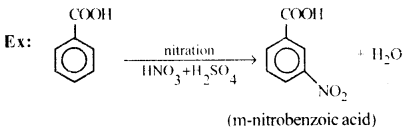
COOH group on benzene, deactivates the ring at ortho and para positions.
Hence substitution takes place at meta position.
Question 6.
Write equations showing the conversion of
i) acetic acid to acetyl chloride
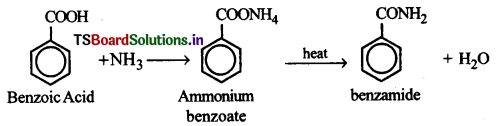
ii) benzoic acid to benzamide
Answer:
i) acetic acid to acetyl chloride:
3CH3COOH + PCl3 ⟶ 3CH3C0Cl + H3PO3
CH3COOH + PCl5 ⟶ CH3COCl + POCl3 + HCl
CH3COOH + SOCl2 ⟶ CH3COCl + SO2 + HCl
ii) benzoic acid to benzamide
Question 7.
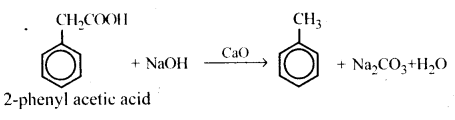
An organic acid with molecular formula C8H8O2 on decarhoylation forms Toluene. Identify the organic acid.
Answer:
The organic acid formed is phenyl acetic acid (2-Phenyl ethanoic acid)
Question 8.
List the reagents suitable to reduce carhoxy lic acid to alcohol.
Answer:
LiAlH4 (or) copper chromate are the needed reducing reagents.

Question 9.
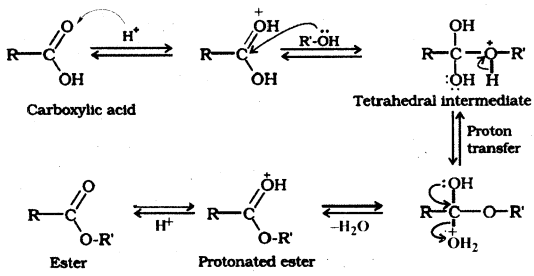
Write the mechanism of esterification.
Answer:
Question 10.
Compare the acidic strength of acetic acid, Chloroacetic acid, benzoic acid and Phenol.
Answer:
The relative values of ka and pka indicate the acidic strength:
Higher ka value and lower pka value indicates that the acid is strong.
Order of acidic strength: Chloroacetic acid > benzoic acid > acetic acid > phenol
The acidic strength of acetic acid, chloroactic acid, benzoic acid and phenol:
| Acid | ka (298 k) | Pka (298 k) |
| 1) CH3COOH (Acetic acid) | 1.75 × 10⁻⁵ | 4.76 |
| 2) Cl-CH2-COOH (Chloroacetic acid) | 1.36 × 10⁻³ | 2.87 |
| 3) C6H5COOH (Benzoic acid) | 6.3 × 10⁻⁵ | 4.0 |
| 4) C6H5OH (Phenol) | 1.1 × 10⁻¹⁰ | 10 |
V. Short Answer Questions
Question 1.
Write the equations of any aldehyde with Fehling’s reagent.
Answer:
Fehling’s solution is an alkaline solution of copper sulphate containing Rochelle salt(sodium potassium tartrate) .
Fehling’s test: When Fehling’s solution is heated with an aldehyde a reddish brown precipitate of (Cu2O) is formed.
RCHO + 2Cu+2 + 5OH– ⟶ RCOO– + Cu2O + 3H2O
Question 2.
What is Tollen’s reagent? Explain its reaction with Aldehydes.
Answer:
1) Tollen’s reagent: Ammonical silver nitrate solution is called Tollen’s reagent.
Its formula is [Ag(NH3)2]+OH–
2) Reaction of toulene with aldehydes ( Silver mirror test):
When Tollen’s reagent is warmed with an aldehyde, it gets reduced to metallic silver.
This metallic silver gets deposited on the inner wall of the test tube to form a silver mirror.
RCHO + 2 [Ag(NH3)2]+ + 3OH– ⟶ RCOO–Silver mirror + 2Ag ↓ + 4NH3 + 2H2O
Question 3.
Explain why Aldehydes and ketones undergo nucleophilic addition while alkenes undergoes electrophilic addition though both are unsaturated compounds.
Answer:
1) Nucleophilic addition: Aldehydes and ketones undergo nucleophilic addition because the intermediate anion formed by the attack of nucleophile on carbonyl group is more stable than the cation formed by attack of electrophile on carbonyl group.

2) Electrophilic addition: Alkenes undergoes electrophilic addition beacuse in alkenes there is double bond between two carbon atoms and is electron rich. This double bond is highly reactive. So it is attacked by electrophilic first. So alkenes undergo electrophilic addition reactions.

Question 4.
Arrange the following in the increasing order of their acidic strength:
benzoic acid, 4-methoxybenzoic acid, 4-nitrobenzoic acid and 4-nethylbenzoic acid.
Answer:
Acidic strength of electron with drawing -NO2 group increases
Acidic strength of electron with releasing -OCH3, -CH3 groups decreases
But releasing power of -OCH3 is more than that of -CH3.
Lower Pka values indicate higher acidity.
Hence the increasing order (low to high) acidic strengths are given below:
4-methoxy benzoic acid < 4-methyl benzoic acid < benzoic acid < 4-nitrobenzoic acid.
Pka values: (4.46) < (4.36) < (4.19) < (3.41)
Question 5.
Describe the following:
i) Crossed aldol condensation
ii) Decarboxylation
Answer:
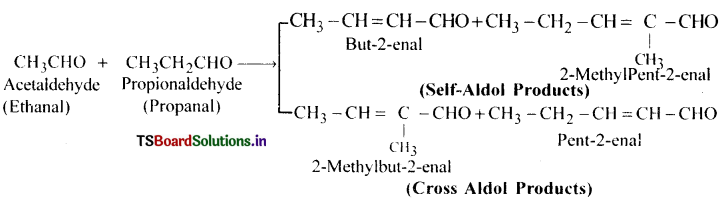
i) Crossed aldol condensation: It is the condensation of two different carbonyl compounds (one of which must have one a-hydrogen) in the presence of alkali. It is the condensation of an aldehyde with a ketone in the presence of an alkali
ii) Decarboxylation: It removes a carboxyl group and releases CO2.
Heating of anhydrous potassium salt of carboxylic acid with sodalime (CaO + NaOH) forms Alkane with the liberation of CO2. The formed alkane contains one carbon less than that of parent acid.

Question 6.
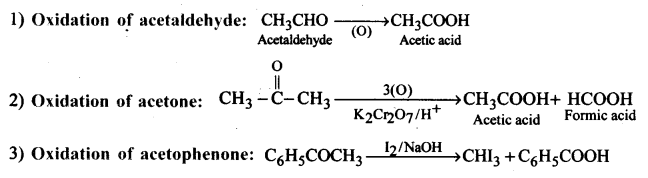
Write the oxidation products of acetaldehyde, acetone and acetophenone.
Answer:
Question 7.
Write the IUPAC names of the following
(i) CH3CH2CH(Br)CH2COOH
(ii) PhCH2COCH2COOH
(iii) CH3CH(CH3)CH2COOC2H5
Answer:
i) CH3CH2CH(Br)CH2COOH: 3-Bromol-pentanoicacid
ii) PhCH2COCH2COOH: 4-Phenyl-3-oxo butanoic acid
iii) CH3CH(CH3)CH2COOC2H5: Ethyl-3-Methyl butanote
Question 8.
Explain the role of electron withdrawing and electron releasing groups on the acidity of carboxylic acids.
Answer:
1) The role of electron withdrawing group on the acidity of carboxylic acids:
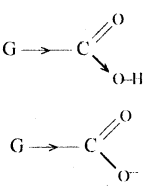
The electron withdrawing substituents tend to withdraw electrons away from the carboxyl carbon. This favours declocalisation of the negative charge. Delocalisation of negative charge stabilizes the carboxylate anions and makes the release of H atom as H+ easier. Hence, the presence of an electron withdrawing substituent increases the acid strength of the acid.

2) The role of electron releasing groups on the acidity of carboxylic acids:
Alkyl groups, such as -CH3, -C2H5 etc., are electron releasing groups. The presence of an electron releasing group tends to increase the negative charge on the oxygen atom of the anion. This localisation of negative charge on the oxygen of the carboxylic group destabilizes the anion. Due to the increased electrostatic effects the release of H atom of the —COOH group as a proton (H+) becomes more difficult. As a result, the strength of the acid decreases.
Question 9.
Draw the Structures of the following derivatives:
i) Acetaldehydedimethylacetal
ii) The ethylene ketal of hexan-3-one
iii) The methyl hemiacetal of formaldehyde
Answer:

Question 10.
An organic compound contains 69.77% carbon, 11.63% hydrogen and rest oxygen. The molecular mass of the compound is 86. It doesn’t reduce Tollens’ reagent but forms sodium hydrogen sulphite adduct and gives positive iodoform test. On vigorous oxidation forms ethanoic and propanoic acids. Write the possible structure of the compound.
Answer:
Determination of molecule formulae:
| Element | Mass% | Atomic mass | Relative No. of atoms | Simplest ratio |
| C | 69.77 | 12 | \(\frac{69.77}{12}\) = 5.81 | \(\frac{5.81}{1.16}\) = 5 |
| H | 11.63 | 1 | \(\frac{11.63}{1}\) = 11.63 | \(\frac{11.6}{1.16}\) = 10 |
| O | 18.6 | 16 | \(\frac{18.6}{16}\) = 1.16 | \(\frac{1.16}{1.16}\) = 1 |
Empirical formula = C5H10O
Empirical formula mass = (5 × 12) + (10 × 1) + (1 × 16) = 86 Given molecular mass) = 86
n = \(\frac{\text { Molecular mass }}{\text { Empirical formula mass }}=\frac{86}{86}\) = 1
∴ Molecular formula of the compound = C5H10O
The compound does not reduce Fehling’s solution, but forms a bisulphite addition compound.
So, the compound is a ketone. This ketone compound gives idoform test.
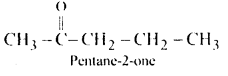
So, the ketone is a methyl ketone. Then the possible compound is CH3-CO-C3H7.
This compound on oxidation gives mixture of ethanoic acid and propanoic acid.
Therefore the possible structure is
VI. Long Answer Questions
Question 1.
Explain the following terms. Give an example of the reaction in each case.
i) Cyanohydrin
ii) Acetal
iii) Semicarbazone
iv) Aldol
v) Hemiacetal
vi) Oxime
Answer:
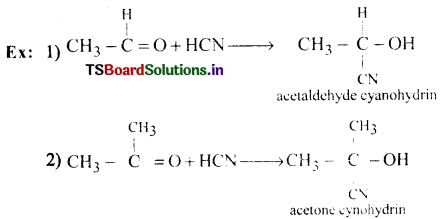
i) Cyanohydrin: Cyanohydrins are very useful compounds for organic synthesis. Hydrogen cyanide (HCN) adds to aldehydes and ketones to form cyanohydrin
ii) Acetal: Aldehydes react with alcohols in the presence of dry hydrogen chloride to form gem- dialkoxy compounds which are known as acetals.

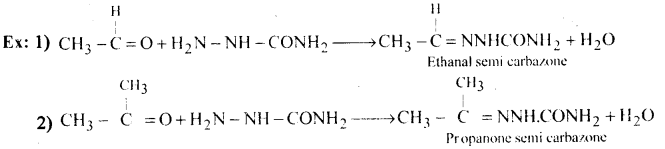
iii) Semicarbozone: Aldehydes and ketones react with semicarbazide (NH2NHCONN2) to form semicarbazone.
iv) Aldol: The β-hydroxy aldehydes (or) β-hydroxy ketones are called aldol.
Aldol reaction: Aldehydes and ketones having at least one α-hydrogen undergo a reaction in the presence of dilute alkali as catalyst to form β-hydroxy aldehyde (aldol) or β-hydroxy ketones (ketol) respectively.
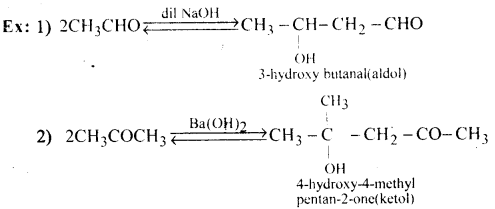
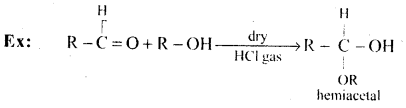
v) Hemi Acetal: When one molecule of alcohol is added to one molecule of aldehyde, it forms a hemiacetal. It is an unstable compound. It contains functional groups of both alcohol and ether.
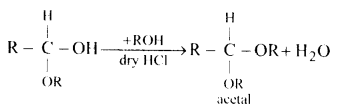
Hemiacetal reacts with one more alcohol molecule to form an acetal.
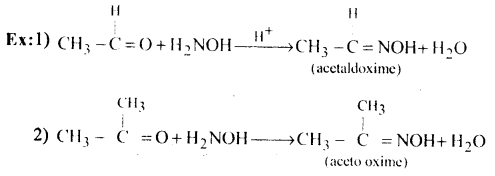
vi) Oxime: Aldehydes and ketones reacts with hydroxylamine to form oximes.
Question 2.
how do you distinguish the following pairs of compounds?
i) Propanal and propanone
ii) Acetophvnone and benzophennne
iii) Phenol and benìok acid
iv) Pentan-2-one and Pentan-3-one
Answer:
i) Propanal Vs propanone: Propanal(CH3CH2CH2OH) does not undergo idoform reaction, where as propanone (CH3—CO—CH3) gives idoform when warmed with iodine in the presence of alkali.

ii) Acetophenone Vs benzopheiionc: Acetophenone is a methyl ketone (C6H5COCH3) while benzophenone (C6H5COC36H5) is a diphenyl ketone. So acetophenone undergoes Idoform reaction. But Bezophenone does not undergo iodoform reaction.

iii) Phenol Vs benzoic acid:
a) Phenol gives coupling reactions with diazonium compounds, while benzoic acid does not. Phenol gives azodyes when reacted with benzenediazonium chloride (C5H5N2Cl) Benzoic acid does not give any reaction with diazonium salts.

b) With neutral FeCl3 phenols give reddish colour,, while benzoic acid gives buff-coloured precipitate.
iv) Pentan-2-one and Pentan-3-one: Pentan-2-one is a methyl ketone. So, it undergoes idoform test. So, when heated with iodine and alkali pentan-2-one, it gives idoform.
But pentan-3-one does not give this test.

Question 3.
Describe the following:
i) Acetylation
ii) Cannizzaro reaction
iii) Cross aldol condensation
iv) Decarboxylation
Answer:
i) Acety lation: Alcohols when treated with an acyl chloride (or) acid anhydride in the presence of pyridine give esters. In this reaction, H of the -OH group of alcohol is replaced by acyl (CH3-CO-) group. So, this reaction is called acylation.

ii) Cannizzaro reaction:Aldehydes having no ‘a’ hydrogen undergo Cannizzaro’s reaction. Such aldehydes in the presence of concentrated alkaline solution undergo self oxydation-reduction to give a mixture of alcohol and a salt of carboxylic acid.
Ex: 1) 2 molecules of formaldehyde undergo self oxydation in presence of conc.NaOH to form methanol and Sodium formate.

2) Benzaldehyde gives benzyl alcohol and sodium benzoate.

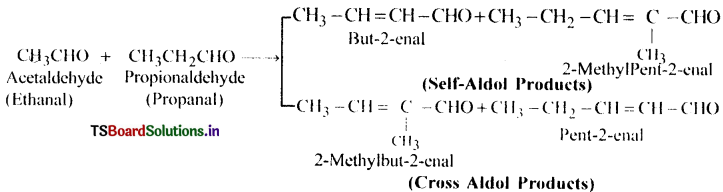
iii) Cross aldol condensation: The condensation of two different carbonyl compounds (one of which must have one a-hydrogen) in the presence of alkali is called cross aldol condensation.
iv) Decarboxylation: It removes a carboxyl group and releases CO2. Heating of anhydrous potassium salt of carboxylic acid with sodalime (CaO+NaOH) forms Alkane with the liberation of C02. The formed alkane contains one carbon less than that of parent acid.

Question 4.
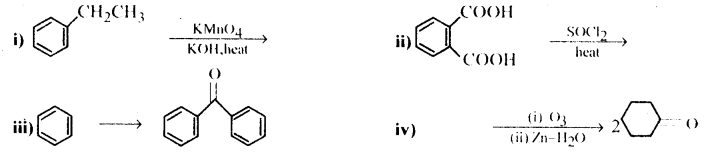
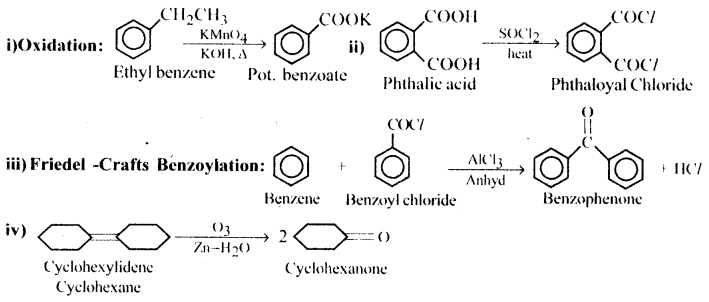
Complete each synthesis by giving the missing starting material, reagent or product.
Answer:
Question 5.
Explain the following reactions
a) Aldol reaction
b) Esterification
c) H.V.Z reaction
d) Broniinaition of Benzoic acid
Answer:
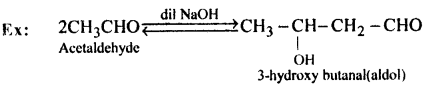
a) Aldol reaction : Aldehydes and ketones having at least one α-hydrogen undergo a reaction in the presence of dilute alkali as catalyst to form β-hydroxy aldehyde.
This is also called Aldol condensation.
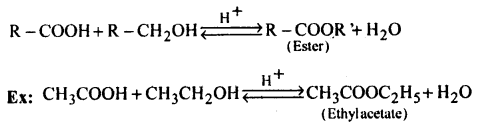
b) Esterification: Carboxylic acid reacts with alcohol in the presence of acidic medium (HCl, H2SO4) to give Ester.
c) H.V.Z Reaction: Carboxylic acids having an a-hydrogen are halogenated at the a-position on treatment with chlorine (or) bromine in the presence of small amount of red phosphorus to give a-halo carboxylic acids.

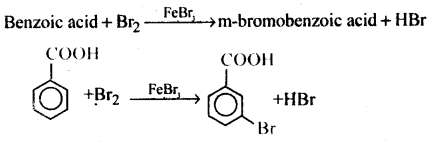
d) Bromination of Benzoic acid:
Bromination of Benzoic acid is an electrophilic aromatic substitution (EAS).
Bromine reacts with FeBr3 to form a strong electrophile.The aromatic ring of benzoic acid attacks Br+ at the meta position, forming a sigma complex (arenium ion).
Loss of H+ restores aromaticity and gives the final product meta-bromobenzoic acid.
Objective Questions
Question 1.
Give IUPAC name of the compound given below.

1) 2-Chloro-5-hydroxyhexane
2) 2-Hydroxy-5-chlorohexane
3) 5-ChIorohexan-2-ol
4) 2-Chlorohexan-5-ol
Answer:
3) 5-ChIorohexan-2-ol
Question 2.
IUPAC name of
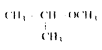 is
is
1) 1 -methoxy-1 -methylethane
2) 2-methoxy-2-methylethane
3) 2-methoxypropane
4) isopropylmethyl ether
Answer:
3) 2-methoxypropane
Question 3.
IUPAC name of m-cresol is
1) 3-methylphenol
2) 3-chlorophenol
3) 3-methoxyphenol
4) benzene-1,3-diol
Answer:
1) 3-methylphenol
Question 4.
How many alcohols with molecular formula C4H10O are chiral in nature?
1) 1
2) 2
3) 3
4)4
Answer:
1) 1
Question 5.
What is the correct order of reactivity of alcohols in the following reaction?

1) 1° > 2° > 3°
2) 1° < 2° > 3°
3) 3° > 2° > 1°
4) 3° > 1° > 2°
Answer:
3) 3° > 2° > 1°
Question 6.
The process of converting alkyl halides into alcohols involves ________
1) addition reaction
2) substitution reaction
3) dehydrohalogenation reaction
4) rearrangement reaction
Answer:
2) substitution reaction
Question 7.
Which of the following compounds will react with sodium hydroxide solution in water?
1) C6H5OH
2) C6H5CH2OH
3) (CH3)3COH
4) C2H5OH
Answer:
1) C6H5OH
Question 8.
In the following sequence of reactions.

the end product is
1) acetone
2) methane
3) acetaldehyde
4) ethylalcohol
Answer:
4) ethylalcohol
Question 9.
Consider the following reaction,

The product Z is
1) toluene
2) benzaldehyde
3) benzoic acid
4) benzene
Answer:
3) benzoic acid
Question 10.
Monochlorination of toluene in sunlight followed by hydrolysis with aq. NaOH yields.
1) o-Cresol
2) m-Cresol
3) 2, 4-Dihydroxytoluene
4) Benzyl alcohol
Answer:
4) Benzyl alcohol
Question 11.
CH3CH2OH can be converted into CH3CHO by _________
1) catalytic hydrogenation
2) treatment with LiAlH4
3) treatment with pyridinium chlorochromate
4) treatment with KMnO4
Answer:
3) treatment with pyridinium chlorochromate
Question 12.
The correct order of increasing acidic strength is ________
1) Phenol < Ethanol < Chloroacetic acid < Acetic acid
2) Ethanol < Phenol < Chloroacetic acid < Acetic acid
3) Ethanol < Phenol < Acetic acid < Chloroacetic acid
4) Chloroacetic acid < Acetic acid < Phenol < Ethanol
Answer:
3) Ethanol < Phenol < Acetic acid < Chloroacetic acid
Question 13.
Which of the following is most acidic?
1) Benzyl alcohol
2) Cyclohexanol
3) Phenol
4) m-Chlorophenol
Answer:
4) m-Chlorophenol
Question 14.
Which of the following compounds is aromatic alcohol?
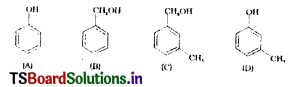
1) A, B, C, D
2) A, D
3) B, C
4) A
Answer:
3) B, C
Question 15.
Compound 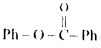 can be prepared by the reaction of _________
1) Phenol and benzoic acid in the presence of NaOH
2) Phenol and benzoyl chloride in the presence of pyridine
3) Phenol and benzoyl chloride in the presence of ZnC2
4) Phenol and benzaldehyde in the presence of palladium.
Answer:
2) Phenol and benzoyl chloride in the presence of pyridine
Question 16.
Among the following sets of reactants which one produces anisole?
1) CH3CHO, RMgX
2) C6H5OH, NaOH, CH3I
3) C6H5OH, neutral FeCl2
4) C6H5-CH3, CH3COCl, AlCl3
Answer:
2) C6H5OH, NaOH, CH3I
Question 17.
The reagent which does not react with both, acetone and benzaldehyde.
1) Sodium hydrogensulphite
2) Phenyl hydrazine
3) Fehling’s solution
4) Grignard reagent
Answer:
3) Fehling’s solution
Question 18.
Which of the following compounds will give butanone on oxidation with alkaline KMnO4 solution?
1) Butan-1 -ol
2) Butan-2-ol
3) Both of these
4) None of these
Answer:
2) Butan-2-ol
Question 19.
Phenol is less acidic than _______
1) ethanol
2) o-nitrophenol
3) o-methylphenol
4) o-methoxyphenol
Answer:
2) o-nitrophenol
Question 20.
Cannizaro’s reaction is not given by _______
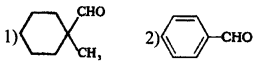
3) H CHO
4) CH3CHO
Answer:
4) CH3CHO
Question 21.
In Ciemmensen Reduction carbonyl compound is treated with _________
1) Zinc amalgam + HCl
2) Sodium amalgam + HCl
3) Zinc amalgam + nitric acid
4) Sodium amalgam + HNO3
Answer:
1) Zinc amalgam + HCl
Question 22.
Ciemmensen reduction of a ketone is carried out in the presence of which of the following?
1) Zn-Hg with HCl
2) LiAlH4
3) H and Pt as catalyst
4) Glycol with KOH
Answer:
1) Zn-Hg with HCl
Question 23.
Reduction of aldehydes and ketones into hydrocarbons using zinc amalgam and conc.HCl is called
1) Ciemmensen reduction
2) Cope reduction
3) Dow reduction
4) Wolff-Kishner reduction
Answer:
1) Ciemmensen reduction
Question 24.
Which one of the following on treatment with 50% aqueous solution hydroxide yields the corresponding alcohol and acid?
1) C6H5CH2CHO
2) C6H5CHO
3) CH3CH2CH2CHO
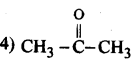
Answer:
2) C6H5CHO
Question 25.
Iodoform test is not given by
1) 2-pentanone
2) ethanol
3) ethanal
4) 3-pentanone
Answer:
4) 3-pentanone