
Referring to the AP Inter 1st Year Maths Study Material Chapter 2 Relations and Functions Exercise 2d Solutions makes it easier to understand complex problems.
AP Inter 1st Year Maths Relations and Functions Solutions Exercise 2d
I.
Question 1.
If f(x) = x2, find \(\frac{\mathrm{f}(1.1)-\mathrm{f}(1)}{(1.1-1)}\)
Solution:
Here f(x) = x2
f(1.1) = (1.1)2 = 1.21; f(1) = (1)2 = 1
\(\frac{\mathrm{f}(1.1)-\mathrm{f}(1)}{(1.1-1)}=\frac{1.21-1}{0.1}=\frac{0.21}{0.1}\) = 2.1
Question 2.
Find the domain of the function f(x) = \(\frac{x^2+2 x+1}{x^2-8 x+12}\)
Solution:
Here f(x) = \(\frac{1}{2}\)
f(x) is a rational function of x.
f(x) assumes real values of all x except for those values of x for which.
x2 – 8x + 12 = 0
⇒ (x – 6) (x – 2) = 0
⇒ x = 2, 6
∴ Domain of function = R – {2, 6}.
Question 3.
Find the domain and the range of the real function f is defined by f(x) = \(\sqrt{(x-1)}\).
Solution:
Here f(x) = -1, f(x) assumes real values
If x – 1 ≥ 0 ⇒ x ≥ 1 ⇒ x ∈ (1, ∞)
∴ Domain of f(x) = {1, ∞}
For Z ≥ 1, f(x) ≥ 0
Range of f(x) = all real numbers ≥ 0 = (0, ∞) .
Question 4.
Find the domain and the range of the real function f defined by f(x) = |x – 1|.
Solution:
Here f(x) = |x – 1|
The function f(x) is defined for all values of x
Domain of f(x) = R
when x > 1 ⇒ |x – 1| = 0
when x < 1 ⇒ |x – 1| = -x + 1 > 0
Range of f(x) = all real numbers ≥ 0.
Question 5.
Let f = {(x, \(\frac{x^2}{1+x^2}\)): x ∈ R} be a function from R into R, Determine the range of f.
Solution:
Here f(x) = \(\frac{x^2}{1+x^2}\)
Put y = \(\frac{x^2}{1+x^2}\) ⇒ y + yx2 = x2
⇒ x2(1 – y) = y
⇒ x2 = \(\frac{y}{1-y}\)
⇒ x = \(\sqrt{\frac{y}{1-y}}\)
\(\frac{1}{2}\) ≥ 0 ⇒ \(\frac{1}{2}\) ≤ 0
⇒ 0 ≤ y < 1
⇒ y ∈ [0, 1)
Range of f(x) = [0, 1)

Question 6.
Let R be a relation from N to N defined by R = |(a, b) : a, b ∈ N and a = b2). Are the following true ?
i) (a, a) ∈ R, for all a ∈ N
ii) (a, b) ∈ R, implies (b, a) ∈ R
iii) (a, b) ∈ R, (b, c) ∈ R implies (a, c) ∈ R.
Justify your answer in each case.
Solution:
i) Given R = {(a, b):a, b ∈ N and a = b2}
(a, a) ∈ R for all a ∈ N 3 ∈ N but 3 * 32 = 9
Hence the statement is not true,
ii) (a, b) ∈ R implies (b, a) ∈ R
Now (4, 2) ∈ N and 4 = 22 = 4
But 3 ≠ 42 = 16 ⇒ (2, 4) ∉ Q
Hence the statement is not true.
iii) (a, b) ∈ R, (b, c) ∈ R ⇒ (a, c) ∈ R
(9, 3) ∈ R, (16, 4) ∈ R because 3, 4, 9, 16 ∈ N
9 ≠ 42 = 16 ⇒ (9, 4) ∈ R
Hence the statement is not true.
Question 7.
Let A = {1, 2, 3, 4). B = (1. 5, 9, 11, 15, 16) and f = {(1, 5), (2, 9), (3, 1), (4, 5), (2, 11)}. Are the following true ?
i) f is a relation from A to B, ii) f is a function from A to B.
Justify your answer in each case.
Solution:
i) Given A = {1, 2, 3, 4}, B = {1, 5, 9, 11, 15, 16}
F = {(1, 5), (2, 9), (3, 1), (4, 5), (2, 11)}
A × B = {(1, 1), (1, 5), (1, 9), (1, 11), (1, 15), (1, 16), (2, 1), (2, 5), (2, 9), (2, 11), (2, 15), (2, 16), (3, 1), (3, 5), (3, 9), (3, 11), (3, 15), (3, 16), (4, 1), (4, 5), (4, 9), (4, 11), (4, 15), (4, 16)} f is a subset of A × B.
Hence f is a relation from A to B.
Statement is true.
ii) f is not a function from A to B because 2 corresponds to two different images that is 9 & 11.
Question 8.
Let f be the subset of Z × z defined by f = {(ab, a + b) : a, b ∈ Z). Is f a function from Z to Z ? Justify your answer.
Solution:
We observe that 1 × 4 = 4 & 2 × 2 = 4 (1 × 4, 1 + 4) ∈ f and (2 × 2, 2 + 2) ∈ f and (4, 4) ∈ f
∴ f is not a function from Z to Z.
Question 9.
Let A = {9, 10, 11, 12, 13} and let f : A → N be defined by f(n) = the highest prime factor of n. Find the range of f.
Solution:
Given A = {9, 10, 11, 12, 13} and f : A → N be defined by f(n) = Highest prime factor of n.
For n = 9, 9 = 1 × 3 × 3; Highest prime factor is 3.
For n = 10, 10 = 1 × 2 × 5; Highest prime factor is 5.
For n = 11, 11 = 1 × 11; Highest prime factor is 11.
For n = 12, 12 = 1 × 2 × 2 × 3; Highest prime factor is 3.
For n = 13, 13 = 1 × 13; Highest prime factor is 13.
∴ f = {(9, 3), (10, 5), (11, 11), (12, 3), (13, 13)}
Hence the range of f = {3, 5, 11, 13}.
II.
Question 1.
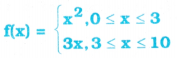
The relation f is defined by
The relation g is defined by
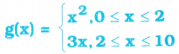
Show that f is a function and g is not a function.
Solution:
Given
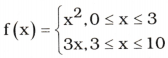
It is observed that f(x) = x2, 0 < x < 3 ⇒ f(3) = 32 = 9
f(x) = 3x, 3 < x < 10 ⇒ f(x) = 3(3) = 9
∴ For 0<x<10, the images of fix) are unique. Thus, the given relation f is a function.
Given
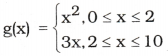
It is observed that g(x) = x2, 0 < x < 2 ⇒ g(2) = 22 = 4
g(x) = 3x, 2 < x < 10 ⇒ g(2) = 3(2) = 6
∴ The element 2 at the domain of the relation g corresponds to two different image (4 & 6). Hence, the given relation g is not a function.
Question 2.
Let f, g : R R be defined, respectively by fix) = x + 1, g(x) = 2x – 3. Find
Solution:
Given f(x) = x + 1, g(x) = 2x – 3
(f + g) (x) = f(x) + g(x) = x + 1 + 2x – 3 = 3x – 2
(f – g) (x) = f(x) – g(x) = x + 1 – 2x + 3 = 4 – x
\(\left(\frac{\mathrm{f}}{\mathrm{~g}}\right)\)(x) = \(\frac{f(x)}{g(x)}=\frac{x+1}{2 x-3}\) when x ≠ \(\frac{3}{2}\)
Question 3.
Let f = ((1, 1), (2, 3), (0, -1), (-1, -3) be a function from Z to Z defined by f(x) = ax + b, for some integers a. b. Determine a, b.
Solution:
Given f(x) = ax + b
f(1) = 1 ⇒ a(1) + b = 1 ⇒ a + b = 1;
f(0) = -1 ⇒ a(0) + b = -1 ⇒ b = -1 a + (-1) = 1 ⇒ a = 2
∴ f(x) = 2x – 1
III.
Question 1.
If f = {(4, 5), (5, 6), (6, -4)} and g = {(4, -4), (6, 5), (8, 5)} then find
(i) f + g
(ii) f – g
(iii) 2f + 4g
(iv) f + 4
(v) fg
(vi) \(\frac{f}{g}\)
Solution:
Given f = {(4, 5), (5, 6), (6, -4); g = {(4, -4), (6, 5), (8, 5)}
i) f + g = {(4, 5 -4), (6, -4 + 5)} = {(4, 1), (6, 1)
ii) f – g = {(4, 5 + 4), (6, -4 -5)} = {(4, 9), (6, -9)}
iii) 2f + 4g = {(4, 10), (5, 12), (6, -8)} + {(4, -16), (6, 20), (8, 20)}
= {(4, 10 – 16), (6, -8 + 20)} = {(4, -6), (6, 12)}
iv) f + 4 = {(4, 5 + 4), (5, 6 + 4), (6, -4 + 4)} = {(4, 9), (5, 10), (6, 0)}
v) fg = {(4, (5 x -4), (6, -4 x 5)} = {(4, -20), (6, -20)}
vi) \(\frac{\mathrm{f}}{\mathrm{~g}}=\left\{\left(4, \frac{-5}{4}\right),\left(6, \frac{-4}{5}\right)\right\}\)
Question 2.
If f and g are real valued functions defined by f(x) = 2x – 1 and g(x) = x2 then find
(i) (3f – 2g)(x)
Solution:
Given f(x) = 2x – 1, g(x) = x2
(3f – 2g)(x) = 3f(x) – 2g(x)
= 3(2x – 1) – 2(x2)
= 6x – 3 – 2x2
= -2x2 + 6x – 3
ii) (fg)(x)
Solution:
(fg)(x)
= f(x) g(x)
= (2x – 1) x2
= 2x3 – x2
iii) \(\left(\frac{\mathrm{f}}{\mathrm{~g}}\right)\) (x)
= \(\frac{f(x)}{g(x)}=\frac{2 x-1}{x^2}\)
iv) (f + g + 2) (x)
Solution:
(f + g + 2) (x)
= f(x) + g(x) + 2
= 2x – 1 + x2 + 2
= x2 + 2x + 1
= (x + 1)2
v) 2f(x)
Solution:
2f(x)
= 2(2x – 1)
= 4x – 2
vi) 2 + f(x)
Solution:
2 + f(x)
= 2 + 2x – 1
= 2x + 1
Question 3.
If f(x) = x2 and g(x) = |x| find the following functions.
(i) f + g
Solution:
Given f(x) = x2, g(x) = |x|
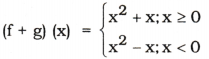
(f + g)(x) = f(x) + g(x) = x2 + |x|
(ii) f – g
Solution:
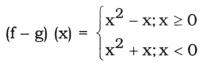
(f – g)(x) = f(x) – g(x) = x2 – |x|
(iii) f . g
Solution:
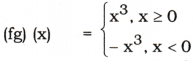
(fg) (x) = f(x) g(x) = x2 |x|
(iv) 2f
Solution:
2f(x) = 2x2
(v) f + 3
Solution:
f + 3 = f(x) + 3 = x2 + 3
(vi) \(\frac{f}{g}\) (for x ≠ 0)
Solution:
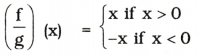
\(\left(\frac{\mathrm{f}}{\mathrm{~g}}\right)\) (x) = \(\frac{f(x)}{g(x)}=\frac{x^2}{|x|}\)
Question 4.
If the function f is defined by
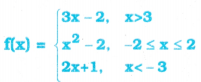
then find the values if exists of f(4), f(2.5), f(-2), f{-4), f(0), f(-7), f(1), f(9).
Solution:
Given
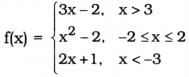
f(4) =3(4) – 2 = 12 – 2 = 10,
f(2.5) = not defined,
f(-2) = 4 – 2 = 2
f(-4) = -8 + 1 = -7,
f(0) = 0 – 2 = -2,
f(-7) = -14 + 1 = -13
f(1) = 1 – 2 = -1,
f(9) = 27 – 2 = 25
Question 5.
Determine a Quadratic function f is defined by f(x) = ax2 + bx + c, if f(0) = 6,
Solution:
Given f(x) = ax2 + bx + c … (1)
f(0) = 0 + 0 + c = 6 ⇒ c = 6
f(2) = 1 ⇒ 4a + 2b + c = 1
⇒ 4a + 2b + 6 = 1
⇒ 4a + 2b = -5 (∵ c = 6) ………(2)
f(-3) = 6 ⇒ 9a – 3b + c = c = 6
⇒ 9a – 3b = 0 ….(3)
On Solving Eqn (2) & Eqn (3)
(2) × 3 ⇒ 12a + 6b = -15
(3) × 2 ⇒ 18a – 6b = 0
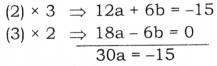
⇒ a = \(\frac{-15}{30}=\frac{-1}{2}\)
⇒ a = \(\frac{-1}{2}\)
Substitute ‘a’ value in Eqn (3), 3b = 9a ⇒ b = 3a = 3\(\left(\frac{-1}{2}\right)=\frac{-3}{2}\)
Substitute a, b, c values in Eqn (1), then f(x) = \(\frac{-1}{2}\) x2 – \(\frac{3}{2}\) x + b