Reproductive Health Questions and Answers AP Inter 2nd Year Zoology Chapter 2

Reviewing AP Inter 2nd Year Zoology Study Material Chapter 2 Reproductive Health Questions and Answers can help students prepare confidently for exams.

AP Inter 2nd Year Zoology 2nd Lesson Reproductive Health Questions and Answers

IV. Very Short Answer Questions

Question 1.
What in your view, are the reasons for population explosion, especially in India?
Answer:

  1. Significant reduction in the death rate.
  2. Decrease in Maternal Mortality Rate (MMR).
  3. Reduction in Infant Mortality Rate (IMR).
  4. Increase in the number of people belonging to the reproductive age group.

Question 2.
What is amniocentesis? Name any two disorders that can be detected through amniocentesis.
Answer:
1. Amniocentesis is a prenatal diagnostic technique used to identify genetic abnormalities in an unborn child.
2. Disorders that can be detected include:

  • Down syndrome
  • Edward’s syndrome
  • Tumer’s syndrome

3. In this procedure, a sample of amniotic fluid is collected, and foetal cells are examined.
4. However, misuse of this method for determining the sex of the foetus has led to legal restrictions.

Reproductive Health Questions and Answers AP Inter 2nd Year Zoology Chapter 2

Question 3.
List out the contraceptive methods available to the couples.
Answer:

  1. Periodic abstinence
  2. Condoms
  3. Vasectomy (male sterilization)
  4. Tubectomy (female sterilization)
  5. Coitus interruptus (withdrawal method)

Question 4.
Mention the advantage of Lactational Amenorrhea. (APMAY-22)(APMAR.-19,24)
Answer:
Advantages of Lactational Amenorrhea (Breastfeeding Method):

  1. During the period of exclusive breastfeeding, the likelihood of conception is extremely low.
  2. Breastfed infants receive enhanced immunity and protection against allergic conditions.

Question 5.
List the different types of Intrauterine Devices (IUDs) used to avoid pregnancy.
Answer:
The various categories of Intrauterine Devices (IUDs) are:

  1. Non-medicated IUDs Example: Lippes Loop
  2. Copper-releasing IUDs Examples: Cu-T (Copper-T), Cu-7, Multiload 375
  3. Hormone-releasing IUDs Examples: Progestasert, LNG-20

Question 6.
Mention the mode of action of oral contraceptive pills (daily pills) in preventing pregnancy.
Answer:

  1. Oral contraceptive pills mainly prevent pregnancy by suppressing ovulation.
  2. They also increase the thickness of cervical mucus, thereby restricting sperm entry into the uterus, and alter the endometrium, making it unfavorable for implantation.

Question 7.
What measures should one take to prevent sexually transmitted diseases (STDs)? (AP MAR-17, 23)
Answer:
Measures to Prevent STDs:

  1. Avoid sexual contact with unknown individuals or multiple partners.
  2. Use condoms consistently during sexual intercourse.
  3. Seek medical consultation for early diagnosis of STDs.
  4. Complete the prescribed treatment if an infection is detected.

8. What are the reasons for infertility in human beings?
Answer:

  1. Infertility may result from physical abnormalities, hormonal imbalances, infections or diseases i (including STIs), and genetic disorders.
  2. It may also arise due to a low sperm count or other male reproductive problems.

V. Short Answer Questions 

Question 1.
Why is the introduction of sex education in schools is necessary?
Answer:

  1. Sex education is important because adolescents experience many physical and emotional changes and are naturally curious about reproductive processes.
  2. Accurate knowledge about reproductive organs, adolescence, bodily changes, and safe hygienic practices helps students understand these developments properly.
  3. Awareness about sexually transmitted diseases enables students to recognize the consequences of unsafe sexual behavior.
  4. Therefore, school students should receive scientifically correct information regarding sex and reproductive health.

Reproductive Health Questions and Answers AP Inter 2nd Year Zoology Chapter 2

Question 2.
Describe the following contraceptive methods.
(a) Natural Methods
(b) Surgical Methods
Answer:
(a) Natural Methods of Contraception: Natural methods prevent pregnancy by avoiding the meeting of sperm and ovum.

  1. Periodic Abstinence: The couple refrains from sexual intercourse during the fertile period (usually from the 10th to 17th day of the menstrual cycle), thereby reducing the chances of fertilization.
  2. Withdrawal or Coitus Interruptus: The male partner withdraws the penis before ejaculation, preventing sperm from entering the female reproductive tract.

(b) Surgical Methods of Contraception: These methods are permanent sterilization procedures.

  1. Vasectomy: A small incision is made on both sides of the scrotum, and a portion of the vas deferens is cut and tied. This prevents sperm from reaching the seminal fluid, making the semen free of sperms.
  2. Tubectomy: Small incisions are made on both sides of the lower abdomen. A section of each fallopian tube is cut and tied, preventing the ovum from reaching the site of fertilization and thereby preventing pregnancy.

Question 3.
Which barrier methods are effectively useful for newly married couples to avoid conception?
Answer:
Barrier methods prevent fertilization by physically blocking the meeting of sperm and ovum.

  1. Condoms (Male and Female): These are thin latex or rubber coverings used over the penis or inside the female reproductive tract. They are easily available, disposable, provide privacy, and also offer protection against STIs and AIDS.
  2. Diaphragms, Cervical Caps, and Vaults: These devices are inserted into the female reproductive tract to cover the cervix and prevent sperm entry. They can be reused and are effective contraceptive barriers.
  3. Spermicidal Agents: Creams, jellies, and foams are used along with barrier devices to destroy or immobilize sperms, thereby increasing contraceptive effectiveness. These methods are safe, reversible, user-friendly, and have very few side effects, making them suitable for newly married couples.

Question 4.
Write short notes on any two of the following.
(a) MTP (Medical Termination of Pregnancy)
(b) RTI (Reproductive Tract Infections)
(c) SAHELI
Answer:
(a) MTP (Medical Termination of Pregnancy): MTP refers to the deliberate termination of pregnancy before full-term development using medical or surgical procedures.

  • It is performed in cases of unwanted pregnancy, contraceptive failure, or when pregnancy poses a risk to the mother’s health.
  • It is considered safer when carried out during the early stages of pregnancy.
  • Proper medical supervision is essential to avoid complications.

RTIs are infections affecting the reproductive organs and may be caused by bacteria, viruses, or other microorganisms.

  • They may spread through sexual contact (STIs) or result from poor hygiene.
  • Common symptoms include pain, abnormal discharge, itching, and infertility if untreated.
  • Early diagnosis and proper treatment help prevent complications.

SAHELT is an oral contraceptive pill developed in India.

  • It is a non-steroidal, once-a-week pill that is convenient to use.
  • It produces fewer side effects when compared to many hormonal contraceptive pills.
  • It is widely used as a method of family planning and birth control.

Question 5.
Write short notes on any two of the following, suggesting some methods that can help infertile couples to have children.
(a) IVF (In Vitro Fertilization)
(b) GIFT (Gamete Intra Fallopian Transfer)
(c) ICSI (Intra-Cytoplasmic Sperm Injection)
Answer:
(a) IVF-In Vitro Fertilization :

  • Fertilization of the ovum takes place outside the body under laboratory conditions.
  • The developing embryo is cultured up to the early stage and then transferred into the uterus.
  • This technique is commonly known as the test-tube baby technique.
  • The sperm and ovum may be obtained either from the couple themselves or from donors.
  • The embryo may be implanted in the biological mother or a surrogate mother.

(b) GIFT (Gamete Intra Fallopian Transfer):

  • GIFT is an Assisted Reproductive Technology (ART) used to help infertile couples achieve pregnancy.
  • In this method, an ovum (egg) collected from a donor is transferred into the fallopian tube of another female. Fertilization occurs naturally inside the body (in vivo).
  • It is useful for women who cannot produce ova but possess normal fallopian tubes and a healthy uterus capable of supporting embryo development.

(c) ICSI (Intra-Cytoplasmic Sperm Injection):

  • ICSI is a specialized ART technique in which a single sperm is directly injected into the ovum to facilitate fertilization.
  • This method is especially useful in cases of very low sperm count or poor sperm quality.
  • The resulting embryo is later transferred into the uterus for further development.

I. Multiple Choice Questions

Question 1.
Amniocentesis is used to detect genetic diseases like.
1) Hepatitis B
2) HIV
3) Haemophilia
4) Syphilis
Answer:
3) Haemophilia

Reproductive Health Questions and Answers AP Inter 2nd Year Zoology Chapter 2

Question 2.
Identify the Intrauterine device (IUD).
1) Diaphragms
2) Lippes Loop
3) Cervical Caps
4) Condom
Answer:
2) Lippes Loop

Question 3.
The sterilization procedure in the male is called.
1) Vasectomy
2) Tubectomy
3) Periodic Abstinence
4) MTP
Answer:
1) Vasectomy

Question 4.
The Transfer of the Zygote or early embryo (with upto 8 blastomeres) into the Fallopian Tube is called.
1. GIFT
2) ICSI
3) ZIFT
4) IUI
Answer:
3) ZIFT

Question 5.
In vitro fertilization (IVF), followed by the transfer of embryo into the female genital tract, is called.
1. IUI
2) Test Tube baby
3) GIFT
4) IVI
Answer:
3) GIFT

Question 6.
What are the major tasks of “Reproductive and Child Health Care (RCH) programmes”?
a) Creating awareness among people about various reproduction-related aspects,
b) Providing facilities regarding reproductive and child health care;
c) Support for building up a reproductively healthy society,
d) Encouraging population explosion
1. a,b only
2) c,d only
3) a,b,c only
4) a,c,d only
Answer:
3) a,b,c only

Reproductive Health Questions and Answers AP Inter 2nd Year Zoology Chapter 2

Question 7.
Which of the following statements is correct?
1. Abortions could happen spontaneously too.
2. Infertility is defined as the inability to produce a viable offspring and is always due to Abnormalities/ defects in the female partner.
3. Completely lactation could help as a barrier method of Contraception.
4. Tubectomy prevents transportation of gametes in males.
Answer:
3. Completely lactation could help as a barrier method of Contraception.

II. Fill in the Blanks

1. Genetic disorders like Down syndrome, Haemophilia, sickle cell anaemia are detected by method.
Answer:
Amniocentesis

2. Central Drug Research Institute (CDRI) is located in ……………………….. .
Answer:
Lucknow

3. The Terminal surgical method to pregnancy is called ……………………… .
Answer:
Sterilization

4. In India, the medical termination of pregnancy (MTP) is legalized in the year ……………………… .
Answer:
1971

5. In …………………….. technique, semen collected from the husband or healthy donor is artificially introduced into the vagina or into the uterus.
Answer:
Intrauterine insemination

III. One Word Answer Questions

Question 1.
Name the new oral contraceptive pill for the females developed by Central Drug Research Institute.
Answer:
SAHELI

Question 2.
Which age group of persons are more vulnerable to the reproductive tract infections and venereal diseases (VDs)?
Answer:
15 to 24 Years.

Question 3.
What are the commonly known special techniques used to help infertile couples to have children?
Answer:
Assisted Reproductive Technologies (ART).

Question 4.
Name the method in which a sperm is directly injected into the ovum.
Answer:
Intra Cytoplasmic Sperm injection.

Reproductive Health Questions and Answers AP Inter 2nd Year Zoology Chapter 2

Question 5.
In which year was a “family planning” program initiated in India?
Answer:
1951.

Objective Questions

Question 1.
Which of the following is an example of an IUD?
1. Copper-T
2. Condom
3. Vasectomy
4. Pill
Answer:
1. Copper-T

Question 2.
Which substances are present in contraceptive pills?
1. Progesterone and estrogen
2. Spermicidal salts
3. Chemicals causing automatic abortion
4. Chemicals that prevent fertilization of ovum
Answer:
1. Progesterone and estrogen

Question 3.
What does the abbreviation MTP stand for?
1. Multi trade practices
2. Malthusian theory on populations
3. Multiple temporary frequency
4. Medical termination of pregnancy
Answer:
4. Medical termination of pregnancy

Question 4.
Tubectomy is mainly performed to prevent
1. Coitus
2. Eggs formation
3. Fertilization
4. Embryonic development
Answer:
3. Fertilization

Question 5.
Which hormone is an important component of oral contraceptive pills?
1. Thyroxine
2. LH
3. Progesterone
4. GH
Answer:
3. Progesterone

Reproductive Health Questions and Answers AP Inter 2nd Year Zoology Chapter 2

Question 6.
Tubectomy, as a method of population control, is carried out on
1. Both males and females
2. Males only
3. Females only
4. Only pregnant women
Answer:
3. Females only

Question 7.
Which of the following is a commonly adopted method of sterilization?
1. IUCD
2. Diaphragm
3. Tubectomy
4. Loop
Answer:
3. Tubectomy

Question 8.
Which mechanical barrier is commonly used for birth control?
1. Copper-T
2. Diaphragm
3. Loop
4. Dalcon shield
Answer:
2. Diaphragm

Question 9.
Which statement correctly describes surrogacy?
1. Surrogate mother is biological mother for the baby
2. The baby will have two biological fathers
3. A woman provides her uterus for the development of someone else’s embryo
4. None
Answer:
3. A woman provides her uterus for the development of some other’s embryo

Question 10.
Which statement about a test tube baby is correct?
1. Fertilization inside female genital tract and growth in test tube
2. Rearing of prematurely bom baby in incubator
3. Fertilization outside and gestation inside the womb of mother
4. Both fertilization and development outside the female genital tract
Answer:
3. Fertilization outside and gestation inside the womb of mother

Question 11.
W hy is breastfeeding considered the best feeding?
1. enhances immunity
2. protects against allergies
3. reduces chances of immediate conception
4. all the above
Answer:
4. all the above

Question 12.
Assisted Reproductive Technology (ART), in which the ‘Test Tube Baby’ technique is employed, is known as
1. Gamete intrafallopian transfer (GIFT)
2. Intracytoplasmic sperm injection (ICSI)
3. In vitro fertilization and embryo transfer (IVF/ET)
4. Zygote intrafallopian transfer (ZIFT)
Answer:
3. In vitro fertilization and embryo transfer (IVF/ET)

Question 13.
Which of the following is a major constituent of oral contraceptive pills?
1. progesterone
2. oxytocin
3. relaxin
4. oiplex
Answer:
1. progesterone

Reproductive Health Questions and Answers AP Inter 2nd Year Zoology Chapter 2

Question 14.
Oral contraceptive pills help in preventing pregnancy by
1. killing the sperms in uterus
2. preventing implantation
3. preventing ovulation
4. both (2) and (3)
Answer:
4. both (2) and (3)

Question 15.
Amniocentesis is carried out for
1. digestion of amino acids
2. conversion of glucose to amino acids
3. taking out of cells near the foetus
4. killing of child before birth
Answer:
3. taking out of cells near the foetus

Question 16.
The Gamete Intra Fallopian Transfer (GIFT) technique is recommended for women
1. who cannot produce an ovum
2. who cannot retain the foetus inside uterus
3. whose cervical canal is too narrow to allow passage for the sperms
4. who cannot provide suitable environment for fertilization
Answer:
1. who cannot produce an ovum

Question 17.
Which of the following is a legally accepted method of birth control?
1. by abstaining from coitus from day 10 to 17 of the menstrual cycle
2. by having coitus at the time of day break
3. by a premature ejaculation during coitus
4. abortion by taking an appropriate medicine
Answer:
4. abortion by taking an appropriate medicine

Question 18.
Which of the following acts as a hormone-releasing Intrauterine Device (IUD)?
1. Multiload 375
2. LNG – 20
3. Cervical cap
4. Vault
Answer:
2. LNG – 20

Question 19.
Identify the incorrectly matched pair.
1. syphilis – Trichuris trichiura
2. sleeping sickness – Trypanosoma gambiense
3. dengue Fever – arbovirus
4. plague – Yersinia pestis
Answer:
1. syphilis – Trichuris trichiura

Question 20.
Progesterone pill helps to avoid pregnancy mainly by preventing
1. ovum formation
2. fertilization
3. implantation
4. none of these
Answer:
1. ovum formation

Question 21.
GIFT involves the transfer of
1. a mixture of sperms and ova into the uterus
2. embryo into the uterus
3. a mixture of sperms and ova into the Fallopian tube
4. zygote into the Fallopian tube
Answer:
3. a mixture of sperms and ova into the Fallopian tube

Question 22.
In vitro fertilisation is a technique that involves transfer of which of the following into the Fallopian tube? ( 2 )
1. Embryo only, up to 8-cell stage
2. Either zygote or early embryo up to 8-cell stage
3. Embryo of 32-cell stage
4. Zygote only
Answer:
2. Either zygote or early embryo up to 8-cell stage

Reproductive Health Questions and Answers AP Inter 2nd Year Zoology Chapter 2

Question 23.
Amniocentesis is mainly permitted for
1. detecting sex of the unborn foetus
2. artificial insemination
3. transfer of embryo into the uterus of a surrogate mother
4. detecting any genetic abnormality
Answer:
4. Detecting any genetic abnormality

Question 24.
Up to how many weeks is Medical Termination of Pregnancy (MTP) considered safe?
1. Eight weeks
2. Twelve weeks
3. Eighteen weeks
4. Six weeks
Answer:
2. Twelve weeks

Question 25.
Which of the following cannot be identified in a developing foetus through amniocentesis?
1. Down’s syndrome
2. Jaundice
3. Klinefelter’s syndrome
4. Sex of the foetus
Answer:
2. Jaundice

Question 26.
Tubectomy is a sterilization method in which
1. small part of the Fallopian tube is removed or tied up
2. ovaries are removed surgically
3. small part of vas deferens is removed or tied up
4. uterus is removed surgically
Answer:
1. small part of the Fallopian tube is removed or tied up

Question 27.
Copper-releasing intrauterine devices (IUDs) release Cu ions to
1. make uterus unsuitable for implantation
2. increase phagocytosis of sperms
3. suppress sperm motility
4. prevent ovulation
Answer:
3. suppress sperm motility

Question 28.
In assisted reproductive technology, IVF involves the transfer of
1. ovum into the Fallopian tube
2. zygote into the Fallopian tube
3. zygote into the uterus
4. embryo with 16 blastomeres into the Fallopian tube
Answer:
2. Zygote into the Fallopian tube

Question 29.
Which of the following is not a sexually transmitted disease?
1. Trichomoniasis
2. Encephalitis
3. Syphilis
4. Acquired Immunodeficiency Syndrome (AIDS)
Answer:
2. Encephalitis

Question 30.
Which virus is not transmitted through the semen of an infected male? ( 1 )
1. Chikungunya virus
2. Ebola virus
3. Hepatitis B virus
4. Human immunodeficiency virus
Answer:
1. Chikungunya virus

Question 31.
A childless couple can be helped through a technique called GIFT. What is the full form of GIFT?
1. Gamete Internal Fertilisation and Transfer
2. Germ cell Internal Fallopian Transfer
3. Gamete Inseminated Fallopian Transfer
4. Gamete Intra Fallopian Transfer
Answer:
4. Gamete Intra Fallopian Transfer

Question 32.
In embryo transfer, embryos produced by in vitro fertilisation are transferred into the
1. uterus
2. Fallopian tube
3. fimbriae
4. cervix
Answer:
1. uterus

Question 33.
Genital warts are caused by
1. Herpes simplex virus (HSV)
2. Treponema pallidum
3. Trichomonas vaginalis
4. Human papillomavirus (HPV)
Answer:
4. Human papillomavirus (HPV)

Reproductive Health Questions and Answers AP Inter 2nd Year Zoology Chapter 2

Question 34.
Which of the following techniques involves the direct introduction of gametes into the oviduct?
1. MTPS
2. ET
3. IVF
4. GIFT
Answer:
4. GIFT

Question 35.
Which of the following is a method of birth control?
1. IUDS
2. GIFT
3. HTF
4. IVF-ET
Answer:
1. IUDS

Question 36.
Syphilis is caused by
1. Treponema pallidum
2. Plasmodium
3. Neisseria gonorrhea
4. Entamoeba histolytica
Answer:
1. Treponema pallidum

Human Reproduction Questions and Answers AP Inter 2nd Year Zoology Chapter 1

Reviewing AP Inter 2nd Year Zoology Study Material Chapter 1 Human Reproduction Questions and Answers can help students prepare confidently for exams.

AP Inter 2nd Year Zoology 1st Lesson Human Reproduction Questions and Answers

IV. Very Short Answer Questions

Question 1.
What are the functions of Sertoli cells of the seminiferous tubules and the Leydig cells in man? (AP MAY-22)
Answer:
Sertoli cells :

  1. Sertoli cells act as supporting and nourishing cells for developing sperm cells.
  2. They also secrete Inhibin, a hormone that helps regulate FSH secretion.
  3. These cells are present within the seminiferous tubules along with germ cells.

Leydig Cells

  1. Leydig cells are found in the spaces between seminiferous tubules.
  2. They produce and release androgens, particularly testosterone, which is essential for male reproductive functions.

Question 2.
Define spermiogenesis and spermiation. (AP MAR-25)
Answer:

  1. Spermiogenesis: The process through which spermatids differentiate and mature into spermatozoa (sperms).
  2. Spermiation: The process in which mature spermatozoa are released from the seminiferous tubules into their lumen.

Question 3.
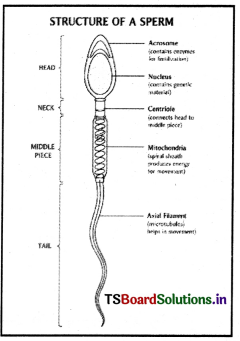
Draw a labelled diagram of a sperm.
Answer:
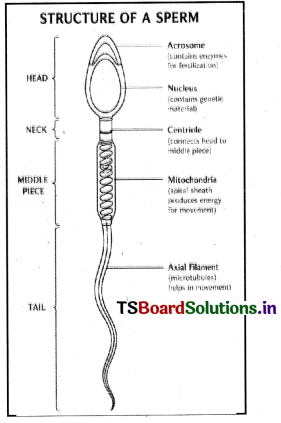
Human Reproduction Questions and Answers AP Inter 2nd Year Zoology Chapter 1 1

Human Reproduction Questions and Answers AP Inter 2nd Year Zoology Chapter 1

Question 4.
What are the major components of seminal plasma?
Answer:
The important constituents of seminal plasma include:

  1. Fructose
  2. Calcium
  3. Mucus
  4. Ascorbic Acid (Vitamin C)

Question 5.
What is the menstrual cycle? Which hormones regulate menstrual cycle?
Answer:
1. The menstrual cycle is the regular reproductive cycle seen in human female primates.
2. During each cycle, the endometrium undergoes preparation for pregnancy and is shed if fertilization does not occur.
3. In human females, these cyclic changes generally occur every28-29 days.
4. The cycle is mainly controlled by the following hormones:

  • Follicle-stimulating hormone (FSH) – Pituitary gland
  • Luteinizing Hormone (LH) – Pituitary gland
  • Estrogen – Ovary
  • Progesterone – Ovary.

Question 6.
What is parturition? Which hormone are involved in inducing parturition?
Answer:

  1. Parturition is the process of childbirth or the delivery of a baby from the uterus.
  2. Oxytocin plays a major role in initiating and facilitating parturition.

Question 7.
How many eggs are released by a human ovary in a month? How many eggs do you think would have been released if the mother gave birth to identical twins? Would your answer change if the twins were fraternal?
Answer:

  1. Normally, one ovum is released from a human ovary during each menstrual cycle.
  2. In the case of identical twins, only one egg is released and later divides into two embryos.
  3. In the case of fraternal twins, two separate eggs are released and fertilized independently.

V. Short Answer Questions 

Question 1.
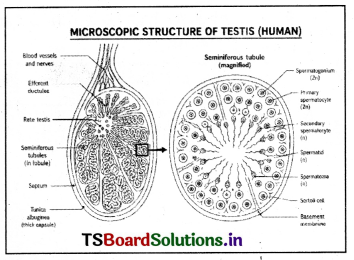
Describe the microscopic structure of the testis in man.
Answer:

  1. The testes of males are located in the scrotal sac, outside the abdominal cavity, because sperm production requires a temperature lower than normal body temperature.
  2. Each testis is enclosed by a tough fibrous covering known as the tunica albuginea.
  3. This covering extends inward and forms partitions called septa.
  4. These septa divide the testis into nearly 250 lobules.
  5. Every lobule contains 1 – 3 highly coiled seminiferous tubules.
  6. The seminiferous tubules are lined by spermatogonia (germ cells) and Sertoli cells.
  7. Spermatogonia develop into primary spermatocytes, which undergo meiosis to form spermatids.
  8. Spermatids are transformed into mature sperm cells through spermiogenesis.
  9. Sertoli cells provide nourishment to developing sperm and secrete Inhibin, which regulates FSH secretion.
  10. Between the seminiferous tubules are Leydig (interstitial) cells.
  11. Leydig cells synthesize and release androgens, mainly testosterone.
  12. Seminiferous tubules open into the rete testis, which further connects to the vasa efferentia.
  13. The vasa efferentia open into the epididymis, which is divided into the caput, corpus, and cauda regions.
  14. The epididymis is highly coiled and serves as the site for sperm maturation and storage.

Human Reproduction Questions and Answers AP Inter 2nd Year Zoology Chapter 1 2

Question 2.
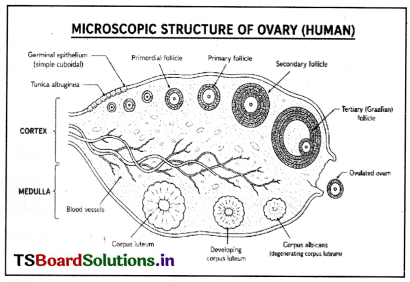
Describe the microscopic structure of the ovary of a woman.
Answer:

  1. The ovaries are the primary female reproductive organs responsible for producing ova and female sex hormones.
  2. A pair of ovaries is located in the lower abdominal region.
  3. Each ovary is attached to the dorsal body wall by a fold of peritoneum called the mesovarium.
  4. The outer surface of the ovary is covered by a simple cuboidal germinal epithelium.
  5. Beneath this epithelium lies a dense connective tissue layer called the tunica albuginea.
  6. The ovarian tissue is differentiated into an outer cortex and an inner medulla.
  7. The medulla contains connective tissue, blood vessels, lymph vessels, and nerve fibers.
  8. The cortex contains ovarian follicles at different stages of development.
  9. Structures such as Graafian follicles, corpus luteum, and corpus albicans are found within the cortex.

Human Reproduction Questions and Answers AP Inter 2nd Year Zoology Chapter 1 3

Question 3.
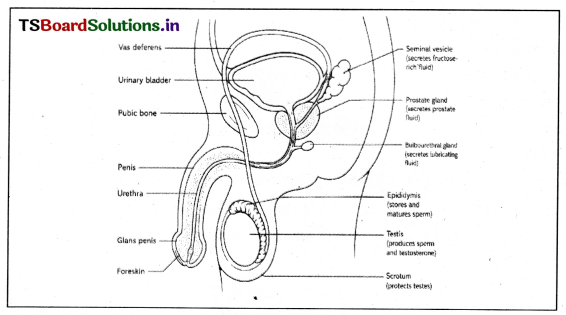
Draw a labelled diagram of the male reproductive system.
Answer:
Human Reproduction Questions and Answers AP Inter 2nd Year Zoology Chapter 1 4

Question 4.
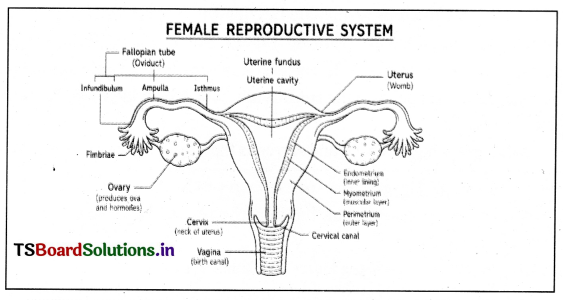
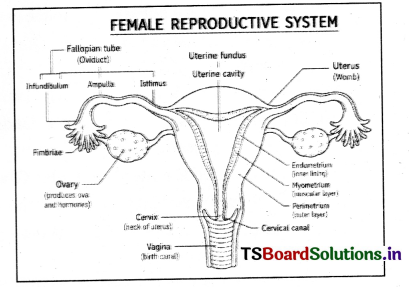
Draw a labelled diagram of the female reproductive system.
Answer:
Human Reproduction Questions and Answers AP Inter 2nd Year Zoology Chapter 1 5

Human Reproduction Questions and Answers AP Inter 2nd Year Zoology Chapter 1

Question 5.
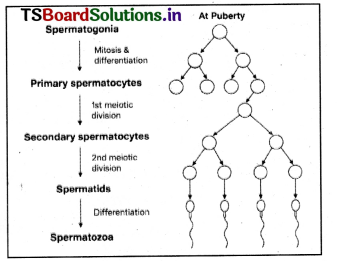
What is spermatogenesis? Briefly describe the process of spermatogenesis in man.
Answer:
Spermatogenesis It is the process by which male gametes (sperms) are formed. In humans, this process begins at puberty.

Process :

  1. Spermatogonial stem cells are present in the seminiferous tubules and divide repeatedly by mitosis.
  2. Some spermatogonia differentiate into primary spermatocytes (2n = 46 chromosomes).
  3. Each primary spermatocyte undergoes the first meiotic division to produce two haploid secondary spermatocytes (n = 23 chromosomes).
  4. Secondary spermatocytes undergo the second meiotic division to form spermatids.
  5. Each primary spermatocyte ultimately gives rise to four haploid spermatids.
  6. Spermatids transform into mature spermatozoa through spermiogenesis.
  7. Mature sperm heads remain embedded in Sertoli cells and are finally released by spermiation.
  8. Hormones such as GnRH, FSH, and LH regulate spermatogenesis.
  9. A mature sperm consists of a head, neck, middle piece, and tail.
  10. The head bears an acrosome containing enzymes such as hyaluronidase that aid in fertilization.
  11. The middle piece contains numerous mitochondria, which provide energy for sperm movement.

Human Reproduction Questions and Answers AP Inter 2nd Year Zoology Chapter 1 6

Question 6.
Describe the structure of a sperm cell with the help of a neat labelled diagram.
Answer:
A sperm cell is a microscopic, motile male gamete specialized for fertilization and enclosed by a plasma membrane.
It is divided into four major parts:
i) Head :

  • Contains a haploid nucleus carrying genetic material.
  • Covered by the acrosome, a cap-like structure.
  • The acrosome contains enzymes that help the sperm penetrate the ovum during fertilization.

ii) Neck:

  • A short connecting region between the head and middle piece.
  • Contains centrioles involved in cell division after fertilization.

iii) Middle Piece:

  • Contains numerous mitochondria arranged around the axial filament.
  • Mitochondria generate ATP required for sperm motility.

iv) Tail (Flagellum):

  • Long and slender structure responsible for locomotion.
  • Propels the sperm through the female reproductive tract toward the ovum. Thus, the sperm is structurally adapted for movement and successful fertilization.

Human Reproduction Questions and Answers AP Inter 2nd Year Zoology Chapter 1 7

Question 7.
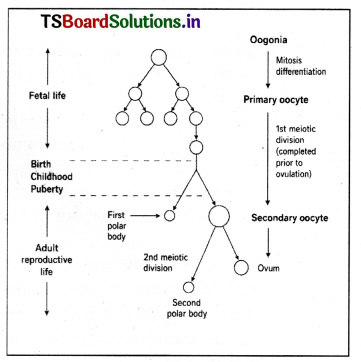
What is oogenesis? Give a brief account of oogenesis in a woman.
Answer:
Oogenesis is the process of formation of a mature female gamete (ovum). Unlike spermatogenesis, it begins during embryonic development.

1. Embryonic Stage :

  • Millions of oogonia are formed in the fetal ovary.
  • No new oogonia are produced after birth.
  • Oogonia enter meiosis I and become primary oocytes.
  • These primary oocytes remain arrested in prophase I.

2. Follicular Development:

  • Each primary oocyte becomes surrounded by granulosa cells, forming a primary follicle.
  • At puberty, about 60,000 – 80,000 primary follicles remain in each ovary.

3. Maturation:

  • Primary follicles develop into secondary follicles and later into tertiary follicles.
  • The tertiary follicle develops a fluid-filled cavity known as the antrum.

4. First Meiotic Division :

  • The primary oocyte completes meiosis-I within the tertiary follicle.
  • This unequal division produces a large secondary oocyte and a small first polar body.

5. Ovulation: The mature Graafian follicle ruptures and releases the secondary oocyte from the ovary.

6. Second Meiotic Division :

  • Meiosis-II is completed only after fertilization.
  • It produces a mature ovum and a second polar body.

Human Reproduction Questions and Answers AP Inter 2nd Year Zoology Chapter 1 8

Question 8.
Name the functions of the following :
(a) Corpus Luteum
(b) Fimbriae
(c) Acrosome
(d) Sperm Tail
Answer:
(a) Corpus Luteum :

  • Secretes large amounts of progesterone.
  • Progesterone maintains the endometrium and supports implantation and pregnancy.

(b) Fim briae :

  • Finger-like projections present at the infundibulum of the fallopian tube.
  • They help in collection of the ovum released from the ovary after ovulation.

(c) Acrosome:

  • Cap-like structure present on the sperm head.
  • Contains enzymes that help the sperm penetrate the coverings of the ovum during fertilization.

d) Sperm Tail:

  • Responsible for sperm motility.
  • Helps propel the sperm through the female reproductive tract toward the ovum.

VI. Long Answer Questions

Question 1.
Describe the Female Reproductive System of a woman with the help of a labelled diagram.
Answer:
The female reproductive organs are located in the pelvic cavity and include :
1) Ovaries :

  • Ovaries are the primary female reproductive organs responsible for producing ova (female gametes) and female sex hormones.
  • A pair of ovaries is situated on either side of the lower abdominal region.
  • Each ovary is attached to the abdominal wall through a fold of peritoneum called the mesovarium.
  • Every ovary consists of three main regions :

1. Germinal (ovarian) epithelium
2. Tunica albuginea
3. Stroma
The stroma is differentiated into an outer cortex and an inner medulla.
Human Reproduction Questions and Answers AP Inter 2nd Year Zoology Chapter 1 9

2. Fallopian Tubes:

  • Each fallopian tube extends from the ovary to the uterus.
  • The ovarian end of the tube is expanded into a funnel-shaped structure known as the infundibulum.
  • The infundibulum bears finger-like projections called fimbriae.
  • Fimbriae help in collecting the ovum released during ovulation.
  • The fallopian tube is the usual site of fertilization and transports the ovum towards the uterus by peristaltic movements.

3. Uterus:

  • The uterus is a single, hollow, muscular organ.
  • It is located between the urinary bladder and rectum.
  • It resembles an inverted pear and is richly supplied with blood vessels.
  • The narrow lower region connecting the uterus to the vagina is called the cervix.
  • The cervix and vagina together constitute the birth canal.
  • The uterine wall consists of three layers: Outer Perimetrium, Middle Myometrium, Inner Endometrium
  • The endometrium undergoes cyclic changes during the menstrual cycle.

4. Vagina:

  • The vagina is a fibromuscular tube extending from the cervix to the vaginal opening.
  • It is lined by non-keratinized stratified squamous epithelium and is highly vascular.

5. Vulva (External Genitalia):

  • The term vulva (pudendum) refers to the external genital organs of the female.
  • The vestibule is the region that contains the external openings of the urethra and vagina.
  • The vaginal opening is partially covered by a thin mucous membrane called the hymen.
  • The clitoris is homologous to the penis in males and contains erectile tissue.
  • A fatty tissue pad covered by skin and pubic hair above the labia majora is called the mons pubis.

Accessory Reproductive Glands of Females: These include :
a) Bartholin’s glands,
b) Skene’s glands.

a) Bartholin’s glands:

  • Also called Greater Vestibular Glands.
  • They are located on either side of the vaginal opening and secrete mucus.

b) Skene’s Glands:

  • Also known as Lesser Vestibular Glands.
  • They are situated on the anterior wall of the vagina near the lower end of the urethra.

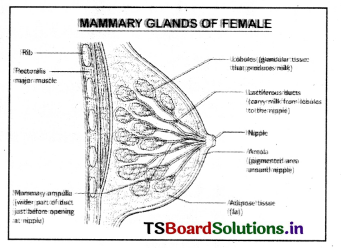
c) Mammary Glands:

  • Mammary glands are paired structures composed of glandular tissue and varying amounts of fat.
  • They contain alveoli, which produce and secrete milk after childbirth.
  • Mammary ducts join to form a mammary ampulla, which opens into a lactiferous duct through which milk is delivered to the infant.

Human Reproduction Questions and Answers AP Inter 2nd Year Zoology Chapter 1 10

Human Reproduction Questions and Answers AP Inter 2nd Year Zoology Chapter 1

Question 2.
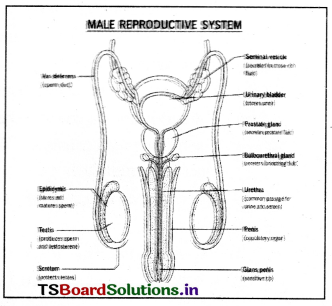
Describe the Male Reproductive System of a Man. Draw a Labelled Diagram of it. (AP MAR-16,17, 19,20,23,24)
Answer:
The male reproductive organs located in the pelvic region include:

  1. Testes
  2. Epididymis
  3. Vas Deferens
  4. Urethra
  5. Penis
  6. Accessory Glands

Human Reproduction Questions and Answers AP Inter 2nd Year Zoology Chapter 1 11

1. Testes :

  • Testes are paired oval-shaped male primary reproductive organs.
  • They are enclosed within a pouch called the scrotum, located outside the abdominal cavity.
  • Sperm production requires a lower temperature; therefore, testes remain within the scrotum.
  • The tunica albuginea forms septa that divide each testis into nearly 250 lobules.
  • Each lobule contains 1 -3 highly coiled seminiferous tubules.
  • Seminiferous tubules contain germinal epithelium and Sertoli cells. Germ cells produce sperm, while Sertoli cells nourish developing sperm.
  • Testosterone regulates spermatogenesis and secondary sexual characteristics.
  • Seminiferous tubules open into the rete testis, which continues into the vasa efferentia and epididymis

2. Epididymis:

  • The epididymis is a long, tightly coiled tube located along the posterior side of each testis.
  • Vasa efferentia open into the epididymis.
  • It serves as a site for sperm maturation and temporary storage.

3. Vas Deferens :

  • The vas deferens is a long, muscular tube.
  • It begins from the tail of the epididymis, enters the abdominal cavity through the inguinal canal, and loops around the urinary bladder.

4. Urethra:

  • The urethra originates from the urinary bladder and extends through the penis.
  • It acts as a common passage for urine and semen.
  • It opens to the exterior through the urethral meatus.

5. Penis:

  • The penis functions as both a urinary organ and a copulatory organ that transfers sperm into the female reproductive tract.
  • It consists of three columns of erectile tissue: Two corpora cavernosa and one corpus spongiosum
  • The enlarged terminal part is the glans penis, covered by a loose fold of skin called the prepuce (foreskin).

6. Accessory Glands :
a) Seminal Vesicles :

  • A pair of glands located behind the urinary bladder.
  • Their secretion contains fructose, which provides energy for sperm.

b) Prostate Gland:

  • Situated below the urinary bladder.
  • Contributes about 15-30% of the seminal fluid.

c) Bulbourethral (Cowper’s) Glands :

  • Located below the prostate gland.
  • They secrete an alkaline fluid that lubricates and neutralizes the urethra during ejaculation.

Question 3.
Describe the Spermatogenesis and Oogenesis with Diagrammatic Representation.
Answer:
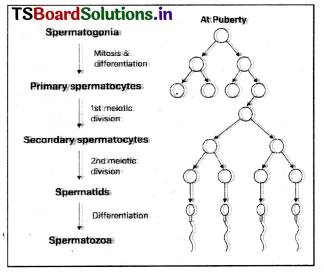
I) Spermatogenesis: Spermatogenesis is the process of sperm formation in the seminiferous tubules of the testes. It begins at puberty under the influence of GnRH.

  1. Multiplication Phase: Immature germ cells called spermatogonia (2n = 46) divide repeatedly by mitosis.
  2. Meiosis I: Primary spermatocytes undergo the first meiotic division to produce two haploid secondary spermatocytes.
  3. Meiosis II: hi Secondary spermatocytes complete the second meiotic division to form four haploid spermatids.
  4. Spermiogenesis: Spermatids differentiate into mature spermatozoa.
  5. Spermiation: Mature sperm are released from Sertoli cells into the lumen of seminiferous tubules.

Human Reproduction Questions and Answers AP Inter 2nd Year Zoology Chapter 1 12

II) Oogenesis :
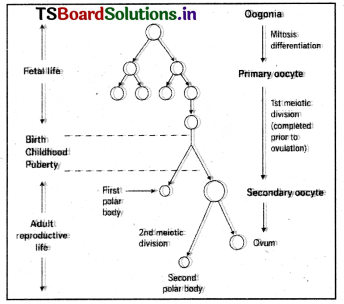
Oogenesis is the process of formation of a mature female gamete (ovum). It begins during embryonic life.

  1. Embryonic Initiation: Millions of oogonia enter meiosis-I and become primary oocytes arrested in prophase I.
  2. Follicular Development: Each primary oocyte is surrounded by granulosa cells to form a primary follicle. At puberty, about 60,000 – 80,000 follicles remain in each ovary.
  3. Maturation: Primary follicles develop into secondary follicles and then tertiary follicles containing an antrum.
  4. First Meiotic Division: The primary oocyte completes meiosis I, producing a large secondary oocyte and a first polar body.
  5. Ovulation: The Graafian follicle ruptures and releases the secondary oocyte.
  6. Second Meiotic Division: This division is completed only after fertilization, producing a haploid ootid (ovum) and a second polar body.

Human Reproduction Questions and Answers AP Inter 2nd Year Zoology Chapter 1 13

Question 4.
Explain the process of Fertilization and Implantation in Humans. Describe the major features of Embryonic Development at various months of pregnancy.
Answer:
1. Fertilization: Fertilization is the fusion of a sperm and ovum to form a zygote. It usually occurs in the ampullary region of the fallopian tube.

  • Insemination and Transport: Semen is deposited in the vagina. Sperms travel through the cervix and uterus to reach the fallopian tube, where fertilization takes place.
  • Contact and Entry: A sperm binds to the zona pellucida of the ovum and prevents entry of additional sperms.
  • Acrosomal Reaction: Enzymes released from the acrosome help the sperm penetrate the ovum.
  • Completion of Meiosis: Sperm entry stimulates completion of meiosis-II in the secondary oocyte, producing an ovum and second polar body.
  • Zygote Formation: Fusion of male and female pronuclei results in a diploid zygote (2n). The sex of the baby depends on whether the fertilizing sperm carries an X or Y chromosome.

2. Implantation: Implantation is the process by which the developing embryo becomes attached to and embedded within the endometrium.

  • Cleavage and Morula Formation: The zygote undergoes repeated mitotic divisions, producing blastomeres. The 8-16 cell stage is called the morula.
  • Blastocyst Formation: The morula develops into a blastocyst composed of an outer trophoblast and inner cell mass.
  • Attachment to Endometrium: The trophoblast attaches to the uterine endometrium.
  • Embedding: The blastocyst becomes completely embedded within the uterine lining.
  • Hormonal Support: Progesterone secreted by the corpus luteum maintains the endometrium and supports implantation.

3. Major Stages of Embryonic Development:

  • End of First Month: The embryonic heart is formed.
  • End of Second Month: Limbs and digits become visible.
  • End of 12 Weeks (First Trimester): Most major organ systems are formed, and external genitalia become distinguishable.
  • Fifth Month: Foetal movements can be felt, and hair appears on the head.
  • End of 24 Weeks (Second Trimester): Fine body hair develops, eyelashes appear, and eyelids separate.
  • End of Nine Months: The foetus becomes fully developed and ready for birth (parturition).

I. Multiple Choice Questions

Question 1.
Humans are ………………………….
1. Oviparous
2. Viviparous
3. Ovoviviparous
4. Parthenogenetic
Answer:
2. Viviparous

Human Reproduction Questions and Answers AP Inter 2nd Year Zoology Chapter 1

Question 2.
The reason behind the presence of testes outside the abdomen is :
1. To decrease the temperature up to 2°C to 2.5°C for spermatogenesis.
2. To increase the temperature up to 2°C to 2.5°C for spermatogenesis.
3. There is no sufficient space in abdominal cavity.
4. To prevent excessive production of sperms.
Answer:
1. To decrease the temperature up to 2°C to 2.5°C for spermatogenesis.

Question 3.
Which of the following depicts the correct pathway of transport of sperms?
1. Vasa Efferentia → Rete Testis → Vas Deference → Epididymis
2. Rete Testis → Epididymis → Vasa Efferentia → Vas Deference
3. Rete Testis → Vas Deference → Vasa Efferentia → Epididymis
4. Rete Testis → Vasa Efferentia → Epididymis → Vas Deferens
Answer:
4. Rete Testis → Vasa Efferentia → Epididymis → Vas Deferens

Question 4.
Which of the following acts as temporary endocrine tissue after ovulation in human females?
1. Corpus albicans
2. Corpus luteum
3. Graafian follicle
4. Tertiary follicle
Answer:
2. Corpus luteum

Question 6.
The correct sequence of milk passage in mammary gland, beginning from alveoli, would be:
1. Mammary tubules → Mammary ampulla → Mammary ducts → Lactiferous ducts
2. Lactiferous ducts → Mammary ducts → Mammary ampulla → Mammary tubules
3. Lactiferous ducts → Mammary ampulla → Mammary ducts → Mammary tubules
4. Mammary tubules → Mammary ducts → Mammary ampulla → Lactiferous ducts
Answer:
4. Mammary tubules → Mammary ducts → Mammary ampulla → Lactiferous ducts

Question 7.
Assertion: The seminal plasma along with the sperms constitute the semen.
Reason: For normal fertility, at least 40 per cent of ejaculated sperms must have normal shape and size, and at least 60 per cent of them must show vigorous motility. ,
1. If both assertion and reason are true and reason is the correct explanation of assertion.
2. If both assertion and reason are true but reason is not the correct explanation of assertion.
3. If assertion is true but reason is false.
4. If Assertion false and Reason is true.
Answer:
3. If assertion is true but reason is false.

Question 8.
The second meiotic division of oocyte is completed during
1. Childbirth
2. Puberty
3. Ovulation
4. Fertilization
Answer:
4. Fertilization

Question 9.
Most of the major organ systems in foetal stage are formed
1. By the end of 151 month
2. By the end of 2nd month
3. By the end of 3rd month
4. By the end of 3rd week
Answer:
3. By the end of 3rd month

Human Reproduction Questions and Answers AP Inter 2nd Year Zoology Chapter 1

Question 10.
The signal for foetal ejection reflex in human female originates from
1. Progesterone
2. Differentiation of mammary glands
3. Fully developed foetus and placenta
4. Sudden drop of oxytocin
Answer:
3. Fully developed foetus and placenta

Question 11.
The act of delivering a foetus at the end of pregnancy is called …………………….. .
1. Parturition
2. Gestation
3. Coitus
4. Lactation
Answer:
1. Parturition

II. Fill in the Blanks

1. Testes are situated outside the abdominal cavity within a pouch called ……………………….. .
Answer:
Scrotum

2. The seminiferous tubules of the testis open into the vasa efferentia through …………………. .
Answer:
Rete testis

3. The part of fallopian tube closer to the ovary with funnel-shaped structure called ……………………. .
Answer:
Infundibulum

4. The process of release of ovum from a mature follicle is called ………………………. .
Answer:
Ovulation

5. Ovulation is induced by a hormone called ………………………… .
Answer:
Luteinizing hormone (LH)

6. The uterine layer that exhibits strong contraction during delivery of the baby is ………………………….. .
Answer:
Myometrium.

7. The fusion of male and female gametes is called …………………………….. .
Answer:
Fertilization

8. The first menstruation is called ………………………….. .
Answer:
Menarche.

9. Zygote divides to form …………………………… which is implanted in uterus.
Answer:
Blastocyst

Human Reproduction Questions and Answers AP Inter 2nd Year Zoology Chapter 1

10. The structural and functional unit between foetus and uterus is called ………………………… .
Answer:
placenta

III. One Word Answer Questions

Question 1.
How many seminiferous tubules are present in every testicular lobule in which sperm are produced?
Answer:
1 to 3

Question 2.
Name the hormones that are synthesized and secreted by Leydig cells.
Answer:
Androgens

Question 3.
The fingerlike projections of the infundibulum of fallopian tube are called as?
Answer:
Fimbriae

Question 4.
What is the tiny finger-like structure which lies at the upper junction of the two labia minora above the urethral opening?
Answer:
Clitoris

Question 5.
Which layer undergoes cyclic changes in menstrual cycle?
Answer:
Endometrium

Question 6.
By the end of which month of gestation is the heart formed in a human embryo?
Answer:
By the end of the first month

Human Reproduction Questions and Answers AP Inter 2nd Year Zoology Chapter 1

Question 7.
The milk produced in the initial few’ days of lactation which is rich in antibodies called ?
Answer:
Colostrum

Question 8.
How many eggs do you think were released by the ovary of a female dog which gave birth to 6 puppies?
Answer:
6 (Six) eggs

Question 9.
What is the cessation of menstrual cycle called?
Answer:
Menopause

Objective Questions

Question 1.
In which type of reproduction are genetic variations commonly observed?
1. Schizogony
2. Sexual reproduction
3. Multiple fission
4. Budding
Answer:
2. Sexual reproduction

Question 2.
Which structure forms the outer covering of the ovary?
1. Mesovarium
2. Germinal epithelium
3. Columnar epithelium
4. Ciliated epithelium
Answer:
2. Germinal epithelium

Question 3.
Cleavage in human beings is classified as :
1. Equal
2. Holoblastic
3. Meroblastic
4. Determinate
Answer:
2. Holoblastic

Question 4.
What is the primary role of the epididymis?
1. Activation of the sperms only
2. Temporary storage of the sperms until they mature
3. Spermatogenesis and spermiogenesis
4. Nourishing of the sperms only
Answer:
2. Temporary storage of the sperms until they mature

Human Reproduction Questions and Answers AP Inter 2nd Year Zoology Chapter 1

Question 5.
What is the basic characteristic feature of sexual reproduction?
1. Fusion of two adult individuals
2. Fusion of male and female gametes produced by meiosis
3. Fusion of gametes produced by mitosis
4. Fusion of male and female haploid gametes produced by mitosis
Answer:
2. Fusion of male and female gametes produced by meiosis

Question 6.
Testes remain attached to the scrotal sac posteriorly through :
1. Dartos muscle
2. Spermatic cords
3. Gubernaculum
4. Rachis
Answer:
3. Gubernaculum

Question 7.
Meiosis takes place in :
1. Both (3) and (4)
2. Spermatogonia and oogonia
3. Primary and secondary oocytes
4. Primary and secondary spermatocytes
Answer:
1. Both (3) and (4)

Question 8.
Seminal plasma receives secretions from :
1. Bulbourethral glands
2. Seminal vesicles
3. Prostate gland
4. All of the above
Answer:
4. All the above

Question 9.
Which part of the fallopian tube is nearest to the ovary?
1. Cervix
2. Ampulla
3. Infundibulum
4. Isthmus
Answer:
3. Infundibulum

Question 10.
Which enzyme helps sperm penetrate the corona radiata and zona pellucida?
1. Citric acid
2. Hyaluronidase
3. Hydrochloric acid
4. Protease
Answer:
2. Hyaluronidase

Question 11.
Implantation in humans generally occurs on :
1. 12th day after copulation
2. 6th day after ovulation
3. 6th day after fertilization
4. 6th day after menstruation
Answer:
4. 6th day after menstruation

Question 12.
Which enzyme plays an important role during implantation?
1. Lipases
2. Amylases
3. Progesterone
4. Proteases
Answer:
4. Proteases

Human Reproduction Questions and Answers AP Inter 2nd Year Zoology Chapter 1

Question 13.
At what stage does the foetal heart begin to beat?
1. End of first trimester
2.2nd month
3. 4th week
4. 14th day
Answer:
3. 4th week

Question 14.
Which gland secretes the highest amount of fructose?
1. Cowper’s gland
2. Prostate gland
3. Tyson gland
4. Seminal vesicle
Answer:
4. Seminal vesicle

Question 15.
In mammals, failure of testes to descend into the scrotum is termed :
1. Castration
2. Impotency
3. Paedogenesis
4. Cryptorchidism
Answer:
4. Cryptorchidism

Question 16.
The vas deferens originates from :
1. Rete testis
2. Corpus epididymis
3. Caput epididymis
4. Cauda epididymis
Answer:
4. Cauda epididymis

Question 17.
Which accessory reproductive gland is unique to male mammals?
1. Prostate gland
2. All
3. Pineal gland
4. Bartholin’s gland
Answer:
1. Prostate gland

Question 18.
Seminal vesicle opens at the junction of:
1. Vas deferens and testis
2. Prostate and urethra
3. Prostate and vas deferens
4. Prostate and Cowper’s gland
Answer:
3. Prostate and vas deferens

Question 19.
Developing sperms receive nourishment from :
1. Connective tissue cells
2. Interstitial cells
3. None
4. Sertoli cells
Answer:
4. Sertoli cells

Question 20.
The egg released during ovulation in humans is at which stage?
1. Mature ovum stage
2. Secondary oocyte stage
3. Oogonial stage
4. Primary oocyte stage
Answer:
2. Secondary oocyte stage

Question 21.
The endocrine structure formed after ovulation from the ruptured Graafian follicle is:
1. Corpus albicans
2. Corpus luteum
3. Corpus striatum
4. Corpus callosum
Answer:
2. Corpus luteum

Question 22.
Which female structure is considered homologous to the male prostate gland?
1. Bulbourethral gland
2. Bartholin’s gland
3. Clitoris
4. None of the above
Answer:
4. None of the above

Human Reproduction Questions and Answers AP Inter 2nd Year Zoology Chapter 1

Question 23.
The luteal phase is also known as:
1. Secretory phase
2. Menstrual flow phase
3. Follicular phase
4. Proliferative phase
Answer:
1. Secretory phase

Question 24.
Which extraembryonic membrane prevents the embryo from drying out inside the uterus?
1. Allantois
2. Yolk sac
3. Chorion
4. Amnion
Answer:
4. Amnion

Question 25.
Which membrane contributes to the formation of the urinary bladder of the embryo?
1. Yolk sac
2. Chorion
3. Minion
4. Allantois
Answer:
4. Allantois

Question 26.
Spermatogenesis is mainly regulated by the influence of:
1. LH
2. ADH
3. STH
4. FSH
Answer:
4. FSH

Question 27.
Which statement is incorrect regarding oogenesis?
1. Growth phase
2. Equal meiotic division
3. Formation of polar bodies
4. Unequal meiotic division
Answer:
2. Equal meiotic division

Question 28.
Prostaglandins are synthesized from:
1. Carbohydrate
2. Steroid
3. Fatty acids
4. Amino acids
Answer:
3. Fatty acids

Human Reproduction Questions and Answers AP Inter 2nd Year Zoology Chapter 1

Question 29.
The embryo at the sixteen-cell stage is known as:
1. Blastomere
2. Gastrula
3. Morula
4. Blastula
Answer:
3. Morula

Question 30.
Which phase of the menstrual cycle normally continues for about 7-8 days?
1. Ovulatory phase
2. Menstruation
3. Follicular phase
4. Luteal phase
Answer:
3. Follicular phase

Question 31.
Corpus luteum and macula lutea share the common feature that they are:
1. Characterised by yellow colour
2. Source of hormones
3. Found in human ovaries
4. Contributory in maintaining pregnancy
Answer:
1. Characterised by yellow colour

Question 32.
Fertilin is produced and released by :
1. Epididymis
2. Testes
3. Egg surface
4. Sperm head tip
Answer:
3. Egg surface

Question 33.
The secretory phase of the menstrual cycle is alternatively termed :
1. Follicular phase and lasts for about 13 days
2. Follicular phase and lasts for about 6 days
3. Luteal phase and lasts for about 13 days
4. Luteal phase and lasts for about 6 days
Answer:
3. Luteal phase and lasts for about 13 days

Question 34.
The signals responsible for initiating parturition arise from:
1. Fully developed foetus only
2. Placenta as well as fully developed foetus
3. Oxytocin released from maternal pituitary
4. Placenta only
Answer:
2. Placenta as well as fully developed foetus

Question 35.
The second maturation division of the mammalian ovum takes place:
1. Until nucleus of sperm and ovum fuse
2. Shortly after ovulation before entry into fallopian tube
3. In Graafian follicle soon after first maturation division
4. Until after sperm has penetrated into ovum
Answer:
4. Until after sperm has penetrated into ovum

Question 36.
Following ovulation, the follicle transforms into :
1. Corpus callosum
2. Corpus cavemosum
3. Corpus luteum
4. Corpus albicans
Answer:
3. Corpus luteum

Human Reproduction Questions and Answers AP Inter 2nd Year Zoology Chapter 1

Question 37.
Bartholin’s glands are located :
1. On either side of vas deferens in humans
2. On either side of vagina in humans
3. On the reduced tail end of birds
4. On the sides of the head of some amphibians
Answer:
2. On either side of vagina in humans

Question 38.
What will be the consequence if the vas deferens is cut?
1. Sperms are non-nucleated
2. Spermatogenesis does not occur
3. Semen is without sperms
4. Sperms are nonmotile
Answer:
3. Semen is without sperms

Question 39.
Functional maturation of sperms occurs in :
1. Epididymis
2. Vagina
3. Oviduct
4. All of these
Answer:
1. Epididymis

Question 40.
Which hormone promotes the development of female secondary sexual characters?
1. Testosterone
2. Androgen
3. Estrogen
4. Progesterone
Answer:
3. Estrogen

Expansion of Ideas Inter 1st Year English Grammar

For systematic learning, students can include AP Inter 1st Year English Grammar with Answers and Expansion of Ideas in English Inter 1st Year in their daily study routine.

AP Inter 1st Year English Expansion of Ideas with Answers

Expansion of ideas is the method by which you go into further depth of your ideas. You must first understand the meaning and then try to restate the given phrase or statement. The best technique to expand a sentence or a proverb is to write synonyms of the original keywords and then expand it using those synonyms. To further expand your topic, you should end your paragraph with either a moral or a conclusion to leave a lasting impression.

For a good expansion of ideas, the theme must have the following features.

  • Organise your thoughts in a logical sequence of priority.
  • Avoid using cliches, cliched language, or extraneous material to the topic at hand.
  • It is important to use basic and brief sentences in your writing.
  • Use colloquial and figurative language when appropriate to use your expansion.
  • Make sure your writing is flawless in grammar, spelling, and punctuation.

Exercises

From Unit – 1

Question 1.
Using the hints provided, write at least ten lines, expanding the ideas into complete sentences. Be creative!
If I Could Fly…
Idea : Imagine you could fly for one day. Write a paragraph about where you would go, what you would do, and how you would feel.
Hints:
If I could fly, I would __________
I would see __________
Along with me, I would take __________
I would try __________
At the end of the day, I would feel __________
Answer:

If I Could Fly …………..

If I could fly, I would soar high above the clouds like a free bird and explore the world from the sky. I would see the towering mountains, sparkling rivers, and bustling cities far below. Along with me, I would take my camera to capture the magical view from the skies. I would try flying over the Eiffel Tower in Paris and circle around the Taj Mahal in India. I would glide through rainbows and dance with the wind. I would wave at people walking on the streets, wondering if they could see me. I would visit places I have only read about in books, like the Great Wall of China and the Grand Canyon. I would fly to a peaceful island and rest on a cloud, feeling the warmth of the sun on my face. At the end of the day, I would feel happy, free, and grateful for the amazing journey I had through the sky.

Question 2.
Using the hints provided, write at least ten lines, expanding the ideas into complete sentences. Be creative!

A Day in a World without Darkness
Idea : Imagine you are living in a world where doesn’t exist; where every moment is filled with unending light. Write a diary entry describing one day in such a world.

Hints:

  • The sun always shines; there’s no night to rest.
  • Cities are bustling, even at midnight-time feels endless.
  • Plants grow rapidly, but some animals struggle without darkness.
  • Can we appreciate light if there’s no darkness?

Instruction: Write at least 10 lines describing what life would feel like in a world without darkness. Reflect on how it changes routines, nature, and the way you view light itself.
Answer:

Diary Entry: A Day in a World without Darkness

June 15, 2042
Dear Diary,

The sun never sets here-it hovers like a watchful eye, painting the sky in eternal gold. I woke up at what my clock claims is 3 AM, but the streets below are alive with chatter, as if it’s noon. Without night, time has lost its rhythm; work, meals, and sleep blur into one endless cycle. Cafes serve coffee at midnight, and children play in parks under the unyielding light.

The plants are thriving, stretching taller each day, but the owls have vanished, and the bats cling to man-made caves. I miss the stars. Last week, scientists projected artificial constellations onto the sky, but it’s not the same. Mom says we’ve forgotten how to rest – our bodies ache for shadows.

I tried closing my blackout curtains today, but the glow seeped in like a persistent whisper. It’s strange: in a world drowned in light, we crave darkness just to remember what brightness means. Would a rainbow matter if the sky never wept? I wonder if we’ve traded mystery for convenience. Tomorrow, I’ll plant a moonflower – just to pretend.

x x x x

Expansion of Ideas Inter 1st Year English Grammar

Question 3.
Using the hints provided, write atleast ten lines, expanding the ideas into complete sentences. Be creative !

A Day in Their Shoes
Idea: Imagine you are a sanitary worker at your college. Write a journal entry describing your day – your work, thoughts, and feelings. Reflect on the challenges you face and what keeps you motivated.

Hints:

  • Morning: Start early, clean classrooms, empty trash bins, pick up leftover snacks and papers.
  • School Activity: Teachers spill coffee, students litter, run on freshly mopped floors.
  • Evening : Tidy up the lunch area, pick up forgotten belongings, sanitize and mop the whole college.
  • Challenges : Repetitive tasks, feeling unacknowledged, exhaustion by the end of the day.
  • Joy: A simple “thank you,” or seeing the college spotless brings quite satisfaction.

Answer:

Journal Entry : A Day in My Shoes

5:30 AM: My alarm buzzes-another day begins before the sun rises. I tie my worn-out shoes, knowing the college won’t clean itself. The empty corridors echo as I sweep classrooms, collecting yesterday’s forgotten notes and crumpled snack wrappers.

8:00 AM : Students trickle in, their laughter bouncing off freshly mopped floors. A teacher rushes past. Coffee sloshing onto the tiles I just cleaned. I sigh but wipe it up – no time to dwell.

12:30 PM : The lunch area is a battlefield of spilled rice and juice boxes. I pick up a lost ID card, wondering if its owner will ever notice it’s gone.

3:00 PM : My back aches from bending, but I keep scrubbing. A student nods at me-just a glance, but it feels like a tiny spark of warmth.

6:00 PM : As I empty the last trash bin, I pause. The college gleams, silent and orderly. It’s not much, but it’s mine. Someone left a note on the staff board: “Thanks for keeping our home clean.” I smile. Maybe tomorrow, I’ll start again.

Question 4.
Using the hints provided, write at least ten lines, expanding the ideas into complete sentences. Be creative !

The Lost Animal
Idea : Imagine an animal that got separated from its home. Write a story about its journey to find its way back. Describe its emotions, the challenges it faces, and how it eventually gets home – or perhaps find a new place to call home.

Hints :

  • First – Getting lost – fear, confusion, and loneliness – what the animal feels after realizing it’s lost.
  • But – Finding strength – the animal uses its instincts, learns to survive, and meets new creatures along the way.
  • Then – Facing obstacles – hunger, wild animals, harsh weather, or dangerous forests – how the animal overcomes these challenges.
  • Later – Meeting helpful friends – other animals who either guide or help the lost animal.

Answer:

The Lost Animal

A little red fox named Rani lived in a quiet forest near the hills. One sunny afternoon, while chasing a bright blue butterfly, Rani ran farther than he ever had before. When the butterfly vanished, Rani looked around and realized, he didn’t recognize a single tree. The forest looked different. The smells were unfamiliar. Fear wrapped around him like a cold wind. He whimpered softly, his tiny paws trembling. ‘Where is home?’ he thought. The silence around him felt heavier than ever. The once-exciting world now seemed too big, too wild and too lonely.

But after a while, Rani sat down and took a deep breath. I can’t stay scared forever,’ he whispered. He remembered how his mother once told him, Trust your nose, little one.’ So he sniffed the air and began walking. Slowly, he learned to find berries to eat and dug little hole to sleep in at night. Along the way, Rani faced many troubles. One night, heavy rain poured down, soaking his fur and turning the ground into slippery mud. Another time, he was chased by a wild dog and had to hide in a hollow log until it left. Hunger often made him weak, and some days he found no food at all. But he kept going.

One morning, while crossing a shallow stream, Rani heard a croak. A friendly old frog named Tinku greeted him. ‘You look far from home, young fox,’ said Tinku. Rani nodded sadly, ‘I’m trying to find it again.’ Tinku smiled and said, ‘Follow the sound of the river. It flows near the hills.’ Later, Runi met a family of squirrels who shared their nuts and told him which ways to avoid. A wise owl gave him directions from the treetops. Step by step, paw by paw, Rani got closer. One evening, as the sun disappeared behind the hills, Rani smelled something; familiar leaves, warm grass, and… his family. He ran as fast as he could. And there they were: his mother, his brothers, all waiting and searching. Tears of joy filled his eyes as he leapt into his mother’s paws. Rani was finally home. And though the journey had been hard, he was braver, wiser, and stronger than before.

Expansion of Ideas Inter 1st Year English Grammar

From Unit 2:

Question 5.
Using the hints provided, write at least ten lines, expanding the ideas into complete sentences. Be creative!

Letter to the Future
Idea : Write a letter to future generations describing the current state of the environment. Think about issues like pollution, climate change, and the loss of natural habitat. What kind of changes do you hope for by the time they are alive? What steps should they take to protect the planet? How can they help reduce waste, save water, and protect animals?

Hints:

  • First – Describe the current environmental problems: pollution, deforestation, melting ice,etc.
  • But – Express hope for change and the power of future actions.
  • Then – Share your hopes for a cleaner, healthier world.
  • Later – Give advice on reducing waste, conserving water, and supporting sustainable practices.
  • Finally – Encourage future generations to stay strong and keep protecting for the Earth.

Answer:

Letter to the Future

Dear Future Generations,

Today, our beautiful Earth is suffering-the skies are filled with smoke, forests are vanishing, ice is meiting, and animals are losing their homes. But we believe in the power of change, and in your ability to make things better than they are now. I dream of a future where rivers flow clean, skies are blue, and trees cover every hill and field. By the time you read this, I hope the world is healing, thanks to choices you and others have made.

Please use less plastic, recycle what you can, and turn off lights when not needed. Save water – every drop counts – and plant trees wherever possible. Support farmers who grow food naturally and companies that care about the planet. Protect every living creature, big or small, because they all have a role in Earth’s balance. Never forget: the Earth is not a gift from our ancestors, but a loan from our children. Stay strong, stay kind, and always stand up for our one and only home – the Earth.

With hope and faith,
A Friend from the Past

Question 6.
Using the hints provided, write at least ten lines, expanding the ideas into complete sentences. Be creative !

Invincible Hope
Idea: Imagine that someone you care about has failed in his exams, and is feeling sad and hopeless. Encourage and inspire him to stay strong and to have hope.

Hints:

  • Start with : ‘Dear friend, I know things are hard, but you are strong.’
  • Say : ‘Remember when you ?’
  • Give advice : ‘Take one step at a time, and I’m here for you.’
  • End with : ‘I believe in you!”

Answer:

Invincible Hope

Dear friend,

I know things are hard, but you are strong.

Remember when you practised day and night for that speech and amazed everyone with your words?

That same determination still lives inside you. Failing an exam doesn’t define who you are – it just means you have another chance to grow. Take one step at a time, and I’m here for you, every step of the way.

You’re not alone, and this moment of failure is not the end-just a bend in the road.

Cry if you need to, but then stand up and try again, braver than before.

Your dreams are still waiting for you, and they are worth every effort.

I believe in you!
x x x x

Expansion of Ideas Inter 1st Year English Grammar

Question 7.
Using the hints provided, write at least ten lines, expanding the ideas into complete sentences. Be creative!

An Apology Letter to Yourself
Idea : Write a letter to yourself, apologise for something you regret, like not studying properly for an exam.

In the letter, explain why you are sorry, and promise to do better in future. Reflect on how you can improve and what steps you’ll take to make things right.

Hints :

  • Dear Me, I’m writing to apologize for …………….
  • I feel I didn’t give my best effort, and …………
  • I will make a plan to study …………..
  • I will ask teachers for help …………..
  • I will try harder and …………

Answer:

An Apology Letter to Myself

Dear Me,

I’m writing to apologize for not preparing properly for the exam and wasting time when I should have been focused.

I feel I didn’t give my best effort, and now I understand how important it is to stay disciplined and organized.

I let distractions win, and I regret not respecting my own potential.

I will make a plan to study every day, even if it’s just for an hour, and stick to it with honesty.

I will ask teachers for help when I’m stuck, instead of pretending I understand everything.

I will try harder and keep track of my progress, no matter how small.

I’ll avoid procrastination by setting short, realistic goals and rewarding myself for completing them.

This is not the end-just a reminder that I can rise stronger if I take responsibility.

I believe I can do better – and this time, I will.

With determination,
Me

Question 8.
Using the hints provided, write at least ten lines, expanding the ideas into complete sentences. Be creative !

The Magic Door
Idea: Imagine you find a magic door in your home. This door leads to an amazing world filled with magical creatures, strange landscapes, or fantastic objects. Write a story about what you find behind the door. What do you see, hear, and feel? Is there anything that surprises you? How does this adventure change you?

Hints:

  • I accidentally found a magical door in my grandparents’ house ………….
  • As the door opened, I saw ……….. (describe creatures, objects, or landscapes)
  • I could hear ……………. (describe sounds like birds singing, wind blowing, or magical noises)
  • I found several creatures and animals facing a problem …………. (describe a problem that is faced by many creatures and animals in that world)
  • I wanted to help them by ……………. (describe how you helped them and made it a better world)

Answer:

The Magic Door

I accidentally found a magical door in my grandparents’ house, hidden behind an old bookshelf in the attic. As the door opened, I saw glowing trees with silver leaves, rivers that floated in the sky, and talking animals with shining eyes. A giant owl greeted me and told me I was in the Land of Everlight. I could hear the soft humming of crystal winds, the cheerful chatter of fairies, and the gentle roar of a distant waterfall. But the magical world wasn’t happy-its sun had stopped rising, and the flowers were losing their colors.

I found several creatures and animals gathered in sadness because their magical gem, the Heart of Everlight, had been stolen. I wanted to help them by solving the riddles of the Forest of Whispers and recovering the gem from the Cave of Shadows. With courage and kindness, I brought the light back to their world. As I returned through the magic door, I felt stronger, braver, and full of wonder. That adventure taught me that even small hearts can make a big difference.

From Unit – 3

Question 9.
Using the hints provided, write at least ten lines, expanding the ideas into complete sentences. Be creative!

Interviewing Inspiration
Idea : Imagine interviewing someone who inspires you – a famous figure, a family member, or a fictional character. Write a creative conversation exploring their journey to success. Include details about the setting to make it vivid and engaging.

Hints:

  • What inspired you to follow your passion?
  • Who supported you the most on your journey?
  • Were there tough moments in your journey? How did you overcome them?
  • What is the best piece of advice you’ve ever received?
  • What advice would you give to someone who’s still searching for their passion?

Answer:

An Imaginary Interview with Dr. A.P.J. Abdul Kalam

It was a quiet morning at the Science Centre in Rameswaram, where I had the rare honour of sitting down with Dr. A.RJ. Abdul Kalam, India’s “Missile Man” and former President. The air was filled with the salty breeze of the nearby sea, and the room echoed with curiosity.

I : Sir, what inspired you to follow your passion in science and service?
Dr. Kalam : As a boy, I was fascinated by the skies. Watching birds fly made me dream of flying machines. That curiosity turned into passion.
I : Who stood by you during this journey?
Dr. Kalam : My parents, especially my father, supported me with values of hard work and honesty. Later, my teachers shaped my scientific thinking.
I : Were there any difficult moments?
Dr. Kalam : Many. Failures in rocket launches tested my patience. But we learned from every mistake and moved forward.
I : What’s the best advice you ever received?
Dr. Kalam : Dream big, but more importantly, work hard to make those dreams real.
I : What advice would you give to today’s youth?
Dr. Kalam : Never give up. Keep searching. Your passion may be hidden, but once you find it, give it your everything.

Expansion of Ideas Inter 1st Year English Grammar

Question 10.
Using the hints provided, write at least ten lines, expanding the ideas into complete sentences. Be creative!

Refugee’s Journal Entry (One Day)
Idea: Write a journal entry from the perspective of a refugee. Imagine their struggles, hopes, and emotions as they experience a day in their uncertain journey.

Hints:

  • ” Today I woke up in a crowded shelter……..”
  • “We have very little food today, and I feel so weak………..”
  • “I can’t stop thinking about my home…”
  • “In this refugee camp, we are all afraid about…….”
  • “But, I try to stay hopeful, hoping that one day we will find a place where……..”

Answer:

Refugee’s Journal Entry (One Day)

Date: 05.09.20xx

Today, I woke up in a crowded shelter with dozens of other families, all huddled together beneath torn blankets. The air was damp, and the sound of crying children echoed around us. We have very little food today, and I feel so weak that I can barely stand. My younger brother gave me his piece of bread, even though he was hungry too. I can’t stop thinking about my home – the smell of my mother’s cooking, the laughter in the courtyard, the trees that once bloomed outside our window. It feels like another lifetime.

In this refugee camp, we are all afraid about what tomorrow may bring – disease, hunger, or the sound of gunfire returning. But I try to stay hopeful, hoping that one day we will find a place where we are not seen as outsiders but welcomed as human beings. Until then, I hold on to dreams – and to each other.

Question 11.
Using the hints provided, write at least ten lines, expanding the ideas into complete sentences. Be creative!

One Day with Tomorrow’s Technology
Idea: Imagine waking up one day in the future, surrounded by incredible new technologies that make life exciting, fun, and easier. Think about how your day would look with these inventions. Write a simple story about one day of your life with these futuristic technologies.

Hints : Gadgets – Pet robot to clean your room – A shirt that changes colour with mood – Flying backpacks to go to college – A pen that takes notes by itself – A fridge that prepares the best food – A holo-playground – At home, an A.I robot to explain tricky concepts – A pillow that tracks your dreams
Answer:

One Day with Tomorrow’s Technology

Today I woke up feeling fresh, thanks to my smart pillow that tracked my dreams and played calming music all night. As I stretched, my pet robot Sparky rolled in and started cleaning my room, even organizing my books in alphabetical order!

I slipped on my mood shirt, which turned bright green- my “excited” color – because I had a science quiz today. No worries though, because my A.I. learning robot had already explained the tough concepts while I ate breakfast yesterday.

Downstairs, the smart fridge had prepared my favorite breakfast – hot idlis with chutney – after scanning my energy levels. With my flying backpack, I zoomed to college in minutes, waving to friends mid-air.
During class, I didn’t need to write a thing. My smart pen floated in the air and took neat notes all by itself. Later, I played with friends in a holo-playground – a magical space where we battled dragons and ran on moon surfaces.

The future is amazing – and this was just one day!

Question 12.
Using the hints provided, write at least ten lines, expanding the ideas into complete sentences. Be creative!

Overcoming-Failure
Idea : Imagine you are a student who failed an important exam. Write a paragraph about how you would feel, what you would do to overcome the failure, and how you would regain confidence. Use the hints below to guide your writing.

Hints : Feeling shocked – fear of disappointing parents – comparing yourself to others – realizing everyone fails sometimes – finding encouragement – reflecting on mistakes – identifying weak areas – creating a new study plan – setting achievable goals – seeking help from teachers – attending extra classes – asking questions – learning from failure – passing the next exam – feeling proud understanding failure is a stepping stone – motivated and confident – sharing your experience to inspire others.
Answer:

Overcoming-Failure

When I saw my exam results and realized I had failed, I was completely shocked. I felt scared and disappointed, especially thinking about how my parents would feel. I began comparing myself to my classmates and felt even worse. But after some time, I reminded myself that everyone fails at some point in life. I found encouragement from my friends and teachers who told me not to give up. I took time to reflect on my mistakes and identified the subjects and topics I was weak in. Then I created a new study plan with achievable goals. I started attending extra classes, asking more questions, and seeking help from my teachers whenever I had doubts. Slowly, I began to improve and gain confidence. In the next exam, I passed with good marks and felt very proud. I now understand that failure is not the end, but a stepping stone to success. This experience has motivated me, and I even share my story with others to inspire them not to give up.

Expansion of Ideas Inter 1st Year English Grammar

Question 13.
Using the hints provided, write at least ten lines, expanding the ideas into complete sentences.

Imagine you went to a picnic with your family in a garden near your village or town. Play a game asking all the members to keep their mobile phones in a box, lock them up for one or two hours, and spend time talking to each other. Write down all that might happen.

Hints: Initially everyone is irritated – slowly get used – first father starts to speak of his school days – mother recollects your (her children’s) childhood memories – sister speaks of how she felt when she was lost and found at a fair – you speak of your favourite memory with each of your family member.
Answer:

A Peaceful Picnic without Mobile Phones

Last Sunday, my family and I went on a picnic to a beautiful garden near our village. As we spread the mat under a shady tree, I proposed a small challenge to everyone: to put their mobile phones in a box and lock it up for two hours. At first, everyone, especially my sister and uncle, frowned and complained – it felt like I had taken away their lifeline. However, as the minutes passed, we began to enjoy the calm, natural surroundings and each other’s company.

Surprisingly, it was my father who broke the silence by sharing stories from his school days, how he was the best cricket player in his class and once got punished for sneaking mangoes from the headmaster’s garden! Mother laughed and soon began telling us about our childhood; how I once tried to feed a chapati to a toy duck, and how my sister used to cry when our neighbour’s dog barked.

Then my sister opened up about the time she got lost at a fair when she was five, how scared she was, and how relieved she felt when Dad finally found her near the candy stall. I felt a deep sense of connection as I shared my favourite memories with each of them: how I love the quiet moments with Dad during our evening walks, how Mom’s bedtime stories always calmed me, and how my sister and I used to make up silly songs on rainy days.

Laughter, surprise, and even a few tears filled those two hours. By the time we opened the box and gave back the phones, no one rushed to check messages. We just sat there, smiling, realizing that real connection lives outside the screen.

Non-Verbal Information Inter 1st Year English Grammar

For systematic learning, students can include AP Inter 1st Year English Grammar with Answers and Non-Verbal Information in English Inter 1st Year in their daily study routine.

AP Inter 1st Year English Non-Verbal Information with Answers

Non-verbal communication has two key aspects. The first includes the elements we use while speaking – such as facial expressions, hand gestures, way of standing and sitting, and body movements. The second involves conveying information through visual formats like tables, pie charts, bar graphs, flow charts, root maps, and tree diagrams. These visual tools are highly effective in presenting information clearly, often making it easy for even common persons to understand complex data. Therefore, students should develop the ability to present information both visually and verbally for effective and comprehensive communication.

1. pie charts / diagrams

A pie chart is a type of graph that displays data in the form of a circular diagram. Each slice of the pie represents a portion of the total, showing the relative size of each category. It is a form of pictorial representation that helps illustrate how a whole is divided into different parts. The slices are often labeled with details to indicate each category’s contribution to the overall matter. To create a pie chart, both categorical variables and numerical variables are required. In this chart, the term ‘pie’ symbolizes the entire dataset, while the slices represent the individual parts that make up the whole.

Example:

Question 1.
Study the following table and draw a pie diagram based on the information given in the table.

FootballHockeyCricketBasketballBadminton
10551010

Answer:

Non-Verbal Information Inter 1st Year English Grammar 1

Try This:

A summer survey conducted among 500 people in an area revealed their favourite beverages to beat the heat:

  • Cool drinks: 148 people preferred them over natural drinks.
  • Buttermilk: 102 people chose this as a healthy option.
  • Sugandhi soda (Nannari): 90 people opted for it.
  • Coconut water: 80 people preferred it.
  • Iced tea: Chosen by 20 people.
  • Cold coffee: Chosen by 15 people.
  • Local drinks: The remaining participants preferred local beverages over all the above options.

Based on this data, create a pie chart to visually represent the distribution of preferences.

Non-Verbal Information Inter 1st Year English Grammar 2

2. Tree diagrams

A tree diagram is a visual tool used to represent the hierarchical structure of information in a clear, pictorial form. It is called a tree diagram because its layout resembles the shape of a tree, though it is typically drawn upside down or left to right with the root at the top and branches extending downward. Tree diagrams are useful for breaking down complex information into simpler, organized parts. Here’s how you can create one:

  1. Choose your main concept, idea, or topic.
    This should be the broadest or most general idea you want to explore.
  2. Place the main concept at the top of the diagram.
    Since tree diagrams are hierarchical, always start with the central theme at the top.
  3. Create the first level of branches.
    These branches represent the key ideas or steps directly related to main concept.
  4. Add additional branches.
    From each of the first-level branches, add more branches to represent supporting details, sub-ideas, or specific outcomes.
  5. Continue branching until completion.
    Keep expanding until all paths lead to conclusions, decisions, or final outcomes.

Tree diagrams are simple to draw and extremely helpful for planning, organizing thoughts, decision-making, and understanding complex systems.

Example

Things in our surroundings form two groups namely living things and non-livings. Living things are of two kinds, plants and animals. There are two types of plants – flowering and non-flowering plants. If we consider animals, some animals lay eggs which are called oviparous animals. Some animals give birth to their young ones. They are viviparous animals.

Read the above paragraph and draw a tree diagram based on the information.
Answer:

Non-Verbal Information Inter 1st Year English Grammar 3

Try This

The Indian government is structured into three main branches: Legislative, Executive, and Judiciary. The Legisla¬tive branch is responsible for making laws. Further it is divided into Parliament and State legislatures. Parliament is further divided into Lok Sabha and Rajya Sabha. State legislature has Vidhan Sabha and Vidhan Parishad. The executive branch is responsible for implementing and enforcing laws. This branch is classified into Central Executive and State Executive. Central Executive has President, Prime Minister and Council of Ministers and Bureaucracy. State Executive has Governor, Chief Minister and Council of Ministers and State Bureaucracy. The judiciary interprets laws, resolves disputes, and ensures justice. Judiciary is further classified into Supreme Court, High Courts and Subordinate courts. Subordinate courts are divided into District and Sessions Courts and Lower courts.

Show the above information in a tree diagram.

Answer:

Non-Verbal Information Inter 1st Year English Grammar 4

Non-Verbal Information Inter 1st Year English Grammar

3. Tables:

A table is a systematic arrangement of information or data, typically organized in rows and columns. Tables are widely used in research, data analysis, and communication because they allow for easy comparison and interpretation of data.

Creating a Table: A Step-by-Step Guide

Drawing a table is a simple and effective way to organize data.

Follow these steps :

  1. Determine the purpose of the table. Identify what infor-mation you want to compare, categorize, or summarize. Knowing the purpose helps define the structure.
  2. Figure out the number of columns and rows needed. De¬cide how much data you have and how it should be grouped.
  3. Represent individual items, records, or entities in rows. Each row should contain data for a single unique obser-vation or record. This ensures clarity and avoids confusion.
  4. Represent attributes, categories, or variables in columns. Each column should describe a specific aspect of the data (e.g., name, age, score), and the data within each column should be of the same type.
  5. Label rows and columns with meaningful headers. Use clear, descriptive headings to ensure the table is easy to read and understand.

Tip : When designing a data table, always organize it so that each row represents a unique observation, and each column represents a specific variable. This makes the data easier to analyze, compare, and interpret.

Example

Four friends decided to compare their monthly expenses on different categories. Srikar spends Rs. 2000 on food. Rs. 1500 on entertainment, Rs. 1000 on travel, and Rs. 500 on skill development. Giridhar spends Rs. 2500 on food, Rs. 1000 on entertainment, Rs. 1500 on travel, and Rs. 750 on skill development. Prabhakar allocates Rs. 1800 for food, Rs. 1200 for entertainment, Rs. 800 for travel, and Rs. 600 for skill development. Siddhu spends Rs. 2200 on food, Rs. 1300 on entertainment, Rs. 900 on travel, and Rs. 700 on skill development.

Read the above passage and draw a table based on the given information.
Answer:

NameMoney spent on
FoodEntertainmentTravelSkill development
Srikar200015001000500
Giridhar250010001500750
Prabhakar18001200800600
Siddhu22001300900700

Try This

Convert the information given below into a table.

The University Wits were a group of influential playwrights and poets of the late 16th century who significantly shaped English literature. Among them, Christopher Marlowe (1564-1593) stood out with his masterpieces Doctor Faustus and Tamburlaine the Great known for their powerful use of blank verse and ambitious characters. Thomas Kyd (1558-1594), a pioneer of the revenge tragedy genre, gained fame with The Spanish Tragedy and Cornelia. Robert Greene (1558-1592), known for his prose romances and pastoral comedies, authored Friar Bacon and Friar Bungay and Pandosto. John Lyly (1554-1606) popularized the Euphuistic style in his works Euphues: The Anatomy of Wit and Endymion.

Thomas Nashe (1567-1601), celebrated for his satirical prose, is remembered for The Unfortunate Traveller and Pierce Penniless: His Supplication to the Devil. George Peele (1556-1596) brought lyrical and pastoral drama to the forefront with The Arraignment of Paris and David and Bethsabe. Finally, Thomas Lodge (1558¬1625), known for his romantic and pastoral literature, authored Rosalynde and A Looking Glass for London and En¬gland. Together, these writers revolutionized English drama and prose, paving the way for the golden age of Elizabethan literature.
Answer:
Here’s the information about the University Wits presented in a table:

PlaywrightLifespanNotable Worksliterary Style/ Genre(s)
Christopher Marlowe1564-1593Doctor Faustus, Tamburlaine the GreatPowerful blank verse, ambitious characters
Thomas Kyd1558-1594The Spanish Tragedy, CorneliaRevenge tragedy
Robert Greene1558-1592Friar Bacon and Friar Bungay, PandostoProse romances, pastoral comedies
John Lyly1554-1606Euphues: The Anatomy of Wit, EndymionEuphuistic style
Thomas Nashe1567-1601The Unfortunate Traveller, Pierce Penniless: His Supplication to the DevilSatirical prose
George Peele1556-1596The Arraignment of Paris, David and BethsabeLyrical and pastoral drama
Thomas Lodge1558-1625Rosalynde, A Looking Glass for London and EnglandRomantic and pastoral literature

Non-Verbal Information Inter 1st Year English Grammar

4. Bar-Graphs

A bar graph (or bar chart) is a type of graph that uses rect-angular bars to visually represent and compare data. The height or length of each bar corresponds to the value or the measure it represents, making it easy to compare different quantities at a glance.

Bar graphs are particularly useful for:

Comparing different categories of information.
Showing how values change over time.
Explaining complex data in a clear and visual format.

They are especially effective when one of the variables is categorical (such as types of fruits, countries, or age groups).

Structure of Bar Graph :

X-axis (horizontal): Usually represents the categories or time periods being measured.
Y-axis (vertical) : Represents the values or quantities corre¬sponding to each category.

Each bar is drawn with a height (or length) proportional to the value it represents, allowing for easy visual comparison.

Example

Read the following passage and draw a bar graph based on the given information.

In a parking area there are a number of vehicles being parked every day. As per the data given by the watchman of that parking area, on Monday, 60 cars, 92 bikes and 23 bicycles were parked. On Tuesday, 57 cars, 101 bikes and 20 bicycles were parked. On Wednesday, 62 cars, 105 bikes and 25 bicycles were parked.
Answer :

Non-Verbal Information Inter 1st Year English Grammar 5

Try This

At a sports complex, the number of participants in different activities was recorded over four days. The data is as follows:

  • Monday: 35 played basketball, 50 played tennis, and 25 used the gym.
  • Tuesday: 40 played basketball, 55 played tennis, and 30 used the gym.
  • Wednesday : 45 played basketball, 60 played tennis, and 35 used the gym.
  • Thursday : 50 played basketball, 65 played tennis, and 40 used the gym.

Based on this data, draw a bar graph representing the number of participants in each activity over the four days. Use different colors for each activity to ensure clarity.
Answer:

Non-Verbal Information Inter 1st Year English Grammar 6

5 . Route Maps

A route map is a detailed diagram or plan that shows the way from a starting point to a specific destination. It typi¬cally includes important information such as the starting location, destination, and the route to follow. A route map often highlights roads, streets, and key landmarks, and may also provide estimated distances or travel times. These maps are designed to help users navigate efficiently between two or more locations, making them especially useful for travel, transportation, and planning purposes.

Example

Anjali got down at city bus-stop. She should go to her friend’s house which is nearby. She called her friend Malathi and took directions to reach Malathi’s home.

Here are the directions :

  1. “After getting down at the city bus stop you will see a medical shop right opposite the bus-stop.”
  2. “Take the only road beside the medical shop.”
  3. “If you walk for two minutes you will see a super bazar on your left.”
  4. “As you cross the super bazar, you arrive at a Y-junction.”
  5. “There take left. After walking a few steps you will see Sweta Padma Apartments. Come into the apartment and our flat number is 402.”

Answer:

Non-Verbal Information Inter 1st Year English Grammar 7

Try This

Route Map Directions : From Vijayawada to Tirupati:

  1. Start: Begin at Vijayawada. Take the NH16 highway heading south.
  2. After 30 km, you’ll pass through Guntur. Continue on NH16.
  3. Drive 150 km further to reach Ongole.
  4. Continue on NH16 for another 150 km to reach Nellore.
  5. Turn Off : At Nellore, take a left turn onto NH716 towards Tirupati.
  6. Follow NH716 for 130 km, passing through smaller towns like Naidupeta.
  7. You will arrive at Tirupati, where you can visit the famous Sri Venkateswara Temple.

Draw a route map from Vijayawada to Tirupati with clear labels for each landmark and a line representing the route. Use symbols for landmarks to make your map visually engaging!
Answer:

Non-Verbal Information Inter 1st Year English Grammar 8

Non-Verbal Information Inter 1st Year English Grammar

Exercises

Question 1.
In 2024 Summer Olympics in Paris, 184 countries sent their athletes to compete in various games. With 594 athletes, the United States had the largest delegation at the Olympics and won 40 gold medals, 44 silver and 42 bronze. Following the U.S, France with 572 athletes and won 16 gold, 26 silver and 22 bronze medals. Australia with 460 athletes won 18 gold, 19 silver and 16 bronze medals. Germany with 427 athletes won 12 gold, 13 silver and 8 bronze medals and India with 110 athletes won 1 silver and 5 bronze.
Answer:

CountryNumber of AthletesGold MedalsSilver MedalsBronze MedalsTotal
United States594404442126
France57216262264
Australia46018191653
Germany4271213833
India1100156

Question 2.
Topic : Modes of Transportation

A city survey recorded the preferred modes of daily transportation among its residents:

  • Public Transport: 40% of the residents.
  • Private Vehicles – cars : 20% of the residents.
  • Private Vehicles – bikes : 25% of the residents.
  • Cycling : 5% of the residents.
  • Walking : 10% of the residents.

Represent this data as a pie chart.
Answer:

Non-Verbal Information Inter 1st Year English Grammar 9

Question 3.
A well-planned vegan diet focuses on whole, plant-based foods and excludes all animal-derived products. A raw High- Carb, Low-Fat (HCLF) vegan diet typically includes carbohydrates, with about 80% of the total calories coming from fruits, vegetables, and other carbohydrate-rich foods. Proteins, often sourced from nuts, seeds, leafy greens, and legumes, make up approximately 10% of the calorie intake. Similarly, fats, derived from sources like avocados, nuts, and seeds, also account for 10% of total calories. This proportion supports a high-energy, nutrient-dense eating style while minimizing fat intake. Represent this data by a pie chart.
Answer:

Non-Verbal Information Inter 1st Year English Grammar 10

Question 4.
A student’s performance in different subjects is as given in the table. Convert the following table into a bar graph.

SubjectMarks
English85
Second Language89
Mathematics90
Science78
Social Studies88
Hindi89
Project70

Answer:

Non-Verbal Information Inter 1st Year English Grammar 11

Non-Verbal Information Inter 1st Year English Grammar

Question 5.
The human nervous system is classified into Central Nervous System (CNS) and Peripheral Nervous System (PNS). Brain is the centre of the CNS consisting of Cerebrum (responsible for voluntary actions, emotions, and sensory perception) and Cerebellum (controls balance and coordination). The Brainstem regulates heart rate, breathing, and reflexes and the Spinal Cord connects the brain to the rest of the body. The Peripheral Nervous System (PNS) has the following: Somatic Nervous System which controls voluntary movements (e.g., skeletal muscles) and Autonomic Nervous System (ANS). It is further divided into Sympathetic Nervous System (“Fight or flight” response) and Parasympathetic Nervous System (“Rest and digest” response).

Represent the above classification of the human nervous system in the form of a tree diagram.
Answer:

Non-Verbal Information Inter 1st Year English Grammar 12

Question 6.
India experiences six primary seasons, each with unique characteristics. Spring, known as Vasanta in Hindi, occurs from March to May (corresponding to the months Chait and Baisakh in the Hindi calendar). Summer, or Grishma, spans May to July, aligning with the Hindi months Jeth and Asarh. The rainy season, referred to as Varsha, lasts from July to September and corresponds to the Hindi months Sawan and Bhadon. Autumn, called Sharada, extends from September to November, represented by the Hindi months Ashwin and Kartik. Winter, or Hemanta, is observed from November to January, covering the Hindi months Aghan and Pausha. Lastly, the cold season, known as Shishira, occurs from January to March, coinciding with the Hindi months Magha and Phalgun. Convert this information into a table diagram.
Answer:

SeasonHindi NameEnglish MonthsHindi Months
SpringVasantaMarch to MayChait and Baisakh
SummerGrishmaMay to JulyJeth and Asarh
RainyVarshaJuly to SeptemberSawan and Bhadon
AutumnSharadaSeptember to NovemberAshwin and Kartik
WinterHemantaNovember to JanuaryAghan and Pausha
Cold SeasonShishiraJanuary to MarchMagha and Phalgun

Question 7.
You are planning a trip from your house to the local park. Along the way, you will pass several landmarks, including a grocery store, a library, a bus stop, and a cafe. Use the following instructions to draw a route map showing your journey:

Start from your house. Turn to your left and walk till you reach a grocery shop on your right. Once you cross the grocery shop you will come to a T- junction. There take left and walk till you reach Public Library on your right. Just beside by the library there’s a pathway that leads to the bus stop. On crossing the bus-stop take left turn at the cafe. In two minutes you will reach the park.

Draw the map with clear labels for each landmark and a line to represent the route you will take. Include symbols for the landmarks to make your map visually engaging !
Answer:

Non-Verbal Information Inter 1st Year English Grammar 13

Question 8.
In a public library, visitors are categorized based on their purpose of visit. The librarian recorded the following data over four days:

  • Monday : 45 visitors for borrowing books, 78 for reading, 32 for internet use.
  • Tuesday : 50 for borrowing books, 85 for reading, 40 for internet use.
  • Wednesday : 55 for borrowing books, 92 for reading, 35 for internet use.

Answer:

Non-Verbal Information Inter 1st Year English Grammar 14

Non-Verbal Information Inter 1st Year English Grammar

Question 9.
The Ramayana, divided into seven parts or kandas, narrates the life and adventures of Lord Rama and his companions. Bala Kanda details the origins of Rama and his brothers, Lakshmana, Bharata, and Shatrughna.

Ayodhya Kanda depicts the events leading to Rama’s 14-year exile. Aranya Kanda chronicles the final year of exile, featuring Rama defeating demons, Sita’s abduction by Ravana. In Kishkindha Kanda, Rama aids Sugriva in defeating Vali, and Hanuman’s southern army discovers Sita’s location in Lanka. Sundara Kanda focuses on Hanuman’s adventures, while Yuddha Kanda recounts the epic war between Rama and Ravana, culminating in Ravana’s defeat and Sita’s Agni Pareeksha. Rama’s exile ends with his celebrated return to Ayodhya. Finally, Uttara Kanda describes the later years, including Sita’s banishment, the birth of Lava and Kusha, and their upbringing by Valmiki.
Answer:

Non-Verbal Information Inter 1st Year English Grammar 17

Question 10.
You are a student at Government Junior College, Guntur. You have won first prize in an elocution competition and need to visit the Collectorate, Guntur, to receive your award from the District Collector. Since you do not know the way to Collectorate, your friend provides you with the following directions.

Directions:
Start at Government Junior College near Naaz Centre in Sambasiva Pet, Guntur. Exit the college and turn left to reach a T-junction. At the junction, turn left and continue until you reach the traffic signals at the rossroads. There, turn right and go straight for approximately 800 metres. You will see Police Parade Ground (PPG) on your left. The Collectorate entrance gate is directly opposite the PPG.

Task: Based on the directions, draw a route map with clear labels for each landmark. Use a line to represent the path you will take and include symbols for the landmarks to make your map visually engaging.
Answer:

Non-Verbal Information Inter 1st Year English Grammar 15

Question 11.
The field of science has been studied in many historic civilizations. It is broadly classified into three main branches : Formal Sciences, Natural Sciences and Applied Sciences. Formal Sciences include the subjects of Mathematics, Statistics and Logic. Natural Sciences are separated into Life Sciences and Physical Sciences. Between these, Life Sciences comprise the studies of Biology and Medicine, while Physical Sciences consist of Chemistry and Physics. Applied Sciences cover the disciplines of Engineering and Medical Science.
Draw a tree diagram to show the above data.

Answer:

Non-Verbal Information Inter 1st Year English Grammar 16

Non-Verbal Information Inter 1st Year English Grammar

Question 12.
Read the following passage and draw a table based on the information.

Silpa Electronic Store sells home appliances like Coffee Makers, Grinders, Mixers, Dish Washers, Ovens and Rice Cookers. Revenue earned by this store in the year 2024 is as follows :

210 Coffee Makers were sold for Rs. 30,000. 260 Grinders were sold for Rs. 96,000. 180 Mixers were sold for Rs. 45,000. 128 Dish Washers were sold for Rs. 3,20,000. 115 Ovens were sold for Rs. 80,000. The highest sold appliance was Rice Cookers, 460 sold for Rs. 48,000. Show the above data in a table form.

Answer:
Sales of Home Appliances

ApplianceQuantity SoldRevenue (Rs.)
Coffee Makers21030,000/-
Grinders26096,000/-
Mixers18045,000/-
Dish Washers1283,20,000/-
Ovens11580,000/-
Rice Cookers46048,000 /-

Ecosystem Questions and Answers AP Inter 2nd Year Botany Chapter 6

Reviewing AP Inter 2nd Year Botany Study Material Chapter 6 Ecosystem Questions and Answers can help students prepare confidently for exams.

AP Inter 2nd Year Botany 6th Lesson Ecosystem Questions and Answers

IV. Very Short Answer Questions

Question 1.
Define an ecosystem.
Answer:

  1. An ecosystem is the basic functional unit of the biosphere where organisms interact with one another as well as with their surrounding physical environment.
  2. These interactions involve the transfer of energy and cycling of nutrients within the system. Examples: Pond, Lake.

Question 2.
Name any two decomposers found in a pond ecosystem.
Answer:
Common decomposers present in a pond ecosystem include :

  1. Fungi
  2. Bacteria
  3. Flagellates

Question 3.
What is humus?
Answer:
Humus is a dark-coloured, amorphous organic substance formed during the decomposition of organic matter through the process of humification.

Ecosystem Questions and Answers AP Inter 2nd Year Botany Chapter 6

Question 4.
Mention any two climatic factors that affect the rate of decomposition.
Answer:
Two important climatic factors influencing decomposition are :

  1. Temperature
  2. Soil moisture.

Question 5.
What is meant by a trophic level?
Answer:
A trophic level refers to the feeding position occupied by an organism in a food chain based on the source from which it obtains food and energy.

Question 6.
What is an ecological pyramid?
Answer:
An ecological pyramid is a diagrammatic representation that illustrates the relationship among organisms at different trophic levels in terms of number, biomass, or energy.

V. Short Answer Questions

Question 1.
Describe the types and importance ecological pyramids.
Answer:
An ecological pyramid is a diagrammatic representation that illustrates the feeding and energy relationships among organisms at different trophic levels in an ecosystem. It generally has a broad base consisting of producers and a narrow top occupied by top consumers.

Types of Ecological Pyramids :
1. Pyramid of Numbers:

  • Represents the number of individuals present at each trophic level.
  • Generally remains upright. Example: Grassland ecosystem.
  • May become inverted in certain ecosystems. Example: A single tree supporting numerous insects.

2. Pyramid of Biomass:

  • Shows the total biomass (living matter) present at each trophic level.
  • Usually upright in terrestrial ecosystems.
  • Can be inverted in aquatic ecosystems where the biomass of fishes exceeds that of phytoplankton.

3. Pyramid of Energy:

  • Depicts the amount of energy available at successive trophic levels.
  • It is always upright and never inverted.
  • Since energy is lost as heat at every trophic level (10% law), higher trophic levels possess progressively less energy.

Importance of Ecological Pyramids :

  • Illustrates energy transfer Helps in understanding how energy moves through different trophic levels and flows the 10% law.
  • Explains trophic relationships: Shows the relationship between producers and consumers in terms of number, biomass, and energy.
  • Facilitates ecosystem comparison: Upright and inverted pyramids help compare different ecosystems such as grasslands and aquatic systems.
  • Indicates ecosystem stability: Helps in understanding the balance, structure, and functioning of ecosystems.

Question 2.
Distinguish between gross primary productivity and net primary productivity.
Answer:

Gross Primary Productivity (GPP)Net Primary Productivity (NPP)
1) Total amount of organic matter or energy produced by producers through photosynthesis.1) Organic matter or energy remaining after respiratory losses are deducted.
2) Includes energy utilized in respiration.2) Excludes respiratory losses.
3) Represents the total productivity of producers.3) Represents the actual productivity available to consumers.
4) Higher value than NPP.4) Lower value than GPP.
5) Formula: GPP = NPP + R5) Formula : NPP = GPP – R

Question 3.
Explain the different steps involved in the process of decomposition.
Answer:

  1. Decomposition is the breakdown of dead organic matter (detritus) into simpler inorganic substances such as carbon dioxide, water, and nutrients by decomposers.
  2. It is predominantly an oxygen-dependent process and occurs through several stages.
  3. The first stage is fragmentation, where detritivores like earthworms break detritus into smaller pieces, increasing the surface area available for microbial activity.
  4. This is followed by leaching, in which water dissolves soluble nutrients and carries them into deeper soil layers.
  5. The next stage is catabolism, where bacteria and fungi release enzymes that convert complex organic compounds into simpler substances.
  6. Subsequently, humification occurs, resulting in the formation of humus, a dark-coloured amorphous substance.
  7. Humus is resistant to further decomposition and serves as a nutrient reservoir.
  8. Finally, mineralisation takes place, where microbes break down humus and release inorganic nutrients into the soil, making them available to plants.
  9. Fragmentation, leaching and catabolism often occur simultaneously.
  10. The rate of decomposition is influenced by factors such as temperature, moisture and the chemical composition of detritus.

Question 4.
Differentiate between grazing food chain and detritus food chain.
Answer:

AspectGrazing Food Chain (GFC)Detritus Food Chain (DFC)
Starting pointBegins with living green plants (producers)Begins with dead organic matter (detritus)
Source of energyDerived from solar energy captured by plantsDerived from energy stored in dead organic matter
Primary organismsHerbivores followed by carnivoresDecomposers (bacteria, fungi) and detritivores
Flow of energyPlants → Herbivores → CarnivoresDetritus → Decomposers → Detritivores → Predators
Major in ecosystemMore common in aquatic ecosystemsMore common in terrestrial ecosystems
ExampleGrass → Goat → HumanDead leaves → Earthworm → Bird


VI. Long Answer Questions

Question 1.
Describe the components of an ecosystem.
Answer:

  • An ecosystem is a functional unit of nature where living organisms interact with one another and with their surrounding environment.
  • It consists of abiotic (non-living) and biotic (living) components, along with structural and – Wabr functional features.

Ecosystem Questions and Answers AP Inter 2nd Year Botany Chapter 6 1

Abiotic Components (Non-living): Abiotic factors include all physical and chemical elements that influence living organisms.
i) Physical and inorganic materials :

  • Air supplies oxygen for respiration and carbon dioxide for photosynthesis.
  • Water is essential for life processes.
  • Soil provides minerals and support for plant growth.

ii) Dissolved substances:

  • Nutrients such as nitrogen, phosphorus, and minerals occur in soil and water.
  • These nutrients are absorbed by plants and transferred through food chains.

iii) Climatic factors:

  • Sunlight, temperature, rainfall, humidity, and wind regulate photosynthesis, growth, and reproduction.
  • Sunlight serves as the primary source of energy in most ecosystems.

2. Biotic Components (Living): Biotic components include all living organisms classified according to their role in energy transfer.
i) Producers (Autotrophs):

  • Green plants, algae, and phytoplankton convert solar energy into chemical energy through photosynthesis.
  • They form the foundation of food chains.

ii) Consumers (Heterotrophs):

  • Depend on producers or other organisms for food.
  • Primary consumers feed on plants.
  • Secondary and tertiary consumers feed on other animals.

iii) Decomposers (Saprotrophs):

  • Bacteria and fungi decompose dead plants, animals, and organic matter.
  • They convert complex substances into simple nutrients and recycle them back to the environment.

3. Structural Features of an Ecosystem :

  • Species composition: Refers to the variety and abundance of species present in an ecosystem. Greater diversity generally indicates higher stability.
  • Stratification: Organisms are arranged in different vertical layers. For example, forests show canopy, shrub, and ground layers.

4. Functional Aspects of an Ecosystem :

  • Productivity: Rate at which producers synthesize organic matter through photosynthesis.
  • Decomposition: Breakdown of dead organic matter into simpler substances.
  • Energy flow: Energy moves from the sun to producers and then to consumers in a unidirectional manner.
  • Nutrient cycling: Continuous circulation of nutrients such as carbon, nitrogen, and phosphorus between living and non-living components.

Ecosystem Questions and Answers AP Inter 2nd Year Botany Chapter 6

Question 2.
Give an account of energy flow in an ecosystem.
Answer:
Flow of Energy in an Ecosystem :

  1. The Sun is the ultimate source of energy for all ecosystems.
  2. Solar energy is captured by plants and transferred through various trophic levels.
  3. Less than 50% of the incoming solar radiation is photosynthetically active radiation (PAR).
  4. Plants utilize only about 2-10% of PAR, which supports the entire living world.
  5. All organisms depend directly or indirectly on producers for energy.
  6. According to the First Law of Thermodynamics, energy can neither be created nor destroyed; it only changes from one form to another.
  7. The Second Law of Thermodynamics states that some energy is lost as heat at every trophic level, reducing the amount available to the next level.
  8. Energy transfer through trophic levels is known as energy flow.
  9. Available energy decreases progressively at higher trophic levels.
  10. When organisms die, their stored energy becomes available to decomposers.
  11. Each trophic level possesses a certain amount of living material called the standing crop.
  12. Standing crop represents biomass and may be expressed as fresh weight or dry weight, with dry weight being more accurate.

I. Multiple Choice Questions

Question 1.
An ecosystem can best be defined as :
1. A collection of similar species living in a habitat.
2. A group of plants and animals living together without interaction.
3. A functional unit where living organisms interact with each other and the environment.
4. The population of a single species in a given area.
Answer:
3. A functional unit where living organisms interact with each other and the environment.

Question 2.
Which of the following is not a natural ecosystem?
1. Desert
2. Forest
3. Aquarium
4. Lake
Answer:
3. Aquarium

Question 3.
Vertical distribution of different species occupying various levels ¡n an ecosystem is called:
1. Stratification
2. Speciation
3. Decomposition
4. Succession
Answer:
1. Stratification

Question 4.
The rate of biomass production per unit area and time is known as:
1. Decomposition
2. Productivity
3. Energy flow
4. Respiration
Answer:
2. Productivity

Question 5.
Net Primary Productivity (NPP) is calculated as:
1. GPP+R
2. GPP-R
3. R-GPP
4. GPP × R
Answer:
2. GPP-R

Question 6.
The process of breaking down complex organic matter into simple inorganic substances is known as :
1. Mineralization
2. Decomposition
3. Stratification
4. Catabolism
Answer:
2. Decomposition

Ecosystem Questions and Answers AP Inter 2nd Year Botany Chapter 6

Question 7.
The energy transfer from one trophic level to another follows the
1. 50% law
2. 25% law
3. 10% law
4. 90% law
Answer:
3. 10% law

Question 8.
In a terrestrial ecosystem, the major conduit for energy flow is the
1. Detritus food chain
2. Grazing food chain
3. Inverted pyramid
4. Microbial chain
Answer:
1. Detritus food chain

Question 9.
Which ecological pyramid is always upright?
1. Pyramid of numbers
2. Pyramid of biomass
3. Pyramid of energy
4. Pyramid of productivity
Answer:
3. Pyramid of energy

Question 10.
The pyramid of biomass in the sea is generally inverted because:
1. Phytoplankton have a higher biomass than that of fishes.
2. Fishes have more biomass than that of phytoplankton.
3. Energy flow in the sea is bidirectional.
4. Decomposers dominate the marine ecosystem.
Answer:
2. Fishes have more biomass than that of phytoplankton.

II. Fill in the Blanks

1. The natural interconnection of food chains make ………………………… .
Answer:
Food web

2. Each trophic level has a certain mass of living material at a particular time called …………………………. .
Answer:
Standing crop

3. …………………………… is the process through which water-soluble inorganic nutrients go down into the soil horizon and get precipitated as unavailable salts.
Answer:
Leaching

Question 4.
Common decomposers in pond ecosystems are ……………………………….. .
Answer:
Bacteria, fungi, and flagellates

5. Measurement of biomass in terms of ……………………….. weight is more accurate
Answer:
Dry

6. In aquatic ecosystems, the limiting factor for the productivity is ………………………….. .
Answer:
Light

7. The rate of decomposition is slower if detritus is rich in lignin and ……………………….. .
Answer:
Chitin

8. Only about ………………………….. percent of the incident solar radiation is photosynthetically active radiation (PAR).
Answer:
Less than 50

9. ………………………… play a vital role in the ecosystem but not given any place in ecological pyramids.
Answer:
Saprophytes

10. Plants are called …………………………. because they fix carbon dioxide.
Answer:
Producers

III. One Word Answer Questions

Question 1.
What is the natural structural and functional unit where living organisms interact with their environment?
Answer:
Ecosystem

Ecosystem Questions and Answers AP Inter 2nd Year Botany Chapter 6

Question 2.
What do we call organisms that prepare their own food using sunlight?
Answer:
Producers

Question 3.
Which term describes the rate of production of biomass or organic matter per unit area over time?
Answer:
Productivity

Question 4.
Which organisms break down dead organic matter into inorganic nutrients?
Answer:
Decomposers

Question 5.
What is the dark, amorphous substance formed during the process of humification?
Answer:
Humus

Question 6.
What is the primary source of energy for all ecosystems on Earth?
Answer:
Sun

Question 7.
What is the sequence of organisms through which energy is transferred in an ecosystem called?
Answer:
Food chain

Question 8.
Which trophic level is occupied by herbivores in a food chain?
Answer:
Second trophic level

Question 9.
Which ecological pyramid is always upright and never inverted?
Answer:
Pyramid of Energy

Question 10.
Which process releases inorganic nutrients from humus through microbial activity?
Answer:
Mineralisation

Objective Questions

Question 1.
The interaction between organisms and their physical surroundings leads primarily to:
1. Species extinction
2. Formation of functional units
3. Random associations
4. Only energy loss
Answer:
2. Formation of functional units

Question 2.
A pond is regarded as a self-sustaining ecosystem because it exhibits components such as productivity, energy flow, and:
1. Mutation
2. Decomposition
3. Evolution
4. Stratification
Answer:
2. Decomposition

Ecosystem Questions and Answers AP Inter 2nd Year Botany Chapter 6

Question 3.
The layered arrangement of trees, shrubs, and grasses in a forest ecosystem is known as:
1. Biomagnification
2. Food chain
3. Stratification
4. Trophic collapse
Answer:
3. Stratification

Question 4.
In pond ecosystems, the chief autotrophic organisms are:
1. Earthworms
2. Phytoplankton and algae
3. Fishes
4. Zooplankton
Answer:
2. Phytoplankton and algae

Question 5.
Consumers in a pond ecosystem are organisms that:
1. Decompose matter
2. Feed on producers or other consumers
3. Produce their own food
4. Fix nitrogen
Answer:
2. Feed on producers or other consumers

Question 6.
Decomposers primarily convert organic matter into:
1. Proteins
2. Lipids
3. Inorganic substances
4. Complex polymers
Answer:
3. Inorganic substances

Question 7.
Energy flow in an ecosystem is considered unidirectional because it:
1. Remains constant
2. Moves only upward
3. Flows and is lost as heat
4. Cycles continuously
Answer:
3. Flows and is lost as heat

Question 8.
Productivity is generally expressed in units such as:
1. kg/hour
2. mol/L
3. g/m2/year
4. m/s
Answer:
3. g/m2/year

Question 9.
Gross Primary Productivity (GPP) includes the total organic matter produced along with:
1. Decomposition
2. Respiration losses
3. Secondary production
4. Only stored biomass
Answer:
2. Respiration losses

Ecosystem Questions and Answers AP Inter 2nd Year Botany Chapter 6

Question 10.
Net Primary Productivity (NPP) represents the biomass available to:
1. Only decomposers
2. Only bacteria
3. Heterotrophs
4. Only producers
Answer:
3. Heterotrophs

Question 11.
Although oceans occupy nearly 70% of Earth’s surface, their productivity is comparatively low mainly due to:
1. High salinity
2. Excess sunlight
3. Lack of nutrients
4. High oxygen
Answer:
3. Lack of nutrients

Question 12.
Biomass production by heterotrophic organisms is referred to as:
1. Parasites
2. Producers
3. Consumers
4. Decomposers
Answer:
3. Consumers

Question 13.
In the decomposition process, fragmentation is mainly performed by:
1. Carnivores
2. Parasites
3. Detritivores
4. Plants
Answer:
3. Detritivores

Question 14.
The downward transport of nutrients into the soil due to water is called:
1. Water action
2. Photosynthesis
3. Chemical reactions
4. Evaporation
Answer:
1. Water action

Question 15.
During decomposition, catabolism is associated with:
1. Energy storage
2. Reproduction
3. Breaking down substances
4. Building complex molecules
Answer:
3. Breaking down substances

Question 16.
Which substance is produced as a result of humification?
1. Proteins
2. Humus
3. Lipids
4. Glucose
Answer:
2. Humus

Question 17.
Humus is characterized by being:
1. Rich in microbes
2. Inorganic
3. Resistant to decomposition
4. Highly degradable
Answer:
3. Resistant to decomposition

Question 18.
Decomposition proceeds more rapidly when detritus is rich in:
1. Chitin
2. Wax
3. Nitrogen
4. Lignin
Answer:
3. Nitrogen

Ecosystem Questions and Answers AP Inter 2nd Year Botany Chapter 6

Question 19.
Warm and moist environmental conditions accelerate decomposition by:
1. Preventing leaching
2. Enhancing microbial activity
3. Slowing microbial activity
4. Stopping reactions
Answer:
2. Enhancing microbial activity

Question 20.
The rate of decomposition generally declines under :
1. Increase respiration
2. Increase decomposition
3. Decrease decomposition
4. Have no effect
Answer:
3. Decrease decomposition

Question 21.
Plants can utilize only a small fraction of solar radiation because :
1. It is reflected by soil
2. Only PAR is useful
3. It is converted to heat
4. It is absorbed by animals
Answer:
2. Only PAR is useful

Question 22.
Approximately what percentage of PAR is captured by plants?
1. 80 – 90%
2. 50 – 70%
3. 2 – 10%
4. 20 – 30%
Answer:
3. 2 – 10%

Question 23.
Producers are important in ecosystems because they :
1. Consume energy
2. Reduce oxygen
3. Fix solar energy
4. Decompose matter
Answer:
3. Fix solar energy

Question 24.
Primary consumers are mainly
1. Decomposers
2. Carnivores
3. Omnivores
4. Herbivores
Answer:
4. Herbivores

Question 25.
The grazing food chain originates from:
1. Carnivores
2. Producers
3. Detritus
4. Decomposers
Answer:
2. Producers

Question 26.
The detritus food chain originates from:
1. Omnivores
2. Dead organic matter
3. Live plants
4. Herbivores
Answer:
2. Dead organic matter

Question 27.
Decomposers are commonly known as saprotrophs because they:
1. Fix nitrogen
2. Store nutrients
3. Decompose organic matter
4. Produce sap
Answer:
3. Decompose organic matter

Question 28.
Food webs are formed due to:
1. Absence of consumers
2. Interconnection of food chains
3. Single feeding relationships
4. Lack of producers
Answer:
2. Interconnection of food chains

Question 29.
Producers occupy which trophic level in a food chain?
1. Third trophic level
2. First trophic level
3. Fourth trophic level
4. Second trophic level
Answer:
2. First trophic level

Question 30.
Herbivores are placed in which trophic level?
1. Fourth level
2. First level
3. Second level
4. Third level
Answer:
3. Second level

Question 31.
Energy availability decreases at higher trophic levels mainly because of:
1. Increased consumption
2. Storage
3. Heat loss
4. Transfer efficiency
Answer:
3. Heat loss

Ecosystem Questions and Answers AP Inter 2nd Year Botany Chapter 6

Question 32.
The term “standing crop” refers to:
1. Decomposition rate
2. Number of crops harvested
3. Biomass at a given time
4. Productivity rate
Answer:
3. Biomass at a given time

Question 33.
Biomass estimation is more accurate when measured as dry weight because:
1. It simplifies counting
2. It removes water variability
3. It increases value
4. It is lighter
Answer:
2. It removes water variability

Question 34.
According to the 10% law:
1. Energy is constant
2. 90% energy is transferred
3. Only 10% energy is transferred
4. Energy increases upward
Answer:
3. Only 10% energy is transferred

Question 35.
The number of trophic levels in an ecosystem is mainly restricted by:
1. Oxygen
2. Water
3. Energy loss
4. Space
Answer:
3. Energy loss

Question 36.
Ecological pyramids depict relationships based on:
1. Only biomass
2. Energy, biomass, number
3. Only energy
4. Only number
Answer:
2. Energy, biomass, number

Question 37.
The base of an ecological pyramid is occupied by:
1. Carnivores
2. Producers
3. Consumers
4. Decomposers
Answer:
2. Producers

Question 38.
Which ecological pyramid is never inverted?
1. Variable
2. Upright
3. Inverted
4. Irregular
Answer:
2. Upright

Question 39.
In marine ecosystems, the biomass pyramid often appears inverted because:
1. Decomposers dominate
2. Fish biomass is higher
3. Producers dominate
4. Energy flow is cyclic
Answer:
2. Fish biomass is higher

Question 40.
Ecological pyramids in most ecosystems are upright mainly because:
1. Consumers dominate
2. Energy increases upward
3. Producers are more abundant
4. Producers are fewer
Answer:
3. Producers are more abundant

Question 41.
Humans are generally categorized as:
1. Producers
2. Only herbivores
3. Omnivores
4. Only carnivores
Answer:
3. Omnivores

Question 42.
Which of the following is not represented in ecological pyramids?
1. Consumers
2. Herbivores
3. Decomposers
4. Producers
Answer:
3. Decomposers

Question 43.
In forest ecosystems, stratification minimizes competition among plants by:
1. Eliminating weaker species
2. Allowing species to occupy different vertical levels
3. Preventing decomposition
4. Increasing energy loss
Answer:
2. Allowing species to occupy different vertical levels

Question 44.
Autotrophs in pond ecosystems synthesize organic matter using :
1. Thermal energy
2. Solar energy
3. Mechanical energy
4. Chemical energy
Answer:
2. Solar energy

Question 45.
Net Primary Productivity (NPP) mainly denotes :
1. Energy lost in decomposition
2. Energy used in respiration
3. Total biomass
4. Growth rate of plants
Answer:
2. Energy used in respiration

Question 46.
Earthworms are called farmers’ friends because they improve soil fertility through:
1. Increasing temperature
2. Breaking down organic matter
3. Producing oxygen
4. Fixing nitrogen
Answer:
2. Breaking down organic matter

Question 47.
Humus serves as a nutrient reservoir because it is:
1. Rich in oxygen
2. Colloidal in nature and resistant to decomposition
3. Easily degradable
4. Water-soluble
Answer:
2. Colloidal in nature and resistant to decomposition

Question 48.
The decomposition rate in an ecosystem is strongly influenced by:
1. Population density
2. Chemical composition of detritus
3. Light intensity
4. Wind speed
Answer:
2. Chemical composition of detritus

Ecosystem Questions and Answers AP Inter 2nd Year Botany Chapter 6

Question 49.
Lignin-rich detritus decomposes slowly because:
1. It absorbs oxygen
2. It resists microbial degradation
3. It contains excess nitrogen
4. It is water-soluble
Answer:
2. It resists microbial degradation

Question 50.
In terrestrial ecosystems, energy primarily moves through the:
1. Food web
2. Detritus food chain
3. Grazing food chain
4. Pyramid of energy
Answer:
2. Detritus food chain

Question 51.
Grazing food chains dominate aquatic ecosystems because:
1. Consumers are few
2. Producers are directly consumed by herbivores
3. Decomposers are absent
4. Detritus is abundant
Answer:
2. Producers are directly consumed by herbivores

Question 52.
The number of trophic levels remains limited because:
1. Consumers are few
2. Energy is lost at each transfer
3. Biomass increases upward
4. Producers are limited
Answer:
2. Energy is lost at each transfer

Question 53.
A pyramid of numbers may become inverted when:
1. Energy flow increases
2. A single large producer supports many consumers
3. Small producers support fewer consumers
4. Decomposers dominate
Answer:
2. A single large producer supports many consumers

Question 54.
The biomass pyramid in aquatic ecosystems is inverted because:
1. Producers have high biomass
2. Consumers reproduce slowly
3. Producers have low standing biomass but high turnover
4. Energy flow is reversed
Answer:
3. Producers have low standing biomass but high turnover

Question 55.
The pyramid of energy always remains upright due to:
1. Increased biomass
2. Energy recycling
3. Loss of energy as heat at each trophic level
4. Constant energy supply
Answer:
3. Loss of energy as heat at each trophic level

Question 56.
Saprotrophs play a major role in ecosystems because they:
1. Consume producers
2. Recycle nutrients by decomposition
3. Produce organic matter
4. Fix nitrogen
Answer:
2. Recycle nutrients by decomposition

Question 57.
Ecological pyramids have limitations because they:
1. Show decomposition
2. Do not account for food webs
3. Include all organisms
4. Show exact biomass
Answer:
2. Do not account for food webs

Question 58.
Why are decomposers generally excluded from ecological pyramids?
1. They do not consume energy
2. They are absent in ecosystems
3. They operate across multiple trophic levels
4. They are autotrophs
Answer:
3. They operate across multiple trophic levels

Question 59.
Biomass is usually expressed as dry weight instead of fresh weight because:
1. Dry weight is easier to measure
2. Water content varies greatly among organisms
3. Water is insignificant
4. Dry weight is higher
Answer:
2. Water content varies greatly among organisms

Question 60.
Energy flow in ecosystems is said to be irreversible mainly because:
1. Producers dominate
2. Nutrients are reused
3. Energy dissipates as heat
4. Energy cycles continuously
Answer:
3. Energy dissipates as heat

Question 61.
If energy transfer efficiency between trophic levels increased greatly, what would happen to the number of trophic levels?
1. Remain unchanged
2. Increase as more energy becomes available
3. Become zero
4. Decrease due to instability
Answer:
2. Increase as more energy becomes available

Question 62.
Excessive accumulation of detritus in an ecosystem suggests that:
1. Mineralisation is rapid
2. Catabolism is enhanced
3. Decomposition rate is reduced
4. Fragmentation is high
Answer:
3. Decomposition rate is reduced

Question 63.
An increase in lignin content of plant litter would cause nutrient cycling to:
1. Remain unaffected
2. Become irregular
3. Decrease due to slow decomposition
4. Increase rapidly
Answer:
3. Decrease due to slow decomposition

Question 64.
The greatest energy loss in an ecosystem occurs through:
1. Food web formation
2. Nutrient cycling
3. Respiration at each trophic level
4. Photosynthesis
Answer:
3. Respiration at each trophic level

Question 65.
What is the Immediate effect of completely removing herbivores from a grazing food chain?
1. Collapse of decomposers
2. Increase in carnivores
3. Increase in plant biomass
4. Decrease in producers
Answer:
3. Increase in plant biomass

Ecosystem Questions and Answers AP Inter 2nd Year Botany Chapter 6

Question 66.
Secondary consumers obtain energy indirectly from producers through:
1. Parasites
2. Herbivores
3. Decomposers
4. Detritus
Answer:
2. Herbivores

Question 67.
Long food chains are uncommon in nature primarily because :
1. Producers are limited
2. Decomposers are absent
3. Energy loss increases with each transfer
4. Consumers dominate
Answer:
3. Energy loss increases with each transfer

Question 68.
A highly productive ecosystem is typically characterized by:
1. Reduced nutrient cycling
2. Low biodiversity
3. High rate of biomass production
4. Low energy flow
Answer:
3. High rate of biomass production

Question 69.
A noticeable decrease in temperature within an ecosystem is most likely to result in:
1. Increased productivity
2. Faster decomposition
3. Increased mineralisation
4. Slower decomposition
Answer:
4. Slower decomposition

Question 70.
A detritus-based ecosystem becomes dominant when:
1. Consumers dominate
2. Dead organic matter accumulation is high
3. Producers are absent
4. Live plant consumption is high
Answer:
2. Dead organic matter accumulation is high

Question 71.
Ecological pyramids do not accurately represent omnivores because they:
1. Are producers
2. Occupy multiple trophic levels simultaneously
3. Consume plants
4. Decompose matter
Answer:
2. Occupy multiple trophic levels simultaneously

Question 72.
If trophic-level energy transfer were 100%, ecosystems would theoretically:
1. Support infinite trophic levels
2. Stop functioning
3. Collapse
4. Lose energy rapidly
Answer:
1. Support infinite trophic levels

Question 73.
Multiple feeding links within a food web help in:
1. Reduced biomass
2. Energy loss
3. Greater ecosystem resilience
4. Reduced productivity
Answer:
3. Greater ecosystem resilience

Question 74.
Elimination of top carnivores from an ecosystem is most likely to cause:
1. No change
2. Increase in herbivore population
3. Stable system
4. Decrease in producers
Answer:
2. Increase in herbivore population

Ecosystem Questions and Answers AP Inter 2nd Year Botany Chapter 6

Question 75.
The primary reason for the inverted biomass pyramid in aquatic ecosystems is:
1. Absence of decomposers
2. Rapid turnover of phytoplankton
3. High producer biomass
4. Low consumer population
Answer:
2. Rapid turnover of phytoplankton

Biotechnology Principles, Processes and Applications Questions and Answers AP Inter 2nd Year Botany Chapter 5

Reviewing AP Inter 2nd Year Botany Study Material Chapter 5 Biotechnology Principles, Processes and Applications Questions and Answers can help students prepare confidently for exams.

AP Inter 2nd Year Botany 5th Lesson Biotechnology Principles, Processes and Applications Questions and Answers

IV. Very Short Answer Questions

Question 1.
Define biotechnology.
Answer:
Biotechnology is a branch of science that makes use of microorganisms, living cells, or their components at an
industrial level to produce useful products and services that benefit human fife and welfare.

Question 2.
What are molecular scissors? Where are they obtained from?
Answer:

  1. Molecular scissors refer to restriction enzymes that cut DNA at specific recognition sites.
  2. These enzymes are naturally isolated from bacteria.

Question 3.
What is EcoRI? How does it function?
Answer:

  1. EcoRI is a restriction endonuclease obtained from the bacterium Escherichia coli.
  2. It recognizes the specific DNA sequence 5′ GAATTC 3′ and cleaves the DNA between G and A.

Question 4.
What are cloning vectors? Give an example.
Answer:
1. Cloning vectors are DNA molecules used to carry and multiply foreign DNA fragments inside a host cell.
2. Examples include plasmids, bacteriophages, cosmids, and artificial chromosomes.

Question 5.
What is recombinant DNA?
Answer:
Recombinant DNA (rDNA) is a hybrid DNA molecule formed by joining a desired DNA fragment with another DNA molecule using the enzyme DNA ligase.

Biotechnology Principles, Processes and Applications Questions and Answers AP Inter 2nd Year Botany Chapter 5

Question 6.
What is the full form of PCR? How is it useful in biotechnology? [AP MAR-23,25]
Answer:
1- PCR stands for Polymerase Chain Reaction.
2. PCR is widely used in:

  • DNA cloning
  • Gene amplification
  • DNA fingerprinting

Question 7.
What is downstream processing? [AP MAR-17,19]
Answer:
The process of separating, purifying, and preparing a product for commercial use after its production is known as downstream processing.

Question 8.
How can one visualize DNA on an Agar gel? [AP MAR-15,20]
Answer:
DNA fragments separated on agarose gel can be visualized by staining them with ethidium bromide and then exposing the gel to ultraviolet (UV) light.

Question 9.
How can you differentiate exonucleases from endonucleases? [AP MAR-24]
Answer:

  1. Exonucleases: Remove nucleotides one by one from the ends of DNA molecules.
  2. Endonucleases: Cut DNA internally at specific sites within the DNA strand.

Question 10.
Write any two beneficial aspects of Genetically Modified plants.
Answer:

  1. Reduced use of pesticides: Genetically modified plants can be made resistant to insect pests, thereby reducing the need for chemical pesticides. Example: Bt crops.
  2. Improved nutritional quality: Genetic modification can enhance the nutritional value of crops. Example: Golden Rice enriched with Vitamin A (β-carotene).

V. Short Answer Questions

Question 1.
Give brief account of amplification of gene of interest using PCR.
Answer:

  1. PCR stands for Polymerase Chain Reaction.
  2. It is a technique used to produce a large number of copies of a desired DNA segment in vitro.
  3. The process requires two sets of primers (short synthetic oligonucleotides complementary to specific regions of DNA), DNA polymerase enzyme, free nucleotides, and template DNA.
  4. During PCR, primers bind to the target DNA sequence, and DNA polymerase synthesizes new DNA strands using the available nucleotides and the original DNA as a template.
  5. Repeated cycles of DNA replication result in exponential amplification of the target DNA. After several cycles, millions to billions of copies of the desired DNA fragment can be produced.
  6. This amplification is made possible by the use ofa thermostable DNA polymerase, such as Taq polymerase, isolated from the bacterium Thermus aquaticus. This enzyme remains active even at the high temperatures required during the process.
  7. The amplified DNA fragment can then be inserted into a suitable vector for cloning or used for various molecular biology applications.
  8. PCR-based gene amplification is also widely used in DNA fingerprinting, where DNA fragment patterns are analyzed for identification purposes.

Biotechnology Principles, Processes and Applications Questions and Answers AP Inter 2nd Year Botany Chapter 5 1

Question 2.
What is a bioreactor? Describe briefly the stirring type of bioreactor?
Answer:

  1. Bioreactors are large vessels, generally having a capacity of 100-1000 litres, used for carrying out biological processes on a large scale.
  2. In these vessels, raw materials are converted into used products such as enzymes, antibiotics, vaccines, and other biomolecules with the help of microorganisms, plant cells or animal cells.
  3. A bioreactor provides ideal conditions required for maximum product formation, such as optimum temperature, pH, substrate concentration, salts, vitamins, and oxygen supply.
  4. The stirred-tank bioreactor is usually cylindrical in shape and is designed to ensure proper mixing of the contents.
  5. Continuous stirring helps in uniform distribution of nutrients and efficient oxygen supply throughout the culture medium.

Biotechnology Principles, Processes and Applications Questions and Answers AP Inter 2nd Year Botany Chapter 5 2

6. A stirred-tank bioreactor generally consists of:

  • Agitator (stirring) system
  • Oxygen delivery system
  • Foam control system
  • Temperature regulation system
  • pH monitoring and control system
  • Sampling outlet for withdrawing small quantities of culture at regular intervals.

Biotechnology Principles, Processes and Applications Questions and Answers AP Inter 2nd Year Botany Chapter 5 3

Question 3.
Discuss different methods of insertion of recombinant DNA into the Host cell?
Answer:
1. Introduction through competent cells: Recombinant DNA can be introduced into competent bacterial cells by keeping them on ice, exposing them briefly to 42°C (heat shock), and then returning them to ice. This facilitates uptake of recombinant DNA.

2. Microinjection Method: In this method, recombinant DNA is directly injected into the nucleus of an animal cell using fine microscopic needles called microneedles.

3. Gene Gun (Biolistic) Method: This technique is mainly used for plant cells. Tiny particles of gold or tungsten coated with DNA are fired into cells at high velocity to deliver the recombinant DNA.

4. Vector-Mediated Transfer: Disarmed pathogens are used as vectors. When these vectors infect host cells, they transfer the recombinant DNA into the host cell where it can be expressed.

Question 4.
Write a short note on Bt cotton. [Ap MAR – 25]
Answer:

  1. Bt cotton is a genetically modified (GM) cotton variety developed to provide protection against insect pests, particularly bollworms.
  2. It is produced by introducing specific genes obtained from the bacterium Bacillus thuringiensis (Bt) into cotton plants.
  3. This bacterium synthesizes insecticidal proteins that are effective against several groups of insects, including Lepidopterans (tobacco budworm, bollworm, armyworm), Coleopterans (beetles) and Dipterans (flies and mosquitoes).
  4. During a particular stage of bacterial growth, Bt produces protein crystals that contain a toxic insecticidal protein.
  5. The Bt toxin is initially present in an inactive form known as a protoxin. When an insect feeds on the plant, the alkaline pH of its gut converts the protoxin into an active toxin.
  6. Most Bt toxins are specific to particular insect groups. These toxins are encoded by Cry genes. For example, Cry IAc and Cry IIAb provide resistance against cotton bollworm, while Cry IAb is effective against corn borer.

Question 5.
Explain the process of RNA interference.
Answer:
RNA interference (RNAi) is a natural biological mechanism in eukaryotic organisms that functions as a cellular defence system. It suppresses the expression of a specific gene by preventing the corresponding mRNA from producing a protein.

Steps involved :

  • Entry of dsRNA: The process begins when double-stranded RNA (dsRNA) enters the cell. This dsRNA is complementary to the target mRNA and may originate from viruses, transposons or experimental introduction.
  • Formation of complementary RNA strands: In biotechnology, genes are introduced in such a way that both sense RNA and antisense RNA are produced. These complementary strands pair with each other to form dsRNA.
  • Activation of the RNAi pathway: The dsRNA activates the RNA interference machinery, which cuts the dsRNA into small RNA fragments. These fragments help identify and target the matching mRNA molecule.
  • Silencing of mRNA: The target mRNA is cleaved or degraded, preventing it from being translated into a protein.
  • Protection of the host organism: Since the harmful protein is not produced, disease- causing organisms such as the nematode Meloidogyne incognita are unable to survive effectively. This protects the host plant from infection and damage.

Biotechnology Principles, Processes and Applications Questions and Answers AP Inter 2nd Year Botany Chapter 5

VI. Long Answer Questions

Question 1.
Explain briefly the various processes of Recombinant DNA Technology. [AP MAR-16,17,24,25]
Answer:
Steps involved in Recombinant DNA Technology :
1. Isolation of DNA:

  • DNA serves as the hereditary material in living organisms.
  • It is enclosed within the cell and surrounded by various cellular components.
  • Cell walls are broken down using enzymes such as lysozyme and cellulase to release cellular contents.
  • Membranes, proteins, and RNA are removed with the help of detergents and enzymes like ribonuclease.
  • Pure DNA is finally precipitated by adding ethanol.

2. Fragmentation of DNA: The purified DNA is cut into smaller fragments using restriction enzymes. This produces DNA pieces of different lengths.
3. Isolation of Desired DNA Fragment: The required DNA fragments are separated using agarose gel electrophoresis. Since DNA carries a negative charge, it migrates through the gel, and the desired fragment is recovered from the gel.
4. Amplification of the Desired Gene by PCR: In Polymerase Chain Reaction (PCR), numerous copies of the selected DNA fragment are produced in vitro using primers and DNA polymerase. Repeated cycles generate millions to billions of copies.

5. Ligation of the DNA Fragment into a Vector: This step requires both a vector DNA and the desired DNA fragment.

  • The vector and source DNA are cut using the same restriction enzyme to generate compatible sticky ends.
  • The desired gene is then joined to the vector with the help of DNA ligase, resulting in the formation of recombinant DNA

6. Introduction of rDNA into the Host Cell: Recombinant DNA can be introduced into host cells through different methods.

  • Host cells can be made competent and exposed to recombinant DNA under suitable conditions to facilitate uptake.
  • In microinjection, recombinant DNA is directly injected into the nucleus of an animal cell.
  • In the gene gun (biolistic) method, DNA-coated gold or tungsten particles are fired into plant cells.

7. Production of the Desired Gene Product: Once recombinant DNA enters a cloning vector and host cell, the foreign DNA replicates and expresses itself, producing the required product.

8. Downstream Processing: After biosynthesis is complete, the product undergoes processing before commercial use. This includes separation, purification, and formulation of the final product.

Biotechnology Principles, Processes and Applications Questions and Answers AP Inter 2nd Year Botany Chapter 5 4

Question 2.
Give a brief account of the tools of Recombinant DNA Technology.
Answer:
Tools of Recombinant DNA Technology: The major tools used in recombinant DNA technology are:
1. Restriction Enzymes
2. Polymerase Enzymes
3. Ligases
4. Vectors
5. Host Organisms

  1. Restriction Enzymes: Restriction enzymes belong to a broader group of enzymes called nucleases.
  • Exonucleases: These enzymes remove nucleotides sequentially from the ends of DNA molecules.
  • Endonucleases: These enzymes cleave DNA at specific internal recognition sites. Each restriction endonuclease identifies a particular palindromic sequence.

Example: EcoRI recognizes the sequence 51 GAATTC 3′ and cuts between G and A.
5′ G A A T T C 3′
3′ C T T A A G 5′

2. Polymerase Enzymes:

  • DNA polymerase is used in PCR to synthesize multiple copies of a target DNA sequence.
  • Through repeated cycles, a very large number of DNA copies can be produced.
  • Amplification is carried out using Taq polymerase, which remains active even at high temperatures.
  • The amplified DNA fragment can subsequently be inserted into a vector for cloning.

3. Ligases :

  • DNA ligase joins the ends of vector DNA and the desired DNA fragment through covalent bonds.
  • This results in the formation of a circular recombinant DNA molecule.

4. Vectors: Vectors are DNA molecules that carry foreign DNA into a suitable host cell.

  • Function: They help in the multiplication and maintenance of foreign DNA.
  • Examples: Plasmids, Bacteriophages, Cosmids

Properties of Cloning Vectors:

  • They should possess a relatively low molecular weight.
  • They must contain one or more unique restriction sites.
  • They should be capable of autonomous replication inside the host cell.
  • They should possess a selectable marker for identifying transformed cells.

5. Host Organisms: A suitable and competent host organism is essential for the successful introduction, replication, and expression of recombinant DNA.

Biotechnology Principles, Processes and Applications Questions and Answers AP Inter 2nd Year Botany Chapter 5 6

I. Multiple Choice Questions

Question 1.
Being a negatively charged molecule, DNA in Electrophoresis moves towards
1. Anode
2. Cathode
3. Equator
4. None of the above
Answer:
1. Anode

Question 2.
Which of the following are used in gene cloning?
1. Ribosomes
2. Plasmids
3. Mesosomes
4. Histones
Answer:
2. Plasmids

Biotechnology Principles, Processes and Applications Questions and Answers AP Inter 2nd Year Botany Chapter 5

Question 3.
What is the function of restriction enzymes? ‘
1. Restrict the elongation of DNA
2. Amplify the DNA molecules
3. Cut the DNA at specific locations
4. Separate the DNA fragments based on length
Answer:
3. Cut the DNA at specific locations

Question 4.
Agarose extracted from the seaweeds is used in
1. Downstream Processing
2. DNA Isolation
3. PCR
4. Electrophoresis
Answer:
4. Electrophoresis

Question 5.
Which of following bacterium is used for production of transgenic plants
1. Agrobacterium
2. Staphylococcus
3. Pseudomonas
4. Thiobacillus
Answer:
1. Agrobacterium

Question 6.
In genetic engineering, antibiotic resistance gene is used as
1. PCR
2. Selectable marker
3. Replicator
4. Vector
Answer:
2. Selectable marker

Question 7.
The technique of producing large number of plants in a very short time is known as
1. Gene transfer
2. Conventional bree
3. Micropropagation
4. Somatic Hybridisation
Answer:
3. Micropropagation

Question 8.
Somatic hybrids are formed by
1. Meristem Culture
2. RNA interference
3. Microinjection
4. Protoplast fusion
Answer:
4. Protoplast fusion

Question 9.
Which part of the plant is grown in vitro to obtain virus-free plants
1. Meristem
2. Ovule
3. Anther
4. Leaf
Answer:
1. Meristem

Question 10.
Meloidogyne incognita, which infects the roots of a tobacco plant, is a
1. Bacterium
2. Virus
3. Algae
4. Nematode
Answer:
4. Nematode

II. Fill in the Blanks

1. Large volume of culture can be processed by using ………………………. .
Answer:
Bioreactors.

2. Genes are located on long molecules ……………………….. of intertwined with histone proteins.
Answer:
DNA

Biotechnology Principles, Processes and Applications Questions and Answers AP Inter 2nd Year Botany Chapter 5

3. ……………………., in animal cells have the ability to transform normal cells into cancerous cells.
Answer:
Retrovirus

4. The separated bands of DNA are cut out from the agarose gel and extracted from gel piece. This step is known as …………………………………. .
Answer:
Elution.

5. Restriction enzymes belong to a larger class of enzymes called ……………………… .
Answer:
Nucleases.

6. Inactive Bt toxin is converted into an active form due to the ……………………… pH of the insect’s gut.
Answer:
Alkaline.

7. Cells in continuous culture system are maintained in ………………………… phase of growth.
Answer:
Log / Exponential

8. Golden rice is a genetically modified crop enriched with ………………………………….. .
Answer:
Vitamin A

9. The inherent capacity of a plant cell to produce a whole plant is known as ………………………. .
Answer:
Totipotency.

III. One Word Answer Questions

Question 1.
After 10 PCR cycles, how many DNA molecules are formed from one DNA molecule?
Answer:
1024

Question 2.
In plants, which enzyme is used to dissolve cell wall during DNA isolation?
Answer:
Cellulase

Question 3.
Agarose is a natural polymer and is extracted from? ,
Answer:
Seaweeds

Question 4.
What do you call a group of letters that form the same word when read in both forward and backward directions?
Answer:
Palindromic sequence

Question 5.
Which enzyme is commonly used-to join DNA fragments?
Answer:
DNA ligase

Question 6.
Name the plasmid extracted from Agrobacterium and used to deliver the gene of interest into a variety of dicot plants?
Answer:
Ti Plasmid

Biotechnology Principles, Processes and Applications Questions and Answers AP Inter 2nd Year Botany Chapter 5

Question 7.
Which sequence is responsible for controlling the copy number of the linked DNA?
Answer:
Origin of Replication (Ori)

Question 8.
Any part of the plant used to culture in vitro to obtain plantlets is known as?
Answer:
Explant

Question 9.
What do you call the plants that are genetically identical to the original plant from which they were grown?
Answer:
Somaclones

Objective Questions

Question 1.
Restriction enzymes are commonly referred to as
1. Antibiotics
2. Chromosomes
3. Restriction enzymes
4. Genes
Answer:
3. Restriction enzymes

Question 2.
The carrier used to introduce foreign DNA into a host organism is
1. r-DNA
2. Messenger RNA
3. Plasmid
4. Chromosome
Answer:
3. Plasmid

Question 3.
Which enzymes cut DNA strands at specific recognition sites?
1. Ligases
2. Exonucleases
3. Endonucleases
4. Polymerases
Answer:
2. Exonucleases

Question 4.
A palindromic sequence in DNA
1. Serves as the recognition site for restriction enzymes
2. Functions as a plasmid
3. Acts as a vector
4. Represents the origin of replication
Answer:
1. Serves as the recognition site for restriction enzymes

Question 5.
Polymerase Chain Reaction (PCR) is mainly employed for
1. DNA precipitation
2. Gene amplification
3. Cutting DNA with restriction enzymes
4. Isolation of a desired gene
Answer:
2. Gene amplification

Question 6.
In the naming of restriction enzymes, the first letter denotes
1. Species
2. Order of isolation
3. Name of the strain
4. Genus
Answer:
4. Genus

Biotechnology Principles, Processes and Applications Questions and Answers AP Inter 2nd Year Botany Chapter 5

Question 7.
Which of the following represents recombinant (chimeric) DNA?
1. Plasmid DNA
2. rDNA
3. Gene of interest after cutting
4. Primer
Answer:
2. rDNA

Question 8.
Which technique is extensively used in DNA fingerprinting?
1. Restriction digestion
2. Isolation of desired genes
3. Gene amplification
4. Extraction of DNA from agarose gel
Answer:
3. Gene amplification

Question 9.
Introduction of a DNA fragment into a bacterial host cell is known as
1. Translation
2. Transformation
3. Transcription
4. Transduction
Answer:
2. Transformation

Question 10.
DNA fragments stained after electrophoresis appear as
1. Fine crystal clusters
2. Thread-like structures
3. Bright violet bands
4. Bright orange bands
Answer:
4. Bright orange bands

Question 11.
The initial step in recombinant DNA technology is
1. Insertion of gene into vector
2. Selection of transformed cells
3. Isolation of the desired gene
4. Ligation of gene with vector
Answer:
3. Isolation of the desired gene

Question 12.
The major enzyme involved in DNA replication in E. coli is
1. DNA-dependent DNA polymerase
2. Restriction endonuclease
3. Ligase
4. DNA-dependent RNA polymerase
Answer:
1. DNA-dependent DNA polymerase

Question 13.
The chief enzyme responsible for PCR is
1. DNA ligase
2. Restriction enzyme
3. Taq polymerase
4. Hydrolase
Answer:
3. Taq polymerase

Question 14.
A commonly used vector for producing transgenic organisms is
1. Ti plasmid
2. Cos sites
3. pBR322
4. Coliphage lambda
Answer:
1. Ti plasmid

Question 15.
pUC101 belongs to the category of
1. Virus
2. Mutagen
3. Plasmid
4. Cosmid
Answer:
3. Plasmid

Question 16.
The first recombinant DNA molecule was constructed using the plasmid of
1. E. coli
2. Bacillus thuringiensis
3. Yeast
4. Salmonella typhimurium
Answer:
4. Salmonella typhimurium

Question 17.
Which among the following are known as molecular scissors?
1. Hind III
2. Bam I
3. EcoRI
4. All of these
Answer:
4. All of these

Question 18.
A labelled nucleic acid fragment used to detect a specific gene is called
1. DNA probe
2. Plasmid DNA
3. T-DNA
4. cDNA
Answer:
1. DNA probe

Biotechnology Principles, Processes and Applications Questions and Answers AP Inter 2nd Year Botany Chapter 5

Question 19.
The enzyme that cuts host DNA during the restriction-modification system in E. coli is
1. Restriction exonuclease
2. Plasmid
3. Restriction endonuclease
4. Type III restriction enzyme
Answer:
3. Restriction endonuclease

Question 20.
EcoRI digestion produces the sticky end sequence
1. AATTC
2. TTAA
3. GAATTC
4. CTTAA
Answer:
2. TTAA

Question 21.
Which gene transfer method is most suitable for animal cells?
1. Gene gun method
2. Calcium-mediated uptake
3. Microinjection
4. Electroporation
Answer:
3. Microinjection

Question 22.
The ‘rop’ gene present in plasmids is associated with
1. Cloning site
2. Replication site
3. Selectable marker
4. Proteins involved in replication
Answer:
4. Proteins involved in replication

Question 23.
A nucleic acid probe tagged with a radioactive molecule can be
1. Double-stranded DNA only
2. Single-stranded RNA only
3. Single-stranded DNA only
4. Both single-stranded DNA and RNA
Answer:
4. Both single-stranded DNA and RNA

Question 24.
Which of the following is NOT required for PCR?
1. DNA template
2. Helicase enzyme
3. Oligonucleotide primer
4. Taq polymerase
Answer:
2. Helicase enzyme

Question 25.
The matrix most commonly employed in gel electrophoresis is
1. Ethidium bromide
2. Sulphite bromide
3. Agarose
4. Sulphate bromide
Answer:
3. Agarose

Question 26.
Which of the following can serve as the recognition site for EcoRI?
1. AATCT
2. GAATTC
3. ATCATC
4. ATGCAT
Answer:
2. GAATTC

Question 27.
After six PCR cycles, the number of DNA molecules produced is
1. 64
2. 16
3. 4
4. 32
Answer:
1. 64

Question 28.
If foreign DNA is inserted into the Sail site of pBR322, transformants can grow on
1. Ampicillin
2. Both antibiotics
3. Tetracycline
4. None
Answer:
1. Ampicillin

Question 29.
Which vector is commonly used to transfer genes into animal cells?
1. Ti plasmid
2.E. coli
3. Retroviruses
4. Disarmed retroviruses
Answer:
4. Disarmed retroviruses

Question 30.
The ratio of triple hydrogen-bonded to double hydrogen-bonded base pairs in an EcoRI recognition site is
1. 2: 1
2. 1: 2
3. 3: 2
4. 3: 4
Answer:
2. 1: 2

Question 31.
The Ti plasmid used for developing transgenic plants is obtained from
1. Rhizobium
2. Yeast plasmid
3. Agrobacterium
4. Azotobacter
Answer:
3. Agrobacterium

Question 32.
Identify the incorrectly matched pair
1. Restriction endonuclease – PstI
2. Retroviruses – T-DNA
3. Recognition sequence of EcoRI – 5′ GAATTC 3′
4. Plasmid – Ringlet of DNA
Answer:
2. Retroviruses – T-DNA

Question 33.
The thermostable DNA polymerase used in PCR is isolated from
1. Beggiatoa
2. Thiobacillus
3. Thermus aquaticus
4. Thermobacter
Answer:
3. Thermus aquaticus

Biotechnology Principles, Processes and Applications Questions and Answers AP Inter 2nd Year Botany Chapter 5

Question 34.
Gene amplification using primers is carried out by
1. ELISA
2. Polymerase Chain Reaction
3. Gene gun
4. Microinjection
Answer:
2. Polymerase Chain Reaction

Question 35.
An antibiotic resistance gene in a vector is mainly used for selecting
1. Recombinant cells
2. Transformed cells
3. Competent cells
4. None of these
Answer:
2. Transformed cells

Question 36.
Gene-specific probes are employed in
1. Colony isolation
2. Colony identification
3. Colony hybridization
4. Colony hybridization
Answer:
3. Colony hybridization

Question 37.
DNA fragments generated by the same restriction enzyme can be joined together using
1. DNA polymerase
2. Restriction enzyme
3. DNA ligase
4. E. coli
Answer:
3. DNA ligase

Question 38.
If nitrogen bases are randomly distributed, the minimum number of nucleotides required for the sequence GAATTC to appear once is
1. 256
2. 512
3. 1024
4. 4096
Answer:
2. 512

Question 39.
The most essential feature of a plasmid is
1. Selectable marker
2. Restriction sites
3. Origin of replication (ori)
4. All of these
Answer:
3. Origin of replication (ori)

Question 40.
In genetic engineering, antibiotics are mainly used as
1. Selectable markers
2. Sources of replication
3. Culture-protecting agents
4. Healthy vector selectors
Answer:
1. Selectable markers

Question 41.
PCR primarily functions in
1. Translation
2. DNA amplification
3. Transduction
4. None of these
Answer:
2. DNA amplification

Question 42.
While cutting DNA, molecular scissors cleave
1. Phosphodiester bonds only
2. Hydrogen bonds only
3. Both phosphodiester and hydrogen bonds
4. Hydrogen and peptide bonds
Answer:
3. Both phosphodiester and hydrogen bonds

43. Agarose gel is
1. A natural polymer obtained from seaweeds
2. A natural polymer from fungi
3. A synthetic polymer from red algae
4. An artificial polymer
Answer:
1. A natural polymer obtained from seaweeds

Question 44.
Which primers are used to initiate PCR?
1. RNA primers
2. DNA primers
3. Both DNA and RNA primers
4. None of these
Answer:
1. RNA primers

Biotechnology Principles, Processes and Applications Questions and Answers AP Inter 2nd Year Botany Chapter 5

Question 45.
The ori sequence in a plasmid refers to
1. The site from which replication begins
2. A sequence controlling copy number
3. A restriction site
4. Both (1) and (2)
Answer:
4. Both (1) and (2)

Reading Comprehension Inter 1st Year English Grammar

For systematic learning, students can include AP Inter 1st Year English Grammar with Answers and Reading Comprehension in English Inter 1st Year in their daily study routine.

AP Inter 1st Year English Reading Comprehension with Answers

Comprehension is a very important skill. It refers to the process of understanding the information presented in a written or oral text. In the Intermediate Public Examination (English) the students’ ability to understand a printed text is tested. This is, therefore, classified as reading comprehension’. Understanding a spoken text is known as listening comprehension’.

Comprehension needs a careful study of the given text. Apart from the explicit meaning there may be implicit mean¬ings and inferences.

In the Public examination, questions of various types follow the given text. Understanding the questions properly is as or rather more, important as understanding the text. Reading the questions first, therefore, will be of some help in improving one’s comprehension skills.

Careful observation of the way the given language is used and regular practice will ensure mastering this all important skill – comprehension.

Examples

Read the following passages and answer the questions that follow.

1. THE TALE OF FARMER

A farmer’s horse ran away, and his neighbors said, “What bad luck!”

The farmer replied, “Maybe.”

The next day, the horse returned with two wild horses. The neighbors exclaimed, “What good luck!”

The farmer replied, “Maybe.”

Later, the farmer’s son tried to ride one of the wild horses but fell and broke his leg. The neighbors lamented, “What bad luck!”

The farmer replied, “Maybe.”

Soon after, soldiers came to recruit young men for war, but they left the farmer’s son because of his broken leg. The neighbors celebrated, “What good luck !”

The farmer simply said, “Maybe.”

This parable shows that life is unpredictable and that it’s wise to reserve judgment. What seems like bad luck may turn into good fortune, and vice versa.

Questions:

Question 1.
What does the parable show ?
Answer:
The parable shows that life is unpredictable and that it’s wise to reserve judgment.

Question 2.
What is a synonym for the word ‘fortune’ ?
Answer:
‘luck’

Question 3.
What was the consequence of the farmer’s son trying to ride one of the wild horses ?
Answer:
He fell and broke his leg.

Question 4.
What part of speech is the word ‘reserve’ in the passage ?
Answer:
‘verb’

Question 5.
Why did the soldiers leave the farmer’s son when they came to recruit young men for war ?
Answer:
Because of his broken leg.

Reading Comprehension Inter 1st Year English Grammar

2. ECHO CHAMBER

Do you know how your social media feed often shows things that match your interests or opinions ? Did you ever wonder why that happens ? You may think it’s just showing you what you like. Correct! Algorithms are designed to show you content that you’re likely to agree with or enjoy, based on what you’ve liked or shared in the past. This can create an echo chamber, where you mostly see opinions that match yours and don’t get exposed to other points of view. Do you think that could be a problem ? It might make you think everyone agrees with you, even if they don’t. It can make it harder to understand other people’s opinions or even realize that there are other perspectives. It’s important to step outside that echo chamber by seeking out different ideas, even if you disagree with them. It helps you think critically and grow as a person. How do you think we could do that together ?

Maybe we could follow some different kinds of accounts or read news from various sources ?

That’s a great idea. Let’s explore different viewpoints so we can talk about them. It’ll make all of us better at understanding the world!

Questions:

Question 1.
What is an echo chamber ?
Answer:
An echo chamber is where you mostly see opinons that match yours.

Question 2.
Why does social media often show content that matches our interests ?
Answer:
Algorithms are designed to show you content that you’re likely to agree with or enjoy, based on what you’ve liked or shared in the past.

Question 3.
State True or palse: Understanding different viewpoints helps us understand the world better.
Answer:
True.

Question 4.
What effect can echo chambers have on our thinking ?
a) Narrow-minded
b) Broad-minded
c) Open to new ideas
Answer:
(a) Narrow-minded

Question 5.
Identify the part of speech of the word ‘various’ in the phrase ‘various sources’.
Answer:
Adjective

Try the Following

1. HERO WORSHIPPING

Hero-worshipping is part of societies. Those heroes might be film stars, political leaders, sports stars or other persons. Hero-worshippers display passionate admiration and imitation of their ‘heroes’. Hero-worshipping is a human quality that shows that a person is overawed by the personality cult. A hero becomes a demigod for him. His hero’s positive attributes become his guiding and inspiring principles and he becomes blind to the hero’s negative traits and weaknesses.

The instinct of hero worship springs from an internal inferiority complex. The result is that they are distanced from reality and live in a dream world of their own. It thus becomes the biggest stumbling block in the progress of persons indulging in it. This plain passion often lands us in a cloud of illusion.

However, with rational thinking and perseverance we can produce more heroes rather than more hero-worshippers.

Questions:

Question 1.
What do hero-worshippers typically display towards their heroes ?
Answer:
They display passionate admiration and imitation of their heroes.

Question 2.
State True or False: A hero-worshipper becomes blind to the hero’s negative traits and weaknesses.
Answer:
True.

Question 3.
According to the passage, from where does the instinct of hero worship spring ?
Answer:
It springs from an internal inferiority complex.

Question 4.
What is the ultimate result of indulging in hero-worshipping ?
Answer:
It distances people from reality, causing them to live in a dream world, and becomes a stumbling block in their progress.

Question 5.
What two qualities do we need to cultivate in order to produce more heroes rather than more hero-worshippers ?
Answer:
Rational thinking and perseverance.

Reading Comprehension Inter 1st Year English Grammar

2. DISABILITY AND PITY

As someone with a disability, I’d like people to know there’s a line between kindness and pity. It’s a realization I’ve come to after a lifetime of struggling with my disability. There are a few of the barriers I face every single day. I will continue to face them for the rest of my life. This is my reality. But it’s not these barriers that get under my skin. I’m a smart, educated, ambitious person, yet many people can’t see past my disability. Don’t get me wrong: I’ve never been bullied. It’s actually the opposite – I’m repeatedly pitied. At least once a day, I can see pity in the eyes or voice of someone I interact with.

The same can’t be said for a woman who insisted on praying over my head to God. She prayed that God shouid take away my disability and fix me. That situation was embarrassing and uncalled for. I didn’t ask for her pity, nor did I ask for her prayers to “fix” me. I don’t pity myself and neither should you. We all love to be shown kindness, but unless someone asks for pity, don’t give it. Pity makes us feel less than others or not enough.

Questions:

Question 1.
How does pitying make someone feel ?
Answer:
Pitying makes someone feel less than others or not enough.

Question 2.
What can people see if they look past the writer’s disability ?
Answer:
They can see that the writer is a smart, educated, and ambitious person.

Question 3.
State True or False: Disabled people are often bullied, and it is problematic for them.
Answer:
False. The writer specifically says, ‘I’ve never been bullied.’

Question 4.
According to the passage, what is more meaningful than pity ?
Answer:
Kindness is more meaningful than pity.

Question 5.
As per the passage, what do disabled people want ?
a) Pity
b) Dignity and respect
c) Charity
Answer:
(b) Dignity and respect

3. CHANGE STARTS FROM HOME

Why do we expect girls to come home early? Because we let boys roam around till late in the evening. Why do we expect girls to learn cooking? Because we never bother to teach our boys how to cook. Why do we expect our girls to be humble and gentle? Because we tell boys to be strong and bold. Discrimination starts at home. It begins in the way we raise our children, in the expectations we set, and the roles we assign. A million homes make up a city, and a thousand cities make up a nation. But as we move from home to society, the discrimination multiplies, spreading far and wide.

it wears many faces — catcalling, eve-teasing, harassment, stalking, abuse, domestic violence, and worse. The unfortunate reality is that these forms of discrimination are not just limited to one part of society; they touch lives everywhere, often in ways we don’t even notice.

The journey of change has to start with us. If we want to create a world where girls aren’t held back by outdated expectations, we need to start questioning and reshaping the norms in our own homes. It’s not just about raising girls right—it’s about raising boys to respect, appreciate, and support them as equals. Only then can we hope for a society that truly stands for fairness, respect, and equality.

Questions:

Question 1.
What role can we play to reduce discrimination, according to the passage ?
Answer:
We can reduce discrimination by questioning and reshaping the norms in our own homes, and by raising boys to respect, appreciate, and support girls as equals.

Question 2.
State True or False: Raising our girls in the right way is enough to change society.
Answer:
False. The passage says it’ not just about raising girls right—it’s also about how we raise boys.

Question 3.
Where does discrimination often begin, as suggested in the passage ?
Answer:
Discrimination often begins at home.

Question 4.
How does the passage suggest that discrimination spreads from one place to another ?
Answer:
It spreads as we move from home to society, multiplying and affecting more people along the way.

Reading Comprehension Inter 1st Year English Grammar

Question 5.
What are some examples of discrimination mentioned in the passage?
Answer:
Catcalling, eve-teasing, harassment, stalking, abuse, and domestic violence.

Exercises

1. Read the following passage carefully and answer the questions that follow.

Social Media

Instagram is the worst social media network for mental health and wellbeing, according to a recent survey. It was associated with high levels of anxiety, depression, bullying, sleep quality and body image and FOMO, or the “fear of missing out.”

There were certainly some benefits associated with social networking for example, self-expression, community building and emotional support.

However, young people who spend more than two hours a day on social networking sites are more likely to report psychological distress. “Seeing friends constantly on holiday or enjoying nights out can make young people feel like they are missing out while others enjoy life,” the #Status Of Mind report states. “These feelings can promote a ‘compare and despair’ attitude.”

Social media posts can also set unrealistic expectations and create feelings of inadequacy and low self-esteem. This may explain why Instagram, where personal photos take centre stage, received the worst scores lor body image and anxiety. As one survey respondent wrote, “Instagram easily makes girls and women feel as if their bodies aren’t good enough as people add filters and edit their pictures in order for them to look ‘perfect’.” The more social networks a young adult uses, the more likely he or she is to report depression and anxiety.

Tips to reduce social media consumption :

  1. Set time limits
  2. Turn off notifications
  3. Replace social media with hobbies like reading, playing, exercising

Questions:

Question 1.
According to the passage, what is the likely outcome for a young adult who uses multiple social networks ?
Answer:
They are more likely to report depression and anxiety.

Question 2.
List two tips to reduce social media consumption mentioned in the passage.
Answer:

  1. Turn off notifications,
  2. Replace the social media with hobbies like reading, playing, exercising

Question 3.
According to a recent survey, which social media network is worst for mental health and wellbeing ?
Answer:
Instagram

Question 4.
What does the term FOMO stand for ?
Answer:
Fear of Missing Out

Question 5.
State True or False: Young people who spend more than two hours a day on social networking sites are less likely to report psychological distress.
Answer:
False.

2. Read the following passage carefully and answer the questions that follow.

Atomic Habits

A habit is an act that you perform automatically by instinct. Like when you walk into a dark room, you instinctively turn on a light switch, right ? Habits are actions you don’t even have to think about, which is why you might not realize how a small daily action can have a powerful effect on your life.

We don’t typically notice tiny changes because the impact is not seen immediately. The impact may not be seen for months, or even years, but the results can be enormous. For instance, eating a plate of panipuri certainly won’t make you unhealthy; however, if you eat a plate of panipuri every week, then you’ll likely see a change in weight over the course of a year. Similarly, going to gym one day won’t immediately make you in shape. Instead, its small habits over time that compound into major results.

While many people believe that making big changes is the key to success, it’s the small things we do each day that have the biggest impact on our lives. Our small daily habits will affect the person we become in the future, so it’s critical that we adopt healthy habits to ensure we live long, successful lives. Luckily, there are many tips and tricks to help you implement new habits today. When you can make your habits an attractive, easy, and satisfying experience, you’ll be more likely to keep up with them.

Questions:

Question 1.
What makes it more likely for someone to keep up with new habits ?
Answer:
When habits are made attractive, easy, and satisfying, people are more likely to keep up with them.

Question 2.
According to many people, what is believed to be the key to success ?
Answer:
Making big changes is believed to be the key to success.

Question 3.
To live and long successful lives, what do we need to adopt ?
Answer:
We need to adopt healthy habits.

Question 4.
Why don’t we typically notice the tiny changes ?
Answer:
Because the impact is not seen immediately; it may take months or even years to become noticeable.

Question 5.
State TRUE or FALSE : Eating a plate of panipuri certainly won’t make you unhealthy; however, if you eat a plate of panipuri every week, then you’ll likely see a change in weight over the course of a year.
Answer:
TRUE.

Reading Comprehension Inter 1st Year English Grammar

3. Read the following passage carefully and answer the questions that follow.

Cyber Safety

More than 175,000 children go online for the first time every day – a new child every half second – UNICEF said today. Digital access exposes these children to a wealth of benefits and opportunities, but also to a host of risks and harms, including access to harmful content, sexual exploitation and abuse, cyberbullying, and misuse of their private information.

UNICEF says, the children should keep things like your full name, age, address, phone number, college name, and even small details about your family private. It’s exciting to meet new people online, but always remember: if you haven’t met them in real life, don’t share personal details, photos, or your location with them. And if anyone ever makes you feel uncomfortable, tell your parent/teacher right away. If you see a link, pop-up, or message from someone you don’t know, don’t click on it. Sometimes, these things can take you to places that can harm your device or steal your information. It’s fun to share photos, but remember: once you post something online, it’s hard to take it back. Only share things you’d be comfortable with everyone (including strangers) seeing.

Questions :

Question 1.
Whom can you tell if anyone makes you feel uncomfortable ?
Answer:
My parent or teacher

Question 2.
What is the name of the organization that cautions children to be safe online ?
Answer:
UNICEF

Question 3.
What might happen if you click on a link or message from someone you don’t know ?
Answer:
It can harm your device or steal your information.

Question 4.
According to UNICEF, how many children go online every day ?
Answer:
More than 175,000 children

Question 5.
State True or False: Once you post something online, it’s easy to take it back.
Answer:
False.

4. Read the following passage carefully and answer the questions that follow.

Social Democracy

We must not to be content with mere political democracy. We must make our political democracy a social democracy as well. Political democracy cannot last unless there lies at the base of it social democracy. What does social democracy mean ? It means a way of life which recognizes liberty, equality and fraternity as the principles of life. These principles of liberty, equality and fraternity are not to be treated as separate items in a trinity. They form a union of trinity in the sense that to divorce one from the other is to defeat the very purpose of democracy. Without equality, liberty would produce the supremacy of the few over the many. Equality without liberty would kill individual initiative. Without fraternity equality and liberty will be no deeper than coats of paint.

Questions :

Question 1.
How can political democracy last, according to the passage ?
Answer:
Political democracy can last only if it is supported by social democracy.

Question 2.
State True or False : The principles of liberty, equality, and fraternity are to be treated as separate items in a trinity.
Answer:
False.

Question 3.
What does social democracy mean ?
Answer:
Social democracy means a way of life that recognizes liberty, equality, and fraternity as the principles of life.

Question 4.
Without fraternity, what would be the outcome of liberty and equality?
Answer:
Liberty and equality would be no deeper than coats of paint.

Question 5.
What would happen if equality existed without liberty ?
Answer:
It would kill individual initiative.

Reading Comprehension Inter 1st Year English Grammar

5. Read the following passage carefully and answer the questions that follow.

Peer Pressure and Substance Abuse

Peer pressure is a risk factor for drug use, including alcohol use or smoking, among both children and adults. A teen is vulnerable to peer pressure When he feels that peer acceptance is important to them, or if he is sensitive to rejection. Teens may willingly choose to use drugs/alcohol to fit in and avoid rejection or look ‘cool’.

How to resist peer pressure: When feeling pushed to participate in something you don’t want, employ these tips to avoid the activity or leave the situation altogether. Such as making eye contact, and refusing to participate in a polite but firm voice. This should be enough to cause a real friend to back off. Or say you can’t participate because of responsibilities you need to attend to later or the next day. If all fail leave the situation if their pressure continues. If this group of friends continues to force you to engage in the behaviour you aren’t interested in, then they may not be the friends you want to spend time with. These types of social situations can be draining at best and dangerous at worst, leading to unwanted drinking or drug use.

Questions:

Question 1.
State True or False: If someone is forcing you to try drugs/ alcohol, they are not your friends.
Answer:
True.

Question 2.
What should one do if peer pressure continues even after saying no ?
Answer:
Leave the situation altogether.

Question 3.
Why may teens willingly choose to use drugs/alcohol ?
Answer:
To fit in, avoid rejection, or look ‘cool’.

Question 4.
Write one tip to avoid peer pressure.
Answer:
Make eye contact and refuse to participate in a polite but firm voice.

Question 5.
If you say no to drug use, who will back off ?
Answer:
A real friend will back off.

6. Read the following passage carefully and answer the questions that follow.

Physical Activity

Physical inactivity is the fourth leading cause of death worldwide. It’s also associated with chronic illness and disability.

Recent research estimates that the world could see close to half a billion new cases of major chronic diseases by 2030 if people don’t get more active.

Regular physical activity helps to prevent and manage many chronic diseases. Popular ways to be physically active include walking, running, cycling, and playing sports.

The World Health Organization (WHO) recommends that children and adolescents (5-17 years old) get an average of at least 60 minutes per day of moderate to vigorous intense physical activity.

This should incorporate vigorous aerobic activities, as well as those that strengthen muscle and bone, at least three days a week. It’s also recommended that children spend no more than two hours a day on recreational screen time.

Physical activity can also boost mental health and academic performance.

Questions:

Question 1.
What does the World Health Organization recommend for children and adolescents ?
Answer:
They should get an average of at least 60 minutes per day of moderate to vigorous intense physical activity, including vigorous aerobic activities and muscle- and bone¬strengthening activities at least three days a week.

Question 2.
What is the fourth leading cause of death worldwide ?
Answer:
Physical inactivity

Question 3.
How many hours a day should children spend on recreational screen time ?
Answer:
No more than two hours a day

Question 4.
What does recent research suggest if people don’t get more active ?
Answer:
The world could see close to half a billion new cases of major chronic diseases by 2030.

Question 5.
According to the paragraph, what is physical inactivity associated with ?
Answer:
Chronic illness and disability.

Reading Comprehension Inter 1st Year English Grammar

7. Read the following passage carefully and answer the questions that follow.

Unity in Diversity

Indian National Army (INA) was founded by Subhas Chandra Bose. It was an organization formed with the aim of securing India’s independence, with the spirit of unity across diverse backgrounds. This chapter in Indian history highlights the power of unity in diversity as a defence against divisive external pressures; however the British captured INA and conducted trials for the officers.

The British prosecuted three INA officers; Shah Nawaz Khan, a Muslim; Gurbaksh Singh Dhillon, a Sikh; and Prem S&hgal, a Hindu; reflecting the natural diversity of the INA itself, which embraced people from all regions and faiths. This diversity, rather than dividing public opinion, became a powerful symbol of unity. Indians across religious and regional lines rallied in solidarity with the officers, viewing their struggle as a representation of the nation’s dream for freedom and dignity. The trials sparked mass protests and reignited the collective drive toward a shared national identity, highlighting the strength of unity in the face of external challenges, reinforcing unity as an instrument for change.

Questions

Question 1.
Who were the three INA officers prosecuted by the British ?
Answer:
Shah Nawaz Khan, Gurbaksh Singh Dhillon, and Prem Sahgal.

Question 2.
What was the aim of the Indian National Army ?
Answer:
To secure India’s independence

Question 3.
Who founded the Indian National Army ?
Answer:
Subhas Chandra Bose

Question 4.
State True or False: The INA officers were from only one religious community.
Answer:
False.

Question 5.
According to the paragraph, what is the best defence against divisive external pressures ?
Answer:
Unity in diversity

8. Read the following passage carefully and answer the questions that follow.

The Stonecutter’s Wish

Once, there was a humble stonecutter who spent his days carving stones from a mountain. One day, he envied a wealthy merchant and wished to be rich. Instantly, he became a merchant, surrounded by wealth.
Soon, he noticed a king commanding respect and power. He wished to be a king. His wish was granted, and he felt powerful until the sun’s heat made him uncomfortable, “The sun is stronger than a king,” he thought, and he became the sun.

As the sun, he noticed a thick cloud blocking his rays. “The cloud is mightier than the sun,” he decided and became a cloud. But then the wind blew him apart, so he wished to be the wind.

The wind rushed mightily across the land until it came upon an immovable mountain. “The mountain is stronger than I am!” he realized, and he became a mighty, unyielding stone.

One day, a stonecutter began chipping away at him. Only then did he understand: he had always been the most powerful thing, just as he was. This parable teaches us to appreciate ourselves and recognize our unique value without envy.

Questions :

Question 1.
Why did the stonecutter wish to be the wind ?
Answer:
Because the wind blew apart the cloud, and he believed the wind was stronger than the cloud.

Question 2.
What is the moral of the parable ?
Answer:
To appreciate ourselves and recognize our unique value without envy.

Question 3.
State True or False: We have always been the most powerful thing, just as we are.
Answer:
True.

Question 4.
Why did the stonecutter want to be a king ?
Answer:
Because he saw that the king commanded respect and power.

Question 5.
What was the stonecutter’s first wish ?
Answer:
To be rich like the wealthy merchant.

9. Read the following passage carefully and answer the questions that follow.

Khejri Massacre

In 1730, the desert of Rajasthan turned red when Amrita Devi, a Bishnoi woman, bravely stood in front of the king’s soldiers to protect the sacred Khejri trees. She hugged a tree and said, “If saving this tree costs my life, it is worth it.” With those words, her head fell to the grouhd.

But her sacrifice didn’t stop there. Ten, twenty, thirty – more people stepped forward, and their heads fell too. Yet the Bishnoi villagers didn’t stop. Fifty, ninety, one hundred – they kept coming, standing strong. Men, women, children, and elders all hugged the trees, refusing to give up. One hundred and fifty, two hundred, two hundred and fifty-five – still, the soldiers kept swinging their swords.

Three hundred, three hundred and fifty-yet the Bishnois didn’t back down. Their courage was stronger than their fear. When the king heard what was happening, he rushed to the scene. Seeing the villagers’ bravery, he was moved.

The king stopped the destruction and promised to protect the Khejri trees forever. Their sacrifice inspired the modern Chipko movement.

Questions:

Question 1.
Which modern movement in India was inspired by the sacrifice of the Bishnois ?
Answer:
The Chipko movement

Question 2.
Who promised to protect the Khejri trees after witnessing the Bishnois’ sacrifice ?
Answer:
The king

Question 3.
How many Bishnois sacrificed their lives to protect the trees ?
Answer:
Three hundred and sixty-three Bishnois

Question 4.
Who was the Bishnoi woman who stood against the king’s soldiers to save the trees ?
Answer:
Amrita Devi

Question 5.
What did Amrita Devi say before sacrificing her life ?
Answer:
If saving this tree costs my life, it ik worth it.

Reading Comprehension Inter 1st Year English Grammar

10. Read the following passage carefully and answer the questions that follow.

Mountain Man

In the hot hills of Bihar, Dashrath Manjhi faced a terrible loss when his wife fell on a mountain path and couldn’t get to the hospital in time. Her death filled him with a strong determination. He stood before the huge mountain that blocked his village from the nearest town and decided to break it with just a hammer and chisel.

With every strike of his tools, pieces of rock fell. Neighbours laughed and called him crazy, but Dashrath kept going. “This mountain took my wife,” he said, “I won’t let it take, anyone else.”

Day after day, year after year, he worked tirelessly His hands bled, the seasons changed, years rolled on and 22 years passed. Slowly, a path appeared where the mountain once stood. The villagers, who once mocked him, began to admire his incredible effort.

In the end, Dashrath Manjhi succeeded. He carved a 110- metre-long road through the mountain, turning a 55-kilometre journey into just 15 kilometres. Known as the “Mountain Man,” he showed the world that even the toughest challenges can be overcome with determination. His story inspires people everywhere to believe in themselves and their dreams. Next time when you feel tired or have a mountain to move just remember the Mountain Man.

Questions:

Question 1.
What did people call Dashrath Manjhi when he started breaking the mountain ?
Answer:
They called him crazy.

Question 2.
What tools did Dashrath Manjhi use to break the mountain ?
Answer:
A hammer and chisel

Question 3.
How many years did Dashrath Manjhi work hard to carve a path through the mountain ?
Answer:
22 years

Question 4.
What title did Dashrath Manjhi earn for his achievement ?
Answer:
The ‘Mountain Man’

Question 5.
State True or False: Even the toughest challenges can be overcome with determination.
Answer:
True.

11. Read the following passage carefully and answer the questions that follow.

Dolphins are regarded as the friendliest creatures in the sea and stories of them helping drowning sailors have been common since Roman times. The more we learn about dolphins, the more we realize that their society is more complex than people previously imagined. They look after other dolphins when they are ill, care for pregnant mothers and protect the weakest in the community, as we do. Some scientists have suggested that dolphins have a language but it is much more probable that they communicate with each other without needing words. Could any of these mammals be more intelligent than man ? Certainly the most common argument in favour of man’s superiority over them that we can kill them more easily than they can kill us is the least satisfactory. On the contrary, the more we discover about these remarkable creatures, the less we appear superior when we destroy them.

Questions:

Question 1.
Which ancient period is referred to in the passage ?
Answer:
Roman times are referred to in the passage.

Question 2.
What do the Dolphins do as humans do ?
Answer:
Dolphins look after other dolphins when they are ill, care for pregnant mothers, and protect the weakest in their community-just like humans do.

Question 3.
Write the antonym of the word ‘superior’.
Answer:
The antonym of ‘superior’ is ‘inferior’.

Question 4.
What do some scientists suggest ?
Answer:
Some scientists suggest that dolphins have a language.

Question 5.
How are Dolphins regarded ?
Answer:
Dolphins are regarded as the friendliest creatures in the sea.

Reading Comprehension Inter 1st Year English Grammar

12. Read the following passage carefully and answer the questions that follow.

The Battle of Chancellorsville, one of the most famous battles of the Civil War, took place in Virginia in the spring of 1863. For months, the two armies had been staked out on opposite banks of a narrow river. The Confederate troops were led by perhaps the most revered military tactician in American history, General Robert E. Lee. The Union soldiers were led by “Fighting” Joe Hooker.

In appearance, personality, and lifestyle, these men were nearly perfect opposites. Lee, an older man in poor health with a gray beard, had a somber, measured demeanor. Hooker was a blond, strapping young man whose vanity over his appearance was but one aspect of his egotism. Whereas Lee was devout and principled, Hooker was known for his rollicking enjoyment of whiskey.

Questions:

Question 1.
Where did the civil war take place ?
Answer:
The Civil War took place in Virginia.

Question 2.
When did the battle take place ?
Answer:
The battle took place in the spring of 1863.

Question 3.
Who led the troops ?
Answer:
The Confederate troops were led by General Robert E. Lee. The Union soldiers were led by “Fighting” Joe Hooker.

Question 4.
‘Somber’ means __________.
Answer:
‘serious’ or ‘solemn’

Question 5.
What is the name of the battle ?
Answer:
The name of the battle is The Battle of Chancellorsville.

Microbes in Human Welfare Questions and Answers AP Inter 2nd Year Botany Chapter 4

Reviewing AP Inter 2nd Year Botany Study Material Chapter 4 Microbes in Human Welfare Questions and Answers can help students prepare confidently for exams.

AP Inter 2nd Year Botany 4th Lesson Microbes in Human Welfare Questions and Answers

IV. Very Short Answer Questions

Question 1.
Why does Swiss cheese have big holes? Name the bacteria responsible for it.
Answer:

  1. The large holes seen in Swiss cheese are formed due to the release of significant amounts of carbon dioxide (CO2) during fermentation.
  2. The bacterium Propionibacterium sharmanii is responsible for producing these holes.

Question 2.
What are fermentors?(AP MAY-17, 22)
Answer:
Fermentors are large-scale containers used for the commercial production of beverages, antibiotics, and other microbial products.

Question 3.
Name any two industrially important enzymes. (AP Mar-19)(AP Mar-17,19, 22)
Answer:
Examples of industrially important enzymes are: Amylase, Lipase, Streptokinase.

Question 4.
What are Baculoviruses?
Answer:

  1. Baculoviruses are viruses that specifically infect insects and other arthropods.
  2. They are widely used as biological control agents, and most belong to the genus Nucleopolyhedrovirus.

Question 5.
Which group of bacteria is found in both the rumen of cattle and sludge of sewage treatment plants?
Answer:
Methanogens.

Microbes in Human Welfare Questions and Answers AP Inter 2nd Year Botany Chapter 4

Question 6.
Name the scientists who were credited with showing the role of penicillin as an antibiotic.
Answer:

  1. Alexander Fleming discovered penicillin.
  2. Ernst Chain and Howard Florey demonstrated and established its effectiveness as an antibiotic.

Question 7.
Name any one species of fungi used in the production of antibiotics.
Answer:

  1. A fungus commonly used in antibiotic production is Penicillium notatum.
  2. It is the source of the antibiotic Penicillin.

Question 8.
What is sewage? In what way can sewage be harmful to us?
Answer:
Sewage refers to municipal wastewater, which contains human excreta, organic matter, and numerous microorganisms.

  1. Many of these microorganisms may be disease-causing pathogens. Therefore, sewage should not be discharged directly into rivers, lakes, or other natural water bodies without treatment.
  2. Before disposal, it is treated in sewage treatment plants (STPs) using naturally occurring heterotrophic microbes.
  3. If untreated sewage contaminates drinking water sources, it can spread diseases and create health problems in humans and domestic animals.

Question 9.
What is the key difference between primary and secondary sewage treatment?
Answer:

  1. Primary Sewage Treatment: It is a physical process that removes suspended particles through methods such as filtration and sedimentation. It is relatively simple and less costly.
  2. Secondary Sewage Treatment: It is a biological process in which the primary effluent is transferred to aeration tanks where microorganisms degrade organic matter. This method is comparatively more complex, time-consuming, and expensive.

Question 10.
How do biofertilizers enrich the fertility of the soil?
Answer:
Biofertilizers improve soil fertility through the action of living organisms such as bacteria, fungi, and cyanobacteria that enhance soil nutrient availability.

They increase soil fertility through the following processes :

  1. Nitrogen fixation
  2. Phosphate solubilization
  3. Addition of organic matter to the soil.

V. Short Answer Questions

Question 1.
Why are floes important in the biological treatment of waste water?
Answer:
Floes are clusters of aerobic bacteria associated with fungal filaments, forming mesh-like aggregates.
Role of floes in biological treatment:

  1. The primary effluent is transferred into large aeration tanks, where air is continuously supplied, and the contents are mechanically agitated.
  2. These conditions promote the rapid multiplication of beneficial aerobic microorganisms, resulting in the formation of flocs.
  3. While growing, these microbes break down a major portion of the organic matter present in the effluent and thereby reduce its Biochemical Oxygen Demand (BOD).
  4. The treated effluent is then sent to a settling tank where the bacterial flocs settle down.
  5. This settled material is known as activated sludge.
  6. A small portion of the activated sludge is recycled back into the aeration tank to serve as inoculum, while the remaining sludge is transferred to anaerobic sludge digesters.

Question 2.
Name the bacterium responsible for the conversion of milk into curd. Mention two benefits of curd formation.
Answer:
The bacterium responsible for converting milk into curd is Lactobacillus, a member of the group known as Lactic Acid Bacteria (LAB).

Two advantages of curd formation are:

  1. Improved Nutritional Value: The process enhances the nutritional quality of milk by increasing the amount of Vitamin B12.
  2. Protection Against Harmful Microbes: LAB helps maintain a healthy gut environment by suppressing the growth of disease-causing microorganisms in the digestive system.

Microbes in Human Welfare Questions and Answers AP Inter 2nd Year Botany Chapter 4

Question 3.
What is BOD? Why is it an important parameter in sewage treatment?
Answer:
BOD (Biochemical Oxygen Demand) is the quantity of oxygen required by microorganisms to decompose the organic matter present in one litre of water.

Importance in sewage treatment:

  • Measure of Organic Pollution: BOD reflects the amount of biodegradable organic matter present in water.
  • Indicator of Water Quality: A higher BOD value indicates greater pollution and a larger amount of organic waste.
  • Useful in Biological Treatment: During secondary treatment, aerobic microbes consume organic matter and help reduce BOD.
  • Assessment of Treatment Efficiency: A decrease in BOD indicates successful sewage treatment and improved water quality.

Question 4.
Define methanogens. Give one example and their role in biogas production.
Answer:
Methanogens are anaerobic microorganisms that grow on cellulosic substrates and produce methane gas along with carbon dioxide and hydrogen in the absence of oxygen. Example: Methanobacterium Role in biogas production:

  • Methanogens function in anaerobic sludge digesters and decompose organic matter.
  • They help break down cellulose-rich material and release biogas.
  • These organisms are also present in the rumen of cattle, where they assist in cellulose digestion.
  • The methane-rich biogas produced is combustible and serves as a valuable fuel for cooking and lighting.

Question 5.
Write two advantages of mycorrhizal association of plants.
Answer:
Mycorrhiza is a mutually beneficial association between the roots of higher plants and certain fungi, commonly belonging to the genus Glomus. In this association, both the plant and the fungus benefit from each other.

Advantages of mycorrhizal association :

  1. Improved Nutrient Absorption: The fungal hyphae spread extensively in the soil and increase the surface area for absorption. They help the plant absorb essential minerals, especially phosphorus, from the soil and transfer them to the plant roots, thereby enhancing plant growth.
  2. Increased Resistance and Better Growth: Plants associated with mycorrhiza show greater resistance to root-borne pathogens and improved tolerance to drought and salinity. As a result, the plants grow healthier and exhibit better overall development.

Question 6.
What is meant by biocontrol? Give one example of microbial biocontrol agent.
Answer:
Biocontrol refers to the use of living organisms or biological methods to manage plant diseases and’pests instead of relying on chemical pesticides.
Example of a microbial biocontrol agent: Bacillus thuringiensis (Bt)

  1. It is a bacterial biocontrol agent used against butterfly caterpillars.
  2. It is available as dried spores that are mixed with water and sprayed on crops.
  3. When insect larvae feed on the treated plants, the toxin becomes active in their gut and kills them.
  4. It specifically targets caterpillars without affecting beneficial insects

VI. Long Answer Questions

Question 1.
Describe the role of microbes in the production of household products with suitable examples.
Answer:
Microorganisms are essential components of the biosphere and occur along with plants and animals. They include bacteria, fungi, protozoa, viruses, and other microscopic forms of life. Many microbes are beneficial and are widely used in the preparation of household products through fermentation.

Important characteristics of microbes:

  1. Wide Distribution: Microorganisms are found everywhere-in soil, water, air, and inside the bodies of plants and animals. They can survive even in extreme habitats such as hot springs, deep oceans, frozen regions, and highly acidic environments.
  2. Microscopic Nature: Most microbes are microscopic and cannot be seen with the naked eye. However, some bacteria and fungi can be grown on nutrient media to form visible colonies for study.
  3. Importance to Human Life: Although some microbes cause diseases, many are useful and play an important role in producing several everyday products.
  4. Dairy Products (Curd): Microorganisms such as Lactobacillus and other Lactic Acid Bacteria (LAB) convert milk into curd. During this process, LAB produce acids that coagulate milk proteins and partially digest them. A small quantity of curd acts as a starter culture and multiplies rapidly under suitable conditions. This process also enhances the nutritional value of milk by increasing Vitamin B12 content.
  5. Fermented Dough (Dosa, Idli and Bread): The batter used for preparing foods such as dosa and idli undergoes fermentation by microbes. The soft and fluffy texture develops because of the release of carbon dioxide (CO2) gas. Similarly, bread making involves the use of baker’s yeast (Saccharomyces cerevisiae).
  6. Traditional Fermented Foods and Drinks: A traditional beverage called Toddy is prepared by fermenting palm sap. Microorganisms are also used in fermenting fish, soybean, and bamboo shoots to prepare different food products.
  7. Cheese Production: Microbes contribute to the manufacture of different varieties of cheese by providing characteristic texture, flavour and aroma. The holes in Swiss cheese are formed due to CO2 produced by Propionibacterium sharmanii. Roquefort cheese develops its special flavour through the action of selected fungi.

Question 2.
Explain the steps involved in secondary sewage treatment and the role of microbes in the process.
Answer:
Secondary sewage treatment, also called biological treatment, utilizes naturally occurring microorganisms to remove organic pollutants from wastewater. Unlike primary treatment, which is mainly physical, this stage depends on microbial activity.

The process involves the following steps:
1. Aeration and Aerobic Digestion:
Process: The primary effluent is transferred into large aeration tanks where it is continuously stirred and supplied with air.
Role of Microbes: Aeration promotes the growth of aerobic microorganisms that form floes, which are aggregates of bacteria associated with fungal filaments.
Reduction of BOD: As these microbes consume organic matter, the Biochemical Oxygen Demand (BOD) of the wastewater decreases considerably.

2. Sedimentation and Activated Sludge:
Process: After BOD is reduced, the effluent is moved into a settling tank.
Role of Microbes: The microbial flocs settle at the bottom and form activated sludge. Inoculum: A small amount of activated sludge is recycled back into the aeration tank to initiate treatment of the next batch.

3. Anaerobic Sludge Digestion:
Process: The remaining activated sludge is transferred into anaerobic sludge digesters.
Role of Microbes: Anaerobic bacteria digest the bacterial and fungal biomass present in the sludge.
Biogas Formation: During digestion, gases such as methane, hydrogen sulphide and carbon dioxide are produced, collectively forming biogas.

4. Final Disposal:

  • After the biological treatment is complete, the treated effluent is generally considered safe enough to be released into natural water bodies like rivers and streams.
  • This microbial methodology has been the primary way of treating millions of gallons of wastewater worldwide for over a century, as no man-made technology has yet rivaled its efficiency. Thus, Secondary sewage treatment relies on microbes to remove organic pollutants, reduce BOD, and produce useful by-products like biogas, making wastewater safe for disposal.

Question 3.
Discuss the industrial applications of microbes in the production of fermented beverages, antibiotics, and bioactive molecules.
Answer:
Microorganisms are extensively employed in industries for producing fermented beverages, antibiotics, and various bioactive compounds. These products are manufactured in large fermenters under controlled environmental conditions.
1. Fermented Beverages: Yeasts are commonly used to prepare alcoholic beverages such as wine, beer, whisky, brandy and rum.

  • Microbe Used: The most widely used yeast is Saccharomyces cerevisiae (brewer’s yeast).
  • Process: It ferments malted cereals and fruit juices to produce ethanol.
  • Products: Wine and beer are obtained without distillation, whereas whisky, brandy and rum are produced after distillation of the fermented broth.

2. Antibiotics:

  • Antibiotics are microbial substances that suppress or destroy disease- causing organisms.
  • Penicillin was the first antibiotic discovered by Alexander Fleming from the fungus Penicillium notatum.
  • The therapeutic value of penicillin was later demonstrated by Ernst Chain and Howard Florey.
  • Antibiotics have greatly reduced deaths caused by diseases such as plague, diphtheria, whooping cough, and leprosy.

3. Bioactive Molecules and Chemicals: Microorganisms are used to manufacture several organic acids, enzymes, and bioactive compounds:

Organic Acids: Examples :

  • Citric acid – Aspergillus niger
  • Acetic acid – Acetobacter aceti
  • Butyric acid – Clostridium butylicum
  • Lactic acid – Lactobacillus

Industrial Enzymes:

  • Lipases – used in detergents for removing oily stains.
  • Pectinases and Proteases – used in clarifying bottled fruit juices.
  • Streptokinase – produced by Streptococcus and used as a ‘clot-buster’.

Bioactive Molecules:

  • Cyclosporin A, produced by Trichoderma polysporum, is used as an immunosuppressant during organ transplantation.
  • Statins, produced by Monascus purpureus, help lower blood cholesterol levels by inhibiting the enzyme responsible for cholesterol synthesis.

Question 4.
Explain the process of biogas production in a typical biogas plant and name the main microbes involved.
Answer:
Biogas is a gaseous fuel mainly consisting of methane (CH4), carbon dioxide (CO2), traces of hydrogen sulphide (H2S), and moisture. It is generated by the anaerobic decomposition of cattle dung, domestic waste, and agricultural residues by microorganisms.

a) Biogas Production from Sludge:

  1. A small amount of activated sludge is recycled back into the aeration tank as inoculum.
  2. In anaerobic digesters, methanogenic bacteria digest the bacterial and fungal biomass present in the sludge.
  3. During digestion, gases such as methane, carbon dioxide, and hydrogen sulphide are released, forming biogas.

b) Biogas Production from Dung:

  1. A biogas plant contains a deep concrete tank in which dung slurry is collected.
  2. A floating cover is placed over the slurry and rises as gas accumulates.
  3. The plant has an outlet connected to pipelines for supplying biogas to nearby houses.
  4. The spent slurry is removed through a separate outlet and is used as an organic fertilizer.

Main Microbes Involved: Methanogens (e.g., Methanobacterium) are the primary microorganisms responsible for biogas production.

Microbes in Human Welfare Questions and Answers AP Inter 2nd Year Botany Chapter 4

I. Multiple Choice Questions

Question 1.
Which microbe is commonly used to convert milk into curd?
1. Acetobacter
2. Rhizobium
3. Lactobacillus
4. Clostridium
Answer:
3. Lactobacillus

Question 2.
Penicillin was discovered by :
1. Robert Koch
2. Edward Jenner
3. Louis Pasteur
4. Alexander Fleming
Answer:
4. Alexander Fleming

Question 3.
Which enzyme is used to remove blood clots in heart patients?
1. Lipase
2. Amylase
3. Streptokinase
4. Cellulase
Answer:
3. Streptokinase

Question 4.
The bacterium that produces butyric acid is:
1. Clostridium
2. Acetobacter
3. Lactobacillus
4. Azotobacter
Answer:
1. Clostridium

Question 5.
Swiss cheese holes are due to release of CO2 produced by :
1. Propionibacterium sharmanii
2. Saccharomyces cerevisiae
3. Lactobacillus
4. Penicillium
Answer:
1. Propionibacterium sharmanii

Question 6.
Methanogens are found in :
1. Aerobic soil
2. Vinegar
3. Cold water bodies
4. Rumen of cattle
Answer:
4. Rumen of cattle

Question 7.
The fungus used to produce cyclosporin A is:
1. Penicillium notatum
2. Trichoderma polysporum
3. Aspergillus niger
4. Saccharomyces
Answer:
2. Trichoderma polysporum

Question 8.
Which of the following microbes helps in nitrogen fixation in paddy fields?
1. Acetobacter
2. Penicillium
3. Glomus
4. Nostoc
Answer:
4. Nostoc

Question 9.
The ‘clot buster’ enzyme is produced by:
1. Streptomyces
2. Streptococcus
3. Bacillus
4. Pseudomonas
Answer:
2. Streptococcus

Question 10.
Which gas is predominantly present in biogas?
1. Carbon dioxide
2. Nitrogen
3. Oxygen
4. Methane
Answer:
4. Methane

II. Fill in the Blanks

1. The microbe used for the commercial production of ethanol is ………………………. .
Answer:
Saccharomyces cerevisiae

2. The puffed-up appearance of dough is due to the production of ………………………… .
Answer:
CO2

3. …………………………… beverages are produced without distillation.
Answer:
Wine & Beer

4. ……………………….. antibiotic was extensively used to treat American soldiers wounded in the World War II.
Answer:
Penicillin.

Microbes in Human Welfare Questions and Answers AP Inter 2nd Year Botany Chapter 4

5. …………………………… is used in the production of Swiss cheese.
Answer:
Propionibacterium sharmanii

6. During biological treatment, microbes significantly reduce ………………………. by consuming organic matter in effluent.
Answer:
Biochemical Oxygen Demand (BOD)

7. ………………………………. is an immunosuppressive drug obtained from Trichoderma polysporum.
Answer:
Cyclosporin A

8. …………………………….. are the enzymes helpful in removing oily stains from the laundry.
Answer:
Lipases

9. ………………….. is a free-living fungus which is an effective biocontrol agent of several plant pathogens.
Answer:
Trichoderma

10. ……………………….. is an example of a methanogen.
Answer:
Methanobacterium

III. One Word Answer Questions

Question 1.
Which bacterium is responsible for the production of acetic acid?
Answer:
Acetobacter aceti

Question 2.
Name the enzyme commonly used as a ‘clot buster’ in heart attack patients.
Answer:
Streptokinase

Question 3.
Which fungus is known for producing Cyclosporin A?
Answer:
Trichoderma polysporum

Question 4.
Name the yeast that is commercially used for producing statins.
Answer:
Monascuspurpureus

Question 5.
What is the full form of BOD?
Answer:
Biochemical Oxygen Demand

Question 6.
Mention one methanogenic bacterium present in the rumen of cattle.
Answer:
Methanobacterium

Question 7.
Which bacterium acts as a biocontrol agent against butterfly caterpillars?
Answer:
Bacillus thuringiensis

Question 8.
Name a fungal genus that forms mycorrhizal associations.
Answer:
Glomus.

Microbes in Human Welfare Questions and Answers AP Inter 2nd Year Botany Chapter 4

Question 9.
Which group of viruses is used as a biological control agent for insect pests?
Answer:
Nucleopolyhedroviruses

Question 10.
Name the traditional Indian beverage prepared by fermenting palm sap.
Answer:
Toddy

Objective Questions

Question 1.
Which bacterium is widely used in converting milk into curd?
1. Bacillus
2. Thiobacillus
3. Lactobacillus
4. Ferrobacillus
Answer:
3. Lactobacillus

Question 2.
LAB (Lactic Acid Bacteria) enhances the nutritional value of curd by increasing the amount of:
1. Vitamin B12
2. Vitamin B1
3. Vitamin B2
4. Vitamin B6
Answer:
1. Vitamin B12

Question 3.
Bread dough fermentation is mainly carried out by:
1. Candida utilis
2. Lactobacillus
3. Saccharomyces cerevisiae
4. Candida lipolytica
Answer:
3. Saccharomyces cerevisiae

Question 4.
The batter used for preparing Idli and Dosa undergoes fermentation by:
1. Bacteria
2. Algae
3. Protozoans
4. Viruses
Answer:
1. Bacteria

Question 5.
Cheese and yoghurt are obtained through the process of:
1. Pasteurisation
2. Fermentation
3. Distillation
4. Dehydration
Answer:
2. Fermentation

Question 6.
Which acid is commonly formed during microbial fermentation?
1. Oxaloacetic acid
2. Lactic acid
3. Fumaric acid
4. Acetic acid
Answer:
2. Lactic acid

Question 7.
Who discovered Penicillin?
1. Louis Pasteur
2. Waksman
3. Alexander Fleming
4. Edward Jenner
Answer:
3. Alexander Fleming

Question 8.
Which one of the following is NOT a beverage?
1. Beer
2. Rum
3. Penicillin
4. Wine
Answer:
3. Penicillin

Question 9.
Large-scale vessels used for culturing microbes are called:
1. Sterilizers
2. Fermenters
3. Autoclaves
4. Stabilizers
Answer:
2. Fermenters

Question 10.
Which was the first antibiotic discovered?
1. Aureomycin
2. Penicillin
3. Ampicillin
4. Tetracycline
Answer:
2. Penicillin

Microbes in Human Welfare Questions and Answers AP Inter 2nd Year Botany Chapter 4

Question 11.
Citric acid is commercially produced by:
1. Yeasts
2. Aspergillus niger
3. Penicillium notatum
4. Chaetomium cellulolyticum
Answer:
2. Aspergillus niger

Question 12.
The first artificially synthesized hormone was:
1. Inulin
2. Casein
3. Insulin
4. Collagen
Answer:
3. Insulin

Question 13.
Beer is commonly prepared from:
1. Grapes
2. Molasses
3. Barley
4. Rye
Answer:
3. Barley

Question 14.
Penicillin is obtained from:
1. Fungus
2. Virus
3. Bacterium
4. Algae
Answer:
1. Fungus

Question 15.
Select the incorrect statement regarding antibiotics:
1. Antibiotics are effective only against specific microbes
2. The first antibiotic discovered was penicillin
3. Some individuals may develop allergy to antibiotics
4. An antibiotic can cure any disease
Answer:
1. Antibiotics are effective only against specific microbes

Question 16.
Ethanol production from starch is carried out using:
1. Lactobacillus
2. Azotobacter
3. Acetobacter
4. Saccharomyces
Answer:
4. Saccharomyces

Question 17.
A vaccine is:
1. A treated bacterial, viral, or protein preparation
2. A treated phage
3. A treated alga
4. A treated fungus
Answer:
1. A treated bacterial, viral, or protein preparation

Question 18.
The term “antibiotic” was introduced by:
1. Edward Jenner
2. Waksman
3. Dr. Y. Subba Rao
4. Alexander Fleming
Answer:
2. Waksman

Question 19.
After a viral infection, infected host cells release:
1. Antibody
2. Interferon
3. Antigen
4. Interleukin
Answer:
2. Interferon

Question 20.
What is the scientific name of baker’s yeast?
1. Candida utilis
2. Saccharomyces cerevisiae
3. Candida lipolytica
4. Chaetomium cellulolyticum
Answer:
2. Saccharomyces cerevisiae

Question 21.
Statins are commercially used as:
1. Blood cholesterol-lowering agents
2. Immunosuppressive agents
3. Clot busters
4. Oil-stain removers
Answer:
1. Blood cholesterol-lowering agents

Question 22.
Which enzyme is commonly used to remove oily stains?
1. Pectinase
2. Lipase
3. Urease
4. Sucrase
Answer:
2. Lipase

Question 23.
BOD stands for:
1. Biological Oxygen Demand
2. Biogeographical Oxygen Demand
3. Biochemical Oxygen Demand
4. Biophysical Oxygen Demand
Answer:
3. Biochemical Oxygen Demand

Question 24.
The major constituent of biogas is:
1. Acetone
2. Methane
3. Ethane
4. Ammonia
Answer:
2. Methane

Question 25.
The microorganisms mainly involved in gobar gas plants are:
1. Denitrifying bacteria
2. Nitrogen-fixing bacteria
3. Methanogens
4. Nitrifying bacteria
Answer:
3. Methanogens

Question 26.
Sewage purification is carried out by:
1. Antibiotics
2. Microbes
3. Fertilizers
4. Antiseptics
Answer:
2. Microbes

Question 27.
Baculoviruses specifically infect:
1. Arthropods
2. Coelenterates
3. Annelids
4. Nematodes
Answer:
1. Arthropods

Question 28.
Which of the following is a symbiotic nitrogen-fixing bacterium?
1. Azotobacter
2. Rhizobium
3. Clostridium
4. Azospirillum
Answer:
2. Rhizobium

Question 29.
Which among the following acts as a biofertilizer?
1. Rhizobium and legume association
2. Blue-green algae and Azolla
3. Nostoc and grasses
4. E. coli and legume association
Answer:
2. Blue-green algae and Azolla

Microbes in Human Welfare Questions and Answers AP Inter 2nd Year Botany Chapter 4

Question 30.
Farmers can enhance paddy yield by nearly 50% through the use of:
1. Rhizobium
2. Farmyard manure
3. Cyanobacteria
4. Cyanobacteria and Azolla
Answer:
4. Cyanobacteria and Azolla

Transformation of Sentences Inter 1st Year English Grammar

For systematic learning, students can include AP Inter 1st Year English Grammar with Answers and Transformation of Sentences in English Inter 1st Year in their daily study routine.

AP Inter 1st Year English Transformation of Sentences with Answers

The term ‘voice’ in grammar refers to one aspect of the verb. If the verb group in a sentence has ‘be+pp of the verb’, then that sentence is said to be in the passive voice. If any of or both the elements (be+V3) are missing in the structure of the verb then the sentence is said to be in the active voice.
(వాక్యంలోనిverb group లో ‘be + V3 ఉంటే, passive voice, be + V3 లలో ఏ ఒక్కటి లేకున్నా active voice అంటారు.)

If the verb is in the passive form, the subject of that sentence is just the ‘sufferer’ of the action indicated by the verb.
(Verb passive లో ఉంటే ఆ వాక్యంలోని subject, verb సూచించిన పని ఫలితాన్ని అనుభవిస్తుంది. అందుకనే ఈ రూపానికి ‘passive’, ‘సోమరిగా పనిచేయకుండా అని పేరు.)

If the verb group is in the active voice, the subject of that sentence is the doer of the action shown by the verb.
(Verb Active voice ఉన్నపుడు, ఆ వాక్యం యొక్క subject, verb సూచించిన పనిని చేస్తుంది. అందుకే ఈ రూపానికి ‘Active-చురుకుగా పనిచేస్తున్న’ అని పేరు.)

If the doer of an action is either unimportant or unknown, the passive structure is natural.
(పనిచేసిన వారు ప్రదానం కాకున్నా, తెలియకున్నా, passive నిర్మాణాలు సహజంగా ఉంటాయి.)

Transformation of sentences from one voice to the other involves five steps.

1. The object in the Active Voice sentence becomes the subject in the Passive Voice sentence.
Ex :
Transformation of Sentences Inter 1st Year English Grammar 1

If there are two objects in the A.V. sentence, either of them can be made the subject in the P.V. sentence.
Ex :
Transformation of Sentences Inter 1st Year English Grammar 2

An interesting book was given to her brother by her.

2. A suitable ‘be’ form is to be introduced. This is the most important step. Selection of the right be’ form is based on two factors : (a) the number and person of the subject in the passive voice and (b) the tense of the verb in the Active Voice.

The following table helps one select the right ‘be’ form.

Subject in the Passive VoiceTense of the verb in Active Voice‘Be’ form to be used in the Passive Voice
1. ISimple Presentam
2. he, she, it, singular nounsSimple Presentis
3. We, you, they, plural nounsSimple Presentare
4. I, he, she, it, singular nounsSimple Pastwas
5. We, you, they plural nounsSimple Pastwere
6. IPresent Continuousam being
7. he, she, it, singular nounsPresent Continuousis being
8. We, you, they plural subjectsPresent Continuousare being
9. I, he, she, it singular nounsPast Continuouswas being
10. We, you, they plural subjectsPast Continuouswere being
11. he, she, it singular nounsPresent Perfecthas been
12. I, we, you, they plural nounsPresent Perfecthave been
13. Any subjectPast Perfecthad been
14. Any subjectwill/shall/can/ may/ would/ should/ could/ might/ must, etc.will, etc. + be
15. Any subjectwill, etc. + havewill, etc. + have been

Ex :

Transformation of Sentences Inter 1st Year English Grammar 3

3. The main verb in the Active Voice sentence is to be changed into its past participle form. One must know the correct past participle forms of irregular verbs.

Ex:
Transformation of Sentences Inter 1st Year English Grammar 4

4. The preposition ‘by’ is used.

5. The subject in the Active voice sentence is made the object of the preposition by’ in the passive voice sentence.
Ex : He broke the glass. (A.V.)

Transformation of Sentences Inter 1st Year English Grammar 5

If the subject in the A.V. sentence is either unimportant or a general one, by + object’ may be dropped.
Ex: Someone removed the dead snake. (A.V.)
The dead snake was removed. (PV.)
(by someone’ is dropped)
People call him ‘Babuji.’ (A.V.)
He is called Babuji’. (‘by people’ not necessary) (P V.)

Transformation of Sentences Inter 1st Year English Grammar

→ Changing Imperative Sentences into Passive

We follow a slightly different method to change imperative sentences from the A.V. to the P.V. (Sentences with dropped subject and with V + object structure, conveying a request or an order are called imperative sentences.)
1. The passive voice sentence begins with Let’.
Ex: Close the door. (A.V.) imperative
Let the door be closed. (P.V.)

2. The object in the A.V. sentence becomes the subject in the P.V. sentence.
Transformation of Sentences Inter 1st Year English Grammar 6

3. The ‘be’ form ‘be’ is introduced.
(Whatever be the subject or the tense form, it is always ‘be’ in imperative sentences.)
Ex. Clean the room. (A.V.)
Let the room be cleaned. (P.V.)

4. The M.V. is changed into its Past Participle form.
Ex:
Transformation of Sentences Inter 1st Year English Grammar 7

As the subject is not explicit in the imperative sentences, the need to use by’ and its object doesn’t arise, while changing imperative sentences into the passive voice.

Transformation of Sentences Inter 1st Year English Grammar

Changing Questions into Passive

Carefully study the transformation of the interrogative sentences into the passive voice.
Ex: Who brought this book ? (A.V.)
By whom was this book brought ? (P.V.)

All the steps followed here are exactly like those we follow in changing the declarative sentences. But the word order is different,
By whom + be + Subject + M.V. in PP + etc ?
Now, notice the transformation of Questions with other ‘wh’ words.
Ex : Where did you put my pen? (A.V.)
Where was my pen put ?
‘Wh’ word + be + subject + MV in PP ?

Observe how ‘yes / no’ Questions are rewritten in the passive voice.
Have you solved the problem ? (A.V.)
Has the problem been solved? (P.V.)
Helping Verb + Subject + be + MV in pp + etc ?

More Examples

1. Lalitha does homework. (AV)
Homework is done by Lalitha. (PV)

2. They are eating bananas. (AV)
Bananas are being eaten by them. (PV)

3. Teja has painted the door. (AV)
The door has been painted by Teja. (PV)

4. We saw many animals in the zoo. (AV)
Many animals were seen by us in the zoo. (PV)

5. Suresh was playing cricket. (AV)
Cricket was being played by Suresh. (PV)

6. 1 had bought three books. (AV)
Three books had been bought by me. (PV)

7. I shall watch a movie. (AV)
A movie will be watched by me. (PV)

8. You will have built a house by the end of next year. (AV)
A house will have been built by the end of next year by you. (PV)

9. He is going to post this letter. (AV)
This letter is going to be posted by him. (PV)

10. Close the door. (AV)
Let the door be closed. (PV)

11. Why have you eaten it ? (AV)
Why has it been eaten by you ? (PV)

12. Did you paint the door ? (AV)
Was the door painted by you ? (PV)

13. We can lock the gate. (AV)
The gate can be locked. (PV)

Transformation of Sentences Inter 1st Year English Grammar

Exercise

Change the voice of the following sentences.

1. Everyone will laugh at us.
Answer:
We will be laughed at by everyone.

2. How did you solve this sum ?
Answer:
How was this sum solved by you?

3. He has lost his wallet and bag.
Answer:
His wallet and bag have been lost by him.

4. Farmers grow crops.
Answer:
Crops are grown by farmers.

5. Tell him to go.
Answer:
Let him be told to go.

6. The jury found the prisoner guilty of murder.
Answer:
The prisoner was found guilty of murder by the jury.

7. I hate people looking at me.
Answer:
I hate being looked at by people.

8. Who taught you English ?
Answer:
By whom were you taught English?

9. I bought her a present.
Answer:
A present was bought for her by me.

10. Who did this?
Answer:
By whom was this done?

11. Consult a good doctor.
Answer:
Let a good doctor be consulted.

12. I will never forget this experience.
Answer:
This experience will never be forgotten by me.

13. The tiger was chasing the deer.
Answer:
The deer was being chased by the tiger.

14. Have you finished the report ?
Answer:
Has the report been finished by you?

15. Somebody stole my pen yesterday.
Answer:
My pen was stolen yesterday by somebody.

16. Nurses look after patients.
Answer:
Patients are looked after by nurses.

17. I saw him opening the parcel.
Answer:
He was seen opening the parcel by me.

18. They are repairing chairs in the hall.
Answer:
Chairs are being repaired in the hall (by them).

19. Do not insult the weak and the oppressed.
Answer:
Let the weak and the oppressed not be insulted.

20. Prashant is solving problems.
Answer:
Problems are being solved by Prashant.

21. She has opened the door.
Answer:
The door has been opened by her.

22. She wrote a poem.
Answer:
A poem was written by her.

Transformation of Sentences Inter 1st Year English Grammar

(B) Reported Speech or Direct / Indirect Speech

Sometimes it becomes necessary to report a person’s words. It can be done in two different ways. One way is to reproduce the actual words of the speaker. The speaker’s actual words are shown in quotation marks in writing. This kind of reporting is called the ‘Direct Speech’.

The other kind is to express the idea of the speaker in the reporter’s words. This type is referred to as the ‘Indirect Speech’.

(ఒక వ్యక్తి అన్న మాటలు అన్నట్లుగా తిరిగి చెబితే Direct Speech. కేవలం భావం మాత్రమే తిరిగి చెబితే Indirect Speech.)

The sentence in the Direct Speech has two parts. They are (a) the part out side the quotation marks (called the reporting part and (b) the part within the quotation marks (called the reported part).

Ex :

Transformation of Sentences Inter 1st Year English Grammar 8
The verb in the reporting part is called “the reporting verb.”

Transformation of Sentences Inter 1st Year English Grammar 9

To change a sentence from the direct speech to the indirect speech, the following steps are to be followed.

1. The reporting part is to be written first. This is applicable only when the reporting part is either in the middle or at the end of the sentence.
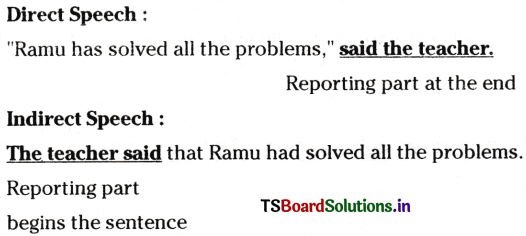
Transformation of Sentences Inter 1st Year English Grammar 10

2. The order of the words in the reporting part is arranged as “Subject + Verb.”
This is applicable only when this order is not followed in the direct speech sentence.
Ex :
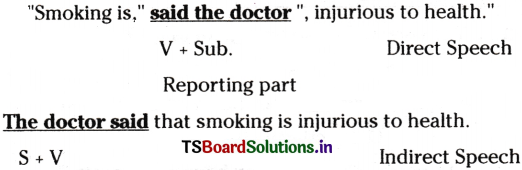
Transformation of Sentences Inter 1st Year English Grammar 11

3. The reporting verb is changed to words like ordered, requested, enquired, told, asked, advised exclaimed, depending on the meaning of the reported part.
Ex :
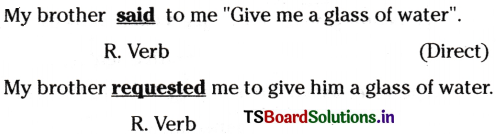
Transformation of Sentences Inter 1st Year English Grammar 12

4. The quotation marks and the comma between the reporting and reported parts are removed in the indirect speech.
Ex : The boy said,” This plant has grown very tall.” (D.S.)
The boy said that that plant had grown very tall. (I.S.)

5. A suitable connecting word is used to connect the reporting and reported parts. The selection of the right connecting word needs careful observation.

Sentence in quotation marksConnecting word
1. Assertive or Exclamatorythat
2. Imperativeto
3. Yes/No type Questionif or whether
4. Wh’ type QuestionNo connecting word

Ex:

Transformation of Sentences Inter 1st Year English Grammar 13

6. The pronouns in the reported part are to be changed suitably. This depends on the first speaker, the speaker’s listener, the reporter and the reporter s listener. One has to ensure that the original speaker’s intention is correctly reported.
(Indirect speech లోకి మార్చేటప్పుడు, ఎవరు ఎవరితో అన్న మాటలను తిరిగి ఎవరు ఎవరికీ చెబుతున్నారు అనేదానిని బట్టి pronouns మారతాయి. మొదట మాట్లాడిన వ్యక్తి ఉద్దేశ్యం మారకుండా సరిగ్గా చెప్పడం అవసరం.)

Transformation of Sentences Inter 1st Year English Grammar

Now notice the following examples carefully :

a) The teacher said to you, “You are late again.” (D.S.)
The teacher told you that you were late again. (I.S.) ‘you’ not changed.

b) The teacher said to me “You have improved your performance.” (D.S.)
The teacher told me that I had improved my performance.
You → I & Your → my

c) The teacher said to Geetha, “You have to submit your assignments tomorrow.” (D.S.)
The teacher told Geetha that she had to submit her assignments the following day. (I.S.)
You → she and your → her

d) The teacher said to Prudhvi, “When will you finish your computer course” ? (D.S.)
The teacher asked Prudhvi when he would finish his computer course. (I.S.)
You → he and your → his

e) The teacher said to the students, “You must consult your parents.” (D.S.)
The teacher told the students that they should consult their parents. (l.S.)
You → they and Your → their

As the examples a, b, c, d and e show you, pronouns change in accordance with the speaker’s reference to a person / persons.

7. In changing sentences into the indirect speech, the tense form of the verbs in the reported part is to be changed. This is the most important part of the transformation. This is done in accordance with the concept popularly known as “the sequence of tenses.”
(Reported part లోని verbs tenses మార్చడం అతి ప్రధాన భాగం. దేనిని ’Sequence of tenses’ అనే నియమానుసారంగా చేయాలి.)

The following table clearly shows when and how to change the tense.

Tense of the Reporting verbType of the reported sentenceChange from Tense in direct speech to tense in indirect speech (with examples)
1. Present or FutureAny typeNo change He says, I can …He says that he can
2. Any tenseUniversal truthsNo change She said “Water saves………………She said that water saves
3. Any tenseImperativeNo change …said close the…… asked to close the…
4. Past tenseAny type other than imperative & universal truthsSimple Present … said … is a…”Simple Past ……said…was a…
5. ||||Present Continuous said…’is/am/are/ playingPast Continuous … said… was/ were playing…
6. ||||Present Perfect Cont. said …”has/have answered”Past Perfect …said… had answered
7. ||||Any type other than imperative & universal truthsPresent perfect cont. said…”has/have been waiting Past perfect cont. said… had been waiting
8. ||||Simple Past said… “came…”Past Perfect said…had come
9. ||||Past Continuous said …”were makingPast Perfect Cont. said… had been making
10. ||||Past Perfect said…”had attendedNo change said had attended.
11. ||||Past Perfect Cont. said ‘had been watching…”No change had been watching
12. ||||All future tense with modal helping verbs “will, can, may”their past tense forms would, could, might
13. ||||Future with ‘shall’ said … “shall…”to would said… “would”
14. ||||musthad to / should
15. ||||oughtought

8. The next step in the transformation from the direct to the indirect is to change the adjectives or adverbs showing ‘nearness” to those showing ‘distance’ as explained in the following table :

Adjective / adverb in ‘direct speech’Adjective or adverb in ‘indirect speech’
1. thisthat
2. thesethose
3. herethere
4. nowthen
5. today/tonightthat day / that night
6. yesterdaythe previous day/ the day before
7. tomorrowthe next day / the following day
8. agobefore

9. The transformation from the direct to the indirect involves a change in the word order. This principle is applicable to interrogative and exclamatory sentences only. This is exemplified in the table given below.

Word order in Direct Speech with examplesWord order in Indirect Speech with examples
1. … Helping verb+subject+Main verb … said … “are you coming”…subject + Helping verb + Main verb asked …..you were coming
2. Helping verb + subject + Main verb said … do you like …subject + …………… + Main verb asked … he …………. liked
3. ‘wh’ word + adj / adv + subject + verb said “How beautiful + the toy is …..subject + verb + intensifier adj/adv exclaimed the toy was very beautiful.

Note that the wh’ word in exclamatory sentences doesn’t have the meaning of a question. It just emphasises the adjective or adverb. Hence this ‘wh’ word in the direct speech becomes the intensifier ‘very’ in the indirect speech.

Transformation of Sentences Inter 1st Year English Grammar

10. The last step in this kind of transformation is to change the Question mark’ or the ‘exclamatory mark’ into a full stop in the indirect speech.

You must note that all the Ten steps detailed above are not necessary to follow in the case of all kinds of sentences. You carefully check which steps are necessary and which steps are not necessary to follow in changing a given sentence.

Examples :

A) Statements:
1. Direct : He said to me, “I am happy to be here this evening”.
Indirect : He told me that he was happy to be there that evening.

2. Direct : He said to her, ‘I bought a house’.
Indirect : He told her that he had bought a house.

3. Direct : He said to me, ‘I shall pay your fees tomorrow.
Indirect : He told me that he would pay my fees the next day.

4. Direct : He said, The sun rises in the east’.
Indirect : He said that the sun rises in the east.

B) Questions:

1. Direct : He said, How many brothers have you ?’
Indirect : He asked me how many brothers I had.

2. Direct : “Have you no sense ?’ shouted the man.
Indirect : The man shouted if he had any sense.

3. Direct : The student asked ‘Where can I get an application form ?’
Indirect : The student enquired where he could get an application form.

4. Direct : John said ‘Will you play chess with me ?’
Indirect : John asked me whether I would play chess with him.

5. Direct : The doctor asked the patient, What did you eat today ?’
Indirect : The doctor enquired the patient what he had eaten that day.

6. Direct : Are you the manager ?’ I said.
Indirect : I asked (or enquired) whether he was the manager.

Imperative Sentences:

1. Direct : The teacher said to the boy, Get out of the room’.
Indirect : The teacher asked (or ordered) the boy to get out of the room.

2. Direct : The doctor said to the patient, Do not smoke’.
Indirect : The doctor advised the patient not to smoke.

3. Direct : Please take me to the officer’ said the visitor.
Indirect : The visitor requested them to take him to the officer.

4. Direct : Polonius said to Laertes, ‘Neither a borrower nor a lender be’.
Indirect: Polonius advised Laertes to be neither a borrower nor a lender.

5. Direct : He said, Let us wait for an hour’.
Indirect: He proposed that they should wait for an hour.

6. Direct : He said to her, ‘Don’t go out now’.
Indirect: He asked her not to go out then.

Transformation of Sentences Inter 1st Year English Grammar

D) Exclamatory Sentences:

1. Direct : He said ‘What a fool I am !’
Indirect : He exclaimed that he was a fool.

2. Direct : ‘How selfish I have been!‘ he said.
Indirect : He exclaimed that he had been very selfish.

3. Direct : He said, ‘Alas, I am ruined!’
Indirect: He exclaimed that he was ruined.

4. Direct : He said, ‘God save the king!’
Indirect : He prayed that God might save the King.

5. Direct : ‘What a lazy girl you are!’ he said to Judy.
Indirect : He exclaimed to Judy that she was a very lazy girl.

6. Direct : ‘May our country be peaceful!’ said they.
Indirect : They expressed their wish that their country might be peaceful.

7. Direct : ‘Hurrah! I have won again’, he said.
Indirect : He exclaimed with joy that he had won again.

8. Direct : He said, ‘Alas! How foolishly have I acted!’
Indirect : He exclaimed with regret that he had acted very foolishly.

9. Direct : The captain said to the goalee, ‘Bravo ! Well done’.
Indirect: The captain applauded the goalee.

10. Direct : The frog said, ‘What a feast it was!’
Indirect: The frog exclaimed that it was a great feast.

More Examples

1. Kiran said, “I am angry.” (Direct)
Kiran said that he was angry. (Indirect)

2. Vijay said, “I’m searching for my wallet.” (Direct)
Vijay said that he was searching for his wallet. (Indirect)

3. He said, “I watched this movie last week.” (Direct)
He said that the had watched that movie the previous week. (Indirect)

4. Latha said, “I have lived here since 1970.” (Direct)
Latha said that she had lived there since 1970. (Indirect)

5. He said, “They had finished the project when I arrived.” (Direct)
He said that they had finished the project when he had arrived.” (Indirect)

6. Shreya said, “I was playing tennis when the accident occurred.” (Direct)
Shreya said that she had been playing tennis when the accident had occurred. (Indirect)

7. She said, “I have been playing the piano for two hours.” (Direct)
She said that she had been playing the piano for two hours. (Indirect)

8. Ajay said, “I had been writing a novel when the light went off.” (Direct)
Ajay said that he had been writing a novel when the light had gone off. (Indirect)

9. Vimal said, “I will shut the window.” (Direct)
Vimal said that he would shut the window. (Indirect)

10. Anji said, “I would buy Rolls Royce if I were rich.” (Direct)
Anji said that he would buy Rolls Royce if he had been rich.” (Indirect)

Exercise

Convert the following sentences into indirect speech.

Question 1.
Parnika will say, “I am not invited.”
Answer:
Parnika will say that she is not invited.

Question 2.
Our science teacher said, “Oil floats on water.”
Answer:
Our science teacher said that oil floats on water.

Question 3.
Eleanor Roosevelt said, “The future belongs to those who believe in the beauty of their dreams.”
Answer:
Eleanor Roosevelt said that the future belongs to those who believe in the beauty of their dreams.

Question 4.
Aarav said to Meghana, “You should not reveal my plan to them.”
Answer:
Aarav told Meghana that she should not reveal his plan to them.

Question 5.
Darshil said to Mayukhi, “I will meet you here tomorrow.”
Answer:
Darshil told Mayukhi that he would meet her there the next day.

Question 6.
Aarushi said, “I was watching TV at 10 pm yesterday.”
Answer:
Aarushi said that she had been watching TV at 10 pm the previous day.

Question 7.
Mahima said, “I have been studying for three hours.”
Answer:
Mahima said that she had been studying for three hours.

Question 8.
We asked the guide, “How far is the museum from here ?”
Answer:
We asked the guide how far the museum was from there.

Question 9.
Angelina said to Jennifer, “When did you submit your project ?”
Answer:
Angelina asked Jennifer when she had submitted her project.

Question 10.
Vedant asked his mother, “Can you make me a sandwich ?”
Answer:
Vedant asked his mother if she could make him a sandwich.

Transformation of Sentences Inter 1st Year English Grammar

Question 11.
Anokhi said to Sahasra, “Do you like painting ?”
Answer:
Anokhi asked Sahasra if she liked painting.

Question 12.
Aaradhya said to her brother, “Please pass me the book.”
Answer:
Aaradhya requested her brother to pass her the book.

Question 13.
My father said to me, “Don’t waste your time.”
Answer:
My father told me not to waste my time.

Question 14.
My brother said, “Let’s go to a movie”.
Answer:
My brother suggested that we go to a movie. / My brother said that we should go to a movie.

Question 15.
The doctor said to the patient, “Wish you a speedy recovery.”
Answer:
The doctor wished the patient a speedy recovery.

Question 16.
“May God bless our country,” said the priest.
Answer:
The priest prayed that God might bless our country.

Question 17.
Jatin said, “I can solve this problem.”
Answer:
Jatin said that he could solve that problem.

Question 18.
Arunima said, “I may attend the meeting.”
Answer:
Arunima said that she might attend the meeting.

Question 19.
Yashwin said, “I must finish the report today.”
Answer:
Yashwin said that he must finish the report that day.

Question 20.
Yamini said, “I would join the team if I had time.”
Answer:
Yamini said that she would join the team if she had time.

Question 21.
The boy said, ‘‘Mom, please give me some milk.”
Answer:
The boy requested her mother to give him some milk.

Question 22.
Kishore said, “I will go to Delhi tomorrow.”
Answer:
Kishore said that he would go to Delhi the next day.

Transformation of Sentences Inter 1st Year English Grammar

(C) Degrees of Comparison

Man craves for variety. He knows that variety is the spice of life. Hence he tries to express the same idea in various different ways. The result is the tradition of describing the quality, quantity size etc., of some thing or person in three different ways. Most adjectives and some adverbs have three different forms. They are positive, comparative and superlative. They are known as the three degrees of comparison.

(ఒక వ్యక్తి యొక్క, వస్తువు యొక్క గుణ, పరిమాణాలను మూడు భిన్న రూపాలలో వ్యక్తీకరించడం ఆనవాయితీ. ఈ రూపాలనే Degrees of comparison అని పిలుస్తారు.)

When the comparison is among a minimum of three persons/things, that can be expressed in all the three degrees. If the compared persons are two only, the superlative degree is not possible. When we talk of the quality, quantity of a single item, only positive degree is possible.

Interchange of Degrees of comparison :
Transforming one sentence from the Superlative Degree to Comparative Degree involves the following steps.

1. First, remove ‘the’ that is used before the superlative adjective, while changing it into the comparative.
2. Write the comparative form of the adjective.
3. Then, add than any other’ after the adjective.
Ex : Praveen is the youngest boy in the class. (S.D.)
Praveen is younger than any other boy in the class.(C.D.)

To change that sentence into the positive :

1. Begin the sentence with No other’.
2. Secondly, place the phrase after the superlative adjective after No other’.
3. Use ‘so + adj in positive Degree + as’ after the verb.
4. Place the subject in the S.D after ‘as’ in P.D.
Ex : He is the richest man in our town. (S.D.)

Transformation of Sentences Inter 1st Year English Grammar 14

Transforming one sentence from the superlative Degree to comparative or positive Degree involves the following steps.
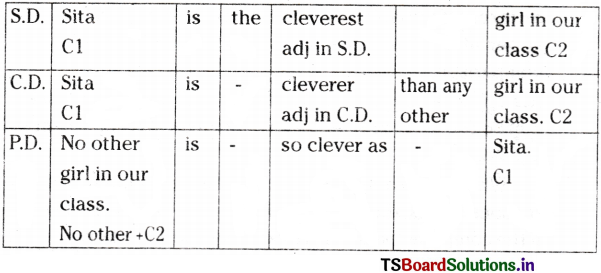
Transformation of Sentences Inter 1st Year English Grammar 15

Sentences with one of phrase in the Superlative degree follow a slightly different wording. This is as explained here under.
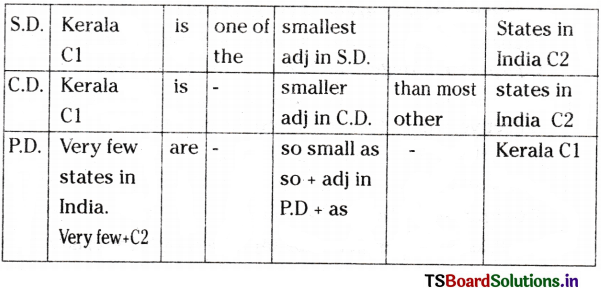
Transformation of Sentences Inter 1st Year English Grammar 16

Some sentences show the comparison between only two things / persons. In such cases, the superlative is not possible. The interchange is made as shown here.
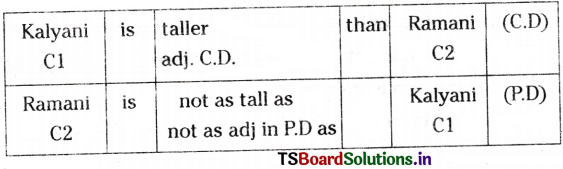
Transformation of Sentences Inter 1st Year English Grammar 17

Examples:

I.
Question 1.
Bengaluru is as cool as Ooty. (Into Comparative)
Answer:
Ooty is not cooler than Bengaluru.

Question 2.
Australia is the biggest island in the world. (Into other degrees)
Answer:
i) Australia is bigger than any other island in the world. (Comparative)
ii) No other island in the world is so big as Australia. (Positive)

Question 3.
The moon is brighter than the stars. (Into Positive)
Answer:
The stars are not so bright as the moon.

Question 4.
There is no vice so bad as drink. (Into Comparative)
Answer:
Drink is worse than any other vice.

Question 5.
Kashmir is the most beautiful place in India. (Into other degrees)
Answer:
i) No other place in India is so beautiful as Kashmir. (Positive)
ii) Kashmir is more beautiful than any other place in India. (Comparative)

Question 6.
Silver is not so precious as gold. (Into Comparative)
Answer:
Gold is more precious than silver.

Question 7.
}Rumble is one of the ablest bowlers. (Into other degrees)
Answer:
i) Very few bowlers are so able as Kumble. (Positive)
ii) Kumble is abler than most other bowlers.(Comparative)

Question 8.
The lion is more ferocious than any other animal. (Into other degrees)
Answer:
i) The lion is the most ferocious of all the animals. (S.D)
ii) No other animal is so ferocious as the lion. (P.D)

Question 9.
The sword is not so mighty as the pen.(Into Comparative)
Answer:
The pen is mightier than the sword. (C.D)

Question 10.
Copper is more useful than most other metals. (Into other degrees)
Answer:
i) Copper is one of the most useful metals. (S.D)
ii) Very few metals are so useful as copper. (P.D)

Question 11.
Mount Everest is higher than any other peak in the world. (Into other degrees)
Answer:
i) Mount Everest is the highest of all the peaks in the world. (S.D)
ii) No other peak in the world is so high as Mount Everest. (P.D)

Question 12.
I like you better than him. (Into Positive)
Answer:
I don’t like him as well as I like you. (P.D)

Question 13.
A deer runs faster than a horse. (Into Positive)
Answer:
A horse does not run so fast as a deer. (P.D)

Question 14.
Sangeetha is the tallest girl in the class. (Into Positive)
Answer:
No other girl in the class is so tall as Sangeetha. (P.D)

Transformation of Sentences Inter 1st Year English Grammar

Question 15.
This is one of the most powerful earthquakes that occurred. (Into other degrees)
Answer:
i) This is more powerful than most other earthquakes that occurred. (C.D)
ii) Very few earthquakes that occurred are as powerful as the earthquake. (PD)

More Examples

Question 1.
Yashwant is not so tail as Praneeth. (Positive)
Answer:
Praneeth is taller than Yashwanth. (Comparative)
Not possibile. (Superlative)

Question 2.
Few other/very few boys are at least as tall as Praneeth. (Positive)
Answer:
Praneeth is taller than most other boys.
Praneeth is one of the tallest boys.

Question 3.
No other boy is so tall as Praneeth. (Positive)
Answer:
Praneeth is taller than any other boy. (Comparative)
Praneeth is the tallest boy. (Superlative)

Question 4.
Mumbai is bigger than Hyderabad. (Comparative)
Hyderabad is not so/as big as Mumbai. (Positive)

Question 5.
Mumbai is one of the biggest cities in the world. (Superlative)
Mumbai is bigger than most other cities in the world. (Comparative)
Few other cities in the world are as big as Mumbai. (Positive)

Question 6.
Mumbai is the biggest city in India. (Superlative)
Mumbai is bigger than any other city in India.(Comparative) No other city in India is so/as big as Mumbai. (Positive)

Exercise for Practice

Fill in the blanks with the correct form of the adjective in parentheses.

Question 1.
Chinnodu is the ___________ (small) of the three friends.
Answer:
smallest

Question 2.
Peddodu says he is ___________ (brave) than Chinnodu.
Answer:
braver

Question 3.
Bheemudu is the ___________ (tall) and the ___________ (strong) of all.
Answer:
tallest, strongest

Question 4.
Chinnodu finds a rock and says it is ___________ (big) any other rocks he’s ever seen.
Answer:
bigger

Question 5.
The water in the stream feels ___________ (cold) than they expected.
Answer:
colder

Question 6.
Bheemudu says he is the ___________ (brave) because he’s not even cold!
Answer:
bravest

Question 7.
In the meadow, Chinnodu thinks the flowers are the ___________ (pretty) he’s ever seen.
Answer:
prettiest

Question 8.
Peddodu finds a yellow flower and says it is ___________ (pretty) than the others.
Answer:
prettier

Question 9.
Bheemudu spots a purple flower and claims it’s the ___________ (pretty) flower of all.
Answer:
prettiest

Question 10.
At the end of the day, Chinnodu says he is the ___________ (tired) of the three.
Answer:
most tired

Question 11.
Peddodu yawns and says he’s even ___________ (tired) than Chinnodu.
Answer:
more tired

Transformation of Sentences Inter 1st Year English Grammar

Question 12.
Bheemudu believes he is the ___________ (tired) because he walked the farthest.
Answer:
most tired

Exercise

Rewrite the sentences according the clues given in the brackets.

Question 1.
Rahul is one of the cleverest boys in the class.
(Convert into Comparative and Positive)
Answer:
Comparative: Rahul is cleverer than most other boys in the class.
Positive : Very few boys in the class are as clever as Rahul.

Question 2.
No other English poet is so great as Milton.
(Rewrite using ‘greater’ and ‘greatest’)
Answer:
Comparative: Milton is greater than any other English poet.
Superlative : Milton is the greatest of all English poets.

Question 3.
Keerthana is more intelligent than any other girl in the class.
(Convert into Superlative and Positive)
Answer:
Superlative: Keerthana is the most intelligent girl in the class.
Positive : No other girl in the class is as intelligent as Keerthana.

Question 4.
Very few towns are as much popular as Varanasi.
(Convert into Comparative and Superlative)
Answer:
Comparative : Varanasi is more popular than most other towns.
Superlative : Varanasi is one of the most popular towns.

Question 5.
Chennai is hotter than Mumbai. (Convert into Positive)
Answer:
Positive : Mumbai is not as hot as Chennai.

Question 6.
Hercules was stronger than any other man.
(Rewrite using ‘strongest’ and ‘strong’)
Answer:
Superlative : Hercules was the strongest man.
Positive : No other man was as strong as Hercules.

Question 7.
He is more like his father than his mother. (Convert into Positive)
Answer:
Positive : He is not as like his mother as he is like his father.

Question 8.
No other animal is so faithful as the dog.
(Convert into Comparative and Superlative)
Answer:
Comparative: The dog is more faithful than any other animal.
Superlative : The dog is the most faithful of all animals.

Question 9.
Mount Everest is higher than any other peak in the world.
(Rewrite using ‘highest’ or ‘high’ instead of ‘higher’)
Answer:
Superlative : Mount Everest is the highest peak in the world.
Positive : No other peak in the world is as high as Mount Everest.

Question 10.
Apples are not so cheap as oranges. (Convert into Comparative)
Answer:
Comparative : Oranges are cheaper than apples.

Question 11.
Manasa sings the best.
(Convert into Comparative and Positive)
Answer:
Comparative : Manasa sings better than all others.
Positive : No one sings as well as Manasa.

Question 12.
Vivekananda was more popular than most other Indian saints.
(Convert into Positive and Superlative)
Answer:
Positive : Very few Indian saints were as popular as Vivekananda.
Superlative: Vivekananda was one of the most popular Indian saints.

Question 13.
No one sings so much beautifully as Chitra.
(Rewrite using ‘better’ and ‘best’)
Answer:
Comparative : Chitra sings better than anyone else.
Superlative : Chitra sings the best of all.

Question 14.
Julie is not as pretty as her sister. (Rewrite using ‘prettier’)
Answer:
Comparative : Her sister is prettier than Julie.

Question 15.
Judith painted better than all other participants.
(Convert into Positive and Superlative)
Answer:
Positive : No other participant painted as well as Judith.
Superlative : Judith was the best painter among all the participants.

Question 16.
Sudha sings the best of all. (Write the Positive Degree)
Answer:
No other girl (person) sings as well as she does.

Question 17.
Very few plays are as much as popular as ‘Julius Caesar’.
(Write the Superlative Degree)
Answer:
‘Julius Caesar’ is one of the most popular plays.

Transformation of Sentences Inter 1st Year English Grammar

(D) Clause Analysis and Synthesis of Sentences

Words are grouped into bigger units in various ways. Depending on their parts and function, the word groups are classified into phrases, clauses and sentences.
(పదసమూహాలలోని భాగాలను, వాటి విధులను అనుసరించి పదసముదాయాలను phrases, clauses and sentences అని వర్గీకరిస్తారు.)

A word group that has no subject, predicate distinction is called the phrase.
Ex: a clever boy (word group – no subject predicate division)
an old house – will have been completed.

A word group that has one subject and one predicate (and only one) with complete or incomplete sense is known as the clause.

Note -1: A predicate is finite verb + something. Therefore, if there is a finite verb in a group of words, that group of words can be identified as a clause.

Note – 2 : To infinites and present participles or past participles without a helping verb before them are not finite verbs. Therefore, they cannot make a group of words a clause.
Ex : I want to go. (To go – not finite – not a clause)
Seeing the police, the crowd dispersed. (Seeing-present participle-No H.V.)
Dejected, she started crying. (Dejected-p.p. No H.V.)

A group of words with one or more subjects and with complete sense is termed as the sentence.
Clauses are of two types. Clauses that have complete sense are main clauses. Clauses that have incomplete sense are subordinate clauses.
Depending on the number of clauses in a sentence and their type, sentences are divided into three kinds.

1. The Simple Sentence: A sentence which contains one main clause and no subordinate clause is called a Simple sentence. It has only one subject and one predicate.
Eg : – The sun rises in east.
1 saw a lion in the zoo.
She completed her work.

2. The Complex Sentence : A sentence which contains one main clause and one or more subordinate clauses is called a Complex sentence.
Eg : – A man, who is dead, tells no lies.
Although she is poor, she is honest.
Where there is a will, there is a way.

3. The Compound Sentence : A sentence which has two or more main clauses is a Compound sentence.
Eg:- Do it or leave it.
She took her dinner and went to bed.
They painted the wall but the paint was washed off.

Conversion from one type of sentence into another requires changing a phrase into a clause or vice versa.

  • Simple to compound – a phrase into a main clause.
  • Simple to complex – a phrase into a subordinate clause. Compound to simple – a main clause into a phrase.
  • Complex to simple – a subordinate clause into a phrase Compound to complex – a main clause into a subordinate clause.
  • Complex to compound – a subordinate clause into a main clause.

Conversion of phrases into clauses or vice versa cannot be reduced into a set of simple rules. Hence one has to practise with keen observation the transformation of simple, complex and compound sentences. However, the following lists of words will be of some help to the learners.

The correct use of the following words will help the learner construct a compound sentence.
and, but, then, or, so, yet, still, either or neither… nor; not only … but also; otherwise, else, therefore.

The words listed below are useful in writing complex sentences.
as, though, although, that, so…that, as soon as; as…as, who, what, when, where, which
(Note : ‘So’ is used both in compound and complex sentences. In complex sentences, ‘So’ is followed by “that”.)

The following phrases are helpful in writing simple sentences.
in spite of; besides, owing to; on account of; in the event of, present participles, past participles’ without helping verbs.

Examples:

I. Conversion of Simple Sentences to Compound

1. By using ‘and’:
e.g.: i) Putting off his clothes, he plunged into the river. (Simple)
He put off his clothes and plunged into the river. (Compound)

ii) The farmer went home at sun set. (Simple)
The sun set and the farmer went home.(Compound)

2. By using ‘not only …………… but also’:
e.g.: i) Besides being handsome, she is intelligent. (Simple)
She is not only handsome, but also intelligent. (Compound)

ii) In addition to useful advice, he gave me financial help. (Simple)
He gave me not only useful advice but also financial help. (Compound)

3. By using but, still, yet, etc :
e.g.: i) In spite of hard work, he could not succeed. (Simple)
He worked hard but he could not succeed. (Compound)

ii) In spite of very bad weather, they marched on. (Simple)
The weather was very bad, still they marched on. (Compound)

iii) Not withstanding her poverty, I love her. (Simple)
She is poor, yet I love her. (Compound)

4. By using conjunctions like or, otherwise, else, so, therefore, etc.
e.g.: i) You must pay the fine to get your scooter back. (Simple)
You must pay the fine or you won’t get your scooter back. (Compound)

ii) I would have been robbed but for the timely help of the policeman. (Simple)
The policeman gave me timely help, otherwise I would have been robbed. (Compound)

iii) She failed on account of her laziness. (Simple)
She was lazy, so she failed. (Compound)

iv) I was pleased with him for his honesty. (Simple)
He was honest, therefore 1 was pleased with him. (Compound)

II. Conversion of Compound Sentences into Simple

1, By using a participle :
e.g.: i) His wife died and this added to his misery. (Compound)
His wife died adding to his misery. (Simple)

ii) The players were tired and they decided to stop the play. (Compound)
Having been tired, the players decided to stop the play. (Simple)

2. By using a prepositional phrase :
e.g.: i) He is rich, yet he is not happy. (Compound)
In spite of his being rich, he is not happy.(Simple)

ii) The film is not only interesting but also it conveys a moral. (Compound)
Besides being interesting, the film conveys a moral. (Simple)

Transformation of Sentences Inter 1st Year English Grammar

III. Conversion of Simple Sentences into Complex Sentences

By expanding a word or a phrase into a clause :
e.g.: i) He pleaded ignorance of the law. (Simple)
He pleaded that he was ignorant of the law. (Complex)

ii) A dead man tells no lies. (Simple)
A man, who is dead, tells no lies. (Complex)

iii) Immediately on reading the telegram, she wept. (Simple)
As soon as she read the telegram, she wept. (Complex)

iv) Being rich, he can buy two cars. (Simple)
As he is rich, he can buy two cars. (Complex)

v) He is working hard to get rank. (Simple)
He is working hard so that he may get rank. (Complex)

vi) The typist worked to the best of his ability. (Simple)
The typist worked as best as he could. (Complex)

vii) In spite of all his riches, he is not happy. (Simple)
Although he is rich, he is not happy. (Complex)

IV. Conversion of Complex Sentences to Simple Sentences

By Converting a clause into a word or a phrase :
e.g.: i) lam responsible for what I do. (Complex)
I am responsible for my actions. (Simple)

ii) The boy proved that he was brilliant. (Complex)
The boy proved his brilliance! (Simple)

iii) As he was ill, he stayed at home. (Complex)
He stayed at home on account of his illness .(Simple)

iv) When the teacher went out, the pupils made a lot of noise. (Complex)
The pupils made a lot of noise in the absence of the teacher. (Simple)

V. Conversion of Compound Sentences to Complex

1. Sentences containing the cumulative conjunction.
e.g.: i) He wanted to win the prize and worked hard .(Compound)
He worked hard so that he might win the prize.(CompIex)

ii) Go to the dentist and he will pull out your painful tooth. (Compound)
If you go to the dentist, he will pull out your painful tooth. (Complex)

2. Sentences containing alternative conjunctions like but, still, nevertheless, however, or otherwise, else, either ………… or, etc.
e.g.: i) Do it or you will suffer. (Compound)
Unless you do it, you will suffer. (Complex)

ii) I have known her for many years but I have never seen her. (Compound)
Although I have known her for many years, I have never seen her. (Complex)

iii) His parents were poor, still they gave him the best education. (Compound)
Though his parents were poor, they gave him the best education. (Complex)

iv) Hurry up, otherwise you will be lat^.(Compound)
Unless you hurry up, you-will be late. (Complex)

VI. Conversion of Complex Sentences to Compound

1. By using cumulative conjunction ‘and’:
e.g.: i) Everybody knows that death is inevitable.(Complex)
Death is inevitable and everybody knows it. (Compound)

ii) I am happy that you have come. (Complex)
You have come and I am happy for it. (Compound)

2. By using alternative conjunction ‘but’:
e.g.: i) Although we lost the match, we fought bravely.(Complex)
We lost the match but we fought bravely/Compound)

ii) I have found my pen that I had lost. (Complex)
I had lost my pen but I have found it. (Compound)

3. By using alternative conjunction ‘or’:
e.g.: i) Unless you control your anger, you won’t prosper. (Complex)
Control your anger or you won’t prosper. (Compound)

4. By using illusive conjunctions like so, therefore etc.,
e.g.: i) As he wants to be a doctor, he has taken Bi.P.C. (Complex)
He wants to be a doctor, therefore, he has taken Bi.P.C. (Compound)

ii) They took rest because they were tired. (Complex)
They were tired, so they took rest. (Compound)

Transformation of Sentences Inter 1st Year English Grammar

A single sentence can be changed from one form into two other forms as seen above. Similarly, two simple sentences can be synthesised to form one simple, complexor compound sentence.

I. The following examples will illustrate the synthesis.

i) By using a participle
A participle is commonly used when the subjects of the two sentences are the same.
For example,
He was tired, He lay down on the sofa.
Being tired, he lay down on the sofa.

ii) By using a prepositional phrase (The preposition is followed by a noun.)
For example,
The magician made a flower. He used colour papers.
The magician made a flower with colour papers.

iii) By using an adverb or adverb phrase
For example,
He signed the agreement. That was foolish.
He foolishly signed the agreement.

iv) By using an infinitive
For example,
You must hurry. You will catch the train.
You must hurry to catch the train.

II. Two or more simple sentences can be combined into a compound sentence by making use of coordinating or correlative conjunctions.
For example,
His parents could not persuade him to give up smoking. Neither could I.
Neither his parents nor I could persuade him to give up smoking.
He was unwell. He attended office.
He was unwell, however, he attended office.

III. Two or more simple sentences can be combined into a complex sentence making use of subordinating conjunctions or relative pronouns and relative adverbs which act as subordinating conjunctions.
For example,
I said something, Ashwin did not listen to it.
Ashwin did not listen to what I said.
She was rich. She was not popular.
Although she was rich, she was not popular.

Examples

1. Advaith Reddy was late but he worked hard. (Compound Sentence)
Though Advaith Reddy was ill he worked hard. (Complex Sentence)
In spite of being ill, Advaith Reddy worked hard. (Simple Sentence)

2. Ram had high fever, so he was at home. (Compound)
As Ram had high fever he stayed at home. (Complex)
Because of high fever Ram stayed at home. OR (Simple)
Having high fever Ram stayed at home. (Simple)

3. Get up early or you can’t catch the train. (Compound)
If you get up early, you can catch the train. OR (Complex)
Unless you get up early, you can’t catch the train. (Complex)
Get up early to catch the train. OR (Simple)
Without getting up early, you can’t catch the train .(Simple)

4. The tree not only gives fruit, but also gives good shade. (Compound)
The tree gives good shade although it mainly gives fruit. (Complex)
Besides giving fruit, the tree gives good shade. (Simple)

More Examples

Rewrite the sentences combining them with the words given in the brackets.

Question 1.
It was cloudy. I went with an umbrella. (as)
Answer:
I went with an umbrella as it was cloudy.

Question 2.
Jhansi is a queen. She is an archer, (not only… but also)
Answer:
Jhansi is not only a queen, but also an archer.

Question 3.
She was tired. She continued to stitch the dress for me. (although)
Answer:
Although she was tired, she continued to stitch the dress for me.

Question 4.
He came to the hotel. He did not eat anything. (however)
Answer:
He came to the hotel; however, he did not eat anything.

Question 5.
That lady is very old. She cannot walk quickly, (too.. to)
Answer:
That lady is too old to walk quickly.

Question 6.
He saw the principal. He started studying. (Seeing)
Answer:
Seeing the principal, he started studying.

Question 7.
I have appointed an attendant. He will look after my grandfather, (to infinitive)
Answer:
I have appointed an attendant to look after my grandfather.

Question 8.
She is very short. She cannot pluck the fruit, (so… that)
Answer:
She is so short that she cannot pluck the fruit.

Question 9.
We must make it fast. The class will begin. (else)
Answer:
We must make it fast, else the class will begin.

Transformation of Sentences Inter 1st Year English Grammar

Question 10.
My task is over. I want to go to a movie, (so)
Answer:
My task is over, so I want to go to a movie.

Exercise for Practice

Rewrite the sentences as directed in the parentheses.

Question 1.
In spite of facing many setbacks, he didn’t lose hope. (Change into compound and complex)
Answer:
Compound: He faced many setbacks, but he didn’t lose hope.
Complex : Although he faced many setbacks, he didn’t lose hope.

Question 2.
Although she is an illiterate, she speaks English well. (Change into simple and compound)
Answer:
Simple : Despite being an illiterate, she speaks English well.
OR
In spite of being an illiterate, she speaks English well.
Compound: She is an illiterate, but she speaks English well!

Question 3.
Speak the truth, or I will kill you. (Change into simple and complex)
Answer:
Simple : You must speake the truth to avoid being killed.
Complex : If you do not speak the truth, I will kill you.

Question 4.
If you work hard, you will get first class. (Change into compound and simple)
Answer:
Compound : Work hard, and you will get first class.
Simple : By working hard, you will get first class.

Question 5.
He is strong so he can lift heavy weights. (Change into simple and complex)
Answer:
Simple : Being strong, he can lift heavy weights.
Complex : Because he is strong, he can lift heavy weights.

Question 6.
Owing to his intelligence, he became an IAS officer. (Change into compound and complex)
Answer:
Compound : He was intelligent, and so he became an IAS officer.
Complex : Because he was intelligent, he became an IAS officer.

Question 7.
He finished his meal and went to work. (Change into complex and simple)
Answer:
Complex : After he finished his meal, he went to work.
Simple : Having finished his meal, he went to work.

Question 8.
The chief guest having taken his seat on the dais, the meeting began. (Change into complex and compound)
Answer:
Complex : After the chief guest had taken his seat on the dais, the meeting began.
Compound : The chief guest took his seat on the dais, and the meeting began.

Question 9.
Shrestha is too shy to face strangers. (Change into complex and compound)
Answer:
Complex: Shrestha is so shy that she cannot face strangers.
Compound : Shrestha is very shy, and she cannot face strangers.

Question 10.
Your writing is so illegible that I cannot understand it. (Change into compound and simple)
Answer:
Compound: Your writing is illegible, and I cannot understand it.
Simple : Your writing is too illegible to understand.

Question 11.
Lucy saw a wounded rabbit. (Change into complex)
Answer:
Complex: Lucy saw a rabbit that was wounded

Question 12.
The police recovered the child that was lost. (Change into simple)
Answer:
Simple : The police recovered the lost child.

Question 13.
Take care when crossing the road. (Change into complex)
Answer:
Complex : Take care when you are crossing the road.

Question 14.
We eat that we may live. (Change into simple)
Answer:
Simple : We eat to live.

Question 15.
No sooner did he see us than we disappeared into the night.
(Use ‘Hardly / Scarcely – when ’ or ‘As soon as ’)
Answer:
Hardly had he seen us when we disappeared into the night.
Scarcely had he seen us when we disappeared into the night.
As soon as he saw us, we disappeared into the night.

Question 16.
Scarcely had he entered the room when the clock struck twelve. (Use ‘No sooner – than/As soon as/Hardly – when ’)
Answer:
No sooner had he entered the room than the clock struck twelve.
As soon as he entered the room, the clock struck twelve.
Hardly had he entered the room when the clock struck twelve.

Question 17.
As soon as the thief saw the policeman coming, he took to his heels. (Use No sooner-than, Scarcely/Hardly – when ’)
Answer:
No sooner did the thief see the policeman coming than he took to his heels.
Scarcely had the thief seen the policeman coming when he took to his heels.
Hardly had the thief seen the policeman coming when he took to his heels.

Transformation of Sentences Inter 1st Year English Grammar

Exercise

Two or more simple sentences can be combined with the help of coordinating conjunctions like, and, therefore, otherwise, as well as, either – or, neither – nor, not only – but also.

Question 1.
They went to the showroom. They bought a car. (Combine with ‘and’)
Answer:
They went to the showroom and bought a car.

Question 2.
The bag was heavy. I couldn’t carry it. (Combine with ‘therefore ’)
Answer:
The bag was heavy; therefore, I couldn’t carry it.

Question 3.
Run fast. You will miss the train. (Combine with ‘otherwise’)
Answer:
Run fast; otherwise, you will miss the train.

Question 4.
Siraj plays hockey. He plays cricket. (combine with ‘as well as ’)
Answer:
Siraj plays hockey as well as cricket.

Question 5.
Ramani is lazy. She is dull. (Combine with ‘either-or’)
Answer:
Ramani is either lazy or dull.

Question 6.
My father doesn’t smoke. He doesn’t drink. (Combine with ‘neither – nor)
Answer:
My father neither smokes nor drinks.

Question 7.
He was a boxer. He lectured at a university. (Combine with ‘not only – but also’)
Answer:
He was not only a boxer but also a university lecturer.

Question 8.
Besides being a singer, she is a dancer. (Combine with ‘not only – but also’)
Answer:
She is not only a singer but also a dancer.

Question 9.
She danced beautifully. I played the piano. (Combine with ‘while’)
Answer:
While she danced beautifully, I played the piano.

Question 10.
She had the required qualifications but she did not get the job. (Change into simple and complex)
Answer:
Simple : In spite of having the required qualifications, she did not get the job.
Complex : Though she had the required qualifications, she did not get the job.

Question 11.
Though she was poor, she would never ask for help. (Change into simple and compound)
Answer:
Simple : In spite of being poor, she would never ask for help.
Compound : She was poor, but she would never ask for help.

Question 12.
Unless he makes the payment in time, his house will be confiscated. (Change into compound and simple)
Answer:
Compound: He must make the payment in time, or his house will be confiscated.
Simple: Failing to make the payment in time, he will have his house confiscated.

Question 13.
Hire a taxi and you will not miss the bus. (Change into complex and simple)
Answer:
Complex : If you hire a taxi, you will not miss the bus.
Simple : By hiring a taxi, you will not miss the bus.

Question 14.
The visitors arrived so we all stood up. (Change into simple and complex)
Answer:
Simple : On the arrival of the visitors, we all stood up.
Complex : When the visitors arrived, we all stood up.

Question 15.
As it was very cold, we stayed indoors. (Change into simple and compound)
Answer:
Simple : Owing to the extreme cold, we stayed indoors.
Compound : It was very cold, so we stayed indoors.

Question 16.
I did not know what to do and called the doctor. (Change into complex and simple)
Answer:
Complex : As I did not know what to do, I called the doctor.
Simple : Not knowing what to do, I called the doctor.

Question 17.
When he heard a cry, he rushed into the room. (Change into compound and simple)
Answer:
Compound : He heard a cry and rushed into the room.
Simple : Hearing a cry, he rushed into the room.

Question 18.
The problem was very difficult and so no one could solve it. (Change into complex and simple)
Answer:
Complex : As the problem was very difficult, no one could solve it.
Simple : Due to the difficulty of the problem, no one could solve it.

Question 19.
The box was so heavy that I couldn’t lift it. (Change into compound and simple)
Answer:
Compound : The box was very heavy, so I couldn’t lift it.
Simple : The box was too heavy for me to lift.

Question 20.
A blind man needs help. (Change into complex)
Answer:
Complex : A man who is blind needs help.

Question 21.
The injured were taken to the nearest hospital. (Change into complex)
Answer:
Complex: Those who were injured were taken to the nearest hospital.

Question 22.
The students hope to pass the exams. (Change into complex)
Answer:
Complex: The students hope that they will pass the exams.

Transformation of Sentences Inter 1st Year English Grammar

Question 23.
Please wait until told to proceed. (Change into complex)
Answer:
Complex : Please wait until you are told to proceed.

Question 24.
The box is too heavy for me to carry.(Change into complex)
Answer:
Complex : The box is so heavy that I cannot carry it.

(E) Question Tag

Question tags are short questions added to statements.
They seek confirmation or agreement. (ఏకీభావాన్ని లేదా ధృవీకరణను ఆశిస్తూ, ఒక వాక్యాన్ని అనుబంధంగా చేర్చిబడే చిన్న ప్రశ్నలే Question tags.)
Question tags have a fixed structure. It can be represented as:
Helping verb + (n’t) + pronoun?
((n’t) in brackets means it is optional.)
e.g. Transformation of Sentences Inter 1st Year English Grammar 18
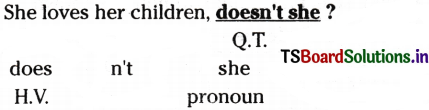
1. While constructing a tag, selecting the suitable helping verb is the first and the most important step. If the given sentence has a helping verb, then that helping verb is used in the tag too.
Eg: She has answered all the questions, hasn’t she ?
has → Helping Verb in the sentence used in the tag too.

The sentence doesn’t have a helping verb, if the verb is either in the simple present or in the simple past and in the affirmative, in case of the simple present, the suitable helping verb is “do/does”. If the verb in the sentence is in the simple past, then we must use did’ in the tag.
Eg: a) She hates smokers, doesn’t she ?
hates → Simple present, hence does’ in tag.
b) They grow vegetables, don’t they ?
Simple present
c) He sold his car, did n’t he ?
Sold – Simple past; hence ‘did’ in tag.

2. The second step is to decide whether to use ‘n’t’ or not. The guiding principle is quite simple. If the given sentence doesn’t have ‘no/not, use n’t is the tag. If the given sentence has ‘no/not’, then the tag doesn’t have n’t’.
Eg : a) He was sleeping in the class, was n’t he ?
‘not’ is not used n’t’ in the tag.

b) They don’t grow rice, do they ?
‘n’t’ in sentence ‘n’t’ not used in tag
Remember to use the short form n’t’ in the tag.

3. The last part of the tag is a pronoun. This corresponds to the subject of the given sentence. If the subject of the sentence is a pronoun, the same pronoun is used in the tag. If the sub¬ject is a noun, select a suitable pronoun as shown below.

Subject in the sentencePronoun used in the tag
1. Name of a manhe
2. Name of a womanshe
3. Name of a single thingit
4. Name referring to a group of persons, places, thingsthey

Eg : a) Gourav is a good cricketer, isn’t he ?
b) Sanya Mirza played well, didn’t she ?
c) Ooty is a beautiful hill station, isn’t it ?
d) Mangoes aren’t good this season, are they ?

4. Note that ‘amn’t is not used. Instead, aren’t is used.
Eg : I am rather slow, aren’t I ?

5. Imperative sentences take will’ as the helping verb in the tags.
Eg : a) Close the door, won’t you? (will + n’t = won’t)
b) Don’t leave the place, will you ?

6. Sentences expressing proposals with the help of “Let us ” have for their tags “Shall we ?”
Eg : Let us walk fast, shall we ?

Transformation of Sentences Inter 1st Year English Grammar

Examples

1. The boys are playing in the hot sun, aren’t they?
2. The girls have sung well, haven’t they?
3. Hari has not learnt well, has he?
4. Hari is one of the cleverest students, isn’t he?
5. Gouri was not good at Mathematics in her S.S.C, was she?
6. Children were playing at that time, weren’t they?
7. Charan did not meet the principal, did he ?
8. Students do not use their mind power properly, do they?
9. Your mother does not become angry easily, does she?
10. Communication skills will help you a lot, won’t they?
11. He should complete the syllabus in time, shouldn’t he?
12. Reshma cannot solve this problem, can she?
13. He shall see me tomorrow, shan’t he?
14. We have never seen him before, have we?
15. There is no time to spend with them, is there?
16. I am your lecturer, aren’t I?
17. Indu and Bhargavi work hard, don’t they?
18. Ramesh treats reading a physical activity, doesn’t he?
19. Prasad spoke to Murali well, didn’t he?
20. Ravi and Ramesh seldom agree with each other, do they ?
21. He hardly helps others, does he?
22. She scarcely responded to my call, did she?
23. I am not invited, am I?
24. Let’s have a cup of tea, shall we?
25. Let me see your photograph, will you?

Exercise

Add suitable question tags to each of the following sentences given below.

Question 1.
You can’t speak Tamil, _________ ?
Answer:
can you?

Question 2.
Children often play video games on smartphones, _________ ?
Answer:
don’t they?

Question 3.
There aren’t any spiders in the bedroom, _________ ?
Answer:
are there?

Question 4.
He could always borrow the money, _________ ?
Answer:
couldn’t he?

Question 5.
They won’t tell anyone, _________ ?
Answer:
will they?

Question 6.
That was amazing, _________ ?
Answer:
wasn’t it?

Question 7.
I’m quite busy with my schedule today, _________ ?
Answer:
aren’t I?

Question 8.
They hadn’t been to the States before, _________ ?
Answer:
had they?

Question 9.
My father works at the art theatre, _________ ?
Answer:
doesn’t he?

Question 10.
Open the door, _________ ? (polite)
Answer:
will you?

Transformation of Sentences Inter 1st Year English Grammar

Question 11.
Let’s go to the beach, _________ ?
Answer:
shall we?

Question 12.
Be quiet, _________ ? (irritation)
Answer:
will you?

Question 13.
John and Mary admire each other, _________ ?
Answer:
don’t they?

Question 14.
One shouldn’t say things like that, _________ ?
Answer:
should one?

Question 15.
Owing to the menace of mosquitoes, none of us slept well last night, _________ ?
Answer:
did we?

Question 16.
Don’t spend too much on trifles, _________ ?
Answer:
will you?

Question 17.
Nobody cares how I feel. _________ ?
Answer:
do they?

Question 18.
I think she’s from Chennai, _________ ?
Answer:
isn’t she?

Question 19.
Have another dosa. _________ ?
Answer:
won’t you?

Question 20.
A little progress has been made, _________ ?
Answer:
hasn’t it?

Question 21.
Sivamani plays the drum well. _________ ?
Answer:
doesn’t he?

Question 22.
I can lift this box, _________ ?
Answer:
can’t I ?

Molecular Basis of Inheritance Questions and Answers AP Inter 2nd Year Botany Chapter 3

Reviewing AP Inter 2nd Year Botany Study Material Chapter 3 Molecular Basis of Inheritance Questions and Answers can help students prepare confidently for exams.

AP Inter 2nd Year Botany 3rd Lesson Molecular Basis of Inheritance Questions and Answers

IV. Very Short Answer Questions

Question 1.
Distinguish between heterochromatin and euchromatin. Which of the two is transcriptionally active?
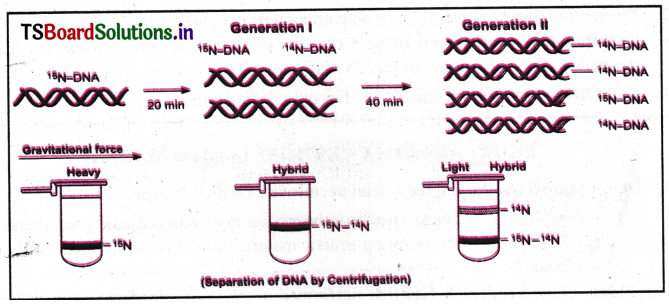
Answer:

HeterochromatinEuchromatin
1) Heterochromatin is tightly packed and stains dark is called Heterochromatin.1) Euchromatin is loosely packed and stains light is called Euchromatin.
2) Heterochromatin is transcriptionally inactive.2) Euchromatin is transcriptionally active.

Question 2.
Who proved that DNA is genetic material? On which organism they worked?
Answer:

  1. Alfred Hershey and Martha Chase demonstrated that DNA is the genetic material.
  2. They conducted their experiment using bacteriophages, which are viruses that infect bacteria.

Question 3.
What is the function of DNA polymerase?
Answer:

  1. DNA polymerase is a highly efficient enzyme that catalyses the polymerisation of a large number of nucleotides within a very short period.
  2. It also carries out the polymerisation process with a high level of accuracy.

Question 4.
What are the components of a nucleotide?
Answer:
A nucleotide consists of 3 components, nitrogen base, pentose sugar and phosphate group.

Question 5.
Given below is the sequence of coding strand of DNA in a transcription unit. 5′-AATGACGCCTATTAGG-3 ′. Write the sequence of
a) Its complementary strand
b) The mRNA
Answer:
a) 3 ‘TTACTGCGGATAATCC’ 5
b) 5 ‘AAUGACGCCUAUUAGG’ 3

Molecular Basis of Inheritance Questions and Answers AP Inter 2nd Year Botany Chapter 3

Question 6.
Name any two viruses which have RNA as genetic material.
Answer:

  1. Influenza virus
  2. Polio virus
  3. HIV

Question 7.
What are the components of a transcriptional unit?
Answer:
The components of transcription unit are Promoter, structural gene, and terminator.

  • A promoter,
  • the structural gene, and
  • A Terminator.

Question 8.
What is the difference between exons and introns?
Answer:

  1. Exons: These are the coding regions of a gene. They are retained in the mature (processed) RNA after RNA processing.
  2. Introns: These are the non-coding regions of a gene. They are removed during RNA processing and are absent in the mature (processed) RNA.

Question 9.
What is meant by capping and tailing?
Answer:

  1. Capping: The addition of a modified nucleotide, methylguanosine triphosphate (mwG), to the 52 end of hnRNA is known as capping.
  2. Tailing: The addition of 200 – 300 adenylate (poly-A) residues to the 32 end of hnRNA is called tailing.

Question 10.
What is meant by point mutation? Give an example.
Answer:

  1. A point mutation is a mutation that occurs due to a change in a single base pair of a DNA molecule.
  2. Example: Sickle cell anaemia.

Question 11.
What is meant by charging of tRNA?
Answer:
Charging of tRNA is the process in which an amino acid is activated in the presence of ATP and then attached to its corresponding (cognate) tRNA.

Question 12.
What is the function of the codon AUG? (AP MAY-22) (AP-20)
Answer:
AUG performs two important functions:

  1. It serves as the start (initiation) codon during protein synthesis.
  2. It specifies the amino acid methionine.

Question 13.
What do you understand ‘Stop codon’, and mention them. (AP MAR-15,19)
Answer:

  1. Stop codons are codons that signal the termination of protein synthesis.
  2. The three stop codons are UAA, UAG, and UGA.
  3. These codons do not specify any amino acid.

Question 14.
What is the difference between the template strand and a coding strand in a DNA molecule?
Answer:

  1. During transcription, the two strands of the DNA molecule separate from each other.
  2. The template strand serves as the complementary strand that guides the synthesis of mRNA.

The coding strand has the same nucleotide sequence as the mRNA (except that thymine is replaced by uracil in RNA) and does not directly serve as the template for transcription.

Question 15.
Write any two chemical differences between DNA and RNA.
Answer:

DNARNA
1) DNA has deoxyribose sugar.1) RNA has ribose sugar.
2) DNA undergoes self-replication.2) RNA does not undergo self-replication.


Question 16.
In a typical DNA molecule, the proportion of Thymine is 30%. Find out the percentage
Answer:

  • Adenme =30%,
  • Guanine = 20%,
  • Cytosine = 20% (Total 70%).

Question 17.
The proportion of nucleotides in a given nucleic acid are: Adenine 18%, Guanine 30%, Cytosine 42%, and Uracil 10%. Name the nucleic acid and mention the number of strands in it.
Answer:

  1. It is RNA (presence of uracil)
  2. It is only single-stranded.

V. Short Answer Questions

Question 1.
Define transformation. Give a brief account of Griffith’s experiment,
Answer:

  1. Transformation: Transformation is the process in which a cell undergoes a genetic change by taking up and incorporating genetic material from its surroundings through the cell membrane.
  2. In 1928, Frederick Griffith performed a series of experiments on the bacterium Streptococcus pneumoniae, which causes pneumonia.
  3. During his study, he observed that the bacteria could change from one form to another when grown in a culture medium.

4. He identified two strains of the bacterium:

  • Smooth strain (S-type) – forms smooth colonies due to the presence of a capsule.
  • Rough strain (R-type) – lacks a capsule and forms rough colonies.

5. The S-type bacteria were disease-causing (virulent), whereas the R-type bacteria were harmless (non-virulent).
6. When living S-type cells were injected into mice, the mice developed pneumonia and died.
7. When living R-type cells were injected into mice, the mice remained healthy and survived.
8. Injection of heat-killed S-type cells did not cause disease in mice.
9. However, when heat-killed S-type cells were mixed with living R-type cells and injected into mice, the mice died, and living S-type bacteria were recovered from them
10. Griffith concluded that the living R-type bacteria had been converted into S-type bacteria by some substance released from the dead S-type cells.
11. He called this substance the transforming principle, which was later identified as DNA.

Molecular Basis of Inheritance Questions and Answers AP Inter 2nd Year Botany Chapter 3

Question 2.
Discuss the significance of heavy isotope of nitrogen in Meselson and Stahl’s experiment?
Answer:
In 1958, Meselson and Stahl used the heavy nitrogen isotope 15N to demonstrate that DNA replication follows a semi-conservative mode.
1. Importance of 15N:

  • Labelling DNA: E. coli bacteria were grown in a medium containing 15NH4Cl, allowing 15N to become incorporated into DNA, producing heavy DNA.
  • Density Difference: Since 15N is heavier than 14N, DNA containing 15N could be easily distinguished from normal DNA based on density.
  • Separation by Centrifugation: DNA samples were separated using CsCl density gradient centrifugation.
    Heavy DNA (15N) formed a lower band.
    Light DNA (14N) formed an upper band.

Molecular Basis of Inheritance Questions and Answers AP Inter 2nd Year Botany Chapter 3 1

2. Tracking DNA Replication:
When bacteria were shifted to a medium containing 14N:
After one generation: Only hybrid DNA (intermediate density) was observed.
After two generations: Both hybrid DNA and light DNA were present in equal proportions. Proof of

Semi-Conservative Replication:
These observations proved that every newly formed DNA molecule contains:

  1. One parental strand (old strand) (15N)
  2. One newly synthesized strand (new strand) (14N). Thus, the use of 15N enabled scientists to trace DNA replication and provided the first experimental evidence for the semi-conservative replication of DNA.

Question 3.
How does t-RNA act as an adaptor molecule?
Answer:
t-RNA (transfer RNA), also known as soluble RNA (s-RNA), functions as an adaptor molecule because it connects the genetic information present in mRNA with the amino acids required for protein synthesis. This concept was proposed by Francis Crick.

How t-RNA Functions as an Adapter:
1. Two Functional Ends: t-RNA possesses two important binding regions:

  • Anticodon loop – recognizes and binds to the complementary codon on mRNA.
  • Amino acid acceptor end – attaches to a specific amino acid.

This enables t-RNA to link codons with their corresponding amino acids.

2. Specificity: Each type of t-RNA carries only a particular amino acid, ensuring accuracy during protein synthesis.
3. Charging (Aminoacylation): Before translation begins, amino acids are attached to their respective t-RNAs using ATP. This process is called charging of t-RNA or aminoacylation.
4. Structure: t-RNA has a cloverleaf-shaped secondary structure, while its three-dimensional structure resembles an inverted L-shape, which helps it function efficiently.

During Translation:

  • The anticodon of t-RNA pairs with the codon on mRNA and delivers the correct amino acid to the ribosome.
  • Thus, t-RNA serves as a bridge between mRNA codons and amino acids, ensuring proper synthesis of proteins.

Question 4.
How many types of RNA polymerases exist in eukaryotic cells? Write their names and functions.
Answer:
Eukaryotic cells contain three major RNA polymerases in the nucleus (apart from those present in organelles). They are:

  1. RNA Polymerase I: Responsible for the synthesis of rRNA molecules (28S, 18S, and 5.8S rRNA).
  2. RNA Polymerase II: Synthesizes hnRNA (heterogeneous nuclear RNA), the precursor of messenger RNA (mRNA).
  3. RNA Polymerase III: Carries out the transcription of tRNA, 5S rRNA, and snRNA (small nuclear RNA).

Question 5.
Identify the A, B, C, and D in the given picture.
Molecular Basis of Inheritance Questions and Answers AP Inter 2nd Year Botany Chapter 3 2
Answer:

  • A → Transcription Unit (Structural Gene): The DNA segment located between the initiation and termination signals where transcription takes place.
  • B → Promoter: The DNA region where RNA polymerase binds to initiate transcription.
  • C → Coding Strand (Non-template Strand): The DNA strand whose sequence is similar to the RNA transcript, except that thymine (T) is replaced by uracil (U) in RNA.
  • D → Terminator: The DNA sequence that signals the end of transcription.

Question 6.
Draw the schematic representation of Lac operon.
Answer:
Molecular Basis of Inheritance Questions and Answers AP Inter 2nd Year Botany Chapter 3 3

Question 7.
What are the differences between DNA and RNA?
Answer:

DNA (Deoxyribonucleic Acid)RNA (Ribonucleic Acid)
1) Double-stranded helix structure.1) Usually single-stranded.
2) Contains deoxyribose sugar.2) Contains ribose sugar.
3) Nitrogen bases: A, T, Q C.3) Nitrogen bases: A, U, G, C.
4) Thymine (T) present.4) Uracil (U) present instead of thymine.
5) More stable chemically.5) Less stable compared to DNA.
6) Mainly found in nucleus.6) Found in nucleus and cytoplasm.
7) Function: Stores genetic information.7) Function: Helps in protein synthesis.
8) Replicates itself.8) Does not self-replicate.
9) Metabolically, DNA is of one type.9) Metabolically, RNA is of three types.
10) The base pairing is A = T and G = C.10) The base pairing is A = U and G = C.

Question 8.
Write the salient features of Genetic code? (AP Mar. 16,17, 24)
Answer:
The important characteristics of the genetic code:

  1. The genetic code is a collection of instructions that guides the conversion of genetic information into proteins containing 20 amino acids.
  2. It is made up of 64 nucleotide triplets, and each triplet is known as a codon.
  3. Out of the 64 codons, 61 codons specify amino acids, while 3 codons do not code for any amino acid and function as stop codons.
  4. Each codon specifies only one particular amino acid, making the genetic code unambiguous and specific.
  5. Some amino acids are represented by more than one codon; therefore, the genetic code is said to be degenerate.
  6. Codons are read continuously on mRNA without any gaps or punctuation marks, making the code comma-less.
  7. The genetic code is nearly universal, meaning it functions similarly in almost all living organisms.
  8. Example: The codon UUU codes for Phenylalanine (Phe) in organisms ranging from bacteria to humans.

Molecular Basis of Inheritance Questions and Answers AP Inter 2nd Year Botany Chapter 3

Question 9.
Give a brief account on nucleosome with a neat labelled diagram.
Answer:

  1. A nucleosome is the fundamental bead-like structural unit of chromatin.
  2. It consists of a histone octamer (eight histone protein molecules) around which DNA is wrapped, along with a DNA segment of about 200 base pairs.
  3. The negatively charged DNA strand coils around the positively charged histone octamer to form a nucleosome.
  4. Nucleosomes help in packing and compacting DNA within the nucleus.
  5. Chromatin is composed of DNA and basic histone proteins.
  6. Nucleosomes are arranged repeatedly along the chromatin fibre, forming its basic repeating units.
  7. Under an electron microscope, chromatin appears as a “beads-on-a-string” structure due to the presence of nucleosomes.

Molecular Basis of Inheritance Questions and Answers AP Inter 2nd Year Botany Chapter 3 4

VI. Long Answer Questions

Question 1.
Give an account of post-transcriptional modifications of a eukaryotic mRNA.
Answer:
The primary transcript (hnRNA) undergoes several modifications after transcription inside the nucleus before becoming mature mRNA.

5′ Capping:

  • The first modification is the addition of a 7-methylguanosine cap at the 5′ end of hnRNA through an unusual 5′ – 5′ triphosphate linkage.
  • Extra methyl groups may also be added to the cap structure.
  • The cap protects mRNA from degradation, helps in its stability, and assists in the initiation of translation.

2. Addition of Poly-A Tail:

  • A long chain of about 40-200 adenine nucleotides is added to the 3′ end of mRNA.
  • This structure is called the Poly-A tail.
  • It is added after transcription and is not directly coded by DNA.
  • The Poly-A tail improves mRNA stability and helps in its transport from the nucleus to the cytoplasm.
  • As mRNA ages in the cytoplasm, the Poly-A tail gradually becomes shorter.

3. Splicing (Removal of Introns):

  • Eukaryotic hnRNA contains both coding and non-coding sequences.
  • The non-coding regions called introns are removed.
  • The coding regions called exons are joined together to form mature mRNA.
  • After these modifications, the mature mRNA leaves the nucleus and participates in protein synthesis.

Question 2.
Discuss the process of translation in detail.
Answer:
Translation is the process by which amino acids are linked together according to the sequence of codons in mRNA to form a polypeptide chain. The process occurs in three stages:

1. Initiation:

  • Amino acids are first attached to their specific tRNAs using ATP (charging of tRNA).
  • The start codon AUG on mRNA is recognized by the charged initiator tRNA.
  • The ribosome acts as the site where translation occurs.
  • It contains two binding sites for tRNA molecules.
  • The small ribosomal subunit binds to mRNA at the start codon, followed by the attachment of the large subunit.

2. Elongation:

  • The ribosome moves along the mRNA one codon at a time.
  • Each incoming amino acid carried by tRNA is joined to the growing polypeptide chain by a peptide bond.
  • This step continues repeatedly, resulting in the elongation of the protein chain.

3. Termination:

  • Translation stops when the ribosome reaches a stop codon (UAA, UAG, or UGA).
  • The completed polypeptide is released, and the ribosomal subunits detach from the mRNA.

Question 3.
Give the salient features of the Double helix structure of DNA.
Answer:
The Double Helix Model of DNA was proposed by Watson and Crick
1. DNA consists of two polynucleotide strands. Each strand has a sugar-phosphate backbone on the outside and nitrogenous bases projecting inward.
2. The two strands run in opposite directions (anti-parallel). If one strand runs 5′ → 3′, the other runs 3′ → 5′.
3. The nitrogenous bases pair through hydrogen bonds:

  • Adenine (A) pairs with Thymine (T) by two hydrogen bonds.
  • Guanine (G) pairs with Cytosine
  • by three hydrogen bonds. This complementary pairing maintains a constant diameter of about 20 Å throughout the helix.

Molecular Basis of Inheritance Questions and Answers AP Inter 2nd Year Botany Chapter 3 5

4. DNA is a right-handed helix. One complete turn measures 3.4 nm and contains about 10 base pairs. The distance between two adjacent base pairs is 0.34 nm.
5. The base pairs are stacked one above another, which provides additional stability to the DNA molecule along with hydrogen bonding.

Question 4.
Describe the Lac operon with schematic representation.
Answer:

  1. The Lac operon is a group of regulatory and structural genes that function together to control the metabolism of lactose in bacteria.
  2. It consists of important regions such as the regulator gene (i), promoter (P), operator (O), and three structural genes: Z, Y, and A.
  3. The operon enables the utilization of lactose by converting it into simpler sugars like glucose and galactose.
  4. In the Lac operon, lactose acts as an inducer.
  5. When lactose is present, it binds to the repressor protein and makes it inactive. RNA polymerase can then bind to the promoter and begin transcription.
  6. As a result, the structural genes Z, Y, and A are expressed and produce their respective enzymes.
  7. These enzymes help in the breakdown and utilization of lactose. When lactose levels decrease, the repressor protein is produced again.
  8. The active repressor binds to the operator region and blocks RNA polymerase from transcribing the operon. Therefore, transcription stops in the absence of the inducer.

Schematic representation of the Lac operon
Molecular Basis of Inheritance Questions and Answers AP Inter 2nd Year Botany Chapter 3 6

I. Multiple Choice Questions

Question 1.
Which among the following is not true?
1. Bacteriophage Φ × 174 has 5386 nucleotides.
2. Bacteriophage lambda has 48502 bp.
3. Escherichiacolihas 4.6 × 10⁶ bp.
4. Haploid content of human DNA is 6.6 × 10⁹ bp.
Answer:
4. Haploid content of human DNA is 6.6 × 10⁹ bp.

Question 2.
As per the Watson and Crick DNA model, the pitch length of the DNA double helix is
1. 0.34 nm
2. 3.4 nm
3. 3.4 Å
4. 0.34 Å
Answer:
2. 3.4 nm

Molecular Basis of Inheritance Questions and Answers AP Inter 2nd Year Botany Chapter 3

Question 3.
Which of the following nitrogen base is absent in RNA?
1. Adenine
2. Cytosine
3. Uracil
4. Thymine
Answer:
4. Thymine

Question 4.
Approximate length of a typical mammalian cell DNA is
1. 2.6 meters
2. 2 meters
3. 2.2 metres
4. 2.4 meters
Answer:
3. 2.2 metres

Question 5.
A molecule should not have one of the following features to act as a genetic material
1. It should be able to generate its replica (Replication).
2. It should be stable chemically and structurally.
3. It should provide the scope for rapid changes that are required for evolution.
4. It should be able to express itself in the form of‘Mendelian Characters’.
Answer:
3. It should provide the scope for rapid changes that are required for evolution.

Question 6.
DNA fragments can be joined by the following enzyme.
1. DNA polymerase
2. DNA Ligase
3. DNase
4. DNA-dependent RNA polymerase
Answer:
2. DNA Ligase

Question 7.
During the transcription RNA Polymerase binds to the following region of transcriptional unit.
1. Terminator
2. Structural gene
3. Promoter
4. Operator
Answer:
3. Promoter

Question 8.
What is the role of RNA polymerase III in the process of transcription in Eukaryotes?
1. Transcription of tRNA, 5 s rRNA, and snRNA
2. Transcription of precursor of mRNA
3. Transcription of only snRNAs
4. Transcription of rRNAs(28S, 18S and 5.8S)
Answer:
1. Transcription of tRNA, 5 s rRNA, and snRNA

Question 9.
‘Operon’concept was proposed by
1. Meselson and Stahl
2. Watson and Crick
3. Jacob and Monod
4. Har Gobind Khorana
Answer:
3. Jacob and Monod

Question 10.
Enzyme permease is synthesized by
1. z-gene
2. a-gene
3. i-gene
4. y-gene
Answer:
4. y-gene

II. Fill in the Blanks

1. DNA is a polymer of ………………………………….. .
Answer:
Deoxyribonucleotides.

2. Cytosine, Uracil …………………………. and are together called Pyrimidines.
Answer:
Thymine.

3. DNA was first identified by Friedrich Miescher, and he named it as ………………………….. .
Answer:
Nuclein

4. James Watson and Francis Crick …………………………… proposed model of DNA.
Answer:
Double Helix

5. Discontinuous synthesis of DNA takes place on ……………………………. parental strand of DNA.
Answer:
5’→ 3′

Molecular Basis of Inheritance Questions and Answers AP Inter 2nd Year Botany Chapter 3

6. ……………………………… is loosely packed and transcriptionally active chromatin.
Answer:
Euchromatin

7. The average rate of polymerisation by DNA polymerase enzyme in E.coli is approximately …………………. per second.
Answer:
2000 bp

8. In bacterial cells, with the help of ………………………….. factor, RNA polymerase initiates transcription.
Answer:
Sigma or σ

9. During transcription, ……………………… enzyme plays a key role in DNA helix unwinding.
Answer:
RNA polymerase

10. Copying of genetic information from one strand of the DNA into RNA is termed as …………………. .
Answer:
transcription

III. One Word Answer Questions

Question 1.
Name the pyrimidine which is common in both DNA and RNA.
Answer:
Cytosine

Question 2.
Which feature of DNA molecule enables the constant distance between two strands?
Answer:
Purine and pyrimidine base pairing.

Question 3.
Who proposed central dogma in molecular biology?
Answer:
Francis Crick.

Question 4.
Write the names of basic amino acids which are rich in histone proteins.
Answer:
Lysine and arginine

Question 5.
At what specific region, DNA replication initiates?
Answer:
‘Ori’region

Question 6.
Name the bacteria which is used by Griffith for conducting transformation experiments.
Answer:
Streptococcus pneumoniae

Question 7.
Normal E. coli was allowed to grow in a medium containing 15NH4Cl for 80 minutes; then what would be the proportions of light, hybrid, and heavy density DNA molecules?
Answer:
0: 2: 14

Question 8.
In which direction does the DNA polymerase enzyme polymerises the DNA.
Answer:
5′ → 3′

Question 9.
Write the name of Severo Ochoa enzyme.
Answer:
Polynucleotide phosphorylase

Question 10.
Who first proposed that the‘codon’is a triplet?
Answer:
George Gamow

Objective Questions

Question 1.
The basic building blocks of nucleic acids are known as
1. Nitrogen bases
2. Nucleotides
3. Pentose monosaccharides
4. Nucleosides
Answer:
2. Nucleotides

Question 2.
The genetic molecule found most abundantly in living organisms is
1. RNA
2. tRNA
3. DNA
4. mRNA
Answer:
3. DNA

Question 3.
The repeating units that make up nucleic acid chains are called
1. Nucleosides
2. Heterocyclic molecules
3. Nucleotides
4. Pentose sugars
Answer:
3. Nucleotides

Question 4.
The principal genetic material in most organisms is
1. mRNA
2. DNA
3. rRNA
4. RNA
Answer:
3. rRNA

Question 5.
DNA molecule carries a
1. Positive charge
2. No charge
3. Negative charge
4. Positive charge only during denaturation
Answer:
3. Negative charge

Molecular Basis of Inheritance Questions and Answers AP Inter 2nd Year Botany Chapter 3

Question 6.
Another name for thymine is
1. Thymidylic acid
2. 5-methyluracil
3. Uridine
4. Thymidine
Answer:
2. 5-methyluracil

Question 7.
DNA acts as a template for the synthesis of
1. DNA only
2. Proteins only
3. Both DNA and RNA
4. RNA only
Answer:
3. Both DNA and RNA

Question 8.
DNA replication generally takes place during
1. Interphase
2. Meiosis
3. Mitosis
4. Interkinesis
Answer:
1. Interphase

Question 9.
RNA differs from DNA in the
1. Type of pyrimidines
2. Number of polynucleotide strands
3. Type of purines
4. Type of sugar
Answer:
3. Type of purines

Question 10.
In DNA, each sugar molecule is attached to
1. One phosphate and two nitrogen bases
2. Two phosphates and two nitrogen bases
3. Two phosphates and one nitrogen base
4. One nitrogen base and one phosphate
Answer:
3. Two phosphates and one nitrogen base

Question 11.
DNA is absent in
1. Mitochondria
2. Plasmids
3. Chloroplasts
4. Ribosomes
Answer:
4. Ribosomes

Question 14.
Which statement correctly describes a property of DNA?
1. It should evolve rapidly
2. It should be biochemically unstable
3. It should mutate very quickly
4. It should be able to replicate
Answer:
4. It should be able to replicate

Question 15.
In eukaryotes, one mRNA molecule is generally produced from
1. Three structural genes
2. A single structural gene
3. Many structural genes
4. Two structural genes
Answer:
2. A single structural gene

Question 16.
The approximate time required for DNA replication in E. coli is
1. 20 minutes
2. 40 minutes
3. 18 minutes
4. 80 minutes
Answer:
3. 18 minutes

Molecular Basis of Inheritance Questions and Answers AP Inter 2nd Year Botany Chapter 3

Question 17.
The total length of DNA present in a typical human cell is about
1. 4.2 metres
2. 3.2 metres
3. 1.2 metres
4. 2 metres
Answer:
4. 2 metres

Question 18.
DNA strands are described as antiparallel because of
1. Peptide bonds
2. Hydrogen bonds
3. Phosphodiester bonds
4. Disulphide bonds
Answer:
2. Hydrogen bonds

Question 19.
One complete turn of B-form DNA measures nearly
1. 2.0 nm
2. 20 nm
3. 3.4 nm
4. 0.34 nm
Answer:
3. 3.4 nm

Question 20.
The transfer of genetic information from DNA into RNA is called
1. Polyadenylation
2. Transformation
3. Transcription
4. Translation
Answer:
3. Transcription

Question 21.
During transcription, the DNA strand that is copied is called
1. Coding strand
2. Terminator strand
3. Template strand
4. Promoter strand
Answer:
1. Coding strand

Question 22.
The DNA strand not directly used in RNA synthesis is known as
1. Template strand
2. Coding strand
3. Antisense strand
4. Complementary strand
Answer:
2. Coding strand

Question 23.
In bacteria, transcription and translation occur respectively in
1. Cytoplasm and cytoplasm
2. Nucleus and cytoplasm
3. Cytoplasm and genephore
4. Nucleoid and nucleus
Answer:
1. Cytoplasm and cytoplasm

Question 24.
Identify the incorrect match.
1. mRNA-template for protein synthesis
2. tRNA-reader of genetic code
3. rRNA – catalytic role in translation
4. Transcription – DNA-dependent DNA polymerase
Answer:
4. Transcription – DNA-dependent DNA polymerase

Question 25.
The primary transcript is longer than functional hnRNA in
1. Prokaryotic animals
2. Cyanobacteria
3. Eukaryotes
4. Prokaryotes
Answer:
3. Eukaryotes

Question 26.
Transcription of snRNA is carried out by
1. RNA polymerase II
2. RNA polymerase III
3. RNA polymerase I
4. RNA polymerase I & II
Answer:
2. RNA polymerase III

Molecular Basis of Inheritance Questions and Answers AP Inter 2nd Year Botany Chapter 3

Question 27.
Introns are commonly found in
1. Eukaryotes only
2. Both prokaryotes and eukaryotes
3. Bacteria only
4. Prokaryotes only
Answer:
1. Eukaryotes only

Question 28.
Exons are present in
1. Only in prokaryotes
2. Only in eukaryotic plants
3. Both prokaryotes and eukaryotes
4. Only in eukaryotes
Answer:
4. Only in eukaryotes

Question 29.
Split genes are characteristic of
1. Cyanobacteria
2. Bacteria
3. All Monerans
4. Eukaryotes
Answer:
4. Eukaryotes

Question 30.
Genes are primarily made up of
1. Glycoproteins
2. Histone proteins
3. Polynucleotides
4. Lipoproteins
Answer:
3. Polynucleotides

Question 31.
The synthesis of repressor mRNA is controlled by
1. ‘i’ gene
2. ‘Y’ gene
3. ‘Z’ gene
4. ‘O’ gene
Answer:
1. ‘i’ gene

Question 32.
The total number of nucleotides present in bacteriophage lambda DNA is
1. 97040
2. 48520
3. 48502
4. 97004
Answer:
3. 48502

Question 33.
The transcriptionally active form of chromatin is called
1. Heterochromatin
2. Euchromatin
3. Chromatogram
4. Prochromatin
Answer:
2. Euchromatin

Question 34.
DNA is composed of which of the following?
A) Sugar
B) Phosphate
C) Purines
D) Pyrimidines
1. A, B and C only
2. A and C only
3. A, B, C and D
4. A and D only
Answer:
3. A, B, C and D

Question 35.
A nucleoside differs from a nucleotide by
1. Presence of phosphate group
2. Absence of phosphate group
3. Absence of sugar
4. Absence of nitrogen base
Answer:
2. Absence of phosphate group

Question 36.
The earliest proof that DNA acts as the genetic material came from
1. Phage infection
2. Bacterial transformation
3. Bacterial translocation
4. Transfection
Answer:
1. Phage infection

Question 37.
Griffith conducted his transformation experiment using
1. Streptococcus pyogenes
2. Escherichia coli
3. Streptococcus pneumoniae
4. Streptomyces griseus
Answer:
3. Streptococcus pneumoniae

Molecular Basis of Inheritance Questions and Answers AP Inter 2nd Year Botany Chapter 3

Question 38.
Avery, MacLeod, and McCarty identified …………………….. as the transforming principle.
1. Proteins
2. Polysaccharides
3. DNA
4. RNA
Answer:
3. DNA

Question 39.
Around each histone core, DNA wraps approximately
1. Two turns
2. Five turns
3. Three turns
4. Four turns
Answer:
1. Two turns

Question 40.
Uracil differs from thymine because it
1. Has a methyl group
2. Has two C-N rings
3. Contains an NH2 group
4. Lacks a methyl group
Answer:
4. Lacks a methyl group

Question 41.
The haploid DNA content in humans is approximately
1. 48502 bp
2. 5386 nucleotides
3. 3.3 × 10⁹ bp
4. 4.6 × 10⁶ bp
Answer:
3. 3.3 × 10⁹ bp

Question 42.
A nucleotide is composed of
1. Sugar + Phosphate
2. Base + Sugar
3. Base + Phosphate
4. Base + Sugar + Phosphate
Answer:
2. Base + Sugar

Question 43.
Which of the following is NOT a property of genetic material?
1. Self-replication
2. Chemical and structural stability
3. Fast mutation
4. Self-expression
Answer:
3. Fast mutation

Question 44.
Which statement is NOT a characteristic of RNA?
1. RNA evolves slowly
2. RNA is unstable and degradable
3. RNA can act as a catalyst
4. RNA mutates faster than DNA
Answer:
1. RNA evolves slowly

Question 45.
In the Hershey and Chase experiment, radioactive 35 S labelled
1. Cytosol of bacteria
2. Phage DNA
3. Protein coat of bacteriophage
4. Bacterial DNA
Answer:
3. Protein coat of bacteriophage

Molecular Basis of Inheritance Questions and Answers AP Inter 2nd Year Botany Chapter 3

Question 46.
A cluster of closely associated structural and regulatory genes functioning together is called
1. Genetic code
2. Operon
3. Monocistronic gene
4. Regulon
Answer:
2. Operon

Question 47.
Heterogeneous nuclear RNA (hnRNA) is converted into mRNA through
1. Splicing only
2. Capping only
3. Tailing only
4. All of the above
Answer:
4. All of the above

Question 48.
The number of sense codons coding for amino acids is
1. 60
2. 64
3. 61
4. 32
Answer:
3. 61

Question 49.
Identify the correct statement.
1. ACG codes for Asparagine
2. UGU codes for Tyrosine
3. CGA codes for Serine
4. GUA codes for Valine
Answer:
4. GUA codes for Valine

Question 50.
Which of the following is NOT a feature of the genetic code?
1. It is degenerate
2. It is nearly universal
3. It is non-continuous
4. It is unambiguous
Answer:
3. It is non-continuous

Question 51.
The functional unit of a gene is known as
1. Muton
2. Cistron
3. Intron
4. Recon
Answer:
2. Cistron

Question 52.
Mature (processed) mRNA contains
1. Exons only
2. Introns only
3. Exons and introns
4. Capping at 3′ end
Answer:
1. Exons only

Question 53.
The RNA molecule that performs both structural and catalytic functions during translation is
1. tRNA
2. rRNA
3. sRNA
4. mRNA
Answer:
2. rRNA

Molecular Basis of Inheritance Questions and Answers AP Inter 2nd Year Botany Chapter 3

Question 54.
Ochoa’s enzyme refers to
1. DNA polymerase
2. Polynucleotide phosphorylase
3. Peptidyl transferase
4. DNA ligase
Answer:
3. Peptidyl transferase

Question 55.
The gene responsible for producing the repressor protein is
1. Promoter gene
2. Structural gene
3. Regulator gene
4. Operator gene
Answer:
3. Regulator gene

Question 56.
The attachment site for the repressor protein produced by the regulator gene is the
1. Structural gene
2. Promoter region
3. Operator gene
4. Inducer
Answer:
3. Operator gene

Question 57.
The rule stating that in DNA the amount of adenine equals thymine and guanine equals cytosine is called
1. Jordan’s rule
2. Chargaff’s rule
3. Aflen’s rule
4. Stahl’s rule
Answer:
2. Chargaff’s rule

Question 58.
Purines are chemically classified as
1. Monocycic
2. Dicyclic and heterocyclic
3. Homocycic
4. Dicyclic and homocyclic
Answer:
2. Dicyclic and heterocyclic

Question 59.
A phosphate group is attached to the 5′-OH of a nucleotide through
1. Glycosidic linkage
2. Hydrogen linkage
3. Phosphoester linkage
4. Both (1) & (2)
Answer:
3. Phosphoester linkage

Molecular Basis of Inheritance Questions and Answers AP Inter 2nd Year Botany Chapter 3

Question 60.
In the Lac operon, the inducer combines with
1. Promoter gene
2. Repressor protein
3. Repressor gene
4. Operator gene
Answer:
2. Repressor protein

Principles of Inheritance and Variation Questions and Answers AP Inter 2nd Year Botany Chapter 2

Reviewing AP Inter 2nd Year Botany Study Material Chapter 2 Principles of Inheritance and Variation Questions and Answers can help students prepare confidently for exams.

AP Inter 2nd Year Botany 2nd Lesson Principles of Inheritance and Variation Questions and Answers

IV. Very Short Answer Questions

Question 1.
What is the cross between the F1 progeny and a homozygous recessive parent called? How is it useful?
Answer:

  1. Such a cross is known as a Test Cross.
  2. It is used to identify the genotype of the organism being tested.

Question 2.
Do you think Mendel’s laws of inheritance would have been different if the characters he chosen were located on the same chromosome?
Answer:
Yes. If the genes for different characters were present on the same chromosome, they would tend to be inherited together and would not follow Mendel’s Law of Independent Assortment

Question 3.
Who proposed the chromosome theory of inheritance? [AP MAR-17,19]
Answer:
Sutton and Boveri.

Question 4.
Define true breeding and mention its significance.
Answer:

  1. True Breeding: Continuous self-pollination over generations, resulting in offspring with the same traits, is called true breeding.
  2. Significance: It ensures the stable inheritance and expression of traits through many generations.

Question 5.
Explain the terms phenotype and genotype. [AP MAR-16,23,24]
Answer:

  • The observable physical appearance of an organism is called its Phenotype.
  • The genetic constitution of an organism is called its Genotype.

Question 6.
What is linkage?
Answer:
Linkage is the tendency of genes located on the same chromosome to remain associated and get inherited together.

Principles of Inheritance and Variation Questions and Answers AP Inter 2nd Year Botany Chapter 2

Question 7.
What will be the phenotypic ratio in the offspring obtained from the following crosses?
a) AA x aa
b) Aa x Aa
Note: Gene A is dominant over gene a.
Answer:
a) 1: 1
b) 3: 1.

Question 8.
In garden peas, the gene T for tall is dominant over its allele for dwarf. Give the genotypes of the parents in the following crosses.
a) Tall × Dwarf producing all tall plants.
b) Tall × dwarf producing half tall and half dwarf.
Answer:
(a) Tall x Dwarf → All tall plants: To obtain all tall offspring, the tall parent must be homozygous dominant (TT) and the dwarf parent must be homozygous recessive (tt). Genotypes: TT × tt
(b) Tall × Dwarf → Half tall and half dwarf (1:1 ratio): This ratio is obtained when the tall parent is heterozygous (Tt) and the dwarf parent is tt. Genotypes: Tt x tt

V. Short Answer Questions

Question 1.
Differentiate between the following
A) Dominant and Recessive B) Homozygous and Heterozygous
Answer:
A)

DominantRecessive
1) Expressed even when only one allele is present (Tt).1) Expressed only when both alleles are recessive (tt).
2) Masks the effect of the recessive allele.2) Gets masked in the presence of a dominant allele.
3) Represented by capital letters (e.g., T).3) Represented by small letters (e.g., t).
4) Appears in F1 generation.4) Usually hidden in F1; appears in F2 generation.

B)

HomozygousHeterozygous
Contains identical alleles (TT or tt).Contains different alleles (Tt).
Produces only one type of gamete.Produces two types of gametes.
Also called purebred.Not a purebred.
Expression depends on allele type (dominant or recessive).Shows dominant trait in most cases.

Question 2.
Explain the law of dominance using a monohybrid cross.
Answer:
Monohybrid Cross:

  1. A cross involving two individuals differing in one pair of contrasting characters is called a monohybrid cross.
  2. In his experiments, Mendel crossed tall and dwarf pea plants to study the inheritance of a single trait. Based on these observations, he proposed the Law of Dominance.

Law of Dominance:

  1. Characters are controlled by discrete hereditary units called factors.
  2. Factors occur in pairs.
  3. When two contrasting factors are present together, one factor (dominant) expresses itself, while the other (recessive) remains hidden.
  4. This law explains why only one parental trait appears in the F1 generation and why both traits reappear in the F2 generation. It also explains the 3:1 phenotypic ratio obtained in F2.

Principles of Inheritance and Variation Questions and Answers AP Inter 2nd Year Botany Chapter 2 1

Question 3.
Define and describe a test cross. [AP MAR-25,16]
Answer:

  1. A test cross is the crossing of an F1 individual with a recessive parent.
  2. It is used to determine whether an individual is homozygous or heterozygous.
  3. A monohybrid test cross produces a 1:1 phenotypic ratio.
  4. A dihybrid test cross produces a ratio.

Principles of Inheritance and Variation Questions and Answers AP Inter 2nd Year Botany Chapter 2 2

Principles of Inheritance and Variation Questions and Answers AP Inter 2nd Year Botany Chapter 2

Question 4.
Explain incomplete dominance with examples.
Answer:
Incomplete Dominance:

  1. Incomplete dominance is a condition in which neither allele is completely dominant nor completely recessive.
  2. A common example is the inheritance of flower colour in Snapdragon (Antirrhinum).
  3. When a red-flowered plant (RR) is crossed with a white-flowered plant (rr), all F1 plants (Rr) show pink flowers.
  4. When the F1 plants are self-pollinated, the F2 generation shows: 1 (RR) Red, 2 (Rr) Pink, 1 (rr) White.
  5. The genotypic ratio remains 1:2:1, similar to Mendel’s monohybrid cross.
  6. However, the phenotypic ratio also becomes 1:2:1 because neither allele completely dominates the other.
  7. Thus, in incomplete dominance, both phenotypic and genotypic ratios in the F2 generation are 1:2:1.

Principles of Inheritance and Variation Questions and Answers AP Inter 2nd Year Botany Chapter 2 3

Question 5.
Define the law of segregation and the law of independent assortment.
Answer:
a) Law of Segregation:

  1. The two alleles of a gene remain separate and do not blend when present together in a heterozygous condition.
  2. During meiosis, these alleles separate so that each gamete receives only one allele.
  3. This law is based on the results of monohybrid crosses.
  4. It was proposed by Mendel.
  5. It is also called the Law of Purity of Gametes.

b) Law of Independent Assortment:

  1. When two or more pairs of contrasting traits are considered, the inheritance of one pair of factors is independent of the other pair.
  2. This law is based on the results of dihybrid crosses.
  3. It was proposed by Mendel as his Second Law.

Principles of Inheritance and Variation Questions and Answers AP Inter 2nd Year Botany Chapter 2 4

Question 6.
Why did T.H. Morgan select fruit flies for his genetical experiments?
Answer:
Thomas Hunt Morgan selected the fruit fly, Drosophila melanogaster, for genetic studies because of several advantages:

  • Easy Cultivation: They can be easily reared on a simple synthetic medium under laboratory conditions.
  • Short Life Cycle: Their life cycle is completed in about two weeks, allowing the study of many generations in a short time.
  • High Reproductive Capacity: A single mating produces a large number of offspring, providing sufficient data for genetic analysis.
  • Distinct Sexual Dimorphism: Male and female flies can be easily distinguished, making breeding experiments convenient.
  • Visible Genetic Variations: They exhibit many hereditary variations that can be observed easily under low-power microscopes.

VI. Long Answer Questions

Question 1.
Explain the dihybrid cross with the help of Punnett square.
Answer:
A dihybrid cross is a genetic cross involving two parents that differ in two pairs of contrasting characters. Mendel used this cross to study the inheritance of two traits at the same time and concluded that different pairs of traits assort independently.
1. The Parental (P) Generation: Mendel crossed a pea plant with round, yellow seeds and a pea plant with wrinkled, green seeds.

  • Genotypes: Round, yellow parent – RRYY; wrinkled, green parent = rryy
  • Dominance: Yellow seed colour (Y) is dominant over green (y). Round seed shape (R) is dominant over wrinkled (r).
  • Gamete: RRYY parent produces RY gametes; rryy parent produces ry gametes.

2. The F Generation: After fertilization, the offspring produced have the genotype.  RrYy Phenotype: All F plants are round and yellow because dominant alleles mask the recessive alleles.

3. Gamete Formation and Independent Assortment: When F plants are self-pollinated, they produce four kinds of gametes. According to the Law of Independent Assortment, segregation of R and r occurs independently of Y and y. The four types of gametes are: RY, Ry, rY, ry. Each type is formed in equal proportion (25% or 1/4).

4. The F Punnett Square: A Punnett square is a diagram used to predict all possible combinations of offspring. For a dihybrid cross, a 16-square Punnett grid is used because four types of male gametes combine with four types of female gametes.

Punnett Square (F, Generation)

RYRyrYry
RYRRYYRRYyRrYYRrYy
RyRRYyRRyyRrYyRryy
rYRrYYRrYyrrYYrrYy
ryRrYyRryyrrYyrryy


5. Results of the Cross: Analysis of the sixteen combinations in the F1 generation gives: Phenotypic Ratio: 9 : 3 : 3: 1

  • 9 Round, Yellow (Parental type)
  • 3 Round, Green (Recombinant)
  • 3 Wrinkled, Yellow (Recombinant)
  • 1 Wrinkled, Green (Parental type)

Genotypic Ratio: 1 : 2 : 1: 2 : 4 : 2 : 1 : 2 : 1
Conclusion: Law of Independent Assortment: Based on the results of the dihybrid cross, Mendel proposed the Law of Independent Assortment, which states that: “When two pairs of traits are inherited together, the segregation of one pair of factors is independent of the segregation of the other pair”. This means that inheritance of one trait (such as seed shape) does not influence the inheritance of another trait (such as seed colour).

Principles of Inheritance and Variation Questions and Answers AP Inter 2nd Year Botany Chapter 2

Question 2.
Write notes on chromosomal theory of inheritance?
Answer:
The Chromosomal Theory of Inheritance was proposed by Walter Sutton and Theodor Boveri. According to this theory, genes are located on chromosomes, and chromosomes are responsible for transmitting hereditary characters from parents to offspring.

1. Main Principles:

  • Genes are arranged in a linear sequence on chromosomes.
  • Chromosomes occur in homologous pairs in diploid organisms, with one chromosome of each pair inherited from each parent.
  • During meiosis, homologous chromosomes separate, causing alleles to segregate. This provides an explanation for Mendel’s Law of Segregation.
  • Different chromosome pairs assort independently during meiosis. This explains Mendel’s Law of Independent Assortment.
  • During fertilization, male and female gametes fuse, restoring the diploid chromosome number in the zygote.

2. Observations of Sutton and Boveri :
They observed that chromosomes:

  • Occur in pairs during meiosis.
  • Separate and move into different gametes. This behaviour closely resembles that of Mendel’s hereditary factors (genes). Therefore, they concluded that chromosomes carry genes and control inheritance.

3. Experimental Evidence: The theory was later supported by Thomas Hunt Morgan through his experiments on Drosophila melanogaster. He discovered:

  • Linkage: Genes present on the same chromosome tend to be inherited together.
  • This demonstrated that all genes do not assort independently.

4. Extension of the Theory:

  • Not all genes follow independent assortment.
  • Genes present on the same chromosome exhibit linkage.
  • Crossing over during meiosis produces recombination.

5. Significance:

  • Provides the physical (cytological) basis of inheritance.
  • Establishes a connection between cytology and genetics.
  • Provides scientific support for Mendel’s laws.
  • Helps in understanding genetic variation and evolution.

Conclusion: The chromosomal theory states that genes are located on chromosomes, and their inheritance follows chromosome behaviour during meiosis and fertilization, thereby explaining how traits are transmitted from parents to offspring.
Principles of Inheritance and Variation Questions and Answers AP Inter 2nd Year Botany Chapter 2 5

Question 3.
Explain the following
a) Law of dominance
b) Incomplete dominance
Answer:
Monohybrid Cross:

  1. A cross between two individuals differing in one contrasting character is called a monohybrid cross.
  2. In his hybridization experiments, Mendel crossed tall and dwarf pea plants to study the inheritance of a single gene. From these observations, he proposed the Law of Dominance.

a) Law of Dominance:

  1. Characters are controlled bý discrete hereditary units called factors.
  2. Factors occur in pairs.
  3. When two contrasting factors are present together, one factor (dominant) expresses itself while the other (recessive) remains hidden.
  4. The law explains why only one parental character appears in the F generation and why both parental characters reappear in the F1 generation. It also explains the 3:1 phenotypic ratio observed in F2.

Principles of Inheritance and Variation Questions and Answers AP Inter 2nd Year Botany Chapter 2 6

b) Incomplete dominance

  1. Incomplete dominance is a phenomenon in which neither allele is completely dominant nor completely recessive.
  2. Example: Flower colour inheritance in Snapdragon (Antirrhinum).
  3. When a homozygous red-flowered plant (RR) is crossed with a homozygous white-flowered plant (rr), all F1 plants (Rr) show pink flowers.
  4. On self-pollination of F1 plants, the F2 generation shows:

1(RR) Red
2(Rr) Pink
1(rr) White

5. The genotypic ratio remains the same as Mendel’s monohybrid cross (1: 2: 1).
6. However, due to incomplete dominance, the phenotypic ratio also becomes 1: 2: 1 instead of 3: 1.
Therefore, in incomplete dominance, both the phenotypic ratio and genotypic ratio in the F2 generation are 1:2:1.
Principles of Inheritance and Variation Questions and Answers AP Inter 2nd Year Botany Chapter 2 7

I. Multiple Choice Questions

Question 1.
The tendency of offsprings to resemble their parents is called
1. Variation
2. Mutation
3. Inheritance
4. Recombination
Answer:
3. Inheritance

Question 2.
The condition of dissimilar allelic pair of a gene is known as
1. homozygous
2. heterozygous
3. linkage
4. polyallelic
Answer:
2. heterozygous

Question 3.
The proportion of plants that were tall and dwarf in F2-generation of Mendel experiment, respectively.
1. 1/4th and 3/4th
2. 3/4th and 1/4th
3. 2/3rdand 1/3rd
4. 1/3rd and 4/3rd
Answer:
2. 3/4th and 1/4th

Principles of Inheritance and Variation Questions and Answers AP Inter 2nd Year Botany Chapter 2

Question 4.
When alleles of two contrasting traits are present together, one of the traits expresses itself during the cross while the other remains hidden. This phenomenon is known as
1. Law of purity of gametes
2. Law of segregation
3. Law of dominance
4. Law of independent assortment
Answer:
3. Law of dominance

Question 5.
What is the genotype of the wrinkled phenotype of pea seeds?
1. rr
2. Rr
3. RR
4. Wr
Answer:
1. rr

Question 6.
Find out the phenotype of A, B, C, D from the given cross in Snapdragon (R = red and r= white).
Principles of Inheritance and Variation Questions and Answers AP Inter 2nd Year Botany Chapter 2 8
1. A-Red, B-Pink, C-Pink, D-White
2. A-Red, B-Red, C-White, D-White
3. A-Pink, B-Red, C-White, D-White
4. A-Pink, B-Red, C-Red, D-White
Answer:
1. A-Red, B-Pink, C-Pink, D-White

Question 7.
How many phenotypes and genotypes are possible in ABO blood group systems
1. Four, five
2. Four, six
3. Four, seven
4. Three, four
Answer:
2. Four, six

Question 8.
Starch synthesis gene in pea plant is an example of
1. single gene produces more than one effect
2. multiple genes produce more than one effect
3. two genes produce more than one effect
4. multiple genes produce less than one effect
Answer:
1. single gene produces more than one effect

Question 9.
Match the following columns.

Column – IColumn – II
A) Test cross1. 9: 3 : 3: 1
B) Monohybrid cross2. Tt × ft
C) F1 selfing3. Tt × Tt
D) Dihybrid cross4. 3:1

A B C D
1) 2 4 3 1
2) 2 4 1 4
3) 3 4 1 2
4) 1 4 1 3
Answer:
1) 2 4 3 1

Question 10.
The types of gametes formed by the genotype RrYy are
1. RY, Ry, rY, ry
2. RY, Ry, ry, ry
3. Ry, Ry, Yy, ry
4. Rr, RR, Yy, YY
Answer:
1. RY, Ry, rY, ry

Question 11.
What is the genotypic ratio in Mendel dihybrid cross?
1. 1 : 2 : 2 : 4 : 1 : 2 : 1 : 2 :1
2. 1 : 4 : 1 : 1 : 2 : 1 : 1 : 2 : 1
3. 1 : 4 : 2 : 1 : 1 :1 : 2 : 1
4. 4 : 2 : 1 : 1 : 1 : 1 : 2 : 1 : 1
Answer:
1. 1 : 2 : 2 : 4 : 1 : 2 : 1 : 2 :1

Question 12.
Strength of the linkage between the two genes is
1. proportionate to the distance between them
2. inversely proportionate to the distance between them
3. depending on length of the chromosomes
4. depending on size of the chromosomes
Answer:
2. inversely proportionate to the distance between them

Principles of Inheritance and Variation Questions and Answers AP Inter 2nd Year Botany Chapter 2

II. Fill in the Blanks

1. The cross between parents, which differ in two pairs of contrasting characters, is ………………….. .
Answer:
Dihybrid cross

2. Mendel selected …………………………. true-breeding pea plant varieties, as pairs which were similar except for one character with contrasting traits.
Answer:
14

3. The production of gametes by the parents, the formation of the zygotes, the F1 and F2 plants can be understood from a diagram is called ………………………… .
Answer:
Punnett Square or Checkerboard.

4. The inheritance of flower colour in ……………….. is a good example to understand incomplete dominance.
Answer:
Dog flower (snapdragon or Antirrhinum)

5. The first genetic map of a chromosome was constructed by ……………………….. .
Answer:
Alfred Sturtevant.

6. The phenotypic ratio of Snapdragon plant monohybrid cross in F2 generation is ………………….. .
Answer:
1: 2: 1

7. The crossing of F1 with its recessive parent is called ……………………….. .
Answer:
Test Cross

8. Linked genes are present on the …………………………….. .
Answer:
Same Chromosome

III. One Word Answer Questions

Question 1.
On which plant did Mendel carry out his experiments?
Answer:
Garden pea (Pisum sativum).

Question 2.
Who is called the Father of Genetics?
Answer:
G. J. Mendel

Principles of Inheritance and Variation Questions and Answers AP Inter 2nd Year Botany Chapter 2

Question 3.
What is the phenotypic ratio of F2 in a dihybrid cross?
Answer:
9 : 3 : 3: 1

Question 4.
What is the genotypic ratio of F2 in a monohybrid cross?
Answer:
1:2:1

Question 5.
What is meant by a physically expressed external character of an individual?
Answer:
Phenotype

Question 6.
What is known as having two similar alleles for a particular trait?
Answer:
Homozygous

Question 7.
What is the term used for the discrete units that govern inheritance of characters?
Answer:
Factors

Question 8.
Mention one cross in which the phenotypic ratio is the same as the genotypic ratio in the F generation.
Answer:
Incomplete dominance or Co-dominance.

Objective Questions

Question 1.
Genes responsible for a pair of opposite traits are known as
1. Hybrids
2. Factors
3. Purehnes
4. Alleles
Answer:
4. Alleles

Question 2.
The dwarf character appears
1. Only after selfing the F1 hybrids
2. Only in F1 generation
3. After crossing F1 hybrids with the dominant parent
4. Only in F2 generation
Answer:
1. Only after selfing the F1 hybrids

Question 3.
In Snapdragon, inheritance of flower colour demonstrates
1. Complete dominance
2. Incomplete recessiveness
3. Incomplete dominance
4. Complete recessiveness
Answer:
3. Incomplete dominance

Question 4.
The Law of Independent Assortment is best explained by
1. Test cross
2. Dihybrid cross
3. Monohybrid cross
4. Backcross
Answer:
2. Dihybrid cross

Question 5.
In Drosophila, the genes controlling body colour and eye colour are located on
1. Sex chromosome
2. X chromosome
3. Autosomes
4. Y chromosome
Answer:
3. Autosomes

Principles of Inheritance and Variation Questions and Answers AP Inter 2nd Year Botany Chapter 2

Question 6.
The chromosome mapping technique was introduced by
1. Alfred Sturtevant
2. Franklin Stahl
3. Marshall Nirenberg
4. Alfred Hershey
Answer:
1. Alfred Sturtevant

Question 7.
A point mutation refers to
1. Loss of chromosome segments
2. Addition of new chromosome segments
3. Change in a single DNA base pair
4. Alteration of an entire chromosome set
Answer:
3. Change in a single DNA base pair

Question 8.
Sickle-cell anaemia results from
1. Polyploidy
2. Single base alteration
3. Insertion
4. Deletion
Answer:
2. Single base alteration

Question 9.
In agriculture, mutations are useful for
1. Development of improved varieties
2. Weed control
3. Pest control
4. Pathogen control
Answer:
1. Development of improved varieties

Question 10.
Which of the following traits in pea plants is recessive?
1. Tall plants
2. Yellow-coloured pods
3. Round seeds
4. Axial flowers
Answer:
2. Yellow-coloured pods

Question 11.
The fastest method of generating genetic variation in crop plants is
1. Polyploidy
2. Hybridization
3. Mutation
4. Selfing
Answer:
3. Mutation

Question 12.
The major chemical basis of heredity in living organisms is
1. Protein
2. DNA
3. Enzyme
4. RNA
Answer:
2. DNA

Question 13.
Genetic information is stored in DNA instead of RNA because
1. DNA is more stable
2. DNA is double-stranded
3. DNA can replicate
4. DNA has higher molecular weight
Answer:
1. DNA is more stable

Question 14.
Genomics is a modern branch concerned with
1. Study of genes
2. Artificial synthesis of genes
3. Transfer of hereditary information
4. Study of the nucleotide sequence of the human genome
Answer:
4. Study of the nucleotide sequence of the human genome

Question 15.
Identify the correct statement
1. Variations are caused only by mutations
2. Hereditary material in all organisms is DNA
3. Genes are randomly arranged on chromosomes
4. RNA is a highly stable nucleic acid
Answer:
2. Hereditary material in all organisms is DNA

Question 16.
The fundamental unit of inheritance is
1. DNA
2. Chromosome
3. Gene
4. Nucleus
Answer:
3. Gene

Principles of Inheritance and Variation Questions and Answers AP Inter 2nd Year Botany Chapter 2

Question 17.
Mutations bring changes in
1. Genotype only
2. Phenotype only
3. Chromosomes only
4. Both genotype and phenotype
Answer:
4. Both genotype and phenotype

Question 18.
Mutations do not lead to
1. Variations
2. Cancer
3. Changes in gene sequences
4. Denaturation of DNA molecule
Answer:
4. Denaturation of DNA molecule

Question 19.
Transgenic crops are produced through
1. Hybridization
2. Gene transfer
3. Gene sequencing
4. Induced mutations
Answer:
2. Gene transfer

Question 20.
Variation and recombination mainly arise due to
1. Cytokinesis
2. Crossing over
3. Synapsis
4. Disjunction of genomes
Answer:
2. Crossing over

Question 21.
Linked genes can be separated naturally through
1. Mutation
2. Genetic engineering
3. Crossing over
4. Genomics
Answer:
3. Crossing over

Question 22.
Which one of the following is NOT a characteristic of genetic material?
1. It should be able to mutate
2. It should replicate itself
3. It is chemically more reactive
4. It must be stable
Answer:
3. It is chemically more reactive

Question 23.
Among the following, which acts as the genetic material?
1. Histone
2. DNA
3. Protein
4. Non-histone
Answer:
2. DNA

Question 24.
Mutations are
1. Non-heritable changes
2. Heritable alterations in characters
3. Changes only in chromosome number
4. Changes only in chromosome shape
Answer:
2. Heritable alterations in characters

Question 25.
Parental characters appear in offspring because of
1. Recombinations
2. Mutation
3. Linkage
4. Crossing
Answer:
3. Linkage

Question 26.
A true-breeding plant is one that
1. Is always homozygous recessive
2. Produces offspring by selfing and remains homozygous
3. Breeds on its own
4. Is produced by selfing a heterozygous plant
Answer:
2. Produces offspring by selfing and remains homozygous

Principles of Inheritance and Variation Questions and Answers AP Inter 2nd Year Botany Chapter 2

Question 27.
Normally, a gamete contains
1. Many alleles of a gene
2. One allele of a gene
3. All alleles of a gene
4. Two alleles of a gene
Answer:
2. One allele of a gene

Question 28.
Mendel proposed that stable units passed from parents to offspring are called
1. Genes
2. Alleles
3. Factors
4. Genotype
Answer:
3. Factors

Question 29.
In a dihybrid cross, the maximum number of phenotypes that can be obtained is
1. 8
2. 16
3. 4
4. 2
Answer:
3. 4

Question 30.
The numbers of genotypes and phenotypes, respectively, in the F2 generation of a Mendelian dihybrid cross are
1. 4 & 9
2. 9 & 4
3. 8 & 16
4. 9 & 12
Answer:
2. 9 & 4

Question 31.
What is the phenotypic ratio obtained in a dihybrid test cross?
1. 9 : 3 : 3: 1
2. 1: 1: 1: 1
3. 2: 1: 1
4. 1 : 2 : 2 : 4 : 1 : 2 : 1 : 2 : 1
Answer:
2. 1: 1: 1: 1

Question 32.
A cross between two pea plants with round seeds produced some wrinkled-seeded offspring. The parental genotypes must be
1. RR & RR
2. RR & Rr
3. Rr & Rr
4. RR & rr
Answer:
2. RR & Rr

Question 33.
A change occurring in a single base pair of DNA is known as
1. Silent mutation
2. Point mutation
3. Frame-shift mutation
4. Lethal mutation
Answer:
2. Point mutation

Question 34.
A well-known example of a point mutation is
1. Turner’s syndrome
2. Down’s syndrome
3. Sickle-cell anaemia
4. Acquired Immunodeficiency Syndrome
Answer:
3. Sickle-cell anaemia

Question 36.
If all F1 plants are tall and the F2 generation shows a 3 tall: 1 dwarf ratio, it supports
1. Law of Dominance
2. Law of Segregation
3. Law of Independent Assortment
4. Incomplete Dominance
Answer:
2. Law of Segregation

Question 37.
In the F2 generation, both phenotypic and genotypic ratios are 1: 2 :1 in
1. Codominance
2. Incomplete dominance
3. Test cross
4. 1 & 2
Answer:
4. 1 & 2

Principles of Inheritance and Variation Questions and Answers AP Inter 2nd Year Botany Chapter 2

Question 38.
In a monohybrid cross, F1 hybrids produce two types of gametes carrying one character each. This illustrates
1. Alleles
2. Heterozygous condition
3. Purity of gametes
4. Inherited factor
Answer:
3. Purity of gametes

Question 39.
When a heterozygous tall plant is crossed with a homozygous dwarf plant, the progeny shows
I) 1: 1 phenotypic ratio
II) 1: 1 genotypic ratio
III) No recessive individuals
IV) No dominant individuals
1. I & II
2. I & IV
3. I & III
4. III & IV
Answer:
1. I & II

Question 40.
The diagrammatic tool used to visualize all possible combinations of male and female gametes is called
1. Morgan square
2. Punnett square
3. Bateson square
4. Mendel square
Answer:
2. Punnett square

Question 41.
A cross between an organism showing a dominant trait and another with a known recessive phenotype is called
1. Back cross
2. Reciprocal cross
3. Test cross
4. Progeny test
Answer:
3. Test cross

Question 42.
In a typical monohybrid cross, the percentage of F2 offspring resembling the dominant parent phenotypically is
1. 25
2. 75
3. 50
4. 100
Answer:
2. 75

Question 43.
The Mendelian phenotypic ratio of 9 :3 : 3: 1 is explained by
1. Law of Dominance
2. Law of Segregation
3. Law of Purity of Gametes
4. Law of Independent Assortment
Answer:
4. Law of Independent Assortment

Question 44.
How many different types of gametes can be produced by a plant with genotype Yy rrTt?
1. Two
2. One
3. Four
4. Eight
Answer:
3. Four

Question 45.
The famous paper “Experiments on Plant Hybrids” was published in
1. 1866
2. 1856
3. 1863
4. 1906
Answer:
4. 1906

Question 46.
Gene → ⊗ → Character. Identify X.
1. Toxin
2. Hormone
3. Vitamin
4. Enzyme
Answer:
4. Enzyme

Question 47.
The 3: 1 proportion observed in the F3 generation is explained by
1. Law of Segregation
2. Law of Dominance
3. Test Cross
4. Law of Independent Assortment
Answer:
1. Law of Segregation

Principles of Inheritance and Variation Questions and Answers AP Inter 2nd Year Botany Chapter 2

Question 48.
When both alleles express their effects simultaneously in a heterozygote, the phenomenon is known as
1. Dominance
2. Codominance
3. Pseudodominance
4. Amphidominance
Answer:
2. Codominance

Question 49.
Which one of the following represents a test cross?
1. YyRr × yyrr
2.YYRR × yyrr
3.YyRr × YyRr
4.YyRr × YYYR
Answer:
1. YyRr × yyrr

Question 50.
A test cross is mainly carried out to determine the
1. Phenotype of hybrid
2. Genotype of hybrid
3. Genotype of recessive parent
4. Genotype of dominant parent
Answer:
4. Genotype of dominant parent

Question 51.
No phenotypic change occurs when an altered gene produces
1. No enzyme
2. Functional enzyme
3. Less efficient enzyme
4. Non-functional enzyme
Answer:
4. Non-functional enzyme

Question 52.
Pleiotropy is correctly represented as
1. One gene → one phenotype
2. One phenotype → different genotypes
3. One gene → different phenotypes
4. Many genes → one phenotype
Answer:
3. One gene → different phenotypes

Question 53.
Phenotypic and genotypic ratios differ in
1. Monohybrid cross F2
2. Monohybrid Test Cross
3. Codominance F2
4. Incomplete Dominance F2
Answer:
1. Monohybrid cross F2

Question 54.
The stage of meiosis during which chromosome segregation occurs is
1. Prophase I
2. Anaphase I
3. Prophase II
4. Anaphase II
Answer:
2. Anaphase I

Question 55.
Crossing over in diploid organisms is mainly responsible for
1. Dominance of genes
2. Linkage between genes
3. Recombination of linked genes
4. Segregation of alleles
Answer:
3. Recombination of linked genes

Question 56.
According to Mendelism, which of the following shows dominance?
1. Wrinkled seeds
2. Green seed coat colour
3. Green pod colour
4. Terminal flower position
Answer:
3. Green pod colour

Question 57.
In hybridization, Tt × tt produces offspring in the ratio
1. 3: 1
2. 1: 2: 1
3. 1: 1
4. 1: 2
Answer:
3. 1: 1

Question 58.
Multiple alleles are responsible for the Inheritance of
1. Phenylketonuria
2. Colour blindness
3. ABO blood groups
4. Sickle-cell anaemia
Answer:
3. ABO blood groups

Question 59.
The process that enables a gene to move from one linkage group to another is called
1. Duplication
2. Inversion
3. Crossing-over
4. Translocation
Answer:
4. Translocation

Principles of Inheritance and Variation Questions and Answers AP Inter 2nd Year Botany Chapter 2

Question 60.
Fruit colour in squash is an example of
1. Recessive epistasis
2. Dominant epistasis
3. Complementary genes
4. Inhibitory genes
Answer:
2. Dominant epistasis