TS 6th Class Maths Solutions Chapter 11 Ratio and Proportion InText Questions

Students can practice Telangana SCERT Class 6 Maths Solutions Chapter 11 Ratio and Proportion InText Questions to get the best methods of solving problems.

TS 6th Class Maths Solutions Chapter 11 Ratio and Proportion InText Questions

Try These

Question 1.
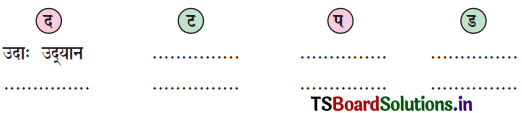
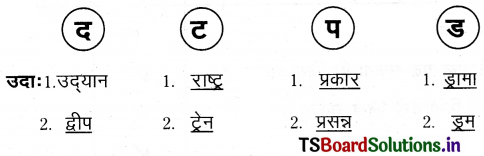
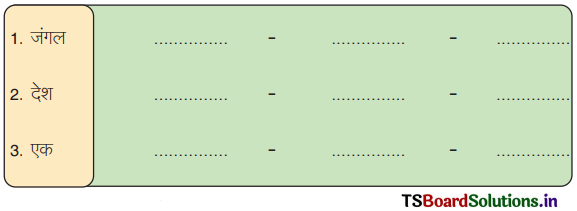
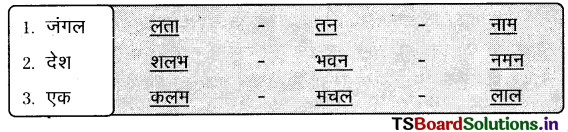
Observe the example and fill in the blanks
TS 6th Class Maths Solutions Chapter 11 Ratio and Proportion InText Questions 1
TS 6th Class Maths Solutions Chapter 11 Ratio and Proportion InText Questions 2
Answer:
TS 6th Class Maths Solutions Chapter 11 Ratio and Proportion InText Questions 3

TS 6th Class Maths Solutions Chapter 11 Ratio and Proportion InText Questions

Try These

Question 1.
In the given figure, find the ratio of
i) Shaded parts to unshaded parts.
ii) Shaded parts to total parts.
iii) Unshaded parts to total parts.
TS 6th Class Maths Solutions Chapter 11 Ratio and Proportion InText Questions 4
Answer:
i) Shaded parts to unshaded parts = 4: 1
ii) Shaded parts to total parts = 4 : 5
iii) Unshaded parts to total parts = 1: 5

Try These

Question 1.
Complete the following table.
TS 6th Class Maths Solutions Chapter 11 Ratio and Proportion InText Questions 5
Answer:
TS 6th Class Maths Solutions Chapter 11 Ratio and Proportion InText Questions 6

Question 2.
TS 6th Class Maths Solutions Chapter 11 Ratio and Proportion InText Questions 7
Answer:
TS 6th Class Maths Solutions Chapter 11 Ratio and Proportion InText Questions 8

Question 3.
In the following figures express the ratio of shaded parts to unshaded parts in the simplest terms.
TS 6th Class Maths Solutions Chapter 11 Ratio and Proportion InText Questions 9
Answer:
Number of shaded parts = 4
Number of unshaded parts = 12
Ratio of shaded parts to unshaded parts = 4:12
= 1:3

TS 6th Class Maths Solutions Chapter 11 Ratio and Proportion InText Questions 10
Answer:
Number of shaded parts = 3
Number of unshaded parts = 6
Ratio of shaded parts to unshaded parts = 3:6
= 1:2

TS 6th Class Maths Solutions Chapter 11 Ratio and Proportion InText Questions 11
Answer:
Number of shaded parts = 4
Number of unshaded parts = 4
Ratio of shaded parts to unshaded parts = 4 : 4
= 1:1

TS 6th Class Maths Solutions Chapter 11 Ratio and Proportion InText Questions 12
Answer:
Number of shaded parts = 6
Number of unshaded parts = 6
Ratio of shaded parts to unshaded parts = 6:6

TS 6th Class Maths Solutions Chapter 11 Ratio and Proportion InText Questions 13
Answer:
Number of shaded parts = 8
Number of unshaded parts = 12
Ratio of shaded parts to unshaded parts = 8 : 12
= 2:3

TS 6th Class Maths Solutions Chapter 11 Ratio and Proportion InText Questions 14
Answer:
Number of shaded parts = 3
Number of unshaded parts = 6
Ratio of shaded parts to unshaded parts = 3:6
= 1:2

TS 6th Class Maths Solutions Chapter 11 Ratio and Proportion InText Questions

Try These

Question 1.
Make a pattern with squared tiles using black and white tiles In the ratIo 2:5. There are many possible ways.
Answer:
TS 6th Class Maths Solutions Chapter 11 Ratio and Proportion InText Questions 15
One of the way is 2:5
2 × 5 : 5 × 5
10 : 25

Try These

Question 1.
i) In the given square rule paper 5 squares, colour 3 squares red and 2 squares green.
ii) If 10 squares are given, find how many are to be red and how maiy of them are to be green so that it becomes proportionate to the figure.
iii) If there are 15 squares then colour them accordingly.
TS 6th Class Maths Solutions Chapter 11 Ratio and Proportion InText Questions 16
Answer:
Student Activity.

TS 10th Class Maths Solutions Chapter 12 Applications of Trigonometry InText Questions

Students can practice 10th Class Maths Textbook SSC Solutions Telangana Chapter 12 Applications of Trigonometry InText Questions to get the best methods of solving problems.

TS 10th Class Maths Solutions Chapter 12 Applications of Trigonometry InText Questions

Do This

Question 1.
Draw diagram for the following situations :
i) A person is flying a kite at an angle of elevation a and the length of thread from his hand to kite is ‘l’.
ii) A person observes two banks of a river at angles of depression θ1 and θ21 < θ2) from the top of a tree of height ‘h’ which is at a side of the river. The width of the river is ‘d’. (AS5) (Page No. 297)
Solution:
i)
TS 10th Class Maths Solutions Chapter 12 Applications of Trigonometry InText Questions 1
In the figure
A is the position of the person.
B is the position of the kite.
AB is the length of thread.

ii)
TS 10th Class Maths Solutions Chapter 12 Applications of Trigonometry InText Questions 2
In the figure,
‘D’ is the position of person
CD is the height of the tree
AB is the width of the river
Angles of depression are θ1 and θ2.

TS 10th Class Maths Solutions Chapter 12 Applications of Trigonometry InText Questions

Think – Discuss

Question 1.
You are observing top of your school building at an angle of elevation a from a point which is at ‘d’ meter distance from foot of the building. Which trigonometric ratio would you like to consider to find the height of the building.
(AS3) (Page No. 297)
Solution:
Rough sketch
TS 10th Class Maths Solutions Chapter 12 Applications of Trigonometry InText Questions 3
I would like to use the “Tangent” to find the height of the building by the “Rough sketch”.

TS 10th Class Maths Solutions Chapter 12 Applications of Trigonometry InText Questions

Question 2.
A ladder of length ‘x’ meter is leaning against a wall making angle θ with the ground. Which trigonometric ratio would you like to consider to find the height of the point on the wall at which the ladder is touching ? (AS3) (Page No. 297)
Solution:
TS 10th Class Maths Solutions Chapter 12 Applications of Trigonometry InText Questions 4
I would like to use the “sin θ” to find the height of the point on the wall at which the ladder is touching.

TS 10th Class Maths Solutions Chapter 12 Applications of Trigonometry Optional Exercise

Students can practice 10th Class Maths Textbook SSC Solutions Telangana Chapter 12 Applications of Trigonometry Optional Exercise to get the best methods of solving problems.

TS 10th Class Maths Solutions Chapter 12 Applications of Trigonometry Optional Exercise

Question 1.
A 1.2 m tall girl spots a balloon moving with the wind in a horizontal line at a height of 88.2 m from the ground. The angle of elevation of the ballon from the eyes of the girl at any instant is 60°. After sometime, the angle of elevation reduces to 30°. Find the distance travelled by the balloon during the interval.
Solution:
TS 10th Class Maths Solutions Chapter 12 Applications of Trigonometry Optional Exercise 1
From the figure,
Let AD be the height of a tall girl standing on the horizontal line AB is 1.2 m.
Let FH = EB = 88.2 m be the height of balloon from the line AB.
At the eyes of the girl D, the angle of elevations are ∠FDC = 60° and ∠EDC = 30°
Now, FG = EC = 88.2 – 1.2 = 87 m.
Let the distance travelled by the balloon,
HB = y m and AH = x m.
∴ DG = x m and GC = ym
In right angled ∆FGD
tan 60° = \(\frac{\mathrm{FG}}{\mathrm{DG}}\)
⇒ \(\sqrt{3}\) = \(\frac{87}{\mathrm{x}}\)
⇒ x = \(\frac{87}{\sqrt{3}}\) ………. (1)
Again, in right angled ∆ECD,
tan 30° = \(\frac{\mathrm{EC}}{\mathrm{DC}}\)
⇒ \(\frac{1}{\sqrt{3}}\) = \(\frac{87}{\mathrm{DG}+\mathrm{GC}}\)
⇒ x + y = 87\(\sqrt{3}\) …………. (2)
∴ From equation (1), substituting
x = \(\frac{87}{\sqrt{3}}\) in equation (2), we get
TS 10th Class Maths Solutions Chapter 12 Applications of Trigonometry Optional Exercise 2
⇒ y = 29 × 2\(\sqrt{3}\) = 58 \(\sqrt{3}\) m.
Hence, the distance travelled by the balloon during the interval is 58 \(\sqrt{3}\) m.

TS 10th Class Maths Solutions Chapter 12 Applications of Trigonometry Optional Exercise

Question 2.
The angles of elevation of the top of a lighthouse from 3 boats A, B and C in a straight line of same side of the lighthouse are a, 2a, 3a respectively. If the distance between the boats A and B is x meters, find the height of lighthouse.
Solution:
From the figure,
Let PQ be the height of the lighthouse = h m
TS 10th Class Maths Solutions Chapter 12 Applications of Trigonometry Optional Exercise 3
A = First point of observation
B = Second point of observation
C = Third point of observation
Given, AB = x and BC = y (Not given in the text)
Exterior angle = Sum of the opposite interior angles
∠PBQ = ∠BQA + ∠BAQ and
∠PCQ = ∠CBQ + ∠CQB
∴ AB = x = QB
By applying the sine rule,
TS 10th Class Maths Solutions Chapter 12 Applications of Trigonometry Optional Exercise 4
⇒ h2 = \(\frac{x^2}{4 y^2}\) (3y – x)(x + y)
∴ h = \(\frac{x}{2 y} \sqrt{(3 y-x)(x+y)}\)
Height of lighthouse
= \(\frac{x}{2 y} \sqrt{(3 y-x)(x+y)}\) meters.

Question 3.
Inner part of a cupboard is in the cuboidical shape with its length, breadth and height in the ratio 1 : \(\sqrt{2}\) : 1. What is the angle made by the longest stick which can be inserted cupboard with its base inside ?
Solution:
TS 10th Class Maths Solutions Chapter 12 Applications of Trigonometry Optional Exercise 5
Inner part of a cupboard is in the cuboidical shape.
Ratio of length, breadth and height are
1 : \(\sqrt{2}\) : 1
In the figure,
Let AB be the length and BC be the height of the cupboard.
AC be the length of the stick.
‘θ’ be the angle of elevation of the stick making with base of the cupboard.
In ∆ABC,
tan θ = \(\frac{\mathrm{BC}}{\mathrm{AB}}\)
⇒ tan θ = \(\frac{1}{1}\)
⇒ tan θ = tan 45°
θ = 45°
∴ The angle of elevation is 45°.

TS 10th Class Maths Solutions Chapter 12 Applications of Trigonometry Optional Exercise

Question 4.
An iron spherical ball of volume 232848 cm3 has been melted and converted into a cone with the vertical angle of 120°. What are its height and base ?
Solution:
Given :
AC = Slant height = l
AB = Vertical height = h
BC = radius = r
Volume of iron spherical ball
V = 232848 cm3
TS 10th Class Maths Solutions Chapter 12 Applications of Trigonometry Optional Exercise 6
As per the problem,
Volume of spherical ball = Volume of cone
∴ \(\frac{1}{3}\) πr2h = 232848
In ∆ABC,
tan 60° = \(\frac{\mathrm{BC}}{\mathrm{AB}}\)
\(\sqrt{3}\) = \(\frac{\mathrm{r}}{\mathrm{h}}\) ⇒ r = \(\sqrt{3}\) h
\(\frac{1}{3}\) π(\(\sqrt{3}\) h)2 × h = 232848
\(\frac{1}{3}\) × \(\frac{22}{7}\) × 3 × h2 × h = 232848
h3 = \(\frac{232848 \times 7}{22}\)
h3 = 10584 × 7 = 74088
h3 = 423
h = 42
But r = h\(\sqrt{3}\)
∴ r = 42\(\sqrt{3}\)

TS 10th Class Maths Solutions Chapter 12 Applications of Trigonometry Optional Exercise

Question 5.
A right circular cylindrical tower, height ‘h’ and radius ‘r’, stands on the ground. Let ‘P’ be a point in the horizontal plane ground and ABC be the semi-circular edge of the top of the tower such that B is the point in it nearest to P. The angles of elevation of the points A and B are 45° and 60° respectively. Show that \(\frac{\mathrm{h}}{\mathrm{r}}=\frac{\sqrt{3}(1+\sqrt{5})}{2}\).
Solution:
As shown in the figure
TS 10th Class Maths Solutions Chapter 12 Applications of Trigonometry Optional Exercise 7
OA = BD = h (height of cylinder)
OD = r (radius of cylinder)
‘O’ is the centre.
ABC is the edge of semi-circle (in the top of cylinder).
B is nearer to the point R So B should be at the outer edge of diameter. That means just above ‘D’.
∠DPB = 60°, ∠OPA = 45° (given)
In ∆BDP, tan P = \(\frac{\mathrm{BD}}{\mathrm{DP}}\) (P = 60°, BD = h)
tan 60° = BD/DP
⇒ \(\sqrt{3}\) = \(\frac{\mathrm{h}}{\mathrm{DP}}\)
⇒ h = \(\sqrt{3}\) DP …………… (1)
In ∆OAP, tan P = \(\frac{\mathrm{OA}}{\mathrm{OP}}\) (here P = 45°, OA = h)
⇒ tan 45° = \(\frac{\mathrm{OA}}{\mathrm{OP}}\) = 1 ⇒ OA = OP
So OA = h = OP = OD + DP
So h = r + DP …………. (2)
From the equation (1) & (2)
h = \(\sqrt{3}\) DP, h = r + DP
∴ \(\sqrt{3}\) DP = r + DP
So r = \(\sqrt{3}\) DP – DP
r = DP(\(\sqrt{3}\) – 1) …………. (3)
TS 10th Class Maths Solutions Chapter 12 Applications of Trigonometry Optional Exercise 8
(But in text book, it is asked as \(\frac{\sqrt{3}(1+\sqrt{5})}{2}\) which is wrong).

TS 10th Class Maths Solutions Chapter 12 Applications of Trigonometry Ex 12.2

Students can practice 10th Class Maths Textbook SSC Solutions Telangana Chapter 12 Applications of Trigonometry Ex 12.2 to get the best methods of solving problems.

TS 10th Class Maths Solutions Chapter 12 Applications of Trigonometry Exercise 12.2

Question 1.
A TV tower stands vertically on the side of a road. From a point on the other side directly opposite to the tower, the angle of elevation of the top of tower is 60°. From another point 10 m away from this point, on the line joining this point to the foot of the tower, the angle of elevation of the top of the tower is 30°. Find the height of the tower and the width of the road. (AS4)
Solution:
In the adjacent figure,
AB denotes the height of the tower.
BC denotes the width of the road.
CD = 10 cm
∠ACB = 60° and ∠ADC = 30°
In ∆ACB, ∠B = 90°
tan 60° = \(\frac{\mathrm{AB}}{\mathrm{BC}}\)
TS 10th Class Maths Solutions Chapter 12 Applications of Trigonometry Ex 12.2 1
\(\frac{\sqrt{3}}{1}\) = \(\frac{\mathrm{AB}}{\mathrm{BC}}\) ………….. (1)
In ∆ ABD, ∠ABD = 90°
tan 30° = \(\frac{\mathrm{AB}}{\mathrm{BD}}\)
\(\frac{1}{\sqrt{3}}\) = \(\frac{\mathrm{AB}}{\mathrm{BC}+\mathrm{CD}}\)
\(\frac{1}{\sqrt{3}}\) = \(\frac{\mathrm{AB}}{\mathrm{BC}+10}\) ………….. (2)
dividing eq. (1) by eq. (2) we have
\(\frac{\mathrm{eq} \mathrm{(1)}}{\mathrm{eq} \mathrm{(2)}}=\frac{\sqrt{3} \times \sqrt{3}}{1}=\frac{\mathrm{AB}}{\mathrm{BC}} \times \frac{\mathrm{BC}+10}{\mathrm{AB}}\)
\(\frac{3}{1}\) = \(\frac{\mathrm{BC}+10}{\mathrm{BC}}\)
3BC = BC + 10
3BC – BC = 10
2BC = 10
BC = \(\frac{10}{2}\) = 5 …………… (3)
from (1),
\(\sqrt{3}\) = \(\frac{\mathrm{AB}}{\mathrm{BC}}\)
\(\frac{\sqrt{3}}{1}\) = \(\frac{\mathrm{AB}}{5}\)
⇒ AB = 5\(\sqrt{3}\)
Hence, the height of the tower = 5 \(\sqrt{3}\) m and the width of the road = 5 m.

TS 10th Class Maths Solutions Chapter 12 Applications of Trigonometry Ex 12.2

Question 2.
A 1.5 m tall boy is looking at the top of a temple which is 30 meter in height from a point of certain distance. The angle of elevation from his eye to the top of the crown of the temple increases from 30° to 60° as he walks towards the temple. Find the distance he walked towards the temple. (AS4)
Solution:
CE denotes the height of the boy CE = 1.5 m
AF denotes the height of the temple AF = 30 m
CB || EF
CEFB is a rectangle
∴ CE = 8F = 1.5 m
∴ AB = AF – BF
= 30 – 1.5
= 28.5 m
TS 10th Class Maths Solutions Chapter 12 Applications of Trigonometry Ex 12.2 13
In ∆ ABC, ∠B = 90°
∴ tan 30° = \(\frac{\mathrm{AB}}{\mathrm{BC}}\)
\(\frac{1}{\sqrt{3}}\) = \(\frac{28.5}{\mathrm{BC}}\)
⇒ BC = 28.5 × \(\sqrt{3}\) …………… (1)
In ∆ ABD, ∠B = 90°
tan 60° = \(\frac{\mathrm{AB}}{\mathrm{BD}}\)
⇒ \(\frac{\sqrt{3}}{1}\) = \(\frac{\mathrm{AB}}{\mathrm{BD}}\)
⇒ \(\frac{\sqrt{3}}{1}\) = \(\frac{28.5}{\mathrm{BD}}\)
⇒ BD × \(\sqrt{3}\) = 28.5
⇒ BD = \(\frac{28.5}{\sqrt{3}}\)
Therefore, the distance, the boy walked towards the temple is CD
CD = BC – BD
TS 10th Class Maths Solutions Chapter 12 Applications of Trigonometry Ex 12.2 3

TS 10th Class Maths Solutions Chapter 12 Applications of Trigonometry Ex 12.2

Question 3.
A statue stands on the top of a 2m tall pedestal. From a point on the ground, the angle of elevation of the top of the statue is 60° and from the same point, the angle of elevation of the top of the pedestal is 45°. Find the height of the statue. (AS4)
Solution:
In ∆ABD, ∠B = 90° and ∠DAB = 45°
∴ tan 60° = \(\frac{\mathrm{BC}}{\mathrm{AB}}\)
\(\frac{\sqrt{3}}{1}\) = \(\frac{\mathrm{BC}}{\mathrm{AB}}\)
AB × \(\sqrt{3}\) = BC
TS 10th Class Maths Solutions Chapter 12 Applications of Trigonometry Ex 12.2 4
AB = \(\frac{\mathrm{BC}}{\sqrt{3}}\) …………….. (1)
In ∆ABD, ∠B = 90° and ∠DAB = 45°
∴ tan 45° = \(\frac{\mathrm{DB}}{\mathrm{AB}}\)
\(\frac{1}{1}\) = \(\frac{2}{\mathrm{AB}}\)
⇒ AB = 2 m ………………. (2)
from (i), \(\frac{\mathrm{BC}}{\sqrt{3}}\) = \(\frac{2}{1}\)
⇒ BC = 2\(\sqrt{3}\)
= 2 × 1.732 = 3.464 m
Therefore, the height of the statue
CD = BC – BD
= 3.464 – 2 = 1.464 m

Question 4.
From the top of a building, the angle of elevation of the top of a cell tower is 60° and the angle of depression to its foot is 45°. If distance of the building from the tower is 7m, then find the height of the tower. (AS4)
Solution:
From the figure,
Let AB be the height of the tower.
CD be the height of the building.
Distance between the building from the tower is 7m
TS 10th Class Maths Solutions Chapter 12 Applications of Trigonometry Ex 12.2 5
Angles of elevation and depression are
∠BDE = 60° and ∠EDA = 45° and DE = AC = 7m and DC = AE
From the right angled ∆BDE,
We have
tan 60° = \(\frac{\mathrm{BE}}{\mathrm{DE}}\)
⇒ \(\sqrt{3}\) = \(\frac{\mathrm{BE}}{7}\)
⇒ BE = 7 \(\sqrt{3}\) ……………….. (1)
From the right angled ∆ADC, we have
tan 45° = \(\frac{\mathrm{CD}}{\mathrm{AC}}\)
1 = latex]\frac{\mathrm{CD}}{7}[/latex]
⇒ CD = 7 ………………. (2)
From the equations (1) and (2)
Height of the tower = AB = AE + BE
= 7 + 7 \(\sqrt{3}\) = 7(1 + \(\sqrt{3}\))
= 7(1 + 1.732)
= 7(2.732) = 19.124 m
Hence, the height of the tower is 19.124 m.

TS 10th Class Maths Solutions Chapter 12 Applications of Trigonometry Ex 12.2

Question 5.
A wire of length 18 m had been tied with electric pole at an angle of elevation 30° with the ground. Because it was covering a long distance, it was cut and tied at an angle of elevation 60° with the ground. How much length of the wire was cut ? (AS4)
Solution:
In the figure,
Let AB be the height of the electric pole = h m.
BC be the actual length of the wire = 18 m.
X and Y are the first and second points of observations.
TS 10th Class Maths Solutions Chapter 12 Applications of Trigonometry Ex 12.2 6
Let AX = a + b and AY = b
Angles of elevations are ∠BXA = 30° and ∠BYA = 60°
TS 10th Class Maths Solutions Chapter 12 Applications of Trigonometry Ex 12.2 7
Again from the ∆ ABY
Cos 60° = \(\frac{\mathrm{AY}}{\mathrm{BY}}\)
\(\frac{1}{2}\) = \(\frac{\mathrm{b}}{\mathrm{BY}}\)
BY = 2b
BY = 2(3\(\sqrt{3}\))
= 6\(\sqrt{3}\)
= 6 (1.732)
∴ BY = 10. 3920
∴ BY = 10.39230
The length of the cut wire = BX – BY
= 18 – 10.39230
= 7.6076 m
= 7.608 m

Question 6.
The angle of elevation of the top of a build¬ing from the foot of the tower is 30° and the angle of elevation of the top of the tower from the foot of building is 60°. If the tower is 30 m high, find the height of the building. (AS4)
Solution:
From the figure,
Let ‘BC’ be the height of the tower is 30 m.
Let ‘AD’ be the height of the building is h mC
TS 10th Class Maths Solutions Chapter 12 Applications of Trigonometry Ex 12.2 8
Angle of elevation, from the bottom of building and tower as well as
∠BAC = 60° and ∠ABD = 30°
Also, let AB = x be the distance between foot of the tower and building.
In right angled ∆ABD, we have
tan 30° = \(\frac{\mathrm{AD}}{\mathrm{AB}}\)
⇒ \(\frac{1}{\sqrt{3}}\) = \(\frac{\mathrm{h}}{\mathrm{x}}\)
⇒ h = \(\frac{\mathrm{x}}{\sqrt{3}}\) ………….. (1)
Again, in right angled ∆BAC, we have
tan 60° = \(\frac{\mathrm{BC}}{\mathrm{AB}}\)
⇒ \(\sqrt{3}\) = \(\frac{30}{\mathrm{x}}\)
x = \(\frac{30}{\sqrt{3}}\) m
Substituting x = \(\frac{30}{\sqrt{3}}\) in equation (1) we get
h = \(\frac{30}{\sqrt{3}} \times \frac{1}{\sqrt{3}}\) = \(\frac{30}{3}\) = 10 m
Hence, the height of the building is 10 m.

TS 10th Class Maths Solutions Chapter 12 Applications of Trigonometry Ex 12.2

Question 7.
Two poles of equal heights are standing opposite to each other on either side of the road, which is 120 feet wide. From a point between them on the road, the angles of elevation of the top of the poles are 60° and 30° respectively. Find the height of the poles and the distances of the point from the poles. (AS4)
Solution:
AB and CD are two poles of equal height.
Let BE = x, then ED = (120 – x)
In ∆ABE, ∠B = 90°, ∠AEB = 60°
∴ tan 60° = \(\frac{\mathrm{AB}}{\mathrm{BE}}\)
TS 10th Class Maths Solutions Chapter 12 Applications of Trigonometry Ex 12.2 9
⇒ \(\frac{\sqrt{3}}{1}\) = \(\frac{\mathrm{AB}}{\mathrm{x}}\)
⇒ AB = \(\sqrt{3}\) x ……………… (1)
In ∆CDE, ∠D = 90° and ∠CED = 30°
∴ tan 30° = \(\frac{\mathrm{CD}}{\mathrm{ED}}\)
⇒ \(\frac{1}{\sqrt{3}}\) = \(\frac{\mathrm{CD}}{120-\mathrm{x}}\)
⇒ CD × \(\sqrt{3}\) = 120 – x
⇒ CD = \(\frac{120-x}{\sqrt{3}}\) ………………… (2)
from (1) & (2), we have
\(\frac{120-x}{\sqrt{3}}\) = \(\frac{\sqrt{3} x}{1}\) (∵ AB = CD)
\(\sqrt{3}\) × \(\sqrt{3}\)x = 120 – x
3x = 120 – x
3x + x = 120
4x = 120
x = \(\frac{120}{4}\) = 30
AB = \(\sqrt{3}\) x
= \(\sqrt{3}\) × 30
= 30\(\sqrt{3}\) = 30 × 1.732
= 51.96 ft
The height of the pole = 51.96 ft.
The distance of one pole AB from the point E = 30 ft.
The distance of another pole CD from the point E = 120 – 30 = 90 ft.

TS 10th Class Maths Solutions Chapter 12 Applications of Trigonometry Ex 12.2

Question 8.
The angles of elevation of the top of a tower from two points are at a distance of 4m and 9 m, find the height of the tower from the base of the tower and in the same straight line with it are complementary. (AS4)
Solution:
From the figure,
AB be the height of a tower = h m
Let the two points on the ground are ‘C’ and
‘D’, such that they make a distance 4 m and
AC = 4 m and AD = 9 m
TS 10th Class Maths Solutions Chapter 12 Applications of Trigonometry Ex 12.2 10
Angles of elevation are ∠ACB = θ and ∠ADB = 90 – θ
In the right angled ∆ABC, we have
tan θ = \(\frac{\mathrm{AB}}{\mathrm{AC}}\)
⇒ tan θ = \(\frac{\mathrm{h}}{4}\)
Again from the right angled ∆ABD, we have
tan (90 – θ) = \(\frac{\mathrm{AB}}{\mathrm{AD}}\)
⇒ cot θ = \(\frac{\mathrm{h}}{9}\)
⇒ \(\frac{1}{\tan \theta}\) = \(\frac{\mathrm{h}}{9}\)
⇒ tan θ = \(\frac{9}{\mathrm{h}}\) …………….. (2)
From the equations (1) and (2) :
\(\frac{\mathrm{h}}{4}\) = \(\frac{9}{\mathrm{h}}\)
⇒ h2 = 36
h = \(\sqrt{36}\) = 6 m
The height of the tower is 6 m.

TS 10th Class Maths Solutions Chapter 12 Applications of Trigonometry Ex 12.2

Question 9.
The angle of elevation of jet plane from a point A on the ground is 60°. After a flight of 15 seconds, the angle of elevation changes to 30°. If the jet plane is flying at a constant height of 1500 \(\sqrt{3}\) meters, find the speed of the jet plane. (\(\sqrt{3}\) = 1.732) (AS4)
Solution:
From the figure,
Let P and Q be the two positions of the plane.
TS 10th Class Maths Solutions Chapter 12 Applications of Trigonometry Ex 12.2 11
Let A’ be the point of observation.
Let ABC be the horizontal line through A.
It is given that angle of elevation of the plane Q
from a point A’ are 60° and 30° respectively.
∴ ∠PAB = 60°, ∠QAB = 30°
Constant height of jet plane = 1500 \(\sqrt{3}\) m
In the right angled ∆ABP we have
tan 60° = \(\frac{\mathrm{BP}}{\mathrm{AB}}\)
⇒ \(\sqrt{3}\) = \(\frac{1500 \sqrt{3}}{\mathrm{AB}}\)
⇒ AC = \(\frac{1500 \sqrt{3}}{\sqrt{3}}\) = 1500 m
In the right angled ∆ACQ, we have
tan 30° = \(\frac{\mathrm{CQ}}{\mathrm{AC}}\) ⇒ \(\frac{1}{\sqrt{3}}\) = \(\frac{1500 \sqrt{3}}{\mathrm{AC}}\)
⇒ AC = 1500 × \(\sqrt{3}\) × \(\sqrt{3}\)
= 1,500 × 3 = 4,500 m
From the figure
PQ = BC = AC – AB
= 4500 – 1500 = 3000 m
Thus, the plane travels 3000 m in 15 seconds.
Hence, speed of a plane = \(\frac{3000}{15}\)
= 200m/sec.

TS 10th Class Maths Solutions Chapter 12 Applications of Trigonometry Ex 12.2

Question 10.
The angle of elevation of the top of a tower from the foot of the building is 30° and the angle of elevation of the top of the building from the foot of the tower is 60°. What is the ratio of heights of tower and building ? (AS4)
Solution:
Let the height of the tower = x m
Let the height of the building = y m
TS 10th Class Maths Solutions Chapter 12 Applications of Trigonometry Ex 12.2 12
Distance between the tower and building = d m.
Angle of elevation of the top of the tower = 30°
From the figure,
tan 30° = \(\frac{\mathrm{x}}{\mathrm{d}}\)
\(\frac{1}{\sqrt{3}}\) = \(\frac{\mathrm{x}}{\mathrm{d}}\)
d = \(\sqrt{3}\)x …………….. (1)
Also tan 60° = \(\frac{\mathrm{y}}{\mathrm{d}}\)
\(\sqrt{3}\) = \(\frac{\mathrm{y}}{\mathrm{d}}\)
d = \(\frac{y}{\sqrt{3}}\) …………….. (2)
From (1) and (2)
\(\sqrt{3}\)x = \(\frac{y}{\sqrt{3}}\)
\(\frac{x}{y}=\frac{1}{\sqrt{3} \cdot \sqrt{3}}=\frac{1}{3}\)
∴ x : y = 1 : 3
∴ The ratio of heights of tower and building = 1 : 3.

TS Inter 1st Year Maths 1A Products of Vectors Important Questions

Students must practice these TS Inter 1st Year Maths 1A Important Questions Chapter 5 Products of Vectors to help strengthen their preparations for exams.

TS Inter 1st Year Maths 1A Products of Vectors Important Questions

Question 1.
If \(\overline{\mathbf{a}}=\overline{\mathbf{i}}+2 \overline{\mathbf{j}}-3 \overline{\mathbf{k}}, \overline{\mathbf{b}}=3 \overline{\mathbf{i}}-\overline{\mathbf{j}}+2 \overline{\mathbf{k}}\) then show that \(\overline{\mathbf{a}}+\overline{\mathbf{b}}, \overline{\mathbf{a}}-\overline{\mathbf{b}}\) are perpendicular.
Solution:
TS Inter 1st Year Maths 1A Products of Vectors Important Questions 1

Question 2.
If the Vectors \(\lambda \overline{\mathbf{i}}-\overline{3} \overline{\mathbf{j}}+5 \overline{\mathrm{k}}, 2 \lambda \overline{\mathrm{i}}-\lambda \overline{\mathbf{j}}-\overline{\mathrm{k}}\) are perpendicular to each other find λ.
Solution:
TS Inter 1st Year Maths 1A Products of Vectors Important Questions 2

Question 3.
If \(\overline{\mathbf{a}}\) =6 \(\overline{\mathrm{i}}+2 \overline{\mathrm{j}}+3 \overline{\mathrm{k}}\) and \(\overline{\mathbf{b}}=2 \overline{\mathbf{i}}-9 \overline{\mathrm{j}}+6 \overline{\mathrm{k}}\) then find \(\overline{\mathrm{a}}, \overline{\mathrm{b}}\) and the angle between \(\overline{\mathbf{a}}\) and \(\overline{\mathbf{b}}\).
Solution:
TS Inter 1st Year Maths 1A Products of Vectors Important Questions 3
TS Inter 1st Year Maths 1A Products of Vectors Important Questions 4

Question 4.
Let \(\overline{\mathbf{a}}=2 \overline{\mathbf{i}}+4 \overline{\mathbf{j}}-5 \overline{\mathrm{k}}, \overline{\mathbf{b}}=\overline{\mathbf{i}}+\overline{\mathbf{j}}+\overline{\mathrm{k}}\) and \( \overline{\mathbf{c}}=\overline{\mathbf{i}}+2 \overline{\mathrm{k}}\). Find unit vector in the opposite direction of \(\overline{\mathbf{a}}+\overline{\mathbf{b}}+\overline{\mathbf{c}}\)
Solution:
TS Inter 1st Year Maths 1A Products of Vectors Important Questions 5

Question 5.
Let \(\bar{a}\) and \(\bar{b}\) be non zero, non collinear vectors. If \(|\overline{\mathbf{a}}+\bar{b}|=|\overline{\mathbf{a}}-\bar{b}|\) then find the angle between \(\bar{a}\) and \(\bar{b}\).
Solution:
TS Inter 1st Year Maths 1A Products of Vectors Important Questions 6
TS Inter 1st Year Maths 1A Products of Vectors Important Questions 7

Question 6.
If \(|\overline{\mathbf{a}}|=11,|\bar{b}|=23 \text { and }|\overline{\mathbf{a}}-\overline{\mathbf{b}}|\) = 30 then find the angle between the vectors \(\overline{\mathbf{a}}, \overline{\mathbf{b}}\), and also find \(|\overline{\mathbf{a}}+\overline{\mathbf{b}}|\)
Solution:
TS Inter 1st Year Maths 1A Products of Vectors Important Questions 8

Question 7.
If \(\overline{\mathbf{a}}=\overline{\mathbf{i}}-\overline{\mathbf{j}}-\overline{\mathbf{k}}, \overline{\mathbf{b}}=2 \overline{\mathbf{i}}-3 \overline{\mathbf{j}}+\overline{\mathbf{k}}\) then find the projection vector of \(\overline{\mathbf{b}} \text { on } \bar{a}\) and its magnitude.
Solution:
Projection vector of \(\overline{\mathbf{b}} \text { on } \bar{a}\) is
TS Inter 1st Year Maths 1A Products of Vectors Important Questions 9

Question  8.
If P, Q, R, S are points whose position vectors are \(\overline{\mathbf{i}}-\overline{\mathbf{k}},-\overline{\mathbf{i}}+\mathbf{2} \overline{\mathbf{j}}, 2 \overline{\mathbf{i}}-3 \overline{\mathbf{k}}\) and 3 \(\overline{\mathbf{i}}-2 \overline{\mathbf{j}}-\overline{\mathbf{k}}\) respectively, then find the component of \(\overline{\mathbf{R S}}\) on \(\overline{\mathbf{P Q}}\).
Solution:
Let O be the origin.
TS Inter 1st Year Maths 1A Products of Vectors Important Questions 10

Question 9.
Let \(\overline{\mathbf{a}}=2 \overline{\mathbf{i}}+3 \overline{\mathbf{j}}+\overline{\mathbf{k}}, \overline{\mathbf{b}}=4 \overline{\mathbf{i}}+\overline{\mathbf{j}}\) and \(\bar{c}=\overline{\mathbf{i}}-3 \overline{\mathbf{j}}-7 \overline{\mathbf{k}}\). Find the vector \(\overline{\mathbf{r}}\) such that \(\overline{\mathbf{r}} \cdot \overline{\mathbf{a}}=9, \overline{\mathbf{r}} \cdot \overline{\mathbf{b}}=7 \text { and } \overline{\mathbf{r}} \cdot \overline{\mathbf{c}}=6\)
Solution:
Let \(\bar{r}=x \bar{i}+y \bar{j}+z \bar{k}\)
TS Inter 1st Year Maths 1A Products of Vectors Important Questions 11
TS Inter 1st Year Maths 1A Products of Vectors Important Questions 12

Question 10.
Show that the points \(2 \bar{i}-\bar{j}+\bar{k}, \bar{i}-3 \bar{j}-5 \bar{k}\) and \( 3 \bar{i}-4 \bar{j}-4 \bar{k}\) are the vertices of a right angled triangle. Also find the other angles.
Solution:
Let O be the origin and A,B,C  be the given points, then
TS Inter 1st Year Maths 1A Products of Vectors Important Questions 13
TS Inter 1st Year Maths 1A Products of Vectors Important Questions 14

Question 11.
Prove that the smaller angle O between any two diagonals of a cube is given by \(\cos ^{-1}\left(\frac{1}{3}\right)\)
Solution:
Consider a unit cube with its vertices as shown in the figure
TS Inter 1st Year Maths 1A Products of Vectors Important Questions 15
TS Inter 1st Year Maths 1A Products of Vectors Important Questions 16
Similarly we can show the result for any other two diagonals of the cube.

Question 12.
Let \(\overline{\mathbf{a}}, \overline{\mathbf{b}}, \overline{\mathbf{c}}\) be non zero mutually orthogonal
vectors if \(\mathbf{x} \overline{\mathbf{a}}+\mathbf{y} \overline{\mathbf{b}}+\mathbf{z} \overline{\mathbf{c}}=\overline{\mathbf{0}}\) then x = y = z = 0
Solution:
TS Inter 1st Year Maths 1A Products of Vectors Important Questions 17

Question 13.
If \(4 \bar{i}+\frac{2 p}{3} \bar{j}+p \bar{k}\) is parallel to the vector \(\overline{\mathbf{i}}+2 \overline{\mathbf{j}}+3 \overline{\mathbf{k}}\). find p.
Solution:
TS Inter 1st Year Maths 1A Products of Vectors Important Questions 18
TS Inter 1st Year Maths 1A Products of Vectors Important Questions 19

Question 14.
Let \(\overline{\mathbf{a}}\) and \(\overline{\mathbf{b}} \) be vectors satisfying \(|\overline{\mathbf{a}}|=|\bar{b}|=5\) and \((\overline{\mathbf{a}}, \overline{\mathbf{b}})=45^{\circ}\)
Solution:
TS Inter 1st Year Maths 1A Products of Vectors Important Questions 20

Question 15.
Let \(\overline{\mathbf{a}}, \overline{\mathbf{b}}, \overline{\mathbf{c}}\) be mutually orthogonal vectors of equal magnitudes. Prove that the vector \(\overline{\mathbf{a}}+\overline{\mathbf{b}}+\overline{\mathbf{c}}\) is equally inclined to each of \(\overline{\mathbf{a}}, \overline{\mathbf{b}}\) and \(\overline{\mathbf{c}}\), the angle of inclination being \(\cos ^{-1}\left(\frac{1}{\sqrt{3}}\right)\)
Solution:
TS Inter 1st Year Maths 1A Products of Vectors Important Questions 21
Similarly we can show the result for any other two diagonals of the cube.

Question 16.
The vectors \(\overline{\mathrm{AB}}=3 \overline{\mathrm{i}}-2 \overline{\mathrm{j}}+2 \overline{\mathrm{k}}\) and \(\overline{\mathrm{AD}}=\overline{\mathrm{i}}-2 \overline{\mathrm{k}}\) represent the adjacent sides of a parallelogram A B C D. Find the angle between the diagonals.
Solution:
TS Inter 1st Year Maths 1A Products of Vectors Important Questions 22
TS Inter 1st Year Maths 1A Products of Vectors Important Questions 23

Question 17.
For any two vectors \(\bar{a}\) and \(\bar{b}\) show that
(i) \(|\overline{\mathbf{a}} \cdot \overline{\mathbf{b}}| \leq|\overline{\mathbf{a}}||\overline{\mathbf{b}}|\) (Cauchy – Schawartz in equality)
(ii) \(|\overline{\mathbf{a}}+\overline{\mathbf{b}}| \leq|\overline{\mathbf{a}}|+|\overline{\mathbf{b}}|\)(Triangle inequality)
Solution:
TS Inter 1st Year Maths 1A Products of Vectors Important Questions 25

Question 18.
Find the area of parallelogram for which the vectors \(\overline{\mathbf{a}}=2 \overline{\mathbf{i}}-3 \overline{\mathbf{j}} \text { and } \overline{\mathbf{b}}=3 \overline{\mathbf{i}}-\overline{\mathbf{k}}\) are adjacent sides.
Solution:
The vector area of the parallelogram
TS Inter 1st Year Maths 1A Products of Vectors Important Questions 26
TS Inter 1st Year Maths 1A Products of Vectors Important Questions 27

Question 19.
Let \(\overline{\mathbf{a}}=\overline{\mathbf{i}}+\overline{\mathbf{j}}+\overline{\mathbf{k}}, \overline{\mathbf{b}}=\mathbf{2} \overline{\mathbf{i}}-\overline{\mathbf{j}}+\mathbf{3} \overline{\mathbf{k}}, \overline{\mathbf{c}}=\overline{\mathbf{i}}-\overline{\mathbf{j}}\) and \(\bar{d}=6 \bar{i}+2 \bar{j}+3 \bar{k}\). Express \(\bar{d}\) interms of \(\overline{\mathbf{b}} \times \overline{\mathbf{c}}, \overline{\mathbf{c}} \times \overline{\mathbf{a}}\) and \(\overline{\mathbf{a}} \times \overline{\mathbf{b}}\).
Solution:
TS Inter 1st Year Maths 1A Products of Vectors Important Questions 28
TS Inter 1st Year Maths 1A Products of Vectors Important Questions 29
TS Inter 1st Year Maths 1A Products of Vectors Important Questions 30
Question 20.
Show that the angle in a semicircle is a right angle.
Solution:
Let O be the centre and AOB be the diameter of the given semicircle. Let P be any point on it. Let the position vectors of A and P be taken as \(\overline{\mathrm{a}}\) and \(\overline{\mathrm{p}}\)
TS Inter 1st Year Maths 1A Products of Vectors Important Questions 31
TS Inter 1st Year Maths 1A Products of Vectors Important Questions 32

Question 21.
For any vectors \(\overline{\mathbf{a}}, \overline{\mathbf{b}}\) and \(\overline{\mathbf{c}}\) prove that \((\overline{\mathbf{a}} \times \overline{\mathbf{b}}) \times \overline{\mathbf{c}}=(\overline{\mathbf{a}} \cdot \overline{\mathbf{c}}) \overline{\mathbf{b}}-(\overline{\mathbf{b}} \cdot \overline{\mathbf{c}}) \overline{\mathbf{a}}\)
Solution:
TS Inter 1st Year Maths 1A Products of Vectors Important Questions 33
TS Inter 1st Year Maths 1A Products of Vectors Important Questions 34

Question 22.
Find the cartesian equation of the plane passing through the point (-2,1,3) and perpendicular to the vector 3 \(\overline{\mathbf{i}}+\overline{\mathbf{j}}+\mathbf{5} \overline{\mathbf{k}}\).
Solution :
TS Inter 1st Year Maths 1A Products of Vectors Important Questions 35

Question 23.
Find the cartesian equation of the plane through the point A (2, – 1, -4) and parallel to the plane 4x – 12y – 3z – 7 = 0.
Solution:
The equation of the parallel plane is 4x- 12y-3z = p
11 passes through A (2, – 1, – 4) then
4(2)-12 (- 1)-3(-4) = p
⇒ 8 + 12 + 12 = p = p = 32
The equation of the required plane is
4x- 12y-3z = 32

Question 24.
Find the angle between the planes
2x – 3y – 6z = 5 and 6x + 2y – 9z = 4.
Solution:
Equation of the plane is 2x – 3y – 6z = 5
TS Inter 1st Year Maths 1A Products of Vectors Important Questions 36

Question 25.
Find limit vector orthogonal to the vector \(3 \bar{i}+2 \bar{j}+6 \bar{k}\) and coplanar with the vectors
\(2 \overline{\mathbf{i}}+\overline{\mathbf{j}}+\overline{\mathbf{k}} \text { and } \overline{\mathbf{i}}-\overline{\mathbf{j}}+\overline{\mathbf{k}}\)
Solution:
TS Inter 1st Year Maths 1A Products of Vectors Important Questions 37
TS Inter 1st Year Maths 1A Products of Vectors Important Questions 38

Question 26.
If \(\overline{\mathbf{a}}=2 \overline{\mathbf{i}}-3 \overline{\mathbf{j}}+5 \overline{\mathbf{k}}, \overline{\mathbf{b}}=-\overline{\mathbf{i}}+4 \overline{\mathbf{j}}+2 \overline{\mathbf{k}}\) then find \(\overline{\mathbf{a}} \times \overline{\mathbf{b}}\) and unit vector perpendicular to both \(\overline{\mathbf{a}}\) and \(\overline{\mathbf{b}}\).
Solution:
TS Inter 1st Year Maths 1A Products of Vectors Important Questions 39

Question 27.
If \(\overline{\mathbf{a}}=2 \overline{\mathrm{i}}-3 \overline{\mathrm{j}}+5 \overline{\mathrm{k}}, \overline{\mathrm{b}}=-\overline{\mathrm{i}}+4 \overline{\mathrm{j}}+2 \overline{\mathrm{k}}\) then find \((\bar{a}+\bar{b})_{\times}(\bar{a}-\bar{b})\) and unit vector perpendicular to both \(\overline{\mathbf{a}}+\overline{\mathbf{b}}\) and \(\overline{\mathbf{a}}-\overline{\mathbf{b}}\).
Solution:
TS Inter 1st Year Maths 1A Products of Vectors Important Questions 40

Question 28.
If \(\overline{\mathbf{a}}, \overline{\mathbf{b}}, \overline{\mathbf{c}}, \overline{\mathbf{d}}\) are vectors such that \(\overline{\mathbf{a}} \times \overline{\mathbf{b}}=\overline{\mathbf{c}} \times \overline{\mathbf{d}}\) and \(\overline{\mathbf{a}} \times \overline{\mathbf{c}}=\overline{\mathbf{b}} \times \overline{\mathbf{d}}\) then show that the vectors \(\overline{\mathbf{a}}-\overline{\mathbf{d}}\) and \(\overline{\mathbf{b}}-\overline{\mathbf{c}}\) are parallel.
Solution:
TS Inter 1st Year Maths 1A Products of Vectors Important Questions 41

Question 29.
Find the area of the triangle formed by the two sides \(\overline{\mathbf{a}}=\overline{\mathbf{i}}+2 \overline{\mathbf{j}}+3 \overline{\mathbf{k}}\) and \(\overline{\mathbf{b}}=3 \overline{\mathbf{i}}+5 \overline{\mathbf{j}}-\overline{\mathbf{k}}\).
Solution:
TS Inter 1st Year Maths 1A Products of Vectors Important Questions 42

Question 30.
In a \(\triangle \mathrm{ABC}\) if \(\overline{\mathrm{BC}}=\overline{\mathrm{a}}, \overline{\mathrm{CA}}=\overline{\mathrm{b}}\) and \(\overline{\mathrm{AB}}=\overline{\mathbf{c}}\) then show that \(\overline{\mathbf{a}} \times \overline{\mathbf{b}}=\overline{\mathbf{b}} \times \overline{\mathbf{c}}=\overline{\mathbf{c}} \times \overline{\mathbf{a}} \cdot\)
Solution:
TS Inter 1st Year Maths 1A Products of Vectors Important Questions 43

Question 31.
Let \(\overline{\mathbf{a}}=\mathbf{2} \overline{\mathbf{i}}-\overline{\mathbf{j}}+\overline{\mathbf{k}}\) and \(\overline{\mathbf{b}}=3 \overline{\mathbf{i}}+4 \overline{\mathbf{j}}-\overline{\mathbf{k}}\). If ‘θ’ is the angle between \(\bar{a}\) and \(\bar{b}\) then find \(\sin \theta\)
Solution:
\(\bar{a}=2 \bar{i}-\bar{j}+\bar{k}, \bar{b}=3 \bar{i}+4 \bar{j}-\bar{k}\)
TS Inter 1st Year Maths 1A Products of Vectors Important Questions 44

Question 32.
Let \(\overline{\mathbf{a}}, \overline{\mathbf{b}}, \overline{\mathbf{c}}\) be such that \(\overline{\mathbf{c}} \neq \overline{\mathbf{0}}, \overline{\mathbf{a}} \times \overline{\mathbf{b}}=\overline{\mathbf{c}}, \overline{\mathbf{b}} \times \overline{\mathbf{c}}=\overline{\mathbf{a}}\). Show that \(\overline{\mathbf{a}}, \overline{\mathbf{b}}, \overline{\mathbf{c}}\) are pair wise orthogonal vectors and \(|\overline{\mathbf{b}}|=1,|\overline{\mathbf{c}}|=|\overline{\mathbf{a}}|\).
Solution:
TS Inter 1st Year Maths 1A Products of Vectors Important Questions 49
TS Inter 1st Year Maths 1A Products of Vectors Important Questions 45

Question 33.
Let \(\overline{\mathbf{a}}=2 \overline{\mathbf{i}}+\overline{\mathbf{j}}-2 \overline{\mathbf{k}}\); \(\overline{\mathbf{b}}=\overline{\mathbf{i}}+\overline{\mathbf{j}}\). If \(\bar{c}\) is a vector such that \(\overline{\mathbf{a}} \cdot \overline{\mathbf{c}}=|\overline{\mathbf{c}}|,|\overline{\mathbf{c}}-\overline{\mathbf{a}}|=2 \sqrt{2}\) and the angle between \(\overline{\mathbf{a}} \times \overline{\mathrm{b}}\) and \(\overline{\mathrm{c}}\) is 30° then find the value of \(|(\overline{\mathbf{a}} \times \overline{\mathbf{b}}) \times \overline{\mathbf{c}}|\).
Solution:
TS Inter 1st Year Maths 1A Products of Vectors Important Questions 46

Question 34.
Let \(\overline{\mathbf{a}}, \overline{\mathbf{b}}\) be two non-collinear unit vectors if \(\bar{\alpha}=\overline{\mathbf{a}}-(\overline{\mathbf{a}} \cdot \overline{\mathbf{b}}) \overline{\mathbf{b}}\) and \(\bar{\beta}=\overline{\mathbf{a}} \times \overline{\mathbf{b}}\) then show that \(|\bar{\beta}|=|\bar{\alpha}|\).
Solution:
TS Inter 1st Year Maths 1A Products of Vectors Important Questions 50

Question 35.
A non zero vector \(\overline{\mathbf{a}}\) is parallel to the line of intersection of the plane determined by the vectors \(\overline{\mathbf{i}}, \overline{\mathbf{i}}+\overline{\mathbf{j}}\) and the plane determined by the vectors \(\overline{\mathbf{i}}-\overline{\mathbf{j}}, \overline{\mathbf{i}}+\overline{\mathbf{k}}\). Find the angle between \(\bar{a}\) and the vector \(\bar{i}-2 \bar{j}+2 \bar{k}\).
Solution:
Let l be the line of intersection of planes determined by the pairs \(\bar{i}, \bar{i}+\bar{j}\) and
TS Inter 1st Year Maths 1A Products of Vectors Important Questions 51
TS Inter 1st Year Maths 1A Products of Vectors Important Questions 52

Question 36.
Let \(\overline{\mathbf{a}}=4 \overline{\mathbf{i}}+5 \overline{\mathbf{j}}-\overline{\mathbf{k}}\), \(\overline{\mathbf{b}}=\overline{\mathbf{i}}-4 \overline{\mathbf{j}}+5 \overline{\mathbf{k}}\) and \(\overline{\mathbf{c}}=3 \overline{\mathbf{i}}+\overline{\mathbf{j}}-\overline{\mathbf{k}}\). Find the vector α which is perpendicular to both \(\bar{a}\) and \(\bar{b}\) and \(\alpha \cdot \overline{\mathbf{c}}\) = 21 \(\bar{\alpha}\) is perpendicular to both \(\bar{a}\) and \(\bar{b}\)
Solution:
TS Inter 1st Year Maths 1A Products of Vectors Important Questions 53

Question 37.
For any vector \(\overline{\mathbf{a}}\) show that
\(|\overline{\mathbf{a}} \times \overline{\mathbf{i}}|^2+|\overline{\mathbf{a}} \times \overline{\mathbf{j}}|^2+|\overline{\mathbf{a}} \times \overline{\mathbf{k}}|^2=2|\overline{\mathbf{a}}|^2\)
Solution:
TS Inter 1st Year Maths 1A Products of Vectors Important Questions 54

Question 38.
If \(\bar{a}\) is a non zero vector and \(\bar{b}\) and \(\bar{c}\) are two vectors such that \(\overline{\mathbf{a}} \times \overline{\mathbf{b}}=\overline{\mathbf{a}} \times \overline{\mathbf{c}}\) and \(\overline{\mathbf{a}} \cdot \overline{\mathbf{b}}=\overline{\mathbf{a}} \cdot \overline{\mathbf{c}}\) then prove that \(\overline{\mathbf{b}}=\overline{\mathbf{c}}\)
Solution:
TS Inter 1st Year Maths 1A Products of Vectors Important Questions 55

Question 39.
Prove that the vectors \(\overline{\mathbf{a}}=2 \overline{\mathbf{i}}-\overline{\mathbf{j}}+\overline{\mathbf{k}}, \overline{\mathbf{b}}=\overline{\mathbf{i}}-3 \overline{\mathbf{j}}-5 \overline{\mathbf{k}}\) and \(\overline{\mathbf{c}}=3 \overline{\mathbf{i}}-4 \overline{\mathbf{j}}-4 \overline{\mathbf{k}}\) are coplanar.
Solution:
\(\bar{a}=2 \bar{i}-\bar{j}+\bar{k}\)
TS Inter 1st Year Maths 1A Products of Vectors Important Questions 56

Question 40.
Find the volume of the parallelopiped whose coterminous edges are represented by the vectors \(2 \bar{i}-3 \bar{j}+\bar{k}, \bar{i}-\bar{j}+2 \bar{k}\) and \(\mathbf{2} \overline{\mathbf{i}}+\overline{\mathbf{j}}-\overline{\mathbf{k}}\)
Solution:
TS Inter 1st Year Maths 1A Products of Vectors Important Questions 57

Question 41.
Show that
\(\overline{\mathbf{i}} \times(\overline{\mathbf{a}} \times \overline{\mathbf{i}})+\overline{\mathbf{j}} \times(\overline{\mathbf{a}} \times \overline{\mathbf{j}})+\overline{\mathbf{k}} \times(\overline{\mathbf{a}} \times \overline{\mathbf{k}})=2 \overline{\mathbf{a}}\) For any vector \(\overline{\mathbf{a}}\).
Solution:
TS Inter 1st Year Maths 1A Products of Vectors Important Questions 58

Question 42.
Prove that for any three vectors \(\overline{\mathbf{a}}, \overline{\mathbf{b}}, \overline{\mathbf{c}} \left[\begin{array}{lll}
\bar{b}+\bar{c} & \bar{c}+\overline{\mathbf{a}} & \overline{\mathbf{a}}+\bar{b}
\end{array}\right]=2\left[\begin{array}{lll}
\overline{\mathbf{a}} & \bar{b} & \overline{\mathbf{c}}
\end{array}\right]\)
Solution:
TS Inter 1st Year Maths 1A Products of Vectors Important Questions 59

Question 43.
For any three vectors \(\overline{\mathbf{a}}, \overline{\mathbf{b}}, \overline{\mathbf{c}}\) prove that
\(\left[\begin{array}{lll}
\overline{\mathbf{b}} \times \overline{\mathbf{c}} & \overline{\mathbf{c}} \times \overline{\mathbf{a}} & \overline{\mathbf{a}} \times \overline{\mathbf{b}}
\end{array}\right]=\left[\begin{array}{lll}
\overline{\mathbf{a}} & \overline{\mathbf{b}} & \overline{\mathbf{c}}
\end{array}\right]^2 \cdot(\mathbf)\)
Solution:
TS Inter 1st Year Maths 1A Products of Vectors Important Questions 60

Question 44.
Let \(\bar{a}, \bar{b}\) and \(\bar{c}\) be unit vectors such that \(\bar{b}\) is not parallel to \(\overline{\mathbf{c}}\) and \(\overline{\mathbf{a}} \times(\overline{\mathbf{b}} \times \overline{\mathbf{c}})=\frac{1}{2} \overline{\mathbf{b}}\). Find the angles made by \(\bar{a}\) with each of \(\overline{\mathbf{b}}\) and \(\overline{\mathbf{c}}\).
Solution:
TS Inter 1st Year Maths 1A Products of Vectors Important Questions 61

Question 45.
For any four vectors \(\overline{\mathbf{a}}, \overline{\mathbf{b}}, \overline{\mathbf{c}}\) and \(\overline{\mathbf{d}}\).
Prove that \((\bar{b} \times \overline{\mathbf{c}}) \cdot(\overline{\mathbf{a}} \times \overline{\mathbf{d}})+(\overline{\mathbf{c}} \times \overline{\mathbf{a}}) \cdot(\overline{\mathbf{b}} \times \overline{\mathrm{d}}) +(\overline{\mathbf{a}} \times \overline{\mathbf{b}}) \cdot(\overline{\mathbf{c}} \times \overline{\mathbf{d}})=0(\mathrm)\)
Solution:
TS Inter 1st Year Maths 1A Products of Vectors Important Questions 62
= 0

Question 46.
Find the equation of the plane passing through the points \(\mathrm{A}=(2,3,-1), \mathrm{B}=(4,5, 2)\) and C=(3,6,5).
Solution:
Let \(\overline{\mathrm{OA}}=2 \overline{\mathrm{i}}+3 \overline{\mathrm{j}}-\overline{\mathrm{k}}
\overline{\mathrm{OB}}=4 \overline{\mathrm{i}}+5 \overline{\mathrm{j}}+2 \overline{\mathrm{k}}\)
\(\overline{\mathrm{OC}}=3 \overline{\mathrm{i}}+6 \overline{\mathrm{j}}+5 \overline{\mathrm{k}}\) with respect to origin \(\mathrm{O}\).
Let P be any point on the plane passing through the points A,B,C
TS Inter 1st Year Maths 1A Products of Vectors Important Questions 63

Question 47.
Find the equation of the plane passing through the point A(3,-2,-1) and parallel to the vectors \(\bar{b}=\bar{i}-2 \bar{j}+4 \bar{k}\) and \(\overline{\mathbf{c}}=3 \overline{\mathbf{i}}+2 \overline{\mathbf{j}}-5 \overline{\mathbf{k}}\).
Solution:
The equation of the plane passing through A=(3,-2,-1) and parallel to the vectors
TS Inter 1st Year Maths 1A Products of Vectors Important Questions 64
Question 48.
Find the vector equation of the plane passing through the intersection of planes \(\overline{\mathbf{r}} \cdot(\overline{\mathbf{i}}+\overline{\mathbf{j}}+\overline{\mathbf{k}})=6\) and \(\overline{\mathbf{r}} \cdot(2 \bar{i}+3 \overline{\mathbf{j}}+4 \overline{\mathbf{k}})=-5\) and the point (1,1,1).
Solution:
TS Inter 1st Year Maths 1A Products of Vectors Important Questions 66
TS Inter 1st Year Maths 1A Products of Vectors Important Questions 65

Question 49.
Find the distance of the point (2,5,-3) from the plane \(\overline{\mathbf{r}} \cdot(6 \bar{i}-3 \bar{j}+2 \bar{k})=4 \cdot\)
Solution:
Here \(\bar{a}=\bar{i}+5 \bar{j}-3 \bar{k}, \bar{n}=6 \bar{i}-3 \bar{j}+2 \bar{k}\) and d=4
Then \(\overline{\mathrm{r}} \cdot \overline{\mathbf{n}}=\overline{\mathrm{d}}\)
The distance of the point (2,5,-3) from the given plane is
TS Inter 1st Year Maths 1A Products of Vectors Important Questions 67

Question 50.
Find the angle between the line \(\frac{x+1}{2}=\frac{y}{3}=\frac{z-3}{6}\) and the plane 10 x+2 y-11 z=3
Solution:
Let φ be the angle between the given line and normal to the plane.
Concert the above equations to vector notation,
TS Inter 1st Year Maths 1A Products of Vectors Important Questions 68

Question 51.
For any four vectors \(\overline{\mathbf{a}}, \overline{\mathbf{b}}, \overline{\mathbf{c}}\) and \(\overline{\mathbf{d}}\) show that
TS Inter 1st Year Maths 1A Products of Vectors Important Questions 69
Solution:
TS Inter 1st Year Maths 1A Products of Vectors Important Questions 70

Question 52.
Find the shortest distance between the skew
TS Inter 1st Year Maths 1A Products of Vectors Important Questions 71
Solution:

TS Inter 1st Year Maths 1A Products of Vectors Important Questions 80

The first line passes through the point A(6,2,2) and parallel to the vector \(\overline{\mathrm{b}}=\overline{\mathrm{i}}-2 \overline{\mathrm{j}}+2 \overline{\mathrm{k}}\).
The second line passes through the point C(-4,0,-1) and parallel to the vector \(\overline{\mathrm{d}}=3 \overline{\mathrm{i}}-2 \overline{\mathrm{j}}-2 \overline{\mathrm{k}}\)
Shortest distance is =\(\frac{|[\overline{\overline{A C}} \bar{b} \bar{d}]|}{|\bar{b} \times \bar{d}|}\)

TS Inter 1st Year Maths 1A Products of Vectors Important Questions 72

Question 53.
i) Show that the altitudes of a triangle are concurrent.
ii) The perpendicular bisectors of the sides of a triangle are concurrent.
Solution:
(i)
TS Inter 1st Year Maths 1A Products of Vectors Important Questions 73
Consider ΔABC . O is point of intersection of altitudes.
To prove that the three altitudes are concurrent at ‘ O ‘. We have to prove that \(\overline{\mathrm{OC}}\) is perpendicular to \(\overline{\mathrm{AB}}\)
TS Inter 1st Year Maths 1A Products of Vectors Important Questions 81
∴  \(\overline{\mathrm{OC}}\) is the third altitude which passes through ‘ O ‘.
Hence the three altitudes of the triangle are concurrent.

(ii)
TS Inter 1st Year Maths 1A Products of Vectors Important Questions 82
TS Inter 1st Year Maths 1A Products of Vectors Important Questions 75
TS Inter 1st Year Maths 1A Products of Vectors Important Questions 76

Question 54.
Show that the vector area of the quadrilateral ABCD having diagonals \(\overline{\mathrm{AC}}, \overline{\mathrm{BD}}\) is \(\frac{1}{2}(\overline{\mathrm{AC}} \times \overline{\mathrm{BD}})\)
Solution:
TS Inter 1st Year Maths 1A Products of Vectors Important Questions 77
ABCD is a quadrilateral. \(\overline{\mathrm{AC}}\) and \(\overline{\mathrm{BD}}\) are diagonals of the quadrilateral. Q is the point of intersection of diagonals.
Vector area of quadrilateral ABCD = Sum of the vector area of ΔAQB, ΔBQC, ΔCQD and ΔDQA.TS Inter 1st Year Maths 1A Products of Vectors Important Questions 83

Question 55.
Let \(\overline{\mathbf{a}}, \overline{\mathbf{b}}, \overline{\mathbf{c}}\) be unit vectors such that \(\bar{b}\) is not parallel to \(\bar{c}\) and \(\bar{a} \times(\bar{b} \times \bar{c})=\frac{1}{2} \bar{b}\). Find the angle made by the vector \(\bar{a}\) with each of the vectors \(\bar{b}\) and \(\bar{c}\).
Solution:
TS Inter 1st Year Maths 1A Products of Vectors Important Questions 79

TS 10th Class Maths Solutions Chapter 13 Probability InText Questions

Students can practice 10th Class Maths Textbook SSC Solutions Telangana Chapter 13 Probability InText Questions to get the best methods of solving problems.

TS 10th Class Maths Solutions Chapter 13 Probability InText Questions

Do This

(a) Outcomes of which of the following experiments cure equally likely. (AS3)(Page No. 307)

Question 1.
Getting a digit 1, 2, 3, 4, 5 or 6 when a die is rolled.
Solution:
Equally likely

Question 2.
Selecting a different colour ball from a bag of 5 red balls, 4 blue balls and 1 black ball.
Note : Picking two different colour balls, i.e., Picking a red, a blue (or) black ball from a ………
Solution:
Not equally likely

Question 3.
Winning in a game of carrom.
Solution:
Not equally likely

Question 4.
Units place of a two digit number selected may be 0, 1, 2, 3, 4, 5, 6, 7, 8 or 9.
Solution:
equally likely

Question 5.
Selecting a different colour ball from a bag of 10 red balls, 10 blue balls and 10 black balls.
Solution:
equally likely

TS 10th Class Maths Solutions Chapter 13 Probability InText Questions

Question 6.
Raining on a particular day of July.
Solution:
equally likely

(b) Are the outcomes of every experiment equally likely ?
Solution:
Outcomes of all experiments need not necessarily be equally likely.

(c) Give examples of 5 experiments that have equally likely outcomes and five more examples that do not have equally likely outcomes.
Solution:
Equally likely events :
a) Getting an even or odd number when a die is rolled.
b) Getting tail or head when a coin is tossed.
c) Getting an even (or) odd number when a card is drawn at random from a pack of cards numbered from 1 to 10.
d) Picking a green or black ball from a bag containing 8 green balls and 8 black balls.
e) Selecting a boy or girl from a class of 20 boys and 20 girls.
f) Selecting a red or black card from a deck of cards.

Events which are not equally likely :
a) Getting a prime (or) composite number when a die is thrown.
b) Getting an even or odd number when a card is drawn at random from a pack of cards numbered from 1 to 5.
c) Getting a number which is a multiple of 3 (or) not a multiple of 3 from numbers 1, 2, …….., 10.
d) Getting a number less than 5 or greater than 5.
e) Drawing a white ball or green ball from a bag containing 5 green balls and 8 white balls.

Think of 5 situations with equally likely events and find the sample space.
a) Tossing a coin : Getting a tail or head when a coin is tossed.
Sample space = {T, H}
b) Getting an even (or) odd number when a die is rolled.
Sample space = {1, 2, 3, 4, 5, 6}
c) Winning a game of shuttle Sample space = {win, loss}
d) Picking a black (or) blue ball from a bag containing 3 blue balls and 3 black balls = {blue, black}
e) Drawing a red coloured card or black coloured card from a deck of cards = {black, red}

TS 10th Class Maths Solutions Chapter 13 Probability InText Questions

d) Is getting a head complementary to getting a tail ? Give reasons.
Solution:
Number outcomes favourable to head = 1
Probability of getting a head = \(\frac{1}{2}\) [P(E)]
Number of outcomes not favourable to head = 1
Probability of not getting a head = \(\frac{1}{2}\) (P (\(\overline{\mathrm{E}}\)))
Now P(E) + P(\(\overline{\mathrm{E}}\)) = \(\frac{1}{2}\) + \(\frac{1}{2}\) = 1
∴ Getting a head is complementary to getting a tail.

e) In case of a die is getting a 1 complementary to events getting 2, 3, 4, 5, 6 ? Give reasons for your answer.
Solution:
Yes, complementary events
∴ Probability of getting a 1 = \(\frac{1}{6}\) [P(E)]
Probability of getting 2, 3, 4, 5, 6
= P (\(\overline{\mathrm{E}}\)) = \(\frac{5}{6}\)
p(E) + P(\(\overline{\mathrm{E}}\)) = \(\frac{1}{6}\) + \(\frac{5}{6}\) = \(\frac{6}{6}\) = 1

f) Write of five new pair of events that are complementary.
Solution:
a) When a die is thrown, getting an even number is complementary to getting an odd number.
b) Drawing a red card from a deck of cards is complementary to getting a black card.
c) Getting an even number is complementary to getting an odd number from numbers 1, 2, ……….., 8.
d) Getting a Sunday is complementary to getting any day other than Sunday in a week.
e) Winning a running race is complementary to loosing it.

Try This

Question 1.
A child has a die whose six faces show the letters A, B, C, D, E and F. The die is thrown once. What is the probability of getting (i) A ? (ii) D ? (AS4)(Page No. 312)
Solution:
Total number of outcomes [A, B, C, D, E and F] = 6
i) Number of favourable outcomes to A = 1
Probability of getting A = P(A)
TS 10th Class Maths Solutions Chapter 13 Probability InText Questions 1
= \(\frac{1}{6}\)

TS 10th Class Maths Solutions Chapter 13 Probability InText Questions

ii) Number of outcomes favourable to D = 1
Probability of getting D
= P(D)
TS 10th Class Maths Solutions Chapter 13 Probability InText Questions 2
= \(\frac{1}{6}\)

Question 2.
Which of the following cannot be the probability of an event ? (AS3)(Page No. 312)
a) 2.3
b) – 1.5
c) 15%
d) 0.7
Solution:
a) 2.3 – Not possible
b) -1.5 – Not possible
c) 15% – May be the probability
d) 0.7 – May be the probability

Question 3.
You have a single deck of well shuffled cards. Then,
i) What is the probability that the card drawn will be a queen ? (AS4)(Page No. 313)
Solution:
Number of all possible outcomes
= 4 × 13 = 1 × 52 = 52
Number of outcomes favourable to Queen
= 4[♥Q ♥Q ♥Q ♥Q]
Probability P(E)
= \(\frac{\text { No. of favourable outcomes }}{\text { Total no.of outcomes }}\)
= \(\frac{4}{52}\)
= \(\frac{1}{13}\)

ii) What is the probability that it is a face card ? (Page No. 314)
Solution:
Face cards are J, Q, K.
∴ Number of outcomes favourable to face cards = 4 × 3 = 12
No. of all possible outcomes = 52
P(E) = \(\frac{\text { No. of favourable outcomes }}{\text { Total no. of outcomes }}\)
= \(\frac{12}{52}\) = \(\frac{3}{13}\)

TS 10th Class Maths Solutions Chapter 13 Probability InText Questions

iii) What is the probability that it is a spade ? (Page No. 314)
Solution:
Number of spade cards = 13
Total number of cards = 52
Probability = \(\frac{\text { Number of outcomes favourable to spade }}{\text { Number of all outcomes }}\)
= \(\frac{13}{52}\) = \(\frac{1}{4}\)

iv) What is the probability that is the face cards of spades ? (Page No. 314)
Solution:
Number of outcomes favourable to face cards of spades = (K, Q, J) = 3
Number of all outcomes = 52 3
∴ P(E) = \(\frac{3}{52}\)

v) What is the probability it is not a face card ? (Page No. 314)
Solution:
Probability of a face card = \(\frac{12}{52}\)
∴ Probability that the card is not a face card
= 1 – \(\frac{12}{52}\) [P (\(\overline{\mathrm{E}}\)) = 1 – P(E)]
= \(\frac{52-12}{52}\)
= \(\frac{40}{52}\) = \(\frac{10}{13}\)

(Or)

Number of favourable outcomes = 4 × 10 = 40
Number of all outcomes = 52
∴ Probability = \(\frac{\text { No. of favourable outcomes }}{\text { Total no. of outcomes }}\)
= \(\frac{40}{52}\) = \(\frac{10}{13}\)

Think – Discuss

Question 1.
Why is tossing a coin considered to be a fair way of deciding which team should get the ball at the beginning of any game ? (Page No. 312)
Solution:
Probability of getting a head is \(\frac{1}{2}\) and a tail is
\(\frac{1}{2}\) = 1
Hence, tossing a coin is a fair way.

TS 10th Class Maths Solutions Chapter 13 Probability InText Questions

Question 2.
Can \(\frac{7}{2}\) be the probability of an event ? Explain. (AS3) (Page No. 312)
Solution:
\(\frac{7}{2}\) can’t be the probability of any event. Since probability of any event should lie between 0 and 1.

Question 3.
Which of the following arguments are correct and which are not correct ? Given reasons. (Page No. 312)

i) If two coins are tossed simultaneously, there are three possible outcomes – two heads, two tails (or) one of each. Therefore, for each. If these outcomes, the probability is \(\frac{1}{3}\)
Solution:
False
Reason :
All possible outcomes are 4. They are HH, HT, TH, TT
Thus, probability of two heads = \(\frac{1}{4}\)
Probability of two tails = \(\frac{1}{4}\)
Probability of one each = \(\frac{2}{4}\) = \(\frac{1}{2}\)

TS 10th Class Maths Solutions Chapter 13 Probability InText Questions

ii) If a die is thrown, there are two possible outcomes – an odd number (or) an even number. Therefore, the probability of getting an odd number is \(\frac{1}{2}\).
Solution:
True
Reason :
All possible outcomes = (1, 2, 3, 4, 5, 6) = 6
Outcomes favourable to an odd number = (1, 3, 5) = 3
Outcomes favourable to an even number = (2, 4, 6) = 3
∴ Probability (odd number)
= \(\frac{\text { No. of favourable outcomes }}{\text { Total no. of outcomes }}\)
= \(\frac{3}{6}\) = \(\frac{1}{2}\)

TS 10th Class Maths Solutions Chapter 13 Probability Optional Exercise

Students can practice 10th Class Maths Textbook SSC Solutions Telangana Chapter 13 Probability Optional Exercise to get the best methods of solving problems.

TS 10th Class Maths Solutions Chapter 13 Probability Optional Exercise

Question 1.
Two customers Shyam and Ekta are visiting a particular shop in the same week (Tuesday to Saturday). Each is equally likely to visit the shop on any day as on another day. What is the probability that both will visit the shop on
(i) the same day ?
(ii) consecutive days ?
(iii) different days ?
Solution:
i) Shyam and Ekta can visit the shop in the following combination :
TS 10th Class Maths Solutions Chapter 13 Probability Optional Exercise 1
TS 10th Class Maths Solutions Chapter 13 Probability Optional Exercise 2
Number of Total outcomes
= 5 × 5 = 52 = 25 (also from the above table)
Number of favourable outcomes to that of visiting on the same day
(Tu, Tu), (W, W), (Th, Th), (I; F), (S, S) = 5
∴ Probability that visiting the shop on the same day
= \(\frac{\text { No. of favourable outcomes }}{\text { No. of total outcomes }}\)
= \(\frac{5}{25}\) = \(\frac{1}{5}\)

ii) Number of outcomes favourable to consecutive days
(Tu, W), (W, Th), (Th, F), (F, S) (W, Tu), (Th, W), (F, Th), (S, F) = 8
∴ Probability of visiting the shop on consecutive days = \(\frac{8}{25}\)

iii) If P(E) is the probability of visiting the shop on the same day, then P(\(\overline{\mathrm{E}}\)) is the probability of visiting the shop not on the same day. i.e., P(\(\overline{\mathrm{E}}\)) is the probability of visiting the shop on different days such that P(E) + P(\(\overline{\mathrm{E}}\)) =1
P(\(\overline{\mathrm{E}}\)) = 1 – P(E) = 1 – \(\frac{1}{5}\) = \(\frac{4}{5}\)

TS 10th Class Maths Solutions Chapter 13 Probability Optional Exercise

Question 2.
A bag contains 5 red balls and some blue balls. If the probability of drawing a blue ball is double that of a red ball, determine the number of blue balls in the bag.
Solution:
Number of red balls in the bag = 5
As the probability of blue balls is double the probability of red balls, we have that number of blue balls is double the number of red balls.
∴ Blue balls = 5 × 2 = 10.

!! Let the number of blue balls = x
Number of red balls = 5
Total no. of balls = x + 5
Total outcomes in drawing a ball at random = x + 5
Number of outcomes favourable to red ball = 5
∴ P(R) = \(\frac{5}{x+5}\)
from the problem.
P(B) = 2 × \(\frac{5}{x+5}\) = \(\frac{10}{x+5}\)
Also, \(\frac{5}{x+5}\) + \(\frac{10}{x+5}\) = 1
[∵ P(\(\overline{\mathrm{E}}\)) + P(E) = 1]
⇒ \(\frac{5+10}{x+5}\) = 1
⇒ \(\frac{15}{x+5}\) = 1 ⇒ x + 5 = 15
⇒ x = 15 – 5 = 10

Question 3.
A box contains 12 balls out of which x are black. If one ball is drawn at random from the box, what is the probability that it will be a black ball ? If 6 more black balls are put in the box, the probability of drawing a black ball is now double of what it was before. Find x.
Solution:
Number of black balls = x
Total number of balls in the box = 12
Probability of drawing a black ball
= \(\frac{\text { No. of favourable outcomes }}{\text { No. of total outcomes }}\)
= \(\frac{x}{12}\) ……………. (1)
When 6 more black balls are placed in the box, number of favourable outcomes to black ball becomes = x + 6.
Total number of balls in the box becomes = 12 + 6 = 18.
Now the probability of drawing a black ball becomes = \(\frac{x+6}{18}\) …………… (2)
By problem,
\(\frac{x+6}{18}\) = 2 . \(\frac{x}{12}\)
⇒ \(\frac{x+6}{18}\) = \(\frac{x}{6}\)
⇒ 6(x + 6) = 18(x)
⇒ 6x + 36 = 18x ⇒ 18x – 6x = 36
⇒ 12x = 36 ⇒ x = \(\frac{36}{12}\) = 3
Check:
Equation (1) ⇒ \(\frac{x}{12}\) = \(\frac{3}{12}\) = \(\frac{1}{4}\)
Equation (2) ⇒ \(\frac{x+6}{18}\) = \(\frac{3+6}{18}\)
= \(\frac{9}{18}\) = \(\frac{1}{2}\)
Equation (1) × 2 = \(\frac{1}{2}\) 2 = \(\frac{1}{2}\) and hence proved.

TS 10th Class Maths Solutions Chapter 13 Probability Optional Exercise

Question 4.
A jar contains 24 marbles, some are green and others are blue. If a marble is drawn at random from the jar, the probability that it is 2 green is \(\frac{2}{3}\). Find the number of blue marbles 3 in the jar.
Solution:
Total number of marbles in the jar = 24
Let the number of green marbles = x
Then number of blue marbles = 24 – x.
Probability of drawing a green marbles
= \(\frac{\text { No. of favourable outcomes }}{\text { No. of total outcomes }}\)
= \(\frac{x}{24}\)
By Problem, \(\frac{x}{24}\) = \(\frac{2}{3}\)
⇒ 3 × x = 24 × 2
x = \(\frac{24 \times 2}{3}\) = 16
∴ Number of green marbles = 6
Number of blue marbles = 24 – 16 = 8

!! P(G) = \(\frac{2}{3}\)
P(G) + P(B) = 1
∴ P(B) = 1 – P(G) = 1 – \(\frac{2}{3}\) = \(\frac{1}{3}\)
Number of blue marbles in the jar
= \(\frac{1}{3}\) × 24 = 8.

TS 10th Class Maths Solutions Chapter 13 Probability Ex 13.2

Students can practice 10th Class Maths Textbook SSC Solutions Telangana Chapter 13 Probability Ex 13.2 to get the best methods of solving problems.

TS 10th Class Maths Solutions Chapter 13 Probability Exercise 13.2

Question 1.
A bag contains 3 red balls and 5 black balls. A ball is drawn at random from the bag. What is the probability that the ball selected is (i) red ? (ii) not red ? (AS1)
Solution:
i) Total number of balls in the bag = 3 red + 5 black = 8 balls
Number of total outcomes when a ball is selected at random = 3 + 5 = 8
Now, number of favourable outcomes of red ball = 3
∴ Probability of getting a red ball
P(E) = \(\frac{\text { No. of favourable outcome }}{\text { No. of total outcomes }}\)
= \(\frac{3}{8}\)

ii) If P(\(\overline{\mathrm{E}}\)) is the probability of selecting no red balls, then
P(E) + P(\(\overline{\mathrm{E}}\)) = 1
P(\(\overline{\mathrm{E}}\)) = 1 – P(E) = 1 – \(\frac{3}{8}\) = \(\frac{5}{8}\)

Question 2.
A box contains 5 red marbles, 8 white marbles and 4 green marbles. One marble is taken out of the box at random. What is the probability that the marble taken out will be (i) red ? (ii) white ? (iii) not green ? (AS1)
Solution:
There are 5 red marbles, 8 white marbles and 4 green marbles in a bag.
∴ Total number of marbles in the bag = 5 + 8 + 4= 17
∴ Number of all possible outcomes = 17
i) Let E be the event that the marble taken out will be red.
Total number of red marbles in the bag = 5
∴ Number of outcomes favourable to E = 5
P(E) = \(\frac{\text { No. of outcomes favourable to E}}{\text { No. of all possible outcomes }}\)
= \(\frac{5}{17}\)

ii) Let E be the event that the marble taken out will be white.
Total number of white marbles in the bag = 8
∴ Number of outcomes favourable to E = 8
P(E) = \(\frac{\text { No. of outcomes favourable to E}}{\text { No. of all possible outcomes }}\)
= \(\frac{8}{17}\)

iii) Let E be the event that the marble taken out will be green.
Total number of green marbles in the bag = 4
∴ Number of outcomes favourable to E = 4
P(E) = \(\frac{\text { No. of outcomes favourable to E}}{\text { No. of all possible outcomes }}\)
= \(\frac{4}{17}\)
∴ Probability that the marble taken out will not be green.
= 1 – P (Probability that the marble taken out will be green)
= 1 – P(E) = 1 – \(\frac{4}{17}\) = \(\frac{13}{17}\)

TS 10th Class Maths Solutions Chapter 13 Probability Ex 13.2

Question 3.
A Kiddy bank contains hundred 50p coins, fifty ₹ 1 coins, twenty ₹ 2 coins and ten ₹ 5 coins. If it is equally likely that one of the coins will fall out when the bank is turned upside down, what is the probability that the coin (i) will be a 50p coin ? (ii) will not be a ₹ 5 coin ? (AS1)
Solution:
i) Number of 50p coins = 100
Number of ₹ 1 coins = 50
Number of ₹ 2 coins = 20
Number of ₹ 5 coins = 10
∴ Total number of coins
= 100 + 50 + 20 + 10 = 180
Number of total outcomes for a coin to fall down = 180
Number of outcomes favourable to 50p coins to fall down = 100
∴ Probability of a 50p coin to fall down No. of favourable outcomes
= \(\frac{\text { No. of favourable outcomes }}{\text { No. of total outcomes }}\)
= \(\frac{100}{180}\) = \(\frac{5}{9}\)

ii) Let P(E) be the probability for a ₹ 5 coin to fall down.
= \(\frac{1}{2}\) (P(\(\overline{\mathrm{E}}\))) = \(\frac{1}{2}\) (P(\(\overline{\mathrm{E}}\)))
No. of outcomes favourable to ₹ 5 coin = 10
∴ Probability for a ₹ 5 coin to fall down
= \(\frac{\text { No. of favourable outcomes }}{\text { No. of total outcomes }}\)
= \(\frac{10}{180}\) = \(\frac{1}{18}\)
Then P(\(\overline{\mathrm{E}}\)) is the probability of a coin which fall down is not a ₹ 5 coin.
Again P(E) + P(\(\overline{\mathrm{E}}\)) = 1
∴ P(\(\overline{\mathrm{E}}\)) = 1 – P(E)
= 1 – \(\frac{1}{18}\)
= \(\frac{17}{18}\)

Question 4.
Gopi buys a fish from a shop for his aquarium. The shopkeeper takes out one fish at random from a tank containing 5 male fish and 8 female fish (See figure). What is the probability that the fish taken out is a male fish ? (AS4)
TS 10th Class Maths Solutions Chapter 13 Probability Ex 13.2 1
Solution:
Number of male fish in the acquarium = 5
Number of female fish in the acquarium = 8
Total number of fish in the acquarium = 5 + 8 = 13
∴ Number of all possible outcomes = 13
Let E be the event that the fish taken out is a male fish.
Number of outcomes favourable to E = 5
∴ P(E) = \(\frac{\text { No. of outcomes favourable to E}}{\text { No. of all possible outcomes }}\)
= \(\frac{5}{13}\)

TS 10th Class Maths Solutions Chapter 13 Probability Ex 13.2

Question 5.
A game of chance consists of spinning an arrow which comes to rest pointing at one of the numbers 1, 2, 3, 4, 5, 6, 7, 8 (See figure) and these are equally likely outcomes. What is the probability that it will point at
TS 10th Class Maths Solutions Chapter 13 Probability Ex 13.2 2
i) 8?
ii) an odd number ?
iii) a number greater than 2 ?
iv) a number less than 9 ?
Solution:
i) The figure shows the numbers from 1 to 8.
Let E be the event that the arrow comes to rest pointing at 8.
Number of outcomes favourable to E = 1
Number of all possible outcomes = 8
∴ P(E) = \(\frac{\text { No. of outcomes favourable to E}}{\text { No. of all possible outcomes }}\)
= \(\frac{1}{8}\)

ii) The odd numbers shown in the figure are 1, 3, 5 and 7 = 4.
Let E be the event that the arrow will point an odd number.
Number of outcomes favourable to E = 4
Number of all possible outcomes = 8
∴ P(E) = \(\frac{\text { Number of outcomes favourable to E}}{\text { Number of all possible outcomes }}\)
= \(\frac{4}{8}\) = \(\frac{1}{2}\)

iii) The numbers which are greater than 2 as per the figure given are 3, 4, 5, 6, 7 and 8 = 6
Let E be the event that the arrow will point a number greater than 2.
Number of outcomes favourable to E = 6
Number of all possible outcomes = 8
∴ P(E) = \(\frac{\text { Number of outcomes favourable to E}}{\text { Number of all possible outcomes }}\)
= \(\frac{6}{8}\) = \(\frac{3}{4}\)

iv) The numbers less than 9 are 1, 2, 3. 4, 5, 6, 7,8
Let E be the event that the arrow will point a number less than 9.
Number of outcomes favourable to E = 8
Number of all possible outcomes = 8
∴ P(E) = \(\frac{\text { Number of outcomes favourable to E}}{\text { Number of all possible outcomes }}\)
= \(\frac{8}{8}\) = 1

TS 10th Class Maths Solutions Chapter 13 Probability Ex 13.2

Question 6.
One card is selected from a well-shuffled deck of 52 cards. Find the probability of getting
i) a king of red colour
ii) a face card
iii) a red face card
iv) the jack of hearts
v) a spade
vi) the queen of diamonds.
Solution:
Total number of cards = 52
∴ Number of all possible outcomes in selecting a card at random = 52
i) Number of out comes favourable to the kings of red colour = 2(♥k, ♥k)
∴ Probability of getting the king of red colour
= \(\frac{\text { No. of favourable outcomes }}{\text { No. of total outcomes }}\)
= \(\frac{2}{52}\) = \(\frac{1}{26}\)

ii) Number of face cards in a deck of cards = 4 × 3 = 12(K, Q, J)
No. of outcomes favourable to select face card = 12
∴ Probability of getting a face card
= \(\frac{\text { No. of favourable outcomes }}{\text { No. of total outcomes }}\)
= \(\frac{12}{52}\) = \(\frac{3}{13}\)

iii) Number of red face cards = 2 × 3 = 6
∴ No. of outcomes favourable to select a red face card = 6
∴ Probability of getting a red face card
= \(\frac{\text { No. of favourable outcomes }}{\text { No. of total outcomes }}\)
= \(\frac{6}{52}\) = \(\frac{3}{26}\)

iv) No. of outcomes favourable to the jack of hearts = 1
∴ Probability of getting the jack of hearts.
= \(\frac{\text { No. of favourable outcomes }}{\text { No. of total outcomes }}\)
= \(\frac{1}{52}\)

v) No. of spade cards = 13
∴ No. of outcomes favourable to ‘a spade card’ = 13
∴ Probability of getting a spade card
= \(\frac{\text { No. of favourable outcomes }}{\text { No. of total outcomes }}\)
= \(\frac{13}{52}\) = \(\frac{1}{4}\)

vi) No. of outcomes favourable to the queen of diamonds = 1
∴ Probability of getting the queen of diamonds
= \(\frac{\text { No. of favourable outcomes }}{\text { No. of total outcomes }}\)
= \(\frac{1}{52}\)

TS 10th Class Maths Solutions Chapter 13 Probability Ex 13.2

Question 7.
Five cards-the ten, jack, queen, king and ace of diamonds, are well shuffled with their face downwards. One card is selected at random.
i) What is the probability that the card is the queen ?
ii) If the queen is selected and put aside (without replacement), what is the probability that the second card selected is
(a) an ace ? (b) a queen ?
Solution:
Total number of cards = 5
Well – Shuffled with their face downwards.
i) Let E be the event that the card is the queen. Therefore, the number of outcomes favourable to E = 1
So, P(E) = \(\frac{\text { Number of outcomes favourable to E}}{\text { Number of all possible outcomes }}\)
= \(\frac{1}{5}\)

ii) If the queen is selected & put a side then the number of remaining cards is 4 (i.e.,) (5 – 1 = 4)
∴ No. of all possible outcomes = 4

a) Let E be the event that the second card picked up is an ace.
Then, the number of outcomes favourable toE = 1
So. P(E)
= \(\frac{\text { Number of outcomes favourable to E}}{\text { Number of all possible outcomes }}\)
= \(\frac{1}{4}\)

b) Let E be the event that the second card selected is a queen.
Then, the number of outcomes favourable to E is 0 (∵ there is no queen)
So, P(E)
= \(\frac{\text { Number of outcomes favourable to E}}{\text { Number of all possible outcomes }}\)
= \(\frac{0}{4}\) = 0

Question 8.
12 defective pens are accidentally mixed 10. with 132 good ones. It is not possible to just look at a pen and tell whether or not it is defective. One pen is taken out at random from this lot. Determine the probability that the pen taken out is a good one.
Solution:
Number of defective pens = 12
Number of good pens = 132
∴ Total number of pens = Number of defective pens + number of good pens
= 12 + 132 = 144
Let E be the event that the pen taken out is a good one,
Then, the number of outcomes favourable to
E = 132
So, P(E) = \(\frac{\text { Number of outcomes favourable to E}}{\text { Number of all possible outcomes }}\)
= \(\frac{132}{144}\) = \(\frac{11}{12}\)

TS 10th Class Maths Solutions Chapter 13 Probability Ex 13.2

Question 9.
A lot of 20 bulbs contain 4 defective ones. One bulb is selected at random from the lot. What is the probability that this bulb is defective ? Suppose the bulb selected in previous case is not defective and is not replaced. Now one bulb is selected at random from the rest. What is the probability that this bulb is not defective ? (AS1, AS4)
Solution:
Total number of bulbs = 20
∴ No. of all possible outcomes = 20
i) Let E be the event that the bulbs drawn at random from the lot is defective.
Then, the number of outcomes favourable to E = 4
∴ P(E) = \(\frac{\text { Number of outcomes favourable to E}}{\text { Number of all possible outcomes }}\)
= \(\frac{4}{20}\) = \(\frac{1}{5}\)

ii) As one bulb is selected at random from the rest,
Total number of bulbs = 20 – 1 = 19
Number of defective bulbs = 4
Let E be the event that the bulb selected is not defective.
Then, the number of outcomes favourable to E is 15 since, now there are 19 – 4 = 15 bulbs which are not defective.
∴ P(E) = \(\frac{\text { No. of outcomes favourable to E}}{\text { No. of all possible outcomes }}\)
= \(\frac{15}{19}\)

Question 10.
A box contains 90 discs which are numbered from 1 to 90. If one disc is selected at random from the box, find the probability that it bears (i) a two-digit number (ii) a perfect square number (iii) a number divisible by 5. (AS1)
Solution:
Number of discs in the box = 90
∴ Number of all possible outcomes = 90
i) Let E be the event that the disc bears a two-digit number.
One digit numbers are 1, 2, 3, 4, 5, 6, 7, 8 and 9. These are 9 in numbers.
Then, the number of outcomes favourable to E = 90 – 9 = 81
∴ P(E) = \(\frac{\text { No. of outcomes favourable to E}}{\text { No. of all possible outcomes }}\)
= \(\frac{81}{90}\) = \(\frac{9}{10}\)

ii) Let E be the event that the disc bears a perfect square number.
The perfect square numbers from 1 to 90 are 1, 4, 9, 16, 25, 36, 49, 64, 81. These are 9.
Then, the number of outcomes favourable to E = 9
∴ P(E) = \(\frac{\text { No. of outcomes favourable to E}}{\text { No. of all possible outcomes }}\)
= \(\frac{9}{90}\) = \(\frac{1}{10}\)

iii) Let E be the event that the disc bears a number divisible by 5 are 5, 10, 15, 20, 25, 30, 35, 40, 45, 50, 55, 60, 65, 70, 75, 80, 85, 90. These are 18.
Then, the number of outcomes favourable to E = 18
∴ P(E) = \(\frac{\text { No. of outcomes favourable to E}}{\text { No. of all possible outcomes }}\)
= \(\frac{18}{90}\) = \(\frac{1}{5}\)

TS 10th Class Maths Solutions Chapter 13 Probability Ex 13.2

Question 11.
Suppose you drop a die at random on the rectangular region shown in figure. What is the probability that it will land inside the circle with diameter 1m ? (AS4)
TS 10th Class Maths Solutions Chapter 13 Probability Ex 13.2 3
Solution:
Length of the rectangular region = 3 m
Breadth of the rectangular region = 2m
Area of the rectangular region =
Length × Breadth = 3 × 2 = 6m2
Diameter of the circle = 1 m
∴ Radius of the circle = \(\frac{1}{2}\) m
∴ Area of the circle = πr2
= \(\frac{22}{7}\) \(\frac{1}{2}\) \(\frac{1}{2}\) = \(\frac{11}{14}\) m2
∴ Probability that the dice will land inside the circle
= \(\frac{\frac{11}{14}}{6}\)
= \(\frac{11}{14}\) \(\frac{1}{6}\) = \(\frac{11}{84}\)

Question 12.
A lot consists of 144 ball pens of which 20 are defective and the others are good. The shopkeeper draws one pen at random and gives it to Sudha. What is the probability that
(i) She will buy it ?
(ii) She will not buy it ? (AS4)
Solution:
Total number of ball pens = 144
i) ∴ Number of all possible outcomes = 144
Number of defective ball pens = 20
∴ Number of good ball pens
= 144 – 20 = 124
∴ Probability that Sudha will buy it
= \(\frac{124}{144}\) = \(\frac{31}{36}\)

ii) Probability that Sudha will not buy it = 1 – (Probability that Sudha will buy it)
= 1 – \(\frac{31}{36}\) = \(\frac{5}{36}\)

TS 10th Class Maths Solutions Chapter 13 Probability Ex 13.2

Question 13.
Two dice are rolled simultaneously and counts are added (i) complete the table given below :

Event: Sum on 2 dice’23456789101112
Probability\(\frac{1}{36}\)\(\frac{5}{36}\)\(\frac{12}{36}\)

i) A student argues that ‘there are 11 possible outcomes 2, 3, 4, 5, 6, 7, 8, 9, 10, 11 and 12. Therefore, each of
them has a probability \(\frac{1}{11}\). Do you agree with this argument ? Justify your answer. (AS3)
Solution:
When two dice are rolled simultaneously there are 36 possible out comes. So n(s) = 36.
i) Let E3 denotes that event that the sum on two dice is 3 the outcomes favourable to the event E3 = (1, 2), (2, 1)
No. of favourable out comes n(E3) = 2
Probability = \(\frac{\mathrm{n}\left(\mathrm{E}_3\right)}{\mathrm{n}(\mathrm{S})}=\frac{2}{36}=\frac{1}{18}\)

ii) Let E4 denotes the event that the sum on two dice is 4 the outcomes favourable to the event E4 = (1,3), (2, 2), (3, 1).
No. of favourable outcomes n(E4) = 3
probability = \(\frac{\mathrm{n}\left(\mathrm{E}_4\right)}{\mathrm{n}(\mathrm{S})}\) = \(\frac{3}{36}\) = \(\frac{1}{12}\)

iii) Let E5 denotes the event that the sum on two dice is 5 the outcomes favourable to the event E5 = (1, 4), (2, 3), (3, 2), (4, 1)
No. of favourable outcomes n(E5) = 4
Probability = \(\frac{\mathrm{n}\left(\mathrm{E}_5\right)}{\mathrm{n}(\mathrm{S})}\) = \(\frac{4}{36}\) = \(\frac{1}{9}\)

iv) Let E6 denotes the event that the sum on two dice is 6 the outcomes favourable to the event E6 = (1, 5), (2, 4), (3, 3), (4, 2), (5, 1)
No. of favourable outcomes n(E6) = 5
Probability = \(\frac{\mathrm{n}\left(\mathrm{E}_6\right)}{\mathrm{n}(\mathrm{S})}\) = \(\frac{5}{36}\)

v) Let E7 denotes the event that the sum on two dice is 7 the outcomes favourable to the event E7 = (1, 6), (2, 5), (3, 4), (4, 3), (5, 2), (6, 1)
No. of favourable outcomes n(E7) = 6
Probability = \(\frac{\mathrm{n}\left(\mathrm{E}_7\right)}{\mathrm{n}(\mathrm{S})}\) = \(\frac{6}{36}\) = \(\frac{1}{6}\)

TS 10th Class Maths Solutions Chapter 13 Probability Ex 13.2

vi) Let E8 denotes the event that the sum on two dice is 8
probability = \(\frac{\mathrm{n}\left(\mathrm{E}_8\right)}{\mathrm{n}(\mathrm{S})}\) = \(\frac{5}{36}\)

vii) Let E9 denotes the event that the sum on two dice is 9 the outcomes favourable to the event E9 = (3, 6), (4, 5), (5, 4), (6, 3), (7,2), (8,1)
No. of favourable outcomes n (E9) = 8
probability = \(\frac{\mathrm{n}\left(\mathrm{E}_9\right)}{\mathrm{n}(\mathrm{S})}\) = \(\frac{4}{36}\) = \(\frac{1}{9}\)

viii) Let E10 denotes the event that the sum on two dice is 10 the outcomes favourable to the event E10 = (1, 9), (2, 8), (3, 7), (4, 6), (5, 5), (6. 4), (7, 3), (8, 2), (9, 1).
No. of favourable outcomes n(E10) = 3
Probability = \(\frac{\mathrm{n}\left(\mathrm{E}_10\right)}{\mathrm{n}(\mathrm{S})}\) = \(\frac{3}{36}\) = \(\frac{1}{12}\)

ix) Let E11 denotes the event that the sum on two dice is 11 the outcomes favourable to the event E11 = (5, 6), (6, 5)

Question 14.
A game consists of tossing a one rupee coin 3 times and recording its outcome each time. Hanif wins if all the tosses give the same result i.e., three heads or three tails, and loses otherwise. Calculate the probability that Hanif will lose the game.
Solution:
Let H : Head, T : Tail
When we toss a one rupee coin 3 times,
S = {H, T} × (H, T} × {H, T} where ‘S’ denotes the cartesian product.
So, n(S) = 2 × 2 × 2 = 8
Let E be the event that Hanif will win the game
i.e., either three heads or three tails will come.
So, E = {(H, H, H), (T, T, T)}
n(E) = 2
So, probability that Hanif will win the game,
P(E) = \(\frac{\mathrm{n}(\mathrm{E})}{\mathrm{n}(\mathrm{S})}\) = \(\frac{2}{8}\) = \(\frac{1}{4}\)
So. probability that Hanif will lose the game,
P(\(\overline{\mathrm{E}}\)) = 1 – P(E) = 1 – \(\frac{1}{4}\) = \(\frac{3}{4}\).

TS 10th Class Maths Solutions Chapter 13 Probability Ex 13.2

Question 15.
A dice is thrown twice. What is the probability that (i) 5 will not come up either time ? (ii) 5 will come up at least once ? [Hint: Throwing a die twice and throwing two dice simultaneously are treated as the same experiment.]
Solution:
When a dice is thrown twice.
S = {1, 2, 3, 4, 5, 6} × (1, 2, 3, 4, 5, 6}
So, n (S) = 6 × 6 = 36
Let E denote the event that 5 will come up at least once.
Then, E = {(1, 5), (2, 5), (3, 5), (4, 5), (5, 1), (5, 2), (5, 3), (5, 4), (5, 5), (5, 6), (6, 5)}.
∴ n(E) = 11
i) Probability that 5 will not come up either time = P(\(\overline{\mathrm{E}}\)) = 1 – P(E)
= 1 – \(\frac{\mathrm{n}(\mathrm{E})}{\mathrm{n}(\mathrm{S})}\)
= 1 – \(\frac{11}{36}\)
= \(\frac{25}{36}\)

ii) Probability that 5 will come up at least once,
P(E) = \(\frac{\mathrm{n}(\mathrm{E})}{\mathrm{n}(\mathrm{S})}\) = \(\frac{11}{36}\)

TS 10th Class Maths Solutions Chapter 12 Applications of Trigonometry Ex 12.1

Students can practice 10th Class Maths Textbook SSC Solutions Telangana Chapter 12 Applications of Trigonometry Ex 12.1 to get the best methods of solving problems.

TS 10th Class Maths Solutions Chapter 12 Applications of Trigonometry Exercise 12.1

Question 1.
A tower stands vertically on the ground. From a point which is 15 meter away from the foot of the tower, the angle of elevation of the top of the tower is 45°. What is the height of the tower ? (AS4)
Solution:
TS 10th Class Maths Solutions Chapter 12 Applications of Trigonometry Ex 12.1 1
In ∆ ABC, ∠B = 90°
AB represents the height of the tower and ∠ACB = 45°
tan 45° = \(\frac{\mathrm{AB}}{\mathrm{BC}}\)
1 = \(\frac{\mathrm{AB}}{15}\)
⇒ AB = 15 meters.
Therefore, the height of the tower = 15 meters.

Question 2.
A tree breaks due to storm and the broken part bends so that the top of the tree touches the ground by making 30° angle with the ground. The distance between the foot of the tree and the top of the tree on the ground is 6 m. Find the height of the tree before falling. (AS4) (A.P. Mar. ’16)
Solution:
Let AB represents the height of the tree
TS 10th Class Maths Solutions Chapter 12 Applications of Trigonometry Ex 12.1 2
AC represents the broken part.
AC = CD (∵ the broken part touches the ground)
Let BC = x meters, the height of the tree after it is broken
In ∆CBD, ∠B = 90° and ∠BDC = 30°
tan 30° = \(\frac{\mathrm{BC}}{\mathrm{BD}}\)
\(\frac{1}{\sqrt{3}}\) = \(\frac{x}{6}\)
⇒ \({\sqrt{3}}\) x = 6
⇒ x = \(\frac{6}{\sqrt{3}}\) (∵ \(\frac{6}{\sqrt{3}} \times \frac{\sqrt{3}}{\sqrt{3}}=\frac{6 \sqrt{3}}{3}=2 \sqrt{3}\))
⇒ x = \(2 \sqrt{3}\)
sin 30° = \(\frac{\mathrm{BC}}{\mathrm{BD}}\)
\(\frac{1}{2}\) = \(\frac{2 \sqrt{3}}{C D}\)
⇒ CD = 2 × 2\({\sqrt{3}}\) = 4\({\sqrt{3}}\)
∴ The height of the tree before falling down
= AB
= AC + CB
= 4\({\sqrt{3}}\) + 2\({\sqrt{3}}\) (∵ AC = CD = 4\({\sqrt{3}}\))
= 6\({\sqrt{3}}\) m

TS 10th Class Maths Solutions Chapter 12 Applications of Trigonometry Ex 12.1

Question 3.
A contractor wants to set up a slide for the children to play in the park. He wants to set it up at the height of 2m and by making an angle of 30° with the ground. What should be the length of the slide ? (AS4)
Solution:
In the triangle ABC, ∠B = 90°
Let AC represents the length of the side
AB = 2 m
sin 30° = \(\frac{\mathrm{AB}}{\mathrm{AC}}\)
\(\frac{1}{2}\) = \(\frac{2}{\mathrm{AC}}\)
⇒ Ac = 4
TS 10th Class Maths Solutions Chapter 12 Applications of Trigonometry Ex 12.1 3
Hence, length of the side = 4m

Question 4.
Length of the shadow of a 15 meter high pole is 5\({\sqrt{3}}\) m at 7 o’ clock in the morning. Then, what is the angle of elevation of the sun rays with the ground at the time ? (A.P. Mar.’15) (AS4)
Solution:
In ∆ABC, ∠B = 90°
AB represents the height of the pole.
AB = 15m
Let BC represents its shadow at 7 o’ clock in the morning.
BC = 5\({\sqrt{3}}\) m
Let the angle of elevation of the sun rays with the ground be ‘θ’.
Now, tan θ = \(\frac{\mathrm{AB}}{\mathrm{BC}}\)
= \(\frac{15}{5 \sqrt{3}}\)
= \(\frac{3}{\sqrt{3}}\)
TS 10th Class Maths Solutions Chapter 12 Applications of Trigonometry Ex 12.1 4
We know that tan 60° = \({\sqrt{3}}\)
∴ θ = 60°
Hence, the angle of elevation of the sun rays with the ground at the time = 60°.

TS 10th Class Maths Solutions Chapter 12 Applications of Trigonometry Ex 12.1

Question 5.
You want to erect a pole of height 10 m with the support of three ropes. Each rope has to make an angle 30° with the pole. What should be the length of the rope ? (AS4)
Solution:
In the figure,
TS 10th Class Maths Solutions Chapter 12 Applications of Trigonometry Ex 12.1 5
Let AB be the height of the pole = 10 m
Let AC be the length of the rope
Angle of elevation is 30°
From right angled ∆ ABC
cos 30° = \(\frac{\mathrm{AB}}{\mathrm{AC}}\)
⇒ \(\frac{\sqrt{3}}{2}\) = \(\frac{10}{\mathrm{AC}}\)
⇒ AC = \(\frac{2 \times 10}{\sqrt{3}}\)
⇒ AC = \(\frac{20}{1.732}\) (∵ \({\sqrt{3}}\) = 1.732)
⇒ AC = 11.547 cm
Hence, the length of the rope is 11.547 m

Question 6.
Suppose you are shooting an arrow from the top of a building at a height of 6 m to a target on the ground at an angle of depression of 60°. What is the distance be-tween you and the object ? (AS4) (A.P. Mar.15)
Solution:
TS 10th Class Maths Solutions Chapter 12 Applications of Trigonometry Ex 12.1 6
In figure,
Let BC be the height of a building = 6 m
‘C’ be the point of the observation and A’ be the target on the ground.
Angle of depression is ∠CAB = 60°
Let AC be the distance between me and the object
From the right angled ∆ABC,
sin 60° = \(\frac{\mathrm{BC}}{\mathrm{AC}}\)
⇒ \(\frac{\sqrt{3}}{2}\) = \(\frac{6}{\mathrm{AB}}\)
⇒ AB = \(\frac{6 \times 2}{\sqrt{3}}=\frac{12}{\sqrt{3}} \times \frac{\sqrt{3}}{\sqrt{3}}=\frac{12 \sqrt{3}}{3}\) = 4\({\sqrt{3}}\) m
Hence, the distance between me and the object is 4\({\sqrt{3}}\) m.

TS 10th Class Maths Solutions Chapter 12 Applications of Trigonometry Ex 12.1

Question 7.
An electrician wants to repair an electric connection on a pole of height 9 m. He needs to reach 1.8 m below the top of the pole to do repair work. What should be the length of the ladder which he should use, when he climbs it at an angle of 60° with the ground ? What will be the distance between foot of the ladder and foot of the pole ? (AS4)
Solution:
In the figure,
Let AB be the height of a pole is 9 m
AC be the actual required height of the pole is 7.2 m
Angle of elevation is ∠CDA = 60°.
CD be the length of the ladder.
AD be the distance between foot of the ladder and foot of the pole.
From the right angled ∆ADC,
tan 60° = \(\frac{\mathrm{AC}}{\mathrm{AD}}\)
⇒ \({\sqrt{3}}\) = \(\frac{7.2}{\mathrm{AD}}\)
TS 10th Class Maths Solutions Chapter 12 Applications of Trigonometry Ex 12.1 7
⇒ AD = \(\frac{7.2}{\sqrt{3}}=\frac{7.2}{1.732}\)
⇒ AD = 4.15692 m
Again, from the ∆ADC,
sin 60° = \(\frac{\mathrm{AC}}{\mathrm{CD}}\)
⇒ \(\frac{\sqrt{3}}{2}\) = \(\frac{7.2}{\mathrm{CD}}\)
⇒ CD = \(\frac{7.2 \times 2}{\sqrt{3}}\)
⇒ CD = \(\frac{7.2 \times 2}{\sqrt{3}} \times \frac{\sqrt{3}}{\sqrt{3}}\)
CD = \(\frac{7.2 \times 2 \times \sqrt{3}}{3}\)
CD = 2.4 × 2 × \({\sqrt{3}}\)
CD = 4.8 × \({\sqrt{3}}\)
CD = 8.3138 m
Hence, the distance between foot of the ladder and foot of the pole is 4.15692 m and the length of the ladder is 8.3138 m.

TS 10th Class Maths Solutions Chapter 12 Applications of Trigonometry Ex 12.1

Question 8.
A boat has to cross a river. It crosses the river by making an angle of 60° with the bank of the river due to the stream of the river and travels a distance of 600 m to reach the another side of the river. What is the width of the river ? (AS4)
Solution:
TS 10th Class Maths Solutions Chapter 12 Applications of Trigonometry Ex 12.1 8
In the figure,
Let A’ be the required point to reach the bank of the river.
Let ‘C’ be the present position of the boat (or) observation point.
AC be the distance travelled by the boat is 600 m
Angle of elevation is ∠ACB = 60°
AB be the actual width of the river
From the right angled ∆ABC,
sin 60° = \(\frac{\mathrm{AB}}{\mathrm{AC}}\)
⇒ \(\frac{\sqrt{3}}{2}\) = \(\frac{\mathrm{AB}}{600}\)
⇒ AB = 600 × \(\frac{\sqrt{3}}{2}\)
⇒ AB = 300\({\sqrt{3}}\) m
⇒ Hence, the width of the river is 300\({\sqrt{3}}\) m

Question 9.
An observer of height 1.8m is 13.2m away from a palm tree. The angle of elevation of the top of the tree from his eyes is 45°. What is the height of palm tree ? (AS4)
Solution:
AB represents the height of the observer.
CD denotes the height of the palm tree.
AB = 1.8 m; BC = 13.2 m AE = 13.2 m (∵ ABCE is a rectangle so, opposite sides of BC and AE are equal)
(AB and EC are also opposite sides of the rectangle ABCE)
∴ AB = EC
In ∆AED, ∠E = 90°
tan 45° = \(\frac{\mathrm{DE}}{\mathrm{AE}}\)
1 = \(\frac{\mathrm{DE}}{13.2}\)
⇒ DE = 13.2 m
TS 10th Class Maths Solutions Chapter 12 Applications of Trigonometry Ex 12.1 9
Therefore, the height of the palm tree CD
= DE + EC
= 13.2 + 1.8
= 15 meters.

TS 10th Class Maths Solutions Chapter 12 Applications of Trigonometry Ex 12.1

Question 10.
In the adjacent figure
In ∆ABC, AC = 6 cm, AB = 5 cm and ∠BAC = 30°. Find the area of the triangle. (AS4)
Solution:
In ∆ ABC,
AB = 5 cm, AC = 6 cm
∠BAC = 30°
Draw BD ⊥ AC
TS 10th Class Maths Solutions Chapter 12 Applications of Trigonometry Ex 12.1 10
In ∆ ABD, ∠ADB = 90°
sin 30° = \(\frac{\mathrm{BD}}{\mathrm{AB}}\)
\(\frac{1}{2}\) = \(\frac{\mathrm{BD}}{5}\)
⇒ 2 × BD = 5
BD = \(\frac{5}{2}\) = 2.5 cm
Hence, area of the triangle ABC
= \(\frac{1}{2}\) × Base × Altitude
= \(\frac{1}{2}\) × AC × BD
= \(\frac{1}{2}\) × 6 × 2.5
= 3 × 2.5 = 7.5 cm2

TS 6th Class Maths Solutions Chapter 14 Understanding 3D and 2D Shapes Ex 14.2

Students can practice Telangana SCERT Class 6 Maths Solutions Chapter 14 Understanding 3D and 2D Shapes Ex 14.2 to get the best methods of solving problems.

TS 6th Class Maths Solutions Chapter 14 Understanding 3D and 2D Shapes Exercise 14.2

Question 1.
Examine whether the following are polygons if not why ?
TS 6th Class Maths Solutions Chapter 14 Understanding 3D and 2D Shapes Ex 14.2 1
Answer:
i) Figure is kept open. So it is not a polygon.
ii) Figure is a closed one made up of 4 line segments. So it is a polygon.
iii) Figure is a circle. It is curved. It is not made up of line segments. So it is not a polygon.

Question 2.
Count the number of sides of the polygons given below and name them.
TS 6th Class Maths Solutions Chapter 14 Understanding 3D and 2D Shapes Ex 14.2 2
Answer:
Figure (i) has 5 sides. It is called a pentagon.
Figure (ii) has 8 sides. It is called an octagon.
Figure (iii) has 6 sides. It is called a hexagon.
Figure (iv) has 3 sides. It is called a triangle.

TS 6th Class Maths Solutions Chapter 14 Understanding 3D and 2D Shapes Ex 14.2

Question 3.
Identify the regular polygons among the figures given below :
TS 6th Class Maths Solutions Chapter 14 Understanding 3D and 2D Shapes Ex 14.2 3
Answer:
Figure (i) is a square. Its sides and angles are all equal. So it is a regular polygon.
Figure (iv) is a regular hexagon. It has equal sides and its angles are equal.
Figure (vi) is an equilateral triangle. Its sides are equal. Its angles are equal.

TS 6th Class Maths Solutions Chapter 14 Understanding 3D and 2D Shapes Ex 14.1

Students can practice Telangana SCERT Class 6 Maths Solutions Chapter 14 Understanding 3D and 2D Shapes Ex 14.1 to get the best methods of solving problems.

TS 6th Class Maths Solutions Chapter 14 Understanding 3D and 2D Shapes Exercise 14.1

Question 1.
A triangular pyramid has a triangle at its base. It is also known as a tetrahedron. Find the number of
TS 6th Class Maths Solutions Chapter 14 Understanding 3D and 2D Shapes Ex 14.1 1
i) No. of Faces :
ii) No. of Edges :
iii) No. of Vertices :
Answer:
A triangular pyramid (tetrahedron) has
i) No. of Faces : 4
ii) No. of Edges : 6
iii) No. of Vertices : 4

Question 2.
A square pyramid has a square at its base. Find the number of
TS 6th Class Maths Solutions Chapter 14 Understanding 3D and 2D Shapes Ex 14.1 2
i) No. of Faces :
ii) No. of Edges :
iii) No. of Vertices :
Answer:
A square pyramid has
i) No. of Faces 5
ii) No. of Edges : 8
iii) No. of Vertices : 5

TS 6th Class Maths Solutions Chapter 14 Understanding 3D and 2D Shapes Ex 14.1

Question 3.
Fill the table.
TS 6th Class Maths Solutions Chapter 14 Understanding 3D and 2D Shapes Ex 14.1 3
Answer:
TS 6th Class Maths Solutions Chapter 14 Understanding 3D and 2D Shapes Ex 14.1 4

Question 4.
A triapgular prism is often in the shape of a kaleidoscope. It has triangular faces.
TS 6th Class Maths Solutions Chapter 14 Understanding 3D and 2D Shapes Ex 14.1 5
i) No. of triangular Faces :
ii) No. of rectangular Faces :
iii) No. of Edges :
iv) No. of Vertices :
Answer:
i) No. of triangular Faces : 2
ii) No. of rectangular Faces : 3
iii) No. of Edges : 9
iv) No. of Vertices : 6