Regular practice with AP Inter 1st Year Physics Study Material Chapter 6 System of Particles and Rotational Motion Questions and Answers helps students stay prepared for examinations.
AP Inter 1st Year Physics 6th Lesson System of Particles and Rotational Motion Questions and Answers
I. Multiple Choice Questions
Question 1.
The vector sum of linear momentum of a system of partices about the centre of mass is [ ]
(1) zero
(2) infinity
(3) negative
(4) either positive of negative
Answer:
(1) zero
Question 2.
A person can easily balance on a moving bicycle but cannot balance on a stationary one due to [ ]
(1) law of conservation of mass
(2) law of conservation of angular momentum
(3) law of conservation of linear momentum
(4) law of conservation of energy
Answer:
(2) law of conservation of angular momentum
Question 3.
All the particles of a body are situated at a distance R from the origin. The distance of the center of mass of the body from the origin is [ ]
(1) =R
(2) ≤ R
(3) > R
(4) ≥ R
Answer:
(2) ≤ R
Question 4.
A solid sphere is rotating in free space. If the radius of the sphere is increased keeping same mass which one of the following will not be affected? [ ]
(1) angular momentum
(2) moment of inertia
(3) angular velocity
(4) rotational kinetic energy
Answer:
(1) angular momentum
Question 5.
The measure of the force that can cause an object to rotate about an axis in [ ]
(1) Torque
(2) angular momentum
(3) impulse
(4) moment of inertia
Answer:
(1) Torque

Question 6.
In the following physical quantities, which is not a vector ? [ ]
(1) Angular velocity
(2) Torque
(3) angular momentum
(4) Work
Answer:
(2) Torque
Question 7.
The rate of change of angular momentum is called [ ]
(1) Torque
(2) work
(3) power
(4) Linear momentum
Answer:
(1) Torque
Question 8.
A particle is moving in a circle of radius “r” with a constant speed “V”. Its angular velocity is
(1) Vr
(2) V/r
(3) Zero
(4) Vr2
Answer:
(2) V/r
Question 9.
Moment of momentum is called [ ]
(1) linear momentum
(2) angular momentum
(3) moment of inertia
(4) torque
Answer:
(2) angular momentum
II. Fill in the Blanks
Question 1.
The centre of mass of a triangular lamina is located at ____.
Answer:
centroid
Question 2.
A vector with zero magnitude is called ___.
Answer:
null vector
Question 3.
The rate of change of angular velocity is called ___.
Answer:
angular acceleration
Question 4.
The ratio between torque about a fixed axis and angular acceleration is ___.
Answer:
moment of inertia
Question 5.
Expression for rotational kinetic energy in terms of moment of inertia (1) and angular velocity [ω] is ___.
Answer:
\(\frac{1}{2} \mathrm{I} \omega^2\)
Question 6.
A body with perfectly definite and unchanging shape is called ___.
Answer:
Question 7.
If \(\hat{\mathrm{i}}\) and \(\hat{\mathrm{j}}\) are the unit vectors along X- and Y-axes respectively, then \(\hat{\mathrm{j}}\) × \(\hat{\mathrm{i}}\) Moment of force is called ___.
Answer:
–\(\hat{\mathrm{k}}\)
Question 8.
Moment of force is called ____
Answer:
torque or couple
Question 9.
Pair of equal and opposite forces with different lines of action is called ____.
Answer:
couple or torque
Question 10.
The moment of inertia of a thin circular ring having radius R and mass “M” about its diameter is ____.
Answer:
MR2/2
III. One Word Answer Questions
Question 1.
Define axis of rotation.
Answer:
Axis of rotation: To prevent translational motion of a rigid body has to be fixed along a straight line. Then the only possible motion is rotation about that fixed line. This fixed line is called axis of rotation.
Question 2.
What is the rotational analogue of force?
Answer:
Torque
Question 3.
Define torque.
Answer:
Torque is the product of force and perpendicular distance of line of action of force from the axis of rotation. It is also called moment of force.
Question 4.
What is the analogue of mass in rotational motion?
Answer:
Moment of Inertia.
Question 5.
What is the SI unit of moment of inertia?
Answer:
I = Mk2; units kg-m2
Question 6.
What is the use of a flywheel in vehicles?
Answer:
Smooth out delivery of power from a motor to a machine. The fly wheel provides mass for rotational inertia to keep engine running, providing stability.
Question 7.
Write the expression for the work in rotational motion about a fixed axis.
Answer:
w = \(\tau\)(Δθ) (or) W = kE = \(\frac{1}{2} \mathrm{I} \omega^2\)
IV. Very Short Answer Questions
Question 1.
Is it necessary that a mass should be present at the centre of mass of any system ?
Answer:
No. It is not necessary to present some mass at the centre of mass of the system.
Ex : At the centre of the ring (or) bangle, there is no mass present at the centre of mass.
Question 2.
Two rigid bodies have same moment of inertia about their axes of symmetry. Of the two, which body will have greater kinetic energy ?
Anwer:
Relation between angular momentum and kinetic energy is, KE = \(\frac{L^2}{2 I}\)
Because moment of inertia is same as the body with large angular momentum will have larger kinetic energy.
Question 3.
Why are spokes provided in a bicycle wheel ?
Answer:
- The spokes of cycle wheel increase its moment of inertia.
- The greater the moment of inertia, the greater is the opposition to any change in uniform rotational motion.
- As a result the cycle runs smoother and speeder.
- If the cycle wheel had no spokes, the cycle would be driven in jerks and hence unsafe.
Question 4.
We cannot open or close the door by applying force at the hinges. Why ?
Answer:
- To open or close a door, we apply a force normal to the door.
- If the force is applied at the hinges the perpendicular distance of force is zero. k Hence, there will be no turning effect however large force is applied.
Question 5.
Why do we prefer a spanner of longer arm as compared to the spanner of shorter arm ?
Answer:
- The turning effect of force, \(\tau\) = \(\overrightarrow{\mathbf{r}} \times \overrightarrow{\mathrm{F}}\). When arm of the spanner is long, r is larger.
- Therefore smaller force (F) will produce the same turning effect.
- Hence, the spanner of longer arm is preferred as compared to the spanner of shorter arm.
Question 6.
By spinning eggs on a table top, how will you distinguish an hard boiled egg from a raw egg?
Answer:
- To distinguish between a hard boiled egg and a raw egg, we spin each on a table top.
- The egg which spins at a slower rate shall be a raw egg.
- This is because in a raw egg, liquid matter inside tries to get away from the axis of rotation.
- Therefore, its moment of inertia T increases. As \(\tau\) = Iα = constant, therefore, α decreases i.e., raw egg will spin with smaller angular acceleration.
Question 7.
Why should a helicopter necessarily have two propellers ?
Answer:
- If the helicopter had only one propeller, then due to conservation of angular momentum, the helicopter itself would turn in the opposite direction.
- Hence, the helicopter should necessarily have two propellers.
Question 8.
If the polar ice caps of the earth were to melt, what would the effect of the length of the day be?
Answer:
Earth rotates about its polar axis. When ice of polar caps of earth melts, mass concentrated near the axis of rotation spreads out. Therefore, moment of inertia ‘I’ increases.
As no external torque acts, L = Iω = I\(\left(\frac{2 \pi}{\mathrm{~T}}\right)\) = constant
with increase of I, T will increase i.e., length of the day will increase.
Question 9.
Why is it easier to balance a bicycle in motion ?
Answer:
- A bicycle in motion is in rotational equilibrium.
- From principles of Dynamics of rotational bodies is that the forces that are perpendicular to the axis of rotation will try to turn the axis of rotation but necessary forces will arise it cancel these forces due to inertia of rotation and fixed position of axis is maintained. So it is easy to balance a rotating body.
V. Short Answer Questions
Question 1.
Distinguish between the centre of mass and the centre of gravity.
Answer:
| Centre of mass | Center of gravity |
| 1) A point Inside a body at which the whole mass is supposed to be concentrated. A force applied at this point produces translatory motion. | 1) A point inside a body through which the weight of the body acts. |
| 2) It pertains (or) contain to mass of the body. | 2) It refers to weight acting on all particles of the body. |
| 3) In case of small bodies centre of mass and centre of gravity coincide. (Uniform gravitational field) | 3) In case of a huge body centre of mass and centre of gravity may not coincide. (Non-uniform gravitational field) |
| 4) Algebraic sum of moments of masses about centre of mass is zero. | 4) Algebraic sum of moments of weights about centre of gravity is zero. |
| 5) Centre of mass is used to study translatory motion of a body when It Is In complicated motion. | 5) Centre of gravity is used to know the stability of the body where It Is to be supported. |
Question 2.
Show that a system of particles moving under the influence of an external force, moves as if the force is applied at its centre of mass.
Answer:
Consider a system of particles of masses m1, m2 ….. mn moves with velocity vectors \(\overrightarrow{\mathrm{v}_1}\), \(\overrightarrow{\mathrm{v}_2}\), \(\overrightarrow{\mathrm{v}_3}\) ….. ‚\(\overrightarrow{\mathrm{v}_n}\)
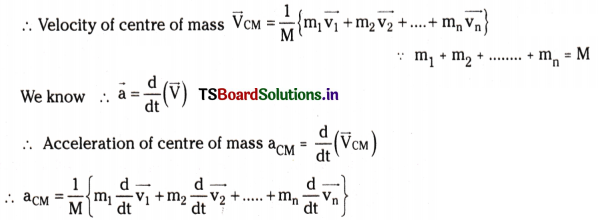
But Force (F) = ma, so total force on the body is
F = MaC.M = m1a1 + m2a2 + m3a3 + …… + mnan
or Total Force F = MaC.M. = F1 + F2 + F3 + …… + Fn
Hence, total force on the body is the sum of forces on individual particles and it is equals to force on centre of mass of the body.
Question 3.
Define vector product. Explain the properties of a vector product with two examples.
Answer:
Vector product (or) cross product: If the product of two vectors (say \(\overline{\mathrm{A}}\) and \(\overline{\mathrm{B}}\)) gives a vector then that multiplication of vectors is called cross product or vector product of vectors.
Mathematically \(\overline{\mathrm{A}}\) × \(\overline{\mathrm{B}}\) = |\(\overline{\mathrm{A}}\)||\(\overline{\mathrm{B}}\)|sinθ⋅\(\hat{\mathrm{n}}\)
where \(\hat{\mathrm{n}}\) = a unit vector perpendicular to both \(\overline{\mathrm{A}}\) and \(\overline{\mathrm{B}}\) (or) perpendicular to the plane of \(\overline{\mathrm{A}}\) and \(\overline{\mathrm{B}}\).
Properties of cross product:
1. Cross product is not commutative i.e. \(\overline{\mathrm{A}}\) × \(\overline{\mathrm{B}}\) ≠ \(\overline{\mathrm{B}}\) × \(\overline{\mathrm{A}}\) But \(\overline{\mathrm{A}}\) × \(\overline{\mathrm{B}}\) = –\(\overline{\mathrm{B}}\) × \(\overline{\mathrm{A}}\)
2. Cross product obeys distributive law i.e., \(\overline{\mathrm{A}}\) × (\(\overline{\mathrm{B}}\) + \(\overline{\mathrm{C}}\)) = (\(\overline{\mathrm{A}}\) × \(\overline{\mathrm{B}}\)) + (\(\overline{\mathrm{A}}\) × \(\overline{\mathrm{C}}\))
3. If any vector is represented by the combination of \(\overline{\mathrm{i}}\), \(\overline{\mathrm{j}}\) and \(\overline{\mathrm{k}}\) then cross product will obey right hand screw rule.
4. The product of two coplanar perpendicular unit vectors will generate a unit vector perpendicular to that plane i.e., \(\overline{\mathrm{i}}\) × \(\overline{\mathrm{j}}\) = \(\overline{\mathrm{k}}\), \(\overline{\mathrm{j}}\) × \(\overline{\mathrm{k}}\) = \(\overline{\mathrm{i}}\) and \(\overline{\mathrm{k}}\) × \(\overline{\mathrm{i}}\) = \(\overline{\mathrm{j}}\)
5. Cross product of parallel vectors is zero i.e., \(\overline{\mathrm{i}}\) × \(\overline{\mathrm{i}}\) = \(\overline{\mathrm{j}}\) × \(\overline{\mathrm{j}}\) = \(\overline{\mathrm{k}}\) × \(\overline{\mathrm{k}}\) = o
Examples of cross product:
1) Torque (or) moment of force (\(\bar{\tau}\)): It is defined as the product of force and perpendicular
distance from the point of application.
∴ Torque \(\bar{\tau}\) = \(\overline{\mathrm{r}}\) × \(\overline{\mathrm{F}}\)
2) Angular momentum and angular velocity: For a rigid body in motion, Angular momentum (\(\overline{\mathrm{L}}\)) = radius (\(\overline{\mathrm{r}}\)) × momentum (m\(\overline{\mathrm{P}}\))
∴ Angular momentum (\(\overline{\mathrm{L}}\)) = \(\overline{\mathrm{r}}\) × (m\(\overline{\mathrm{v}}\)) = m(\(\overline{\mathrm{r}}\) × \(\overline{\mathrm{V}}\))
Question 4.
Define angular velocity. Derive y = r ω.
Answer:
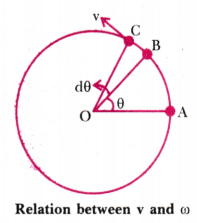
Angular velocity (ω): Rate of change of angular displacement is called angular velocity.
Relation between linear velocity (v) and angular velocity (ω):
- Let a particle P is moving along circumference of a circle of radius ‘r’ with uniform speed v.
- Let it is initially at the position A, during a small time Δt it goes to a new position say C from B.
- Angle subtended during this small interval is say dθ.
- By definition angular velocity, ω = \(\operatorname{Lt}_{\Delta \mathrm{t} \rightarrow 0} \frac{\Delta \theta}{\Delta \mathrm{t}}\) = \(\frac{d \theta}{d t}\)
But linear velocity v = \(\underset{\Delta t \rightarrow 0}{\operatorname{Lt}} \frac{\mathrm{BC}}{\delta \mathrm{t}}\)
When θ is small arc BC = r dθ ⇒ v = r ⋅ \(\frac{d \theta}{d t}\) ∴ v = r.ω (∵ \(\frac{\mathrm{d} \theta}{\mathrm{dt}}\) = ω)
Question 5.
Define angular acceleration and torque. Establish the relation between angular acceleration and torque.
Answer:
Angular acceleration (α): Rate of change of angular velocity Is called angular acceleration.
Torque : It is defined as the product of the force and the perpendicular distance of the point of
application of the force from that point.
Relation between angular acceleration and Torque:
We know that, L = Iω
On differentiating the above expression with respect to time ‘t’
\(\frac{\mathrm{dL}}{\mathrm{dt}}\) = \(\frac{\mathrm{d}}{\mathrm{dt}}(\mathrm{I} \omega)\) ⇒ \(\frac{\mathrm{dL}}{\mathrm{dt}}\) = I\(\frac{\mathrm{d} \omega}{\mathrm{dt}}\)
But \(\frac{\mathrm{dL}}{\mathrm{dt}}\) is the rate of change of angular momentum called “Torque (\(\tau\))” and \(\frac{\mathrm{d} \omega}{\mathrm{dt}}\) is the rate of change of angular velocity called “angular acceleration (α)”
∴ The relation between Torque and angular acceleration is, \(\tau\) = Iα
Question 6.
Write the equations of motion for a particle rotating about a fixed axis.
Answer:
Equations of rotational kinematics: If ‘θ’ is the angular displacement, ωi is the initial angular velocity, ωf is the final angular velocity after a time ‘t’ seconds and ‘α’ is the angular acceleration, then the equations of rotational kinematics can be written as, ωf = ωi + αt, θ = ωit + \(\frac{1}{2} \alpha t^2\) and \(\omega_{\mathrm{f}}^2\) – \(\omega_{\mathrm{i}}^2\) = 2αθ
VI. Long Answer Questions
Question 1.
State and prove the principle of conservation of angular momentum. Explain the principle of conservation of angular momentum with examples.
Answer:
Law of conservation of angular momentum: When no external torque is acting on a body then the angular momentum of that rotating body is constant.
i.e., I1ω1 = I2ω2 (when \(\tau\) = 0)
Explanation : Here I1 and I2 are moment of inertia of rotating bodies and ω1 and ω2 are their initial and final angular velocities, If external torque \(\tau\) = 0 then \(\frac{\mathrm{d} \overrightarrow{\mathrm{~L}}}{\mathrm{dt}}\) = \(\tau\) = 0
∴ Change in angular momentum is also zero.
∴ \(\mathrm{d} \overrightarrow{\mathrm{~L}}_2-\mathrm{d} \overrightarrow{\mathrm{~L}}_1\) = 0 or i.e., I2ω2 – I1ω1 = 0 or I1ω1 = I2ω2
∴ Change in angular momentum is also zero.
⇒ \(\mathrm{d} \overrightarrow{\mathrm{~L}}_2-\mathrm{d} \overrightarrow{\mathrm{~L}}_1\) = 0 or i.e., I2ω2 – I1ω1 = 0 or I1ω1 = I2ω2
Example – 1: A boy stands over the centre of a horizontal platform which is rotating freely with a speed ω1 (n1 revolutions/sec.) about a vertical axis passing through the centre of the platform and straight up through the boy.
- He holds two bricks in each of his hands close to his body. The combined moment of inertia of the system is say If.
- Let the boy stretches his arms to hold the masses far away from his body.
- In this position the moment of inertia increases to I2 and let ω2 is his angular speed.
Here ω2 < ω1 because moment of inertia increases.
∴ I1ω1 = I2ω2 ⇒ I1\(\frac{2 \pi}{\mathrm{~T}_1}\) = I2\(\frac{2 \pi}{\mathrm{~T}_2}\) ⇒ I1n1 = I2n2
Example – 2 : An athlete diving off a high spring board can bring his legs and hands close to the body and performs Somersault about a horizontal axis passing through his body in the air before reaching the water below it. During the fall his angular momentum remains constant.
Question 2.
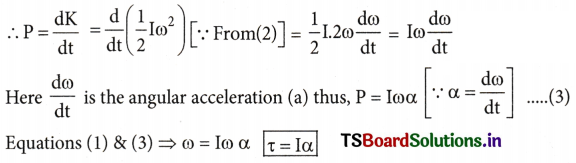
(a) Using the expressions for Power and Kinetic energy of rotational motion, derive the relation \(\tau\) = Iα.
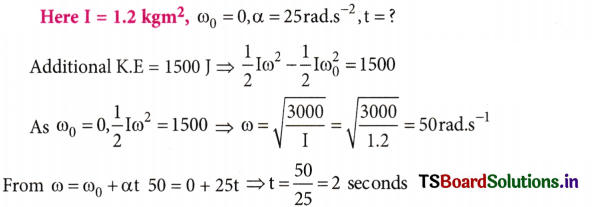
(b) The moment of inertia of a body shout a given axis is 1.2 kg-m2. Initially, the body is at rest in order to produce a rotational kinetic energy of 1500J, for how much duration an angular acceleration of 25 rad/s2 must be applied about that axis?
Answer:
(a) Derivation of \(\tau\) = Iα using power and kinetic energy of rotational motion:
Power of a rotational motion P = \(\tau\)ω ….(1)
Kinetic energy of rotational motion K.E. = \(\frac{1}{2} \mathrm{I} \omega^2\) ….. (2)
According to work-energy theorem, power can be expressed as the rate of change of kinetic energy.
(b)
Problems
Question 1.
Show that a ⋅ (b × c) is equal in magnitude to the volume of the paralielopiped formed on the three vectors a, b and c.
Solution:
Let a paralielopiped be formed on three vectors
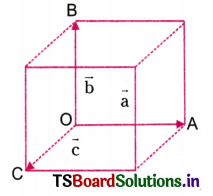
\(\overrightarrow{\mathrm{OA}}\) = \(\vec{a}\), \(\overrightarrow{\mathrm{OB}}\) = \(\vec{b}\), \(\overrightarrow{\mathrm{OC}}\) = \(\vec{c}\)
Now, \(\vec{b}\) × \(\vec{c}\) = be sin 90° \(\hat{\mathrm{n}}\) = bc\(\hat{\mathrm{n}}\) where \(\hat{\mathrm{n}}\) is the unit vector along \(\overrightarrow{\mathrm{OA}}\) perpendicular to the plane containing \(\vec{b}\) and \(\vec{c}\)
Now \(\vec{a}\) ⋅ (\(\vec{b}\) × \(\vec{c}\)) = \(\vec{a}\) ⋅ bc \(\hat{\mathrm{n}}\) = (a) (bc) cos 0°= abc
Which is equal in magnitude to the volume of paralielopiped.
Question 2.
A rope of negligible mass is wound round a hollow cylinder of mass 3 kg and radius 40 cm. What is the angular acceleration of the cylinder if the rope is pulled with a force of 30 N ? What is the linear acce-leration of the rope ? Assume that there is no slipping.
Solution:
Here M = 3 kg ; R = 40 cm = 0.4 m
Moment of inertia of the hollow cylinder about its axis, I = MR2 = 3(0.4)2 = 0.48 kg m2
Force applied, F = 30 N
∴ Torque, T = F × R = 30 × 0.4 = 12 N – m
If α is angular acceleration produced, then from \(\tau\) = lα
⇒ α = \(\frac{\tau}{\mathrm{I}}\) = \(\frac{12}{0.48}\) = 25 rad s-2 = 25 rad s-2
Linear acceleration, a = Rα = 0.4 × 25 = 10 ms-2.
Question 3.
A coin is kept a distance of 10 cm from the centre of a circular turn table. If the coefficient of static friction between the table and the coin is 0.8. Find the frequency or rotation of the disc at which the coin will just begin to slip.
Solution:
Distance of coin = r = 10 cm = 0.1 m. ; Coefficient of friction μ = 0.8.
Frequency of rotation = number of rotations per second.
For coin not to slip μmg = μrω2 ⇒ ω = \(\frac{\mu \mathrm{g}}{\mathrm{r}}\)
∴ ω = \(\sqrt{\frac{0.8 \times 9.8}{1}}\) = \(\sqrt{78.4}\) = 8.854 rad/sec.
Number of rotations per sec = Rotational frequency = \(\frac{\omega}{2 \pi}\) = \(\frac{8.854}{2 \pi}\) = 1.409 Rot/sec or 84.54 r.p.m.
Question 4.
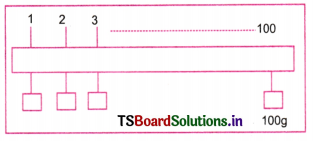
Particles of masses 1g, 2g, 3g…,1o0g are kept at the marks 1 cm, 2 cm, 3 cm…,100 cm respectively on a meter scale. Find the moment of inertia of the system of particles about a perpendicular bisector of the meter scale.
Solution:
Given Masses of 1g, 2g, 3g ….. 1oo g are 1, 2, 3 …… 100 cm on a scale.
i) Sum of masses Σm = \(\sum_{\mathrm{i}=1}^{\mathrm{n}} \mathrm{ni}\)
Sum of n natural numbers
S = \(\frac{\mathrm{n}(\mathrm{n}+1)}{2}\) = \(\frac{100 \times 101}{2}\)
∴ Total mass (M) = 5051 gr = 5.051 kg → (1)
ii) Centre of mass of all these masses is given by XC.M. = \(\frac{\left(m_1 x_1+m_2 x_2+\ldots .\right)}{\Sigma m}\)
\(=\frac{1 \times 1+2 \times 2+3 \times 3+\ldots .+100 \times 100}{\mathrm{M}}\) = \(\frac{1^2+2^2+3^2+\ldots \ldots+100^2}{M}\)
But sum of squares of 1st n natural numbers is (S) = \(\frac{\mathrm{n}(\mathrm{n}+1)(2 \mathrm{n}+1)}{6}\)
∴ CM = \(\frac{\mathrm{n}(\mathrm{n}+1)(2 \mathrm{n}+1)}{6 \times \mathrm{n}(\mathrm{n}+1)}\) use M = \(\frac{\mathrm{n}(\mathrm{n}+1)}{2}\) ∴ CM = \(\frac{201}{3}\) = 67 CM → (2)
iii) M.O.I. = I = \(\mathrm{m}_1 \mathrm{r}_1^2\) + \(\mathrm{m}_2 \mathrm{r}_2^2\) + \(\mathrm{m}_3 \mathrm{r}_3^2\) + … + \(\mathrm{m}_100 \mathrm{r}_100^2\)
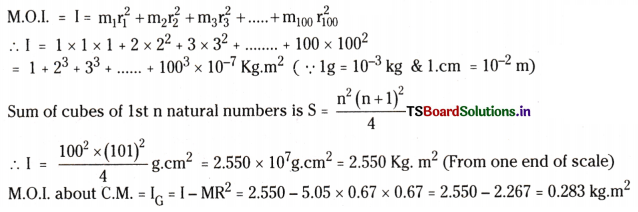
iv) Perpendiçular bisector is at 50 CM.; So shift M.O.I from centre of mass to
x1 = 50cm point from x = 67 CM
∴ Distance between the axis R = 67 – 50 = 17cm = 0.17M
M.O.I. about this axis I = IG + MR2 = 0.283 + 5.05 × 0.17 × 0.17 = 0.283 + 0.146 = 0.429 kgm2
∴ M.O.I. about perpendicular bisector of scale = 0.429 kg – m2
Question 5.
Three particles each of mass loo g are placed at the vertices of an equilateral triangle of side length 10 cm. Find the moment of inertia of the system about an axis passing through the centroid of the triangle and perpendicular to its plane.
Solution:
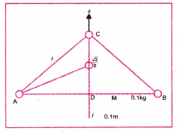
Mass of each particle m = 1oo g; side of equilateral triangle = 10 cm.
In equilateral triangle height of angular bisector CD = \(\frac{\sqrt{3}}{2} l\)
Centroid will divide the angular bisector in a ratio 2: 1 A
So X distance of each mass from vertex to centroid is 2.\(\frac{\sqrt{3}}{3} l\) = \(\frac{1}{\sqrt{3}} l\)
Moment of Inertia of the system I = m1\(\mathrm{r}_1^2\) + m2\(\mathrm{r}_1^2\) + m3\(\mathrm{r}_3^2\)
∴ I = 0.1 × \(\left(\frac{\sqrt{3}}{3} \times 0.1\right)^2\) + 0.1 × \(\left(\frac{\sqrt{3}}{3} \times 0.1\right)^2\) + o.1 × \(\left(\frac{\sqrt{3}}{3} \times 0.1\right)^2\) = 3 × \(\frac{3}{9}\) × 0.13 = 1 × 10⁻³ kg. m2
Question 6.
The moment of inertia of a fly wheel making 300 revolutions per minute is 0.3 kgm2. Find the torque required to bring it to rest in 20s.
Solution:
M.O.I, I = 0.3 kg. ; time, t = 20 sec.,
ω1 = 300 R.P.M. = \(\frac{30}{60}\) = 5. R.P.S.; ω2 = 0
Torque, latex]\tau[/latex] = Iα = 0.3 × \(\frac{5 \times 2 \pi}{20}\) = 0.471 N – m.
Question 7.
When 100J of work is done on a fly wheel, its angular velocity is increased from 60 rpm to 180 rpm. What is the moment of inertia of the wheel?
Solution:
W = 100J, ω1 = 60 RPM = 1 R.P.S = 2πRad.
ω2 = 180 R.P.M. = 3 R.P.S = 6n Rad.
Work done, W = 100 J = \(\frac{1}{2} \mathrm{I} \omega_2^2\) – \(\frac{1}{2} \mathrm{I} \omega_1^2\)
∴ 100 = \(\frac{1}{2} \mathrm{I}\left(36 \pi^2-4 \pi^2\right)\) ⇒ I = \(\frac{200}{32 \pi^2}\) = 0.6332 k g m2 = 0.63 kg.m2
Question 8.
Four spheres each diameter 2a and mass ‘m’ are placed with their centres on the four corners of a square of the side b. Calculate the moment of inertia of the system about any side of the square.
Solution:
Diameter of sphere = 2a ⇒ radius = a ; Side of square = b.
For spheres 1 and 2 axis of rotation is same and passing through diameters. M.O.I. of solid sphere about any diameter = \(\frac{2}{5}\)MR2 (put M = m and R = a)
∴ M.O.I. of spheres 1 & 2 = I1 + I2 = \(\frac{2}{5}\)ma2 + \(\frac{2}{5}\)ma2 = \(\frac{2}{5}\)ma2 → 1
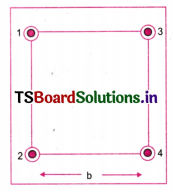
For spheres 3,4 M.O.I. about diameters = \(\frac{2}{5}\)ma2 + \(\frac{2}{5}\)ma2 = \(\frac{2}{5}\)ma2
Transfer this M.O.T. on to the axis using Parallel axes theorem.
∴ I3 + I4 = \(\frac{2}{5}\)ma2 + mb2 + \(\frac{2}{5}\)ma2 + mb2 = \(\frac{4}{5}\)ma2 + 2mb2
Total M.O.I. of the system = \(\frac{4}{5}\)ma2 + \(\frac{4}{5}\)ma2 + 2mb2 ∴ I = [\(\frac{8}{5}\)ma2 + 2mb2]
System of Particles and Rotational Motion Class 11 NCERT Solutions
Question 1.
Give the location of the centre of mass of a
(i) sphere
(ii) cylinder
(iii) ring and
(iv) cube; each of uniform mass density. Does the centre of mass necessarily lie inside the body ?
Answer:
The centre of mass of each of above bodies lies at their respective geometrical centres. No, the centre of mass may lie outside the body as in the case of a ring, a hollow sphere, a hollow cylinder, a hollow cube etc.
Question 2.
In the HCl molecule the separation between the nuclei of two atoms is about 1.27 A° (1 A° = 10-10 m). Find the approximate location of the centre of mass (CM) of the molecule. Given that a chlorine atom is about 35.5 times as massive as a hydrogen atom and nearly all the mass of the atom is concentrated in its nucleus.
Answer:
The centre of mass of two particle system is Xcm = \(\frac{m_1 x_1+m_2 x_1}{m_1+m_2}\)
HCl molecule contains one hydrogen (H) atom and one chlorine (Cl) atom. If mass of H-atom is mH, the mass of chlorine atom will be mCl = 35.5 mH.
Assuming origin at the location of H-atom, we have
m1 = mH, m2 = mCl = 35.5mHx1 = 0, x = x = 1.27 A°.
∴ The centre of mass of HCl molecule,
xcm = \(\frac{m_1 x_1+m_2 x_2}{m_1+m_2}\) = \(\frac{m_H \times 0+35.5 m_H \times 1.27 A^0}{m_H+35.5 m_H}\) = \(\frac{35.5}{36.5}\) × 1.27 A° = 1.235 A°
Question 3.
A child sits stationary at one end of a long trolley moving uniformly with a speed V on a smooth horizontal floor. If the child gets up and runs about on the trolley in any manner, what is the speed of the CM of the (trolley + child) system ?
Answer:
Initially the speed of system (trolley + sitting child) is V. When child runs about on the trolley, the forces involved (such as action, reaction, friction, etc.) are internal forces, which can not affect the net motion of the system. Therefore, the speed of system still remains V.
Question 4.
Show that the area of the triangle contained between the vectors \(\overrightarrow{\mathrm{a}}\) and \(\overrightarrow{\mathrm{b}}\) is one half of the magnitude of \(\overrightarrow{\mathrm{a}}\) × \(\overrightarrow{\mathrm{b}}\).
Answer:
Suppose two vectors \(\overrightarrow{\mathrm{a}}\) and \(\overrightarrow{\mathrm{b}}\) are represented by the sides OP and OQ of Δ POQ as shown in Fig.
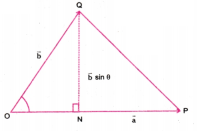
Let ∠POQ = θ. Draw QN ⊥ OP. The magnitude of the vector product \(\overrightarrow{\mathrm{a}}\) × \(\overrightarrow{\mathrm{b}}\) is
|\(\overrightarrow{\mathrm{a}}\) × \(\overrightarrow{\mathrm{b}}\)| sinθ = (OP)(OQ)sinθ
= (OP) (QN) [∵ QN = OQ sin θ]
= 2 × \(\frac{1}{2}\) (OP) (QN) = 2 × Area of Δ POQ
or Area of Δ POQ = \(\frac{1}{2}\)|\(\overrightarrow{\mathrm{a}}\) × \(\overrightarrow{\mathrm{b}}\)|
Hence the area of the triangle contained between the vectors \(\overrightarrow{\mathrm{a}}\) and \(\overrightarrow{\mathrm{b}}\) is one half of the magnitude of \(\overrightarrow{\mathrm{a}}\) × \(\overrightarrow{\mathrm{b}}\)
Question 5.
Show that \(\overrightarrow{\mathrm{a}}\)-(\(\overrightarrow{\mathrm{b}}\)×\(\overrightarrow{\mathrm{c}}\)) is equal in magnitude to the volume of the parallelopiped formed on the three vectors \(\overrightarrow{\mathrm{a}}\), \(\overrightarrow{\mathrm{b}}\) and \(\overrightarrow{\mathrm{c}}\).
Answer:
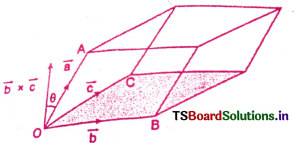
As showing in the fig. consider a parallelopiped having the three non-coplanar vectors, \(\overrightarrow{\mathrm{a}}\), \(\overrightarrow{\mathrm{b}}\) and \(\overrightarrow{\mathrm{c}}\) as edges meeting at a point O.
Let \(\overrightarrow{O A}\) = \(\overrightarrow{\mathrm{a}}\), \(\overrightarrow{O B}\) = \(\overrightarrow{\mathrm{b}}\) and \(\overrightarrow{O C}\) = \(\overrightarrow{\mathrm{c}}\).
Then, (\(\overrightarrow{\mathrm{b}}\) × \(\overrightarrow{\mathrm{c}}\)) is a vector perpendicular to the plane of \(\overrightarrow{\mathrm{b}}\) and \(\overrightarrow{\mathrm{c}}\).
Let θ be the angle between \(\overrightarrow{\mathrm{a}}\) and \(\overrightarrow{\mathrm{b}}\) × \(\overrightarrow{\mathrm{c}}\).
Clearly, | \(\overrightarrow{\mathrm{a}}\) | cos θ is the height of the parallelopiped orthogonal to it its base. Now
\(\overrightarrow{\mathrm{a}}\) – (\(\overrightarrow{\mathrm{b}}\) × \(\overrightarrow{\mathrm{c}}\)) = |\(\overrightarrow{\mathrm{b}}\) × \(\overrightarrow{\mathrm{c}}\)|cosθ = |\(\overrightarrow{\mathrm{b}}\) × \(\overrightarrow{\mathrm{c}}\)|cosθ
= Base area of the parallelopiped x Height of the parallelopiped on this base
= Volume of the parallelopiped having the vectors \(\overrightarrow{\mathrm{a}}\), \(\overrightarrow{\mathrm{b}}\), \(\overrightarrow{\mathrm{c}}\) along edges meeting at a point.
Question 6.
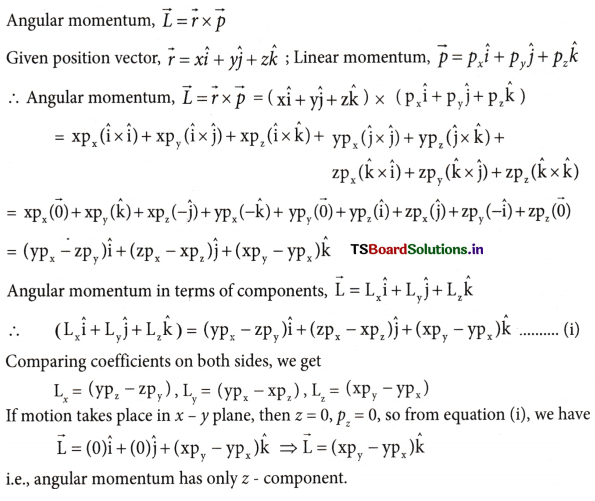
Find the components along the x, y, z axes of angular momentum \(\overrightarrow{\mathrm{L}}\) of a particle, whose position vector is \(\overrightarrow{\mathrm{r}}\) with components x, y, z and momentum is \(\overrightarrow{\mathrm{P}}\) with components px, py and pz. Show that if the particle moves ony in the x – y plane, the angular momentum has only z – component.
Answer:
Question 7.
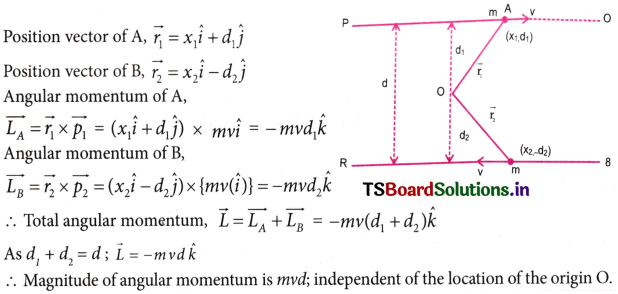
Two particles, each of mass m and speed v, travel in opposite directions along parallel lines separated by a distance d. Show that the angular momentum vector of the two particle system is the same whatever be the point about which the angular momentum is taken.
Solution:
Let PQ and RS be the parallel lines at separation d and O a point about which angular momentum is taken.
A and B are two particles each of mass m, moving in opposite directions with velocity v. At any instant let (x1, d1) and (x2, – d2) be the coordinates of A and B respectively. At this instant
Position vector of A, r, = xxi + dj
Question 8.
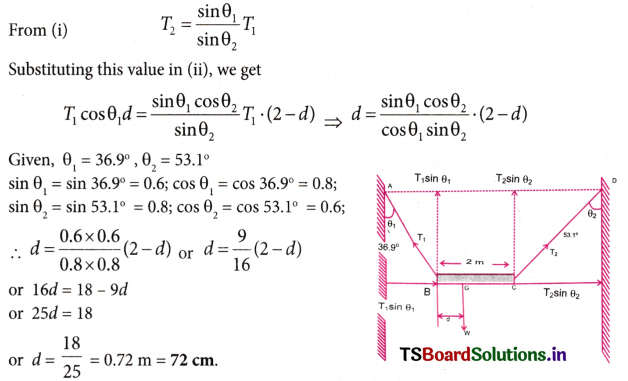
A non-uniform bar of weight W is suspended at rest by two strings of negligible weight as shown in Fig. The angles made by the strings with the vertical are 36.9° and 53.1° respectively. The bar is 2 m long.
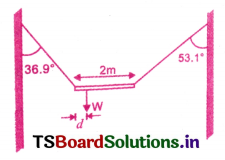
Calculate the distance ‘d’ of the centre of gravity of the bar from its left end.
Answer:
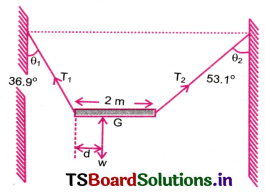
Let T1 and T2 the tensions in strings AB and CD respectively.
For horizontal equilibrium of bar
T1 sin θ1 = T2 sin θ2 ……. (i)
Taking moments about centre of gravity G,
T1 cos θ1 d = T2 Cos θ2 (2 – d) ……. (ii)
Question 9.
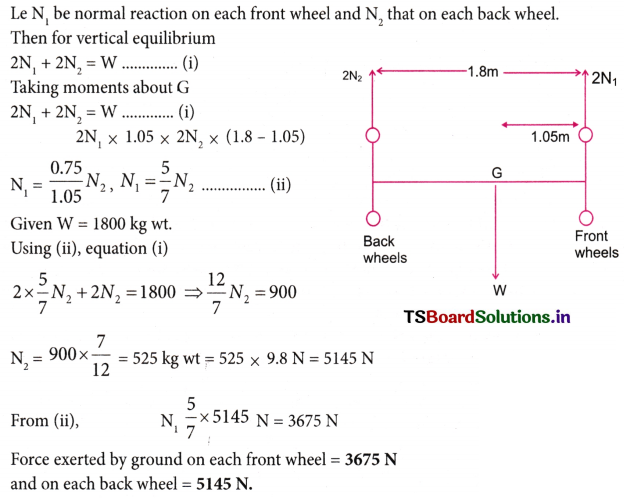
A car weighs 1800 kg. The distance between its front and back axles is 1.8 m. Its centre of gravity is 1.05 m behind the front axis. Determine the force exerted by the level ground on each front wheel and each back wheel.
Answer:
Question 10.
Torques of equal magnitude are applied to a hollow cylinder and a solid sphere, both having the same mass and radius. The cylinder is free to rotate about its standard axis of symmetry and the sphere is free to rotate about an axis passing through its centre. Which of the two will acquire a greater angular speed after a given time?
Answer:
Moment of inertia of cylinder about standard axis of symmetry, Icylinder = \(\frac{1}{2}\)MR2
Moment of inertia of sphere about its diameter, Isphere = \(\frac{2}{5}\)MR2
Equation of motion of rotational motion is \(\tau\) = Iα
Angular acceleration, α = \(\frac{\tau}{I}\); For same torque (\(\tau\)), α ∝ \(\frac{1}{I}\)
As Isphere < Icylinderr
So αsphere < αcylinderr
i.e., sphere will have greater angular acceleration, hence after a given time t, the sphere will acquire greater angular speed (ω = αt).
Question 11.
A solid cylinder of mass 20 kg rotates about its axis with angular speed 100 rad s-1. The radius of the cylinder is 0.25 m. What is the kinetic energy associated with the rotation of the cylinder? What is the magnitude of angular momentum of the cylinder about its axis?
Answer:
Moment of inertia of solid cylinder of mass M and radius R about its geometrical axis is I = \(\frac{1}{2}\)MR2
Here, mass M= 20 kg, radius R = 0.25 m
Moment of inertia, I = \(\frac{1}{2}\)MR2 = \(\frac{1}{2}\) × 20 × (0.25)2 = 0.625 kg m2
Angular velocity ω = 100 rad s-1
Kinetic energy of rotation, K = \(\frac{1}{2}\)Iω2 = \(\frac{1}{2}\) × 0.625 × (100)2 = 3125 J
Angular momentum of cylinder about its axis, L = Iω = 0.625 × 100 = 62.5 kg m2 s-1
Question 12.
(a) A child stands at the centre of a turn table with his two arms outstretched. The turntable is set rotating with an angular speed of 40 rev/mm. How much is the angular speed of the child if he folds his hands back and thereby reduces his moment of inertia to 2/5 times the initial value? Assume that the turntable rotates without friction.
(b) Show that the child’s new kinetic energy of rotation is more than the initial kinetic energy of rotation. How do you account for this increase is kinetic energy?
Answer:
(a) A external torque on the system is zero, the angular momentum of the system (L = Iω) remains constant.
I1ω1 = I2ω2 ⇒ ω2 = \(\frac{I_1 \omega_1}{I_2}\)
Given, I2 = \(\frac{2}{5}\)I1, ω1 = 40 rev/min.
Final angular speed, ω2 = \(\frac{I_1}{\left(\frac{2}{5} I_1\right)}\) × 40 = \(\frac{5}{2}\) × 40 = 100 rev/mm.
Kinetic energy, K = \(\frac{1}{2}\)Iω2 = \(\frac{L^2}{2 I}\)
(b) As angular momentum, L = constant KE ∝ \(\frac{1}{I}\)
As final moment of inertia becomes 2/5 times the initial value, therefore, final KE becomes 5/2 times of initial value. It is the inernal chemical energy of child, that is converted into kinetic energy of rotation.
Question 13.
A rope of negligible mass is would round a hollow cylinder of mass 3 kg and radius 40 cm. What is the angular acceleration of the cylinder if the rope is pulled with a force of 30 N ? What is the linear acceleration of the rope ? Assume that there is no slipping.
Answer:
Moment of inertia of hollow cylinder about its geometrical axis
I = MR2
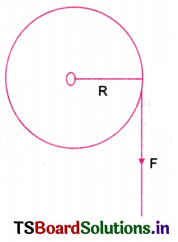
Here, M = 3 kg, R = 40 cm = 0.40m; I = 3 × (0.40)2 = 0.48 kgm2
When the rope is pulled by a force F = 30 N,
the torque exerted on the cylinder is \(\tau\) = FR = 30 × 0.40 kg m2
If α is the angular acceleration produced, then equation of rotational motion \(\tau\) = I α gives
α = \(\frac{\tau}{I}\) = \(\frac{12 \mathrm{Nm}}{0.48 \mathrm{kgm}^2}\) = 25 rad/s2
Linear acceleration, a = R α = 0.40 × 25 = 10 ms-2.
Question 14.
To maintain a rotor at a uniform angular speed of 200 rad s-1, an engine needs to traansmits a torque of 180 Nm. What is the power required by the engine? Assume that the enegine is 100% efficient.
Answer:
Assuming 100% efficiency,
Power required by engine, P = \(\frac{d W}{d t}\) = \(\tau \omega\)
Given, \(\tau\) = 180 Nm, ω = 200 rad s-1
∴ P = 180 × 200 = 36,000 W = 36 kW
Question 15.
From a uniform disc of radius R, a circular hole of radius R12 is cut out. The centre of the hole is at R/2 from the centre of the original disc. Locate the centre of gravity of the resulting flat body.
Answer:
Let σ be mass per unit area of disc.
Mass of smaller disc, m = \(\pi\left(\frac{R}{2}\right)^2 \sigma\) = \(\frac{1}{4} \pi R^2 \sigma\)
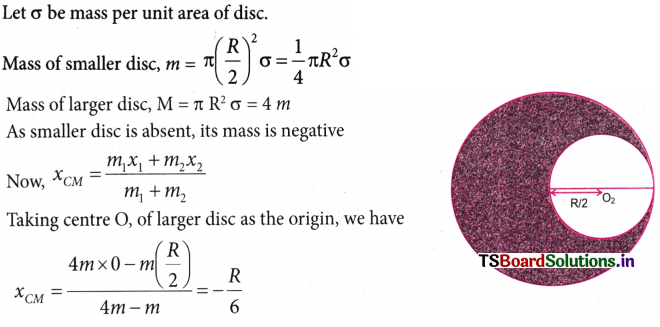
For a small body the centre of mass and centre of gravity coincide, so centre of gravity of resulting flat body is at a distance R/6 from the centre of original disc, opposite to the centre of cut portion.
Question 16.
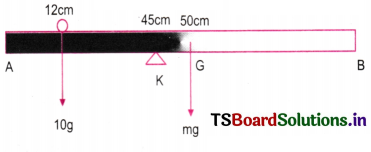
A metre stick is balanced on a knife edge at tis centre. When two coins, each of mass 5 g are put on the top of the other at the 12.0 cm mark, the stick is found to be balanced at 45.0 cm. What is the mass of metre stick ?
Answer:
Let M be the mass of metre stick AB.
The weight of two coins placed at 12 cm mark = 2 × 5 g = 10 g
Weight of metre stick acts at centre of gravity G, i.e, at 50 cm mark
Taking unit of mass as gram and unit of distance as cm.
Take moments about knife edge K, we get
⇒ 10 g (45 – 12) = Mg (50 – 45) ⇒ M = \(\frac{10 \times 33}{5}\) = 66 gram.
Question 17.
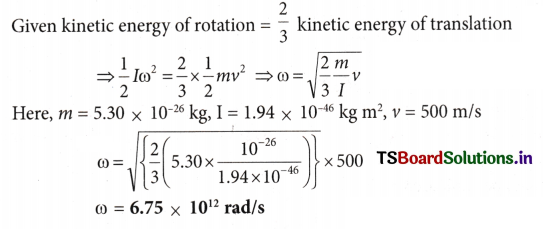
The oxygen molecule has a mass of 5.30 × 10⁻²⁶ kg and a moment of inertia 1.94 × 10-46 kg m2 about an axis through its centre perpendicular to the lines joining the two atoms. Suppose the mean speed of such a molecule in a gas is 500 m/s and that its kinetic energy of rotation is two third of its kinetic energy of translation. Find the average angular velocity of the molecule.
Answer: