
Referring to the AP Inter 2nd Year Maths Study Material Chapter 10 Vector Algebra Exercise 10c Solutions makes it easier to understand complex problems.
AP Inter 2nd Year Maths Vector Algebra Solutions Exercise 10c
I.
Question 1.
Find the angle between two vectors a and b with magnitude \(\sqrt{3}\) and 2 respectively having \(\vec{a} \cdot \vec{b}=\sqrt{6}\)
Solution:
Given that \(|\vec{a}|=\sqrt{3} ;|\vec{b}|=2\) and \(\vec{a} \cdot \vec{b}=\sqrt{6}\) Let θ be the ange between the vectors \(\overrightarrow{\mathrm{a}} \text { and } \overrightarrow{\mathrm{b}}\).
We have cos θ = \(\frac{\vec{a} \cdot \vec{b}}{|\vec{a}||\vec{b}|} \Rightarrow \cos \theta=\frac{\sqrt{6}}{\sqrt{3}(2)}=\frac{\sqrt{6}}{\sqrt{3} \sqrt{4}}=\frac{\sqrt{6}}{\sqrt{12}}=\sqrt{\frac{6}{12}}=\sqrt{\frac{1}{2}}=\frac{1}{\sqrt{2}}=\cos \frac{\pi}{4}\) ∴ θ = \(\frac{\pi}{4}\)
Question 2.
Find the angle between the vectors \(\hat{\mathbf{i}}-2 \hat{\mathbf{j}}+3 \hat{\mathbf{k}} \text { and } 3 \hat{\mathbf{i}}-2 \hat{\mathbf{j}}+\hat{\mathbf{k}}\).
Solution:
Given that \(\vec{a}=\hat{i}-2 \hat{j}+3 \hat{k} \text { and } \vec{b}=3 \hat{i}-2 \hat{j}+\hat{k}\).
⇒ \(|\overrightarrow{\mathrm{a}}|=\sqrt{1+4+9}=\sqrt{14} \text { and }|\overrightarrow{\mathrm{b}}|=\sqrt{9+4+1}=\sqrt{14}\)
Also \(\vec{a} \cdot \vec{b}=(\hat{i}-2 \hat{j}+3 \hat{k}) \cdot(3 \hat{i}-2 \hat{j}+\hat{k})\) = 1(3) + (-2)(-2) + 3(1) = 3 + 4 + 3 = 10
Let θ be the angle between the vectors \(\overrightarrow{\mathrm{a}} \text { and } \overrightarrow{\mathrm{b}}\).
∴ cos θ = \(\frac{\vec{a} \cdot \vec{b}}{|\vec{a} \| \vec{b}|}=\frac{10}{\sqrt{14} \sqrt{14}}=\frac{10}{14}=\frac{5}{7} \Rightarrow \theta=\cos ^{-1}\left(\frac{5}{7}\right)\)

Question 3.
Find the projection of the vector \(\hat{\mathbf{i}}-\hat{\mathbf{j}}\) on the vector \(\hat{\mathbf{i}}+\hat{\mathbf{j}}\)
Solution:
Let \(\vec{a}=\hat{i}-\hat{j}=\hat{i}-\hat{j}+0 \hat{k} \text { and } \vec{b}=\hat{i}+\hat{j}=\hat{i}+\hat{j}+0 \hat{k}\)
Projection of vector \(\vec{a} \text { on } \vec{b}=\frac{\vec{a} \cdot \vec{b}}{|\vec{b}|}=\frac{(1)(1)+(-1)(1)+0(0)}{\sqrt{(1)^2+(1)^2+0^2}}=\frac{1-1+0}{\sqrt{2}}=\frac{0}{\sqrt{2}}=0\)
Question 4.
Find the projection of the vector \(\hat{\mathbf{i}}+3 \hat{\mathbf{j}}+7 \hat{\mathbf{k}}\) on the vector \(7 \hat{\mathbf{i}}-\hat{\mathbf{j}}+8 \hat{\mathbf{k}}\)
Solution:
Let \(\vec{a}=i+3 \hat{j}+7 \hat{k} \text { and } \vec{b}=7 \hat{i}-\hat{j}+8 \hat{k}\)
Projection of vector \(\vec{a} \text { on } \vec{b}=\frac{\vec{a} \cdot \vec{b}}{|\vec{b}|}=\frac{1(7)+3(-1)+7(8)}{\sqrt{7^2+(-1)^2+8^2}}=\frac{7-3+56}{\sqrt{49+1+64}}=\frac{60}{\sqrt{114}}\)
Question 5.
Evaluate the product \((3 \vec{a}-5 \vec{b}) \cdot(2 \vec{a}+7 \vec{b})\)
Solution:
The given dot product is \((3 \vec{a}-5 \vec{b}) \cdot(2 \vec{a}+7 \vec{b})\)
= \((3 \vec{a}) \cdot(2 \vec{a})+(3 \vec{a}) \cdot(7 \vec{b})-(5 \vec{b})(2 \vec{a})-(5 \vec{b})(7 \vec{b})=6 \vec{a} \cdot \vec{a}+21 \vec{a} \cdot \vec{b}-10 \vec{b} \cdot \vec{a}-35 \vec{b} \cdot \vec{b}\)
= \(6|\vec{a}|^2+21 \vec{a} \cdot \vec{b}-10 \vec{a} \cdot \vec{b}-35|\vec{b}|^2\) [∵ \(\vec{a} \cdot \vec{a}=|\vec{a}|^2 \text { and } \vec{b} \cdot \vec{b}=|\vec{b}|^2 \text { and } \vec{b} \cdot \vec{a}=\vec{a} \cdot \vec{b}\)]
= \(6|\vec{a}|^2+11 \vec{a} \cdot \vec{b}-35|\vec{b}|^2\)
Question 6.
Find \(|\overrightarrow{\mathbf{x}}|\), if for a unit vector a,\((\vec{x}-\vec{a}) \cdot(\vec{x}+\vec{a})=12\)
Solution:
Given that \(\vec{a}\) is a unit vector ⇒ \(|\vec{a}|=1\) …..(i)
Also given that \((\vec{x}-\vec{a}) \cdot(\vec{x}+\vec{a})=12 \Rightarrow \vec{x} \cdot \vec{x}+\vec{x} \cdot \vec{a}-\vec{a} \cdot \vec{x}-\vec{a} \cdot \vec{a}=12 \Rightarrow|\vec{x}|^2-|\vec{a}|^2=12\)
Putting \(|\vec{a}|=1 \text { from (i), }|\vec{x}|^2-1=12 \Rightarrow|\vec{x}|^2=13 \Rightarrow|\vec{x}|=\sqrt{13} \text {. }\)
Question 7.
If \(\vec{a}=2 \hat{i}+2 \hat{j}+3 \hat{k}, \vec{b}=-\hat{i}+2 \hat{j}+\hat{k} \text { and } \vec{c}=3 \hat{i}+\hat{j}\) are such that \(\vec{a}+\lambda \vec{b}\) is perpendicular to \(\overrightarrow{\mathrm{c}}\), then find the value of λ.
Solution:
Given that \(\vec{a}=2 \hat{i}+2 \hat{j}+3 \hat{k}, \vec{b}=-\hat{i}+2 \hat{j}+\hat{k} \text { and } \vec{c}=3 \hat{i}+\hat{j}\)
Now, \(\vec{a}+\lambda \vec{b}=2 \hat{i}+2 \hat{j}+3 \hat{k}+\lambda(-\hat{i}+2 \hat{j}+\hat{k})=2 \hat{i}+2 \hat{j}+3 \hat{k}-\lambda \hat{i}+2 \lambda \hat{j}+\lambda \hat{k}\)
⇒ \(\vec{a}+\lambda \vec{b}=(2-\lambda) \hat{i}+(2+2 \lambda) \hat{j}+(3+\lambda) \hat{k}\)
Also we have \(\vec{c}=3 \hat{i}+\hat{j}=3 \hat{i}+\hat{j}+0 \hat{k}\)
Given that \(\vec{a}+\lambda \vec{b}\) is perpendicular to \(\vec{c} \Rightarrow(\vec{a}+\lambda \vec{b}) \cdot \vec{c}=0\)
⇒ (2 – λ)3 + (2 + 2λ)1 + (3 + λ)0 = 0
⇒ 6 – 3λ + 2 + 2λ = 0 ⇒ -λ + 8 = 0 ⇒ -λ = -8 ⇒ λ = 8
Question 8.
Show that \(|\vec{a}| \vec{b}+|\vec{b}| \vec{a}\) is perpendicular to \(|\vec{a}|\vec{b}-|\vec{b}| \vec{a}/latex], for any two nonzero vectors [latex]\vec{a} \text { and } \vec{b}\)
Solution:
The dot product of the given vectors is \((|\vec{a}|\vec{b}+|\vec{b}| \vec{a}) \cdot(|\vec{a}| \vec{b}-|\vec{b}| \vec{a})\)
= \(|\vec{a}|^2 \overrightarrow{b . \mathrm{b}}-|\overrightarrow{\mathrm{a}}||\overrightarrow{\mathrm{b}}| \overrightarrow{\mathrm{b}} \cdot \overrightarrow{\mathrm{a}}+|\overrightarrow{\mathrm{b}}||\overrightarrow{\mathrm{a}}| \overrightarrow{\mathrm{a} .} \overrightarrow{\mathrm{b}}-|\overrightarrow{\mathrm{b}}|^2 \overrightarrow{\mathrm{a} . \mathrm{a}}=|\overrightarrow{\mathrm{a}}|^2|\overrightarrow{\mathrm{~b}}|^2-|\overrightarrow{\mathrm{b}}|^2|\overrightarrow{\mathrm{a}}|^2=0\)
∴ The given two vectors are perpendicular.
Question 9.
If \(\overrightarrow{\mathbf{a}} . \overrightarrow{\mathbf{a}}=0\) and \(\overrightarrow{\mathbf{a}} . \overrightarrow{\mathbf{b}}=0\), then what can be concluded about the vector \(\overrightarrow{\mathbf{b}}\)?
Solution:
We have \(\vec{a} \cdot \vec{a}=0 \text { and } \vec{a} \cdot \vec{b}=0\)
Hence \(|\overrightarrow{\mathbf{a}}|^2=0 \Rightarrow|\overrightarrow{\mathbf{a}}|=0\)
∴ \(\overrightarrow{\mathbf{a}}\) is the zero vector
Thus, any vector \(\overrightarrow{\mathbf{b}}\) can satisfy \(\vec{a} . \vec{b}=0\)
Question 10.
If \(\overrightarrow{\mathbf{a}}, \overrightarrow{\mathbf{b}}, \overrightarrow{\mathbf{c}}\) are unit vectors such that \(\overrightarrow{\mathbf{a}}+\overrightarrow{\mathbf{b}}+\overrightarrow{\mathbf{c}}=\overrightarrow{\mathbf{0}}\), find the value of \(\overrightarrow{\mathbf{a}} \cdot \overrightarrow{\mathbf{b}}+\overrightarrow{\mathbf{b}} \cdot \overrightarrow{\mathbf{c}}+\overrightarrow{\mathbf{c}} \cdot \overrightarrow{\mathbf{a}}\)
Solution:
Consider \(|\vec{a}+\vec{b}+\vec{c}|^2=(\vec{a}+\vec{b}+\vec{c}) \cdot(\vec{a}+\vec{b}+\vec{c})\)
⇒ \(0=|\overrightarrow{\mathrm{a}}|^2+|\overrightarrow{\mathrm{b}}|^2+|\overrightarrow{\mathrm{c}}|^2+2(\overrightarrow{\mathrm{a}} \cdot \dot{\overrightarrow{\mathrm{~b}}}+\overrightarrow{\mathrm{b}} \cdot \overrightarrow{\mathrm{c}}+\overrightarrow{\mathrm{c}} \cdot \overrightarrow{\mathrm{a}})\)
⇒ 0 = 1 + 1 + 1 + \(2(\vec{a} \cdot \vec{b}+\vec{b} \cdot \vec{c}+\vec{c} \cdot \vec{a})=2(\vec{a} \cdot \vec{b}+\vec{b} \cdot \vec{c}+\vec{c} \cdot \vec{a})=-3\)
⇒ \((\vec{a} \cdot \vec{b}+\vec{b} \cdot \vec{c}+\vec{c} \cdot \vec{a})=\frac{-3}{2}\)
Question 11.
If either vector \(\vec{a}=\overrightarrow{0} \text { or } \vec{b}=\overrightarrow{0}\) then \(\overrightarrow{\mathbf{a}} \cdot \overrightarrow{\mathbf{b}}=0\). But the converse need not be true. Justify your answer with an example.
Solution:
Let \(\vec{a}=2 \hat{i}+4 \hat{j}+3 \hat{k} \text { and } \vec{b}=3 \hat{i}+3 \hat{j}-6 \hat{k}\)
∴ \(\vec{a} . \vec{b}\) = 2(3) + 4(3) + 3(-6) = 6 + 12 – 18 = 0
Here \(\vec{a} , \vec{b}\) are two non-zero perpendicular vectors
So, the converse of the statement need not to be true.
II.
Question 1.
Show that each of the given three vectors \(\frac{1}{7}(2 \hat{i}+3 \hat{j}+6 \hat{k}), \frac{1}{7}(3 \hat{i}-6 \hat{j}+2 \hat{k}), \frac{1}{7}(6 \hat{i}+2 \hat{j}-3 \hat{k})\) is a unit vector: Also, show that they are mutually perpendicular to each other.
Solution:
Let \(\frac{1}{7}(2 \hat{\mathrm{i}}+3 \hat{\mathrm{j}}+6 \hat{\mathrm{k}})=\frac{2}{7} \hat{\mathrm{i}}+\frac{3}{7} \hat{\mathrm{j}}+\frac{6}{7} \hat{\mathrm{k}}\) ……(i)
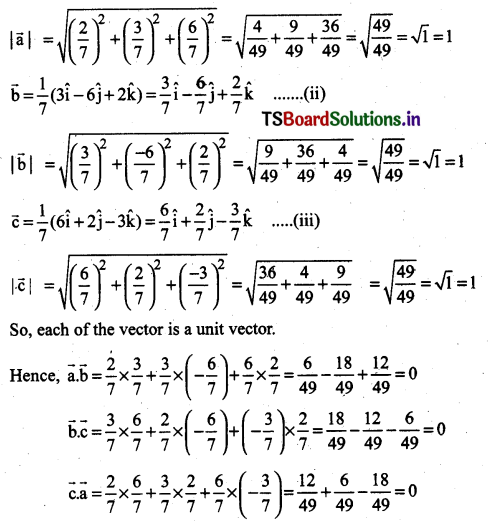
So, the 3 vectors are mutually perpendicular to each other.
Question 2.
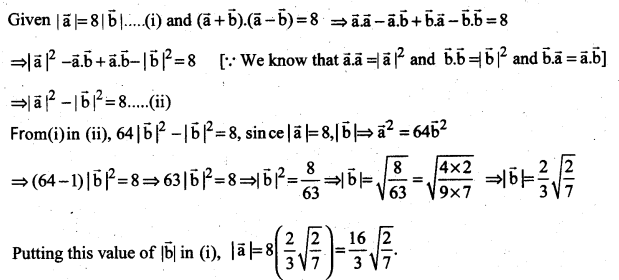
Find \(|\vec{a}| \text { and }|\vec{b}| \text { if }(\vec{a}+\vec{b}) \cdot(\vec{a}-\vec{b})=8 \text { and }|\vec{a}|=8|\vec{b}|\)
Solution:
Question 3.
Find the magnitude of two vectors \(\vec{a} \text { and } \vec{b}\), having the same magnitude and such that the angle between them is 60° and their scalar product is 1/2.
Solution:
Given that \(\vec{a} \text { = } \vec{b}\); angle θ between \(\vec{a} \text { and } \vec{b}\) is 60°, their scalar product =1/2
Thus \(\vec{a} \cdot \vec{b}=\frac{1}{2} \Rightarrow|\vec{a} \| \vec{b}| \cos \theta=\frac{1}{2}\) [∵ \(\overrightarrow{\mathrm{a}} \cdot \overrightarrow{\mathrm{~b}}=|\overrightarrow{\mathrm{a}}||\overrightarrow{\mathrm{b}}| \cos \theta\)]
Putting \(|\vec{b}|=|\vec{a}|\)and θ = 60° (in the above), we have \(|\vec{a}| .|\vec{a}| \cos 60^{\circ}=\frac{1}{2} \Rightarrow|\vec{a}|^2\left(\frac{1}{2}\right)=\frac{1}{2}\)
⇒ \(|\left.\vec{a}\right|^2=1 \Rightarrow|\vec{a}|=1\) ……..(i) (∵ Length of a vector is never negative)
∴ \(|\vec{b}|=|\vec{a}|=1\) [By (i)]
∴ \(|\vec{a}|=1 \text { and }|\vec{b}|=1\)
Question 4.
If the vertices A, B, C of a triangle ABC are (1, 2, 3), (-1, 0, 0), (0, 1, 2), respectively, then find ∠ABC. [∠ABC is the angle between the vectors \(\overrightarrow{B A} \text { and } \overrightarrow{B C}\)].
Solution:
Given vertices A, B, C of a triangle ABC are (1, 2, 3), (-1, 0, 0), (0, 1, 2) respectively.
Position vector (P. V) of point A (1, 2, 3) is \(\overrightarrow{O A}=\hat{i}+2 \hat{j}+3 \hat{k}\)
Position vector (P. V) of point B(-1, 0, 0) is \(\overrightarrow{O B}=-\hat{i}+0 \hat{j}+0 \hat{k}\)
Position vector (P.V) of point C(0, 1, 2) is \(\overrightarrow{\mathrm{OC}}=0 \hat{\mathrm{i}}+\hat{\mathrm{j}}+2 \hat{\mathrm{k}}\)
Now \(\overrightarrow{B A}=\overrightarrow{O A}-\overrightarrow{O B}=(\hat{i}+2 \hat{j}+3 \hat{k})-(-\hat{i}+0 \hat{j}+0 \hat{k})=\hat{i}+2 \hat{j}+3 \hat{k}+\hat{i}-0 \hat{j}-0 \hat{k}=2 \hat{i}+2 \hat{j}+3 \hat{k}\) ….(i)
and \(\overrightarrow{B C}=\overrightarrow{O C}-\overrightarrow{O B}=0 \hat{i}+\hat{j}+2 \hat{k}-(-\hat{i}+0 \hat{j}+0 \hat{k})=0 \hat{i}+\hat{j}+2 \hat{k}+\hat{i}-0 \hat{j}-0 \hat{k}=\hat{i}+\hat{j}+2 \hat{k}\) …………….(ii)
Using (i) and (ii) cos ∠ABC = \(\frac{\overrightarrow{\mathrm{BA}} \cdot \overrightarrow{\mathrm{BC}}}{|\overrightarrow{\mathrm{BA}}||\overrightarrow{\mathrm{BC}}|}=\frac{2(1)+2(1)+3(2)}{\sqrt{4+4+9} \sqrt{1+1+4}}=\frac{10}{\sqrt{17} \sqrt{6}}=\frac{10}{\sqrt{102}}\) [∵ \(\cos \theta=\frac{\vec{a} \cdot \vec{b}}{|\vec{a}||\vec{b}|}\)]
∴ ∠ABC = \(\cos ^{-1}\left(\frac{10}{\sqrt{102}}\right)\)
Question 5.
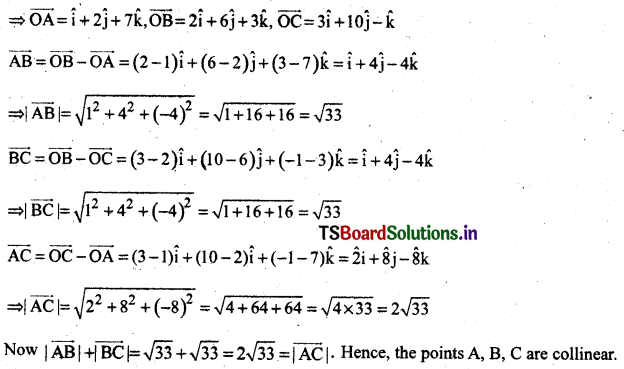
Show that the points A(1, 2, 7), B(2, 6, 3) and C(3, 10, -1) are coliinear.
Solution:
Given points are A(1, 2, 7), B(2, 6, 3) and C(3, 10, -1)
Question 6.
Show that the vectors \(2 \bar{i}-\bar{j}+\bar{k}, \bar{i}-3 \bar{j}-5 \bar{k}, \text { and } 3 \bar{i}-4 \bar{j}-4 \bar{k}\) form the vertices of a right angled triangle.
Solution:
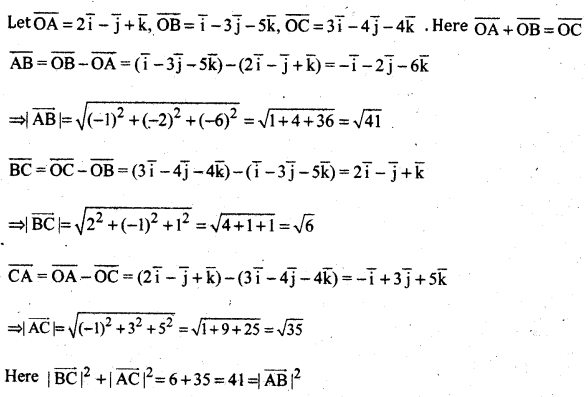
∴ Given vectors form a right angled triangle.