
Referring to the AP Inter 2nd Year Maths Study Material Chapter 11 Three Dimensional Geometry Exercise 11b Solutions makes it easier to understand complex problems.
AP Inter 2nd Year Maths Three Dimensional Geometry Solutions Exercise 11b
I.
Question 1.
Show that the three lines with direction are mutually perpendicular.
Solution:
Lines with dc’s l1, m1, n1 and l2, m2, n2 are perpendicular if l1l2 + m1m2 + n1n2 = 0
(i) l1, m1, n1 = \(\frac{12}{13}, \frac{-3}{13}, \frac{-4}{13}\) and l2, m2, n2 = \(\frac{4}{13}, \frac{12}{13}, \frac{3}{13}\)
∴ l1l2 + m1m2 + n1n2 = \(\frac{12}{13} \times \frac{4}{13}+\left(\frac{-3}{13}\right) \times \frac{12}{13}+\left(\frac{-4}{13}\right) \times \frac{3}{13}\)
= \(\frac{48}{169}-\frac{36}{169}-\frac{12}{169}\) = 0
Hence, the lines are perpendicular.
(ii) l1, m1, n1 = \(\frac{4}{13}, \frac{12}{13}, \frac{3}{13}\) and l2, m2, n2 = \(\frac{3}{13}, \frac{-4}{13}, \frac{12}{13}\)
∴ l1l2 + m1m2 + n1n2 = \(\frac{4}{13} \times \frac{3}{13}+\frac{12}{13} \times\left(\frac{-4}{13}\right)+\frac{3}{13} \times \frac{12}{13}\)
= \(\frac{12}{169}-\frac{48}{169}+\frac{36}{169}\) = 0
Hence, the lines are perpendicular.
(iii) l1, m1, n1 = \(\frac{3}{13}, \frac{-4}{13}, \frac{12}{13}\) and l2, m2, n2 = \(\frac{12}{13}, \frac{-3}{13}, \frac{-4}{13}\)
∴ l1l2 + m1m2 + n1n2 = \(\left(\frac{3}{13}\right) \times\left(\frac{12}{13}\right)+\left(\frac{-4}{13}\right) \times\left(\frac{-3}{13}\right)+\left(\frac{12}{13}\right) \times\left(\frac{-4}{13}\right)\)
= \(\frac{36}{169}+\frac{12}{169}-\frac{48}{169}\) = 0
Hence, the lines are perpendicular.
So, the all three lines are mutually perpendicular.

Question 2.
Show that the line through the points (1, -1, 2), (3, 4, -2) is perpendicular to the line through the points (0, 3, 2) and (3, 5, 6).
Solution:
Let AB be the line joining the points (1, -1, 2) and (3, 4, -2)and;
CD be the line through the points (0, 3, 2) and (3, 5, 6).
Hence, a1 = 3 – 1 = 2, b1 = 4 – (-1) = 5, c1 = -2 – 2 = -4
a2 = 3 – 0 = 3, b2 = 5 – 3 = 2, c2 = 6 – 2 = 4
If AB ⊥ CD then a1a2 + b1b2 + c1c2 = 0
⇒ (2)(3) + 5(2) + (-4)(4) = 6 + 10 – 16 = 16 – 16 = 0
Hence, AB and CD are perpendicular to each other.
Question 3.
If A(5, 6, 4), B(3, 5, 2) C(4, 3, x) are vertices of a triangle such that ∠ABC = \(\frac{\pi}{2}\). then
Solution:
Given A = (5, 6, 4), B = (3, 5, 2) C = (4, 3, x)
D.r’s of AB = (a1, b1, c1) = (5-3, 6-5, 4-2) = (2, 1, 2)
D.r’s of BC = (a2, b2, c2) = (4-3, 3-5, x-2) = (1, -2, x-2)
If AB ⊥ BC then a1a2 + b1b2 + c1c2 = 0
⇒ 2(1) + 1(-2) + 2(x-2) = 0
⇒ 2(1) – 2 + 2x – 4 = 0
⇒ 2x = 4
⇒ x = 2
Question 4.
Show that the line through the points (4, 7, 8), (2, 3, 4) is parallel to the line through the points (- 1, – 2, 1), (1, 2, 5).
Solution:
Let AB be the line joining the points (4, 7, 8) and (2,3,4) ;
and CD be the line through the points (- 1, -2, 1) and (1, 2, 5).
Hence, a1, = 2 – 4 = -2, b1 = 3 – 7 = -4, c1 = 4 – 8 = -4
a2 = 1 -(-1) = 2, b2 = 2-(-2) = 4, c2 = 5 – 1 = 4
If AB || CD then \(\frac{a_1}{a_2}=\frac{b_1}{b_2}=\frac{c_1}{c_2}\)
Here, \(\frac{a_1}{a_2}=\frac{-2}{2}\) = -1; \(\frac{b_1}{b_2}=\frac{-4}{4}\) = -1; \(\frac{c_1}{c_2}=\frac{-4}{4}\) = -1
Hence, AB is parallel to CD.
Question 5.
If the line through the poInts (1, 3, 4), (3, 1, 6) is perpendicular to the line through the points (0, -1, 3), (2, λ, -1), then find A.
Solution:
Let As (1, 3, 4), B = (3, 1, 6), C(0, -1, 3), and D (2, λ, -1)
D.r’s of AB = (a1, b1, c1) = (3-1, 1-3, 6-4) = (2, -2, 2)
D.r’s of CD = (a2, b2, c2) = (2-0, λ+1, -1-3) = (2, λ+1, -4)
If AB ⊥ CD then a1a2 + b1b2 + c1c2 = 0
⇒ 2(2) + (-2)(λ+1) + 2(-4) = 4 – 2λ – 2 – 8 = 0
⇒ -2λ = 6
⇒ λ = -3
Question 6.
Find the equation of the line which passes through the point (1, 2, 3) and is parallel to the vector \(3 \hat{i}+2 \hat{j}-2 \hat{k}\).
Solution:
Given that the line passes through the point A(1, 2, 3).
∴ the position vector through A( 1, 2, 3) is \(\vec{a}=\hat{i}+2 \hat{j}+3 \hat{k}\), \(\vec{b}=3 \hat{i}+2 \hat{j}-2 \hat{k} .\)
So, line passing through point A(1, 2, 3) and parallel to b is given by \(\vec{r}=\vec{a}+\lambda \vec{b}\), λ is a real
Hence required equation of the line is \(\vec{r}=\hat{i}+2 \hat{j}+3 \hat{k}+\lambda(3 \hat{i}+2 \hat{j}-2 \hat{k})\)
The Cartesian form is with (xi,yj,zj) = (1,2,3) and the direction ratios (a, b, c) = (3, 2, -2) is
\(\frac{\mathrm{x}-\mathrm{x}_1}{\mathrm{a}}=\frac{\mathrm{y}-\mathrm{y}_1}{\mathrm{~b}}=\frac{\mathrm{z}-\mathrm{z}_1}{\mathrm{c}}\)
⇒ \(\frac{x-1}{3}=\frac{y-2}{2}=\frac{z-3}{-2}\)
Question 7.
Find the equation of a line parallel to x-axis and passing through the origin.
Solution:
The line parallel to x-axis and passing through the origin O(0,0,0)is x-axis itself.
Let A be a point on x-axis.
∴ the coordinates of A are given by (a, 0, 0), where a∈R
Hence, the direction ratios of OA are (a, 0, 0)
The equation of OA is given by ⇒ \(\frac{x-0}{a}=\frac{y-0}{0}=\frac{z-0}{0}\) ⇒ \(\frac{\mathrm{x}}{1}=\frac{\mathrm{y}}{0}=\frac{\mathrm{z}}{0}\) = a
Hence, the equation of line parallel to x-axis and passing origin is y = 0, z = 0
Question 8.
Find the equation of the line in vector and in cartesian form that passes through the point with position vector \(2 \hat{i}-\hat{j}+4 \hat{k}\) and is in the direction \(\hat{i}+2 \hat{j}-\hat{k}\)
Solution:
Given that \(\vec{a}=2 \hat{i}-\hat{j}+4 \hat{k}\), \(\vec{b}=\hat{i}+2 \hat{j}-\hat{k}\)
The vector equation of the line is given by \(\vec{r}=\vec{a}+\lambda \vec{b}\), where λ is some real number
Hence, \(\vec{r}=2 \hat{i}-\hat{j}+4 \hat{k}+\lambda(\hat{i}+2 \hat{j}-\hat{k})\)
The cartesian form is with (x1, y1, z1) = (2, -1, 4) and the direction ratios (a, b, c) = (1, 2, -1) is
\(\frac{x-x_1}{a}=\frac{y-y_1}{b}=\frac{z-z_1}{c}\)
⇒ \(\frac{x-2}{1}=\frac{y+1}{2}=\frac{z-4}{-1}\)
Question 9.
Find the cartesian equation of the line which passes through the point (- 2, 4, – 5) and parallel to the line given by \(\frac{x+3}{3}=\frac{y-4}{5}=\frac{z+8}{6}\)
Solution:
It is given that the required line passes through the point (- 2,4, – 5) and is parallel to \(\frac{x+3}{3}=\frac{y-4}{5}=\frac{z+8}{6}\)
∴ its direction ratios are 3k, 5k and 6k, where k ≠ 0
It is known that the equation of the line through the point (x1, y1, z1)and with direction ratios (a, b, c) is given by
\(\frac{x-x_1}{a}=\frac{y-y_1}{b}=\frac{z-z_1}{c}\)
Hence, the equation of the required line is \(\frac{x+2}{3 k}=\frac{y-4}{5 k}=\frac{z+5}{6 k}\) ⇒ \(\frac{x+2}{3}=\frac{y-4}{5}=\frac{z+5}{6}\) = k
Thus, the cartesian equation of the line is \(\frac{x+2}{3}=\frac{y-4}{5}=\frac{z+5}{6}\)
Question 10.
The cartesian equation of a line is \(\frac{x-5}{3}=\frac{y+4}{7}=\frac{z-6}{2}\). Write its vector form.
Solution:
It is given that the Cartesian equation of the line is \(\frac{x-5}{3}=\frac{y+4}{7}=\frac{z-6}{2}\)
Hence, the given line passes through the point (5, -4, 6)
∴ the position vector of the point is \(\vec{a}=5 \hat{i}-4 \hat{j}+6 \hat{k}\)
Also, the direction ratios of the given line are (3,7,2).
This means that the line is in the direction of the vector, \(\vec{b}=3 \hat{i}+7 \hat{j}+2 \hat{k}\)
As we known that the line through positive vector and in the direction of the vector \(\vec{b}\) is
given by the equation, \(\vec{r}=a+\lambda \vec{b}\), λ ∈ R
∴ \(\vec{r}=(5 \hat{i}-4 \hat{j}+6 \hat{k})+\lambda(3 \hat{i}+7 \hat{j}+2 \hat{k})\) is the required equation of the given line in vector form.
Question 11.
Find the angle between the lines whose direction ratios are a, b, c and b – c, c – a„ a – b.
Solution:
The angle θ between the lines with direction ratios a,b,c and (b – c), (c – a), (a – b) is given by,
cos θ = \(\left|\frac{a(b-c)+b(c-a)+c(a-b)}{\sqrt{a^2+b^2+c^2} \sqrt{(b-c)^2+(c-a)^2+(a-b)^2}}\right|\)
θ = cos-1\(\frac{ab-ac+bc-ab+ac-bc}{\sqrt{a^2+b^2+c^2} \sqrt{(b-c)^2+(c-a)^2+(a-b)^2}}\) = cos-1 0 = 90°
∴ the required angle is 90°
Question 12.
Find the angle between the following pairs of lines:
\(\vec{r}=2 \hat{i}-5 \hat{j}+\hat{k}+\lambda(3 \hat{i}+2 \hat{j}+6 \hat{k})\) and \(\vec{r}=7 \hat{i}-6 \hat{k}+\mu(\hat{i}+2 \hat{j}+2 \hat{k})\)
Solution:
Angle between the given pairs of lines is given by cos θ = \(\left|\frac{\overline{b_1} \cdot \overline{b_2}}{\left|\overline{b_1}\right|\left|\overline{b_2}\right|}\right|\)
The given lines are parallel to the vectors, \(\overrightarrow{b_1}=3 \hat{i}+2 \hat{j}+6 \hat{k}\) and \(\overrightarrow{b_2}=\hat{i}+2 \hat{j}+2 \hat{k}\)
\(\left|\vec{b}_1\right|=\sqrt{3^2+2^2+6^2}=\sqrt{49}\) = 7; \(\left|\overrightarrow{b_2}\right|=\sqrt{1^2+2^2+2^2}=\sqrt{9}\) = 3
\(\vec{b}_1 \cdot \vec{b}_2\) = (3i + 2j + 6k) . (i + 2j + 2k) = 3(1) + 2(2) + 6(2) = 3 + 4 + 12 = 19
∴ cos θ = \(\left|\frac{\overrightarrow{b_1} \cdot \overrightarrow{b_2}}{\left|\overrightarrow{b_1}\right|\left|\overrightarrow{b_2}\right|}\right|=\left|\frac{19}{7 \times 3}\right|=\frac{19}{21}\)
⇒ θ = cos-1\(\left(\frac{19}{21}\right)\)
Question 13.
Find the angle between the following pairs of lines:
\(\vec{\mathrm{r}}=3 \hat{\mathrm{i}}+\hat{\mathrm{j}}-2 \hat{\mathrm{k}}+\lambda(\hat{\mathrm{i}}-\hat{\mathrm{j}}-2 \hat{\mathrm{k}})\) and \(\vec{r}=2 \hat{i}-\hat{j}-56 \hat{k}+\mu(3 \hat{i}-5 \hat{j}-4 \hat{k})\)
Solution:
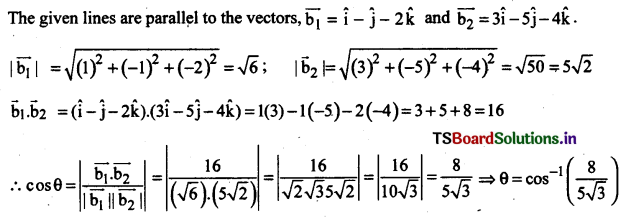
Question 14.
Find the angle between the following pair of lines:
\(\frac{x-2}{2}=\frac{y-1}{5}=\frac{z+3}{-3}\) and \(\frac{x+2}{-1}=\frac{y-4}{8}=\frac{z-5}{4}\)
Solution:
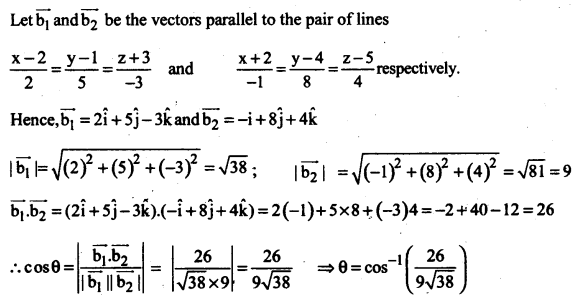
Question 15.
Find the angle between* the following pair of lines:
\(\frac{x}{2}=\frac{y}{2}=\frac{z}{1}\) and \(\frac{x-5}{4}=\frac{y-2}{1}=\frac{z-3}{8}\)
Solution:
Let \(\vec{\mathrm{b}_1}\) and \(\vec{\mathrm{b}_2}\) be the vectors parallel to the pair of lines
\(\frac{x}{2}=\frac{y}{2}=\frac{z}{1}\) and \(\frac{x-5}{4}=\frac{y-2}{1}=\frac{z-3}{8}\) respectively
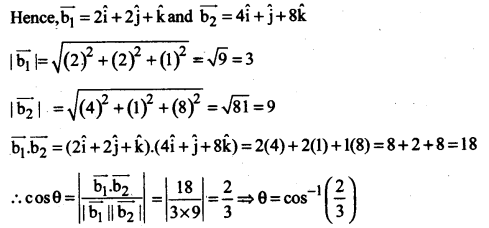
Question 16.
Show that the lines \(\frac{x-5}{7}=\frac{y+2}{-5}=\frac{z}{1}\) and \(\frac{x}{1}=\frac{y}{2}=\frac{z}{3}\) are perpendicular to each other.
Solution:
The equations of the given lines are \(\frac{x-5}{7}=\frac{y+2}{-5}=\frac{z}{1}\) and \(\frac{x}{1}=\frac{y}{2}=\frac{z}{3}\)
Here, a1 = 7, b1 = -5, c1 = 1; a2 = 1, b2 = 2, c2 = 3
Two lines with direction ratios, a1, b1, c1 and a2, b2, c2 are perpendicular to each other,
if a1a2 + b1b2+ c1c2 = 0.
Here, 7(1) + (-5)2 + 1(3) = 7 – 10 + 3 = 0
∴ the given lines are perpendicular to each other.
Question 17.
Show that the pair of lines \(\frac{4-x}{3}=\frac{2 y+1}{2}=\frac{z-1}{5}\) and \(\frac{2 x+1}{2}=\frac{3-y}{2}=\frac{3 z-1}{3}\) are perpendicular to each other.
Solution:
The equations of the given lines are \(\frac{4-x}{3}=\frac{2 y+1}{2}=\frac{z-1}{5}\) ⇒ \(\frac{x-4}{-3}=\frac{y+1 / 2}{1}=\frac{z-1}{5}\)
\(\frac{2 x+1}{2}=\frac{3-y}{2}=\frac{3 z-1}{3}\) ⇒ \(\frac{x+1 / 2}{1}=\frac{y-3}{-2}=\frac{z-1 / 3}{1}\)
Here, a1 = -3, b1 = 1, c1 = 5
a2 = 1, b2 = -2, c2 = 1
Two lines with direction ratios, a1, b1, c1 and a2, b2, c2 are perpendicular to each other,
if a1a2 + b1b2 + c1c2 = 0.
Here, (-3)1 + 1(-2) + 5(1) = -3 – 2 + 5 = 0
∴ the given lines are perpendicular to each other.
Question 18.
If the lines \(\frac{x-1}{-3}=\frac{y-2}{2 k}=\frac{z-3}{2}\) and \(\frac{x-1}{3 k}=\frac{y-1}{1}=\frac{z-6}{-5}\) are perpendicular, find the value of k.
Solution:
From the given equations, we have a1 = -3, b1 = 2k, c1 = 2; a2 = 3k, b2 = 1, c2 = -5
Two lines with d.r’s a1, b1, c1 and a2, b2, c2 are perpendicular, if a1a2 + b1b2 + c1c2 = 0
⇒ -3(3k) + 2k(1) + 2(-5) = 0
⇒ -9k + 2k – 10 = 0
⇒ 7k = -10
⇒ k = \(\frac{-10}{7}\)
Question 19.
Find the values of p so that the lines
\(\frac{1-x}{3}=\frac{7 y-14}{2 p}=\frac{z-3}{2}\) and \(\frac{7-7 x}{3 p}=\frac{y-5}{1}=\frac{6-z}{5}\) are at right angles.
Solution:
Equation of the lines in the standard form are
\(\frac{1-x}{3}=\frac{7 y-14}{2 p}=\frac{z-3}{2}\)
⇒ \(\frac{x-1}{-3}=\frac{y-2}{\frac{2 p}{7}}=\frac{z-3}{2}\) and
\(\frac{7-7 x}{3 p}=\frac{y-5}{1}=\frac{6-z}{5}\)
⇒ \(\frac{x-1}{\frac{-3 p}{7}}=\frac{y-5}{1}=\frac{z-6}{-5}\)
The direction ratios of the lines are given by a1 = -3, b1 = \(\frac{2 p}{7}\), c1 = 2; a2 = \(\frac{-3 p}{7}\), b2 = 1, c2 = -5
Since, both the lines are perpendicular to each other, we have
a1a2 + b1b2 + c1c2 = 0
⇒ (-3) \(\left(\frac{-3 p}{7}\right)\) + \(\left(\frac{2 p}{7}\right)\)1 + 2(-5) = 0
⇒ \(\frac{9 p}{7}\) + \(\frac{2 p}{7}\) – 10 = 0
⇒ \(\frac{11}{7}\)p = 10
⇒ 11p = 10 × 7
⇒ p = \(\frac{70}{11}\)
Question 20.
Find the values of p so that the lines \(\frac{x-5}{5 p+2}=\frac{2-y}{5}=\frac{z-1}{1}\) and \(\frac{x}{1}=\frac{2 y+1}{4 p}=\frac{z-1}{3}\) arc at right angles.
Solution:
The given lines are \(\frac{x-5}{5 p+2}=\frac{2-y}{5}=\frac{z-1}{1}\) and \(\frac{x}{1}=\frac{2 y+1}{4 p}=\frac{z-1}{3}\)
The direction ratios of the lines are given by
a1 = 5P + 2, b1 = -5, c1 = 1; a2 = 1, b2 = 2p, c2 = 3
Since, both the lines are perpendicular to each other, we have a1a2 + b1b2 + c1c2 = 0
⇒ (5p + 2)(1)+(-5)2p + 1(3) = 0
⇒ -5p + 5 = 0
⇒ 5p = 5
⇒ p = 1
II.
Question 1.
Find the distance between the pair of parallel lines
\(\vec{r}=(\hat{i}+2 \hat{j}-4 \hat{k})+\lambda(4 \hat{i}+3 \hat{j}-12 \hat{k})\) and \(\vec{r}=(3 \hat{i}+3 \hat{j}-5 \hat{k})+\mu(4 \hat{i}+3 \hat{j}-12 \hat{k})\)
Solution:
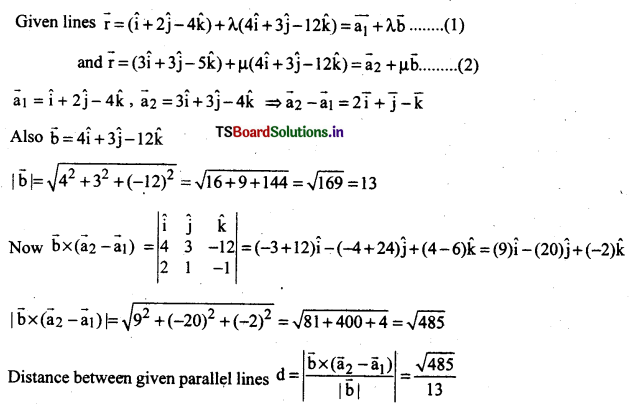
Question 2.
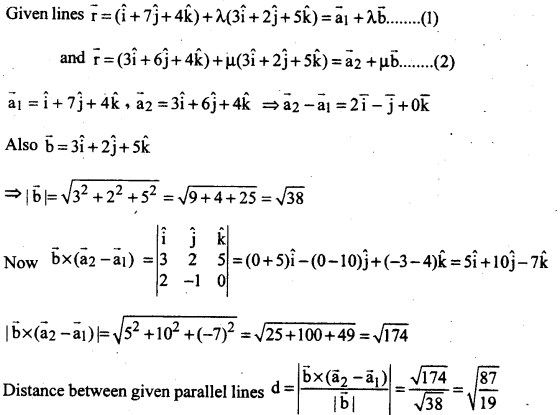
Find the distance between the pair of parallel lines
\(\vec{r}=(\hat{i}+7 \hat{j}+4 \hat{k})+\lambda(3 \hat{i}+2 \hat{j}+5 \hat{k})\) and \(\vec{r}=(3 \hat{i}+6 \hat{j}+4 \hat{k})+\mu(3 \hat{i}+2 \hat{j}+5 \hat{k})\)
Solution:
Question 3.
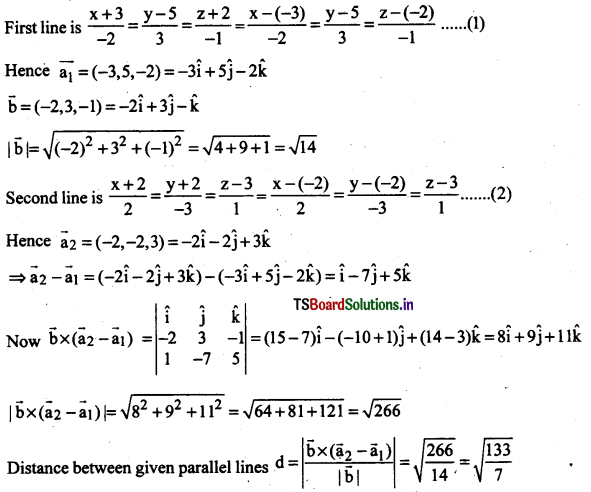
Find the distance between the pair of parallel lines.
\(\frac{x+3}{-2}=\frac{y-5}{3}=\frac{z+2}{-1}\) and \(\frac{x+2}{2}=\frac{y+2}{-3}=\frac{z-3}{1}\)
Solution:
Question 4.
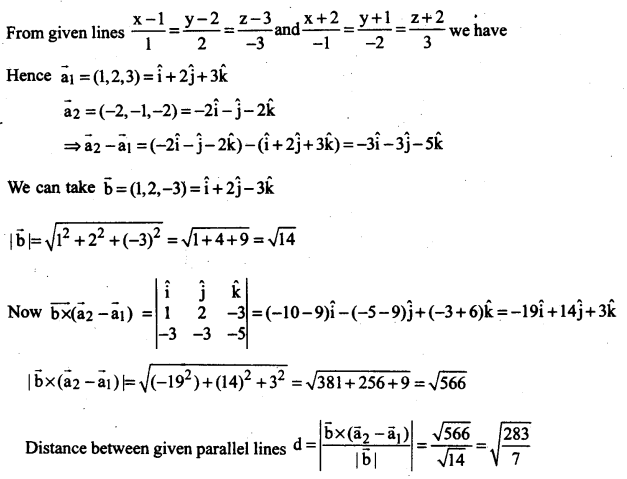
Find the distance between the pair of parallel lines.
\(\frac{x-1}{1}=\frac{y-2}{2}=\frac{z-3}{-3}\) and \(\frac{x+2}{-1}=\frac{y+1}{-2}=\frac{z+2}{3}\)
Solution:
Question 5.
If the lines whose direction ratios are (1, 2, z), (1, y, -1) and (x, -4, 1) are mutually perpendicular,then find the value of x+y+z .
Solution:
Let Dr’s of given lines are (a1, b1, c1) = (1, 2, z) …………. (1)
(a2, b2, c2) = (1, y, -1) ……………. (2)
(a3, b3, c3) = (x, -4, 1) …………… (3)
Lines with Dys (a1, b1, c1), (a2, b2, c2) are mutually perpendicular if a1a2 + b1b2 + c1c2 = 0
Here, (1)1 + 2(y) + z(-1) = 0 ⇒ 1+ 2y – z = 0 ……………… (4)
a2a3 + b2b3 + c2c3 = 0 ⇒ x – 4y – 1 = 0 ……………… (5)
a3a1 + b3b1 + c3c1 = 0 ⇒ x – 8+ z = 0 …………… (6)
By solving (4), (5) & (6) we get the values of x, y, z
(5) – (6)
-4y – 1 + 8 – z = 0 ⇒ -4y – z+ 7 = 0 ………. (7)
(4) × 2 ⇒ 4y – 2z + 2 = 0
Adding we get -3z + 9 = 0
⇒ -3z = -9
⇒ z = 3
From (6), we have x – 8 + z = 0
⇒ x – 8 + 3 = 0 ⇒ x = 5
From (4), we have 2y = z – 1 = 0
⇒ 2y = 3 – 1 ⇒ 2y = 2
⇒ y = 1
∴ x + y + z = 5 + 1 + 3 = 9
III.
Question 1.
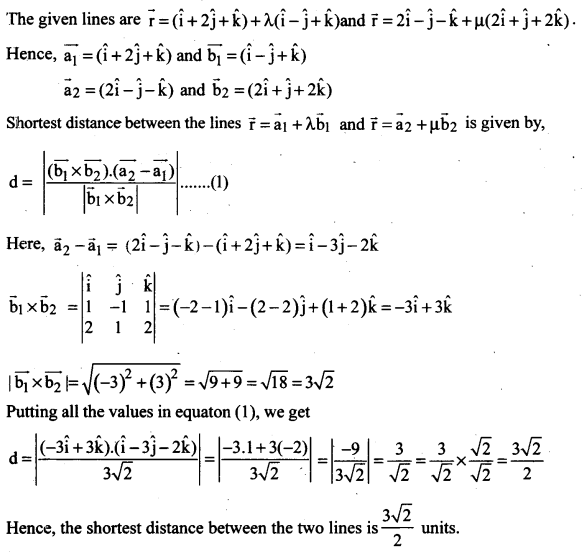
Find the shortest distance between the lines
\(\vec{r}=(\hat{i}+2 \hat{j}+\hat{k})+\lambda(\hat{i}-\hat{j}+\hat{k})\) and \(\vec{r}=2 \hat{i}-\hat{j}-\hat{k}+\mu(2 \hat{i}+\hat{j}+2 \hat{k})\)
Solution:
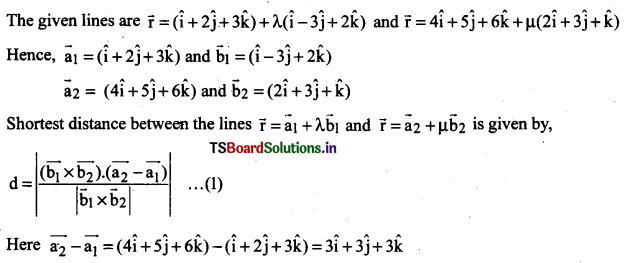
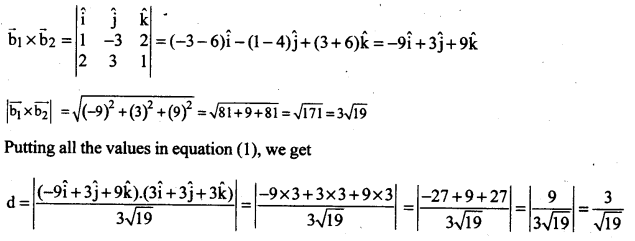
Question 2.
Find the shortest distance between the lines whose vector equations are
\(\vec{r}=(\hat{i}+2 \hat{j}+3 \hat{k})+\lambda(\hat{i}-3 \hat{j}+2 \hat{k})\) and \(\vec{r}=(\hat{i}+2 \hat{j}+3 \hat{k})+\lambda(\hat{i}-3 \hat{j}+2 \hat{k})\)
Solution:
Question 3.
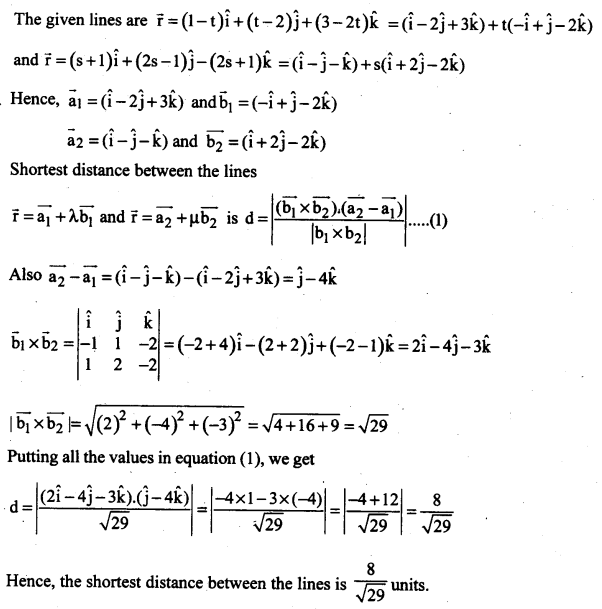
Find the shortest distance between the lines whose equations are
\(\vec{r}=(1-t) \hat{i}+(t-2) \hat{j}+(3-2 t) \hat{k}\) and \(\vec{r}=(s+1) \hat{i}+(2 s-1) \hat{j}-(2 s+1) \hat{k}\)
Solution:
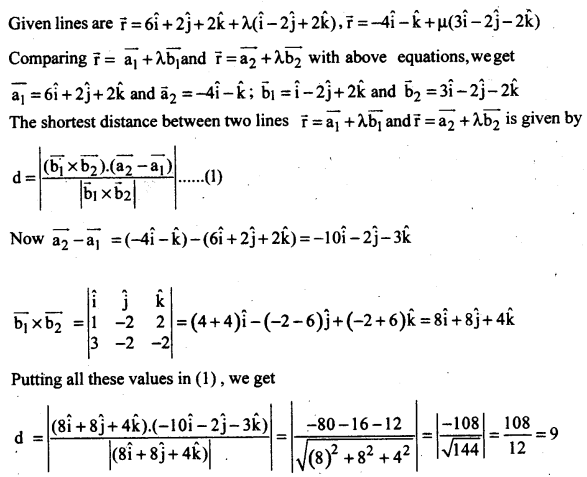
Question 4.
Find the shortest distance between lines \(\vec{r}=6 \hat{i}+2 \hat{j}+2 \hat{k}+\lambda(\hat{i}-2 \hat{j}+2 \hat{k})\) and \(\vec{r}=-4 \hat{i}-\hat{k}+\mu(3 \hat{i}-2 \hat{j}-2 \hat{k})\)
Solution:
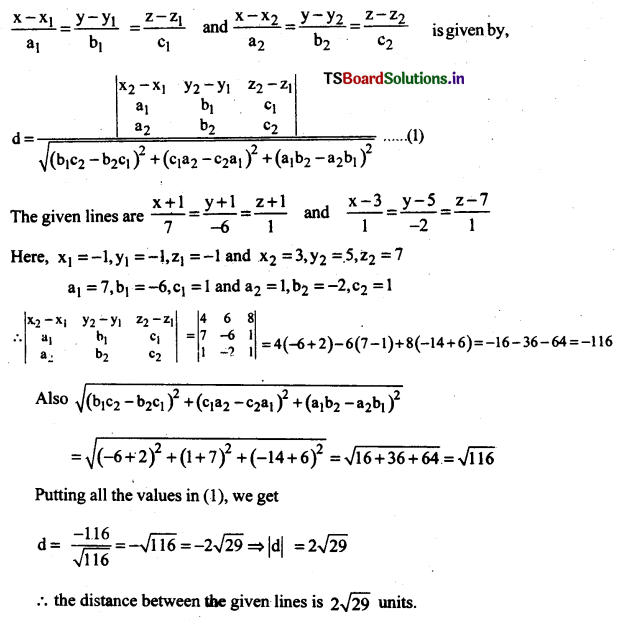
Question 5.
Find the shortest distance between the lines
\(\frac{x+1}{7}=\frac{y+1}{-6}=\frac{z+1}{1}\) and \(\frac{x-3}{1}=\frac{y-5}{-2}=\frac{z-7}{1}\)
Solution:
The shortest distance between the two lines,
Question 6.
Find the vector equation of the line passing through the point (1, 2, – 4) and perpendicular to the two lines: \(\frac{x-8}{3}=\frac{y+19}{-16}=\frac{z-10}{7}\) and \(\frac{x-15}{3}=\frac{y-29}{8}=\frac{z-5}{-5}\)
Solution:
Let \(\vec{a}=\hat{i}+2 \hat{j}-4 \hat{k}\), \(\vec{b}=b_1 \hat{i}+b_2 \hat{j}+b_3 \hat{k}\)
The equation of the line passing through (1, 2, -4) and parallel to vector \(\vec{b}\) is given by
⇒ \(\vec{\mathrm{r}}=\vec{\mathrm{a}}+\lambda \vec{\mathrm{b}}\) ⇒ \(\vec{r}=(\hat{i}+2 \hat{j}-4 \hat{k})+\lambda\left(b_1 \hat{i}+b_2 \hat{j}+b_3 \hat{k}\right)\) ………….. (1)
The equations of the given lines are
\(\frac{x-8}{3}=\frac{y+19}{-16}=\frac{z-10}{7}\) …………… (2) and
\(\frac{x-15}{3}=\frac{y-29}{8}=\frac{z-5}{-5}\) ………….. (3)
Since, lines of the equations (1) and (2) are perpendicular to each other we have
3b1 – 16b2 + 7b3 = 0 ………….(4)
Also, Lines (1) and (3) are perpendicular to each other ⇒ 3b1 + 8b2 – 5b3 = 0 …………… (5)
Solving equations (4) and (5), we have
\(\frac{b_1}{(-16) \times(-5)-8 \times 7}=\frac{b_2}{7 \times 3-3 \times(-5)}=\frac{b_3}{3 \times 8-3 \times(-16)}\)
⇒\(\frac{b_1}{24}=\frac{b_2}{36}=\frac{b_3}{72}\)
⇒ \(\frac{b_1}{2}=\frac{b_2}{3}=\frac{b_3}{6}\)
Hence, the direction ratios of \(\) are and 2, 3, 6
∴ \(\vec{b}=2 \hat{i}+3 \hat{j}+6 \hat{k}\)
Putting \(\vec{b}=2 \hat{i}+3 \hat{j}+6 \hat{k}\) in equation (1), we get \(\vec{r}=(\hat{i}+2 \hat{j}-4 \hat{k})+\lambda(2 \hat{i}+3 \hat{j}+6 \hat{k})\)
∴ the required vector equation of the line is \(\vec{r}=(\hat{i}+2 \hat{j}-4 \hat{k})+\lambda(2 \hat{i}+3 \hat{j}+6 \hat{k})\)