Referring to the AP Inter 2nd Year Maths Study Material Chapter 11 Three Dimensional Geometry Exercise 11a Solutions makes it easier to understand complex problems.
AP Inter 2nd Year Maths Three Dimensional Geometry Solutions Exercise 11a
I.
Question 1.
If a line makes angles 90°, 135°, 45° with the .v, y and z-axes respectively, find its direction cosines.
Solution:
Let l, m, n be the direction cosines of the given line.
Then l = cos90° =0
m = cos 135° = cos(90° +45°) = -sin 45° = –\(\frac{1}{\sqrt{2}}\)
n = cos 45° = \(\frac{1}{\sqrt{2}}\)
∴ the direction cosines of the line are 0, –\(\frac{1}{\sqrt{2}}\) and \(\frac{1}{\sqrt{2}}\)

Question 2.
If a line makes an angles of 60″ and 45″ with the direction of positive X and Z aixs respectively. Find the angle made by the line with the Y-aixs.
Solution:
Let l, m, n be the direction cosines of the given line.
Let β be the angle made by line with y-axis.
Then l = cos 60° = \(\frac{1}{2}\), m = cosβ, n = cos45°= \(\frac{1}{\sqrt{2}}\)
We know that l2 + m2 + n2 = 1
⇒ \(\frac{1}{4}\) + m2 + \(\frac{1}{2}\) = 1
⇒ m2 + \(\frac{1+2}{4}\) = 1
⇒ m2 = 1 – \(\frac{3}{4}\) = \(\frac{1}{4}\)
⇒ cos2 β = \(\frac{1}{4}\)
⇒ cos β = ±\(\frac{1}{2}\)
∴ β = 60° (or) 120°
Question 3.
Find the direction cosines of a line which makes equal angles with the coordinate axes.
Solution:
Let the line makes an angle a with each of the coordinates axes.
Then l = cosα, m = cosα, n = cosα
We know that l2 + m2 + n2 = 1
⇒ cos2α + cos2α + cos2α = 1
⇒ cos2α = \(\frac{1}{3}\)
⇒ cos α = ±\(\frac{1}{\sqrt{3}}\)
Thus, the direction cosines of the line are ±\(\frac{1}{\sqrt{3}}\), ±\(\frac{1}{\sqrt{3}}\) and ±\(\frac{1}{\sqrt{3}}\).
Question 4.
If a line makes angle-75 and 60° with the positive directions of Y and Z axis respectively and the angle made by the line with thc positive direction of X-axis is a.. then find the value cos2α ?
Solution:
Let l, m, n be the direction cosines of the given line.
Then l = cosα, m = cosβ = cos 75° = \(\frac{\sqrt{3}-1}{2 \sqrt{2}}\), n =cosy = cos60°= \(\frac{1}{2}\)
We know that l2 + m2 + n2 = 1
⇒ cos2α + \(\frac{(\sqrt{3}-1)^2}{8}\) + \(\frac{1}{4}\) = 1
⇒ cos2α = 1 – \(\left(\frac{(\sqrt{3}-1)^2}{8}+\frac{1}{4}\right)\)
= 1 – \(\frac{1}{4}\) – \(\left(\frac{3+1-2 \sqrt{3}}{8}\right)\)
= \(\frac{3}{4}-\frac{4-2 \sqrt{3}}{8}\)
= \(\frac{6-(4-2 \sqrt{3})}{8}\)
= \(\frac{2(1+\sqrt{3})}{2 \times 4}\) = \(\frac{1+\sqrt{3}}{4}\)
∴ cos2α = \(\frac{1+\sqrt{3}}{4}\)
Question 5.
If a line has the direction ratios -18, 12, -4 then what arc its direction cosines ?
Solution:
D.r’s of the given line = (a, b, c)= (-18, 12, -4)
∴ \(\sqrt{a^2+b^2+c^2}\)
= \(\sqrt{(-18)^2+(12)^2+(-4)^2}\)
= \(\sqrt{484}\) = 22
DC’s = \(\left(\frac{a}{\sqrt{a^2+b^2+c^2}}, \frac{b}{\sqrt{a^2+b^2+c^2}}, \frac{c}{\sqrt{a^2+b^2+c^2}}\right)\)
= \(\left(\frac{-18}{22}, \frac{12}{22}, \frac{-4}{22}\right)\)
= \(\left(\frac{-9}{11}, \frac{6}{11}, \frac{-2}{11}\right)\)
Question 6.
Find the direction cosines of the joining the points (-2, 6, 7) and (1, 2, -5).
Solution:
Let A(x1, y1, z1) = (-2, 6, 7), B(x2, y2, z2) = (1, 2, -5)
Dr’s of AB = (a, b, c) = (x2 – x1, y2 – y1, z2 – z1) = (1+2, 2-6, -5-7) = (3, -4, -12)
∴ \(\sqrt{a^2+b^2+c^2}\)
= \(\sqrt{9+16+144}\)
= \(\sqrt{169}\) = 22
DC’s of AB = \(\left(\frac{a}{\sqrt{a^2+b^2+c^2}}, \frac{b}{\sqrt{a^2+b^2+c^2}}, \frac{c}{\sqrt{a^2+b^2+c^2}}\right)\)
= \(\left(\frac{3}{13}, \frac{-4}{13}, \frac{-12}{13}\right)\)
Question 7.
Show that the points (2, 3, 4), (-1, -2, 1), (5, 8, 7) are collinear.
Solution:
Given points are A(2, 3, 4), B(-1, -2, 1), C(5, 8, 7).
D.r’s of line joining A and B are (-1-2, -2-3, 1-4) is (-3, -5, -3) ⇒ (3, 5, 3)
D.r’s of line joining A and C are (5-2, 8-3, 7-4) ⇒ 3, 5, 3
Hence D.r’s of AB and AC are proportional.
∴ A,B,C are collinear.
Question 8.
If the points (2, -1, -3), (4, a, 1) and (3, 1, b) are collinear, then find the ratio between a and A?
Solution:
Let A(x1, y1, z1) = (2, -1, 3), B (x2, y2, z2) = (4, a, 1), C(x3, y3, z3) = (3, 1, b)
If A,B,C are collinear then \(\frac{x_1-x_2}{x_2-x_3}=\frac{y_1-y_2}{y_2-y_3}=\frac{z_1-z_2}{z_2-z_3}\)
⇒ \(\frac{2-4}{4-3}=\frac{-1-a}{a-1}=\frac{3-1}{1-b}\)
⇒ \(\frac{-2}{1}=\frac{-1-a}{a-1}=\frac{2}{1-b}\)
⇒ \(\frac{-2}{1}=\frac{-1-a}{a-1}\)
⇒ 2a – 2 = 1 + a ⇒ 2a – a = 1 + 2 ⇒ a = 3
⇒ \(\frac{-2}{1}=\frac{2}{1-b}\) ⇒ \(\frac{-1}{1}=\frac{1}{1-b}\)
⇒ -1 + b = 1
⇒ b = 2
∴ Required ratio \(\frac{a}{b}=\frac{3}{2}\)
⇒ 3 : 2
II.
Question 1.
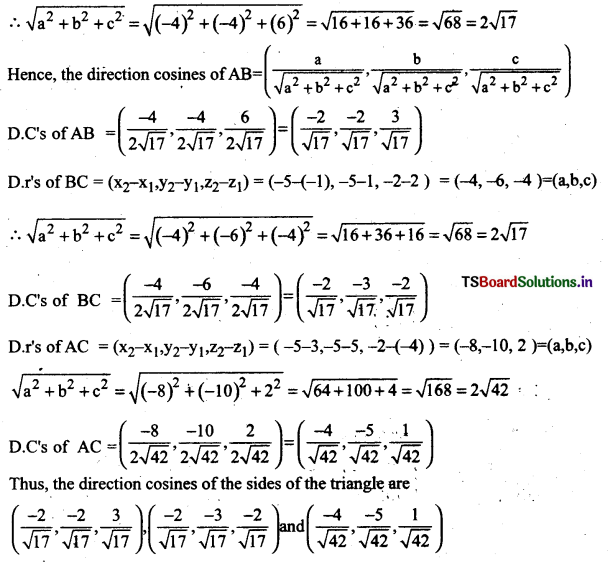
Find the direction cosines of the sides of the triangle whose vertices are (3, 5, -4),(-1, 1, 2) and (-5, -5, -2).
Solution:
Let A(x1, y1, z1) = (3, 5, -4), B (x2, y2, z2) = (-1, 1, 2), C(x3, y3, z3) = (-5, -5, -2)
Question 2.
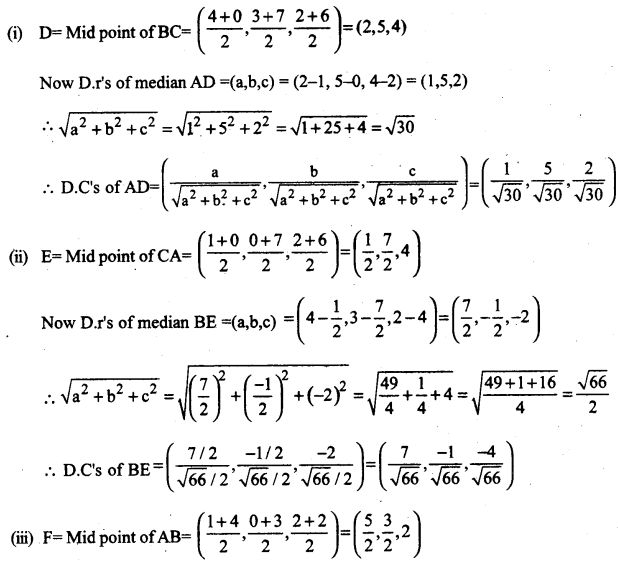
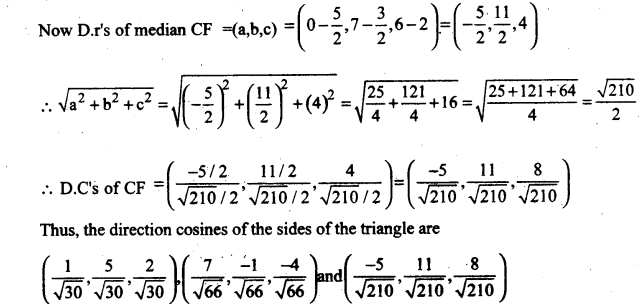
Find the direction cosines of the medians of the triangles whose vertices are (1, 0, 2), (4. 3, 2) and (0, 7, 6).
Solution:
Vertices of the triangle are A = (1, 0, 2), B (4, 3, 2) and C(0, 7, 6).