
Reviewing AP Inter 2nd Year Accounts Study Material Chapter 3 Introduction to Partnership Accounts Questions and Answers can help students prepare confidently for exams.
AP Inter 2nd Year Accountancy 3rd Lesson Introduction to Partnership Accounts Questions and Answers
I. Fill in the blanks
Question 1.
The simplest and oldest type of business structure, which is owned and run by one person, is called a ________________.
Answer:
Sole proprietorship
Question 2.
A written document that outlines the rules, responsibilities, and rights of partners is called a ________________.
Answer:
Partnership deed
Question 3.
If the partnership deed is absent or doesn’t address a specific issue, the rules prescribed in ________________ will be applied.
Answer:
Indian Partnership Act, 1932
Question 4.
Interest on capital is an expense for the firm and is ________________ to the profit and Loss Appropriation Account.
Answer:
Debited
Question 5.
If a partnership deed is absent, Profits and losses must be shared ________________ among the partners.
Answer:
Equally
Question 6.
A ________________ Account an extension of the Profit and Loss Account and shows how profits are distributed among the partners.
Answer:
Profit and Loss Appropriation
Question 7.
The fixed capital method requires a separate account called a Partner’s ________________ Account to record items like drawings, salary, and interest.
Answer:
Current
II. Very Short Answer Questions
Question 1.
Define partnership.
Answer:
According to Section 4 of the Indian Partnership Act, 1932, partnership is the relationship between two or more persons who agree to share the profits of a business that is carried on by all or by any one of them acting on behalf of all.
Question 2.
What is Mutual Agency in partnership business?
Answer:
Mutual agency means that every partner has the authority to act on behalf of the firm and can also represent the other partners in business matters.
Question 3.
What is Interest on capital?
Answer:
Interest on capital is allowed to partners only when it is clearly provided for in the partnership deed. If there is no such agreement among the partners, interest on capital is not permitted.

Question 4.
What is interest on drawings?
Answer:
- Interest on drawings refers to the amount charged by the partnership firm on the money withdrawn by a partner for personal purposes.
- As per the Indian Partnership Act 1932, if the partnership deed does not contain any provision regarding interest on drawings, no such interest will be charged.
III. Short Answer Questions
Question 1.
What is meant by partnership deed?
Answer:
A Partnership Deed is a legal document prepared in writing that specifies the rights, duties, and responsibilities of the partners. It acts as the basic framework for running the partnership business and helps in avoiding misunderstandings and disputes. A partnership is formed through an agreement between two or more persons. This agreement may be oral or written, and the Partnership Act does not make a written agreement compulsory.
Question 2.
What is the main purpose of Profit and Loss Appropriation Account?
Answer:
The Profit and Loss Appropriation Account is an extension of the Profit and Loss Account. It is prepared to show how the firm’s profit is distributed among the partners. All adjustments relating to partners, such as salary, commission, and interest, are recorded in this account. It begins with the net profit or net loss transferred from the Profit and Loss Account.
Question 3.
What accounts are prepared under fixed capital method?
Answer:
Under the fixed capital method, each partner maintains two separate accounts – the Partner’s Capital Account and the Partner’s Current Account. The capital balance remains unchanged in the Capital Account, while all adjustments such as share of profit or loss, interest on capital, drawings, interest on drawings, salary, and commission are recorded in the Partner’s Current Account.
Question 4.
How Interest on capital treated while preparing Profit and Loss Appropriation account?
Answer:
Interest on partners’ capital is allowed only if it is specifically provided for in the partnership deed. If there is no agreement among the partners, no interest on capital is allowed. Since it is an expense or loss to the firm, it is debited to the Profit and Loss Appropriation Account and credited to the Partners’’ Capital Account or Current Account, as it represents income to the partners.
Question 5.
How Interest on drawings treated while preparing Profit and Loss Appropriation account?
Answer:
Partners may withdraw cash or goods from the business to meet their personal requirements. If the partnership deed contains a provision for charging interest on drawings, it is calculated at the agreed rate for the period the amount remains outstanding during the accounting year. Charging interest on drawings discourages excessive withdrawals by the partners. Since it is an income to the firm, it is credited to the Profit and Loss Appropriation Account and debited to the Partners’ Capital Account or Current Account, as it is a charge against the partners.
Question 6.
How Interest on loan treated while preparing Profit and Loss Appropriation account?
Answer:
When a partner lends money to the firm, the amount is recorded in a separate Loan Account, and interest is calculated according to the rate specified in the agreement. If there is no agreement, the Indian Partnership Act provides for interest at 6% per annum on the loan, irrespective of whether the firm earns a profit or not. As interest on loan is an expense for the firm, it is debited to the Profit and Loss Account and credited to the Partner’s Loan Account or the Partner’s Capital/Current Account.
IV. Long Answer Questions
Question 1.
What are the main characteristics of a partnership as defined by the Indian Partnership Act, 1932?
Answer:
The important characteristics of a partnership are given below:
- Two or More Persons: A partnership must consist of at least two persons. According to the Indian Partnership Act, 1932, the maximum number of partners is 10 in banking business and 20 in other types of businesses.
- Agreement; A partnership is formed through an agreement between the partners. The agreement may be either oral or written, though a written agreement is preferable to avoid future disputes.
- Business: A partnership must be established to carry on a lawful business with the objective of earning profits. Mere joint ownership of property does not constitute a partnership.
- Mutual Agency: Every partner acts as both a principal and an agent. Therefore, each partner has the authority to represent the firm and act on behalf of the other partners.
- Sharing of Profits: The partners agree to share the profits and losses of the business. An association formed without the objective of earning profit is not regarded as a partnership.
- Liability of Partners: The liability of partners is unlimited and joint. If required, partners are personally liable for the debts of the firm.
- Transfer of Share: A partner cannot transfer his or her share in the partnership to another person without obtaining the consent of all the other partners, thereby maintaining mutual confidence. ,
- Management : Every partner has the right to participate in the management of the business. However, the responsibility for managing the day-to-day affairs may be assigned by mutual agreement.
Question 2.
What is a Partnership Deed? List out the contents of this legal document.
Answer:
A Partnership Deed is a legal agreement that specifies the rights, duties, and responsibilities of the partners in a partnership firm. It provides a proper framework for managing the business and helps in avoiding misunderstandings and disputes.
The usual contents of a Partnership Deed are:
- Objective of the Partnership
- Principal Place of Business
- Period or Duration of the Partnership
- Capital Contribution of Partners
- Withdrawal of Capital
- Salary and Commission of Partners
- Ratio of Profit and Loss Sharing
- Dissolution of the Partnership
- Admission and Retirement of Partners
- Rules regarding Bankruptcy
- Accounting and Audit Provisions
- Voluntary Retirement of a Partner
- Rights, Duties and Responsibilities of Partners
- Banking Arrangements and Management of Funds
- Borrowing Policy of the Firm
- Financial Year of the Partnership
Question 3.
According to the Indian Partnership Act, 1932, what rules apply to a partnership when there is no written agreement?
Answer:
When the partnership deed is silent on a particular matter or when no written agreement exists, the provisions of the Indian Partnership Act, 1932 automatically apply. These rules serve as the default guidelines to ensure fair treatment of all partners. As per Section 13 of the Indian Partnership Act, 1932, the following rules are applicable:
- Profits and losses of the firm shall be shared equally among the partners.
- No interest shall be allowed on partners’ capital.
- No interest shall be charged on partners’ drawings.
- A partner who has advanced a loan to the firm is entitled to receive interest at 6% per annum on the loan amount.
- No partner is entitled to receive any salary or commission.
Question 4.
What is the purpose of a Profit and Loss Appropriation Account? How is it different from a regular Profit and Loss Account within a partnership firm?
Answer:
The Profit and Loss Appropriation Account is an extension of the Profit and Loss Account. It is prepared to show the manner in which the firm’s profit is distributed among the partners. All adjustments relating to partners, such as salary, commission, interest on capital, interest on drawings, and profit-sharing, are recorded through this account. It begins with the net profit or net loss transferred from the Profit and Loss Account.
Key Differences:
- Stage of Preparation: The Profit and Loss Account is prepared after the Trading Account, whereas the Profit and Loss Appropriation Account is prepared only after the Profit and Loss Account has been completed.
- Objective: The Profit and Loss Account determines the net profit or net loss earned by the business. In contrast, the Profit and Loss Appropriation Account shows how that profit is allocated among the partners.
- Nature of Items: The Profit and Loss Account records expenses and losses incurred in running the business, known as “Charges against Profit. ” The Profit and Loss Appropriation Account records “Appropriations of Profit,” such as partners’ salary, commission, and interest on capital.
- Requirement: The preparation of a Profit and Loss Account is compulsory for all business organisations to determine operating results. A Profit and Loss Appropriation Account is prepared only in the case of partnership firms.
- Dependency: Expenses recorded in the Profit and Loss Account must be provided for even when the business incurs a loss. However, the Profit and Loss Appropriation Account is generally prepared only when there is profit available for distribution among the partners.
Exercises
Question 1.
Archana and Swetha are partners sharing profits in the ratio of 3 : 2, with capitals of ₹ 50,000 and ₹ 30,000 respectively. Interest on capital is agreed to be paid @ 6% p.a. calculate interest on capital.
Solution:
Archana’s Capital: ₹ 50,000 ; Swetha’s Capital : ₹ 30,000 ; Rate of Interst: 6% p.a.
Interest on capital = Share Capital × \(\frac{\text { Interest Rate }}{100}\)
Archana = 50,000 × \(\frac{6}{100}\) = ₹ 3,000 ; Swetha = 30,000 × \(\frac{6}{100}\) = ₹ 1800
Question 2.
Karthik and Prasad are partners sharing profits and losses in the ratio of 3 : 2. On 1st April 2024 their capital balances were ₹ 50,000 and ₹ 40,000 respectively. On 1st July 2024, Karthik brought ₹ 10,000 as his additional capital, whereas Prasad brought ₹ 20,000 as additional capital on 1st October 2024. Interest on capital was provided @ 10% p.a. Calculate the interest on capital of Karthik and Prasad on 31st March 2025.
Solution:
A interest on capital shall be worked as follows:
1. Calculation of Interest on Capital for Karthik:
On Opening Capital: ₹ 50,000 for 12 months (1st April 2024 to 31st March 2025)
On Aditional Capital: ₹ 10,000 for 9 months (1st July 2024 to 31st March 2025)
2. Calculation of Interest on Capital for Prasad :
On Opening Capital: ₹ 40,000 for 12 months (1st April 2024 to 31st March 2025), On Aditional Capital: ₹ 20,000 for 6 months (1st October 2024 to 31st March 2025)
Interest on Capital = [40,000 × \(\frac{10}{100}\)] + [20,000 × \(\frac{10}{100}\) × \(\frac{6}{12}\) = ₹ 4,000 + ₹ 1,000 = ₹ 5,000.
Question 3.
Rama and Krishna are partners sharing profits and losses in the ratio of 5 : 1. Their capitals at the end of the financial year 2023-24 were ₹ 1,50,000 and ₹ 75,000. On October 1st, 2024 Rama and Krishna had brought additional capitals of ₹ 16,000 and ₹ 14,000 respectively. On November 1st 2024 Rama withdrew ₹ 6,000 and on December 1st 2024 Krishna withdrew ₹ 9,000 from their capitals. Calculate interest on capital @ 15% p.a. for the year 2024-25.
Solution:
1. Calculation of Interest on Capital for Rama :
On Opening Capital (₹ 1,50,000) : For the full year (12 months)
On Aditional Capital (₹ 16,000) : From Oct 1 to March 31 (6 months)
Interest on Withdrawal (₹ 6,000) : From Nov 1 to March 31(5 months)
Interest on Capital = [1,50,000 × \(\frac{15}{100}\)] + [16,000 + \(\frac{15}{100}\) × \(\frac{6}{12}\)] – [6,000 × \(\frac{15}{100}\) × \(\frac{5}{12}\)]
= 22,500 + 1200 – 375 = ₹ 23,325.
2. Calculation of Interest on Capital for Krishna:
On Opening Capital (₹ 75,000) : For the full year (12 months)
On Aditional Capital (₹ 14,000) : From Oct 1 to March 31 (6 months)
Interest on Withdrawal (₹ 9,000) : From Dec 1 to March 31 (4 months)
Interest on Capital = [75,000 × \(\frac{15}{100}\)]] + [14,000 × \(\frac{15}{100}\) × \(\frac{6}{12}\)] – [9,000 × \(\frac{15}{100}\) × \(\frac{4}{12}\)]
= 11,250 + 1050 – 450 = ₹ 11,850
Question 4.
Lakshmi and Parvathi are partners, sharing profits and losses in the ratio of 5 : 3. The balances in their capital accounts as on Aprill, 2023 were; Lakshmi, ₹ 6,00,000 and Parvathi, ₹ 8,00,000. Calculate interest on capital for the F.Y. 2023-24;
(a) when there is no agreement in respect of interest on capital, and
(b) when there is an agreement that the interest on capital will be allowed @ 8% p.a.
Solution:
a) When there is no agreement in respect of interest on capital:
No interest on Capital is allowed
b) When there is an agreement that the interest on capital will be allowed @ 8% p.a.
For Lakshmi = [6,00,000 × \(\frac{8}{100}\)] = ₹ 48000 ; For Parvathi = [8,00,000 × \(\frac{8}{100}\)] = ₹ 64000
Question 5.
Amar and Akbar are partners in a firm. They share profits in the ratio of 3 : 2. As per their partnership agreement, interest on drawings is to be charged @10% p.a. Their drawings during 2024 were ₹ 24,000 and ₹ 16,000, respectively. Calculate interest on drawings.
Hint: If the date of Drawings is not given in the question, interest on drawings will be charged and average period of 6 months)
Solution:
Interest on drawings for average period = Drawings Amount × \(\frac{\text { Interest Rate }}{100}\) × Average period
For Amar = 24,000 × \(\frac{10}{100}\) × \(\frac{6}{12}\) = ₹ 1200 ; For Akbar = 16,000 × \(\frac{10}{100}\) × \(\frac{6}{12}\) = ₹ 800
Question 6.
Mohit is a partner, who withdrew ₹ 5,500 at the end of June, 2024. The Partnership deed provides for charging the interest on drawings @ 12% p.a. Calculate interest on Mohith’s drawings for the year ending 31st December, 2024.
Solution:
Interest on drawings = Drawings Amount × \(\frac{\text { Interest Rate }}{100}\)
For Mohit = 5500 × \(\frac{12}{100}\) × \(\frac{6}{12}\) = ₹ 330
Question 7.
Bose is a partner in a firm. He withdraws ₹ 3,000 at the starting of each month for 12 months. The books of the firm close on March 31 every year. Calculate interest on drawings if the rate of interest is 10% p.a.
Solution:
Calculation of Interest on Drawings for Bose:
1. TotalDrawings:
Bose withdraws 3,000 at the beginning of every month for 12 months.
Total Drawings = ₹ 3,000 × 12 = 36,000
2. Average Period:
Since drawings are made at the beginning of each month, the average period is calculated as:
- Average Period \(=\frac{\text { Months left after first withdrawal }+ \text { Months left after last withdrawal }}{2}\)
- Average Period = \(\frac{12+1}{2}\) = 6.5 months
3. Interest Calculation:
The rate of interest is 10% per annum.
- Formula: Interest = Total Drawings × \(\frac{\text { Rate }}{100}\) × \(\frac{\text { Average Period }}{12}\)
- Interest = 36,000 × \(\frac{10}{100}\) × \(\frac{6.5}{12}\) = 3,600 × 0.54167
- Interest = ₹ 1,950
The interest on Bose’s drawings for the year is ₹ 1,950.
Question 8.
Vishnu and Thomas are partners in a firm. They share profits equally. Vishnu’s monthly drawings are ₹ 2,000. Interest on drawings is to be charged @ 10% p.a. Calculate interest on Vishnu’s drawings for the year 2024, assuming that money is withdrawn:
(i) in the beginning of every month,
(ii) in the middle of every month, and
(iii) at the end of every month.
Solution:
Calculation of Interest on Vishnu’s Drawings for 2024 :
Total Drawings:
Monthly withdrawal ₹ 2,000
Total Annual Drawings = ₹ 2,000 × 12 = ₹ 24,000
Rate of Interest = 10% p.a.
i) In the beginning of every month
- Average Period: \(\frac{12+1}{2}\) = 6.5 months
- Formula: Total Drawings × \(\frac{\text { Rate }}{100}\) × \(\frac{6.5}{12}\)
- Calculation : 24,000 × \(\frac{10}{100}\) × \(\frac{6.5}{12}\)
- Interest: ₹ 1,300
ii) In the middle of every month
- Average Period: \(\frac{11.5+0.5}{2}\) = 6 months
- Formula : Total Drawings × \(\frac{\text { Rate }}{100}\) × \(\frac{6}{12}\)
- Calculation : 24,000 × \(\frac{10}{100}\) × \(\frac{6}{12}\)
- Interest: ₹ 1,200
iii) At the end of every month
- Average Period: \(\frac{12+1}{2}\) = 5.5 months
- Formula: Total Drawings × \(\frac{\text { Rate }}{100}\) × \(\frac{5.5}{12}\)
- Calculation : 24,000 × \(\frac{10}{100}\) × \(\frac{5.5}{12}\)
- Interest: ₹ 1,100
Question 9.
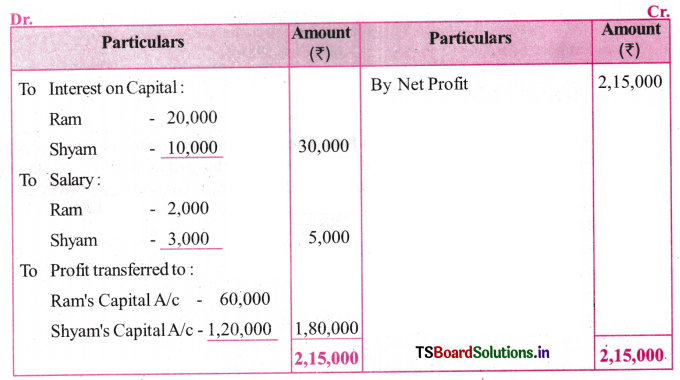
Ram and Shyam started a partnership firm on 1st January, 2024. Their capital contributions were ₹ 2,00,000 and ₹ 1,00,000 respectively.
The partnership deed provided:
- Interest on capitals @10% p.a.
- Ram to get a salary of ₹ 2,000 p.a. and Shyam ₹ 3,000 p.a.
- Profits are to be shared in the ratio of 1 : 2.
The profits for the year ended 31st December, 2024 before making above appropriations were ₹ 2,15,000. Prepare Profit and Loss Appropriation Account.
Solution:
Profit and Loss Appropriation A/c for the year ended 31st Dec, 2024
Working Notes :
* Distribution of Profit (Ratio 1:2) :
- Ram’s Share = 1,80,000 × 1/3 = ₹ 60,000
- Shyam’s Share = 1,80,000 × 2/3 = ₹ 1,20,000
Question 10.
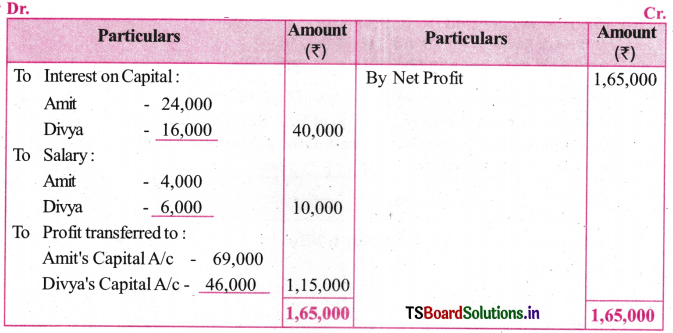
Amit and Divya started a partnership firm on January 1st, 2025. Their initial capital contributions were ₹ 3,00,000 and ₹ 2,00,000, respectively.
The partnership deed provided the following:
- Interest on capital @ 8% p.a.
- Amit to receive a salary of ₹ 4,000 p.a. and Divya to receive ₹ 6,000 p.a.
- Profits are to be shared in the ratio of 3 : 2.
The profits for the year ended December 31, 2025, before making any appropriations, were ₹ 1,65,000. Prepare the Profit and Loss Appropriation Account.
Solution:
Profit and Losss Appropriation A/c for the year ended 31st Dec, 2025
Working Notes:
* Distribution of Profit (Ratio 3:2)
- Amit’s Share = 1,15,000 × 3/5 = ₹ 69,000
- Divya’s Share = 1,15,000 × 2/5 = ₹ 46,000
Question 11.
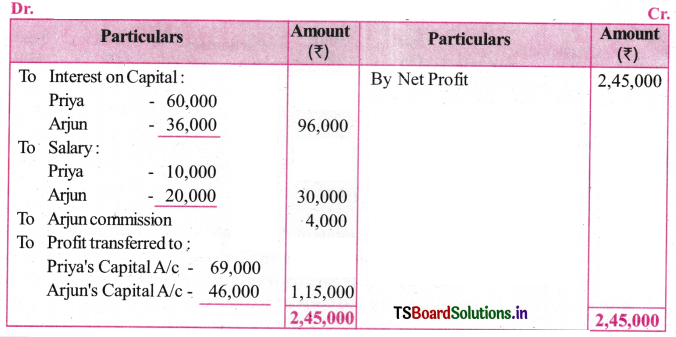
Priya and Arjun started a partnership firm on April 1st, 2024. Their initial capital contributions were ₹ 5,00,000 and ₹ 3,00,000, respectively.
The partnership deed provided the following:
- Interest on capital @ 12% p.a.
- Priya to receive a salary of ₹ 10,000 p.a. and Arjun to receive ₹ 20,000 p.a.
- Arjun receives a commission of ₹ 4,000
- Profits are to be shared in the ratio of 3 : 1.
The profits for the year ended March 31st, 2025, before making any appropriations, were ₹ 2,50,000. Prepare the Profit and Loss Appropriation Account.
Solution:
Profit and Loss Appropriation A/c for the year ended 31st Dec, 2025
Working Notes:
* Distribution of Profit (Ratio 3:1)
- Priya’s Share = 1,15,000 × 3/4 = ₹ 86,250
- Arjun’s Share = 1,15,000 × 1/4 = ₹ 28,750
Question 12.
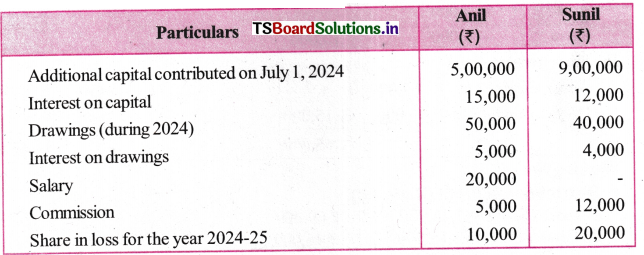
Anil and Sunil are partners with capitals of ₹ 25,00,000 and ₹ 15,00,000 respectively. They agree to share profits in the ratio of 1 : 2. Show how the following transactions will be recorded in the capital accounts of the partners in case the capitals are fixed. The books are closed on March 31st, every year.
Solution:
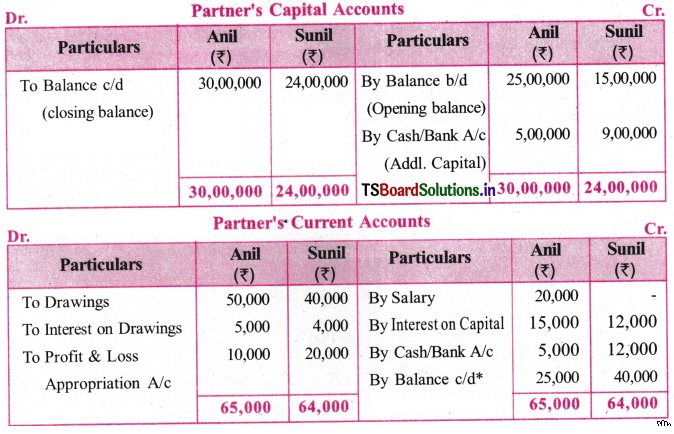
Question 13.
Amit and Rahul are partners with capitals of ₹ 20,00,000 and ₹ 12,00,000 respectively. They agree to share profits and losses in the ratio of 4 : 1. The books are closed on March 31 every year. Consider the following transactions for the year 2024-25 and prepare partners’ capital accounts and current accounts under fixed capital method.
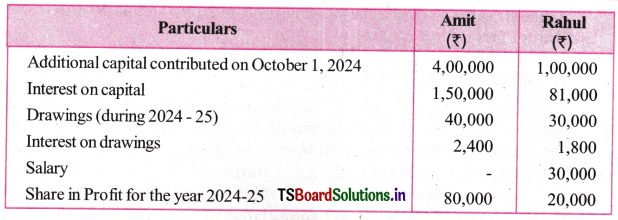
Solution:
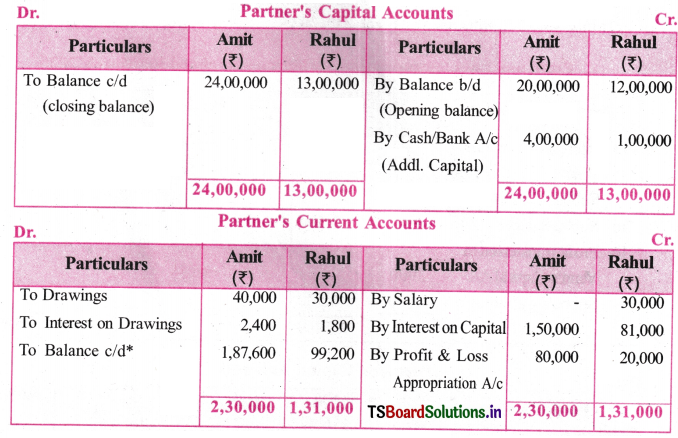
Question 14.
On March 31st 2023, the capital accounts of Ramya, Radha and Shanti showed balance of ₹ 24,000 ₹ 18,000 and ₹ 12,000 respectively. After all adjustments profit for the year ended March 31, 2024, amounted to ₹ 36,000 and the partner’s drawings had been Ramya, ₹ 3,600; Radha, ₹ 4,500 and Shanti, ₹ 2,700. The interest on capital @ 10% and the profit sharing ratio of Ramya, Radha and Shanti was 3 : 2 : 1. Prepare Partners’ capital Accounts.
Solution:
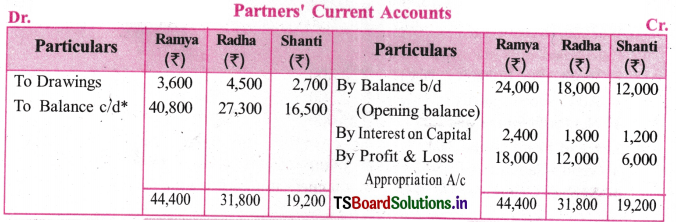
* Assumed that the given adjustments are not made to capital A/c’s till the date.
* Share of Profit (Ratio 3 : 2 : 1):
- Ramya : 36,000 × 3/6 = ₹ 18,000
- Radha : 36,000 × 2/6 = ₹ 12,000
- Shanti: 36,000 × 1/6 = ₹ 6,000
Question 15.
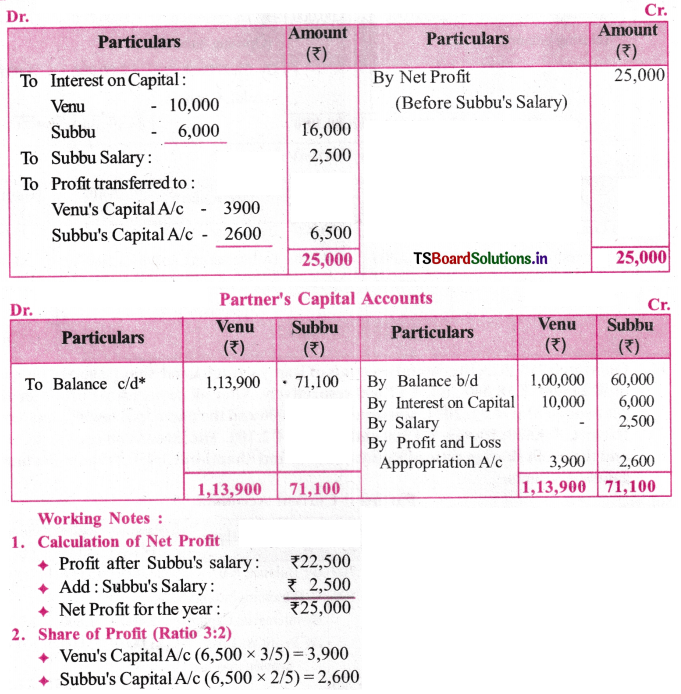
Venu and Subbu are partners sharing profits in the ratio of 3 : 2, with capitals of ₹ 1,00,000 and ₹ 60,000 respectively. Interest on capital is agreed @ 10% p.a. Subbu is to be allowed an annual salary of ₹ 2,500. During the year 2024-25, the profits prior to the calculation of interest on capital but after charging Subbu’s salary amounted to ₹ 22,500. Prepare Profit and Loss Appropriation Account and the partners’ capital accounts for the year ending March 31st, 2025.
Solution:
Profit and Loss Appropriation A/c for the year ended 31st March, 2025
Question 16.
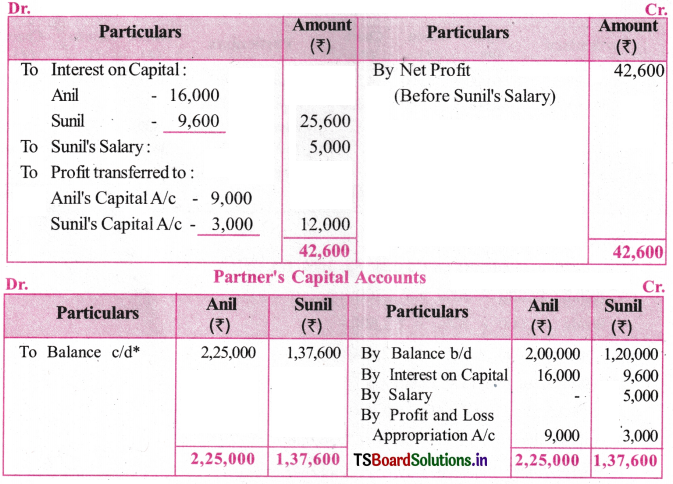
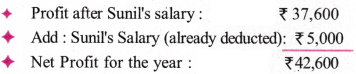
Anil and Sunil are partners sharing profits in the ratio of 3 : 1, with capitals of ₹ 2,00,000 and ₹ 1,20,000 respectively. Interest on capital is agreed @ 8% p.a. Sunil is to be allowed an annual salary of ₹ 5,000. After accounting for Sunil’s salary but before deducting interest on capital, the firm’s profit during the year 2024-25 was ₹ 37,600. Prepare the Profit and Loss Appropriation Account and the partners’ capital accounts for the year ending March 31st, 2025.
Solution:
Profit and Loss Appropriation A/c for the year ended 31st March, 2025
Working Notes :
1. Calculation of Net Profit
2. Share of Profit (Ratio 3 : 2)
- Anil’s Capital A/c (12,000 × 3/4) = 9,000
- Sunil’s Capital A/c (12,000 × 1/4) = 3,000
3. Calculation of interest @ 8% P.A.
- Anil Interest = 2,00,000 × \(\frac{8}{100}\) = 16,000
- Sunil Interest = 1,20,000 × \(\frac{8}{100}\) = ₹ 9,600
Question 17.
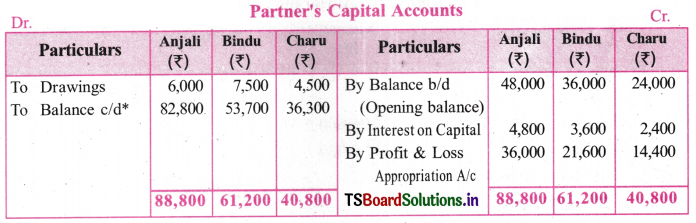
On March 31st, 2025, the partnership of Anjali, Bindu, and Charu had a profit of ₹ 72,000 after making adjustment for interest on capital. Their capital balances at the beginning of the year were ₹ 48,000, ₹ 36,000, and ₹ 24,000, respectively. The partners’ drawings during the year were ₹ 6,000 for Anjali, ₹ 7,500 for Bindu, and ₹ 4,500 for Charu. The partnership agreement stipulates a 10% interest on capital, and profits are to be shared in a 5 : 3 : 2 ratio. Prepare Partners’ capital Accounts.
Solution:
Working Notes :
1. Calculation of interest on Capital (@ 10% P.A.) :
- Anjali: 48,000 × 10% = ₹ 4,800
- Bindu: 36,000 × 10% = ₹ 3,600
- Charu: 24,000 × 10% = ₹ 2,400
2. Distriburtion of Profit (₹ 72,000) :
Ratio : 5 : 3 :2 (total = 10)
- Anjali’s Share : 72,000 × 5/10 = ₹ 36,000
- Bindu’s Share : 72,000 × 3/10 = ₹ 21,600
- Charu’s Share : 72,000 × 2/10 = ₹ 14,400