
Practice AP Inter 2nd Year Maths Study Material Chapter 6 Application of Derivatives MCQ to identify your strengths and weak areas.
AP Inter 2nd Year Maths Application of Derivatives MCQ
I. Select the correct option from the given choices.
Question 1.
The rate of change of the area of a circle with respect to its radius r at r = 6 cm
1) 10π
2) 12π
3) 8π
4) 11π
Solution:
2) 12π
Area of a circle A = πr2; Diff w.r.t ‘r’
Rate of change of Area = \(\frac{\mathrm{dA}}{\mathrm{dr}}\) = 2(2r); Now, = \(\frac{\mathrm{dA}}{(\mathrm{dr})}\) = 2(2)(6) = 122 at r = 6
Question 2.
The total revenue in Rupees received from the sale of x units of a product is given by R(x) = 3x2 + 36x + 5. The marginal revenue, when x = 15 is
1)116
2) 96
3) 90
4) 126
Solution:
4) 126
Revenue = R(x) = 3x2 + 36x + 5; Marginal Revenue = \(\frac{\mathrm{dR}}{\mathrm{dx}}\) = 3(2x) + 36
\(\begin{aligned}
&\frac{\mathrm{dR}}{\mathrm{dx}}\\
&\text { at } x=15
\end{aligned}\) = 6(15) + 36 = 90 + 36 = 126

Question 3.
Which of the following functions are decreasing on (0, \(\frac{\pi}{2}\))?
1) cos x
2) cos2x
3) cos3x
4) tanx
Solution:
1) cos x
Let f(x) = cosx. For decreasing interval f'(x) < 0 ⇒ -sin x < 0 ⇒ sin x > 0 ∀ x ∈ (0, \(\frac{\pi}{2}\))
Question 4.
On which of the following intervals is the function f given by f (x) = x100 + sin x – 1 is decreasing ?
1) (0, 1)
2) (\(\frac{\pi}{2}\), π)
3) (0, \(\frac{\pi}{2}\))
4) (-π, \(\frac{\pi}{2}\))
Solution:
4) (-π, \(\frac{\pi}{2}\))
Give f(x) = x100 + sinx – 1 ⇒ f’ (x) = 100x99 + cos x. For decreasing interval f'(x) < 0
check option
1) In (0, 1) = (0, radian) = (0,57°) f'(x) = 100x99 + cos x > 0 (+ve)
2) In (\(\frac{\pi}{2}\), π), f'(x) = 100x99 + cosx – a large+ve value + ve (∵ -1 ≥ cos + ve)
3) In (0, \(\frac{\pi}{2}\)), f'(x) = +ve + +ve (+ve);
4) In (-π, \(\frac{-\pi}{2}\)), f'(x) = -ve- = -ve < 0
Question 5.
In which interval y = x2 e-x is increases
1) (-∞, ∞)
2) (-2, 0)
3) (2, ∞)
4) (0, 2)
Solution:
4) (0, 2)
f(x) = x2.e-x ⇒ f'(x) = x2(-e=x) + e-x(2x)
For increasing interval f'(x) > 0 ⇒ e-x(2x – x2) > 0
⇒ 2x – x2 > 0 ∵ e-x > 0 ∀x ∈ R ⇒ x2 – 2x < 0 ⇒ x(x – 2) < 0 ⇒ x ∈ (0, 2)
Question 6.
On the curve x2 = 2y which is nearest to the pojnt (0, 5) is
1) (\(2 \sqrt{2}\), 4)
2) (\(2 \sqrt{2}\), 0)
3) (0, 0)
4) (2, 2)
Solution:
1) (\(2 \sqrt{2}\), 4)
Let P(t, \(\frac{t^2}{2}\)) is a point on x2 = 2y and A = (0, 5)
consider PA2 = (t – 0)2 + (\(\frac{t^2}{2}\) – 5)2 …..(1) ⇒ PA2 = f(x) = t2 + (\(\frac{t^2}{2}\) – 5)2
For maxima (or) minimum f'(x) = 0 ⇒ 2t + 2(\(\frac{t^2}{2}\) – 5)\(\left[\frac{2 \mathrm{t}}{2}\right]\) = 0 ⇒ 2t + (t2 – 10)t = 0
⇒ 2t + t3 – 10t = 0 ⇒ t3 – 8f = 0 ⇒ f(t2 – 8) = 0 ⇒ t = 0 (or) t = \(\sqrt{8}=2 \sqrt{2}\)
From (1) at t = 0 ⇒ PA2 = 0 + (-5)2 = 25; at t = \(\sqrt{8}\) ⇒ PA2 = 8 + (-1)2 = 9 minimum
∴ at t = \(\sqrt{8}\) ⇒ P = (\(\sqrt{8}\), 4) = (2\(\sqrt{2}\), 4) is nearest
Question 7.
For all real values of x, the minimum value of \(\frac{1-x+x^2}{1+x+x^2}\) is
1) 0
2) 1
3) 3
4) 1/3
Solution:
4) 1/3
f(x) = \(\frac{1-x+x^2}{1+x+x^2} \Rightarrow f^{\prime}(x)=\frac{\left(1+x+x^2\right)(-1+2 x)-\left(1-x+x^2\right)(1+2 x)}{\left(1+x+x^2\right)^2}=\frac{2\left(x^2-1\right)}{\left(1+x+x^2\right)^2}\)
∴ f'(x) = 0 ⇒ 2(x2 – 1) = 0 ⇒ x2 = 1 ⇒ x = ±1
By second derivative test, f is the minimum at x = 1 and f(1) = \(\frac{1-1+1}{1+1+1}=\frac{1}{3}\)
Question 8.
The maximum value of |x(x – 1) + 1|\(\frac{1}{3}\), 0 ≤ x ≤ 1 is
1) \(\left(\frac{1}{3}\right)^{\frac{1}{3}}\)
2) \(\frac{1}{2}\)
3) 1
4) 0
Solution:
3) 1
y = f(x) = \([x(x-1)+1]^{\frac{1}{3}}=\left(x^2-x+1\right)^{\frac{1}{3}}=\left(\left(x-\frac{1}{2}\right)+\frac{3}{4}\right)^{\frac{1}{3}}\)
Since, extreme values (maximum (or) minimum) occurs at critical points (or) at the end of the interval. Solving, f'(x) = 0 we get x = \(\frac{1}{2}\) (critical calue)
∴ fmax = Max of {(f(0), f(1), f\(\left(\frac{1}{2}\right)\)} = Max of {1, 1, \(\left(\frac{3}{4}\right), \frac{1}{3}\)} ⇒ fmax = 1
Question 9.
A cylindrical tank of radius 10 m is being filled with wheat at the rate of 314 cubic metre per hour. Then the depth of the wheat is increasing at the rate of
1) 1 m/h
2) 0.1 m/h
3) 1.1 m/h
4) 0.5 m/h
Solution:
1) 1 m/h
Given r = 10 = radius, \(\frac{d v}{d t}\) = 314, h = depth, \(\frac{d h}{d t}\) = ?
Volume = V = πr2h ⇒ V = π(100)h ⇒ V = (3.14)100h ⇒ V = (314)h
Diff w.r.t ‘f’ \(\frac{d v}{d t}\) = (314)\(\frac{d h}{d t}\) ⇒ (314) = (314)\(\frac{d h}{d t}\) ⇒ \(\frac{d h}{d t}\) = 1 ∴ \(\frac{d h}{d t}\) = 1 m/h
Question 10.
The function f(x) = x3 + 3x is increasing in interval
1) (-∞, 0)
2) (0, ∞)
3) R
4) (0, 1)
Solution:
3) R
f(x) = x3 + 3x
For increasing interval f'(x) > 0 ⇒ 3x2 + 3 > 0 ∀x ∈ R
Question 11.
The interval in which the function f(x) = 2x3 + 9x2 + 12x – 1 is decreasing
1) (-1, ∞)
2) (-2, -1)
3) (-0, -2)
4) (-1, 1)
Solution:
2) (-2, -1)
f(x) = 2x3 + 9x2 + 12x – 1
For decreasing interval f'(x) < 0 ⇒ 2(3x2) + 9(2x) + 12 < 0
⇒ x2 + 3x + 2 < 0 ⇒ (x + 1)(x + 2) < 0 x ∈ (-2, -1)
Question 12.
At which point the function f(x) = |x – 3| attains minimum value
1) x = 1
2) x < 3 3) x = 3 4) x > 3
Solution:
3) x = 3
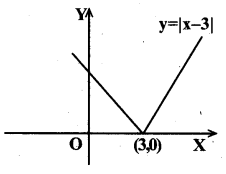
y = f(x) = |x – 3| graph
clearly f(x) is maximum at x = 3
Question 13.
Minimum value of the function f(x) = |x – 2| + |x – 5| is
1) 1
2) 2
3) 3
4) 4
Solution:
3) 3
f(x) = |x – 2| + |x – 5| = |x – a| + |x – b|
Range of f(x) is [|a – b|, ∞) ⇒ fMinimum = |a – b|
fmin = |2 – 5| = |3| = 3
Question 14.
The maximum value of is \(\frac{\log x}{x}\) is 0 < x < ∞ is
1) ∞
2) e
3) 1
4) e-1
Solution:
4) e-1
f(x) = \(\frac{\log x}{x} \Rightarrow f^{\prime}(x)=\frac{x\left(\frac{1}{x}\right)-\log x(1)}{x^2}=\frac{1-\log x}{x^2}\)
For maxima (or) Minima f'(x) = 0 ⇒ 1 – log x = 0 ⇒ loge x = 1 ⇒ x = e
fmax at x = e = \(\frac{\log _{\mathrm{e}}}{\mathrm{e}}=\frac{1}{\mathrm{e}}=\mathrm{e}^{-1}\)
Question 15.
The minimum value of (x – α) (x – β) is
1) 0
2) αβ
3) \(\frac{1}{4}(\alpha-\beta)^2\)
4) \(\frac{-1}{4}(\alpha-\beta)^2\)
Solution:
4) \(\frac{-1}{4}(\alpha-\beta)^2\)
f(x) = (x – α)(x – β) = x2(α + β)x + αβ = ax2 + bx + c
⇒ A = 1 (+ve)
⇒ fmin = \(\frac{4 a c-b^2}{4 a}=\frac{4(1)(\alpha \beta)-(\alpha+\beta)^2}{4}=\frac{-\left[(\alpha+\beta)^2+4 \alpha \beta\right]}{4}=-\left(\frac{(\alpha-\beta)^2}{4}\right) .\)