Referring to the AP Inter 2nd Year Maths Study Material Chapter 10 Vector Algebra Exercise 10e Solutions makes it easier to understand complex problems.
AP Inter 2nd Year Maths Vector Algebra Solutions Exercise 10e
I.
Question 1.
Write down a unit vector in XY-plane, making an angle of 30° with the positive direction of x-axis.
Solution:
Let the unit vector be taken as \(\overrightarrow{\mathrm{r}}=\cos \theta \hat{\mathrm{i}}+\sin \theta \hat{\mathrm{j}}\), where θ is angle with positive x-axis.
[∵ cos2θ + sin2θ = 1]
∴ \(\overrightarrow{\mathrm{r}}=\cos 30^{\circ} \hat{\mathrm{i}}+\sin 30^{\circ} \hat{\mathrm{j}}=\frac{\sqrt{3}}{2} \hat{\mathrm{i}}+\frac{1}{2} \hat{\mathrm{j}}\)
Question 2.
Find the scalar components and magnitude of the vector joining the points P(x1, y1, z1) and Q(x2, y2, z2).
Solution:
Given that P(x1, y1, z1) and Q(x2, y2, z2) ⇒ \(\overrightarrow{O P}=x_1 \hat{i}+y_1 \hat{j}+z_1 \hat{k} \text { and } \overrightarrow{O Q}=x_2 \hat{i}+y_2 \hat{j}+z_2 \hat{k}\)
∴ \(\overrightarrow{\mathrm{PQ}}=\overrightarrow{\mathrm{OQ}}-\overrightarrow{\mathrm{OP}}=\left(\mathrm{x}_2-\mathrm{x}_1\right) \hat{\mathrm{i}}+\left(\mathrm{y}_2-\mathrm{y}_1\right) \hat{\mathrm{j}}+\left(\mathrm{z}_2-\mathrm{z}_1\right) \hat{\mathrm{k}}\)
⇒ \(|\overrightarrow{\mathrm{PQ}}|=\sqrt{\left(\mathrm{x}_2-\mathrm{x}_1\right)^2+\left(\mathrm{y}_2-\mathrm{y}_1\right)^2+\left(\mathrm{z}_2-\mathrm{z}_1\right)^2}\)
Hence, the scalar components of the vectors are (x2 – x1), (y2 – y1), (z2 – z1)
and magnitude of the vector is \(\sqrt{\left(x_2-x_1\right)^2+\left(y_2-y_1\right)^2+\left(z_2-z_1\right)^2}\)

Question 3.
A girl walks 4 km towards west, then she walks 3 km in a direction 30° east of north and stops. Determine the girl’s displacement from her initial point of departure.
Solution:
Let O and B be the initial and final positions of the girl, respectively. Then, the girl’s position can be shown by the adjacent diagram. \(\overrightarrow{\mathrm{OA}}=-4 \hat{\mathrm{i}}\)
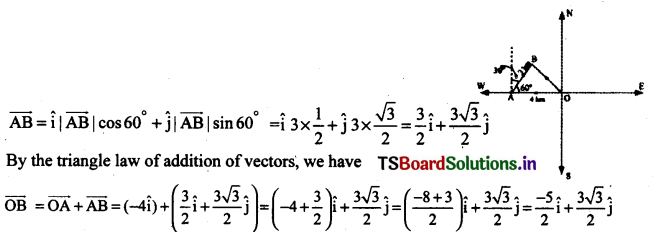
Hence, the girl’s displacement from her intial point of departure is \(\overrightarrow{\mathrm{d}}=\frac{-5}{2} \hat{\mathrm{i}}+\frac{3 \sqrt{3}}{2} \hat{\mathrm{j}}\)
Question 4.
If \(\vec{a}=\vec{b}+\vec{c}\), then is it true that \(|\vec{a}|=|\vec{b}|+|\vec{c}|\)? Justify your answer.
Solution:
No. If \(\vec{a}=\vec{b}+\vec{c}\), then they form a triangle.
In ABC, \(\overrightarrow{\mathrm{CB}}=\overrightarrow{\mathrm{a}}, \overrightarrow{\mathrm{CA}}=\overrightarrow{\mathrm{b}}, \overrightarrow{\mathrm{AB}}=\overrightarrow{\mathrm{c}}\)
From triangle law of addition of vectors we have \(\vec{a}=\vec{b}+\vec{c}\)
From triangle inequality we have \(|\vec{a}|<|\vec{b}|+|\vec{c}|\)
Hence, it is not true that \(|\vec{a}|=|\vec{b}|+|\vec{c}|\)
Question 5.
Find the value of x for which \(x(\hat{\mathbf{i}}+\hat{\mathbf{j}}+\hat{\mathbf{k}})\) is a unit vector.
Solution:
If \(x(\hat{\mathbf{i}}+\hat{\mathbf{j}}+\hat{\mathbf{k}})\) is a unit vector then
\(|x(\hat{i}+\hat{j}+\hat{k})|=1 \Rightarrow \sqrt{x^2+x^2+x^2}=1 \Rightarrow \sqrt{3 x^2}=1 \Rightarrow \sqrt{3} x=1 \Rightarrow x= \pm \frac{1}{\sqrt{3}}\)
Question 6.
Find a vector of magnitude 5 units, and parallel to the resultant of the vectors \(\overrightarrow{\mathbf{a}}=2 \hat{\mathbf{i}}+3 \hat{\mathbf{j}}-\hat{\mathbf{k}} \text { and } \overrightarrow{\mathbf{b}}=\hat{\mathbf{i}}-2 \hat{\mathbf{j}}+\hat{\mathbf{k}}\)
Solution:
Given vectors \(\overrightarrow{\mathbf{a}}=2 \hat{\mathbf{i}}+3 \hat{\mathbf{j}}-\hat{\mathbf{k}} \text { and } \overrightarrow{\mathbf{b}}=\hat{\mathbf{i}}-2 \hat{\mathbf{j}}+\hat{\mathbf{k}}\)
Let vectors \(\overrightarrow{\mathbf{c}}\) be the resultant of vectors \(\vec{a} \text { and } \vec{b}\)
∴ \(\vec{c}=\vec{a}+\vec{b}=2 \hat{i}+3 \hat{j}-\hat{k}+\hat{i}-2 \hat{j}+\hat{k}=3 \hat{i}+\hat{j}+0 \hat{k}\)
∴ Required vector of magnitude 5 units and parallel to the resultant of the vectors \(\overrightarrow{\mathrm{c}}=\overrightarrow{\mathrm{a}}+\overrightarrow{\mathrm{b}}\)
\(5 \hat{\mathrm{c}}=5 \frac{\overrightarrow{\mathrm{c}}}{|\overrightarrow{\mathrm{c}}|}=5\left(\frac{3 \hat{\mathrm{i}}+\hat{\mathrm{j}}+0 \hat{\mathrm{k}}}{\sqrt{9+1+0}}\right)=\frac{5}{\sqrt{10}}(3 \hat{\mathrm{i}}+\hat{\mathrm{j}})=\frac{5}{\sqrt{10}} \frac{\sqrt{10}}{\sqrt{10}}(3 \hat{\mathrm{i}}+\hat{\mathrm{j}})=\frac{5}{10} \sqrt{10}(3 \hat{\mathrm{i}}+\hat{\mathrm{j}})\)
= \(\frac{\sqrt{10}}{2}(3 \hat{\mathrm{i}}+\hat{\mathrm{j}})=\frac{3}{2} \sqrt{10 \mathrm{i}}+\frac{\sqrt{10}}{2} \hat{\mathrm{j}} .\)
Question 7.
If \(\overrightarrow{\mathbf{a}}=\hat{\mathbf{i}}+\hat{\mathbf{j}}+\hat{\mathbf{k}}, \overrightarrow{\mathbf{b}}=2 \hat{\mathbf{i}}-\hat{\mathbf{j}}+3 \hat{\mathbf{k}} \text { and } \overrightarrow{\mathbf{c}}=\hat{\mathbf{i}}-2 \hat{\mathbf{j}}+\hat{\mathbf{k}}\) find a unit vector parallel to the vector \(2 \vec{a}-\vec{b}+3 \vec{c}\).
Solution:
Given vectors are \(\vec{a}=\hat{i}+\hat{j}+\hat{k}, \vec{b}=2 \hat{i}-\hat{j}+3 \hat{k}, \vec{c}=\hat{i}-2 \hat{j}+\hat{k}\)
Let \(\vec{d}=2 \vec{a}-\vec{b}+3 \vec{c}=2(\hat{i}+\hat{j}+\hat{k})-(2 \hat{i}-\hat{j}+3 \hat{k})+3(\hat{i}-2 \hat{j}+\hat{k})=2 \hat{i}+2 \hat{j}+2 \hat{k}-2 \hat{i}+\hat{j}-3 \hat{k}+3 \hat{i}-6 \hat{j}+3 \hat{k}\)
∴ \(\hat{d}=3 \hat{i}-3 \hat{j}+2 \hat{k}\)
A unit vector parallel to the vector \(\overrightarrow{\mathrm{d}}=3 \hat{\mathrm{i}}-3 \hat{\mathrm{j}}+2 \hat{\mathrm{k}} \text { is } \hat{\mathrm{d}}=\frac{\overrightarrow{\mathrm{d}}}{|\overrightarrow{\mathrm{~d}}|}\)
= \(\frac{3 \hat{i}-3 \hat{j}+2 \hat{k}}{\sqrt{9+9+4}}=\frac{3 \hat{i}-3 \hat{j}+2 \hat{k}}{\sqrt{22}}=\frac{3}{\sqrt{22}} \hat{i}-\frac{3}{\sqrt{22}} \hat{j}+\frac{2}{\sqrt{22}} \hat{k}\)
Question 8.
Show that the direction cosines of a vector equally inclined to the axes OX, OY and OZ are \(\pm\left(\frac{1}{\sqrt{3}}, \frac{1}{\sqrt{3}}, \frac{1}{\sqrt{3}}\right)\)
Solution:
Let a vector be equally inclined to OX, OY and OZ at an angle α
So, the DCs of the vectors are cosα, cosα, and cosα
∴ cos2α + cos2α + cos2α = 1 ⇒ 3 cos2α = 1 ⇒ cos2α = \(\frac{1}{3}\) ⇒ cosα = \(\pm \frac{1}{\sqrt{3}}\)
II.
Question 1.
Show that the points A(1, -2, -8), B(5, 0, -2) and C(11, 3, 7) are collinear, and find the ratio in which B divides AC.
Solution:
Given points are A(1, -2, -8), B(5, 0, -2) C(11, 3, 7)
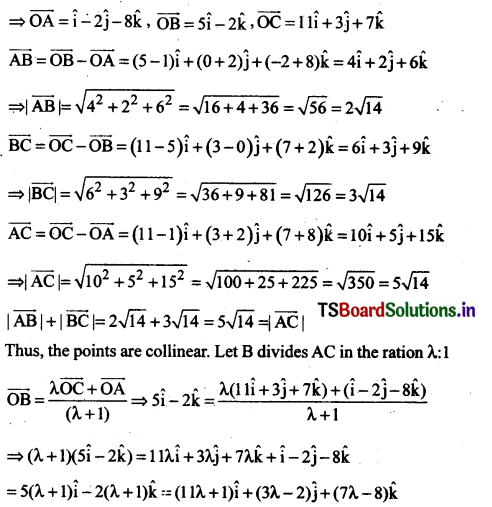
On equating the corresponding components, we get
⇒ 5(λ + 1) = (11λ + 1) ⇒ 5λ + 5 = 11λ + 1 ⇒ 6λ = 4 ⇒ λ = \(\frac{2}{3}\). Thus, the ratio is 2 : 3
Question 2.
Find the position vector of a point R which divides the line joining two points P and Q whose position vectors are \((2 \vec{a}+\vec{b}) \text { and }(\vec{a}-3 \vec{b})\) externally in the ratio 1 : 2. Also, show that P is the mid point of the line segment RQ.
Solution:
We have \(\overrightarrow{\mathrm{OP}}=2 \overrightarrow{\mathrm{a}}+\overrightarrow{\mathrm{b}} \text { and } \overrightarrow{\mathrm{OQ}}=\overrightarrow{\mathrm{a}}-3 \overrightarrow{\mathrm{~b}}\)
It is given that point R divides a line segment joining two points P and Q externally in the ratio 1 : 2.
Then, by using the section formula, we get
\(\overrightarrow{\mathrm{OR}}=\frac{2(\overrightarrow{\mathrm{OP}})-1 \overrightarrow{\mathrm{OQ}}}{2-1}=\frac{2(2 \overrightarrow{\mathrm{a}}+\overrightarrow{\mathrm{b}})-(\overrightarrow{\mathrm{a}}-3 \overrightarrow{\mathrm{~b}})}{2-1}=\frac{4 \overrightarrow{\mathrm{a}}+2 \overrightarrow{\mathrm{~b}}-\overrightarrow{\mathrm{a}}+3 \overrightarrow{\mathrm{~b}}}{1}=3 \overrightarrow{\mathrm{a}}+5 \overrightarrow{\mathrm{~b}}\)
Hence, the position vector of R is \(3 \overrightarrow{\mathrm{a}}+5 \overrightarrow{\mathrm{~b}}\)
Thus, the position vector of midpoint of RQ = \(\frac{\overrightarrow{\mathrm{OQ}}+\overrightarrow{\mathrm{OR}}}{2}\)
\(R Q=\frac{\overrightarrow{\mathrm{OQ}}+\overrightarrow{\mathrm{OR}}}{2}=\frac{(\overrightarrow{\mathrm{a}}-3 \overrightarrow{\mathrm{~b}})+(3 \overrightarrow{\mathrm{a}}+5 \overrightarrow{\mathrm{~b}})}{2}=2 \overrightarrow{\mathrm{a}}+\overrightarrow{\mathrm{b}}\)
Thus, P is the midpoint of line segment RQ.
Question 3.
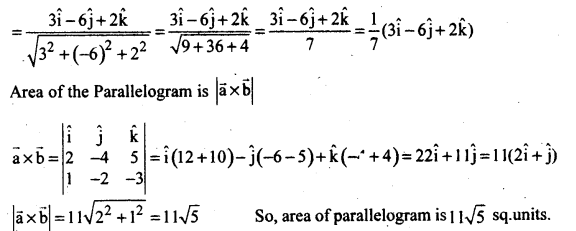
The two adjacent sidt s of a parallelogram are \(2 \hat{i}-4 \hat{j}+5 \hat{k} \text { and } \hat{i}-2 \hat{j}-3 \hat{k}\). Find the unit vector parallel to its diagonal. Also, find its area.
Solution:
Let \(\vec{a}=2 \hat{i}-4 \hat{j}+5 \hat{k}, \quad \vec{b}=\hat{i}-2 \hat{j}-3 \hat{k}\)
Diagonal of the parallelogram is \(\vec{a}+\vec{b}\)
⇒ \(\vec{a}+\vec{b}=2 \hat{i}-4 \hat{j}+5 \hat{k}+\hat{i}-2 \hat{j}-3 \hat{k}=(2+1) \hat{i}+(-4-2) \hat{j}+(5-3) \hat{k}=3 \hat{i}-6 \hat{j}+2 \hat{k}\)
So the unit vector parallel to the diagonal is \(\frac{\vec{a}+\vec{b}}{|\vec{a}+\vec{b}|}\)
Question 4.
Let \(\vec{i}=\hat{i}+4 \hat{j}+2 \hat{k}, \vec{b}=3 \hat{i}-2 \hat{j}+7 \hat{k} \text { and } \vec{c}=2 \hat{i}-\hat{j}+4 \hat{k}\). Find a vector d which is perpendicular to both \(\text { \vec{a} and } \vec{b}, \text { and } \vec{c} . \vec{d} =15\)
Solution:
Let \(\vec{d}=d_1 \hat{i}+d_2 \hat{j}+d_3 \hat{k}\) Since \(\overrightarrow{\mathrm{d}}\) is perpendicular to both \(\vec{a} \text { and } \vec{b}\) we have
\(\overrightarrow{\mathrm{d}} \cdot \overrightarrow{\mathrm{a}}=0 \Rightarrow \mathrm{~d}_1+4 \mathrm{~d}_2+2 \mathrm{~d}_3=0\) ……(1)
\(\overrightarrow{\mathrm{d}} \cdot \overrightarrow{\mathrm{~b}}=0 \Rightarrow 3 \mathrm{~d}_1-2 \mathrm{~d}_2+7 \mathrm{~d}_3=0\) …………(2)
Also it is given that \(\vec{c} \cdot \vec{d}=15 \Rightarrow 2 d_1-d_2+4 d_3=15\) ……..(3)
On solving (1),(2) and (3) we get \(d_1=\frac{160}{3}, d_2=-\frac{5}{3}, d_3=-\frac{70}{3}\)
∴ \(\overrightarrow{\mathrm{d}}=\frac{160}{3} \hat{\mathrm{i}}-\frac{5}{3} \hat{\mathrm{j}}-\frac{70}{3} \hat{\mathrm{k}}=\frac{1}{3}(160 \hat{\mathrm{i}}-5 \hat{\mathrm{j}}-70 \hat{\mathrm{k}})\)
Question 5.
The scalar product of the vector \(\hat{\mathbf{i}}+\hat{\mathbf{j}}+\hat{\mathbf{k}}\) with a unit vector along the sum of vectors \(2 \hat{i}+4 \hat{j}-5 \hat{k} \text { and } \lambda \hat{i}+2 \hat{j}+3 \hat{k}\) is equsil to one. Find the value of λ.
Solution:
We have \((2 \hat{i}+4 \hat{j}-5 \hat{k})+(\lambda \hat{i}+2 \hat{j}+3 \hat{k})=(2+\lambda) \hat{i}+6 \hat{j}-2 \hat{k}\)
Unit vector along \((2 \hat{i}+4 \hat{j}-5 \hat{k})+(\lambda \hat{i}+2 \hat{j}+3 \hat{k})\) is
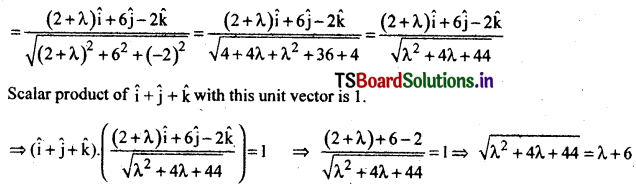
⇒ λ2 + 4λ + 44 = (λ + 6)2 ⇒ λ2 + 4x + 44 = λ2 + 12λ + 36 ⇒ 8λ = 8 ⇒ λ = 1
Question 6.
If \(\vec{a}, \vec{b}, \vec{c}\) are mutually perpendicular vectors of equal magnitudes, show that the vector \(\overrightarrow{\mathbf{a}}+\overrightarrow{\mathbf{b}}+\overrightarrow{\mathbf{c}}\) is equally inclined to \(\vec{a}, \vec{b}, \vec{c}\)
Solution:
Given that \(\vec{a}, \vec{b}, \vec{c}\) are mutually perpendicular vectors of equal magnitudes
⇒ \(\vec{a} \cdot \vec{b}=\vec{b} \cdot \vec{c}=\vec{c} \cdot \vec{a}=0\)
Let \(\vec{a}+\vec{b}+\vec{c}\) be inclined to \(\overrightarrow{\mathbf{a}}, \overrightarrow{\mathbf{b}}, \overrightarrow{\mathbf{c}}\) at angles θ1, θ2, θ3 respectively.
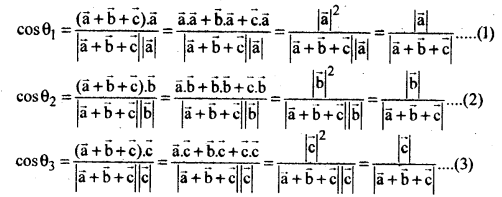
Given that \(\vec{a}, \vec{b}, \vec{c}\) are of equal magnitude ⇒ \(|\overrightarrow{\mathrm{a}}|=|\overrightarrow{\mathrm{b}}|=|\overrightarrow{\mathrm{c}}|\)
Hence from (1), (2), (3) we get cosθ1= cos θ2 = cos θ3 Thus, θ1 = θ2 = θ3
Question 7.
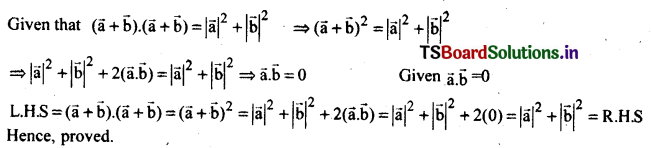
Prove that \((\vec{a}+\vec{b}) \cdot(\vec{a}+\vec{b})=|\vec{a}|^2+|\vec{b}|^2\), if and only if \(\vec{a} , \vec{b}\) are perpendicular, given \(a \neq 0, b \neq 0\)
Solution: