
Practice AP Inter 2nd Year Maths Study Material Chapter 5 Continuity and Differentiability MCQ to identify your strengths and weak areas.
AP Inter 2nd Year Maths Continuity and Differentiability MCQ
I. Select the correct option from the given choices.
Question 1.
Which of the following statement is true?
1) Every polynomial function is continuous
2) The function f(x) = 5x + 3 is continuous at x = 0
3) The function f(x) = |x| is continuous at x = 0
4) All of the options are correct
Solution:
4) All of the options are correct
By definition, all are correct
Question 2.
If f(x) = \(\begin{cases}3 a x-2 b, & x>1 \\ a x+b+1, & x<1\end{cases}\) and \(\underset{x \rightarrow 1}{\mathrm{Lt}}\) f(x) exists.
Then the relation between a and b is
1) 3a – 2b = 1
2) 2a – 3b = 1
3) 2a + 3b = 1
4) 2a + 3b = 1
Solution:
2) 2a – 3b = 1
\(\underset{x \rightarrow 1}{\mathrm{Lim}}\) f(x) exists ⇒ LHL = RHL ⇒ \(\underset{{x \rightarrow 1-\\(x<1)}}{{Lim}}\) f(x) = \(\underset{{x \rightarrow 1+\\(x>1)}}{{Lim}}\) f(x)
⇒ a + b + 1 = 3a – 2b ⇒ 2a – 3b = 1

Question 3.
The function f(x) = \(\begin{cases}\frac{2}{5-x}, & x<3 \\ 5-x, & x \geq 3\end{cases}\) is
1) Left discontinuous at x = 3
2) Left continuous at x = 3
3) Right discontinuous at x = 5
4) Discontinuous at x = 5
Solution:
1) Left discontinuous at x = 3
At x = 3, f(3) = 5 – 3 = 2

LHL ≠ f(3) ⇒ f(x) is Left discontinuous at x = 3
Question 4.
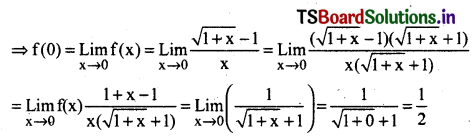
If the function f(x) = \(\frac{\sqrt{1+x}-1}{x}\) is continuous at x = 0. Then f(0) =
1) \(-\frac{1}{2}\)
2) \(\frac{1}{3}\)
3) \(\frac{1}{2}\)
4) \(-\frac{1}{3}\)
Solution:
3) \(\frac{1}{2}\)
f(x) is continuous at x = 0
Question 5.
If a function f(x) defined on [a, b] is discontinuous at x = α ∈ [a, b] . Then

Solution:
f(x) is discontinuous at x = α ⇒ \(\underset{x \rightarrow \alpha}{\mathrm{Lim}}\) f(x) ≠ f(x) [by definition]
Question 6.
If the function f defined by f(x) = \(\begin{cases}\cos x, & \text { if } x \leq 0 \\ 3 x+\alpha, & \text { if } 0<x<2 \\ \beta x+3, & \text { if } 2 \leq x \leq 4 \\ 11, & \text { if } x>4\end{cases}\)
where α,β are real constants is continuous on R. Then α2 + β2 =
1) 3
2) 9
3) 5
4) 4
Solution:
3) 5
Given f is continuouson R f is continuous at every real number.
Consider continuity of f(x) ar x = 0
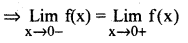
⇒ cos 0° = 3(0) + α ⇒ 1 = 0 + α ⇒ α = 1
Now, consider continuity at x = 4
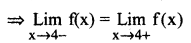
⇒ β(4) + 3 = 11 ⇒ 4β = 8 ⇒ β = 2 Now, α2 + β2 = 12 + 22 = 5
Question 7.
In the interval [0, 3]. The function f(x) = |x – 1| + |x – 2| is
1) discontinuous
2) differentiable
3) continuous but not differentiable at x = 2 only
4) continuous but not differentiable at x = 1 and x = 2.
Solution:
4) continuous but not differentiable at x = 1 and x = 2.
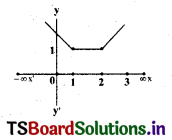
Graph f(x) = |x – 1| + |x – 2| is
f(x) is continuous on [0, 3]
bot not differentiable at x = 1 and x = 2 (turning points)
Question 8.
If y = \(\sqrt{\mathbf{x}+\sqrt{\mathbf{x}+\sqrt{\mathbf{x}+\ldots . . \infty}}}\). Then \(\frac{d y}{d x}\) is equal to
1) \(\frac{1}{y}\)
2) \(\frac{1}{x}\)
3) \(\frac{1}{2x-1}\)
4) \(\frac{1}{2y-1}\)
Solution:
4) \(\frac{1}{2y-1}\)
Formula: If y = \(\sqrt{f(x)+\sqrt{f(x)+\sqrt{f(x)+\ldots}}}\) ∞, then \(\frac{d y}{d x}=\frac{f^{\prime}(x)}{2 y-1}\)
Given f(x) = x ⇒ f'(x) = 1 ∴ \(\frac{d y}{d x}=\frac{1}{2 y-1}\)
Question 9.
The set of all points where the function f(x) = 2x|x| is differentiable is
1) (-∞, ∞)
2) (-∞, 0) ∪ (0, ∞)
3) (0, ∞)
4) (-∞, 0)
Solution:
1) (-∞, ∞)
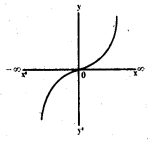
f(x) = 2x |x| = \(\begin{cases}-2 x^2 & \forall x \leq 0 \\ 2 x^2 & \forall x>0\end{cases}\)
f'(x) = \(\left\{\begin{aligned}
-4 \mathrm{x} & \forall \mathrm{x} \leq 0 \\
4 \mathrm{x} & \forall \mathrm{x}>0
\end{aligned}\right.\) exists ∀x ∈ R ⇒ f(x) is differentiable ∀x ∈ R ⇒ x ∈ (-∞, ∞)
Question 10.
Differentiation of (x2 – 5x + 8) (x3 + 7x + 9) can be done
1) only by using product rule
2) only by obtaining a single polynomial expanding it
3) only by using logarithmic differentiation
4) All of the options are correct
Solution:
4) All of the options are correct
All are correct.
Question 11.
If y = cos-1(cos x) the find \(\frac{d y}{d x}\) at x = \(\frac{5 \pi}{4}\)
1) 1
2) -1
3) 0
4) \(-\frac{1}{\sqrt{2}}\)
Solution:
2) -1
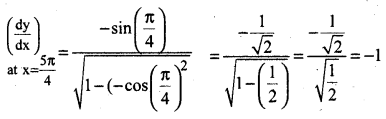
\(\frac{d}{d x}\left(\cos ^{-1} x\right)=\frac{-1}{\sqrt{1-x^2}}\)
y = \(\cos ^{-1}(\cos x) \Rightarrow \frac{d y}{d x}=\frac{-1}{\sqrt{1-(\cos x)^2}} \cdot \frac{d}{d x}(\cos x)=\frac{(-1)(-\sin x)}{\sqrt{-1(\cos x)^2}}=\frac{\sin x}{\sqrt{1-(\cos x)^2}}\)
Question 12.
If f(x) = x4 – x3 + 7x2 + 14, then what is the value of f1(5)?
1) 594
2) 549
3) 954
4) 495
Solution:
4) 495
f(x) = x4 – x3 + 7x2 + 14 ⇒ f'(x) = 4x3 – 3x2 + 14x
at x = 5; f'(5) = 4(5)3 – 3(5)2 + 14(5) = 4(125) – 3 × 25 + 70 = 500 – 75 + 70 = 495
Question 13.
If y = x + \(\frac{1}{\mathbf{x}}\) then which among the following holds?
1) x2y1 + xy = 0
2) x2y1 + xy + 2 = 0
3) x2y1 – xy + 2 = 0
4) x2y1 + xy – 2 = 0
Solution:
3) x2y1 – xy + 2 = 0
Given y = x + \(\frac{1}{x}\) ..(1); y = 1 – \(\frac{1}{x^2}\)
⇒ x2y1 = x2 – 1 …….(2) ⇒ x2y1 – ⇒ x2 + 1 = 0 x2y1 – [xy – 1] + 1 = 0
⇒ x2y1 – xy + 1 + 1 = 0 ⇒ x2y1 – xy + 2 = 0
Question 14.
\(\frac{d}{d x}\left(e^{\log _e \sqrt{1+\tan ^2 x}}\right)\) when x ∈ Q1
1) sec2(x) tan x
2) sec x tan2(x)
3) sec x tan x
4) tan2 (x)
Solution:
3) sec x tan x
Given y = \(e^{\log _e \sqrt{1+\tan ^2 x}}\) [∵ elogNe = N]
y = \(\sqrt{1+\tan ^2 x}\) = sec x ∴ \(\frac{d y}{d x}=\frac{d}{d x}(\sec x)\)= sec x tan x
Question 15.
If y = log(cosh x) then \(\frac{d^2 y}{d x^2}\) =
1) sech2 x
2) -sech2 x
3) sinh x
4) -sinh x
Solution:
1) sech2 x
y = log(cosh x)
⇒ \(\frac{d y}{d x}=\frac{1}{\cosh x}(\sinh x)=\tanh x \Rightarrow \frac{d}{d x}\left(\frac{d y}{d x}\right)=\frac{d}{d x}(\tanh x) \Rightarrow \frac{d^2 y}{d x^2}=\operatorname{sech}^2 x\)
Question 16.
If f(x) = \(\begin{cases}\frac{\sin ^2(a x)}{x^2} ; & x \neq 0 \\ 1 ; & x=0\end{cases}\) is continuous at x = 0, then the value of ‘a’ is
1) -1
2) 1
3) 0
4) ±1
Solution:
4) ±1

Question 17.
If y = sinh-1\(\left[\frac{1-\mathbf{x}}{1+\mathbf{x}}\right]\). Then \(\frac{d y}{d x}\) is equal to
1) \(\frac{-\sqrt{2}}{(1+x) \sqrt{1+x^2}}\)
2) \(\frac{-1}{(1+x) \sqrt{x}}\)
3) \(\frac{1}{\left(1+x^2\right) \sqrt{1+x}}\)
4) \(\frac{\sqrt{2}}{1+x \sqrt{1-x^2}}\)
Solution:
1) \(\frac{-\sqrt{2}}{(1+x) \sqrt{1+x^2}}\)
Formula: \(\frac{d}{d x}\left(\sinh ^{-1} x\right)=\frac{1}{\sqrt{x^2+1}}\)
Given y = \(\sinh ^{-1}\left[\frac{1-x}{1+x}\right] \Rightarrow \frac{d y}{d x}=\frac{1}{\sqrt{\left(\frac{1-x}{1+x}\right)^2+\frac{1}{1}}} \cdot \frac{d}{d x}\left(\frac{1-x}{1+x}\right)\)
= \(\frac{1+x}{\sqrt{(1-x)^2+(1+x)^2}}\left[\frac{(1+x)[-1]-[(1-x)(1)]}{(1+x)^2}\right]\)
= \(\frac{-1-x-1+x}{\sqrt{2\left(1^2+x^2\right)}(1+x)}=\frac{-2}{\sqrt{2} \sqrt{1+x^2}(1+x)}=\frac{-2}{\sqrt{1+x^2}(1+x)}\)
Question 18.
[x] represents the greatest integer function of x. At x = \(-1 \frac{\mathrm{~d}}{\mathrm{dx}}(\sin \pi|\mathrm{x}|)\) =
1) 0
2) 2
3) -2
4) 1/2
Solution:
1) 0
Let y = sin π[x] \(\frac{\mathrm{d}}{\mathrm{dx}}=\frac{\mathrm{d}}{\mathrm{dx}}[\sin \pi[\mathrm{x}]]=\frac{\mathrm{d}}{\mathrm{dx}}[\sin (\mathrm{n} \pi)]=\frac{\mathrm{d}}{\mathrm{dx}}(0)=0\)
where n = [x] = An integer ∈ Z ∀x ∈ R
G.S of θ = nπ ∀n ∈ Z ⇒ sin (nπ) = 0 ∀n ∈ Z
Question 19.
If 3.sin(xy) + 4.cos(xy) = 5, then \(\frac{d y}{d x}\) is equal to
1) \(\frac{3 \sin x y+4 \cos x y}{3 \cos x y-4 \sin x y}\)
2) \(\frac{3 \cos x y+4 \sin x y}{4 \cos x y-3 \sin x y}\)
3) \(\frac{-y}{x}\)
4) \(\frac{x}{y}\)
Solution:
3) \(\frac{-y}{x}\)
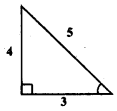
Given 3 sin(xy) + 4 cos(xy) = 5
⇒ \(\frac{3}{5}\)sin (xy) + \(\frac{4}{5}\)cos(xy) = \(\frac{5}{5}\) ⇒ sin (xy)cos α + cos (xy)sin α = 1
⇒ sin(xy + α) = sin 90° ⇒ xy = \(\frac{\pi}{2}\) – α = A constant
Diff. w.r.t x
⇒ \(x \frac{d y}{d x}+y(1)=0 \Rightarrow x \frac{d y}{d x}=-y\)
\(\frac{d y}{d x}=-\frac{y}{x}\)
Question 20.
If y = logxy then \(\frac{d y}{d x}\) is equal to
1) \(\frac{1}{x \log y}\)
2) \(\frac{\log y}{x(1+\log y)}\)
3) \(\frac{1}{x(1+\log y)}\)
4) \(\frac{1}{1+\log y}\)
Solution:
3) \(\frac{1}{x(1+\log y)}\)
Formula: \(\log _{\mathrm{b}}^{\mathrm{a}}=\frac{\log \mathrm{a}}{\log \mathrm{~b}}, \frac{\mathrm{~d}}{\mathrm{dx}}(\mathrm{U} \cdot \mathrm{~V})=\mathrm{U} \cdot \frac{\mathrm{dU}}{\mathrm{dx}}+\mathrm{V} \frac{\mathrm{dV}}{\mathrm{dx}}\)
Given y = \(\log _y^x \Rightarrow y=\frac{\log x}{\log y} \Rightarrow y \cdot(\log y)=\log x\)
⇒ \(y\left(\frac{1}{y} ; \frac{d y}{d x}\right)+(\log y) \frac{d y}{d x}=\frac{1}{x} \Rightarrow(1+\log y) \frac{d y}{d x}=\frac{1}{x} \Rightarrow \frac{d y}{d x}=\frac{1}{x(1+\log y)}\)