
Referring to the AP Inter 2nd Year Maths Study Material Chapter 9 Differential Equations Exercise 9c Solutions makes it easier to understand complex problems.
AP Inter 2nd Year Maths Differential Equations Solutions Exercise 9c
I.
Question 1.
Find the general solution of \(\frac{d y}{d x}=\frac{1-\cos x}{1+\cos x}\)
Solution:
Given D.E. is \(\frac{d y}{d x}=\frac{1-\cos x}{1+\cos x} \Rightarrow \frac{d y}{d x}=\frac{2 \sin ^2 \frac{x}{2}}{2 \cos ^2 \frac{x}{2}}=\tan ^2 \frac{x}{2}\)
⇒ \(\frac{d y}{d x}=\left(\sec ^2 \frac{x}{2}-1\right) \Rightarrow d y=\left(\sec ^2 \frac{x}{2}-1\right) d x\)
Integrating both sides, we get \(\int \mathrm{dy}=\int\left(\sec ^2 \frac{\mathrm{x}}{2}-1\right) \mathrm{dx}\)
⇒ y = \(\int \sec ^2 \frac{x}{2} d x-\int d x \Rightarrow y=2 \tan \frac{x}{2}-x+C\)
Question 2.
Find the general solution of \(\frac{d y}{d x}=\sqrt{4-y^2}\), (-2 < y < 2)
Solution:
Given D.E. is \(\int \frac{d y}{\sqrt{4-y^2}}=\int d x\)
Integrating both sides, we get \(\int \frac{d y}{\sqrt{4-y^2}}=\int d x\)
⇒ sin-1\(\frac{y}{2}\) = x + C ⇒ \(\frac{y}{2}\) = sin(x + C) ⇒ y = 2 sin(x + C)

Question 3.
Find the general solution of \(\frac{d y}{d x}+y=1\), (y ≠ 1)
Solution:
Given D.E. is \(\frac{d y}{d x}+y=1 \Rightarrow \frac{d y}{d x}=1-y \Rightarrow \frac{d y}{1-y}=d x\)
Integrating both sides, we get
\(\int \frac{\mathrm{dy}}{1-\mathrm{y}}=\int \mathrm{dx}\) ⇒ -log (y – 1) = x + log C ⇒ – log C – log(y – 1) = x
⇒ -[log C + log(y – 1)] = x ⇒ log C(y – 1) = -x ⇒ C(y – 1) = e-x
⇒ y = 1 + \(\frac{1}{C} e^{-x}\) ⇒ y = 1 + Ae-x (Where A = \(\frac{1}{C}\))
Question 4.
Find the general solution of sec2 x tan ydx + sec2 ytan xdy = 0
Solution:
Given D.E. is sec2 x tan ydx + sec2 ytan xdy = 0
⇒ sec2 xtan ydx = -(sec2 y)(tan x) dy
⇒ \(\frac{\sec ^2 x}{\tan x} d x=-\frac{\sec ^2 y}{\tan y} d y\)
Integrating both sides, we get
\(\int \frac{\sec ^2 x}{\tan x} d x=-\int \frac{\sec ^2 y}{\tan y} d y\) ………….(1)
Let tan x = t \(\frac{d}{d x}\)(tan x) = \(\frac{d t}{d x}\) ⇒ sec2 x = \(\frac{d t}{d x}\) ⇒ sec2 xdx =dt
Now, \(\int \frac{\sec ^2 x}{\tan x} d x=\int \frac{1}{t} d t\) = log t = log(tan x) …………(2)
Similarly, \(\int \frac{\sec ^2 y}{\tan y} d y\) = log(tan y) ………….(3)
Using (1), (2), (3) we get log(tan x) = -log(tan y) + log C
log(tan x) = log\(\left(\frac{\mathrm{C}}{\tan \mathrm{y}}\right)\) ⇒ tan x = \(\frac{\mathrm{C}}{\tan \mathrm{y}}\) ⇒ tan x tan y = C
Question 5.
Find the general solution of (ex + e-x) dy – (ex – e-x)dx = 0
Solution:
Given D.E. is (ex + e-x) dy – (ex – e-x)dx = 0
⇒ (ex + e-x)dy = (ex – e-x)dx ⇒ dy = \(\left[\frac{e^x-e^{-x}}{e^x+e^{-x}}\right] d x\)
Integrating both sides, we get \(\int \mathrm{dy}=\int\left[\frac{\mathrm{e}^{\mathrm{x}}-\mathrm{e}^{-\mathrm{x}}}{\mathrm{e}^{\mathrm{x}}+\mathrm{e}^{-\mathrm{x}}}\right] \mathrm{dx}\) ……..(1)
Let (ex + e-x) = t ⇒ \(\frac{d}{d x}\)(ex + e-x) = \(\frac{d t}{d x}\) ⇒ (ex + e-x)dx = dt
Putting these values in equation (1), we get \(\int \mathrm{dy}=\int \frac{1}{\mathrm{t}} \mathrm{dt}+\mathrm{C}\)
⇒ y = log(t) + C ⇒ y = log(ex + e-x) + C
Question 6.
Find the general solution of \(\frac{d y}{d x}\) = (1 + x2)(1 + y2)
Solution:
Given D.E. \(\frac{d y}{d x}\) = (1 + x2)(1 + y2) ⇒ \(\frac{d y}{1+y^2}\) = (1 + x2)dx
Integratingboth sides, we get \(\int \frac{d y}{1+y^2}=\int\left(1+x^2\right) d x\)
⇒ tan-1 y = \(\int \mathrm{dx}+\int \mathrm{x}^2 \mathrm{dx} \Rightarrow \tan ^{-1} \mathrm{y}=\mathrm{x}+\frac{\mathrm{x}^3}{\mathrm{x}}+\mathrm{C}\)
Question 7.
Find the general solution of y log ydx – xdy = 0
Solution:
Given D.E. is y log ydx – xdy = 0 ⇒ y log ydx = xdy ⇒ \(\frac{d y}{y \log y}=\frac{d x}{x}\)
Integrating both sides, we get \(\int \frac{d y}{y \log y}=\int \frac{d x}{x}\) ………….(1)
Let log y = ⇒ t \(\frac{d}{d y}(\log y)=\frac{d t}{d y} \Rightarrow \frac{1}{y}=\frac{d t}{d y} \Rightarrow \frac{1}{y} d y=d t\)
Putting these values in equation (1) we get \(\) ⇒ log t = log x + log C
⇒ log(log y) = log Cx ⇒ log y = Cx ⇒ y = eCx
Question 8.
Find the general solution of \(x^5 \frac{d y}{d x}\) = -y5
Solution:
Given D.E is \(x^5 \frac{d y}{d x}=-y^5 \Rightarrow \frac{d y}{y^5}=-\frac{d x}{x^5} \Rightarrow \frac{d x}{x^5}+\frac{d y}{y^5}=0\)
Integrating both sides, we get \(\int \frac{d x}{x^5}+\int \frac{d y}{y^5}\) = k
⇒ \(\int x^{-5} d x+\int y^{-5} d y=k \Rightarrow \frac{x^{-4}}{-4}+\frac{y^{-4}}{-4}\) = k
⇒ x-4 + y-4 = -4k ⇒ x-4 + y-4 = C (where C = -4k)
Question 9.
Find the general solution of \(\frac{d y}{d x}\) = sin-1 x
Solution:
Given D.E. is \(\frac{d y}{d x}\) = sin-1 x dy = sin-1 xdx
Integrating both sides, we get \(\)
⇒ y = sin-1 x.\(\text { (1) } \mathrm{dx}-\int\left[\left(\frac{\mathrm{d}}{\mathrm{dx}}\left(\sin ^{-1} \mathrm{x}\right)\right] \int(1) \mathrm{dx}\right] \mathrm{dx}\)
⇒ y = x sin-1 x + \(\frac{-x}{\sqrt{1-x^2}} d x\) ………….(1)
Let 1 – x2 = t ⇒ \(\frac{d}{d x}\left(1-x^2\right)=\frac{d t}{d x} \Rightarrow-2 x=\frac{d t}{d x} \Rightarrow x d x=-\frac{1}{2} d t\)
Puttingthese values in equation (1), we get
⇒ y = x sin-1 x + \(\int \frac{1}{2 \sqrt{t}} d t \Rightarrow y=x \sin ^{-1} x+\frac{1}{2} \int(t)^{\frac{-1}{2}} d t\)
⇒ y = x sin-1 x + \(\frac{1}{2} \cdot\left(\frac{\frac{1}{t^2}}{\frac{1}{2}}\right)+C \Rightarrow y=x \sin ^{-1} x+\sqrt{t}+C\)
y = x sin-1 x + \(\sqrt{1-x^2}\) + C
Question 10.
Find the general solution of ex tan ydx + (1 – ex)sec2 ydy = 0
Solution:
Given D.E. is ex tan ydx + (1 – ex)sec2 ydy = 0
⇒ (1 – ex) sec2 y dy = -ex tan y dx ⇒ \(\frac{\sec ^2 y}{\tan y} d y=\frac{-e^x}{1-e^x} d x\)
Integrating both sides, we get
\(\)
Let tan y = u ⇒ \(\frac{d}{d y}(\tan y)=\frac{d u}{d y} \Rightarrow \sec ^2 y=\frac{d u}{d y}\) ⇒ sec2 ydy = du
Now, \(\int \frac{\sec ^2 y}{\tan y} d y=\int \frac{d u}{u}\) = log u = log(tan y) ……….(2)
Now, let(1 – ex) = t ⇒ \(\frac{d}{d x}\)(1 – ex) = \(\frac{d t}{d x}\)
⇒ -ex = \(\frac{d t}{d x}\) ⇒ -ex dx = dt
Now, \(\int \frac{-e^x}{1-e^x} d x=\int \frac{d t}{t}\) = log t = log(1 – ex) ……………(3)
Sub (2) and (3) in (1) ⇒ log(tan y) = log(1 – ex) + log C
⇒ log(tan y) = log[C(1 – ex)] ⇒ tan y = C(1 – ex)
Question 11.
Find a particular solution of \(\cos \left(\frac{\mathrm{dy}}{\mathrm{dx}}\right)\) = 1 (a ∈ R); y = 1 when x = 0
Solution:
Given D.E is \(\cos \left(\frac{d y}{d x}\right)\) = a \(\frac{d y}{d x}\) = cos-1 a ⇒ dy = cos-1 adx
Integrating both sides, we get
\(\int \mathrm{dy}=\cos ^{-1} \mathrm{a} \int \mathrm{dx}\) ⇒ y =cos-1 a.x + C ⇒ y = cos-1 a + C
Now, y = 1 when x = 0 ⇒ 1 = 0.cos-1 a + C ⇒ C = 1
Thus, y = xcos-1 a + 1 ⇒ \(\frac{y-1}{x}=\cos ^{-1} a \Rightarrow \cos \left(\frac{y-1}{x}\right)=a\), is a particular solution.
II.
Question 1.
Find a particular solution of \(\frac{d y}{d x}\) = y tan x; y = 1 when x = 0
Solution:
Given D.E. is \(\frac{d y}{d x}\) = y tan x ⇒ \(\frac{d y}{y}\) = tan xdx
Integrating both sides, we get \(\int \frac{d y}{y}=\int \tan x d x\) ⇒ log y = log(sec x) + log C
⇒ log y = log(sec xC) ⇒ y = C sec x
Now, y = 1, x = 0 ⇒ 1 = C × sec0 ⇒ 1 = C × 1 ⇒ C = 1, Thus, y = sec x is a particular solution.
Question 2.
Find the equation of a curve passing through the point (0, 0) and whose differential equation is y’ = ex sin x.
Solution:
Given D.E. is y’ = ex sin x ⇒ \(\frac{d y}{d x}\) = ex sin x ⇒ dy = ex sinx dx
Integrating both sides, we get \(\int d y=\int e^x \sin x d x \Rightarrow y=\int e^x \sin x d x\) ……………..(1)
Let I = \(\int e^x \sin x d x\)
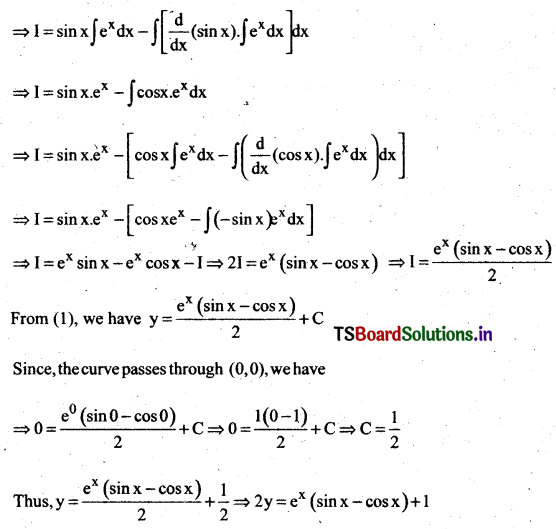
⇒ 2y – 1 = ex(sin x – cos x) which is the equation of the curve.
Question 3.
For the differential equation \(x y \frac{d y}{d x}\) = (x + 2)(y + 2). find the solution curve passing through the point (1, -1).
Solution:
Given D.E. is \(x y \frac{d y}{d x}\) = (x + 2)(y + 2) ⇒ \(\left(\frac{y}{y+2}\right) d y=\left(\frac{x+2}{2}\right) d x\)
Integrating both sides, we get
\(\int\left(1-\frac{2}{y+2}\right) d y=\int\left(1+\frac{2}{x}\right) d x \Rightarrow \int d y-2 \int \frac{1}{y+2} d y=\int d x+2 \int \frac{1}{x} d x\)
⇒ y – 2log(y + 2) = x + 2log x + C
⇒ y – x – C = log x2 + log(y + 2)2 ⇒ y – x – C = log[x2(y + 2)2]
Since, the curve passes through (1, -1) we have
⇒ -1 – 1 – C = log[(1)2(-1 + 2)2] ⇒ -2 – C = log 1 ⇒ 2 – C = 0 ⇒ C = -2
Thus, y – x + 2 = log[x2(y + 2)2] is the required solution of the curve.
Question 4.
Find the equation of a curve passing through the point (0, -2) given that at any point (x, y) on the curve, the product of the slope of its tangent and y coordinate of the point is equal to the x coordinate of the point.
Solution:
Let x and y be the x-coordinate and y-coordinate of the curve, respectively.
We know that the slope of a tangent to the curve in the coordinate axis is given by \(\frac{d y}{d x}\)
y.\(\frac{d y}{d x}\) = x ydy = xdx
Integrating both sides, \(\int y d y=\int x d x \Rightarrow \frac{y^2}{2}=\frac{x^2}{2}+C\) ⇒ y2 – x2 = 2C
Since, the curve passes through (0, -2) , we have (-2)2 – 02 = 2C ⇒ 2C = 4
Thus, y2 – x2 = 4 is the required equation of the curve.
III.
Question 1.
Find a particular solution of (x3 + x2 + x + 1)\(\frac{d y}{d x}\) = 2x2 + x;y = 1 when x = 0
Solution:
Given D.E. is (x3 + x2 + x + 1)\(\frac{d y}{d x}\) = 2x2 + x;y = 1
⇒ \(\frac{d y}{d x}=\frac{2 x^2+x}{\left(x^3+x^2+x+1\right)} \Rightarrow d y=\frac{2 x^2+x}{\left(x^3+x^2+x+1\right)} d x\)
Integrating both sides, we get
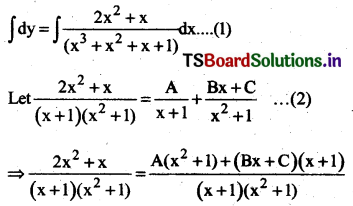
⇒ A(x2 + 1) + (Bx + C)(x + 1) = 2x2 + x….(1)
Put x = -1 in (1) then A[(-1)2 + 1] + 0 = 2(-12) + 1 ⇒ 2A = 1 ⇒ A = 1/2
Put x = 0 in (1) then A + C = 0 => C = -A = -1/2
Equating the coefficients of x2 we get A + B = 2 => B = 2 – A = 2 – \(\frac{1}{2}=\frac{3}{2}\)
∴ A = \(\frac{1}{2}\), B = \(\frac{3}{2}\) and C = \(\frac{-1}{2}\)
Substituting these values in (2) , we get
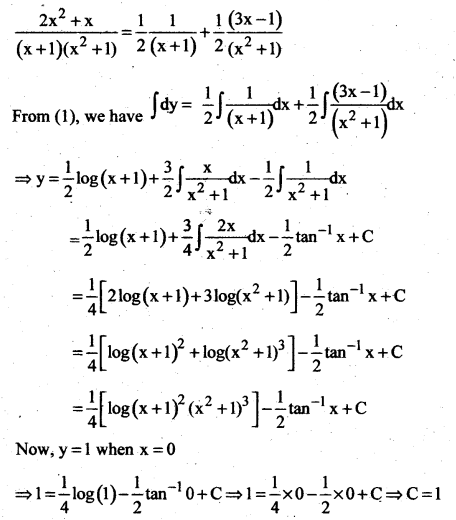
Thus, y = \(\frac{1}{4}\)[log(x + 1)2(x2 + 1)3] – \(\frac{1}{2}\)tan-1 x + 1, is a particular solution.
Question 2.
Find a particular solution of x(x2 – 1)\(\frac{d y}{d x}\) = 1; y = 0 when x = 2
Solution:
Given D.E. is x(x2 – 1)\(\frac{d y}{d x}\) = 1 ⇒ dy = \(\frac{d x}{x\left(x^2-1\right)} \Rightarrow d y=\frac{1}{x(x-1)(x+1)} d x\)
Integrating both sides, we get \(\int \mathrm{dy}=\int \frac{1}{\mathrm{x}(\mathrm{x}-1)(\mathrm{x}+1)} \mathrm{dx}\) ……..(1)
Let \(\frac{1}{(x-1)(x+1)}=\frac{A}{x}+\frac{B}{x-1}+\frac{C}{x+1}\) …….(2)
⇒ \(\frac{1}{x(x-1)(x+1)}=\frac{A(x-1)(x+1)+B x(x+1)+C x(x-1)}{x(x-1)(x+1)}\)
⇒ A(x – 1)(x + 1) + Bx(x + 1) + Cx(x – 1) = 1 ………..(3)
Put x =0 in (3) then A(0 – 1)(0 + 1) + B(0) + C(0) = 1 ⇒ -A = 1 ⇒ A = -1
Put x =1 in (3) then A(0) + B1(1 + 1) + C(0) = 1 ⇒ 2B = 1 ⇒ B = 1/2
Put x = -1 in (3) then A(0) + B(0) + C(-1)(-1 – 1) = 1 ⇒ 2C = 1 ⇒ C = 1/2
∴ A = -1, B = \(\frac{1}{2}\) and C = \(\frac{1}{2}\)
Substituting these values in (2), we get
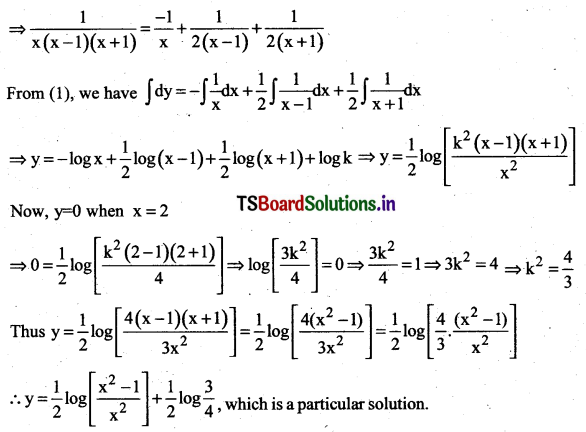
Question 3.
At any point (x, y) of a curve, the slope of the tangent is twice the slope of the line segment joining the point of contact to the point (- 4, -3). Find the equation of the curve given that it passes through (-2, 1).
Solution:
Given that (x, y) is point of contact of curve and tangent.
Slope of segment joining (x, y) and (-4, -3) is m1 = \(\frac{y+3}{x+4}\)
We know that the slope of a tangent to the curve in the coordinate axis is \(\frac{d y}{d x}\)
Slope of tangent is m2 = \(\frac{d y}{d x}\) But m2 = 2m1
⇒ \(\frac{d y}{d x}=2 \frac{(y+3)}{x+4} \Rightarrow \frac{d y}{y+3}=\frac{2 d x}{x+4}\)
Integrating both sides, we get \(\int \frac{d y}{y+3}=2 \int \frac{d x}{x+4}\) ⇒ log(y + 3) = 2log(x + 4) + log C
⇒ log (y + 3) = log C(x + 4)2 ⇒ y + 3 = C(x + 4)2
Since, the curve passes through , (-2, 1) we have 1 + 3 = C(-2 + 4)2 ⇒ 4 = 4C ⇒ C = 1
Thus, y + 3 = (x + 4)2 is the required equation of the curve.
Question 4.
The volume of spherical balloon being inflated changes at a constant rate. If initially its radius is 3 units and after 3 seconds it is 6 units. Find the radius of balloon after t seconds.
Solution:
Let the rate of change of volume of the balloon be k.
⇒ \(\frac{\mathrm{dV}}{\mathrm{dt}}=\mathrm{k} \Rightarrow \frac{\mathrm{~d}}{\mathrm{dt}}\left(\frac{4}{3} \pi \mathrm{r}^3\right)=\mathrm{k} \Rightarrow \frac{4}{3} \pi 3 \mathrm{r}^2 \frac{\mathrm{dr}}{\mathrm{dt}}=\mathrm{k} \Rightarrow 4 \pi \mathrm{r}^2 \mathrm{dr}=\mathrm{kdt}\)
Integrating both sides, we get \(\int 4 \pi \mathrm{r}^2 \mathrm{dr}=\int \mathrm{kdt} \Rightarrow 4 \pi \frac{\mathrm{r}^3}{3}=\mathrm{kt}+\mathrm{C} \Rightarrow 4 \pi \mathrm{r}^3=3(\mathrm{kt}+\mathrm{C})\)
At t = 0, we have r = 3
⇒ 4π × 27 = 3(k × 0 + C) ⇒108π = 3C ⇒ C = 36π
Now, at t = 3, we have r = 6 ⇒ 4π × 63 = 3(k × 3 + C)
⇒ 864π = 3(3k + 36π) ⇒ 3k = 288π – 36π = 252π ⇒ k = 84π
Hence 4πr3 = 3[84πt + 36π] ⇒ 4πr3 = 4π(63t + 27)
⇒ r3 = 63t + 27 ⇒ r = (63t + 27)\(\frac{1}{3}\)
Thus, the radius of the balloon after t seconds is (63t + 27)\(\frac{1}{3}\) units.
Question 5.
In a bank, principal increases continuously at the rate of r%.per year. Find the value of r if Rs 100 double itself in 10 years (loge2 = 0.6931).
Solution:
Let p, t and r represent the principle, time and rate of interest respectively.
The principle increases continuously at the rate of r% per year
⇒ \(\frac{d p}{d t}=\left(\frac{r}{100}\right) p \Rightarrow \frac{d p}{p}=\left(\frac{r}{100}\right) d t\)
Integrating both sides, we get \(\int \frac{\mathrm{dp}}{\mathrm{p}}=\frac{\mathrm{r}}{100} \int \mathrm{dt} \Rightarrow \log \mathrm{p}=\frac{\mathrm{rt}}{100}+\mathrm{k} \Rightarrow \mathrm{p}=\mathrm{e}^{\frac{\mathrm{rt}}{100}+\mathrm{k}}\)
It is given that p = 100 when t = 0 ⇒ 100 = ek
Now, if t = 10 then p = 2 × 100 = 200
Hence, 200 = \(e^{\frac{r}{10}+k} \Rightarrow 200=e^{\frac{r}{10}} e^k \Rightarrow 200=e^{\frac{r}{10}} \cdot 100 \Rightarrow e^{\frac{r}{10}}=2 \Rightarrow \frac{r}{10}=\log _e 2\)
⇒ \(\frac{\mathrm{r}}{10}\) = 0.6931 ⇒ r = 6.931
Thus, the rate of interest, r = 6.931%
Question 6.
In a bank, principal increases continuously at the rate of 5% per year. An amount of Rs 1000 Is deposited with this bank, how much will it worth after 10 years (e0.5 = 1.648).
Solution:
Let p and t be the principle and time, respectively.
The principle increases continuóusly at the rate of 5%per year.
\(\frac{d p}{d t}=5 \% \times p \Rightarrow \frac{d p}{d t}=\left(\frac{5}{100}\right) p \Rightarrow \frac{d p}{d t}=\frac{p}{20} \Rightarrow \frac{d p}{p}=\frac{d t}{20}\)
Integrating both sides, we get \(\int \frac{d p}{p}=\frac{1}{20} \int d t \Rightarrow \log p=\frac{t}{20}+C \Rightarrow p=e^{\frac{t}{20}+C}\)
Now, p = 1000 when t = 0 ∴ 1ooo = eC
Now, at t= 10 and eC = 1000 ⇒ p = \(e^{\frac{10}{20}+C} \Rightarrow p=e^{0.5} \times e^C\) ⇒ p = 1.648 × 1000 ⇒ p = 1648
∴ After 10 years Rs. 1000 becomes Rs 1648 at the rate of 5%.
Question 7.
In a culture, the bacteria count is 1,00,000. The number is increased by 10% in 2 hours. In how many hours will the count reach 2,00,000, if the rate of growth of bacteria is proportional to the number present?
Solution:
Let y be the number of bacteria at any instant t.
Rate of growth of the bacteria is proportional to the number present
⇒ \(\frac{d y}{d t} \propto y \Rightarrow \frac{d y}{d t}=k y \Rightarrow \frac{d y}{y}=k d t\)
Integrating both sides, we get \(\int \frac{d y}{y}=k \int d t \Rightarrow \log y=k t+C\)
Let y0 be the number of bacteria at t = 0 ⇒ log y0 = C ⇒ log y = kt + log y0
⇒ log y – log y0 = kt ⇒ log\(\left(\frac{\mathrm{y}}{\mathrm{y}_0}\right)\) = kt
Since, the number of bacteria increases by 10% in 2 hours. ⇒ \(\frac{y}{y_0}=\frac{110}{100} \Rightarrow \frac{y}{y_0}=\frac{11}{10}\)
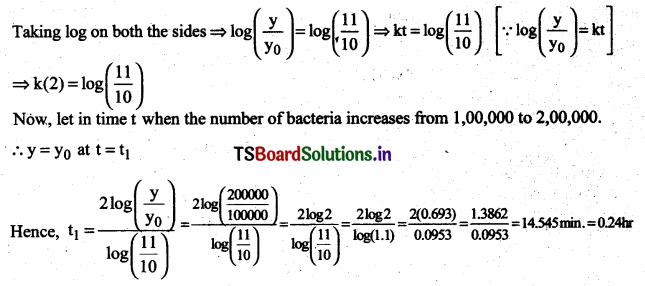
The number of bacteria increases from 1,00,000 to 2,00,000 in 0.24 hr.