
Referring to the AP Inter 2nd Year Maths Study Material Chapter 6 Application of Derivatives Exercise 6b Solutions makes it easier to understand complex problems.
AP Inter 2nd Year Maths Application of Derivatives Solutions Exercise 6b
I.
Question 1.
Show that the function given by f (x) = 3x + 17 is increasing on R.
Solution:
Let x1 and x2 be any two numbers in R.
Then x1 < x2 = (3x1 + 17) < (3x2 + 17) ⇒ f (x1) < f (x2)
Thus, f is strictly increasing on R.
Question 2.
Show that the function given by f (x) = e2x is increasing on R.
Solution:
Let x1 and x2 be any two numbers in R.
Then x1 < x2 ⇒ 2x1 < 2x2
⇒ e2x1 < e2x2
⇒ f (x1) < f (x2)
Thus, f is strictly increasing on R.

Question 3.
Prove that the logarithmic function is increasing on (0, ∞).
Solution:
The given function is f(x) = log x ⇒ f (x) = \(\frac{1}{x}\)
For, x > 0, f'(x) = \(\frac{1}{x}\) > 0
Thus, the logarithmic function is strictly increasing in interval (0, ∞)
Question 4.
Prove that the function given by f(x) = x3 – 3x2 + 3x – 100 is increasing in k.
Solution:
Given that f(x) = x3 – 3x2 + 3x – 100
⇒ f'(x) = 3x2 – 6x + 3 = 3(x2 – 2x + 1) = 3(x – 1)2
For x ∈ R, (x – 1)2 ≥ 0
So, f'(x) is always positive in R.
Thus, the function is increasing in R.
II.
Question 1.
Show that the function given by f (x) = sin x is
(a) increasing in (0, \(\frac{\pi}{2}\))
(b) decreasing in (\(\frac{\pi}{2}\), π)
(c) neither increasing nor decreasing in (0, π)
Solution:
Given that f(x) = sin x ⇒ f'(x) = cos x
(a) For x ∈ (0, \(\frac{\pi}{2}\)) ⇒ cos x > 0 ⇒ f(x) > 0. Thus, f is strictly increasing in (0, \(\frac{\pi}{2}\))
(b) For x ∈ (\(\frac{\pi}{2}\), π) ⇒ cos x < 0 ⇒ f(x) < 0. Thus, f is strictly decreasing in (\(\frac{\pi}{2}\), π)
From (a) & (b) it is clear that f is neither strictly increasing nor decreasing in (0, π)
Question 2.
Find the intervals in which the function f given by f(x) = 2x2 – 3x is
(a)increasing (b) decreasing
Solution:
Given that f(x) = 2x2 – 3x ⇒ f'(x) = 4x – 3
Now f'(x) = 0 ⇒ 4x – 3 = 0 ⇒ x = 3/4
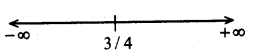
In (\(\frac{3}{4}\), ∞), f'(x) = 4x – 3 > 0. Hence,f is strictly increasing in (\(\frac{3}{4}\), ∞)
In (-∞, \(\frac{3}{4}\)), f'(x) = 4x – 3 < 0. Here, f is strictly decreasing in (-∞, \(\frac{3}{4}\))
Question 3.
Find the intervals in which the function f given by f (x) = 2x3 – 3x2 – 36x + 7 is
(a) increasing
(b) decreasing
Solution:
Given that f (x) = 2x3 – 3x2 – 36x + 7
⇒ f'(x) = 6x2 – 6x – 36 = 6(x2 – x – 6) = 6(x + 2)(x – 3)
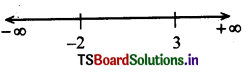
∴ f'(x) = 0 ⇒ x = -2, 3
In(-∞, 2)and(3, ∞),f'(x) > 0. In (-2, 3), f'(x) < 0
∴ f is strictly increasing in (-∞, -2), (3, ∞) and strictly decreasing in (-2, 3)
Question 4.
Find the intervals in which the function x2 + 2x – 5 is strictly increasing or decreasing:
Solution:
Let f(x) = x2 + 2x – 5 ⇒ f ’(x) = 2x + 2 = 2(x + 1)
(i) f(x) is increasing when f'(x) > 0 ⇒ x + 1 > 0 ⇒ x > – 1 ⇒ x ∈ (-1, ∞)
(ii) f(x) is decreasing when f'(x) <0 ⇒ X + 1<0 ⇒ x < -1 ⇒ x ∈ (-∞, -1).
Question 5.
Find the intervals in which the function 10 – 6x – 2x2 is strictly increasing or decreasing:
Solution:
Let f(x) = 10 – 6x – 2x2 ⇒ f'(x) = -6 – 4x = -2(2x+3)
x = –\(\frac{3}{2}\) divides the number line into two intervals (-∞, –\(\frac{3}{2}\)) and (-\(\frac{3}{2}\), ∞)
(i) In (-∞, –\(\frac{3}{2}\)), f'(x) = -2(2x + 3) < 0 ⇒ 2x + 3 > 0. Hence f is strictly increasing for x < \(\frac{-3}{2}\) (ii) In (-\(\frac{3}{2}\), ∞).f'(x) = -2(2x + 3) > 0 ⇒ 2x + 3 < 0 Hence f is strictly decreasing for x > \(\frac{-3}{2}\)
Question 6.
Find the intervals in which the function -2x3 – 9x2 – 12x + 1 is strictly increasing or decreasing:
Solution:
Let f(x)= -2x3 – 9x2 – 12x + 1
f'(x) = -6x2 – 18x – 12 = -6(x2 + 3x + 2) = -6(x + 1)(x + 2)
∴ f'(x) = 0 ⇒ x = -1; -2
x= -1 and x= -2 divide the number line into intervals (-∞, 2), (-2, -1) and (-1, ∞)

In (-2, -1), f (x) = -6(x + 1)(x + 2) > 0 Hence, f is strictly increasing in (-2, -1)
Hence, f is strictly increasing in (-2, -1)
In (-∞, -2) and (-1, ∞), f'(x) = -6(x + 1)(x + 2) < 0
Hence, f is strictly decreasing in (-∞, -2) ∪ (-1, ∞)
Question 7.
Find the intervals in which the function 6 – 9x – x2 is strictly increasing or decreasing:
Solution:
Let f(x) = 6 – 9x – x2 ⇒ f'(x) = -9 – 2x = -(2x + 9)
(i) f(x) is increasing when f'(x) > 0 ⇒ -(2x + 9) > 0 ⇒ 2x + 9 < 0
⇒ 2x < -9 ⇒ x < \(\frac{-9}{2}\) ⇒ x ∈ (-∞, \(\frac{-9}{2}\))
(ii) f(x) is decreasing when f'(x) < 0 ⇒ -(2x+9) < 0 ⇒ 2x + 9 > 0
⇒ 2x > -9 ⇒ x > \(\frac{-9}{2}\) ⇒ x ∈ (\(\frac{-9}{2}\), ∞)
Question 8.
Prove that the function f given by f (x) = x2 – x + 1 is neither strictly increasing nor decreasing on (- 1, 1).
Solution:
Given that f(x) = x2 – x + 1 ⇒ f'(x) = 2x – 1
Now, f'(x) = 0 ⇒ 2x – 1 = 0⇒ 2x = 1 ⇒ x = \(\frac{1}{2}\)
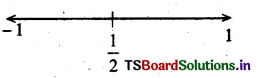
x = \(\frac{1}{2}\) divides the interval (-1, 1) into (-1, \(\frac{1}{2}\)) and (\(\frac{1}{2}\), 1)
In interval (-1, \(\frac{1}{2}\)), f'(x) = 2x – 1 < 0
Hence, f is strictly decreasing in (-1, \(\frac{1}{2}\))
In interval (\(\frac{1}{2}\), 1), f'(x) = 2x – 1 > 0
Hence, f is strictly increasing in (\(\frac{1}{2}\), 1).
Thus,f is strictly increasing nor strictly decreasing in interval (-1, 1)
Question 9.
For what values of a the function f given b f (x) = x2 + a + 1 is incrcaing on [1, 2]?
Solution:
Given that f(x) = x2 + ax + 1 = f'(x) = 2x + a
Now, the function f has to be strictly increasing on (1, 2]
Since, 2x + a is a linear function, its minimum occurs at x = 1
∴ minimum value = 2(1) + a = 2 + a
Since, the function is increasing
∴ 2 + a ≥ 0 ⇒ a ≥ -2
Question 10.
Prove that the function f given by f (x) = log sin x is increasing on (0, \(\frac{\pi}{2}\)) decreasing on (\(\frac{\pi}{2}\), π)
Solution:
Given that f (x) = log sin x ⇒ f (x) = \(\frac{1}{\sin x}\) (cos x) = cot x
In interval (0, \(\frac{\pi}{2}\)), f'(x) = cot x > 0
Hence, f is strictly increasing in (0, \(\frac{\pi}{2}\))
In interval (\(\frac{\pi}{2}\), π), f'(x) = cot x < 0. Hence, f is strictly decreasing in (\(\frac{\pi}{2}\), π)
Question 11.
Prove that the function f given by f (x) = log |cos x| is decreasing on (o, \(\frac{\pi}{2}\)) and increasing on (\(\frac{3\pi}{2}\), 2π)
Solution:
Given that f(x) = log |cos x| ⇒ f'(x) = \(\frac{1}{\cos x}\)(-sin x) = -tanx
In interval (0, \(\frac{\pi}{2}\)), tan x > 0 ⇒ – tan x < 0
Hence f(x) < 0
Thus, f is strictly decreasing on (0, \(\frac{\pi}{2}\))
In interval (\(\frac{3\pi}{2}\), 2π), tan x < 0 ⇒ -tan x > 0
Hence f'(x) > 0
Thus, f is strictly increasing on (\(\frac{3\pi}{2}\), 2π)
Question 12.
Find the values of x for which y = |x(x – 2)|2 is an increasing function.
Solution:
Given that y = [x(x – 2)]2 = [x2 – 2x]2
∴ \(\frac{\mathrm{dy}}{\mathrm{dx}}\) = \(\frac{\mathrm{d}}{\mathrm{dx}}\)[x2 – 2x]2 = 2(x2 – 2x)(2x – 2) = 4x(x – 2)(x – 1)
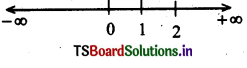
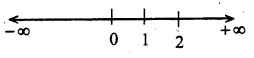
Now \(\frac{\mathrm{dy}}{\mathrm{dx}}\) = 0 ⇒ 4x(x – 2)(x – 1) ⇒ x = 0, x = 2, x = 1
x = 0, x = 1 and x = 2 divide the number line intervals (-∞, 0), (0, 1),
In (1, 2) and (2, ∞), \(\frac{\mathrm{dy}}{\mathrm{dx}}\) > 0.
Hence y is strictly increasing in intervals (0, 1) and (2, ∞)
So, y is increasing for 0 < x < 1 and x > 2.
III.
Question 1.
Find the intervals in which the function (x + 1)3(x – 3)3 is strictly increasing or decreasing.
Solution:
f(x) = (x + 1)3(x – 3)3 ⇒ f'(x) = 3(x + 1)2(x – 3)3 + 3(x – 3)2(x + 1)3
= 3(x + 1)2 (x – 3)2 [x – 3 + x + 1] = 3(x + 1)2 (x – 3)2 (2x – 2)
= 6(x + 1)2(x – 3)2(x – 1)
∴ f'(x) = 0 = x = -1, 3, 1
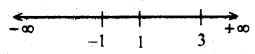
x = -1 3,1 divides the number line into four intervals (-∞, -1), (-1, 1), (1, 3) and (3, ∞)
In(-∞, -1) and(-1, 1), f'(x) = -6(x + 1)2(x – 3)2(x – 1) < 0
Hence, f is strictly decreasing in (-∞, -1) and (-1, 1)
In(1, 3) and (3, ∞), f ‘(x) = -6(x + 1)2 (x – 3)2 (x – 1) > 0
Hence, f is strictly increasing in (1, 3) and (3, ∞)
Question 2.
Show that y = log(1 + x) – \(\frac{2 x}{2+x}\), x > -1, is an increasing function of x throughout its domain.
Solution:
Given that y = log(1 + x) – \(\frac{2 x}{2+x}\)
∴ \(\frac{\mathrm{dy}}{\mathrm{dx}}=\frac{1}{1+x}-\frac{(2+x)(2)-2 x(1)}{(2+x)^2}=\frac{1}{1+x}-\frac{4}{(2+x)^2}=\frac{x^2}{(1+x)(2+x)^2}\)
Now, \(\frac{\mathrm{dy}}{\mathrm{dx}}\) = 0 ⇒ \(\frac{x^2}{(2+x)^2}\) = 0 ⇒ x2 = 0 ⇒ x = 0
Since, x > -1, x = 0 divides domain (-1, ∞) in two intervals -1 < x < 0 and x > 0
Case (i): -1 < x < 0 ⇒ x<0 and x > -1. We have x + 1 > 0, (2 + x)2 >0, x2 > 0
∴ \(\frac{x^2}{(1+x)(2+x)^2}\) > 0
∴ \(\frac{\mathrm{dy}}{\mathrm{dx}}\) > 0
Çasc (ii): x > 0 We have x + 1 > 0, (2 + x)2 >0, x2 > 0
∴ \(\frac{x^2}{(1+x)(2+x)^2}\) > 0
∴ \(\frac{\mathrm{dy}}{\mathrm{dx}}\) > 0
Hence, in both cases, we get \(\frac{\mathrm{dy}}{\mathrm{dx}}\) > 0
∴ f is an increasing function of x throughout its domain.
Question 3.
Prove that y = \(\frac{4 \sin \theta}{(2+\cos \theta)}\) – θ is an increasing function of θ in [0, \(\frac{\pi}{2}\)].
Solution:
Given that y = \(\frac{4 \sin \theta}{(2+\cos \theta)}\) – θ
⇒ \(\frac{d y}{d \theta}\) = \(\frac{(2+\cos \theta)(4 \cos \theta)-4 \sin \theta(-\sin \theta)}{(2+\cos \theta)^2}-1=\frac{8 \cos \theta+4 \cos ^2 \theta+4 \sin ^2 \theta}{(2+\cos \theta)^2}-1=\frac{8 \cos \theta+4}{(2+\cos \theta)^2}-1\)
Now \(\frac{d y}{d \theta}\) = 0 ⇒ \(\frac{8 \cos \theta+4}{(2+\cos \theta)^2}\) = 1 ⇒ 8 cos θ + 4 = 4 + cos2θ + 4 cos θ
⇒ cos2θ – 4cos θ = 0 ⇒ cos θ(cos θ – 4) = 0 ⇒ cos θ = 0 or cos θ = 4
∴ cos θ = 0 ⇒ θ = \(\frac{\pi}{2}\)
\(\frac{d y}{d \theta}=\frac{8 \cos \theta+4-\left(4+\cos ^2 \theta+4 \cos \theta\right)}{(2+\cos \theta)^2}=\frac{4 \cos \theta-\cos ^2 \theta}{(2+\cos \theta)^2}=\frac{\cos (4-\cos \theta)}{(2+\cos \theta)^2}\)
In interval [0, \(\frac{\pi}{2}\)], we have cos θ > 0
Also, 4 > cos θ ⇒ 4 – cos θ > 0
Hence, cos θ (4 – cos θ) > 0 and also (2 + cos θ)2 > 0
∴ \(\frac{\cos \theta(4-\cos \theta)}{(2+\cos \theta)^2}\) > 0
Hence, \(\frac{d y}{d \theta}\) > 0
So, y is strictly increasing in (0, \(\frac{\pi}{2}\)) and the given function is continuous at x = 0 and x = π/2
Thus, y is increasing in interval [0, \(\frac{\pi}{2}\)]
Question 4.
Let I be any interval disjoint from |-1, 1|. Prove that the function f given by f(x) = x + \(\frac{1}{x}\) is increasing on I.
Solution:
Given I is any interval disjoint from [-1, 1] i.e., I ∩ [-1, 1] = Φ ⇒ I ∈ (-∞, -1) ∪ (1, ∞)
Now, f(x) = x + \(\frac{1}{x}\) ⇒ f (x) = 1 – \(\frac{1}{x^2}\)
Case (i): In (-∞, -1) clearly f'(x) = 1 – \(\frac{1}{x^2}\) > 0
Case (ii): In (1, ∞) clearly f'(x) = 1 – \(\frac{1}{x^2}\) > 0
Hence f'(x) > 0 in (-∞, -1) ∪ (1, ∞)
∴ f is strictly increasing function in the interval I disjoint from [-1, 1]