
Referring to the AP Inter 2nd Year Maths Study Material Chapter 7 Integrals Exercise 7j Solutions makes it easier to understand complex problems.
AP Inter 2nd Year Maths Integrals Solutions Exercise 7j
I.
Question 1.
Evaluate \(\int_0^4|x-1| d x\)
Solution:
The given integral is |x – 1|
(x – 1) ≤ 0 when 0 ≤ x ≤ 1 and (x – 1) ≥ 0 when 1 ≤ x ≤ 4
I = \(\int_0^1|x-1| d x+\int_1^4|x-1| d x\) (\(\int_a^b f(x) d x=\int_b^c f(x) d x+\int_c^b f(x) d x\))
I = \(\int_0^1-(x-1) d x+\int_1^4(x-1) d x\)
= \(\left[x-\frac{x^2}{2}\right]_0^1+\left[\frac{x^2}{2}-x\right]_1^4=\left(1-\frac{1}{2}-0\right)+\left[(8-4)-\left(\frac{1}{2}-1\right)\right]=\frac{1}{2}+\frac{9}{2}=5\)
Question 2.
Evaluate \(\int_2^8|x-5| d x\)
Solution:
Let I = \(\int_2^8|x-5| d x\)
As (x – 5) ≤ 0 on [2, 5] and (x – 5) ≥ 0 on [5, 8]
I = \(\int_2^5-(x-5) d x+\int_5^8(x-5) d x\) (∵ \(\int_a^b f(x)=\int_a^c f(x)+\int_c^b f(x)\))
= \(\left[\frac{\mathrm{x}^2}{2}-5 \mathrm{x}\right]_2^5+\left[\frac{\mathrm{x}^2}{2}-5 \mathrm{x}\right]_5^8=-\left[\frac{25}{2}-25-2+10\right]+\left[32-40-\frac{25}{2}+25\right]\) = 9
Question 3.
Evaluate \(\int_{-5}^5|x+2| d x\)
Solution:
Let I = \(\int_{-5}^5|x+2| d x\)
As, (x + 2) ≤ 0 on [-5, -2] and (x + 2) ≥ 0 and [-2, 5]
∴ \(\int_{-5}^5|x+2| d x=\int_{-5}^{-2}-(x+2) d x+\int_{-2}^5(x+2) d x\)
I = \(-\left[\frac{x^2}{2}+2 x\right]_{-5}^{-2}+\left[\frac{x^2}{2}+2 x\right]_{-2}^5\)
= \(-\left[\frac{(-2)^2}{2}+2(-2)-\frac{(-5)^2}{2}-2(-5)\right]+\left[\frac{(5)^2}{2}+2(5)-\frac{(-2)^2}{2}-2(-2)\right]\)
= \(-\left[2-4-\frac{25}{2}+10\right]+\left[\frac{25}{2}+10-2+4\right]=-2+4+\frac{25}{2}-10+\frac{25}{2}+10-2+4=29\)
Question 4.
Evaluate \(\int_0^1 x(1-x)^n d x\)
Solution:
Let I = \(\int_0^1 x(1-x)^n d x\)
∴ I = \(\int_0^1(1-x)(1-(1-x))^n d x=\int_0^1(1-x)(x)^n d x=\int_0^1\left(x^n-x^{n+1}\right) d x\)
= \(\left[\frac{x^{n+1}}{n+1}-\frac{x^{n+2}}{n+2}\right]_0^1\) [∵ \(\int_0^{\mathrm{a}} \mathrm{f}(\mathrm{x}) \mathrm{dx}=\int_0^{\mathrm{a}} \mathrm{f}(\mathrm{a}-\mathrm{x}) \mathrm{dx}\)]
= \(\left[\frac{1}{n+1}-\frac{1}{n+2}\right]=\frac{(n+2)-(n+1)}{(n+1)(n+2)}=\frac{1}{(n+1)(n+2)}\)
Question 5.
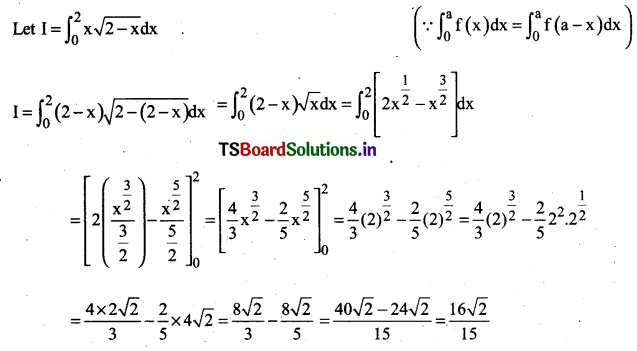
Evaluate \(\int_0^2 x \sqrt{2-x} d x\)
Solution:
Question 6.
Evaluate \(\int_0^{\frac{\pi}{2}} \frac{\sqrt{\sin x}}{\sqrt{\sin x}+\sqrt{\cos x}} d x\)
Solution:
Let I = \(\int_0^{\frac{\pi}{2}} \frac{\sqrt{\sin x}}{\sqrt{\sin x}+\sqrt{\cos x}} d x\) ……..(1)
⇒ I = \(\int_0^{\frac{\pi}{2}} \frac{\sqrt{\sin \left(\frac{\pi}{2}-x\right)}}{\sqrt{\sin \left(\frac{\pi}{2}-x\right)}+\sqrt{\cos \left(\frac{\pi}{2}-x\right)}} d x\)
⇒ I = \(\int_0^{\frac{\pi}{2}} \frac{\sqrt{\cos x}}{\sqrt{\cos x}+\sqrt{\sin x}} d x\) …..(2)
Adding (1) and (2), we get 2I = \(\int_0^{\frac{\pi}{2}} \frac{\sqrt{\sin x}+\sqrt{\cos x}}{\sqrt{\sin x}+\sqrt{\cos x}} d x\)
⇒ 2I = \(\int_0^{\frac{\pi}{2}} 1 . d x \Rightarrow 2 I=[x]_0^{\frac{\pi}{2}} \Rightarrow 2 I=\frac{\pi}{2} \Rightarrow I=\frac{\pi}{4}\)
Question 7.
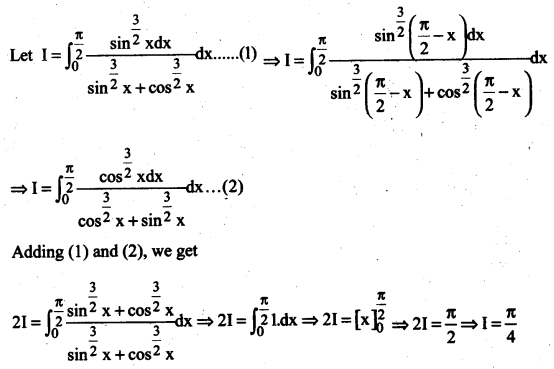
Evaluate \(\int_0^{\frac{\pi}{2}} \frac{\sin ^{\frac{3}{2}} x d x}{\sin ^{\frac{3}{2}} x+\cos ^{\frac{3}{2}} x}\)
Solution:
Question 8.
Evaluate \(\int_0^{\pi / 2} \frac{\cos ^5 x}{\sin ^5 x+\cos ^5 x} d x\)
Solution:
We know \(\int_0^a f(x) d x=\int_0^a f(a-x) d x\)
I = \(\int_0^{\pi / 2} \frac{\cos ^5 x}{\sin ^5 x+\cos ^5 x} d x\) ……..(1) = \(\int_0^{\pi / 2} \frac{\cos ^5\left(\frac{\pi}{2}-x\right)}{\sin ^5\left(\frac{\pi}{2}-x\right)+\cos ^5\left(\frac{\pi}{2}-x\right)} d x\)
= \(\int_0^{\pi / 2} \frac{\sin ^5 x d x}{\sin ^5 x+\cos ^5 x}\) …………..(2)
Adding (1) and (2), we get
2I = \(\int_0^{\pi / 2} \frac{\cos ^5 x+\sin ^5 x}{\sin ^5 x+\cos ^5 x} d x=\int_0^{\pi / 2} 1 d x=[x]_0^{\pi / 2}=\frac{\pi}{2}-0=\frac{\pi}{2}\)
∴ 2I = \(\frac{\pi}{2}\) ⇒ I = \(\frac{\pi}{4}\)
Question 9.
Evaluate \(\int_0^{\frac{\pi}{2}} \frac{\sin x-\cos x}{1+\sin x \cos x} d x\)
Solution:
Let I = \(\int_0^{\frac{\pi}{2}} \frac{\sin x-\cos x}{1+\sin x \cos x} d x\) ………(1)
⇒ I = \(\int_0^{\frac{\pi}{2}} \frac{\sin \left(\frac{\pi}{2}-x\right)-\cos \left(\frac{\pi}{2}-x\right)}{1+\sin \left(\frac{\pi}{2}-x\right) \cos \left(\frac{\pi}{2}-x\right)} d x\)
⇒ I = \(\int_0^{\frac{\pi}{2}} \frac{\cos x-\sin x}{1+\sin x \cos x} d x\)
Adding (1) and (2), we get 2I = \(\int_0^{\frac{\pi}{2}} \frac{0}{1+\sin x \cos x} d x\) ⇒ I = 0
Question 10.
Evaluate \(\int_0^a \frac{\sqrt{x}}{\sqrt{x}+\sqrt{a-x}} d x\)
Solution:
Let I = \(\int_0^a \frac{\sqrt{x}}{\sqrt{x}+\sqrt{a-x}} d x\) ……(1)
We know that, (\(\int_0^{\mathrm{a}} \mathrm{f}(\mathrm{x}) \mathrm{dx}=\int_0^{\mathrm{a}} \mathrm{f}(\mathrm{a}-\mathrm{x}) \mathrm{dx}\))
I = \(\int \frac{\sqrt{a-x}}{\sqrt{a-x}+\sqrt{x}} d x\) ……….(2)
Adding (1) and (2), we get 2I = \(\int_0^a \frac{\sqrt{x}+\sqrt{a-x}}{\sqrt{x}+\sqrt{a-x}} d x\)
⇒ 2I = \(\int_0^a 1 . d x \Rightarrow 2 I=[x]_0^a \Rightarrow 2 I=a \Rightarrow I=\frac{a}{2}\)
Question 11.
Evaluate \(\int_{\frac{-\pi}{2}}^{\frac{\pi}{2}} \sin ^7 x\) dx
Solution:
Let I = \(\int_{\frac{-\pi}{2}}^{\frac{\pi}{2}} \sin ^7 x\) dx ………….(1)
Now sin7(-x) = [sin(-x)]7 = (-sin x)7 = -sin x, ⇒ sin2 x is an odd function
If f(x) is an odd function, then \(\int_{-a}^a f(x) d x=0\)
∴ I = \(\int_{\frac{\pi}{2}}^{\frac{\pi}{2}} \sin ^7 x\) dx = 0
Question 12.
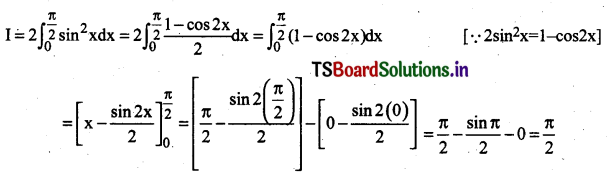
Evaluate \(\frac{\int_{-\pi}^{\frac{\pi}{2}}}{2} \sin ^2 x d x\)
Solution:
Let I = \(\frac{\int_{-\pi}^{\frac{\pi}{2}}}{2} \sin ^2 x d x\)
As sin2(-x) = [sin(-x)]2 = (-sin x)2 = sin2 x ∴ sin2 x is an even function
If f(x) is an even function, then \(\int_{-\mathrm{a}}^{\mathrm{a}} \mathrm{f}(\mathrm{x}) \mathrm{dx}=2 \int_0^{\mathrm{a}} \mathrm{f}(\mathrm{x}) \mathrm{dx}\)
Question 13.
Evaluate \(\int_{-1}^1 x^{17} \cos ^4 x d x\)
Solution:
Let I = \(\int_{-1}^1 x^{17} \cos ^4 x d x\)
Let f(x) = x17 cos4 x ⇒ f(-x) = (-x)17 cos4(-x) = -x17 cos4 x = -f(x)
f(x) is an odd function
We know that if f(x) is an odd function, then \(\int_{-a}^a f(x) d x=0\)
∴ I = \(\int_{-1}^1 x^{17} \cos ^4 x d x=0\)
Hence proved.
Question 14.
Evaluate \(\int_0^{2 \pi} \cos ^5 x d x\)
Solution:
Let I = \(\int_0^{2 \pi} \cos ^5 x d x\) ……….(1)
We have cos5(2π – x) = cos5 x
∴ I = \(2 \int_0^\pi \cos ^5 x d x\) ⇒ I = 2(0) = 0 [∵cos5(π – x) = – cos5x]
III.
Question 1.
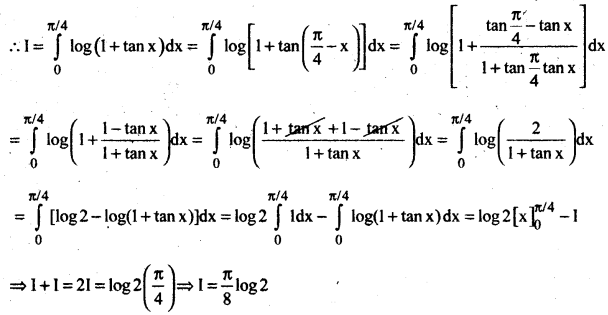
Evaluate \(\int_0^{\pi / 4} \log (1+\tan x) d x\)
Solution:
We know \(\int_0^a f(x) d x=\int_0^a f(a-x) d x\)
Question 2.
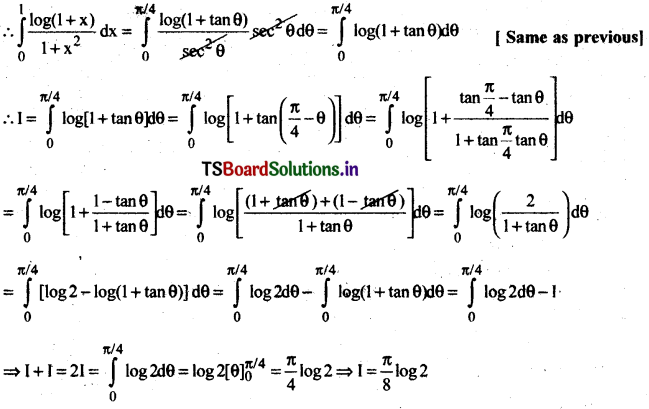
Evaluate \(\int_0^1 \frac{\log (1+x)}{1+x^2} d x\)
Solution:
Put x = tan θ ⇒ dx = sec2 θdθ. Also, x = 0 ⇒ θ = 0; x = 1 θ = \(\frac{\pi}{4}\)
Now, 1 + x2 = 1 + tan2 θ = sec2 θ
Question 3.
Evaluate \(\int_0^{\frac{\pi}{2}}(2 \log \sin x-\log \sin 2 x) d x\)
Solution:
Consider \(\int_0^{\frac{\pi}{2}}(2 \log \sin x-\log \sin 2 x) d x\)
⇒ I = \(\int_0^{\frac{\pi}{2}}(2 \log \sin x-\log (2 \sin x \cos x)) d x\)
[∵ sin2x = 2sin xcos x
log(abc) = log a + lob b + log c]
I = \(\int_0^{\frac{\pi}{2}}(2 \log \sin x-\log \sin x-\log \cos x-\log 2) d x\)
⇒ I = \(\int_0^{\frac{\pi}{2}}[\log \sin x-\log \cos x-\log 2] d x \ldots(1)\)
⇒ I = \(\left.\int_0^{\frac{\pi}{2}} \log \sin \left(\frac{\pi}{2}-x\right)-\log \cos \left(\frac{\pi}{2}-x\right)-\log 2\right] d x\)
⇒ I = \(\int_0^{\frac{\pi}{2}}[\log \cos x-\log \sin x-\log 2] d x\) ………(2)
Adding (1) and (2), we get
2I = \(\int_0^{\frac{\pi}{2}}(-\log 2-\log 2) \mathrm{dx} \Rightarrow 2 \mathrm{I}=-2 \log 2 \int_0^{\frac{\pi}{2}} 1 . \mathrm{dx}\)
⇒ I = \(-\log 2\left[\frac{\pi}{2}\right] \Rightarrow \mathrm{I}=\frac{\pi}{2}(-\log 2) \Rightarrow \mathrm{I}=\frac{\pi}{2}\left[\log \frac{1}{2}\right] \Rightarrow \mathrm{I}=\frac{\pi}{2} \log \frac{1}{2}=\frac{-\pi}{2} \log 2\)
Question 4.
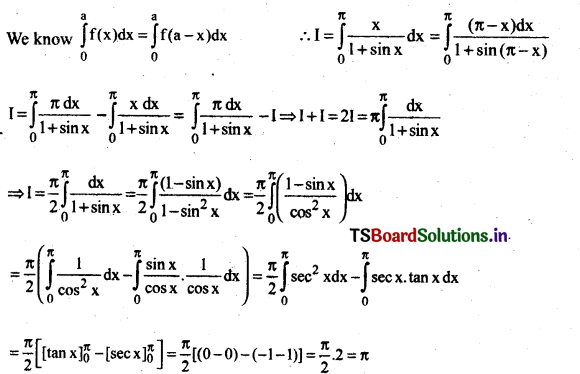
Evaluate \(\int_0^\pi \frac{x}{1+\sin x} d x\)
Solution:
Question 5.
Find the integral of \(\int_{\frac{\pi}{6}}^{\frac{\pi}{3}} \frac{\sin x+\cos x}{\sqrt{\sin 2 x}} d x\)
Solution:
Consider I = \(\int_{\frac{\pi}{6}}^{\frac{\pi}{3}} \frac{\sin x+\cos x}{\sqrt{\sin 2 x}} d x\)
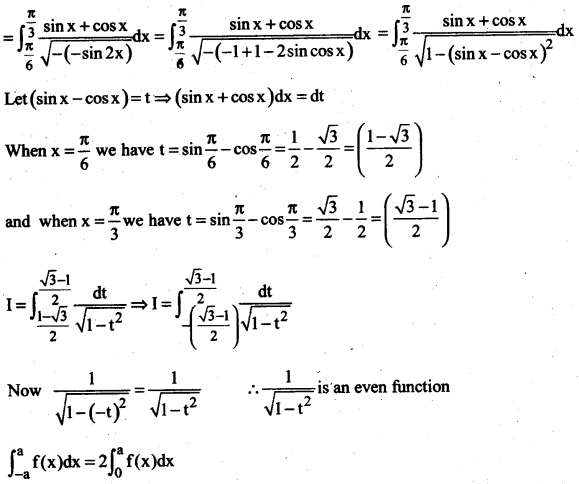
We know that if f(x) is an even function, then
I = \(2 \int_0^{\frac{\sqrt{3}-1}{2}} \frac{d t}{\sqrt{1-t^2}}=\left[2 \sin ^{-1} t\right]_0^{\frac{\sqrt{3}-1}{2}}=2 \sin ^{-1}\left(\frac{\sqrt{3}-1}{2}\right)\)
Question 6.
Evaluate \(\int_0^{\pi / 4} \frac{\sin x+\cos x}{9+16 \sin 2 x} d x\)
Solution:
Here, we take the substitution sinx – cosx = t. Then (cos x + sin x) = dt
Now x = 0 ⇒ t = sin0 – cos0 = 0 – 1 = -1 and x = π/4 ⇒ t = \(\)
Also, (sinx – cosx)2 = t2 ⇒ sin2x + cos2x – 2sinxcosx = t2 ⇒ 1 – sin2x = t2 ⇒ sin2x = 1 – t2
∴ 9 + 16sin2x = 9 + 16(1 – t2) = 9 + 16 – 16t2 = 25 – 16t2
∴ I = \(\int_0^{\pi / 4} \frac{\sin x+\cos x}{9+16 \sin 2 x} d x=\int_{-1}^0 \frac{d t}{25-16 t^2}=\int_{-1}^0 \frac{d t}{5^2-(4 t)^2}=\frac{1}{4} \cdot \frac{1}{2(5)} \cdot \log \left[\frac{5+4 t}{5-4 t}\right]_{-1}^0\)
= \(\frac{1}{40}\left[\log \left[\frac{5+0}{5-0}\right]-\log \left[\frac{5-4}{5+4}\right]\right]=\frac{1}{40}\left[\log 1-\log \frac{1}{9}\right]\)
= \(\frac{1}{40}\left[0-\log 9^{-1}\right]=\frac{1}{40}[\log 9]=\frac{\log 3^2}{40}=\frac{2 \log 3}{40}=\frac{\log 3}{20}\)
Question 7.
Find the integral of \(\int_0^{\frac{\pi}{4}} \frac{\sin x \cos x}{\cos ^4 x+\sin ^4 x} d x\)
Solution:

Put tan2x = t ⇒ 2 tan x sec2 xdx = dt
When x = 0 we have t = 0 and when x = \(\frac{\pi}{4}\), t = 1
∴ I = \(\frac{1}{2} \int_0^1 \frac{\mathrm{dt}}{1+\mathrm{t}^2}=\frac{1}{2}\left[\tan ^{-1} \mathrm{t}\right]_0^1=\frac{1}{2}\left[\tan ^{-1} 1-\tan ^{-1} 0\right]=\frac{1}{2}\left[\frac{\pi}{4}\right]=\frac{\pi}{8}\)
Question 8.
Find the integral of \(\int_0^{\frac{\pi}{2}} \frac{\cos ^2 x}{\cos ^2 x+4 \sin ^2 x} d x\)
Solution:
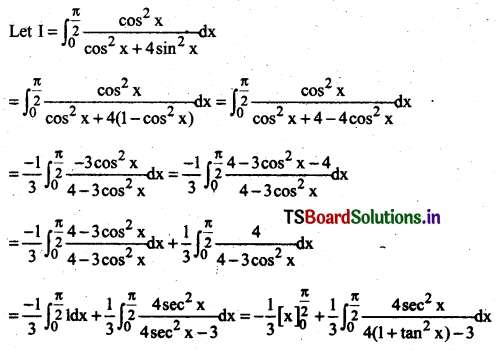
= \(-\frac{\pi}{6}+\frac{2}{3} \int_0^{\frac{\pi}{2}} \frac{2 \sec ^2 x}{1+4 \tan ^2 x} d x\) ……….(1)
Consider, \(\int_0^{\frac{\pi}{2}} \frac{2 \sec ^2 x}{1+4 \tan ^2 x} d x\)
Put, 2 tan x = t ⇒ 2 sec2 xdx = dt
When x = 0 we have t = 0 and x = \(\frac{\pi}{2}\) we have t = ∞
∴ \(\int_0^{\frac{\pi}{2}} \frac{2 \sec ^2 x}{1+4 \tan ^2 x} d x=\int_0^{\infty} \frac{d t}{1+t^2}=\left[\tan ^{-1} t\right]_0^{\infty}=\left[\tan ^{-1}(\infty)-\tan ^{-1}(0)\right]=\frac{\pi}{2}\)
∴ from (1), we get I = \(-\frac{\pi}{6}+\frac{2}{3}\left[\frac{\pi}{2}\right]=\frac{\pi}{3}-\frac{\pi}{6}=\frac{\pi}{6}\)
Question 9.
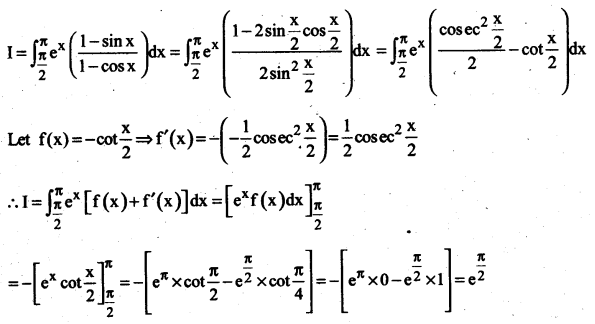
Find the integral of \(\int_{\frac{\pi}{2}}^\pi e^x\left(\frac{1-\sin x}{1-\cos x}\right) d x\)
Solution:
Question 10.
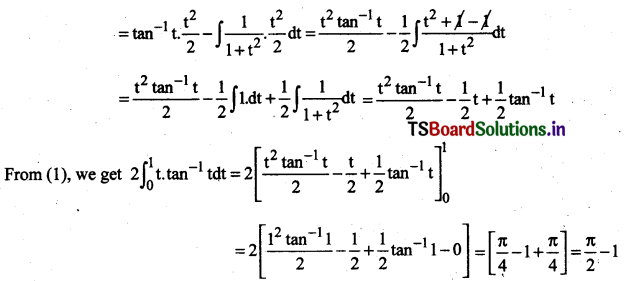
Find the integral of \(\int_0^{\frac{\pi}{2}} \sin 2 x \tan ^{-1}(\sin x) d x\)
Solution:
Let I = \(\int_0^{\frac{\pi}{2}} \sin 2 x \tan ^{-1}(\sin x) d x=\int_0^{\frac{\pi}{2}} 2 \sin x \cos x \tan ^{-1}(\sin x) d x\)
Put sin x = t ⇒ cos xdx= dt
When x = 0 we get t = 0 and when x = \(\frac{\pi}{2}\) we get t = 1 ⇒ I = \(2 \int_0^1 \mathrm{t} \tan ^{-1}(\mathrm{t}) \mathrm{dt}\) …………..(1)
Now \(\int t \cdot \tan ^{-1} t d t=\tan ^{-1} t \int t d t-\int\left[\frac{d}{d t}\left(\tan ^{-1} t\right) \int t d t\right] d t\)
Question 11.
Find the integral of \(\int_1^4[|\mathrm{x}-1|+|\mathrm{x}-2|+|\mathrm{x}-3|] \mathrm{dx}\)
Solution:
Let I = \(\int_1^4[|\mathrm{x}-1|+|\mathrm{x}-2|+|\mathrm{x}-3|] \mathrm{dx} \Rightarrow \mathrm{I}=\int_1^4|\mathrm{x}-1| \mathrm{dx}+\int_1^4|\mathrm{x}-2| \mathrm{dx}+\int_1^4|\mathrm{x}-3| \mathrm{dx}\)
I = I1 + I2 + I3 ………(A)
Where, I1 = \(\int_1^4|x-1| d x, I_2=\int_1^4|x-2| d x \text { and } I_3=\int_1^4|x-3| d x\)
I1 = \(\int_1^4|x-1| d x\)
(x – 1) ≥ 0 for 1 ≤ x ≤ 4
∴ I1 =\(\int_1^4(x-1) d x \Rightarrow I_1=\left[\frac{x^2}{2}-x\right]_1^4=\left[8-4-\frac{1}{2}+1\right]=\frac{9}{2}\) ………………(1)
I2 = \(\int_1^4|x-2| d x\)
x – 2 ≤ 0 for 1 ≤ x ≤ 2 and x – 2 ≥ 0 for 2 ≤ x ≤ 4
∴ I2 = \(\int_1^2(2-x) d x+\int_2^4(x-2) d x \Rightarrow I_2=\left[2 x-\frac{x^2}{2}\right]_1^2+\left[\frac{x^2}{2}-2 x\right]_2^4\)
⇒ I2 = \(\left[4-2-2+\frac{1}{2}\right]+[8-8-2+4] \Rightarrow I_2=\frac{1}{2}+2=\frac{5}{2}\) ………….(2)
⇒ I3 = \(\int_1^4|x-3| d x\)
x – 3 ≤ 0 for 1 ≤ x ≤ 3 and x – 3 ≥ 0 for 3 ≤ x ≤ 4
∴ I3 = \(\int_1^3(3-x) d x+\int_3^4(x-3) d x\)
⇒ I3 = \(\left[3 x-\frac{x^2}{2}\right]_1^3+\left[\frac{x^2}{2}-3 x\right]_3^4 \Rightarrow I_3=\left[9-\frac{9}{2}-3+\frac{1}{2}\right]+\left[8-12-\frac{9}{2}+9\right]\)
⇒ I3 = \([6-4]+\left[\frac{1}{2}\right]=\frac{5}{2}\) ………….(3)
From equations (1), (2), (3) and (A), we get I = \(\frac{9}{2}+\frac{5}{2}+\frac{5}{2}=\frac{19}{2}\)
Question 12.
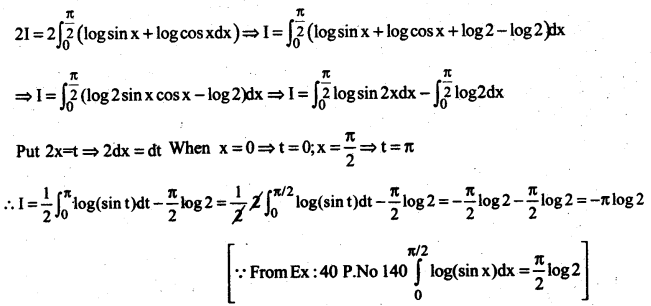
Evaluate \(\int_0^\pi \log (1+\cos x) d x\)
Solution:
Consider I = \(\int_0^\pi \log (1+\cos x) d x\) ………….(1) (∵ \(\int_0^{\mathrm{a}} \mathrm{f}(\mathrm{x}) \mathrm{dx}=\int_0^{\mathrm{a}} \mathrm{f}(\mathrm{a}-\mathrm{x}) \mathrm{dx}\))
⇒ I = \(\int_0^\pi \log [1+\cos (\pi-x)] d x \Rightarrow I=\int_0^\pi \log (1-\cos x) d x\) ……(2)
Adding (1) and (2), we get 2I = \(\int_0^\pi[\log (1+\cos x)+\log (1-\cos x)] d x\)
2I = \(\int_0^\pi \log \left(1-\cos ^2 x\right) d x \Rightarrow 2 I=\int_0^\pi \log \left(\sin ^2 x\right) d x\) [∵ log xn = n logx]
⇒ 2I = \(2 \int_0^\pi \log (\sin x) d x \Rightarrow I=\int_0^\pi \log (\sin x) d x\) ……..(3)
∴ sin(π – x) = sin x
We know that \(\int_0^{2 \mathrm{a}} \mathrm{f}(\mathrm{x}) \mathrm{dx}=2 \int_0^{\mathrm{a}} \mathrm{f}(\mathrm{x}) \mathrm{dx} \text { if } \mathrm{f}(2 \mathrm{a}-\mathrm{x})=\mathrm{f}(\mathrm{x})\)
∴ I = 2\(2 \int_0^{\frac{\pi}{2}} \log \sin x d x \quad \ldots(4) \Rightarrow I=2 \int_0^{\frac{\pi}{2}} \log \sin \left(\frac{\pi}{2}-x\right) d x=2 \int_0^{\frac{\pi}{2}} \log \cos x d x\) …………..(5)
Adding (4) and (5), we get
Question 13.
Evaluate \(\int_1^2 e^{2 x}\left(\frac{1}{x}-\frac{1}{2 x^2}\right) d x\)
Solution:
\(\int_1^2\left(\frac{1}{x}-\frac{1}{2 x^2}\right) e^{2 x} d x\) Put 2x = t ⇒ 2dx = dt
When x = 1 we have t = 2 and when x = 2 we have t = 4
∴ \(\int_1^2\left(\frac{1}{x}-\frac{1}{2 x^2}\right) e^{2 x} d x=\frac{1}{2} \int_2^4 e^t\left(\frac{2}{t}-\frac{2}{t^2}\right) d t=\int_2^4 e^t\left(\frac{1}{t}-\frac{1}{t^2}\right) d t\)
= \(\left[e^t \cdot \frac{1}{t}\right]_2^4=\left[\frac{e^t}{t}\right]_2^4=\frac{e^4}{4}-\frac{e^2}{2}=\frac{e^2\left(e^2-2\right)}{4}\)
Question 14.
If f and g are defined as f(x) = f(a – x) and g(x) + g(a – x) = 4, then show that \(\)
Solution:
Let I = \(\int_0^{\mathrm{a}} \mathrm{f}(\mathrm{x}) \mathrm{g}(\mathrm{x}) \mathrm{dx} \ldots \ldots(1) \Rightarrow \int_0^{\mathrm{a}} \mathrm{f}(\mathrm{a}-\mathrm{x}) \mathrm{g}(\mathrm{a}-\mathrm{x}) \mathrm{dx}\)
⇒ \(\int_0^a f(x) g(a-x) d x\) ………..(2)
Adding (1) and (2), we get 2I = \(\int_0^a\{f(x) g(x)+f(x) g(a-x)\} d x\)
⇒ 2I = \(\int_0^{\mathrm{a}} \mathrm{f}(\mathrm{x})\{\mathrm{g}(\mathrm{x})+\mathrm{g}(\mathrm{a}-\mathrm{x})\} \mathrm{dx}\)
⇒ 2I = \(\int_0^a f(x)(4) d x \quad[g(x)+g(a-x)=4] \Rightarrow I=2 \int_0^a f(x) d x\)