
Referring to the AP Inter 2nd Year Maths Study Material Chapter 5 Continuity and Differentiability Exercise 5g Solutions makes it easier to understand complex problems.
AP Inter 2nd Year Maths Continuity and Differentiability Solutions Exercise 5g
I.
Question 1.
Find the second order derivative of x2 + 3x + 2
Solution:
Let y = x2 + 3x + 2
∴ \(\frac{\mathrm{dy}}{\mathrm{dx}}\) = 2x + 3 . 1 + 0 = 2x + 3.
Again differentiating w.r.t. x, we have
\(\frac{\mathrm{d}^2 \mathrm{y}}{\mathrm{dx}^2}=\frac{d}{d x}\left(\frac{d y}{d x}\right)\) = 2(1) + 0 = 2
Question 2.
Find the second order derivative of x20.
Solution:
Let y = x20
∴ \(\frac{\mathrm{dy}}{\mathrm{dx}}\) = 20x19
Again differentiating w.r.t. x, we have
\(\frac{\mathrm{d}^2 \mathrm{y}}{\mathrm{dx}^2}\) = 20 × 19x18 = 380x18

Question 3.
Find the second order derivative of x . cos x
Solution:
Let y = x cos x
∴ \(\frac{\mathrm{dy}}{\mathrm{dx}}\) = x\(\frac{\mathrm{d}}{\mathrm{dx}}\)cos x + c0s x \(\frac{\mathrm{d}}{\mathrm{dx}}\)x [By Product Rule]
= -x sin x + cos x .
Again differentiating w.r.t. x, we have
\(\frac{\mathrm{d}^2 \mathrm{y}}{\mathrm{dx}^2}\) = –\(\frac{\mathrm{d}}{\mathrm{dx}}\)(x sin x) + \(\frac{\mathrm{d}}{\mathrm{dx}}\)cos x
= -[x\(\frac{\mathrm{d}}{\mathrm{dx}}\)sin x + sin x\(\frac{\mathrm{d}}{\mathrm{dx}}\)(x)] – sin x
= -(x cos x + sin x) – sin x = -x cos x – sin x – sin x
= -x cos x – 2 sin x = -(x cos x + 2 sin x).
Question 4.
Find the second order derivative of log x
Solution:
Let y = log x
∴ \(\frac{\mathrm{dy}}{\mathrm{dx}}=\frac{1}{x}\)
Again differentiating w.r.t. x, we have
\(\frac{\mathrm{d}^2 \mathrm{y}}{\mathrm{dx}^2}=\frac{d}{d x}\left(\frac{1}{x}\right)\) = \(\frac{\mathrm{d}}{\mathrm{dx}}\)x-1
= (-1)x-2 = \(\frac{-1}{x^2}\)
Question 5.
Find the second order derivative of tan-1 x
Solution:
Let y = tan-1 x
∴ \(\frac{\mathrm{dy}}{\mathrm{dx}}\) = \(\frac{1}{1+x^2}\)
Again differentiating w.r.t. x, we have
∴ \(\frac{\mathrm{d}^2 \mathrm{y}}{\mathrm{dx}^2}=\frac{\mathrm{d}}{\mathrm{dx}}\left(\frac{1}{1+\mathrm{x}^2}\right)\) = \(\frac{\left(1+x^2\right) \frac{d}{d x}(1)-1 \frac{d}{d x}\left(1+x^2\right)}{\left(1+x^2\right)^2}\)
= \(\frac{\left(1+x^2\right) 0-(2 x)}{\left(1+x^2\right)^2}\) = \(\frac{-2 x}{\left(1+x^2\right)^2}\)
II.
Question 1.
Find the second order derivative of x3 log x
Solution:
Let y = x3 log x
∴ \(\frac{\mathrm{dy}}{\mathrm{dx}}\) = x3\(\frac{\mathrm{d}}{\mathrm{dx}}\) log x + log x \(\frac{\mathrm{d}}{\mathrm{dx}}\) x3 [By Product Rule]
= x3\(\frac{1}{\mathrm{x}}\) + (log x)3x2 = x2 + 3x2 log x
Again differentiating w.r.t. x, we have
∴ \(\frac{\mathrm{d}^2 \mathrm{y}}{\mathrm{dx}^2}\) = \(\frac{\mathrm{d}}{\mathrm{dx}}\) x2 + 3\(\frac{\mathrm{d}}{\mathrm{dx}}\) (x2 log x) = 2x + 3[x2 \(\frac{\mathrm{d}}{\mathrm{dx}}\) log x + log x\(\frac{\mathrm{d}}{\mathrm{dx}}\)x2]
= 2x + 3(x2 . \(\frac{1}{\mathrm{x}}\) + (log x)2x) = 2x + 3(x + 2x log x)
= 2x + 3x + 6x log x = 5x + 6x log x
= x(5 + 6 log x)
Question 2.
Find the second order derivative of ex sin 5x
Solution:
Let y = ex sin 5x
∴ \(\frac{\mathrm{dy}}{\mathrm{dx}}\) = ex\(\frac{\mathrm{d}}{\mathrm{dx}}\)sin 5x + sin 5x\(\frac{\mathrm{d}}{\mathrm{dx}}\)ex [By Product Rule]
= ex cos5x\(\frac{\mathrm{d}}{\mathrm{dx}}\)5x + sin5xex = ex cos5 x5 + ex sin5x
= ex (5 cos 5x + sin 5x)
Again differentiating w.r.t. x using product rule, we have
∴ \(\frac{\mathrm{d}^2 \mathrm{y}}{\mathrm{dx}^2}\) = ex \(\frac{\mathrm{d}}{\mathrm{dx}}\)(5 cos 5x + sin 5x) + (5 cos 5x + sin 5x)\(\frac{\mathrm{d}}{\mathrm{dx}}\)ex
= ex(5(-sin 5x)5 + (cos 5x)5) + (5 cos 5x + sin 5x)ex
= ex(-25 sin 5x + 5 cos 5x + 5 cos 5x + sin 5x)
= ex(10 cos 5x – 24 sin 5x)
= 2ex(5 cos 5x – 12 sin 5x).
Question 3.
Find the second order derivative of e6x cos 3x
Solution:
Let y = e6x cos 3x
∴ \(\frac{\mathrm{dy}}{\mathrm{dx}}\) = e6x\(\frac{\mathrm{d}}{\mathrm{dx}}\)cos 3x + cos 3x\(\frac{\mathrm{d}}{\mathrm{dx}}\)e6x [By Product Rule]
= e6x (-sin 3x)\(\frac{\mathrm{d}}{\mathrm{dx}}\)(3x) + cos 3x . e6x\(\frac{\mathrm{d}}{\mathrm{dx}}\)6x
= -e6x sin 3x . 3 + cos 3x e6x . 6
⇒ \(\frac{\mathrm{dy}}{\mathrm{dx}}\) = 6e6x cos 3x – 3e6x sin 3x …………… (1)
∴ \(\frac{\mathrm{d}^2 \mathrm{y}}{\mathrm{dx}^2}\) = \(\frac{\mathrm{d}}{\mathrm{dx}}\) (6e6x cos 3x – 3e6x sin 3x) = 6\(\frac{\mathrm{d}}{\mathrm{dx}}\)(e6x cos 3x) – 3\(\frac{\mathrm{d}}{\mathrm{dx}}\)(e6x sin 3x)
= 6[6e6x cos 3x – 3e6x sin 3x] – 3[sin 3x\(\frac{\mathrm{d}}{\mathrm{dx}}\)(e6x) + e6x\(\frac{\mathrm{d}}{\mathrm{dx}}\)(sin 3x)] [using (1)1
= 36e6x cos 3x – 18e6x sin 3x – 3[sin 3xe6x 6 + e6x cos 3×3]
= 36e6x cos 3x – 18e6x sin 3x – 18e6x sin 3x – 9e6x cos3x
= 27 e6x cos 3x – 36e6x sin 3x = 9e6x (3 cos 3x – 4 sin 3x)
Question 4.
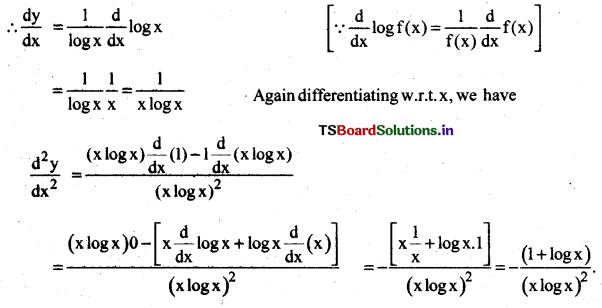
Find the second order derivative of log (log x)
Solution:
Let y = log (log x)
Question 5.
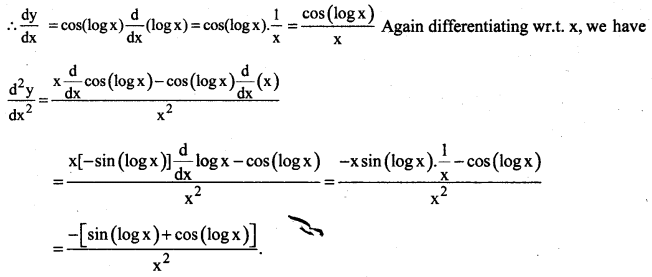
Find the second order derivative of sin(log x)
Solution:
Let y = sin(log x)
Question 6.
If y = 5 cos x – 3 sin x, prove that \(\frac{\mathrm{d}^2 \mathrm{y}}{\mathrm{dx}^2}\) + y = 0
Solution:
Given that y = 5 cos x – 3 sin x ……………. (i)
⇒ \(\frac{\mathrm{dy}}{\mathrm{dx}}\) = -5 sin x – 3 cos x
Again differentiating w.r.t. x,
\(\frac{\mathrm{d}^2 \mathrm{y}}{\mathrm{dx}^2}\) = -y = -5 cos x + 3 sin x
= -(5 cos x – 3 sin x) = -y (By (i))
⇒ \(\frac{\mathrm{d}^2 \mathrm{y}}{\mathrm{dx}^2}\) = -y
∴ \(\frac{\mathrm{d}^2 \mathrm{y}}{\mathrm{dx}^2}\) + y = 0
Question 7.
If y = cos-1x. Find \(\frac{\mathrm{d}^2 \mathrm{y}}{\mathrm{dx}^2}\) in terms of y alone.
Solution:
Given that y = cos-1x ⇒ x = cos y …………. (i)
∴ \(\frac{\mathrm{dy}}{\mathrm{dx}}\) = \(\frac{-1}{\sqrt{1-x^2}}=\frac{-1}{\sqrt{1-\cos ^2 y}}=\frac{-1}{\sqrt{\sin ^2 y}}=\frac{-1}{\sin y}\) = -cosec y [By (i)]
⇒ \(\frac{\mathrm{dy}}{\mathrm{dx}}\) = -cosec y …………. (ii)
Again differentiating both sides w.r.t. x, we have
\(\frac{\mathrm{d}^2 \mathrm{y}}{\mathrm{dx}^2}\) = –\(\frac{\mathrm{d}}{\mathrm{dx}}\) (cosec y) = -[-cosec y cot y \(\frac{\mathrm{dy}}{\mathrm{dx}}\)]
= cosec y cot y(-cosec y) = -cosec2y cot y.
Question 8.
If y 3 cos (log x) + 4 sin (log x). show that x2y2 + xy1 + y = 0
Solution:
Given that y = 3cos(log x)+ 4sin(log x)
∴ \(\frac{\mathrm{dy}}{\mathrm{dx}}\) = (y1)= -3 sin(logx)\(\frac{\mathrm{d}}{\mathrm{dx}}\)logx + 4cos(log x) \(\frac{\mathrm{d}}{\mathrm{dx}}\) logx
⇒ y1 =- 3 sin(1ogx) \(\frac{1}{x}\) +4cos(logx). \(\frac{1}{x}\)
⇒ xy1 = -3 sin(log x) +4 cos(log x)
Again differentiating both sides wrt. x,
\(\frac{\mathrm{d}}{\mathrm{dx}}\) (xy1) = -3 cos(log x)\(\frac{\mathrm{d}}{\mathrm{dx}}\)log x – 4sin(log x)\(\frac{\mathrm{d}}{\mathrm{dx}}\)log x
x\(\frac{\mathrm{d}}{\mathrm{dx}}\)y1 + y1\(\frac{\mathrm{d}}{\mathrm{dx}}\)x = – 3 cos(log x)\(\frac{\mathrm{d}}{\mathrm{dx}}\) – 4 sin(log x)\(\frac{1}{\mathrm{dx}}\) [By Product Rule]
⇒ xy2 + y1 = –\(\frac{[3 \cos (\log x)+4 \sin (\log x)]}{x}\)
⇒ x(xy2 + y1) = -[3 cos(log x)+ 4 sin(log x)]
⇒ x2y2 + xy1 = -y ⇒ x2y2 + xy1 + y = 0
Question 9.
If y = Aemx + Benx, show that \(\frac{\mathrm{d}^2 \mathrm{y}}{\mathrm{dx}^2}\) – (m + n) \(\frac{\mathrm{dy}}{\mathrm{dx}}\) + mny = 0
Solution:
Given that y =Aemx + Benx …………. (i)
∴ \(\frac{\mathrm{dy}}{\mathrm{dx}}\) = Aemx\(\frac{\mathrm{d}}{\mathrm{dx}}\)(mx) + Benx\(\frac{\mathrm{d}}{\mathrm{dx}}\)(nx) [∵ \(\frac{\mathrm{d}}{\mathrm{dx}}\) ef(x) = ef(x) \(\frac{\mathrm{d}}{\mathrm{dx}}\) f(x)]
⇒ \(\frac{\mathrm{dy}}{\mathrm{dx}}\) = Amemx + Bnenx …………. (ii)
∴ \(\frac{\mathrm{d}^2 \mathrm{y}}{\mathrm{dx}^2}\) = Amemxm + Bnenx.n = Am2emx + Bn2enx ……………. (iii)
Putting values of y, \(\frac{\mathrm{dy}}{\mathrm{dx}}\) and \(\frac{\mathrm{d}^2 \mathrm{y}}{\mathrm{dx}^2}\) from(i), (ii) and (iii) in
L.H.S. = \(\frac{\mathrm{d}^2 \mathrm{y}}{\mathrm{dx}^2}\) – (m + n)\(\frac{\mathrm{dy}}{\mathrm{dx}}\) + mny
= Am2emx + Bn2enx – (m + n)(Amemx +Bnenx) + mn(Aemx + Benx)
= Am2emx + Bn2enx – Am2emx – Bmnenx – Anmemx – Bn2enx + Amnemx + Bnmenx = 0
= R.H.S.
Question 10.
If y = 500e7x + 600e-7x, show that \(\frac{\mathrm{d}^2 \mathrm{y}}{\mathrm{dx}^2}\) = 49y
Solution:
Given y = 500e7x + 600e-7x …………. (i)
⇒ \(\frac{\mathrm{dy}}{\mathrm{dx}}\) = 500e7x (7) + 600e-7x(-7) = 500(7)e7x – 600(7)e-7x
Now \(\frac{\mathrm{d}^2 \mathrm{y}}{\mathrm{dx}^2}\) = 500(7)e7x (7) – 600(7)e-7x (7)
= 500(49)e7x + 600(49)e-7x
= 49[500e7x + 600e-7x] = 49 y ………………. [By (I)]
∴ \(\frac{\mathrm{d}^2 \mathrm{y}}{\mathrm{dx}^2}\) = 49y.
Question 11.
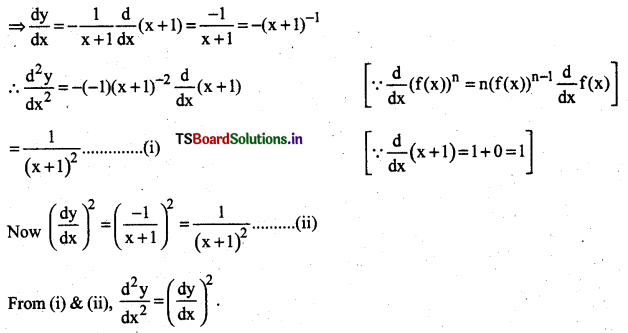
If ey (x + 1) = 1, show that \(\frac{d^2 y}{d x^2}=\left(\frac{d y}{d x}\right)^2\)
Solution:
Given that ey (x + 1) = 1 ⇒ ey = \(\frac{1}{x+1}\)
Taking logs of both sides, log ey = log \(\frac{1}{x+1}\)
⇒ y loge = log 1 – log(x + 1)
⇒ y = -log(x + 1) [∵ log e = 1 and log 1 = 0]
Question 12.
If y = (tan-1x)2, show that (x2 + 1)2y2 + 2x (x2 + 1)y1 = 2
Solution:
Given that y = (tan-1x)2
⇒ y1 = 2(tan-1x)\(\frac{\mathrm{d}}{\mathrm{dx}}\)tan-1x [∵ \(\frac{\mathrm{d}}{\mathrm{dx}}\) (f(x))n = n(f(x))n-1\(\frac{\mathrm{d}}{\mathrm{dx}}\)f(x)]
⇒ y1 = 2(tan-1x)\(\frac{1}{1+x^2}\)
⇒ y1 = \(\frac{2 \tan ^{-1} x}{1+x^2}\)
⇒ (1 + x2)y1 = 2 tan-1x
Again differentiating both sides w.r.t. x,
(1 + x2)\(\frac{\mathrm{d}}{\mathrm{dx}}\)y1 + y1\(\frac{\mathrm{d}}{\mathrm{dx}}\)(1 + x2) = 2 . \(\frac{1}{1+x^2}\)
⇒ (1 + x2)y2 + y1 . 2x = \(\frac{2}{1+x^2}\)
⇒ (x2 + 1)2y2 + 2x(1 + x2)y1 = 2.