
Referring to the AP Inter 2nd Year Maths Study Material Chapter 5 Continuity and Differentiability Exercise 5b Solutions makes it easier to understand complex problems.
AP Inter 2nd Year Maths Continuity and Differentiability Solutions Exercise 5b
I.
Question 1.
Differentiate the function sin(x2 + 5) with respect to x.
Solution:
Let y = sin(x2 + 5)
∴ \(\frac{\mathrm{dy}}{\mathrm{dx}}\) = \(\frac{\mathrm{d}}{\mathrm{dx}}\) sin(x2 + 5) = cos(x2 + 5) \(\frac{\mathrm{d}}{\mathrm{dx}}\)(x2 + 5) [∵ \(\frac{\mathrm{d}}{\mathrm{dx}}\) sin f(x) = cos f(x) \(\frac{\mathrm{d}}{\mathrm{dx}}\)f(x)]
= cos(x2 + 5) (2x + 0) [∵ \(\frac{\mathrm{d}}{\mathrm{dx}}\) xn = nxn-1 and \(\frac{\mathrm{d}}{\mathrm{dx}}\) (c) = 0]
= 2x cos(x2 + 5)

Question 2.
Differentiate the function cos(sin x) with respect to x.
Solution:
Let y = cos(sin x)
∴ \(\frac{\mathrm{dy}}{\mathrm{dx}}\) = \(\frac{\mathrm{d}}{\mathrm{dx}}\) cos(sin x) = -sin(sin x) \(\frac{\mathrm{d}}{\mathrm{dx}}\)(sin x) [∵ \(\frac{\mathrm{d}}{\mathrm{dx}}\) cos f(x) = -sin f(x) \(\frac{\mathrm{d}}{\mathrm{dx}}\)f(x)]
= -sin(sin x) cos x = -cos x sin(sin x)
Question 3.
Differentiate the function sin(ax + b) with respect to x.
Solution:
Let y = sin(ax + b)
∴ \(\frac{\mathrm{dy}}{\mathrm{dx}}\) = \(\frac{\mathrm{d}}{\mathrm{dx}}\)sin(ax + b) = cos(ax + b) \(\frac{\mathrm{d}}{\mathrm{dx}}\)(ax + b)
= cos(ax + b)[a\(\frac{\mathrm{d}}{\mathrm{dx}}\)(x) + \(\frac{\mathrm{d}}{\mathrm{dx}}\)(b)]
= cos(ax + b)[a(1) + 0] = a cos(ax + b)
Question 4.
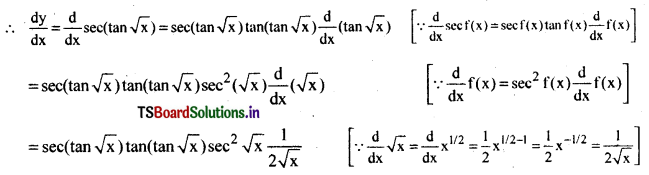
Differentiate the function sec(tan(\(\sqrt{x}\))) with respect to x.
Solution:
Let y = sec(tan(\(\sqrt{x}\)))
Question 5.
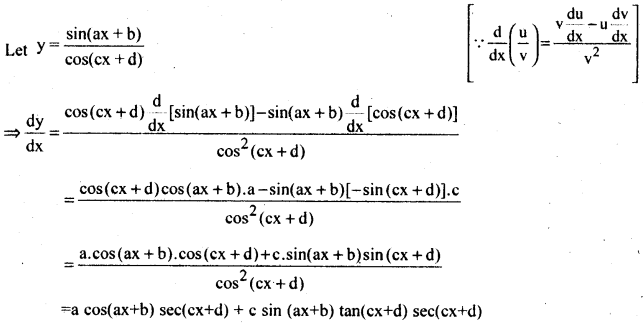
Differentiate the function \(\frac{\sin (a x+b)}{\cos (c x+d)}\) with respect to x.
Solution:
Question 6.
Differentiate the function cosx3 . sin2(x5) with respect to x.
Solution:
Let y = cosx3 . sin2(x5) = cos x3 (sin x5)2 [∵ sin2f(x) = [sin f(x)]2]
∴ \(\frac{\mathrm{dy}}{\mathrm{dx}}\) = cos x3 \(\frac{\mathrm{d}}{\mathrm{dx}}\) (sin x5)2 + (sin x5)2 \(\frac{\mathrm{d}}{\mathrm{dx}}\) cos x3 [∵ \(\frac{\mathrm{d}}{\mathrm{dx}}\) (uv) = u\(\frac{\mathrm{dv}}{\mathrm{dx}}\) + v\(\frac{\mathrm{du}}{\mathrm{dx}}\)]
= cos x3 2(sin x5)\(\frac{\mathrm{d}}{\mathrm{dx}}\)sin x5 +(sin x5)2 (-sin x3 )\(\frac{\mathrm{d}}{\mathrm{dx}}\)x3
= cos x32(sin x5)cos x5 (5x4 + (sin x5)2(-sin x3)(3x2) [∵ \(\frac{\mathrm{d}}{\mathrm{dx}}\) sin x5 = cos x5 \(\frac{\mathrm{d}}{\mathrm{dx}}\) x5 = cos x5(5x4)]
= 10x4 cos x3 sin x5 cos x5 – 3x2 sin2 x5 sin x3
= x2 sin x5[10x2 cos x3 cos x5 – 3 sin x5 sin x3].
Question 7.
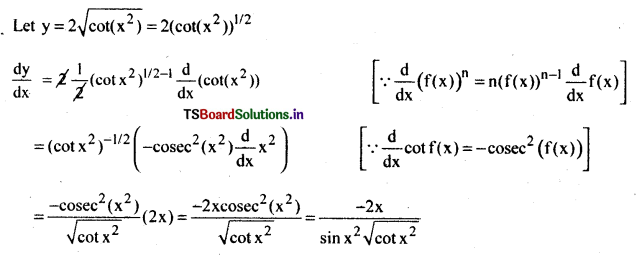
Differentiate the function \(2 \sqrt{\cot \left(x^2\right)}\) with respect to x.
Solution:
Question 8.
Differentiate the function cos(\(\sqrt{x}\)) with respect to x.
Solution:
Let y = cos(\(\sqrt{x}\))
∴ \(\frac{\mathrm{dy}}{\mathrm{dx}}\) = \(\frac{\mathrm{d}}{\mathrm{dx}}\) cos(\(\sqrt{x}\))
= -sin \(\sqrt{x}\) \(\frac{\mathrm{d}}{\mathrm{dx}}\) \(\sqrt{x}\) [∵ \(\frac{\mathrm{d}}{\mathrm{dx}}\) cos f(x) = -sin f(x) \(\frac{\mathrm{d}}{\mathrm{dx}}\) f(x)]
= -sin \(\sqrt{x} \frac{1}{2 \sqrt{x}}\) [∵ \(\frac{\mathrm{d}}{\mathrm{dx}} \sqrt{x}=\frac{1}{2 \sqrt{x}}\)
II.
Question 1.
Prove that the function f given by f(x) = |x – 1|, x ∈ R k is not differentiable at x = 1.
Solution:
Given f(x) = |x – 1| , x ∈ R ……….. (i)
To prove: f(x) is not differentiable at x = 1
Putting x = 1 in (i), f'(1) = |1 – 1| = |0| = 0
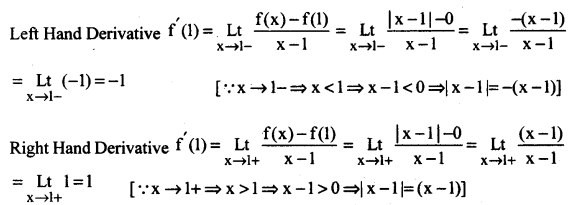
Here, L.H.L of f'(1) ≠ R.H.L of f'(1)
∴ f(x) is not differentiable at x = 1
Question 2.
Prove (hat the greatest nleger function defined by f(x) = |x|, 0 < x < 3 is not differentiable at x = 1 and x = 2.
Solution:
Given f(x) = [x], 0 < x < 3 ……….(i)
(a) Differentiability at x = 1
Putting x = 1 in (i), f(1) = [1] = 1 .
Left Hand derivative of f'(1) = \(\underset{\mathrm{x} \rightarrow 1-}{\mathrm{Lt}}\) \(\frac{f(x)-f(1)}{x-1}\) = \(\underset{\mathrm{x} \rightarrow 1-}{\mathrm{Lt}}\)\(\frac{[x]-1}{x-1}\)
Put x = 1 – h, h → 0+
\(\underset{\mathrm{h} \rightarrow 0+}{\mathrm{Lt}}\)\(\frac{[1-\mathrm{h}]-1}{1-\mathrm{h}-1}\) = \(\underset{\mathrm{h} \rightarrow 0+}{\mathrm{Lt}}\)\(\frac{0-1}{-h}\)
= \(\underset{\mathrm{h} \rightarrow 0+}{\mathrm{Lt}}\)\(\frac{1}{h}\)
We know that as h → 0+, [c – h] = c – 1 if c is an integer
∴ [1 – h] = 1 – 1 = 0
Put h = 0, \(\frac{1}{h}\) = \(\frac{1}{0}\) = ∞ does not exist
∴ f(x) is not differentiable at x = 1
(We need not find R f'(1) as L f'(1) does not exist).
(b) Differentiability at x = 2
Putting x = 2 in (i), f(2) = [2] = 2 .
Left Hand derivative of f'(2) = \(\underset{\mathrm{x} \rightarrow 1-}{\mathrm{Lt}}\) \(\frac{f(x)-f(2)}{x-2}\) = \(\underset{\mathrm{x} \rightarrow 1-}{\mathrm{Lt}}\)\(\frac{[x]-2}{x-2}\)
Put x = 2 – h, h → 0+
\(\underset{\mathrm{h} \rightarrow 0+}{\mathrm{Lt}}\)\(\frac{[2-\mathrm{h}]-2}{2-\mathrm{h}-2}\) = \(\underset{\mathrm{h} \rightarrow 0+}{\mathrm{Lt}}\)\(\frac{1-2}{-h}\)
= \(\underset{\mathrm{h} \rightarrow 0+}{\mathrm{Lt}}\)\(\frac{-1}{-h}\)
(For h → 0+, [2 – h] = 2 – 1 = 1
\(\underset{\mathrm{h} \rightarrow 0+}{\mathrm{Lt}}\)\(\frac{1}{h}\) = \(\frac{1}{0}\) = ∞ does not exist
∴ f(x) is not differentiable at x = 2
Note. For h → 0+, [c + h] = c if c is an integer