Reviewing AP Inter 2nd Year Accounts Study Material Chapter 6 Company Accounts Questions and Answers can help students prepare confidently for exams.
AP Inter 2nd Year Accountancy 6th Lesson Company Accounts Questions and Answers
I. Fill in the blanks
Question 1.
___ the total amount of money raised by a company by issuing shares to its shareholders.
Answer:
Share capital
Question 2.
____ capital is the maximum amount of share capital which a company is authorized to raise by issuing the shares.
Answer:
Authorized share capital
Question 3.
The person who purchases a share is called ___
Answer:
Share holder
Question 4.
When a company issues its shares at their fàce value, it is said to be an ___.
Answer:
Issued at par
Question 5.
When a company issues its shares at a price of higher than the face value, it is said to be an ____.
Answer:
Issued at premium.
Question 6.
When a company issues its shares at a priceless than the face value, it is said to be an ____.
Answer:
Issued at Discount
II. Very Short Answer Questions
Question 1.
Share Capital.
Answer:
Share capital is the total amount of money a company raises by issuing shares (small units of ownership) to investors.
Question 2.
Company.
Answer:
- A company is a voluntary association of individuals established under the law.
- It has a separate legal identity, limited liability, and perpetual succession.
Question 3.
Authorized Share Capital.
Answer:
- Authorized share capital is the maximum amount of share capital that a company is permitted to raise by issuing shares.
- It is specified in the company’s Memorandum of Association and is also known as nominal capital or registered capital.

Question 4.
Shareholder.
Answer:
- A shareholder is an individual or organization that owns one or more shares in a company.
- By owning shares, they become one of the owners of the company.
Question 5.
Issued at par.
Answer:
Shares are said to be issued at par when they are issued at their face value.
Ex : If the face value of a share is ₹ 10 and it is issued for ₹ 10, it is an issue at par.
Question 6.
Issued at Premium.
Answer:
- When a company issues its shares at a price higher than their face value, the shares are said to be issued at a premium.
- The amount received over and above the face value is called premium, and such an issue is known as shares issued at a premium.
Ex : If the face value of a share is ₹ 100 and it is issued at ₹ 110, the extra amount of ₹ 10 is treated as capital income (premium).
Question 7.
Issued at Discount.
Answer:
- When a company issues its shares at a price lower than their face value, the shares are said to be issued at a discount.
- The difference between the face value and the issue price is known as discount, which is considered a capital loss.
Ex: If the face value of a share is ₹ 100 and it is issued at, ₹ 90, the discount is ₹ 10.
III. Short Answer Questions
Question 1.
Types of Capital.
Answer:
From an accounting perspective, the share capital of a company is classified into the following types:
1. Authorised Capital:
- Authorised capital is the highest amount of share capital that a company is legally permitted to raise by issuing shares.
- It is mentioned in the company’s Memorandum of Association and is also known as Nominal Capital or Registered Capital.
Ex : ABC Ltd. has an Authorised Capital of ₹ 10,00,000, divided into 1,00,000 equity shares of 10 each.
2. Issued Capital:
- Issued capital is the portion of the authorised capital that the company offers to the public for subscription.
- A company may issue the whole authorised capital at once or in parts according to its financial requirements.
Ex : ABC Ltd. issued 80,000 shares of ₹ 10 each (80,000 × 10) = ₹ 8,00,000.
3. Subscribed Capital:
- Subscribed capital is the part of the issued capital that has been accepted by the public.
- It refers to the shares for which applications are received and allotted by the company.
Ex : The public subscribes to 75,000 shares of ₹ 10 each (75,000 × ₹ 10) = ₹ 7,50,000.
4. Called-up Capital:
- Calle’d-up capital is the part of the subscribed capital that the company asks shareholders to pay.
- The company may call for the full face value or only a portion of it.
Ex : The company calls ₹ 8 per share on 75,000 shares = ₹ 6,00,000.
5. Paid-up Capital:
- Paid-up capital is the amount of called-up capital that has actually been paid by the shareholders.
Ex : If some shareholders fliilto pay ₹ 24,000 (3,000 shares × ₹ 8), the company receives ₹ 5,76,000(72,000 shares × ₹ 8) as paid-up capital.
6. Uncalled Capital:
- Uncalled capital is the portion of the subscribed or issued capital that has not yet been demanded by the company from the shareholders.
Ex : The company has not called ₹ 2 per share on 75,000 shares, which amounts to ₹ 1,50,000.
7. Unpaid Capital:
- Unpaid capital is the part of the called-up capital that has been demanded but has not been paid by the shareholders. It is also known as Calls in Arrears.
Ex : Some shareholders have not paid ₹ 24,000 (3,000 shares × ₹ 8).
8. Reserve Capital:
- Reserve capital is the part of the uncalled capital that the company decides to call only if the company is wound up.
- This reserved uncalled amount is known as Reserve Capital.
Question 2.
Types of Share.
Answer:
Shares represent ownership in a company. To meet different financial and ownership requirements, companies issue various types of shares. Under the Companies Act, 2013, shares are mainly classified into two categories:
1. Equity Shares
2. Preference Shares
1. Equity Shares (Ordinary Shares):
- Equity shares are the most common type of shares issued by a company.
- They indicate ownership in the company and give shareholders the right to vote and share in the company’s profits.
- These are also called Ordinary Shares because they do not have any special rights like preference shares.
2. Preference Shares:
Preference shares are shares that provide certain preferential rights over equity shares in the following two matters:
- Dividend : Preference shareholders receive dividends before equity shareholders.
- Repayment of Capital : During the winding up of a company, preference shareholders are repaid before equity shareholders.
Question 3.
What is an Equity share?
Answer:
Equity Shares (Ordinary Shares):
- Equity shares are the primary shares issued by a company.
- They represent ownership in the company and give shareholders the right to vote and participate in its profits.
- They are called Ordinary Shares because they do not enjoy any special privileges like preference shares.
Key Features of Equity Shares:
- Ownership Rights: Equity shareholders are the actual owners of the company.
- Voting Rights : They have the right to vote in general meetings and elect the directors.
- Residual Claim : They receive dividends only after preference shareholders have been paid.
- Variable Dividend : The dividend is not fixed and depends on the company’s profits and management‘s decision.
- Risk and Reward: Equity shares involve higher risk because shareholders are paid last during liquidation, but they also offer higher return opportunities through capital appreciation, bonus shares, and higher dividends.
- Permanent Capital : Equity shares are generally not redeemable during the lifetime of the company.
Question 4.
Explain different stages in the issue of shares.
Answer:
The process of issuing shares by a company takes place through several important stages. These stages help ensure that shares are properly offered, allotted, and the required amount is collected.
1. Prospectus Stage:
- The company invites the public to purchase its shares by issuing a prospectus.
- The prospectus includes details such as the company’s objectives, capital structure, risk factors, and terms of issue.
- This information enables investors to make informed investment decisions.
2. Application Stage:
- Interested investors apply for shares by submitting an application form.
- They must pay the application money along with the form.
- The applications are submitted either to the company or through authorised banks.
3. Allotment Stage:
- After receiving the applications, the company decides the number of shares to be allotted to each applicant.
- A Letter of Allotment is sent to the successful applicants.
- The allotment money then becomes payable.
4. Call Stage:
After the allotment, the remaining share amount is collected in instalments known as calls:
- First Call — The first instalment collected after allotment.
- Second Call — The next instalment, if required.
- Final Call — The last payment collected to make the shares fully paid.
5. Issue of Share Certificate:
- After all the required payments are made, the company issues a Share Certificate.
- The share certificate serves as legal proof of ownership of the shares.
IV. Long Answer Questions
Question 1.
What is a Company ? Explain the key features of company.
Answer:
A company is a modern and large-scale form of business organization that is suitable for businesses requiring huge capital, limited liability, and continuous existence.
According to Section 2(20) of the Companies Act, 2013, a company means a company incorporated under the Companies Act, 2013 or any earlier company law. It is a separate legal entity from its members. As an artificial legal person, a company can own property, enter into contracts, sue and be sued, and enjoys perpetual succession.
Key Features of a Company:
- Separate Legal Entity: A company has its own legal identity, independent of its shareholders.
- Limited Liability : The liability of shareholders is restricted to the amount invested by them.
- Perpetual Succession : The company continues to exist regardless of changes in ownership, management, death, or retirement of members.
- Common Seal: Traditionally, the common seal served as the official signature of the company, though its use is optional under modern law.
- Transferability of Shares: Shares of most companies can be freely transferred from one person to another.
- Separation of Ownership and Management: Shareholders are the owners, while the company is managed by directors on.their behalf.
Question 2.
What is share capital ? Discuss different type of share capitals.
Answer:
Since a company is an artificial legal person, it cannot create its own capital. The required capital is collected from a number of individuals known as shareholders. The total amount contributed by these shareholders is called share capital.
From an accounting perspective, share capital is classified into the following types:
1. Authorised Capital:
- Authorised capital is the maximum amount of share capital that a company is permitted to raise by issuing shares.
- It is specified in the company’s Memorandum of Association and is also known as Nominal Capital or Registered Capital.
Ex : ABC Ltd. has an authorised capital of ₹ 10,00,000, divided into 1,00,000 equity shares of ₹ 10 each.
2. Issued Capital:
- Issued capital is the portion of the authorised capital that the company offers to the public for subscription.
- A company may issue the entire authorised capital or only a part of it according to its financial requirements.
Ex : ABC Ltd. issues 80,000 shares of ₹ 10 each = ₹ 8,00,000.
3. Subscribed Capital:
- Subscribed capital is the part of the issued capital that has actually been subscribed by the public.
- It represents the shares for which applications have been received and allotments have been made.
Ex : The public subscribes to 75,000 shares of ₹ 10 each = ₹ 7,50,000.
4. Called-up Capital:
- Called-up capital is the portion of the subscribed capital that the company has asked shareholders to pay.
- The company may call either the entire face value or only a part of it.
Ex : The company calls ₹ 8 per share on 75,000 shares = ₹ 6,00,000.
5. Paid-up Capital:
- Paid-up capital is the amount of called-up capital that has actually been paid by the shareholders.
Ex : If shareholders holding 3,000 shares fail to pay ₹ 8 per share (₹ 24,000), the paid-up capital will be 72,000 shares × ₹ 8 = ₹ 5,76,000.
6. Uncalled Capital:
- Uncalled capital is the part of the subscribed or issued capital that has not yet been demanded by the company from shareholders.
Ex : The company has not called ₹ 2 per share on 75,000 shares = ₹ 1,50,000.
7. Unpaid Capital:
- Unpaid capital is the portion of the called-up capital that shareholders have failed to pay. It is also known as Calls in Arrears.
Ex : Shareholders holding 3,000 shares did not pay ₹ 24,000 (3,000 × ₹ 8).
8. Reserve Capital:
- Reserve capital is that portion of the uncalled capital which the company decides to call only at the time of winding up.
- This amount is reserved exclusively for such circumstances.
Question 3.
Explain the various kinds of shares and their features.
Answer:
Shares represent ownership in a company. To meet different financial and ownership requirements, companies issue different categories of shares. Under the Companies Act, 2013, shares are broadly classified into two types :
1. Equity Shares
2. Preference Shares
1. Equity Shares (Ordinary Shares):
- Equity shares are the most common type of shares issued by a company.
- They signify ownership in the company and provide shareholders with voting rights as well as a share in the company’s profits.
- These shares are also called ordinary shares because they do not enjoy any special privileges.
Key Features of Equity Shares :
- Ownership Rights: Equity shareholders are the actual owners of the company.
- Voting Rights: They have the right to vote in general meetings and elect the directors.
- Residual Claim: They receive dividends only after preference shareholders have been paid.
- Variable Dividend : The dividend is not fixed and depends on the company’s profits and management decisions.
- Risk and Reward : Equity shares involve greater risk, as shareholders are paid last during liquidation, but they also offer higher return potential through dividends, bonus shares, and capital appreciation.
- Permanent Capital: These shares are generally not redeemable during the company’s lifetime.
2. Preference Shares :
Preference shares provide certain preferential rights over equity shares in two important respects:
- Dividend: Preference shareholders receive dividends before equity shareholders.
- Repayment of Capital: During winding up, they are repaid before equity shareholders.
Key Features of Preference Shares :
- Fixed Dividend : They generally carry a fixed rate of dividend.
- Preferential Rights : They receive priority in dividend payments and repayment of capital.
- Limited or No Voting Rights : Normally, they do not have voting rights except on matters affecting their rights.
- Lower Risk : Preference shares are considered safer than equity shares.
- No Management Control: Preference shareholders do not participate in the management of the company.
Question 4.
Discuss the different types of share capital of companies.
Answer:
Generally, the shares of a company may be issued in the following ways :
1. Issued at Par
2. Issued at a Premium
3. Issued at a Discount
1. Shares Issued at Par (Face Value):
- When shares are issued at their face value, they are said to be issued at par.
Ex: If the face value of a share is ₹ 10 and it is issued for ₹ 10, the shares are issued at par.
2. Shares Issued at a Premium (Section 52 of the Companies Act, 2013):
- When shares are issued at a price higher than their face value, they are said to be issued at a premium.
- The excess amount received over the face value is known as Share Premium, which is treated as capital income.
Ex: If a share with a face value of ₹ 100 is issued at ₹ 110, the premium received is ₹ 10.
3. Shares Issued at a Discount:
- When shares are issued at a price lower than their face value, they are said to be issued at a discount.
- The difference between the face value and the issue price is known as discount, which represents a capital loss.
Ex: If the face value of a share is ₹ 100 and it is issued at ₹ 90, the discount allowed is ₹ 10.
Exercises
Straight Line Method or Fixed Installment Method
I. Very Short Answer Questions
Question 1.
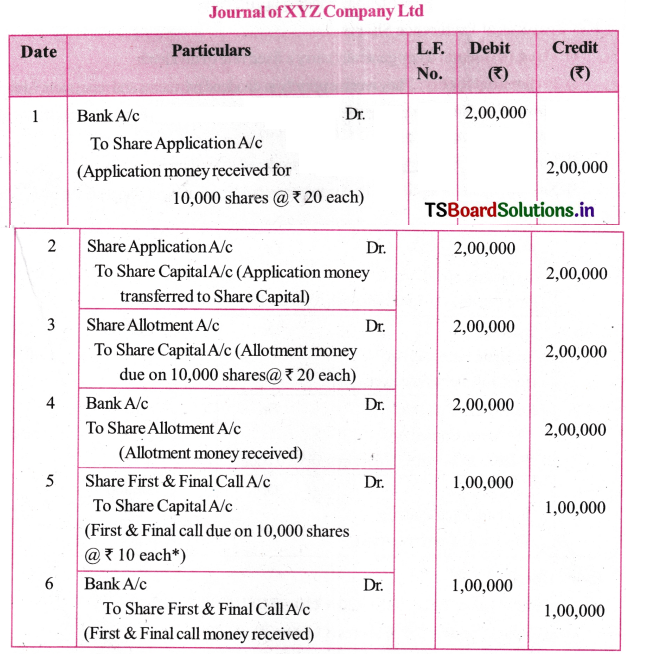
XYZ Company Ltd issued 10,000 shares of ₹ 50 each for the subscription to the public. Payable at ₹ 20 per share On application, ₹ 20 per share on allotment and the balance ₹ 10 on first and final call. All the amounts were duly received. Make journal entries in the books of the company.
Solution:
Journal of XYZ Company Ltd
Question 2.
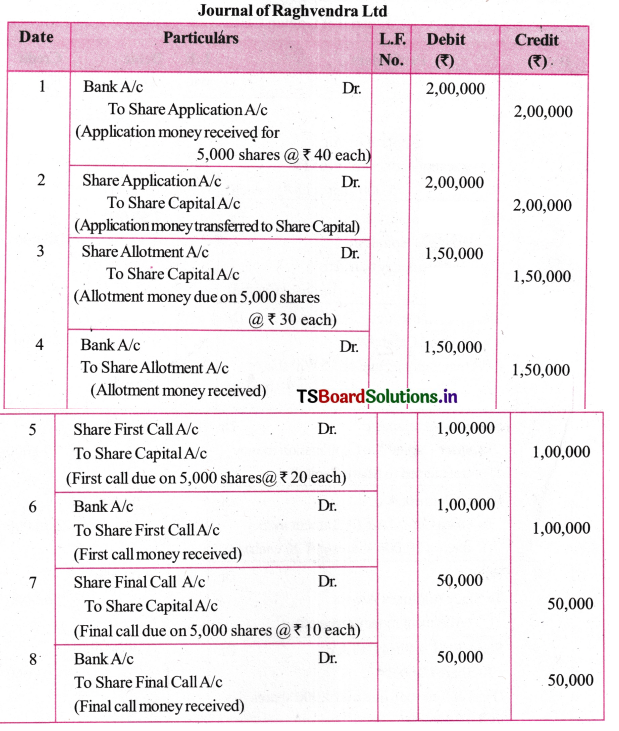
Raghvendra Ltd decided to issue 5,000 shares of ₹ 100 each for the subscription. Payable at ₹ 40 per share on application, ₹ 30 per share on allotment and ₹ 20 on first call and the balance ₹ 10 on final call. All the money was duly received. Write journal entries in the books of the company.
Solution:
Journal of Raghvendra Ltd
Quick Check
- Total Share Value: ₹ 40 + ₹ 30 + ₹ 20 + ₹ 10 = ₹ 100 (Issued at Par).
- Total Capital Created: 5,000 shares × ₹ 100 = ₹ 5,00,000.
Question 3.
Gaman cloths Ltd. issued 15,000 shares of ₹ 150 each, Payable at ₹ 50 per share on application, ₹ 50 per share on allotment and the balance ?20 on first call, ₹ 20 on second call and ₹ 10 final call. All the money was duly received. Prepare journal entries in the books of the Gaman Cloths Ltd. company.
Solution:
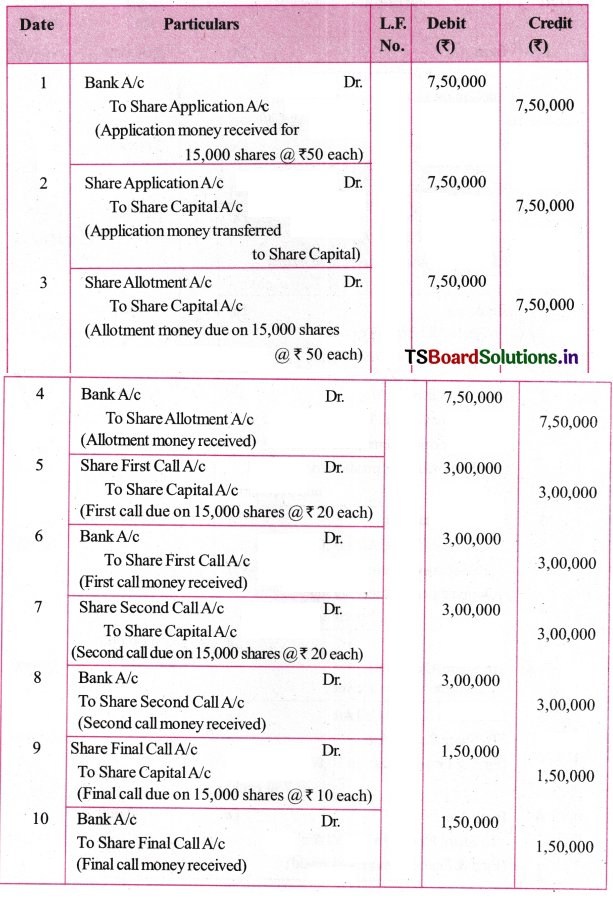
Calculation Recap:
- Face Value: ₹ 150
- Installments : ₹ 50 (App) + ₹ 50 (Allot) + ₹ 20 (1st) + ₹ 20 (2nd) + ₹ 10 (Final) = ₹ 150
- Total Cash Received : 15,000 shares × ₹ 150 = ₹ 22,50,000
Question 4.
Sangeetha Furniture’s Ltd. issued 10,000 shares of ₹ 100 each at a premium of ₹ 10 per share payable as follows, on application ₹ 40(including premium per share), on allotment ₹ 40 (including premium ₹ 5 per share) the remaining balance ₹ 30 on first and final call, the issue was fully subscribed. All the money was duly received. Make the Journal entries in the books of the company.
Solution:
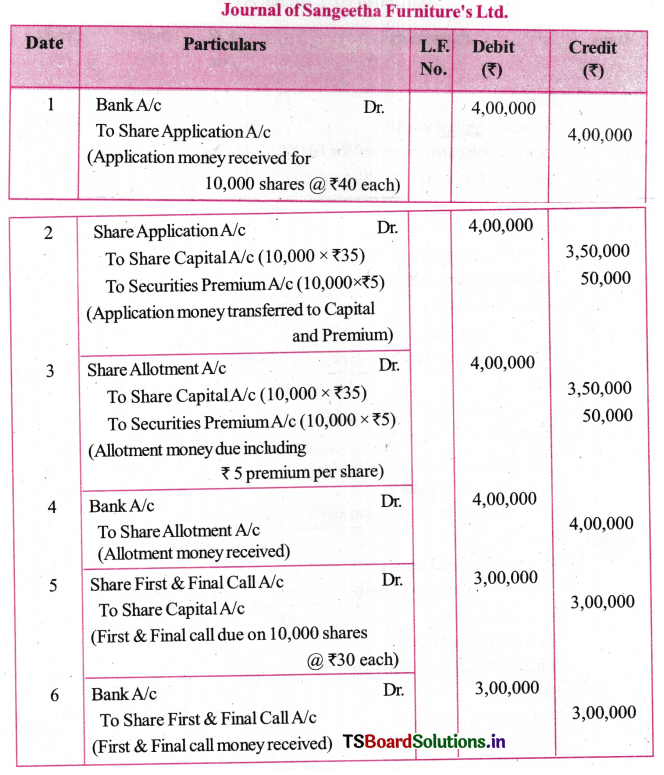
Total Share Capital : ₹ 35 (App) + ₹ 35 (Allot) + ₹ 30 (Call) = ₹ 1o0
Total Securities Premium : ₹ 5 (App) + ₹ 5 (Allot) = ₹ 10
Total Cash Collected : ₹ 4,00,000 + ₹ 4,00,000 + ₹ 3,00,000 = ₹ 11,00,000
Question 5.
HBL Engineers Ltd. having an authorized capital of 710,00,000 in share of 710 each, issued 10,000 at a premium of 72 per share payable at 74 on application(including premium 71 per share), 75 on allotment (including premium 71 per share) the remaining balance 73 on first and final call, the issue was fully subscribed. All the money was duly received. Prepare the Journal entries in the books of the company.
Solution:
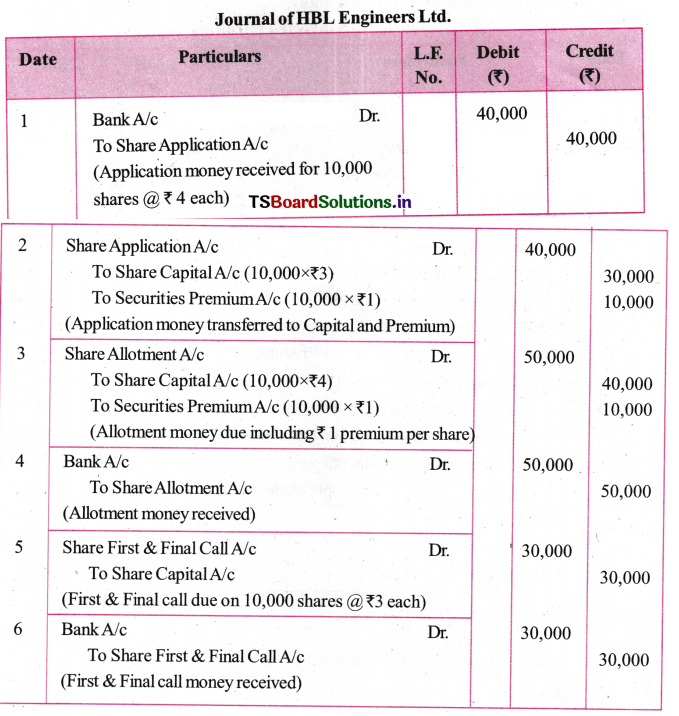
- Total Premium: ₹ 1 (App) + ₹ 1 (Allot) = ₹ 2 per share.
- Total Capital Portion : ₹ 3 (App) + ₹ 4 (Allot) + ₹ 3 (Call) = ₹ 10 per share.
- Total Collection :(₹ 4 + ₹ 5 + ₹ 3) × 10,000 shares = ₹ 1,20,000.
Question 6.
Dhanalakshmi Ltd. issued 50,000 shares-of ₹ 100 at a premium of ₹ 10 per share, payable at ₹ 40 on application(including premium ₹ 5 per share), ₹ 40 on allotment (including premium of ₹ 5 per share) the remaining balance ₹ 30 on first and final call, the issue was fully subscribed. All the money was duly received. Record the Journal entries in the books of the company.
Solution:
Dhanalakshmi Ltd is issuing shares at a Premium, which is an extra amount charged above the face value. The total issue price is ₹ 110 (₹ 100 face value + ₹ 10 premium).
The premium is split: ₹ 5 at Application and ₹ 5 at Allotment.
Journal of Dhanalakshmi Ltd.
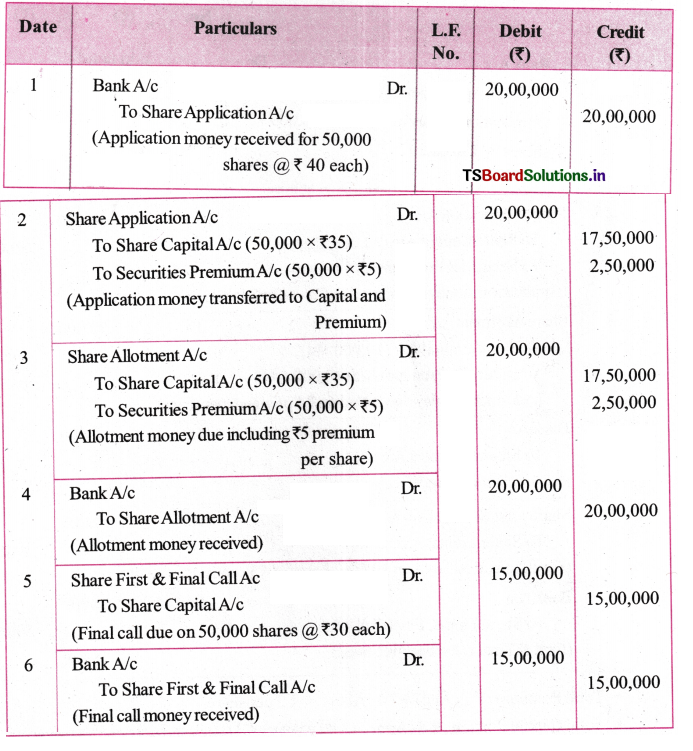
- Total Premium : ₹ 5 (App) + ₹ 5 (Allot) = ₹ 10
- Total Capital: ₹ 35 (App) + ₹ 35 (Allot) + ₹ 30 (Call) = ₹ 100
- Total Collection: (₹ 40 + ₹ 40 + ₹ 30) × 50,000 shares = ₹ 55,00,000.
Question 7.
Padmavati Ltd. issued to the public for subscription of 10,000 shares of ₹ 100 each at a discount of 10% per share, payable at ₹ 30 on application, ₹ 40 on allotment and ₹ 20 on first and final call, the issue was fully subscribed. All the money was duly received. Write the Journal entries in the books of the company.
Solution:
Journal of Padmavathi Ltd.
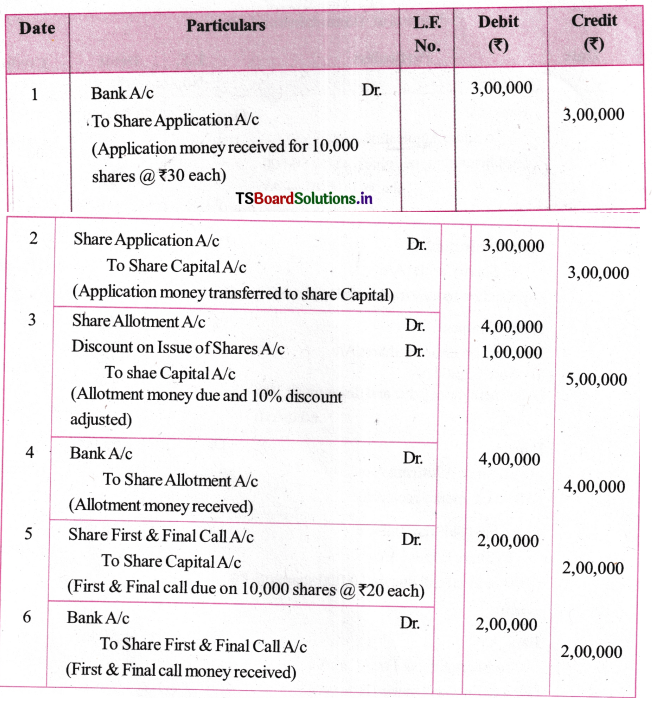
Calculation Breakdown
- Discount: 10% of ₹ 100 = ₹ 10 per share.
- Total Issue Price : ₹ 30 (App) + ₹ 40 (Allot) + ₹ 20 (Call) = ₹ 90 (which is ₹ 100 – ₹ 10 discount)
- Total Discount Amount: 10,000 shares × ₹ 10 = ₹ 1,00,000.
- Total Cash Received: 10,000 shares × ₹ 90 = ₹ 9,00,00.
Question 8.
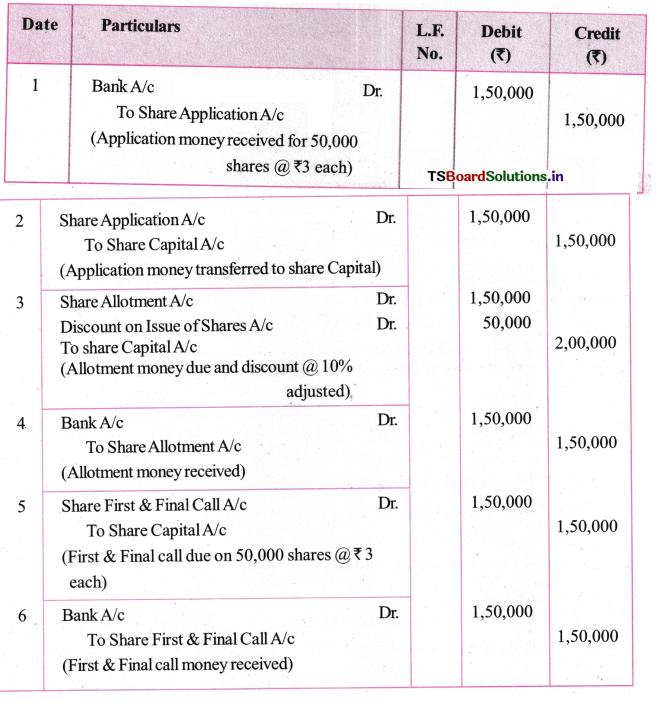
Venkatadri Company Ltd. issued 50,000 shares of ₹ 10 each at a discount of 10% per share, the shares were payable at ₹ 3 on application, ₹ 3 on allotment and ₹ 3 on first and final call, the issue was fully subscribed. All the money was duly received. Give Journal entries in the books of the company.
Solution:
Journal of Venkatadri Company Ltd.