Referring to the AP Inter 1st Year Maths Study Material Chapter 4 Complex Numbers and Quadratic Equations Exercise 4a Solutions makes it easier to understand complex problems.
AP Inter 1st Year Maths Complex Numbers and Quadratic Equations Solutions Exercise 4a
I. Express each of the complex number given in the exercises 1 to 10 in the form a + ib.
Question 1.
(5i) (-\(\frac{3}{5}\)i)
Solution:
(5i) (-\(\frac{3}{5}\)i)
= -5i × \(\frac{3}{5}\) × i
= -3i2 [∵ i2 = -1]
= -3(-1) = 3
= 3 + i0
Question 2.
i9 + i19
Solution:
i9 + i19
= i9 + i10.i9
= i9[1 + (i2)5]
= i9(1 – 1)
= 0 = 0 + i0
Question 3.
i-39
Solution:
i-39 = i4×(-9)-3
= (i4)-9 × i-3
= (1)-9 × i-3 [∵ i4 = 1]
= \(\frac{1}{i^3}=\frac{1}{-i}\) [∵ i3 = -i]
= \(\frac{-1}{i} \times \frac{i}{i}=-\frac{i}{i^2}=\frac{-i}{-1}\) [∵ i2 = -1]
= i
= 0 + i [∵ i2 = -1]

Question 4.
3(7 + i7) + i(7 + i7)
Solution:
3(7 + i7) + i(7 + i7)
= 21 + 21i + 7i + 7i2
= 21 + 28i + 7 × (-1)
= 14 + 28i [∵ i2 = -1]
Question 5.
(1 – i) – (-1 + i6)
Solution:
(1 – i) – (-1 + i6)
= 1 – i + 1 – 6i
= 2 – 7i
Question 6.
(\(\frac{1}{5}\) + i\(\frac{2}{5}\)) – (4 + i\(\frac{5}{2}\))
Solution:
(\(\frac{1}{5}\) + i\(\frac{2}{5}\)) – (4 + i\(\frac{5}{2}\))
= \(\frac{1}{5}\) + \(\frac{2}{5}\)i – 4 – \(\frac{5}{2}\)i
= (\(\frac{1}{5}\) – 4) + i(\(\frac{2}{5}\) – \(\frac{5}{2}\))
= \(\left(-\frac{19}{5}\right)\) + i\(\left(-\frac{21}{10}\right)\)
= \(\frac{19}{5}\) – i\(\frac{21}{10}\)
Question 7.
[(\(\frac{1}{3}\) + i\(\frac{7}{3}\)) + (4 + i\(\frac{1}{3}\))] – (-\(\frac{4}{3}\) + i)
Solution:
[(\(\frac{1}{3}\) + i\(\frac{7}{3}\)) + (4 + i\(\frac{1}{3}\))] – (-\(\frac{4}{3}\) + i)
= \(\frac{1}{2}\) + i + 4 + \(\frac{1}{3}\)i + \(\frac{4}{3}\) – i
= (\(\frac{1}{3}\) + 4 + \(\frac{4}{3}\)) + i(\(\frac{7}{3}\) + \(\frac{1}{3}\) – 1)
= \(\frac{17}{3}\) + i\(\frac{5}{3}\)
Question 8.
(1 – i)4
Solution:
(1 – i)4 = [(1 – i)2]2
= [i2 + i2 – 2i]2
= [1 – 1 – 2i]2
= [-2i]2 = 4i2
= -4
= -4 + 0i [∵ i2 = -1]
Question 9.
(\(\frac{1}{3}\) + 3i)3
Solution:
(\(\frac{1}{3}\) + 3i)3 = (\(\frac{1}{3}\))3 + (3i)3 + 3\(\frac{1}{2}\)(3i)(\(\frac{1}{2}\) + 3i)
= \(\frac{1}{27}\) + 27i3 + 3i(\(\frac{1}{3}\) + 3i)
= \(\frac{1}{27}\) + 27(-i) + i + 9i2 (∵ i3 = -i)
= \(\frac{1}{27}\) – 27i + i – 9i (∵ i2 = -1)
= (\(\frac{1}{27}\) – 9) – 26i
= –\(\frac{242}{27}\) – 26i
Question 10.
(-2 – \(\frac{1}{3}\)i)3
Solution:
(-2 – \(\frac{1}{3}\)i)3
= (-1)3 × (2 + \(\frac{1}{3}\)i)3
= -[23 + (\(\frac{i}{3}\))3 + 3(2)(\(\frac{i}{3}\))(2 + \(\frac{i}{3}\))]
= -[8 + \(\frac{1}{2}\) +2i (2 + \(\frac{1}{3}\))]
= -[8 – \(\frac{i}{27}\) + 4i + \(\frac{2}{3}\)i2] [∵ i3 = -1]
= -[8 – \(\frac{1}{27}\) + 4i – \(\frac{2}{3}\)]
= –\(\left[\frac{22}{3}+\frac{107 \mathrm{i}}{27}\right]\)
= –\(\frac{22}{3}\) – i\(\frac{107}{27}\)
Find the multiplicative inverse of each of the complex numbers given in Exercises 11 to 13.
Question 11.
4 – 3i
Solution:
Let z = 4 – 3i .
Then, z̄ = 4 + 3i and |z|2 = 42 + (-3)2 = 16 + 9 = 25
Therefore, the multiplicative inverse of 4 – 3i is given by
z-1 = \(\frac{\bar{z}}{|z|^2}=\frac{4+3 i}{25}\)
= \(\frac{4}{25}\) + i\(\frac{3}{25}\)
Question 12.
√5 + 3i
Solution:
Let z̄ = √5 + 3i
Then, z̄ = √5 – 3i and |z|2 = (√5) + 32 = 5 + 9 = 14
Therefore, the multiplicative inverse of √5 + 3i is given by
z-1 = \(\frac{\bar{z}}{|z|^2}=\frac{\sqrt{5}-3 i}{14}=\frac{\sqrt{5}}{14}-\frac{3}{14} i\)
Question 13.
-i
Solution:
Let z = -i
Let z = i and |z|2 = 12 = 1.
Therefore the multiplicative inverse of -i is given by, z-1 = \(\frac{\bar{z}}{|z|^2}=\frac{i}{1}\) = 0 + i(1)
II.
Question 1.
Express the following expression in the form of a + ib.
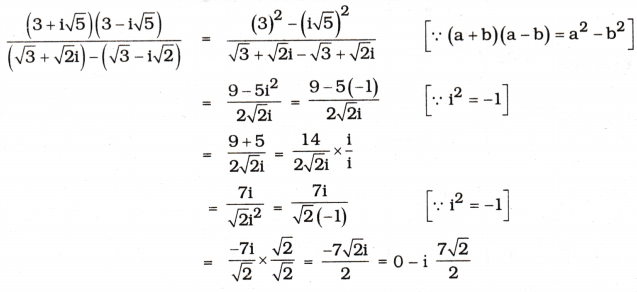
\(\frac{(3+i \sqrt{5})(3-i \sqrt{5})}{(\sqrt{3}+\sqrt{2} i)-(\sqrt{3}-i \sqrt{2})}\)
Solution: