
Regular practice with AP Inter 1st Year Commerce Study Material Chapter 6 Fundamental Aspects of Joint Stock Company Questions and Answers helps students stay prepared for examinations.
AP Inter 1st Year Commerce 6th Lesson Fundamental Aspects of Joint Stock Company Questions and Answers
Fill in the Blanks
Question 1.
The capital of a company is divided into small units is called __________
Answer:
Shares
Question 2.
The members who invest their money by purchasing the shares of a company are known as __________
Answer:
Shareholders
Question 3.
A company comes into existence when it is registered under Indian Companies Act or any previous company acts.
Answer:
2013
Question 4.
The elected representatives of the company who manage the day-to-day affairs of the company are called __________
Answer:
Board of Directors
Question 5.
East India Company is an example of a __________ company.
Answer:
Chartered company
Question 6.
A company created by special act of the parliament or legislature of any state is called a __________ company.
Answer:
Statutory company
Question 7.
The minimum paid up capital of a private company is __________
Answer:
Rs. 1,00,000/-
Question 8.
The minimum paid-up capital of public company is __________
Answer:
Rs. 5,00,000/-
Question 9.
A company which controls the management of another company is called a __________ company.
Answer:
Holding company

Question 10.
A private company must suffix its name __________
Answer:
private limited
Very Short Answer Questions
Question 1.
Joint Stock Company.
Answer:
A joint stock company or simply a company is a voluntary association of individuals formed to undertake a large-scale business activity. It is established by law and can be dissolved by law. The company has a separate legal existence so that even if its members die, the company remains in existence. Its members contribute money for a common purpose. The money so contributed constitutes the capital of the company. The capital of the company is divided into small units called shares. Since members invest their money by purchasing the shares from the company, they are known as share holders and the capital of the company is known as share capital.
Question 2.
Government Company.
Answer:
Government Company : Any company in which not less than 51 percent of the paid-up share capital is held by the central Government and or by any State Government or State Governments is called a “Government Company”.
Ex : BEL, ONGC, NTPC are the examples of Government Company.
Question 3.
Statutory Company.
Answer:
Statutory companies are those, which are started under the special act of parliament. Public utility concerns like railways, electricity etc are in corporated by special acts of parliament.
Ex : SBI, RBI established under Banking companies act -1949, New India assurance company is established under insurance companies act – 1956.
Question 4.
Chartered Company.
Answer:
Chartered companies are those which are started under a special charter of a king. Several companies were started in England under Royal charter in 17th century. The charter defined their powers.
Ex : East India Company.
In India such type of company does not exist because there is no monarchy.
Question 5.
One person company.
Answer:
As per the companies act 2013 one person company (OPC) means “a company which has only one person as member”. This is a company in which only one man hold the whole share capital of the company.
Question 6.
Holding Company.
Answer:
Where one company contrails the management for another company, the controlling company is called “Holding Company”.
Ex : If company A holds more than 51% of paid up share capital of company B, the company A is called Holding Company.
Question 7.
Subsidiary Company.
Answer:
When one company controls the management of another company, the company so controlled is called as subsidiary company. For example if company ‘A’ holds more than 51% of paid up share capital of company ‘B’. ‘B’ is called a subsidiary company.
Question 8.
Private Company.
Answer:
A private company is a very suitable form for carrying on the business of family and small concerns. It is registered under the companies act, 2013 or any previous company law. According to section 2(68) of the companies act, 2013 a private company has the following feature :
- The minimum paid up capital is Rs. 1,00,000.
- The minimum number of members is 2.
- The maximum number of members is 200.
- It is prohibited from issuing of shares to the public.
- It is prohibited from transfer of shares.
Question 9.
Public Company.
Answer:
It is a suitable form of company for carrying on the business on a large scale, involving a huge amount of capital. According to section 2(71) of companies act of 2013, a public company has the following features.
- The minimum paid up capital is Rs. 5,00,000.
- The minimum number of members is 7.
- The maximum number of members is unlimited. Such a company must us the word “Ltd” as part of its name.
A public company must write public limited or simply limited after its name. Steel Authority of India limited, Bajaj Auto Limited, Reliance Industries Limited and Hindustan Lever Limited are the examples of public companies.
Question 10.
Company Limited by Guarantee.
Answer:
This type of company can be defined as a company having the liability of its members limited by its memorandum to such amount as the members may respectively undertake to contribute to the assets of the company in the event of its being wound up. The amount guaranteed by each member cannot be demanded until the company is wound up. Companies limited by guarantee are very few, as they are non-trading companies.
Question 11.
Foreign Company.
Answer:
It is company incorporated outside India and has place of business. The term ‘place of business’ does not mean agency business in India. It may be noted that even if, all the shareholders of a company are Indian citizens, it will still be called “foreign company” if it is registered outside India.
Question 12.
Multi National Company.
Answer:
Such companies extend the areas of their operations beyond the country in which they are registered.
Question 13.
Define Company.
Answer:
Company : “According to Section 3 of the companies act, 1956 “A company is an artificial person created by law, having a separate legal entity with a perpetual succession and a common seal”.
“A joint stock company is a voluntary association of individuals for profit, having a capita’ dividend into transferable shares, the ownership of which is the condition of membership” – L.H. Honey
Question 14.
Company as per Companies Act, 2013.
Answer:
As per the companies Act, 2013. “A company refers to an organisation incorporated under the companies act, 2013 or under any previous company law”.
Question 15.
Dormant Company.
Answer:
It is a company does not carry any accounting transactions for a period of two years. Such company can apply to registrar of companies calling it as a “Dormant company”.
Short Answer Questions
Question 1.
List out the features of Joint Stock Company.
Answer:
The distinctive features of a company are as follows :
1) An Artificial Person Created by Law : A company is an artificial person created by law and existing only in contemplation of law. It is an intengible and invisible legal person having no body and soul.
2) Separate Legal Entity : A company has an entity quite distinct and independent of the existence of the members who constitute it. In other words, a company has a separate legal entity entirely different from that of its members. It can make contracts, purchase and sell goods, employ people and conduct any lawful business in its own name. It can sue and can be sued in the court of law in its own name, of course, through some representatives.
3) Formation : The formation of a joint stock company involves the preparation of several documents and compliance with various legal requirements before it starts its operation, A company comes into existence only when it is registered under the Indian companies act, 2013 or any previous company law.
4) Common seal as a substitute for signature : As the company is not a natural person, it cannot sign its documents. The common seal with the name of the company engraved on it is therefore, used in place of signature. Generally, the secretary of the company is authorised to keep the seal under his safe custody.
5) Perpetual Existence : A company has perpetual existance unlike a sole trading or partnership concern. Once a company is formed, it continues for an unlimited period until it is legally dissolved. In other words, a company has a perpetual life and the death, lunacy, retirement or insolvency of its members does not affect its existence.
6) Limited Liability of Members : The liability of a member of a company is limited to the extent of the amount unpaid on the shares he holds.
Ex :If “Jeswanth” holds one share of Rs. 10 and has paid Rs.7 on that share, his liability would be limited to the unpaid amount of Rs. 3. Beyond this, he is not liable to pay anything towards the debts or losses of the company.
7) Transfer ability of Shares :The members of a company (Public) are free to transfer or dispose of the shares held by them to any person as and when they like. They do not need the consent of other shareholders to transfer their shares. However, in the case of private companies, certain restrictions are imposed on the transfer of shares.
8) Membership : The form of a joint stock company, a minimum of two (2) members are required in case of a private limited company and seven (7) members in case of public limited company. The maximum limit is fifty (50) in case of private limited company. There is no maximum limit on the members in case of a public limited company. In case of one person company, only one shareholder will act as a member.
9) Democratic Management: Different catagories of people from various areas contribute to the capital of a company. Since it is not possible for them to look after the day-to-day management of the company, they may take part in deciding the general policies of the company but the day-to-day affairs of the company are managed by their elected representatives “Board of Directors”.
10) Statutory Regulations : A company has to comply with and abide by several statutory requirements. It is governed by the companies act and must invariably follow the various provisions of the act. Under the act, companies should submit several returns to the government and their accounts have to be audited by a chartered accountant.
Question 2.
Briefly explain different types of companies.
Answer:
1) Chartered Companies : Charatered companies are those which are started under a special charter of a king. Several companies were started in England under Royal charter in 17th century. The charter defined their powers.
Ex : East India company.
In India such type of company does not exist because there is no monarchy.
2) Statutory Company Statutory companies are those which are started under the special act of parliament. Public utility concerns like railways, electricity etc. are incorporated by special act of parliament.
Ex: SBI, RBI established under Banking companies act. 1949.
New India assurance company is established under insurance companies act – 1956
3) Government Companies : These companies are regisered under companies act 1956. According to companies act, Government company means any company in which not less than 51% of paid up share the central government or any state government holds capital.
Ex : Such companies is HMT.
4) Registered Companies : All those companies registered under the companies act are called “registered companies”. Companies formed under the India companies act may be divided into three classes.
5) Private company : A private company is one which by its Articles of Association.
- Limits the number of members to 50.
- Restricts the right of transfer of shares and
- Prohibits any invitation to public to subscribe for its shares and debentures.
6) Public Company : According companies act, all those companies other than private companies are considered as public limited companies.
Question 3.
What are the features of Public Company ?
Answer:
The public companies carry business in large-scale involving huge amount of capital, resources and huge infrastructure. Public companies procure capital from public. There is no restriction on transfer of ownership on shares. Such a company must use the word “LIMITED” or “Ltd” as a part of its name. According to section 2(71) of the companies act, 2013 a public company is one which has
- The minimum paid-up capital of Rs. 5,00,000/-
- The minimum number of members is 7.
- The maximum number of members is unlimited.
Question 4.
What are the features of a Private Company ?
Answer:
Private Company : A private company is a very suitable form for carrying on the business of family and small concerns. It is registered under the companies act, 2013 or any previous company law. According to section 2(68) of the companies act, 2013 a private company has the following features.
- The minimum paid up capital is Rs. 1,00,000.
- The minimum number of members is two (2).
- The maximum number of members is 200
- It is prohibited from issuing of shares to the public.
- It is prohibited from transfer of shares.
Private companies have to follow all these conditions mentioned above. These companies must include “Private Limited” after their names. The ownership of these companies is confined only to well-known selected persons. It requires a minimum of two persons to start a “Private Limited company”. Usually, whenever partnership firms need more capital to expand their business, they convert themselves into private companies. It may be noted that private companies are exempted from various regulations of the companies act. They combine the advantages of both the company and the partnership form of business organisation.
Question 5.
Write any five advantages of joint stock company.
Answer:
Joint stock company organisation is an artificial person created by law and a voluntary association of persons who contributes to its capital. It will have a common seal.
Advantages or Merits of Joint Stock Company :
- Large Capital:One of the main advantages of the joint stock company is that it facilitates mobilisation of large amount of capital. It would not be possible under the other forms. Joint stock companies are suitable for those business where large resources are required.
- Limited Liability :The liability of the shareholders of a company is limited to the value of shares they held. The limited liability encourages many persons to invest in shares of joint stock companies.
- Continuity of Existence : When a company is incorporated it becomes a separate legal entity. It is an entity with perpetual succession. The death or insolvency of members does not in any way affect the existence of the company.
- Efficient – Management : In company form of organisation ownership is separate from management. It enables the company to appoint expert and qualified persons for managing various business functions. The efficient management will help the company to expand and diversity its activities.
- Economics of large – scale Production : With the availability of large-scale resources, the company can organise on a big scale. The increase in scale and size of the business will result in economic in production purchase and marketing etc. Hence, cost of production is reduced, goods are provided to customers at cheaper rates.
Question 6.
Write any Five disadvantages of Joint Stock Company.
Answer:
- Difficulty in formation : Promotion of a company is not an easy task. A number of stages are involved in company promotion. A lot of legal formalities are required to be performed at the time of registration. Therefore it is proved that the formation of company is difficult.
- Lack of personal interest : The company is not managed by the proprietors. It is
managed by the directors and paid officials. They do not have a share in the profits. They have very little personal interest. . - Fraudulent Management : All the shareholders of the company cannot take part in its management. They elect directors periodically. They will manage the business. If the directors are dishonest, they may misuse their powers and position.
- Temptation of speculate :The liability of shareholders is limited. So the management is tempted to get into speculative activities. They may lead to the ultimate ruin of the company.
- Limited borrowing capacity : The liability of the shareholders is limited. Therefore, the credit that can be obtained by the company will also be limited.
Long Answer Questions
Question 1.
Explain the advantages and disadvantages of a Joint Stock Company.
Answer:
Joint stock company organisation is an artificial person created by law and a voluntary association of persons who contributes to its capital. It will have a common seal. Definitions : “Joint stock company is voluntary association of individuals for profit, having a capital divided into transferable shares, the ownership of which is the condition of membership”. – L.H. Hanery
Advantages or Merits :
- Large Capital: One of the main advantages of the joint stock company is that it facilitates mobilisation of large amount of capital. Joint stock companies are suitable for those business where large resources are required.
- Limited Liability : The liability of the shareholders of a company is limited to the value of shares they held. The limited liability encourages many persons to invest in shares of joint stock companies.
- Continuity of Existence : When a company is incorporated it becomes a separate legal entity. It is an entity with perpetual succession. The death or insolvency of members does not in anyway affect the existence of the company.
- Efficient Management ; In company form of organisation ownership is separate from management. It enables the company to appoint expert and qualified persons for managing various business functions. The efficient management will help the company to expand and diversity its activities.
- Economics of large – scale Production : With the availability of large-scale resources, the company can organise on a big scale. The increase in scale and size of the business will result in economic in production purchase and marketing etc. Hence, cost of production is reduced, goods are provided to customers at cheaper rates.
- Transfer of Shares : Every member can transfer his share freely without informing the other shareholders. He can sell his shares easily in the stock market. This facility attracts many investors.
- Public Confidence : Companies are subject to government controls and regulation. Their accounts are audited by chartered accountant. The affairs of a company are made public through its published accounts and annual reports. This creates confidence in the public about the functioning of the company.
- Mobilisation of small savings : As the value of a share is small and as the liability is limited more capital can be raised from all classes of people. Small savings of the public can be mobilized and directed to productive channels.
- Facilitates Industrial Development: We cannot expect Industrialization of a country without the help of Joint Stock system. Joint stock companies have encouraged the growth of national income. They have brought about an increase in the standard of living of the people.
- Public Confidence :The accounts of the company are audited by chartered accountants. The affairs of the company are made published through leading newspapers. This creates confidence in the public about the functioning of the company.
- Tax Benefits : Company income tax at flat rate and the companies which are established in backward areas get some concession in tax.
Demerits / Disadvantages :
- Difficulty in formation : Promotion of a company is not an easy task. A number of stages are involved in company promotion. A lot of legal formalities are required to be performed at the time of registration. Therefore it is proved that the information of company is difficult.
- Lack of personal interest: The company is not managed by the proprietors. It is managed by the directors and paid officials. They do not have a share in the profits. They have very little personal interest in the business.
- Fraudulent Management : All the shareholders of a company cannot take part in its management. They elect directors periodically. If the directors are dishonest, they may misuse their powers and position.
- Temptation of speculate : The liability of shareholders is limited. So the management is tempted to get into speculative activities. They may lead to the ultimate ruin of the company.
- Limited borrowing capacity : The liability of the shareholders is limited. Therefore, the credit that can be obtained by the company will also be limited.
- Lack of personal touch : There is no personal touch between the shareholders and consumers and the worker. This may result consumer’s dissatisfaction and labour troubles.
- Delay in decision making : In company form of organisation no single individual can make a policy decision. All important decisions are taken either by the Board of Directors or by the General House. Decision making process is time consuming. So. many opportunities may be lost because of delay in decision – making.
- Inflexible and Inelastic : A company lacks elasticity and adaptability. The memorandum of association of the company restricts the scope of business. It is very difficult to adopt business to changing circumstances due to very rigid legal formalities.
- Lack of Secrecy : The management of company’s remaining in the hands of many persons. Everything is discussed in the meetings of Board of Directors. The trade secrets cannot be maintained.
- Lack of continuity policies : In company, the some directors may not be elected every time. Therefore, company may not have unity of management and continuity of policies.
- Evils of Large-scale Operation : A company suffers from the Evils of large – scale operation such as lack of co-ordination, lack of close supervision.
Question 2.
Distinguish a Private company and a Public company.
Answer:
Private Company : A private company is a very suitable form for carrying on the business of family and small concerns. It is registered under the companies act, 2013 or any previous company law. According to section 2(68) of the companies act. 2013 a private company has the following features.
- The minimum paid up capital is Rs. 1,00,000.
- The minimum number of members is two (2).
- The maximum number of members is 200.
- It is prohibited from issuing of shares to the public.
- It is prohibited from transfer of shares. Such a company must use the word “Pvt. Ltd” as the part of its name.
Public Company : ft rs a sccftahte form of company for carrying on the business on a targe – scale, involving a huge amount of capital. According to section 2(71) of the companies act of 2013, a public company has the following features :
- The minimum paid-up capital of Rs. 5,00,000/-
- The minimum number of members is 7.
- The maximum number of members is unlimited. Such a company must use the word “Ltd” as part of its name.
Ex : Steel Authority of India Ltd., Reliance Industries Ltd., Hindustan Lever Ltd., & Bajaj Auto Limited etc.
Distinguish between Private Company & Public Company :
| Basis of comparison | Private Company | Public Company |
| 1. Minimum number of members | Two (2) members | Seven (7) members |
| 2. Maximum number of members | 200 members | No Limit |
| 3. Minimum paid up capital | Rs. One Laksh | Rs. 5 Lakh. |
| 4. Identification | Must suffix ‘Private Limited’ to its name | Must suffix ‘Public Limited’ to its name. |
| 5. Transfer of shares | Members cannot transfer their shares | Members can freely sell their shares to others |
| 6. Public issue of capital | It cannot secure capital from the public | It can secure capital from the public |
| 7. Commencement of Business | It can start its business immediately upon its incorporation | It cannot starts its business immediately after its in corporation. It has to obtain a certificate for starting |
| 8. Board of Directors | Minimum : 2 Maximum : 15 | Minimum : 3 Maximum : 15 |
| 9. Appointment and Retirement of directors | A single resolution is enough to appoint or retire the directors. | A separate resolution is require. |
| 10. Managerial Remuneration | There are no restrictions on the remuneration of Directors and Managing Directors. | There are Restriction. |
Question 3.
What is Joint Stock Company ? What are the features of it ?
Answer:
Meaning : Joint stock company organisation is an artificial person created by law and voluntary association of persons who contributes to its capital.
Definitions : “Joint stock company is voluntary association of individuals for profit, having a capital divided into transferable shares, the ownership of which is the condition of membership”. – L.H. Hanery
A Joint Stock Company limited by shares is “a company having permanent paid or nominal share capital of fixed amount divided into shares also of fixed amount held and transferable as stock and formed on the principles of having in its members only the holders of those shares of stocks and no other persons”. – Indian Companies Act, 1956
Distinctive features of a Joint Stock Company :
- Artificial Person Created by Law : A company is an artificial person created by law and existing only in contemplation of law. It is an intengible and invisible legal person having no body and soul.
- Separate Legal Entity : The company is created under law. It has separate legal entity apart from its members. It can file a suit against others and can be sued against. It can purchase assets and can make contracts on its name.
- Formation : The formation of a joint stock company consists of preparation of several documents and compliance of so many legal requirements prior to starting its operations. Registration under Indian Companies Act. 1956 is mandatory.
- Common Seal : A company being an artificial person cannot put its signatures. The law requires every company to have a seal and get its name engraved on it. The seal of the company is affixed on all important documents.
- Perpetual Existence : A company has perpetual existance that is to say its existence is not affected by the death or insolvency of its members. The company can be wound up by the operation of law.
- Limited Liability : The liability of a share-holder is limited to the extent of face value of shares held by him. Shareholders are not liable to bring their personal assets to pay the debts of the company.
- Transferability of Shares : Shareholder of a company can sell his shares at his will at anytime. He need not take permission from other shareholders.
- Membership : In the case of public limited companies, the minimum number of shareholders is seven and the maximum is unlimited. In the case of private limited companies, the minimum is two and maximum is fifty.
- Democratic Management : Members are the owners of the company. Management of business is vested in the board of directors elected by the members. Thus, owners of the company have no direct control over the business of the company on democratic lines.
- Wide diffusion of ownership : The shareholders are the owners of the company. They are scattered throughout the country.
- Statutory Regulations : A company is governed by the companies act. It has to submit a number of returns to the government. Its account must be audited by a chartered accountant.
- Regid Objective : The type of business in which the company would participate is mentioned in the object clauses of memorandum of association.
- Shareholders are not the agents : The shareholders of the company cannot act as agents of the company. They cannot bind the company by their acts.
Question 4.
Listout and briefly explain different types of companies.
Answer:
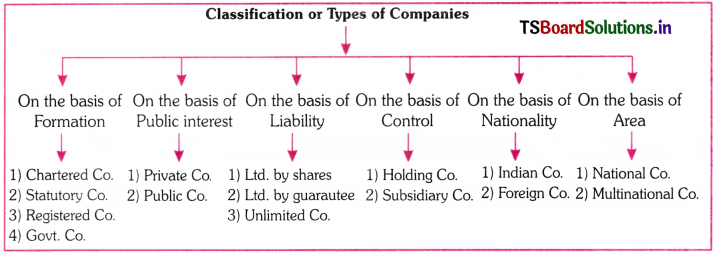
Companies are of different types, and are classified based on various points of view. A brief description of each type is as follows :
I) Based on Formation:
- Chartered Companies : The companies that are established by a Royal charter or special sanctions from the Royal Head of state are called chartered companies. Such companies are granted special privileges and powers to achieve their defined objectives. Ex : East India company, Bank of England etc.
Such companies do not exist now-a-days. - Statutory Company : A company that is created by a special act of the parliament or the legislature of a state is called a “Statutory company”.
Ex : SBI, RBI, LIC & UTI etc. - Registered Companies : A company which is established through registration with the registrar or companies, under the companies act, 2013 or any previous law is called a “Registered Company”. These companies are governed by the above act, but subject to the rules of Memorandum of association and articles of association of their own.
Ex : Infosys, ITC, WIPRO etc. - Government Companies : A company in which not less than 51% of the paid up share capital is held by the Central Government and or by any state government or state governments is called a “Government Company”.
Ex : ONGC, NTPC etc. - One Person Company (OPC) : Section 2(62) of the companies act, 2013 states that a company can be firmed with just one director and one member. The director and the member can be the same person.
II) Based on Public Interest: On the basis of the number of members or public interest, companies may be further categorized into
- Private company,
- Public company.
1) Private Company : A private company is a very suitable form for carrying on the business of family and small concerns. It is registered under the companies act, 2013 or any previous company law. According to section 2(68) of the companies act, 2013 a private company has the following features.
- The minimum paid up capital is Rs. 1,00,000.
- The minimum number of members is two (2).
- The maximum number of members is 200.
- It is prohibited from issuing of shares to the public.
- It is prohibited from transfer of shares. These companies must include private limited after their names.
2) Public Company : It is a suitable form of company for carrying on the business on a large – scale, involving a huge amount of capital. According to section 2(71) of the companies act of 2013, a public company has the following features :
- The minimum paid-up capital of Rs. 5,00.000/-
- The minimum number of members is 7.
- The maximum number of members is unlimited. Such a company must use the word “Ltd” as part of its name.
Ex : Steel Authority of India Ltd., Bajaj Auto Ltd., Reliance Industries Ltd. & Hindustan Lever Ltd., & etc.
III) Based on Liability :
- Companies Limited Shares : A company having the liability of its members limited by the memorandum to the value of shares held by them is called a “company Limited” by shares.
- Companies Limited by Guarantee : This type of company can be defined as a company having the liability of its members limited by its memorandum to such amount as the members may respectively undertake to contribute to the assets of the company in the event of its being wound up. The amount guaranteed by each member cannot be demanded until the company is wound up. Companies limited by guarantee are very few, as they are non-trading companies.
- Unlimited Companies : The liability of members of such companies is limited. All the members will be liable to meet the liabilities of the company to an unlimited extent. Such companies are not popular and they are not found in large number.
IV) Based on Control :
- Holding Company : Where are company controls the management of another company, the controlling company is called “Holding Company”.
Ex : If company ‘A’ holds more than 51% of paidup share capital of company ‘B’, then company ‘A’ is called a holding company. - Subsidiary Company : When one company controls the management of another company the company so controlled is called as “Subsidiary Company”.
Ex : If company ‘A’ holds more than 51% of paidup share capital of company ‘B’. ‘B’ is called a subsidiary company.
V) Based on of Nationality
- Indian Company : A company registered in India and having a place of business in India is called an “Indian company”. It may be a private company or a public company.
- Foreign Company : It is a company incorporated outside India and has a place of business. The term ‘place of business’ does not mean agency business in India. It may be noted that even if, all the sharholders of a company are Indian citizens, it will still be called “foreign company”, if it is registered outside India.
VI) Based on area :
- National Company : Such companies confine their operations within the boundaries of the country in which they are registered.
- Multi-National Company : Such companies extend the areas of their operations beyond the country in which they are registered.
Check Your Knowledge
1. Fill in the blanks for the following questions :
Question 1.
The official signature of a company is called __________
Answer:
common seal
Question 2.
The company is managed by the group of persons known as __________
Answer:
Board of directors
Question 3.
The word limited should appear after the name of __________
Answer:
Registered company
Question 4.
A company is formed by __________
Answer:
Promoters
Question 5.
A joint stock company or simply a company is a __________ of individuals formed to undertake a large scale business activity.
Answer:
Voluntary Association
Question 6.
A company is an __________ person.
Answer:
Artificial
Question 7.
The secretary of the company is authorised to keep the __________ under his safe custody.
Answer:
seal
Question 8.
The liability of a member of a company is __________
Answer:
limited
Question 9.
OPC stands for __________
Answer:
One Person Company
Question 10.
Statutory company one example is __________
Answer:
Life Insurance Corporation, SBI etc.
Question 11.
A company in which not less than 51% of the paid-up share capital is held by the __________
Answer:
Central Government / State Govt. / State Govt.
Question 12.
A public company must write __________ after its name.
Answer:
Public Limited
Question 13.
A company registered in India and having a place of business in India is called an __________
Answer:
Indian Company
Question 14.
The accounts of a public company are open for inspection by __________
Answer:
Public
II. State whether the statement are True or False
Question 1.
The company’s form of organisation contributes to the growth of business. (True/False)
Answer:
True
Question 2.
The joint stock company is the only form of business organisation which can provide capital for small-scale operations. (True/False)
Answer:
False
Question 3.
The companies are required to pay tax at a low rate. (True/False)
Answer:
False
Question 4.
Redtapism and bureaucratic hurdles do not permit quick decisions and prompt action in company form of organisation. (True/False)
Answer:
True
Question 5.
At every stage in the management of a company, there are legal rules and regulations to follow. (True/False)
Answer:
True
Question 6.
The shares of a public company are dealt in on an employment exchange. (True/False)
Answer:
False
Question 7.
Company is the only form of business. (True/False)
Answer:
True
Question 8.
According to Sec 2(71) of the companies act 2013. (True/False)
Answer:
True
Question 9.
A company which not less than 51% of the paid-up share capital is held by the private company. (True/False)
Answer:
False
Question 10.
Chartered companies for example Bank of England. (True/False)
Answer:
True
Student Activity
State whether the statements are True or False.
Question 1.
The capital of a company is divided into small units called shares. (True/False)
Answer:
True
Question 2.
A company is a natural person created by law. (True/False)
Answer:
False
Question 3.
A company has a separate legal entity. (True/False)
Answer:
True
Question 4.
The secretary of the company is authorized to keep the seal of the company under his safe custody. (True/False)
Answer:
True
Question 5.
The liability of a member of a company is limited to the extent of the amount of shares held by him. (True/False)
Answer:
True
Question 6.
East India company is an example of a statutory company. (True/False)
Answer:
False
Question 7.
A single resolution is enough to appoint or retire the directors of a private company. (True/False)
Answer:
True
Question 8.
Both public & private companies can secure capital from the public. (True/False)
Answer:
False
Question 9.
A public company can start its business immediately upon its registration. (True/False)
Answer:
False
Question 10.
The maximum number of members in case of Pvt. Ltd. company is 200. (True/False)
Answer:
True
Question 11.
There are no restrictions on managerial remuneration in case of a public limited company. (True/False)
Answer:
False
Question 12.
The shares of a private company can be transferred freely. (True/False)
Answer:
False