
Regular practice with AP Inter 1st Year Physics Study Material Chapter 7 Gravitation Questions and Answers helps students stay prepared for examinations.
AP Inter 1st Year Physics 7th Lesson Gravitation Questions and Answers
I. Multiple Choice Questions
Question 1.
A planet moves around the sun in an elliptical orbit at a given point P, it is closest from the sun at a distance d1 and has a speed v1. At another point Q, when it is farthest from the sun at a distance d2, its speed v2 will be
(1) \(\frac{\mathrm{d}_2^2 \mathrm{v}_2}{\mathrm{~d}_1^2}\)
(2) \(\frac{\mathrm{d}_2 \mathrm{v}_2}{\mathrm{~d}_1}\)
(3) \(\frac{d_1 v_2}{d_2}\)
(4) \(\frac{\mathrm{d}_2^2 \mathrm{v}_2}{\mathrm{~d}_1^2}\)
Hint: m1v1r1 = m2v2r2, v1d1 = v2d2, v2 = \(\frac{\mathrm{v}_1 \mathrm{~d}_1}{\mathrm{~d}_2}\)
Answer:
(3) \(\frac{d_1 v_2}{d_2}\)
Question 2.
According to kepler, the period of revolution (T) of a planet and its mean distance (r) from the sun are related by the equation [ ]
(1) T3 r3 constant
(2) T2 r3 = constant
(3) T r3 = constant
(4) T2 r = constant
Answer:
(2) T2 r3 = constant
Question 3.
A satellite revolves around the earth in an elliptical orbit. Its speed [ ]
(1) is the same at all points in the orbit
(2) is greatest when it is closest to the earth
(3) is greatest when it is farthest from the earth
(4) goes on increasing or decreasing continuously depending upon the mass of the satellite.
Answer:
(3) is greatest when it is farthest from the earth
Question 4.
The force of gravitation is [ ]
(1) repulsive force
(2) electrostatic force
(3) conservative force
(4) non – conservative force
Answer:
(3) conservative force
Question 5.
If the distance between two masses is doubled, the gravitational attraction between them
(1) is doubled
(2) becomes four times
(3) is reduced to half
(4) is reduced to a quarter
Answer:
(4) is reduced to a quarter
Question 6.
If the earth losses its gravity, then for a body [ ]
(1) weight becomes xero, but not the mass
(2) mass becomes zero, but not the weight
(3) both mass and weight becomes zero
(4) neither mass nor weight become zero
Answer:
(1) weight becomes xero, but not the mass
Question 7.
The first experimental value of G is given by [ ]
(1) Cavendish
(2) Copernicus
(3) Brook Teylor
(4) None of these
Answer:
(1) Cavendish
Question 8.
The acceleration due to gravity is ‘g’ at a point distant ‘r’ from the centre of the earth of radius’R’. If r < R,then [ ]
(1) g ∝ r
(2) g ∝ r2
(3) g ∝ r-1
(4) g ∝ r2
Answer:
(1) g ∝ r
Question 9.
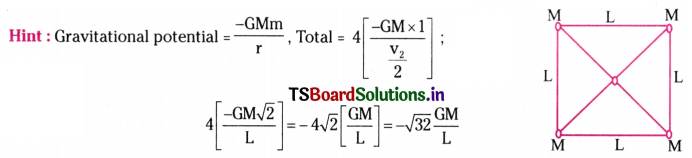
Four particles each of mass M, are located at the vertices of a square with side L. The gravitational potentIal due to this at the centre of the square is [ ]
(1) \(-\sqrt{32} \frac{\mathrm{GM}}{\mathrm{~L}}\)
(2) \(-\sqrt{64} \frac{\mathrm{GM}}{\mathrm{~L}^2}\)
(3) Zero
(4) \(-\sqrt{32} \frac{\mathrm{GM}}{\mathrm{~L}}\)
Answer:
(1) \(-\sqrt{32} \frac{\mathrm{GM}}{\mathrm{~L}}\)
Question 10.
The escape velocity of a sphere of mass m from the surface of the earth having mass M and radius R is given by [ ]
(1) \(\sqrt{\frac{2 \mathrm{GM}}{\mathrm{R}}}\)
(2) \(2 \sqrt{\frac{\mathrm{GM}}{\mathrm{R}}}\)
(3) \(\sqrt{\frac{2 \mathrm{GMm}}{\mathrm{R}}}\)
(4) \(\sqrt{\frac{\mathrm{GM}}{\mathrm{R}}}\)
Answer:
(1) \(\sqrt{\frac{2 \mathrm{GM}}{\mathrm{R}}}\)
Question 11.
For a satellite moving in an orbit around the earth, the ratio of magnitudes of its kinetic energy to potential energy is [ ]
(1) 2 : 1
(2) 1 : 2
(3) 1 : \(\sqrt{2}\)
(4) \(\sqrt{2}\) ; 1

Answer:
(2) 1 : 2
Question 12.
When a satellite going round the earth in a circular orbit of radius r with speed v loses some of its energy, then r and y changes as [ ]
(1) r and v both will increase
(2) r and v both will decrease
(3) r will decrease and v will increase
(4) r will increase and v will decrease
Answer:
(3) r will decrease and v will increase
Question 13.
If r represents the radius of the orbit of a satellite of mass m moving around a planet of mass M, the square of orbital velocity (vo) of the satellite is given by [ ]
(1) \(\mathrm{v}_0^2\) = \(\mathrm{g} \frac{\mathrm{M}}{\mathrm{r}}\)
(2) \(\mathrm{v}_0^2\) = \(\frac{\mathrm{GMm}}{\mathrm{r}}\)
(3) \(\mathrm{v}_0^2\) = \(\frac{\mathrm{Gr}}{\mathrm{M}}\)
(4) \(\mathrm{v}_0^2\) = \(\frac{\mathrm{GM}}{\mathrm{r}}\)
Answer:
(4) \(\mathrm{v}_0^2\) = \(\frac{\mathrm{GM}}{\mathrm{r}}\)

Question 14.
The period of a satellite in a circular orbit around a planet is independent of [ ]
(1) the mass of the planet
(2) the radius of the planet
(3) the mass of the satellite
(4) the radius of the satellite
Answer:
(3) the mass of the satellite
II. Fill in the Blanks
Question 1.
Kepler’s second law regarding constancy of areal velocity of a planet is a consequence of the law of conservation of ____.
Answer:
angular momentum
Question 2.
If M is the mass of the earth and R is its radius, the ratio of the acceleration due to gravity on the surface of the earth and the universal gravitational constant is ____.
Answer:
\(\frac{\mathrm{M}}{\mathrm{R}^2}\)
Question 3.
If R is the radius of the earth and g is the acceleration due to gravity on the earth’s surface, then the mean density of the earth is ___
Answer:
\(\frac{3 g}{4 \pi R G}\)
Question 4.
The intensity of gravitational field at the centre of the spherical shell is ___.
Answer:
zero
Question 5.
The force of attraction due to a hollow sherical shell of uniform density, on a point mass situated inside it is ___. Answer:
zero
Question 6.
The acceleration due to gravity on the surface of the earth is g’. Its value at a height equal to double the radius of the earth is ___
Answer:
Question 7.
As we go from the equator to the poles, the value of g ___.
Answer:
increases
Question 8.
The escape velocity of a projectile from the earth’s surface is (approximately) ___.
Answer:
11.2 km/s
Question 9.
A missile is launched with a velocity less than the escape velocity. The sign of sum of its kinetic and potential energy is ___.
Answer:
negative
Question 10.
The time period of satellite in an orbit very close to the surface of the earth is (approximately) ___
Answer:
85 minutes
Question 11.
If Ve is the escape velocity and V0 is the orbital velocity of a satellite for an orbit close to the earths surface, then Ve is ________________ times of V0.
Answer:
\(\sqrt{2}\)
III. One Word Answer Questions
Question 1.
State Kepler’s law of orbits.
Answer:
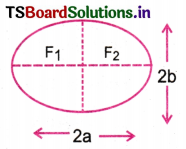
Law of orbits (1st law) : All planets move in an elliptical orbit with the sun is at one of its foci.
Question 2.
State Kepler’s law of areas.
Answer:
Law of areas (2nd law) : The line joining the planet to the sun sweeps equal areas in equal intervals of time, i.e., \(\frac{\Delta \mathrm{A}}{\Delta \mathrm{~T}}\) = constant.
i. e., planets will appear to move slowly when they are away from the sun, and they will move fast when they are nearer to the sun.
Question 3.
What is the value of universal gravitational constant ?
Answer:
G = 6.67 × 10⁻¹¹ Nm2 / kg2
Question 4.
What is the weight of a body at the centre of the earth ?
Answer:
Zero
Question 5.
What is the gravitational potential energy of two point masses m1 and m2, which are kept at infinite distance from each other ?
Answer:
U = \(\frac{-\mathrm{Gm}_1 \mathrm{~m}_2}{\mathrm{r}}\) as r = ∝, U = 0 = Zero
Question 6.
Does the escape velocity of the projected body depend upon its mass ?
Answer:
No.
Question 7.
What is the sign of kinetic energy of a satellite revolving around the earth?
Answer:
Positive.
Question 8.
Does the orbital velocity of a satellite depend upon its mass?
Answer:
No.
Question 9.
What is the time period of the moon revolving in an orbit around the earth ?
Answer:
27.3days.
IV. Very Short Answer Questions
Question 1.
State the unit and dimension of universal gravitational constant (G).
Answer:
Units of G = N-m2 / kg2.
Dimensional formula = M-1 L3 T-2.
Question 2.
State the vector form of Newton’s law of gravitation.
Answer:
Vector form of Newton’s Law of gravitation is \(\bar{F}\) = \(\frac{\mathrm{Gm}_1 \mathrm{~m}_2 \overline{\mathrm{r}}}{\overline{\mathbf{r}}^3} .\)
Question 3.
If the gravitational force of the Earth on the Moon is F. What is the gravitational force of the moon on the earth ? Do these forces form an action – reaction pair ?
Answer:
Gravitational force between the earth and the moon and the moon and the earth are same. i.e., FEM = -FME
Gravitational force between the bodies are treated as action – reaction pair.
Question 4.
What would be the change in acceleration due to gravity (g) at the surface, if the radius of the Earth decreases by 2% keeping the mass of the Earth constant ?
Answer:
Acceleration due to gravity, g = \(\frac{\mathrm{GM}}{\mathrm{R}^2}\)
When mass is kept as constant and radius is decreased by 2% then \(\frac{\Delta R}{R}\) × 100 =
2
From distribution of errors in multiplications and divisions \(\frac{\Delta \mathrm{g}}{\mathrm{~g}}\) × 100 = -2 × 100 = -2\(\frac{\Delta \mathrm{R}}{\mathrm{R}}\) × 100
% Change in g = -2 × 2 = -4% -ve sign indicates that when R decreases ‘g’ increases.
Question 5.
As we go from one planet to another, how will
a) the mass and
b) the weight of a body change?
Answer:
a) As we go from one planet to another planet mass of the body does not change. Mass of a body is always constant.
b) As we move from one planet to another planet weight of the body gradually decreases. It become weightless. When we approaches the other planet the weight will gradually increases.
Question 6.
Keeping the length of a simple pendulum constant, will the time period to be the same on all planets ? Support your answer with reason.
Answer:
Even though length of pendulum / is same, the time period of oscillation T value changes from planet to planet.
Time period of pendulum, T = \(\sqrt{\frac{l}{g}}\) i.e., T depends on l and g.
Acceleration due to gravity, (g = \(\frac{\mathrm{GM}}{\mathrm{R}^2}\)) changes from planet to planet.
Hence Time period of pendulum changes even though length ‘F is same.
Question 7.
Give the equation for the value of g at a depth’d’ from the surface of the Earth. What is the value of ‘g’ at the centre of the Earth ?
Answer:
Acceleration due to gravity at a depth’d’ below the ground is, gd = g\(\left(1-\frac{D}{R}\right)\)
Acceleration due to gravity at centre of the earth is zero. (Since D = R)
Question 8.
What are the factors that make ‘g’ the least at the equator and maximum at the poles ?
Answer:
‘g’ is least at the equator due to
- The equatorial radius of the earth is maximum ∵ g = \(\frac{\mathrm{GM}}{\mathrm{R}^2}\) (∵ R = maximum)
- Due to rotation of the earth centrifugal force will act on the bodies. It opposes gravitational pull of the earth on the bodies. At equator centrifugal force is maximum. So ‘g’ value is least at equator.
The ‘g’ ⇒ maximum at poles due to
- The polar radius of the earth is minimum (∵ g = \(\frac{\mathrm{GM}}{\mathrm{R}^2}\))
- Centrifugal force due to rotation of the earth is zero at poles. This centrifugal force reduces earth’s gravitational pull. Since Centrifugal force is zero, ‘g’ value is maximum at poles.
Question 9.
“Hydrogen is in abundance around the sun but not around the earth”. Explain.
Answer:
The escape velocity on the sun is very high compared to that on the earth. The gravitational pull of the sun is very large because of its larger mass compared to that of the earth. So it is very difficult for hydrogen to escape from the Sun’s atmosphere. Hence hydrogen is abundant on sun.
V. Short Answer Questions
Question 1.
State Kepler’s Laws of planetary motion.
Answer:
Kepler’s Laws :
Law of orbits (1st law) : All planets will move in an elliptical orbits with the sun lies at one of its foci. ‘a’ and ‘b’ are lengths of semi major axis and semi minor axis.
Law of areas (2nd law) : The line that joins any planet to the sun sweeps equal areas in equal intervals of
time, i.e., \(\frac{\Delta \mathrm{A}}{\Delta \mathrm{~T}}\) = constant.
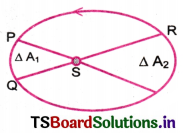
i.e., planets will appear to move slowly when they are away from the sun, and they will move fast when they are nearer to the sun.
Law of periods (3rd law): The square of time period of revolution of a planet is proportional to the cube of the semi major axis of the ellipse traced out by the planet.
i.e., T2 ∝ a3 or \(\frac{\mathrm{T}^2}{\mathrm{a}^3}\) = constant
where T = time period of revolution, a = semi major axis (length).
Question 2.
Derive the relation between acceleration due to gravity (g) at the surface of a planet and Gravitational constant (G).
Answer:
Relation between g and G: Each and everybody was attracted towards the centre of the earth with some force. This is called weight of the body, W = mg …… (1)
This force is due to gravitational pull on the body by the earth.
For small distances above the earth from centre of the earth is equal to radius of earth R’.
According to Newton’s law of gravitation.
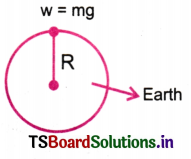
Force between two bodies, F = \(\frac{\mathrm{GMm}}{\mathrm{R}^2}\) ……. (2)
From equations (1), (2)
∴ mg = \(\frac{\mathrm{GMm}}{\mathrm{R}^2}\) ⇒ g = \(\frac{\mathrm{GM}}{\mathrm{R}^2}\)
∴ Relation between g and G is g = \(\frac{\mathrm{GM}}{\mathrm{R}^2}\)
Question 3.
How does the acceleration due to gravity (g) change for the same values of height (h) and depth(d)?
Answer:
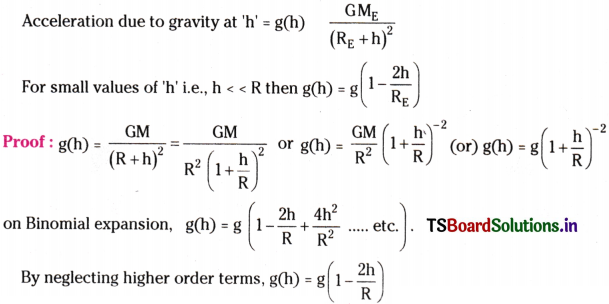
Variation of ‘g’ with altitude: When we go to a height ‘h’ above the ground ‘g’ value decreases.
On surface of earth (g) = \(\frac{\mathrm{GM}}{\mathrm{R}^2}\)
At an altitude ‘h’ g(h) = \(\frac{\mathrm{GM}}{(\mathrm{R}+\mathrm{h})^2}\) because R + h is the distance from centre of the earth to the given point at ‘h’. ‘
h < < R ⇒ g(h) = g(1 – \(\frac{2 h}{R}\))
So acceleration due to gravity decreases with height above the ground.
Variation of ‘g’ with depth: When we go deep into the ground ‘g’ value decreases. At a depth ‘d’ inside the ground mass of the earth upto the point d from centre will exhibit force of attraction on the body. The remaining mass does not exhibit any influence. So effective radius is (R – d) only. Acceleration due to gravity ‘g’ at a depth ‘d’ is given by
gd = \(\frac{4}{3} \pi \rho \mathrm{G}(\mathrm{R}-\mathrm{d})\) (∵ g = \(\frac{4}{3} \pi \rho \mathrm{GR}\))
(or) gd= \(\frac{4}{3} \pi \rho \mathrm{GR}\left(1-\frac{\mathrm{d}}{\mathrm{R}}\right)\)
(or) gd = g(1 – \(\frac{d}{R}\))
So ‘g’ value decreases with depth below the ground.
Question 4.
What is orbital velocity ? Obtain an expression for it.
Answer:
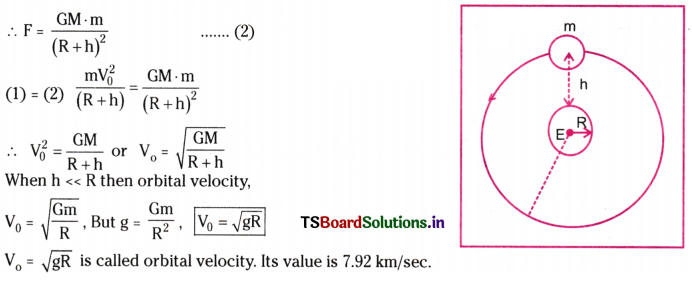
Orbital velocity (V0): Velocity of a satellite moving in the orbit is called orbital velocity (V0). Let a satellite of mass in is revolving round the earth in a circular orbit at a height ‘h’ above the ground.
Radius of the orbit = R + h where R is radius of the earth.
In orbital motion is “The centrifugal and centripetal forces acting on the satellite”.
Centrifugal force = \(\frac{\mathrm{mV}^2}{\mathrm{r}}\) = \(\frac{\mathrm{mV}_0^2}{\mathrm{R}+\mathrm{h}}\) …….. (1) (In this case V = V0 and r = R + h)
Centripetal force is the force acting towards the centre of the circle it is provided by gravitational force between the planet and the satellite.
Question 5.
What is escape velocity? Obtain an expression for it.
Answer:
Escape velocity (vi)min : It is defined as the minimum velocity required by a body to overcome gravitational field of the earth is known as escape velocity.
For a body of mass m gravitational potential energy on surface of the earth.
PE = –\(\frac{\mathrm{G} \cdot \mathrm{~m} \cdot \mathrm{M}_{\mathrm{E}}}{\mathrm{R}_{\mathrm{E}}}\)
For a body to escape from gravitational field of the earth its kinetic energy must be equal or more than gravitational potential energy.
KE = \(\frac{1}{2}\)mv2 For minimum velocity KE = PE
∴ \(\frac{1}{2}\)mv2 = –\(\frac{\mathrm{Gm} \cdot \mathrm{M}_{\mathrm{E}}}{\mathrm{R}_{\mathrm{E}}}\) OR v = \(\sqrt{\frac{2 \mathrm{GM}_{\mathrm{E}}}{\mathrm{R}_{\mathrm{E}}}}\)
∴ The minimum initial speed on surface of the earth [vi]min = \(\sqrt{\frac{2 \mathrm{GM}_{\mathrm{E}}}{\mathrm{R}_{\mathrm{E}}}}\) is called escape Speed.
(or) V = \(\sqrt{2 \mathrm{gR}_{\mathrm{E}}}\) (∴ g = \(\frac{\mathrm{GM}}{\mathrm{R}^2}\))
Question 6.
If two places are at the same height from the mean sea level; One is a mountain and other is in air. At which place will ‘g’ be greater ? State the reason for your answer.
Answer:
‘g’ value on the mountain is greater than ‘g’ value in air even though bath are at same height. For a point on mountain while deciding the ‘g’ value, mass of mountain is also considered which leads to change in ‘g’ value depending on local condition such as concentration of huge mass at a particular place. Whereas for a point in air no such effect is considered. Hence ‘g’ on the top of mountain is more.
Question 7.
The weight of an object is more at the poles than at the equator. At which of these can we get more sugar for the same weight ? State the reason for your answer.
Answer:
If we are using common balance to measure sugar we will get some quantity of sugar both at equator and at poles. Whereas if we are using spring balance to weigh sugar then weight of sugar at poles is more. So we will get less quantity. Weight of sugar at equator is less. So we will get more quantity of sugar at equator.
Question 8.
If a nut becomes loose and gets detached from a satellite revolving around the earth, will it fall down to the earth or will it revolve around the earth ? Give reasons for your answer.
Answer:
If a nut is detached from a satellite revolving in the orbit then its velocity is equals to orbital velocity. So it continues to revolve in the same orbit. It does not fall on the earth.
Question 9.
An object projected with a velocity greater than or equal to 11.2 km.s-1 will not return to the earth. Explain the reason.
Answer:
Escape velocity of the earth is 11.2 km/sec. If any body acquires a velocity of 11.2 km/sec. or more its kinetic energy is more than gravitational potential energy. So earth is not able to stop the motion of that body. So any body with a velocity 11.2 km/s or more will escape from gravitational field of earth and never comes back to the earth.
VI. Long Answer Questions
Question 1.
Define gravitational potential energy and derive an expression for it associated with two particles of masses m1 and m2.
Answer:
Gravitational potential energy of a body at a point in a gravitational field of another. It is defined as the amount of work done in brining the given body from infinity to that point in the field is called Gravitational potential energy.
Expression for gravitational potential energy : Consider two particles of masses m1 and m2 are placed at the points ‘O’ and p respectively. Let the distance between the two particles is ‘r’ i.e., OP = r.
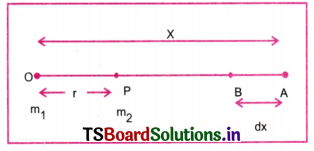
Let us calculate the gravitational potential energy of the particle of mass m2 placed at point p in the gravitational field of m,. Join OP and extended it in forward direction.
Consider two points A and B on this line such that OA = x and AB = dx.
The gravitational force of attraction on the particle at A is, F = \(\frac{\mathrm{Gm}_1 \mathrm{~m}_2}{x^2}\)
Small amount of work done in bringing the particle without acceleration through a very small distance AB is, dW = F dx = \(\frac{\mathrm{Gm}_1 \mathrm{~m}_2}{\mathrm{x}^2}\) dx
Total workdone in bringing thearticIe from infinity to the point P is,

Since, this work done is stored in the particle as its gravitational potential energy (U). Therefore, gravitational potential energy of the particle of mass m2 placed at point ‘p’ in the gravitational field of particle of mass m1 at distance r is, U = \(\frac{-\mathrm{Gm}_1 \mathrm{~m}_2}{\mathrm{r}}\)
Here, negative sign shows that the potential energy is due to attractive gravitational force between two particles.
Question 2.
Derive an expression for the variation of acceleration due to gravity (a) above and (b) below the surface of the Earth.
Answer:
Variation of acceleration due to gravity above the surface of earth : We know ‘g’ on planet, g = \(\frac{\mathrm{GM}}{\mathrm{R}^2}\). But on earth ‘g’ value changes with height above the ground ‘h’.
Variation of ’g’ with altitude : For a point h’ above the earth total mass of earth seems to be concentrated at centre of earth. Now distance from centre of earth is (R + h).
Variation of acceleration due to gravity below the surface of earth : At a depth d’ inside the ground mass of the earth upto the point d from centre will exhibit force of attraction on the body. The remaining mass does not exhibit any influence.
Mass of spherical body M ∝ R3
∴ Ms/ME = (RE – d)3/ R3 where Ms where Ms is mass of the earth’s shell upto a depth ‘d’ from centre. Gravitational force at depth d’ is F (d) = GMs m/(RE – d)2 = GME m (RE – d)/ \(R_E^2\)
So ’g’ value decreases with depth below the ground.
Question 3.
State Newton’s Universal Law of Gravitation. Explain how the value of the Gravitational constant (G) can be determined by Cavendish method.
Answer:
Newton’s law of gravitation: Every body in the universe attracts every other body with a force which is directly proportional to the product of their masses and inversely propor-tional to the square of the distance between them.
F ∝ m1m2 and F ∝ \(\frac{1}{\mathrm{~d}^2}\) or F ∝ \(\frac{\mathrm{m}_1 \mathrm{~m}_2}{\mathrm{~d}^2}\) or F = \(\frac{\mathrm{Gm}_1 \mathrm{~m}_2}{\mathrm{~d}^2}\)
This is always a force of attraction and acts along the line joining the two bodies.
Cavendish experiment to find gravitational constant ‘G’: Cavendish experiment consists of a long metalic rod AB to which two small lead spheres of mass m are attached.
This rod is supended from a rigid support with the help of a thin wire. Two heavy spheres of mass
M are brought near to these small spheres in opposite direction. Then gravitational force will act between the spheres.
Force between the spheres, F = \(\frac{\mathrm{GMm}}{\mathrm{~d}^2}\)
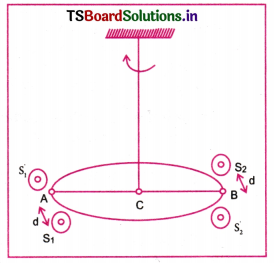
Two equal and opposite forces acting at the two ends of the rod AB will develop force couple and the rod will rotate through an angle ‘θ’
∴ Torque on the rod F × L = \(\frac{\mathrm{GM} \cdot \mathrm{~m}}{\mathrm{~d}^2}\)L ….. (1)
Restoring force couple = \(\tau \theta\) ……. (2)
Where \(\tau\) = Restoring couple per unit twist
∴ \(\tau \theta\) = \(\frac{\mathrm{GMm}}{\mathrm{~d}^2}\) or G = \(\frac{\tau \cdot \theta \mathrm{d}^2}{\mathrm{MmL}}\)
By measuring θ we can calculate ‘G’ value when other parameters are known.
Practical value of G is 6.67 × 10⁻¹¹ Nm2/kg2.
Problems
(Gravitational Constant ‘G’ = 6.67 × 10⁻¹¹ Nm2kg-2; Radius of earth ‘R’ = 6400 km; Mass of earth ‘ME’ = 6 × 1024 kg)
Question 1.
Two spherical balls each of mass 1 kg are placed 1 cm apart. Find the gravitational force of attraction between them.
Solution:
Mass of each ball, m = 1 kg; Separation, r = 1 cm = 10-2 m
Gravitational force of attraction, F = \(\frac{\mathrm{Gmm}}{\mathrm{r}^2}\) = \(\frac{6.67 \times 10^{-11} \times 1 \times 1}{\left(10^{-2}\right)^2}\) = 6.67 × 10-11 × 104 = 6.67 × 10⁻⁷ N.
Question 2.
The mass of a ball is four times the mass of another ball. When these balls are separated by a distance of 10 cm, the gravitational force between them is 6.67 × 10⁻⁷ N. Find the masses of the two balls.
Solution:
Mass of 1st ball = m.; Mass of 2nd ball = 4m.; Separation, r = 10 cm = 0.1 m;
Mass of the 1st ball = m ?.; Gravitational force, F = 6.67 × 10⁻⁷ N
∴ m2 = \(\frac{10^{-7}}{4 \times 10^{-9}}\) = \(\frac{100}{4}\) = 25 ⇒ m = 5
∴ Mass of the balls are 5 kg, 20 kg.
Question 3.
Three spherical balls of masses 1 kg, 2 kg and 3 kg are placed at the corners of an equilateral triangle of side 1 m. Find the magnitude of the gravitational force exerted by the 2 kg and 3 kg masses on the 1 kg mass.
Solution:
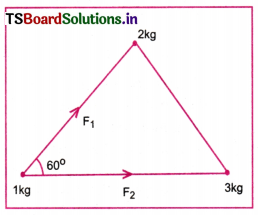
Side of equilateral triangle, a = 1m.
Masses at corners = 1 kg, 2 kg, 3 kg.
Force between 1 kg, 2g = F1 = G.\(\frac{2 \times 1}{1^2}\) = 2 G
Force between 1 kg, 3kg = F2 = G.\(\frac{3 \times 1}{1^2}\) = 3G.
Now F1 & F2 act with an angle of 60°
∴ Resultant force, FR = \(\sqrt{\mathrm{F}_1^2+\mathrm{F}_2^2+2 \mathrm{~F}_1 \mathrm{~F}_2 \cos \theta}\)
= \(\sqrt{4 \mathrm{G}^2+9 \mathrm{G}^2+2 \times 2 \times 3 \mathrm{G}^2 \times \frac{1}{2}}\) = G\(\sqrt{4+9+6}\) = \(\sqrt{19}\)G
Question 4.
At a certain height above the earths surface, the acceleration due to gravity is 4% of its value at the surface of the earth. Determine the height.
Solution:
Acceleration due to gravity at a height, h = 4% of g.
Radius of the earth, R = 6400 K.M. = 6.4 × 10⁶ m.
∴ gh = \(\frac{4}{100}\)g. But gh = \(\frac{g \cdot R^2}{\left(1+\frac{h}{R}\right)^2}\) ⇒ \(\frac{4}{100} \mathrm{~g}\) = \(\frac{g}{\left(1+h / R^2\right)}\) ⇒ (1 + \(\frac{h}{R}\)) = \(\frac{100}{4}\)
Take roots on both sides then, 1 + \(\frac{\mathrm{h}}{\mathrm{R}}\) = \(\frac{10}{2}\) = 5 ⇒ 1 + \(\frac{h}{R}\) = 5 – 1 = 4
∴ h = 4R = 6400 × 4 = 25,600k.m.
Question 5.
A satellite orbits the earth at a height of 1000 km. Find its orbital speed.
Solution:
Radius of the earth, R = 6,400 km = 6.4 × 10⁶ m; Mass of the earth, M = 6 × 1024
Height of satellite, h = 1000 km; G = 6.67 × 10¹¹ N – m2 / kg2

Question 6.
A satellite orbits the earth at a height equal to the radius of earth. Find it’s
(i) orbital speed and
(ii) Period of revolution.
Solution:
Radius of earth, R = 6400 k.m.; Height above the earth, h = R.
Mass of the earth, M = 6 × 1024; G = 6.67 × 10⁻¹¹ N – m2/kg2
i)

ii)
Time period, T = \(\frac{2 \pi(2 \mathrm{R})}{\mathrm{V}}\) = \(\frac{2 \times 3.142 \times 6.4 \times 10^6 \times 2}{5592}\) = 14,380 sec. = 3.994h ≈ 4 hours.
Question 7.
The gravitational force of attraction between two objects decreases by 36% when the distance between them is increased by 4 in. flnd the original distance between them.
Solution:
Let force between the objects = F; Distance between them = r.
For Case II distance, r1 = (r + 4); New force, F1 = 36% less than F,
∴ F1 = F\(\left(1-\frac{36}{100}\right)\) = \(\frac{64}{100} \mathrm{~F}\) \(\frac{\text { G.m.m }}{\mathrm{r}^2}\) ⇒ 100 r2 = 64(r + 4)2
Take square roots on both sides.
10r = 8(r + 4) ⇒ 10r = 8r + 32 ⇒ (10 – 8)r = 2r = 32 ∴ r = 16m.
Question 8.
Two satellites are revolving round the earth at different heights. The ratio of their orbital speeds is 2 : 1. If one of them is at a height of 100 km what is the height of the other satellite?
Answer:
Mass of earth, m = 6 × 10²⁰ kg; G = 6.67 × 10⁻¹¹ N—m2 / kg2
Ratio of orbital velocities \(V_{0_1}\) : \(V_{0_2}\) = 2 : 1; Height of one satellite, h = 100 k.m
But squaring on both sides \(\frac{\mathrm{Gm}}{\mathrm{R}+\mathrm{h}_1}\) = \(\frac{1}{4} \frac{\mathrm{Gm}}{\mathrm{R}+\mathrm{h}_2}\) ⇒ 4(R + h2) = R + h1 ⇒ 4R + 4h2 = R + h1
⇒ h1 = 3R + 4h2 ; h2 = 100 km
∴ h1 = 3 × 6400 + 400 = 19600 km.
Gravitation Class 11 NCERT Solutions
Question 1.
Answer the following :
(a) You can shield a charge from electrical forces by putting it inside a hollow conductor. Can you shield a body from the gravitational influence of nearby matter by putting in inside a hollow sphere or by some other means ?
(b) An astronaut inside a small spaceship orbiting round the earth cannot detect gravity. If the space station orbiting around the earth has a large size, can he hope to detect gravity ?
(c) If you compare the gravitational force on the earth due to the sun to that due to the moon, you wild find that the sun’s pull is greater than the moon’s pull. However, the tidal effect of the moon’s pull is greater than the tidal effect of sun. Why ?
Answer:
(a) No, a body cannot be shielded from the gravitational effect of nearby matter because the gravitational field is independent of the presence of other matter.
(b) Yes, if the mass of spaceship is sufficient to have its own gravity.
(c) The tidal effect depends inversely on the cube of the distance unlike the gravitational force which depends inversely on the square of the distance. As the distance of moon from sea is much smaller as compared to distance of sun from sea, therefore tidal effect, of moon’s pull is greater than the tidal effects of sun’s pull.
Question 2.
Choose the correct alternative :
(a) Acceleration due to gavity increases/decreases with increasing altitude
(b) Acceleration due to gravity increases/decreases with increasing depth (assume the earth to be a sphere of uniform density).
(c) Acceleration due to gravity is independent of mass of the earth/mass of the body.
(d) The formula -GMm\(\left(\frac{1}{r_2}-\frac{1}{r_1}\right)\) is more/less accurate than the formula mg (r2 – r1) for the difference in potential energy between two points r2 and r1 distance away from the centre of the earth.
Answer:
(a) The acceleration due to gravity decreases with increasing altitude because the formula is gh = \(\frac{g}{\left(1+\frac{h}{R}\right)^2}\)
(b) The acceleration due to gravity decreases with increasing depth because formula is gx = g(1 – \(\frac{x}{R}\)) where x is the depth.
(c) The acceleration due to gravity is independent of mass of body because the formula is g = \(\frac{\mathrm{GM}_{\mathrm{e}}}{\mathrm{R}^2}\) where Me = mass of the earth.
Question 3.
Suppose there existed a planet that went around the Sun twice as fast as the earth. What would be its orbital size as compared to that of the earth?
Answer:
From Kepler law, square of the time period of revolution of a planet is proportional to the cube of semi-major axis, i.e. T2 ∝ R3
TE = T, RF = RTP = 2T, RP=?

RP = 0.63 R orbital size of the given planet is 0.63 times to the earth orbital size.
Question 4.
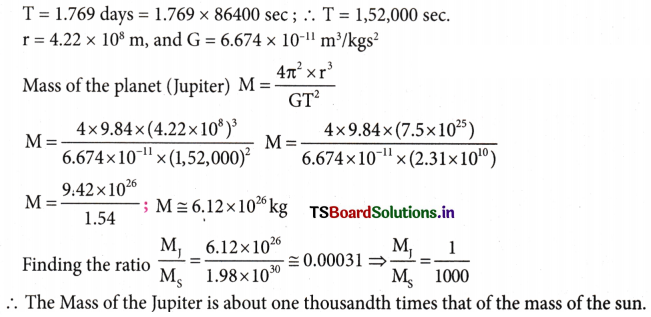
One of the satellites of Jupiter, has an orbital period of 1.769 days and the radius of the orbit is 4.22 × 10⁸ m. Show that the mass of Jupiter is about one-thousandth times that of the sun.
Answer:
T = 1.769 days = 1.769 × 86400 sec; ∴ T = 1,52,000 sec.
r = 4.22 × 10⁸ m, and G = 6.674 × 10⁻¹¹ m3/kgs2
Question 5.
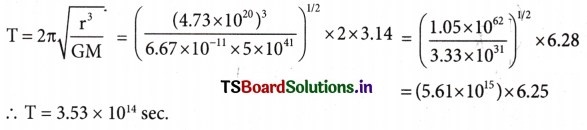
Let us assume that our galaxy consists of 23.5 × 101 stars each of one solar mass. How long will a star at a distance of 50,000 ly from the galactic centre take to complete one revolution ? Take the diameter of the Milky Way to be 105 ly. (ly = light year)
Answer:
Mass of galaxy = 2.6 × 10¹¹ solar mass
We know that 1 solar mass = 2 × 1030 kg
M = 2.5 × 1011 × 2 × 1030 = 5 × 1041kg
Distance between galastic centre to the star = 50,000 Ly.
r = 50,000 × 9.46 × 1015m = r = 4.73 × 10²⁰m
Question 6.
Choose the correct alternative:
(a) If zero of the potential energy is at infinity, the total energy of an orbiting satellite is negative of its kinetic/potential energy.
(b) The energy required to launch an orbiting satellite out of the earth’s gravitational influence is more/less than the energy required to project a stationary object at the same height (as the satellite) out of earth’s influence.
Answer:
(a) The total energy of an orbiting satellite is negative of its kinetic energy.
Reason: Potential energy U = –\(\frac{\mathrm{GMm}}{\mathrm{r}}\) ; Kinetic energy, K = + \(\frac{\mathrm{GMm}}{\mathrm{r}}\)
Total energy = K + U = –\(\frac{\mathrm{GMm}}{2 \mathrm{r}}\)
(b) The energy (ΔE1) required to launch an orbiting satellite out of the earth’s gravitational field is less than the energy (ΔE2) required to project a stationary object of same mass as satellite at the same height out of the earth’s influence.
Reason : ΔE1 = \(\frac{1}{2} \mathrm{mv}_{\mathrm{e}}^2\) – \(\frac{1}{2} \mathrm{mv}_0^2\) = \(\frac{1}{2} \mathrm{~m} \frac{2 \mathrm{GM}}{\mathrm{r}}\) – \(\frac{1}{2} \mathrm{~m} \frac{\mathrm{Gm}}{\mathrm{r}}\) = \(\frac{\text { GMm }}{2 \mathrm{r}}\)
ΔE2 = \(\frac{1}{2} \mathrm{mv}_{\mathrm{e}}^2\) = \(\frac{1}{2} \mathrm{~m} \frac{2 \mathrm{GM}}{\mathrm{r}}\) = \(\frac{\mathrm{GMm}}{\mathrm{r}}\)
Question 7.
Does the escape speed of a body from the earth depend on
(a) the mass of the body,
(b) the location from where it is projected,
(c) the direction of the projection,
(d) the height of the location from where the body is launched ?
Answer:
The escape speed form the earth is Ve = \(\sqrt{\frac{2 \mathrm{GM}_e}{\mathrm{r}}}\) = \(\sqrt{\frac{2 G M_e}{R_e+h}}\) ….. (i)
Where Me is mass of the earth, Re = radius of the earth and h is height from the earth’s
surface. C C
The expression (i) is independent of mass of the body, the location of body and the direction of projection; but depends on height h, so the answers are (a) No, (b) No, (c) No, (d) yes.
Question 8.
A comet orbits the sun in a highly elliptical orbit. Does the comet have a constant
(a) linear speed,
(b) angular speed,
(c) angular momentum,
(d) kinetic energy,
(e) potential energy,
(f) total energy throughout its orbit ? Neglect any mass loss of the comet when it comes very close to the sun ?
Answer:
Constant for (c) and (f) only.
The gravitational force of the sun on comet is central, therefore, angular momentum of comet is constant.
The gravitational force on comet is conservative, so total (mechanical) energy of comet remains constant.
Question 9.
Which of the following symptoms is likely to afflict an astronaut in space,
(a) swollen feet,
(b) swollen face,
(c) headache,
(d) orientational problem?
Answer:
An astronaut in space has no weight, so he will not be affected by
(a) swollen feet and he can be affected by
(b) swollen face,
(c) headache and
(d) orientatinal problem.
Question 10.
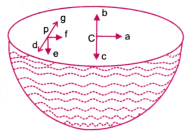
The gravitational intensity at the centre of a hemispherical shell of uniform mass density has the direction indicated by the arrow (Fig.)
(i) a
(ii) b
(iii) c
(iv) 0
(iv) 0
Answer:
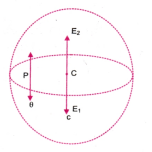
Inside every point of a spherical shell, the gravitational potential is constant, so gravitational intensity is zero. As G is symmetrical point,
\(\overrightarrow{E_1}\) + \(\overrightarrow{E_2}\) = 0 ⇒ \(\overrightarrow{E_1}\) = –\(\overrightarrow{E_2}\)
i.e., for lower hemisphere, it is directed along (c).
Question 11.
For the above problem, the direction of the gravitational intensity at an orbitrary point P is indicated by the arrow (i) d
(ii) e
(iii) f
(iv) g.
Answer:
For the same reason, the direction of gravitational intensity at P due to lower hemisphere is along (e).
Question 12.
A rocket is fired from the earth towards the sun. At what distance from the earth’s centre is the gravitational force on the rocket zero ? Mass of the sun = 2 × 1030 kg, mass of the earth = 6 × 1024 kg. Neglect the effect of other planets, ett. (Orbital radius = 1.5 × 10¹¹ m)
Answer:
The gravitational force on rocket will be zero at a point where the gravitational attraction force due to the sun and the earth are equal and opposite.
The orbital radius r is the distance between earth and sun. Let x be distance of rocket from the earth when the gravitational force on the rocket is zero, Then distance of rocket from the sun = (r – x).
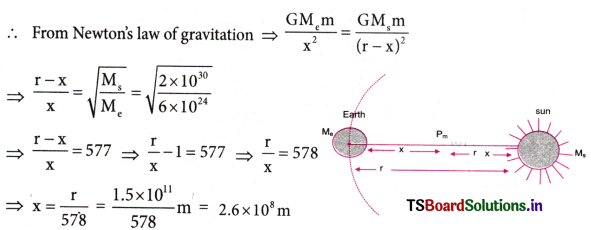
Question 13.
How will ‘you weigh the sun’ that is estimate its mass ? The mean orbital radius of the earth around the sun is 1.5 × 10⁸ km.
Answer:
We can weight the sun by using the fact that earth revolves around the sun in circular orbit due to gravitational pull with a period of 1 year.
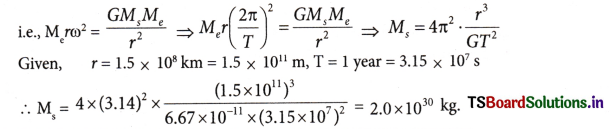
Question 14.
A saturn year is 29.5 times the earth year. How far is the saturn from the sun if the earth is 1.50 × 10⁵ km away from the sun?
Answer:
From Kepler’s third law T2
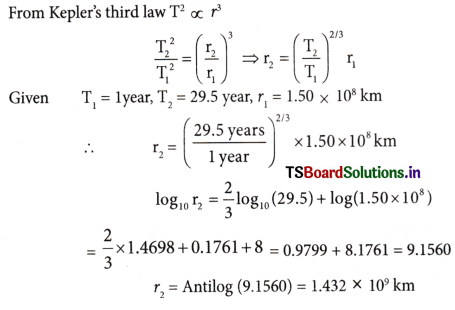
Question 15.
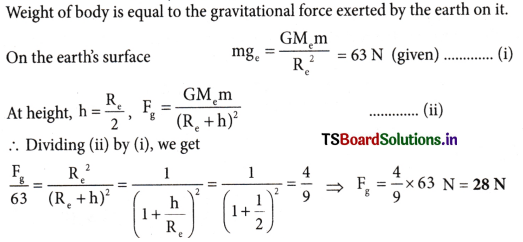
A body weighs 63 N on the surface of the earth. What is the gravitational force on it due to the earth at a height equal to half the radius of the earth ?
Answer:
Weight of body is equal to the gravitational force exerted by the earth on it.
Question 16.
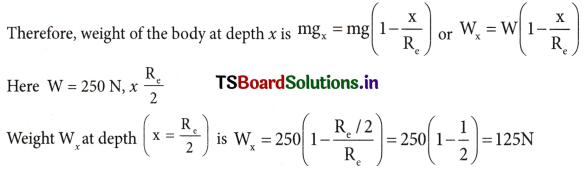
Assuming the earth to be a sphere of uniform mass density, how much would a body weigh half way down to the centre of the earth if it weighed 250 N on the surface ?
Answer:
Assuming earth to be a sphere of uniform density, the value of g at depth x from earth’s surface is gx = \(\left(1-\frac{\mathrm{x}}{\mathrm{R}_{\mathrm{e}}}\right)\), where R is the radius of the earth.
Question 17.
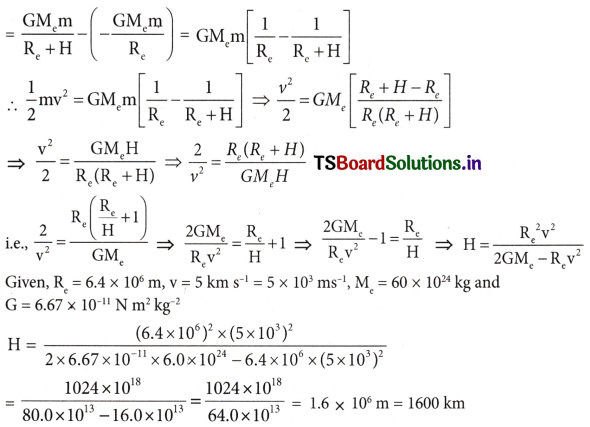
A rocket is fired vertically with a speed of 5 km s’ from the earth’s surface. How far from the earth does the rocket go before returning to the earth ? Mass of the earth = 6.0 × 10⁶ N kg, mean radius of the earth = 6.4 × 10⁶ m, G = 6.67 × 10⁻¹¹ N m2 kg2.
Answer:
Gravitational potential energy at height ‘h’ U = –\(\frac{\mathrm{GM}_{\mathrm{e}} \mathrm{~m}}{\mathrm{R}_{\mathrm{e}}+\mathrm{h}}\)
At maximum height velocity of rocket is zero, so kinetic energy of rocket O
At the earth’s surface, height h = O
At maximum height, hmax = H
From conservation of energy,
Loss in kinetic energy = Gain in gravitational potential energy
Loss of KE = \(\frac{1}{2} m v^2\) – 0 = \(\frac{1}{2} m v^2\)
Gain in gravitational potential energy
Question 18.
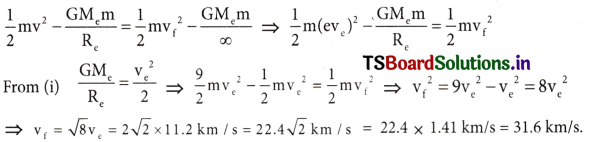
The escape velocity of a projectile on the earth’s surface is 11.2 km/s. A body is projected from the earth’s surface with thrice this speed. What is the speed of the body far away from the earth ? Ignore the presence of the sun and other planets.
Answer:
Given, ve = \(\sqrt{\frac{2 G M_e}{R_e}}\) = 11.2 km/s ……. (i)
If v is the speed of projection of body, then Iv = 3v<sub.e. If vf is final velocity, then according to principle of conservation of energy,
Total energy at the earth’s surface = Total energy far away from the earth (KE + PE) at the earth’s surface = (KE + PE) at infinite distance
Question 19.
A satellite orbits the earth at a height of 400 km above the surface. How much energy must be expanded to rocket, the satellite out of the earth’s gravitational influence?
Mass of the satellite = 200 kg; mass of the earth = 6.0 x 1024 kg;
Radius of the earth = 6.4 × 10⁶ m; G = 6.67 × 10⁻¹¹ N m2 kg-2
Answer:
The total energy of satellite of mass m orbiting the earth (of mass Me) in circular path of radius r is given by E = \(\frac{\mathrm{GM}_{\mathrm{e}} \mathrm{~m}}{2 \mathrm{r}}\)
If satellite is at a height h above the earth’s surface, then r = R + h
∴ E = –\(\frac{\mathrm{GM}_{\mathrm{e}} \mathrm{~m}}{2\left(\mathrm{R}_{\mathrm{e}}+\mathrm{h}\right)}\)
The energy required to send the satellite out of the earth’s gravitational field is equal to Binding energy, B = -E = \(\frac{\mathrm{GM}_{\mathrm{e}} \mathrm{~m}}{2\left(\mathrm{R}_{\mathrm{e}}+\mathrm{h}\right)}\)
Here, Me = 6.0 × 1024 kg, m = 200 kg, Re = 6.4 × 10⁶ m
Substituting given values, we get B = \(\frac{\left(6.67 \times 10^{-11}\right)\left(6.0 \times 10^{24}\right) \times 200}{2\left(6.4 \times 10^6+0.4 \times 10^6\right)}\) = 5.89 × 10⁹ J
Question 20.
Two stars each of 1 solar mass (= 2 × 1030 kg) are approaching each other for a head on collision. When they are at a distance of 109 km, their speeds are negligible. What is the speed with which they collide ? The radius of each star is 104 km. Assume the stars to remain undistorted until they collide. (Use the known value of G). Take G = 6.67 × 10⁻¹¹ N m2 kg-2.
Answer:
Let M (= 2 × 1030 kg) be the mass of each star and r1 (= 109 km = 1012 m) be the initial separation between them.
Initial gravitational potential energy of stars Ui = –\(\frac{\mathrm{GMM}}{\mathrm{r}_1}\) = –\(\frac{\mathrm{GM}^2}{\mathrm{r}_1}\)
Initial kinetic energy of stars = 0
∴ Initial total energy, E = –\(\frac{\mathrm{GM}^2}{\mathrm{r}_1}\)
When they collide separation between stars is r2 = 2R
If v is speed of each star just before collision, the final kinetic energy = 2\(\left(\frac{1}{2} M v^2\right)\)
Total energy just before collision = –\(\frac{\mathrm{GM}^2}{2 \mathrm{R}}\)
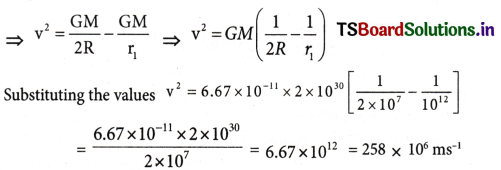
Question 21.
Two heavy spheres each of mass 100 kg and radius 0.10 m are placed 1.0 m apart on a horizontal table. What is the gravitational force and potential at the mid point of the line joining the centres of the spheres ? Is an object placed at that point in equilibrium ? If so, is the equilibrium stable or unstable ?
Answer:
The mass of each sphere can be supposed to be concentrated at its centre. The distance of mid-point C from the centre of each sphere.
r1 = r2 = \(\frac{\mathrm{r}}{2}\) = \(\frac{1.0}{2}\)m = 0.5 m/
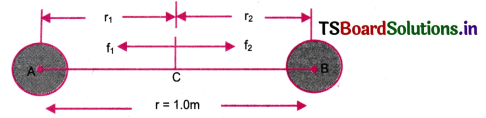
Gravitational Force : The gravitational field at the centre (C) due to sphere A,
f1 = \(\frac{\mathrm{GM}_1}{\mathrm{r}_1^2}\), along \(\overrightarrow{\mathrm{CA}}\)
Gravitational field at C due to sphere B, f2 = \(\frac{\mathrm{GM}_2}{\mathrm{r}_2{ }^2}\) along \(\overrightarrow{\mathrm{CB}}\),
As M1 = M2 = 100 kg and r1 = r2 = 0.50 m
\(\vec{f}_1\) and \(\vec{f}_2\) are equal and opposite, hence the resultant gravitational field at the centre C is zero.
since the gravitational field at the mid-point is zero, so the gravitational force,
Fg = mfg is also zero.
Gravitational potential:
The gravitational potential at the centre (C) due to sphere A, V1 = \(\frac{\mathrm{GM}_1}{\mathrm{r}_1}\)
The gravitational potential at (C) due to sphere B, V2 = \(\frac{\mathrm{GM}_2}{\mathrm{r}_2}\)
∴ Net gravitational potential at C, Vg = V1 + V2 = \(-\frac{\mathrm{GM}_1}{\mathrm{r}_1}-\frac{\mathrm{GM}_2}{\mathrm{r}_2}\)
Here M1 = M2 = 100 kg, r1 = r2 = 0.50 m
Vg = –\(\frac{2 \mathrm{GM}_1}{\mathrm{r}_1}\) = –\(\frac{2 \times 6.67 \times 10^{-11} \times 100}{0.50}\) = -2.67 × 10⁻⁸ J/kg.
As the gravitational force on an object placed at mid-point is zero, the object placed at mid-point (C) will be in equilibrium.
The equilibrium of an obejct is unstable, because the object if displaced a little towards any side from the mid-point will tend to move further away from the mid-point.