Regular practice with AP Inter 1st Year Chemistry Study Material Chapter 9 Hydrocarbons Questions and Answers helps students stay prepared for examinations.
AP Inter 1st Year Chemistry 9th Lesson Hydrocarbons Questions and Answers
I. Multiple Choice Questions
Question 1.
Alkyl halides on reaction with sodium in the presence of dry ether give alkanes. This reaction is named as
1) Wurtz reaction
2) Kolbe’s reaction
3) Decarboxylation
4) Dehydrohalogenation
Answer:
1) Wurtz reaction

Question 2.
Complete combustion of methane gives
1) CO2 + H2O
2) CO2 + H2
3) COCl2
4) CO + CO2 + H2O
Answer:
1) CO2 + H2O
CH4 + 2O2 → CO2 + 2H2O
Question 3.
How many conformations are possible for ethane?
1) 2
2) 3
3) infinite
4) 5
Answer:
3) infinite
For ethane infinite number of conformations are possible.
Question 4.
By which reaction ethene is obtained from ethyne?
1) Oxidation
2) Polymerisation
3) Hydrogenation
4) Dehydrogenation
Answer:
3) Hydrogenation

Question 5.
When one mole of an alkene produces one mole of methanal and one mole of ethanal on ozonolysis followed by hydrolysis. The alkene is
1) Ethylene
2) Propene
3) 2-butene
4) 2,3-dimethyl, 2-butene
Answer:
2) Propene


Question 6.
The reaction of HBr with CH3CH2=CH2 at 400 °C yields
1) CH2Br – CH = CH2
2) CH3-CHBr-CH3
3) CH3-CH2-CH2Br
4) CH2Br-CH2-CH2Br
Answer:
2) CH3-CHBr-CH3

Question 7.
When acetylene is passed through dil.H2SO4 in presence of HgSO4 the compound formed is
1) Ethanol
2) Ethanal
3) Ethanoic acid
4) Propanone
Answer:
2) Ethanal

Question 8.
Acetylenic hydrogens are acidic because [ ]
1) Sigma electron density of C-H bond in acetylene is nearer to carbon which has 50% s-character.
2) Acetylene has only one hydrogen on each carbon.
3) Acetylene contains least number of hydrogens among the possible hydrocarbons having two carbons.
4) Acetylene belongs to the class of alkynes with molecular formula CnH2n-2.
Answer:
1) Sigma electron density of C-H bond in acetylene is nearer to carbon which has 50% s-character.
In acetylene, carbon undergoes sp hybridisation which has 50% s-character, and o – electron density of C-H bond is nearer to carbon.
Question 9.
Aromatic compounds burn with sooty flame, because
1) They have a ring structure of carbon atoms.
2) They have a relatively high percentage of hydrogen.
3) They have a relatively high percentage of carbon.
4) They resist reaction with oxygen of air.
Answer:
3) They have a relatively high percentage of carbon.
They have a relatively high percentage of carbon.
II. Fill in the Blanks
Question 1.
Decreasing order of Acidic behaviour of Ethane, Ethene and Ethyne is ___.
Answer:
Ethyne > Ethene > Ethane
Question 2.
Carbon-carbon single bond length in ethane is ___ carbon-carbon double bond length in ethene is ___.
Answer:
1.54 \(\text { Å }\), 1.34 \(\text { Å }\)
Question 3.
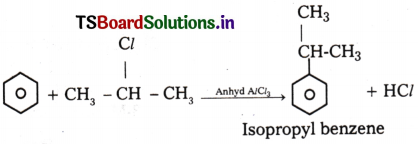
When Benzene treated with 1-chloropropane in presence of anhydrous AlCl3 ___ is formed.
Answer:
Question 4.
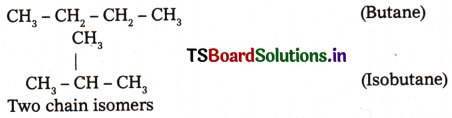
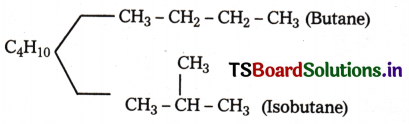
The possible isomers for C4H10 are ___.
Answer:
Question 5.
Calcium carbide on hydrolysis gives ___.
Answer:

III. One Word Answer Questions
Question 1.
How do you prepare ethyl bromide from ethylene?
Answer:

Question 2.
What is decarboxylation?
Answer:
Removal of CO2 from a compound is called decarboxylation.
Eg:

Question 3.
What is halogenation?
Answer:
Halogenation is a chemical reaction which introduces one or more halogens into a chemical compounds.
Eg:

Question 4.
What is meant by aromatization or reforming ?
Answer:
Aromatisation or (reforming) : Alkanes with six or more carbon atoms on heating at 773 K, 10-20atm. pressure in presence of V2O5/Mo2O3/Cr2O3 to form aromatic compounds. This is called aromatization.

Question 5.
What is meant by isomerisation ?
Answer:
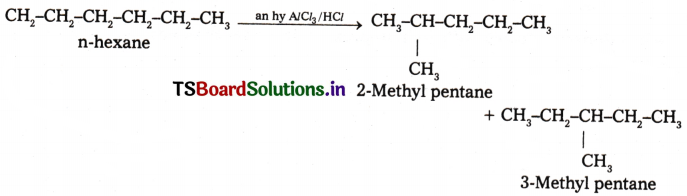
Alkanes when heated in presence of anhydrous A/Cl3/HC/ to form branched chain isomers. This is called Isomerisation.
Question 6.
What is pyrolysis or cracking ?
Answer:
Pyrolysis (or) Cracking : Heating of higher alkanes at high temperatures decompose into lower alkanes, alkenes etc.. This is called Pyrolysis.
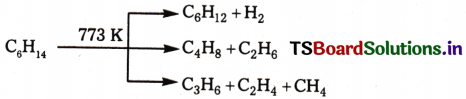
Pyrolysis is the principle involved in preparation of petrol gas from kerosene oil or petrol.
Question 7.
What is Lindlar’s catalyst ?
Answer:
Lindlar’s catalyst is the partially deactivated palladised charcoal.
Question 8.
What is ozonolysis ?
Answer:
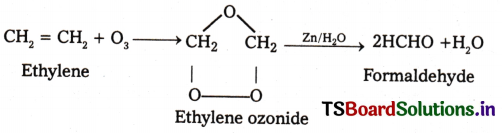
Addition of ozone to unsaturated compounds to form ozonides followed by hydrolysis to form carbonyl compounds is called ozonolysis.
Question 9.
What is polymerisation ?
Answer:
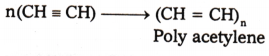
Joining of simple units to form a large molecular weight compound at high temperatures / pressure is called polymerisation.
Question 10.
What is linear polymerisation ?
Answer:
Polymerisation which involves monomers of joining end to end to form a single, long, unbranched chain molecules is called linear polymerisation.
Question 11.
What is cyclic polymerisation ?
Answer:
Polymerisation in which multiple small molecules reacts to form a larger molecule with a ring like structure is called cyclic polymerisation.
Eg :

Question 12.
What are arenes ?
Answer:
Aromatic hydrocarbons are called arenes.
Question 13.
Give any two examples for o- and p- directing groups.
Answer:
O, P – directing group examples -OH, -NH2, -OCH3
Question 14.
What is meant by carcinogenicity ?
Answer:
Benzene and arenes having more than two benzene rings fused, are toxic and cancer causing. This is called Carcinogenicity.
Question 15.
Give any two examples for m- directing groups.
Answer:
m-directing groups. Eg : -NO2, -CN, -CHO
IV. Very Short Answer Questions
Question 1.
What is substitution reaction? Explain with one example.
Answer:
The chemical reactions in which some of the groups (or) atoms substituted are called substitution reactions.
Eg:

Question 2.
What is Friedel-Crafts alkylation?
Answer:
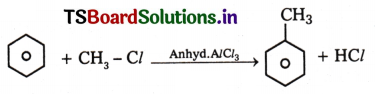
Friedal Crafts alkylation : Benzene reacts with alkyl halides in presence of anhydrous AlCl3 to form alkylbenzene.
Benzene on reaction with CH3 — Cl in anhydrous AlCl3 to form toluene.
Question 3.
What is Friedel-Crafts acylation?
Answer:
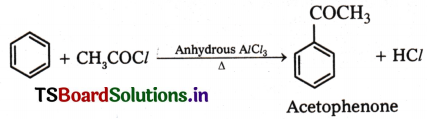
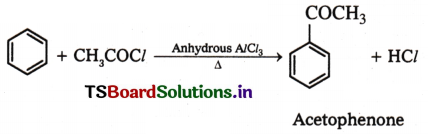
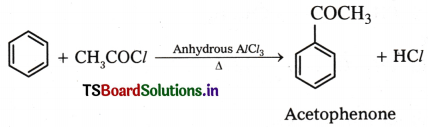
Friedel Crafts acylation: Benzene reacts with acyihalide in presence of anhydrous AlCl3 to form acylbenzene.
Benzene reacts with acetyl chloride in AlCl3 to form acetophenone.
Question 4.
Explain the structural isomerism with one example.
Answer:
Structural isomerism : Organic compounds having same formula but differ in structural arrangement are called structural isomers. This is called structural isomerism.
Question 5.
What is stereoisomerism? Give one example.
Answer:
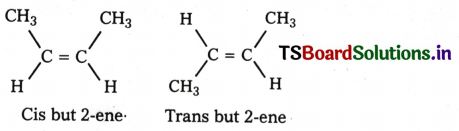
Organic compounds having same formula but differ in their spatial arrangement are called Stereoisomers. This is called Stereoisomerism.
Eg:
Question 6.
Kharasch effect is not observed in the addition of HI to alkene. Why ?
Answer:
Kharasch effect proceed through free radical mechanism. HI bond is weaker (296KJmol-1) and Iodine free radicals combine to form Iodine molecule instead of adding to the double bond.
∴ It is not observed in the addition of HI to alkene.
Question 7.
What is meant by torsional strain ?
Answer:
In the conformations of alkanes the rotation around a C – C single bond is not completely free. It is hindered by a weakrepulsive interaction between the adjacent bonds. This type of repulsive interaction is called torsional strain.
Question 8.
How ethane is prepared from ethene ?
Answer:
Ethene reacts with hydrogen in presence of nickel catalyst to form ethane.

Question 9.
What is Wurtz’reaction? Give one example.
Answer:
Wurtz Reaction : Alkyl halides reacts with sodium metal in presence of dry ether to form alkanes.
Eg: Melthyl bromide reacts with sodium metal in presence of dry ether to form ethane.

Question 10.
Explain Kolbe’s electrolytic method with an example.
Answer:
Kolbe’s Electrolysis: Aq. solutions of Na/K salts of carboxylic acids on electrolysis gives alkanes.

Question 11.
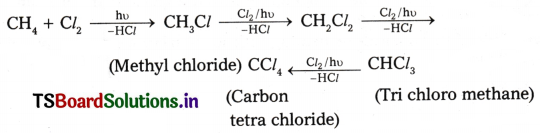
Write the Halogenation of methane.
Answer:
Methane undergo halogenation in presence of sunlight to form finally Tetra halomethane.
Question 12.
What is the product obtained when methane reacts with steam? Write the equation.
Answer:
Methane reacts with steam at 1273 K to form CO and H2 in presence of Nickel catalyst. (Industrial method of preparation of hydrogen)

Question 13.
State Markovnikov rule.
Answer:
When HBr is added to unsymmetrical alkene then negative part of reagent attached to that carbon atom having less no. of hydrogen atoms.

Proceeds through ionic mechanism.
Question 14.
Write the bond enthalpy of carbon-carbon single bond, carbon-carbon double bond and carbon-carbon triple bond in kJ/mole.
Answer:
Bond enthalpy of C ≡ C is 823 kJ mol-1
Bond enthalpy of C = C is 681 kJ mol-1
Bond enthalpy of C – C is 348 kJ mol-1
Question 15.
What is Sulphonation of benzene ?
Answer:
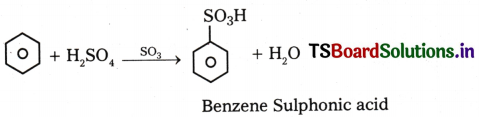
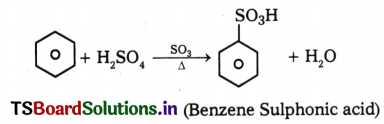
Benzene reacts with sulphuric acid in presence of SO3 to form benzene sulphonic acid.
V. Short Answer Questions
Question 1.
Complete the following reaction and name the products A, B and C.

Answer:

A is acetylene (or) ethyne. B is benzene. C is toluene or methylbenzene.
Question 2.
What is dehydrohalogenation? Write the equation for the formation of alkene from alkyl halide.
Answer:
Removal of one hydrogen atom and one halogen atom from adjacent carbon atoms of a compound is called dehydrohalogenation.
Alkene from alkyl halide: Ethyl chloride on heating with ale. KOH undergoes dehydrohalogenation and gives ethylene.

Question 3.
Which type of organic compounds react with ozone? Explain with one example.
Answer:
- Unsaturated hydrocarbons undergo addition with ozone and form addition compounds called ozonides.
- These ozonides are unstable and undergo hydrolysis forming carbonyl compounds. This is called ozonolysis.
- Unsaturated hydrocarbons usually react with ozone. This is used to locate multiple bonds in unsaturated compounds like alkenes, alkynes and benzene.
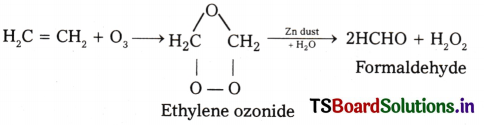
Eg: Ethylene undergoes addition with ozone forming ethylene ozonide. This on hydrolysis in presence of Zn dust gives formaldehyde and H2O2.
Question 4.
Explain the reactions of acetylene with
a) Na in liquid NH3
b) Water
Answer:
a) Acidic nature of alkynes: Acetylene reacts with sodium metal and sodamide (NaNH2) to form sodium acetylide with liberation of hydrogen gas.
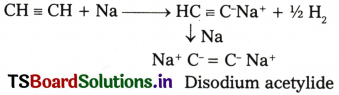
Acidic nature order: Alkynes > Akenes > Akanes
CH = CH > CH2 = CH2 > CH3 – CH3
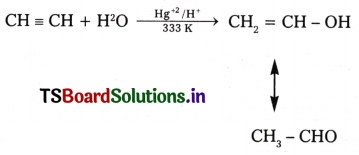
b) Acetylene reacts with water in presence of Hg+2/H+ at 333 K to form vinyl alcohol on rearrangement forms acetaldehyde.
Question 5.
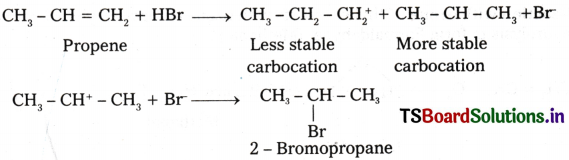
Exlplain the addition of HBr to propene with ionic mechanism.
Answer:
Electrophilic addition of HBr to CH3 – CH = CH2 molecule : A pair of electrons from the double bond attacks the electrophilic HBr to produce an achiral trigonal Planar, carbocation intermediate. The halide ion (Br–) then adds to either face of the +vely charged carbon forming the alkyl halide.
VI. Long Answer Questions
Question 1.
Describe two methods of preparation of Ethane. Give ány three reactions of Ethane.
Answer:
Methods of preparations of Ethane:
1) Wurtz reaction : Ethyl bromide reacts with sodium metal in presence of dry ether to form Ethane.

2) By decarboxylation : Sodium propionate undergo decarboxylation with NaOH and CaO to form Ethane.

Reactions of Ethane:
1) Halogenation: Ethane reacts with chlorine in presence of sunlight (by) to form chloro ethane.

2) Combustion: Ethane on combustion (burning in air (or) oxygen) to form carbon dioxide and water.

3) Controlled oxidation : Ethane undergo controlled oxidation in presence of manganese acetate to form acetic acid.

Question 2.
Describe two methods of preparation of Ethylene. How does it reacts with the following. Give equations.
a) Ozone
b) Cold and dil.alk KMnO4
c) Br2
Answer:
Preparations of Ethylene:
1) By dehydrohalogenation : Ethyl chloride reacts with aic. KOH to form ethylene by dehydrohalogenation.
CH3-CH2-Cl+Alc.KOH → CH2 = CH2 + KCl + H2O
2) By dehydration of Ethanol : Ethanol reacts with Conc.H2SO4 at 170°C (443 K) to form Ethylene.

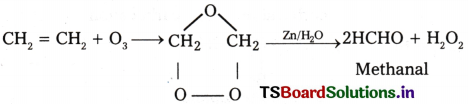
a) Reaction with ozone : Ethylene reacts with ozone to form Ethylene ozonide followed by hydrolysis to form Formaldehyde. (Methanal)
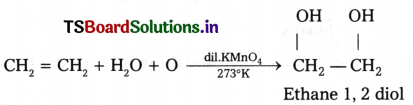
b) Reaction with cold.dil. Alk.KMnO4. : Ethylene reacts with cold dil.alk. KMnO4 to form Ethylene glycol (Ethane 1, 2-diol).
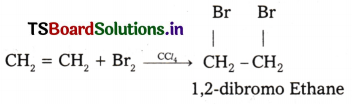
c) Reaction with Br2: Ethylene reacts with bromine in presence of CCl4 to form 1,2-dibromo ethane.
Question 3.
Give two methods of preparation of acetylene. How does it react with water ?
Answer:
Preparations of acetylene :
1) From Calcium Carbide : Calcium carbide undergo hydrolysis to form acetylene.

2) From Vicinal dihalides: 1,2-dibromo ethane reacts with alc.KOH followed by the reaction with NaNH2 to form acetylene.

3) Reaction with water: Acetylene reacts with water in presence of HgSO4/H+ to form vinyl alcohol followed by rearrangement to form Ethanal (Acetaldehyde)

Question 4.
How does acetylene reacts with the following reagents? Give the corresponding equations and name the products formed in the reaction.
a) Water
b) Hydrogen
c) Halogens
d) Hydrogen halide
Answer:
a) Reaction with water: Acetylene reacts with water in presence of HgSO4/H+ to form vinyl alcohol followed by rearrangement to form ethanal (Acetaldehyde).

b) With Hydrogen : Acetylene undergo hydrogenation in presence of Pt – Catalyst first forms Ethylene and finally forms Ethane.

d) With hydrogen halide : Acetylene undergo addition reaction with HCl or HBr to form germinal halides.

Question 5.
What is Conformational Isomerism ? Write the conformers of Ethane.
Answer:
Conformational Isomerism : Different spatial arrangements of atoms or molecules which can be converted into one another by rotation around a C-C Single bond are called Conformations. This is called Conformational isomerism.
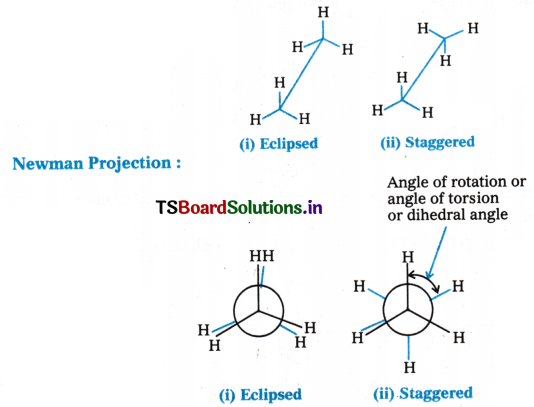
Conformations of Ethane : Ethane (CH3 – CH3) have infinite no.of conformations but two are major.
1) Eclipsed Conformation : The conformation in which hydrogen atoms attached to two carbons are as close together as possible is called eclipsed conformation.
2) Staggered Conformation: The conformation in which hydrogens are far apart as possible is known as staggered conformation.
- Any other intermediate conformation is called a “skew conformation”.
- These two conformations are represented by Saw horse and Newman projection. Sawhorse Projection :
Relative Stability of conformations :
- Staggered conformation is more stable than eclipsed conformation.
- In Staggered Conformation C – H bonds of front carbon and back carbon are for apart from each other so electronic repulsions are low.
- In Eclipsed confirmation both carbon – C – H bonds are nearer so electronic repulsions are high.
- Hence staggered form is more stable than Eclipsed conformation.
Question 6.
How do we get benzene from acetylene? Give corresponding equation. Explain the halogenation, alkylation, acylation, nitration and sulphonation of benzene.
Answer:
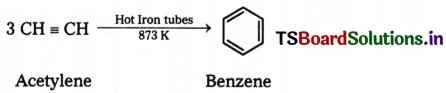
Cyclic polymerisation of acetylene :
Acetylene undergo cyclic polymerisation in red hot iron tubes at 873 K to form benzene.
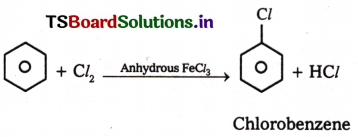
i) Halogenation: Benzene reacts with halogens in presence of lewis acid to form halobenzen.
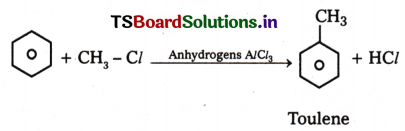
ii) Alkylation: Benzene reacts with alkyl halides in presence of anhydrous AlCl3 to form alkly benzene.
Benzene on reaction with CH3 – Cl Methyl Chloride in anhydrous AlCl3 to form to Methyl Benzene (or) Toulene.
iii) Friedel Crafts Acylation : Benzene reacts with acylhalide in presence of an hydrons AlCl3 to form acylbenzene.
Benzene reacts with acetyl chloride in AlCl3 to form acetophenone.
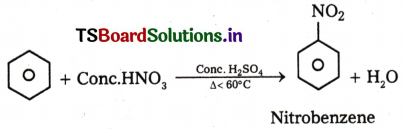
iv) Nitration : Benzene undergo nitration with nitration mixture (Conc.HNO3 + Conc.H2SO4 1:1 ratio) at < 60°C to form nitrobenzene.
v) Sulphonation : Benzene reacts with sulphuric acid in presence of SO3 to form benzene Sulphonic acid. (Benzene Sulphonic acid)
Question 7.
Explain aromatic electrophilic substitution reactions of benzene.
Answer:
Electrophilic substitution reaction of benzene proceeds in two steps.
Step 1 : The electrophile (E+) takes two electrons of the six – electron π system, to form a s σ bond with a carbon atom of the benzene ring. Then that carbon atom becomes sp3 hybridised.
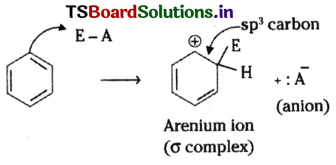
Step 2 : A proton is removed from the carbon atom of the a complex that bears the E (electrophile). Then that carbon atom changes to sp2 state again. Then the benzene derivative with fully delocalised six n electrons is formed.
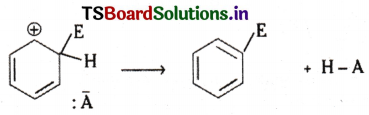
(The proton H+ combines with the anion obtained from the molecule E – A → E+ + : A–)
Question 8.
Explain electrophilic addition reactions of ethylene with mechanism.
Answer:
1) Addition of halogens: Ethylene combines with halogens at room temp, in an inert solvent medium, to give a vicinal dihalide.
Ex: Bromination.
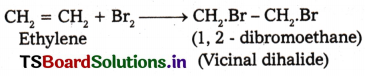
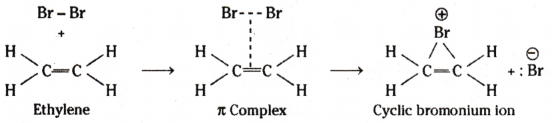
Mechansism : It involves 2 steps:
Step-1 : The π – electrons of the double bond attack the halogen molecule. Then a loose p complex (cyclic bromonium ion), with a 3 – membered ring is formed.
Step-2 : The negative bromide ion attacks the cyclic bromonium ion from the backside.
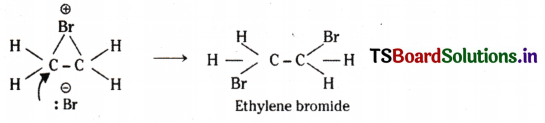
This is called, ‘trans’ addition of halogens.
2) Addition of hydrogen halide : Ethylene reacts with hydrogen halide (HX) to give ethyl halide.
Ex:

Mechanism : This mechanism is quite similar to that of the halogen addition, involving 2 steps.
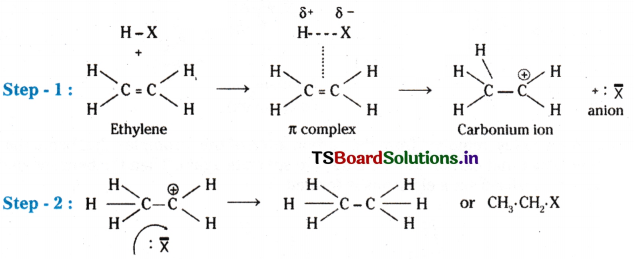
3) Addition of hypochlorous acid to ethylene : Ethylene reacts with hypochlorous acid to give ethylene chlorohydrin.
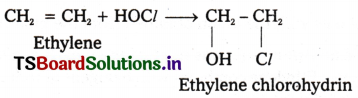
Mechanism : HOCl → (HO)– + Cl+
The same mechanism as in the case of addition of HX.
HX → H+ + X–
In HOCl, the Cl+ adds first. Then OH– adds to the other carbon atom.
Question 9.
How do you convert the following compounds from benzene ?
a) Chlorobenzene
b) Toluene
c) Acetophenone
Answer:
(a) Halogenation : Benzene reacts with halogens in presence of lewis acid to form halobenzene.
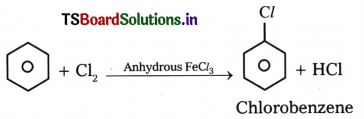
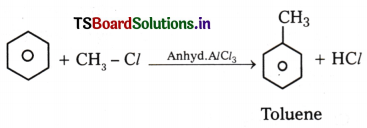
(b) Friedel Crafts alkylation : Benzene reacts with alkyl halides in presence of an hydrous AlCl3 to form alky benzene.
Benzene on reaction with CH3 – Cl in anhydrous AlCl3 to form to toluene.
(c) Friedel Crafts acylation : Benzene reacts with acylhalide in presence of anhydrous AlCl3 to form acylbenzene.
Benzene reacts with acetyl chloride in AlCl3 to form acetophenone.
Question 10.
What do you understand about Geometrical isomerism? Explain the geometrical isomers of 2-butene.
Answer:
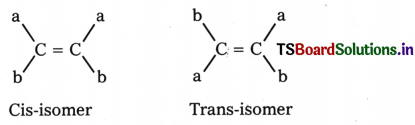
Geometrical Isomerism: Compounds having same molecular formula but differ in geometry in space are called Geometric isomers.
- Geometrictal isomerism arised in C=C (Alkenes) containing compounds attached to two different groups.
- In alkenes due to restricted rotation this isomerism is arised.
- Geometrical isomers are two types.
1) Cis-Isomer: Same group present on same side of double bonded carbon atoms then it is Cis Isomer.
2) Trans-Isomer : Same group present on opposite side of double bonded carbon atoms then it is trans-isomer.
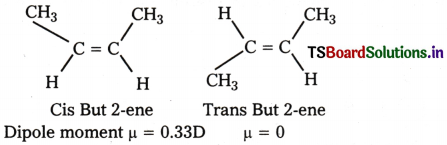
Geometrical isomers of But 2-ene is
But 2-ene structure is CH3– CH = CH – CH3
Hydrocarbons Class 11 NCERT Solutions
Question 1.
How do you account for the formation of ethane during chlorination of methane?
Answer:
Chlorination of methane is a free radical reaction which occurs by the following mechanism:
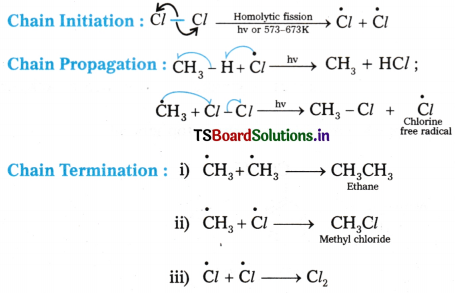
From the above mechanism, it is clear that, methyl free radicals are produced during chain propagation step. In the chain termination step, the two CH3 free radicals combine together to form ethane (CH3 — CH3) molecule.
Question 2.
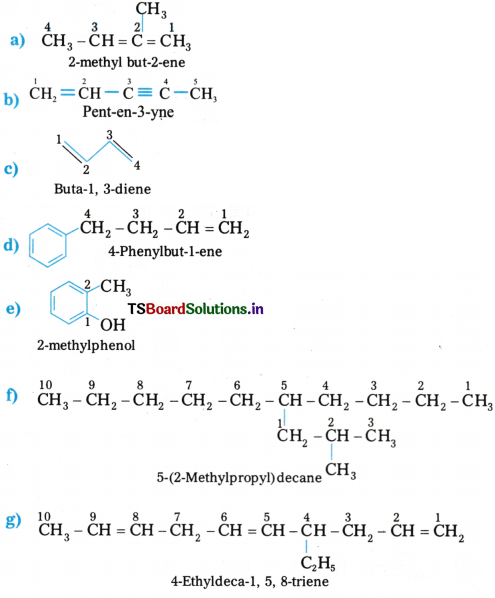
Write IUPAC names of the following compounds:
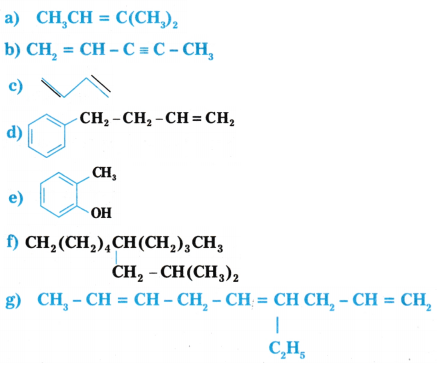
Answer:
Question 3.
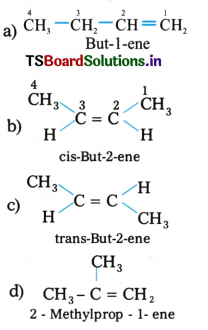
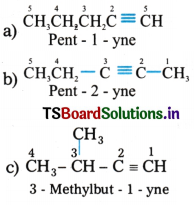
For the following compounds, write structural formulas and IUPAC names for all possible isomers having the number of double or triple bond as indicated :
a) C4H8 (one double bond)
b) C5H8 (one triple bond)
Answer:
a) Isomers of C4H8 having one double bond are
b) Isomers of C5H8 having one triple bond is
Question 4.
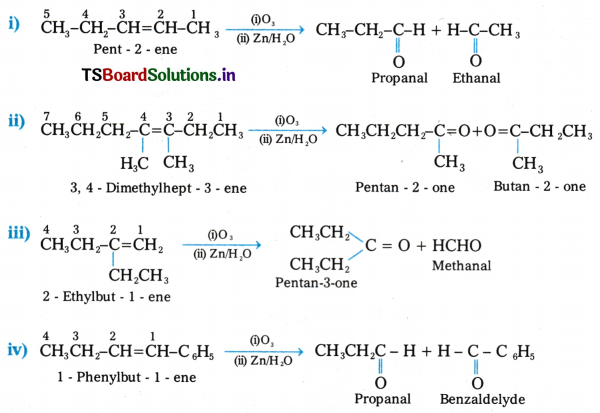
Write IUPAC names of the products obtained by the ozonolysis of the following compounds.
i) Pent-2-ene
ii) 3, 4-Dimethylhept-e-ene
iii) 2-Ethylbut-l-ene
iv) 1-Phenylbut-l-ene
Answer:
Question 5.
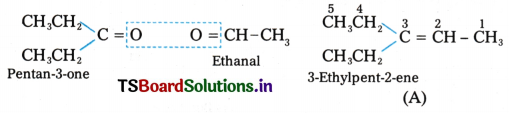
An alkene ‘A’ on ozonolysis gives a mixture of ethanal and pentan-3-one. Write structure and IUPAC name of ‘A’
Answer:
Question 6.
An alkene A contains three C – C, eight C – H σ-bonds, and one C – C p-bond. A on ozonolysis gives two moles of an aldehyde of molar mass 44 u. Write the IUPAC name of A’.
Answer:
i) An aldehyde with molar mass of 44 u is ethanal (CH3CHO).
ii) Write two moles of ethanal side by side with their oxygen atoms pointing towards each other. Remove the oxygen atoms and join them by a double bond to obtain the structure of alkene ‘A’.

But-2-ene has three C – C, eight C – H σ-bonds and one C – C π-bond.
Question 7.
Propanal and pentan-3-one are the ozonolysis products of an alkene ? What is the structural formula of the alkene ?
Answer:
Write the structures of propanal and pentan-3-one with their oxygen atoms facing each other. Remove oxygen atoms and join the two fragments by a double bond to obtain the structure of the alkene.

Question 8.
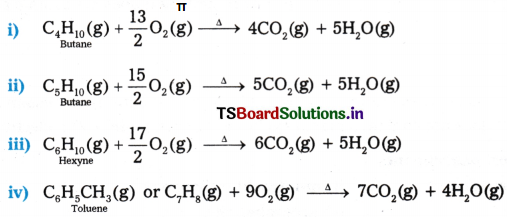
Write chemical equations for the combustion reaction of the following hydrocarbons.
i) Butane
ii) Pentene
iii) Hexyne
iv) Toluene
Answer:
Question 9.
Draw the cis and trans structures for hex-2-ene. Which isomer will have higher b.p and why?
Answer:
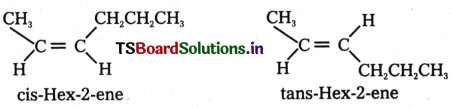
cis-Hex-2-ene have higher boiling than trans-Hex-2-ene because of the presence of stronger dipole-dipole interactions in cis-Hex-2-ene than trans-Hex-2-ene (alomost non-polar).
Question 10.
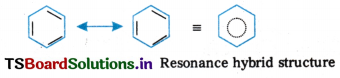
Why is benzene extraordinarily stable though it contains three double bonds ?
Answer:
Resonance or delocalization of electrons usually leads to stability. Since, in benzene all the six π-electrons of the three double bonds are completely delocalized between the six carbon atoms of the bezene ring. Therefore, it is extraordinarily stable.
Question 11.
What are the necessary conditions for any system to be aromatic ?
Answer:
The necessary conditions for a molecule to be aromatic are :
- It should be cyclic and planar.
- It should contain Huckel number of electrons, i.e., (4n + 2) p-electrons where n = 0, 1, 2, 3, …… etc.
Question 12.
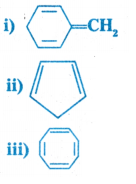
Explain why the following systems are not aromatic.
Answer:
i)
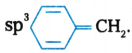
Since the presence of a sp3-hybridized carbon, therefore the system is not planar. It contains six π-electrons but the system is not fully conjugated as all the six π-electrons do not form a single cyclic electron cloud which surrounds all the atoms of the ring. Hence, it is not an aromatic compound.
ii)

Due to the presence of a sp3-carbon, the system is not planar. Hence, it contains only four π electrons, therefore, the system is not aromatic as if does not contain planar cyclic cloud having (4n + 2) π-electrons.
iii)

Cyclooctatetraene is not planar and contains 8π-electrons. Therefore, the system is not aromatic since it does not contain a planar cyclic cloud having (4n + 2)π electrons.
Question 13.
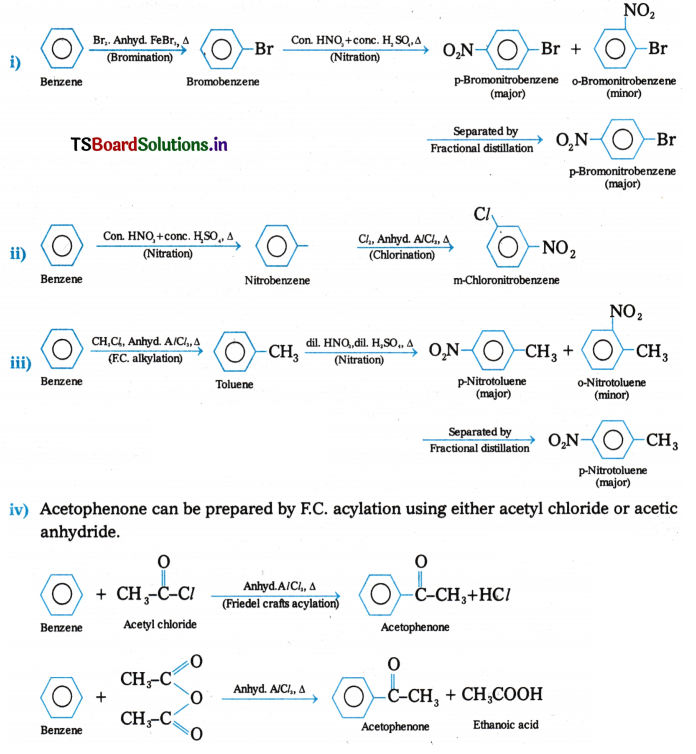
How will you convert benzene into
i) p-nitrobromobenzene
ii) m-nitrochlorobenzene
iii) p-nitrotoluene
iv) acetophenone
Answer:
Question 14.
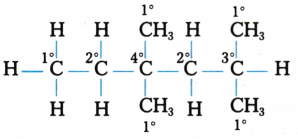
In the alkane, CH3CH2 – C(CH3)2 – CH2 – CH(CH3)2, identify 1°, 2°, 3° carbon atoms and give the number of H-atoms bonded to each one of these.
Answer:
The structural formula of the given compound is
Question 15.
What effect does branching of an alkane chain has on its boiling point ?
Answer:
As the branching increases, the surface area of an alkane decreases. Therefore, van der Waals forces of attraction are minimum and hence the boiling point of the alkane decreases with branching.
Question 16.
Addition of HBr to propene yields 2-bromopropane, while in presence of benzoyl peroxide, the same reaction yields 1-bromopropane. Explain and give mechanism.
Answer:
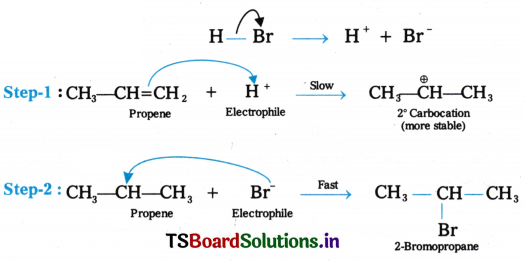
- Addition of HBr to propene is an electrophilic addition reaction in which the electrophile i.e., H+ first adds to give a more stable 2° carbocation.
- In the 2nd step, the carbocation is rapidly attacked by the nucleophile Br– ion to give
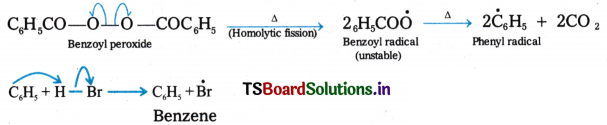
In the presence of benzoyl peroxide, the reaction is still electrophilic but the electrophile here is a Br free radical which is obtained by the action of benzoyl peroxide on HBr.
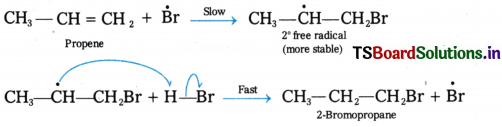
- In the first step, Br free radical adds to propene in such a way so as to generate a more stable 2° free radical.
- In the second step, the free radical thus obtained rapidly abstracts a hydrogen atom from HBr to give 1-bromopropane.
Question 17.
Write down the products of ozonolysis of 1, 2-dimethylbenzene (o-xylene). How does the result support Kekule structure for benzene ?
Answer:
The Kekule’s dynamic formula for benzene is well supported by the ozonolysis of dimethylbenzene (o-xylene) to get glyoxal, monomethyl glyoxal and dimethyl glyoxal in the ratio of 3 : 2 : 1.
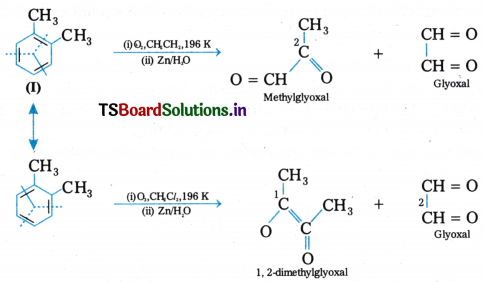
Since, all the three products cannot be obtained from any one of the two Kekule structure. This shows that o-xylene is a resonance hybrid of the two Kekule structures (I and II).
Question 18.
Arrange benzene, n-hexane and ethyne in decreasing order of acidic behaviour. Also give reason for this behaviour.
Answer:
- The hybridization state of carbon in the given compounds is


- The partial +ve charge on the H-atom increases and hence the acidic character increases as the s-character of the orbital increases. Thus, the acidic character decreases in the order: Ethyne > Benzene > Hexane.
Question 19.
Why does benzene undergo electrophilic substitution reactions easily and nucleophilic substitutions with difficulty ?
Answer:
Benzene contains three π bonds in conjugation. Due to the presence of π electron cloud lying above and below the plane of the aromatic ring, it is a rich source of electrons. Therefore, it attracts the electrophiles (i.e., electron seeking reagents) towards itself and repels nucleophiles (electron-rich reagents). As a result, benzene undergoes electrophilic reaction easily and nucleophilic with difficulty.
Question 20.
How would you convert the following compounds into benzene?
i) Ethyne
ii) Ethene
iii) Hexane
Answer:
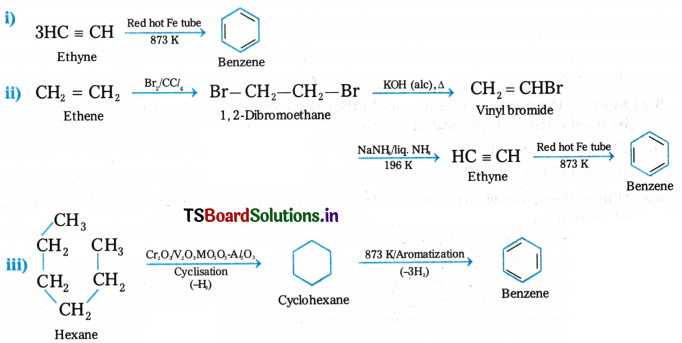
Question 21.
Write structures of all the alkenes which on hydrogenation give 2-methylbutane.
Answer:
The structural formula of 2-methylbutane is
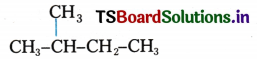
Putting double bonds at various different positions and satisfying the tetracovalency of each carbon atom; structures of various alkenes which give 2-methylbutane on hydrogenation are :

Question 22.
Arrange the following set of compounds in order of their decreasing relative reactivity with an electrophile, E+.
i) Chlorobenzene, 2, 4-dinitrochlorobenzene, p-nitrochlorobenzene.
ii) Toluene, p-H3C – C6H4 – NO2, p-O2N – C6H4 – NO2.
Answer:
i) Higher the electron density on the benzene ring, more reactive is the compound towards electrophilic substitution reactions. Since, NO2 is a more electron-withdrawing group than Cl, therefore, more the number of nitro groups, less reactive is the compound. Hence, the overall reactivity decreases in the order :
Chlorobenzene > p-nitrochlorobenzene > 2, 4-dinitrochlorobenzene.
ii) CH3 group is electron donating but NO2 group is electron-withdrawing. Therefore, the maximum electron-density will be in toluene, followed by p-nitrotoluene followed by p-dinitrobenzene. Hence, the overall reactivity decreases in the order,
Toluene > p-H3C – C6H4 – NO2 → p-O2N – C6H4 – NO2
Note : The basic difference between the Dumas and Kjeldahl’s method is that in Dumas method N2 is evolved and in Kjeldahl’s method NH3 is evolved.
Question 23.
Out of benzene, m-dinitrobenzene and toluene which will undergo nitration most easily and why ?
Answer:
CH3 group is electron-donating while -NO2 group is electron-withdrawing. Therefore, maximum electron density will be in toluene, followed by benzene and least in m-dinitrobenzene. Hence nitration decreases in the order : toluene > benzene > m- dinitrobenzene.
Question 24.
Suggest the name of a Lewis acid other than anhydrous aluminium chloride which can be used during ethylation of benzene.
Answer:
The Lewis acid catalysts other than anhydrous AlCl3 used during ethylation of benzene (Friedel crafts alkylation) is FeCl3, BF3, SnCl4 etc.
Question 25.
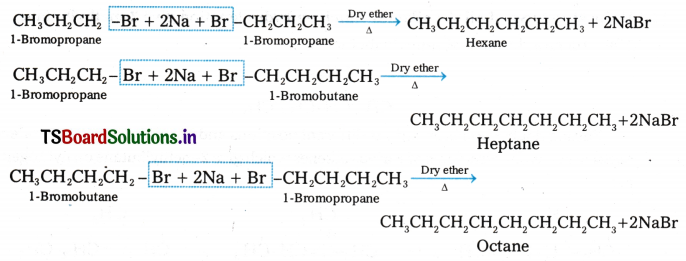
Why is Wurtz reaction not preferred for the preparation of alkanes containing odd number of carbon atoms ? Illustrate your answer by taking one example.
Answer:
- For preparation of alkanes containing odd number of carbon atoms, a mixture of two alkyl halides are taken.
- Since, two alkyl halides can react in three different ways, therefore, a mixture of three alkanes would be formed. For example, Wurtz reaction between 1-bromopropane and 1-bromobutane gives a mixture of three alkanes, i.e., hexane, heptane and octane as shown below: