
Regular practice with AP Inter 1st Year Chemistry Study Material Chapter 2 Structure of Atom Questions and Answers helps students stay prepared for examinations.
AP Inter 1st Year Chemistry 2nd Lesson Structure of Atom Questions and Answers
I. Multiple Choice Questions
Question 1.
Which of the following statements are correct about cathode rays ?
I. They move from cathode to anode.
II. These are visible rays.
III. Television picture tubes are cathode ray tubes.
IV. In the absence of electric or magnetic fieid, these rays travel in straight lines. Choose the most appropriate answer from the options given below.
1) I, II and III
2) II, III and IV
3) I, III and IV
4) I, II, III and IV
Answer:
Cathode rays
(I) Move from cathode to anode
(III) Television picture tubes are cathode ray tubes
(IV) In the absence of electrical and magnetic field they travel in straight lines
Question 2.
Increasing order for the values of e/m for electron (e), proton (p), neutron (n) and α – particles is
1) e < p < n < α
2) n < α < p < e
3) n < p < e < α
4) n < p < α < e
Solution:
e/m of electron (e) = 1.7588 × 10¹¹ coulomb / kg
e/m of proton (p) = 9.57 × 10⁴ coloumb / kg
e/m of neutron (n) = 0
e/m of α – particle (α) = 2/4 = 0.5
∴ n < α < p < e
Question 3.
Rutherford’s experiment on the scattering of a-particles showed for the first time that the atom has
1) Electrons
2) Protons
3) Nucleus
4) Neutrons
Answer:
According to Rutherford atom has nucleus.
Question 4.
Thomson’s model of the atom is also called
1) Plum pudding model
2) Raisin pudding model
3) Watermelon model
4) All of the above
Answer:
J.J.Thomson model is also called as Plum pudding (or) Raisin pudding (or) Watermelon model.
Question 5.
In photoelectric effect at which frequency electron will be ejected with certain kinetic energy υ0 = threshold frequency)
1) υ – υ0
2) υ0 > υ
3) υ0 > o
4) υ > υ0
Answer:
When the incident frequency (ν) is greater than the threshold frequency (ν0).
Electron will be ejected υ > υ0

Question 6.
A 600 Watt mercury lamp emits monochromatic radiation of wavelength 331.3 nm. How many photons are emitted from the lamp per second ? (h = 6.626 × 10⁻³⁴ Js, Velocity of light = 3 × 10⁸ H m/s)
1) 1 × 10¹⁹
2) 1 × 10²⁰
3) 1 × 10²¹
4) 1 × 10²³
Solution:
600 W = 600 J/sec
Energy emitted per second = 600 J
Energy of one photon = \(\frac{\mathrm{hc}}{\lambda}=\frac{6.626 \times 10^{-34} \mathrm{Js} \times 3 \times 10^8 \mathrm{~m} / \mathrm{s}}{313.3 \times 10^{-9} \mathrm{~m}}\) = 6.344 × 10⁻⁹ m
No.of protons emitted per second = \(\frac{600}{6.344 \times 10^{-19}}\) = 1 × 10²¹
Question 7.
Which of the following electronic transitions in the hydrogen atom will require highest energy ?
1) n = 4 to n = 5
2) n = 1 to n = 2
3) n = 3 to n = 5
4) n = 2 to n = 3
Answer:
Lower energy levels are closer to the nucleus so n 1 to n = 2 require highest energy.
Question 8.
The ratio of radii of second orbit of hydrogen atom to 4th orbit of He+ ion is
1) 1 : 4
2) 2 : 1
3) 1 : 2
4) 3 : 2
Solution:
Radius of 2nd orbit of hydrogen (rH) = \(\frac{\mathrm{n}_{\mathrm{H}}^2 \mathrm{a}_0}{\mathrm{Z}_{\mathrm{H}}}=\frac{2^2 \times \mathrm{a}_0}{1}\) = 4a0
Radius of 4th orbit of He+ ion (rHe+ ) = \(\frac{\mathrm{n}_{\mathrm{He}^{+}}^2 \mathrm{a}_0}{\mathrm{Z}_{\mathrm{He}^{+}}}=\frac{4^2 \times \mathrm{a}_0}{2}\) = 8a0
∴ \(\frac{\mathrm{r}_{\mathrm{H}}}{\mathrm{r}_{\mathrm{He}^{+}}}=\frac{4 \mathrm{a}_0}{8 \mathrm{a}_0}=\frac{1}{2}\)
Question 9.
The energies of an electron in first orbit of He+ and 3rd orbit of Li2+ in J are respectively
1) -8.72 × 10⁻¹⁸, -2.18 × 10⁻¹⁸ J
2) -8.72 × 10⁻¹⁸, -1.96 × 10⁻¹⁷J
3) -1.96 × 10⁻¹⁷, -2.18 × 10⁻¹⁸ J
4) -8.72 × 10¹⁷, -1.96 × 10⁻¹⁷J
Solution:
Energy of an electron in first orbit of He+
= – 2.18 × 10⁻¹⁸ \(\frac{\mathrm{Z}^2}{\mathrm{n}^2}\) J = – 2.18 × 10⁻¹⁸ \(\frac{2^2}{1^2}\) = – 8.72 × 10⁻¹⁸ J
Energy of an electron in 3rd orbit of Li+2
= -2.18 × 10⁻¹⁸ × \(\frac{\mathrm{Z}^2}{\mathrm{n}^2}\) = -2.18 × 10⁻¹⁸ × \(\frac{3^2}{3^2}\) = -2.18 × 10⁻¹⁸ J
Question 10.
The value of Rydberg constant is
1) 109777cm-1
2) 109977cm-1
3) 109677cm-1
4) 109277cm-1
Answer:
Value of Rydberg constant is 1,09,677 cm-1
Question 11.
The velocity of a particle A is 0.1 m/s and that of a particle B is 0.05 m/s. If the mass of the particle B is 5 times that of particle A. Then the ratio of de-Broglie wavelengths associated with the particles A and B is [ 4 ]
1) 2 : 5
2) 3 : 4
3) 6 : 4
4) 5 : 2
Solution:
de-Broglie’s equation λ = \(\frac{\mathrm{h}}{\mathrm{~m}}\)
Particle ‘A’
v1 = 0.1 m/s
m1 = M (say)
Particle ‘B’
v2 = 0.05 m/s
m2 = 5M
\(\frac{\lambda_A}{\lambda_B}=\frac{m_2 v_2}{m_1 v_1} \text { (or) } \frac{\left(m_B v_B\right)}{m_A v_A}==\frac{5 M \times 0.05}{M \times 0.1}=\frac{25}{10}=\frac{5}{2}\)
∴ Ratio of wavelengths = 5 : 2.
Question 12.
The number of radial nodes and angular nodes of a 4f orbital are respectively
1) 0, 3
2) 1, 2
3) 2, 1
4) 2, 0
Answer:
For 4f – orbital n = 4, l = 3
Radial nodes = n – l – l = 4 – 3 -1 = 0
Angular nodes = l = 3
Question 13.
Maximum number of electrons possible with spin quantum number +1/2 with principal quantum number n = 4 is
1) 16
2) 9
3) 4
4) 25
Solution:
Given S = +\(\frac{1}{2}\), n = 4
| 4s | 4p | 4d | 4f | |
| S = +\(\frac{1}{2}\) | 1 | 3 | 5 | 7 |
Total = 1 + 3 + 5 + 7 = 16
Question 14.
The wavelength of second line in the Lyman series of hydrogen atomic spectrum is (Rydberg constant = R cm-1)
1) \(\frac{8 \mathrm{R}}{9}\)
2) \(\frac{9}{8 \mathrm{R}}\)
3) \(\frac{4}{3 \mathrm{R}}\)
4) \(\frac{3 \mathrm{R}}{4}\)
Solution:
2nd line in the Lyman series, n1 = 1, n2 = 3 (For 2nd line)
Rydberg’s equation, \(\bar{v}=\frac{1}{\lambda}=R_H\left[\frac{1}{n_1^2}-\frac{1}{n_2^2}\right]=R\left[\frac{1}{1^2}-\frac{1}{3^2}\right]=R\left[\frac{8}{9}\right]\)
\(\frac{1}{\lambda}=\frac{8 \mathrm{R}}{9}\) ⇒ λ = \(\frac{9}{8 \mathrm{R}}\)
Question 15.
What is the correct orbital designation of an electron with the quantum numbers n = 4, l = 3, m = -2, s = +1/2?
1) 3s
2) 4f
3) 5p
4) 4d
Answer:
n = 4, l = 3, m = -2 and s = +1/2
Correct orbital is 4f become l = 3 → f-orbital
II. Fill in the Blanks
Question 1.
Splitting of spectral lines in a magnetic field is called _______.
Answer:
Splitting of spectral lines in presence of external magnetic field is called Zeeman effect.
Question 2.
Splitting of spectral lines in an electric field is called ________.
Answer:
Splitting of spectral lines in presence of electric field is called Stark effect.
Question 3.
The preference of three unpaired electrons in the nitrogen atom can explained by _______.
Answer:
Hund’s rule: No pairing of electrons takes place until each degenerate orbital singly occupied.
Eg : Nitrogen contains three unpaired electrons according to Hund’s Rule.
Question 4.
The electronic configuration of copper is ________.
Answer:
Electronic configuration of ‘Cu’ is [Ar] 4s13d10 (or) 1s22s22p63s23p64s13d10.
Question 5.
The electronic configuration of chromium is _______.
Answer:
Electronic configuration of ‘Cr’ is [Ar] 4s13d5 (or) 1s12s12p63s13p64s13d5
Question 6.
In potassium atom, the differentiating electrons enters into 4s orbital instead of 3d orbital. This is according to _______.
Answer:
Aufbau principle: Electrons filled in various orbitals in the order of increasing energy. Energy predicted by (n + l) value.
Lowest (n + l) value orbital filled first. For example 4s (4 + 0) si filled before 3d(3 + 2).
III. One Word Answer Questions
Question 1.
Define isotopes.
Answer:
Isotopes: Nuclides having same atomic number but with different mass number are called Isotopes. Eg : Isotopes of hydrogen 1H1, 1H2, 1H3.
Question 2.
Write the difference between orbit and orbital ?
Answer:
Orbit is a fixed circular path around the nucleus in which electron is revolving.
Orbital is a 3-dimensional space where the probability of finding the electron is maximum (95%).
Question 3.
How many nodal planes are present in d orbitals ?
Answer:
No.of nodal planes present in d-orbital = 2.
Question 4.
How many ‘p’ electrons are present in Sulphur atom ?
Answer:
Sulphur electronic configuration 1s22s22p63s23p4
Total no.of ‘P’ electrons = 6 + 4 = 10.
Question 5.
What are degenerate orbitals ?
Answer:
The orbitals with in the same substances having equal energy are called degenerate orbitals.
Eg: Px, Py, Pz
IV. Very Short Answer Questions
Question 1.
Calculate the charge of one mole of electrons.
Answer:
Change of 1 mole of electrons
= -1.602 × 10-19 × 6.022 × 1023
= 96500 coulombs = 1 Faraday
Question 2.
How many neutrons and electrons are present in the nuclei of \({ }_6^{12} \mathrm{C}\), \({ }_8^{18} \mathrm{O}\), \({ }_{12}^{24} \mathrm{Mg}\), \({ }_{26}^{56} \mathrm{Fe}\)
Answer:
| Nuclide | No.of electrons | No.of neutrons (A – Z) |
| 6C12 | 6 | 12 – 6 = 6 |
| 8O18 | 8 | 18 – 8 = 10 |
| 12Mg24 | 12 | 24 – 12 = 12 |
| 26Fe56 | 26 | 56 – 26 = 30 |
Question 3.
What is a black body ?
Answer:
Black body: The body which is perfect absorber and perfect emitter of all type of radiations incident on it is called a black body.
Question 4.
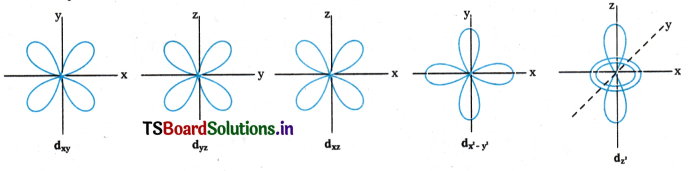
Draw the shapes of dz2 and dx2-y2 orbitals.
Answer:
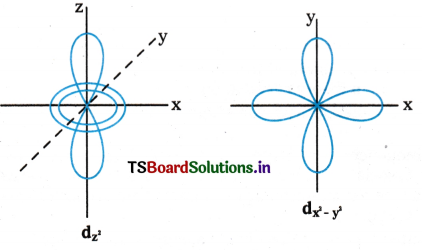
Question 5.
What is the frequency of radiation of wavelength 600 nm ?
Answer:
ν = \(\frac{c}{\lambda}=\frac{3 \times 10^8 \mathrm{~m} / \mathrm{s}}{600 \times 10^{-9} \mathrm{~m}}\) = 5 × 10¹⁴ sec-1
Question 6.
How many subshells are associated with n = 5?
Answer:
Five subshells are associated with n = 5.
5s, 5p, 5d, 5f and 5g
Question 7.
How many electrons in an atom may have if n = 4 and ms = +1/2?
Answer:
n = 4 and ms = +\(\frac{1}{2}\)
| 4s | 4p | 4q | 4f | |
| S = +\(\frac{1}{2}\) | 1 | 3 | 5 | 7 |
Total = 1 + 3 + 5 + 7 = 16
Question 8.
Explain Pauli’s exclusion principle.
Answer:
Pauli’s exclusion principle : “No two electrons in an atom can have the same set of four quantum numbers.”
This principle implies that “‘an orbital can accommodate a maximum of two electrons” with opposite spins ⇅.
Question 9.
What is Hund’s rule ?
Answer:
Hund’s rule : “Pairing up of electrons takes place only when all the available degenerate orbitals in a given sub-shell are filled with one electron each.”
Question 10.
What is Aufbau principle?
Answer:
In the ground state of the atoms,
“The orbitals are filled up with electrons in the increasing order of their energy.”
The relative order of energy of various orbitals is
Is < 2s < 2p < 3s < 3p < 4s < 3d < 4p < 5s < 4d < 5p < 6s < 4f
V. Short Answer Questions
Question 1.
Explain photoelectric effect.
Answer: Photoelectric effect : J.J. Thomson and P. Lenard showed that “when a beam of light of suitable wavelength is allowed to fall on the surface of a metal, the electrons are emitted from the surface of the metal”. This phenomenon is called, photoelectric effect.
Explanation of photoelectric effect by Einstein : Einstein (1905) explained photoelectric effect with the help of Planck’s quantum theory of radiation.
- According to quantum theory of radiation, a photon of light of frequency, ν is associated with energy equal to ho.
- When a photon of light of frequency ν (ν is higher than threshold frequency) falls on a metal, some of the energy associated with the photon is consumed to separate the electron from the surface and the remaining energy is imparted to the ejected electron, to give it certain velocity, say, equal to v.
- Due to this velocity, the emitted electron gains kinetic energy equal to 1/sup>.
- The proton of energy which is consumed to separate the electron is equal to the binding energy of the electron.
- This energy is called ‘threshold energy’ or ‘work function’ and is equal to the product of h and threshold frequency (υ0) of a photon of radiation falling on the metal surface.
- Thus this energy is equal to hυ0. This is the minimum energy associated with the photon (of frequency υ0) of the incident radiation which is consumed to separate one electron from the metal surface.
- The above discussion shows that hu is equal to the sum of 1/2mv2 (K.E. of one electron) and hυ2.
i.e., hυ = hυ2 + \(\frac{1}{2}\)mv2
Question 2.
Which of the following sets of quantum numbers are not possible ?
(a) n = 0; l = 0; ml = 0; ms = +\(\frac{1}{2}\)
(b) n = 1; l = 0; ml = 0; ms = – \(\frac{1}{2}\)
(c) n = 1; l = 1; ml = 0; ms = + \(\frac{1}{2}\)
(d) n = 2; l = 1; ml = 0; ms = + \(\frac{1}{2}\)
Answer:
a) n = 0, l = 0, ml = 0, ms = + \(\frac{1}{2}\) is not possible because n ≠ 0.
c) n = 1, l = 1, ml = 0, ms = + \(\frac{1}{2}\) is not possible because n ≠ 1.
Question 3.
What is a nodal plane ? How many nodal planes are possible for 2p and 3d orbitals?
Answer:
Nodal plane : The plane at which the probability of finding an electron is zero is called nodal plane.
Nodal planes for an orbital = 1 (azimuthal quantum)
Nodal planes for 2p orbital = 1
Nodal planes for 3d orbital = 2
Question 4.
Explain the difference between orbit and orbital.
Answer:
| Orbit | Orbital |
| 1. It is the circular path around the nucleus in which the electron revolves. | 1. It is the region of the space around the nucleus where the probability of finding the electron is maximum. |
| 2. It represents the planar motion of an electron. | 2. It represents the three dimensional motion of an electron. |
| 3. Orbits are non-directional. Hence they cannot explain the shape of molecules. | 3. Orbitals (except S – orbital) have directional character. Hence they can account for shapes of molecules. |
| 4. The maximum no. of electrons in an orbit is given by 2n2. | 4. An orbital can accommodate a maximum of 2 electrons with opposite spins. |
Question 5.
Show that the circumference of the Bohr orbit for the hydrogen atom is an integral multiple of the de Broglie wavelength associated with the electron revolving around the orbit.
Answer:
According to Bohr’s model mvr = \(\frac{\mathrm{nh}}{2 \pi}\) ⇒ 2πr = n \(\frac{\mathrm{h}}{\mathrm{mv}}\)
But = \(\frac{\mathrm{h}}{\mathrm{mv}}\) = λ
∴ 2 πr = nλ
So the circumference of the Bohr orbit (2πr) must be equal to an integral (n) multiple of the de-Broglie wavelength (λ).
VI. Long Answer Questions
Question 1.
Explain briefly the Planck’s quantum theory.
Answer:
Planck’s Quantum Theory :
- The emission of radiation is due to vibrations of charged particles (electrons) in the body.
- The emission of radiation is not continuous, but in discrete packets of energy called ‘quanta’. This emitted radiation propagates in the form of waves.
- The energy associated with each quantum (E) is given by E = hυ, where υ is the frequency of radiation and h is Planck’s constant (h = 6.63 × 10⁻²⁷ ergs)
- A body can emit or absorb either one quantum (hυ) of energy or some whole number multiples of it.
Success of Planck’s Quantum Theory : This theory successfully explains the black body radiations. A black body is a perfect absorber and also a perfect radiator of radiations. Explanation of Graph :
- The radiations emitted by a hot black body, when passed through a prism, produce a spectrum of different wavelengths.
- A graph of the ‘intensity of radiation’ against ‘wavelength’ gives a curve. Such curves obtained at different temperatures of a black body are shown in the graph.
The following conclusions can be drawn from a study of the shapes of the curves.
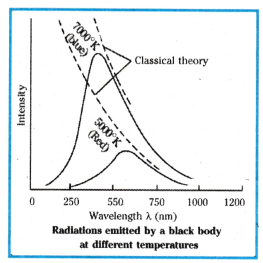
- At a given temperature, the intensity of radiation increases with wavelength, reaches a maximum and then decreases.
- As the temperature increases, the peak of the curve (maximum point on curve) shifts to lower wavelengths.
The ‘wave theory of light’ could not explain the above experimental results, satisfactorily.
Question 2.
What are the postulates of Bohr’s model of hydrogen atom ? Discuss the importance of this model to explain various series of line spectra in hydrogen atom.
Answer:
A) Postulates of Bohr’s theory :
1) Electrons revolve around the nucleus in certain, definite circular paths, called orbits. They are also known as energy levels or shells.
2) Each orbit is associated with a definite amount of energy. Hence these orbits are called energy orbits or energy levels or energy shells.
3) As the value of n increases, the size and energy of the orbit increases.
4) As long as the electrons revolve in the circular orbits, they neither emit nor absorb energy. Hence, these orbits are also called stationary orbits.
5) More than one stationary orbit is possible for any electron and the angular momentum of the revolving electron is quantized. That is, the electrons revolve in those circular orbits in which the angular momentum of the revolving electron is an integral multiple of h/2π.
This can be expressed as mvr = n × \(\frac{h}{2 \pi}\)
where, m = mass of the electron; v = velocity of the electron; r = radius of the orbit; h = Planck’s constant; n = Principal quantum number.
6) The energy of electron changes when the electron jumps from one orbit to another orbit. When the electron jumps from a lower orbit to a higher orbit, energy is absorbed. Similarly when the electron jumps from a higher orbit to a lower orbit, energy is emitted. The energy emitted or absorbed is given by the equation, ∆E = E2 – E1 = hv
where E1 = Energy of lower orbits; E2 = Energy of higher orbits;
∆E = Difference in energy; h = Planck’s constant; v = Frequency.
B) Explanation of formation of different lines in various series of Hydrogen atomic spectrum:
Hydrogen atom has only one electron and it revolves around the nucleus in the first orbit.
When certain amount of hydrogen gas containing a large number of electrons, is heated or exposed to light energy or is subjected to electric discharge, the different electrons absorb different amount of energy and get excited to different higher orbits.
But, they do not stay there for longer periods. Hence, they try to come back to lower orbits (deexcitation). This de-excitation need not necessarily be the same for all the atoms.
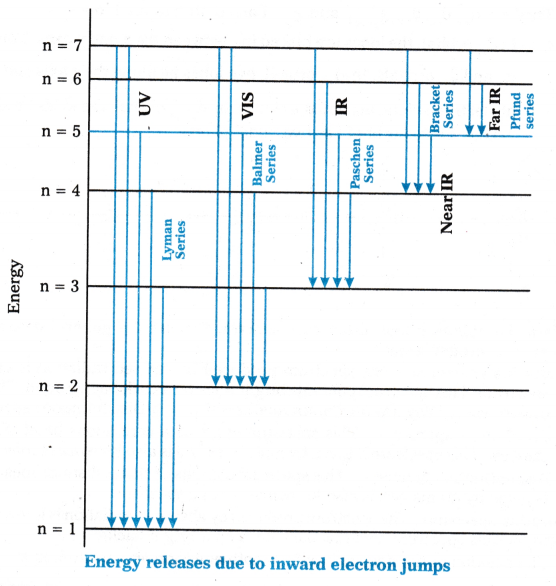
Some excited electrons may come back from any of the higher energy levels to lower energy level n = 1. Then Lyman series is formed in the U.V. region. Some excited electrons may come back from any of the higher energy levels to lower energy level n = 2. Then Balmer series is formed in the visible region.
Similarly, when the excited electron comes back, from any of the higher energy levels to lower levels 3, 4 & 5, we get Paschen, Brackett and Pfund series respectively in the I.R. region.
The de-excitation process from higher energy level to lower energy level also may take place in a single step or in different steps. For example, the de – excitation process of an electron from 4th energy level to 1st energy level can be as shown below.
Direct step : From 4th level to 1st (i.e.,) 4 → 1
Different steps : 4 → 3 → 2 → 1; 4 → 3 → 1; 4 → 2 → 1.
- For each electronic transition one line is formed in the spectrum.
- Thus we get a large number of lines in a given series.
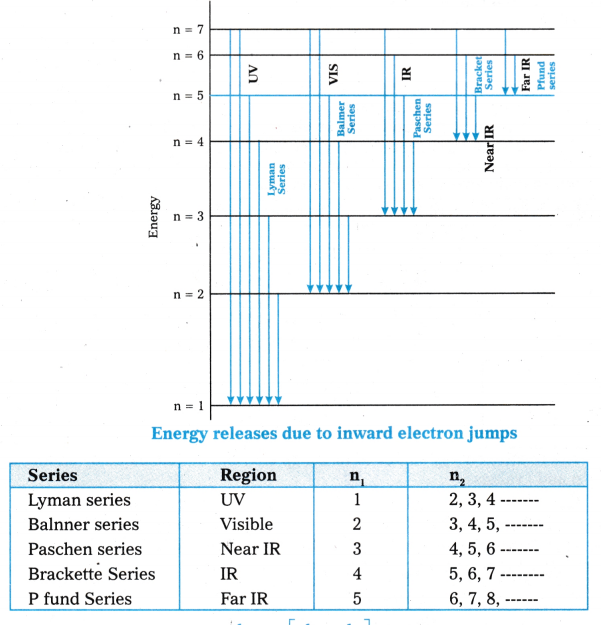
Rydberg’s equation is v = \(\frac{1}{\lambda}=\mathrm{R}_{\mathrm{H}}\left[\frac{1}{\mathrm{n}_1^2}-\frac{1}{\mathrm{n}_2^2}\right]\)
RH = Rydberg constant = 1,09,677 cm-1
Question 3.
How are quantum numbers n, l and m1 arrived at ? Explain the significance of these quantum numbers.
Answer:
To describe an electron completely four quantum numbers were predicted.
They are a) Principal quantum number (n)
b) Azimuthal quantum number (l)
c) Magnetic quantum number, (ml) and
d) Spin quantum number, (ms).
a) Principal Quantum Number :
- This was proposed by Neils Bohr.
- It is denoted by the letter ‘n’.
- It represents the circular orbits around the nucleus.
- As the value of n increases the size and energy of the orbit increases.
- According to number method n has the values 1, 2, 3, According to letter method ‘n’ can be represented by the letters K, L, M,
- In any orbit, the number of sub-orbits = n, number of orbitals = n2; number of electrons = 2n2.
- This Quantum number describes the size and energy of the orbit.
b) Azimuthal Quantum Number :
- This was proposed by Sommerfeld.
- It is also known as Angular momentum quantum number.
- It is denoted by the letter V.
- This quantum number represents the sub-levels present in the main levels.
- The sub-levels are s, p, d and f.
- The l values of s, p, d and f sub-levels are 0, 1, 2 and 3 respectively.
- The first main level contains only one sub-level and it is s. The second main level contains s, p sub – levels. The third main level contains s, p, d sub-levels. The fourth main level contains s, p, d and f sub-levels.
Main level Sub-levels Sub-sub-levels 1 s 1s 2 s 2s p 2p 3 s 3s p 3p d 3d 4 s 4s P 4p d 4d f 4f - The relative energy values of 1s, 2s, 2p etc., can be calculated by adding up their n and l values.
Eg : 1. Energy value of 1s = 1 + 0 = 1
2. Energy value of 2p = 2 + 1 = 3
3. Energy value of 3d = 3 + 2 = 5
4. Energy value of 4f =4 + 3 = 7 - This Quantum number describes the shape of the orbital.
| Sub-level | Shape |
| s | spherical |
| P | dumb-bell |
| d | double dumb-bell |
| f | four fold dumb-bell |
c) Magnetic Quantum Number :
- This was proposed by Lande.
- It is denoted by the letter’m’.
- This quantum number describes the sub – sub levels or orbitals present in a given sub level.
- ‘m’ has values from – l to +l through ‘0’.
- The total number of ‘m’ values for a given value of ‘l’ is (2l + l).
- All the orbitals present in a given sub-level possesses the same energy values, because they possess the same n and l values.
- This quantum number describes the orientation of the orbitals in space,
d) Spin Quantum Number : .
- It was proposed by Uhlenbeck and Goudsmit.
- It is denoted by ms.
- This quantum number describes the spin of the revolving electron.
- ’ms‘ value of clockwise electron is +1/2 and that of anticlockwise electron is -1/2.
- Clockwise revolving electron is represented by + 1/2 and anticlockwise revolving electron is represented by -1/2.
- This quantum number describes the direction of spin of the revolving electron.
Question 4.
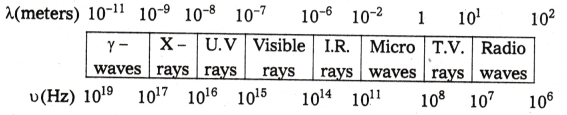
What are various ranges of electromagnetic radiation ? Explain the characteristics of electromagnetic radiation.
Answer:
- According to Maxwell, “electromagnetic radiation”, is made up of electromagnetic waves.
- An electromagnetic, wave propagating through space is a combination of two components, one is varying electric field and the other is varying magnetic field.
- These two fields are perpendicular to each other and are also perpendicular to the direction of propagation of wave.
Characteristics of electromagnetic radiations :
1) These are produced by oscillating charged particles in a body.
2) The radiations can pass through vacuum also. So medium for transmission is not required.
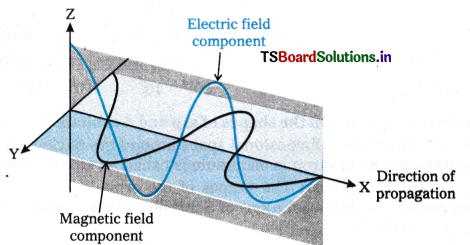
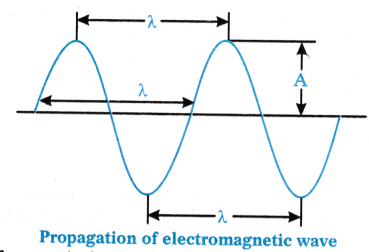
The Electric and Magnetic filed components of an electromagnetic wave. These components have the same wavelength, frequency, speed and amplitude, but they vibrate in two mutually perpendicular planes.
3) The wavelength (λ) is the distance between two neighbouring crests or troughs of the wave. Unit for λ is cm, m, nm, Å.
4) Frequency of the wave (υ) is the number of waves which cross a particular point in one second.
υ = \(\frac{\text { velocity }}{\text { wavelength }}=\frac{c}{\lambda}\)
Unit of frequency is cycles per sec (cps) or hertz (Hz). 1 Hz = 1 cps).
The frequency is inversely proportional to its wavelength, υ ∝ \(\frac{1}{\lambda}\)
5) Velocity (c) of a wave is the distance travelled by the wave in one second.
Velocity = wavelength x frequency ⇒ c = λ x υ.
Velocity of all electromagnetic radiations in space or in vacuum is the same and is equal to 3 ×, 1010 cm/s.
6) Wave number (\(\bar{v}\)) is the number of wavelengths per centimeter. It is reciprocal of wavelength.
\(\bar{v}\) = \(\frac{1}{\lambda}\); Unit of \(\bar{v}\) is cm-1.
7) Amplitude (A) is the height of the crest or depth of the trough of a wave. It determines the intensity or brightness of the light.
8) Electromagnetic spectrum is the spectrum which shows the wavelengths or frequencies or wave numbers of various regions of electromagnetic radiations.
Question 5.
Define atomic orbital. Explain the shapes of s, p and d orbitals with the help of diagram.
Answer:
Atomic orbital: The three – dimensional space around the nucleus in an atom where the probability of finding an electron is maximum is called an atomic orbital.
Shapes of s, p and d orbitals : The shapes of the orbitals are the ‘angular distribution curves’, obtained as one of the solutions of Schrodinger wave equation.
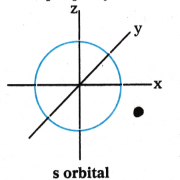
1) Shape of s – orbital:
- s orbital is spherical in shape.
- As the value of principal quantum number increases, size of s orbital increases.
Thus, sizes are : 1s < 2s < 3s …….. - ‘s’ orbital has no directional property.
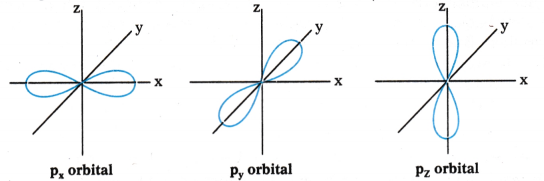
2) Shape of p-orbital: Shape of p-orbital is dumb-bell. There are three p – orbitals. They are px, py and pz orbitals. Each orbital has two lobes. These lobes are oriented along their respective axes. Each p-orbital has one nodal plane.
3) Shape of d – orbital: d – orbital has double dumb-bell shape. There are five d – orbitals. They are dxy, dyz, dxz, dx2-y2 and dz2. Each d orbital has 4 lobes.
In dxy orbital, the lobes are placed in – between the x and y axes. This is similar for dyz and dxz orbitals. In dz2 orbital, two lobes lie along the z axis and there is a ring of electron – cloud around the centre. In dx2-y2 orbitals, the lobes lie along the x and y-axes. Each d orbital has two nodal planes.
Question 6.
Explain the emission and absorption spectra. Discuss the general description of line spectra in hydrogen atom.
Answer:
1) Emission spectrum : The spectrum produced by emitted radiation is called emission spectrum. This spectrum contains bright lines on a dark background. This spectrum is of two types. They are (a) Continuous spectrum (b) Discontinuous spectrum.
a) Continuous spectrum : This spectrum contains a continuous band of colours like a rainbow This spectrum is given by molecules and is also known as Molecular spectrum.
b) Discontinuous spectrum: This spectrum consists of sharp, distinct lines. This spectrum is given by atoms and is also known as atomic spectrum.
2) Absorption spectrum: The spectrum produced by absorbed radiation is known as absorption spectrum. This spectrum contains dark lines on a bright background.
The position of the lines or bands in both emission and absorption spectra is same.
Explanation of formation of different lines in various series of Hydrogen atomic spectrum : Hydrogen atom has only one electron and it revolves around the nucleus in the first orbit.
When certain amount of hydrogen gas containing a large number of electrons, is heated or exposed to light energy or is subjected to electric discharge, the different electrons absorb different amounts of energy and get excited to different higher orbits. But, they do not stay there for longer periods. Hence, they try to come back to lower orbits (de-excitation). This de-excitation need not necessarily be the same for all the atoms.
Some excited electrons may come back from any of the higher energy levels to lower energy level n = 1. Then Lyman series is formed in the U.V. region. Some excited electrons may come back from any of the higher energy levels to lower energy level n = 2.
Then Balmer series is formed in the visible region. Similarly, when the excited electron comes back, from any of the higher energy levels to lower levels 3, 4 & 5, we get Paschen, Brackett and Pfund series respectively in the I.R. region.
The de-excitation process from higher energy level to lower energy level also may take place in a single step or in different steps. For example, the de – excitation process of an electron from 4th energy level to 1st energy level can be as shown below.
Direct step : From 4th level to 1st (i.e.,) 4 → 1
Different steps :4 → 3→ 2 → 1; 4 → 3 → 1; 4 → 2 → 1.
For each electronic transition one line is formed in the spectrum. Thus we get a large number of lines in a given series.
Question 7.
Write the postulates and limitations of Bohr’s model of an atom.
Answer:
A) Postulates of Bohr’s theory : .
1) Electrons revolve around the nucleus in certain, definite circular paths, called orbits. They are also known as energy levels or shells.
2) Each orbit is associated with a definite amount of energy. Hence these orbits are called energy orbits or energy levels or energy shells.
3) As the value of n increases, the size and energy of the orbit increases.
4) As long as the electrons revolve in the circular orbits, they neither emit nor absorb energy. Hence, these orbits are also called stationary orbits.
5) More than one stationary orbit is possible for any electron and the angular momentum of the revolving electron is quantized. That is, the electrons revolve in those circular orbits in which the angular momentum of the revolving electron is an integral multiple of h/2π.
This can be expressed as mvr = n × \(\frac{\mathrm{h}}{2 \pi}\)
where m = Mass of the electron; v = Velocity of the electron; r = Radius of the orbit; h = Planck’s constant; n = Principal quantum number.
6) The energy of electron changes when the electron jumps from one orbit to another orbit. When the electron jumps from a lower orbit to a higher orbit, energy is absorbed. Similarly when the electron jumps from a higher orbit to a lower orbit, energy is emitted. The energy emitted or absorbed is given by the equation,
∆E = E2 – E1 = hυ
where E1 = Energy of lower orbit; E2 = Energy of higher orbit;
∆E = Difference in energy; h = Planck’s constant; υ – Frequency.
B) Limitations of Bohr’s Theory :
Bohr’s model of atom could explain the
- Stability of atom
- The line spectrum of hydrogen atom and ions with a single electron (He+, Li2+, Be3+ ….) But this model could not explain the following observations.
- Bohr’s model cannot explain the spectra of atoms or ions having more than one electron.
- When the spectrum of hydrogen was taken with a spectroscope of high resolving power, it was observed that each line is actually ‘a group of fine lines’. Bohr’s model cannot explain this fine structure in the atomic spectra.
- It cannot explain Zeeman effect (splitting of spectral lines in the presence of magnetic field) and stark effect (splitting of spectral lines in an electric field).
- And also it cannot explain the ability of atoms to form molecules by chemical bonds.
- It failed to explain the dual nature of electrons and also the geometry and shapes of molecules.
Question 8.
What are the consequences that lead to the development of quantum mechanical model of an atom ?
Answer:
The quantum mechanical model of the atom arised due to the limitations of previous atomic models like Bohr’s atomic model and it introduction of new concepts like wave particle duality and the uncertainty principle.
The failure of classical mechanics to explain atomic behaviour leads to the formation of quantum mechanical model.
The development of the schrodinger’s equation had more accurate and probabilistic explanation of electron behaviour in atoms.
Quantum mechanical model of an atom explains the motion of very minute particles which possess both particle and wave nature. Schrodinger’s equation applies to these type of particles and it is given by
\(\frac{\partial^2 \psi}{\partial \mathbf{x}^2}+\frac{\partial^2 \psi}{\partial \mathbf{y}^2}+\frac{\partial^2 \psi}{\partial \mathbf{z}^2}+\frac{8 \pi^2 \mathbf{m}}{\mathbf{h}^2}(\mathrm{E}-\mathrm{V}) \psi\) = 0
Salient features of the quantum mechanical model of atom :
1) The energy of an electron in an atom is quantised. It means, the electron can have only certain values of energy.
2) The energy levels in an atom are quantised, which are the allowed solutions of Schrodinger wave equation, applied for electron wave.
3) All the information about the orbiting electron in an atom is contained in the orbital wave function, Ψ.
4) The exact path of an electron cannot be determined accurately. We can only find the probability of the electron at different points in an atom.
5) Ψ2 is the probability density, which is always positive. From the value of Ψ2, at different points within the atom, it is possible to find the ‘orbital’ an of electron.
Orbital is the three-dimensional space around the nucleus of an atom, where there is high probability of finding the electron.
Question 9.
Explain the following
a) de Broglie’s concept
b) Heisenberg’s uncertainty principle
Answer:
a) de-Broglie’s concept:
de-Broglie’s hypothesis : The light is found to exhibit wave nature as well as particle nature (dual nature).
Based on this idea of ‘dual nature of light’, de Broglie in 1924 proposed that “all micro- particles including the electron moving with high velocity are associated with dual nature (i.e.,) both particle and wave nature.
De-broglie derived an expression for the wavelength of the moving electron.
Expression for de-Broglie wavelengths :
According to ‘Planck’s quåntum theory’, energy of a photon,
E = hυ ; But υ = \(\frac{c}{\lambda}\)
∴ E = h.\(\frac{c}{\lambda}\) ……… (1)
Einstein’s mass-energy equivalence equation is E = mc2 ………….. (2)
combining eqns. (1) and (2),
\(\frac{\mathrm{h} \cdot \mathrm{c}}{\lambda}\) = mc2 or λ = \(\frac{\mathrm{h}}{\mathrm{mc}}\) = \(\frac{\mathrm{h}}{\mathrm{p}}\) (p = mc = momentum)
(p = mc = momentum)
This equation is applicable to photons as well as to all microparticles, moving with high speed.
∴ We can write in general, λ = \(\frac{\mathrm{h}}{\mathrm{p}}\) = \(\frac{\mathrm{h}}{\mathrm{mv}}\)
where m = mass of the microparticle and v = its velocity
‘λ’ is called, de-Broglie wavelength or material wavelength.
Significance Of de-Broglie’s concept :
- According to Bohr’s theory, electron revolves in an orbit in which its angular momentum (mvr) is an integral multiple Of Bohr assumed electron as a particle. Hence his equation can be taken as mvr = n\(\left(\frac{\mathrm{h}}{2 \pi}\right)\) where n = a whole number.
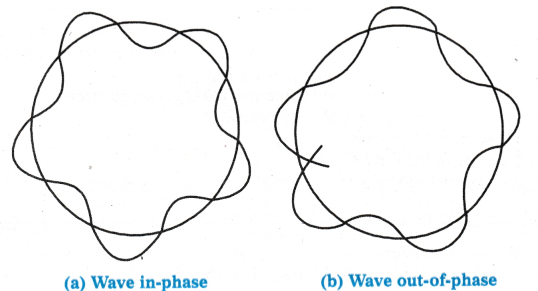
- According to de Broglie, electron behaves as a standing (or stationary) wave which extends round the nucleus in a circular orbit.
- If the ends of the electron wave meet to give a regular series of crests and troughs, the electron-wave is said to be ‘in phase’.
- It means, there is constructive interference of electron waves and the electron motion has a character of standing wave or non-energy radiating motion.
- Always it is a necessary condition to get an electron-wave in phase’ such that the circumference of the Bohr’s orbit (= 2πr) is equal to the whole number multiples of the wave-length (l) of the electron-wave.
nλ = 2πr ⇒ λ = \(\frac{2 \pi \mathrm{r}}{\mathrm{n}}\)
But λ = \(\frac{\mathrm{h}}{\mathrm{mv}}\)
∴ \(\frac{2 \pi \mathrm{r}}{\mathrm{n}}=\frac{\mathrm{h}}{\mathrm{mv}}\) or mvr = \(\frac{\mathrm{nh}}{2 \pi}\)
This is Bohr’s equation which stipulates that “the angular momentum of an electron moving around the nucleus is an integral multiple of \(\frac{\mathrm{h}}{2 \pi}\)“. This shows that, de-Broglie’s theory and Bohr’s theory are in agreement with each other.
b) Heisenberg’s uncertainty principle: “It is not possible to determine simultaneously and accurately both the position and momentum (or velocity) of a microscopic moving particle like electron, proton etc.”
Mathematically it can be expressed as, ∆x × ∆p ≥ \(\frac{\mathrm{h}}{4 \pi}\)
where ∆x = Uncertainty involved in the position
∆p = Uncertainty in momentum and h = Planck’s constant.
Significance of uncertainty principle :
- This principle applies for motion of microscopic objects and not so for macroscopic objects.
- For massive bodies, the uncertainties have no practical importance.
- According to this principle microscopic bodies like electrons cannot have fixed paths of motion.
Structure of Atom Class 11 NCERT Solutions
Question 1.
i) Calculate the number of electrons which will together weigh one gram.
ii) Calculate the mass and charge of one mole of electrons.
Answer:
i) ∵ Mass of one electron = 9.11 × 10⁻³¹ kg
∴ Number of electrons weighing together one gram (10-3 kg) will be
= \(\frac{1}{9.11 \times 10^{-31}}\) × 10-3 = 1.098 × 1027electrons
ii) ∵ Mass of one electron = 9.1 × 10⁻³¹ kg
∴ Mass of one mole of electrons = (9.1 × 10-31) × (6.022 × 1023) = 5.486 × 10⁻⁷ kg
∵ Charge of one electron = 1.602 × 10⁻¹⁹ C
∴ Charge of one mole of electrons = (1.602 × 10-19) × (6.022 × 1023) = 9.65 × 10⁴ C.
Question 2.
Calculate the total number of electrons present in one mole of methane.
Find (a) the total number and (b) the total mass of neutrons in 7 mg of l4C. (Assume that mass of a neutron = 1.675 × 10⁻²⁷ kg).
iii) Find (a) the total number and (b) the total mass of protons in 34 mg of NH„ at STP. Will the answer change if the temperature and pressure are changed ?
Answer:
∵ 1 molecule of methane contains 10 electrons.
∴ 6.022 × 10²³ molecules will contain = 6.022 × 1024 electrons
Hence, 1 mole of CH4 = 6.022 × 1024 electrons.
ii) a) 1 g atom of 14C = 14 g
1 g atom of 14C = 6.023 × 10²³ atoms
∴ 14 g or 14000 mg of 14C have 6.023 × 1023 × 8 neutrons
⇒ 7 mg of 14C will have \(\frac{8 \times 6.023 \times 10^{23}}{14000}\) × 7 = 2.409 × 10²¹ neutrons.
b) Mass of 1 neutron = 1.675 × 10⁻²⁷ kg
∴ Mass of 2.409 × 10²¹ neutrons = 4.035 × 10⁻⁶ kg.
iii) a) 1 g molecule of NH3 = 17 g
1 molecule of NH3 contains 10 protons.
17 g NH3 contains 6.022 × 1023 × 10 protons
∴ 0.034 g NH3 contains = \(\frac{6.022 \times 10^{24}}{17}\) × 0.034 = 1.2044 × 10²² protons.
Mass of 1 proton = 1.6726 × 10⁻²⁷ kg
∴ Mass of 1.2044 × 10²² protons = 2.0145 × 10⁻⁵ kg
No, there will be no effect, if temperature and pressure is changed.
Question 3.
How many neutrons and protons are there in the following nuclei ?
\({ }_6^{13} \mathrm{C},{ }_8^{16} \mathrm{O},{ }_{12}^{24} \mathrm{Mg},{ }_{26}^{56} \mathrm{Fe},{ }_{38}^{88} \mathrm{Sr}\)
Answer:
Number of protons and neutrons in the following nuclei are as follows.
\({ }_6^{13} \mathrm{C}\) ; Number of protons = 6 ; Number of neutrons = 13 – 6 = 7.
\({ }_8^{16} \mathrm{O}\) ; Number of protons = 8 ; Number of neutrons = 16 – 8 = 8.
\({ }_{12}^{24} \mathrm{Mg}\) ; Number of protons = 12 ; Number of neutrons = 24 – 12 = 12.
\({ }_{26}^{56} \mathrm{Fe}\) ; Number of protons = 26 ; Number of neutrons = 56 – 26 = 30.
\({ }_{38}^{88} \mathrm{Sr}\) ; Number of protons = 38 ; Number of neutrons = 88 – 38 = 50.
Question 4.
Write the complete symbol for the atom with the given atomic number (Z) and atomic mass (A),
i) Z = 17, A = 35
ii) Z = 92, A = 233
iii) Z = 4, A = 9
Answer:
i) \({ }_17^{35} \mathrm{Cl}\)
ii) \({ }_92^{233} \mathrm{U}\)
iii) \({ }_4^{9} \mathrm{Be}\)
Question 5.
Yellow light emitted from a sodium lamp has a wavelength (λ) of 580 nm. Calculate the frequency (ν) and wavenumber (\(\bar{v}\)) of the yellow light.
Answer:
Given, λ = 580 nm = 580 × 10-9 m; c = 3.0 × 10⁸ ms-1
∵ Frequency ν = \(\frac{c}{\lambda}\) ⇒ = \(\frac{3 \times 10^8 \mathrm{~ms}^{-1}}{580 \times 10^{-9} \mathrm{~m}}\) = 5.17 × 10¹⁴ s-1
∴ Wave number \(\bar{v}\) = \(\frac{1}{\lambda}\) ⇒ \(\bar{v}\) = \(\frac{3 \times 10^8 \mathrm{~ms}^{-1}}{580 \times 10^{-9} \mathrm{~m}}\) = 1.72 × 10⁶ m-1
Question 6.
Find energy of each of the photons which
i) correspond to light of frequency 3 × 10¹⁵ Hz.
ii) have the wavelength 0.50 Å.
Answer:
i) ν = 3 × 10¹⁵ Hz
∵ Energy of photon (E) = hv
∴ E = 6.626 × 10-34 Js × 3 × 1015 s-1 = 1.988 × 10⁻¹⁸ J
ii) λ = 0.50 Å = 0.50 × 10⁻¹⁰ m
∵ E = hν = h\(\frac{c}{\lambda}\) ⇒ E = \(\frac{6.626 \times 10^{-34} \mathrm{Js} \times 3 \times 10^8 \mathrm{~ms}^{-1}}{0.50 \times 10^{-10} \mathrm{~m}}\) = 3.98 × 10⁻¹⁵ J
Question 7.
Calculate the wavelength, frequency and wavenumber of a light wave whose period is 2.0 × 10⁻¹⁰ s.
Answer:
Given, Time = 2.0 × 10⁻¹⁰s
Frequency (ν) = \(\frac{1}{\mathrm{~T}}=\frac{1}{2.0 \times 10^{-10} \mathrm{~s}}\) = 5 × 10⁹ s-1
Wavelength (λ) = \(\frac{c}{v}=\frac{3 \times 10^8 \mathrm{~ms}^{-1}}{5 \times 10^9 \mathrm{~s}^{-1}}\) = 6.0 × 10⁻² m
Wavenumber (\(\bar{v}\)) = \(\frac{c}{v}=\frac{3 \times 10^8 \mathrm{~ms}^{-1}}{5 \times 10^9 \mathrm{~s}^{-1}}\) = 16.66 m-1
Question 8.
What is the number of photons of light with a wavelength of 4000 pm that provide 1 J of energy ?
Answer:
Given, λ = 4000 pm = 4 × 10⁻⁹ m
E = Nhν ⇒ E = Nh\(\frac{c}{\lambda}\) ⇒ N = \(\frac{\mathrm{E} \lambda}{\mathrm{hc}}\)
N = \(\frac{1 \times 4 \times 10^{-9}}{6.626 \times 10^{-34} \times 3 \times 10^8}\) = 2.012 × 10¹⁶ photons.
Question 9.
A photon of wavelength 4 × 10⁻⁷ m strikes on metal surface, the work function of the metal being 2.13 eV. Calculate (i) the energy of the photon (eV), (ii) the kinetic energy of the emission, and (iii) the velocity of the photo electron (1 eV = 1.6020 × 10⁻¹⁹ J).
Answer:
Given, λ = 4 × 10⁻⁷ m, hν0 = 2.13 eV
i) As we know that, Energy (E) = hν = \(\frac{\mathrm{hc}}{\lambda}\) ⇒ E = \(\frac{6.626 \times 10^{-34} \times 3 \times 10^8}{4 \times 10^{-7}}\) = 4.97 × 10⁻¹⁹ J
1 eV = 1.602 × 10⁻¹⁹ J
∴ 4.97 × 10⁻¹⁹ J = \(\frac{4.97 \times 10^{-19}}{1.602 \times 10^{-19}}\) eV = 3.10 eV
ii) Kinetic energy of emission = \(\frac{1}{2}\) mν2 = hν – hν0 = 3.10 – 2.13 =
iii) ∵ \(\frac{1}{2}\) mν2 = 0.97 eV
⇒ \(\frac{1}{2}\) × (9.11 × 10⁻³¹) × ν2 = 0.97 × 1.602 × 10-19
⇒ ν2 = 34.1 × 10¹⁰ ⇒ ν = 5.84 × 10⁵ ms-1
Question 10.
Electromagnetic radiation of wavelength 242 nm is just sufficient to ionise the sodium atom. Calculate the ionisation energy of sodium in kJ mol-1.
Answer:
λ = 242 nm = 242 × 10-9 m
E = Nhν ⇒ E = Nh\(\frac{c}{\lambda}\)
E = \(\frac{6.02 \times 10^{23} \times 6.626 \times 10^{-34} \times 3 \times 10^8}{242 \times 10^{-9}}\)
= 4.945 × 10⁵ J mol-1 = 494.5 kJ mol-1
Question 11.
A 25 watt bulb emits monochromatic yellow light of wavelength of 0.57 μm. Calculate the ratio of emission of quanta per second.
Answer:
λ = 0.57 μm = 0.57 × 10⁻⁶ m; Energy emitted by bulb = 25 Js<sup-1 = 25 W
Energy of one photon is given as, E = \(\frac{hc}{\lambda}\) ⇒ E = \(\frac{6.626 \times 10^{-34} \times 3 \times 10^8}{0.57 \times 10^{-6}}\) = 3.49 × 10⁻¹⁹ J
Rate of emission of quanta per second = \(\frac{25 \mathrm{Js}^{-1}}{3.49 \times 10^{-19} \mathrm{~J}}\) = 7.18 × 10⁻¹⁹ s-1
Question 12.
Electrons are emitted with zero velocity from a metal surface when it is exposed to radiation of wavelength 6800 Å. Calculate threshold frequency (ν0) and work function (W0) of the metal.
Answer:
λ0 = 6800 Å = 6800 × 10-10
c = νλ ⇒ ν0 = \(\) = 4.41 × 10¹⁴ s-1
Work function (W0) = hν0 = 6.626 × 10-34 × 4.41 × 1014 = 2.92 × 10⁻¹⁹ J
Question 13.
What is the wavelength of light emitted when the electron in a hydrogen atom undergoes transition from an energy level with n = 4 to an energy level with n = 2 ?
Answer:
Given, n1 = 2, n2 = 4
Wave No. (\(\bar{v}\)) = R\(\left[\frac{1}{\mathrm{n}_1^2}-\frac{1}{\mathrm{n}_2^2}\right]\)
\(\bar{v}\) = 109677 \(\left[\frac{1}{(2)^2}-\frac{1}{(4)^2}\right]\)
\(\bar{v}\) = 109677 \(\left[\frac{3}{16}\right]\) ⇒ \(\bar{v}\) = 20564.44 cm-1
∴ λ = \(\frac{1}{\bar{v}}\) = \(\frac{1}{20564.44}\) = 4.86 × 10⁻⁵ cm = 486 × 10-7 cm
∴ λ = 486 nm [1 nm = 10-7 cm]
Question 14.
How much energy is required to ionise a H-atom if the electron occupies n = 5 orbit ? Compare your answer with the ionization enthalpy of H-atom (energy required to remove the electron from n = 1 orbit).
Answer:
Given, change in energy ∆E = E2 – E1 ⇒ ∆E = 2.18 × 10⁻¹⁸ \(\left[\frac{1}{\mathrm{n}_1^2}-\frac{1}{\mathrm{n}_2^2}\right]\) J atom-1
If n1 = 5 and n2 = ∞, then ∆E = 2.18 × 10⁻¹⁸\(\left[\frac{1}{(5)^2}-\frac{1}{(\infty)^2}\right]\) = 0.0872 × 10⁻¹⁸ J
If n1 = 1 and n2 = ∞, then ∆E = 2.18 × 10⁻¹⁸ \(\left[\frac{1}{(1)^2}-\frac{1}{(\infty)^2}\right]\) = 2.18 × 10⁻¹⁸ J
Now, \(\frac{\Delta \mathrm{E}^{\prime}}{\Delta \mathrm{E}}=\frac{2.18 \times 10^{-18}}{0.0872 \times 10^{-18}}\) = 25
Hence, the ionisation enthalpy required to remove electron from n = 1 orbit is 25 times the energy required to remove electron from n = 5 orbit.
Question 15.
What is the maximum number of emission lines when the excited electron of a H atom in n = 6 drops to the ground state ?
Answer:
The maximum number of emission lines obtained on dropping electrons from n = 6 to ground state will be equal to
\(\frac{\mathrm{n}(\mathrm{n}-1)}{2}\) = \(\frac{6(6-1)}{2}\) = \(\frac{6 \times 5}{2}\) = 15
Question 16.
i) The energy associated with the first orbit in the hydrogen atom is -2.18 × 10⁻¹⁸ J atom-1. What is the energy associated with the fifth orbit ?
ii) Calculate the radius of Bohr’s fifth orbit for hydrogen atom.
Answer:
i) E1 = -2.18 × 10⁻¹⁸ J atom-1
∴ E5 = \(\frac{-2.18 \times 10^{-18}}{\mathrm{n}^2}=\frac{-2.18 \times 10^{-18} \mathrm{~J}}{5^2}\) = -8.72 × 10⁻²⁰ J
ii) Bohr radius(rn) = 0.529 × n2 Å
r5 = 0.529 × 52 = 13.23 Å = 1.323 nm
Question 17.
Calculate the wavenumber for the longest wavelength transition in the Balmer series of atomic hydrogen.
Answer:
For Balmer series, \(\bar{v}\) = R\(\left[\frac{1}{\mathrm{n}_1^2}-\frac{1}{\mathrm{n}_2^2}\right]\)
For longest wavelength transition, \(\bar{v}\) should be minimum, i.e., n2 = 3
∴ \(\bar{v}\) = 1.09677 × 10⁷ \(\left[\frac{1}{2^2}-\frac{1}{3^2}\right]\) = 1.09677 × 10⁷ \(\left[\frac{5}{36}\right]\)
= 1.524 × 10⁶ m-1
Question 18.
What is the energy in joules, required to shift the electron of the hydrogen atom from the First Bohr orbit to the fifth Bohr orbit and what is the wavelength of the light emitted when the electron returns to the ground state ? The ground state electron energy is -2.18 × 10⁻¹¹ erg?
Answer:
E0 = -2.18 × 10⁻¹¹ erg, n1 = 1, n2 = 5
∆E = E5 – E1 = 2.18 × 10⁻¹¹ \(\left[\frac{1}{1^2}-\frac{1}{5^2}\right]\) = 2.09 × 10⁻¹¹ erg
∴ Energy emitted on moving electron to the ground state = 2.09 × 10⁻¹¹ erg
We know that, ∆E = hν = \(\frac{\mathrm{hc}}{\lambda}\) ⇒ λ = \(\frac{6.626 \times 10^{-27} \times 3 \times 10^{10}}{2.09 \times 10^{-11}}\) = 9.51 × 10⁻⁶ cm = 951 Å
Question 19.
The electron energy in hydrogen atom is given as En = (-2.18 × 10⁻¹⁸)/n2 J. Calculate the energy required to remove an electron completely from the n = 2 orbit. What is the longest wavelength of light in cm that can be used to cause this transition ?
Answer:
En = –\(\frac{2.18 \times 10^{-18}}{\mathrm{n}^2}\) J
∆E = E∞ – E2 = 0 – \(\left[\frac{2.18 \times 10^{-18}}{2^2}\right]\) = 5.45 × 10⁻¹⁹
∴ ∆E = hν = \(\frac{\mathrm{hc}}{\lambda}\)
⇒ λ = \(\frac{6.626 \times 10^{-34} \times 3 \times 10^8}{5.45 \times 10^{-19}}\) = 3.65 × 10⁻⁷ m = 3.65 × 10⁻⁵ cm
Question 20.
Calculate the wavelength of an electron moving with a velocity of 2.05 × 10⁻⁷ ms-1.
Answer:
de Broglie equation is λ = \(\frac{\mathrm{h}}{\mathrm{mv}}\) ⇒ λ = \(\frac{6.626 \times 10^{-34}}{9.11 \times 10^{-31} \times 2.05 \times 10^7}\) = 3.55 × 10⁻¹¹ m
Question 21.
The mass of an electron is 9.1 × 10⁻³¹ kg. IfitsK.E. is 3.0 × 10⁻²⁵ J, calculate its wavelength.
Answer:
m2 = 9.1 × 10⁻³¹ kg, K.E. = 3.0 × 10⁻²⁵ J
K.E. = \(\frac{1}{2}\)mv2 ⇒ v = \(\sqrt{\frac{2 \mathrm{~K} . \mathrm{E}}{\mathrm{~m}}}=\sqrt{\frac{2 \times 3.0 \times 10^{-25}}{9.1 \times 10^{-31}}}\) = 812 ms-1
According to de Broglie equation,
λ = \(\frac{\mathrm{h}}{\mathrm{mv}}\) ⇒ λ = \(\frac{6.626 \times 10^{-34}}{9.1 \times 10^{-31} \times 812}\) = 8.967 × 10⁻⁷ m = 8967 Å
Question 22.
Which of the following are isoelectronic species, i.e., those having the same number of electrons ?
Na+, K+, Mg2+, Ca2+, S2-, Ar
Answer:
The number of electrons in the given species are as follow.
Na+ = 10, K+ = 18, Mg2+ = 10, Ca2+ = 18, S2- = 18, Ar = 18
∴ Na+ and Mg2+; K+, Ca+, S2- and Ar are isoelectronic species.
Question 23.
i) Write the electronic configurations of the following ions : (a) H– (b) Na2- (c) O2- (d) F–.
ii) What are the atomic numbers of elements whose outermost electrons are represented by (a) 3s1 (b) 2p3 and (c) 3p5 ?
iii) Which atoms are indicated by the following configurations ?
(a) [He]2s1 (b) [Ne]3s2 3p3 (c) [Ar]4s2 3d1
Answer:
i) The electronic configuration of the following ions are as follows,
a) H– = 1s2
b) Na+ = 1s2 2s2 2p6
c) O2- = 1s2 2s2- 2p6
d) F– = 1s2 2s2 2p6
ii) The atomic number of element whose outermost electrons are given is represented as
a) Z = 11; 1s2 2s2 2p6 3s1
b) Z = 7; 1s2 2s2 2p3
c) Z = 17; 1s2 2s2 2p6 3s2 3p5
iii) a) Li = 1s2 2s1
b) P = 1s2 2s2 2p6 3s2 3p3
c) Sc = 1s2 2s2 2p6 3s2 3p6 4s2 3d1
Question 24.
What is the lowest value of n that allows g orbitals to exist ?
Answer:
For g-subshell; l = 4 and to have l = 4, the minimum value of n = 5. This is because, the value of l = 0 to (n – 1).
Question 25.
An electron is in one of the 3d orbitals. Give the possible values of n, l and m/for this electron.
Answer:
For 3d orbital, n = 3, l = 2 and my = -2, -1, 0, +1, +2.
Question 26.
An atom of an element contains 29 electrons and 35 neutrons. Deduce (i) the number of protons and (ii) the electronic configuration of the element.
Answer:
i) Number of protons = Number of electrons = Atomic number (for neutral atom)
∵ Number of electrons = 29
∴ Number of protons = 29
ii) Atomic number = 29
Electronic configuration = [Ar]18 3d10 4s1
Question 27.
Give the number of electrons in the species \(\mathrm{H}_2^{+}\), H2 and \(\mathrm{O}_2^{+}\) .
Answer:
Number of electrons in the given species are as follows.
H\(\mathrm{H}_2^{+}\) = 1 electron; H2 = 2 electrons ; \(\mathrm{O}_2^{+}\) = 15 electrons
Question 28.
i) An atomic orbital has n = 3. What are the possible values of l and ml ?
ii) List the quantum numbers (ml and l) of electrons for 3d orbital.
iii) Which of the following orbitals are possible ?
1p, 2s, 2p and 3f
Answer:
i) When n = 3, l = 0, 1, 2
For l = 0 ; m, = 0
For l = 1 ; m; = -1, 0 +1
For l = 2 ; m, = -2, -1, 0 +1, +2
ii) For 3d orbital, n = 3; l = 2 ; m, = -2, -1, 0, +1, +2
iii) For n = 1, l = 0 but for p-orbital, l = 1. Therefore, lp-orbital is not possible.
For n = 2, l = 0, 1 thus, 2s-orbital is possible, (∵ l = 0 for s-orbital).
For n = 2, l = 0, 1 and thus, 2p-orbital is possible (∵ l = 1 for p-orbital).
For n = 3, l = 0, 1, 2 and thus, 3f-orbital is not possible (∵ l = 3 for f-orbital).
Question 29.
Using s, p, d notations, describe the orbital with the following quantum numbers.
i) n = 1; l = 0
ii) n = 3, l = 1
iii) n = 4; l = 2
iv) n = 4; l = 3
Answer:
i) n = 1; l = 0; 1s
ii) n = 3, l = 1; 3p
iii) n = 4; l = 2; 4d
iv) n = 4; l = 3; 4f
Question 30.
Explain and give reasons, for which of the following sets of quantum numbers are not possible.
i) n = 0, l = 0, ml = 0, ms = + \(\frac{1}{2}\)
ii) n = 1, l = 0, ml = 0, ms = – \(\frac{1}{2}\)
iii) n = 0, l = 0, ml = 0, ms = + \(\frac{1}{2}\)
iv) n = 2, l = 1, ml = 0, ms = – \(\frac{1}{2}\)
v) n = 3, l = 3, ml = -3, ms = + \(\frac{1}{2}\)
vi) n = 3, l = 1, ml = 0, ms = + \(\frac{1}{2}\)
Answer:
i) Not possible as n ≠ 0
ii) Possible
iii) Not possible as n = 1, l ≠ 1
iv) Possible
v) Not possible as n = 3, l ≠ 3
vi) Possible
Question 31.
How many electrons in an atom may have the following quantum numbers ?
i) n = 4, ms = –\(\frac{1}{2}\)
ii) n = 3, l = 0
Answer:
i) Total number of electrons = 2n2, i.e., 2 × 42 = 32
Out of which, 16 electrons will have ms = –\(\frac{1}{2}\)
ii) n = 3, l = 0 means 3s and therefore it has 2 electrons.
Question 32.
Show that the circumference of the Bohr orbit for the hydrogen atom is an integral multiple of the de Broglie wavelength associated with the electron revolving around the orbit.
Answer:
According to Bohr’s postulate, mvr = \(\frac{\mathrm{nh}}{2 \pi}\) ⇒ 2πr = \(\frac{\mathrm{nh}}{\mathrm{mv}}\) …………. (1)
According to de Broglie equation, ⇒ λ = \(\frac{\mathrm{h}}{\mathrm{mv}}\) …………. (2)
From equation (1) and equation (2), we get 2πr = nλ
Therefore, the circumference (2πr) of the Bohr orbit for the hydrogen atom is an integral multiple of the de Broglie wavelength.
Question 33.
What transition in the hydrogen spectrum would have the same wavelength as the Balmer transition n = 4 to n = 2 of He+ spectrum ?
Answer:
H-like particle, \(\bar{v}\) = RZ2\(\left[\frac{1}{\mathrm{n}_1^2}-\frac{1}{\mathrm{n}_2^2}\right]\)
Thus, for He+ spectrum, \(\bar{v}\) = RZ2\(\left[\frac{1}{\mathrm{n}_1^2}-\frac{1}{\mathrm{n}_2^2}\right]\)
⇒ \(\bar{v}\) = \(\frac{1}{\lambda}\) = R × 4 × \(\frac{3}{16}\) [∵ n1 = 2, n2 = 4, Z = 2]
For the corresponding transition of the same wavelength in Hydrogen spectrum
\(\frac{3 \mathrm{R}}{4}=\frac{1}{\lambda}=\mathrm{R}\left[\frac{1}{\mathrm{n}_1^2}-\frac{1}{\mathrm{n}_2^2}\right]\)
⇒ \(\frac{1}{\mathrm{n}_1^2}-\frac{1}{\mathrm{n}_2^2}=\frac{3}{4}\) ………… (i)
The above equation (i) is valid for transition from n = 2 to n = 1.
Question 34.
Calculate the energy required for the process
He+(g) → He2+ (g) + e–
The ionization energy for the H atom in the ground state is 2.18 × 10⁻¹⁸ J atom-1.
Answer:
For H-atom, E = 2.18 × 10⁻¹⁸ J atom-1
∵ For the given process, En = –\(\frac{1}{\left(4 \pi \varepsilon_0\right)^2} \frac{2 \pi^2 \mathrm{mZ}^2 \mathrm{e}^4}{\mathrm{n}^2 \mathrm{~h}^2}=\frac{-2.18 \times 10^{-18} \mathrm{Z}^2}{\mathrm{n}^2}\) J atom-1
For He+ ion, Z = 2
∴ En = \(\frac{-2.18 \times 10^{-18} \times(2)^2}{\mathrm{n}^2}=\frac{-8.72 \times 10^{-18}}{\mathrm{n}^2}\) J atom-1
E1 = \(\frac{-8.72 \times 10^{-18}}{(1)^2}\) J atom-1
For the corresponding transition of the same wavelength in Hydrogen spectrum
Energy required for the process, He+(s) → He2+(g) + e–
∆E = En – E1 = 0 – (-8.72 × 10⁻¹⁸) = 8.72 × 10⁻¹⁸ J
Question 35.
If the diameter of a carbon atom is 0.15 nm, calculate the number of carbon atoms which can be placed side by side in straight line across the scale of length 20 cm long.
Answer:
Diameter of carbon atom = 0.15 nm = 1.5 × 10⁻¹⁰ m
Length along which carbon atoms are placed = 20 cm = 0.2 m
Thus, number of C-atoms = \(\frac{0.2}{1.5 \times 10^{-10}}\) = 1.33 × 10⁹
Question 36.
2 × 10⁸ atoms of carbon are arranged side by side. Calculate the radius of carbon atom if the length of this arrangement is 2.4 cm.
Answer:
Length = 2.4 cm
Number of carbon atoms = 2 × 10⁸
Diameter of each carbon atom = \(\frac{2.4}{2 \times 10^8}\) = 1.2 × 10⁻⁸ cm
∴ Radius = \(\frac{\text { Diameter }}{2}=\frac{1.2 \times 10^{-8}}{2}\) = 6.0 × 10⁻⁹ cm = 6.0 × 10⁻¹¹ m = 0.06 nm
Question 37.
The diameter of zinc atom is 2.6 Å. Calculate (i) radius of zinc atom in pm and (ii) number of atoms present in a length of 1.6 cm if the zinc atoms are arranged side by side lengthwise.
Answer:
Given, diameter = 2.6 Å = 2.6 × 10⁻¹⁰ m = 260 pm ⇒ Length = 1.6 cm = 1.6 × 10⁻² cm
i) Radius of Zn atom = \(\frac{260}{2}\) = 130 pm
ii) Number of Zn atoms = \(\frac{1.6 \times 10^{-2} \mathrm{~m}}{2.6 \times 10^{-10} \mathrm{~m}}\) = 6.154 × 10⁻⁷
Question 38.
A certain particle carries 2.5 × 10⁻¹⁶ C of static electric charge. Calculate the number of electrons present in it.
Answer:
Charge = 2.5 × 10⁻¹⁶ C; Charge carried by one electron = -1.6 × 10⁻¹⁹ C
∴ No. of electrons present = \(\frac{2.5 \times 10^{-16} \mathrm{C}}{1.6 \times 10^{-19} \mathrm{C}}\) = 1560
Question 39.
In Millikan’s experiment, static electric charge on the oil drops has been obtained by shining X-rays. If the static electric charge on the oil drop is -1.282 × 10⁻¹⁸C, calculate the number of electrons present in it.
Answer:
Charge = -1.282 × 10⁻¹⁸C ; Charge carried by one electron = -1.6 × 10⁻¹⁹ C
∴ No.of electrons present = \(\frac{-1.282 \times 10^{-18}}{-1.6 \times 10^{-19}}\) = 8
Question 40.
In Rutherford’s experiment, generally the thin foil of heavy atoms, like gold, platinum etc., have been used to be bombarded by the a-particles. If the thin foil of light atoms like aluminium etc. is used, what difference would be observed from the above results ?
Answer:
- If light atoms like aluminium etc. is used they will have small positive charge on the nucleus due to presence of lighter nucleus.
- Because, the number of particles deflected back and those deflected through some angle will be much smaller.
- On the other hand, in case of heavy atoms some a-particles are deflected back easily.
Question 41.
Symbols \({ }_{35}^{79} \mathrm{Br}\) and 79Br can be written, whereas symbols \({ }_{79}^{35} \mathrm{Br}\) and 35Br are not acceptable. Answer briefly.
Answer:
\({ }_{35}^{79} \mathrm{Br}\) and 79Br are acceptable way of representation whereas \({ }_{79}^{35} \mathrm{Br}\) and 35Br are not acceptable because for a given element, atomic number is fixed and its omission from the symbol is acceptable but the mass number is not fixed because it depends on the nature of isotope of the element.
According to IUPAC nomenclature to write the higher number (mass number) on top (superscript) and the lower number (atomic number) at the bottom (subscript).
Question 42.
An element with mass number 81 contains 31.7% more neutrons as compared to protons. Assign the atomic symbol.
Answer:
Given, the mass number of element is 81.
Let x be the number of protons.
The number of neutrons is = x + 0.317x = 1.317x
Now we know that mass number is equal to the sum of the number of protons and the number of neutrons.
Hence, 81 = x + 1.317x = 2.317x ⇒ x = 34.95 or 35
Hence, the symbol is \({ }_{35}^{81} \mathrm{Br}\).
Question 43.
An ion with mass number 37 possesses one unit of negative charge. If the ion contains 11.1% more neutrons than the electrons, find the symbol of the ion.
Answer:
Given, the mass number of ion is 37.
Let x be the number of electrons.
The number of neutrons is x + 0.111x = 1.111x.
The number of protons is = x – 1. (∵ Given ion possesses one unit of negative charge)
Now we know that mass number is equal to the sum of the number of protons and the number of neutrons. Hence,
x – 1 + 1.111x = 37 ⇒ 2.111x = 38 ⇒ x = 18
The number of electrons is 18. The number of protons is 17.
Hence, the symbol of the ion is \({ }_{17}^{37} \mathrm{Cl}{ }^{-}\).
Question 44.
An ion with mass number 56 contains 3 units of positive charge and 30.4% more neutrons than electrons. Assign the symbol to this ion.
Answer:
Given, 3 units of positive charge.
Let the atomic number or number of protons be x.
Thus, number of electrons = x – 3
Number of neutrons, n = 30.4% more neutrons than electrons
⇒ n = (x – 3) + 0.304 x (x – 3) ⇒ n = (0.304 + 1) x (x – 3) ⇒ n = 1.304(x – 3)
Mass number of given ion = 56
Mass number of an atom = number of protons + number of neutrons
56 = x + 1.304(x – 3)
⇒ 56 = 2.304x – 3.912 ⇒ 59.912 = 2.304x ⇒ x = 26
Thus, number of protons = x = 26, element is Iron (Fe)
number of electrons = x – 3 = 26 – 3 = 23
Therefore, symbol of the ion will be \({ }_{26}^{56} \mathrm{Fe}^{3+}\).
Question 45.
Arrange the following type of radiations in increasing order of frequency; (i) radiation from microwave oven (ii) amber light from traffic signal (iii) radiation from FM radio (iv) cosmic rays from outer space and (v) X-rays.
Answer:
The increasing order of frequency is
FM < Microwave oven < Amber light < X-rays < Cosmic rays
Question 46.
Nitrogen laser produces a radiation at a wavelength of 337.1 nm. If the number of photons emitted is 5.6 × 1024, calculate the power of this laser.
Answer:
Number of photons (N) = 5.6 × 1024; Planck’s constant, h = 6.626 × 10⁻³⁴ J/s ; Speed of light, c = 3 × 10⁸ m/s ; Wavelength, λ = 337.1 nm = 337.1 × 10⁻⁹ m
Now, the power of the laser is
E = \(\frac{\mathrm{Nhc}}{\lambda}=\frac{5.6 \times 10^{24} \times 6.62 \times 10^{-34} \times 3 \times 10^8}{337.1 \times 10^{-9}}\) = 3.3 × 10⁻⁶ J/s or 3.3 × 10⁻⁶W
Question 47.
Neon gas is generally used in the sign boards. If it emits strongly at 616 nm, calculate (i) the frequency of emission, (ii) distance travelled by this radiation in 30s (iii) energy of quantum and (iv) number of quantum present if it produces 2J of energy.
Answer:
Wavelength (λ) = 616 nm or 616 × 10-9 m
i) The frequency of emission, v = \(\frac{c}{\lambda}=\frac{3 \times 10^8}{616 \times 10^{-9}}\) = 4.87 × 10¹⁴ Hz
ii) The distance (d) travelled in 30s is Distance = Speed × Time = 3 × 108 × 30 = 9.0 × 10⁹ m
iii) Energy of quantum, E = hν = \(\frac{\mathrm{hc}}{\lambda}=\frac{6.626 \times 10^{-34} \times 3 \times 10^8}{616 \times 10^{-9}}\) = 32.27 × 10⁻²⁰ J
iv) Number of quanta in 2 J energy = \(\frac{\text { Total Energy }}{\text { Energy of one photon }}=\frac{2}{32.34 \times 10^{-28}}\) = 6.2 × 10¹⁸
Question 48.
In astronomical observations, signals observed from the distant stars are generally weak. If the photon detector receives a total of 3.15 × 10⁻⁸ J from the radiations of 600 nm. Calculate the number of photons received by the detector.
Answer:
Total energy = 3.15 × 10⁻¹⁸ J; Wavelength (A.) = 600 nm = 600 × 10-9 m
Energy of photon, E = hν = \(\frac{\mathrm{hc}}{\lambda}=\frac{\left(6.626 \times 10^{-34} \mathrm{Js}\right) \times\left(3 \times 10^8 \mathrm{~ms}^{-1}\right)}{600 \times 10^{-9} \mathrm{~m}}\) = 3.313 × 10⁻¹⁹ J
∴ Number of photons received = \(\frac{\text { Total energy received }}{\text { Energy of photon }}=\frac{3.15 \times 10^{-18}}{3.313 \times 10^{-18}}\) = 9.51 ≈ 10
Question 49.
Lifetimes of the molecules in the excited states are often measured by using pulsed radiation source of duration nearly in the nano second range. If the radiation source has the duration of 2ns and the number of photons emitted during the pulse source is 2.5 × 10¹⁵, calculate the energy of the source.
Answer:
Given, time (t) = 2ns or 2 × 10⁻⁹ s, Number of photons (N) = 2.5 × 10¹⁵
As we know, Frequency (ν) = \(\frac{1}{\text { Lifetime }}=\frac{1}{2 \times 10^{-9} \mathrm{~s}}\) or 0.5 × 10⁻⁹ s-1
Now, E = Nhν = 2.5 × 1015 × 6.626 × 10-34 × 0.5 × 109 = 8.28 × 10⁻¹⁰ J
Question 50.
The longest wavelength doublet absorption transition is observed at 589 and 589.6 nm. Calculate the frequency of each transition and energy difference between two excited states.
Answer:
λ1 = 589 nm = 589 × 10-9 m
ν1 = \(\frac{c}{\lambda_1}=\frac{3 \times 10^8 \mathrm{~m} / \mathrm{s}}{589 \times 10^{-9} \mathrm{~m}}\) = 5.093 × 10¹⁴ s-1; ν2 = \(\frac{c}{\lambda_2}=\frac{3 \times 10^8 \mathrm{~m} / \mathrm{s}}{589.6 \times 10^{-9} \mathrm{~m}}\) = 5.088 × 10¹⁴ s-1
Energy difference (∆E) = E2 – E1 = h(ν2 – ν1) = 6.626 × 10⁻³⁴ (5.093 × 10¹⁴ – 5.088 × 10¹⁴)
= 3.31 × 10⁻²² J
Question 51.
The work function for caesium atom is 1.9 eV. Calculate (i) the threshold wavelength and (ii) the threshold frequency of the radiation, (iii) If the caesium element is irradiated with a wavelength 500 nm, calculate the kinetic energy and the velocity of the ejected photoelectron.
A.
i) Work function (W0 ) = hv0
∴ v0 = \(\frac{\mathrm{W}_0}{\mathrm{~h}}=\frac{1.9 \times 1.602 \times 10^{-19} \mathrm{~J}}{6.626 \times 10^{-34} \mathrm{Js}}\) = 4.59 × 10¹⁴s-1 [1 eV = 1.602 × 10¹⁹J]
ii) λ0 = \(\frac{c}{v_0}=\frac{3.0 \times 10^8 \mathrm{~ms}^{-1}}{4.59 \times 10^{14} \mathrm{~s}^{-1}}\) = 6.53 × 10⁻¹ m = 653 × 10-9m = 653 nm
iii) K.E. of ejected electron = h(v – v0) = hc\(\left(\frac{1}{\lambda}-\frac{1}{\lambda_0}\right)\)
= (6.623 × 10⁻³⁴ Js)(3.0 × 10⁸ms-1) \(\left(\frac{1}{500 \times 10^{-9} \mathrm{~m}}-\frac{1}{653 \times 10^{-9} \mathrm{~m}}\right)\)
= \(\frac{6.626 \times 3.0 \times 10^{-26}}{10^{-9}}\left(\frac{153}{500 \times 653}\right) \mathrm{J}\) = 9.32 × 10⁻²⁰ J
K.E. = \(\frac{1}{2}\)mv2 = 9.32 × 10⁻²⁰ J or kg m2s-2
∴ \(\frac{1}{2}\) × (9.11 × 10⁻³¹ kg) × v2 = 9.32 × 10⁻²⁰ kg m2-2
⇒ v2 = 2.055 × 10¹¹ m2s-2 = 20.55 × 10¹¹ m2s-2 ⇒ v = 4.53 × 10⁵ ms-1
Question 52.
Following results are observed when sodium metal is irradiated with different wavelengths. Calculate threshold wavelength and Planck’s constant.

Answer:
h(v – v0) = \(\frac{1}{2}\)mv2 or hc\(\left(\frac{1}{\lambda}-\frac{1}{\lambda_0}\right)\) = \(\frac{1}{2}\)mv2
Substituting the given results of the three experiments, we get
\(\frac{\mathrm{hc}}{10^{-9}}\left(\frac{1}{500}-\frac{1}{\lambda_0}\right)=\frac{1}{2} \mathrm{~m}\left(2.55 \times 10^6\right)^2\) ……….(i)
\(\frac{\mathrm{hc}}{10^{-9}}\left(\frac{1}{450}-\frac{1}{\lambda_0}\right)=\frac{1}{2} \mathrm{~m}\left(4.35 \times 10^6\right)^2\) ……………(ii)
\(\frac{\mathrm{hc}}{10^{-9}}\left(\frac{1}{400}-\frac{1}{\lambda_0}\right)=\frac{1}{2} \mathrm{~m}\left(5.20 \times 10^6\right)^2\) …………(iii)
Dividing equation (ii) by equation (i), we get
\(\frac{\lambda_0-450}{450 \lambda_0} \times \frac{500 \lambda_0}{\lambda_0-500}=\left(\frac{4.35}{2.55}\right)^2 \Rightarrow \frac{\lambda_0-450}{\lambda_0-500}=\left(\frac{4.35}{2.55}\right)^2 \times \frac{450}{500}\) = 2.619
⇒ λ0 – 450 = 2.619 λ0 – 1309.5 ⇒ 1.619λ0 = 859.5 ⇒ λ0 = 531 nm
Substituting this value in equation (iii), we get
\(\frac{\mathrm{h} \times\left(3 \times 10^8\right)}{10^{-9}}\left(\frac{1}{400}-\frac{1}{531}\right)=\frac{1}{2}\) (9.11 × 10⁻³¹)(5.20 × 10⁶)2 ⇒ h = 6.66 × 10⁻³⁴ Js
Question 53.
The ejection of the photoelectron from the silver metal in the photoelectric effect experiment can be stopped by applying the voltage of 0.35 V when the radiation 256.7 nm is used. Calculate the work function for silver metal.
Answer:
Energy of incident radiation = Work function + Kinetic energy of photoelectron
Energy of incident radiation (E) = hv = h\(\frac{c}{\lambda}=\frac{\left(6.626 \times 10^{-34} \mathrm{Js}\right)\left(3.0 \times 10^8 \mathrm{~ms}^{-1}\right)}{\left(256.7 \times 10^{-9} \mathrm{~m}\right)}\)
= 7.74 × 10⁻¹⁹J
= 4.88 eV [∵ 1 eV = 1.602 × 10⁻¹⁹J]
The potential applied gives the kinetic energy to the electron.
Hence, kinetic energy of the electron = 0.35 eV
∴ Work function = 4.83 eV – 0.35 eV = 4.48 eV
Question 54.
If the photon of the wavelength 150 pm strikes an atom and one of its inner bound electrons is ejected out with a velocity of 1.5 × 10⁷ ms-1, calculate the energy with which it is bound to the nucleus.
Answer:
Energy of the incident photon = hv = h\(\frac{c}{\lambda}=\frac{\left(6.626 \times 10^{-34} \mathrm{Js}\right)\left(3.0 \times 10^8 \mathrm{~ms}^{-1}\right)}{\left(150 \times 10^{-12} \mathrm{~m}\right)}\) = 1.325 × 10⁻¹⁵J
Energy of the electron ejected = \(\frac{1}{2}\)mv2= \(\frac{1}{2}\)(9.11 × 10⁻³¹kg) (1.5 × 10⁷ms-1)2 = 1.025 × 10⁻¹⁶ J
Energy with which the electron was bound to the nucleus
= 13.25 × 10⁻¹⁶ J – 1.025 × 10⁻¹⁶ J
= 12.225 × 10⁻¹⁶ J
= \(\frac{12.225 \times 10^{-16}}{1.602 \times 10^{-19}}\) = 7.63 × 10³ eV
Question 55.
Emission transitions in the Paschen series end at orbit n = 3 and start from orbit n and can be represented as ν = 3.29 × 10¹⁵\(\left[\frac{1}{3^2}-\frac{1}{n^2}\right]\)
Calculate the value of n if the transition is observed at 1285 nm. Find the region of the spectrum.
Answer:
ν = \(\frac{c}{\lambda}=\frac{3.0 \times 10^8 \mathrm{~ms}^{-1}}{1285 \times 10^{-9} \mathrm{~m}}\) = 3.29 × 10¹⁵\(\left[\frac{1}{3^2}-\frac{1}{n^2}\right]\)
⇒ \(\frac{1}{\mathrm{n}^2}=\frac{1}{9}-\frac{3.0 \times 10^8 \mathrm{~ms}^{-1}}{1285 \times 10^{-9} \mathrm{~m}} \times \frac{1}{3.29 \times 10^{15}}\) = 0.111 – 0.071 = 0.04 = \(\)
⇒ n2 = 25 ⇒ n = 5
Question 56.
Calculate the wavelength for the emission transition if it starts from the orbit having radius 1.3225 nm and ends at 211.6 pm. Name the series to which this transition belongs and the region of the spectrum.
Answer:
Radius of nth orbit of H-like particles = \(\frac{0.529 \mathrm{n}^2}{\mathrm{Z}}\)Å = \(\frac{52.9 \mathrm{n}^2}{\mathrm{Z}}\)pm
r1 = 1.3225 nm = 1322.5 pm = \(\frac{52.9 \mathrm{n}_1^2}{\mathrm{Z}}\) ; r2 = 211.6 pm = \(\frac{52.9 \mathrm{n}_2^2}{\mathrm{Z}}\)
∴ \(\frac{\mathrm{r}_1}{\mathrm{r}_2}=\frac{1322.5}{211.6}=\frac{\mathrm{n}_1^2}{\mathrm{n}_2^2}\) ⇒ \(\frac{\mathrm{n}_1^2}{\mathrm{n}_2^2}\) = 6.25 or \(\frac{\mathrm{n}_1}{\mathrm{n}_2}\) = 2.5
∴ If n2 = 2, n1 = 5. Thus, the transition is from 5th orbit to 2nd orbit. It belongs to Balmer series.
\(\bar{v}\) = 1.097 × 10⁷ m-1 \(\left(\frac{1}{2^2}-\frac{1}{5^2}\right)\) = 1.097 × \(\frac{21}{100}\) × 107 m-1
⇒ λ = \(\frac{1}{\bar{v}}=\frac{100}{1.097 \times 21 \times 10^7} \mathrm{~m}\) = 434 × 10-9 m = 434 nm
Question 57.
Dual behaviour of matter proposed by de Broglie led to the discovery of electron microscope often used for the highly magnified images of biological molecules and other type of material. If the velocity of the electron in this microscope is 1.6 × 10⁶ ms-1, calculate de Broglie wavelength associated with this electron.
Answer:
λ = \(\frac{\mathrm{h}}{\mathrm{mv}}=\frac{6.626 \times 10^{-34} \mathrm{~kg} \mathrm{~m}^2 \mathrm{~s}^{-1}}{\left(9.11 \times 10^{-31} \mathrm{~kg}\right)\left(1.6 \times 10^6 \mathrm{~ms}^{-1}\right)} \mathrm{m}\) = 4.55 × 10⁻¹⁰ m = 455 pm
Question 58.
Similar to electron diffraction, neutron diffraction microscope is also used for the determination of the structure of molecules. If the wavelength used here is 800 pm, calculate the characteristic velocity associated with the neutron.
Answer:
Mass of neutron = 1.675 × 10⁻²⁷ kg
λ = \(\frac{\mathrm{h}}{\mathrm{mv}}\) ⇒ ν = \(\frac{\mathrm{h}}{\mathrm{~m} \times \lambda}=\frac{6.626 \times 10^{-34} \mathrm{kgm}^2 \mathrm{~s}^{-1}}{1.675 \times 10^{-27} \mathrm{~kg} \times\left(800 \times 10^{-12} \mathrm{~m}\right)}\) = 4.94 × 10² ms-1
Question 59.
If the velocity of the electron in Bohr’s first orbit is 2.19 × 10⁶ ms-1, calculate the de Broglie wavelength associated with it.
Answer:
λ = \(\frac{\mathrm{h}}{\mathrm{mv}}=\frac{6.626 \times 10^{-34} \mathrm{~kg} \mathrm{~m}^2 \mathrm{~s}^{-1}}{\left(9.11 \times 10^{-31} \mathrm{~kg}\right)\left(2.19 \times 10^6 \mathrm{~ms}^{-1}\right)}\) = 3.32 × 10⁻¹⁰ m = 332 pm
Question 60.
The velocity associated with a proton moving in a potential difference of 1000 V 4.37 × 10⁵ ms-1. If the hockey ball of mass 0.1 kg is moving with this velocity, calculate the wavelength associated with this velocity.
Answer:
λ = \(\frac{\mathrm{h}}{\mathrm{mv}}=\frac{6.626 \times 10^{-34} \mathrm{~kg} \mathrm{~m}^2 \mathrm{~s}^{-1}}{(0.1 \mathrm{~kg})\left(4.37 \times 10^5 \mathrm{~ms}^{-1}\right)}\) = 1.56 × 10⁻²⁸ m
Question 61.
If the position of the electron is measured within an accuracy of ± 0.002 nm, calculate the uncertainty in the momentum of the electron. Suppose the momentum of the electron \(\frac{\mathrm{h}}{4 \pi \times 0.05}\) nm, is there any problem in defining this value.
Answer:
∆x = 0.002 nm = 2 × 10⁻³ nm = 2 × 10-12 m
∆x × ∆p = \(\frac{\mathrm{h}}{4 \pi}\) ⇒ ∆p = \(\frac{\mathrm{h}}{4 \pi . \Delta \mathrm{x}}=\frac{6.626 \times 10^{-34} \mathrm{~kg} \mathrm{~m}^2 \mathrm{~s}^{-1}}{4 \times 3.14 \times\left(2 \times 10^{-12} \mathrm{~m}\right)}\) = 2.638 × 10⁻²³ kg ms-1
Actual momentum = \(\frac{\mathrm{h}}{4 \pi \times 0.05 \mathrm{~nm}}=\frac{6.626 \times 10^{-34} \mathrm{~kg} \mathrm{~m}^2 \mathrm{~s}^{-1}}{4 \times 3.14 \times 5 \times 10^{-11} \mathrm{~m}}\) = 1.055 × 10⁻²⁴ kg ms-1
It cannot be defined as the actual magnitude of the momentum is smaller than the uncertain.
Question 62.
The quantum numbers of six electrons are given below. Arrange them in order of increasing energies. If any of these combination (s) has/have the same energy lists ;
i) n = 4, l = 2, ml = -2, ms = -1/2
ii) n = 3, l = 2, ml = 1, ms = +1/2
iii) n = 4, l = 1, ml = 0, ms = +1/2
iv) n = 3, l = 2, ml = -2, ms = -1/2
v) n = 3, l = 1, ml = -1, ms = +1/2
vi) n = 4, l = 1, ml = 0, ms = +1/2
Answer:
The orbitals occupied by the electrons are
(i) 4d
(ii) 3d
(iii) 4p
(iv) 3d
(v) 3p
(vi) 4p
Their energies will be in the order : (v) < (ii) = (iv) < (vi) = (iii) < (i)
Question 63.
The bromine atom possesses 35 electrons. If contains 6 electrons in 2p-orbital, 6 electrons in 3p-orbital and 5 electrons in 4p orbital. Which of these electron experiences the lower effective nuclear charge ?
Answer:
4p-electrons, are far apart from the nucleus, decreases effective nuclear charge.
Question 64.
Among the following pairs of orbitals which orbital will experience the larger effective nuclear charge ?
(i) 2s and 3s,
(ii) 4d and 4f,
(iii) 3d and 3p.
Answer:
i) 2s-orbital is closer to the nucleus than 3s-orbital. Hence, 2s will experience larger effective nuclear charge.
ii) 4d as d-orbitals are more penetrating than f-orbitals.
iii) 3p as p-orbitals are more penetrating than d-orbitals.
Question 65.
The unpaired electrons in Al and Si are present in,3p-orbital. Which electrons will experience more effective nuclear charge from the nucleus ?
Answer:
Silicon has greater nuclear charge (+14) than aluminium (+13). Hence, the unpaired 3p-electron in case of silicon will experience more effective nuclear charge.
Question 66.
Indicate the number of unpaired electrons in : (i) P, (ii) Si, (iii) Cr, (iv) Fe and (v) Kr.
Answer:
i) 15P = 1s2 2s2 2p6 3s2 3px1 3py13pz1. No.of unpaired electrons = 3.
ii) 14Si = 1s2 2s2 2p6 3s2 3px1 3py1 4pz0. No.of unpaired electrons = 2.
iii) 24Cr = 1s2 2s2 2p6 3s2 3p6 3d5 4s1. No.of unpaired electrons = 6.
iv) 26Fe = 1s2 2s2 2p6 3s2 3p6 3d6 4s2. No.of unpaired electrons = 4.
v) 36Kr = 1s2 2s2 2p6 3s22 3p6 3d10 4s2 4p6. No.of unpaired electrons = 0.
Question 67.
i) How many subshells are associated with n = 4 ?
ii) How many electrons will be present in the subshells having ms value of -1/2 for n = 4?
Answer:
i) n = 4, l = 0, 1, 2, 3 (4 subshells, viz., s, p, d and f).
ii) Number of orbitals in 4th shell = n2 = 42 = 16.
Each orbital has one electron with ms = –\(\frac{1}{2}\). Hence, there will be 16 electrons with ms = –\(\frac{1}{2}\)