
Referring to the AP Inter 1st Year Maths Study Material Chapter 4 Complex Numbers and Quadratic Equations Exercise 4d Solutions makes it easier to understand complex problems.
AP Inter 1st Year Maths Complex Numbers and Quadratic Equations Solutions Exercise 4d
I. Solve each of the following equations.
Question 1.
x2 + 3 = 0
Solution:
The given quadratic equation is x2 + 3 = 0
On comparing the given equation with ax2 + bx + c = 0,
We obtain a = 1, b = 0 and c = 3
Therefore, the discriminant of the given equation is
D = b2 – 4ac = 02 – 4 × 1 × 3 = – 12
Therefore, the required solutions are
Question 2.
2x2 + x + 1 = 0
Solution:
The given quadratic equation is 2x2 + x + 1 = 0
On comparing the given equation with ax2 + bx + c = 0,
We obtain a = 2, b = 1 and c = 1
Therefore, the discriminant of the given equation is
D = b2 – 4ac = 12 – 4 × 2 × 1 × = -7
Therefore, the required solutions are
\(\frac{-b \pm \sqrt{D}}{2 a}=\frac{-1 \pm \sqrt{-7}}{2 \times 2}=\frac{-1 \pm \sqrt{7} i}{4}\) [∵ √-1 = i]
Question 3.
x2 + 3x + 9 = 0
Solution:
The given quadratic equation is x2 + 3x + 9 = 0
On comparing the given equation with ax2 + bx + c = 0,
We obtain a = 1, b = 3 and c = 9
Therefore, the discriminant of the given equation is
D = b2 – 4ac = 32 – 4 × 1 × 9 = -27
Therefore, the required solutions are
\(\frac{-b \pm \sqrt{D}}{2 a}=\frac{-3 \pm \sqrt{-27}}{2 \times 1}=\frac{-3 \pm 3 \sqrt{-3}}{2}=\frac{-3 \pm 3 \sqrt{3} i}{2}\) [∵ √-1 = i]

Question 4.
-x2 + x – 2 = 0
Solution:
The given quadratic equation is -x2 + x – 2 = 0
On comparing the given equation with ax2 + bx + c = 0,
We obtain a = -1, b = 1 and c = -2
Therefore, the discriminant of the given equation is
D = b2 – 4ac = 12 – 4 × (-1) × (-2) = -7
Hence, the required solutions are
\(\frac{-b \pm \sqrt{D}}{2 a}=\frac{-1 \pm \sqrt{-7}}{2 \times(-1)}=\frac{-1 \pm \sqrt{7} i}{-2}\) [∵ √-1 = i]
Question 5.
x2 + 3x + 5 = 0
Solution:
The given quadratic equation is x2 + 3x + 5 = 0
On comparing the given equation with ax2 + bx + c = 0,
We obtain a = 1, b = 3 and c = 5
Therefore, the discriminant of the given equation is D = b2 – 4ac = 32 – 4 × 1 × 5 = -11
Hence, the required solutions are
\(\frac{-\mathrm{b} \pm \sqrt{\mathrm{D}}}{2 \mathrm{a}}=\frac{-3 \pm \sqrt{-11}}{2 \times 1}=\frac{-3 \pm \sqrt{11} \mathrm{i}}{2}\) [∵ √-1 = i]
Question 6.
x2 – x + 2 = 0
Solution:
The given quadratic equation is x2 – x + 2 = 0
On comparing the given equation with ax2 + bx + c = 0,
We obtain a = 1, b = -1 and c = 2
Therefore, the discriminant of the given equation is
D = b2 – 4ac = (-1)2 – 4 × 1 × 2 = -7
Hence, the requird solutions are
\(\frac{-b \pm \sqrt{D}}{2 a}=\frac{-1(-1) \pm \sqrt{-7}}{2 \times 1}=\frac{1 \pm \sqrt{7} i}{2}\) [∵ √-1 = i]
Question 7.
√2x2 + x + √2 = 0
Solution:
The given quadratic equation is √2x2 + x + √2 = 0
On comparing the given equation with ax2 + bx + c = 0,
We obtain a = 72 , b = 1 and c = 72
Therefore, the discriminant of the given equation is
D = b2 – 4ac = (-1)2 – 4 × √2 × √2 = -7
Hence, the required solutions are
\(\frac{-b \pm \sqrt{D}}{2 a}=\frac{-1 \pm \sqrt{-7}}{2 \times \sqrt{2}}=-\frac{1 \pm \sqrt{7} i}{2 \sqrt{2}}\) [∵ √-1 = i]
Question 8.
√3x2 – √2x + 3√3 = 0
Solution:
The given quadratic equation is √3x2 – √2x + 3√3 = 0
comparing the given equation with ax2 + bx + c = 0,
We obtain a = √3 , b = -√2 and c = 375
Therefore, the discriminant of the given equation is
D = b2 – 4ac = (-√2)2 – 4 × (√3) × (3√3) = -34
Hence, the required solutions are
\(\frac{-\mathrm{b} \pm \sqrt{\mathrm{D}}}{2 \mathrm{a}}=\frac{-(-\sqrt{2}) \pm \sqrt{-34}}{2 \times \sqrt{3}}=\frac{\sqrt{2} \pm \sqrt{34} \mathrm{i}}{2 \sqrt{3}}\) [∵ √-1 = i]
Question 9.
x2 + x + \(\frac{1}{\sqrt{2}}\) = 0
Solution:
This equation can also be written as x2 + x + \(\frac{1}{\sqrt{2}}\)= 0
On comparing the given equation with ax2 + bx + c = 0,
We obtain a = √2 , b = √2 and c = 1
Therefore, the discriminant of the given equation is
D = b2 – 4ac = (√2)2 – 4 × (√5) × 1 = 2 – 4√2
Hence, the required solutions are
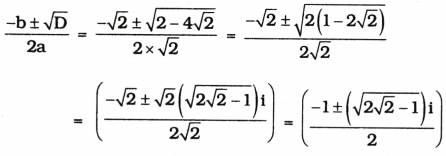
Question 10.
x2 + \(\frac{\mathbf{x}}{\sqrt{2}}\) + 1 = o
Solution:
The given quadratic equation is x2 + \(\frac{\mathbf{x}}{\sqrt{2}}\) + 1 = 0
75
This equation can also be written as x2 + \(\frac{\mathbf{x}}{\sqrt{2}}\) + 1 = o
On comparing the given equation with ax2 + bx + c = 0,
We obtain a = √5, b = 1 and c = √2
Therefore, the discriminant of the given equation is
D = b2 – 4ac = (1)2 – 4 × (√2) × (√2) = 1 – 8 = -7
Hence, the required solutions are
\(\frac{-b \pm \sqrt{D}}{2 a}=\frac{-1 \pm \sqrt{-7}}{2 \times \sqrt{2}}=\frac{-1 \pm \sqrt{7} i}{2 \sqrt{2}}\)