
Referring to the AP Inter 2nd Year Maths Study Material Chapter 6 Application of Derivatives Exercise 6c Solutions makes it easier to understand complex problems.
AP Inter 2nd Year Maths Application of Derivatives Solutions Exercise 6c
I.
Question 1.
Find the maximum and minimum value of f (x) = | x + 2 | – 1
Solution:
Given that f(x) = |x + 2| – 1
It is obvious that | x + 2 | ≥ 0 for every x ∈ R
∴ f (x) = | x + 2 | – 1 ≥ -1 for every x ∈ R
The minimum value of f is attained when | x + 2 | = 0 ⇒ x + 2 = 0 ⇒ x = -2
∴ minimum value of f = f(-2) =|-2 + 1| – 1 = -1
Hence, the function f does not have a maximum value.
Question 2.
Find the maximum and minimum value of g (x) = – | x + 1 | + 3
Solution:
Given that g (x) = -| x + 1 | + 3
It is obvious that | x + 1 | ≥ 0 for every x ∈ R
∴ f (x) = – | x + 1 | + 3 ≤ 3 for every x ∈ R
The minimum value of g is attained when | x + 1 | = 0 ⇒ x + 1 = 0 ⇒ x = -1
∴ maximum value of g = g(-1) = |-1 + 1| + 3 = 3
Hence, the function g does not have a minimum value.

Question 3.
Find the maximum and minimum value of h (x) = sin (2x) + 5
Solution:
Given that h (x) = sin (2x) + 5
We know that -1 ≤ sin2x ≤ 1 ⇒ – 1 + 5 ≤ sin2x ≤ 1 + 5 ⇒ 4 ≤ sin2x + 5 ≤ 6
Hence, the maximum and minimum values of h are 6 and 4 respectively.
Question 4.
Find the maximum and minimum value of f(x) = | sin 4x + 3 |
Solution:
Given that f(x) = | sin4x + 3|
We know that —1 ≤ sin4x ≤ 1 ⇒ 2 ≤ sin4x+3 ≤ 4 ⇒ 2 ≤ |sin4x + 3| ≤ 4
Hence, the maximum and minimum values of f are 4 and 2 respectively.
Question 5.
Find the maximum and minimum value of h (x) = x + 1, x ∈ (- 1, 1)
Solution:
Given that h (x) = x + 1, x ∈ (-1, 1). Now h'(x) = 1 ≠ 0
∴ h(x) has no maximum or no minimum.
Question 6.
Prove that f (x) = ex do not have maxima or minima.
Solution:
Given that f(x) = ex ⇒ f ‘(x) = ex ⇒ f “(x) = ex
For maxima or minima f(x) = 0 ⇒ ex = 0.
This equation is not satified for any real x.
∴ f(x) has no maxima or minima on R.
Question 7.
Prove that g (x) = log x do not have maxima or minima.
Solution:
Given that g(x)= log x ⇒ g'(x) = \(\frac{1}{x}\) ⇒ g”(x) = –\(\frac{1}{x^2}\)
For maximum f ‘(x) = 0 ⇒ \(\frac{1}{x}\) = 0 is not satisfied for any real x.
∴ f(x) has no maxima or minima.
Question 8.
Prove that h(x) = x3 + x2 + x + 1 do not have maxima or minima.
Solution:
Given that h(x) = x3 + x2 + x + 1 ⇒ h'(x) = 3x2 + 2x +1
Now, h'(x) = 0 ⇒ 3x2 + 2x +1 = 0 ⇒ x = \(\frac{-2 \pm 2 \sqrt{2} i}{6}\) ⇒ x = \(\frac{-1 \pm \sqrt{2} i}{3}\) ≠ R
∴ there does not exist c ∈ R such that h'(c) = 0
Hence, function h does not have maxima or minima.
Question 9.
It is given that at x = 1, the function x4 – 62x2 + ax + 9 attains its maximum value, on the interval |0, 2|. Find the value of a.
Solution:
Let f(x) = x4 – 62x2 + ax + 9 ⇒ f'(x) = 4x3 – 124x + a
It is given that function f attains its maximum value on the interval [0, 2] at x = 1.
Hence, f'(1) = 0 ⇒ 4x3 – 124x + a = 0 ⇒ 4 – 124 + a = 0 ⇒ -120 + a = 0 ⇒ a = 120
Thus, the value of a = 120
II.
Question 1.
Find the maximum and minimum values of f (x) = (2x – 1)2 + 3
Solution:
Given that f (x) = (2x – 1)2 + 3
It is obvious that (2x – 1)2 ≥ 0 for every x ∈ R
∴ (2x – 1)2 + 3 ≥ 3 for every x ∈ R
The minimum value of f is attained when 2x – 1 = 0 ⇒ 2x – 1 = 0 ⇒ x = \(\frac{1}{2}\)
Hence, minimum value of f is f(\(\frac{1}{2}\)) = (2(\(\frac{1}{2}\)) – 1)2 + 3 = 3
Thus, the function f does not have a maximum value
Question 2.
Find the maximum and minimum values of f(x) = 9x2 + 12x + 2
Solution:
Given that f (x) = 9x2 + 12x + 2
It is obvious that (3x + 2)2 ≥ 0 for every x ∈ R
∴ f(x) = (3x + 2)2 – 2 ≥ -2 for every x ∈ R
The minimum value off is attained when 3x + 2 = 0 ⇒ 3x + 2 = 0 ⇒ x = –\(\frac{2}{3}\)
Hence, minimum value off is f(-\(\frac{2}{3}\)) = (3(-\(\frac{2}{3}\))+ 2)2 – 2 = -2
Thus, the function f does not have a maximum value.
Question 3.
Find the maximum and minimum values of f (x) = -(x – 1)2 + 10.
Solution:
Given that f(x) = -(x – 1)2 + 10.
It is obvious that (x – 1)2 ≥ 0 for every x ∈ R
∴ f(x) = -(x – 1)2 + 10 ≤ 10 for every x ∈ R
The maximum value of f is attained when (x – 1) = 0 ⇒ x = 1
∴ Maximum value of f is f(1) = -(1 – 1)2 + 10 = 10
Hence, the function f does not have a minimum value.
Question 4.
Find the maximum and minimum values of g (x) = x3 + 1
Solution:
Given that g(x) = x3 ⇒ g'(x) = 3x2 > 0 ⇒ g'(x) > 0 ⇒ x = 0
g'(x) = 3x2 ≥ 0 for all x.
x = 0 is not a maximum or minimum
Hence, function g neither has a maximum value nor a minimum value.
Question 5.
Find the local maxima and local minima, of f (x) = x2 and also find the local maximum and the local minimum values.
Solution:
Given that f(x) = x2 ⇒ f ‘(x) = 2x ⇒ f “(x) = 2
For maximum or minimum f'(x) = 0 ⇒ 2x = 0 ⇒ x = 0
Now f “(0) = 2 > 0
∴ f(x) has minimum at x = 0
Point of local minimum is x = 0
Local minimum at x = 0 is f(0) = 02 = 0
∴ Point of local minimum is (0, 0)
Question 6.
Find the local maxima and local minima of g(x) = x3 – 3x and also find the local maximum and the local minimum values.
Solution:
Given that f(x) = x3 – 3x ⇒ f'(x) = 3x2 – 3 ⇒ f”(x) = 6x
For maximum or minimum f ‘(x) = 0 ⇒ 3x2 – 3 = 0 ⇒ x2 – 1 = 0 ⇒ x = ± 1
Now f'(l) = 6(1) = 6 > 0
∴ f(x) has minimum at x = 1
Minimum value is f(1) = 13 – 3(1) = -2
Also f”(-1) = 6(-1) = -6 < 0
∴ f(x) has maximum value at x = – 1
Maximum value is f(-1) = (-1)3 – 3(-1) = -1 + 3 = 2.
Question 7.
Find the local maxima and local minima of h (x) = sin x + cos x, 0 < x < π/2 and also find the local maximum and the local minimum values.
Solution:
Given that h(x) = sin x + cos x, 0 < x < π/2 ⇒ h'(x) = cos x – sin x
Now h'(x) = 0 ⇒ cos x – sin x ⇒ sin x = cos x ⇒ tan x = 1 ⇒ x = \(\frac{\pi}{4}\) ∈ (0, \(\frac{\pi}{2}\))
Also, h'(x) = -sin x – cos x = -(sin x + cos x)
Hence, h’\(\left(\frac{\pi}{4}\right)\) = –\(\left(\frac{1}{\sqrt{2}}+\frac{1}{\sqrt{2}}\right)=\frac{-2}{\sqrt{2}}=-\sqrt{2}\) < 0
∴ By second derivative test. x = \(\frac{\pi}{4}\) is a point of local maxima and the local maximum at x = \(\frac{\pi}{4}\)
we have h\(\left(\frac{\pi}{4}\right)\) = sin\(\frac{\pi}{4}\) + cos \(\frac{\pi}{4}\) = \(\frac{1}{\sqrt{2}}+\frac{1}{\sqrt{2}}=\sqrt{2}\)
Question 8.
Find the local maxima and local minima, of f (x) – sin x – cos x, 0 < x < 2π and also find the local maximum and the local minimum values.
Solution:
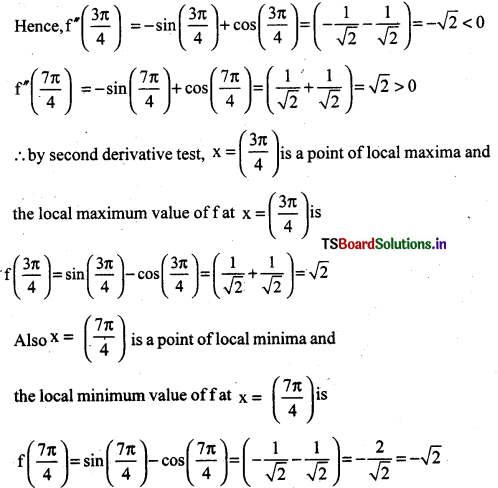
Given that f (x) = sin x – cos x, 0 Now, f'(x) = 0 ⇒ cos x + sin x = 0 ⇒ sin x = -cos x ⇒ tan x = -1 ⇒ x = \(\frac{3\pi}{4}\), \(\frac{7\pi}{4}\) ∈ (0, 2π)
Also, f”(x ) = – sin x + cos x
Question 9.
Find the local maxima and local minima, of f(x) = x3 – 6x2 + 9x + 15 and also find the local maximum and the local minimum values.
Solution:
Given that f(x) = x3 – 6x2 + 9x + 15 ⇒ f’(x) = 3xx2 – 12x + 9 ⇒ f”(x) = 6x – 12
For maximum or minimum f'(x) = 0 ⇒ 3x2 – 12x + 9 = 0 ⇒ 3(x2 – 4x + 3) = 0
Now f”(1) = 6(1) – 12 = -6 < 0
∴ f(x) has maximum value at x = 1
Maximum value is f(1) = 13 – 6(1)2 + 9(1) + 15 = 1 – 6 + 9+ 15 = 19
Also f”(3) = 6(3) – 12 = 18 – 12 = 6 > 0
∴ f(x) has minimum value at x = 3
Minimum value is f(3) = 33 – 6.32 + 9.3 + 15 = 27 – 54 + 27 + 15 = 15
Question 10.
Find the local maxima and local minima, of g(x) = \(\frac{x}{2}+\frac{2}{x}\), (x > 0) and also find the local maximum and the local minimum values.
Solution:
Given that g(x) = \(\frac{x}{2}+\frac{2}{x}\) ⇒ g'(x) = \(\frac{1}{2}-\frac{2}{x^2}\) ⇒ g”(x) = \(\frac{4}{x^3}\)
For max. or min. we have g'(x) = 0
⇒ \(\frac{1}{2}-\frac{2}{x^2}\) = 0
⇒ \(\frac{x^2-4}{2 x^2}\) = 0
⇒ x2 – 4 = 0
⇒ x = ±2 = 2 [∵ x > 0]
Now g”(2) = \(\frac{4}{2^3}\) = \(\frac{1}{2}\) > 0
∴ g(x) has minimum value at x = 2
Minimum value is g(2) = \(\frac{2}{2}\) + \(\frac{2}{2}\) = 1 + 1 = 2
Question 11.
Find the local maxima and local minima, of g(x) = \(\frac{1}{x^2+2}\) and also find the local maximum and the local minimum values.
Solution:
Given that g(x) = \(\frac{1}{x^2+2}\) ⇒ g'(x) = \(\frac{-(2 x)}{\left(x^2+2\right)^2}\)
Now g'(x) = 0 ⇒ \(\frac{-(2 x)}{\left(x^2+2\right)^2}\) = 0 ⇒ x = 0
Now, for values close to and to the left of 0, g'(x) > 0
Also, for values close to x = 0 and to the right of 0, g'(x) < 0
Therefore, by first derivative test, x = 0 is a point of local maxima and the local maximum value of g(0) = \(\frac{1}{0+2}\) = \(\frac{1}{2}\)
Question 12.
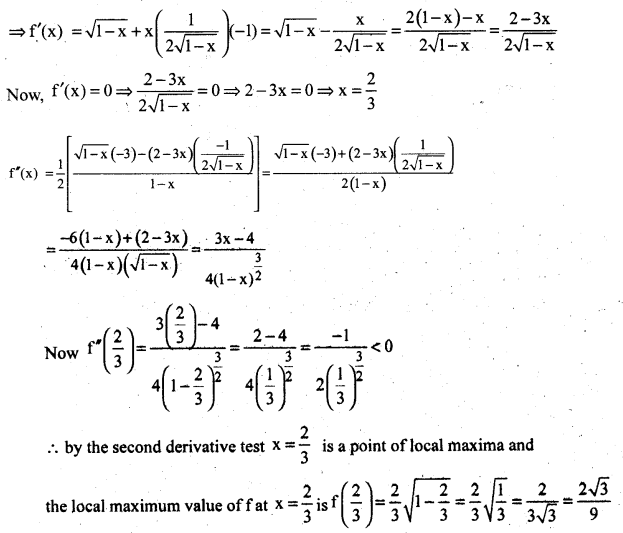
Find the local maxima and local rninlrnaq of f(x) = x\(\sqrt{1-x}\), x, 0 < x < 1 and also find the local maximum and the local minimum values.
Solution:
Given that f(x) = x\(\sqrt{1-x}\)
Question 13.
Find the absolute maximum value and the absolute minimum value of function f (x) = x3 in the given interval x ∈ [- 2, 2]
Solution:
Given f(x) = x3 ⇒ f'(x) = 3x2
Now f'(x) = 0 ⇒ 3x2 = 0
Then we evaluate the value of f at critical point x=0 and at end points of the interval [-2, 2]
(i) f(0) = 0 ……………… (1)
(ii) f(-2) =(-2)3 = -8 ………… (2)
(iii) f(2) = (2)3 =8 ………….. (3)
From (1), (2) & (3) the absolute Minimum value is – 8 & absolute Maximum value is 8
Question 14.
Find the absolute maximum value and the absolute minimum value of function f (x) = sin x + cos x in the given interval x ∈ [0, π]
f(x) = sin x + cos x in the given interval x ∈ [0, π]
Solution:
Given f(x) = sin x + cos x ⇒ f'(x) = cos x – sin x
Now f'(x) = 0 ⇒ cos x – sin x = 0 ⇒ sin x = cos x – 1 ⇒ x = \(\frac{\pi}{4}\) ∈ [0, π]
Now the critical point is \(\frac{\pi}{4}\) and end points of [0, π] are 0, π.
(i) \(f\left(\frac{\pi}{4}\right)=\sin \frac{\pi}{4}+\cos \frac{\pi}{4} \Rightarrow=\frac{1}{\sqrt{2}}+\frac{1}{\sqrt{2}}=\frac{2}{\sqrt{2}}=\sqrt{2}\) ………….. (1)
(ii) f(0) = sin 0 + cos 0 = 0 + 1 = 1 ……. (2)
(iii) f(π) = sin π + cos π – 0 – 1 = -1 ………….. (3)
From (1), (2) & (3) the absolute Minimum value is -1 & absolute Maximum value is \(\sqrt{2}\)
Question 15.
Find the absolute maximum value and the absolute minimum value of function
f(x) = 4x – \(\frac{1}{2}\)x2 in the given interval x ∈ [-2, \(\frac{9}{2}\)]
Solution:
Given f(x) = 4x – \(\frac{1}{2}\)x2 and f'(x) = 4 – \(\frac{1}{2}\)(2x) = 4 – x
Now f'(x) = 0 ⇒ 4 – x = 4
Now the critical point is 4 and end points of [-3, 1]
(i) f(4) = 16 – \(\frac{1}{2}\)(16) = 16 – 8 = 8 …………… (1)
(ii) f(-2) = -8 – \(\frac{1}{2}\) (4) = -8 – 2 = -10 ……………. (2)
(iii) f\(\left(\frac{9}{2}\right)=\) = 18 – \(\frac{1}{2}\left(\frac{9}{2}\right)^2\) = 18 – \(\frac{81}{8}\) = 18 – 10.125 = 7.875 …………… (3)
From (1), (2) & (3) the absolute Minimum value is – 10 & absolute Maximum value is 8.
Question 16.
Find the absolute maximum value and the absolute minimum value of function f (x) = (x – 1)2 + 3 in the given interval x ∈ [-3, 1]
Solution:
Given f(x) = (x – 1)2 + 3 ⇒ f'(x) = 2(x – 1)
Now f'(x) = 0 ⇒ 2 (x – 1) = 0 ⇒ x = 1
Now the critical point is at 1 and end points of [-3, 1]
(i) f(1) = (1 – 1)2 + 3 = 3 ………… (1)
(ii) f (-3) = (-3 – 1)2 + 3 = 16 + 3 = 19 ……………… (2)
Hence, we conclude that the absolute maximum value is 19 occurring at x = -3.
Also, the absolute minimum value of on [-3, 1] is 3 occurring at x = 1.
Question 17.
Find the maximum profit that a company can make, if the profit function is given by p (x) = 41 – 72x – 18x2.
Solution:
Given p(x) = 41 – 72 x – 18x2. …………. (1)
⇒ p'(x) = -72 – 36x ⇒ p'(x) = -36 < 0
For maxima or minima, p'(x) = 0 ⇒ -72 – 36x = 0 ⇒ 36x = -72 ⇒ x = -2
Also p”(2) = -36 < 0
∴ The profit f(x) is maximum when x = -2
From (1), the maximum profit is p(2) = 41 – 72 (-2) – 18(4) = 41 + 144 – 72 = 185 – 72 = 113
Question 18.
Find both the maximum value and the minimum value of 3x4 – 8x3 + 12x2 – 48x + 25 on the interval [0, 3].
Solution:
Given f(x) = 3x4 – 8x3 + 12x2 – 48x + 25
f'(x) = 12x3 – 24x2 + 24x – 48 = 12(x3 – 2x2 + 2x – 4)
= 12[x2 (x – 2) + 2(x – 2)] = 12(x – 2)(x2 + 2)
For maximum or minimum, f'(x) = 0 ⇒ x – 2 = 0 ⇒ x = 2
Hence the critical point is x= 2. Also end points of the interval [0, 3] are 0, 3.
(i) f(2) = 3(2)4 – 8(2)3 + 12(2)2 – 48(2) + 25 = 48 – 64 + 48 – 96 + 25 = -39 ……… (1)
(ii) f(0) = 3(0)4 – 8(0)3 + 12(0)2 – 48(0) + 25 = 25 ……………. (2)
(iii) f(3) = 3(3)4 – 8(3)3 + 12(3)2 – 48(3) + 25 = 243 – 216 + 108 – 144 + 25 = 16 ……… (3)
From (1), (2), (3) Absolute maximum = 25 & Absolute minimum = -39
Question 19.
At what points in the interval [0, 2π], docs tire function sin 2x attain its maximum value?
Solution:
Given f(x) = sin 2x ⇒ f'(x) = 2 cos 2x
For maximum or minimum,
f'(x) = 0 ⇒ 2 cos 2x = 0 ⇒ 2x = \(\frac{\pi}{4}, \frac{3 \pi}{4}, \frac{5 \pi}{4}, \frac{7 \pi}{4}\) ⇒ x = \(\frac{\pi}{4}, \frac{3 \pi}{4}, \frac{5 \pi}{4}, \frac{7 \pi}{4}\)
Hence the critical points are x = \(\frac{\pi}{4}, \frac{3 \pi}{4}, \frac{5 \pi}{4}, \frac{7 \pi}{4}\).
Also end points of the interval [0, 2π] are 0, 2π.
(i) f\(\left(\frac{\pi}{4}\right)\) = sin\(\left(\frac{\pi}{4}\right)\) = 1
(ii) f\(\left(\frac{3\pi}{4}\right)\) = sin\(\frac{3\pi}{2}\) = -1
(iii) f\(\left(\frac{5\pi}{4}\right)\) = sin \(\frac{5\pi}{2}\) = 1
(iv) f\(\left(\frac{7\pi}{4}\right)\) = sin\(\frac{7\pi}{2}\) = -1
(v) f(0) = sin 0 = 0
(vi) f(2π) = sin 2π = 0
Hence, we conclude that the absolute maximum value is occurring at x = \(\frac{\pi}{4}\) and x = \(\frac{5\pi}{4}\)
Question 20.
What is the maximum value of the function sin x + cos x?
Solution:
Let f(x) = sin x + cos x ⇒ f'(x) = cos x – sin x
Now, f”(x) = 0 ⇒ cos x – sinx = 0 ⇒ sin x = cos x ⇒ tan x = 1 ⇒ x = \(\frac{\pi}{4}\), \(\frac{5\pi}{4}\)
Hence, f “(x) = – sin x – cos x = – (sin x + cos x )
Now f”(x) will be negative •
Now, f”(x) will be negative when (sin x + cos x) is positive i.e., when sin x and cos x are both positive.
Also, we know that sin x and cos x both are positive in the first quadrant.
Then, f”(x) will be negative when x ∈ (0, \(\frac{\pi}{2}\))
Thus, we consider x = \(\frac{\pi}{4}\)
\(f^{\prime \prime}\left(\frac{\pi}{4}\right)=-\left(\sin \frac{\pi}{4}+\cos \frac{\pi}{4}\right)=-\left(\frac{2}{\sqrt{2}}\right)=-\sqrt{2}<0\)
By second derivative test, f will be the maximum at x = \(\frac{\pi}{4}\) and the maximum value of f is \(f\left(\frac{\pi}{4}\right)=\sin \frac{\pi}{4}+\cos \frac{\pi}{4}=\frac{1}{\sqrt{2}} \times \frac{1}{\sqrt{2}}=\frac{2}{\sqrt{2}}=\sqrt{2}\)
Question 21.
Find the maximum value of 2x3 – 24x + 107 in the interval [1, 3]. Find the maximum value of the same function in [-3, -1].
Solution:
Let f(x) = 2x3 – 24x + 107 ⇒ f (x) = 6x3 – 24 = 6(x3 – 4)
Now, f'(x) = 0 ⇒ 6(x2 – 4) = 0 ⇒ x2 = 4 ⇒ x = ± 2
Now, we first consider the interval [1, 3].
Then, we evaluate the value of f at the critical point x = 2 ∈ [1, 3] [and at the end points of the interval [1, 3].
Hence, f(2) = 2(2)3 – 24(2)+107 = 16 – 48 + 107 = 75
f(1) = 2(1)3 – 24(1) + 107 = 2 – 24 + 107 = 85
f(3) = 2(3)3 – 24(3) + 107 = 54 – 72 + 107 = 89
Thus, the absolute maximum value of f(x) in the interval [1, 3] is 89 occurring at x = 3.
Next, we consider the interval [-3, -1].
Then, we evaluate the value of f at the critical point x = -2 ∈ [-3, -1] and at the end points of the interval [-3, -1]
Hence, f(-3) = 2(-3)3 – 24(-3) + 107 = -54 + 72 + 107 = 125
f(-1) = 2(-1)3 – 24(-1) + 107 = -2 + 24 + 107 = 129
f(-2) = 2(-2)3 – 24(-2) + 107=—16 + 48 + 107 = 139
Hence, the absolute maximum value of f(x) in the interval [-3, -1] is 139 occurring at x = -2
Question 22.
Find the maximum and minimum values of x + sin 2x on [0, 2π].
Solution:
Let f(x) = x ± sin 2x ⇒ f'(x) = 1 + 2 cos 2x
Now f'(x) = 0 = 1 + 2 cos 2x = 0 ⇒ cos 2x = 0 ⇒ cos 2x = \(\frac{-1}{2}\) = -cos\(\frac{\pi}{3}\) = cos (π – \(\frac{\pi}{3}\)) = cos \(\frac{2\pi}{3}\)
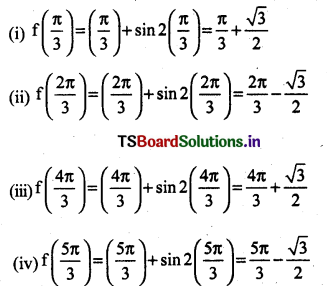
⇒ 2x = 2nπ ± \(\frac{2\pi}{3}\) [[n ∈ Z] ⇒ x = nπ ± \(\frac{\pi}{3}\) [n ∈ Z] ⇒ x = \(\frac{\pi}{3}\), \(\frac{2\pi}{3}\), \(\frac{4\pi}{3}\), \(\frac{5\pi}{3}\) ∈ [0, 2π]
Then, we evaluate the value of fat critical points x = \(\frac{\pi}{3}\), \(\frac{2\pi}{3}\), \(\frac{4\pi}{3}\), \(\frac{5\pi}{3}\) and at the end points of the interval [0, 2π].
(v) f(0) = 0 + sin0 = 0
(vi) f(2π) = 2π + sin 4π = 2π + 0 = 2π
Hence, we conclude that the absolute maximum value of f(x) is 2π occurring at x = 2π and the absolute minimum value of f(x) is 0 occurring at x = 0.
Question 23.
Find two numbers whose sum is 24 and whose product is as large as possible.
Solution:
Let a number be x .
Then, the other number be (24 – x).
Let P(x) denote the product of the two numbers.
Thus, we have: P(x) = x (24 – x) = 24x – x2
∴ P'(x) = 24 – 2x ⇒ P'(x) = -2
Now, P'(x) = 0 ⇒ 24 – 2x = 0 ⇒ 24 = 2x ⇒ x = 12
Also, P'(12) = -2 < 0
By second derivative test, x = 12 is the point of local maxima of P.
Thus, the numbers are 12 and (24 – 12) = 12
Hence, the product of the numbers is the maximum when the numbers are 12 each.
III.
Question 1.
Find two positive numbers x and y such that x + y = 60 and xy3 is maximum.
Solution:
The two numbers are x and y such that x + y = 60 ⇒ y = 60 – x …………. (1)
Let f(x) = xy3 = f(x) = x(60 – x)3 ………………. (1)
⇒ f’(x) = (60 – x)3 – 3x(60 – x)2 = (60 – x)2[60 – x – 3x] = (60 – x)2(60 – 4x)
⇒ f”(x) = -2(6o – x)(6o – 4x) – 4(6o – x)2 = -2(60 – x)[60 – 4x + 2(60 – x)]
= -2(60 – x)(180 – 6x) = -12(60 – x)(30 – x)
Now. f'(x) = 0 ⇒ x = 60 or x = 15
When x = 60 then, f”(x) = 0
When x = 15 then f”(x) = -12(60 – 15)(30 – 15) = -12 × 45 × 15 < 0
By second derivative test, x1 5 is a point of local maxima of f.
Thus, function xy3 is maximum when x = 15 and y = 60 – 15 = 45
Hence, the required numbers are 15 and 45.
Question 2.
Find two positive numbers x and y such that their sum is 35 and the product x2y5 is a maximum.
Solution:
Let a number be x. Then, the other number is y = (35 – x).
Let P(x) = x2y5 – Then we have, P(x) = x2 (35 – x)5
P'(x) = 2x(35 – x)5 + x25(35 – x)4 (-1) = 2x (35 – x)5 – 5x2 (35 – x)4
= x(35 – x)4[2(35 – x) – 5x] = x(35 – x)4 (70 – 7x) = 7x (35 – x)4(10 – x)
P”(x) = 7(35 – x)4(10 – x) + 7x[-(35 – x)4 – 4(35 – x)3(10 – x)]
= 7(35 – x)4(10 – x) – 7x(35 – x)4 – 28x(35 – x)3 (10 – x)
= 7(35 – x)3[(35 – x)(10 – x) – x(35 – x) – 4x(10 – x)]
= 7(35 – x)3[350 – 45x + x2 – 35x + x2 – 40x + 4x2]
= 7(35 – x)3(6x2 – 120x + 350)
Now P'(x) = 0 ⇒ x = 0, x = 35, x = 10
When, x = 35 then, P'(x) = P (x) = 0 ⇒ y = 35 – 35 = 0
This will make the product x2y5 equal to 0.
When, x = 0 then y = 35 – 0 = 35.This will make the product x2y5 equal to 0.
Hence,x = 0 and x = 35 cannot be the possible values of x.
When x = 10. Then, p”(x) = 7 (35 – 10)3 (6 × 100 – 120 × 10 + 350) = 7 (25)3 (-250) < 0
By second derivative test, P(x) will be the maximum when x = 10 and y = 35 – 10 = 25
Hence, the required numbers are 10 and 25.
Question 3.
Kind two positive numbers whose sum is 16 and the sum of whose cubes is minimum.
Solution:
Let a number be x . Then, the other number be (16 – x).
Let the sum of the cubes of these numbers be denoted by S(x).
Then, S(x) = x3 + (16 – x)3
∴ S'(x) = 3x2 + 3(16 – x)2(-1) = 3x2 – 3(16 – x)2 ⇒ S'(x) = 6x + 6(16 – x)
Now, S'(x) = 0 ⇒ 3x2 – 3(16 – x)2 = 0 ⇒ x2 – (16 – x)2 = 0
⇒ x2 – 256 – x2 + 32x = 0 ⇒ x = \(\frac{256}{32}\) ⇒ x = 8
Also, S”(8) = 6(8) + 6(16 – 8) = 48 + 48 = 96 > 0
By second derivative test, x=8 is the point of local minima of S.
Thus, the numbers are 8 and (16 – 8) = 8.
Hence, the sum of the cubes of the numbers is the minimum when the numbers are 8 each.
Question 4.
A square piece of tin of side 18 cm is to be made into a box without top, by cutting a square from each corner and folding up the flaps to form the box. What should be the side of the square to be cut off so that the volume of the box is the maximum possible.
Solution:
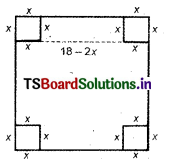
Let the side of the square to be cut off be x cm.
Then, the length and the breadth of the box will be( 18 – 2x)cm each and the height of the box be x cm.
∴ Volume V (x) of the box is given by,V(x) = lbh = x(18 – 2x)2.
Hence, V'(x) = 1 (18 – 2x )2 + 2x(18 – 2x)(-2) = (18 – 2x )2 – 4x (18 – 2x ) = (18 – 2x)[18 – 2x – 4x]
= (18 – 2x)(18 – 6x) = 6x2(9 – x)(3 – x) = 12(9 – x)(3 – x)
= 12(x2 – 12x + 27) = 12(x – 9)(x – 3)
V'(x) = 12(2x – 12) = 24(x – 6) .
Now, V'(x) = 0 ⇒ x = 9, x = 3
If, x = 9 then the length and the breadth will become 0.
Hence, x ≠ 9
When x = 3 then, V”(3)= 24(3 – 6) = -72 < 0
By second derivative test, x = 3 is the point of local maxima of V.
Hence, if we remove a square of side 3 cm from each corner of the square tin and make a box from the remaining sheet, then the volume of the box obtained is the largest possible.
Question 5.
A rectangular sheet of tin 45 cm by 24 cm is to he made into a box without top, by culling off square from each cornet and holding up the flaps. What should he the side of the square to he cut off so that the volume of the box is maximum ?
Solution:
Let the side of the square to be cut off be x cm.
Then, the height of the box is x cm,
the length is (45 – 2x)cm and the breadth (24 – 2x) cm.
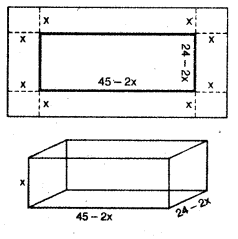
Therefore, the volume V(x) of the box is given by, _________________
V(x) = x(45 – 2x)(24 – 2x) = x(1080 – 90x – 48x + 4x2)
= 4x3 – 138x2 +1080x
Hence,V’(x) = 12x2 – 276x + 1080 = 12(x2 – 23x + 90)
= 12(x – 18)(x – 5)
V'(x) = 24x – 276 = 12(2x – 23)
Now, V'(x) = 0 ⇒ x = 18, x = 5
It is not possible to cut off a square of side 18 cm from each comer of the rectangular sheet. :
Thus, x cannot be equal to 18.
When, x = 5
Then, V'(5) = 12[2 (5) – 23] = 12 (10 – 23) = 12(-13) = -156 < 0
By second derivative test, x = 5 is the point of local maxima.
Hence, the side of the square to be cut off to make the volume of the box maximum possible is 5 cm.
Question 6.
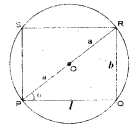
Show that of all the rectangles inscribed in a given fixed circle, the square has the maximum area.
Solution:
Let a rectangle of length 1 and breadth b be inscribed in the given circle of radius a .
Then, the diagonal passes through the centre and is of length 2a cm
Now, by applying the Pythagoras theorem, we have:
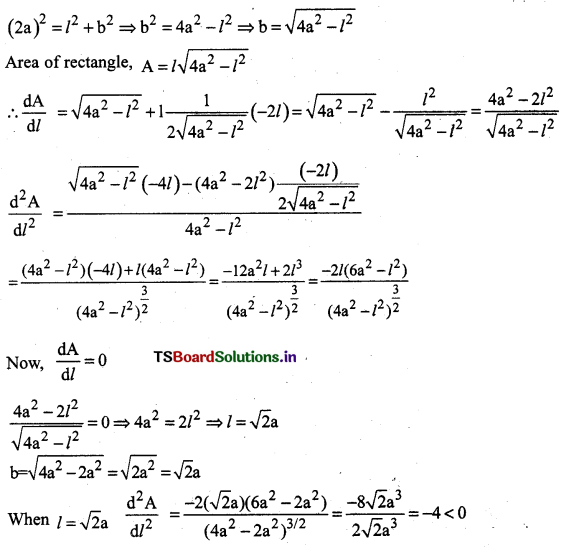
By the second derivative test, when l = \(\sqrt{2}\)a, then the area of the rectangle is the maximum. Since, l = b = \(\sqrt{2}\)a the rectangle is a square.
Hence, it has been proved that of all the rectangles inscribed in the given fixed circle, the square has the maximum area.
Question 7.
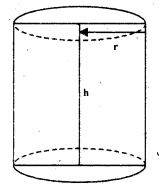
Show that the right circular cylinder of given surface and maximum volume is such that its height is equal to the diameter of the base.
Solution:
Let r and h be the radius and height of the cylinder respectively.
Then, the surface area (S) of the cylinder is given by, S = 2πr2 + 2πrh
∴ h = \(\frac{S-2 \pi r^2}{2 \pi r}=\frac{S}{2 \pi}\left(\frac{1}{r}\right)-r\)
Let V be the volume of the cylinder
V = πr2h = πr2 = \(\left[\frac{\mathrm{S}}{2 \pi}\left(\frac{1}{\mathrm{r}}\right)-\mathrm{r}\right]\) = \(\frac{\mathrm{Sr}}{2}\) -πr3
\(\frac{\mathrm{dV}}{\mathrm{dr}}=\frac{\mathrm{S}}{2}\) – 3πr2 ⇒ \(\frac{d^2 V}{d r^2}\) = -6πr
Now, \(\frac{\mathrm{dV}}{\mathrm{dr}}\) = 0 ⇒ \(\frac{\mathrm{S}}{2}\) – 3πr2 = 0
⇒ \(\frac{\mathrm{S}}{2}\) = 3πr2
⇒ r2 = \(\frac{\mathrm{S}}{6 \pi}\)
When r2 = \(\frac{\mathrm{S}}{6 \pi}\)
Then \(\frac{d^2 V}{d r^2}=-6 \pi\left(\sqrt{\frac{S}{6 \pi}}\right)<0\)
By second derivative test, the volume is the maximum when r2 = \(\frac{\mathrm{S}}{6 \pi}\)
Now, when r2 = \(\frac{\mathrm{S}}{6 \pi}\) Then, h = \(\frac{6 \pi \mathrm{r}^2}{2 \pi}\left(\frac{1}{\mathrm{r}}\right)\) – r = 3r – r = 2r
Hence, the volume is the maximum vyhen the height is twice the radius i.e., when the height is equal to the diameter.
Question 8.
Of all the closed cylindrical cans (right circular), of a given volume of 100 cubic centimetres, find the dimensions of the can which has the minimum surface area?
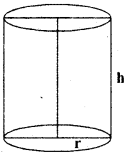
Solution:
Let r and h be the radius and height of the cylinder respectively.
Then, volume V of the cylinder is given by, V = πr2 = 100 ⇒ h = \(\frac{100}{\pi \mathrm{r}^2}\)
Surface area is given by: S = 2πr2 + 2πrh = 2πr2 + \(\frac{200}{\mathrm{r}}\)
⇒ \(\frac{\mathrm{dS}}{\mathrm{~d} \mathrm{r}}\) = 4πr – \(\frac{200}{r^2}\) ⇒ \(\frac{\mathrm{d}^2 \mathrm{~S}}{\mathrm{dr}^2}\) = 4πr + \(\frac{400}{r^2}\)
Now, \(\frac{\mathrm{dS}}{\mathrm{dr}}\)= 0 ⇒ 4πr – \(\frac{200}{r^2}\) = 0
⇒ 4πr = \(\frac{200}{r^2}\)
⇒ r3 = \(\frac{200}{4 \pi}=\frac{50}{\pi}\)
⇒ r = \(\left(\frac{50}{\pi}\right)^{\frac{1}{3}}\)
When, r = \(\left(\frac{50}{\pi}\right)^{\frac{1}{3}}\) Then, \(\frac{\mathrm{d}^2 \mathrm{~S}}{\mathrm{dr}^2}\) > 0
By second derivative test, the surface area is the minimum when r = \(\left(\frac{50}{\pi}\right)^{\frac{1}{3}}\)
when r = \(\left(\frac{50}{\pi}\right)^{\frac{1}{3}}\) we have h = \(\frac{100}{\pi\left(\frac{50}{\pi}\right)^{\frac{2}{3}}}=\frac{2 \times 50}{(\pi)(50)^{\frac{2}{3}} \cdot \pi^{\frac{2}{3}}}=2\left(\frac{50}{\pi}\right)^{\frac{1}{3}}\)
Hence, the required dimensions of the can which has the minimum surface area is given by radius \(\left(\frac{50}{\pi}\right)^{\frac{1}{3}}\) cm and height \(2\left(\frac{50}{\pi}\right)^{\frac{1}{3}}\) cm.
Question 9.
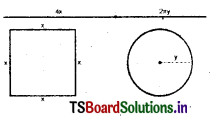
A wire of length 28 m is to be cut into two pieces. One of the pieces is to be made into a square and the other into a circle. What should be the length of the two pieces so that the combined area of the square and the circle is minimum?
Solution:
Let a piece of length l be cut from the given wire to make a square.
Then, the other piece of wire to be made into a circle is of length (28 – l).
Now, side of square is 1/4.
Let r be the radius of the circle.
Then, 2πr = 28 – l ⇒ r = \(\frac{1}{2 \pi}\)(28 – l)
The combined areas of the square and the circle A, is given by,
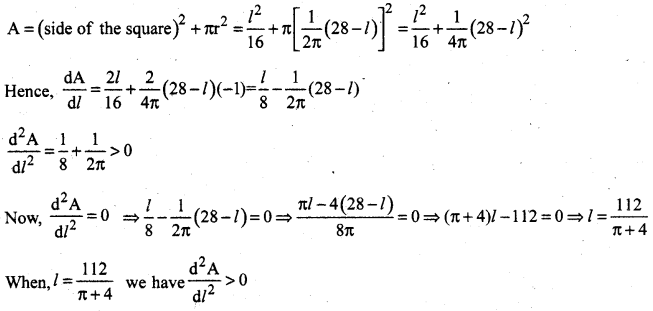
By second derivative test, the area (A) is the minimum when l = \(\frac{112}{\pi+4}\) cm.
Hence, the combined area is the minimum when the length of the wire in making the square is l = \(\frac{112}{\pi+4}\) cm while the length of the wire in making the circle is \(\left(28-\frac{112}{\pi+4}\right)=\frac{28 \pi}{\pi+4}\) cm.
Question 10.
Prove that the volume of the largest cone that can be inscribed in a sphere of radius R is 8/27 of the volume of the sphere.
Solution:
Let r and h be the radius and height of the cone respectively inscribed in a sphere of radius R.
Let V be the volume of the cone.Then V = \(\frac{1}{3}\)πr2 h
Height of the cone is given by, h = R + AB = R + \(\sqrt{R^2-r^2}\) [ABC is a right angle]
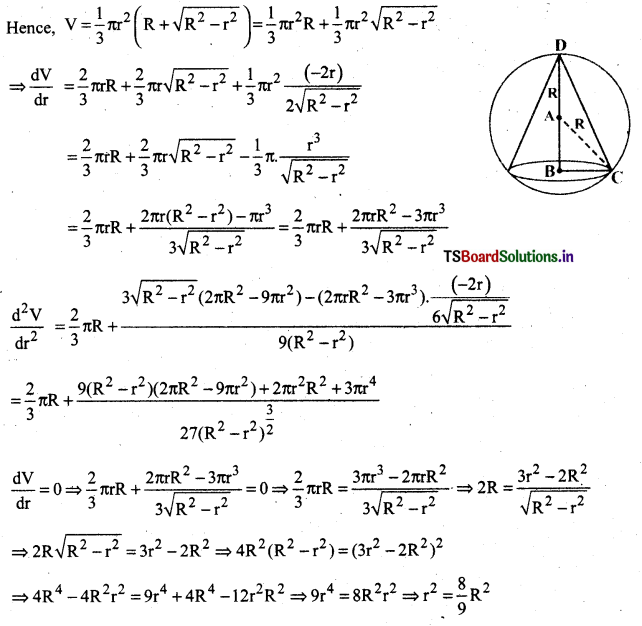
When, r2 = \(\frac{8}{9}\) R2. Then \(\frac{d^2 \mathrm{~V}}{\mathrm{dr}^2}\) < 0
By second derivative test, the volume of the cone is the maximum, when r2 = \(\frac{8}{9}\) R2
When, r2 = \(\frac{8}{9}\) R2.
Then, h = R + \(\sqrt{R^2-\frac{8}{9} R^2}=R+\sqrt{\frac{1}{9} R^2}=R+\frac{R}{3}=\frac{4}{3} R\)
∴ V = \(\frac{1}{3} \pi\left(\frac{8}{9} R^2\right)\left(\frac{4}{3} R\right)=\frac{8}{27}\left(\frac{4}{3} \pi R^3\right)=\frac{8}{27} \times(\text { Volume of sphere })\)
Hence, the volume of the largest cone that can be inscribed in the sphere is 8/27 the volume of the sphere.
Question 11.
Show that the right circular cone of least curved surface and given volume has an altitude equal to \(\sqrt{2}\) time the radius of the base.
Solution:
Let r and h be the radius and height of the cone, respectively.
Then, the volume (V) of the cone is given by, V = \(\frac{1}{3}\)πr2 h ⇒ h = \(\frac{3 \mathrm{~V}}{\pi \mathrm{r}^2}\)
The surface area (S) of the cone is given by, S = πrl,
where l is the slant height
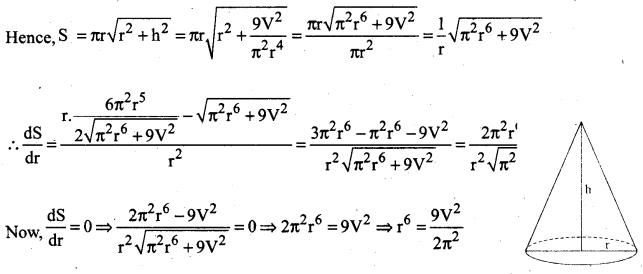
Thus, it can be easily verified that when r6 = \(\frac{9 V^2}{2 \pi^2}\), ⇒ \(\frac{\mathrm{d}^2 \mathrm{~S}}{\mathrm{~d} \mathrm{r}^2}\) > 0,
By second derivative test, the surface area of the cone is the least when r6 = \(\frac{9 V^2}{2 \pi^2}\)
Then, h = \(\frac{3 \mathrm{~V}}{\pi \mathrm{r}^2}=\frac{3 \mathrm{~V}}{\pi \mathrm{r}^2}\left(\frac{2 \pi^2 \mathrm{r}^6}{9}\right)^{\frac{1}{2}}=\frac{3}{\pi \mathrm{r}^2} \cdot \frac{\sqrt{2} \pi \mathrm{r}^3}{3}=\sqrt{2} \mathrm{r}\)
Hence, for a given volume, the right circular cone of the least curved surface has an altitude equal to \(\sqrt{2}\) times the radius of the base.
Question 12.
Show that the semi-vertical angle of the cone of the maximum volume and of given slant height is tan-1\(\sqrt{2}\)
Solution:
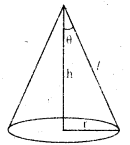
Let θ be the semi-vertical angle of the cone.
It is clear that θ ∈ [o, \(\frac{\pi}{2}\)]
Let r, h and l be the radius, height, and the slant height of the cone respectively.
The slant height of the cone is given as constant.
Now, r = l sin θ and h = l cos θ
The volume V of the cone is given by, V = \(\frac{\pi l^3}{3}\)(sin2θ . cosθ)
∴ \(\frac{\mathrm{dV}}{\mathrm{~d} \theta}\) = \(\frac{\pi l^3}{3}\) (sin2θ(-sin θ) + cosθ2sinθ.cosθ)
= \(\frac{\pi l^3}{3}\)(-sin3θ + 2sinθcos2θ)
\(\frac{d^2 V}{d \theta^2}\) = \(\frac{\pi l^3}{3}\)[-3sin2θ cosθ + 2(sin θ . 2 cos θ(-sin θ)) + cos2θ(cos θ)]
= \(\frac{\pi l^3}{3}\) [-3sin2θcosθ – 4sin2θcosθ + 2cos3θ]
= \(\frac{\pi l^3}{3}\) [-7sin2θcosθ + 2cos3θ]
Now, \(\frac{\mathrm{dV}}{\mathrm{~d} \theta}\) = 0
⇒ \(\frac{\pi l^3}{3}\) [-sin3θ + 2sinθcos2θ] = 0
⇒ sin3θ = 2sinθcos2θ
⇒ tan2 θ = \(\sqrt{2}\) since, sin θ ≠ 0
⇒ tan θ = \(\sqrt{2}\) since, θ ∈ [o, \(\frac{\pi}{2}\)]
We have, sin θ = \(\frac{\sqrt{2}}{\sqrt{3}}\), cosθ = \(\frac{1}{\sqrt{3}}\)
Now, \(\frac{\mathrm{d}^2 \mathrm{~V}}{\mathrm{~d} \theta^2}=\frac{\pi l^3}{3}\left[-7 \cdot \frac{2}{3} \cdot \frac{1}{\sqrt{3}}+2 \cdot \frac{1}{3 \sqrt{3}}\right]=\frac{\pi l^3}{3}\left[\frac{-12}{3 \sqrt{2}}\right]=-\frac{4 \pi l^3}{3 \sqrt{2}}\) < 0
By second derivative test, the volume V is the maximum when θ = tan-1\(\sqrt{2}\)
Hence, for a given slant height, the semi-vertical angle of the cone of the maximum volume is tan-1\(\sqrt{2}\)
Question 13.
Show that semi-vertical angle of right circular cone of given surface area and maximum volume is sin-1\(\left(\frac{1}{3}\right)\)
Solution:
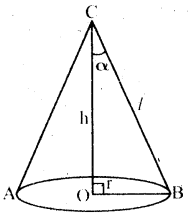
Let r be the radius, l be the slant height and h be the height of the cone of given surface area S.
Also, let α be the semi-vertical angle of the cone.
Then, S = πrl + πr2 ⇒ l = \(\frac{\mathrm{S}-\pi \mathrm{r}^2}{\pi \mathrm{r}}\) …………….. (1)
Let V be the volume of the cone, Then V = \(\frac{1}{3}\)πr2h
V2 = \(\frac{1}{9}\)π2r4h2
= \(\frac{1}{9}\)π2r4(l2 – r2) [∵ l2 = r2 + h2]
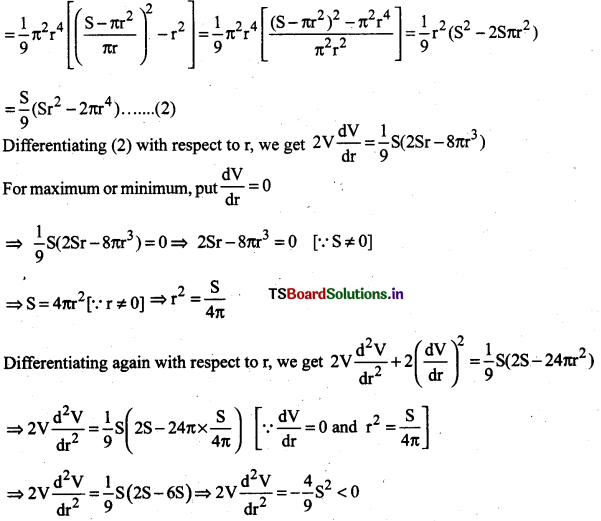
Thus V is maximum when S = 4πr2
∴ S = πrl + πr2 ⇒ 4πr2 = πrl + πr2
⇒ 3πr2 = πrl
⇒ l = 3r
Now, in ∆COB
sinα = \(\frac{O B}{B C}=\frac{r}{1}=\frac{r}{3 r}=\frac{1}{3}\)
∴ α = sin-1\(\left(\frac{1}{3}\right)\)