
Referring to the AP Inter 2nd Year Maths Study Material Chapter 5 Continuity and Differentiability Exercise 5h Solutions makes it easier to understand complex problems.
AP Inter 2nd Year Maths Continuity and Differentiability Solutions Exercise 5h
I.
Question 1.
Differentiate (3x2 – 9x + 5)9 w.r.t. x
Solution:
Let y = (3x2 – 9x + 5)9
⇒ \(\frac{\mathrm{dy}}{\mathrm{dx}}\) = 9(3x2 – 9x + 5)8\(\frac{\mathrm{d}}{\mathrm{dx}}\)(3x2 – 9x + 5) [∵ \(\frac{\mathrm{d}}{\mathrm{dx}}\) (f(x))n = n(f(x))n-1\(\frac{\mathrm{d}}{\mathrm{dx}}\)f(x)]
= 9(3x2 – 9x + 5)8[3(2x) – 9(1) + 0]
= 9(3x2 – 9x + 5)8(6x – 9) = 27(3x2 – 9x + 5)8(2x – 3).

Question 2
Differentiate sin3 x + cos6 x w.r.t. x
Solution:
Let y = sin3 x +cos6 x = (sin x)3 + (cos x)6
∴ \(\frac{\mathrm{dy}}{\mathrm{dx}}\) = 3(sin x)2\(\frac{\mathrm{d}}{\mathrm{dx}}\) sin x + 6(cos x)5\(\frac{\mathrm{d}}{\mathrm{dx}}\)cos x [∵ \(\frac{\mathrm{d}}{\mathrm{dx}}\) (f(x))n = n(f(x))n-1\(\frac{\mathrm{d}}{\mathrm{dx}}\)f(x)]
= 3 sin2 x cos x – 6 cos5 x sin x
= 3 sin x cos x(sin x – 2 cos4 x)
II.
Question 1.
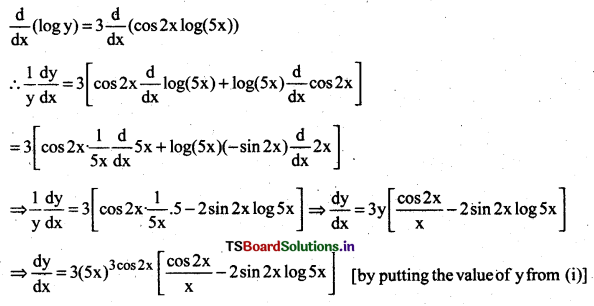
Differentiate (5x)3 cos 2x w.r.t. x
Solution:
Let y = (5x)3 cos 2x ………….. (i)
Taking logs of both sides of (1) we have
logy = log(5x)3 cos 2x = 3 cos 2x log(5x)
Differentiating both sides w.r.t. x, we have
Question 2.
Differentiate sin-1(x\(\sqrt{\mathrm{x}}\)), 0 ≤ x ≤ 1 w.r.t. x
Solution:
Let y = sin-1(x\(\sqrt{\mathrm{x}}\)) = sin-1 (x3/2 [∵ x\(\sqrt{\mathrm{x}}\) = x1 . x1/2 = x1+1/2 = x3/2]
∴ \(\frac{\mathrm{dy}}{\mathrm{dx}}\) = \(\frac{1}{\sqrt{1-\left(x^{3 / 2}\right)^2}} \frac{d}{d x} x^{3 / 2}\) [∵ \(\frac{\mathrm{d}}{\mathrm{dx}}\)sin-1f(x) = \(\frac{1}{\sqrt{1-(f(x))^2}} \frac{d}{d x}\)f(x)]
= \(\frac{1}{\sqrt{1-x^3}} \frac{3}{2} x^{1 / 2}\)
= \(\frac{3 \sqrt{x}}{2 \sqrt{1-x^3}}\)
= \(\frac{3}{2} \sqrt{\frac{x}{1-x^3}}\)
Question 3.
Differentiate cos (a cos x + b sin x), for some constant a and b. w.r.t. x
Solution:
Let y = cos(a cos x + b sin x) for some constants a and b.
∴ \(\frac{\mathrm{dy}}{\mathrm{dx}}\) = -sin(a cos x + b sin x)\(\frac{\mathrm{d}}{\mathrm{dx}}\)(a cos x + b sin x) [∵ \(\frac{\mathrm{d}}{\mathrm{dx}}\) cos f(x) = -sin f(x)\(\frac{\mathrm{d}}{\mathrm{dx}}\)f(x)]
= -sin(a cos x + b sin x)[-a sin x + b cos x]
= -(-a sin x + b cos x)sin(a cos x + b sin x)
= (a sin x – b cos x)sin(a cos x + b sin x).
Question 4.
Find \(\frac{\mathrm{dy}}{\mathrm{dx}}\) if y = 12(1 – cost), x = 10(t – sint), – \(\frac{\pi}{2}\) < t < \(\frac{\pi}{2}\)
Solution:
Given that y = 12(1 – cos t) and x = 10(t – sin t)
Differentiating both equations wr.t. t, we haye
\(\frac{\mathrm{dy}}{\mathrm{dt}}\) = 12\(\frac{\mathrm{d}}{\mathrm{dt}}\)(1 – cost) = 12(0 + sin t) = 12 sin t
\(\frac{\mathrm{dx}}{\mathrm{dt}}\) = 10\(\frac{\mathrm{d}}{\mathrm{dt}}\)(t – sin t) = 10(1 – cos t)
∴ \(\frac{d y}{d x}=\frac{d y / d t}{d x / d t}=\frac{12 \sin t}{10(1-\cos t)}=\frac{6}{5} \cdot \frac{2 \sin \frac{1}{2} \cos \frac{1}{2}}{2 \sin ^2 \frac{t}{2}}=\frac{6}{5} \frac{\cos \frac{1}{2}}{\sin \frac{t}{2}}=\frac{6}{5} \cot \frac{t}{2} .\)
Question 5.
Using the fact that sin (A + B) = sin A cos B + cos A sin B and the differentiation, obtain the sum formula for cosines.
Solution:
Given that sin (A + B) = sinA cosB + cosA sinB
Assuming A and B are functions of x and differentiating both sides w.r.t x, we have
cos(A+B)\(\frac{\mathrm{d}}{\mathrm{dx}}\)(A+B) = sin A \(\frac{\mathrm{d}}{\mathrm{dx}}\)(cos B) + cos B\(\frac{\mathrm{d}}{\mathrm{dx}}\)(sin A) + cos A\(\frac{\mathrm{d}}{\mathrm{dx}}\)(sin B) + sin B\(\frac{\mathrm{d}}{\mathrm{dx}}\)(cosA)
⇒ cos(A+B)\(\left(\frac{\mathrm{dA}}{\mathrm{dx}}+\frac{\mathrm{dB}}{\mathrm{dx}}\right)\) = -sin A sin B\(\frac{\mathrm{dA}}{\mathrm{dx}}\) + cos B cos A\(\frac{\mathrm{dA}}{\mathrm{dx}}\) + cos A cos B\(\frac{\mathrm{dB}}{\mathrm{dx}}\) – sin B sin A\(\frac{\mathrm{dA}}{\mathrm{dx}}\)
=(cos A cos B – sin A sin B) \(\frac{\mathrm{dB}}{\mathrm{dx}}\) +(cos A cos B – sin A sin B)\(\frac{\mathrm{dA}}{\mathrm{dx}}\)
= (cos A cos B – sin A sin B)\(\left(\frac{\mathrm{dB}}{\mathrm{dx}}+\frac{\mathrm{dA}}{\mathrm{dx}}\right)\)
Cancelling \(\left(\frac{\mathrm{dB}}{\mathrm{dx}}+\frac{\mathrm{dA}}{\mathrm{dx}}\right)\) both sides, we have cos(A + B)= cos A cos B – sin A sin B
Question 6.
If y = \(\left|\begin{array}{ccc}
f(x) & g(x) & h(x) \\
l & m & n \\
a & b & c
\end{array}\right|\), prove that \(\frac{d y}{d x}=\left|\begin{array}{ccc}
f^{\prime}(x) & g^{\prime}(x) & h^{\prime}(x) \\
l & m & n \\
a & b & c
\end{array}\right|\)
Solution:
Given that y = \(\left|\begin{array}{ccc}
f(x) & g(x) & h(x) \\
l & m & n \\
a & b & c
\end{array}\right|\)
Expanding the determinant along the first row,
y = f(x)(mc – nb) – g(x)(lc – na) + h(x)(lb – ma)
∴ \(\frac{\mathrm{dy}}{\mathrm{dx}}\) = (mc – nb)\(\frac{\mathrm{d}}{\mathrm{dx}}\)f(x) – (lc – na)\(\frac{\mathrm{d}}{\mathrm{dx}}\)g(x) + (lb – ma)\(\frac{\mathrm{d}}{\mathrm{dx}}\)h(x)
= (mc – nb)f'(x) – (lc – na)g'(x) + (lb – ma)h'(x) ………… (i)
R.H.S = \(\frac{d y}{d x}=\left|\begin{array}{ccc}
f^{\prime}(x) & g^{\prime}(x) & h^{\prime}(x) \\
l & m & n \\
a & b & c
\end{array}\right|\)
= f'(x)(mc – nb) – g'(x)(lc – na) + h'(x)(lb – ma)
= (mc – nb)f'(x) – (lc – na)g'(x) + (lb – ma)h'(x) ………….. (ii)
From (i)and (ii), we have L.H.S. = RHS.
Question 7.
Differentiate the function (log x)cos x w.r.t. x.
Solution:
Let y = (log x)cos x ………………. (i)
⇒ log y = log(log x)cos x = cos x log(logx) [∵ log mn = n log m]
∴ \(\frac{\mathrm{d}}{\mathrm{dx}}\) log y = \(\frac{\mathrm{d}}{\mathrm{dx}}\)[cos x log(log x)]
⇒ \(\frac{1}{y}\frac{\mathrm{d}}{\mathrm{dx}}\) = cos x \(\frac{\mathrm{d}}{\mathrm{dx}}\) log (log x) + log(log x)\(\frac{\mathrm{d}}{\mathrm{dx}}\) cos x [By Product rule]
= cos x \(\frac{1}{\log x} \frac{d}{d x}\)log x + log(log x)(- sin x) = \(\frac{\cos x}{\log x} \frac{1}{x}\) -sin x log(log x)
∴ \(\frac{\mathrm{dy}}{\mathrm{dx}}\) = y[\(\frac{\cos x}{x \log x}\) – sin x log(log x)]
Putting the value of y from (i), \(\frac{\mathrm{dy}}{\mathrm{dx}}\) = (log x)c0s x[\(\frac{\cos x}{x \log x}\) – sin x log(log x)]
Question 8.
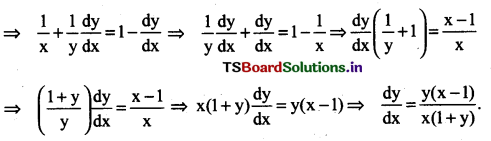
Find \(\frac{\mathrm{dy}}{\mathrm{dx}}\) of the function xy = e(x – y)
Solution:
Given that xy = = e(x – y) ⇒ log(xy) = log e(x – y)
⇒ log x + log y = (x – y) log e ⇒ log x + logy = x – y (∵ log e = 1)
Differentiating both sides w.r.t. x, we have \(\frac{\mathrm{d}}{\mathrm{dx}}\)log x + \(\frac{\mathrm{d}}{\mathrm{dx}}\) log y = \(\frac{\mathrm{d}}{\mathrm{dx}}\)x – \(\frac{\mathrm{d}}{\mathrm{dx}}\)y
Question 9.
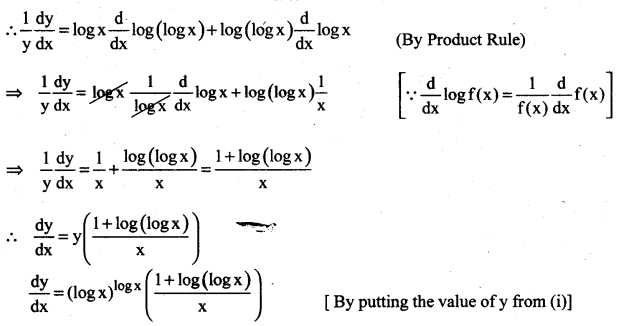
Differentiate the function x (log x)log x, x > 1 w.r.t x.
Solution:
Let y = (log x)log x, x >1 …………… (i)
Taking log of both sides of (i), we have
log y = log(log x)log x = log x log(log x)
Differentiating both sides w.r.t x,we have \(\frac{\mathrm{d}}{\mathrm{dx}}\)(logy) = \(\frac{\mathrm{d}}{\mathrm{dx}}\) (log x log(log x))
III.
Question 1.
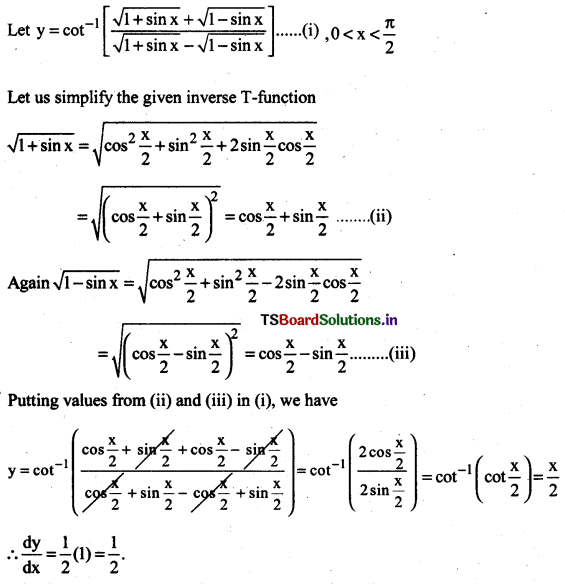
Differentiate cot-1\(\left[\frac{\sqrt{1+\sin \mathrm{x}}+\sqrt{1-\sin \mathrm{x}}}{\sqrt{1+\sin \mathrm{x}}-\sqrt{1-\sin \mathrm{x}}}\right]\), 0 < x < \(\frac{\pi}{2}\) w.r.t. x
Solution:
Question 2.
Differentiate (sin x – cos x)(sin x – cos x), \(\frac{\pi}{4}\) < x < \(\frac{3\pi}{4}\) w.r.t. x
Solution:
Let y = (sin x – cos x)(sin x – cos x) …………… (i)
⇒ logy =log(sin x – cos x)(sin x – cos x) = (sin x – cos x)log(sin x – cos x)
Differentiating both sides w.r.t x,we have
\(\frac{\mathrm{d}}{\mathrm{dx}}\)log y = \(\frac{\mathrm{d}}{\mathrm{dx}}\) (sin x – cos x)log(sin x – cos x)
\(\frac{\mathrm{d}}{\mathrm{dx}}\) log y = (sin x – cos x)\(\frac{\mathrm{d}}{\mathrm{dx}}\)log(sin x – cos x) + log(sin x – cos x)\(\frac{\mathrm{d}}{\mathrm{dx}}\)(sin x – cos x)
⇒ \(\frac{1}{y} \frac{d y}{d x}\) = (sin x – cos x)\(\frac{1}{(\sin x-\cos x)} \frac{d}{d x}\) (sin x – cos x) + log(sin x – cos x)(cos x + sin x)
=(cos x + sin x) + (cos x + sin x)log(sin x – cos x)
⇒ \(\frac{1}{y} \frac{d y}{d x}\) = (cos x + sin x)[1 + log(sin x – cos x)]
⇒ \(\frac{\mathrm{dy}}{\mathrm{dx}}\) = y(cos x + sin x)[1 + log(sin x – cosx)]
Putting the value of y from (i),
⇒ \(\frac{\mathrm{dy}}{\mathrm{dx}}\) = (sin x – cos x)(sin x – cos x) (cos x + sin x)[1 + log(sin x – cos x)]
Question 3.
Differentiate xx + xa + ax + aa, for some fixed a > 0 and x > 0 w.r.t. x
Solution:
Let y = xx + xa + ax + aa
∴ \(\frac{\mathrm{dy}}{\mathrm{dx}}\) = \(\frac{\mathrm{d}}{\mathrm{dx}}\) xx + \(\frac{\mathrm{d}}{\mathrm{dx}}\)xa + \(\frac{\mathrm{d}}{\mathrm{dx}}\)ax + \(\frac{\mathrm{d}}{\mathrm{dx}}\)aa
= \(\frac{\mathrm{d}}{\mathrm{dx}}\)xx + axa-1 + ax log a + 0 [∵ aa is constant as 33 = 27 is constant]
= \(\frac{\mathrm{d}}{\mathrm{dx}}\)xx + axa-1 + ax log a ………….. (i)
To find \(\frac{\mathrm{d}}{\mathrm{dx}}\) (xx) We take u = xx ……………… (ii)
Taking log on both sides of eqn (ii),we have log u = log xx = x log x
∴ \(\frac{\mathrm{d}}{\mathrm{dx}}\) log u = \(\frac{\mathrm{d}}{\mathrm{dx}}\) (x log x) ⇒ \(\frac{1}{u} \frac{d u}{d x}\) = x \(\frac{\mathrm{d}}{\mathrm{dx}}\)(log x) + log x\(\frac{\mathrm{d}}{\mathrm{dx}}\)x (Product Rule)
= x\(\frac{1}{\mathrm{x}}\) + log x.1 = 1 + log x ⇒ \(\frac{\mathrm{du}}{\mathrm{dx}}\) = u(1 + log x)
\(\frac{\mathrm{d}}{\mathrm{dx}}\) xx = xx(1 + log x) [By putting the value of u from (ii)]
Putting this value in eqn. (i), \(\frac{\mathrm{dy}}{\mathrm{dx}}\) = xx(1 + log x) + axa-1 + ax log a.
Question 4.
Find \(\frac{\mathrm{dy}}{\mathrm{dx}}\), if y = sin-1x + sin-1\(\sqrt{1-x^2}\), 0 < x < 1
Solution:
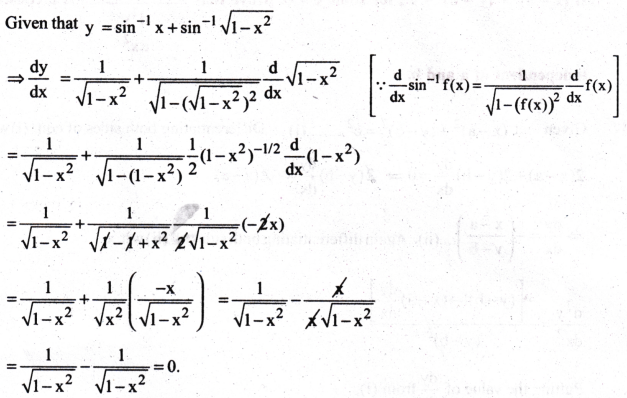
Question 5.
If x\(\sqrt{1+\mathrm{y}}\) + y\(\sqrt{1+\mathrm{x}}\) = 0, for -1 < x < 1, prove that \(\frac{d y}{d x}=-\frac{1}{(1+x)^2}\)
Solution:
Given that x\(\sqrt{1+\mathrm{y}}\) + y\(\sqrt{1+\mathrm{x}}\) = 0 …………. (i)
We shall first find y in terms of x
From eqn. (i), xx\(\sqrt{1+\mathrm{y}}\) = -y\(\sqrt{1+\mathrm{x}}\)
Squaring on both sides,
x2(1 + y) = y2(1 + x)
⇒ x2 + x2y = y2 + y2x or x2 – y2 = -x2y + y2x
⇒ (x – y)(x + y) = -xy(x – y)
Dividing both sides by (x – y) ≠ 0 (∵ x ≠ y)
x + y = -xy ⇒ y + xy = -x ⇒ y(1 + x) = -x
⇒ y = –\(\frac{x}{1+x}\)
Now differentiating both sides wrt.x, we have
\(\frac{d y}{d x}=-\frac{(1+x) \frac{d}{d x}(x)-x \frac{d}{d x}(1+x)}{(1+x)^2}=-\frac{(1+x) \cdot 1-x \cdot 1}{(1+x)^2}=-\frac{1}{(1+x)^2} .\)
Question 6.
If (x – a)2 + (y – b)2 = c2, for some c > 0, prove that \(\frac{\left[1+{\frac{d y}{d x}^2}\right]^3}{d^2 y}\) is a constant independent of a and b.
Solution:
Given that (x – a)2 + (y – b)2 = c2 …………. (i)
Differentiating both sides of eqn. (i) w.r.t. x,
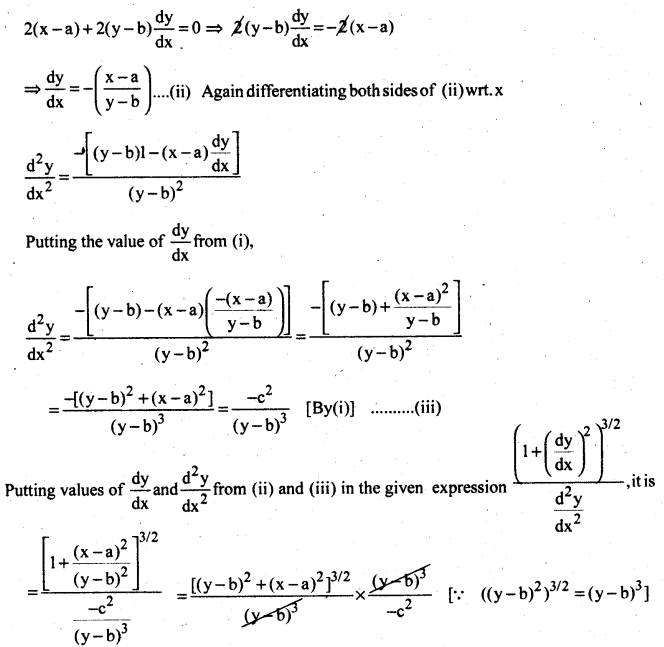
Putting (x – a)2 + (y – b)2 = c2 from (i)
= \(\frac{\left(c^2\right)^{3 / 2}}{-c^2}=\frac{-c^3}{c^2}\) = -c which is a constant and is independent of a and b
Question 7.
If cos y = x cos (a + y), with cos a ≠ ± , prove that \(\frac{d y}{d x}=\frac{\cos ^2(a+y)}{\sin a}\)
Solution:
Given that cos y = x cos (a + y)
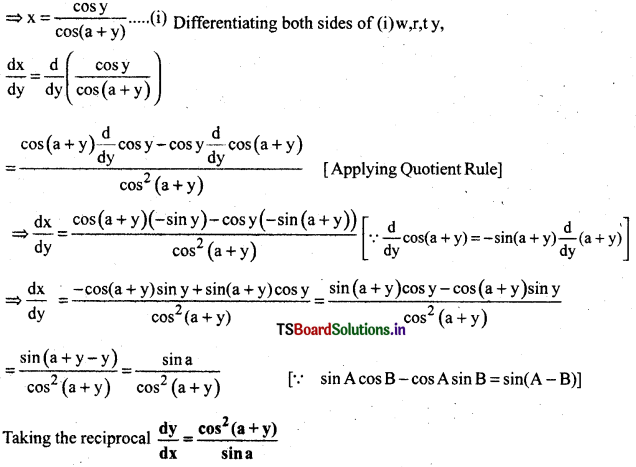
Question 8.
If x = a(cos t + t sin t) and y = a(sin t – t cos t). find \(\frac{\mathrm{d}^2 \mathrm{y}}{\mathrm{dx}^2}\).
Solution:
Given x = a(cos t + t sin t) and y = a(sin t – t cos t),
Differentiating both eqns. w.r.t. t,we have
\(\frac{\mathrm{dx}}{\mathrm{dt}}\) = a(-sin t + t\(\frac{\mathrm{d}}{\mathrm{dt}}\)sin t + sin t\(\frac{\mathrm{d}}{\mathrm{dt}}\)t = a(-sin t + t cos t + sin t) = at cos t
\(\frac{\mathrm{dy}}{\mathrm{dt}}\) = a(cost – \(\frac{\mathrm{d}}{\mathrm{dt}}\)(t cos t)) = a(cos t – t\(\frac{\mathrm{d}}{\mathrm{dt}}\)cos t – cos t \(\frac{\mathrm{d}}{\mathrm{dt}}\)t) a(cos t + t sin t – cos t) = at sin t
∴ y = u + v
∴ \(\frac{d y}{d x}=\frac{d y / d t}{d x / d t}=\frac{\text { at } \sin t}{\text { at } \cos t}=\frac{\sin t}{\cos t}\) = tan t
Now differentiating both sides w.r.t.. x,we have \(\frac{\mathrm{d}^2 \mathrm{y}}{\mathrm{dx}^2}\) = \(\frac{\mathrm{d}}{\mathrm{dx}}\) (tan t) sec2 t\(\frac{\mathrm{d}}{\mathrm{dt}}\)(t)
= sec2 t\(\frac{\mathrm{d}}{\mathrm{dt}}\) = sec2 t\(\left(\frac{1}{a t \cos t}\right)\) ………..(By(i))
= sec2 t\(\left(\frac{\sec t}{\mathrm{at}}\right)=\frac{\sec ^3 t}{\mathrm{at}}\)
Question 9.
If y = ea cos-1x, -1 ≤ x ≤ 1, show that (1 – x2)\(\frac{\mathrm{d}^2 \mathrm{y}}{\mathrm{dx}^2}\) – x\(\frac{\mathrm{dy}}{\mathrm{dx}}\) – a2y = 0
Solution:
Given that y = ea cos-1x
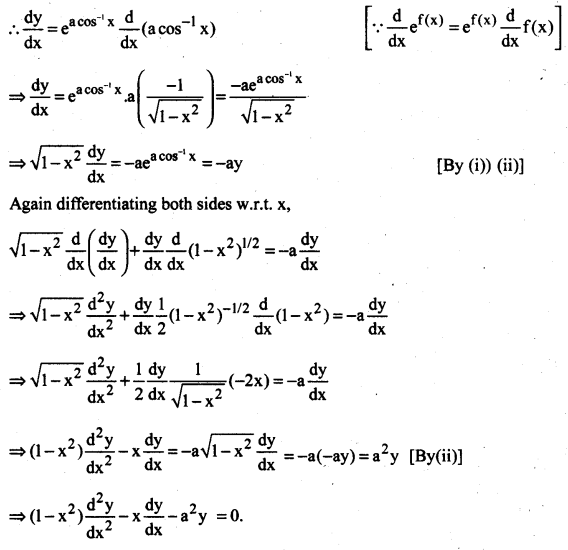
Question 10.
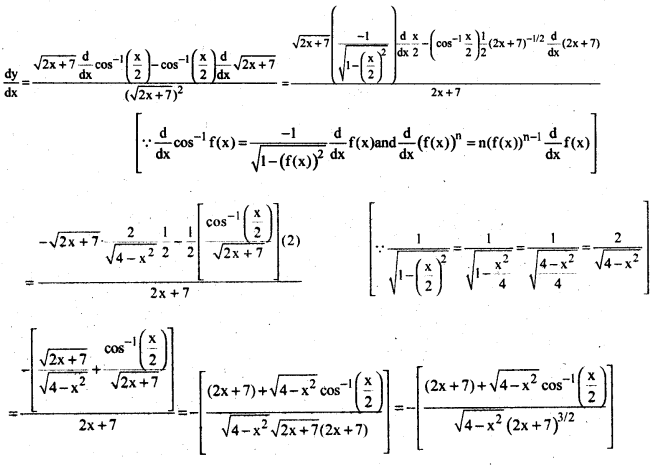
Find the derivative of the function \(\frac{\cos ^{-1} \frac{x}{2}}{\sqrt{2 x+7}}\), -2 < x < 2 with respect to x.
Solution:
Let y = \(\frac{\cos ^{-1} \frac{x}{2}}{\sqrt{2 x+7}}\)
Applying the Quotient rule, we have
Question 11.
Find the derivative of the function xx2-3 + (x – 3)x2, for x > 3 with respect to x.
Solution:
Let y = xx2-3 + (x – 3)x2 for x > 3
Put u = xx2-3 and v = (x – 3)x2
∴ y = u + v
∴ \(\frac{\mathrm{dy}}{\mathrm{dx}}\) = \(\frac{\mathrm{du}}{\mathrm{dx}}\) + \(\frac{\mathrm{dv}}{\mathrm{dx}}\) ………. (1)
Now u = x(x2-3)
∴ Taking log of both sides, we have
log u = log x(x2-3) = (x2 – 3) log x.
Differentiating both sides w.r.t. x, we have
\(\frac{1}{\mathrm{u}}\frac{\mathrm{dy}}{\mathrm{dx}}\) = (x2 – 3) \(\frac{\mathrm{d}}{\mathrm{dx}}\) log x + log x\(\frac{\mathrm{d}}{\mathrm{dx}}\) (x2 – 3) = (x2 – 3)\(\frac{1}{\mathrm{x}}\) + log x(2x – 0)
⇒ \(\frac{1}{\mathrm{u}}\frac{\mathrm{dy}}{\mathrm{dx}}\) = \(\frac{x^2-3}{x}\) + 2x log x
∴ \(\frac{\mathrm{du}}{\mathrm{dx}}\) = u[\(\frac{x^2-3}{x}\) – 2 x log x]
\(\frac{\mathrm{du}}{\mathrm{dx}}\) = x(x2 – 3) \(\left(\frac{x^2-3}{x}+2 x \log x\right)\) [By putting u = xx2-3]
Now consider v = (x – 3)x2 ⇒ log v = log (x – 3)x2 = x2 log(x – 3)
∴ \(\frac{\mathrm{d}}{\mathrm{dx}}\)log v = \(\frac{\mathrm{d}}{\mathrm{dx}}\)(x2 log(x – 3))
⇒ \(\frac{1}{\mathrm{v}}\frac{\mathrm{dv}}{\mathrm{dx}}\) = x2\(\frac{\mathrm{d}}{\mathrm{dx}}\) log(x – 3) + log(x – 3)\(\frac{\mathrm{d}}{\mathrm{dx}}\)x2
= x2\(\frac{1}{x-3} \frac{d}{d x}\)(x – 3) + log(x – 3) . 2x
⇒ \(\frac{1}{\mathrm{v}}\frac{\mathrm{dv}}{\mathrm{dx}}\) = \(\frac{x^2}{x-3}\) + 2x log(x – 3)
⇒ \(\frac{\mathrm{dv}}{\mathrm{dx}}\) = v[\(\frac{x^2}{x-3}\) + 2x log(x – 3)]
= (x – 3)x2[\(\frac{x^2}{x-3}\) + 2x log(x – 3)] ……………. (iii) [By putting v = (x – 3)x2]
Putting values of \(\frac{\mathrm{du}}{\mathrm{dx}}\) and \(\frac{\mathrm{dv}}{\mathrm{dx}}\) from (ii) and (iii) in (i), we have
\(\frac{\mathrm{dy}}{\mathrm{dx}}\) = x(x2-3)[\(\frac{x^2-3}{x}\) + 2x log x] + (x – 3)x2 [\(\frac{x^2}{x-3}\) + 2x log(x – 3)]
Question 12.
If f (x) = |x|3 show that f”(x) exists for all real x and find it.
Solution:
Given f (x) = |x|3 = x3 if x ≥ 0 ………… (i) [∵ |x| = x if x ≥ 0]
and f(x) = |x|3 = (-x)3 = -x3 if x < 0 (ii) [∵ |x| = -x if x < 0]
f'(x) = 3x2 if x >0 and f'(x) = -3x2 if x < 0 ……………. (iii) (At x = 0, we can’t write the value of f(x) by usual rule of derivatives because x = 0 is a partitioning point of values of f(x) given by (i) and (ii)) ∴ f'(x) = 6x if x > 0 and f'(x) = -6x if x < 0 …………… (iv) ∴ From (iv), f”(x) exists for all x > 0 and for all x < 0 i.e., for all x ∈ R except at x = 0
(i) Let us discuss derivability of f(x) at x = 0
L f'(0) = \(\underset{\mathrm{x} \rightarrow 0-}{\mathrm{Lt}}\) \(\frac{f(x)-f(0)}{x-0}\) = \(\underset{\mathrm{x} \rightarrow 0-}{\mathrm{Lt}}\) \(\frac{-x^3-0}{x}\) [By (ii) and (i)]
= \(\underset{\mathrm{x} \rightarrow 0-}{\mathrm{Lt}}\) -x2 = 0 (On putting x = 0)
R f'(0) = \(\underset{\mathrm{x} \rightarrow 0+}{\mathrm{Lt}}\) \(\frac{f(x)-f(0)}{x-0}\) = \(\underset{\mathrm{x} \rightarrow 0+}{\mathrm{Lt}}\) \(\frac{-x^3-0}{x-0}\) [By (i)]
= \(\underset{\mathrm{x} \rightarrow 0+}{\mathrm{Lt}}\) x2 = 0 (On putting x = 0)
∴ Lf'(0) = Rf'(0) = 0
∴ f(x) is derivable at x = 0 and f'(0) = 0