
Referring to the AP Inter 2nd Year Maths Study Material Chapter 5 Continuity and Differentiability Exercise 5e Solutions makes it easier to understand complex problems.
AP Inter 2nd Year Maths Continuity and Differentiability Solutions Exercise 5e
Question 1.
Differentiate cos x . cos 2x . cos 3x w.r.t. x
Solution:
Let y = cos x cos 2x cos 3x ………… (i)
⇒ log(y) = log(cos x cos 2x cos 3x) = log(cos x) + log(cos 2x) + log(cos 3x)
Differentiating both sides w.r.t. x. we have
\(\frac{\mathrm{d}}{\mathrm{dx}}\)log y = \(\frac{\mathrm{d}}{\mathrm{dx}}\)logcosx + \(\frac{\mathrm{d}}{\mathrm{dx}}\)logcos2x + \(\frac{\mathrm{d}}{\mathrm{dx}}\)logcos3x.
∴ \(\frac{1}{y} \frac{d y}{d x}=\frac{1}{\cos x} \frac{d}{d x} \cos x+\frac{1}{\cos 2 x} \frac{d}{d x} \cos 2 x+\frac{1}{\cos 3 x} \frac{d}{d x} \cos 3 x\) [∵ \(\frac{\mathrm{d}}{\mathrm{dx}}\) logf(x) = \(\frac{1}{f(x)} \frac{d}{d x}\) f(x)]
= \(\frac{1}{\cos x}\)(-sin x) + \(\frac{1}{\cos 2x}\)(-sin 2x) \(\frac{\mathrm{d}}{\mathrm{dx}}\) (2x) + \(\frac{1}{\cos 3x}\)(-sin 3x)\(\frac{\mathrm{d}}{\mathrm{dx}}\)3x
= -tan x – (tan2x)2 – tan3x(3)
∴ \(\frac{\mathrm{dy}}{\mathrm{dx}}\) = -y(tanx + 2tan2x + 3tan3x)
\(\frac{\mathrm{dy}}{\mathrm{dx}}\) = -cosx cos2x cos3x(tan x + 2tan 2x +3tan3x). [∵ By putting the value of y from (i)]

Question 2.
Differentiate \(\sqrt{\frac{(x-1)(x-2)}{(x-3)(x-4)(x-5)}}\) w.r.t. x.
Solution:
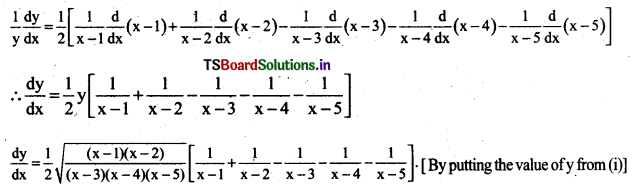
Let y = \(\sqrt{\frac{(x-1)(x-2)}{(x-3)(x-4)(x-5)}}=\left[\frac{(x-1)(x-2)}{(x-3)(x-4)(x-5)}\right]^{1 / 2}\) ……………. (i)
Taking log on both sides and simplifying we have
log y = \(\frac{1}{2}\)[log(x – 1) + log(x – 2) – log(x – 3) – log(x – 4) – log(x – 5)]
Differentiating both sides w.r.t. x we have
Question 3.
Differentiate xx – 2sin x w.r.t. x.
Solution:
Let y = xx – 2sin x
Put u = xx and v = 2sin x ∴ y = u – v
∴ \(\frac{\mathrm{dy}}{\mathrm{dx}}\) = \(\frac{\mathrm{du}}{\mathrm{dx}}\) – \(\frac{\mathrm{dv}}{\mathrm{dx}}\) ………….. (i)
Now u = xx
⇒ log u = log xx = x log x [∵ log mn = n log m]
⇒ \(\frac{\mathrm{d}}{\mathrm{dx}}\)(log u) = \(\frac{\mathrm{d}}{\mathrm{dx}}\)(x log x)
⇒ \(\frac{1}{u} \frac{d u}{d x}\) = x \(\frac{\mathrm{d}}{\mathrm{dx}}\) log x + log x \(\frac{\mathrm{d}}{\mathrm{dx}}\) x = x \(\frac{1}{x}\) + log x1
= 1 + log x
∴ \(\frac{\mathrm{du}}{\mathrm{dx}}\) = u(1 + log x) = xx(1 + log x) …………. (ii)
Again v = 2sin x
∴ \(\frac{\mathrm{dv}}{\mathrm{dx}}\) = \(\frac{\mathrm{d}}{\mathrm{dx}}\) 2sin x = 2sin x log2\(\frac{\mathrm{d}}{\mathrm{dx}}\)sinx [∵ \(\frac{\mathrm{d}}{\mathrm{dx}}\) af(x) = af(x) log a\(\frac{d}{d x}\) f(x)]
⇒ \(\frac{\mathrm{dv}}{\mathrm{dx}}\) = 2sin x (log 2)cos x = cos x . 2sin x log 2 ………….. (iii)
Putting values from (ii) and (iii) in (i), we have
\(\frac{\mathrm{dy}}{\mathrm{dx}}\) = xx(1 + log x) – cos x 2sin x log 2
Question 4.
Differentiate (x + 3)2 . (x + 4)3 . (x + 5)4 w.r.t. x.
Solution:
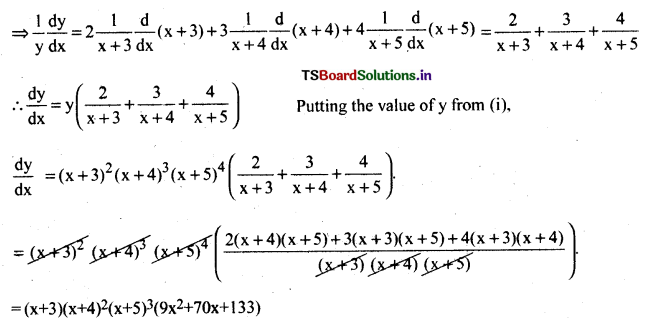
Let y = (x + 3)2 . (x + 4)3 . (x + 5)4 ………. (i)
log y = 2 log (x + 3) + 3 log(x + 4) + 4 log(x + 5)
∴ \(\frac{\mathrm{d}}{\mathrm{dx}}\) log y = 2\(\frac{\mathrm{d}}{\mathrm{dx}}\) log(x + 3) + 3\(\frac{\mathrm{d}}{\mathrm{dx}}\)log(x + 4) + 4\(\frac{\mathrm{d}}{\mathrm{dx}}\) log(x + 5)
Question 5.
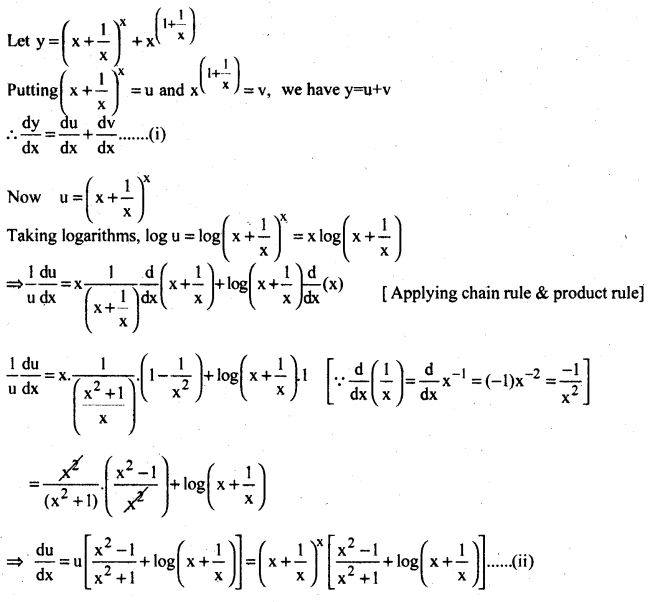
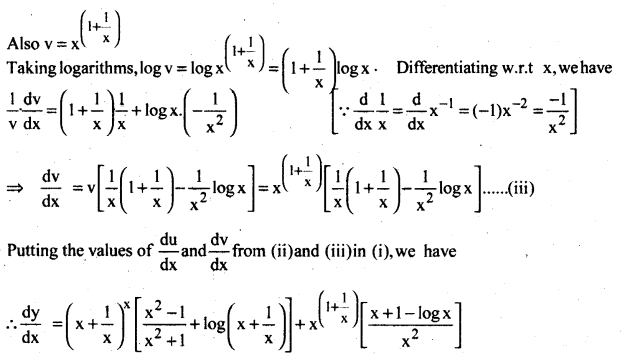
Differentiate \(\left(x+\frac{1}{x}\right)^x+x^{\left(1+\frac{1}{x}\right)}\) w.r.t. x
Solution:
Question 6.
Differentiate (log x)x + xlog x w.r.t. x.
Solution:
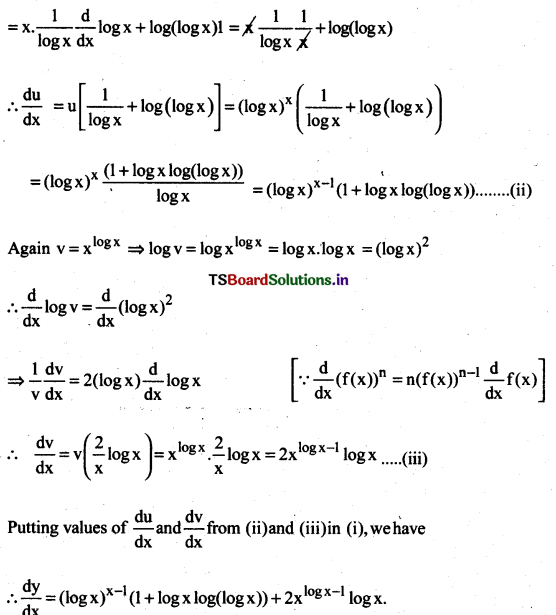
Let y = (log x)x + xlog x
Put u = (log x)x and v = xlog x
Then y = u + v ⇒ \(\frac{d y}{d x}=\frac{d u}{d x}+\frac{d v}{d x}\) ……….. (i)
Now u = (log x)x
⇒ log u = log(log x)x = x log(log x) [∵ log mn = n log m]
∴ \(\frac{\mathrm{d}}{\mathrm{dx}}\) log u = \(\frac{\mathrm{d}}{\mathrm{dx}}\) [x log(log x)]
∴ \(\frac{1}{\mathrm{u}}\frac{\mathrm{d}}{\mathrm{dx}}\) = x \(\frac{\mathrm{d}}{\mathrm{dx}}\) log(log x) + log(log x) \(\frac{\mathrm{d}}{\mathrm{dx}}\) x [By Product rule]
Question 7.
Differentiate (sin x)x + sin-1\(\sqrt{x}\) w.r.t. x.
Solution:
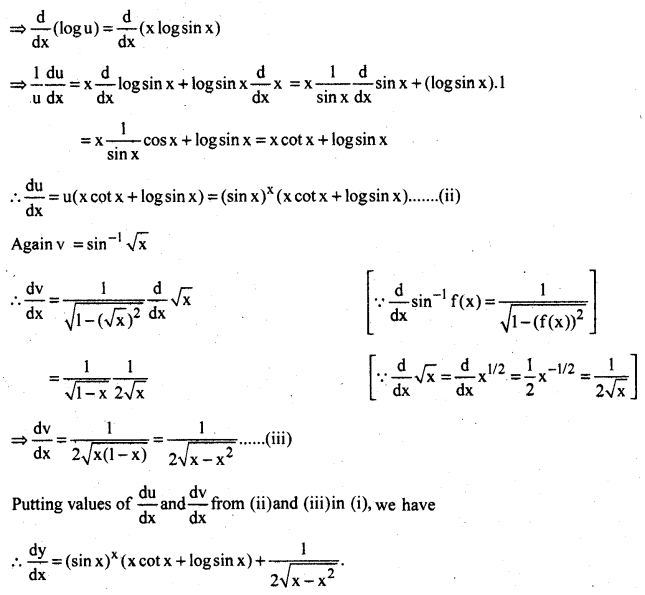
Let y = (sin x)x + sin-1\(\sqrt{x}\)
Put u = (sin x)x and v = sin-1\(\sqrt{x}\)
∴ \(\frac{d y}{d x}=\frac{d u}{d x}+\frac{d v}{d x}\) ……….. (i)
Now u = (sin x)x
∴ log u = log (sin x)x = x log sin x
Question 8.
Differentiate xsin x + (sin x)cos x w.r.t. x.
Solution:
Let y = u + v
Put u = xsin x and v = (sin x)cos x
Then y = u + v
⇒ \(\frac{d y}{d x}=\frac{d u}{d x}+\frac{d v}{d x}\) ……….. (i)
Now u = xsin x
∴ log u = log xsin x = sin x log x
∴ \(\frac{\mathrm{d}}{\mathrm{dx}}\) log u = \(\frac{\mathrm{d}}{\mathrm{dx}}\) (sin x log x)
⇒ \(\frac{1}{\mathrm{u}}\frac{\mathrm{du}}{\mathrm{dx}}\) = sin x \(\frac{\mathrm{d}}{\mathrm{dx}}\) log x + log x \(\frac{\mathrm{d}}{\mathrm{dx}}\) sin x
= sin x \(\frac{1}{\mathrm{x}}\) + (log x) cos x = \(\frac{\sin x}{x}\) + cos x log x
\(\frac{d u}{d x}=u\left(\frac{\sin x}{x}+\cos x \log x\right)=x^{\sin x}\left(\frac{\sin x}{x}+\cos x \log x\right)\) …………… (ii)
Again v =(sin x)c0s x ⇒ log y = log(sin x)cos x = cos x log sin x
∴ \(\frac{\mathrm{d}}{\mathrm{dx}}\) (log v) = \(\frac{\mathrm{d}}{\mathrm{dx}}\)[cos x log sin x]
⇒ \(\frac{1}{\mathrm{v}}\frac{\mathrm{du}}{\mathrm{dx}}\) = cos x \(\frac{\mathrm{d}}{\mathrm{dx}}\) log sin x + log sin x\(\frac{\mathrm{d}}{\mathrm{dx}}\)cos x
= cos x \(\frac{1}{\sin x} \frac{d}{d x}\)(sin x) + log sin x(-sin x) = cot x . cos x – sin x log sin x
∴ \(\frac{\mathrm{dv}}{\mathrm{dx}}\) = v(cos x cot x – sin x log sin x)
= (sin x)cos x(cos x cot x – sin x log sin x) ……………. (iii)
Putting values of \(\frac{\mathrm{du}}{\mathrm{dx}}\) and \(\frac{\mathrm{dv}}{\mathrm{dx}}\) from (ii)and (in)in (i),we have
∴ \(\frac{\mathrm{dy}}{\mathrm{dx}}\) = xsin x(\(\frac{\sin x}{x}\) + cos x log x) + (sin x)cos x(cos x cot x – sin x log sin x)
Question 9.
Differentiate xx cos x + \(\frac{x^2+1}{x^2-1}\) w.r.t. x.
Solution:
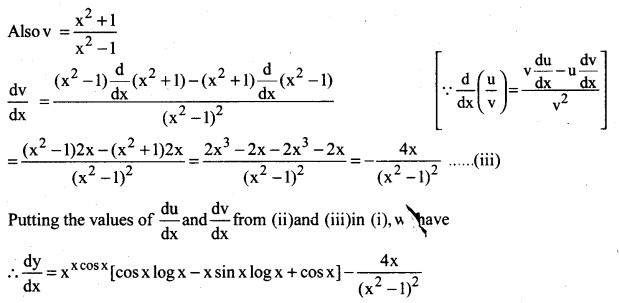
let y = xx cos x + \(\frac{x^2+1}{x^2-1}\)
Putting xx cos x = u and \(\frac{x^2+1}{x^2-1}\) = v
We have y = u + v ⇒ \(\frac{\mathrm{dy}}{\mathrm{dx}}\) = \(\frac{\mathrm{du}}{\mathrm{dx}}\) + \(\frac{\mathrm{dv}}{\mathrm{dx}}\) ……….. (i)
Now u = xx cos x
Taking logarithms, log u = log xx cos x = x cos x log x
Differentiating w.r.t. x, we have
\(\frac{1}{\mathrm{u}}\frac{\mathrm{du}}{\mathrm{dx}}\) = \(\frac{\mathrm{d}}{\mathrm{dx}}\)(x cos x log x) = \(\frac{\mathrm{d}}{\mathrm{dx}}\)(x) cos x log x + x \(\frac{\mathrm{d}}{\mathrm{dx}}\) (cos x) log x + x cos x \(\frac{\mathrm{d}}{\mathrm{dx}}\) (log x)
[∵ \(\frac{\mathrm{d}}{\mathrm{dx}}\) (uvw) + \(\frac{\mathrm{du}}{\mathrm{dx}}\)vw + u\(\frac{\mathrm{dv}}{\mathrm{dx}}\).w + uv\(\frac{\mathrm{dw}}{\mathrm{dx}}\)]
= 1 cos x log x + x(-sin x)log x + x cos x.\(\frac{1}{\mathrm{x}}\)
⇒ \(\frac{\mathrm{du}}{\mathrm{dx}}\) = u[cos x log x – x sin x log x + cos x]
= xx cos x[cos x log x – x sin x log x + cos x] …………. (ii)
Question 10.
Differentiate (x cos x)x + (x sin x)1/x w.r.t. x.
Solution:
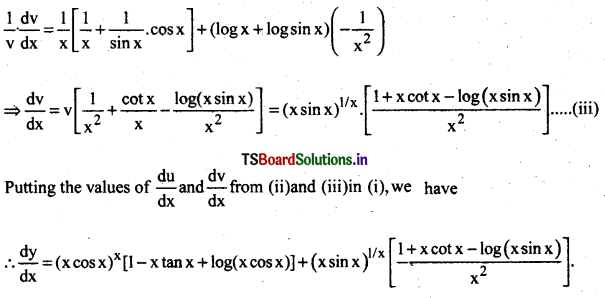
Let y = (x cos x)x + (x sin x)1/x
Putting (x cos x)x = u and (x sin x)1/x = v,
we have y = u + v
⇒ \(\frac{\mathrm{dy}}{\mathrm{dx}}\) = \(\frac{\mathrm{du}}{\mathrm{dx}}\) + \(\frac{\mathrm{dv}}{\mathrm{dx}}\) …………. (i)
Now u = (x cos x)x
Taking logarithms,
log u = log(x cos x)x = x log (x cos x) = x(log x + log cos x)
Differentiating w.r.t. x, we have
\(\frac{1}{u} \cdot \frac{d u}{d x}=x\left[\frac{1}{x}+\frac{1}{\cos x} \cdot(-\sin x)\right]\) + (log x + log cos x) . 1
⇒ \(\frac{\mathrm{du}}{\mathrm{dx}}\)[1 – x tan x + log(x cos x)] [∵ log a + log b = log ab]
= (x cos x)x [1 – x tan x + log(x cos x)] ……………. (ii)
Also v = (x sin x)1/x
Taking logarithms,
log v = log (x sin x)1/x = \(\frac{1}{x}\) log (x sin x) = \(\frac{1}{x}\) (log x + log sin x)
Differentiating w.r.t. x, we have
Question 11.
Find \(\frac{\mathrm{dy}}{\mathrm{dx}}\) of the function xy + yx = 1.
Solution:
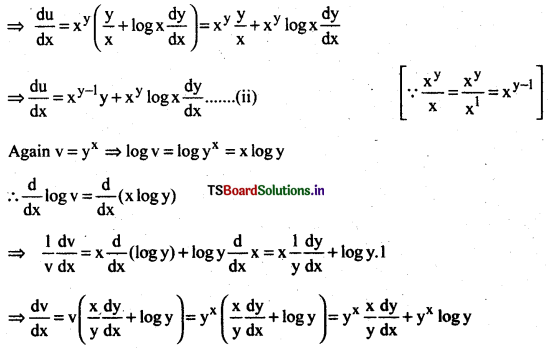
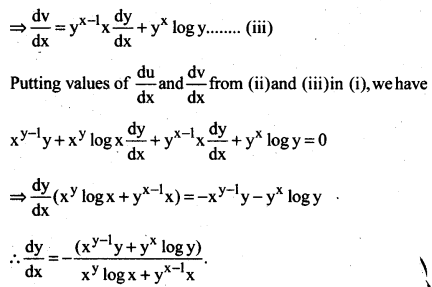
Given that xy + yx = 1 ⇒ u + v = 1 where u = xy and v = yx
⇒ \(\frac{\mathrm{d}}{\mathrm{dx}}\) (u) + \(\frac{\mathrm{d}}{\mathrm{dx}}\) (v) = \(\frac{\mathrm{d}}{\mathrm{dx}}\) (1)
⇒ \(\frac{\mathrm{du}}{\mathrm{dx}}\) + \(\frac{\mathrm{dv}}{\mathrm{dx}}\) = 0 ………….. (i)
Now, u = xy log u = log xy = y log x
∴ \(\frac{\mathrm{d}}{\mathrm{dx}}\)log u = \(\frac{\mathrm{d}}{\mathrm{dx}}\)(y log x)
⇒ \(\frac{1}{\mathrm{u}}\frac{\mathrm{du}}{\mathrm{dx}}\) = y\(\frac{\mathrm{d}}{\mathrm{dx}}\)log x + log x\(\frac{\mathrm{dy}}{\mathrm{dx}}\) = y\(\frac{1}{\mathrm{x}}\) + log x \(\frac{\mathrm{dy}}{\mathrm{dx}}\)
∴ \(\frac{\mathrm{du}}{\mathrm{dx}}\) = \(u\left(\frac{y}{x}+\log x \cdot \frac{d y}{d x}\right)\)
Question 12.
Find \(\frac{\mathrm{dy}}{\mathrm{dx}}\) of the function yx = xy.
Solution:
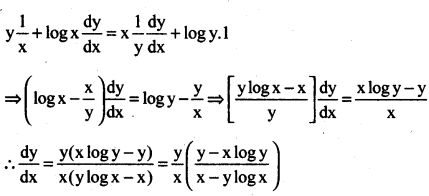
Given that yx = xy ⇒ xy = yx
Taking logarithms,
log xy = log yx
⇒ y log x = x log y.
Differentiating w.r.t. x we have
Question 13.
Find \(\frac{\mathrm{dy}}{\mathrm{dx}}\) of the function (cos x)y = (cos y)x
Solution:
Given that (cos x)y = (cos y)x ⇒ log(cos x)y = log(cos y)x
⇒ y log cos x = x log cos y.
Differentiating both sides w.r.t. x, we have
\(\frac{\mathrm{d}}{\mathrm{dx}}\) (y log cos x) = \(\frac{\mathrm{d}}{\mathrm{dx}}\) (x log cos y)
Applying Product Rule on both sides,
y\(\frac{\mathrm{d}}{\mathrm{dx}}\)log cos x + log cos x\(\frac{\mathrm{dy}}{\mathrm{dx}}\) = x\(\frac{\mathrm{d}}{\mathrm{dx}}\)log cos y + log ços y\(\frac{\mathrm{d}}{\mathrm{dx}}\)x
⇒ y. \(\frac{1}{\cos x}\frac{\mathrm{d}}{\mathrm{dx}}\) cos x + log cos x\(\frac{1}{\cos y}\frac{\mathrm{dy}}{\mathrm{dx}}\) = x. \(\frac{\mathrm{d}}{\mathrm{dx}}\) cos y + log cos y
⇒ y \(\frac{1}{\cos x}\) (-sin x) + log cos x\(\frac{\mathrm{dy}}{\mathrm{dx}}\) = x \(\frac{1}{\cos y}\) (-sin y \(\frac{\mathrm{dy}}{\mathrm{dx}}\)) + log cos y
⇒ -y tan x + log cos x . \(\frac{\mathrm{dy}}{\mathrm{dx}}\) = -x tan y \(\frac{\mathrm{dy}}{\mathrm{dx}}\) + log cos y
⇒ x tan y\(\frac{\mathrm{dy}}{\mathrm{dx}}\) + log cos x . \(\frac{\mathrm{dy}}{\mathrm{dx}}\) = y tan x + log cos y
⇒ \(\frac{\mathrm{dy}}{\mathrm{dx}}\)(x tan y + log cos x) = y tan x + log cos y
⇒ \(\frac{\mathrm{dy}}{\mathrm{dx}}\) = \(\frac{y \tan x+\log \cos y}{x \tan y+\log \cos x}\)
Question 14.
Find the derivative of the function given by f(x) = (1 + x) (1 + x2) (1 + x4) (1 + x8) and hence find f'(1).
Solution:
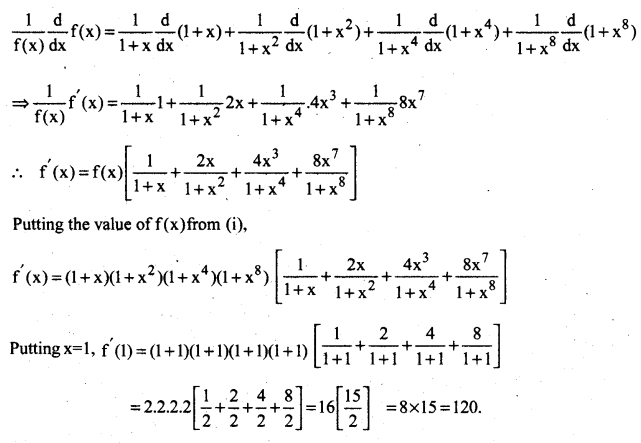
Given f(x) = (1 + x) (1 + x2) (1 + x4) (1 + x8) …………. (i)
Taking logs on both sides, we have
log f(x) = log(1 + x) + log(1 + x2) + log (1 + x4) + log(1 + x8)
Differentiating both sides w.r.t. x, we have
Question 15.
Differentiate (x2 – 5x + 8) (x3 + 7x + 9) in three was mentioned below:
i) by using product rule
ii) b expanding the product to obtain a single polynomial.
iii) by logarithmic differentiation. l)o they all give the same answer?
Solution:
Let y = (x2 – 5x + 8) (x3 + 7x + 9) ……………… (1)
(i) To find \(\frac{\mathrm{dy}}{\mathrm{dx}}\) by using Product Rule:
\(\frac{\mathrm{dy}}{\mathrm{dx}}\) = (x2 – 5x + 8)\(\frac{\mathrm{d}}{\mathrm{dx}}\)(x3 + x + 9) + (x3 + 7x + 9)\(\frac{\mathrm{d}}{\mathrm{dx}}\)(x2 – 5x + 8)
= (x2 – 5x + 8x)(3x2 + 7) + (x3 + 7x + 9)(2x – 5)
= 3x4 + 7x2 – 15x3 – 35x + 24x2 + 56 + 2x4 – 5x3 + 14x2 – 35x + 18x – 45
= 5x4 – 20x3 + 45x2 – 52x + 11 …………… (2)
(ii) To find \(\frac{\mathrm{dy}}{\mathrm{dx}}\) by expanding the product to obtain a single polynomial:
From (1)y = (x2 – 5x + 8)(x3 + 7x + 9)
= x5 + 7x3 + 9x2 – 5x4 – 35x2 – 45x + 8x3 + 56x + 72
⇒ y = x5 – 5x4 + 15x3 – 26x2 + 11x + 72
∴ \(\frac{\mathrm{dy}}{\mathrm{dx}}\) = 5x4 – 20x3 + 45x2 – 52x + 11 ……………….. (3)
(iii) To find \(\frac{\mathrm{dy}}{\mathrm{dx}}\) by logarithmic differentiation:
Taking logs on both sides of (1), we have
log y = log(x2 – 5x + 8)(x3 + 7x + 9)
∴ \(\frac{\mathrm{d}}{\mathrm{dx}}\)log y = \(\frac{\mathrm{d}}{\mathrm{dx}}\)log(x2 – 5x + 8) + \(\frac{\mathrm{d}}{\mathrm{dx}}\) log(x3 + 7x + 9)
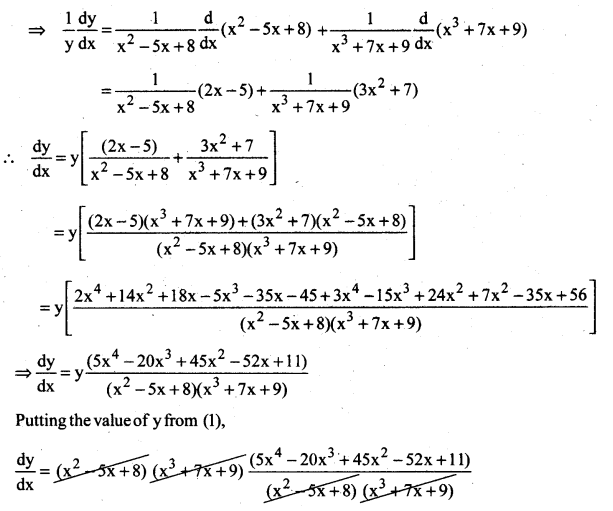
= 5x4 – 20x3 + 45x2 – 52x + 11
From (2), (3) and (4) we get the same answer in all the 3 ways
Question 16.
If u, y and w are functions of x, then show that
\(\frac{\mathrm{d}}{\mathrm{dx}}\) (uvw) = \(\frac{\mathrm{du}}{\mathrm{dx}}\) v.w + u.\(\frac{\mathrm{dv}}{\mathrm{dx}}\) .w + u.v\(\frac{\mathrm{dw}}{\mathrm{dx}}\) in two ways – first by repeated application of product rule, second b logarithm differentiation.
Solution:
Given that u, y and w are functions of x.
To prove: \(\frac{\mathrm{d}}{\mathrm{dx}}\) (uvw) = \(\frac{\mathrm{du}}{\mathrm{dx}}\) v.w + u.\(\frac{\mathrm{dv}}{\mathrm{dx}}\) .w + u.v\(\frac{\mathrm{dw}}{\mathrm{dx}}\) …………. (i)
(i) To prove eqn. (i): by using product rule
L.H.S = \(\frac{\mathrm{d}}{\mathrm{dx}}\)(uvw) = \(\frac{\mathrm{d}}{\mathrm{dx}}\)(uv)w = uv\(\frac{\mathrm{d}}{\mathrm{dx}}\)(w) + w\(\frac{\mathrm{d}}{\mathrm{dx}}\)(uv)
Again Applying Product Rule on \(\frac{\mathrm{d}}{\mathrm{dx}}\) (uv)
L.H.S. = \(\frac{\mathrm{d}}{\mathrm{dx}}\)(uvw) = uvv\(\frac{\mathrm{dw}}{\mathrm{dx}}\) + w[u\(\frac{\mathrm{d}}{\mathrm{dx}}\)v + v\(\frac{\mathrm{d}}{\mathrm{dx}}\)u] = uv\(\frac{\mathrm{dw}}{\mathrm{dx}}\) + uw\(\frac{\mathrm{dv}}{\mathrm{dx}}\) + vw\(\frac{\mathrm{du}}{\mathrm{dx}}\) = R.H.S
∴ \(\frac{\mathrm{d}}{\mathrm{dx}}\) (uvw) = \(\frac{\mathrm{du}}{\mathrm{dx}}\) vw + u\(\frac{\mathrm{dv}}{\mathrm{dx}}\)w + uv\(\frac{\mathrm{dw}}{\mathrm{dx}}\). Hence proved.
(ii) Let y = uvw
Taking logs on both sides logy = log( uvw) = log u + log v + log w
∴ \(\frac{\mathrm{d}}{\mathrm{dx}}\)log y = \(\frac{\mathrm{d}}{\mathrm{dx}}\)log u + \(\frac{\mathrm{d}}{\mathrm{dx}}\) log v + \(\frac{\mathrm{d}}{\mathrm{dx}}\) log w
⇒ \(\frac{1}{y} \frac{d y}{d x}=\frac{1}{u} \frac{d u}{d x}+\frac{1}{v} \frac{d v}{d x}+\frac{1}{w} \frac{d w}{d x} \Rightarrow \frac{d y}{d x}=y\left[\frac{1}{u} \frac{d u}{d x}+\frac{1}{v} \frac{d v}{d x}+\frac{1}{w} \frac{d w}{d x}\right]\)
Putting y = uvw, \(\frac{\mathrm{d}}{\mathrm{dx}}\)(uvw) = uvw \(\left(\frac{1}{u} \frac{d u}{d x}+\frac{1}{v} \frac{d v}{d x}+\frac{1}{w} \frac{d w}{d x}\right)\)
= \(\frac{\mathrm{du}}{\mathrm{dx}}\) vw + u\(\frac{\mathrm{dv}}{\mathrm{dx}}\)w + uv\(\frac{\mathrm{dw}}{\mathrm{dx}}\)
Hence proved.
∴ In both the methods, we will get the same answer