
Reviewing AP Inter 2nd Year Commerce Study Material Chapter 7 Entrepreneurship Questions and Answers can help students prepare confidently for exams.
AP Inter 2nd Year Commerce 7th Lesson Entrepreneurship Questions and Answers
Very Short Answer Questions
Question 1.
Who is an entrepreneur?
Answer:
The word entrepreneur is derived from the French verb “entrepreneur”, which means to undertake’.
Entrepreneur is a person who starts his own, new and small business. An entrepreneur may be referred to such a single person or a group who promote a new enterprise by collecting various factors of production and bearing the risks arising out of such venture.
Question 2.
What is an entrepreneurship?
Answer:
Peter F Drucker stated that entrepreneurship is neither a science nor an art. It has a knowledge base. Knowledge in entrepreneurship is a means to an end. Indeed, the ends largely define what contributes knowledge in practice.
Question 3.
What is the primary difference between a startup and a small business?
Answer:
| Startup | Traditional small business |
| 1. A startup is a new type of business that usually brings a completely new idea, product, or way of doing things. | 1. A traditional small business follows a well known and simple business model, like a local grocery shop or tailor. |
| 2. It wants to grow very fast and reach many customers. | 2. It grows slowly and steadily, serving customers. |
Question 4.
What is the main role of role of Entrepreneurship?
Answer:
The main role of entrepreneurship is to identify opportunities and create value by organizing resources to start and manage businesses.
It includes Job creation, Innovation and Economic growth, Capital formation.
Question 5.
What is the difference between innovation and invention?
Answer:
Innovation: Innovation involves successfully applying new ideas that create value.
It means turning an invention or a new idea into something practical, useful, and marketable.
Invention: An invention refers to the creation of a new device, method, or process. It represents the initial phase of “discovery.”

Question 6.
Mention one famous Indian startup and its field.
Answer:
- Flipkart: Changed e-commerce in India, making online shopping available to millions (Acquired by Walmart).
- Paytm: A leader in digital payments and financial services, popularizing cashless transactions.
Short Answer Questions
Question 1.
Explain the importance of entrepreneurship in economic development.
Answer:
Importance of entrepreneurship: Entrepreneurship serves as a powerful driver of progress, benefitting both the economy and society.
1. Job Creation (Create New Jobs): New businesses are essential for creating jobs. Entrepreneurs not only employ themselves but also add jobs for others as their ventures grow, which helps reduce unemployment rates.
2. Innovation & Economic Growth (Bring New Ideas to Life): Entrepreneurs introduce new products, services, and technologies that enhance lives and form new markets. This ongoing innovation boosts economic growth by increasing productivity and generating wealth.
3. Capital Formation (Turn Savings into Solutions): Entrepreneurs mobilize idle savings from different sources (investors, banks) and put them to productive use by starting businesses, leading to more investment in the economy.
4. Improved Standard of Living (Make Our Lives Better): By offering a wider variety of goods and services, often at competitive prices, entrepreneurs enhance consumer choice and raise the overall standard of living
5. Balanced Regional Development: Entrepreneurship can spread economic activity to less developed regions, helping to lessen regional disparities.
Question 2.
Describe the key traits of an entrepreneur.
Answer:
Key Traits of an entrepreneur
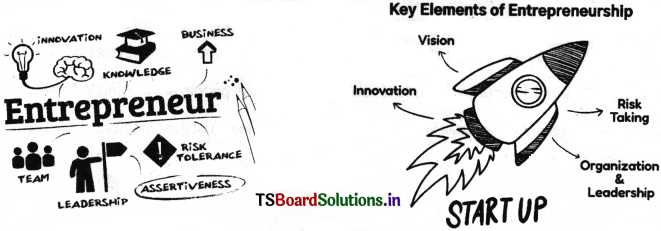
1. Risk-taking: This is not about being careless or reckless. It means having a strong readiness to take calculated risks. Entrepreneurs can balance potential rewards against possible losses and dare to act despite uncertainty. They understand that without some degree of risk, there is usually no significant reward.
2. Creativity and Innovation: Entrepreneurs are driven to come up with new ideas, solve existing problems, or find entirely new ways to deliver value to customers. They do not stick to traditional thinking and are willing to challenge established norms to find truly innovative solutions.
3. Decision-making and Leadership: In the fast-paced and often unclear world of new ventures, entrepreneurs must make quick and sound decisions, even when they lack complete information. They also need to inspire and guide their teams, clearly stating a goal and motivating others to work passionately toward it.
4. Faith in Self and Idea and Perseverance: The journey of entrepreneurship is often full of challenges. Entrepreneurs must believe in themselves and the value of their ideas, showing strong confidence. They must also be determined to push through, even during difficult times. They see mistakes as chances to learn and continually push forward.
Question 3.
What are some common challenges that startups face?
Answer:
Startup Challenges:
- Lack of Funds: Many startups struggle to secure enough and timely funding, especially in the early stages.
- Competition: The market is often crowded, and new startups face strong competition from established companies and other newcomers.
- Market Acceptance: Even a great idea needs customer acceptance. Many startups fail -because they can’t find enough customers willing to pay for their product or service.
- Regulatory Issues: Navigating complicated government regulations, permits, and legal requirements can be overwhelming.
- Talent Acquisition: Finding and keeping skilled employees, especially in niche tech fields, can be difficult.
Question 4.
Explain the opportunities for entrepreneurship in Andhra Pradesh.
Answer:
Opportunities for entrepreneurship in Andhra Pradesh:
1. Aqua Culture & Fisheries: Andhra Pradesh leads in aquaculture. Local entrepreneurs, from small-scale farmers to larger exporters, take risks in shrimp and fish farming, processing and export, significantly aiding the economy and job creation.
2. Food Processing & Agri-Businesses: Entrepreneurs are emerging in areas such as chilli processing (Guntur), mango pulp production, and other agro-based fields, adding value to agricultural products and generating rural jobs.
3. Small & Medium Enterprises (SMEs) in Tier 2/3 Cities: In cities like Visakhapatnam, Vijayawada, and Tirupati, local entrepreneurs launch SMEs in manufacturing, retail, and services (such as coaching centers, local IT services, and hospitality) to meet regional demands and create jobs.
4. Tourism & Hospitality: With its coastline, historic sites, and religious centers, Andhra Pradesh sees local entrepreneurs establishing hotels, resorts, travel agencies, and eateries to serve tourists, directly impacting local economies.
5. Emerging Tech Startups (especially Visakhapatnam): Although smaller than in major metros, there’s a growing ecosystem of tech startups in cities like Vizag, where young entrepreneurs develop software solutions, mobile apps, and IT services, often backed by government initiatives to encourage innovation.
Long Answer Questions
Question 1.
Discuss the various functions and roles of an entrepreneur in a business.
Answer:
The word entrepreneur is derived from the French verb “entrepreneur”, which means ‘to undertake’.
Entrepreneur is a person who starts his own, new and small business. An entrepreneur may be referred to such a single person or a group who promote a new enterprise by collecting various factors of production and bearing the risks arising out of such venture.
Role of an Entrepreneur:
Entrepreneurs are often seen as “jack-of-all-trades” because they take on various responsibilities to start a new venture.
Primary Responsibilities (Functions) of an entrepreneur:
1. Idea Generation: This step marks the true beginning of the entrepreneurial journey. Entrepreneurs constantly search for new ideas, showing an ability to identify emerging opportunities in the market or find innovative ways to improve existing products or services.
They may brainstorm, observe market trends, or engage with potential customers to develop and refine concepts for the future.
2. Organizing Resources: A good idea alone is not enough; entrepreneurs must gather and organize all necessary resources to bring that idea to life. This includes managing human resources by hiring skilled individuals, securing financial capital through personal savings or investors, acquiring physical resources like office space and equipment, etc.
3. Regulation of Business Operations: Once the necessary resources are gathered, the entrepreneur takes charge of the daily operations of the business. This responsibility includes essential management tasks like planning, directing, coordinating, and controlling all aspects of the business from production to sales and marketing.
4. Taking Risks & Dealing with Uncertainty: Entrepreneurs operate in uncertain conditions, investing their time, money, and effort into ventures that may not succeed. They must make critical decisions even with incomplete information, aware of the potential for losses but motivated by possible significant gains. It highlights that they prefer to take risks that have been well- considered, avoiding rash decisions.
5. Making Money: While creating value is crucial, a key goal for entrepreneurs is to make a profit.
Profit serves as the tangible reward for their risk-taking, innovation, and effective management.
Additionally, profits are vital for business growth, expansion, and reinvestment in future opportunities.
Question 2.
Explain the importance of entrepreneurship and its impact on the economy and society.
with examples from Andhra Pradesh.
Answer:
I) Importance of entrepreneurship: Entrepreneurship serves as a powerful driver of progress, benefiting both the economy and society.
1. Job Creation (Create New Jobs): New businesses are essential for creating jobs. Entrepreneurs not only employ themselves but also add jobs for others as their ventures grow, which helps reduce unemployment rates.
2. Innovation & Economic Growth (Bring New Ideas to Life): Entrepreneurs introduce new products, services, and technologies that enhance lives and form new markets. This ongoing innovation boosts economic growth by increasing productivity and generating wealth.
3. Capital Formation (Turn Savings into Solutions): Entrepreneurs mobilize idle savings from different sources (investors, banks) and put them to productive use by starting businesses, leading to more investment in the economy.
4. Improved Standard of Living (Make Our Lives Better): By offering a wider variety of goods and services, often at competitive prices, entrepreneurs enhance consumer choice and raise the overall standard of living.
5. Balanced Regional Development: Entrepreneurship can spread economic activity to less developed regions, helping to lessen regional disparities.
II) Examples of Entrepreneurship in Andhra Pradesh:
1. Aquaculture & Fisheries: Andhra Pradesh leads in aquaculture. Local entrepreneurs, from small-scale farmers to larger exporters, take risks in shrimp and fish farming, processing and export, significantly aiding the economy and job creation.
2. Food Processing & Agri-Businesses: Entrepreneurs are emerging in areas such as chilli processing (Guntur), mango pulp production, and other agro-based fields, adding value to agricultural products and generating rural jobs.
3. Small & Medium Enterprises (SMEs) in Tier 2/3 Cities: In cities like Visakhapatnam, Vijayawada, and Tirupati, local entrepreneurs launch SMEs in manufacturing, retail, and services (such as coaching centers, local IT services, and hospitality) to meet regional demands and create jobs.
4. Tourism & Hospitality: With its coastline, historic sites, and religious centers, Andhra Pradesh sees local entrepreneurs establishing hotels, resorts, travel agencies, and eateries to serve tourists, directly impacting local economies.
5. Emerging Tech Startups (especially Visakhapatnam): Although smaller than in major metros, there’s a growing ecosystem of tech startups in cities like Vizag, where young entrepreneurs develop software solutions, mobile apps, and IT services, often backed by government initiatives to encourage innovation.
Question 3.
Define and explain the characteristics of an entrepreneur.
Answer:
The word entrepreneur is derived from the French verb “entrepreneur”, which means ‘to undertake’.
Entrepreneur is a person who starts his own, new and small business. An entrepreneur may be referred to such a single person or a group who promote a new enterprise by collecting various factors of production and bearing the risks arising out of such venture.
Characteristics of entrepreneurs:
1. Risk-taking: This is not about being careless or reckless. It means having a strong readiness to take calculated risks. Entrepreneurs can balance potential rewards against possible losses and dare to act despite uncertainty. They understand that without some degree of risk, there is usually no significant reward.
2. Creativity and Innovation: Entrepreneurs are driven to come up with new ideas, solve existing problems, or find entirely new ways to deliver value to customers. They do not stick to traditional thinking and are willing to challenge established norms to find truly innovative solutions.
3. Decision-making and Leadership: In the fast-paced and often unclear world of new ventures, entrepreneurs must make quick and sound decisions, even when they lack complete information. They also need to inspire and guide their teams, clearly stating a goal and motivating others to work passionately toward it.
4. Faith in Self and Idea and Perseverance: The journey of entrepreneurship is often full of challenges. Entrepreneurs must believe in themselves and the value of their ideas, showing strong confidence. They must also be determined to push through, even during difficult times. They see mistakes as chances to learn and continually push forward.
5. Networking and Relationship Building: They actively build and maintain relationships with a variety of stakeholders, including investors, suppliers, customers, and experienced mentors.
6. Flexibility and Adaptability: To succeed, entrepreneurs need to be able to change their plans, shift strategies quickly, and embrace new technologies or changing market conditions to keep their businesses relevant and competitive.
7. Opportunity Recognition: They have a strong ability to notice subtle market trends, identify unmet needs that others miss, and find gaps in the current market landscape.
8. Continuous Learning: The most successful business people are lifelong learners. They constantly seek new knowledge and are willing to adjust their methods based on feedback and new insights.
Question 4.
Explain the concept of innovation in business and its different types, providing examples.
Answer:
Innovation is a vital tool for entrepreneurship and a key factor for success in business.
Innovation involves successfully applying new ideas that create value. It means turning an invention or a new idea into something practical, useful, and marketable. This includes introducing something genuinely new or significantly improved.
Example: The smartphone was an innovation. Mobile phones existed (invention), but the smart phone combined multiple technologies (internet, apps, touch screen) in a new way to create significant value and a new market.
Types of Innovation in Business.
Innovation can occur in various areas of a business:
Product Innovation:
Meaning: Developing new or significantly improved goods or services. This involves enhancing features, performance, design, or user-friendliness.
Example: Launching an electric car that can charge wirelessly (new product) or adding features to an existing messaging app to improve its capabilities (improved product).
Process Innovation:
Meaning: Implementing a new or significantly improved method of production or delivery. This aims to make processes more efficient, cost-effective, or higher quality.
Example: Henry Ford’s assembly line revolutionized car manufacturing by making the process much faster and cheaper. A company using drones for faster package delivery represents process innovation.
Valuable ideas can come from several sources, i.e, customers, competitors and technology etc.,
Question 5.
Explain the concept of a startup, differentiate it from a traditional small business, and describe the key steps involved in starting a startup.
Answer:
| Startup | Traditional Small Business |
| 1. A startup is a new type of business that usually brings a completely new idea, product, or way of doing things. | 1. A traditional small business follows a well-known and simple business model, like a local grocery shop or tailor. |
| 2. It wants to grow very fast and reach many customers, sometimes across the whole country or even the world. | 2. It grows slowly and steadily, serving customers in a local area or specific region. |
| 3. Startups often take big risks because their business ideas are new and untested. | 3. It faces less risk because its business model has already been proven to work. |
| 4. They usually need outside money from investors to get started. | 4. Usually, the owner uses their own savings instead of outside investors. |
| 5. Most startups use technology (like apps or websites) to grow quickly and change the way people do things. | 5. It may use technology (like online payments), but not as the main part of the business. |
| 6. Ex: A new food delivery app that connects local home cooks with nearby customers. | 6. Ex: A small bakery in your neighborhood that sells bread and cakes to local customers. |
Steps to Start a Startup:
1. Identifying a Problem & Solution: The first crucial step is to understand a real problem faced by people or businesses and brainstorm a unique, effective solution.
2. Developing a Minimum Viable Product (MVP): Instead of creating the final product, a startup builds an MVP, which is the simplest version of the product or sen/ice with enough features to satisfy early customers and gather feedback for future development. This approach lowers initial costs and risks.
3. Testing the Idea (Pilot Projects): The MVP is launched as a pilot project for a small group of early users. This helps see if the solution works, if customers will use it, and if they will pay for it. Based on feedback,
the startup refines its product or changes direction entirely.
4. Funding Basics: Startups often need outside funding to grow quickly.
- Bootstrapping: Using personal savings or revenue from initial sales to fund the business and reduce reliance on outside capital.
- Angel Investors: Wealthy individuals who invest in early-stage startups and often provide mentorship.
- Venture Capital (VC): Funds managed by professional investors that invest in high-growth potential startups in exchange for equity.
Fill in the Blanks
Question 1.
The word “entrepreneur” is derived from the French word “Entrepreneur,” which means to __________.
Answer:
Undertake
Question 2.
The first step in starting a business is __________ generation.
Answer:
Idea
Question 3.
A __________ is a young company that aims to develop a unique product or service and sell it.
Answer:
Startup
Question 4.
One of the common challenges for startups is a lack of __________.
Answer:
Funding
Question 5.
Successful entrepreneurs must have a strong readiness to take __________ risks.
Answer:
Calculated
Question 6.
A key goal for entrepreneurs is to make a __________.
Answer:
Profit
Question 7.
Flipkart and Zomato are examples of famous Indian __________.
Answer:
Startups