
Regular practice with AP Inter 1st Year Commerce Study Material Chapter 5 Partnership Questions and Answers helps students stay prepared for examinations.
AP Inter 1st Year Commerce 5th Lesson Partnership Questions and Answers
Fill in the Blanks
Question 1.
The persons who form a partnership are individually known as ____________.
Answer:
Partners
Question 2.
The partnership form of business organisation is governed by the Indian Partnership Act of ____________
Answer:
1932
Question 3.
Every partner acts as a principal as well as an ____________ of the firm.
Answer:
Agent
Question 4.
The ____________ of a partnership firm is not compulsory.
Answer:
Registration
Question 5.
Section ____________ of the partnership act, 1932 defines a partnership.
Answer:
4
Question 6.
____________ liability partnership firms are found in some European countries and USA.
Answer:
Limited
Question 7.
A partnership ____________ is a document containing the terms and conditions of a partnership.
Answer:
Deed
Question 8.
Active partners are also called ____________ partners.
Answer:
working
Question 9.
A sleeping partner is also called a ____________ partner.
Answer:
Dormant
Question 10.
Nominal partners are ____________ to third parties for all the acts of the firm.
Answer:
liable

Question 11.
The liability partners is ____________
Answer:
unlimited
Question 12.
Partners in profits apply only to ____________ partners.
Answer:
minor
Very Short Answer Questions
Question 1.
Partnership Firm.
Answer:
Partnership is an association of two or more persons who pool their financial and managerial resources and agree to carry on a business, and share its profit or losses. The persons who form a partnership firm individually are known as ‘Partners’. The firm is known as ‘Partnership firm’.
Question 2.
Registration of Partnership.
Answer:
The Indian partnership Act of 1932 doesnot make it compulsory for a firm to be registered. But there are some certain disadvantages associated with an unregistered firm, making its registration virtually essential. Registration can take place at any time.
The procedure for registration of a firm is as follows :
- The firm will have to apply to the Registrar of Firms of the state concerned in the prescribed form number I.
- It should be accompained a fee of Rs. 1500/- and to be sent to registrar of Firms :
- Name of the firm,
- Location,
- Names of other places where the firm carries on business,
- Name in full addresses of the partners,
- The date on which various partners joined the firm,
- The duration of the firm.
- The duly filled in form must be signed by all the partners.
- The Registrar will scrutinize the application and if he satisfied, isue the certificate of registration.
Question 3.
Partnership Deed.
Answer:
Partnership arises out of a contract or an agreement. It can be formed with the consent of all the partners. It may be oral or written. The written agreement among the partners is called partnership deed. It contains terms and conditions relating to partnership.
Question 4.
Active Partner.
Answer:
An active partner is one who takes active part in the day-to-day working of the business. He enjoys full voice in the organisation of the firm. He may also be called a “Working Partner”.
Question 5.
Sleeping Partner.
Answer:
Only provides funds to the firm. He does not take part in the management of the firm. Sleeping partner is liable for the liabilities of the firm like other partners. He is not known to the public as a partner. So he may be called as a “secret partner”.
Question 6.
Nominal Partner.
Answer:
The partner who allow the firms to use their names as partners in the firm, are called as nominal partners.
Question 7.
Partners by Estoppel.
Answer:
A person who behaves in the public in such a way of give an impression that he/she is a partner of the firm is called “partner by estoppel”. Such partners are not entitled to share the profits of the firm, but are fully liable if somebody suffers because of his/her false representation.
Question 8.
Partner by Holding out.
Answer:
If a person is considered by outsider as a partner in a firm and he does not deny his being so considered he is called a “partner by holding out”. He does not contribute capital to the firm and does not participate in profits. He is liable to third parties.
Question 9.
Partner in Profits.
Answer:
This type of partner will share only profits. But his liability to creditors is unlimited. He won’t share the losses of the firm. Only he enjoys the profits.
Question 10.
General Partners.
Answer:
If the liability of the partners is unlimited, they are treated as general partners. If the amount of liability is not specified in the document such partner is deemed to be general partner.
Question 11.
Limited Partners.
Answer:
Liability of the partners is limited to the extent of their investment of capitals.
Question 12.
Define partnership. Write any one.
Answer:
Definitions :
- “Partnership as the relation between persons who have agreed to share the profits of a business carried on by all or any one acting for all”. – Section 4 of the Partnership Act, 1932
- “Partnership is the relation existing between persons competent to make contract, who agree to carry on a lawful business in common with a view to private gain”. – L.H. Haney
- “Two or more individuals may form a partnership by making a written or oral agreement that they will jointly assume full responsibility for the conduct of business”. – John Shubin
Short Answer Questions
Question 1.
What are the features of a partnership ?
Answer:
Definition : “The relation between persons who have agreed to share the profits of a business carried on by all or any one of them acting for all”. – Partnership Act, 1932
Characteristics / Features of Partnership :
- Formation : The partnership business is governed by the provisions of Indian partnership act, 1932. It comes into force by a deed. It should be formed with an object of profit earning but not for rendering charitable services.
- Unlimited liability : Each partner of the firm as liable to the unlimited extent to satisfy the obligations of the firm to outsiders. It means that if the assets of the firm are insufficient to satisfy the claims of creditors of the firm even the personal property of the partners can be attached to satisfy such claims.
- Lawful Business : The business must be lawful. Any agreement containing the provisions which are opposing the public policies, the partnership will be cancelled.
- Principal and Agent Relationship : Every partner has a right to take part in business. Every partner is a principal as well as an agent to the firm.
- Voluntary Registration : Registration of a firm is not compulsory. But an unregistered firm suffers from some limitations which make it virtually compulsory to be registered.
Question 2.
Who are the different types of partners in a partnership firm ?
Answer:
Types of Patners : A partnership can have different types of partners, each with their own roles and responsibilities. Understanding these types is crucial for gaining a clear understanding of their rights and responsibilities involved. These are described as follows :
I) Based on the extent of Participation : In the day-to-day management of the firm, partners can be classified as :
- Active Partners (or) Working Partners : The partners who actively participate in the day-to-day operations of the business are known as active partners or working partners.
- Sleeping partners : Those partners who do not participate in the day-to-day activities of the business are known as “sleeping” or “dormant” partners. Such partners simply contribute capital and share the profits and losses.
II) Based on sharing of profits : The partners may be classified as :
- Nominal Partners : Nominal partners allow the firm to use their name as partner. They neither invest any capital nor participate in the day-to-day operations. They are not entitled to share in the profits of the firm. However, they are liable to third parties for all the acts of the firm.
- Partners in Profits : A person who shares in the profits of a business without being liable for the losses is known as partner in profits. This applies only to the minors are admitted to the benefits of the firm and their liability is limited to their capital contribution.
III) Based on liability : The partners can be classified as :
- Limited Partners : The liability of limited partners is limited to the extent of their capital contribution. This type of partner is found in limited partnership firms in some European Countries and the U.S.A. However, such partnerships are not allowed in India. The concept of limited liability partnership is recognised under the limited liability partnership act, 2008, which is under the consideration of parliament.
- General Partners : The partners having unlimited liability are called as general partners or partners with unimited liability. It may be noted that every partner who is not a limited partner is treated as a general partner.
IV) Based on the behaviour and conduct exhibited : There are two more types of partners. They are :
- Partner by Estopper : A person who behaves in public in such a way as to give the impression that he/she is a partner to the firm, is called “partner by estoppel”. Such partners are not entitled to share the profits of the firm, but they are fully liable if someone suffers due to their false representation.
- Partners by Holdingout: A partner or partnership firm declares that a particular person is a partner of their firm, and such person does not disclaim it. Then he/she is known as “Partners by Holdingout”. Such partners are not entitled to profits but are fully liable for the firm’s debts.
Question 3.
What is the registration procedure of partnership ?
Answer:
Procedure to get a firm registered :
- The firm will have to apply to the registrar of firms of the state concerned in the prescribed form.
- A form containing the following particulars accompanied by a fee of Rs. 3/- has to be sent to the registrar of firms.
- The name of the firm.
- Location of the firm.
- Names of other places where the firm carries on business.
- The name in full and addresses of the partners.
- The date on which various partners joined the firm.
- The duration of the firm.
- Duly filled in form must be signed by all the partners. The filled-in form along with prescribed registration fee must be deposited in the office of the registrar of firms.
- The registrar will scrutinise the application, and if he is satisfied that all formalities relating to registration have been duly complied with he will put the name of the firm in his registrar and issue the certificate of registration.
Question 4.
What are the contents of the partnership deed ?
Answer:
The document containing the terms and conditions of contract are called as “articles of partnership” or “Partnership Deed”.
According to Indian Partnership Act of 1932, the agreement may be oral or written. It has to be stamped according to Indian Stamps Act – 1899.
Contents of Partnership Deed :
- Name of the firm.
- Nature of the firm.
- Names and addresses of the partners.
- Location of the partnership.
- Duration of the partnership.
- Amount of capital contribution by each partner.
- Profit & Loss Ratio.
- Duties, Powers and Obligations of the partners.
- Salaries and withdrawals of the partners.
- Methods of preparation of accounts and their auditing.
- Procedure for dissolution of the firm.
- Procedure for settlement of disputes.
Question 5.
Briefly explain the Rights of the Partners.
Answer:
The rights and duties of the partners are specified in the partnership deed. If there is absence of deed, the provisions specified under the Indian partnership act are applicable.
Rights of the partners :
- Right to take part in the conduct and management of the firm.
- Right to be consulted and expressed his opinion on any matter related to the firm.
- Right to access and inspect any copy, books of accounts and records of the firm.
- Right to share profits equally, unless the deed specify.
- Right to receive interest on loans and advances made by the partners to the firm.
- Right to be indemnified for the expenses losses sustained by the partner to the firm.
- Right to the partnership property unless and otherwise the deed specified.
- Right to impose the authority, to do any act for the purpose of protecting the firm from loss.
- Right to act as an agent of the partnership, in the ordinary course of the business.
Question 6.
Briefly explain the duties of the Partners.
Answer:
The rights and duties of the partners are specified in the partnership deed. If there is absence of deed the provisions specified under the Indian partnership act are applicable.
Duties of the Partners :
- Duty to behave honestly towards the firm and other partners as well.
- Duty to behave just and faithful towards other partners.
- Duty to share losses, unless the deed specify.
- Duty to share the losses sustained due to his wilful negligence in the business.
- Duty to maintain the books of accounts with true and fair value of transactions.
- Duty to not to make secret profits or commissions otherwise from the firm’s business.
- Duty to not transfer the share in profits of him to the outsiders.
- Duty to not carry any business, in the same line of product of business, in which he is a partner.
Question 7.
Define Partnership. Explain its merits.
Answer:
Definition : “The relationship between persons who agree to carry on a business in common with a view to private gain”. – L.H. Haney
Advantages / Merits of a Partnership Firm :
- Easy Formation : A partnership can be formed easily without many legal formalities. Since it is not compulsory to get the firm registered, a simple agreement, either in oral or writing implied is sufficient to create a partnership firm.
- Availability of Larger Resources : Since two or more partners joint hands to start partnership firm, it may be possible to pool more resources as compared to sole proprietorship form of business organisation.
- Better Decisions : In partnership firm each partner has a right to take part in the management of the business. All major decisions are taken in consultation with and with the consent of all partners. Thus, collective wisdom prevails and there is less scope for reckless and hasty decisions.
- Flexibility : The partnership firm is a flexible organisation. At anytime the partners can decide to change the size on nature of business or area of its operation after taking the necessary consent of all the partners.
- Sharing of Risks : The losses of the firm are shared by all the partners equally or as per the agreed ratio.
- Keen interest: Since partners share the profit and bear the losses, they take keen interest in the affairs of the business.
- Protection of Interest: ln partnership form of business organisation, the rights of each partner and his/her interests are fully protected. If a partner is dissatisfied with any decision, he can ask for dissolution of the firm withdraw from the partnership.
Question 8.
Explain the Limitations of Partnership firm.
Answer:
Definition : “The relation between persons who have agreed to share the profits of a business carried on by all or anyone of them acting for all”. – Partnership Act of 1932, Sec.4
Demerits / Limitations :
- Unlimited Liability : The partners are personally liable for the debts and obligations of the firm. In other words, their personal property can also be utilized for payment of firm’s liabilities.
- Instability : Every partnership firm uncertain life. The death, insolvency, incapacity on the retirement of any partner brings the firm to an end.
- Limited Capital : Since the total number of partner cannot exceed 20, the capacity to raise funds remain limited as compared to Joint Stock Company.
- Non-transferability of share : The share of interest of any partner cannot be transferred to other partners or to the outsiders. So, it creates inconvenience for the partner who wants to transfer his share to others fully and partly. The only alternative is dissolution of the firm.
- Possibility of Conflicts : Every partner in the firm has an equal right to participate in the management. There is friction and quarrel among the partners. Difference of opinion may give rise to quarrels and lead to dissolution of the firm.
Long Answer Questions
Question 1.
Define Partnership. Discuss its merits and limitations.
Answer:
A partnership is an association of two or more persons to carryon a business and to share its profits and losses.
Definition : “The relation between persons who have agreed to share the profits of a business carried on by all or any one of them acting for all”. – Partnership Act of 1932 (Section 4)
“The relationship between persons who agree to carry on a business in common with a view to private gain”. – L.H. Haney
Merits :
- Easy Formation : An oral or written agreement is enough to start any lawful business on partnership basis. There are no complicated legal formalities regarding the establishment of such enterprise. Even registration of such firms is not compulsory.
- Huge Capital : The resources of more than one person are available for the business. New partners can be admitted to secure more capital that may be needed for the expansion of business.
- Wise Decision : A partnership consists of people possessing different abilities. Hence, they discuss every problem in detail and take wise and quick decision.
- Introduction of division of labour : A partnership enjoys all advantages of division of labour. As there are more than one partner, the duties can be assigned to different partners according to their qualification and specialisation.
- Greater borrowing capacity : The creditors of the firm can recover their loans from the private properties of all the partners. So the ability of a firm to raise loans depends upon the private properties of the partners. Thus a firm employs greater credit in the market.
- Secrecy : The partners can keep the business secrets to themselves.
- Protection of Minority interests : All important decisions are taken by the consent of all partners. If anything goes wrong unsatisfied partner can file a suit in the court of law the minority interest will be protected by law.
- Flexibility The partners can change the nature, the method of business, or situation of the business very early by the agreement. No legal formalities for the above changes.
- Division of Labour : In partnership there are more than one partner hence the work can be divided among them according the qualifications and specialisation.
- Risk/Losses can be shared by all: The losses incurred by the firm will be shared by all the partners. So the share of loss of each partner will be less than the sole trader.
Limitations :
- Unlimited Liability ; The partners are personally liable for the debts and obligations of the firm. In other words, their personal property can also be utilized for payment of firm’s liabilities.
- Instability : Every partnership firm uncertain life. The death, insolvency, incapacity on the retirement of any partner brings the firm to an end.
- Limited Capital : Since the total number of partner cannot exceed 20, the capacity to raise funds remain limited as compared to Joint Stock Company.
- Non-transferability of share : The share of interest of any partner cannot be transferred to other partners or to the outsiders. So, it creates inconvenience for the partner who wants to transfer his share to others fully and partly. The only alternative is dissolution of the firm.
- Possibility of Conflicts : Every partner in the firm has an equal right to participate in the management. There is friction and quarrel among the partners. Difference of opinion may give rise to quarrels and lead to dissolution of the firm.
Question 2.
What is Partnership Deed ? And also explain its contents.
Answer:
The document containing the terms and conditions of contact are called as “articles of partnership” or “partnership deed”.
According to Indian Partnership Act of 1932, the agreement may be oral or written. It has to be stamped according to Indian Stamps Act – 1899.
Contents of Partnership Deed :
- Name of the firm.
- Nature of the firm.
- Names and addresses of the partners.
- Location of the partnership.
- Duration of the partnership.
- Amount of capital contribution by each partner.
- Profit & Loss Ratio.
- Duties. Powers and Obligations of the partners.
- Salaries and withdrawals of the partners.
- Methods of preparation of accounts and their auditing.
- Procedure for dissolution of the firm.
- Procedure for settlement of disputes.
Question 3.
Define partnership and discuss the different types of partners.
Answer:
Basing on the roles and responsibilities partners of a firm can be divided as under :
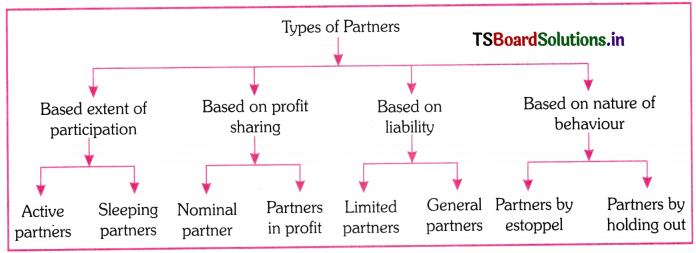
I) Basing on the participation :
- Active Partner : The partner who participates in the day-to-day business transactions he is known as “Active Partner”.
- Sleeping Partner : The partner who do not participates in the day-to-day transactions of the firm, is known as “sleeping partner” or “dormant partner”.
II) Basing on the sharing in profits :
- Nominal Partner : The partner who allow the firms to use their names as partners in the firm, are called as “Nominal Partners”.
- Partner in Profits : This type of partner will share only profits. But his liability to creditors is unlimited. He won’t share the losses of the firm. Only he enjoys the profits.
III) Basing on Liability :
- Limited Partners : Liability of the partners is limited to the extent of their investment of capitals.
- General Partners : If the liability of the partners is unlimited, they are treated as general partners. If the amount of liability is not specified in the document, such partner is deemed to be general partner.
IV) Basing on the behaviour and conduct exhibited :
- Partner by estoppel : A partner even by his false representation, public or third parties got believed that he is a partner of one firm, he is called as “partner by estoppel”.
- Partner by holdingout: A partner or partnership firm declares that a particular person is a partner of their firm and such a person does not disclaim it, then such a partner is said to be “partner by holdingout”.
Question 4.
Is Registration of partnership compulsory under the partnership Act 1932 ? Explain the procedure required for registration ?
Answer:
Registration of partnership firm is not compulsory. It is optional or the partnership firms according to the Indian Partnership Act – 1932. Registration can be made at anytime. By keeping unregistered, partnership firms, the firms cannot sue on others and cannot be sued by others.
The procedure for registration of a firm is as under.
- The firm will have to apply to the registrar of the firm of the concerned state, by paying stipulated fee for application.
- Following are the contents of the application :
- Name of the firm.
- Address of the firm.
- Address/locations of the firm, where the firm carries its business operations.
- Complete details of the partners along with adresses.
- The dates of admission of various partners.
- Duration of the firm.
- Duly filled application form must be signed by all the partners, prescribed registration fee is to be paid in the office of the registrar of the firm.
- If the registrar will scrutinize the application, attached by the other documents, and if satisfied with all the formalities pertaining to registration, on the name of the firm, the registrar will issue the certificate of registration.
Question 5.
Define Partnership. Explain its Merits and Demerits.
Answer:
A partnership is an association of two or more persons to carry on a business and to share its profits and losses.
Definition : “The relation between persons who have agreed to share the profits of a business carried on by all or any one of them acting for all”. – Partnership Act of 1932 (Section 4) “The relationship between persons who agree to carry on a business in common with a view to private gain”. – L.H. Haney
Advantages / Merits of a Partnership Firm :
- Easy Formation : An oral or written agreement is enough to start any lawful business on partnership basis. There are no complicated legal formalities regardings the establishment of such enterprise. Even registration of such firms is not compulsory.
- Huge Capital : The resources of more than one person are available for the business.
New partners can be admitted to secure more capital that may be needed for the expansion of business. - Wise Decision : A partnership consists of people possessing different abilities. Hence, they discuss every problem in detail and take wise and quick decision.
- Introduction of division of labour : A partnership enjoys all advantages of division of labour. As there are more than one partner, the duties can be assigned to different partners according to their qualification and specialisation.
- Greater borrowing capacity :The creditors of the firm can recover their loans from the private properties of all the partners. So the ability of a firm to raise loans depends upon the private properties of the partners. Thus a firm employs greater credit in the market.
- Secrecy :The partners can keep the business secrets to themselves.
- Protection of Minority interests : All important decisions are taken by the consent of all partners. If anything goes wrong unsatisfied partner can file a suit in the court of law the minority interest will be protected by law.
- Flexibility : The partners can change the nature, the method of business, or situation of the business very early by the agreement. No legal formalities for the above changes.
- Division of Labour : In partnership there are more than one partner hence the work can be divided among them according the qualifications and specialisation.
- Risk/Losses can be shared by all: The losses incurred by the firm will be shared by all the partners. So the share of loss of each partner will be less than the sole trader.
Demerits / Disadvantages of Partnership :
- Unlimited Liability : The liability of partners is unlimited. They are not only liable for their business investment but their private properties can also be taken for business liabilities.
- Limited Resources : A partnership firm may not be able to raise adequate capital for expansion beyond a certain limit. Legally the number of partners in a firm cannot be more than 20, which puts a limit to the capacity of a firm to raise capital for large – scale operation.
- Continuity is uncertain : Death, insolvency in capacity of one of the partners may lead to dissolution of the firm. Dissolution by notice at anytime brings about the closure of the firm.
- Mutual Distrust: The mutual distrust among partners is the main cause for the dissolution of partnership concerns.
- Limitations on transfer of share : No partner can transfer his interest in the firm to outsiders without the consent of all other partners.
- Lack of public faith : The accounts of partnership concerns are not published. So, the public is unaware of the exact position of the business. Therefore a partnership may not enjoy public confidence.
- Delay in decision : Before any decision is taken all the partners must be consulted. Hence, quick decisions may not be taken.
- Differences in opinions : Sometimes the opinions of the partners may differ. They may not be able to come to a common understanding. Such difference of opinions may lead to disputes and costly litigations.
Question 6.
Define partnership and state its important features.
Answer:
Definition : Section 4 of the partnership act, 1932 defines partnership as “the relation between persons who have agreed to share the profits of a business carried on by all or anyone of them acting for all”.
Characteristics / Features of Partnership :
- Formation : The partnership form of business organisation is governed by the provisions of Indian Partnership Act, 1932. It comes into existence through a legal agreement where in the terms and conditions governing the relationship among the partners, sharing of profits and losses and the manner of conducting the business are specified must be lawful and run with the profit motive.
- Unlimited Liability :The partners of a firm have unlimited liability. Personal assets may be used for repaying debts incases the business assets are insufficient. Further, the partners are jointly and individually liable for payment of debts.
- Existence of lawful business :The business of which the persons have agreed to share the profit, must be lawful. Any agreement to indulge in smuggling, black marketing etc., cannot be called partnership business in the eyes of law.
- Principal agent relationship : Three must be an agency relationship between the partners. Every partner is the principal as well as the agent of the firm. When a partner deals with other parties he/she acts as an agent of other partners and at the same time the other partners become the principal.
- Voluntary Registration : The registration of a partnership firm is not compulsory. But an unregistered firm suffers from some limitations which make it virtually compulsory to be registered.
Check Your Knowledge
I. Fill in the blanks for the following questions :
Question 1.
The partner who does not participate in the day-to-day activities of the business is known as ____________
Answer:
Sleeping partner
Question 2.
____________ allows the firm use their name as partner.
Answer
Nominal partner
Question 3.
A person who shares the profits of the business without being liable for the losses is known as ____________
Answer:
Profits in partner
Question 4.
The partner having unlimited liability is called a ____________
Answer:
General partner
Question 5.
Maximum partners are ____________ of the partnership firm.
Answer:
Banking 10, others 20
Question 6.
Minimum partners are ____________ of the partnership firm.
Answer:
2
Question 7.
The partners who actively participate in the day-to-day operations of the business are known as ____________
Answer:
Active partner
Question 8.
Partnership is an agreement between ____________ or ____________ persons.
Answer:
Two or more
Question 9.
Business secrete of the firm are known to the ____________
Answer:
Partners
Question 10.
Difference of opinion may give rise to quarrels and lead to ____________ of the firm.
Answer:
Dissolution
Question 11.
The partnership firm is a ____________ organisation.
Answer:
Flexibility
Question 12.
The persons who are enter into partnership individually called ____________ and collectively known as ____________
Answer:
Partners, firm
II. State whether the statement are True or False.
Question 1.
The persons who form a partnership are individually known as partners. (True/False)
Answer:
True
Question 2.
The partnership form of business organisation is governed by the provisions of Indian Partnership Act of 1932. (True/False)
Answer:
True
Question 3.
Every partner is the principal as well as the agent of the firm. (True/False)
Answer:
True
Question 4.
Any agreement to indulge in smuggling, black marketing etc. cannot be called partnership business in the eyes of law. (True/False)
Answer:
True
Question 5.
Limited partner is found in limited partnership firms in some European countries and the USA. (True/False)
Answer:
True
Question 6.
A partnership can be formed easily without many legal formalities. (True/False)
Answer:
True
Question 7.
The partnership firm is a flexible organisation. (True/False)
Answer:
True
Question 8.
The losses of the firm are shared by all partners equally or as per the agreed ratio. (True/False)
Answer:
True
Question 9.
Registrar will not scrutinise the application. (True/False)
Answer:
False
Question 10.
The Registration form contains the following particulars and it should be accompanied by a fee of Rs. 500/- and sent to the registrar of firms. (True/False)
Answer:
False
Student Activity
State whether the statements are True or False.
Question 1.
Partnership is an ideal form of organisation only for large size of organisation. (True/False)
Answer:
False
Question 2.
The partners of the partnership firm have unlimited liability. (True/False)
Answer:
True
Question 3.
The registration of a partnership firm is compulsory. (True/False)
Answer:
False
Question 4.
Sleeping partners simply contribute capital and share the profits and losses. (True/False)
Answer:
True
Question 5.
Partners by holdingout are not entitled to profits but are liable for the firm’s debts. (True/False)
Answer:
True
Question 6.
The partnership firm is not flexible organisation. (True/False)
Answer:
False
Question 7.
It is mandatory to publish the annual accounts of the partnership firm. (True/False)
Answer:
False
Question 8.
The share of interest of any partner can be transferred to other partners or outsiders. (True/False)
Answer:
True
Question 9.
A partnership deed is not a public document. (True/False)
Answer:
False
Question 10.
The death, insolvency, incapacity or retirement of any partner does not bring the firm to an (True/False)
Answer:
False