
Regular practice with AP Inter 1st Year Accounts Study Material Chapter 1 Book Keeping and Accounting Questions and Answers helps students stay prepared for examinations.
AP Inter 1st Year Accountancy 1st Lesson Book Keeping and Accounting Questions and Answers
I. Fill in the blanks
Question 1.
____ is the branch of knowledge that reveals how to keep a record of business transactions.
Answer:
Book keeping
Question 2.
The basic objective of book keeping is to have a ___ record of all business transactions.
Answer:
Permanent
Question 3.
AICPA Means _____
Answer:
American Institute of Certified Public Accountants
Question 4.
AAA means ___
Answer:
American Accounting Association
Question 5.
___ is a complete sequence of accounting processes that begins with the recording of business transactions and ends with preparation of final accounts.
Answer:
The Accounting Cycle
Question 6.
____ refers to a systematic knowledge of accounting that covers rules, regulations principles, concepts and conventions and standards that govern the accounting process.‘
Answer:
Accountancy
Question 7.
___ refers to the actual process of preparing and presenting the accounting information.
Answer:
Accounting
Question 8.
Accounting considers ___ transactions only.
Answer:
Monetary

Question 9.
A person who owns a business is called as a ____
Answer:
proprietor
Question 10.
The amount invested by the owner in the business is called ____.
Answer:
Capital
Question 11.
___ can be classified into tangible and intangible.
Answer:
Assets
Question 12.
Assets that have a physical existence, seen and touched are called ____ Assets.
Answer:
Tangible
Question 13.
Assets that have no physical existence, seen and touched are called ____ Assets.
Answer:
InTangible
Question 14.
____ refer to the financial obligation of a business.
Answer:
Liabilities
Question 15.
The amount of cash (or) value of goods withdrawn from the business by the proprietor for his personal use is called ____
Answer:
drawings
Question 16.
Debtors are shown as an ___ in the Balance Sheet.
Answer:
asset
Question 17.
Creditors are shown as a ___ in the Balance Sheet.
Answer:
liability
Question 18.
____ is the difference between revenue and expense.
Answer:
Income
II. Very Short Answer Type Questions
Question 1.
What is Book Keeping?
Answer:
Book- keeping is the art of recording business transactions in a systematic manner. It covers four activities i.e., identifying the transactions, measuring the identified transactions, recording in a chronological order and classifying the recorded transactions.
Question 2.
Define Accounting.
Answer:
The American Institute of Certified Public Accountants has defined the Accounting as “the art of recording, classifying and summarizing in a significant manner in terms of money transactions and events which in part, at least of a financial character and interpreting the results thereof.
Question 3.
What is an Accounting Cycle?
Answer:
An accounting cycle is a complete sequence beginning with the recording of transaction and ending with preparation of financial statements. It involves journalizing, ledger posting, balancing, trial balance, preparation of trading, profit and loss account and balance sheet.
Question 4.
What is a transaction?
Answer:
Transactions are those activities of a business, which involve transfer of money or goods or services between two persons or two accounts. For example, purchase of goods, sale of goods, borrowing from bank, commission received and dividend received. Transactions are of two types namely cash and credit transactions.
Question 5.
Define Capital
Answer:
It is the amount invested by the owner in the business. This amount is increased by the amount of profits earned and the amount of additional capital introduced. It is decreased by the amount of losses incurred and the amounts withdrawn.
Question 6.
Explain Drawings.
Answer:
It is the amount of cash or value of goods withdrawn from the business by the proprietor for his personal use. It is deducted from the capital.
Question 7.
What is a Voucher?
Answer:
It is a written document in support of a transaction. It is a proof that transaction has taken place for the value stated in the voucher. It may be in the form of cash receipt, invoice, cash memo, bank pay in slip etc. It is necessary to audit the accounts.
III. Short Answer Type Questions
Question 1.
Explain the advantages of Accounting.
Answer:
Advantages of Accounting : The following are the main advantages of accounting.
- Permanent and Reliable Record : Accounting provides permanent record for all business transactions and provides reliable information to different interested parties.
- Net Result of Business Operations : Accounting provides the final result (Profit or Loss) of business for a given period of time.
- Ascertainment of Financial Position : It is not enough to know only the profit or loss, but the proprietor requires a full picture of his financial position to plan for the next year’s business.
- Facility of Comparative Study : Accounting provides the facility of comparative study of the various aspects of the business such as profits, sales, expenses, etc.
- Control over Assets : In the course of business, the proprietor acquires various assets like building, machinery, furniture, etc. which are well protected by generating records.
Question 2.
Explain the Limitations of Accounting.
The following are the limitations of accounting
Answer:
- Records only monetary transactions : Accounting considers monetary transactions only, non-monetary transactions like quality, organization culture, units of production sales, etc. are ignored in accounting.
- Historical in nature : Accounting considers only historical transactions, i.e transactions which have occurred in the past only recorded in accounting books.
- Price level changes are not considered : Accounting does not consider price level changes which may occur from time to time, thus, it does not reflect the current position.
- Does not provide realistic information : While preparing the books of account, subjectivity of the accountant may influence the final results of the business enterprise. This may not provide realistic information which in turn affects the overall results of the business concern.
Question 3.
Distinguish between Book Keeping and Accounting.
Answer:
| Basis of Comparison | Book Keeping | Accounting |
| Objective | To maintain systematic records of the business. | To ascertain profitability and financial performance of the business. |
| Nature | Often routine and clerical in nature. | Analytical and executive in nature. |
| Responsibility | A book keeper is responsible for recording of business transactions only. | An accountant is responsible for finalization of accounts and revealing the net results of the business enterprise. |
| Supervision | The book keeper does not supervise and check the work of an accountant. | An accountant checks and supervises the work of book keeper. |
| Staff Involved | Book keeping is done by the junior level staff in accounting department. | Senior staff or Accountants performs the accounting work. |
Question 4.
Explain the steps involved in Accounting process.
Answer:
Accounting process :
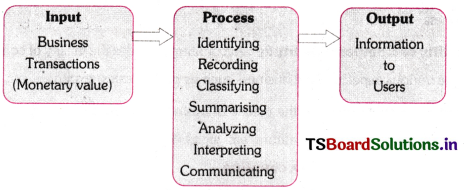
- Identifying : Identifying the business transactions from the source documents.
- Recording : The next function of accounting is to keep a systematic record of all business transactions, which are identified in an orderly manner, soon after their occurrence in the journal or subsidiary books.
- Classifying : This is concerned with the classification of the recorded business transactions so as to group the transactions of similar type at one place.
- Summarizing : It is the process of finding the totals of balances of all accounts so as to prepare trial balance.
- Reporting : The classified information available from the trial balance is used to prepare profit and loss account and balance sheet in a manner useful to the users of accounting information.
- Analysing : It establishes the relationship between the items of the profit and loss account and the balance sheet.
- Interpreting : It is concerned with explaining the meaning and significance of the relationship so established by the analysis. Interpretation should be useful to the users.