
Reviewing AP Inter 2nd Year Zoology Study Material Chapter 1 Human Reproduction Questions and Answers can help students prepare confidently for exams.
AP Inter 2nd Year Zoology 1st Lesson Human Reproduction Questions and Answers
IV. Very Short Answer Questions
Question 1.
What are the functions of Sertoli cells of the seminiferous tubules and the Leydig cells in man? (AP MAY-22)
Answer:
Sertoli cells :
- Sertoli cells act as supporting and nourishing cells for developing sperm cells.
- They also secrete Inhibin, a hormone that helps regulate FSH secretion.
- These cells are present within the seminiferous tubules along with germ cells.
Leydig Cells
- Leydig cells are found in the spaces between seminiferous tubules.
- They produce and release androgens, particularly testosterone, which is essential for male reproductive functions.
Question 2.
Define spermiogenesis and spermiation. (AP MAR-25)
Answer:
- Spermiogenesis: The process through which spermatids differentiate and mature into spermatozoa (sperms).
- Spermiation: The process in which mature spermatozoa are released from the seminiferous tubules into their lumen.
Question 3.
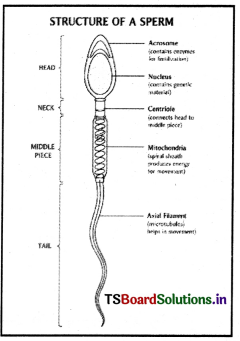
Draw a labelled diagram of a sperm.
Answer:

Question 4.
What are the major components of seminal plasma?
Answer:
The important constituents of seminal plasma include:
- Fructose
- Calcium
- Mucus
- Ascorbic Acid (Vitamin C)
Question 5.
What is the menstrual cycle? Which hormones regulate menstrual cycle?
Answer:
1. The menstrual cycle is the regular reproductive cycle seen in human female primates.
2. During each cycle, the endometrium undergoes preparation for pregnancy and is shed if fertilization does not occur.
3. In human females, these cyclic changes generally occur every28-29 days.
4. The cycle is mainly controlled by the following hormones:
- Follicle-stimulating hormone (FSH) – Pituitary gland
- Luteinizing Hormone (LH) – Pituitary gland
- Estrogen – Ovary
- Progesterone – Ovary.
Question 6.
What is parturition? Which hormone are involved in inducing parturition?
Answer:
- Parturition is the process of childbirth or the delivery of a baby from the uterus.
- Oxytocin plays a major role in initiating and facilitating parturition.
Question 7.
How many eggs are released by a human ovary in a month? How many eggs do you think would have been released if the mother gave birth to identical twins? Would your answer change if the twins were fraternal?
Answer:
- Normally, one ovum is released from a human ovary during each menstrual cycle.
- In the case of identical twins, only one egg is released and later divides into two embryos.
- In the case of fraternal twins, two separate eggs are released and fertilized independently.
V. Short Answer Questions
Question 1.
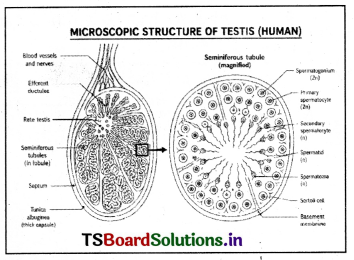
Describe the microscopic structure of the testis in man.
Answer:
- The testes of males are located in the scrotal sac, outside the abdominal cavity, because sperm production requires a temperature lower than normal body temperature.
- Each testis is enclosed by a tough fibrous covering known as the tunica albuginea.
- This covering extends inward and forms partitions called septa.
- These septa divide the testis into nearly 250 lobules.
- Every lobule contains 1 – 3 highly coiled seminiferous tubules.
- The seminiferous tubules are lined by spermatogonia (germ cells) and Sertoli cells.
- Spermatogonia develop into primary spermatocytes, which undergo meiosis to form spermatids.
- Spermatids are transformed into mature sperm cells through spermiogenesis.
- Sertoli cells provide nourishment to developing sperm and secrete Inhibin, which regulates FSH secretion.
- Between the seminiferous tubules are Leydig (interstitial) cells.
- Leydig cells synthesize and release androgens, mainly testosterone.
- Seminiferous tubules open into the rete testis, which further connects to the vasa efferentia.
- The vasa efferentia open into the epididymis, which is divided into the caput, corpus, and cauda regions.
- The epididymis is highly coiled and serves as the site for sperm maturation and storage.
Question 2.
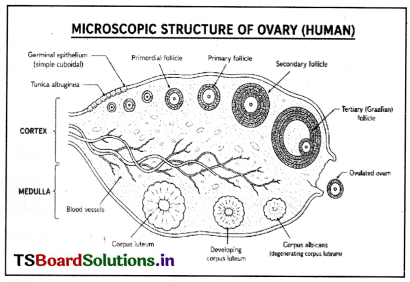
Describe the microscopic structure of the ovary of a woman.
Answer:
- The ovaries are the primary female reproductive organs responsible for producing ova and female sex hormones.
- A pair of ovaries is located in the lower abdominal region.
- Each ovary is attached to the dorsal body wall by a fold of peritoneum called the mesovarium.
- The outer surface of the ovary is covered by a simple cuboidal germinal epithelium.
- Beneath this epithelium lies a dense connective tissue layer called the tunica albuginea.
- The ovarian tissue is differentiated into an outer cortex and an inner medulla.
- The medulla contains connective tissue, blood vessels, lymph vessels, and nerve fibers.
- The cortex contains ovarian follicles at different stages of development.
- Structures such as Graafian follicles, corpus luteum, and corpus albicans are found within the cortex.
Question 3.
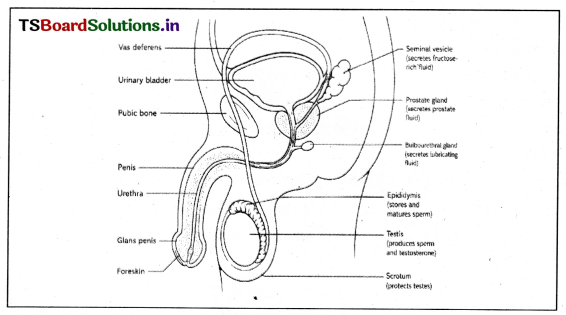
Draw a labelled diagram of the male reproductive system.
Answer:
Question 4.
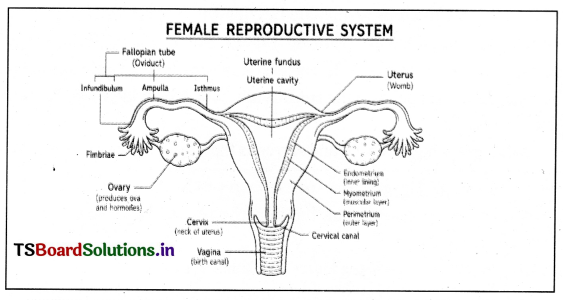
Draw a labelled diagram of the female reproductive system.
Answer:
Question 5.
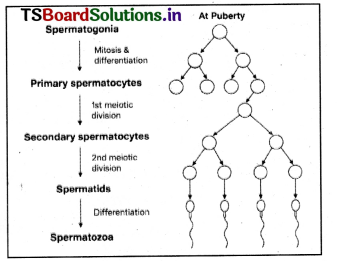
What is spermatogenesis? Briefly describe the process of spermatogenesis in man.
Answer:
Spermatogenesis It is the process by which male gametes (sperms) are formed. In humans, this process begins at puberty.
Process :
- Spermatogonial stem cells are present in the seminiferous tubules and divide repeatedly by mitosis.
- Some spermatogonia differentiate into primary spermatocytes (2n = 46 chromosomes).
- Each primary spermatocyte undergoes the first meiotic division to produce two haploid secondary spermatocytes (n = 23 chromosomes).
- Secondary spermatocytes undergo the second meiotic division to form spermatids.
- Each primary spermatocyte ultimately gives rise to four haploid spermatids.
- Spermatids transform into mature spermatozoa through spermiogenesis.
- Mature sperm heads remain embedded in Sertoli cells and are finally released by spermiation.
- Hormones such as GnRH, FSH, and LH regulate spermatogenesis.
- A mature sperm consists of a head, neck, middle piece, and tail.
- The head bears an acrosome containing enzymes such as hyaluronidase that aid in fertilization.
- The middle piece contains numerous mitochondria, which provide energy for sperm movement.
Question 6.
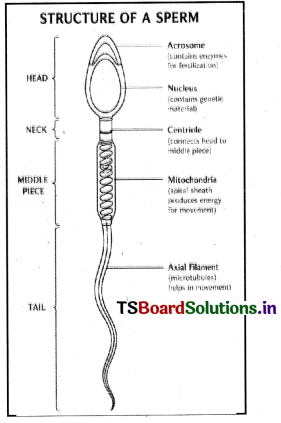
Describe the structure of a sperm cell with the help of a neat labelled diagram.
Answer:
A sperm cell is a microscopic, motile male gamete specialized for fertilization and enclosed by a plasma membrane.
It is divided into four major parts:
i) Head :
- Contains a haploid nucleus carrying genetic material.
- Covered by the acrosome, a cap-like structure.
- The acrosome contains enzymes that help the sperm penetrate the ovum during fertilization.
ii) Neck:
- A short connecting region between the head and middle piece.
- Contains centrioles involved in cell division after fertilization.
iii) Middle Piece:
- Contains numerous mitochondria arranged around the axial filament.
- Mitochondria generate ATP required for sperm motility.
iv) Tail (Flagellum):
- Long and slender structure responsible for locomotion.
- Propels the sperm through the female reproductive tract toward the ovum. Thus, the sperm is structurally adapted for movement and successful fertilization.
Question 7.
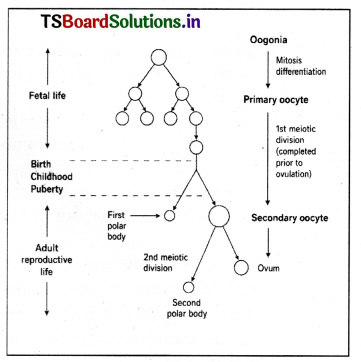
What is oogenesis? Give a brief account of oogenesis in a woman.
Answer:
Oogenesis is the process of formation of a mature female gamete (ovum). Unlike spermatogenesis, it begins during embryonic development.
1. Embryonic Stage :
- Millions of oogonia are formed in the fetal ovary.
- No new oogonia are produced after birth.
- Oogonia enter meiosis I and become primary oocytes.
- These primary oocytes remain arrested in prophase I.
2. Follicular Development:
- Each primary oocyte becomes surrounded by granulosa cells, forming a primary follicle.
- At puberty, about 60,000 – 80,000 primary follicles remain in each ovary.
3. Maturation:
- Primary follicles develop into secondary follicles and later into tertiary follicles.
- The tertiary follicle develops a fluid-filled cavity known as the antrum.
4. First Meiotic Division :
- The primary oocyte completes meiosis-I within the tertiary follicle.
- This unequal division produces a large secondary oocyte and a small first polar body.
5. Ovulation: The mature Graafian follicle ruptures and releases the secondary oocyte from the ovary.
6. Second Meiotic Division :
- Meiosis-II is completed only after fertilization.
- It produces a mature ovum and a second polar body.
Question 8.
Name the functions of the following :
(a) Corpus Luteum
(b) Fimbriae
(c) Acrosome
(d) Sperm Tail
Answer:
(a) Corpus Luteum :
- Secretes large amounts of progesterone.
- Progesterone maintains the endometrium and supports implantation and pregnancy.
(b) Fim briae :
- Finger-like projections present at the infundibulum of the fallopian tube.
- They help in collection of the ovum released from the ovary after ovulation.
(c) Acrosome:
- Cap-like structure present on the sperm head.
- Contains enzymes that help the sperm penetrate the coverings of the ovum during fertilization.
d) Sperm Tail:
- Responsible for sperm motility.
- Helps propel the sperm through the female reproductive tract toward the ovum.
VI. Long Answer Questions
Question 1.
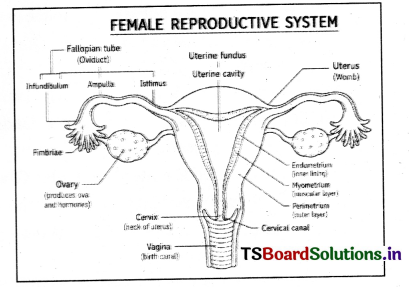
Describe the Female Reproductive System of a woman with the help of a labelled diagram.
Answer:
The female reproductive organs are located in the pelvic cavity and include :
1) Ovaries :
- Ovaries are the primary female reproductive organs responsible for producing ova (female gametes) and female sex hormones.
- A pair of ovaries is situated on either side of the lower abdominal region.
- Each ovary is attached to the abdominal wall through a fold of peritoneum called the mesovarium.
- Every ovary consists of three main regions :
1. Germinal (ovarian) epithelium
2. Tunica albuginea
3. Stroma
The stroma is differentiated into an outer cortex and an inner medulla.
2. Fallopian Tubes:
- Each fallopian tube extends from the ovary to the uterus.
- The ovarian end of the tube is expanded into a funnel-shaped structure known as the infundibulum.
- The infundibulum bears finger-like projections called fimbriae.
- Fimbriae help in collecting the ovum released during ovulation.
- The fallopian tube is the usual site of fertilization and transports the ovum towards the uterus by peristaltic movements.
3. Uterus:
- The uterus is a single, hollow, muscular organ.
- It is located between the urinary bladder and rectum.
- It resembles an inverted pear and is richly supplied with blood vessels.
- The narrow lower region connecting the uterus to the vagina is called the cervix.
- The cervix and vagina together constitute the birth canal.
- The uterine wall consists of three layers: Outer Perimetrium, Middle Myometrium, Inner Endometrium
- The endometrium undergoes cyclic changes during the menstrual cycle.
4. Vagina:
- The vagina is a fibromuscular tube extending from the cervix to the vaginal opening.
- It is lined by non-keratinized stratified squamous epithelium and is highly vascular.
5. Vulva (External Genitalia):
- The term vulva (pudendum) refers to the external genital organs of the female.
- The vestibule is the region that contains the external openings of the urethra and vagina.
- The vaginal opening is partially covered by a thin mucous membrane called the hymen.
- The clitoris is homologous to the penis in males and contains erectile tissue.
- A fatty tissue pad covered by skin and pubic hair above the labia majora is called the mons pubis.
Accessory Reproductive Glands of Females: These include :
a) Bartholin’s glands,
b) Skene’s glands.
a) Bartholin’s glands:
- Also called Greater Vestibular Glands.
- They are located on either side of the vaginal opening and secrete mucus.
b) Skene’s Glands:
- Also known as Lesser Vestibular Glands.
- They are situated on the anterior wall of the vagina near the lower end of the urethra.
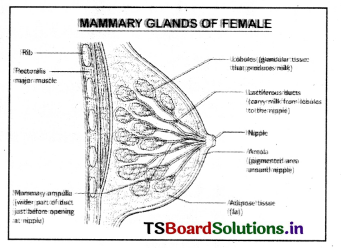
c) Mammary Glands:
- Mammary glands are paired structures composed of glandular tissue and varying amounts of fat.
- They contain alveoli, which produce and secrete milk after childbirth.
- Mammary ducts join to form a mammary ampulla, which opens into a lactiferous duct through which milk is delivered to the infant.
Question 2.
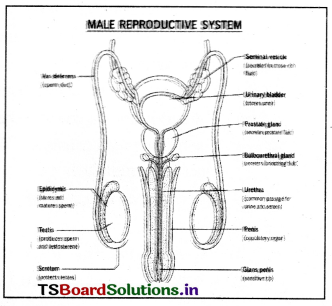
Describe the Male Reproductive System of a Man. Draw a Labelled Diagram of it. (AP MAR-16,17, 19,20,23,24)
Answer:
The male reproductive organs located in the pelvic region include:
- Testes
- Epididymis
- Vas Deferens
- Urethra
- Penis
- Accessory Glands
1. Testes :
- Testes are paired oval-shaped male primary reproductive organs.
- They are enclosed within a pouch called the scrotum, located outside the abdominal cavity.
- Sperm production requires a lower temperature; therefore, testes remain within the scrotum.
- The tunica albuginea forms septa that divide each testis into nearly 250 lobules.
- Each lobule contains 1 -3 highly coiled seminiferous tubules.
- Seminiferous tubules contain germinal epithelium and Sertoli cells. Germ cells produce sperm, while Sertoli cells nourish developing sperm.
- Testosterone regulates spermatogenesis and secondary sexual characteristics.
- Seminiferous tubules open into the rete testis, which continues into the vasa efferentia and epididymis
2. Epididymis:
- The epididymis is a long, tightly coiled tube located along the posterior side of each testis.
- Vasa efferentia open into the epididymis.
- It serves as a site for sperm maturation and temporary storage.
3. Vas Deferens :
- The vas deferens is a long, muscular tube.
- It begins from the tail of the epididymis, enters the abdominal cavity through the inguinal canal, and loops around the urinary bladder.
4. Urethra:
- The urethra originates from the urinary bladder and extends through the penis.
- It acts as a common passage for urine and semen.
- It opens to the exterior through the urethral meatus.
5. Penis:
- The penis functions as both a urinary organ and a copulatory organ that transfers sperm into the female reproductive tract.
- It consists of three columns of erectile tissue: Two corpora cavernosa and one corpus spongiosum
- The enlarged terminal part is the glans penis, covered by a loose fold of skin called the prepuce (foreskin).
6. Accessory Glands :
a) Seminal Vesicles :
- A pair of glands located behind the urinary bladder.
- Their secretion contains fructose, which provides energy for sperm.
b) Prostate Gland:
- Situated below the urinary bladder.
- Contributes about 15-30% of the seminal fluid.
c) Bulbourethral (Cowper’s) Glands :
- Located below the prostate gland.
- They secrete an alkaline fluid that lubricates and neutralizes the urethra during ejaculation.
Question 3.
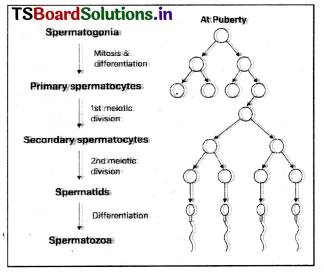
Describe the Spermatogenesis and Oogenesis with Diagrammatic Representation.
Answer:
I) Spermatogenesis: Spermatogenesis is the process of sperm formation in the seminiferous tubules of the testes. It begins at puberty under the influence of GnRH.
- Multiplication Phase: Immature germ cells called spermatogonia (2n = 46) divide repeatedly by mitosis.
- Meiosis I: Primary spermatocytes undergo the first meiotic division to produce two haploid secondary spermatocytes.
- Meiosis II: hi Secondary spermatocytes complete the second meiotic division to form four haploid spermatids.
- Spermiogenesis: Spermatids differentiate into mature spermatozoa.
- Spermiation: Mature sperm are released from Sertoli cells into the lumen of seminiferous tubules.
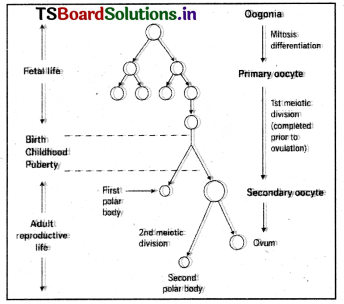
II) Oogenesis :
Oogenesis is the process of formation of a mature female gamete (ovum). It begins during embryonic life.
- Embryonic Initiation: Millions of oogonia enter meiosis-I and become primary oocytes arrested in prophase I.
- Follicular Development: Each primary oocyte is surrounded by granulosa cells to form a primary follicle. At puberty, about 60,000 – 80,000 follicles remain in each ovary.
- Maturation: Primary follicles develop into secondary follicles and then tertiary follicles containing an antrum.
- First Meiotic Division: The primary oocyte completes meiosis I, producing a large secondary oocyte and a first polar body.
- Ovulation: The Graafian follicle ruptures and releases the secondary oocyte.
- Second Meiotic Division: This division is completed only after fertilization, producing a haploid ootid (ovum) and a second polar body.
Question 4.
Explain the process of Fertilization and Implantation in Humans. Describe the major features of Embryonic Development at various months of pregnancy.
Answer:
1. Fertilization: Fertilization is the fusion of a sperm and ovum to form a zygote. It usually occurs in the ampullary region of the fallopian tube.
- Insemination and Transport: Semen is deposited in the vagina. Sperms travel through the cervix and uterus to reach the fallopian tube, where fertilization takes place.
- Contact and Entry: A sperm binds to the zona pellucida of the ovum and prevents entry of additional sperms.
- Acrosomal Reaction: Enzymes released from the acrosome help the sperm penetrate the ovum.
- Completion of Meiosis: Sperm entry stimulates completion of meiosis-II in the secondary oocyte, producing an ovum and second polar body.
- Zygote Formation: Fusion of male and female pronuclei results in a diploid zygote (2n). The sex of the baby depends on whether the fertilizing sperm carries an X or Y chromosome.
2. Implantation: Implantation is the process by which the developing embryo becomes attached to and embedded within the endometrium.
- Cleavage and Morula Formation: The zygote undergoes repeated mitotic divisions, producing blastomeres. The 8-16 cell stage is called the morula.
- Blastocyst Formation: The morula develops into a blastocyst composed of an outer trophoblast and inner cell mass.
- Attachment to Endometrium: The trophoblast attaches to the uterine endometrium.
- Embedding: The blastocyst becomes completely embedded within the uterine lining.
- Hormonal Support: Progesterone secreted by the corpus luteum maintains the endometrium and supports implantation.
3. Major Stages of Embryonic Development:
- End of First Month: The embryonic heart is formed.
- End of Second Month: Limbs and digits become visible.
- End of 12 Weeks (First Trimester): Most major organ systems are formed, and external genitalia become distinguishable.
- Fifth Month: Foetal movements can be felt, and hair appears on the head.
- End of 24 Weeks (Second Trimester): Fine body hair develops, eyelashes appear, and eyelids separate.
- End of Nine Months: The foetus becomes fully developed and ready for birth (parturition).
I. Multiple Choice Questions
Question 1.
Humans are ………………………….
1. Oviparous
2. Viviparous
3. Ovoviviparous
4. Parthenogenetic
Answer:
2. Viviparous
Question 2.
The reason behind the presence of testes outside the abdomen is :
1. To decrease the temperature up to 2°C to 2.5°C for spermatogenesis.
2. To increase the temperature up to 2°C to 2.5°C for spermatogenesis.
3. There is no sufficient space in abdominal cavity.
4. To prevent excessive production of sperms.
Answer:
1. To decrease the temperature up to 2°C to 2.5°C for spermatogenesis.
Question 3.
Which of the following depicts the correct pathway of transport of sperms?
1. Vasa Efferentia → Rete Testis → Vas Deference → Epididymis
2. Rete Testis → Epididymis → Vasa Efferentia → Vas Deference
3. Rete Testis → Vas Deference → Vasa Efferentia → Epididymis
4. Rete Testis → Vasa Efferentia → Epididymis → Vas Deferens
Answer:
4. Rete Testis → Vasa Efferentia → Epididymis → Vas Deferens
Question 4.
Which of the following acts as temporary endocrine tissue after ovulation in human females?
1. Corpus albicans
2. Corpus luteum
3. Graafian follicle
4. Tertiary follicle
Answer:
2. Corpus luteum
Question 6.
The correct sequence of milk passage in mammary gland, beginning from alveoli, would be:
1. Mammary tubules → Mammary ampulla → Mammary ducts → Lactiferous ducts
2. Lactiferous ducts → Mammary ducts → Mammary ampulla → Mammary tubules
3. Lactiferous ducts → Mammary ampulla → Mammary ducts → Mammary tubules
4. Mammary tubules → Mammary ducts → Mammary ampulla → Lactiferous ducts
Answer:
4. Mammary tubules → Mammary ducts → Mammary ampulla → Lactiferous ducts
Question 7.
Assertion: The seminal plasma along with the sperms constitute the semen.
Reason: For normal fertility, at least 40 per cent of ejaculated sperms must have normal shape and size, and at least 60 per cent of them must show vigorous motility. ,
1. If both assertion and reason are true and reason is the correct explanation of assertion.
2. If both assertion and reason are true but reason is not the correct explanation of assertion.
3. If assertion is true but reason is false.
4. If Assertion false and Reason is true.
Answer:
3. If assertion is true but reason is false.
Question 8.
The second meiotic division of oocyte is completed during
1. Childbirth
2. Puberty
3. Ovulation
4. Fertilization
Answer:
4. Fertilization
Question 9.
Most of the major organ systems in foetal stage are formed
1. By the end of 151 month
2. By the end of 2nd month
3. By the end of 3rd month
4. By the end of 3rd week
Answer:
3. By the end of 3rd month
Question 10.
The signal for foetal ejection reflex in human female originates from
1. Progesterone
2. Differentiation of mammary glands
3. Fully developed foetus and placenta
4. Sudden drop of oxytocin
Answer:
3. Fully developed foetus and placenta
Question 11.
The act of delivering a foetus at the end of pregnancy is called …………………….. .
1. Parturition
2. Gestation
3. Coitus
4. Lactation
Answer:
1. Parturition
II. Fill in the Blanks
1. Testes are situated outside the abdominal cavity within a pouch called ……………………….. .
Answer:
Scrotum
2. The seminiferous tubules of the testis open into the vasa efferentia through …………………. .
Answer:
Rete testis
3. The part of fallopian tube closer to the ovary with funnel-shaped structure called ……………………. .
Answer:
Infundibulum
4. The process of release of ovum from a mature follicle is called ………………………. .
Answer:
Ovulation
5. Ovulation is induced by a hormone called ………………………… .
Answer:
Luteinizing hormone (LH)
6. The uterine layer that exhibits strong contraction during delivery of the baby is ………………………….. .
Answer:
Myometrium.
7. The fusion of male and female gametes is called …………………………….. .
Answer:
Fertilization
8. The first menstruation is called ………………………….. .
Answer:
Menarche.
9. Zygote divides to form …………………………… which is implanted in uterus.
Answer:
Blastocyst
10. The structural and functional unit between foetus and uterus is called ………………………… .
Answer:
placenta
III. One Word Answer Questions
Question 1.
How many seminiferous tubules are present in every testicular lobule in which sperm are produced?
Answer:
1 to 3
Question 2.
Name the hormones that are synthesized and secreted by Leydig cells.
Answer:
Androgens
Question 3.
The fingerlike projections of the infundibulum of fallopian tube are called as?
Answer:
Fimbriae
Question 4.
What is the tiny finger-like structure which lies at the upper junction of the two labia minora above the urethral opening?
Answer:
Clitoris
Question 5.
Which layer undergoes cyclic changes in menstrual cycle?
Answer:
Endometrium
Question 6.
By the end of which month of gestation is the heart formed in a human embryo?
Answer:
By the end of the first month
Question 7.
The milk produced in the initial few’ days of lactation which is rich in antibodies called ?
Answer:
Colostrum
Question 8.
How many eggs do you think were released by the ovary of a female dog which gave birth to 6 puppies?
Answer:
6 (Six) eggs
Question 9.
What is the cessation of menstrual cycle called?
Answer:
Menopause
Objective Questions
Question 1.
In which type of reproduction are genetic variations commonly observed?
1. Schizogony
2. Sexual reproduction
3. Multiple fission
4. Budding
Answer:
2. Sexual reproduction
Question 2.
Which structure forms the outer covering of the ovary?
1. Mesovarium
2. Germinal epithelium
3. Columnar epithelium
4. Ciliated epithelium
Answer:
2. Germinal epithelium
Question 3.
Cleavage in human beings is classified as :
1. Equal
2. Holoblastic
3. Meroblastic
4. Determinate
Answer:
2. Holoblastic
Question 4.
What is the primary role of the epididymis?
1. Activation of the sperms only
2. Temporary storage of the sperms until they mature
3. Spermatogenesis and spermiogenesis
4. Nourishing of the sperms only
Answer:
2. Temporary storage of the sperms until they mature
Question 5.
What is the basic characteristic feature of sexual reproduction?
1. Fusion of two adult individuals
2. Fusion of male and female gametes produced by meiosis
3. Fusion of gametes produced by mitosis
4. Fusion of male and female haploid gametes produced by mitosis
Answer:
2. Fusion of male and female gametes produced by meiosis
Question 6.
Testes remain attached to the scrotal sac posteriorly through :
1. Dartos muscle
2. Spermatic cords
3. Gubernaculum
4. Rachis
Answer:
3. Gubernaculum
Question 7.
Meiosis takes place in :
1. Both (3) and (4)
2. Spermatogonia and oogonia
3. Primary and secondary oocytes
4. Primary and secondary spermatocytes
Answer:
1. Both (3) and (4)
Question 8.
Seminal plasma receives secretions from :
1. Bulbourethral glands
2. Seminal vesicles
3. Prostate gland
4. All of the above
Answer:
4. All the above
Question 9.
Which part of the fallopian tube is nearest to the ovary?
1. Cervix
2. Ampulla
3. Infundibulum
4. Isthmus
Answer:
3. Infundibulum
Question 10.
Which enzyme helps sperm penetrate the corona radiata and zona pellucida?
1. Citric acid
2. Hyaluronidase
3. Hydrochloric acid
4. Protease
Answer:
2. Hyaluronidase
Question 11.
Implantation in humans generally occurs on :
1. 12th day after copulation
2. 6th day after ovulation
3. 6th day after fertilization
4. 6th day after menstruation
Answer:
4. 6th day after menstruation
Question 12.
Which enzyme plays an important role during implantation?
1. Lipases
2. Amylases
3. Progesterone
4. Proteases
Answer:
4. Proteases
Question 13.
At what stage does the foetal heart begin to beat?
1. End of first trimester
2.2nd month
3. 4th week
4. 14th day
Answer:
3. 4th week
Question 14.
Which gland secretes the highest amount of fructose?
1. Cowper’s gland
2. Prostate gland
3. Tyson gland
4. Seminal vesicle
Answer:
4. Seminal vesicle
Question 15.
In mammals, failure of testes to descend into the scrotum is termed :
1. Castration
2. Impotency
3. Paedogenesis
4. Cryptorchidism
Answer:
4. Cryptorchidism
Question 16.
The vas deferens originates from :
1. Rete testis
2. Corpus epididymis
3. Caput epididymis
4. Cauda epididymis
Answer:
4. Cauda epididymis
Question 17.
Which accessory reproductive gland is unique to male mammals?
1. Prostate gland
2. All
3. Pineal gland
4. Bartholin’s gland
Answer:
1. Prostate gland
Question 18.
Seminal vesicle opens at the junction of:
1. Vas deferens and testis
2. Prostate and urethra
3. Prostate and vas deferens
4. Prostate and Cowper’s gland
Answer:
3. Prostate and vas deferens
Question 19.
Developing sperms receive nourishment from :
1. Connective tissue cells
2. Interstitial cells
3. None
4. Sertoli cells
Answer:
4. Sertoli cells
Question 20.
The egg released during ovulation in humans is at which stage?
1. Mature ovum stage
2. Secondary oocyte stage
3. Oogonial stage
4. Primary oocyte stage
Answer:
2. Secondary oocyte stage
Question 21.
The endocrine structure formed after ovulation from the ruptured Graafian follicle is:
1. Corpus albicans
2. Corpus luteum
3. Corpus striatum
4. Corpus callosum
Answer:
2. Corpus luteum
Question 22.
Which female structure is considered homologous to the male prostate gland?
1. Bulbourethral gland
2. Bartholin’s gland
3. Clitoris
4. None of the above
Answer:
4. None of the above
Question 23.
The luteal phase is also known as:
1. Secretory phase
2. Menstrual flow phase
3. Follicular phase
4. Proliferative phase
Answer:
1. Secretory phase
Question 24.
Which extraembryonic membrane prevents the embryo from drying out inside the uterus?
1. Allantois
2. Yolk sac
3. Chorion
4. Amnion
Answer:
4. Amnion
Question 25.
Which membrane contributes to the formation of the urinary bladder of the embryo?
1. Yolk sac
2. Chorion
3. Minion
4. Allantois
Answer:
4. Allantois
Question 26.
Spermatogenesis is mainly regulated by the influence of:
1. LH
2. ADH
3. STH
4. FSH
Answer:
4. FSH
Question 27.
Which statement is incorrect regarding oogenesis?
1. Growth phase
2. Equal meiotic division
3. Formation of polar bodies
4. Unequal meiotic division
Answer:
2. Equal meiotic division
Question 28.
Prostaglandins are synthesized from:
1. Carbohydrate
2. Steroid
3. Fatty acids
4. Amino acids
Answer:
3. Fatty acids
Question 29.
The embryo at the sixteen-cell stage is known as:
1. Blastomere
2. Gastrula
3. Morula
4. Blastula
Answer:
3. Morula
Question 30.
Which phase of the menstrual cycle normally continues for about 7-8 days?
1. Ovulatory phase
2. Menstruation
3. Follicular phase
4. Luteal phase
Answer:
3. Follicular phase
Question 31.
Corpus luteum and macula lutea share the common feature that they are:
1. Characterised by yellow colour
2. Source of hormones
3. Found in human ovaries
4. Contributory in maintaining pregnancy
Answer:
1. Characterised by yellow colour
Question 32.
Fertilin is produced and released by :
1. Epididymis
2. Testes
3. Egg surface
4. Sperm head tip
Answer:
3. Egg surface
Question 33.
The secretory phase of the menstrual cycle is alternatively termed :
1. Follicular phase and lasts for about 13 days
2. Follicular phase and lasts for about 6 days
3. Luteal phase and lasts for about 13 days
4. Luteal phase and lasts for about 6 days
Answer:
3. Luteal phase and lasts for about 13 days
Question 34.
The signals responsible for initiating parturition arise from:
1. Fully developed foetus only
2. Placenta as well as fully developed foetus
3. Oxytocin released from maternal pituitary
4. Placenta only
Answer:
2. Placenta as well as fully developed foetus
Question 35.
The second maturation division of the mammalian ovum takes place:
1. Until nucleus of sperm and ovum fuse
2. Shortly after ovulation before entry into fallopian tube
3. In Graafian follicle soon after first maturation division
4. Until after sperm has penetrated into ovum
Answer:
4. Until after sperm has penetrated into ovum
Question 36.
Following ovulation, the follicle transforms into :
1. Corpus callosum
2. Corpus cavemosum
3. Corpus luteum
4. Corpus albicans
Answer:
3. Corpus luteum
Question 37.
Bartholin’s glands are located :
1. On either side of vas deferens in humans
2. On either side of vagina in humans
3. On the reduced tail end of birds
4. On the sides of the head of some amphibians
Answer:
2. On either side of vagina in humans
Question 38.
What will be the consequence if the vas deferens is cut?
1. Sperms are non-nucleated
2. Spermatogenesis does not occur
3. Semen is without sperms
4. Sperms are nonmotile
Answer:
3. Semen is without sperms
Question 39.
Functional maturation of sperms occurs in :
1. Epididymis
2. Vagina
3. Oviduct
4. All of these
Answer:
1. Epididymis
Question 40.
Which hormone promotes the development of female secondary sexual characters?
1. Testosterone
2. Androgen
3. Estrogen
4. Progesterone
Answer:
3. Estrogen