
Regular practice with AP Inter 1st Year Chemistry Study Material Chapter 8 Organic Chemistry – Some Basic Principles and Techniques Questions and Answers helps students stay prepared for examinations.
AP Inter 1st Year Chemistry 8th Lesson Organic Chemistry – Some Basic Principles and Techniques Questions and Answers
I. Multiple Choice Questions
Question 1.
Alicyclic compounds are
1) Aromatic compounds
2) Aliphatic cyclic compounds
3) Heterocyclic compounds Aliphatic cyclic compounds.
4) Alkanes
Answer:
2) Aliphatic cyclic compounds
Question 2.
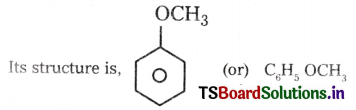
What is the formula of Anisole?
1) C6H5OCH3
2) C6H5NH2
3) C6H5COCH5
4) C6H5OH
Answer:
The IUPAC name of Anisole is methoxybenzene.
Question 3.
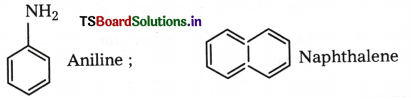
Which of the following is an example for heterocyclic aromatic compound?
1) Aniline
2) Benzene
3) Furan
4) Naphthalene
Answer:
3) Furan
Furan is an example for heterocyclic aromatic compound.

Question 4.
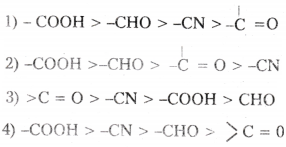
In which of the following functional groups are arranged as per the priority order of the functional groups?
Answer:

Question 5.
The IUPAC name of Neopentane is
1) 2-methyl propane
2) 2,2-dimethyl butane
3) 2-methyl butane
4) 2,2-dimethyl propane
Answer:
4) 2,2-dimethyl propane
The IUPAC name of Neopentane is 2, 2 – Dimethyl Propane

Question 6.
Hybridisation of carbon in \(\stackrel{+}{\mathrm{C}} \mathrm{H}_3\) is
1) sp3
2) sp3
3) sp
4) sp3d
Answer:
2) sp3
Question 7.
Which of the following involves the displacement effect of sigma bonded electrons ?
1) Mesomeric effect
2) Inductive effect
3) Resonance
4) Elficirovnerk efiecf-
Answer:
2) Inductive effect
Question 8.
Kjeldahl method is not applicable to compounds containing nitrogen in
1) Nitro group
2) Az0 group
3) Nitrogen present in the ring
4) All
Answer:
4) All
Answer:
In all cases Kjeldahls method is not applicable to compounds containing nitrogen
Question 9.
Crude oil in petroleum industry is separated by
1) Distillation
2) Fractional distillation
3) Crystallisation
4) Solvent extraction
Answer:
By Fractional distillation
Question 10.
Chloroform and aniline are easily separated by the technique
1) Distillation
2) Fractional Distillation
3) Sublimation
4) Chromatography
Answer:
1) Distillation
Chloroform and Anilin. are separatd by distillation
II. Fill in the Blanks
Question 1.
Ethyl alcohol and methyl alcohol can be separated by ___
Answer:
Fractional distillation.
Question 2.
Steam distillation is applied to separate substances which are ___
Answer:
Steam volatile
Question 3.
Nitrogen, sulphur and halogens present in an organic compound are detected by ___.
Answer:
Lassaigne’s Test (or) Sodium fusion extract test.
Question 4.
Methoxy propane and Ethoxy ethane are examples of ____.
Answer:
metamers (difference in attachment of alkyl group.
Question 5.
Propanone and propanal are ____ isomers.
Propanone (ketone)
Propanal (aldehyde)
both are functional group isomers.
III. One Word Answer Questions
Question 1.
Define catenation.
Answer:
Self linkage of atoms among themselves to form long chains and rings is called catenation.
Question 2.
What is the hybridisation of carbon in Ethane ?
Answer:
In ethane (CH3 – CH3) each carbon undergo sp3 hybridization.
Question 3.
What is the hybridization of carbon in CH3F ?
Answer:
In CH3F carbon undergoes sp3 hybridization.
Question 4.
Define functional group.
Answer:
A group of atoms in a molecule that are responsible for the chemical reactivity and properties of that molecule is called functional group. Eg : Aldehyde (-CHO)
Question 5.
What is homologous series ?
Answer:
A series of organic compounds containing a characteristic functional group represented by same general formula and successive members differ by -CH2 is called homologous series. Eg : Alkanes – CH4, C2H6, C3H8 etc …….
Question 6.
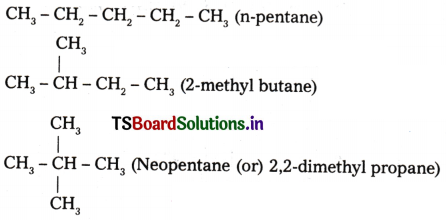
How many chain isomers are possible for alkane having molecular formula C5H12 ?
Answer:
For C5H12 possible chain isomers are three
Question 7.
What is an electrophile ?
Answer:
An electrophile is a reagent that takes away an electron pair from reactive site.
Eg: \(\mathrm{NO}_2^{+}\), \(\mathrm{CH}_3^{+}\).
Question 8.
What is an electromeric effect ?
Answer:
The complete transfer of a shared pair of π – electrons to one of the atoms joined by a multiple bond on the demand of attacking reagent is called electromeric effect.
Question 9.
What is differential extraction ?
Answer:
When an organic compound is present in an aqueous solution. It is separated by shaking it with an organic solvent in which it is more soluble than in water.
Question 10.
What is distillation ?
Answer:
The method used to separate volatile liquids from non-volatile impurities and the liquids having sufficient difference in their boiling points.
Question 11.
What is retardation factor ?
Answer:
In chromatography the relative adsorption of each component of the mixture is expressed in terms of it’s retardation factor (Rf).
Rf = \(\frac{\text { Distance travelled by component }}{\text { Distance travelled by solvent }}\)
Question 12.
Write the principle involved in paper chromatography.
Answer:
The principle involved in paper chromatography is partition. Here differential partitioning between stationary phase and mobile phase.
Question 13.
Give two examples for alicyclic compounds.
Answer:

Question 14.
Give examples for benzenoid aromatic compounds.
Answer:
IV. Very Short Answer Questions
Question 1.
How many n and a bonds are present in each of the following molecules ?
a) HC ≡ CCH = CHCH3
b) CH2 = C = CHCH3
Answer:
a) CH ≡ C – CH = CH – CH3
10σ bonds 3π-bonds
b) CH2 = C = CH – CH3
9σ bonds 2π-bonds
Question 2.
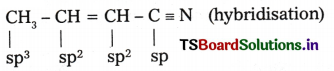
What is the type of hybridisation of each carbon in the following compound? CH3CH=CHCN
Answer:
Question 3.
What is carbocation? Give example.
Answer:
A molecule with a positively charged carbon atom is called carbocation, Eg : \(\mathrm{CH}_3^{+}\).
Question 4.
What is metamerism? Give example.
Answer:
Organic compounds having same molecular formula but differ in attachment of alkyle groups is called metamerism. These are called metamers.

Question 5.
Write the IUPAC names of
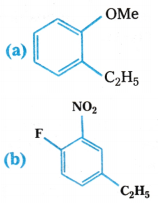
Answer:
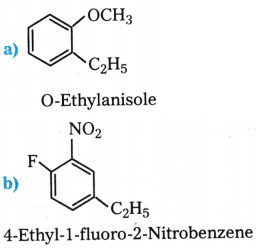
Question 6.
Write the IUPAC names of
a) CH3CH(OH)CH3
b)
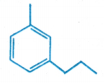
Answer:
a)
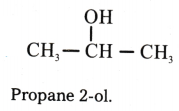
b)
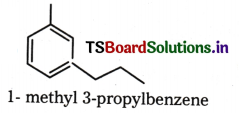
Question 7.
Write the structures of
(a) 4-ethyl 2-methyl aniline and
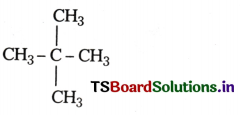
(b) Neopentane.
Answer:
a) 4-Ethyl 2-methyl Aniline
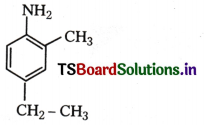
b) Neopentane
Question 7.
Explain the principle of Adsorption chromatography.
Answer:
Principle of Adsorption chromatography This is based on the fact 15 at different compounds are adsorbed on an adsorbent to different degrees.
Question 8.
Explain the term “Crystallisation”.
Answer:
Crystallisation :This technique is used for the purification of solid organic compounds. It is based on the difference in the solubilities of the compound and the impurities in a suitable solvent.
Question 10.
What are electrophiles and nucleophiles? Give examples.
Answer:.
1) Electrophiles : (Electron loving) :A reagent that takes away an electron pair from reactive site is called electrophile (E+). Eg : \(\mathrm{NO}_2^{+}\), \(\mathrm{CH}_3^{+} .\)
2) Nucleophiles: (Nucleus loving) :A reagent that brings an electron pair to the reactive site is called a nucleophile \(\left(\mathrm{Nu}^{\Theta}\right)\). Eg : CN– and OH– etc.
V. Short Answer Questions
Question 1.
What is the position isomerism and functional isomerism? Give one example for each.
Answer:
Position isomerism : Compounds having same molecular formula but differ in position of substituent / functional, group/ multiple bond are called position isomers.
This is called position isomerism.
Ex:
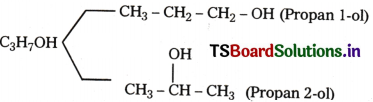
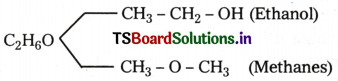
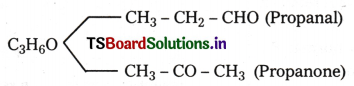
Functional group isomerism : Compounds having same molecular formula but differ in nature of functional group are called functional group isomers.
Eg:
1)Alcohols, Ethens are functional group isomers
2) Aldehydes, factors are functional group isomers
Question 2.
Explain the difference between structural isomers and stereoisomers.
Answer:
| Structural Isomers | Stereo Isomers |
| 1. The compounds having same molecular formula but differ in their structural arrangements of atoms or group of atoms. | 1. The compounds having same molecular formula but differ in their spatial arrangement of atoms or group of atoms. |
| 2. Spatial arrangement is not considered. | 2. Structure of the compound is not changed. |
| 3. Structural isomers possess different physical properties. Ex : With increase in number of branches in alkanes with same molecular formula, boiling points are decreased. | 3. Stereo isomers may or may not differ in their physical properties. Ex :a) Diastereomers and cis-trans isomers differ in their boiling and melting points. b) Enantiomers have same physical properties. |
| 4. Chain isomers, positional isomers, functional isomers, metamers, ketoenol tautomers and ring isomers are called structural isomers. | 4. Configurational and conformational isomers are called stereo isomers. |
Question 3.
Write about hyper conjugation?
Answer:
Hyperconjugation :The delocalisation of σ – electrons of C-H bond of an alkyl group directly attached to an atom of unsaturated system (or) to an atom with unshared P-orbital is called hyperconjugation.

Question 4.
Write a note on
a) Distillation,
b) Distillation under reduced pressure.
Answer:
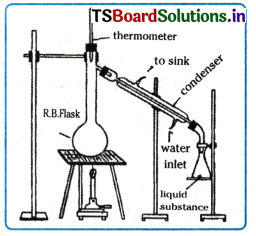
a) Distillation:
- This process is useful for the purification of liquids contaminated with non-volatile impurities.
- The impure liquid is boiled in a distillation flask and the vapours are condensed and collected in a receiver.
- This method can also be used to separate liquids which differ in their boiling points by about 40°C.
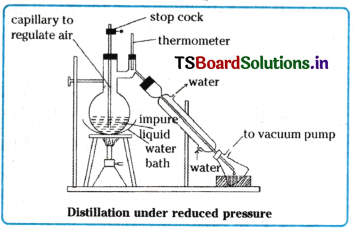
b) Distillation under reduced pressure :
- This method is useful to purify liquids that have very high BPs and those which decompose at or below their boiling points.
- If the external pressure is reduced the liquid boils at lower temperature than its normal BP without decomposition.
Question 5.
What are the different types of organic reactions?
Answer:
Common types of organic reactions are
(1) Substitution reactions
(2) Addition reactions
(3) Elimination reactions
(4) Rearrangement reactions.
1) Substitution (Displacement) reactions : The replacement of an atom or group from a molecule by a different atom or group is known as ‘substitution reaction’.
Ex :
i) 
ii) CH3OH + HBr → CH3 Br + H2O
2) Addition reactions : Reactions in which atoms or groups of atoms are added to a molecule are known as addition reactions.
Ex :

The multiple bond breaks and then the addition takes place.
3) Elimination reactions : The molecule loses atoms or group of atoms and a multiple bond is formed. (These are actually the reverse of addition reactions)
Ex :
i) Dehydration :

ii) Dehalogenation:

4) Molecular rearrangement reactions: In these reactions, an atom or a group migrates from one atom to another atom, within the same molecule.
Ex :
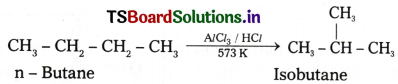
i) n – Butane to Isobutane :
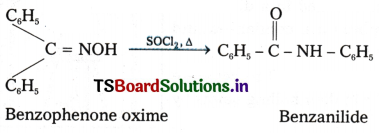
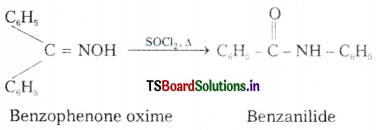
ii) Benzophenone oxime to Benzanilide :
Question 6.
Write the equations involved in the detection of Nitrogen, Halogens and Sulphur in organic compounds.
Answer:
Lassaigne’s Test: In Lassaigne’s test, the organic compound is mixed with sodium metal and fused strongly.
- The fused mass is extracted with water by plunging the red hot ignition tube in distilled water and the contents are boiled for 5 minutes and filtered.
- The filtrate is called Sodium extract or Lassaigne’s extract.
- If nitrogen is present in the organic compound, it reacts with sodium and carbon forming sodium cyanide.

- If sulphur is present in the organic compound, it reacts with sodium forming sodium sulphide.
2 Na + S → Na2S - If halogens are present in the organic compound, they form sodium halides.
2 Na + X → 2 NaX (X = Cl, Br or I)
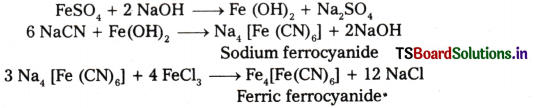
Test for Nitrogen : A little of the Lassaigne’s extract is made alkaline with NaOH solution and then freshly prepared FeSO4 solution is added.
- To it 2 – 3 drops of FeCl3 solution is added, cooled and acidified with cone. HCl.
- A prussian blue or green ppt. or colouration is observed.
Test for Halogens A little of the Lassaigne’s extract is acidified with nitric acid and treated with AgNO3 solution.
- If white ppt. soluble, in NH4OH is formed, the halide is Cl–. Hence, chlorine is present.
- If pale yellow ppt. partially soluble in NH4OH is formed, the halide is Br–. Hence, bromine is present.
- If yellow ppt. insoluble in NH4OH is formed, the halide is I–. Hence, iodine is present.
Test for Sulphur: To a little of the Lassaigne’s extract freshly prepared sodium nitroprusside solution is added. - Deep purple colouration is observed.

Question 7.
Write a note on Resonance effect.
Answer:
Resonance Effect : The polarity produced in the molecules by the interaction of two π bonds or between a π bond and long pair of electrons present on adjacent atom is called resonance effect (or) mesomeric effect.
Two types of Effects
1) +R Effect (Positive resonance effect) (+M effect) The transfer of electrons is away from an atom (or) substituent attached to the conjugated system is called +R effect. Eg : NH2 group
2) – R Effect (Negative resonance effect) (-M Effect): The transfer of electrons towards the atom (or)substituent attached to the conjugated system is called -R effect. Eg : CO, NO2 group.
Question 8.
Explain inductive effect with a suitable example.
Answer:
Inductive Effect The polarisation of σ-bond caused by the polarisation of adjacent σ-bond is called inductive effect

This effect is passed on to the subsequent bonds but the effect decreases after three bonds. This is a permanent effect operating in the molecule.
Types of Inductive Effect:
- Positive inductive Effect (+I) : Electron donating groups causes positive inductive Effet (+I). Eg : Alkyl groups R-, (Ethyl C2H5 – Methyl CH3)
- Negative inductive Effect (-I) Electron with drawing groups causes negative inductive effect (-I). Eg : CN–, -COOH etc…….
- Presence of +I effect groups, in a molecule increases the basic nature of that molecule.
- Presence of -I effect groups in a molecule increases the acidic nature of that molecule.
Question 9.
Write about homolytic fission and heterolytic fission.
Answer:
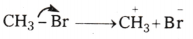
Heterolytic cleavage- Bond breaking takes place by unequal sharing of electrons of bond, i.e, shared pair of electrons remains with one of the fragment.
• Ions are formed in heterolytic cleavage.
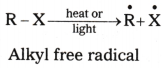
Homolytic cleavage : Bond breaking takes place by equal sharing of electrons of bond, i.e, one of the electrons of the shared pair in a covalent bond goes with each of the bonded atoms.
• In homolytic cleavage free radicals are formed
Question 10.
Discuss the chemistry of Lassaigne’s test.
Answer:
Lassaigne’s Test: In Lassaigne’s test, the organic compound is mixed with sodium metal and fused strongly.
- The fused mass is extracted with water by plunging the red hot ignition tube in distilled water and the contents are boiled for 5 minutes and filtered.
- The filtrate is called sodium extract or Lassaigne’s extract.
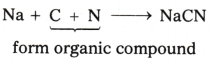
- If nitrogen is present in the organic compound, it reacts with sodium and carbon forming sodium cyanide.
- If sulphur is present in the organic compound, it reacts with sodium forming sodium sulphide.
2 Na + S → Na2S - If halogens are present in the organic compound, they form sodium halides.
2 Na + X → 2 NaX (X = Cl, Br or I)
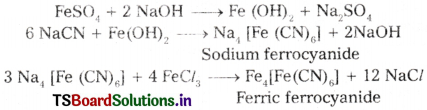
Test for Nitrogen : A little of the Lassaigne’s extract is made alkaline with NaOH solution and then freshly prepared FeSO4 solution is added. - To it 2 – 3 drops of FeCl3 solution is added, cooled and acidified with cone. HCl.
- A prussian blue or green ppt. or colouration is observed.
Test for Halogens: A little of the Lassaigne’s extract is acidified with nitric acid and treated with AgNO solution.
- If white ppt. soluble in NH4OH is formed, the halide is Cl. Hence, chlorine is present.
- If pale yellow ppt. partially soluble in NH4OH is formed, the halide is Br–. Hence, bromine is present.
- If yellow ppt. insoluble in NH4OH is formed, the halide is I–. Hence, iodine is present. Test for Sulphur: To a little of the l.assaigne’s extract freshly prepared sodium nitroprusside solution is added.
- Deep purple colouration is observed.

VI. Long Answer Questions
Question 1.
Write a note on:
a. Distillation
b. Fractional distillation
c. Distillation under reduced pressure
d. Steam distillation
Answer:
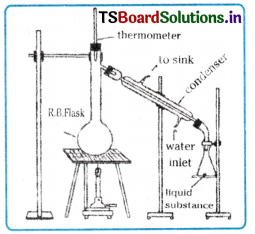
a) Distillation:
- This process is useful for the purification of liquids contaminated with non-volatile impurities.
- The impure liquid is boiled in a distillation flask and the vapours are condensed and collected in a receiver.
- This method can also be used to separate liquids which differ in their boiling points by about 40 ’C.
b) Fractional Distillation:
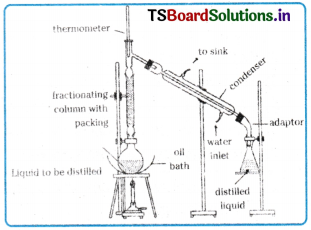
- In this process loop tubes having different shapes and designs to fit for a particular requirement are used.
- These are called fractionating columns. The liquid mixture is taken in a distillation flask, fitted with a fractionating column at its mouth.
- At the upper end of the column, it is connected to a water condenser.
- Then vapours of that liquid with lower BP condense and collect in the receiver.
c) Distillation under reduced pressure :
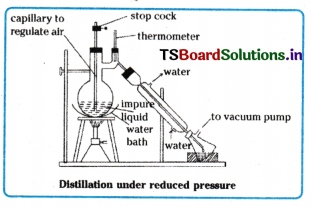
- This method is useful to purify liquids that have very high BPs and those which decompose at or below their boiling points.
- If the external pressure is reduced the liquid boils at lower temperature than its normal BP without decomposition.
d) Steam distillation :
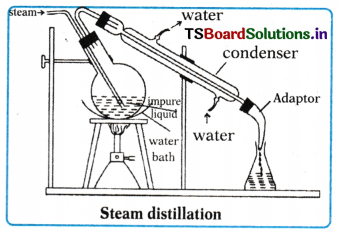
- Liquids immiscible with water and possessing high BP can be purified by steam distillation. In this method, steam is passed into the hot impure liquid.
- Steam mixed with volatile organic compound comes out. It passes through the condenser and collects in the receiver.
- The water layer and the organic layer are separated using a separating funnel.
Question 2.
Write a brief note on chromatography.
Answer:
Chromatography is a method of separation of components of a mixture between the stationary phase and a mobile phase.
Chromatography involves the following three steps :
- Adsorption and retention of a mixture of substances on the stationary phase and separation of adsorbed substances by the mobile phase to different distances on the stationary phase.
- Recovery of the substances separated by a continuous flow of the mobile phase (known as elution) and
- Qualitative and quantitative analysis of the eluted substances.
* Based on the physical states of the stationary phase and mobile phase and also on the basis of the principle of adsorption of substances on the stationary phase chromatography processes are classified into several types as given below.
| Chromatography processes | Stationary phase | Mobile phase |
| 1) Column chromatography | solid | liquid |
| 2) Liquid- liquid partition chromatography | liquid | liquid |
| 3) Paper chromatography | liquid | liquid |
| 4) Thin layer chromatography (TLC) | liquid or solid | liquid |
| 5) Gas | liquid chromatography (GLC) | liquid gas |
| 6) Gas – solid chromatography (GSC) | solid | gas |
| 7) Ion exchange chromatography | solid | liquid |
There are two chromatography techniques
(1) Adsorption chromatography
(2) Partition chromatography.
Question 3.
Explain the following:
a. Column chromatography
b. Thin layer chromatography
c. Partition chromatography
Answer:
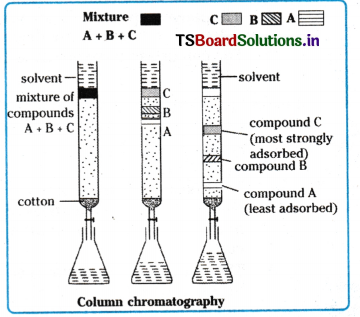
a) Column chromatography:
- In this type of chromatography the components of a mixture are separated by a column of adsorbent (stationary phase) packed in a glass tube. The column is fitted with a stopcock at its lower end.
- The mixture to be adsorbed on the adsorbent is placed at the top of the stationary phase. cotton
- A suitable eluant (solvent) is allowed to flow down the column slowly.
- Depending on the degree to which the compounds are adsorbed, the components are separated.
- The most readily adsorbed substances are retained near the top and others come down accordingly to various distances.
b) Thin layer chromatography:
- This type of chromatography also involves adsorption differences. Here the adsorbent silica gel or alumina is coated over a glass plate of suitable size.
- The plate is called TLC plate or chromoplate.
- The solution of the mixture to be separated by a small spot at about 2 cm from the bottom of the plate. The plate is then kept in a closed jar containing the eluant (solvent).
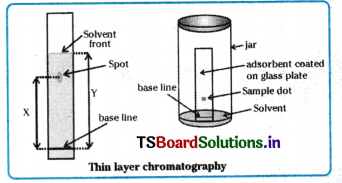
- As the eluant rises up the plate, the components of the mixture move up along with the eluant to various distances depending on their degree of adsorption.
- The relative adsorption of a component of the mixture is expressed in terms of its retardation factor (Rt) value.
Rt \(=\frac{\text { Distance moved by the substance from base line }(\mathrm{X})}{\text { Distance moved by the solvent from the base line }(\mathrm{Y})}\)
c) Partition chromatography:
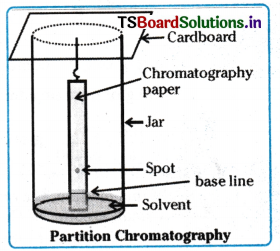
- This is based on continuous differential partitioning of components of a mixture between the stationary phase and the mobile phase.
- In this type of chromatography, a special paper called chromatography paper contains water trapped in it which acts as the stationary phase.
- The chromatography paper spotted with the solution of the mixture at the base is suspended in a suitable solvent or a mixture of solvents. This solvent acts as the mobile phase.
- The solvent rises up the paper by capillary action and moves over the spot.
- The paper selectively retains different components as per their differing partition in mobile and stationary phases.
- The paper strip so developed is known as chromatogram. The spots of the separated coloured compounds are detected.
- For colourless compounds, other methods like spraying a suitable reagent are used.
Question 4.
Explain the estimation of nitrogen of an organic compound by-
a. Dumas method
b. Kjeldahl’s method
Answer:
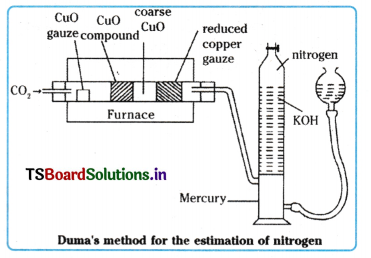
a) Estimation of nitrogen by Duma’s method:
- In this methodm, a known weight of organic compound is heated strongly with coarse cupric oxide.
- Then carbon and hydrogen get oxidised to CO2 and H2O vapour respectively. Nitrogen is converted to N2 gas.
- Some nitrogen converted into its oxides, gets reduced by copper gauze to nitrogen.
- The liberated gases are passed over a solution of KOH. Then CO2 gets absorbed.
- Nitrogen is collected over KOH solution and its volume is found out.
Calculation :
Suppose ‘a’ g of organic compound gives V ml of N2 gas at room temp. T K.
Vol. of N2 gas at STP is calculated as follows.
Expt. conditions
P1 = (P – p) mm where
p = aqueous tension
T2 = 273
V2 = ?
STP conditions
P2 = 760 mm
T1 = T K
V1 = V
From, \(\frac{\mathrm{P}_1 \mathrm{~V}_1}{\mathrm{~T}_1}\) = \(\frac{\mathrm{P}_2 \mathrm{~V}_2}{\mathrm{~T}_2}\) ⇒ V2 = \(\frac{\mathrm{P}_1 \mathrm{~V}_1 \mathrm{~T}_2}{\mathrm{P}_2 \mathrm{~T}_1}\) = \(\frac{(\mathrm{P}-\mathrm{p}) \times \mathrm{V} \times 273}{760 \times \mathrm{T}}\) = x ml.
22,400 ml. of N2 at STP weighs 28 g
∴ x ml. of N2 at STP weighs …… ?
= \(\frac{x \times 28}{22,400}\)g
‘a’ g of organic compound contains \(\frac{28 \times x}{22400}\) g of N2
∴ 100 g of organic compound contains ?
= \(\frac{100}{\mathrm{a}}\) × \(\frac{28 \times x}{22400}\) g of N2
b) Estimation of N2 by Kjeldahl’s method :
- In this method, the organic compound is heated with conc. H2SO4 in presence of a small amount of CuSO4.
- Then N2 is quantitatively converted into ammonium sulphate.
- The contents of the flask are transferred into another flask and heated with excess of NaOH solution to liberate ammonia gas.
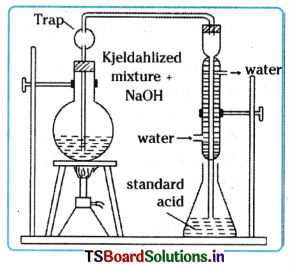
- The gas so liberated is passed and absorbed in a known vol. of known conc. H2SO4 (excess).
- Now the excess of acid remained after the neutralisation by NH3 is titrated against a standard solution of alkali.
- From this, the amount of H2SO4 used to neutralise NH3 is calculated.
From this the mass of ammonia formed is calculated and from that the % of N2 gas is calculated.
Kjeldahls method for the estimation of nitrogen:
Organic compound + H2SO4 → (NH4)2 SO4
(NH4)2SO4 + 2 NaOH → NaSO4 + 2 H2O + 2NH3
2 NH3 + H2SO4 → (NH4)2 SO4
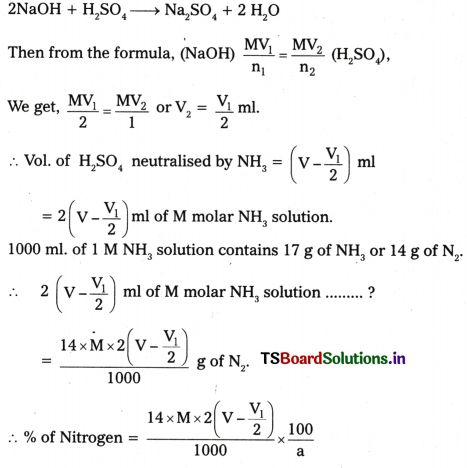
Calculations :
Mass of organic compound = a g
Vol. of H2SO4 initially taken = Vml.
Molarity of H2SO4 = M
Vol. of NaOH consumed after complete neutralisation = V1 ml.
Molarity of NaOH = M
Question 5.
Explain Inductive effect with a suitable example.
Answer:
Inductive Effect : The polarisation of o-bond caused by the polarisation of adjacent o-bond is called inductive effect.

- This effect is passed on to the subsequent bonds but the effect decreases after three bonds.
- This is a permanent effect operating in the molecule.
Types of Inductive Effect:
1) Positive inductive effect (+I) : Electron donating groups causes positive inductive effect (+I).
Eg : Alkyl groups R-, (Ethyl C2H5 – Methyl CH3)
2) Negative inductive effect (-I) : Electron withdrawing groups causes negative inductive effect (-I). Eg : CN–, -COOH etc….
Presence of +I effect groups in a molecule increases the basic nature of that molecule. Presence of -I effect groups in a molecule increases the acidic nature of that molecule.
Eg:
1) Acidic nature of trichloro acetic acid (CCl3COOH) > dichloro acetic acid (CHCl2COO) > Mono chloroacetic acid (ClCH2COOH) > (Acetic acid (CH3COOH)
This is due to the presence of -I. effecting group – CH3.
Eg : 2) Basic nature of dimethyl amine (CH3)2NH > Methyl amine (CH3NH2) > Ammonia (NH3).
This is due to the presence of + I. effecting group CH3.
Question 6.
Write a note on Mesomeric effect.
Answer:
Mesomeric Effect : The polarity produced in the molecules by the interaction of two π bonds or between a π bond and long pair of electrons present on adjacent atom is called resonance effect (or) mespmeric effect.
Two types of Effects
1) +R Effect (Positive resonance effect) (+M effect) : The transfer of electrons is away from an atom (or) substituent attached to the conjugated system is called +R effect.
Eg : NH2 group
2) – R Effect (Negative resonance Effect) (-M Effect): The transfer of electrons towards the atom (or) substituent attached to the conjugated system is called -R effect.
Eg : CO, NO2 group.
Question 7.
Describe Resonance effect with one example.
Answer:
- It is not possible to explain the properties of a molecule by giving a single structure to it. Then several possible structures are to be proposed.
- Each structure will explain some properties of the molecule.
- All structures put together explain all the properties. This phenomenon is known as resonance.
- All the structures thus proposed are called resonance or canonical structures.
Eg : Urea CO(NH2)2 has the following resonance (or canonical) structures.

Salient features of resonance :
- Resonance structures are interconvertible.
- Resonance involves only displacement of electrons without disturbing the positions of atoms.
- All atoms in the molecule should lie in the same plane.
- The no. of paired and unpaired electrons should be the same in all the structures.
- The canonical structures should have nearly equal energy.
- More stable resonance structure contributes more to the actual structure of the molecule.
- More the delocalisation of electrons, more is the stability.
- More the covalent bonds, more is the stability and charge separation gives less stability.
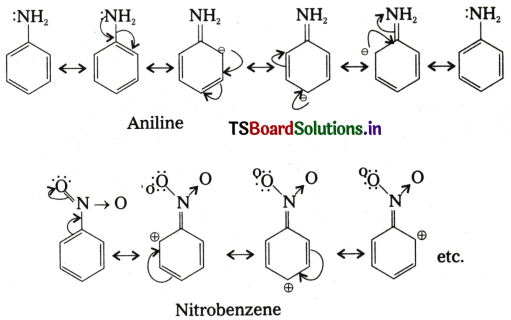
Resonance effect : It is the polarity produced in a molecule by the interactions of two p bonds or between a p bond and a lone pair of electrons present on adjacent atoms. This effect is transmitted throughout the chain.
- If the transfer of electrons is away from the atoms of substituent groups attached to the conjugated system, then the molecule gets high electron density in some of its positions as in aniline and it is given (+R).
- If the shift of electrons is towards the atom or substituent groups, it is (-R) as in nitrobenzene.
Resonance Energy : The energy difference between the real structure and the most stable resonance structure is called resonance stabilisation energy or resonance energy.
Question 8.
Explain different types of organic reactions with suitable examples.
Answer:
Common types of organic reactions are
(1) Substitution reactions
(2) Addition reactions
(3) Elimination reactions
(4) Rearrangement reactions.
1) Substitution (Displacement) reactions : The replacement of an atom or group from a molecule by a different atom or group is known as ‘substitution reaction’.
Eg :
i)

ii) CH3OH + HBr → CH3 Br + H2O
2) Addition reactions : Reactions in which atoms or groups of atoms are added to a molecule are known as addition reactions.
Eg :

The multiple bond breaks and then the addition takes place.
3) Elimination reactions : The molecule loses atoms or group of atoms and a multiple bond is formed. (These are actually the reverse of addition reactions.)
Eg :
i) Dehydration :

ii) Dehalogenation:

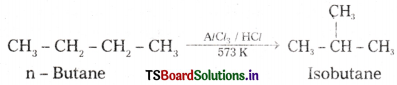
4) Molecular rearrangement reactions : In these reactions, an atom or a group migrates from one atom to another atom, within the same molecule.
Eg :
i) n – Butane to Isobutane :
ii) Benzophenone oxime to Benzanilide :
Organic Chemistry – Some Basic Principles and Techniques Class 11 NCERT Solutions
Question 1.
What are hybridisation states of each carbon atom in the following compounds ?
CH2 = C = O, CH3CH = CH2, (CH3)2CO, CH2 = CHCN, C6H6
Answer:
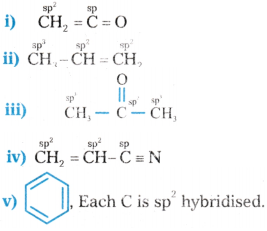
Question 2.
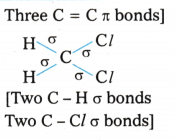
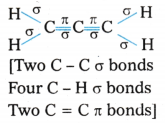
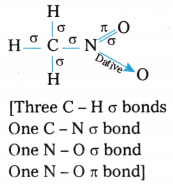
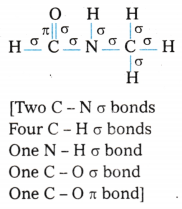
Indicate the σ and π bonds in the following molecules :
C6H6, C6H12, CH2Cl2, CH2 = C = CH2, CH3NO2, hconhch3
Answer:
i)
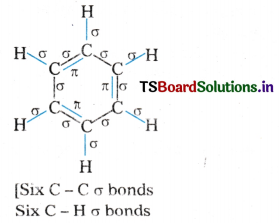
ii)
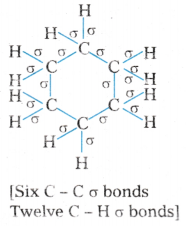
iii)
iv)
v)
vi)
Question 3.
Write bond line formulas for : Isopropyl alcohol, 2, 3-dimethyl butanal, Heptan-4-one.
Answer:
Question 4.
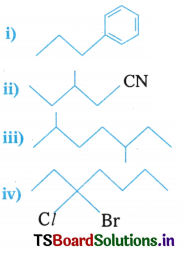
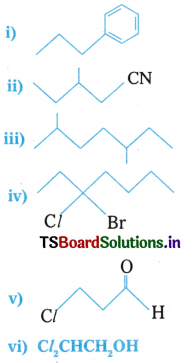
Give the IUPAC names of the following compounds.
Answer:
i) Propyl benzene
ii) 3-methylpentane-1-nitrile
iii) 2, 5-dimethyl heptane
iv) 3-bromo-3-chloro heptane
v) 3-chloro propanal
vi) 2, 2-dichloro ethanol
Question 5.
Which of the following represents the correct IUPAC name for the wipounds concerned?
i) 2, 2-dimethylpentane or 2-dimethylpentane
ii) 2, 4, 7-trimethyloctane or 2, 5, 7-trimethyloctane
iii) 2-chloro-4-methylpentane or 4-chloro-2-methylpe ntane
iv) But-3-yn-1-ol-or But-4-ol-1-yne
Answer:
i) 2, 2-dimethylpentane is correct. 2-dimethylpentane is wrong because locant 2 is mentioned only once for two methyl groups.
ii) 2, 4, 7-trimethyloctane is correct. This is because the sum 2 + 4 + 7 = 13 is lower than the sum 2 + 5 + 7 = 14
iii) 2-chloro-4-methylpentane is correct. This is because in 4-chloro-2-methylpentane, the numbering is not done from the end from which Cl is nearer.
iv) But-3-yn-l-ol is correct. In But-4-ol-l-yne, the locant for the principal group (-OH), is greater.
Question 6.
Draw formulas for the first five members of each homologous series beginning with the following compounds.
i) H – COOH
ii) CH3COCH3
Answer:
i) HCOOH, CH3COOH, CH3CH2COOH
CH3CH2CH2COOH, CH3CH2CH2CH2COCH
ii) CH3COCH3, CH3CH2COCH3, CH3CH2CH2COCH3
CH3CH2CH2CH2COCH3, CH3CH2CH2CH2CH2COCH3
iii) CH2 = CH2, CH3 – CH = CH2, CH3 – CH2 – CH = CH2
CH3 – CH2 – CH2 – CH = CH2, CH3 – CH2 – CH2 – CH2 – CH = CH2
Question 7.
Give condensed and bond line structural formulas and identify the functional group(s) present, if any for
i) 2, 2, 4-trimethylpentane
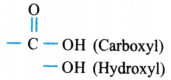
ii) 2-hydroxy-l, 2, 3-propanetricarboxylic acid
iii) Hexanedial
Answer:
i) Condensed formula : (CH3)3CCH2CH(CH3)2
Bond-line formula:

Functional group(s) present: Nil
ii) Condensed formula : HOOCCH2C (OH)
Bond-line formula:
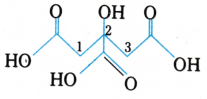
Functional group(s) present:
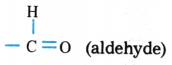
iii) Condensed formula : OHC(CH2)4CHO
Bond-line formula:
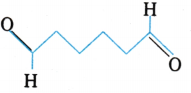
Functional group(s) present:
Question 8.
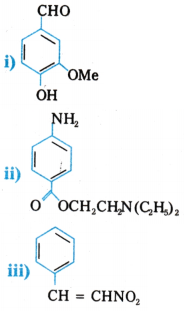
Identify the functional groups in the following compounds
Answer:
i) -CHO (aldehyde), -OH (alcohol), and -OMe i.e., -OCH3 (ether)
ii) -NH2 (1° amine, aromatic),
 -(ester), -N(C2H5)2 (3° amine)
iii) -CH = CH- (ethylenic double bond), -NO2 (nitro)
Question 9.
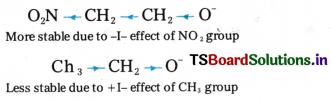
Which of the two : O2NCH2CH2O– or CH3CH2O–. is expected to be more stable and why?
Answer:
- O2NCH2CH2O is more stable than CH3CH2O–. This is because -NO2 group is electron attracting and exerts -1-effect.
- Therefore, negative charge present on —O— is dispersed and molecule is stabilised. On the other hand, -CH3 – CH2– group in CH3CH2O – exerts + 1-effect and increases electron density at -O–. This de-estabilises the CH3 – CH2O– species.
Question 10.
Explain, why alkyl groups act as electron donors when attached to a π system.
Answer:
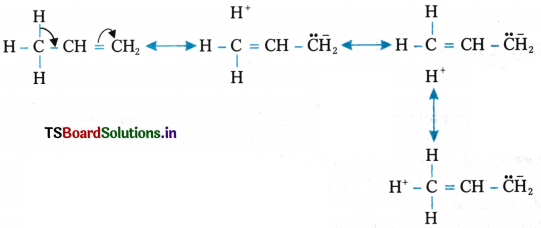
Due to’ hyperconjugation, alkyl groups act as electron donors when attached to a π-system. For example, let us consider hyperconjugation in propene.
Question 11.
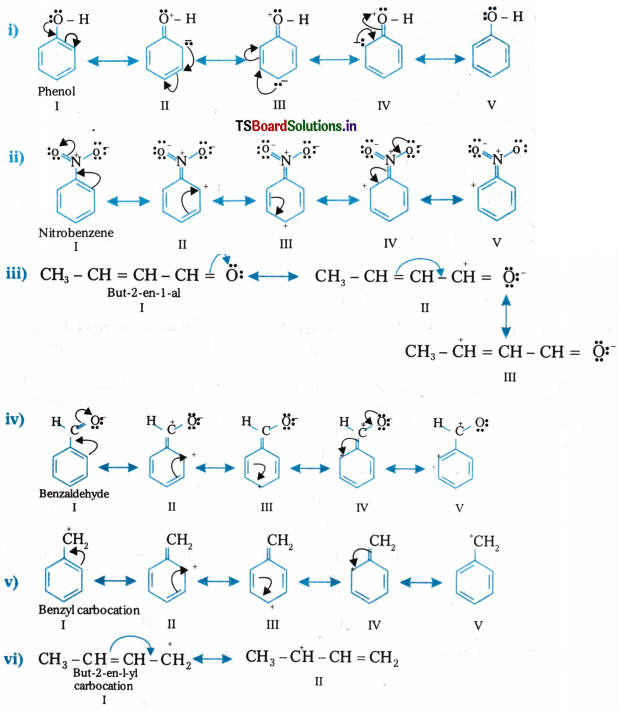
Draw the resonance structures for the following compounds. Show the electron shift using curved-arrow notation.
i) C6H6OH
ii) C6H5NO2
iii) CH3CH = CHCHO
iv) C6H5 – CHO
v) C6H5 – \(\stackrel{+}{\mathrm{C}} \mathrm{H}_2\)
vi) CH3 -CH = CH\(\stackrel{+}{\mathrm{C}} \mathrm{H}_2\)
Answer:
Question 12.
What are electrophiles and nucleophiles ? Explain with examples.
Answer:
- Electrophiles are electron loving reagents. They are electron deficient and so, act as Lewis acid and seek electrons.
Ex : H+, H3O+, \(\mathrm{O}_2^{+}\) (from HNO3), SO3H+, NO+, Br+, AlCl3, BF3 are neutral species which act as electrophiles. - Nucleophiles are nucleus loving reagents. They are electron rich and so, act as a Lewis base and donate electrons.
Ex : Cl–, Br–, I–, OH–, CN–, RO– (alkoxide ion), RCOO–.
Question 13.
Identify the reagents shown in bold in the following equations as nucleophiles or electrophiles.
i) CH3COOH + HO– → CH3COO– + H2O
ii) CH3COCH3 + CN– → (CH3)2C(CN)(OH)
iii) C6H5 + \(\stackrel{+}{\mathbf{C}} \mathbf{O}\) → C6H5COCH3
Answer:
i) OH– is nucleophile.

ii) CN– is also a nucleophile.

iii) CH3\(\mathrm{C}^{+} \mathrm{O}\) is electrophile

Question 14.
Classify the following reactions in one of the reaction type studied in this unit.
i) CH3CH2Br + HS– → CH3CH2SH + Br–
ii) (CH3)2C = CH2 + HCl → (CH3)2ClC – CH3
iii) CH3CH2Br + HO– → CH2 + H2O + Br–
iv) (CH3)3C – CH2OH + HBr → (CH3)2 CBrCH2CH3 + H2O
Answer:
i) Nucleophilic substitution reaction
ii) Electrophilic addition
iii) Bimolecular elimination
iv) Nucleophilic substitution with rearrangement.
Question 15.
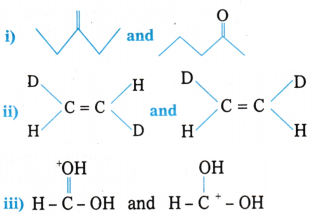
What is the relationship between the members of following pairs of structures ? Are the structural or geometrical isomers or resonance contributors ?
Answer:
i) Structural isomers (position isomers as well as metamers)
ii) Geometrical isomers.
iii) Resonance contributors
Question 16.
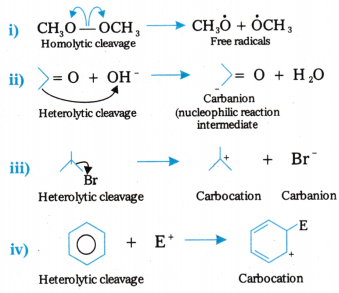
For the following bond cleavages, use curved-arrows to show the electron flow and classify each as homolysis or heterolysis. Identify reactive intermediate produced as free radical carbocation and carbanion.
Answer:
Question 17.
Explain the terms inductive and electromeric effects. Which electron displacement effect explains the following correct orders of acidity of the carboxylic acids ?
i) Cl3CCOOCH > Cl2CHCOOH > ClCH2COOH
ii) CH3CH2COOH > (CH3)2CHCOOH > (CH3)3C.COOH
Answer:
Inductive effect:
- Polar covalent bond in organic compounds cause inductive effect.
- For example, in chloroethane (2CH3 1CH2– Cl), C – Cl bond is a polar covalent bond.
- This is because Cl is more electronegative than C.
- It is polarised in such a way that the carbon-1 gains some -ve charge (δ+), the chlorine gains some -ve charge (δ–) and may be represented as,

- The polar C – Cl bond induces polarity in the adjacent bonds. Such polarisation of one σ-bond caused by the polarisation of adjacent σ-bond is referred to as the inductive effect.
- The inductive effect is related to the ability of substituents (s) to either withdraw or donate electron density to the attached carbon atom. Electron withdrawing groups like halogens, nitro (-NO2), cyano (-CN), carboxy (-COOH), ester (-COOR), aryloxy (-OAr), produce, I-effect, whereas electron donating groups like methyl (-CH3), ethyl (-CH2 – CH3) etc. produce + I-effect.
Electromeric effect:
• It involves the complete transfer of electrons of a multiple bond e.g., double or triple bond to one of the bonded atoms (usually more electronegative) in presence of attacking reagent.

This effect is temporary and occurs only in the presence of a reagent.
• When the electrons of a π-bond are transferred to that atom of the double bond to which the reagent get finally attached the effect is called + E-effect.
Example :

On the other hand, when the electrons of the double bond are transferred to an atom of the double bond, other than the one to which the reagent gets finally attached, the effect is called -E-effect.
Example :

i) Example of -I-effect:

ii) Example of +I-effect:

Question 18.
Give a brief description of the principles of the following techniques taking an example in each case :
i) Crystallisation
ii) Distillation
iii) Chromatography
Answer:
i) Crystallisation:
- This is one of the most commonly used techniques for the purification of solid organic compounds. It is based on the difference in the solubilities of the compound and the impurities in a suitable solvent.
- The impure compound is dissolved in a solvent in which it is sparingly soluble at room temperature but appreciably soluble at higher temperature.
- The solution is concentrated to get a nearly saturated solution.
- On cooling the solution, pure compound crystallises out and is removed by filtration. Freezing of water into ice is an example of crystallisation.
ii) Distillation :
- A separation process in which a liquid is converted to vapour and the vapour is then condensed to a liquid is called distillation.
- Distillation is thus a process of evaporation and condensation.
- For example, the process can be used in the purification of a mixture of chloroform (bp 334 K) and aniline (bp 457 K) having a large difference in their boiling points.
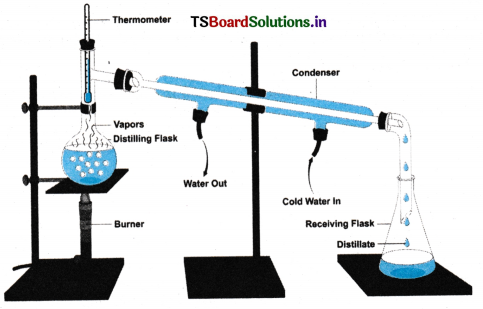
- A pure solvent, a mixture of solvents, or a gas is allowed to move slowly over the stationary phase.
- The components of the mixture get gradually is an extremely valuable method for the separation of amino-acid, geometrical and optical isomers.
Question 19.
Describe the method, which can be used to separate two compounds with different solubilities in a solvent S.
Answer:
- Two compounds having different solubilities in a solvent S, can be separated by a technique called fractional crystallisation.
- When a hot saturated solution of two compounds is allowed to cool, the less soluble compound crystallizes out first, leaving more soluble compound in the solution.
- The crystals of the first compound are separated from the mother liquor.
- Now mother liquor is further concentrated and the hot solution is again allowed to cool, when the crystals of the second i.e., more soluble compound separate out.
Question 20.
What is the difference between distillation, distillation under reduced presure and steam distillation ?
Answer:
Distillation is used to separate :
- volatile liquids from non-volatile impurities, and
- liquids having sufficient difference in boiling point.
- Distillation under reduced pressure is used to separate compounds which decompose at or below their boiling points.
- Steam distillation is applied to those substances which have high boiling point are steam volatile and immiscible with water.
Question 21.
Discuss the chemistry of Lassaigne’s test.
Answer:
Lassaigne’s test: For this test a “Sodium extract” is prepared for the substance. This is done by heating a pea-sized piece of sodium metal in a combustion tube (5 cm in length and 0.3 cm in diameter) and melted over bunsen burner flame.
- Organic substance is added to the molten sodium pinch by pinch or drop by drop.
- After some substance has reacted, the heating of the combustion tube is gradually increased to redness.
- The red hot tube is broken into about 10 mL of distilled water kept in a dish.
- The solution is then heated to boiling for a few minutes. Any of the sodium metal, left unreacted, reacts with water as follows :
2Na + 2HOH → 2NaOH + H2 - The solution is filtered. The filtered solution is called sodium extract or Lassaigne’s extract.
- In this process, the nitrogen of the organic substance is converted to sodium cyanide, sulphur to sodium sulphide or sulpho cyanide and the halogens to the respective halides.
- All these are soluble in water.
Na + C + N → NaCN (cyanide)
2Na + S → Na2S (sulphide)
Na + S + C + N → NaSCN (sulpho cyanide)
Na + X → NaX (halide) (X = Cl, Br or I)
Question 22.
Differentiate between the principle of estimation of nitrogen in an organic compound by
i) Dumas method
ii) Kjeldahl’s method
Answer:
i) In Dumas method, a known weight of organic compound containing nitrogen is heated in presence of CuO, such that the nitrogen present in organic compound is changed to dinitrogen.
- The evolved dinitrogen is collected in a nitrometer.
- The volume thus obtained is converted to NTP and the percentage of nitrogen is calculated by using the equation.
%N = \(\frac{28}{22400}\) × \(\frac{\text { Volume of } \mathrm{N}_2 \text { at NTP } \times 100}{\text { Mass of organic compound taken }}\)
ii) In Kjeldahl’s method, a known weight of organic compound containing nitrogen is heated with cone. H2SO4. in presence of K2SO4 and little Hg in a long necked flask called Kjeldahl’s flask.
- When nitrogen present in organic compound is converted into (NH4)2SO4 that is boiled with excess of NaOH solution to liberate NH3 gas which is further absorbed in a known excess of standard H2SO4.
- The volume of acid unused is determined by titration against a standard alkali solution.
- From the volume of the acid used the percentage of nitrogen is determined by using the equation.
%N \(=\frac{1.4 \times \text { Molarity of acid × basicity of acid } \text { × } \text { volume of acid used }}{\text { Mass of the substance taken }}\)
Question 23.
Discuss the principle of estimation of halogens, sulphur and phosphorus present in an organic compound.
Answer:
i) Estimation of halogen by the Carius method:
- A small quantity of the substance is weighed in a small ignition tube (3 mm in diameter × 50 mm in length) and is placed in Carius tube (a thick-walled Jena glass tube about 45 cm long and 2.5 cm in diameter) having enough of concentrated HNO3 and AgNO3 crystals [in Fig. (a)].
- The Carius tube is sealed by using an oxygas flame.
- The sealed tube is placed in an iron socket tube heated in a special furnace.
- The furnace temperature is maintained near 475 K [in Fig. (b)] for six to seven hours and then the furnace is allowed to cool down to room temperature.
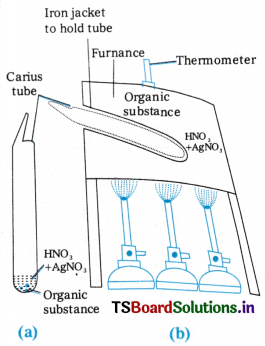
- The halogen part of the substance is converted into the corresponding silver halide. After breaking the seal, contents of the Carius tube are collected.
- Silver halide is filtered, washed, dried and weighed. Percentage of the halogen is then calculated from the mass of silver halide formed.
Percentage of halogen \(=\frac{\text { Mass of silver halide } \text { × } \text { Atomic mass of halide } \times 100}{\text { Molecular mass of silver halide } \text { × } \text { Mass of organic compound }}\)
ii) Estimation of sulphur : This is also done by the Carius method.
- Instead of adding crystals of AgNO3 as done for halogens, crystals of BaCl2 are added.
- The sulphur part is oxidised to sulphuric acid.
- This gives a precipitate of BaSO4 which is collected, washed, dried and weighed. 233.34 g of BaSO4 contains 32 g of sulphur.
Percentage of sulphur \(=\frac{\text { Weight of } \mathrm{BaSO}_4 \times \text { Atomic mass of sulphur } \times 100}{\text { Molecular mass of } \mathrm{BaSO}_4 \times \text { Mass of organic compound }}\)
iii) Estimation of Phosphorus : Non-volatile orthophosphoric acid H3PO4, which is precipitated as MgNH4PO4 with magnesia mixture.
• On heating the precipitate Mg2P2O7 is obtained as a stable residue.
•Calculation of percentage of phosphorus can be done as follows.
(P) → H3PO4
H3PO4 + Magnesia mixture → MgNH4PO4
2MgNH4PO4 → Mg2P2O7 + 2NH3 + H2O
Molecular mass of Mg2P2O7 = 2 × 24 + 2 × 31 + 7 × 16 = 222 units
222 g of Mg2P2O7 contain 62 g of phosphorus
Let mass of substance be w gram and of Mg2P2O7 residue x grams.
Mass of phosphorus in x gram of Mg2P2O7 = \(\frac{62 x}{222} \mathrm{~g}\)
Percentage of phosphorus in the compound = \(\frac{62 x}{222} \times \frac{100}{w}\)
Question 24.
Explain the principle of paper chromatography.
Answer:
- Paper chromatography is also known as partition chromatography. It is based on the principle of continuous partitioning of component of a mixture between stationary and mobile phases.
- In paper chromatography, a special quality paper known as chromatography paper is used and the water trapped in it act as the stationary phase.
- A rectangular chromatography paper (of about 22 cm length and 5 cm width) is taken. It is spotted with the mixture of the solution (say blue and red ink) at the centre of its one end.
- The chromatography paper is fixed vertically between two halves of the cork and suspended in suitable solvent or a mixture of solvent (in the present case in a mixture of 1 volume methanol and 9 volume water) taken in a boiling tube in such a way that the ink spot is just above the solvent level, (figure (a))
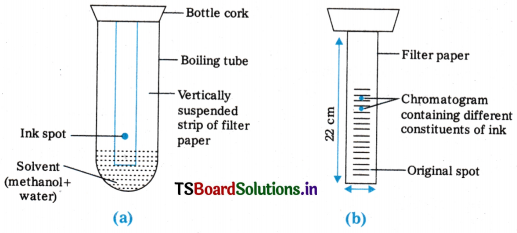
- The solvent rises up the paper by capillary action and flows over the spot (in the present case mixture of ink). As a result, the coloured components (in the present case ink) get dissolved in the solvent mixture and rises up the paper by capillary action.
- The paper selectively retains different components (red and blue ink) are visible at different heights from the position of the initial spot on the chromatogram. (figure (b)).
- In case the spots separated are colourless, they may be observed by the use of an appropriate spray reagent.
Question 25.
Why is nitric acid added to sodium extract before adding silver nitrate for testing halogens?
Answer:
- Nitric acid is added to sodium extract before adding silver nitrate for testing halogens, because if sodium extract contains Na2S or NaCN along with NaX, silver nitrate will give Ag2S and AgCN etc., and will interfere in the test.
- To remove sulphide and cyanide as H2S, and HCN dil. HNO3 is added.
NaCN + HNO3 → NaNO3 + HCN↑
Na2S + 2HNO3 → 2NaNO3 + H2S↑
Question 26.
Explain the reason for the fusion of an organic compound with metallic sodium for testing nitrogen, sulphur and halogens.
Answer:
- Nitrogen, sulphur and halogens are present in organic compound in covalent form, which cannot be analysed.
- On fusion with sodium these are converted in ionic form in the form of sodium cyanide, sodium halide, sodium sulphide etc.
Question 27.
Name a suitable technique of separation of the components from a mixture of calcium sulphate and camphor.
Answer:
By sublimation, the two can be separated. Camphor sublimates whereas CaSO4 is left behind.
Question 28.
Explain why an organic liquid vaporises at a temperature below its boiling point in its steam distillation.
Answer:
- In steam distillation, the mixture of organic liquid and water boils at a temperature at which the sum of vapour pressure of the liquid (p1) and that of water (p2) is equal to that of the atmospheric pressure (p) i.e., p = p1 + p2
- This is attained at a temperature much below the boiling point of the liquid. In other words, the organic liquid vaporises at a temperature much lower than its normal boiling point.
Question 29.
Will CCl4 give white precipitate of AgCl on heating it with silver nitrate ? Give reason for your answer.
Answer:
CCl4 will not give any white precipitate of AgCl on heating it with silver nitrate solution. Carbon tetrachloride contains chlorine, but it is bonded to carbon atom by a covalent bond; hence it does not give any precipitate of silver chloride.
Question 30.
Why is a solution of potassium hydroxide used to absorb carbon dioxide evolved during the estimation of carbon present in an organic compound ?
Answer:
2KOH + CO2 → K2CO3 + H2O
Total CO2 formed by organic compound is absorbed by potassium hydroxide solution. And then the percentage of C present in organic compound can be calculated using,
C% \(=\frac{12}{44}\) \(\times \frac{\text { Mass of } \mathrm{CO}_2}{\text { Mass of the organic compound }}\) × 100
Question 31.
Why is it necessary to use acetic acid and not sulphuric acid for acidification of sodium extract for testing sulphur by lead acetate test ?
Answer:
Sulphuric acid is a powerful oxidising agent; it may oxidise Na2S present in sodium extract to sodium sulphate and then we will not be able to get the nitroprusside test of sulphur while if acidification done by using acetic acid the formed product lead acetate is soluble and do not interfere with the test.
Question 32.
An organic compound contains 69% carbon and 4.8% hydrogen, the remainder being oxygen. Calculate the masses of carbon dioxide and water produced when 0.20 g of this substance is subjected to complete combustion.
Answer:
100 g of organic compound contains 69 g of carbon
∴ 0.2 g of organic compound contains \(\frac{69}{100}\) × 0.2 g carbon = 0.138 g of carbon
Now we know that:
12 g of carbon gives = 44 g of CO2
∴ 0.138 g of carbon gives = \(\frac{44}{12}\) × 0.138g of CO2 = \(\frac{6.072}{12}\) g = 0.506 g
Also, 100 g of organic compound contains = 4.8 g of hydrogen
∴ 0.2 g of organic compound contains = \(\frac{4.8}{100}\) × 0.2 g of hydrogen = 0.0096 g of hydrogen
2 g of hydrogen gives = 18 g of H2O
∴ 0.0096 g of hydrogen gives = \(\frac{18}{2}\) × 0.0096 g of H2O = 0.0864 g
Question 33.
A sample of 0.50 g of an organic compound was treated according to Kjeldahl’s method. The ammonia evolved was absorbed in 50 mL of 0.5 M H2SO4. The residual acid required 60 mL of 0.5 M solution NaOH for neutralisation. Find the percentage composition of nitrogen in the compound.
Answer:
Mass of organic compound taken = 0. 50 g
Volume of 0.5 M of H2SO4 solution = 50 mL
Volume of NaOH of 0.5 M required for neutralisation of residual acid
= 60 mL = 30 mL of 0.5 M of H2SO4
Volume of 0.5 M of H2SO4 used for absorbing NH3 = (50 – 30) mL or 20 mL of 0.5 M of H2SO4
Now, 20 mL of 0.5 M of H2SO4 = 40 mL of 0.5 M of NH3 or 20 mL of 1 M of NH3
1000 mL of 1 M of NH3 contains 17 g ammonia or 14 g of Nitrogen
20 mL of 1 M NH3 contains = \(\frac{20}{1000}\) × 14 = 0.28 g of nitrogen
∴ Nitrogen in 0.5 g of organic substance = 0.28 g
or Percentage of Nitrogen = \(\frac{0.28}{0.5}\) × 100 = 56
Question 34.
0.3780 g of an organic chloro compound gave 0.5740 g of silver chloride in Carius estimation. Calculate the percentage of chlorine present in the compound.
Answer:
Using the relation :
Percentage of chlorine = \(\frac{35.5}{01435}\) × \(\frac{\text { Mass of } \mathrm{AgCl} \text { formed }}{\text { Mass of the substance taken }}\) × 100
Given, Mass of AgCl formed = 0.5740 g
Mass of organic chioro compound taken = 0.3780 g
Substituting the values in the equation above, we get
= \(\frac{35.5}{143.5} \) × \(\frac{0.5740}{0.3780}\) = 37.566%
Question 35.
In the estimation of sulphur by Carius method, 0.468 g of an organic sulphur compound afforded 0.668 g of barium sulphate. Find out the percentage of sulphur in the given compound.
Answer:
Percentage of sulphur in an organic compound is given by
%S = \(\frac{32}{233}\) × \(\frac{\text { Mass of } \mathrm{BaSO}_4 \text { formed }}{\text { Mass of compound taken }}\) × 100
%S = \(\frac{32}{233}\) × \(\frac{0.668}{0.468}\) × 100 = 19.60
Question 36.
In the organic compound CH2 = CH – CH2 – CH2 – C ≡ CH, the pair of hydridised orbitals involved in the formation of C2 – C3 bond is :
a) sp-sp2
b) sp-sp3
c) sp2-sp3
d) sp3 = sp3
Answer:
(c) sp2-sp3
Question 37.
In the Lassaigne’s test for nitrogen in an organic compound, the Prussian blue colour is obtained due to the formation of
a) Na4[Fe(CN)6]
b) Fe4[Fe(CN)6]3
c) Fe2[Fe(CN)6]
d) Fe3[Fe(CN)6]4
Answer:
b) Fe4[Fe(CN)6]3
Question 38.
Which of the following carbocation is most stable ?
a) (CH3)3C.\(\stackrel{ \pm}{\mathbf{C}}\)H2
b) (CH3)3\(\stackrel{+}{\mathrm{C}}\)
c) CH3CH2\(\stackrel{+}{\mathbf{C}}\)H2
d) CH3\(\stackrel{+}{\mathrm{C}}\)HCH2CH3
Answer:
b) (CH3)3\(\stackrel{+}{\mathrm{C}}\). This is because order of stability of carbocations is 3° > 2° > 1°.
Question 39.
The best and latest technique for isolation, purification and separation of organic compounds is
a) Crystallisation
b) Distillation
c) Sublimation
d) Chromatography
Answer:
(d) Chromatography
Question 40.
The reaction : CH3CH2I + KOH(aq) → CH3CH2OH + KI is classified as,
a) electrophilic substitution
b) nucleophilic substitution
c) elimination
d) addition
Answer:
(b) Nucleophilic substitution. In this reaction the nucleophile I– is replaced by the nucleophile OH–.