
Regular practice with AP Inter 1st Year Chemistry Study Material Chapter 5 Thermodynamics Questions and Answers helps students stay prepared for examinations.
AP Inter 1st Year Chemistry 5th Lesson Thermodynamics Questions and Answers
I. Multiple Choice Questions
Question 1.
According to the third law of thermodynamics which one of the following quantities for a perfectly crystalline solid is zero at absolute zero (- 273.15 °C) ?
1) Gibbs energy
2) Entropy
3) Enthalpy
4) Internal energy
Answer:
2) Entropy
The Entrops of pure and perfectly crystalline substances is zero at absolute zero (0°k).
Question 2.
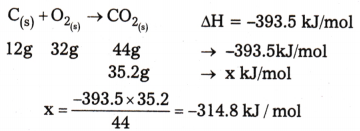
The heat of combustion of carbon is-393.5 kJ/mol. The enthalpy change in the formation of 35.2g of CO2 from carbon and oxygen gas is
1) -315 kJ
2) + 315 kJ
3) -630 kJ
4)-3.15kJ
Answer:
1) -315 kJ
Question 3.
For the reaction. N2 + 3H2 ⇌ 2NH3, ∆H = ?
1) ∆U+2RT
2) ∆U – 2RT
3) ∆H = RT
4) ∆U- RT
Solution:
2) ∆U – 2RT
N2 + 3H2 ⇌ 2NH3
∆H = ∆U + ∆nRT
∆n = no. of gas products – no. of gas reactants = 2 – (1 + 3) = -2
∆H = ∆U – 2RT
Question 4.
Which amongst the following options is the correct relation between change in enthalpy and change in internal energy?
1) ∆H = ∆U + ∆ngRT
2) ∆H – ∆U – ∆nRT
3) ∆H + ∆U = ∆nR
4) ∆H = ∆U – ∆ngRT
Answer:
1) ∆H = ∆U + ∆ngRT
∆H = ∆U+ ∆n(g), RT is the correct relation
Question 5.
A thermodynamic state function is a quantity
1) used to determine heat changes
2) whose value is independent of path
3) used to determine pressure-volume work
4) whose value depends on temperature only
Answer:
2) whose value is independent of path
State function depends on initial and final states but independent on path.

Question 6.
For the process to occur under adiabatic conditions, the correct condition is
1) ∆T = 0
2) ∆p = 0
3) q = 0
4) w = 0
Answer:
3) q = 0
In adiabatic process no heat is transferred between system and surroundings.
∴ q = 0
Question 7.
The enthalpies of all elements in their standard states are
1) Unity
2) Zero
3) < 0
4) Different for every element
Answer:
2) Zero
Enthalpies of all Elements in their standard states are zero.
Question 8.
The enthalpy of combustion of methane, graphite and dihydrogen at 298 K are – 890.3 kJ/mol, – 393.5 kJ mol-1 and -285.8 kJ mol-1 respectively. Enthalpy of formation of CH4 (g) will be
1) – 74.8kJ mol-1
2) 52.27kJ mol-1
3) + 74.8kJ mol-1
4) – 52.26 kJ mol-1
Solution:
1) – 74.8kJ mol-1
Combustion of methane are CH4(g) + O2(g) → CO2(g) + 2H2O(l); ∆H(CH4) = – 890.3kJ/mol
Combustion of graphite, C(S) +O2(g) → CO2(g) ; ∆H(c) = -393 kJ/mol
Combustion of dihydrogen, 2H2(g) + O2(g) → 2H2O(l) ; ∆H(H2) =-285.8 kJ/mol
Formation of methane C(S) + 2H2(g) → CH4(g) ; ∆Hf = ?
∆Hf = ∆Hc + 2∆H(H2) – ∆HCH4 = -393 + -2 × (-285.5) – (-890.3 kJ)
= -393 – 575.6 + 890.3 = -74.8 kJ/mol
Question 9.
A reaction, A + B → C + D + qis found to have a positive entropy change. The reaction will be
1) possible at high temperature
2) possible only at low temperature
3) not possible at any temperature
4) possible at any temperature
Answer:
4) possible at any temperature
The given reaction will be possible at any temperature because entropy change is positive and enthalpy change is negative.
Question 10.
Which of the following are not state functions ?
1) work and entropy
2) heat and work
3) entropy and internal energy
4) heat and entropy
Answer:
2) heat and work
Heat and work are not state functions. Both are path functions.
Question 11.
The Gibbs energy change (∆G) at constant temperature is equal to
1) ∆H – TS
2) ∆H + TS
3) ∆H + T∆S
4) ∆H – T∆S
Answer:
∆G = ∆H – T∆S
Question 12.
For the reaction, 2Cl (g) → Cl2 (g) the correct option is
1) ∆rH > 0 and ∆rS < 0
2) ∆H < 0 and ∆S > 0
3) ∆rH < 0 and ∆rS < 0
4) ∆rH > 0 and ∆rS > 0
Answer:
3) ∆rH < 0 and ∆rS < 0
2Cl(g) → Cl2(g)
This reaction is exothermic so ∆H < 0. In the reaction no.of moles decreases (2 → 1) so randomness decreases so ∆S < O
∴ ∆H < O and ∆S < O
Question 13.
Which of the following is not an extensive property?
1) Mass
2) Volume
3) Temperature
4) Enthalpy
Answer:
3) Temperature
Temperature is an intensive property.
Question 14.
The correct thermodynamic conditions for the spontaneous reaction at all temperatures is
1) ∆rH > 0 and ∆rS < 0
2) ∆rH < 0 and ∆rS > 0
3) ∆rH < 0 and ∆rS < 0
4) ∆rH > 0 and ∆rS > 0
Answer:
2) ∆rH < 0 and ∆rS > 0
For a reaction to be spontaneous ∆H < 0 and ∆S > 0
Question 15.
If a process is carried out at constant volume (∆V = 0), the correct expression is
1) ∆U= Q – Pex∆V
2) ∆U = q
3) ∆U = q + Pex∆V
4) ∆U = w
Answer:
2) ∆U = q
∆H = ∆U + P∆V
∆V = 0
∆H = ∆Q + P∆V ∴ ∆U = Q
II. Fill in the Blanks
Question 1.
q = w = -Pext (vf – vi) is for irreversible __________ change.
Answer:
For irreversible isothermal change q = w = -Pext (vf – vi)
Question 2.
q = -w = nRT In (vf/vi) is for _______ isothermal change.
Answer:
For reversible isothermal change q = -w = nRT ln\(\left(\frac{V_f}{V_i}\right)\)
Question 3.
For an isolated system, ∆U = 0, the value of AS will be
For an isolated system ∆U = 0, ∆S ≥ 0 (Zero)
Question 4.
In _______ system there is no exchange of matter and energy between the system and surroundings.
Answer:
In isolated system there is no exchange of matter and energy between system and surroundings takes place.
Question 5.
For chemical reactions, _______ is used to measure the value of heat change at constant volume.
Answer:
Bomb calorimeter is used to measure the value of any heat change at constant volume.
III. One Word Answer Questions
Question 1.
Work is done by the system and ‘q’ is the amount of heat is supplied to the system. What type of system would it be?
Answer:
Work is done by the system and ‘q’ is the amount of heat is supplied to the system then it is a closed system.
Question 2.
The system loses ‘q’ amount of heat though no work is done on the system. What type of wall does the system have?
Answer:
The wall is thermally conducting wall.
Question 3.
What is the work done in the free expansion of an ideal gas in reversible and irreversible processes?
Answer:
Work done is zero. No work is done.
Question 4.
In isothermal reversible change of an ideal gas, what is the value of q ?
Answer:
q = 2.303 nRT log\(\left(\frac{\mathrm{V}_2}{\mathrm{~V}_1}\right)\)
Where, n = no. of moles ; R = gas constant; T = Temperature ; V2 = final volume ; V1 = initial volume
Question 5.
For an adiabatic change in an ideal gas what is the relationship between its ∆U and W (adiabatic)?
Answer:
For an adiabatic change in an ideal gas ∆V = w
IV. Very Short Answer Questions
Question 1.
Define a system.
Answer:
A small part of universe which is taken to study thermodynamics is called a system.
Question 2.
State the first law of thermodynamics.
Answer:
First law of Thermodynamics : Energy can neither be created nor be destroyed. It can transform from one form to another.
Question 3.
State the second law of thermodynamics.
Answer:
2nd law of thermodynamics: All spontaneous processes are thermodynamically irreversible and entropy of system increases.
Question 4.
State the third law of thermodynamics.
Answer:
3rd law of thermodynamics : The Entropy of pure and perfectly crystalline substances is zero at absolute zero (0° K).
Question 5.
What are intensive and extensive properties?
Answer:
Measurable properties of A system may be classified into two types, i) Extensive properties, i’i) Intensive properties.
i) Extensive Properties: The properties of a system which depend on the total amount of the material present in the system are called extensive properties.
Eg : Mass (m), volume (V), internal energy (E), heat content (H), Gibbs energy (G), entropy (s), heat capacity (v), etc. are extensive properties.
ii) Intensive properties : Properties of a system which are independent of the amount of the material in the system are called intensive properties.
Eg: Density, molar properties such as molar volume, molar entropy, molar heat capacity, surface tension(S), viscosity, specific heat, refractive index, pressure, temperature, boiling point, freezing point and vapour pressure are intensive properties.
Question 6.
Define the state function. Give two examples.
Answer:
State function: The thermodynamic function that depends on initial and final states of the substance but not on the path is called state function.
Eg Temperature, Enthalpy, internal Energy.
Question 7.
The equilibrium constant for a reaction is 10. What will be the value of ∆G° ? (R= 8.314JK-1 mol-1, T = 300K)
Solution:
From the expression, ∆G° = -2.303 RT logKeq
AG® for the reaction = (2.303) (8.314 JK-1 mol-1) (300 K) log 10
= – 5744.14 J mol-1 = – 5.744 kJ mol-1
Question 8.
Two litres of an ideal gas at a pressure of 10 atm expands isothermally into vacuum until its total volume is 10 litres. How much heat is absorbed and how much work is done in the expansion?
Solution:
We have q = – w = pex (10 – 2) = 0(8) = 0
No work is done. So no heat is absorbed.
Question 9.
Calculate the entropy change in surroundings when 1.00 mole of H2O(l), is formed under standard conditions ∆fH° = – 286 kJ mol-1.
Solution:
∆fS = [Si – Ss] = \(\frac{\Delta_{\text {fus }} \mathrm{H}}{\mathrm{~T}_{\mathrm{f}}}\)
= \(\frac{-286 \mathrm{kJmol}^{-1}}{298 \mathrm{~K}}\) = 959 JK-1mol-1
Question 10.
Given N2(g) + 3H2(g) → 2NH3 (g): ∆rH° = – 92.4 kJ. What is the standard enthalpy of the formation of NH3 gas?
Solution:
The heat of reaction ∆rH° is – 92.4 kJ mol-1
This is the heat of formation of 2 moles of ammonia.
The enthalpy of formation of 1 mol of NH3 = \(\frac{-92.4}{2}\)
= – 46.2 kJ
∴ Standard enthalpy of formation of ammonia = – 46.2 kJ
V. Short Answer Questions
Question 1.
What are open, closed and isolated systems ? Give one example for each.
Answer:
Types of systems :
Basing on the fact whether energy or matter or both are exchanging between the system and the surroundings. The systems are classified into three types, a) open system b) closed system c) isolated system.
a) Open system :
A system which can exchange both matter and energy with its surroundings is called open system.
Ex: A liquid in an open vessel. It can absorb heat energy from the surroundings and can give heat energy to the surroundings during evaporation and condensation. Similarly water can go as vapour into the surroundings and vapour can condense as liquid into the beaker.
b) Closed system :
A system which can exchange energy but not matter with its surroundings is called closed system.
Ex : Water taken in a closed non-porous vessel. This can take heat from the surroundings and is evaporated. The vapour can condense back into liquid releasing heat to the surroundings. But water cannot leave or enter the vessel because it is closed.
c) Isolated system :
A system in which neither rnatter nor enerß,’ is exchanged with surroundings.
Ex : Liquid taken in a closed thermos flask. Heat can neither enter nor leave the flask. Similarly liquid or its vapour cannot go into the surroundings.
Question 2.
State and explain the Hess’s law of constant Heat summation.
Answer:
Hess’s law :
Energy changes remains constant whether the reactions takes place in single step or in several steps.
I. Formation of CO2: CO2 can be formed either in one step or in two steps.
a) C(graphite) + O2(g) → CO2(g), ∆H = – 393.5 kJ
b) C(graphite) + O2→ CO (g), ∆H = -110.5kJ –
CO (g) + O2 (g) → CO2 (g), ∆H = – 283.5 kJ
Total ∆H = – 393.52 kJ
Reaction ‘a’ is completed in single step and reaction ‘b’ is completed in two steps. But in both the cases energy changes remains constant, which proves Hess’s law.
II. Formation of NH4Cl (aq) :
a) NH3 (g) + H2O (l) → NH3 (aq), ∆H = -35.1 k.J
HCl (g) + H2O (l) → HCl (aq), ∆H = 72.9 kJ
NH3 (aq) + HCl (aq) → NH4Cl (aq), ∆H = -51.5kJ
Total ∆H = – 159.5 kJ
b) NH3 (g) + HCl (g) → NH4Cl (g), ∆H = – 176.1 kJ
NH4Cl (s) + H2O (l) → NH4Cl (aq), ∆H = + 16.3 kJ
Total ∆H = – 159.8 kJ
In both reactions (a) and (b), the heat of formation of NH4C/ (aq.) is the same, which proves Hess’s law.
Uses of Hess’s law : It is used to determine
- Heat of formation.
- Heat of reaction.
- Crystal lattice energy.
- Transition temperatures of allotropic forms.
Question 3.
Define heat capacity. What are Cp and Cv ? Show that Cp – Cv = R.
Answer:
- Heat capacity of a substance is defined as the amount of heat required to raise its temperature through one degree.
- The heat capacity at constant volume is represented by Cv. Cv gives the measure of the change of internal energy (E) of a system with temperature.
- If heat is absorbed by the system at a constant pressure, heat capacity is represented by Cp. It is called heat capacity at constant pressure.
- At constant pressure, when heat is absorbed the volume of the gas increase. While the gas expands it does some work, for which extra heat amount is required. Hence Cp always greater than Cv. The Cp is equal to change in internal energy and the work done.
- The work done is equal to PV where V is the change in volume.
Relation between Cp and Cv :
For an ideal gas H = E + PV
Differentiating with temperature, \(\frac{\mathrm{dH}}{\mathrm{dT}}=\frac{\mathrm{dE}}{\mathrm{dT}}+\frac{\mathrm{d}(\mathrm{PV})}{\mathrm{dT}}\)
For one mole of ideal gas, PV = RT
∴ \(\frac{\mathrm{dH}}{\mathrm{dT}}=\frac{\mathrm{dE}}{\mathrm{dT}}+\frac{\mathrm{d}(\mathrm{RT})}{\mathrm{dT}}\) or \(\frac{\mathrm{dE}}{\mathrm{dT}}+\mathrm{R} \frac{\mathrm{dT}}{\mathrm{dT}}=\frac{\mathrm{dE}}{\mathrm{dT}}+\mathrm{R}\)
∴ Cp = Cv + R or Cp – Cv = R or \(\frac{C_p}{C_V}\) = γ
Question 4.
What is entropy? Explain with examples.
Answer:
Entropy means transformation. It is denoted by ‘S’.
Entropy is a measure of disorder or randomness in a system.
The greater the disorder in a system the higher is the entropy.
Entropy is a state function.
Entropy change (∆S) between any two states is therefore given by the equation.
∆S = \(\frac{\mathrm{q}_{\text {rev }}}{\mathrm{T}}\)
qrev is the heat absorbed by the system isothermally and reversibly at T during the state change.
A substance in solid state have lowest entropy because the particles are orderly arranged. The gaseous state of the same substance have highest entropy because the particles are moving most disorderly. The liquid state of the same substance have entropy in between the values for solid and the gaseous state.
For a spontaneous process in an isolated system the change in entropy (∆S) is positive.
Question 5.
Show that ∆H = ∆U + ∆ngRT.
Answer:
Derivation of ∆H = ∆U + ∆ngRT ; Change in Enthalpy = ∆H
Change in internal energy = ∆V ; Change in no. of moles of gas = ∆n
According to Enthalpy H = U+ PV ; Ideal gas equation is PV = nRT
Consider H = U + PV
∆H = ∆(U + PV) ⇒ ∆H = ∆U + ∆(PV)
At Constant temperature T, [∆PV = ∆(nRT) = ∆n(RT)]
∴ ∆H = ∆U = ∆n(RT)
∴ ∆H = ∆U + ∆n(g)RT
Hence Derived.
Question 6.
What is enthalpy of a reaction? Explain the standard enthalpy of a reaction.
Answer:
The enthalpy of a reaction is defined as the enthalpy change accompanying the chemical reaction when the molar quantities of reactants and products are the same as indicated in the chemical equation.
- It is also known as heat of reaction. It is represented by ∆H.
- The enthalpy change at the standard state conditions is called standard enthalpy of the
reaction. It is denoted by ∆rHθ. The superscript (θ) represents standard state. - Standard state of a substance is its most stable state at one bar pressure and 298 K.
Question 7.
Define and explain the standard enthalpy of formation (∆fHθ).
Answer:
Standard heat of formation of a compound is defined as the heat change accompanying the formation of one mole of a compound from its constituent elements, all the substances being in their standard states (1 bar pressure and 298 K).
Standard enthalpy of formation of the substance is also called its standard enthalpy
and denoted by Hq. Standard enthalpies of free elements are taken to be zero.
Eg : C(graphite) + O2 (g) → CO2 (g); ∆Hθ = – 393.5 kJ
Question 8.
Define and explain the enthalpy of combustion (∆cHθ).
Answer:
It is the enthalpy change accompanying the complete combustion of one mole of a substance in excess of oxygen or air.
For example, the enthalpy of combustion of carbon is represented as
C(s) + O2 (g) → CO2 (g) ; ∆H = – 393.5 kJ
Combustion reactions are always accompanied by the evolution of heat, therefore, the value of ∆cH is always negative.
Question 9.
In a process, 701 J of heat is absorbed by a system and 394 J of work is done by the system. What is the change in internal energy for the process?
Solution:
dq = dU – dW ⇒ 701 = dU – (- 394 J)
⇒ dU = 701 – 394 = 307 J
So, the change in internal energy for the process = 307 J.
Question 10.
Calculate the number of kJ of heat necessary to raise the temperature of 60.0 g of aluminum from 35°C to 55°C. Molar heat capacity of Al is 24 J mol-1 K-1.
Solution:
q = m.c × dT
Where q = heat liberated ; m = mass of Aluminum 60/27
c = 1 molar heat capacity of Aluminium = 24 ;
dT = Temperature change = 55 – 35 = 20.
q = \(\frac{60}{27}\) × 24 × 20 = 1.067 kJ.
VI. Long Answer Questions
Question 1.
Explain the experiment to determine the internal energy change of a chemical reaction.
Answer:
- The change in internal energy ∆U in a chemical reaction can be determined using bomb calorimeter.
- The bomb is a steel vessel. It is immersed in a water bath.
- The whole device is called calorimeter.
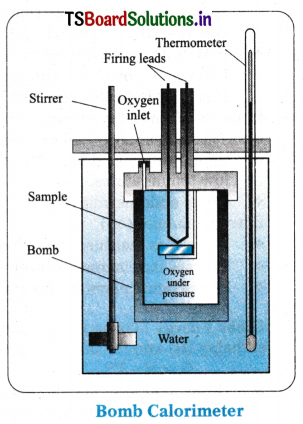
- A combustible substance is burnt in pure oxygen supplied in the steel bomb.
- The heat evolved during the reaction measured from the rise in the temperature.
- Since the bomb calorimeter is sealed, the energy changes taking place in it are considered as that taking place at constant volume.
- Temperature change of the calorimeter produced by the reaction is then converted to qv by using the known heat capacity of the calorimeter.
q = -C × \(\frac{\mathrm{M}}{\mathrm{W}}\) × ∆T
where ‘C’ is the heat capacity of calorimeter ; ∆T is the change in temperature
W is the mass of substance ; M is the molecular mass of substance taken.
Question 2.
Explain the experiment to determine the enthalpy change of a chemical reaction.
Solution:
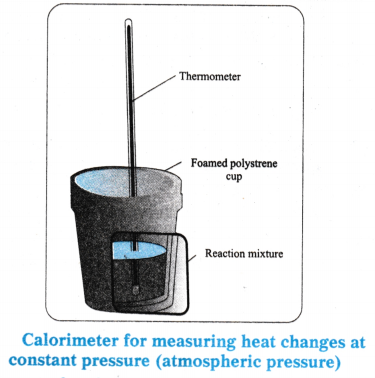
- The change of enthalpy ∆H of a reaction can be measured in a calorimeter as shown in the figure.
- However the calorimeter is kept open to the atmosphere.
- The calorimeter is immersed in an insulated water bath fitted with stirrer and thermometer.
- The temperature of the bath is recorded in the beginning and after the end of the reaction and change in temperature is recorded.
- Knowing the heat capacity of water bath and calorimeter and also the change in temperature, the heat absorbed or evolved in the reaction can be calculated.
- This gives the enthalpy change (∆H) of the reaction.
Question 3.
Explain the spontaneity of a reaction in terms of enthalpy change, entropy change and Gibb’s energy change.
Solution:
The spontaneity of a process occurs on it’s own without external influence.
It is determined by the change in Gibb’s free Energy (∆G).
This combines the Enthalpy change acted (∆H) and the Entropy Change (∆S) of the system at a given temperature (T).
G = H – TS ⇒ ∆G = ∆H – T∆S
If ∆G < O (negative) indicates a spontaneous process.
If ∆G > O (positive) indicates a non-spontaneous process.
If ∆G = 0 indicates equilibrium reaction.
In terms of Enthalpy change (∆H)
This is heat absorbed or released during a process.
Exothermic reactions (∆H < O) release heat and tends to be spontaneous, especially at low temperatures.
While endothermic process (∆H > O) absorb heat and are usually non-spontaneous.
Entropy change (∆S)
Entropy is measure of randomness of disorderness of a system.
Process that increase entropy (∆S > O) tend to be spontaneous.
Temperature plays an important role when enthalpy and entropy changes have opposing signs.
Gibbs Energy : Gibbs energy is a thermodynamic function. This is the difference in the
enthalpy (H) and the product of entropy (S) and absolute temperature (T) of the system.
G = H – TS
Gibbs energy is the amount of energy available from a system which can be put to useful work at constant temperature and pressure.
The change in Gibbs energy for the system ∆Gsystem at constant temperature is
∆ Gsystem = ∆Hsystem – T∆Hsystem
If ∆Gsystem is negative (< 0) the process is spontaneous.
If ∆Gsystem is positive (> 0) the process is non-spontaneous.
If ∆Gsystem is zero the system has attained equilibrium.
Thermodynamics Class 11 NCERT Solutions
Question 1.
Choose the correct answer. A thermodynamic state function is a quantity
a) used to determine the heat changes.
b) whose value is independent of path.
c) used to determine the pressure, volume, work.
d) whose value depends on temperature only.
Answer:
(b), A thermodynamic state function is a quantity whose value is independent of path.
Question 2.
For the process to occur under adiabatic conditions, the correct condition is
a) ∆T = 0
b) ∆p = 0
c) ∆q = 0
d) w = 0
Answer:
(c) ∆q = 0
Question 3.
The enthalpies of all elements in their standard states are
a) unity
b) zero
c) < 0
d) different for each element
Answer:
(b) zero
Question 4.
∆U° for combustion of methane is – X kJ mol-1. The value of ∆H° is
a) = ∆U°
b) > ∆U°
c) < ∆U°
d) = 0
Answer:
(c) < ∆U°
Question 5.
The enthalpy of combustion of methane, graphite and dihydrogen at 298 K are -890.3 kJ mol-1, – 393.5 kJ mol-1 and – 285.8 kJ mol-1 respectively. Enthalpy of formation of CH4(g) will be
a) – 74.8 kJ mol-1
b) – 52.27 kJ mol-1
c) +74.8 kJ mol-1
d) +52.26 kJ mol-1
Answer:
(a) – 74.8 kJ mol-1
Question 6.
A reaction A + B → C + D + q is found to have a positive entropy change. The reaction will be
a) possible at high temperature
b) possible only at low temperature
c) not possible at any temperature
d) possible at any temperature
Answer:
(d), possible at any temperature.
Question 7.
In a process, 701 J of heat is absorbed by a system and 394 J of work is done by the system. What is the change in internal energy of the process ?
Solution:
In the given case, q = 701 J, w = -394 J.
According to the first law of thermodynamics,
∆U = q + w = +701 + (-394) = +307 J.
Thus, internal energy increases by 307 J.
Question 8.
The reaction of cynamide. NH2CN(s), with dioxygen was carried out in a bomb calorimeter and ∆U was found to be -742.7 kJ mol-1 at 298 K. Calculate enthalpy change for the reaction at 298 K.
NH2CN(S) + \(\frac{3}{2}\)O2(g) → N2(g) + CO2(g) + H2O(l)
Solution:
For the given reaction, ∆ng = (1 +1) – (\(\frac{3}{2}\)) – 1 = +(\(\frac{1}{2}\)) mole ;
∆H = ∆U + ∆ngRT
We have, ∆H = 742.7 + (\(\frac{1}{2}\) × 8.314 × 10-3 × 298j (∵ R = 8.314 × 10⁻³ kJ mo-1 K-1)
=-741.5 kJ mol-1
Question 9.
Calculate the number of kJ of heat necessary to raise the temperature of 60.0 g of aluminium from 35°C to 55°C. Molar heat capacity of Al is 24 J mol-1 K-1.
Solution:
For n moles of a substance, q = n × C × ∆T.
In the present case, n = \(\frac{60.0}{27}\) = 2.22 moles.
Cm = 24 J mol-1 K-1 = 24 × 10-3 kJ mol-1 K-1 ; ∆T = (273 + 55) – (273 + 35) = 20 K
∴ q = 2.22 × 24 × 10-3 × 20 = 1.07 kJ
Question 10.
Calculate the enthalpy change on freezing of 1.0 mol of water at 10.0° C to ice at -10.0° C.
∆fusH = 6.03 kJ mol-1 at 0°C.
Cp [H2O(l)] = 75.3 J mol-1 K-1 ; Cp [H2O(s)] = 36.8 J mol-1 K-1
Solution:
∆H = Cp ∆T (at constant pressure)
i) ∆H involved in changing the temperature of 1 mole of liquid water from 10°C to 0°C
= Cp [H2O(l)] × ∆T = 75.3 × (0 – 10) = -753 J/mol – -0.753 kJ/mol
ii) ∆H involved in changing 1 mole of liquid water at 0°C to 1 mole of ice at 0°C
= -∆fusH = -6.03 kJ/mol
iii) ∆H involved in changing 1 mole of ice at 0°C (273 K) to 1 mole of ice at -10°C (263 K)
= Cp [H2O(s)] × ∆T = 36.8 × (-10 – 0) = -368 J/mol = -0.368 kJ/mol
∴ Total enthalpy change in the entire process
= – 0.753 + (-6.03) + (-0.368) = – 7.151 kJ mol-1
Question 11.
Enthalpy of combustion of carbon to CO2 is -393.5 kJ mol-1. Calculate the heat released upon formation of 35.2 g of CO2 from carbon and dioxygen gas.
Solution:
- The corresponding equation is C(s) + O2(g) → CO2(g); ∆H = -393.5 kJ/mol
1 mole = 44g - Heat released during the formation of 44 g of CO2 = -393.5 kJ
- Heat released upon, formation of 35.2 g of CO2 = \(\frac{393.5}{44}\) × 35.2 = -314.8 kJ/mol
∴ The value of ∆H involved in the formation of 35.2 g of CO2 = -314.8 kJ
Question 12.
Enthalpies of formation of CO(g), CO2(g), N2O(g) and N2O4(g) are -110, -393, 81 and 9.7 kJ mol-1 respectively. Find the value of ∆rH for the reaction,
N2O4(g) + 3CO(g) → N2O(g) + 3CO2(g)
Solution:
∆rH° = Σ∆fH° (products) – l∆fH° (reactants)
= {∆fH° [N2O(g)] + 3 × ∆fH° [CO2(g)]> – {∆fH° [N2O4(g)] + 3 × ∆fH°[CO(g)]}
= (81 + [3 × (-393)]} – (9.7 + 3 × (-110)} kJ/mol
= (-1098) – (-320.3) kJ/mol = -777.7 kJ/mol
Question 13.
Given N2(g) + 3H2(g) → 2NH3(g); ∆rH° = -92.4 kJ mol-1. What is the standard enthalpy of formation of NH3 gas ?
Solution:
Reaction corresponding to the formation of ammonia can be written as
\(\frac{1}{2}\)N2(g) + \(\frac{3}{2}\)H2(g) → NH3(g)
∴ ∆fH° [NH3(g)] = \(\frac{1}{2}\) ∆rH° = \(\frac{1}{2}\) × (-92.4) = -46.2 kJ mol-1.
Question 14.
Calculate the standard enthalpy of formation of CH3OH(l) from the following data.
CH3(OH)(l) + \(\frac{3}{2}\) O2(g) → CO2(g) + 2H2O(l); ∆rH° = -726 kJ mol-1
C(s) + O2(g) → CO2(g) ; ∆cH° = -393 kJ mol-1
H2(g) + 1/2 O2(g) → H2O(l); ∆fH° = -286 kJ mol-1
Solution:
In the given data,
∆cH°[CO2(g)] = ∆fH° [CO2(g)] = -393 kJ mol-1
∴ ∆rH° = Σ∆fH° (products) – Σ∆fH° (reactants)
⇒ ∆rH° = {∆fH° [CO2(g)] + 2 × ∆fH° [H2O(l)]> – {∆fH° [CH3OH(l) + 3/2 × ∆fH° [O2(g)]
⇒ -726 = {-393 + 2 × (-286)} – {∆fH° [CH3OH(l)] + 3/2 × 0}
⇒ -726 = (-965) – ∆fH° [CH3OH(l)]
⇒ ∆fH° [CH3OH(l)] = +726 – 965 = -239 kJ mol-1
Question 15.
Calculate enthalpy change for the process, CCl4(g) → C(g) + 4Cl(g) and calculate bond enthalpy of C — Cl in CCl4(g).
∆vapH°[CCl4] = 30.5 kJ mol-1 ; [CCl4] = -135.5 kJ mol-1 ;
∆aH° [C] = 715.0 kJ mol-1 ; ∆aH° [Cl2] = 242 k.J mol-1
where ∆aH° is enthalpy of atomisation.
Solution:
The given data can be expressed as follows.
CCl4(l) → CCl4(g) ; ∆vapH° = 30.5 kJ mol-1 ………. (i)
C(s) + 2C/2(g) → CCl4(l) ; ∆fH° = -135.5 kJ mol-1 ………. (ii)
C(s) → C(g); ∆aH° = 715.0 kJ mol-1 ………. (iii)
Cl2(g) → 2Cl(g) ; ∆aH° – 242 kJ mol-1 ………… (iv)
The required equation is CCl4(g) → C(g) + 4Cl(g)
The required equation can be obtained as follows.
Equation (iii) + 2 × Equation (iv) – Equation (i) – Equation (ii)
Thus, we have, ∆H = [715.0 + (2 × 242) – 30.5 – (-135.5)] kJ/mol-1
⇒ CCl4(g) → C(g) + 4C/(g) ; ∆H = 1304 kJ mol-1
Hence, the enthalpy change for the given process is 1304 kJ mol-1.
Bond enthalpy of C – Cl in CCl4(g) = \(\frac{1304}{4}\) = 326 kJ mol-1
Question 16.
For an isolated system, ∆U = 0, what will be ∆S ?
Answer:
For an isolated system, ∆U = 0 and for a process to be spontaneous, the value of ∆S must be positive.
Question 17.
For the reaction at 298 K, 2A + B → C ; ∆H = 400 kJ mol-1 and ∆S = 0.2 kJ/K/mol-1.
At what temperature, will the reaction become spontaneous considering ∆H and ∆S to be constant over the temperature range ?
Solution:
When ∆G = 0, the reaction will be at equilibrium.
The temperature at which the reaction is in equilibrium can be obtained as follows,
∵ ∆G = ∆H – T∆S
T = \(\frac{\Delta \mathrm{H}-\Delta \mathrm{G}}{\Delta \mathrm{~S}}=\frac{400-0}{0.2}\) = 2000 K
The reaction will be spontaneous when ∆G is negative. This is possible only at a temperature greater than 2000 K.
Question 18.
For the reaction, 2Cl(g) → Cl2(g), what are the signs of ∆H and ∆S ?
Answer:
- The given reaction involves the formation of Cl – Cl bond. The process will therefore involve a release of energy, i.e., ∆H will be negative.
- Further, the proces involves a decrease in the randomness because 2 moles of isolated atoms will have greater randomness than one mole of a molecule. Hence, entropy decreases, i.e., ∆S is negative.
- Thus, in the given process both ∆H and ∆S are negative.
Question 19.
For the reaction 2A(g) + B(g) → 2D(g); ∆U° = -10.5 kJ and ∆S° = -44.1 JK-1
Calculate ∆G° for the reaction, and predict whether the reaction may occur spontaneously.
Solution:
For the given reaction, ∆ng = 2-(2 + 1) = -1
∴ ∆H° = ∆U° + ∆ngRT
= -10.5 + (-1) × 8.314 × 10-3 kJ mol-1 K-1 × 298
= -12.98 kJ (∵R = 8.314 × 10⁻³ kJ mol-1 K-1 and all substances are in standard states, i.e., T = 298 K)
Hence, ∆G° = ∆H° – T∆S°
= -12.98 – [298 × (-44.1 × 10⁻³)] = 0.162 kJ
Since, ∆G° for the process is positive, the reaction will not occur spontaneously.
Question 20.
The equilibrium constant for a reaction is 10. What will be the value of ∆G° ?
R = 8.314 JK-1 mol-1, T = 300 K.
Solution:
∵ ∆G° = -2.303 RT log10 K
We have, ∆G° = -2.303 × 8.314 × 300 × log1010
= -2.303 × 8.314 × 300 × 1
= -5744.1 J/mol = -5.744 kJ/mol
Question 21.
Comment on the thermodynamic stability of NO2(g), given
\(\frac{1}{2}\)N2(g) + \(\frac{1}{2}\) O2(g) → NO(g) ; ∆rH° = 90 kJ mol-1
NO(g) + \(\frac{1}{2}\) O2(g) → NO2(g) ; ∆rH° = -74 kJ mol-1
Answer:
- In the formation of NO(g), heat is absorbed. Therefore, NO(g) has a higher heat energy than the reactants and therefore is unstable.
- On the other hand, formation of NO2(g) involves release of heat energy.
- Hence, NO2(g) has a lower heat energy and is stable.
- Thus, unstable NO(g) changes to stable NO2(g).
Question 22.
Calculate the entropy change in surroundings when 1.00 mol of H2O(l) is formed under standard conditions.
∆fH° = -286 kJ mol-1
Solution:
The standard enthalpy of formation of H2O(l), i.e., ∆fH° is -286 kJ mol-1. It implies that formation of H2O(l) is an exothermic process and 286 kJ mol-1 heat is evolved. This heat is absorbed by the surroundings. Thus, qsurr = +286 kJ mol-1
Hence, entropy change in surroundings is
∆Ssurr = \(\frac{\mathrm{q}_{\text {surr }}}{\mathrm{T}}=\frac{286}{298}\) = 0.9597 kJ K-1 mol-1 = 959.7 JK-1 mol-1