
Regular practice with AP Inter 1st Year Chemistry Study Material Chapter 4 Chemical Bonding and Molecular Structure Questions and Answers helps students stay prepared for examinations.
AP Inter 1st Year Chemistry 4th Lesson Chemical Bonding and Molecular Structure Questions and Answers
I. Multiple Choice Questions
Question 1.
The octet rule is valid for which of the following molecules?
1) SF6
2) PCl5
3) BeCl2
4) NH3
Answer:
4) NH3
NH3 obeys octet rule. Central atom ‘N’ Contains total eight electrons (four from bonding, four from lone pairs). In SF6, PCl5 exceeds the valance electrons 12, 10 respectively.
In BeCl2 ‘Be’ Contains only four electrons.
Question 2.
The valency shell of calcium contains
1) 2 electrons
2) 4 electrons
3) 6 electrons
4) 8 electrons
Answer:
1) 2 electrons
Calcium electronic Configuration – [Ar] 4s2. It contains only two electrons
Question 3.
Which of the following compound has an electrovalent bond?
1) CH4
2) MgCl2
3) SiCl4
4) BI3
Answer:
2) MgCl2
MgCl2 Contains ionic bond, Mg+2 + 2 Cl– → MgCl2
Remaining CH4, SiCl4, BI3 Contains covalent bonds.
Question 4.
Which of the following is ionic?
1) KI
2) CH4
3) Diamond
4) H2
Answer:
1) KI
KI is an ionic compound remaining are covalent.
Question 5.
The low solubility of BaSO4 in water can be attributed to
1) high lattice energy
2) dissociation energy
3) low lattice energy
4) Ionic bond
Answer:
1) high lattice energy
Due to high lattice energy BaSO4 is less soluble in water.

Question 6.
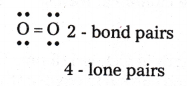
The number of bond pairs and number of lone pairs of electrons actually present in OO2 as per Valence Bond theory are
1) 2, 2
2) 2, 4
3) 2, 1
4) 2, 3
Answer:
2) 2, 4
Question 7.
A covalent bond is formed
1) By the transfer of electrons
2) By sharing of electrons
3) By donating electrons
4) All of these
Answer:
2) By sharing of electrons
Covalent bond is formed by sharing of electrons between atoms.
Question 8.
The shape of molecule of the type AX5 (where the central atom has no lone pairs) as per VSEPR theory is
1) Octahedral
2) Square pyramidal
3) Tetrahedral
4) Trigonal bipyramidal.
Answer:
4) Trigonal bipyramidal.
AX5 Type (no lone pairs on central atom).
According to VSEPR Theory AX5 type has trigonal bipyramidal shape.
Question 9.
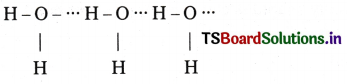
Water shows abnormal properties due to
1) Intramolecular hydrogen bonding
2) Covalent bonds
3) Intermolecular hydrogen bonding
4) Polarity
Answer:
3) Intermolecular hydrogen bonding
Water shows abnormal property due to inter molecular hydrogen bonding
Question 10.
A central atom in a molecule has two lone pairs of electrons and forms three single bonds. The shape of the molecule is
1) Trigonal pyramidal
2) Planar triangular
3) T-shaped
4) See-saw
Answer:
3) T-shaped
A central atom in a molecule has two lone pairs and three single bonds then the shape of molecule is T-shape.
Question 11.
What is the shape of AB4E type of molecule like SF4?
1) Distorted tetrahedron
2) A folded square
3) See-saw
4) All of these
Answer:
4) All of these
The shape of AB4E (E = lone pair) type of molecule like SF4 has See-Saw (or) Distorted tetrahedron (or) folded square.
Question 12.
Which of the following molecules has a triple bond?
1) CH4
2) C2H4
3) C2H2
4) CO2
Answer:
3) C2H2
C2H2 has triple bond. CH ☰ CH (Carbon sp-hybridised)
Question 13.
If the bond enthalpy of O2, N2 and H2 are 498 kJ/mol, 946 kJ/mol and 435.8 kJ/mol respectively. Choose the correct order of decreasing bond strength [ 2 ]
1) H2 > N2 > O2
2) N2 > O2 > H2
3) H2 > O2 > N2
4) N2 > H2 > O2
Answer:
2) N2 > O2 > H2
Bond Strengths order, N2 > O2 > H2
(946 kJ/mol) (498 kJ/mol) (435.8 kJ/mol)
Bond enthalpy increases, bond strength also increases.
Question 14.
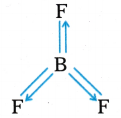
Which of the following has zero dipole moment?
1) HF
2) H2O
3) NH3
4) BF3
Answer:
4) BF3
BF3 has zero dipole moment (µ).
Bonds Vector moment sum = 0 ⇒ ∴ µ = 0.
Question 15.
Which of the following is correct?
1) PCl5 has 3 equatorial and 2 axial bonds.
2) In PCl5 bond angles are 120° and 90°.
3) Axial bonds are longer but weaker than equatorial bonds, which makes PC/5 more reactive.
4) All of the above.
Answer:
4) All of the above.
1, 2, 3 all statements are true regarding to PCl5 molecule.
II. Fill in the Blanks
Question 1.
A chemical bond in which the electron cloud is unevenly shared is known as _______.
Answer:
The bond in which electron cloud is unevenly shared is called polar covalent bond.
Question 2.
Hybridisation produces a set of orbitals.
Answer:
In hybridisation hybrid orbitals are formed.
Question 3.
Bond order in N2 molecule is .
Answer:
Bond order of N2 molecule is 3. N ☰ N
Question 4.
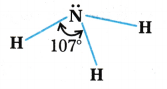
The shape of ammonia molecule is ________.
Answer:
The shape of ammonia molecule is Pyramidal.
Question 5.
The total number of sigma and pi bonds in C2H4 molecule is ______
Answer:
C2H4, CH2 = CH2 (or)
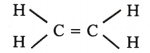
Total 5σ – bonds and one π – bond.
III. One Word Answer Questions
Question 1.
What is the carbon oxygen bond length in CO2 molecule ?
Answer:
In CO2 carbon-oxygen bond length is 116.3pm (approximately).
Question 2.
How many electrons are shared during the formation of a double bond?
Answer:
Four electrons are involved in the formation of a double bond.
Question 3.
Define formal charge.
Answer:
The formal charge of an atom in polyatomic molecule (or) ion may be defined as the difference between the no.of valence electrons of that atom in free state and the no.of electrons assigned to that atom in Lewis structure.
Question 4.
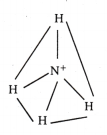
What is the shape of NH4+ ion?
Answer:
Shape of NH4+ ion is Tetrahedral.
Question 5.
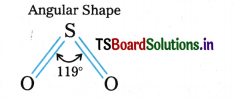
What is the bond angle in SO2 molecule?
Answer:
In SO2 bond angle is 119°.
IV. Very Short Answer Questions
Question 1.
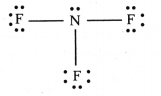
Draw the Lewis structure for the NF3 molecule.
Answer:
Lewis structure of NF3 molecule is
Question 2.
BF3 is trigonal planar, but NF3 is pyramidal. Why?
Answer:
In BF3 central atom, ‘B’ has no lone pair of electrons so it has trigonal planar.
But in NF3 central atom ‘N’ has one lone pair so it has shape NF3.
Question 3.
O2 is paramagnetic, while O22- is diamagnetic. Why?
Answer:
O2 is para magnetic because it has unpaired electrons (or) odd no. of electrons.
O2-2 is dia magnetic because it has no unpaired electrons.
Question 4.
N-F bond is more polar than N-H bond, but NH3 is more polar than NF3. Why?
Answer:
- N-F bond is more polar than N-H because fluorine is more electronegative than hydrogen.
- NH3 is more polar than NF3 because individual dipole moments of N-H bonds in NH3 add up to form large dipole moment (1.46D) while in dipoles of NF3 partially cancel each other out (μ = 0.24D).
Question 5.
Water is a liquid at room temperature, but hydrogen sulphide is a gas. Give reason.
Answer:
In water inter molecular hydrogen bond is present whereas in H2S it is absent so water is a liquid at room temperature but H2S is a gas.
Question 6.
Write the bond order and magnetic behaviour of H2.
Answer:
H2(1s1) σ1s2
Bond order = \(\frac{1}{2}\) [No. of bonding electrons – No.of antibonding electrons] = \(\frac{1}{2}\) [2 – 0] = 1.
H2 is a dia magnetic molecule because it has no unpaired electrons.
Question 7.
What is Hybridisation?
Answer:
The intermixing of atomic orbitals of an atom to form equal no.of new orbitals (hybrid orbitals) is called hybridisation.
Question 8.
State Octet rule.
Answer:
The tendency of atom to prefer to have eight valence electrons in the valence shell. This is called octet rule.
Question 9.
What is meant by bond order?
Answer:
The no.of bonds present between the two atoms in a molecule is called bond order.
Eg : Bond order of O2 is ‘2’ (O = O).
Question 10.
Give two examples of odd electron molecules.
Answer:
Nitric oxide (NO), Nitrogen dioxide (NO2) are examples of odd electron molecules.

V. Short Answer Questions
Question 1.
State Fajan’s rules and give suitable examples.
Answer:
Fajan’s rules are applied to predict the nature of bond in a molecule.
Fajan’s rules:
1) As the size of cation increases, the ionic nature of the bond increases.
Eg : The ionic nature among alkali metal ions follows the order :
Li+ < Na+ < K+ < Rb+ < Cs+.
2) Ionic bond is favoured with a small anion. Eg :Out of CaF2 and Cal<sub<2, CaF<sub<2 is more ionic, as the size of I– ion is smaller than that of I– ion. size : F– < I–.
3) Smaller charges on cation or anion or both the ions, favours the formation of ionic bond. Eg :NaCl is more ionic than AlCl3 as the charge on Na (Na+) is less than that on Al Al+3.
4) Cations with inert gas configuration form ionic bonds, while cations with pseudo inert gas configuration favour covalent bond formation.
Eg : NaCl is ionic, since Na+ (2, 8, 8) has inert gas configuration.
CuCl is more covalent, since Cu+ (2, 8, 18) has pseudo inert gas configuration.
Question 2.
Define dipole moment and give its applications.
Answer:
Dipole moment is the product of the magnitude of the charge and the distance between the centres of positive and negative charges. It is designated by m.
Dipole moment (μ) = Charge (Q) × distance (r) between the charges.
Units of dipole moment are Debye units (D).
Applications:
- Dipole moment is useful in calculating the percent ionic character of polar covalent bonds.
% ionic character = \(\frac{\mu_{\text {obs }}}{\mu_{\text {ionic }}}\) × 100 - Dipole moment is useful in predicting the shapes of molecules.
- In the case of AX2 type molecules if dipole moment is zero they have linear structure but if they have some dipole moment they are angular.
- AX3 type molecules with dipole moment zero are planar triangular in shape but if they have some dipole moment they have pyramidal shape.
- AX4 type molecules with dipole moment zero have symmetric tetrahedral structure but if they have some dipole moment they have distorted tetrahedral shape.
- In geometrical isomers trans isomers have zero dipole moment. While cis isomers have some dipole moment.
- It is useful to predict the polarity of molecule.
- Molecular with dipole moment is greater than zero are polar.
- Molecular with dipole moment is equal to zero are non polar.
Question 3.
Explain the structure of CH4 molecule.
Solution:
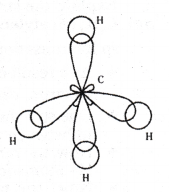
CH4 (Methane):
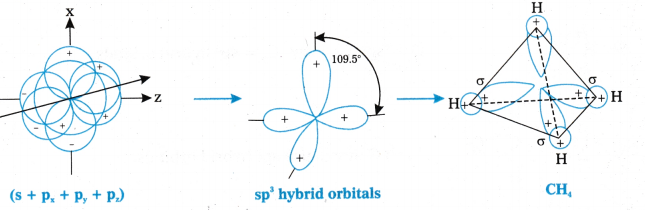
In the formation of methane molecule the central carbon atom undergoes sp3 hybridisation in its excited state 1s32s1 \(2 p_x^1 2 p_y^1 2 p_z^1\).
As a result of which four sp3 hybrid orbitals will form on it. All of them contain an electron, each. Now, these four hybrid orbitals overlap Head – Head with Is orbitals of four hydrogen atoms forming CH4 molecule.
The structure of the molecule is tetrahedral. The bond angle is 109°28′. Since there are no lone pairs, there is no distortion in the shape of the molecule.
Question 4.
What are a and n bonds? Specify the differences between them.
Solution:
Sigma (σ) Bond : A covalent bond formed by end-end overlap of orbitals is called sigma covalent bond.
Pi (π) Bond : A covalent bond formed by lateral overlap of orbitals is called pi covalent bond.
| Sigma (σ) bond | pi (π) bond | ||
| 1) | A σ bond is formed by the axial overlap of two half – filled orbitals belonging to the valence shells of the two combining atoms. | 1) | A π bond is formed by the lateral over-lap of orbitals. |
| 2) | The σ bonding electron cloud is symmetric about the internuclear axis. | 2) | The π bonding electron cloud lies above and below the plane of the internuclear axis. |
| 3) | It is a strong bond since the extent of overlap is much. | 3) | It is weaker than σ bond, since the extent of overlap is less. |
| 4) | It allows free rotation of atoms or groups about the bond. | 4) | π bond restricts such free rotation. |
| 5) | It can exist independently. | 5) | It is formed only after σ bond is formed. |
| 6) | It determines the shape of the molecule. | 6) | The shape of the molecule is independent of such bond. |
Question 5.
Explain the structure of Ethylene.
Solution:
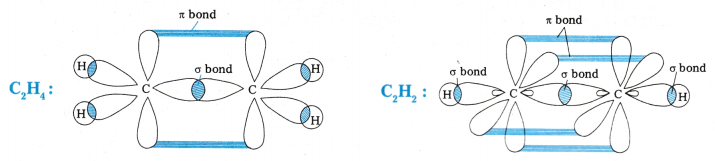
C2 H4 (Ethylene): In the formation of ethylene molecule, the two carbon atoms will undergo sp2 hybridisation in their excited states.
As a result of which sp2 hybrid orbitals will form on each of them.
All the six hybrid orbitals contain an electron, each. At first, one sp2 hybrid orbital of each carbon atom overlap Head-Head forming one sigma bond in between them. Now, the remaining four sp2 hybrid orbitals overlap Head-Head with’ 1 s’ orbitals of four ‘H’ atoms forming four sigma bonds.
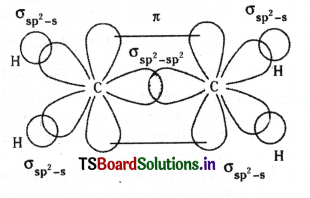
Now, the unhybridised pure 2pz orbitals of each carbon atom overlap side-wise forming π bond in between them.
Thus a double bond is formed in between the two carbon atoms.
In total there are five sigma bonds and one pi bond in ethylene molecule. The molecule as a whole is planar.
Question 6.
Explain the structure of Acetylene.
Solution:
C2H2 (Acetylene) : In the formation of acetylene molecule, the two carbon atoms undergo
sp hybridisation in their excited states (1s2 2s1 \(2 \mathrm{p}_{\mathrm{x}}^1 2 \mathrm{p}_{\mathrm{y}}^1 2 \mathrm{p}_{\mathrm{z}}^1\)).
- As a result of which two sp hybrid orbitals form on each of them. All of them contain an electron, each.
- One sp hybrid orbital of each carbon atom overlaps Head – Head forming a sigma bond in between them.
- Now, the remaining two ‘sp’ hybrid orbitals overlap Head – Head with ‘1s’ orbitals of two H – atoms forming two σ bonds.
- Now, the unhybridised, pure 2py and 2pz orbitals of each carbon atom overlap side – wise forming two π bonds in between them.
- Thus, a triple bond is formed between the two carbon atoms. In total there are three sigma bonds and two pi bonds in acetylene molecule.
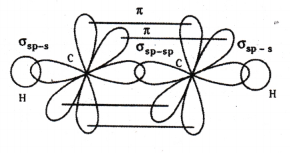
- The bond angle is 180°.
- The molecule is linear.
Question 7.
Explain the hybridisation involved in PCl5 molecule.
Solution:
In the formation of PCl5 molecule the central phosphorus atom undergoes sp3d hybridisation.
Eg: Formation of PCl5 molecule Atomic number of (P) = 15
Ground state electronic configuration = 1s22s22p63s23p3
Excited state configuration = 1s22s22p63s1 \(3 \mathrm{p}_{\mathrm{x}}^1 3 \mathrm{p}_{\mathrm{y}}^1 3 \mathrm{p}_{\mathrm{z}}^1\)3d1
- In the formation of PC/5 molecule the central ‘P’ atom undergoes sp3d hybridisation in its excited state. As a result of which five sp3d hybrid orbitals will form on it.
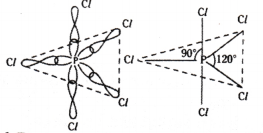
- All the five hybrid orbitals contain an electron, each.
- Now, the five sp3d hybrid orbitals overlap Head – Head with half-filled 3pz orbitals of five chlorine atoms forming five sigma bonds.
- The shape of the molecule is trigonal bipyramidal with bond angles 120° and 90°.
Question 8.
Explain the hybridisation involved in SF6 molecule.
Solution:
In the formation of SF6 molecule the central ‘S’ atom undergoes sp3d2 hybridization.
Eg : Formation of SF6 molecule :
Atomic number of Sulphur =16
Ground state configuration of ‘S’ = 1s22s22p63s23p4
Excited state I configuration = 1s22s22p63s2 \(3 \mathrm{p}_{\mathrm{x}}^1 3 \mathrm{p}_{\mathrm{y}}^1 3 \mathrm{p}_{\mathrm{z}}^1 3 \mathrm{~d}_{\mathrm{x}^2-\mathrm{y}^2}^1\) .
Excited state II configuration = 1s22s22p63s1 \(3 \mathrm{p}_{\mathrm{x}}^1 3 \mathrm{p}_{\mathrm{y}}^1 3 \mathrm{p}_{\mathrm{z}}^1 3 \mathrm{~d}_{\mathrm{x}^2-\mathrm{y}^2}^1 3 \mathrm{~d}_{\mathrm{z}^2}^1\)
- In the formation of SF6 molecule, the central ’S’ atom undergoes sp3d2 hybridization in its excited state II configuration.
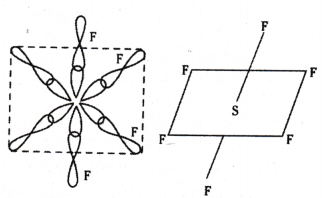
- As a result of which six hybrid orbitals form on it. All of them contain an electron, each.
- Now all these six hybrid orbitals overlap Head – Head with half-filled 2pz orbitals of six ‘F’ atoms forming six σ bonds.
- The shape of the molecule is octahedral with a bond angle of 90° and 180°.
Question 9.
What is hydrogen bond? Explain the different types of hydrogen bonds with examples.
Solution:
‘The electrostatic force of attraction between a partially charged hydrogen atom of a molecule
Explanation :
1) The molecule having H – bonds should have a highly electronegative atom like F, O or N directly linked to H – atom by a covalent bond.
2) H – bond is stronger than van der Waal’s forces but weaker than ionic and covalent bonds.
van der waal’s forces < H – bond
Energy : 2 – 10 kJ mol-1 2 – 40 kJ mol-1
< Covalent bond < Ionic bond
200 – 400 kJ mol-1
3) The strength of H – bond increases with the EN of the atom attached covalently to H atom.
Types of H – bonds : The are 2 types.
1) Intramolecular H – bonding and
2) Intermolecular H – bonding
1) Intramolecular H – bonding : The H – bonding formed between H atom of a molecule and a highly electronegative atom of the same molecule, is called intramolecular hydrogen bond.
Eg:
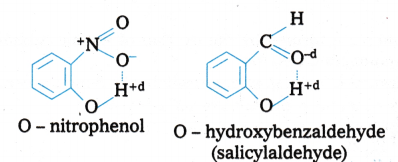
2) Intermolecular H – bonding : The H – bonding formed in between H – atom of one molecule and a highly electronegative atom of another molecule of same substance or different substances is called intermolecular hydrogen bond.
Eg:

Consequences of H – bonding :
- Highly viscous nature of H2SO4 , HNO3, H3PO4 etc, is due to H – bonding.
- The high b.p. of water is due to H – bonds in it.
- H2O is a liquid but H2S is a gas, since H — bond is present in H2O only.
Question 10.
Explain the formation of Ionic bond with suitable examples.
Solution:
“The electrostatic force of attraction between oppositely charged ions formed by the transfer of electrons” is called ionic bond.
Orbital concept of bonding : The method of formation of ionic bond in sodium chloride can be shown by the following orbital model.
Electronic configurations are :
Na (Z = 11) 1s22s22p63s1and Cl (Z = 17) 1s22s22p63s23p5

In the formation of sodium chloride, the 3s electron of Na atom is transferred to the half- filled 3p orbital of Cl atom. It gets paired up with it.
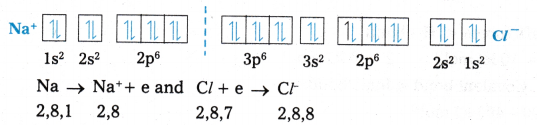
The Na+ and Cl– ions thus formed will have the inert gas configurations of neon and argon and get attracted by coulombic electrostatic forces of attraction, forming Na+Cl–, ionic compound.
Question 11.
Explain valence bond theory with suitable examples.
Solution:
Valence Bond Theory (VBT) :
- VBT was introduced by London and Heitler and further developed by Pauling.
- It explains how atoms form chemical bonds by overlapping atomic orbitals.
Postulates :
- Covalent bonds are formed by the overlap of atomic orbitals of two atoms each containing an unpaired electron.
- Greater the extent of overlap stronger will be the bond formed.
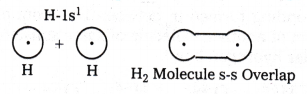
- Overlappings in ‘s’ and ’p’ orbitals are s-s, s-p, p-p.
- Decreasing order of overlapping of orbitals is p-p > s-p > s-s
Fraction of H2 Molecule (s-s overlap)
Question 12.
Explain the polar covalent bond with suitable example.
Solution:
- When a covalent bond is formed between two similar atoms, for example in H2, O2 Cl2, N2 or F2 the shared pair of electrons is equally attracted by the two atoms. So the shared electron pair is situated exactly between the two identical nuclei.
- The bond so formed is non-polar covalent bond.
- If a bond is formed between atoms of different elements to form heteronuclear molecule like HF the shared electron pair between the two atoms gets displaced more towards fluorine since the electronegativity of fluorine is more than that of hydrogen.
- As a result partial negative charge develops on fluorine atom while an equal amount of partial positive charge develops on hydrogen atom.
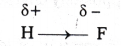
- The resultant covalent bond becomes polar covalent bond. The direction of the displacement of electron is represented with an arrow mark on the bond.
VI. Long Answer Questions
Question 1.
Draw the MOED of N2 molecule. Calculate the bond order and write its magnetic behaviour.
Solution:
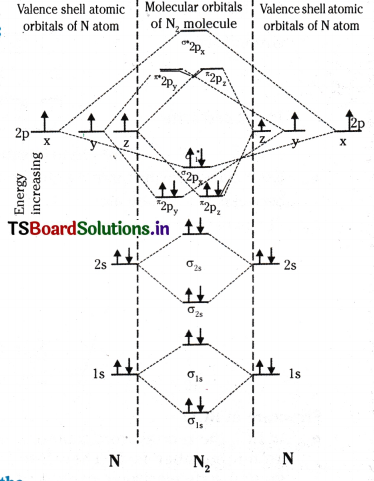
Molecular Orbital Energy diagram of N2:
Electronic configuration of molecular orbital of N2 :
σ1s2, σ*, 1s2, σ, 2s2, σ* 2s2, π2py2 = π2pz2, σ2px2
Calculation of bond order of Ncc:
Number of bonding electrons (Nb) = 10
Number of anti-bonding electrons (Na) = 4
Bond order = \(\frac{1}{2}\) (Nb – Na)
= \(\frac{1}{2}\)(10 – 4)
= \(\frac{1}{2}\)(6) = 3
Nitrogen is diamagnetic since all the electrons of N\(\frac{1}{2}\) molecule are paired.
Question 2.
Draw the MOED of O2 molecule. Calculate the bond order and write its mignetic behaviour.
Solution:
Molecular Orbital Energy diagram of O2 :
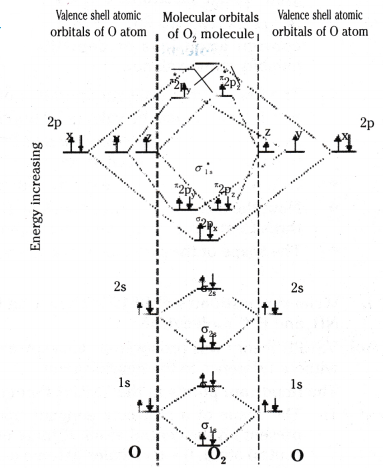
Electronic configuration of molecular orbital of O2 :
σ1s2, σ* 1s2, 2s2, σ* 2s2, σ2px2,
π2y2 = π2pz2 , π* 2py1 = π* 2pz1
Calculation of bond order of O2:
Number of bonding electrons (Nb) = 10
Number of anti-bonding electrons (Na) = 6
Bond order = \(\frac{1}{2}\) (Nb – Na)
= \(\frac{1}{2}\) (10 – 6) = \(\frac{1}{2}\)(4) = 2
Oxygen is paramagnetic as there are two unpaired electrons in two antibonding π* 2py and π* 2pz molecular orbitals. So oxygen is diamagnetic.
Question 3.
Explain the structure of Ethane and BCl3.
Solution:
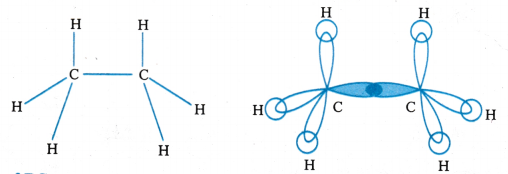
Structure of Ethane ((C2H6) :
In Ethane molecule each carbon undergoes sp3 hybridisation, in 1st excited state.
C – 1s22s22p2
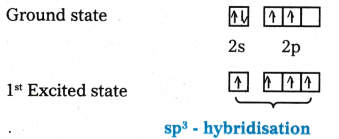
Each carbon forms three σ-bonds with three hydrogen atoms and σ-bond is formed between two carbon atoms.
Shape of the molecule is tetrahedral and bond angle is 109°. 18′.
Structure of BCl3:
In BCl3 the central atom is boron. Its atomic number is 5. Therefore its ground state electronic configuration is 1s22s2\(2 p_x^1 2 p_y^1 2 p_z^0\). From this configuration it is evident that it exhibits mono-valency.
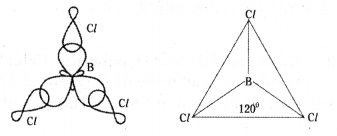
The first excited state configuration of B is 1s22s1 \(2 p_x^1 2 p_y^1 2 p_z^0\). Since, there are two half-filled orbitals, the valency of Boron is 3.
In order to explain the formation of BCl3 molecule sp2 hybridisation is to be assumed to boron atom in its excited state I.
As a result of which three sp2 hybrid orbitals will form on it.
Now, the three sp2 hybrid orbitals of ‘B’ atom overlap Head – Head with 3pz orbitals of three Cl atoms forming three sigma bonds.
The shape of the molecule is plane triangular and the bond angle is 120°.
Question 4.
Write the postulates of VSEPR Theory and how it is helpful in predicting the shapes of NH3 and H2O molecules?
Solution:
VSEPR theory was proposed by Gillespy and Nyholm. It predicts the shapes of molecules without reference to the hybridisation.
The important points in the VSEPR theory are :
- The shape of a molecule depends upon the number of electron pairs (bond pairs) present on the central atom. If there are only ‘bond pairs’ and no ‘lone pairs’ on the central atom, the molecules assume a regular geometrical shape.
- If there are ‘lone pairs’ also on the central atom, then the structure gets distorted and the bond angle changes.
- A ‘lone pair of electrons’ occupy more space around the central atom than a bond pair, because the ‘lone pair’ is attracted by only one nucleus, while the ‘bond pair’ is attracted by two nuclei.
- The electron pairs orient in space so as to have minimum repulsions among them, which determines the ‘bpnd angles’.
- The order of repulsion between various electron pairs is
1.p – 1.p > 1.p – b.p > b.p – b.p - The magnitude of repulsion between bond pairs of electrons depends on the electronegativity differences between the central atom and the other atoms.
- The order of repulsion between different bonds is :
Triple bond > Double bond > Single bond
Shapes of molecules based on VSEPR theory
| No. of electron pairs | Type of electron pairs | Type of molecule | Shape | Example |
| 2 | 2BP | AB2 | Linear | BeCl2 |
| 3 | 3BP | AB3 | Plane triangular | BCl3 |
| 3 | 2BP +1LP | AB2 | V – shaped | SO2 |
| 4 | 4BP | AB4 | Tetrahedral | CH4 |
| 4 | 3BP +1LP | AB3 | Pyramidal | NH3 |
Applications:
1. Structure of NH3 molecule :
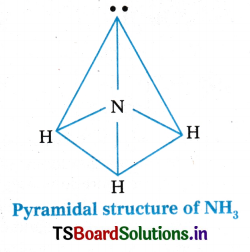
- In NH3 molecule, the central ‘N’ atom contains 3 borid pairs one lone pair. In total, there are four pair and of electrons.
- Hence, according to VSEPR theory, the expected structure of the molecule in tetrahedral with a bond angle of 109°28′. But, because of the presence of lone pair, the shape of the molecule gets distorted.
- Therefore, the real structure of the molecule is pyramidal with a bond angle of 107°.
2. Structure of H2O molecule :
- In H2O molecule, the central ‘O’ atom contains two bond pair and two lone pairs.
- In total, there are four pair of electrons. Hence, according to VSEPR theory, the expected structure of the molecule is tetrahedral with a bond angle of 109°28’.
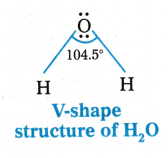
- But, because of the presence of lone pair, the shape of the molecule gets distorted.
- Therefore, the real structure of the molecule is V-shape with a bond angle of 104.5°.
Chemical Bonding and Molecular Structure Class 11 NCERT Solutions
Question 1.
Explain the formation of a chemical bond.
Answer:
- The chemical bond formation can be explained on the basis of electronic theory of valency.
- According to this theory, the cause of chemical combination among atoms is the tendency to attain the stable electronic configuration of the neighbouring inert gas by losing, gaining or sharing of electrons.
Question 2.
Write Lewis dot symbols for atoms of the following elements : Mg, Na, B, O, N, Br.
Answer:

Question 3.
Write Lewis symbols for the following atoms and ions : S and S2; Al and Al3+; H and H–
Answer:

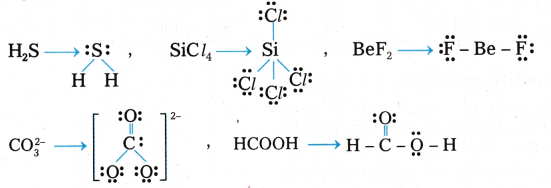
Question 4.
Draw the Lewis structures for the following molecules and ions. H2S, SiCl4, BeF2, CO32-, HCOOH
Answer:
Question 5.
Define octet rule. Write its significance and limitations.
Answer:
Octet rule states that atoms of various elements enter into chemical combination so as to attain the configuration of eight electrons in their outermost shell.
Significance : It helps in explaining why different atoms combine with each other to form ionic and covalent compounds.
Limitations Some limitations of the octet rule are given below.
a) Incomplete Octet of the central Atom
b) Odd Electron Molecules
c) Expanded Octet/Hypervalent Compounds
d) Noble Gas Elements
Question 6.
Write the favourable factors for the formation of ionic bond.
Answer:
The formation of ionic bond between two atoms is favoured by the following factors.
- Low ionization enthalpy of the metal atom.
- High electron affinity of the non-metal atom.
- High lattice energy of the compound formed.
- Low sublimation energy of metals.
Question 7.
Discuss the shape of the following molecules using the VSEPR model:
BeCl2, BCl3, SiCl4, AsF5, H2S, PH3
Answer:
i) BeCl2: The central atom Be having two valence electrons has only two bond pairs and no lone pair. It is of the type AB . Hence, shape is linear.
Cl – Be – Cl
ii) BCl3: The central atom B having 3 valence electrons has only 3 bond pairs and no lone pair. It is of the type AB3. Hence, shape is triangular planar.

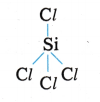
iii) SiCl4: Bond pairs = 4, lone pairs = 0.
It is of the type AB4.
Hence, shape is tetrahedral.
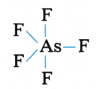
iv) AsF5 : Bond pairs = 5, lone pair = 0.
It is Of the type AB5.
Hence, shape is trigonal bipyramidal.
v) H2S : Bond pairs = 2, lone pairs = 2.
It is of the type AB2E2.
Hence, the shape Bent/V shaped.

vi) PH3: Bond pairs = 3, lone pair = 1.
It is of the type AB3E.
Hence, shape is trigonal pyramidal.

Question 8.
Although geometries of NH3 and H2O molecules are distorted tetrahedral, bond angle in water is less than that of ammonia. Discuss.
Answer:
- In NH3, there is only one lone pair on N-atom to repel the bond pairs, while in H2O, there are two lone pairs on O-atom to repel the bond pairs.
- Therefore, the repulsions on bond pairs are greater in H2O than in NH3 and hence the bond angle is less.
Question 9.
How do you express the bond strength in terms of bond order ?
Answer:
Bond order ∝ bond strength i.e., greater the bond order, greater is the bond strength.
Question 10.
Define the bond length.
Answer:
Bond length is defined as the equilibrium distance between the nuclei of two bonded atoms in a molecule.
Question 11.
Explain the important aspects of resonance with reference to the CO32- ion.
Answer:
- If only one lewis structure were considered, then there are two single bonds and one double bond between C and O but according to experimental findings, all carbon to oxygen bond in CO32- are found to be equivalent.
Thus, carbonate ion is best explained on the basis of the following resonating structures.

Here, all the resonating structures have similar energy and same no.of bonded and non- bonded pair of electrons with same positions of atom therefore, all the C — O bonds have same bond length.
Question 12.
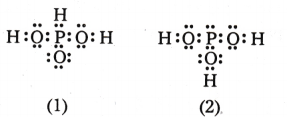
H3PO3 can be represented by structures 1 and 2 as shown below. Can these two structures by taken as the canonical forms of the resonance hybrid representing H3PO3 ? If not, give reasons for the same.
Answer:
No, these two structures cannot be taken as canonical forms because position of the H- atom have been changed in these structures.
Question 13.
Write the resonance structures for SO3, NO2 and NO3–
Answer:
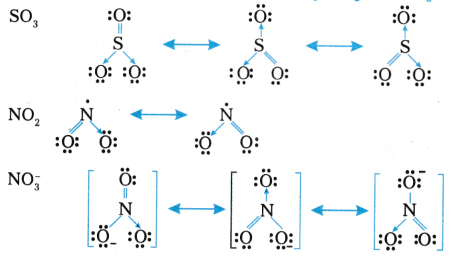
Question 14.
Use Lewis symbols to show electron transfer between the following atoms to form cations and anions : (i) K and S (ii) Ca and O (iii) Al and N.
Answer:
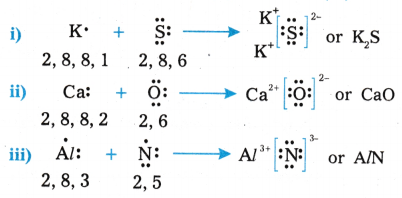
Question 15.
AlthoUgh both CO2 and H2O are triatomic molecules, the shape of H2O molecule is bent while that of CO2 is linear. Explain this on the basis of dipole moment.
Answer:
The dipole moment studies show that net dipole moment of CO2 molecule is zero. This is possible only if dipole moments of C — O are equal and opposite and cancel out each other.
On the other hand, H2O molecule is found to have a net dipole moment (1.84 D) which means the 2O — H bonds must be inclined to each other at a certain angle. This shows that it is a bent molecule.

Question 16.
Write the significance/applications of dipole moment.
Answer:
- Dipole moment measurements help us to distinguish between a polar and a non-polar molecule. Molecules having dipole moments are called polar molecules where as non-polar molecules have zero dipole moment.
- Dipole moment gives an idea about the ionic character of a bond in a molecule.
% Ionic character = \(\frac{\text { Observed dipole moment }}{\text { Calculated dipole momen }}\) × 100 - From the known values of dipole moment, shapes of molecules can be easily predicted. For example, the experimental dipole moment of CO2 is zero which suggests that CO2 molecule is linear.
- The greater the dipole moment, the greater is the polarity in the molecule.
Question 17.
Define electronegativity. How does it differ from electron gain enthalpy ?
Answer:
The ability of an atom to attract the shared pair of electrons towards itself is called electronegativity (χ) of the atom.
The difference between electron affinity and electronegativity is
| Electron Affinity | Electronegativity |
| 1. It is the tendency of an atom to attract outside electron. | It is the tendency of an atom to attract shared pair of electrons. |
| 2. It is the absolute electron attracting tendency of the atom. | It is the relative electron attracting tendency of the atom. |
| 3. It is the property of an isolated atom. | It is the property of the bonded atom. |
| 4. The elements with symmetrical configuration have almost zero electron affinities. | The elements with symmetrical configuration have specific electronegativity. |
| 5. Its units are kJ mol-1 and eV/atom. | It has no unit. |
Question 18.
Explain with the help of suitable example polar covalent bond.
Answer:
Polar covalent bond is formed between two unlike atoms which differ in their affinities for electrons.
Eg : 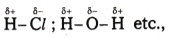
Question 19.
Arrange the bonds in order of increasing ionic character in the molecules : LiF, K2O, N2, SO2 and ClF3.
Answer:
Ionic character a lattice energy ∝ charge on the ion ∝ \(\frac{1}{\text { size of the ion }}\). Therefore the correct size of the ion order is N2 < SO2 < ClF3 < K2O < LiF
Question 20.
The skeletal structure of CH3COOH as shown below is correct, but some of the bonds are shown incorrectly. Write the correct Lewis structure for acetic acid.
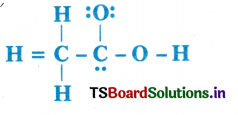
Answer:
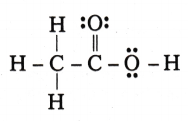
Question 21.
Apart from tetrahedral geometry, another possible geometry for CH4 is square planar with the four H atoms at the corners of the square and the C atom at its centre. Explain why CH4 is not square planar ?
Answer:
Electronic configuration of C – atom is 1s2 2s2 \(2 \mathrm{p}_{\mathrm{x}}^1 2 \mathrm{p}_{\mathrm{y}}^1\) in the ground state and 1s2 2s1\(2 \mathrm{p}_{\mathrm{x}}^1 2 \mathrm{p}_{\mathrm{y}}^1 2 \mathrm{p}_{\mathrm{z}}^1\) in the excited state. Hence, carbon is sp3 hybridised and has tetrahedral shape.
- For square planar the hybridisation required is dsp2 which is not possible for C-atom in CH4 because of absence of d-orbitals.
- Also according to VSEPR theory, if CH4 were square planar, the bond angle would be 90°.
- For tetrahedral structure, the bond angle is 109° 28′.
- Therefore, in the square planar structure, repulsions between the bond pairs would be more and thus, the stability will be less.
Question 22.
Explain why BeH2 molecule has a zero dipole moment although the Be-H bonds are polar.
Answer:
In BeH2 molecule, there are two Be-H bonds. Since Be and H differ in their electronegativities, so the Be-H should be a polar bond. This means that Be- H bond has a dipole moment.
The two dipole must be oriented in the opposite direction, at 180‘, so that their sum is zero. So, the BeH2 molecule is linear molecule.
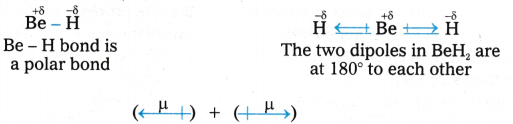
Net dipole = µ – µ = 0, the two dipoles cancel each other completely so the net dipoles of BeH2 is zero
Question 23.
Which out of NH3 and NF3 has higher dipole moment and why ?
Answer:
- NH3 has higher dipole moment than NF3 because F is more electronegative than N and therefore the direction of bond from N to F in dipoles NF3.
- On the other hand, N is more electronegative than H and thus the direction of bond dipoles from H to N in NH3.
- Therefore, In NF3 the resultant moment of the 3N – F bonds partially cancels the resultant moment of lone pair and In NH3, the resultant moment of N – H bonds adds up to the bond moment of lone pair of electrons.
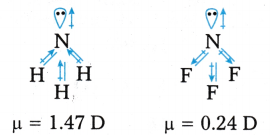
Question 24.
What is meant by hybridisation of atomic orbitals ? Describe the shapes of sp, sp2, sp3 hybrid orbitals. ,
Answer:
Hybridisation is the process of intermixing of the orbitals of slightly different energies so as to redistribute their energies, to generate a new set of orbitals of equivalent energies and shape.
sp Hybrid orbitals : In this type of hybridisation, one s and one p-orbital is hybridized (or intermix) to produce two equivalent hybrid orbitals, known as sp hybrid orbitals.
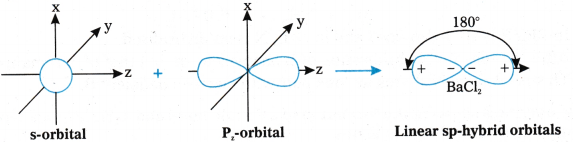
sp2 Hybrid orbitals: In this type of hybridisation, one s and two p (px and py) orbitals of one atom is hybridized to give three equivalent sp2 hybrid orbitals.
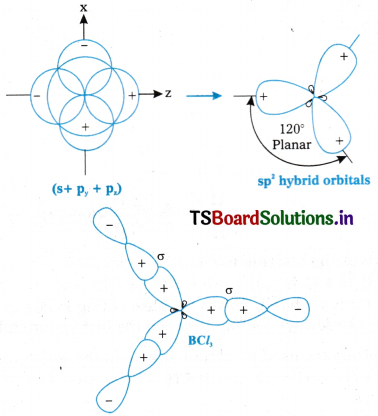
sp3 Hybrid orbitals : In this hybridisation, one s and three p-orbitals intermix to form four sp3 hybrid orbitals of equivalent energy and identical shape.
Question 25.
Describe the change in hybridisation (if any) of the Al atom in the following reaction.
AlCl3 + Cl– → AlCl4–
Answer:
E.C. of 13Al = 1s2 2s2 2p6 3s2 3px1 (Ground state) or = 1s2 2s2 2p6 3s1 3px1 3py1 (Excited state). In case of AlCl3, Al undergoes sp2 hybridisation to give trigonal planar structure. For the formation of AlCl4–, the empty 3pz orbitals is also involved, so that hybridisation is sp3 and the shape is tetrahedral.
Question 26.
Is there any change in the hybridisation of B and N atoms as a result of the following reaction?
BF3 + NH3 → F3B.NH3
Answer:
- In BF3, B is sp2 hybridised and in NH3, N is sp3 hybridised.
- After the reaction, hybridisation of B changes to sp3 but that of N remains unchanged.
- This is because N shares its lone pair with electron deficient B.
Question 27.
Draw diagrams showing the formation of a double bond and a triple bond between carbon atoms in C2H4 and C2H2 molecules.
Answer:
Question 28.
What is the total number of sigma and pi bonds in the following molecules ?
i) C2H2
ii) C2H4
Answer:

Question 29.
Considering x-axis as the internuclear axis, which of the following will not form a sigma bond and why ?
(i) 1s and 1s
(ii) 1s and 2px;
(iii) 2py and 2py;
(iv) 1s and 2s.
Answer:
Only (iii) will not form a a bond. This is because taking x-axis as the intermolecular axis, there will be lateral (sideway) overlap between the two 2pyorbitals forming a π bond.
Question 30.
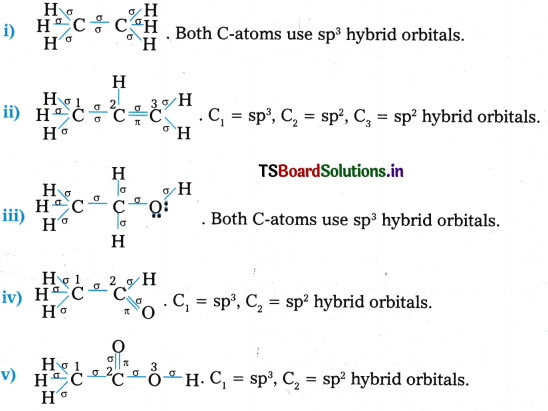
Which hybrid orbitals are used by carbon atoms in the following molecules ?
i) CH3 – CH3;
(ii) CH3 – CH = CH2;
(iii) CH3 – CH3 – OH ;
(iv) CH3 – CHO;
(v) CH3COOH
Answer:
Question 31.
What do you understand by bond pairs and lone pairs of electrons ? Illustrate by giving one example of each type.
Answer:
- Covalent bonds are formed by mutual sharing of electrons between the two atoms.
- The shared pairs of electrons present between the bonded atoms are called bond pairs of electrons.
- The electron pairs present on the atoms which do not take part in bonding are called lone pairs of electrons.
- For example, in
 , there are only 4 bond pairs but in NH3
 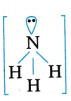 three bond pairs and one lone pair of electrons.
Question 32.
Distinguish between a sigma and a pi bond.
Answer:
| Sigma (σ) bond | Pi (π) bond |
| 1. A σ bond is formed by axial overlap of atomic orbitals. | A π bond is formed by the lateral (sidewise) overlap of p-orbitals. |
| 2. The σ bond can be formed by the overlap of s – s, s – p and p – p orbitals. | The π bond is formed by the overlap of p-orbitals only. |
| 3. In σ bond the bonded orbital consists of a single electron cloud symmetrical about intemuclear axis. | In π bond, the bonded orbital consists of two electron cloud, one above and the other below the plane of participating atoms. |
| 4. The σ bond is stronger because overlapping can take place to the maximum extent along the axes. | The π bond is weak because the lateral (sidewise) overlapping of orbitals is not very effective. |
| 5. In σ bond the ct electrons are localized. | In π bond, the n electrons are delocalized and, therefore, referred to as mobile electrons. |
| 6. There can be a free rotation of atoms around the bond. | Free rotation of atoms in π bond is not possible because it involves breaking of bond. |
| 7. σ Bonds are less reactive. | ‘π’ bonds are very reactive. |
| 8. The bond distance between two atoms bonded by a σ bond is longer than that involving n bond. | The π bond leads to shortening of bond distance between the bonded atoms. |
| 9. σ Bond can have independent existence. | π Bond always exists along with a o bond. |
| 10. The shape of the molecule is determined by the σ bond present in the molecule. | The π bond does not affect the shape of the molecule. However, a π bond may modify the dimensions of the molecule. |
| 11. There can never be more than one σ bond between two atoms. | There can be more than one (eg., O2) or two (e.g.,N2) π bonds between two atoms. |
Question 33.
Explain the formation of H2 molecule on the basis of valence bond theory.
Answer:
Hydrogen molecule consists of two hydrogen atoms.
Hydrogen atom contains one proton in the nucleus and an electron revolving around the
nucleus.
When the two hydrogen atoms are separated by a large distance, there is a virtually no interaction between them, the potential energy of the system (the two H atoms) is taken as zero.
At larger separation, the two hydrogen atoms maintian their identity and no hydrogen molecule is formed.
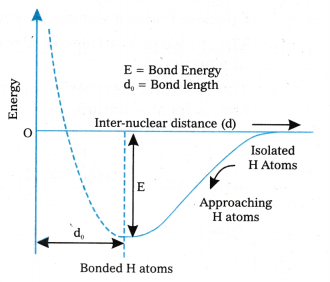
- However, the situation entirely changes when the two hydrogen atoms approach closer to each other the attraction of the nuclei for the electrons increases and the repulsion between the nuclei and also between the electrons increases.
- So as long as the attraction prevails over repulsion, the potential energy of the system decreases.
- The decrease in potential energy continues till a certain minimum value is attained. If the two hydrogen atoms are brought still closer, the potential energy shows a sharp rise.
- This is due to the fact, that the repulsion between the two nuclei at such a small inter- nuclear distance becomes dominant.
- The formation of a covalent bond between two hydrogen atoms takes place at the point which corresponds to the minimum is the potential energy curve.
- The decrease in potential energy must be accompanied by a release of energy i.e., as the H molecule is formed from two hydrogen atoms, heat is given off.
Question 34.
Write the important conditions required for the linear combination of atomic orbitals to form molecular orbitals.
Answer:
Conditions for the combination of Atomic Orbitals :
i) The combining atomic orbitals must possess the same or nearly the same energy.
ii) The combining atomic orbitals must possess the same symmetry about the molecular axis with same energy. If the orbitals possess same energy but their symmetry is not same then they will not combine.
iii) The combining atomic orbitals must overlap to the maximum extent. Greater the extent of overlap, the more will be the electron-density between the nuclei of a molecular orbital.
Types of Molecular orbitals :
In case of diatomic molecules, the molecular orbitals are designated as σ (sigma), π (pi), δ (delta) etc.-Bonding molecular orbitals are designated as (σ, π, δ) etc. and anti-bonding molecular orbitals are represented as (σ*, π*, δ*) etc.
i) A sigma molecular orbital is formed by the additive or subtractive combination of s – s, s – p and pz – pz atomic orbital. They have cylindrical symmetry around the inter- nuclear axis.
ii) A pi-molecular orbital is formed by the lateral or side-wise overlap of p-orbitals.
Question 35.
Use molecular orbital theory to explain why Be2 molecule does not exist.
Answer:
Electronic configuration of 4Be is 1s2 2s2.
Be2(8e–) = σ1s2, σ* 1s2, σ2s2, σ*2s2
∴ Bond over = \(\frac{1}{2}\)(4 – 4) = 0. Thus, Be2 order does not exist.
Question 36.
Compare the relative stability of the following species and indicate their magnetic properties; O2, O2+, O2– (superoxide), O22- (peroxide)
Answer:
O2(16e+) = σ1s2, σ* 1s2, σ 2s2, σ* 2s2, σ 2pz2, π 2px2 ≈ π2py2, π* 2px1 ≈ π* 2py1
B.O = \(\frac{1}{2}\) (10 – 6) = 2; Paramagnetic
O2+ (15e–) = σ1s2, σ* 1s2, σ 2s2, σ* 2s2, σ 2pz2, π 2px2 ≈ π2py2, π* 2px1 ≈ π* 2py0
B.O = \(\frac{1}{2}\) (10 – 5) = 2.5; Paramagnetic
O2– (17e–) = σ1s2, σ* 1s2, σ 2s2, σ* 2s2, σ 2pz2, π 2px2 ≈ π2py2, π* 2px2 ≈ π* 2py1
B.O = \(\frac{1}{2}\) (10 – 7) = 1.5; Paramagnetic
O22-(18e–) = σ1s2, σ* 1s2, σ 2s2, σ* 2s2, σ 2pz2, π 2px2 ≈ π2py2, π* 2px2 ≈ π* 2py2
B.O = \(\frac{1}{2}\) (10 – 8) = 1; Paramagnetic
Since, the bond order ∝ bond stability. Therefore, the relative stabilities of the given species is in the order : O2+ > O2 > O2– > O22-.
Question 37.
Write the significance of a plus and a minus sign shown in representing the orbitals.
Answer:
- As orbitals are represented by wave functions, a plus sign in an orbital represents a
- +ve wave function and a minus sign represents a -ve wave function.
- When the wave functions with similar sign combines, it gives bonding molecular orbitals whereas that having opposite sign gives antibonding molecular orbitals.
Question 38.
Describe the hybridisation in case of PCl5. Why are the axial bonds longer as compared to equatorial bonds ?
Answer:
PCl3: The ground state and excited state of outer electronic configuration of Phosphorus (Z = 15) is given below.
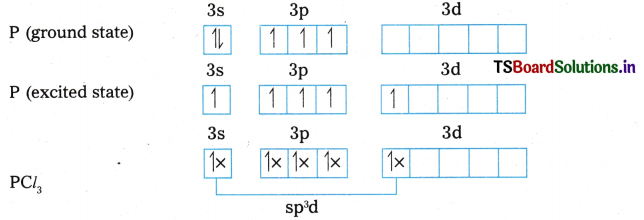
Therefore hybridisation is sp3d and shape is trigonal bipyramidal. In PCl5 molecule, axial bonds are longer as compared to the equatorial bonds because axial bond pairs suffers greater repulsion from equatorial bond pairs.
Question 39.
Define hydrogen bond. Is it weaker or stronger than the van der Waals forces ?
Answer:
The bond formed between the hydrogen atom of one molecule with the electronegative atom (F, O, or N) of another molecule is known as hydrogen bond.
Types of Hydrogen bond : There are two types of hydrogen bonds.
i) Intermolecular Hydrogen Bond: It exists between two different molecules of the same or different compounds.
Ex : hydrogen bond formed between the molecules of HE
ii) Intramolecular Hydrogen Bond: It exists when hydrogen atom and the highly electro-negative (F, O, or N) is present in the same molecule.
Ex:
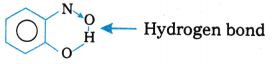
Yes, Hydrogen bond is stronger than van der Wall’s forces.
Question 40.
What is meant by the term bond order? Calculate the bond order of: N2, O2, O2+ and O2–.
Answer:
Bond order is defined as the number of covalent bonds present between the two atoms in a molecule
i) N2(14) → σ1s2, σ* 1s2, σ 2s2, σ* 2s2, π 2px2 ≈ π2py2, σ* 2pz1
B.O. = \(\frac{1}{2}\)(10 – 4) = 3
ii) O2(16) → σ1s2, σ* 1s2, σ 2s2, σ* 2s2, σ 2pz2, π 2px2 ≈ π2py2, π* 2px1 ≈ π* 2py0
B.O. = \(\frac{1}{2}\)(10 – 6) = 2
iii) O2+ (15) → σ1s2, σ* 1s2, σ 2s2, σ* 2s2, σ 2pz2, π 2px2 ≈ π 2py2, π* 2px1 ≈ π* 2py0
B.O. = \(\frac{1}{2}\)(10 – 5) = 2.5
iv) O2– (17) → σ1s2, σ* 1s2, σ 2s2, σ* 2s2, σ 2pz2, π 2px2 ≈ π 2py2, π* 2px2 ≈ π* 2py1
B.O. = \(\frac{1}{2}\)(10 – 7) = 1.5